1 . 1
E8 STORAGE
Come join us at careers@e8storage.com
https://goo.gl/FOuczd
2 . 1
HIGH PERFORMANCE STORAGE
DEVICES IN KERNEL
E8 Storage
By /Evgeny Budilovsky @budevg
12 Jan 2016
3 . 1
STORAGE STACK 101
3 . 2
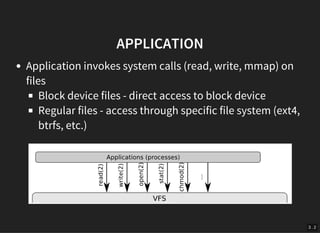
APPLICATION
Application invokes system calls (read, write, mmap) on
files
Block device files - direct access to block device
Regular files - access through specific file system (ext4,
btrfs, etc.)
3 . 3
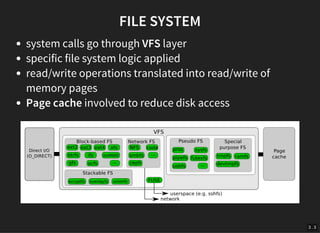
FILE SYSTEM
system calls go through VFS layer
specific file system logic applied
read/write operations translated into read/write of
memory pages
Page cache involved to reduce disk access
3 . 4
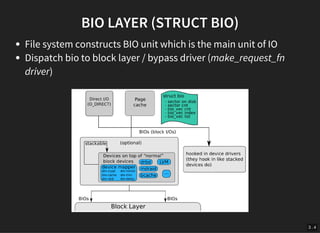
BIO LAYER (STRUCT BIO)
File system constructs BIO unit which is the main unit of IO
Dispatch bio to block layer / bypass driver (make_request_fn
driver)
3 . 5
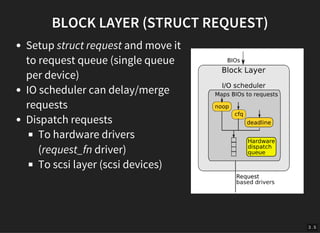
BLOCK LAYER (STRUCT REQUEST)
Setup struct request and move it
to request queue (single queue
per device)
IO scheduler can delay/merge
requests
Dispatch requests
To hardware drivers
(request_fn driver)
To scsi layer (scsi devices)
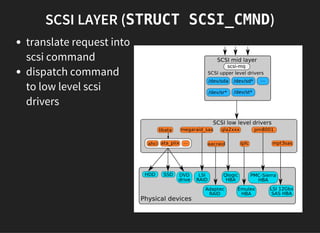
SCSI LAYER (STRUCT SCSI_CMND)
translate request into
scsi command
dispatch command
to low level scsi
drivers
3 . 6
WRITE (O_DIRECT)
# Application 
perf record ­g dd if=/dev/zero of=1.bin bs=4k  
     count=1000000 oflag=direct 
... 
perf report ­­call­graph ­­stdio 
# Submit into block queue (bypass page cache) 
write 
  system_call_fastpath 
    sys_write 
      vfs_write 
        new_sync_write 
          ext4_file_write_iter 
            __generic_file_write_iter 
              generic_file_direct_write 
                ext4_direct_IO 
                  ext4_ind_direct_IO 
                    __blockdev_direct_IO 
                      do_blockdev_direct_IO 
                        submit_bio 
                          generic_make_request 
3 . 7
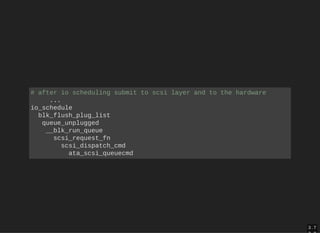
# after io scheduling submit to scsi layer and to the hardware 
     ... 
io_schedule 
  blk_flush_plug_list 
   queue_unplugged 
    __blk_run_queue 
      scsi_request_fn 
        scsi_dispatch_cmd 
          ata_scsi_queuecmd 
3 . 8
3 . 9
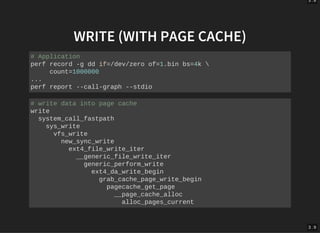
WRITE (WITH PAGE CACHE)
# Application 
perf record ­g dd if=/dev/zero of=1.bin bs=4k  
     count=1000000 
... 
perf report ­­call­graph ­­stdio 
# write data into page cache 
write 
  system_call_fastpath 
    sys_write 
      vfs_write 
        new_sync_write 
          ext4_file_write_iter 
            __generic_file_write_iter 
              generic_perform_write 
                ext4_da_write_begin 
                  grab_cache_page_write_begin 
                    pagecache_get_page 
                      __page_cache_alloc 
                        alloc_pages_current 
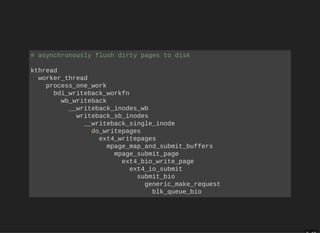
# asynchronously flush dirty pages to disk 
kthread 
  worker_thread 
    process_one_work 
      bdi_writeback_workfn 
        wb_writeback 
          __writeback_inodes_wb 
            writeback_sb_inodes 
              __writeback_single_inode 
                do_writepages 
                  ext4_writepages 
                    mpage_map_and_submit_buffers 
                      mpage_submit_page 
                        ext4_bio_write_page 
                          ext4_io_submit 
                            submit_bio 
                              generic_make_request 
                                blk_queue_bio 
3 . 10
4 . 1
HIGH PERFORMANCE BLOCK
DEVICES
4 . 2
CHANGES IN STORAGE WORLD
Rotational devices (HDD)
"hundreds" of IOPS , "tens" of
milliseconds latency
Today, flash based devices (SSD)
"hundreds of thousands" of IOPS,
"tens" of microseconds latency
Large internal data parallelism
Increase in cores and NUMA
architecture
New standardized storage
interfaces (NVME)
4 . 3
NVM EXPRESS
4 . 4
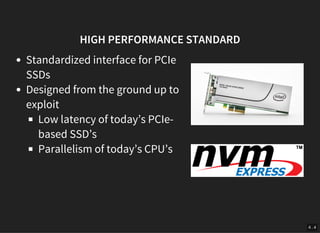
HIGH PERFORMANCE STANDARD
Standardized interface for PCIe
SSDs
Designed from the ground up to
exploit
Low latency of today’s PCIe-
based SSD’s
Parallelism of today’s CPU’s
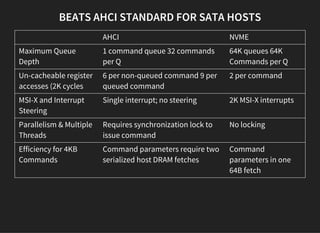
BEATS AHCI STANDARD FOR SATA HOSTS
  AHCI NVME
Maximum Queue
Depth
1 command queue 32 commands
per Q
64K queues 64K
Commands per Q
Un-cacheable register
accesses (2K cycles
6 per non-queued command 9 per
queued command
2 per command
MSI-X and Interrupt
Steering
Single interrupt; no steering 2K MSI-X interrupts
Parallelism & Multiple
Threads
Requires synchronization lock to
issue command
No locking
Efficiency for 4KB
Commands
Command parameters require two
serialized host DRAM fetches
Command
parameters in one
64B fetch
4 . 54 . 6
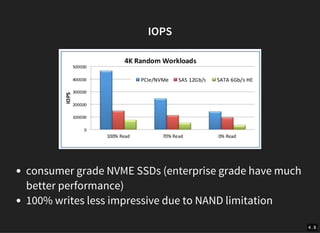
IOPS
consumer grade NVME SSDs (enterprise grade have much
better performance)
100% writes less impressive due to NAND limitation
4 . 7
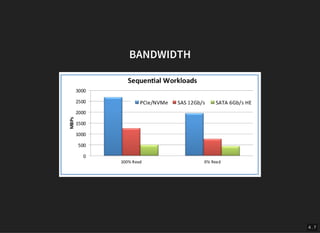
BANDWIDTH
4 . 8
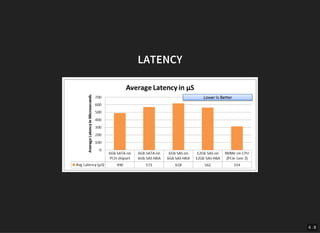
LATENCY
5 . 1
THE OLD STACK DOES NOT SCALE
5 . 2
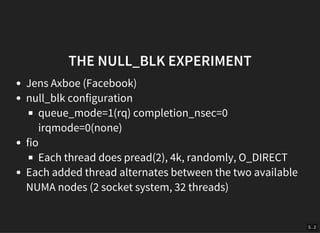
THE NULL_BLK EXPERIMENT
Jens Axboe (Facebook)
null_blk configuration
queue_mode=1(rq) completion_nsec=0
irqmode=0(none)
fio
Each thread does pread(2), 4k, randomly, O_DIRECT
Each added thread alternates between the two available
NUMA nodes (2 socket system, 32 threads)
5 . 3
LIMITED PERFORMANCE
5 . 4
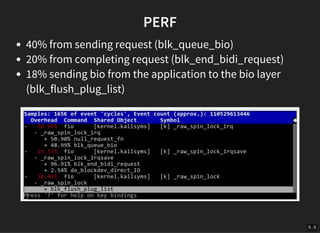
PERF
Spinlock
contention
5 . 5
PERF
40% from sending request (blk_queue_bio)
20% from completing request (blk_end_bidi_request)
18% sending bio from the application to the bio layer
(blk_flush_plug_list)
5 . 6
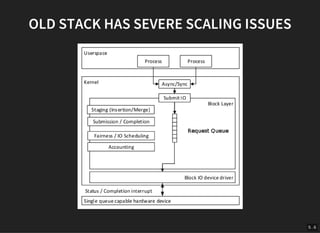
OLD STACK HAS SEVERE SCALING ISSUES
5 . 7
PROBLEMS
Good scalability before block layer (file system, page
cache, bio)
Single shared queue is a problem
We can use bypass mode driver which will work with bio's
without getting into shared queue.
Problem with bypass driver: code duplication
6 . 1
BLOCK MULTI-QUEUE TO THE
RESCUE
6 . 2
HISTORY
Prototyped in 2011
Paper in SYSTOR 2013
Merged into linux 3.13 (2014)
A replacement for old block layer with different driver API
Drivers gradually converted to blk-mq (scsi-mq, nvme-
core, virtio_blk)
6 . 3
ARCHITECTURE - 2 LAYERS OF QUEUES
Application works with per-
CPU software queue
Multiple software queues
map into hardware queues
Number of HW queues is
based on number of HW
contexts supported by
device
Requests from HW queue
submitted by low level
driver to the device
ARCHITECTURE - ALLOCATION AND TAGGING
IO tag
Is an integer value that uniquely identifies IO submitted
to hardware
On completion we can use the tag to find out which IO
was completed
Legacy drivers maintained their own implementation
of tagging
With block-mq, requests allocated at initialization time
(based on queue depth)
Tag and request allocations combined
Avoids per request allocations in driver and tag
maintenance
6 . 46 . 5
ARCHITECTURE - I/O COMPLETIONS
Generally we want completions to be as local as possible
Use IPIs to complete requests on submitting node
Old block layer was using software interrupts instead of
IPIs
Best case there is an SQ/CQ pair for each core, with MSI-X
interrupt setup for each CQ, steered to the relevant core
IPIs used when there aren't enough interrupts/HW queues
6 . 6
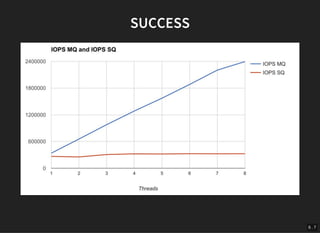
NULL_BLK EXPERIMENT AGAIN
null_blk configuration
queue_mode=2(multiqueue) completion_nsec=0
irqmode=0(none) submit_queues=32
fio
Each thread does pread(2), 4k, randomly, O_DIRECT
Each added thread alternates between the two available
NUMA nodes (2 socket system, 32 threads)
6 . 7
SUCCESS
6 . 8
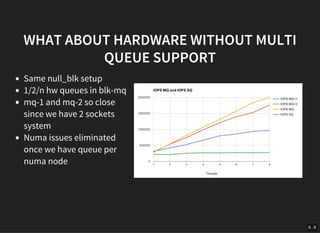
WHAT ABOUT HARDWARE WITHOUT MULTI
QUEUE SUPPORT
Same null_blk setup
1/2/n hw queues in blk-mq
mq-1 and mq-2 so close
since we have 2 sockets
system
Numa issues eliminated
once we have queue per
numa node
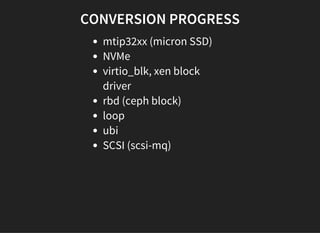
CONVERSION PROGRESS
mtip32xx (micron SSD)
NVMe
virtio_blk, xen block
driver
rbd (ceph block)
loop
ubi
SCSI (scsi-mq)
6 . 97 . 1
SUMMARY
Storage device performance has accelerated from
hundreds of IOPS to hundreds thousands of IOPS
Bottlenecks in software gradually eliminated by
exploiting concurrency and introducing lock-less
architecture
blk-mq is one example
Questions ?
8 . 1
REFERENCES
1.
2.
3.
4.
5.
6.
7.
Linux Block IO: Introducing Multi-queue SSD Access on
Multi-core Systems
The Performance Impact of NVMe and NVMe over Fabrics
Null block device driver
blk-mq: new multi-queue block IO queueing mechanism
fio
perf
Solving the Linux storage scalability bottlenecks - by Jens
Axboe

High Performance Storage Devices in the Linux Kernel