1
Bill Lawrence, Ph.D. Commercial Cyber Security Services, Lockheed Martin
(C) Lockheed Martin Corporation 2014© Lockheed Martin Corporation. All Rights Reserved.
This document [or software] shall not be reproduced, modified, distributed or displayed without
the prior written consent of the Lockheed Martin Corporation
Closing the Gap between Physical, Process Control, and
Cybersecurity for the Energy and Utilities Industry
22
Intelligence-driven Defense
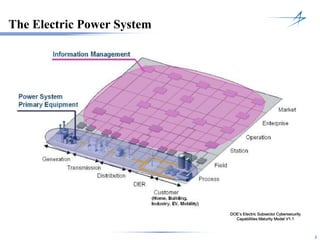
The Electric Power System
DOE’s Electric Subsector Cybersecurity
Capabilities Maturity Model V1.1
3
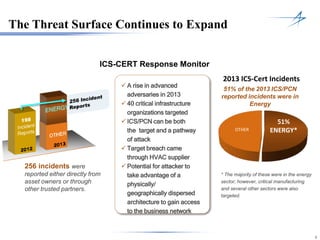
The Threat Surface Continues to Expand
256 incidents were
reported either directly from
asset owners or through
other trusted partners.
2013 ICS-Cert Incidents
51%
ENERGY*OTHER
ICS-CERT Response Monitor
51% of the 2013 ICS/PCN
reported incidents were in
Energy
* The majority of these were in the energy
sector; however, critical manufacturing
and several other sectors were also
targeted.
 A rise in advanced
adversaries in 2013
 40 critical infrastructure
organizations targeted
 ICS/PCN can be both
the target and a pathway
of attack
 Target breach came
through HVAC supplier
 Potential for attacker to
take advantage of a
physically/
geographically dispersed
architecture to gain access
to the business network
44(C) Lockheed Martin Corporation 2014
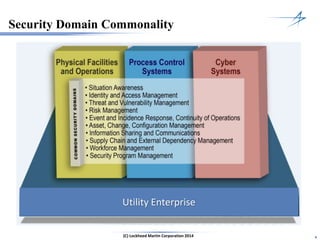
Security Domain Commonality
Utility Enterprise
55(C) Lockheed Martin Corporation 2014
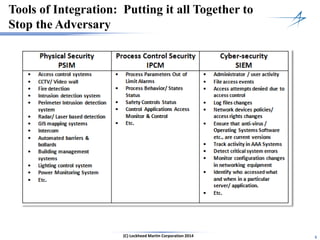
Tools of Integration: Putting it all Together to
Stop the Adversary
66(C) Lockheed Martin Corporation 2014
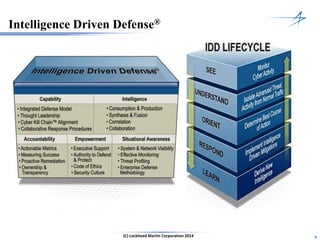
Intelligence Driven Defense®
77(C) Lockheed Martin Corporation 2014
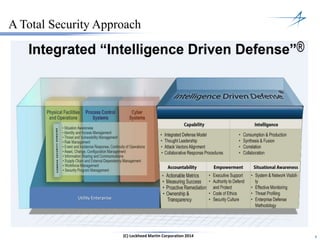
A Total Security Approach
Utility Enterprise
88(C) Lockheed Martin Corporation 2014
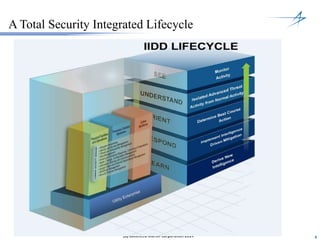
A Total Security Integrated Lifecycle
9
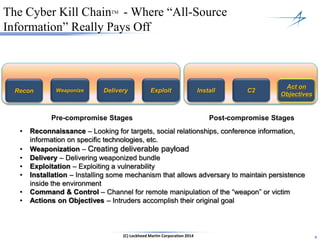
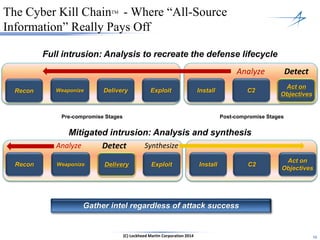
The Cyber Kill ChainTM - Where “All-Source
Information” Really Pays Off
Recon Weaponize Delivery Exploit Install
Act on
Objectives
C2
Pre-compromise Stages Post-compromise Stages
(C) Lockheed Martin Corporation 2014
• Reconnaissance – Looking for targets, social relationships, conference information,
information on specific technologies, etc.
• Weaponization – Creating deliverable payload
• Delivery – Delivering weaponized bundle
• Exploitation – Exploiting a vulnerability
• Installation – Installing some mechanism that allows adversary to maintain persistence
inside the environment
• Command & Control – Channel for remote manipulation of the “weapon” or victim
• Actions on Objectives – Intruders accomplish their original goal
10
The Cyber Kill ChainTM - Where “All-Source
Information” Really Pays Off
Mitigated intrusion: Analysis and synthesis
Recon Weaponize Delivery Exploit Install
Act on
Objectives
C2
Recon Weaponize ExploitDelivery Install
Act on
Objectives
C2
Detect
Detect
Analyze
Analyze Synthesize
Full intrusion: Analysis to recreate the defense lifecycle
Pre-compromise Stages Post-compromise Stages
Gather intel regardless of attack success
(C) Lockheed Martin Corporation 2014
1111(C) Lockheed Martin Corporation 2014
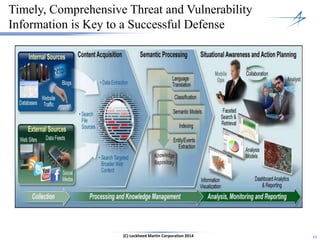
Timely, Comprehensive Threat and Vulnerability
Information is Key to a Successful Defense
12
Moving from Today to Tomorrow Towards a
Fully Integrated Total Security Architecture
A Total Security Architecture of the future, such as I-IDD, would
tightly integrate all the Security processes and information
• Requires systems architecture evolution for full multi-layer
interoperability across all the Physical, Process, and Cyber-Security
processes and information
– Timely Threat and Vulnerability Data Source Integration and Analysis
– Event Detection Filtering and Analysis
– Advanced Threat Detection
– Cross Domain Correlation
– Guided Forensics
– Workflow Enhancement
• Many pieces exist today in the different security functional areas
• But the full vision is a daunting task for today’s legacy systems
13
A Total Security solution is possible now as a
stepwise, manageable manor
• Use a top-down system-of-systems integration and design
approach
• Review all security processes in light of an Integrated Total
Security approach
• Prioritize integrated functions against threat impact severity and
probability
• Concentrate on the most critical functions that need to be
integrated first.
– Situation Awareness: PSIMs, SIEMs, Process Monitoring Systems,
– Threat and Vulnerability Collection and Analysis
– Consolidate into centralized Total Security Operations Centers
• Then begin the migration to more automated security information
correlation tools for your Total Security professionals
An Approach to Closing the Gaps between Physical, Process Control, and Cybersecurity for the Energy and Utilities Industry

An Approach to Closing the Gaps between Physical, Process Control, and Cybersecurity for the Energy and Utilities Industry

  • 1.
    1 Bill Lawrence, Ph.D.Commercial Cyber Security Services, Lockheed Martin (C) Lockheed Martin Corporation 2014© Lockheed Martin Corporation. All Rights Reserved. This document [or software] shall not be reproduced, modified, distributed or displayed without the prior written consent of the Lockheed Martin Corporation Closing the Gap between Physical, Process Control, and Cybersecurity for the Energy and Utilities Industry
  • 2.
    22 Intelligence-driven Defense The ElectricPower System DOE’s Electric Subsector Cybersecurity Capabilities Maturity Model V1.1
  • 3.
    3 The Threat SurfaceContinues to Expand 256 incidents were reported either directly from asset owners or through other trusted partners. 2013 ICS-Cert Incidents 51% ENERGY*OTHER ICS-CERT Response Monitor 51% of the 2013 ICS/PCN reported incidents were in Energy * The majority of these were in the energy sector; however, critical manufacturing and several other sectors were also targeted.  A rise in advanced adversaries in 2013  40 critical infrastructure organizations targeted  ICS/PCN can be both the target and a pathway of attack  Target breach came through HVAC supplier  Potential for attacker to take advantage of a physically/ geographically dispersed architecture to gain access to the business network
  • 4.
    44(C) Lockheed MartinCorporation 2014 Security Domain Commonality Utility Enterprise
  • 5.
    55(C) Lockheed MartinCorporation 2014 Tools of Integration: Putting it all Together to Stop the Adversary
  • 6.
    66(C) Lockheed MartinCorporation 2014 Intelligence Driven Defense®
  • 7.
    77(C) Lockheed MartinCorporation 2014 A Total Security Approach Utility Enterprise
  • 8.
    88(C) Lockheed MartinCorporation 2014 A Total Security Integrated Lifecycle
  • 9.
    9 The Cyber KillChainTM - Where “All-Source Information” Really Pays Off Recon Weaponize Delivery Exploit Install Act on Objectives C2 Pre-compromise Stages Post-compromise Stages (C) Lockheed Martin Corporation 2014 • Reconnaissance – Looking for targets, social relationships, conference information, information on specific technologies, etc. • Weaponization – Creating deliverable payload • Delivery – Delivering weaponized bundle • Exploitation – Exploiting a vulnerability • Installation – Installing some mechanism that allows adversary to maintain persistence inside the environment • Command & Control – Channel for remote manipulation of the “weapon” or victim • Actions on Objectives – Intruders accomplish their original goal
  • 10.
    10 The Cyber KillChainTM - Where “All-Source Information” Really Pays Off Mitigated intrusion: Analysis and synthesis Recon Weaponize Delivery Exploit Install Act on Objectives C2 Recon Weaponize ExploitDelivery Install Act on Objectives C2 Detect Detect Analyze Analyze Synthesize Full intrusion: Analysis to recreate the defense lifecycle Pre-compromise Stages Post-compromise Stages Gather intel regardless of attack success (C) Lockheed Martin Corporation 2014
  • 11.
    1111(C) Lockheed MartinCorporation 2014 Timely, Comprehensive Threat and Vulnerability Information is Key to a Successful Defense
  • 12.
    12 Moving from Todayto Tomorrow Towards a Fully Integrated Total Security Architecture A Total Security Architecture of the future, such as I-IDD, would tightly integrate all the Security processes and information • Requires systems architecture evolution for full multi-layer interoperability across all the Physical, Process, and Cyber-Security processes and information – Timely Threat and Vulnerability Data Source Integration and Analysis – Event Detection Filtering and Analysis – Advanced Threat Detection – Cross Domain Correlation – Guided Forensics – Workflow Enhancement • Many pieces exist today in the different security functional areas • But the full vision is a daunting task for today’s legacy systems
  • 13.
    13 A Total Securitysolution is possible now as a stepwise, manageable manor • Use a top-down system-of-systems integration and design approach • Review all security processes in light of an Integrated Total Security approach • Prioritize integrated functions against threat impact severity and probability • Concentrate on the most critical functions that need to be integrated first. – Situation Awareness: PSIMs, SIEMs, Process Monitoring Systems, – Threat and Vulnerability Collection and Analysis – Consolidate into centralized Total Security Operations Centers • Then begin the migration to more automated security information correlation tools for your Total Security professionals