
Industry Reliability and Security
Standards Working Together
Where the standards are going and where your program
should be heading
21 August 2014
Page 2
About your presenters
Josh Axelrod
► Ernst & Young LLP
Cybersecurity, Power &
Utility lead
► Former NERC CIP auditor
► Former Navy nuclear
engineer
► Certifications: CISSP,
CISA, CISM, GICSP,
CRISC, CGEIT
Matt Davis
► Ernst & Young LLP
Cybersecurity, Power &
Utility team
► Former NERC CIP auditor
► Former ISP/telecom
engineer
► Certifications: CISSP,
CISA, CISM, GICSP,
CRISC, CIPP/IT
Page 3
Overview
► Version Control
► Taking Control
► Framework Alignment
► Reliability Assurance Initiative
► Take a Risk
► Predictions
21 August 2014 Industry Reliability and Security Standards Working Together
Page 4
Version (out of) Control
Page 5
Which version?
► CIP standards are rapidly evolving and fragmenting.
► Current list of draft RSAWs:
► CIP-002-5.1
► CIP-003-6
► CIP-004-6
► CIP-005-5
► CIP-006-6
► CIP-007-6
► CIP-008-5
► CIP-009-6
► CIP-010-2
► CIP-011-2
21 August 2014 Industry Reliability and Security Standards Working Together
Page 6
Not much to see here, keep moving …
► Overview of V6 changes
► Removal of Identify, Assess, Correct (IAC)
► “Cabling” is back with mitigating controls … again
► Physical ports control for PCA
► Transient devices – prior to use
► CIP-014-1
► Third-party assessments
► Who is qualified? Who is willing?
21 August 2014 Industry Reliability and Security Standards Working Together
Page 7
Take Controls
Page 8
Let It Go
► Moving away from regulatory requirements
► Right-size for your organization based on risk and budget
► Create your own story
► Leverage other frameworks
► Review all controls for need
► Similar to ISO 27000 approach
21 August 2014 Industry Reliability and Security Standards Working Together
Page 9
Keys to Control Success
► Development
► Program – design
► Controls – effectiveness
► Maintain – change control
► Mapping
► Get granular
► Risk management process
► Drive selection
21 August 2014 Industry Reliability and Security Standards Working Together
Page 10
Framework Alignment
Page 11
Why NIST?
► 800-53 is comprehensive and free
► What NERC CIP was supposed to use and will continue
to evolve toward
► Strong guidance
► Guidance from other 800 series
► Alignment to federal (EO 13636)
► Alignment to 800-82 (ICS)
► Detonation chambers
21 August 2014 Industry Reliability and Security Standards Working Together
Page 12
Other Options
► ISO 27001 – international and corporate
► Not free
► BITS – third-party assessments
► Not free
► PCI – encryption, virtualization
► Free
21 August 2014 Industry Reliability and Security Standards Working Together
Page 13
Reliability Assurance Initiative
Page 14
Reliability Assurance Initiative (RAI)
► Risk Assessment
► Region will develop a transparent but customized compliance profile
based on the Registered Entity’s impact to the grid.
► Assessment will be shared with the Entity so that it understands how
it will be monitored as part of the compliance profile.
► Internal Controls Reliance
► Entity’s internal control practices will be provided and reviewed by
the Region.
► Region will evaluate the level of the entities internal control program
to tailor compliance activities in conjunction with the assessment.
21 August 2014 Industry Reliability and Security Standards Working Together
Page 15
A New Hope
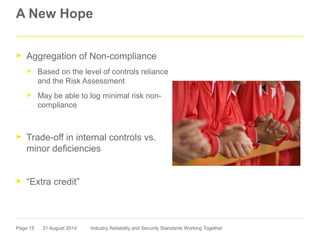
► Aggregation of Non-compliance
► Based on the level of controls reliance
and the Risk Assessment
► May be able to log minimal risk non-
compliance
► Trade-off in internal controls vs.
minor deficiencies
► “Extra credit”
21 August 2014 Industry Reliability and Security Standards Working Together
Page 16
Internal Compliance Program
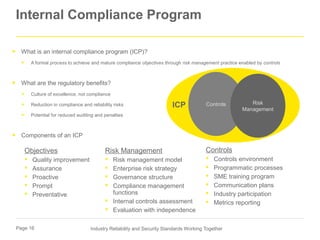
► What is an internal compliance program (ICP)?
► A formal process to achieve and mature compliance objectives through risk management practice enabled by controls
► What are the regulatory benefits?
► Culture of excellence, not compliance
► Reduction in compliance and reliability risks
► Potential for reduced auditing and penalties
► Components of an ICP
Objectives
 Quality improvement
 Assurance
 Proactive
 Prompt
 Preventative
Risk Management
 Risk management model
 Enterprise risk strategy
 Governance structure
 Compliance management
functions
 Internal controls assessment
 Evaluation with independence
Controls
 Controls environment
 Programmatic processes
 SME training program
 Communication plans
 Industry participation
 Metrics reporting
Controls Risk
Management
ICP
Industry Reliability and Security Standards Working Together
Page 17
Take a Risk
Page 18
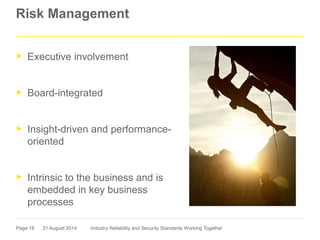
Risk Management
► Executive involvement
► Board-integrated
► Insight-driven and performance-
oriented
► Intrinsic to the business and is
embedded in key business
processes
21 August 2014 Industry Reliability and Security Standards Working Together
Page 19
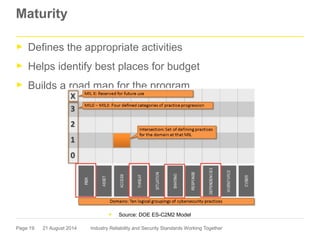
Maturity
► Defines the appropriate activities
► Helps identify best places for budget
► Builds a road map for the program
► Source: DOE ES-C2M2 Model
21 August 2014 Industry Reliability and Security Standards Working Together
Page 20
Summary
Page 21
V7 Predictions
► Third-party compliance
► Threat management
► Baselines for monitoring
► HIPS or white-listing
► Application security
► Honeypots … just kidding
21 August 2014 Industry Reliability and Security Standards Working Together
Page 22
Summary
► Manage security through risk
► Keep maturing to keep ahead
► Monitor trends to anticipate change
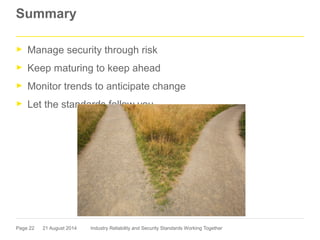
► Let the standards follow you
21 August 2014 Industry Reliability and Security Standards Working Together
Page 23
Q&A
► Thank you!
joshua.axelrod@ey.com
matt.davis@ey.com

Industry Reliability and Security Standards Working Together

  • 1.
    Industry Reliability andSecurity Standards Working Together Where the standards are going and where your program should be heading 21 August 2014
  • 2.
    Page 2 About yourpresenters Josh Axelrod ► Ernst & Young LLP Cybersecurity, Power & Utility lead ► Former NERC CIP auditor ► Former Navy nuclear engineer ► Certifications: CISSP, CISA, CISM, GICSP, CRISC, CGEIT Matt Davis ► Ernst & Young LLP Cybersecurity, Power & Utility team ► Former NERC CIP auditor ► Former ISP/telecom engineer ► Certifications: CISSP, CISA, CISM, GICSP, CRISC, CIPP/IT
  • 3.
    Page 3 Overview ► VersionControl ► Taking Control ► Framework Alignment ► Reliability Assurance Initiative ► Take a Risk ► Predictions 21 August 2014 Industry Reliability and Security Standards Working Together
  • 4.
  • 5.
    Page 5 Which version? ►CIP standards are rapidly evolving and fragmenting. ► Current list of draft RSAWs: ► CIP-002-5.1 ► CIP-003-6 ► CIP-004-6 ► CIP-005-5 ► CIP-006-6 ► CIP-007-6 ► CIP-008-5 ► CIP-009-6 ► CIP-010-2 ► CIP-011-2 21 August 2014 Industry Reliability and Security Standards Working Together
  • 6.
    Page 6 Not muchto see here, keep moving … ► Overview of V6 changes ► Removal of Identify, Assess, Correct (IAC) ► “Cabling” is back with mitigating controls … again ► Physical ports control for PCA ► Transient devices – prior to use ► CIP-014-1 ► Third-party assessments ► Who is qualified? Who is willing? 21 August 2014 Industry Reliability and Security Standards Working Together
  • 7.
  • 8.
    Page 8 Let ItGo ► Moving away from regulatory requirements ► Right-size for your organization based on risk and budget ► Create your own story ► Leverage other frameworks ► Review all controls for need ► Similar to ISO 27000 approach 21 August 2014 Industry Reliability and Security Standards Working Together
  • 9.
    Page 9 Keys toControl Success ► Development ► Program – design ► Controls – effectiveness ► Maintain – change control ► Mapping ► Get granular ► Risk management process ► Drive selection 21 August 2014 Industry Reliability and Security Standards Working Together
  • 10.
  • 11.
    Page 11 Why NIST? ►800-53 is comprehensive and free ► What NERC CIP was supposed to use and will continue to evolve toward ► Strong guidance ► Guidance from other 800 series ► Alignment to federal (EO 13636) ► Alignment to 800-82 (ICS) ► Detonation chambers 21 August 2014 Industry Reliability and Security Standards Working Together
  • 12.
    Page 12 Other Options ►ISO 27001 – international and corporate ► Not free ► BITS – third-party assessments ► Not free ► PCI – encryption, virtualization ► Free 21 August 2014 Industry Reliability and Security Standards Working Together
  • 13.
  • 14.
    Page 14 Reliability AssuranceInitiative (RAI) ► Risk Assessment ► Region will develop a transparent but customized compliance profile based on the Registered Entity’s impact to the grid. ► Assessment will be shared with the Entity so that it understands how it will be monitored as part of the compliance profile. ► Internal Controls Reliance ► Entity’s internal control practices will be provided and reviewed by the Region. ► Region will evaluate the level of the entities internal control program to tailor compliance activities in conjunction with the assessment. 21 August 2014 Industry Reliability and Security Standards Working Together
  • 15.
    Page 15 A NewHope ► Aggregation of Non-compliance ► Based on the level of controls reliance and the Risk Assessment ► May be able to log minimal risk non- compliance ► Trade-off in internal controls vs. minor deficiencies ► “Extra credit” 21 August 2014 Industry Reliability and Security Standards Working Together
  • 16.
    Page 16 Internal ComplianceProgram ► What is an internal compliance program (ICP)? ► A formal process to achieve and mature compliance objectives through risk management practice enabled by controls ► What are the regulatory benefits? ► Culture of excellence, not compliance ► Reduction in compliance and reliability risks ► Potential for reduced auditing and penalties ► Components of an ICP Objectives  Quality improvement  Assurance  Proactive  Prompt  Preventative Risk Management  Risk management model  Enterprise risk strategy  Governance structure  Compliance management functions  Internal controls assessment  Evaluation with independence Controls  Controls environment  Programmatic processes  SME training program  Communication plans  Industry participation  Metrics reporting Controls Risk Management ICP Industry Reliability and Security Standards Working Together
  • 17.
  • 18.
    Page 18 Risk Management ►Executive involvement ► Board-integrated ► Insight-driven and performance- oriented ► Intrinsic to the business and is embedded in key business processes 21 August 2014 Industry Reliability and Security Standards Working Together
  • 19.
    Page 19 Maturity ► Definesthe appropriate activities ► Helps identify best places for budget ► Builds a road map for the program ► Source: DOE ES-C2M2 Model 21 August 2014 Industry Reliability and Security Standards Working Together
  • 20.
  • 21.
    Page 21 V7 Predictions ►Third-party compliance ► Threat management ► Baselines for monitoring ► HIPS or white-listing ► Application security ► Honeypots … just kidding 21 August 2014 Industry Reliability and Security Standards Working Together
  • 22.
    Page 22 Summary ► Managesecurity through risk ► Keep maturing to keep ahead ► Monitor trends to anticipate change ► Let the standards follow you 21 August 2014 Industry Reliability and Security Standards Working Together
  • 23.
    Page 23 Q&A ► Thankyou! joshua.axelrod@ey.com matt.davis@ey.com

Editor's Notes

  • #6 Time to left go of versions <number>
  • #17 <number>