Existing Building Commissioning
LEED CANADA FOR EXISTING BUILDINGS: OPERATIONS AND MAINTENANCE
Credit 2.1 – 2 Points
Credit 2.2 – 2 Points
Credit 2.3 – 2 Points
(Energy and Atmosphere)
Presentation by: Michael Clarke
Credit 2.1: Investigation and Analysis
Credit 2.2: Implementation
Credit 2.3: Ongoing Commissioning
Existing Building Commissioning
Credit 2.1
Credit 2.2
Credit 2.3
Existing Building Commissioning
Credit 2.1: Investigation and Analysis
Credit 2.2: Implementation
Credit 2.3: Ongoing Commissioning
Credit 2.1
EX.B.Commissioning: Investigation and Analysis
Credit Prerequisites:
• EA Prerequisite 1: Energy Efficiency Best Management Practices – Planning,
Documentation and Opportunity Assessment
• EA Prerequisite 2: Minimum Energy Efficiency Performance
Related Credits:
• EA Credit 1: Optimize Energy Efficiency Performance
• EA Credit 2.2: Existing Building Commissioning - Implementation
• EA Credit 2.3: Existing Building Commissioning – Ongoing Commissioning
Credit 2.1
EX.B.Commissioning: Investigation and Analysis
• WHAT - What is the intent of the Credit?
• WHY – Why are we doing this Credit?
• HOW – How do we meet the requirements of this Credit?
• WHO – Who can implement the requirements for this Credit?
Credit 2.1
EX.B.Commissioning: Investigation and Analysis Credit 2.1
• WHAT - What is the intent of the Credit?
• WHY – Why are we doing this Credit?
• HOW – How do we meet the requirements of this Credit?
• WHO – Who can implement the requirements for this Credit?
EX.B.Commissioning: Investigation and Analysis
Credit Intent: “Through a systematic process, develop an
understanding of the operation of the building’s major
energy systems, options for optimizing energy performance
and a plan to achieve energy savings.”
Credit 2.1
EX.B.Commissioning: Investigation and Analysis
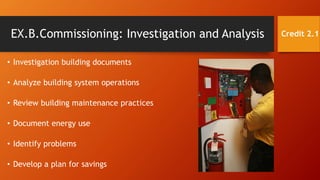
• Investigation building documents
• Analyze building system operations
• Review building maintenance practices
• Document energy use
• Identify problems
• Develop a plan for savings
Credit 2.1
• WHAT - What is the intent of the Credit?
• WHY – Why are we doing this Credit?
• HOW – How do we meet the requirements of this Credit?
• WHO – Who can implement the requirements for this Credit?
EX.B.Commissioning: Investigation and Analysis Credit 2.1
EX.B.Commissioning: Investigation and Analysis
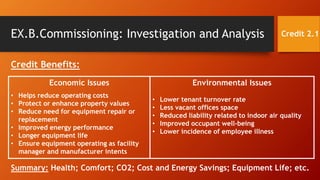
Credit Benefits:
Credit 2.1
Economic Issues
• Helps reduce operating costs
• Protect or enhance property values
• Reduce need for equipment repair or
replacement
• Improved energy performance
• Longer equipment life
• Ensure equipment operating as facility
manager and manufacturer intents
Environmental Issues
• Lower tenant turnover rate
• Less vacant offices space
• Reduced liability related to indoor air quality
• Improved occupant well-being
• Lower incidence of employee illness
Summary: Health; Comfort; CO2; Cost and Energy Savings; Equipment Life; etc.
• WHAT - What is the intent of the Credit?
• WHY – Why are we doing this Credit?
• HOW – How do we meet the requirements of this Credit?
• WHO – Who can implement the requirements for this Credit?
EX.B.Commissioning: Investigation and Analysis Credit 2.1
EX.B.Commissioning: Investigation and Analysis
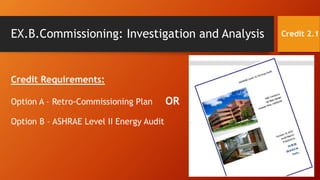
Credit Requirements:
Option A – Retro-Commissioning Plan OR
Option B – ASHRAE Level II Energy Audit
Credit 2.1
EX.B.Commissioning: Investigation and Analysis
Option A – Retro-Commissioning Plan:
• Building Information (history, size, occupancy, space uses, etc).
• Breakdown of energy use for major systems
• List the problems that affect occupants comfort and energy use –
(Energy Savings / Indoor Condition Improvement Opportunities)
• List cost-effective capital improvements that will address the problems.
• List potential procedural and operational changes that will address the problems.
• Perform Cost-Benefit analysis for each improvement.
• Develop a Timetable for completion.
Credit 2.1
EX.B.Commissioning: Investigation and Analysis
Option A – Retro-Commissioning Plan – Detailed Description:
A.1 - Site Assessment
A.2 - Energy Use Breakdown
A.3 - Diagnostic Monitoring and Functional Testing
A.4 - Master List of Findings
Credit 2.1
EX.B.Commissioning: Investigation and Analysis
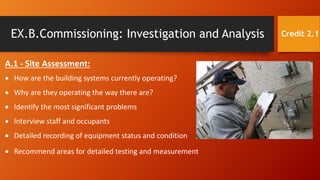
A.1 - Site Assessment:
 How are the building systems currently operating?
 Why are they operating the way there are?
 Identify the most significant problems
 Interview staff and occupants
 Detailed recording of equipment status and condition
 Recommend areas for detailed testing and measurement
Credit 2.1
EX.B.Commissioning: Investigation and Analysis
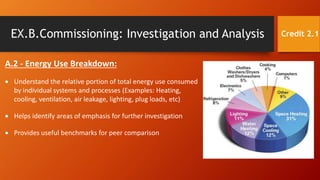
A.2 - Energy Use Breakdown:
 Understand the relative portion of total energy use consumed
by individual systems and processes (Examples: Heating,
cooling, ventilation, air leakage, lighting, plug loads, etc)
 Helps identify areas of emphasis for further investigation
 Provides useful benchmarks for peer comparison
Credit 2.1
EX.B.Commissioning: Investigation and Analysis
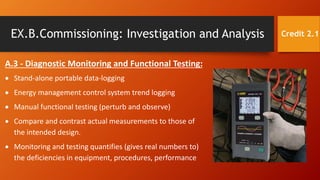
A.3 - Diagnostic Monitoring and Functional Testing:
 Stand-alone portable data-logging
 Energy management control system trend logging
 Manual functional testing (perturb and observe)
 Compare and contrast actual measurements to those of
the intended design.
 Monitoring and testing quantifies (gives real numbers to)
the deficiencies in equipment, procedures, performance
Credit 2.1
EX.B.Commissioning: Investigation and Analysis
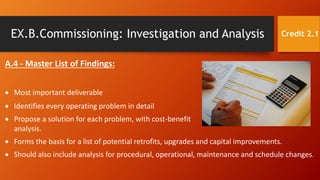
A.4 - Master List of Findings:
 Most important deliverable
 Identifies every operating problem in detail
 Propose a solution for each problem, with cost-benefit
analysis.
Credit 2.1
 Forms the basis for a list of potential retrofits, upgrades and capital improvements.
 Should also include analysis for procedural, operational, maintenance and schedule changes.
EX.B.Commissioning: Investigation and Analysis
Option B – ASHRAE Level II Audit – Summary:
• Described in ASHRAE’s Procedures for Commercial Building Audits.
• Document the breakdown of energy use in the building.
• Perform a cost-savings analysis of all practical measures that meet the owner’s
constraints, along with a discussion of operations and maintenance procedures.
• List the identified capital improvements that will provide cost-effective energy savings
and document the cost-benefit analysis associated with each.
Credit 2.1
EX.B.Commissioning: Investigation and Analysis Credit 2.1
EX.B.Commissioning: Investigation and Analysis
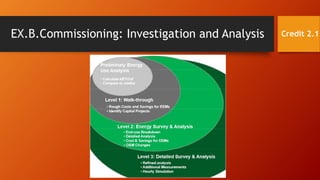
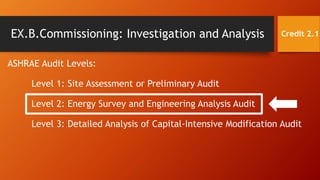
ASHRAE Audit Levels:
Level 1: Site Assessment or Preliminary Audit
Level 2: Energy Survey and Engineering Analysis Audit
Level 3: Detailed Analysis of Capital-Intensive Modification Audit
Credit 2.1
EX.B.Commissioning: Investigation and Analysis
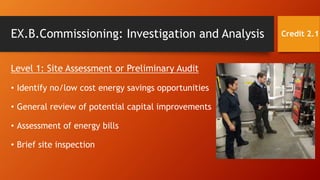
Level 1: Site Assessment or Preliminary Audit
• Identify no/low cost energy savings opportunities
• General review of potential capital improvements
• Assessment of energy bills
• Brief site inspection
Credit 2.1
EX.B.Commissioning: Investigation and Analysis
ASHRAE Audit Levels:
Level 1: Site Assessment or Preliminary Audit
Level 2: Energy Survey and Engineering Analysis Audit
Level 3: Detailed Analysis of Capital-Intensive Modification Audit
Credit 2.1
EX.B.Commissioning: Investigation and Analysis Credit 2.1
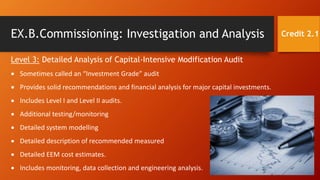
Level 3: Detailed Analysis of Capital-Intensive Modification Audit
 Sometimes called an “Investment Grade” audit
 Provides solid recommendations and financial analysis for major capital investments.
 Includes Level I and Level II audits.
 Additional testing/monitoring
 Detailed system modelling
 Detailed description of recommended measured
 Detailed EEM cost estimates.
 Includes monitoring, data collection and engineering analysis.
EX.B.Commissioning: Investigation and Analysis
ASHRAE Audit Levels:
Level 1: Site Assessment or Preliminary Audit
Level 2: Energy Survey and Engineering Analysis Audit
Level 3: Detailed Analysis of Capital-Intensive Modification Audit
Credit 2.1
EX.B.Commissioning: Investigation and Analysis
Option B – ASHRAE Level II Audit:
Credit 2.1
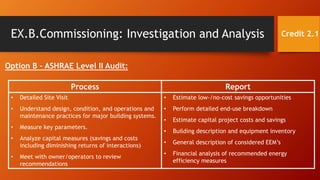
Process Report
• Detailed Site Visit
• Understand design, condition, and operations and
maintenance practices for major building systems.
• Measure key parameters.
• Analyze capital measures (savings and costs
including diminishing returns of interactions)
• Meet with owner/operators to review
recommendations
• Estimate low-/no-cost savings opportunities
• Perform detailed end-use breakdown
• Estimate capital project costs and savings
• Building description and equipment inventory
• General description of considered EEM’s
• Financial analysis of recommended energy
efficiency measures
EX.B.Commissioning: Investigation and Analysis
Option B – ASHRAE Level II Audit – Procedure:
1. Review of system design (electrical and mechanical)
2. Review of maintenance and operations procedures
3. Measurement of operating parameters; comparison with design levels.
Example Parameters: operating schedule, heating and cooling water temperature, supply air temperature, space temperature and humidity, ventilation quantities, light levels, etc)
4. A review of the existing operating and maintenance problems.
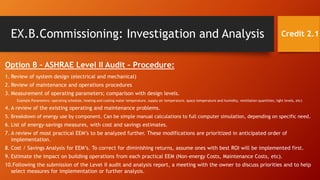
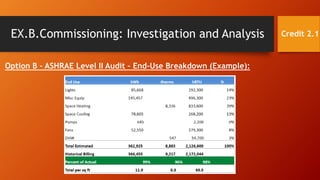
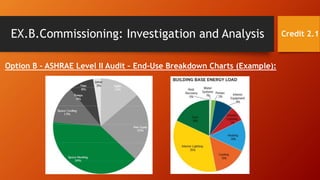
5. Breakdown of energy use by component. Can be simple manual calculations to full computer simulation, depending on specific need.
6. List of energy-savings measures, with cost and savings estimates.
7. A review of most practical EEM’s to be analyzed further. These modifications are prioritized in anticipated order of
implementation.
8. Cost / Savings Analysis for EEM’s. To correct for diminishing returns, assume ones with best ROI will be implemented first.
9. Estimate the impact on building operations from each practical EEM (Non-energy Costs, Maintenance Costs, etc).
10.Following the submission of the Level II audit and analysis report, a meeting with the owner to discuss priorities and to help
select measures for implementation or further analysis.
Credit 2.1
EX.B.Commissioning: Investigation and Analysis
Option B – ASHRAE Level II Audit – End-Use Breakdown (Example):
Credit 2.1
EX.B.Commissioning: Investigation and Analysis
Option B – ASHRAE Level II Audit – End-Use Breakdown Charts (Example):
Credit 2.1
EX.B.Commissioning: Investigation and Analysis
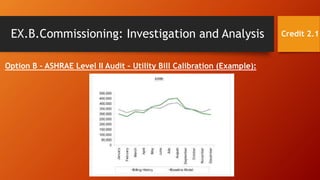
Option B – ASHRAE Level II Audit – Utility Bill Calibration (Example):
Credit 2.1
EX.B.Commissioning: Investigation and Analysis
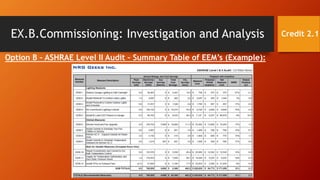
Option B – ASHRAE Level II Audit – Summary Table of EEM’s (Example):
Credit 2.1
EX.B.Commissioning: Investigation and Analysis
Option B – ASHRAE Level II Audit – Software Modelling
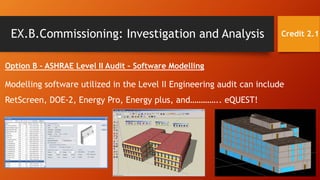
Modelling software utilized in the Level II Engineering audit can include
RetScreen, DOE-2, Energy Pro, Energy plus, and………….. eQUEST!
Credit 2.1
EX.B.Commissioning: Investigation and Analysis
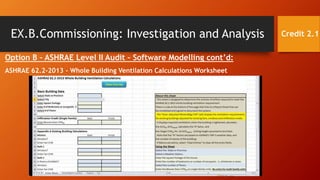
Option B – ASHRAE Level II Audit – Software Modelling cont’d:
ASHRAE 62.2-2013 - Whole Building Ventilation Calculations Worksheet
Credit 2.1
• WHAT - What is the intent of the Credit?
• WHY – Why are we doing this Credit?
• HOW – How do we meet the requirements of this Credit?
• WHO – Who can implement the requirements for this Credit?
EX.B.Commissioning: Investigation and Analysis Credit 2.1
EX.B.Commissioning: Investigation and Analysis
Credit Commissioning Team:
The Level II audit may be conducted by an external commissioning agent or even
by members of the building operations staff.
“The commissioning team can consist of facility managers and building
operations staff, as well as third-party engineers, energy auditors and
management companies, consultants, and systems maintenance experts. The
team composition will depend on project size and systems complexity.”
Credit 2.1
Credit 2.1: Investigation and Analysis
Credit 2.2: Implementation
Credit 2.3: Ongoing Commissioning
Existing Building Commissioning Credit 2.2
• Credit Intent
• Requirements
• No-/Low-Cost Improvements
• Capital Expenditure Plan
• Cost-Benefit
• Building Operating Plan
• Training & Team
• Timeline
Credit 2.2EX.B.Commissioning: Implementation
EX.B.Commissioning: Implementation
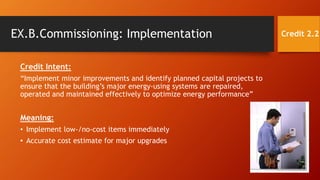
Credit Intent:
“Implement minor improvements and identify planned capital projects to
ensure that the building’s major energy-using systems are repaired,
operated and maintained effectively to optimize energy performance”
Meaning:
• Implement low-/no-cost items immediately
• Accurate cost estimate for major upgrades
Credit 2.2
EX.B.Commissioning: Implementation
Credit Requirements:
• Implement no- or low-cost solutions (…to problems found in Credit 2.1)
• Create a capital plan for major retrofits or upgrades.
• Provide training for management staff that builds awareness and skills
(Training in energy efficiency, equipment and systems operations and maintenance)
• Demonstrate the observed and/or anticipated financial costs and benefits of
measures that have been implemented.
• Update the building operating plan as necessary to reflect any changes in the
occupancy / equipment runtime schedule, set-points, lighting, etc.
• Regularly review the building plan.
Credit 2.2
EX.B.Commissioning: Implementation
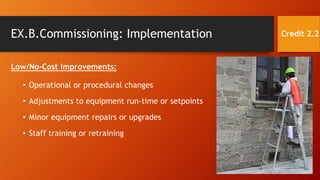
Low/No-Cost Improvements:
• Operational or procedural changes
• Adjustments to equipment run-time or setpoints
• Minor equipment repairs or upgrades
• Staff training or retraining
Credit 2.2
EX.B.Commissioning: Implementation
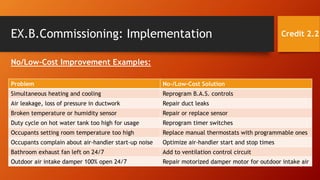
No/Low-Cost Improvement Examples:
Credit 2.2
Problem No-/Low-Cost Solution
Simultaneous heating and cooling Reprogram B.A.S. controls
Air leakage, loss of pressure in ductwork Repair duct leaks
Broken temperature or humidity sensor Repair or replace sensor
Duty cycle on hot water tank too high for usage Reprogram timer switches
Occupants setting room temperature too high Replace manual thermostats with programmable ones
Occupants complain about air-handler start-up noise Optimize air-handler start and stop times
Bathroom exhaust fan left on 24/7 Add to ventilation control circuit
Outdoor air intake damper 100% open 24/7 Repair motorized damper motor for outdoor intake air
EX.B.Commissioning: Implementation
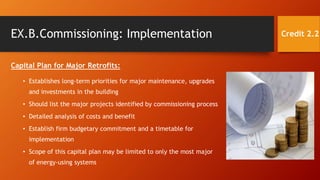
Capital Plan for Major Retrofits:
• Establishes long-term priorities for major maintenance, upgrades
and investments in the building
• Should list the major projects identified by commissioning process
• Detailed analysis of costs and benefit
• Establish firm budgetary commitment and a timetable for
implementation
• Scope of this capital plan may be limited to only the most major
of energy-using systems
Credit 2.2
EX.B.Commissioning: Implementation
Cost Benefit Analyses:
• Demonstrate financial logic for correcting the problems from Credit 2.1
• Account for all the costs and savings associated with each measure, including
schedule changes.
• Calculations include ‘payback time’, ‘rate of return’, ‘cost-benefit ratio’, etc.
• Actual Utility rate schedules used (Gas, Water, Electricity, Etc)
Credit 2.2
EX.B.Commissioning: Implementation
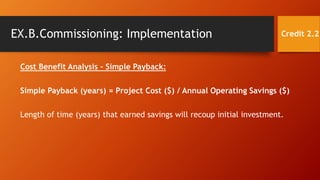
Cost Benefit Analysis - Simple Payback:
Simple Payback (years) = Project Cost ($) / Annual Operating Savings ($)
Length of time (years) that earned savings will recoup initial investment.
Credit 2.2
EX.B.Commissioning: Implementation
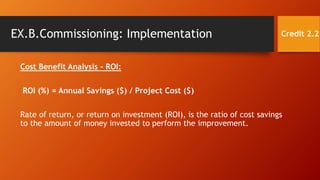
Cost Benefit Analysis - ROI:
ROI (%) = Annual Savings ($) / Project Cost ($)
Rate of return, or return on investment (ROI), is the ratio of cost savings
to the amount of money invested to perform the improvement.
Credit 2.2
EX.B.Commissioning: Implementation
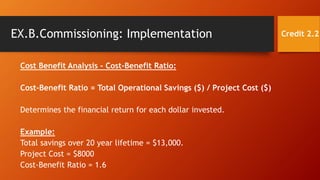
Cost Benefit Analysis - Cost-Benefit Ratio:
Cost-Benefit Ratio = Total Operational Savings ($) / Project Cost ($)
Determines the financial return for each dollar invested.
Example:
Total savings over 20 year lifetime = $13,000.
Project Cost = $8000
Cost-Benefit Ratio = 1.6
Credit 2.2
EX.B.Commissioning: Implementation
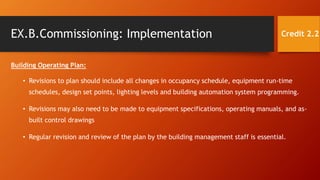
Building Operating Plan:
• Revisions to plan should include all changes in occupancy schedule, equipment run-time
schedules, design set points, lighting levels and building automation system programming.
• Revisions may also need to be made to equipment specifications, operating manuals, and as-
built control drawings
• Regular revision and review of the plan by the building management staff is essential.
Credit 2.2
EX.B.Commissioning: Implementation
Training:
• Facility Managers, Engineers, Major-system Equipment Operators - must have skills and
knowledge necessary to identify and implement sustainable operations measures.
• Training should build awareness and develop skills within a broad range of building
operations topics
• No minimum requirements, but 24 hours per staff person per year is recommended.
Credit 2.2
Team:
The team associated with the accomplishment of this credit may include representatives from
facilities, third party engineers, energy managers, and building operations and maintenance staff.
Credit 2.1: Investigation and Analysis
Credit 2.2: Implementation
Credit 2.3: Ongoing Commissioning
Existing Building Commissioning Credit 2.3
EX.B.Commissioning: Ongoing Commissioning
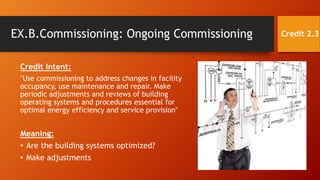
Credit Intent:
"Use commissioning to address changes in facility
occupancy, use maintenance and repair. Make
periodic adjustments and reviews of building
operating systems and procedures essential for
optimal energy efficiency and service provision"
Meaning:
• Are the building systems optimized?
• Make adjustments
Credit 2.3
EX.B.Commissioning: Ongoing Commissioning
Ongoing Commissioning - Description:
• A continuous, dynamic process – ongoing monitoring and analysis
• Emphasizes a systems-wide approach, continually making sure that indoor
conditions and building energy systems are understood, monitored and repaired.
• Regular review and revisions to the building operating plan – include details on system
testing, performance verification, corrective action and ongoing measurements.
• Usually undertaken after a full retro-commissioning has been completed
Credit 2.3
EX.B.Commissioning: Ongoing Commissioning
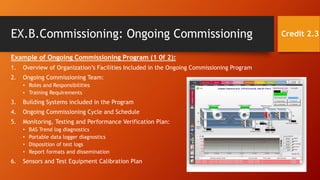
Example of Ongoing Commissioning Program (1 0f 2):
1. Overview of Organization’s Facilities Included in the Ongoing Commissioning Program
2. Ongoing Commissioning Team:
• Roles and Responsibilities
• Training Requirements
3. Building Systems included in the Program
4. Ongoing Commissioning Cycle and Schedule
5. Monitoring, Testing and Performance Verification Plan:
• BAS Trend log diagnostics
• Portable data logger diagnostics
• Disposition of test logs
• Report formats and dissemination
6. Sensors and Test Equipment Calibration Plan
Credit 2.3
EX.B.Commissioning: Ongoing Commissioning
Example of Ongoing Commissioning Program (2 of 2):
7. Issue Identification and Response Protocols
8. Ongoing Commissioning Annual Report
• Summary of Issues Resolved
• Ongoing Commissioning Program Costs
• Savings Related to Resolved Issues
REFERENCE DOCUMENTS:
A. Building Operating Plan (and Revision History)
B. Energy Audit Reports (Level I and II)
C. Preventive Maintenance Plan
D. Building Automation System (BAS) PM Plan
E. Retro-commissioning Report
Credit 2.3
EX.B.Commissioning: Ongoing Commissioning
Regional Variation:
• The mechanical systems and energy efficiency strategies used in a given region tend to vary with
the climate and available energy sources.
• Building envelope may be more important in certain regions
• Water systems may be more important in arid regions.
• The ongoing commissioning program should account for seasonal as well as regional variations.
Credit 2.3
Credit 2.1: Investigation and Analysis
Credit 2.2: Implementation
Credit 2.3: Ongoing Commissioning
Existing Building Commissioning Credit 2.3
EX.B.Commissioning: Ongoing Commissioning Credit 2.3
Always make sure your solutions are effective…

LEED Canada - Existing Building Commissioning_Mar1st

  • 1.
    Existing Building Commissioning LEEDCANADA FOR EXISTING BUILDINGS: OPERATIONS AND MAINTENANCE Credit 2.1 – 2 Points Credit 2.2 – 2 Points Credit 2.3 – 2 Points (Energy and Atmosphere) Presentation by: Michael Clarke
  • 2.
    Credit 2.1: Investigationand Analysis Credit 2.2: Implementation Credit 2.3: Ongoing Commissioning Existing Building Commissioning Credit 2.1 Credit 2.2 Credit 2.3
  • 3.
    Existing Building Commissioning Credit2.1: Investigation and Analysis Credit 2.2: Implementation Credit 2.3: Ongoing Commissioning Credit 2.1
  • 4.
    EX.B.Commissioning: Investigation andAnalysis Credit Prerequisites: • EA Prerequisite 1: Energy Efficiency Best Management Practices – Planning, Documentation and Opportunity Assessment • EA Prerequisite 2: Minimum Energy Efficiency Performance Related Credits: • EA Credit 1: Optimize Energy Efficiency Performance • EA Credit 2.2: Existing Building Commissioning - Implementation • EA Credit 2.3: Existing Building Commissioning – Ongoing Commissioning Credit 2.1
  • 5.
    EX.B.Commissioning: Investigation andAnalysis • WHAT - What is the intent of the Credit? • WHY – Why are we doing this Credit? • HOW – How do we meet the requirements of this Credit? • WHO – Who can implement the requirements for this Credit? Credit 2.1
  • 6.
    EX.B.Commissioning: Investigation andAnalysis Credit 2.1 • WHAT - What is the intent of the Credit? • WHY – Why are we doing this Credit? • HOW – How do we meet the requirements of this Credit? • WHO – Who can implement the requirements for this Credit?
  • 7.
    EX.B.Commissioning: Investigation andAnalysis Credit Intent: “Through a systematic process, develop an understanding of the operation of the building’s major energy systems, options for optimizing energy performance and a plan to achieve energy savings.” Credit 2.1
  • 8.
    EX.B.Commissioning: Investigation andAnalysis • Investigation building documents • Analyze building system operations • Review building maintenance practices • Document energy use • Identify problems • Develop a plan for savings Credit 2.1
  • 9.
    • WHAT -What is the intent of the Credit? • WHY – Why are we doing this Credit? • HOW – How do we meet the requirements of this Credit? • WHO – Who can implement the requirements for this Credit? EX.B.Commissioning: Investigation and Analysis Credit 2.1
  • 10.
    EX.B.Commissioning: Investigation andAnalysis Credit Benefits: Credit 2.1 Economic Issues • Helps reduce operating costs • Protect or enhance property values • Reduce need for equipment repair or replacement • Improved energy performance • Longer equipment life • Ensure equipment operating as facility manager and manufacturer intents Environmental Issues • Lower tenant turnover rate • Less vacant offices space • Reduced liability related to indoor air quality • Improved occupant well-being • Lower incidence of employee illness Summary: Health; Comfort; CO2; Cost and Energy Savings; Equipment Life; etc.
  • 11.
    • WHAT -What is the intent of the Credit? • WHY – Why are we doing this Credit? • HOW – How do we meet the requirements of this Credit? • WHO – Who can implement the requirements for this Credit? EX.B.Commissioning: Investigation and Analysis Credit 2.1
  • 12.
    EX.B.Commissioning: Investigation andAnalysis Credit Requirements: Option A – Retro-Commissioning Plan OR Option B – ASHRAE Level II Energy Audit Credit 2.1
  • 13.
    EX.B.Commissioning: Investigation andAnalysis Option A – Retro-Commissioning Plan: • Building Information (history, size, occupancy, space uses, etc). • Breakdown of energy use for major systems • List the problems that affect occupants comfort and energy use – (Energy Savings / Indoor Condition Improvement Opportunities) • List cost-effective capital improvements that will address the problems. • List potential procedural and operational changes that will address the problems. • Perform Cost-Benefit analysis for each improvement. • Develop a Timetable for completion. Credit 2.1
  • 14.
    EX.B.Commissioning: Investigation andAnalysis Option A – Retro-Commissioning Plan – Detailed Description: A.1 - Site Assessment A.2 - Energy Use Breakdown A.3 - Diagnostic Monitoring and Functional Testing A.4 - Master List of Findings Credit 2.1
  • 15.
    EX.B.Commissioning: Investigation andAnalysis A.1 - Site Assessment:  How are the building systems currently operating?  Why are they operating the way there are?  Identify the most significant problems  Interview staff and occupants  Detailed recording of equipment status and condition  Recommend areas for detailed testing and measurement Credit 2.1
  • 16.
    EX.B.Commissioning: Investigation andAnalysis A.2 - Energy Use Breakdown:  Understand the relative portion of total energy use consumed by individual systems and processes (Examples: Heating, cooling, ventilation, air leakage, lighting, plug loads, etc)  Helps identify areas of emphasis for further investigation  Provides useful benchmarks for peer comparison Credit 2.1
  • 17.
    EX.B.Commissioning: Investigation andAnalysis A.3 - Diagnostic Monitoring and Functional Testing:  Stand-alone portable data-logging  Energy management control system trend logging  Manual functional testing (perturb and observe)  Compare and contrast actual measurements to those of the intended design.  Monitoring and testing quantifies (gives real numbers to) the deficiencies in equipment, procedures, performance Credit 2.1
  • 18.
    EX.B.Commissioning: Investigation andAnalysis A.4 - Master List of Findings:  Most important deliverable  Identifies every operating problem in detail  Propose a solution for each problem, with cost-benefit analysis. Credit 2.1  Forms the basis for a list of potential retrofits, upgrades and capital improvements.  Should also include analysis for procedural, operational, maintenance and schedule changes.
  • 19.
    EX.B.Commissioning: Investigation andAnalysis Option B – ASHRAE Level II Audit – Summary: • Described in ASHRAE’s Procedures for Commercial Building Audits. • Document the breakdown of energy use in the building. • Perform a cost-savings analysis of all practical measures that meet the owner’s constraints, along with a discussion of operations and maintenance procedures. • List the identified capital improvements that will provide cost-effective energy savings and document the cost-benefit analysis associated with each. Credit 2.1
  • 20.
  • 21.
    EX.B.Commissioning: Investigation andAnalysis ASHRAE Audit Levels: Level 1: Site Assessment or Preliminary Audit Level 2: Energy Survey and Engineering Analysis Audit Level 3: Detailed Analysis of Capital-Intensive Modification Audit Credit 2.1
  • 22.
    EX.B.Commissioning: Investigation andAnalysis Level 1: Site Assessment or Preliminary Audit • Identify no/low cost energy savings opportunities • General review of potential capital improvements • Assessment of energy bills • Brief site inspection Credit 2.1
  • 23.
    EX.B.Commissioning: Investigation andAnalysis ASHRAE Audit Levels: Level 1: Site Assessment or Preliminary Audit Level 2: Energy Survey and Engineering Analysis Audit Level 3: Detailed Analysis of Capital-Intensive Modification Audit Credit 2.1
  • 24.
    EX.B.Commissioning: Investigation andAnalysis Credit 2.1 Level 3: Detailed Analysis of Capital-Intensive Modification Audit  Sometimes called an “Investment Grade” audit  Provides solid recommendations and financial analysis for major capital investments.  Includes Level I and Level II audits.  Additional testing/monitoring  Detailed system modelling  Detailed description of recommended measured  Detailed EEM cost estimates.  Includes monitoring, data collection and engineering analysis.
  • 25.
    EX.B.Commissioning: Investigation andAnalysis ASHRAE Audit Levels: Level 1: Site Assessment or Preliminary Audit Level 2: Energy Survey and Engineering Analysis Audit Level 3: Detailed Analysis of Capital-Intensive Modification Audit Credit 2.1
  • 26.
    EX.B.Commissioning: Investigation andAnalysis Option B – ASHRAE Level II Audit: Credit 2.1 Process Report • Detailed Site Visit • Understand design, condition, and operations and maintenance practices for major building systems. • Measure key parameters. • Analyze capital measures (savings and costs including diminishing returns of interactions) • Meet with owner/operators to review recommendations • Estimate low-/no-cost savings opportunities • Perform detailed end-use breakdown • Estimate capital project costs and savings • Building description and equipment inventory • General description of considered EEM’s • Financial analysis of recommended energy efficiency measures
  • 27.
    EX.B.Commissioning: Investigation andAnalysis Option B – ASHRAE Level II Audit – Procedure: 1. Review of system design (electrical and mechanical) 2. Review of maintenance and operations procedures 3. Measurement of operating parameters; comparison with design levels. Example Parameters: operating schedule, heating and cooling water temperature, supply air temperature, space temperature and humidity, ventilation quantities, light levels, etc) 4. A review of the existing operating and maintenance problems. 5. Breakdown of energy use by component. Can be simple manual calculations to full computer simulation, depending on specific need. 6. List of energy-savings measures, with cost and savings estimates. 7. A review of most practical EEM’s to be analyzed further. These modifications are prioritized in anticipated order of implementation. 8. Cost / Savings Analysis for EEM’s. To correct for diminishing returns, assume ones with best ROI will be implemented first. 9. Estimate the impact on building operations from each practical EEM (Non-energy Costs, Maintenance Costs, etc). 10.Following the submission of the Level II audit and analysis report, a meeting with the owner to discuss priorities and to help select measures for implementation or further analysis. Credit 2.1
  • 28.
    EX.B.Commissioning: Investigation andAnalysis Option B – ASHRAE Level II Audit – End-Use Breakdown (Example): Credit 2.1
  • 29.
    EX.B.Commissioning: Investigation andAnalysis Option B – ASHRAE Level II Audit – End-Use Breakdown Charts (Example): Credit 2.1
  • 30.
    EX.B.Commissioning: Investigation andAnalysis Option B – ASHRAE Level II Audit – Utility Bill Calibration (Example): Credit 2.1
  • 31.
    EX.B.Commissioning: Investigation andAnalysis Option B – ASHRAE Level II Audit – Summary Table of EEM’s (Example): Credit 2.1
  • 32.
    EX.B.Commissioning: Investigation andAnalysis Option B – ASHRAE Level II Audit – Software Modelling Modelling software utilized in the Level II Engineering audit can include RetScreen, DOE-2, Energy Pro, Energy plus, and………….. eQUEST! Credit 2.1
  • 33.
    EX.B.Commissioning: Investigation andAnalysis Option B – ASHRAE Level II Audit – Software Modelling cont’d: ASHRAE 62.2-2013 - Whole Building Ventilation Calculations Worksheet Credit 2.1
  • 34.
    • WHAT -What is the intent of the Credit? • WHY – Why are we doing this Credit? • HOW – How do we meet the requirements of this Credit? • WHO – Who can implement the requirements for this Credit? EX.B.Commissioning: Investigation and Analysis Credit 2.1
  • 35.
    EX.B.Commissioning: Investigation andAnalysis Credit Commissioning Team: The Level II audit may be conducted by an external commissioning agent or even by members of the building operations staff. “The commissioning team can consist of facility managers and building operations staff, as well as third-party engineers, energy auditors and management companies, consultants, and systems maintenance experts. The team composition will depend on project size and systems complexity.” Credit 2.1
  • 36.
    Credit 2.1: Investigationand Analysis Credit 2.2: Implementation Credit 2.3: Ongoing Commissioning Existing Building Commissioning Credit 2.2
  • 37.
    • Credit Intent •Requirements • No-/Low-Cost Improvements • Capital Expenditure Plan • Cost-Benefit • Building Operating Plan • Training & Team • Timeline Credit 2.2EX.B.Commissioning: Implementation
  • 38.
    EX.B.Commissioning: Implementation Credit Intent: “Implementminor improvements and identify planned capital projects to ensure that the building’s major energy-using systems are repaired, operated and maintained effectively to optimize energy performance” Meaning: • Implement low-/no-cost items immediately • Accurate cost estimate for major upgrades Credit 2.2
  • 39.
    EX.B.Commissioning: Implementation Credit Requirements: •Implement no- or low-cost solutions (…to problems found in Credit 2.1) • Create a capital plan for major retrofits or upgrades. • Provide training for management staff that builds awareness and skills (Training in energy efficiency, equipment and systems operations and maintenance) • Demonstrate the observed and/or anticipated financial costs and benefits of measures that have been implemented. • Update the building operating plan as necessary to reflect any changes in the occupancy / equipment runtime schedule, set-points, lighting, etc. • Regularly review the building plan. Credit 2.2
  • 40.
    EX.B.Commissioning: Implementation Low/No-Cost Improvements: •Operational or procedural changes • Adjustments to equipment run-time or setpoints • Minor equipment repairs or upgrades • Staff training or retraining Credit 2.2
  • 41.
    EX.B.Commissioning: Implementation No/Low-Cost ImprovementExamples: Credit 2.2 Problem No-/Low-Cost Solution Simultaneous heating and cooling Reprogram B.A.S. controls Air leakage, loss of pressure in ductwork Repair duct leaks Broken temperature or humidity sensor Repair or replace sensor Duty cycle on hot water tank too high for usage Reprogram timer switches Occupants setting room temperature too high Replace manual thermostats with programmable ones Occupants complain about air-handler start-up noise Optimize air-handler start and stop times Bathroom exhaust fan left on 24/7 Add to ventilation control circuit Outdoor air intake damper 100% open 24/7 Repair motorized damper motor for outdoor intake air
  • 42.
    EX.B.Commissioning: Implementation Capital Planfor Major Retrofits: • Establishes long-term priorities for major maintenance, upgrades and investments in the building • Should list the major projects identified by commissioning process • Detailed analysis of costs and benefit • Establish firm budgetary commitment and a timetable for implementation • Scope of this capital plan may be limited to only the most major of energy-using systems Credit 2.2
  • 43.
    EX.B.Commissioning: Implementation Cost BenefitAnalyses: • Demonstrate financial logic for correcting the problems from Credit 2.1 • Account for all the costs and savings associated with each measure, including schedule changes. • Calculations include ‘payback time’, ‘rate of return’, ‘cost-benefit ratio’, etc. • Actual Utility rate schedules used (Gas, Water, Electricity, Etc) Credit 2.2
  • 44.
    EX.B.Commissioning: Implementation Cost BenefitAnalysis - Simple Payback: Simple Payback (years) = Project Cost ($) / Annual Operating Savings ($) Length of time (years) that earned savings will recoup initial investment. Credit 2.2
  • 45.
    EX.B.Commissioning: Implementation Cost BenefitAnalysis - ROI: ROI (%) = Annual Savings ($) / Project Cost ($) Rate of return, or return on investment (ROI), is the ratio of cost savings to the amount of money invested to perform the improvement. Credit 2.2
  • 46.
    EX.B.Commissioning: Implementation Cost BenefitAnalysis - Cost-Benefit Ratio: Cost-Benefit Ratio = Total Operational Savings ($) / Project Cost ($) Determines the financial return for each dollar invested. Example: Total savings over 20 year lifetime = $13,000. Project Cost = $8000 Cost-Benefit Ratio = 1.6 Credit 2.2
  • 47.
    EX.B.Commissioning: Implementation Building OperatingPlan: • Revisions to plan should include all changes in occupancy schedule, equipment run-time schedules, design set points, lighting levels and building automation system programming. • Revisions may also need to be made to equipment specifications, operating manuals, and as- built control drawings • Regular revision and review of the plan by the building management staff is essential. Credit 2.2
  • 48.
    EX.B.Commissioning: Implementation Training: • FacilityManagers, Engineers, Major-system Equipment Operators - must have skills and knowledge necessary to identify and implement sustainable operations measures. • Training should build awareness and develop skills within a broad range of building operations topics • No minimum requirements, but 24 hours per staff person per year is recommended. Credit 2.2 Team: The team associated with the accomplishment of this credit may include representatives from facilities, third party engineers, energy managers, and building operations and maintenance staff.
  • 49.
    Credit 2.1: Investigationand Analysis Credit 2.2: Implementation Credit 2.3: Ongoing Commissioning Existing Building Commissioning Credit 2.3
  • 50.
    EX.B.Commissioning: Ongoing Commissioning CreditIntent: "Use commissioning to address changes in facility occupancy, use maintenance and repair. Make periodic adjustments and reviews of building operating systems and procedures essential for optimal energy efficiency and service provision" Meaning: • Are the building systems optimized? • Make adjustments Credit 2.3
  • 51.
    EX.B.Commissioning: Ongoing Commissioning OngoingCommissioning - Description: • A continuous, dynamic process – ongoing monitoring and analysis • Emphasizes a systems-wide approach, continually making sure that indoor conditions and building energy systems are understood, monitored and repaired. • Regular review and revisions to the building operating plan – include details on system testing, performance verification, corrective action and ongoing measurements. • Usually undertaken after a full retro-commissioning has been completed Credit 2.3
  • 52.
    EX.B.Commissioning: Ongoing Commissioning Exampleof Ongoing Commissioning Program (1 0f 2): 1. Overview of Organization’s Facilities Included in the Ongoing Commissioning Program 2. Ongoing Commissioning Team: • Roles and Responsibilities • Training Requirements 3. Building Systems included in the Program 4. Ongoing Commissioning Cycle and Schedule 5. Monitoring, Testing and Performance Verification Plan: • BAS Trend log diagnostics • Portable data logger diagnostics • Disposition of test logs • Report formats and dissemination 6. Sensors and Test Equipment Calibration Plan Credit 2.3
  • 53.
    EX.B.Commissioning: Ongoing Commissioning Exampleof Ongoing Commissioning Program (2 of 2): 7. Issue Identification and Response Protocols 8. Ongoing Commissioning Annual Report • Summary of Issues Resolved • Ongoing Commissioning Program Costs • Savings Related to Resolved Issues REFERENCE DOCUMENTS: A. Building Operating Plan (and Revision History) B. Energy Audit Reports (Level I and II) C. Preventive Maintenance Plan D. Building Automation System (BAS) PM Plan E. Retro-commissioning Report Credit 2.3
  • 54.
    EX.B.Commissioning: Ongoing Commissioning RegionalVariation: • The mechanical systems and energy efficiency strategies used in a given region tend to vary with the climate and available energy sources. • Building envelope may be more important in certain regions • Water systems may be more important in arid regions. • The ongoing commissioning program should account for seasonal as well as regional variations. Credit 2.3
  • 55.
    Credit 2.1: Investigationand Analysis Credit 2.2: Implementation Credit 2.3: Ongoing Commissioning Existing Building Commissioning Credit 2.3
  • 56.
    EX.B.Commissioning: Ongoing CommissioningCredit 2.3 Always make sure your solutions are effective…

Editor's Notes

  • #3 “Existing Building Commissioning” Credit; Broken into three parts.
  • #4 Will spend about 2/3rds of the time on Credit 2.1, then the last 1/3 of my time on Credits 2.2 and 2.3. Reason for this is to avoid repetition, and the content of Credit 2.1 overlaps the most with what we have studied in ESET.
  • #5 Related Credits and prerequisites all have to do with energy efficiency, as energy efficiency is what this credit deals with.
  • #6 Over the next 12 minutes or so, I will be answering these five questions about Credit 2.1 For credits 2.2 and 2.3, I will not have time to answer these questions, so I will be much briefer at that time.
  • #7 First Question: What is Credit 2.1? What is its purpose? What is its intent?
  • #8 From the LEED Credit Manual.
  • #9 Meaning…
  • #10 Why would we even care to investigate the energy use and operations of a building?
  • #11 If we can identify problem areas and fix them, this may result in both Economic and Environmental Benefits.
  • #12 What must we achieve to complete Credit 2.1?
  • #13 Two options: Both basically energy audits, like we’ve done
  • #14 These are points that the Retro-Commissioning Plan must include – 1) Building Information 2) Building Energy Use 3) Identify problems 4) Propose Equipment Solutions 5) Propose no-cost procedure and operational changes 6) Analyze the financial benefit for each improvement 7) Develop a timetable for Completion.
  • #15 Option A, the retro-commissioning plan, involves 4 steps: Site Assessment; An Energy Use Breakdown; Diagnostic Monitoring and Functional Testing; and a Master List of Findings.
  • #16 System operations = How and why. Problems. Interview. Equipment Status and condition. Identify areas for further testing.
  • #17 Breakdown energy use by category, or zone, or system, etc. Helps identify trouble areas. Benchmarks.
  • #18 Datalogging; looking at control software trends lines; ‘Perturb-and-Observe’ Tests. Compare to Design Intent. Quantifies deficiencies. May include: Combustion analysis and steady state efficiency testing. Lighting level assessment. Blower door testing. Duct leakage testing. Air flow and temperature measurements. Water flow and temperature measurements. Tracer gas analysis. Infrared thermography. Solar shading analysis. Electrical testing. Relative humidity testing.
  • #19 Most important – Like an Audit Report. Identifies every problem – proposes a solution, with financial analysis. List forms the basis for a retrofit recommendation page. Should also include analysis of so called no-cost changes, example: Shifting work to off-peak hours. Can the employees adapt? Will they grumble and moan? Will they demand that they be paid overtime for working offpeak hours?
  • #20 Very similar to Option A. Main distinction is the formalization, standardization and repeatability of the audit procedure.
  • #21 Next section going to describe the distinguishing characteristics of each audit level. This picture does a great job of summing the Levels up; like a Russian doll, where only the Level 3 audit contains everything.
  • #22 Three different levels of audit in the ASHREA standard: Level I is a simple walkthrough audit; Level II is an engineering level audit; Level III is a detailed analysis of very expensive retrofits.
  • #23 “Not going to go into great detail…” Level I description. Everything here included in Level II audit.
  • #24 Three different levels of audit in the ASHREA standard: Level I is a simple walkthrough audit; Level II is an engineering level audit; Level III is a detailed analysis of very expensive retrofits.
  • #25 “Just very briefly…” Doing all those things that are required to give confidence before large sum of money is spent. (Data, model, cost estimates, analysis and future projections, etc)
  • #26 Three different levels of audit in the ASHREA standard: Level I is a simple walkthrough audit; Level II is an engineering level audit; Level III is a detailed analysis of very expensive retrofits.
  • #27 “BUT, we’re not really interested in the Levels I and III, because it is only the Level II audit that is required for Option B of this Credit.” You’ll notice that the audit procedure is very similar to Option A audit.
  • #28 The Meat of the ASHRAE Level II Audit. Lots of text, but worth going into.
  • #32 Looks very familiar! Notice that it includes numbers like peak savings, total savings, elec and gas savings, cost of upgrade, potential incentive, IRR and simple payback. MIRR = Modified Internal Rate of Return
  • #33 Center picture is “OpenStudio”, a plug-in for the free Google Sketchup… Same drawing interface, but with a detailed energy modelling suite underneath the hood = Energy plus software.
  • #34 Not all Level II audit will require a fully realized software model.. It may be possible to model specific systems of the building using specialized Excel worksheet. This is an example of a Excel spreadsheet to calculate building ventilation
  • #37 Finally, we reach the next two Credits… Credit 2.2 and 2.3. Very briefly…
  • #38 The Topics we’re going to cover in this Credit, very briefly.
  • #39 Credit 2.2 – Implementation. Intention, Meaning.
  • #40 Already talked about the first two, they are the most important, and form the primary intent of this credit. The others are described in further slides. This “no- or low-cost solutions is further discussed in the next two slides, because it’s interesting.
  • #41 Really is the Truest low hanging fruit.
  • #42 These problems are the sorts of things that can go unnoticed for years, causing a significant waste of energy. “It’s always been like that; my boss has never told me to get it fixed; that’s not my job, etc”
  • #43 The no/low cost covers what we can do right now; this covers what we cant do right now, because of the money involved.
  • #45 Next three slides are financial calculations typical for Credit 2.2. The equations here provide calculations for payback period, rate of return, and cost-benefit ratio. No accounting for the time value of money.
  • #47 We haven’t looked at cost-benefit ratio yet, but it is yet another metric for evaluating the effectives of each potential upgrade. Highest C-B Ratio upgrades would be first; if under 1, upgrade would not be effective.
  • #48 Part of the no-/low-cost implementations that have to do with ‘soft changes’: changing set points, schedules and programs.
  • #49 Again the suggestion is made that building operations and maintenance staff are part of the LEED team which accomplishes the Credit.
  • #51 Basically, make sure the upgrades, etc, are optimized.
  • #52 “An ongoing commissioning program includes elements of planning, system testing, performance verification, corrective action response, ongoing measurement and documentation to proactively address operating problems.” Ongoing monitoring through datalogging or BAS logging. Comparing data to design; making adjustments. Corrective action procedure example: “If there’s a failure here, what does the building operator do?”, etc.
  • #53 The sort of activities that would be happening during an ongoing commissioning program
  • #54 Continued… Also, some of the documentation that would be consulted; revised; updated; etc during the ongoing commissioning.
  • #56 Done!