Wilckodontics
Dr. Rinisha Sinha
MDS III Postgraduate trainee
Our Team Infographics
Discussion
Introduction
Results
History
04
01
03
02
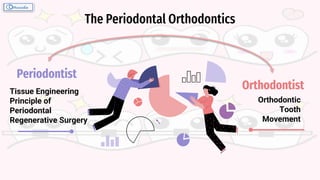
The Periodontal Orthodontics
Periodontist
Orthodontist
Orthodontic
Tooth
Movement
Tissue Engineering
Principle of
Periodontal
Regenerative Surgery
Periodontally Osteogenic
Accelerated Orthodontics
Corticotomy Osteogenic
Facilitated Orthodontics
Alveolar Osteogenic Orthodontics
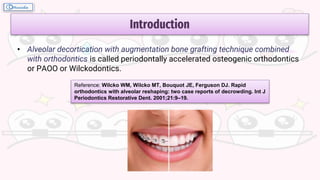
Introduction
• Alveolar decortication with augmentation bone grafting technique combined
with orthodontics is called periodontally accelerated osteogenic orthodontics
or PAOO or Wilckodontics.
Reference: Wilcko WM, Wilcko MT, Bouquot JE, Ferguson DJ. Rapid
orthodontics with alveolar reshaping: two case reports of decrowding. Int J
Periodontics Restorative Dent. 2001;21:9–19.
History
L. C. Bryan; 1893
CORTICOTOMY-FACILITATED TOOTH
MOVEMENT
Düker; 1975
MODIFICATION OF KOLE
Wilcko et al. 2001
WILCKODONTICS or AOO
Köle; 1959
‘COMPLETE BONY BLOCK’
Corticotomy
Modified
Corticotomy
PAOO
Corticotomy
Technique
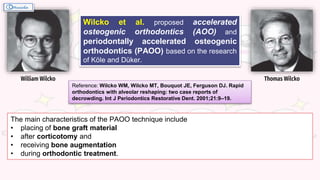
William Wilcko Thomas Wilcko
Wilcko et al. proposed accelerated
osteogenic orthodontics (AOO) and
periodontally accelerated osteogenic
orthodontics (PAOO) based on the research
of Köle and Düker.
The main characteristics of the PAOO technique include
• placing of bone graft material
• after corticotomy and
• receiving bone augmentation
• during orthodontic treatment.
Reference: Wilcko WM, Wilcko MT, Bouquot JE, Ferguson DJ. Rapid
orthodontics with alveolar reshaping: two case reports of
decrowding. Int J Periodontics Restorative Dent. 2001;21:9–19.
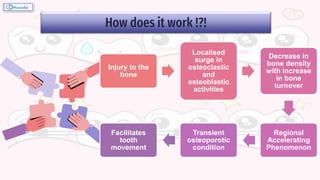
How does it work !?!
Injury to the
bone
Localised
surge in
osteoclastic
and
osteoblastic
activities
Decrease in
bone density
with increase
in bone
turnover
Regional
Accelerating
Phenomenon
Transient
osteoporotic
condition
Facilitates
tooth
movement
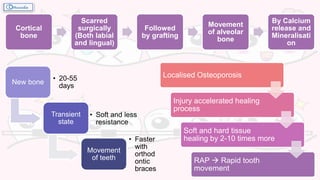
Cortical
bone
Scarred
surgically
(Both labial
and lingual)
Followed
by grafting
Movement
of alveolar
bone
By Calcium
release and
Mineralisati
on
New bone
• 20-55
days
Transient
state
• Soft and less
resistance
Movement
of teeth
• Faster
with
orthod
ontic
braces
Localised Osteoporosis
Injury accelerated healing
process
Soft and hard tissue
healing by 2-10 times more
RAP  Rapid tooth
movement
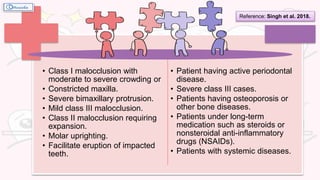
• Class I malocclusion with
moderate to severe crowding or
• Constricted maxilla.
• Severe bimaxillary protrusion.
• Mild class III malocclusion.
• Class II malocclusion requiring
expansion.
• Molar uprighting.
• Facilitate eruption of impacted
teeth.
• Patient having active periodontal
disease.
• Severe class III cases.
• Patients having osteoporosis or
other bone diseases.
• Patients under long-term
medication such as steroids or
nonsteroidal anti-inflammatory
drugs (NSAIDs).
• Patients with systemic diseases.
Reference: Singh et al. 2018.
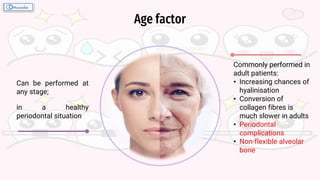
Age factor
Commonly performed in
adult patients:
• Increasing chances of
hyalinisation
• Conversion of
collagen fibres is
much slower in adults
• Periodontal
complications
• Non-flexible alveolar
bone
Can be performed at
any stage;
in a healthy
periodontal situation
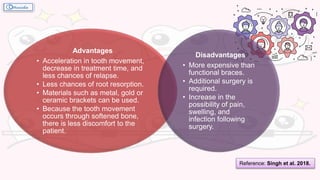
Advantages
• Acceleration in tooth movement,
decrease in treatment time, and
less chances of relapse.
• Less chances of root resorption.
• Materials such as metal, gold or
ceramic brackets can be used.
• Because the tooth movement
occurs through softened bone,
there is less discomfort to the
patient.
Disadvantages
• More expensive than
functional braces.
• Additional surgery is
required.
• Increase in the
possibility of pain,
swelling, and
infection following
surgery.
Reference: Singh et al. 2018.
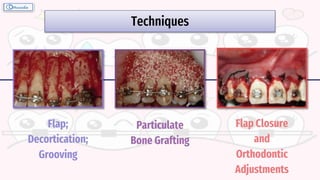
Techniques
Particulate
Bone Grafting
Flap;
Decortication;
Grooving
Flap Closure
and
Orthodontic
Adjustments
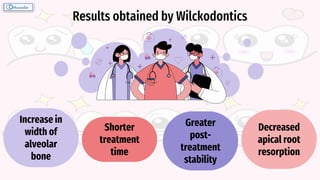
Results obtained by Wilckodontics
Increase in
width of
alveolar
bone
Shorter
treatment
time
Greater
post-
treatment
stability
Decreased
apical root
resorption
Surgical Techniques
Classical
surgical
technique
Corticotomy
with
gingival
augmentatio
n technique
Piezocision
technique
Modified
corticotom
y technique
Osteo-
perforatio
n
technique
Laser
Corticoto
my
Parent Article
The Significance of Utilizing A Corticotomy on Periodontal
and Orthodontic Outcomes: A Systematic Review and
Meta-Analysis
Name of the Authors: Jonathan Gao, Trung Nguyen, Snehlata Oberoi,
Heesoo Oh, Sunil Kapila, Richard T. Kao, and Guo-Hao Lin
Name of the Journal: The Journal of Biology
Date of Publication: August, 2021
Type of study: Meta-analyses
AIM:
To compare the clinical and radiographic outcomes for patients who received
an orthodontic treatment with a localized corticotomy, anterior Corticotomy-
assisted orthodontic treatment (CAOT) or Periodontal accelerated
osteogenic orthodontics (PAOO) to the ones who received a conventional
orthodontic treatment.
Specifically, using published prospective and retrospective studies meeting the
inclusion criteria, this project assessed the rate of tooth movement and
changes to the periodontal parameters of a localized corticotomy, anterior
CAOT or PAOO procedure relative to a conventional orthodontic treatment.
METHOD:
1. Population, intervention, Comparison, Outcome (PICO) Question:
“Does the use of corticotomy procedures provide better clinical and radiographic
outcomes than conventional treatments in patients who receive orthodontic treatment?”
2. Selected population: Subjects receiving orthodontic treatment for correcting a
malocclusion
3. Primary Outcomes to be compared:
• Rate of tooth movement
• Changes of periodontal parameters
4. Selection Criteria:
Human case-control studies or Randomized Controlled Trials (RCTs) between January
1980 and June 2021
METHOD:
5. Inclusion Criteria:
• including ≥10 subjects receiving orthodontic treatment and having a corticotomy
with or without bone grafting material
• reporting outcomes of one of the clinical (the amount of canine distalization, loss of
molar anchorage, keratinized tissue gain, bone thickness gain, pocket depth
reduction) and/or radiographic parameters (root length reduction, bone density
change) after the treatment.
6. Exclusion Criteria:
• articles such as editorials, letters or commentaries,
• animal/in vitro studies,
• literature reviews and
• case reports/series with <10 patients
METHOD:
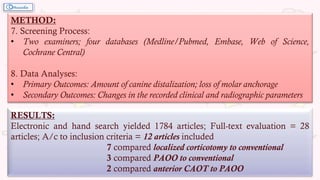
7. Screening Process:
• Two examiners; four databases (Medline/Pubmed, Embase, Web of Science,
Cochrane Central)
8. Data Analyses:
• Primary Outcomes: Amount of canine distalization; loss of molar anchorage
• Secondary Outcomes: Changes in the recorded clinical and radiographic parameters
RESULTS:
Electronic and hand search yielded 1784 articles; Full-text evaluation = 28
articles; A/c to inclusion criteria = 12 articles included
7 compared localized corticotomy to conventional
3 compared PAOO to conventional
2 compared anterior CAOT to PAOO
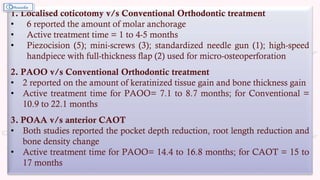
1. Localised coticotomy v/s Conventional Orthodontic treatment
• 6 reported the amount of molar anchorage
• Active treatment time = 1 to 4-5 months
• Piezocision (5); mini-screws (3); standardized needle gun (1); high-speed
handpiece with full-thickness flap (2) used for micro-osteoperforation
2. PAOO v/s Conventional Orthodontic treatment
• 2 reported on the amount of keratinized tissue gain and bone thickness gain
• Active treatment time for PAOO= 7.1 to 8.7 months; for Conventional =
10.9 to 22.1 months
3. POAA v/s anterior CAOT
• Both studies reported the pocket depth reduction, root length reduction and
bone density change
• Active treatment time for PAOO= 14.4 to 16.8 months; for CAOT = 15 to
17 months
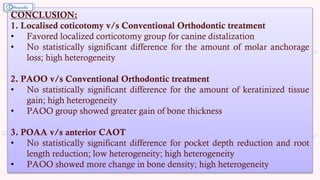
CONCLUSION:
1. Localised coticotomy v/s Conventional Orthodontic treatment
• Favored localized corticotomy group for canine distalization
• No statistically significant difference for the amount of molar anchorage
loss; high heterogeneity
2. PAOO v/s Conventional Orthodontic treatment
• No statistically significant difference for the amount of keratinized tissue
gain; high heterogeneity
• PAOO group showed greater gain of bone thickness
3. POAA v/s anterior CAOT
• No statistically significant difference for pocket depth reduction and root
length reduction; low heterogeneity; high heterogeneity
• PAOO showed more change in bone density; high heterogeneity
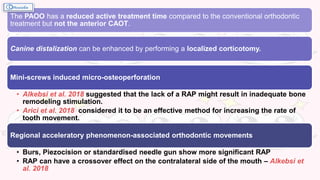
The PAOO has a reduced active treatment time compared to the conventional orthodontic
treatment but not the anterior CAOT.
Canine distalization can be enhanced by performing a localized corticotomy.
Mini-screws induced micro-osteoperforation
• Alkebsi et al. 2018 suggested that the lack of a RAP might result in inadequate bone
remodeling stimulation.
• Arici et al. 2018 considered it to be an effective method for increasing the rate of
tooth movement.
Regional acceleratory phenomenon-associated orthodontic movements
• Burs, Piezocision or standardised needle gun show more significant RAP
• RAP can have a crossover effect on the contralateral side of the mouth – Alkebsi et
al. 2018
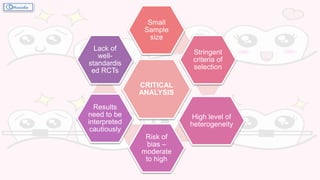
CRITICAL
ANALYSIS
Small
Sample
size
Stringent
criteria of
selection
High level of
heterogeneity
Risk of
bias –
moderate
to high
Results
need to be
interpreted
cautiously
Lack of
well-
standardis
ed RCTs
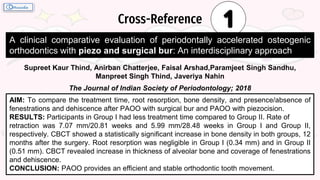
Cross-Reference
A clinical comparative evaluation of periodontally accelerated osteogenic
orthodontics with piezo and surgical bur: An interdisciplinary approach
Supreet Kaur Thind, Anirban Chatterjee, Faisal Arshad,Paramjeet Singh Sandhu,
Manpreet Singh Thind, Javeriya Nahin
The Journal of Indian Society of Periodontology; 2018
AIM: To compare the treatment time, root resorption, bone density, and presence/absence of
fenestrations and dehiscence after PAOO with surgical bur and PAOO with piezocision.
RESULTS: Participants in Group I had less treatment time compared to Group II. Rate of
retraction was 7.07 mm/20.81 weeks and 5.99 mm/28.48 weeks in Group I and Group II,
respectively. CBCT showed a statistically significant increase in bone density in both groups, 12
months after the surgery. Root resorption was negligible in Group I (0.34 mm) and in Group II
(0.51 mm). CBCT revealed increase in thickness of alveolar bone and coverage of fenestrations
and dehiscence.
CONCLUSION: PAOO provides an efficient and stable orthodontic tooth movement.
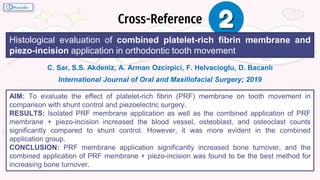
Cross-Reference
C. Sar, S.S. Akdeniz, A. Arman Ozcirpici, F. Helvacioglu, D. Bacanlı
International Journal of Oral and Maxillofacial Surgery; 2019
AIM: To evaluate the effect of platelet-rich fibrin (PRF) membrane on tooth movement in
comparison with shunt control and piezoelectric surgery.
RESULTS: Isolated PRF membrane application as well as the combined application of PRF
membrane + piezo-incision increased the blood vessel, osteoblast, and osteoclast counts
significantly compared to shunt control. However, it was more evident in the combined
application group.
CONCLUSION: PRF membrane application significantly increased bone turnover, and the
combined application of PRF membrane + piezo-incision was found to be the best method for
increasing bone turnover.
Histological evaluation of combined platelet-rich fibrin membrane and
piezo-incision application in orthodontic tooth movement
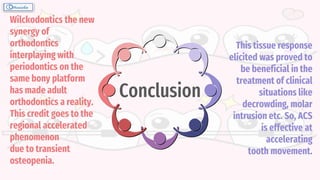
Wilckodontics the new
synergy of
orthodontics
interplaying with
periodontics on the
same bony platform
has made adult
orthodontics a reality.
This credit goes to the
regional accelerated
phenomenon
due to transient
osteopenia.
This tissue response
elicited was proved to
be beneficial in the
treatment of clinical
situations like
decrowding, molar
intrusion etc. So, ACS
is effective at
accelerating
tooth movement.
Conclusion
References
Wilkodontics - A Novel
Synergy in Time to Save
Time; JCDR; 2014
Periodontally accelerated
osteogenic orthodontics:
An interdisciplinary
approach for faster
orthodontic therapy; J
Pharm Bioallied Sci; 2014
Updates on periodontally accelerated osteogenic orthodontics; Orthodontic Waves; 2021
Scope of treatment with
periodontally accelerated
osteogenic orthodontics
therapy; Int J ortho; 2015
Assessment of the effects
of local platelet-rich fibrin
injection and piezocision
on orthodontic tooth
movement during canine
distalization; AJOD; 2021
Wilckodontics: a
multidisciplinary treatment
approach in dentistry;
IJRDPL; 2015
Periodontally accelerated
osteogenic orthodontics-
A Literature review; JIJPI;
2021
Shirisha
K et al.
Adusumil
li et al.
T.H. Wu
et al.
Ferguson
et al.
Karci et
al.
Kumar S
et al.
Meghana
et al.
Wilckodontics.pptx

Wilckodontics.pptx

  • 1.
    Wilckodontics Dr. Rinisha Sinha MDSIII Postgraduate trainee
  • 2.
  • 3.
  • 4.
    Periodontally Osteogenic Accelerated Orthodontics CorticotomyOsteogenic Facilitated Orthodontics Alveolar Osteogenic Orthodontics
  • 5.
    Introduction • Alveolar decorticationwith augmentation bone grafting technique combined with orthodontics is called periodontally accelerated osteogenic orthodontics or PAOO or Wilckodontics. Reference: Wilcko WM, Wilcko MT, Bouquot JE, Ferguson DJ. Rapid orthodontics with alveolar reshaping: two case reports of decrowding. Int J Periodontics Restorative Dent. 2001;21:9–19.
  • 6.
    History L. C. Bryan;1893 CORTICOTOMY-FACILITATED TOOTH MOVEMENT Düker; 1975 MODIFICATION OF KOLE Wilcko et al. 2001 WILCKODONTICS or AOO Köle; 1959 ‘COMPLETE BONY BLOCK’ Corticotomy Modified Corticotomy PAOO Corticotomy Technique
  • 7.
    William Wilcko ThomasWilcko Wilcko et al. proposed accelerated osteogenic orthodontics (AOO) and periodontally accelerated osteogenic orthodontics (PAOO) based on the research of Köle and Düker. The main characteristics of the PAOO technique include • placing of bone graft material • after corticotomy and • receiving bone augmentation • during orthodontic treatment. Reference: Wilcko WM, Wilcko MT, Bouquot JE, Ferguson DJ. Rapid orthodontics with alveolar reshaping: two case reports of decrowding. Int J Periodontics Restorative Dent. 2001;21:9–19.
  • 8.
    How does itwork !?! Injury to the bone Localised surge in osteoclastic and osteoblastic activities Decrease in bone density with increase in bone turnover Regional Accelerating Phenomenon Transient osteoporotic condition Facilitates tooth movement
  • 9.
    Cortical bone Scarred surgically (Both labial and lingual) Followed bygrafting Movement of alveolar bone By Calcium release and Mineralisati on New bone • 20-55 days Transient state • Soft and less resistance Movement of teeth • Faster with orthod ontic braces Localised Osteoporosis Injury accelerated healing process Soft and hard tissue healing by 2-10 times more RAP  Rapid tooth movement
  • 10.
    • Class Imalocclusion with moderate to severe crowding or • Constricted maxilla. • Severe bimaxillary protrusion. • Mild class III malocclusion. • Class II malocclusion requiring expansion. • Molar uprighting. • Facilitate eruption of impacted teeth. • Patient having active periodontal disease. • Severe class III cases. • Patients having osteoporosis or other bone diseases. • Patients under long-term medication such as steroids or nonsteroidal anti-inflammatory drugs (NSAIDs). • Patients with systemic diseases. Reference: Singh et al. 2018.
  • 11.
    Age factor Commonly performedin adult patients: • Increasing chances of hyalinisation • Conversion of collagen fibres is much slower in adults • Periodontal complications • Non-flexible alveolar bone Can be performed at any stage; in a healthy periodontal situation
  • 12.
    Advantages • Acceleration intooth movement, decrease in treatment time, and less chances of relapse. • Less chances of root resorption. • Materials such as metal, gold or ceramic brackets can be used. • Because the tooth movement occurs through softened bone, there is less discomfort to the patient. Disadvantages • More expensive than functional braces. • Additional surgery is required. • Increase in the possibility of pain, swelling, and infection following surgery. Reference: Singh et al. 2018.
  • 13.
  • 14.
    Results obtained byWilckodontics Increase in width of alveolar bone Shorter treatment time Greater post- treatment stability Decreased apical root resorption
  • 15.
  • 16.
    Parent Article The Significanceof Utilizing A Corticotomy on Periodontal and Orthodontic Outcomes: A Systematic Review and Meta-Analysis Name of the Authors: Jonathan Gao, Trung Nguyen, Snehlata Oberoi, Heesoo Oh, Sunil Kapila, Richard T. Kao, and Guo-Hao Lin Name of the Journal: The Journal of Biology Date of Publication: August, 2021 Type of study: Meta-analyses
  • 17.
    AIM: To compare theclinical and radiographic outcomes for patients who received an orthodontic treatment with a localized corticotomy, anterior Corticotomy- assisted orthodontic treatment (CAOT) or Periodontal accelerated osteogenic orthodontics (PAOO) to the ones who received a conventional orthodontic treatment. Specifically, using published prospective and retrospective studies meeting the inclusion criteria, this project assessed the rate of tooth movement and changes to the periodontal parameters of a localized corticotomy, anterior CAOT or PAOO procedure relative to a conventional orthodontic treatment.
  • 18.
    METHOD: 1. Population, intervention,Comparison, Outcome (PICO) Question: “Does the use of corticotomy procedures provide better clinical and radiographic outcomes than conventional treatments in patients who receive orthodontic treatment?” 2. Selected population: Subjects receiving orthodontic treatment for correcting a malocclusion 3. Primary Outcomes to be compared: • Rate of tooth movement • Changes of periodontal parameters 4. Selection Criteria: Human case-control studies or Randomized Controlled Trials (RCTs) between January 1980 and June 2021
  • 19.
    METHOD: 5. Inclusion Criteria: •including ≥10 subjects receiving orthodontic treatment and having a corticotomy with or without bone grafting material • reporting outcomes of one of the clinical (the amount of canine distalization, loss of molar anchorage, keratinized tissue gain, bone thickness gain, pocket depth reduction) and/or radiographic parameters (root length reduction, bone density change) after the treatment. 6. Exclusion Criteria: • articles such as editorials, letters or commentaries, • animal/in vitro studies, • literature reviews and • case reports/series with <10 patients
  • 20.
    METHOD: 7. Screening Process: •Two examiners; four databases (Medline/Pubmed, Embase, Web of Science, Cochrane Central) 8. Data Analyses: • Primary Outcomes: Amount of canine distalization; loss of molar anchorage • Secondary Outcomes: Changes in the recorded clinical and radiographic parameters RESULTS: Electronic and hand search yielded 1784 articles; Full-text evaluation = 28 articles; A/c to inclusion criteria = 12 articles included 7 compared localized corticotomy to conventional 3 compared PAOO to conventional 2 compared anterior CAOT to PAOO
  • 21.
    1. Localised coticotomyv/s Conventional Orthodontic treatment • 6 reported the amount of molar anchorage • Active treatment time = 1 to 4-5 months • Piezocision (5); mini-screws (3); standardized needle gun (1); high-speed handpiece with full-thickness flap (2) used for micro-osteoperforation 2. PAOO v/s Conventional Orthodontic treatment • 2 reported on the amount of keratinized tissue gain and bone thickness gain • Active treatment time for PAOO= 7.1 to 8.7 months; for Conventional = 10.9 to 22.1 months 3. POAA v/s anterior CAOT • Both studies reported the pocket depth reduction, root length reduction and bone density change • Active treatment time for PAOO= 14.4 to 16.8 months; for CAOT = 15 to 17 months
  • 22.
    CONCLUSION: 1. Localised coticotomyv/s Conventional Orthodontic treatment • Favored localized corticotomy group for canine distalization • No statistically significant difference for the amount of molar anchorage loss; high heterogeneity 2. PAOO v/s Conventional Orthodontic treatment • No statistically significant difference for the amount of keratinized tissue gain; high heterogeneity • PAOO group showed greater gain of bone thickness 3. POAA v/s anterior CAOT • No statistically significant difference for pocket depth reduction and root length reduction; low heterogeneity; high heterogeneity • PAOO showed more change in bone density; high heterogeneity
  • 23.
    The PAOO hasa reduced active treatment time compared to the conventional orthodontic treatment but not the anterior CAOT. Canine distalization can be enhanced by performing a localized corticotomy. Mini-screws induced micro-osteoperforation • Alkebsi et al. 2018 suggested that the lack of a RAP might result in inadequate bone remodeling stimulation. • Arici et al. 2018 considered it to be an effective method for increasing the rate of tooth movement. Regional acceleratory phenomenon-associated orthodontic movements • Burs, Piezocision or standardised needle gun show more significant RAP • RAP can have a crossover effect on the contralateral side of the mouth – Alkebsi et al. 2018
  • 24.
    CRITICAL ANALYSIS Small Sample size Stringent criteria of selection High levelof heterogeneity Risk of bias – moderate to high Results need to be interpreted cautiously Lack of well- standardis ed RCTs
  • 25.
    Cross-Reference A clinical comparativeevaluation of periodontally accelerated osteogenic orthodontics with piezo and surgical bur: An interdisciplinary approach Supreet Kaur Thind, Anirban Chatterjee, Faisal Arshad,Paramjeet Singh Sandhu, Manpreet Singh Thind, Javeriya Nahin The Journal of Indian Society of Periodontology; 2018 AIM: To compare the treatment time, root resorption, bone density, and presence/absence of fenestrations and dehiscence after PAOO with surgical bur and PAOO with piezocision. RESULTS: Participants in Group I had less treatment time compared to Group II. Rate of retraction was 7.07 mm/20.81 weeks and 5.99 mm/28.48 weeks in Group I and Group II, respectively. CBCT showed a statistically significant increase in bone density in both groups, 12 months after the surgery. Root resorption was negligible in Group I (0.34 mm) and in Group II (0.51 mm). CBCT revealed increase in thickness of alveolar bone and coverage of fenestrations and dehiscence. CONCLUSION: PAOO provides an efficient and stable orthodontic tooth movement.
  • 26.
    Cross-Reference C. Sar, S.S.Akdeniz, A. Arman Ozcirpici, F. Helvacioglu, D. Bacanlı International Journal of Oral and Maxillofacial Surgery; 2019 AIM: To evaluate the effect of platelet-rich fibrin (PRF) membrane on tooth movement in comparison with shunt control and piezoelectric surgery. RESULTS: Isolated PRF membrane application as well as the combined application of PRF membrane + piezo-incision increased the blood vessel, osteoblast, and osteoclast counts significantly compared to shunt control. However, it was more evident in the combined application group. CONCLUSION: PRF membrane application significantly increased bone turnover, and the combined application of PRF membrane + piezo-incision was found to be the best method for increasing bone turnover. Histological evaluation of combined platelet-rich fibrin membrane and piezo-incision application in orthodontic tooth movement
  • 27.
    Wilckodontics the new synergyof orthodontics interplaying with periodontics on the same bony platform has made adult orthodontics a reality. This credit goes to the regional accelerated phenomenon due to transient osteopenia. This tissue response elicited was proved to be beneficial in the treatment of clinical situations like decrowding, molar intrusion etc. So, ACS is effective at accelerating tooth movement. Conclusion
  • 28.
    References Wilkodontics - ANovel Synergy in Time to Save Time; JCDR; 2014 Periodontally accelerated osteogenic orthodontics: An interdisciplinary approach for faster orthodontic therapy; J Pharm Bioallied Sci; 2014 Updates on periodontally accelerated osteogenic orthodontics; Orthodontic Waves; 2021 Scope of treatment with periodontally accelerated osteogenic orthodontics therapy; Int J ortho; 2015 Assessment of the effects of local platelet-rich fibrin injection and piezocision on orthodontic tooth movement during canine distalization; AJOD; 2021 Wilckodontics: a multidisciplinary treatment approach in dentistry; IJRDPL; 2015 Periodontally accelerated osteogenic orthodontics- A Literature review; JIJPI; 2021 Shirisha K et al. Adusumil li et al. T.H. Wu et al. Ferguson et al. Karci et al. Kumar S et al. Meghana et al.

Editor's Notes