AN INSIGHT INTO
INTRAORAL SCANNER
Presented by
Y. Manjusha
1st
year Postgraduate
Dept. Of Prosthodontics
And Crown and Bridge
CONTENTS
• Introduction
• Benefits
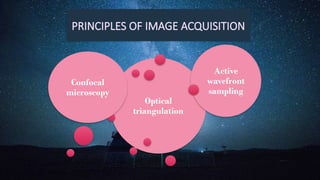
• Principles of image acquisition
• Various scanners
• Factors to consider
• Scanning pattern
• Point cloud count
• Conclusion
• References
INTRODUCTION
What is an IO scanner?
The intraoral scanner is a device that senses asperities of an
object and captures it as 3D data. In general, the object is
irradiated with a laser to acquire three-dimensional data, and the
data is then converted into polygon data, which is a set of
triangular surfaces.
Components of an intraoral scanner
– Camera: The scanner is equipped with a high-resolution camera that captures images of
the teeth and gums. Advanced scanners use multiple cameras to capture different angles
simultaneously, ensuring comprehensive coverage.
– Light Source: Most scanners use a light source, often in the form of a laser or structured
light, to illuminate the oral cavity and enhance the clarity of the captured images.
– Touchscreen Display: Many modern intraoral scanners come with an integrated
touchscreen display, allowing the dental professional to view the scans in real-time, make
annotations, and even zoom in on specific areas.
– Software: The heart of the intraoral scanner is its software. It processes the captured
images, stitches them together, and creates the 3D digital model. Advanced software can also
offer features like color mapping, measurement tools, and integration with other dental
software systems for treatment planning.
– Ergonomic Design: Given that the scanner needs to navigate the tight spaces of the oral
cavity, it’s designed to be compact, lightweight, and ergonomically shaped to ensure comfort
for both the patient and the dental professional.
The underlying technology of intraoral scanning is a blend of optics, computer graphics, and
data processing. By harnessing these technologies, intraoral scanners can deliver precise and
detailed digital impressions, making them an indispensable tool in modern dentistry.
BENEFITS
Chairside analysis
Optimise workflow in practice
Eliminates re- makes
Reduces the number of required appointments
A faster and more comfortable patient experience
Faster turnaround of work
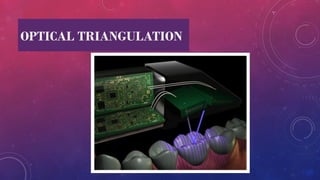
Optical
triangulation
Confocal
microscopy
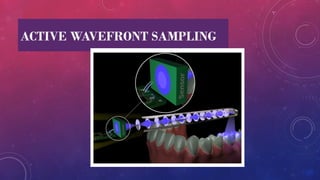
Active
wavefront
sampling
PRINCIPLES OF IMAGE ACQUISITION
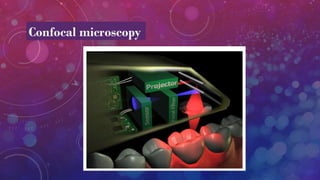
Confocal microscopy
OPTICAL TRIANGULATION
ACTIVE WAVEFRONT SAMPLING
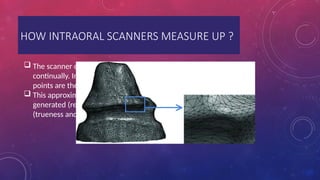
HOW INTRAORAL SCANNERS MEASURE UP ?
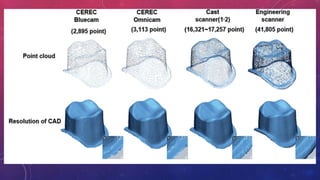
 The scanner does not measure the dental surface
continually. Instead, it generates a point cloud, and these
points are then joined to form the scanned object.
 This approximation will depend on the number of points
generated (resolution), which can lead to low accuracy
(trueness and precision) when fewer points are obtained.
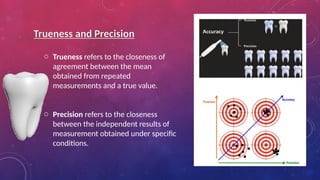
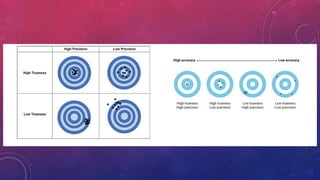
Trueness and Precision
o Trueness refers to the closeness of
agreement between the mean
obtained from repeated
measurements and a true value.
o Precision refers to the closeness
between the independent results of
measurement obtained under specific
conditions.
VARIOUS SCANNERS AVAILABLE IN THE MARKET
1) Align – itero – element 5D
2) 3Shape – Trios 3, 4, 5
3) Medit – i500, i700, i700w
4) Dentsply sirona
5) 3M ESPE – True definition
6) Upcera
7) Dental wings – DWIO
8) VATECH – EzScan
9) GC – Aadva IOS 200
10) Eighteeth – Helios 60
WHICH IS THE BEST?
Dr. Ahmad Al-Hassiny scanned his patient, 14 crown, 15 inlay, 16 onlay,
and 17 crown, with five different IOS to compare between them-
AS 200E by Alliedstar
Aoralscan 3 by Shining 3D
2DS 3.0 by Runyes
TRIOS 5 by 3Shape
CEREC Primescan by Dentsply Sirona
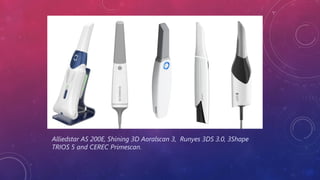
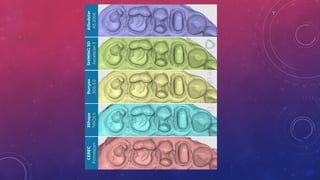
Alliedstar AS 200E, Shining 3D Aoralscan 3, Runyes 3DS 3.0, 3Shape
TRIOS 5 and CEREC Primescan.
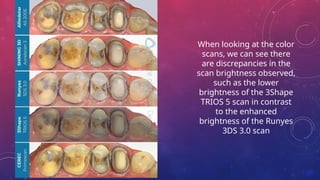
When looking at the color
scans, we can see there
are discrepancies in the
scan brightness observed,
such as the lower
brightness of the 3Shape
TRIOS 5 scan in contrast
to the enhanced
brightness of the Runyes
3DS 3.0 scan
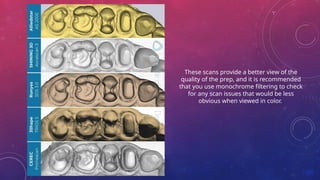
These scans provide a better view of the
quality of the prep, and it is recommended
that you use monochrome filtering to check
for any scan issues that would be less
obvious when viewed in color.
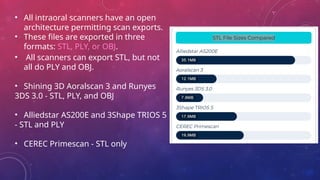
• All intraoral scanners have an open
architecture permitting scan exports.
• These files are exported in three
formats: STL, PLY, or OBJ.
• All scanners can export STL, but not
all do PLY and OBJ.
• Shining 3D Aoralscan 3 and Runyes
3DS 3.0 - STL, PLY, and OBJ
• Alliedstar AS200E and 3Shape TRIOS 5
- STL and PLY
• CEREC Primescan - STL only
SCAN ACCURACY
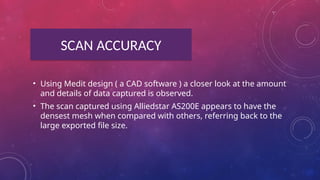
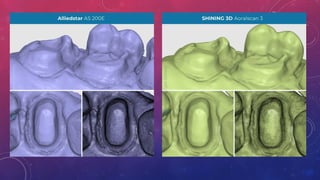
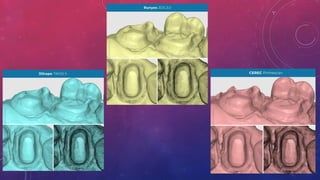
• Using Medit design ( a CAD software ) a closer look at the amount
and details of data captured is observed.
• The scan captured using Alliedstar AS200E appears to have the
densest mesh when compared with others, referring back to the
large exported file size.
• Across all the evaluated digital intraoral scanners, TRIOS 5 emerged as
the ,most accurate ]in recording data.
• Moreover, the output of all four scanners falls within a clinically
acceptable range for full arch digital impression utility.
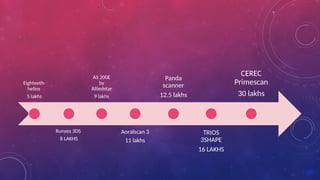
Eighteeth-
helios
5 lakhs
Runyes 3DS
8 LAKHS
AS 200E
by
Alliedstar
9 lakhs
Aoralscan 3
11 lakhs
Panda
scanner
12.5 lakhs
TRIOS
3SHAPE
16 LAKHS
CEREC
Primescan
30 lakhs
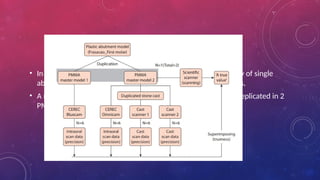
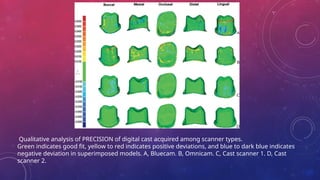
• In a study conducted by Jae-Jun Lee, on comparing the accuracy of single
abutment digital cast obtained using intraoral and cast scanners,
• A maxillary first molar was selected as abutment to study and replicated in 2
PMMA models .
Qualitative analysis of PRECISION of digital cast acquired among scanner types.
Green indicates good fit, yellow to red indicates positive deviations, and blue to dark blue indicates
negative deviation in superimposed models. A, Bluecam. B, Omnicam. C, Cast scanner 1. D, Cast
scanner 2.
FACTORS TO CONSIDER
• Accuracy
• Ease of use
• Speed
• Size
• Integration
• Patient communication
• Durability
• Software
SCANNING PATTERN
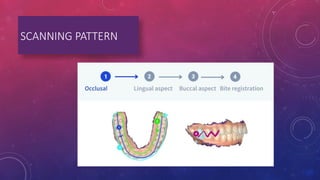
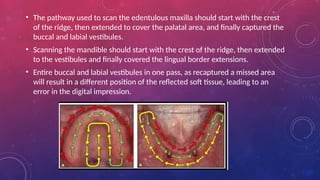
• The pathway used to scan the edentulous maxilla should start with the crest
of the ridge, then extended to cover the palatal area, and finally captured the
buccal and labial vestibules.
• Scanning the mandible should start with the crest of the ridge, then extended
to the vestibules and finally covered the lingual border extensions.
• Entire buccal and labial vestibules in one pass, as recaptured a missed area
will result in a different position of the reflected soft tissue, leading to an
error in the digital impression.
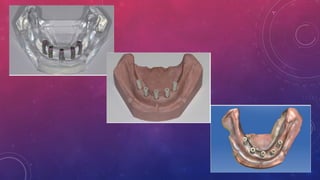
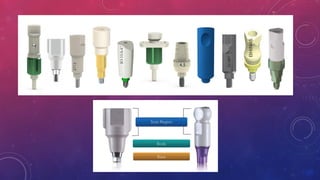
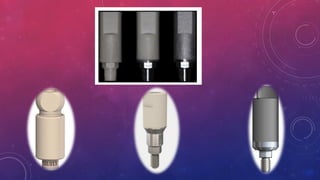
INTRA ORAL SCANNERS IN IMPLANTOLOGY
RECENT ADVANCES
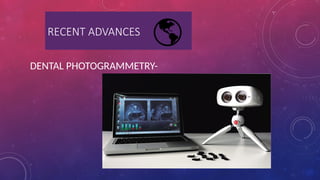
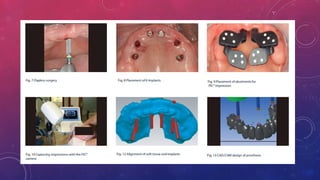
DENTAL PHOTOGRAMMETRY-
• Integrating advanced intraoral scanners can streamline workflows, reduce
chairside time, and enhance patient experience through more comfortable
and efficient scanning processes .
• Opting for scanners equipped with the most recent hardware and software
versions ensures enhanced precision and compatibility with evolving digital
workflows.
CONCLUSION
• Logozzo S, Zanetti EM, Franceschini G, Kilpelä A, Mäkynen A. Recent advances in dental optics-Part I: 3D
intraoral scanners for restorative dentistry. Optics and Lasers in Engineering. 2014 Mar 1;54:203-21.
• Richert R, Goujat A, Venet L, Viguie G, Viennot S, Robinson P, Farges JC, Fages M, Ducret M. Intraoral scanner
technologies: a review to make a successful impression. Journal of healthcare engineering. 2017;2017.
• Goodacre BJ, Goodacre CJ, Baba NZ. Using Intraoral Scanning to Capture Complete Denture Impressions,
Tooth Positions, and Centric Relation Records. International Journal of Prosthodontics. 2018 Jul 1;31(4).
• Medina-Sotomayor P, Pascual A, Camps I. Accuracy of four digital scanners according to scanning strategy in
complete-arch impressions. PloS one. 2018 Sep 13;13(9):e0202916.
• Lee JJ, Jeong ID, Park JY, Jeon JH, Kim JH, Kim WC. Accuracy of single-abutment digital cast
obtained using intraoral and cast scanners. J Prosthet Dent. 2017 Feb;117(2):253-259. doi:
10.1016/j.prosdent.2016.07.021. Epub 2016 Sep 22. PMID: 27666500.
REFERENCES
Thank you

An insight into intraoral scanner technology

  • 2.
    AN INSIGHT INTO INTRAORALSCANNER Presented by Y. Manjusha 1st year Postgraduate Dept. Of Prosthodontics And Crown and Bridge
  • 3.
    CONTENTS • Introduction • Benefits •Principles of image acquisition • Various scanners • Factors to consider • Scanning pattern • Point cloud count • Conclusion • References
  • 4.
    INTRODUCTION What is anIO scanner? The intraoral scanner is a device that senses asperities of an object and captures it as 3D data. In general, the object is irradiated with a laser to acquire three-dimensional data, and the data is then converted into polygon data, which is a set of triangular surfaces.
  • 5.
    Components of anintraoral scanner – Camera: The scanner is equipped with a high-resolution camera that captures images of the teeth and gums. Advanced scanners use multiple cameras to capture different angles simultaneously, ensuring comprehensive coverage. – Light Source: Most scanners use a light source, often in the form of a laser or structured light, to illuminate the oral cavity and enhance the clarity of the captured images. – Touchscreen Display: Many modern intraoral scanners come with an integrated touchscreen display, allowing the dental professional to view the scans in real-time, make annotations, and even zoom in on specific areas.
  • 6.
    – Software: Theheart of the intraoral scanner is its software. It processes the captured images, stitches them together, and creates the 3D digital model. Advanced software can also offer features like color mapping, measurement tools, and integration with other dental software systems for treatment planning. – Ergonomic Design: Given that the scanner needs to navigate the tight spaces of the oral cavity, it’s designed to be compact, lightweight, and ergonomically shaped to ensure comfort for both the patient and the dental professional. The underlying technology of intraoral scanning is a blend of optics, computer graphics, and data processing. By harnessing these technologies, intraoral scanners can deliver precise and detailed digital impressions, making them an indispensable tool in modern dentistry.
  • 7.
    BENEFITS Chairside analysis Optimise workflowin practice Eliminates re- makes Reduces the number of required appointments A faster and more comfortable patient experience Faster turnaround of work
  • 8.
  • 9.
  • 10.
  • 11.
  • 12.
    HOW INTRAORAL SCANNERSMEASURE UP ?  The scanner does not measure the dental surface continually. Instead, it generates a point cloud, and these points are then joined to form the scanned object.  This approximation will depend on the number of points generated (resolution), which can lead to low accuracy (trueness and precision) when fewer points are obtained.
  • 13.
    Trueness and Precision oTrueness refers to the closeness of agreement between the mean obtained from repeated measurements and a true value. o Precision refers to the closeness between the independent results of measurement obtained under specific conditions.
  • 15.
    VARIOUS SCANNERS AVAILABLEIN THE MARKET 1) Align – itero – element 5D 2) 3Shape – Trios 3, 4, 5 3) Medit – i500, i700, i700w 4) Dentsply sirona 5) 3M ESPE – True definition 6) Upcera 7) Dental wings – DWIO 8) VATECH – EzScan 9) GC – Aadva IOS 200 10) Eighteeth – Helios 60
  • 16.
  • 17.
    Dr. Ahmad Al-Hassinyscanned his patient, 14 crown, 15 inlay, 16 onlay, and 17 crown, with five different IOS to compare between them- AS 200E by Alliedstar Aoralscan 3 by Shining 3D 2DS 3.0 by Runyes TRIOS 5 by 3Shape CEREC Primescan by Dentsply Sirona
  • 18.
    Alliedstar AS 200E,Shining 3D Aoralscan 3, Runyes 3DS 3.0, 3Shape TRIOS 5 and CEREC Primescan.
  • 19.
    When looking atthe color scans, we can see there are discrepancies in the scan brightness observed, such as the lower brightness of the 3Shape TRIOS 5 scan in contrast to the enhanced brightness of the Runyes 3DS 3.0 scan
  • 20.
    These scans providea better view of the quality of the prep, and it is recommended that you use monochrome filtering to check for any scan issues that would be less obvious when viewed in color.
  • 21.
    • All intraoralscanners have an open architecture permitting scan exports. • These files are exported in three formats: STL, PLY, or OBJ. • All scanners can export STL, but not all do PLY and OBJ. • Shining 3D Aoralscan 3 and Runyes 3DS 3.0 - STL, PLY, and OBJ • Alliedstar AS200E and 3Shape TRIOS 5 - STL and PLY • CEREC Primescan - STL only
  • 23.
    SCAN ACCURACY • UsingMedit design ( a CAD software ) a closer look at the amount and details of data captured is observed. • The scan captured using Alliedstar AS200E appears to have the densest mesh when compared with others, referring back to the large exported file size.
  • 26.
    • Across allthe evaluated digital intraoral scanners, TRIOS 5 emerged as the ,most accurate ]in recording data. • Moreover, the output of all four scanners falls within a clinically acceptable range for full arch digital impression utility.
  • 27.
    Eighteeth- helios 5 lakhs Runyes 3DS 8LAKHS AS 200E by Alliedstar 9 lakhs Aoralscan 3 11 lakhs Panda scanner 12.5 lakhs TRIOS 3SHAPE 16 LAKHS CEREC Primescan 30 lakhs
  • 30.
    • In astudy conducted by Jae-Jun Lee, on comparing the accuracy of single abutment digital cast obtained using intraoral and cast scanners, • A maxillary first molar was selected as abutment to study and replicated in 2 PMMA models .
  • 31.
    Qualitative analysis ofPRECISION of digital cast acquired among scanner types. Green indicates good fit, yellow to red indicates positive deviations, and blue to dark blue indicates negative deviation in superimposed models. A, Bluecam. B, Omnicam. C, Cast scanner 1. D, Cast scanner 2.
  • 33.
    FACTORS TO CONSIDER •Accuracy • Ease of use • Speed • Size • Integration • Patient communication • Durability • Software
  • 34.
  • 35.
    • The pathwayused to scan the edentulous maxilla should start with the crest of the ridge, then extended to cover the palatal area, and finally captured the buccal and labial vestibules. • Scanning the mandible should start with the crest of the ridge, then extended to the vestibules and finally covered the lingual border extensions. • Entire buccal and labial vestibules in one pass, as recaptured a missed area will result in a different position of the reflected soft tissue, leading to an error in the digital impression.
  • 36.
    INTRA ORAL SCANNERSIN IMPLANTOLOGY
  • 42.
  • 45.
    • Integrating advancedintraoral scanners can streamline workflows, reduce chairside time, and enhance patient experience through more comfortable and efficient scanning processes . • Opting for scanners equipped with the most recent hardware and software versions ensures enhanced precision and compatibility with evolving digital workflows. CONCLUSION
  • 46.
    • Logozzo S,Zanetti EM, Franceschini G, Kilpelä A, Mäkynen A. Recent advances in dental optics-Part I: 3D intraoral scanners for restorative dentistry. Optics and Lasers in Engineering. 2014 Mar 1;54:203-21. • Richert R, Goujat A, Venet L, Viguie G, Viennot S, Robinson P, Farges JC, Fages M, Ducret M. Intraoral scanner technologies: a review to make a successful impression. Journal of healthcare engineering. 2017;2017. • Goodacre BJ, Goodacre CJ, Baba NZ. Using Intraoral Scanning to Capture Complete Denture Impressions, Tooth Positions, and Centric Relation Records. International Journal of Prosthodontics. 2018 Jul 1;31(4). • Medina-Sotomayor P, Pascual A, Camps I. Accuracy of four digital scanners according to scanning strategy in complete-arch impressions. PloS one. 2018 Sep 13;13(9):e0202916. • Lee JJ, Jeong ID, Park JY, Jeon JH, Kim JH, Kim WC. Accuracy of single-abutment digital cast obtained using intraoral and cast scanners. J Prosthet Dent. 2017 Feb;117(2):253-259. doi: 10.1016/j.prosdent.2016.07.021. Epub 2016 Sep 22. PMID: 27666500. REFERENCES
  • 47.

Editor's Notes

  • #9 The scanner uses confocal laser scanning in which a laser beam is projected on an object, via a beam splitter, the reflected beam is led through a focal filter so that only the image that lies in the focal point of the lens can project on the sensor. The distance of the scanned part of the object to the lens is known as THE FOCAL DISTANCE. To scan the whole object, the lens is moved up and down, each time projecting a part of the object onto the sensor.
  • #10 It is of two types Active and Passive triangulation . In active triangulation methods, a light radiation is projected onto the object, and its reflection is acquired in order to calculate the position of the object. In passive triangulation methods no kind of radiation is emitted by the scanning device itself and the system is based on detecting reflected ambient radiation
  • #11 AWS imaging allows any system with a digital camera to function in 3D. It eliminates the need for multiple cameras to acquire 3D geometries. It consists of an off – axis aperture which moves on a circular path around the optical axis. This movement produces the rotation of target points on a circle on the image plane. Depth information of the target point can be derived from the radius of the circular point pattern by each point. Advantage being use of only one path for reconstruction of the object.
  • #13 Accuracy is a qualitative value which is determined by the closeness of agreement between a result of a measurement and true value of the measurement. It is determined by trueness and precision.
  • #19 The saturation and brightness of the scans captured using the Alliedstar AS 200E, Shining 3D Aoralscan 3, and CEREC Primescan IOS appear to be similar, with the Alliedstar AS 200E possessing slightly more surface texture within the color scan as previewed in its native scanner software.
  • #22 All scans were exported in an STL format and previewed in the Medit Design app.
  • #25 TRIOS 5 appeared to have captured the most detailed, prominent, visible margin line
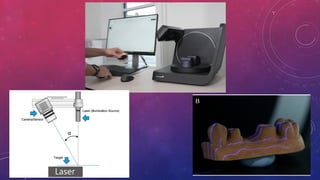
  • #29 A dental laboratory scanner, also called a dental model scanner is a desktop scanner that allows dental technicians to simply place a model (or die — a small model of the crown or root surface of the tooth) inside it, press a button, and the scanner generates a 3D model. The way the scanner works is by simultaneously projecting light onto the scanned object and capturing an image of the object with on-board cameras. Combined, this will generate a 3D model of the object right away. Some scanners use laser light, but nowadays most scanners use structured light.
  • #31 In the analysis of trueness of the digital scanner casts, significant differences were observed among Bluecam (17.5 ±1.8 mm), cast scanner 1 (17.4 ±1.7 mm), Omnicam (13.8 ±1.4 mm), and cast scanner 2 (12.3 ±0.1 mm), in descending order. Cast scanner 2 showed the minimum difference from the scan data indicating the true value and did not show a statistically significant difference compared with Omnicam. In addition, a significant difference was found in trueness between cast scanners 1 and 2 (P
  • #33 The scanner's accuracy is important for the fit of the final restoration. It should be able to capture fine details for all types of restorations.  Consider how easy the software is to manage and set up, as well as how intuitive it is. The scanner should also be comfortable to hold and use in the patient's mouth.  . How quickly the scanner can make a 3D impression model is important, as it can then be sent to the lab quickly  The scanner should be comfortable to hold, so consider its size and weight. 
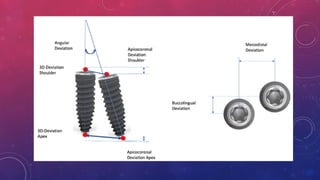
  • #38 During scan of the scan body- 3 dimensional measurements of implant is captured like trajectory, depth, rotation
  • #42 A process that estimates the three-dimensional coordinates of surface points using pictures of a single physical object taken from different angles