Recommendations of the Massachusetts
Water Infrastructure Finance Commission
Martin Pillsbury
Metropolitan Area
Planning Council
Boston, MA
The Water Headlines…
 Massachusetts has a drinking water finance problem…..
 ….and a wastewater finance problem….
 ….and soon to have a storm water finance problem.
 Water is one of our state’s greatest assets, but if we don’t
manage it well, it can be a liability.
 What will it take to manage it well?
 Smart, sustainable policies and regulations
 Innovative approaches to water management
 Sustained investment in critical infrastructure
Water Infrastructure Finance Commission
 Established by the Legislature in 2009
 Chaired by Senator Jamie Eldridge
 Leading House member Rep. Carolyn Dykema
 18 members from multiple water stakeholder groups
 Convened in May 2010 and issued its final report in Feb. 2012
 Charged with “developing a comprehensive, long-range
water infrastructure finance plan for the commonwealth and
municipalities”
Mind the Gap ($21.4 Billion of it)
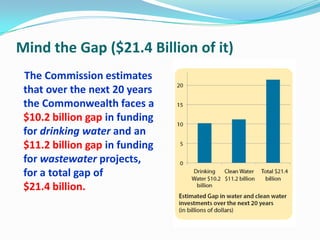
The Commission estimates
that over the next 20 years
the Commonwealth faces a
$10.2 billion gap in funding
for drinking water and an
$11.2 billion gap in funding
for wastewater projects,
for a total gap of
$21.4 billion.
Mind the Gap ($21.4 Billion of it)
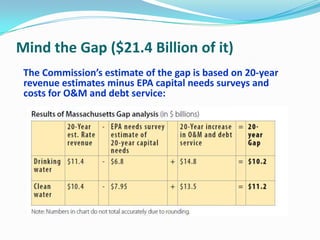
The Commission’s estimate of the gap is based on 20-year
revenue estimates minus EPA capital needs surveys and
costs for O&M and debt service:
Total Projected 20-Year Funding Gap
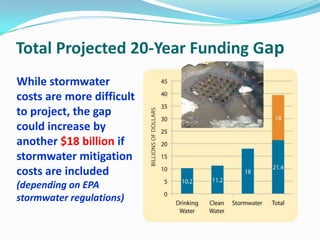
While stormwater
costs are more difficult
to project, the gap
could increase by
another $18 billion if
stormwater mitigation
costs are included
(depending on EPA
stormwater regulations)
What’s Behind the Gap?
Water utilities face many cost challenges:
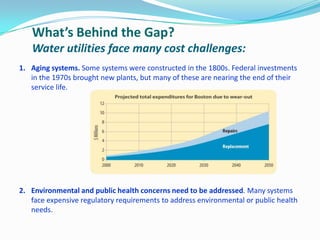
1. Aging systems. Some systems were constructed in the 1800s. Federal investments
in the 1970s brought new plants, but many of these are nearing the end of their
service life.
2. Environmental and public health concerns need to be addressed. Many systems
face expensive regulatory requirements to address environmental or public health
needs.
What’s Behind the Gap?
Water utilities face many cost challenges:
3. Lack of state control over Clean Water permits. Massachusetts has not accepted
“primacy” to enforce the Clean Water Act. This may provide flexibility to prioritize
scarce resources.
4. Security and redundancy investments are required. Communities must invest to
protect the public during emergencies -- from natural disasters to system failures
to acts of terrorism.
5. Operating costs are rising. Water and wastewater operations use a significant
amount of energy, chemicals and manpower. As these costs rise, so does the cost
of providing clean water.
6. Many water utilities are not running at optimal efficiency. Best management
practices are used only partially by systems across the state. Many need technical
assistance and training.
What’s Behind the Gap?
Water utilities face many cost challenges:
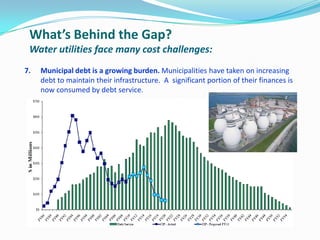
7. Municipal debt is a growing burden. Municipalities have taken on increasing
debt to maintain their infrastructure. A significant portion of their finances is
now consumed by debt service.
What’s Behind the Gap?
Revenues are not keeping pace with needs:
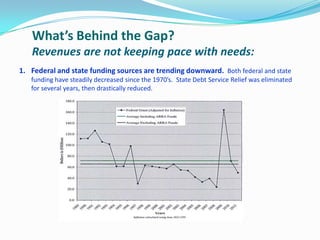
1. Federal and state funding sources are trending downward. Both federal and state
funding have steadily decreased since the 1970’s. State Debt Service Relief was eliminated
for several years, then drastically reduced.
What’s Behind the Gap?
Revenues are not keeping pace with needs:
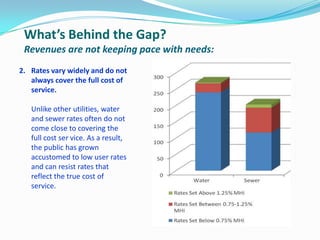
2. Rates vary widely and do not
always cover the full cost of
service.
Unlike other utilities, water
and sewer rates often do not
come close to covering the
full cost ser vice. As a result,
the public has grown
accustomed to low user rates
and can resist rates that
reflect the true cost of
service.
What’s Behind the Gap?
Revenues are not keeping pace with needs:
3. Unanticipated financial effects of water conservation have an impact on utilities’
bottom lines. Increasing levels of water conservation is good for the environment
and should be encouraged. Because water is billed based on volume sold,
however, it has led to reduced revenues for maintaining water systems.
4. Affordability is an important issue for many communities. Keeping water and
sewer service affordable is of particular concern to individuals on low and/or fixed
incomes. It is important to recognize that different communities have different
abilities to pay for improvements.
Recommendations of the Commission
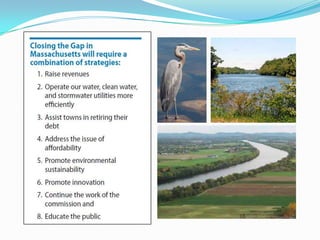
1. Increase funds available for water-related infrastructure at all levels
 Sustain current programs and investments at the state and federal level,
including in particular state and federal contributions to the Water and
Sewer State Revolving Funds
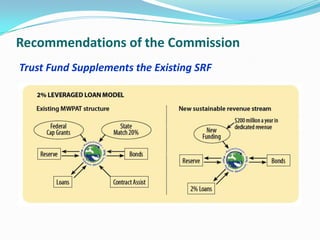
 Establish a new Trust Fund, to be funded annually at $200 million and
used for a mixed program of direct payments to cities and towns, low
interest loans, and grants
 Incent all communities, authorities and districts to utilize rate structures
that reflect the full cost of water supply and wastewater treatment.
Recommendations of the Commission
2. Reduce costs and find efficiencies
 Provide strong incentives to use best management practices
 Encourage enterprise funds for stormwater mitigation
 Encourage appropriate regional solutions
 Use a watershed approach when making funding decisions
 Encourage efficient water and energy use
 Encourage strategic public-private partnerships
Recommendations of the Commission
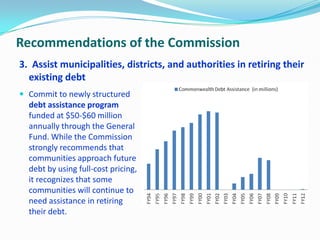
3. Assist municipalities, districts, and authorities in retiring their
existing debt
 Commit to newly structured
debt assistance program
funded at $50-$60 million
annually through the General
Fund. While the Commission
strongly recommends that
communities approach future
debt by using full-cost pricing,
it recognizes that some
communities will continue to
need assistance in retiring
their debt.
Recommendations of the Commission
4. Address the issue of affordability
 Identify creative ways to address affordability for municipalities and individual
ratepayers. Measure their local contribution and commitment using a ratio of
average household annual utility cost to the community’s Median Household
Income (MHI ratio).
 Consider making SRF loan decisions more need-based by considering the MHI
ratio in the selection criteria for loans, grants, interest rates and principal
forgiveness
 Seek new federal and state support to address affordability concerns
Recommendations of the Commission
5. Promote Environmental Sustainability
 Promote water conservation and water reuse
 Reduce the release of nutrients
 Encourage energy efficiency
 Prioritize solutions that keep water within its basin
 Protect water sources through watershed protection programs
 Encourage integrated resource management
 Increase regulatory flexibility to better direct funding to projects
that deliver the highest public benefit
Recommendations of the Commission
6. Promote Innovation
 Supporting pilot projects, proof of concept projects and new technology
 Provide technical assistance to communities for innovative approaches
 Reduce regulatory barriers to innovation
 Address the economic risk of pilot innovative projects
 Invest in Massachusetts as a hub of innovation in the field of water, wastewater,
and stormwater management and technology
Recommendations of the Commission
Strategies to Help Us Close the Gap
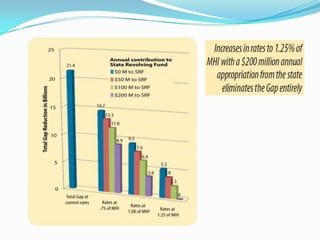
 If municipalities, districts and authorities adopt full-cost pricing
combined with moderate, predictable rate increases and increase their
water and sewer rates to between 1.25 and 1.50 percent of their
Median Household Income, and
 If the state creates and consistently funds a new Trust Fund with $200
million to provide a mix of direct assistance, low interest loans and
grants to assist towns with their water infrastructure needs, then
…the state will be able to reduce the gap substantially, perhaps by up to
80%, over the next 20 years.
Recommendations of the Commission
Trust Fund Supplements the Existing SRF
.
Massachusetts Water Infrastructure: Toward Financial Sustainability

Massachusetts Water Infrastructure: Toward Financial Sustainability

  • 1.
    Recommendations of theMassachusetts Water Infrastructure Finance Commission Martin Pillsbury Metropolitan Area Planning Council Boston, MA
  • 2.
    The Water Headlines… Massachusetts has a drinking water finance problem…..  ….and a wastewater finance problem….  ….and soon to have a storm water finance problem.  Water is one of our state’s greatest assets, but if we don’t manage it well, it can be a liability.  What will it take to manage it well?  Smart, sustainable policies and regulations  Innovative approaches to water management  Sustained investment in critical infrastructure
  • 3.
    Water Infrastructure FinanceCommission  Established by the Legislature in 2009  Chaired by Senator Jamie Eldridge  Leading House member Rep. Carolyn Dykema  18 members from multiple water stakeholder groups  Convened in May 2010 and issued its final report in Feb. 2012  Charged with “developing a comprehensive, long-range water infrastructure finance plan for the commonwealth and municipalities”
  • 4.
    Mind the Gap($21.4 Billion of it) The Commission estimates that over the next 20 years the Commonwealth faces a $10.2 billion gap in funding for drinking water and an $11.2 billion gap in funding for wastewater projects, for a total gap of $21.4 billion.
  • 5.
    Mind the Gap($21.4 Billion of it) The Commission’s estimate of the gap is based on 20-year revenue estimates minus EPA capital needs surveys and costs for O&M and debt service:
  • 6.
    Total Projected 20-YearFunding Gap While stormwater costs are more difficult to project, the gap could increase by another $18 billion if stormwater mitigation costs are included (depending on EPA stormwater regulations)
  • 7.
    What’s Behind theGap? Water utilities face many cost challenges: 1. Aging systems. Some systems were constructed in the 1800s. Federal investments in the 1970s brought new plants, but many of these are nearing the end of their service life. 2. Environmental and public health concerns need to be addressed. Many systems face expensive regulatory requirements to address environmental or public health needs.
  • 8.
    What’s Behind theGap? Water utilities face many cost challenges: 3. Lack of state control over Clean Water permits. Massachusetts has not accepted “primacy” to enforce the Clean Water Act. This may provide flexibility to prioritize scarce resources. 4. Security and redundancy investments are required. Communities must invest to protect the public during emergencies -- from natural disasters to system failures to acts of terrorism. 5. Operating costs are rising. Water and wastewater operations use a significant amount of energy, chemicals and manpower. As these costs rise, so does the cost of providing clean water. 6. Many water utilities are not running at optimal efficiency. Best management practices are used only partially by systems across the state. Many need technical assistance and training.
  • 9.
    What’s Behind theGap? Water utilities face many cost challenges: 7. Municipal debt is a growing burden. Municipalities have taken on increasing debt to maintain their infrastructure. A significant portion of their finances is now consumed by debt service.
  • 10.
    What’s Behind theGap? Revenues are not keeping pace with needs: 1. Federal and state funding sources are trending downward. Both federal and state funding have steadily decreased since the 1970’s. State Debt Service Relief was eliminated for several years, then drastically reduced.
  • 11.
    What’s Behind theGap? Revenues are not keeping pace with needs: 2. Rates vary widely and do not always cover the full cost of service. Unlike other utilities, water and sewer rates often do not come close to covering the full cost ser vice. As a result, the public has grown accustomed to low user rates and can resist rates that reflect the true cost of service.
  • 12.
    What’s Behind theGap? Revenues are not keeping pace with needs: 3. Unanticipated financial effects of water conservation have an impact on utilities’ bottom lines. Increasing levels of water conservation is good for the environment and should be encouraged. Because water is billed based on volume sold, however, it has led to reduced revenues for maintaining water systems. 4. Affordability is an important issue for many communities. Keeping water and sewer service affordable is of particular concern to individuals on low and/or fixed incomes. It is important to recognize that different communities have different abilities to pay for improvements.
  • 13.
    Recommendations of theCommission 1. Increase funds available for water-related infrastructure at all levels  Sustain current programs and investments at the state and federal level, including in particular state and federal contributions to the Water and Sewer State Revolving Funds  Establish a new Trust Fund, to be funded annually at $200 million and used for a mixed program of direct payments to cities and towns, low interest loans, and grants  Incent all communities, authorities and districts to utilize rate structures that reflect the full cost of water supply and wastewater treatment.
  • 14.
    Recommendations of theCommission 2. Reduce costs and find efficiencies  Provide strong incentives to use best management practices  Encourage enterprise funds for stormwater mitigation  Encourage appropriate regional solutions  Use a watershed approach when making funding decisions  Encourage efficient water and energy use  Encourage strategic public-private partnerships
  • 15.
    Recommendations of theCommission 3. Assist municipalities, districts, and authorities in retiring their existing debt  Commit to newly structured debt assistance program funded at $50-$60 million annually through the General Fund. While the Commission strongly recommends that communities approach future debt by using full-cost pricing, it recognizes that some communities will continue to need assistance in retiring their debt.
  • 16.
    Recommendations of theCommission 4. Address the issue of affordability  Identify creative ways to address affordability for municipalities and individual ratepayers. Measure their local contribution and commitment using a ratio of average household annual utility cost to the community’s Median Household Income (MHI ratio).  Consider making SRF loan decisions more need-based by considering the MHI ratio in the selection criteria for loans, grants, interest rates and principal forgiveness  Seek new federal and state support to address affordability concerns
  • 17.
    Recommendations of theCommission 5. Promote Environmental Sustainability  Promote water conservation and water reuse  Reduce the release of nutrients  Encourage energy efficiency  Prioritize solutions that keep water within its basin  Protect water sources through watershed protection programs  Encourage integrated resource management  Increase regulatory flexibility to better direct funding to projects that deliver the highest public benefit
  • 18.
    Recommendations of theCommission 6. Promote Innovation  Supporting pilot projects, proof of concept projects and new technology  Provide technical assistance to communities for innovative approaches  Reduce regulatory barriers to innovation  Address the economic risk of pilot innovative projects  Invest in Massachusetts as a hub of innovation in the field of water, wastewater, and stormwater management and technology
  • 19.
    Recommendations of theCommission Strategies to Help Us Close the Gap  If municipalities, districts and authorities adopt full-cost pricing combined with moderate, predictable rate increases and increase their water and sewer rates to between 1.25 and 1.50 percent of their Median Household Income, and  If the state creates and consistently funds a new Trust Fund with $200 million to provide a mix of direct assistance, low interest loans and grants to assist towns with their water infrastructure needs, then …the state will be able to reduce the gap substantially, perhaps by up to 80%, over the next 20 years.
  • 20.
    Recommendations of theCommission Trust Fund Supplements the Existing SRF
  • 21.