Green Infrastructure Finance
  What’s Old is New and What’s Really New


         Bill Holman and Lydia Olander
       Nicholas Institute, Duke University
Urban Water Sustainability Leadership Conference
         October 3-5, in Milwaukee WI
Sources of Water Finance
• Your money – water rates
  – Base fees and volumetric fees
  – Revenueshed
• Other people’s money – leverage
  – Credits
  – Markets
  – Incentives
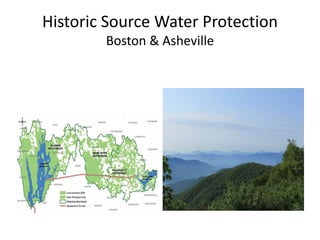
Historic Source Water Protection
        Boston & Asheville
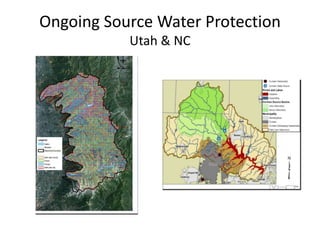
Ongoing Source Water Protection
           Utah & NC
Willingness to Pay
• Assured supplies of clean water
  – Essential to public health, environment ,economy
    and electricity
• Value of water is increasing
  – Water risk is a business issue
• Protect water quantity as well as quality
  – Value of capacity
• Utility $ leverage other $
• No public awareness = No willingness
Source Water Protection Theory
• Identify risks
• Increase public awareness & support
• Implement policies to reduce risks
  – Adopt rules, conserve land, clean up sites…
• Limited program success
• How could this program be improved?
Terms
Financing for Green Infrastructure
can include:
• Payment for Ecosystem Services
• Payment for Watershed Services
Interchangeable terms for common ideas

Ecosystem Service Markets are a variation on
this theme
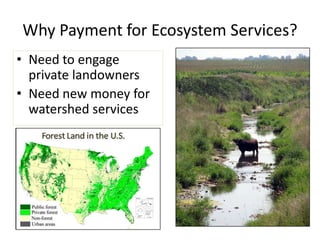
Why Payment for Ecosystem Services?
• Need to engage
  private landowners
• Need new money for
  watershed services
Types of financing
1. Traditional financing

2. Regulation driven ES financing
      • Water quality trading (developers); wetland and stream
        mitigation

3. Privately funded social marketing

4. Other ES programs that provide watershed
   services
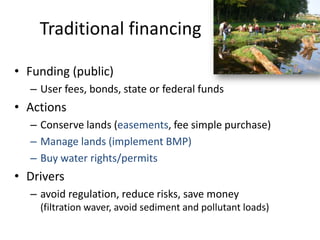
Traditional financing

• Funding (public)
  – User fees, bonds, state or federal funds
• Actions
  – Conserve lands (easements, fee simple purchase)
  – Manage lands (implement BMP)
  – Buy water rights/permits
• Drivers
  – avoid regulation, reduce risks, save money
    (filtration waver, avoid sediment and pollutant loads)
Traditional financing – New design
• Auctions/ Bidding
  – Conestoga Watershed Reverse Auction (PA) -P loading- CIG grant
    to test new payment approach- paying for best bids (P/$)
  – Flint River Drought Protection Auctions (GA)- state auction pays
    landowners to retire water permits
• Revolving fund for BMPs
  – Conserve to Enhance (Tucson AZ) – EPA grant pays subsidies for
    participants to install water harvesting features in homes,
    participants track water use and pay amount saved on water
    bills back to the program
• Cross boundary PES
  – The Upper Neuse Clean Water Initiative (NC) – City of Raleigh is
    paying the neighboring (upstream) county for land conservation
    and resulting water benefits using water fees.
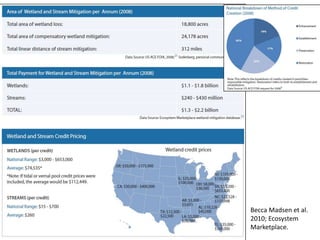
Regulation driven ES financing
• Funding (regulated entities)
   – Clean Water Act
       • Land developers for wetland and stream mitigation
       • Wastewater dischargers (NPDES and State) – water quality trading
   – Endangered Species Act
       • Land developers for habitat mitigation (Salmon in NW; others?)
• Actions
   – Mitigation for damages (restore or create required ecosystem
     acreage and services; often conservation)
   – Offset for pollutant discharges – trading permits to pollute
     (Management to reduce pollutant loads or impacts)
• Issue
   – How to harness all of this funding and activity so that it
     provides benefits for your watersheds?
Becca Madsen et al.
2010; Ecosystem
Marketplace.
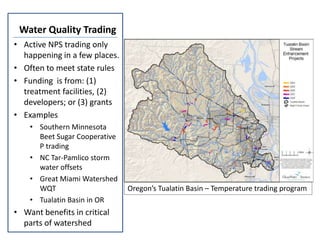
Water Quality Trading
• Active NPS trading only
  happening in a few places.
• Often to meet state rules
• Funding is from: (1)
  treatment facilities, (2)
  developers; or (3) grants
• Examples
    • Southern Minnesota
      Beet Sugar Cooperative
      P trading
    • NC Tar-Pamlico storm
      water offsets
    • Great Miami Watershed
      WQT                      Oregon’s Tualatin Basin – Temperature trading program
    • Tualatin Basin in OR
• Want benefits in critical
  parts of watershed
Regulation driven activity

• Harnessing potential benefits of mitigation
  and trading programs
• Needs integrated planning and management
  across federal, state agencies, municipal govts
  and other funding opportunities.
  – Way to encourage priority siting and types of
    projects (value adder; service/trading area
    priorities)
• New money from developer funded activities
Voluntary -Social benefits market/PES
• Bonneville Environmental Foundation “Water
  Restoration Certificates”
   – Private entities pay for water restoration certificates for
     their marketing/social benefits
   – Pay landowners to take actions that restore water flow
   – Credits are retired, not traded
   – Avoids potential regulatory risks

• Wal-Mart’s Acres for America program – voluntary
  program to permanently protect an acre for every acre
  of land developed for its stores (no specific intention to
  match quality of habitat)
Other payments/markets
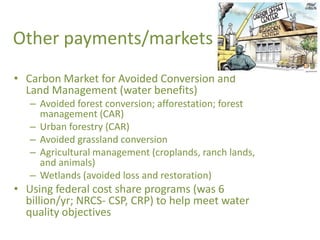
• Carbon Market for Avoided Conversion and
  Land Management (water benefits)
   – Avoided forest conversion; afforestation; forest
     management (CAR)
   – Urban forestry (CAR)
   – Avoided grassland conversion
   – Agricultural management (croplands, ranch lands,
     and animals)
   – Wetlands (avoided loss and restoration)
• Using federal cost share programs (was 6
  billion/yr; NRCS- CSP, CRP) to help meet water
  quality objectives
For more information
http://nicholasinstitute.duke.edu/
What we know about GI/ES
• We know general relationships
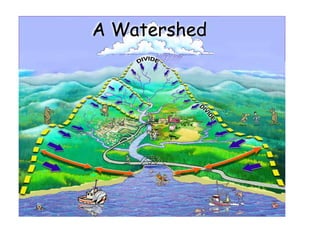
  – Wetlands slow down and clean up water
  – Forests moderate flow and reduce sediment loads
• We don’t know (without research)
  – Specific production functions
  – What type of wetland, how big and where will
    have how much impact on water flow and quality
  – How much forest and where will have how much
    impact on water flow and sediment loads
Green infrastructure finance

Green infrastructure finance

  • 1.
    Green Infrastructure Finance What’s Old is New and What’s Really New Bill Holman and Lydia Olander Nicholas Institute, Duke University Urban Water Sustainability Leadership Conference October 3-5, in Milwaukee WI
  • 2.
    Sources of WaterFinance • Your money – water rates – Base fees and volumetric fees – Revenueshed • Other people’s money – leverage – Credits – Markets – Incentives
  • 3.
    Historic Source WaterProtection Boston & Asheville
  • 4.
    Ongoing Source WaterProtection Utah & NC
  • 5.
    Willingness to Pay •Assured supplies of clean water – Essential to public health, environment ,economy and electricity • Value of water is increasing – Water risk is a business issue • Protect water quantity as well as quality – Value of capacity • Utility $ leverage other $ • No public awareness = No willingness
  • 6.
    Source Water ProtectionTheory • Identify risks • Increase public awareness & support • Implement policies to reduce risks – Adopt rules, conserve land, clean up sites… • Limited program success • How could this program be improved?
  • 7.
    Terms Financing for GreenInfrastructure can include: • Payment for Ecosystem Services • Payment for Watershed Services Interchangeable terms for common ideas Ecosystem Service Markets are a variation on this theme
  • 8.
    Why Payment forEcosystem Services? • Need to engage private landowners • Need new money for watershed services
  • 9.
    Types of financing 1.Traditional financing 2. Regulation driven ES financing • Water quality trading (developers); wetland and stream mitigation 3. Privately funded social marketing 4. Other ES programs that provide watershed services
  • 10.
    Traditional financing • Funding(public) – User fees, bonds, state or federal funds • Actions – Conserve lands (easements, fee simple purchase) – Manage lands (implement BMP) – Buy water rights/permits • Drivers – avoid regulation, reduce risks, save money (filtration waver, avoid sediment and pollutant loads)
  • 11.
    Traditional financing –New design • Auctions/ Bidding – Conestoga Watershed Reverse Auction (PA) -P loading- CIG grant to test new payment approach- paying for best bids (P/$) – Flint River Drought Protection Auctions (GA)- state auction pays landowners to retire water permits • Revolving fund for BMPs – Conserve to Enhance (Tucson AZ) – EPA grant pays subsidies for participants to install water harvesting features in homes, participants track water use and pay amount saved on water bills back to the program • Cross boundary PES – The Upper Neuse Clean Water Initiative (NC) – City of Raleigh is paying the neighboring (upstream) county for land conservation and resulting water benefits using water fees.
  • 12.
    Regulation driven ESfinancing • Funding (regulated entities) – Clean Water Act • Land developers for wetland and stream mitigation • Wastewater dischargers (NPDES and State) – water quality trading – Endangered Species Act • Land developers for habitat mitigation (Salmon in NW; others?) • Actions – Mitigation for damages (restore or create required ecosystem acreage and services; often conservation) – Offset for pollutant discharges – trading permits to pollute (Management to reduce pollutant loads or impacts) • Issue – How to harness all of this funding and activity so that it provides benefits for your watersheds?
  • 13.
    Becca Madsen etal. 2010; Ecosystem Marketplace.
  • 14.
    Water Quality Trading •Active NPS trading only happening in a few places. • Often to meet state rules • Funding is from: (1) treatment facilities, (2) developers; or (3) grants • Examples • Southern Minnesota Beet Sugar Cooperative P trading • NC Tar-Pamlico storm water offsets • Great Miami Watershed WQT Oregon’s Tualatin Basin – Temperature trading program • Tualatin Basin in OR • Want benefits in critical parts of watershed
  • 15.
    Regulation driven activity •Harnessing potential benefits of mitigation and trading programs • Needs integrated planning and management across federal, state agencies, municipal govts and other funding opportunities. – Way to encourage priority siting and types of projects (value adder; service/trading area priorities) • New money from developer funded activities
  • 16.
    Voluntary -Social benefitsmarket/PES • Bonneville Environmental Foundation “Water Restoration Certificates” – Private entities pay for water restoration certificates for their marketing/social benefits – Pay landowners to take actions that restore water flow – Credits are retired, not traded – Avoids potential regulatory risks • Wal-Mart’s Acres for America program – voluntary program to permanently protect an acre for every acre of land developed for its stores (no specific intention to match quality of habitat)
  • 17.
    Other payments/markets • CarbonMarket for Avoided Conversion and Land Management (water benefits) – Avoided forest conversion; afforestation; forest management (CAR) – Urban forestry (CAR) – Avoided grassland conversion – Agricultural management (croplands, ranch lands, and animals) – Wetlands (avoided loss and restoration) • Using federal cost share programs (was 6 billion/yr; NRCS- CSP, CRP) to help meet water quality objectives
  • 18.
  • 19.
    What we knowabout GI/ES • We know general relationships – Wetlands slow down and clean up water – Forests moderate flow and reduce sediment loads • We don’t know (without research) – Specific production functions – What type of wetland, how big and where will have how much impact on water flow and quality – How much forest and where will have how much impact on water flow and sediment loads