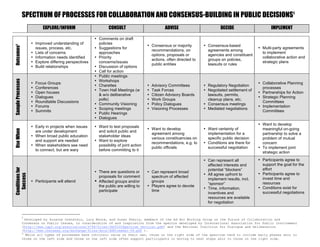
SPECTRUM OF PROCESSES FOR COLLABORATION AND CONSENSUS-BUILDING IN PUBLIC DECISIONS1
EXPLORE/INFORM CONSULT ADVISE DECIDE IMPLEMENT
Outcomes2
• Improved understanding of
issues, process, etc.
• Lists of concerns
• Information needs identified
• Explore differing perspectives
• Build relationships
• Comments on draft
policies
• Suggestions for
approaches
• Priority
concerns/issues
• Discussion of options
• Call for action
• Consensus or majority
recommendations, on
options, proposals or
actions, often directed to
public entities
• Consensus-based
agreements among
agencies and constituent
groups on policies,
lawsuits or rules
• Multi-party agreements
to implement
collaborative action and
strategic plans
SampleProcesses
• Focus Groups
• Conferences
• Open houses
• Dialogues
• Roundtable Discussions
• Forums
• Summits
• Public meetings
• Workshops
• Charettes
• Town Hall Meetings (w
& w/o deliberative
polls)
• Community Visioning
• Scoping meetings
• Public Hearings
• Dialogues
• Advisory Committees
• Task Forces
• Citizen Advisory Boards
• Work Groups
• Policy Dialogues
• Visioning Processes
• Regulatory Negotiation
• Negotiated settlement of
lawsuits, permits,
cleanup plans, etc.
• Consensus meetings
• Mediated negotiations
• Collaborative Planning
processes
• Partnerships for Action
• Strategic Planning
Committees
• Implementation
Committees
UseWhen
• Early in projects when issues
are under development
• When broad public education
and support are needed
• When stakeholders see need
to connect, but are wary
• Want to test proposals
and solicit public and
stakeholder ideas
• Want to explore
possibility of joint action
before committing to it
• Want to develop
agreement among
various constituencies on
recommendations, e.g. to
public officials
• Want certainty of
implementation for a
specific public decision
• Conditions are there for
successful negotiation
• Want to develop
meaningful on-going
partnership to solve a
problem of mutual
concern
• To implement joint
strategic action
Conditionsfor
Success
• Participants will attend
• There are questions or
proposals for comment
• Affected groups and/or
the public are willing to
participate
• Can represent broad
spectrum of affected
groups
• Players agree to devote
time
• Can represent all
affected interests and
potential “blockers”
• All agree upfront to
implement results, incl.
“sponsor”
• Time, information,
incentives and
resources are available
for negotiation
• Participants agree to
support the goal for the
effort
• Participants agree to
invest time and
resources
• Conditions exist for
successful negotiations
1
Developed by Suzanne Orenstein, Lucy Moore, and Susan Sherry, members of the Ad Hoc Working Group on the Future of Collaboration and
Consensus on Public Issues, in consideration of and inspiration from the spectra developed by International Association for Public Involvement
(http://www.iap2.org/associations/4748/files/IAP2%20Spectrum_vertical.pdf) and the National Coalition for Dialogue and Deliberation
(http://www.thataway.org/exchange/files/docs/ddStreams1-08.pdf ).
2
While all types of processes have intrinsic value on their own, those on the right side of the spectrum tend to include early phases akin to
those on the left side and those on the left side often support participants in moving to next steps akin to those on the right side.
Mediation, Consensus Building and Facilitation 
Massachusetts Association of Planning Directors 
2011 Conference  
New Bedford, MA 
June 9, 2011 
Communication  
o Understand the importance of this “basic” skill 
 
Sources of Land Use Disputes 
o What issues underlie disputes for planners?  
 
Key Mediation and Negotiation Concepts 
o Interests and Positions 
• Where does getting out interests get you?   
• Can generate lots of options, trade and share interests, bigger pie, identity and core 
concerns (acknowledgement, autonomy, status, etc.) 
o BATNA 
Best Alternative to a Negotiated Agreement (also BATMA, … Mediated Agreement) 
Importance in knowing yours and other parties’ 
Testing how realistic BATNA(s) are in a conversation 
Sets a basis for an agreement 
o Neutrality 
Should planners be neutral?  Why or why not? 
When is it appropriate to be neutral?   
Challenges to maintaining neutrality? e.g.., AICP ethics – role is to focus on the public 
good 
Benefits to identifying the right person to help engage people (staff, community 
member, professional) 
o Personal Biases 
Acknowledge that there is a content/relationship tension  
Why does that matter in your work? 
• Your inclination influences the scope of the work/discussion with the public & others 
 
Choosing the Right Process 
o Range of different types of collaboration processes (see chart on back) 
o Common Objections to collaboration and how to respond 
 
Contact Information 
Ona Ferguson, Senior Associate, the Consensus Building Institute, 617‐844‐1127, 
oferguson@cbuilding.org   
Chris Kluchman, Town Planner, Town of Westford, 978‐692‐5524, ckluchman@westfordma.gov  
 
Shiona Sommerville, ssommerville@post.harvard.edu  

Spectrum of Processes for Collaboration and Consensus-Building in Public Decisions

  • 1.
    SPECTRUM OF PROCESSESFOR COLLABORATION AND CONSENSUS-BUILDING IN PUBLIC DECISIONS1 EXPLORE/INFORM CONSULT ADVISE DECIDE IMPLEMENT Outcomes2 • Improved understanding of issues, process, etc. • Lists of concerns • Information needs identified • Explore differing perspectives • Build relationships • Comments on draft policies • Suggestions for approaches • Priority concerns/issues • Discussion of options • Call for action • Consensus or majority recommendations, on options, proposals or actions, often directed to public entities • Consensus-based agreements among agencies and constituent groups on policies, lawsuits or rules • Multi-party agreements to implement collaborative action and strategic plans SampleProcesses • Focus Groups • Conferences • Open houses • Dialogues • Roundtable Discussions • Forums • Summits • Public meetings • Workshops • Charettes • Town Hall Meetings (w & w/o deliberative polls) • Community Visioning • Scoping meetings • Public Hearings • Dialogues • Advisory Committees • Task Forces • Citizen Advisory Boards • Work Groups • Policy Dialogues • Visioning Processes • Regulatory Negotiation • Negotiated settlement of lawsuits, permits, cleanup plans, etc. • Consensus meetings • Mediated negotiations • Collaborative Planning processes • Partnerships for Action • Strategic Planning Committees • Implementation Committees UseWhen • Early in projects when issues are under development • When broad public education and support are needed • When stakeholders see need to connect, but are wary • Want to test proposals and solicit public and stakeholder ideas • Want to explore possibility of joint action before committing to it • Want to develop agreement among various constituencies on recommendations, e.g. to public officials • Want certainty of implementation for a specific public decision • Conditions are there for successful negotiation • Want to develop meaningful on-going partnership to solve a problem of mutual concern • To implement joint strategic action Conditionsfor Success • Participants will attend • There are questions or proposals for comment • Affected groups and/or the public are willing to participate • Can represent broad spectrum of affected groups • Players agree to devote time • Can represent all affected interests and potential “blockers” • All agree upfront to implement results, incl. “sponsor” • Time, information, incentives and resources are available for negotiation • Participants agree to support the goal for the effort • Participants agree to invest time and resources • Conditions exist for successful negotiations 1 Developed by Suzanne Orenstein, Lucy Moore, and Susan Sherry, members of the Ad Hoc Working Group on the Future of Collaboration and Consensus on Public Issues, in consideration of and inspiration from the spectra developed by International Association for Public Involvement (http://www.iap2.org/associations/4748/files/IAP2%20Spectrum_vertical.pdf) and the National Coalition for Dialogue and Deliberation (http://www.thataway.org/exchange/files/docs/ddStreams1-08.pdf ). 2 While all types of processes have intrinsic value on their own, those on the right side of the spectrum tend to include early phases akin to those on the left side and those on the left side often support participants in moving to next steps akin to those on the right side.
  • 2.
    Mediation, Consensus Building and Facilitation  Massachusetts Association of Planning Directors  2011 Conference   New Bedford, MA  June 9, 2011  Communication   o Understand the importance of this “basic” skill    Sources of Land Use Disputes  o What issues underlie disputes for planners?     Key Mediation and Negotiation Concepts  oInterests and Positions  • Where does getting out interests get you?    • Can generate lots of options, trade and share interests, bigger pie, identity and core  concerns (acknowledgement, autonomy, status, etc.)  o BATNA  Best Alternative to a Negotiated Agreement (also BATMA, … Mediated Agreement)  Importance in knowing yours and other parties’  Testing how realistic BATNA(s) are in a conversation  Sets a basis for an agreement  o Neutrality  Should planners be neutral?  Why or why not?  When is it appropriate to be neutral?    Challenges to maintaining neutrality? e.g.., AICP ethics – role is to focus on the public  good  Benefits to identifying the right person to help engage people (staff, community  member, professional)  o Personal Biases  Acknowledge that there is a content/relationship tension   Why does that matter in your work?  • Your inclination influences the scope of the work/discussion with the public & others    Choosing the Right Process  o Range of different types of collaboration processes (see chart on back)  o Common Objections to collaboration and how to respond    Contact Information  Ona Ferguson, Senior Associate, the Consensus Building Institute, 617‐844‐1127,  oferguson@cbuilding.org    Chris Kluchman, Town Planner, Town of Westford, 978‐692‐5524, ckluchman@westfordma.gov     Shiona Sommerville, ssommerville@post.harvard.edu