Network Management
Lec. Mrs. Farah Abdulkadir Habeeb
Garmian Of University
College Of Computer & Information Technology/ KHANAQIN
Department Of Information Network
NETWORK MANAGEMENT
What is Management ???
Management: defined as monitoring & controlling
• the resources in computers.
• the resources used in the connection & communication of computers.
• the applications used in the computers.
Involves: collecting of data, processing data to generate information, making
decisions and enactment of activities to implement those decisions.
The Management has two main function:
1. Controlling
2. Monitoring
The result of these two function is that we achieve integration, and this integration leads
to achieving the two main goals.
- maximizing benefit from the resources in the network.
- minimize the risks.
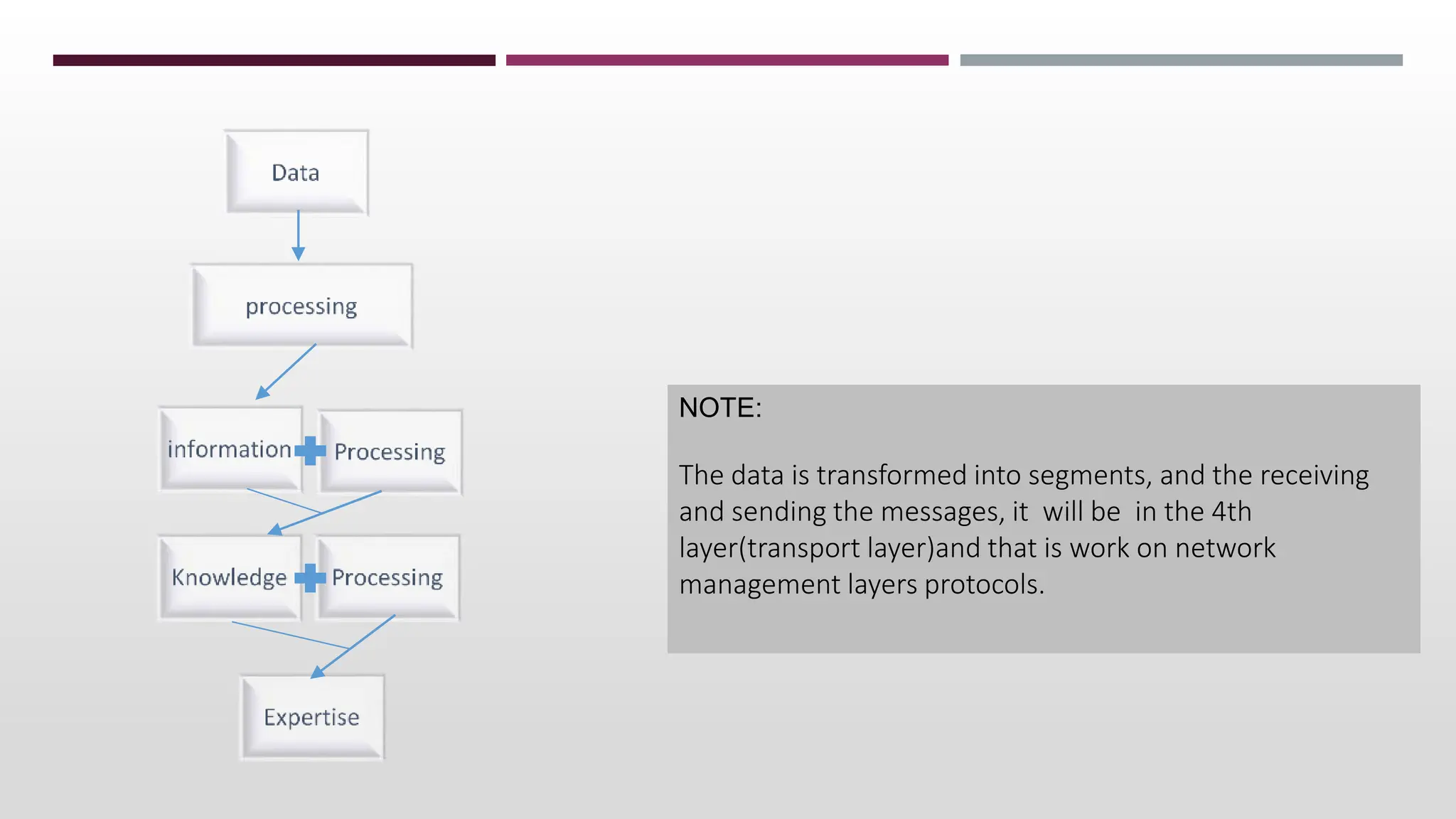
NOTE:
The data is transformed into segments, and the receiving
and sending the messages, it will be in the 4th
layer(transport layer)and that is work on network
management layers protocols.
NETWORK MANAGEMENT
What is Network Management& Systems Management ???
Several Definitions available!
Network Management (NM) provides mechanisms for the monitoring, control and
coordination of all managed objects within the physical and data link layer of a network
node > [IEEE] (Institute of Electrical and Electronics Engineers)
Systems Management provides mechanisms for the monitoring, control and
coordination of all managed objects within open systems. This is effected through
application layer protocol > [IEEE] (Institute of Electrical and Electronics Engineers)
Network Management is subset of Systems Management
NETWORK MANAGEMENT
What is Network Management& Systems Management (cont. 2)
• Monitoring: continuous watching of resources for deterioration of function.
Is more pro-active rather than re-active.
• Control: make effective modifications to functioning of resources for
optimization/rectification.
• Co-ordination: involves both co-ordination of resources and co-ordination of
monitoring/control activities.
NETWORK MANAGEMENT
Why Systems/network Management
• Higher network availability
• Reduce Network operational costs
• Reduce network bottlenecks
• Increase flexibility of operation and integration
• Higher efficiency
• Security
NETWORK MANAGEMENT
Two basic Models of Network Management
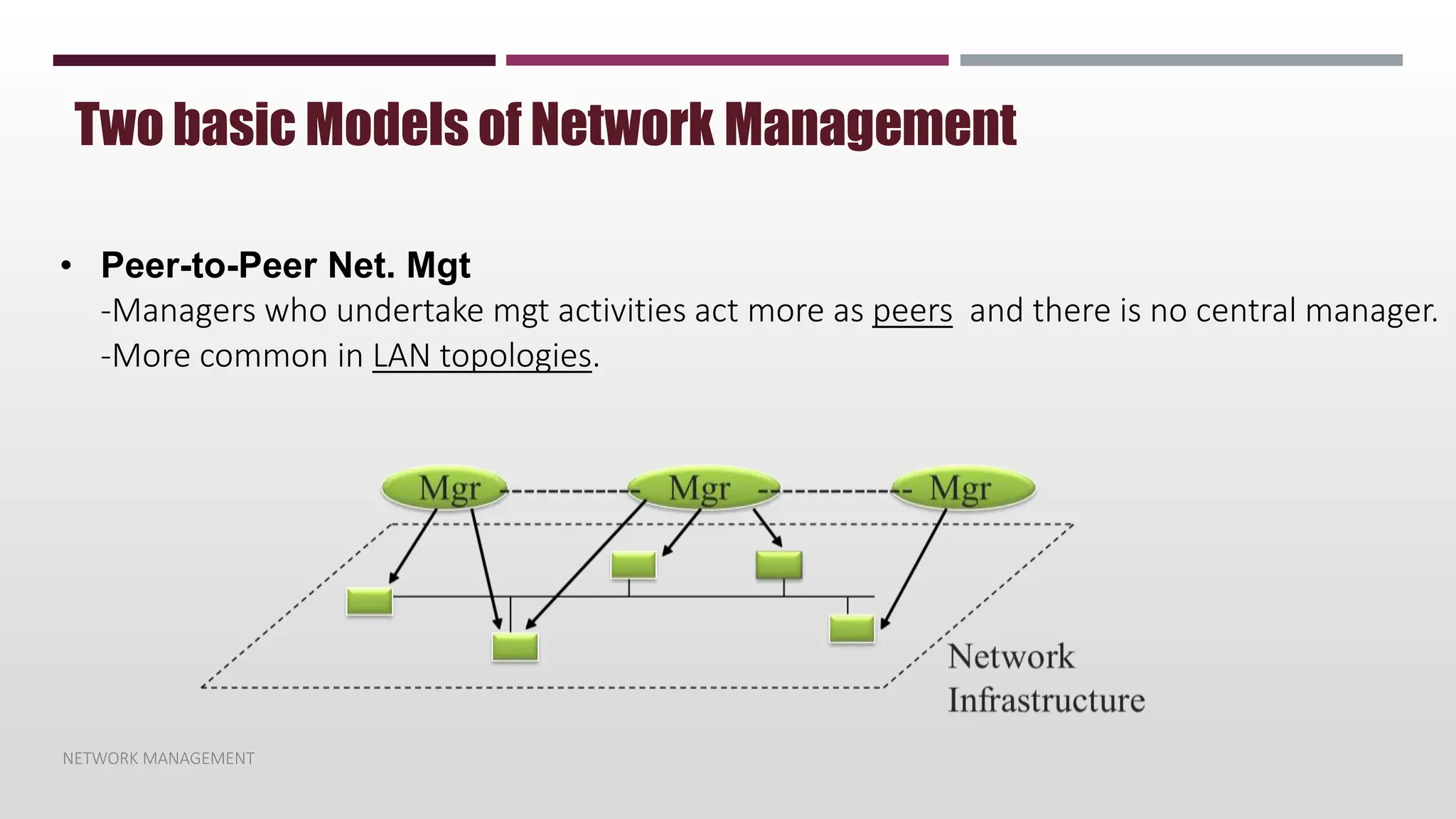
• Peer-to-Peer Net. Mgt
-Managers who undertake mgt activities act more as peers and there is no central manager.
-More common in LAN topologies.
NETWORK MANAGEMENT
Two basic Models of Network Management
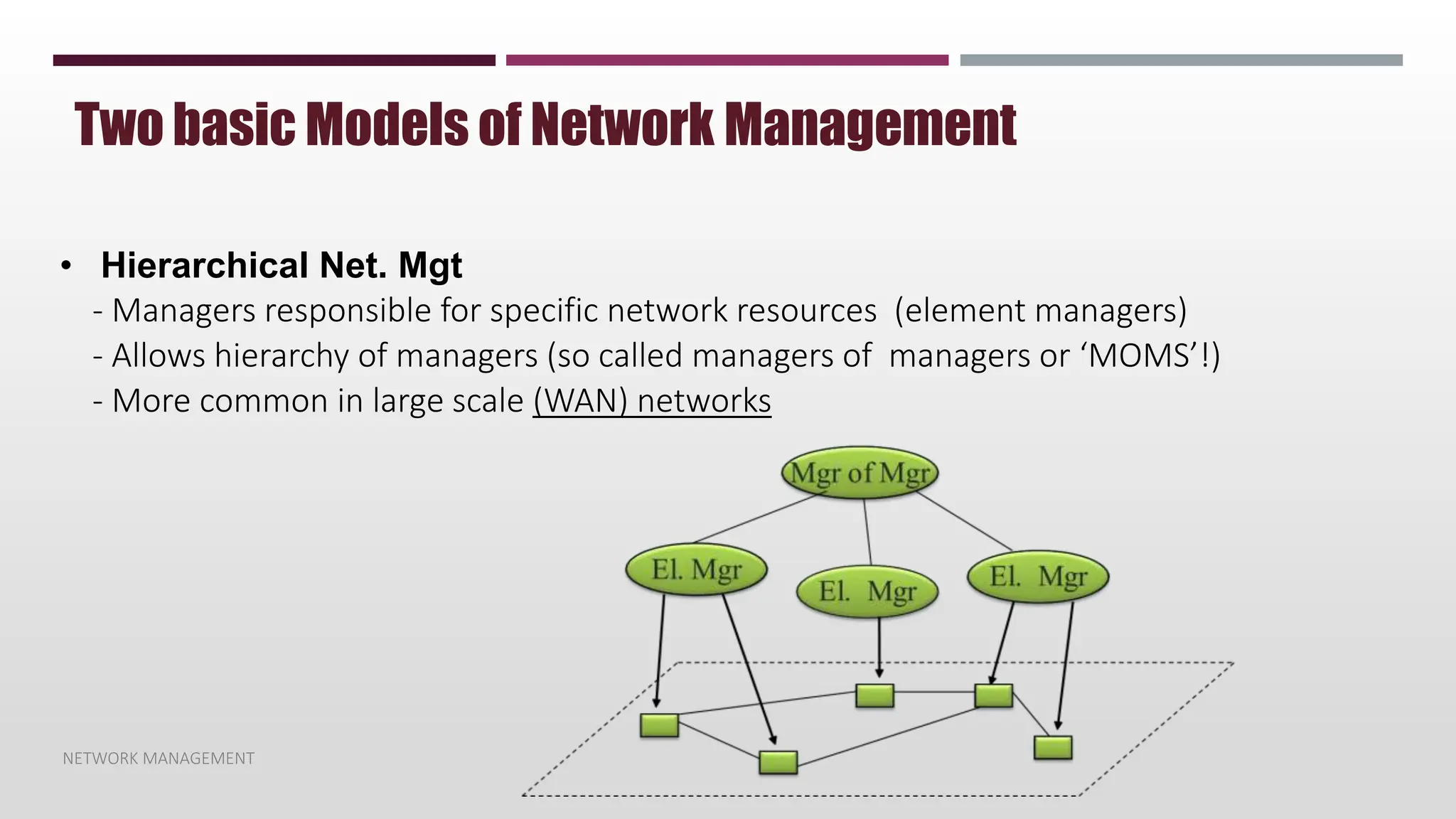
• Hierarchical Net. Mgt
- Managers responsible for specific network resources (element managers)
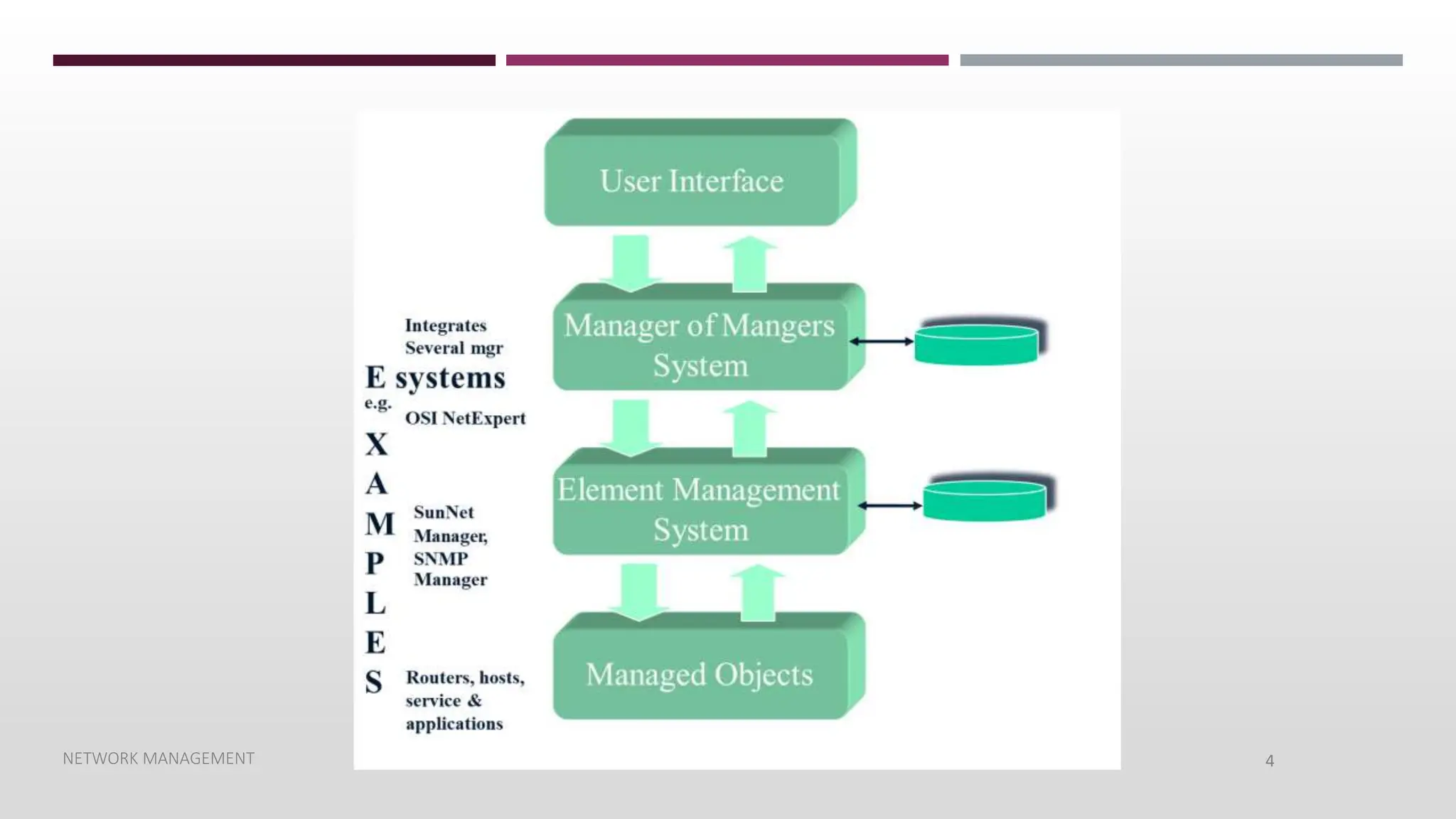
- Allows hierarchy of managers (so called managers of managers or ‘MOMS’!)
- More common in large scale (WAN) networks
NETWORK MANAGEMENT
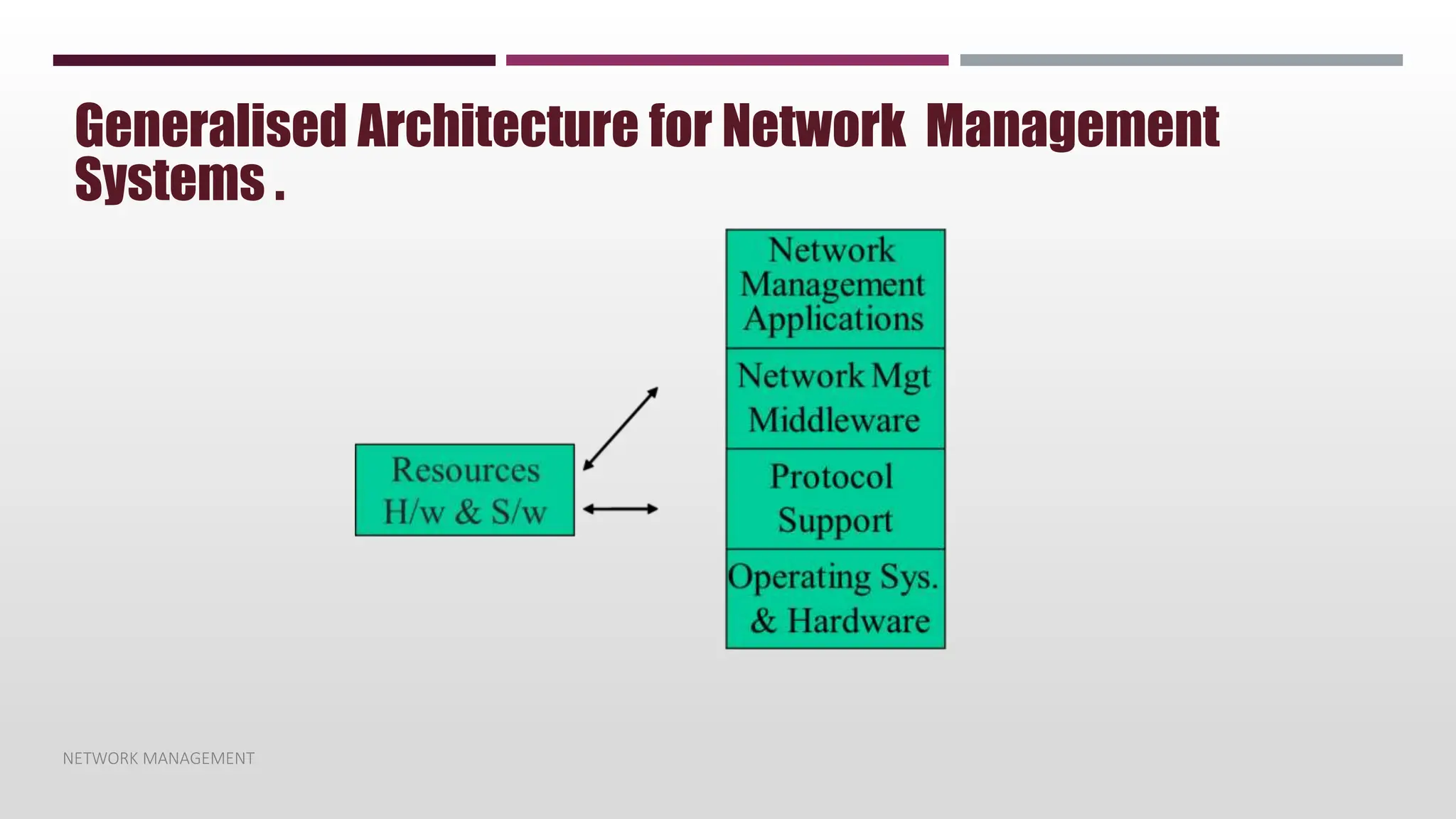
Generalised Architecture for Network Management
Systems .
NETWORK MANAGEMENT
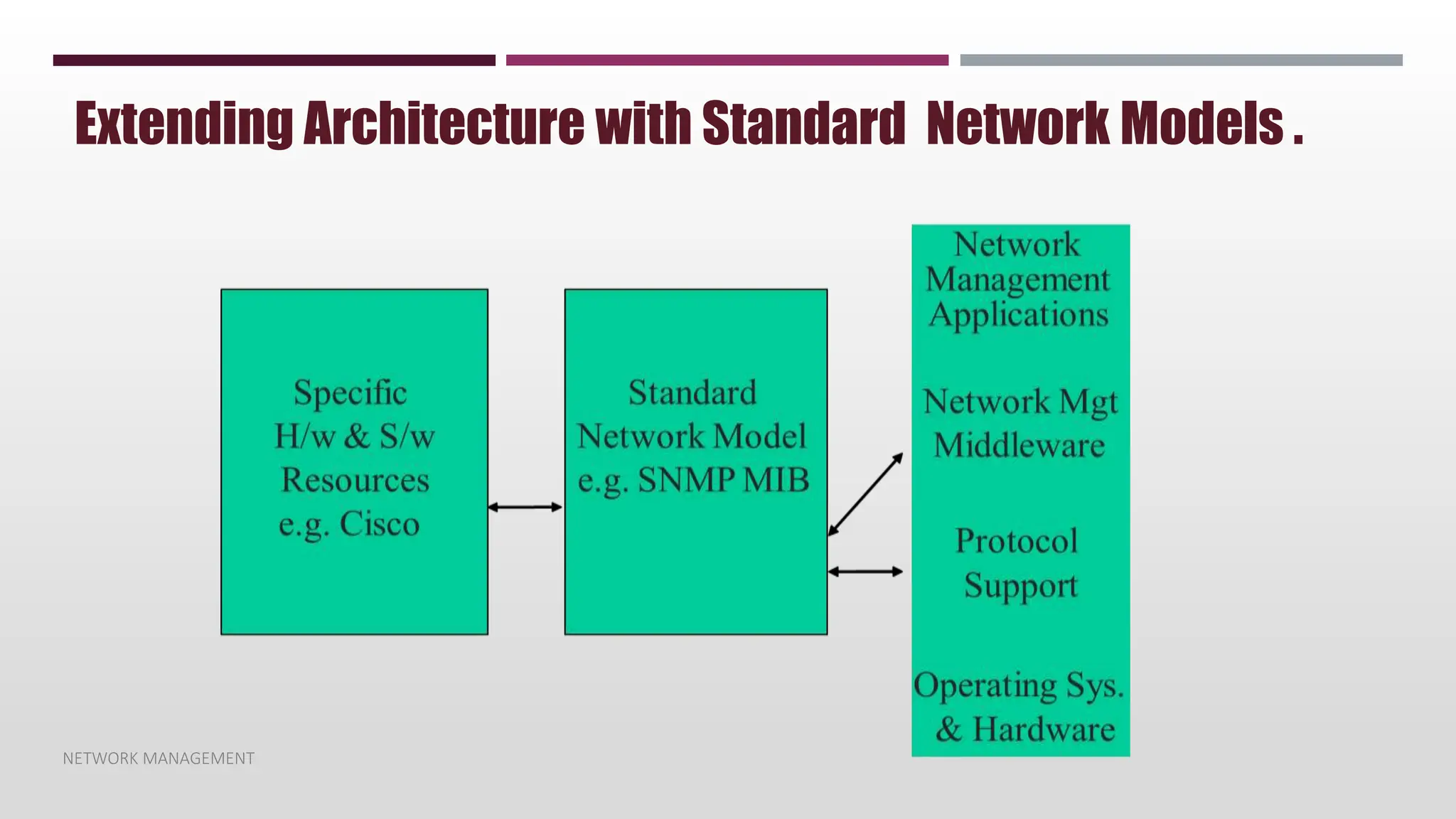
Extending Architecture with Standard Network Models .
NETWORK MANAGEMENT
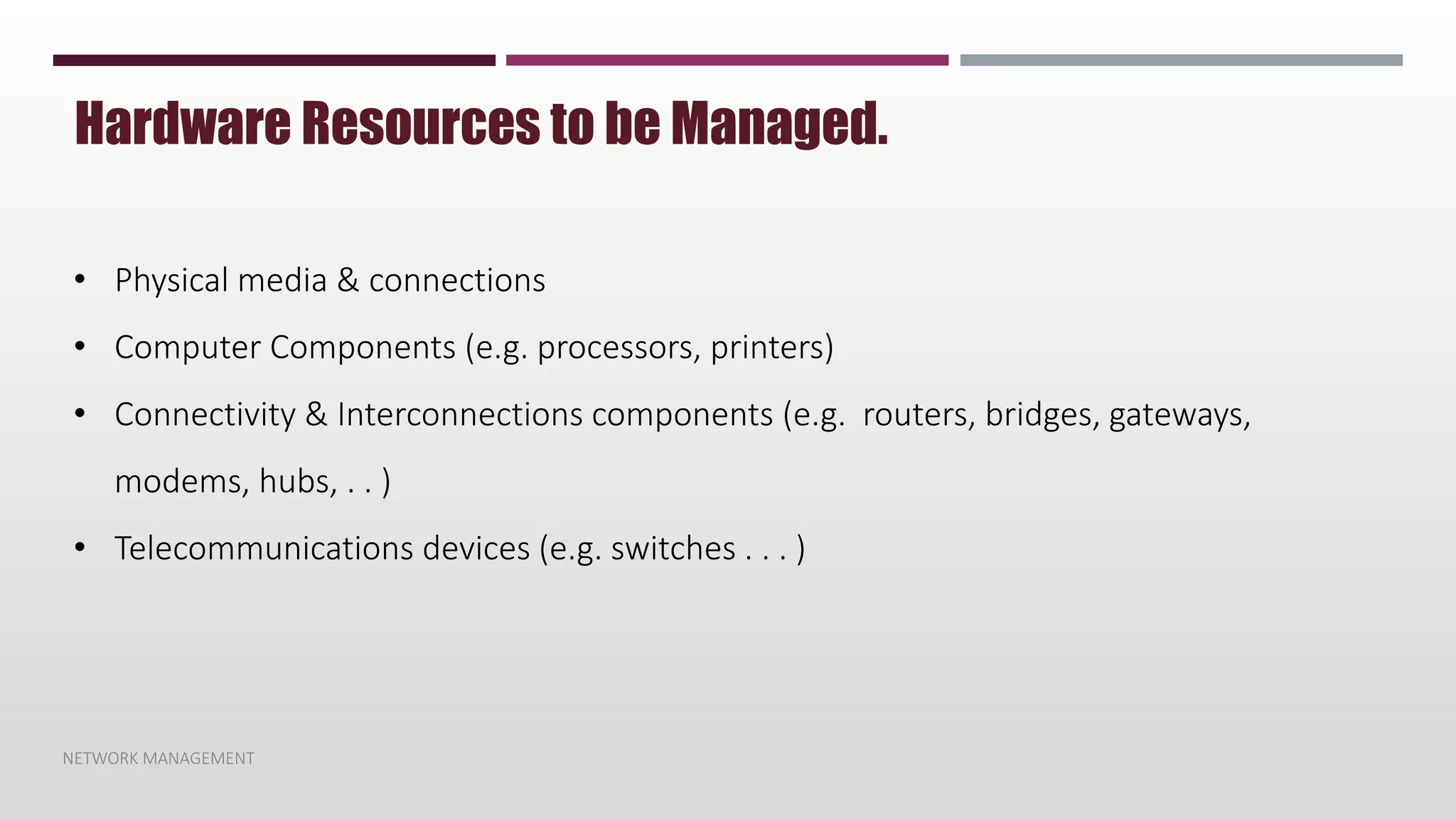
Hardware Resources to be Managed.
• Physical media & connections
• Computer Components (e.g. processors, printers)
• Connectivity & Interconnections components (e.g. routers, bridges, gateways,
modems, hubs, . . )
• Telecommunications devices (e.g. switches . . . )
NETWORK MANAGEMENT
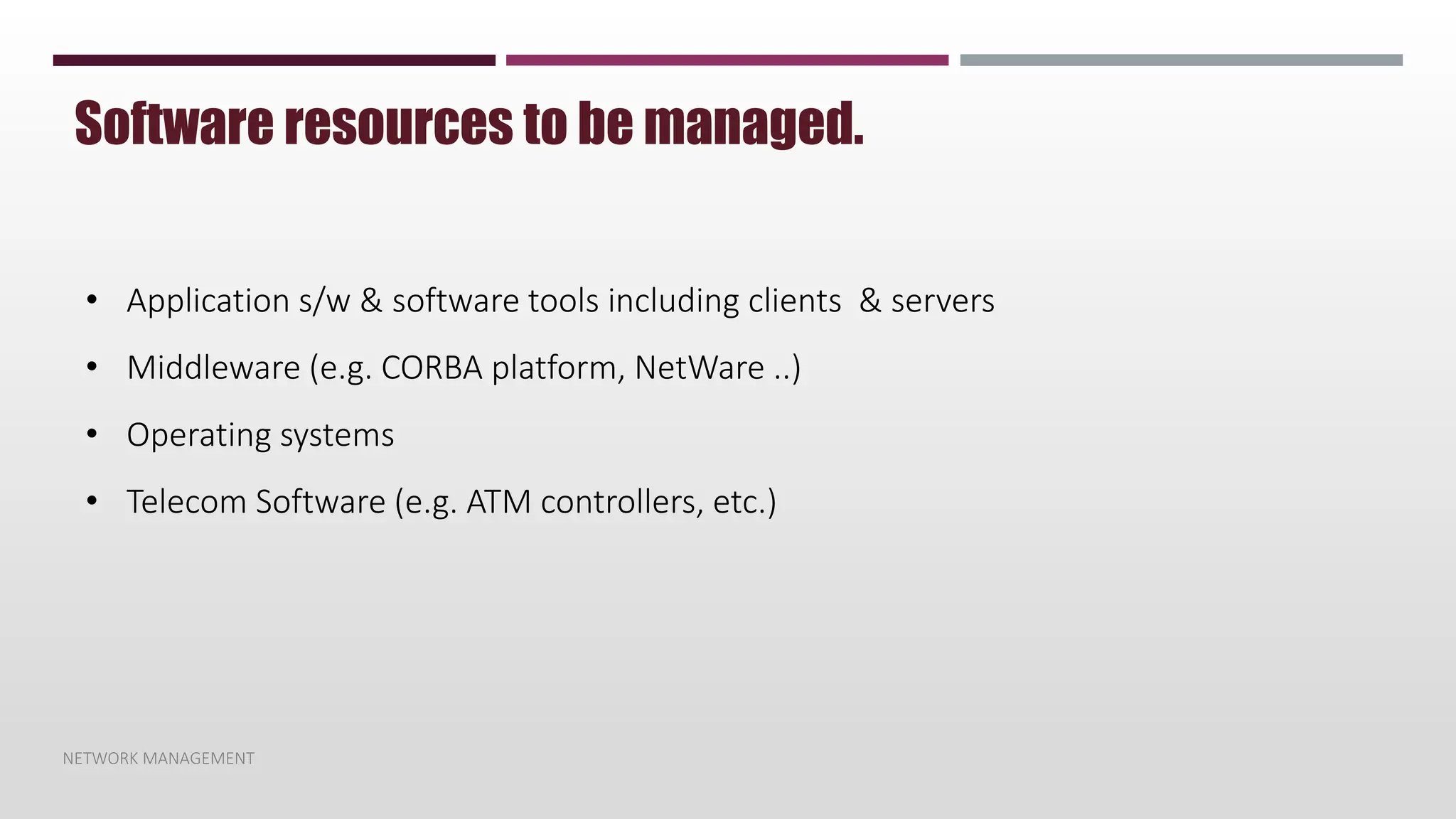
Software resources to be managed.
• Application s/w & software tools including clients & servers
• Middleware (e.g. CORBA platform, NetWare ..)
• Operating systems
• Telecom Software (e.g. ATM controllers, etc.)
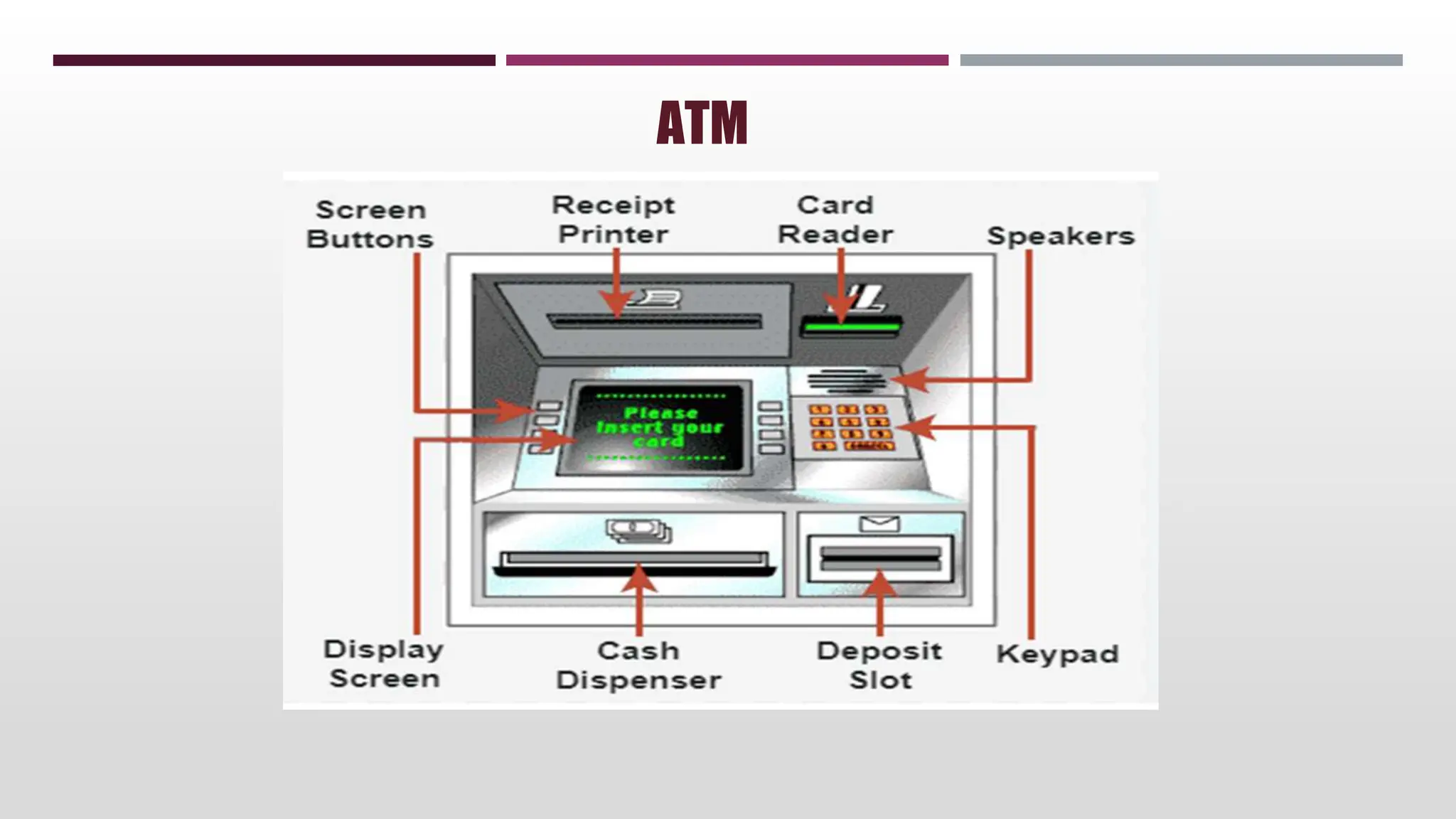
ATM
ATM has two input devices:
•Card reader - The card reader captures the account information stored on the magnetic
stripe on the back of an ATM/debit or credit card. The host processor uses this information
to route the transaction to the cardholder's bank.
•Keypad - The keypad lets the cardholder tell the bank what kind of transaction is required
(cash withdrawal, balance inquiry, etc.) and for what amount. Also, the bank requires the
cardholder's personal identification number (PIN) for verification. Federal law requires that
the PIN block be sent to the host processor in encrypted form.
And an ATM has four output devices:
•Speaker - The speaker provides the cardholder with auditory feedback when a key is pressed.
•Display screen - The display screen prompts the cardholder through each step of the
transaction process. Leased-line machines commonly use a monochrome or color CRT
(cathode ray tube) display. Dial-up machines commonly use a monochrome or color LCD.
•Receipt printer - The receipt printer provides the cardholder with a paper receipt of the
transaction.
•Cash dispenser - The heart of an ATM is the safe and cash-dispensing mechanism. The entire
bottom portion of most small ATMs is a safe that contains the cash.
NETWORK MANAGEMENT
What Protocols support Mgt.
 As management can be reduced down to monitoring & controlling, any protocol
that can
1. retrieve information
2. set/send information
can be used as a management protocol.
 However, two ‘specific’ mgt protocols have been agreed
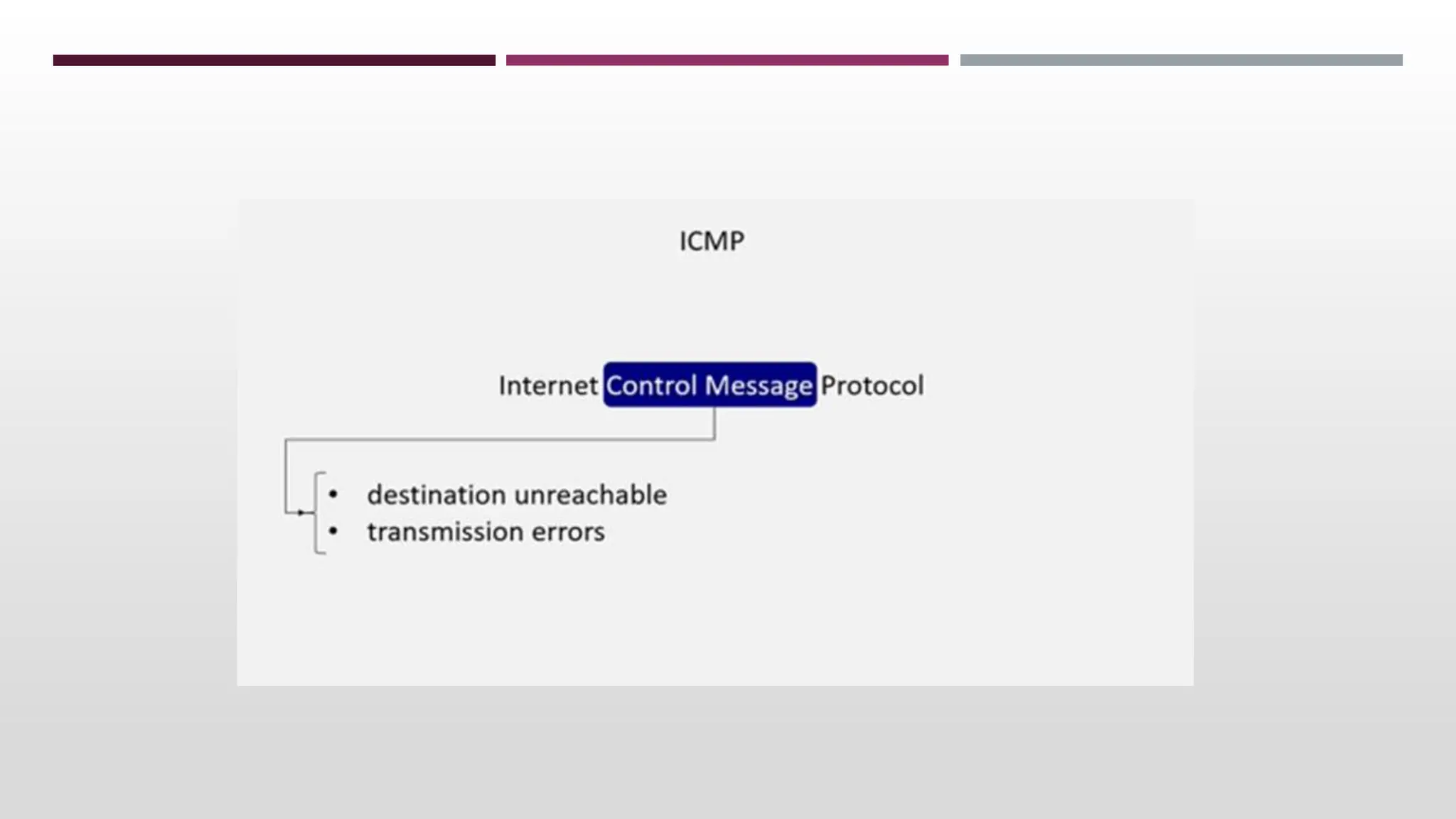
Internet Control Message Protocol (ICMP) from the Telecom Community (ITU)
Simple Network Management Protocol (SNMP) from the computer industry (IETF)
NETWORK MANAGEMENT
Network Management Middleware
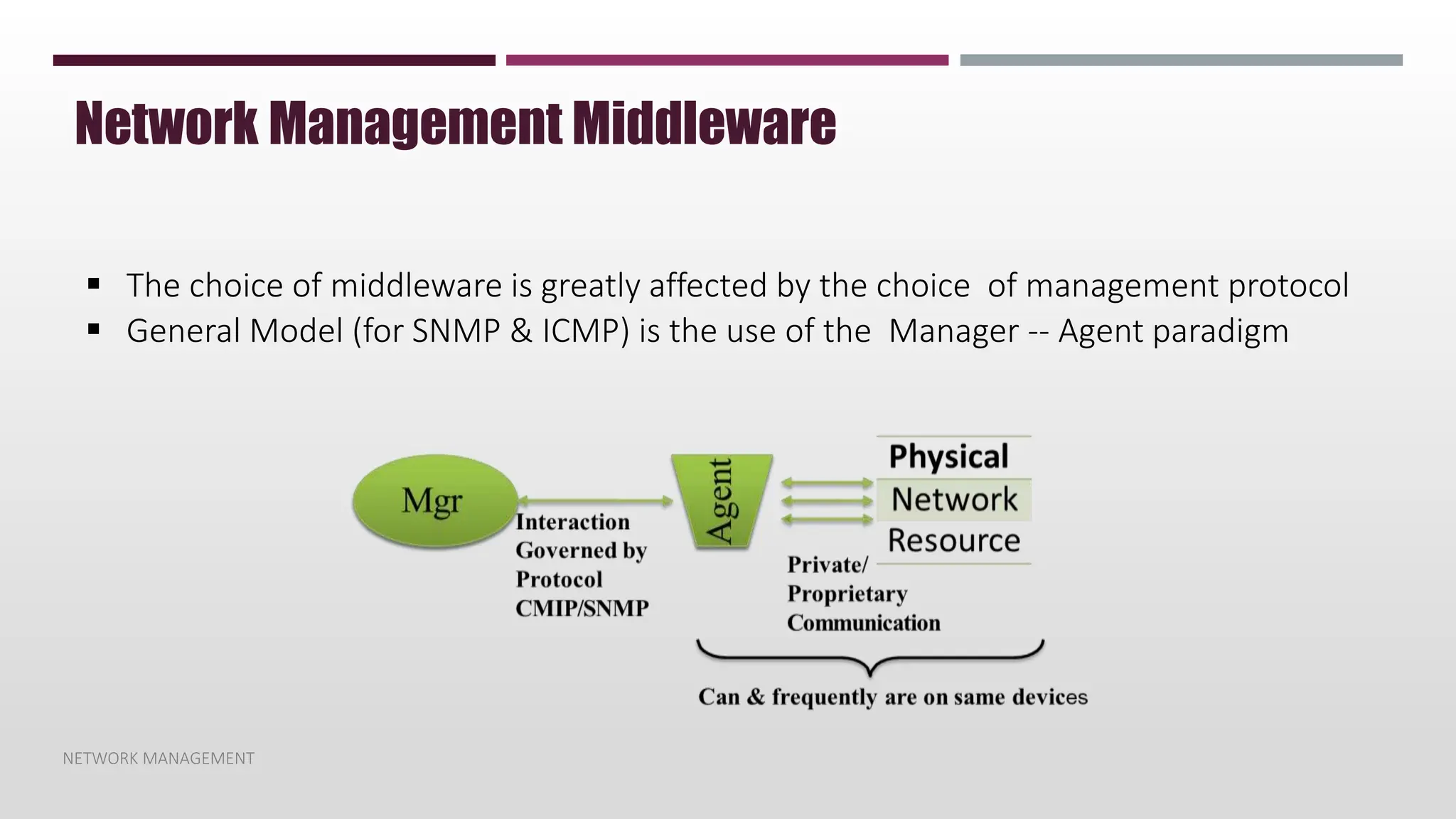
 The choice of middleware is greatly affected by the choice of management protocol
 General Model (for SNMP & ICMP) is the use of the Manager -- Agent paradigm
NETWORK MANAGEMENT
Network Management Agents
 Varies in size & complexity greatly depending on ICMP/SNMP usage
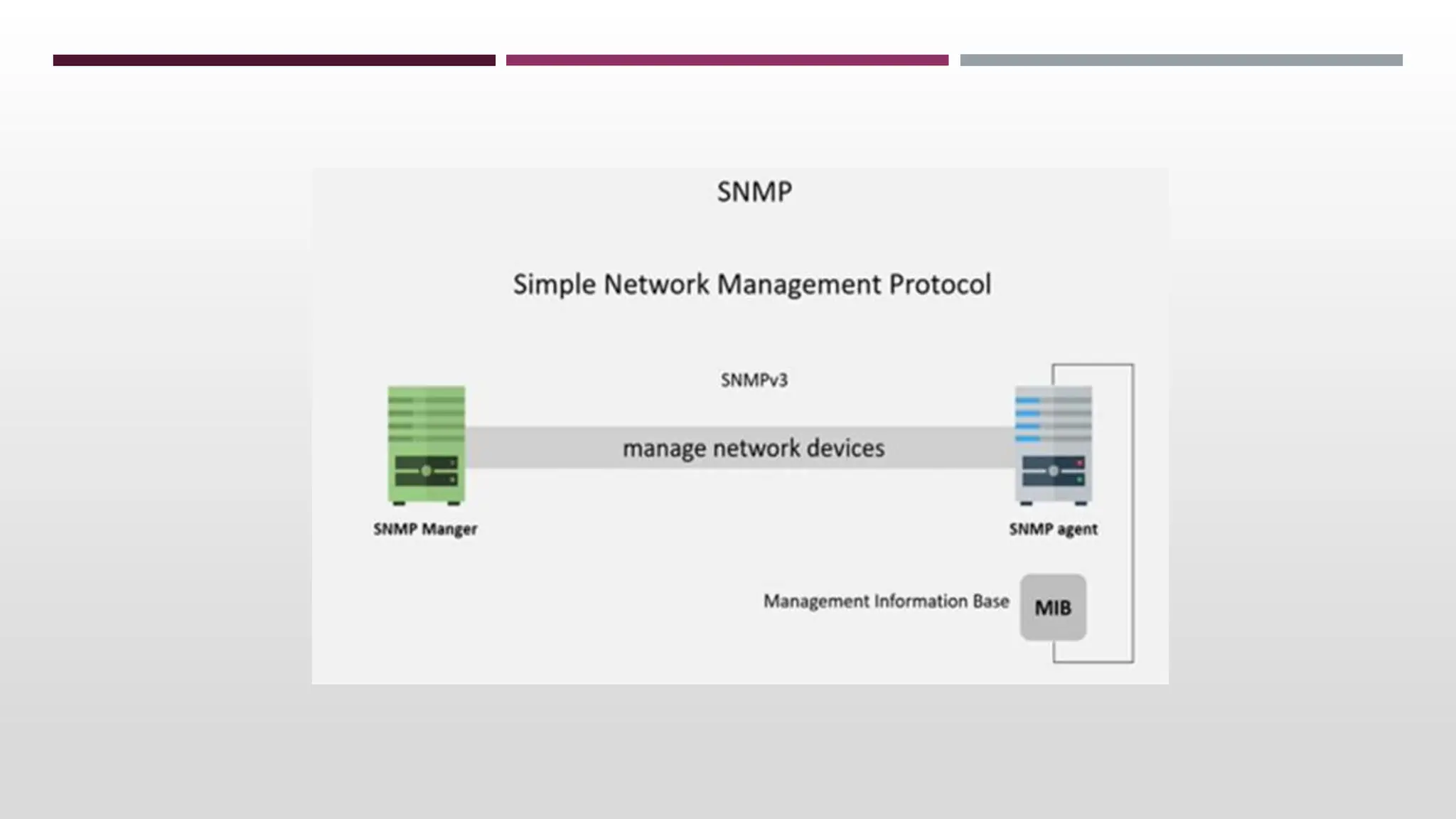
1. SNMP
- Agent very simple. Just consists of tables of information called a Management Information
Base (MIB)
- Small memory footprint and processing requirements
- Primitive interaction between Mgr and Agent
- Master / slave relationship between SNMP Mgr & Agent
i.e. mgr must call or poll agent continuously for reliable information
- Standard MIB specs. for different types of devices
NETWORK MANAGEMENT
Network Management Agents (cont 2)
2. ICMP Agents
- Much more complex & greater memory and processing overhead
- Typically implemented on larger/more complex communication devices
e.g. switches, some routers
- Fully Object Oriented Information model (MIB)
- Much more sophisticated interaction with manager
- Much more local processing of raw data possible before returning information to manager
- Agent can initiate Agent -- Manager dialogue (Alarm/Alert reporting)
- Better security
NETWORK MANAGEMENT
Network Management Models ( Information Models, Network Resource Models,
Management Information Bases)
 Provide a standard way to describe network resources in an application and
vendor-independent way for manipulation/query by network management
applications
 Typically defines
• A modelling language for defining network resources, e.g.
• Their configuration settings, e.g. WLAN SSID
• Their state variables, e.g. number of connected devices
• The notifications/events they generate e.g. No Internet connection
• The hierarchy/connections of resources in the network
• A global addressing/naming scheme for network resources
NETWORK MANAGEMENT
Network Management Applications
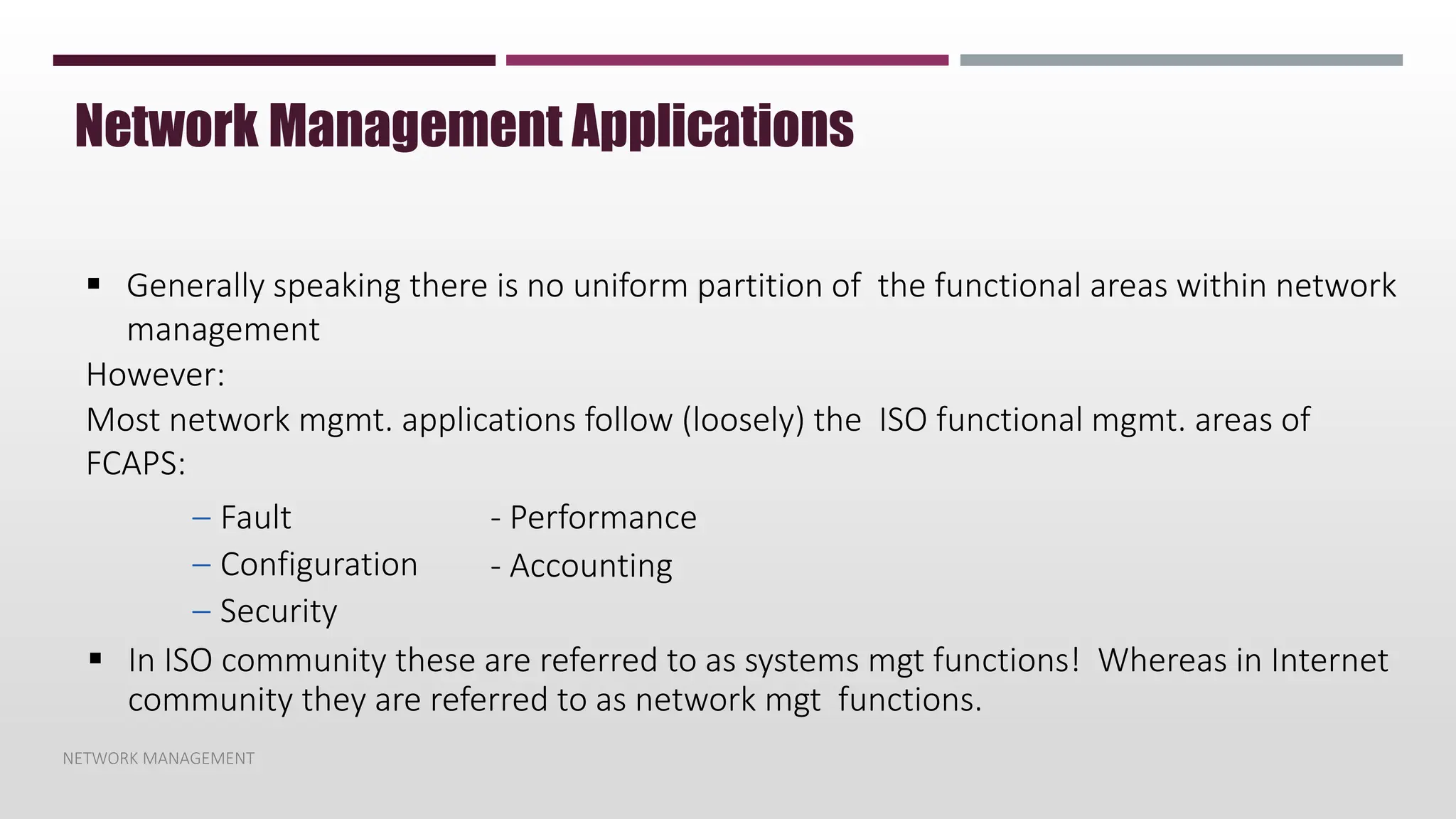
 Generally speaking there is no uniform partition of the functional areas within network
management
However:
Most network mgmt. applications follow (loosely) the ISO functional mgmt. areas of
FCAPS:
– Fault
– Configuration
– Security
- Performance
- Accounting
 In ISO community these are referred to as systems mgt functions! Whereas in Internet
community they are referred to as network mgt functions.
NETWORK MANAGEMENT
Fault Management
 Responsible for:
• detection of a problem
• fault Isolation
• correction to normal operation
• uses Polling of managed objects to search for error conditions and/or report alarms/alerts,
• Can also use event reporting
• illustrates the problem detected either as a graphic or in textual format©
NETWORK MANAGEMENT
Configuration Management
Responsible for:
• Changes, additions and deletions on the managed object parameter(s)
• Needs to be co-ordinated with the network management systems personnel
(frequently involve some manual work scheduling)
• Underlies most of the other network management functional areas
NETWORK MANAGEMENT
Accounting
Responsible for:
• Usually divided into three stages: metering, tariffing and billing.
• Metering logs a particular usage of the managed object
• Tariffing is the means by which a charge can be calculated e.g. Flat rate (e.g. leased
line), incremental rate, variable rates etc.
• Billing is the selection & application of a tariffing mechanism on the metered usage
and the composition of the customer bill.
• Typically ignored in LAN networks where tariffing and billing are irrelevant but VERY
important for Telecom Network & Service providers
NETWORK MANAGEMENT
Performance Management
Responsible for:
• Optimization of managed objects e.g. telephone truck line utilization, bandwidth allocation
in ATM network, load balancing on distributed servers.
• Identification of bottlenecks in network and implementation of corrective action.
• Divides into four main functions: Performance data collection, Data analysis, Problem
Reporting, Display & formatting.
NETWORK MANAGEMENT
Security management
Responsible for:
• administration of access controls on managed objects.
• issuing of security alarm reports for violations. Several types of threat to assets:
– Interruption, interception, modification and fabrication
Assets:
– Hardware, software, data and communication lines and networks
NETWORK MANAGEMENT 4
NETWORK MANAGEMENT
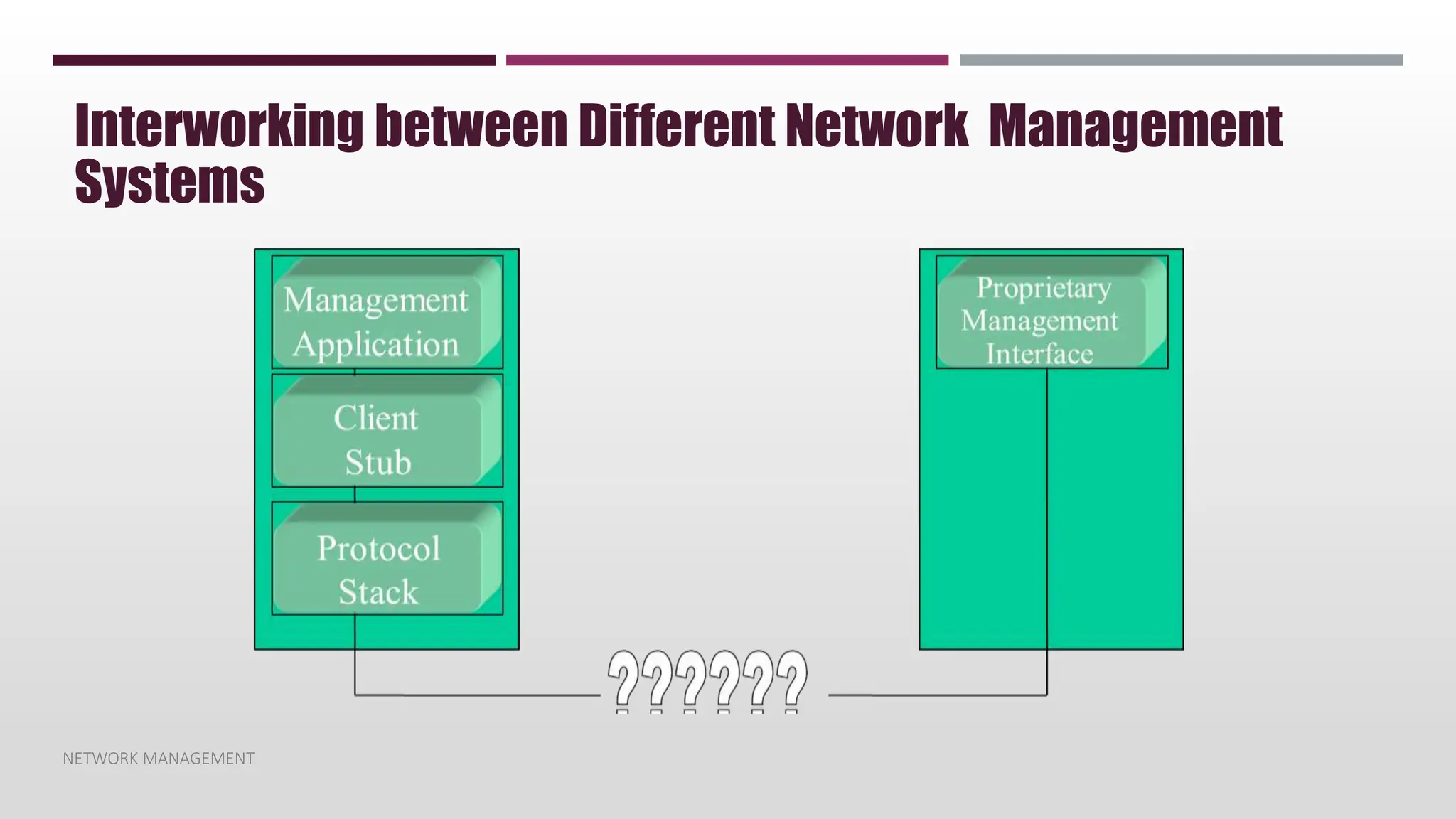
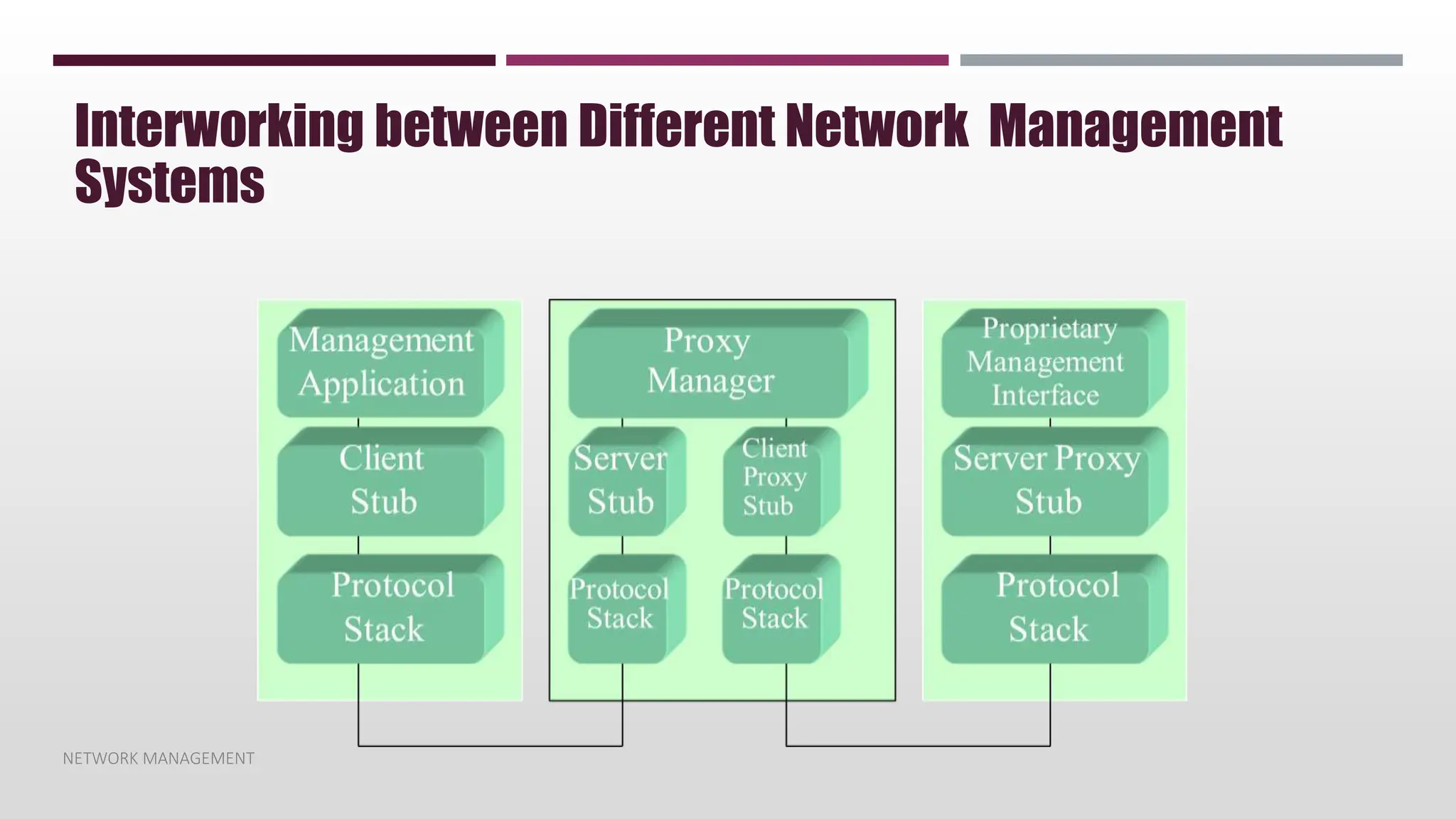
Interworking between Different Network Management
Systems
NETWORK MANAGEMENT
Interworking between Different Network Management
Systems
Network Monitoring (Revisited)
Recap:
 Net. Monitoring concerned with observing & analysing the status and behaviour
of:
– End Systems
– Intermediate Systems
– Sub networks
 Challenges of Net. Monitoring :
• Gaining access to monitored information (e.g. definition of monitoring
information, retrieval of that info.)
• Design of monitoring mechanism
• Usage of monitored information (e.g. by fault or performance Accounting
Management applications
 Static Information:
• characterizes current configuration (e.g. network element)
• stored in network element
 Dynamic Information:
• related to events in the network e.g. number of packets transmitted
• collected and stored in network element but can be stored
remotely (e.g. for some LAN based network elements)
 Statistical:
• derived from dynamic information
• gathered by any systems with access to dynamic information, i.e. by
network element, remote monitor, or management application
Network monitoring information
 Managers can gather information about network
element via Polling and/or Event Reporting
Polling:
• Request - Response interaction between manager & Agent.
• Query can be specific (named parameter/object) or a general search
• Example uses: investigate (ping) problem
• Implementation effort centered on Manager
Polling vs event reporting
 Event Reporting:
• Agent initiative to generate periodic report & send to manager
• Reporting condition(s) may be pre-configured by manager
• Example uses: significant change in Managed object values, unusual event.
• Can be more efficient than Polling e.g. for monitoring managed objects whose
states or values change relatively infrequently
• Has less communication overhead that Polling
Polling Vs Event Reporting (cont.)
Polling vs Event Reporting (cont. 2)
 Both are useful information gathering techniques
 Telecoms world traditionally rely on event reporting where as SNMP world puts
very little reliance on event reporting
 Choice depends on:
• Amount of network traffic generated by each method
• Robustness in critical situations
• Time delay in notifying network manager
• Amount of processing in Managed devices
• Particular network monitoring applications being supported
• Contingencies required in case of notifying device fails before sending a report
First let’s consider what indicators of performance are important
 Two categories of Performance indication
• Service Oriented Measures
– relate to satisfaction of service level agreements with users
• Efficiency Oriented Measures
– relation to meeting network requirements at minimum cost.
Performance Monitoring
 Availability:
• Percentage of time a network system, component, or an application is available
for a user
 Response Time:
• Length of time it takes a response to appear at a user’s terminal after a user
action calls for it
 Accuracy:
• Percentage of time that no errors occur in the transmission and delivery of
information
Service Oriented Network Performance Indicators
 Throughput:
• Rate at which application-oriented events occur e.g. transaction messages,
file transfers, number of session for an application over a given time, number
of calls for a circuit switched environment.
 Utilisation:
• Percentage of the theoretical capacity of a resource that is being used (e.g.
transmission line, switch etc.)
Efficiency Oriented Network Performance Indicators
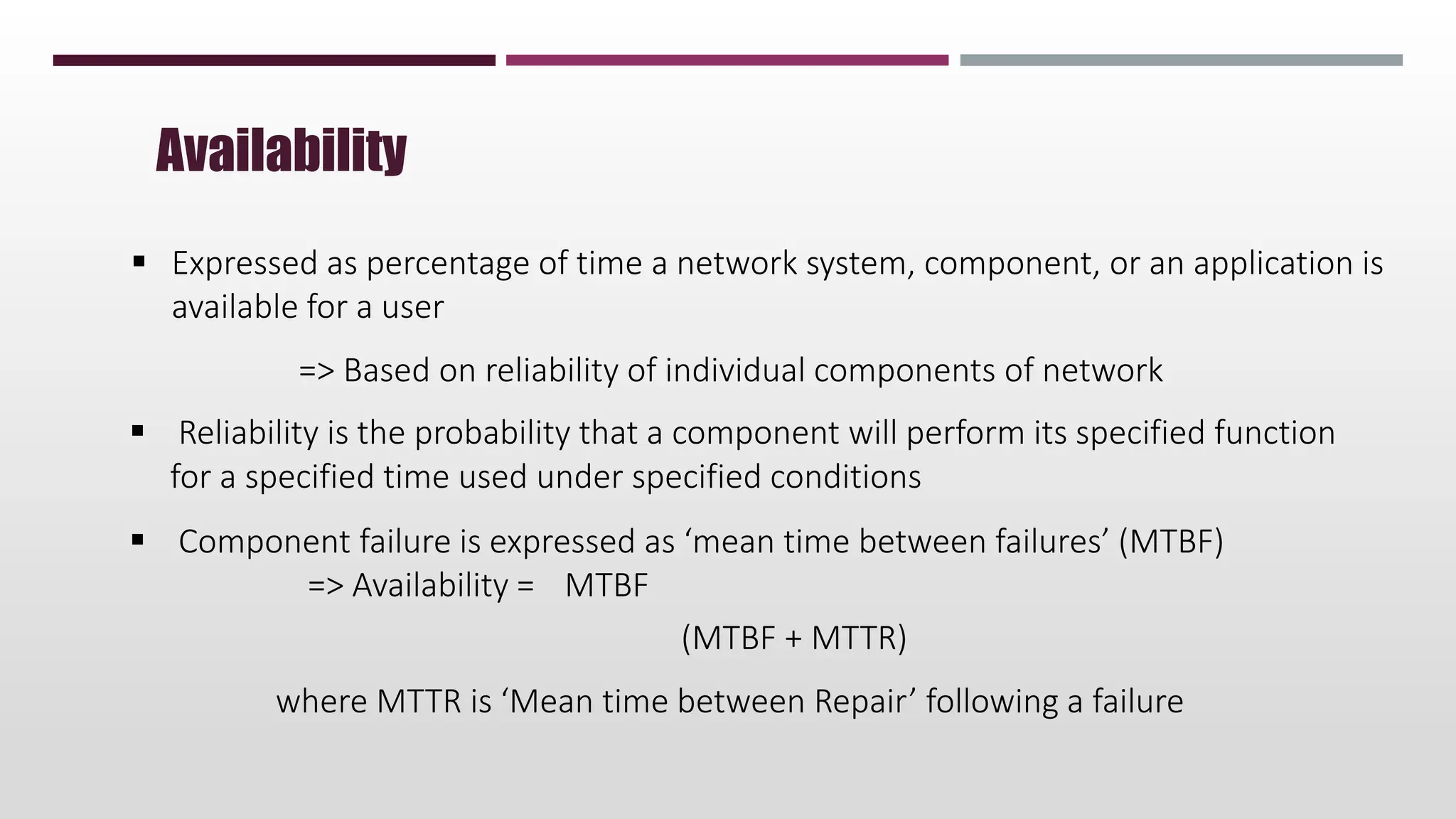
 Expressed as percentage of time a network system, component, or an application is
available for a user
=> Based on reliability of individual components of network
 Reliability is the probability that a component will perform its specified function
for a specified time used under specified conditions
 Component failure is expressed as ‘mean time between failures’ (MTBF)
=> Availability = MTBF
(MTBF + MTTR)
where MTTR is ‘Mean time between Repair’ following a failure
Availability
 Is time it takes to react to a given input
 Achievable with
(i) increased cost of computer processing power
(ii) trade-offs with other requirements
 Two forms of response time:
• User Response Time - timespan between moment user receives
complete reply to one command and enters the next command
• System Response Time - timespan between moment a user enters a
command and the moment a complete response is displayed on the
terminal
Response Time
 Seven elements of response time typically found in most monitoring
applications
 Inbound terminal delay: delay in getting an inquiry from the terminal to the
communication line. Is directly dependent on transmission rate from terminal to
controller
 Inbound queuing time: time required for processing by the controller or PAD*
device. E.g. can be dependent on buffer/queue size and load on controller
 Inbound service time: time taken to transmit over comms. link, network or
other communications facility from the controller to the host’s front -end
processor
Elements of Response Time
 Processor delay: Time front-end processor, disk drives etc. on computer spend
preparing a reply to the original inquiry.
 Outbound queuing time: time reply spends at a port in the front-end processor
waiting to be dispatched on the network or communication line.
 Outbound service time: time to transmit the communications facility
from the host’s front end processor to the controller.
Elements of Response Time (cont. 2)
 Accuracy
• Because of built-in error correction (in data link and transport
protocols), accuracy is generally not a user concern
• Nevertheless useful to monitor rate of errors that must be corrected
 Throughput
• is an application oriented measurement (calculation of the rate at which
they occur)
• Examples include
– Number of transactions of a given type in a certain period
– Number of customer sessions for a given application during a certain
period of time
Accuracy & Throughput
 Is a more fine grained measure than throughput
 Concerned with percentage of time that a resource is in use over a given
period of time
 Useful in determining network bottlenecks and congestion
 Response time usually increases exponentially as utilization of a resource
increases
Utilization
 One technique to measure utilization is to observe differences between planned load
and actual load on various links in a network
 Planned load is reflected by capacity (bits per second) of each individual link
 Actual load is the measured average traffic (bits per sec)
 Comparison of the planned load and actual load on each link can identify
inefficient allocation of resources
 A closer balance between planned load and actual load can be achieved =>
reducing the total capacity and resulting in more efficient usage of resources
Utilization (cont. 2)
 Having looked at Performance Indicators - now lets look at the actual Performance
Monitoring Function/Activities.
 Can be thought of as divided into three components:
• Performance Measurement which is concerned with actual gathering of
statistics about network traffic and timing.
• Performance Analysis which is concerned with software for reducing and
presenting data.
• Synthetic Traffic Generation which is concerned with observation of network under
controlled load(s).
Performance-Monitoring Functions
 Often performed by Agent within network element (e.g. router)
• e.g. Observes the amount of traffic into/out of a network element,
number of connections (at various levels of network protocol stack), and
traffic per connection
 Can be expensive (in processing time) on the network element
 In LANs remote (external) monitoring can be used to observe network
traffic (broadcast/shared network.
Performance Measurement Functions
 Is traffic evenly distributed among the network users or are there source-to-destination
pairs with unusually heavy traffic ?
 What is the percentage of each type of packet? Are some packet types of unusually high
frequency ? (could indicate an error or an inefficient protocol)
 What is the distribution of data packets sizes ?
 What is the channel utilization and throughput ?
Example Questions that Performance Measurement reported
in LAN should answer
Must detect and report faults
• at minimum agent will maintain a log of significant events & errors
• If Managers use polling => heavy reliance on agent fault/error logs
• If Agents use event reporting => importance of tight criteria for issuing fault reports
in order to avoid an ’event storm’
• Fault Monitor should also anticipate faults e.g. setting thresholds for event reporting
Fault Monitoring Functions
 Should also assist in isolating & diagnosing faults
 For example Fault Monitoring functions might include:
- Connectivity test
- Protocol integrity test
- Data integrity test
- Data saturation test
- Connection saturation test - Response time test
- Function test - Loopback test
Fault Monitoring functions
 Keeps track of users’ usage of network resources
 Typical accounting data for network may include:
• user identification
• receiver identification - network resource to which connection was attempted
and/or made
• number of packets transmitted
• security levels – identify transmission and processing priorities
• time stamps – for principle transmission & processing event, e.g. start and stop
times
Accounting Monitoring Functions
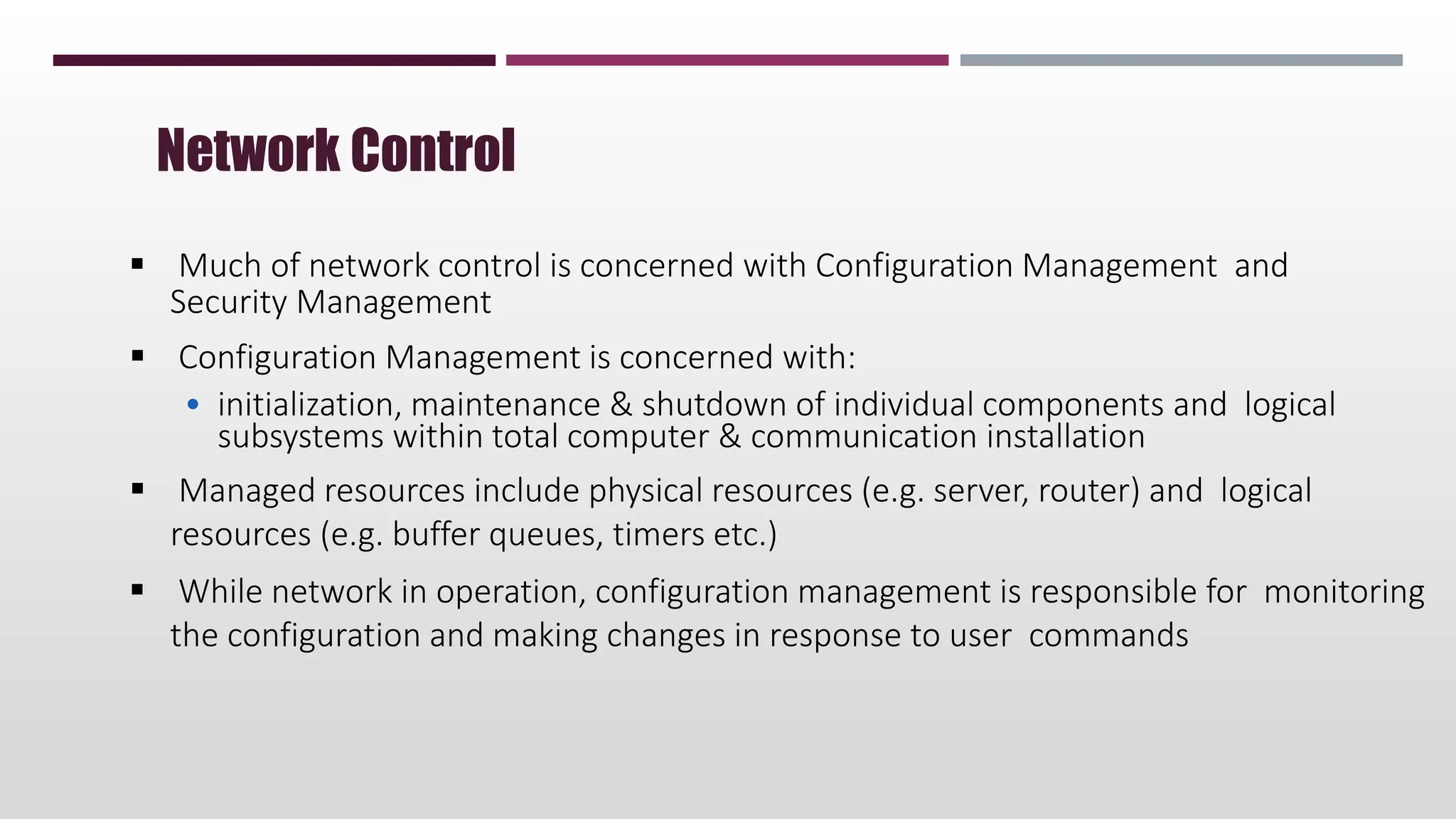
 Much of network control is concerned with Configuration Management and
Security Management
 Configuration Management is concerned with:
• initialization, maintenance & shutdown of individual components and logical
subsystems within total computer & communication installation
 Managed resources include physical resources (e.g. server, router) and logical
resources (e.g. buffer queues, timers etc.)
 While network in operation, configuration management is responsible for monitoring
the configuration and making changes in response to user commands
Network Control
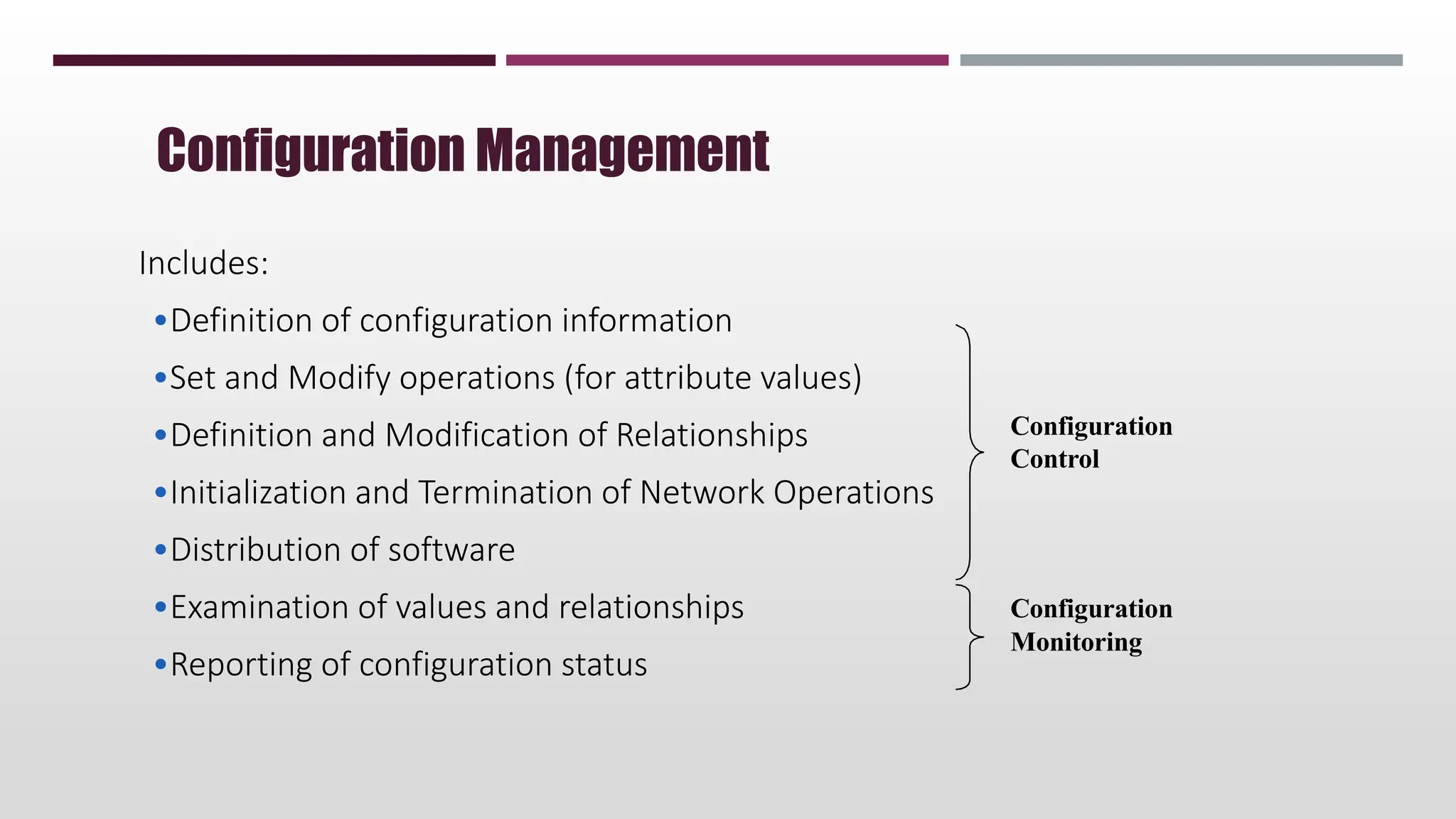
Includes:
•Definition of configuration information
•Set and Modify operations (for attribute values)
•Definition and Modification of Relationships
•Initialization and Termination of Network Operations
•Distribution of software
•Examination of values and relationships
•Reporting of configuration status
Configuration
Control
Configuration
Monitoring
Configuration Management
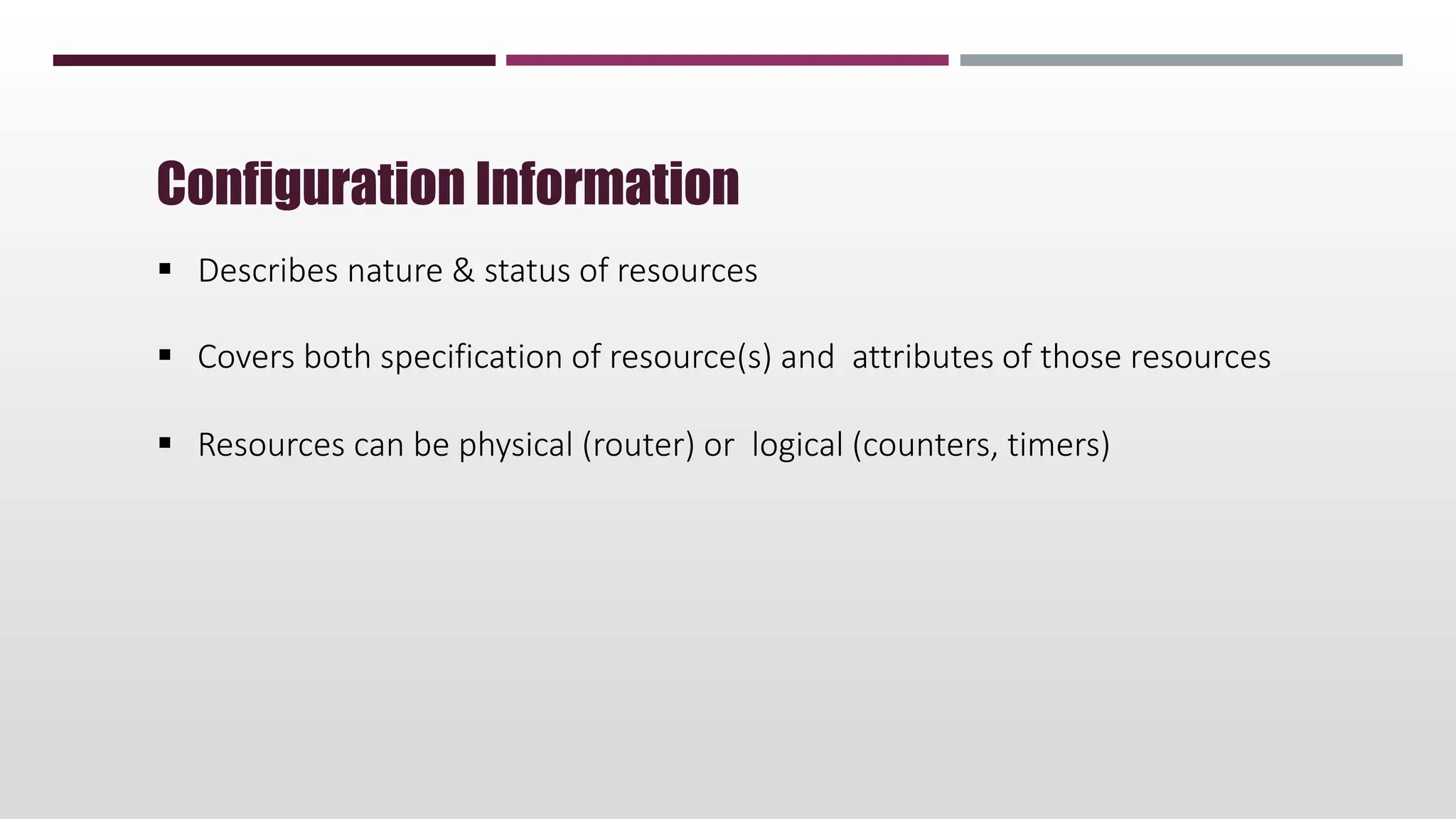
 Describes nature & status of resources
 Covers both specification of resource(s) and attributes of those resources
 Resources can be physical (router) or logical (counters, timers)
Configuration Information
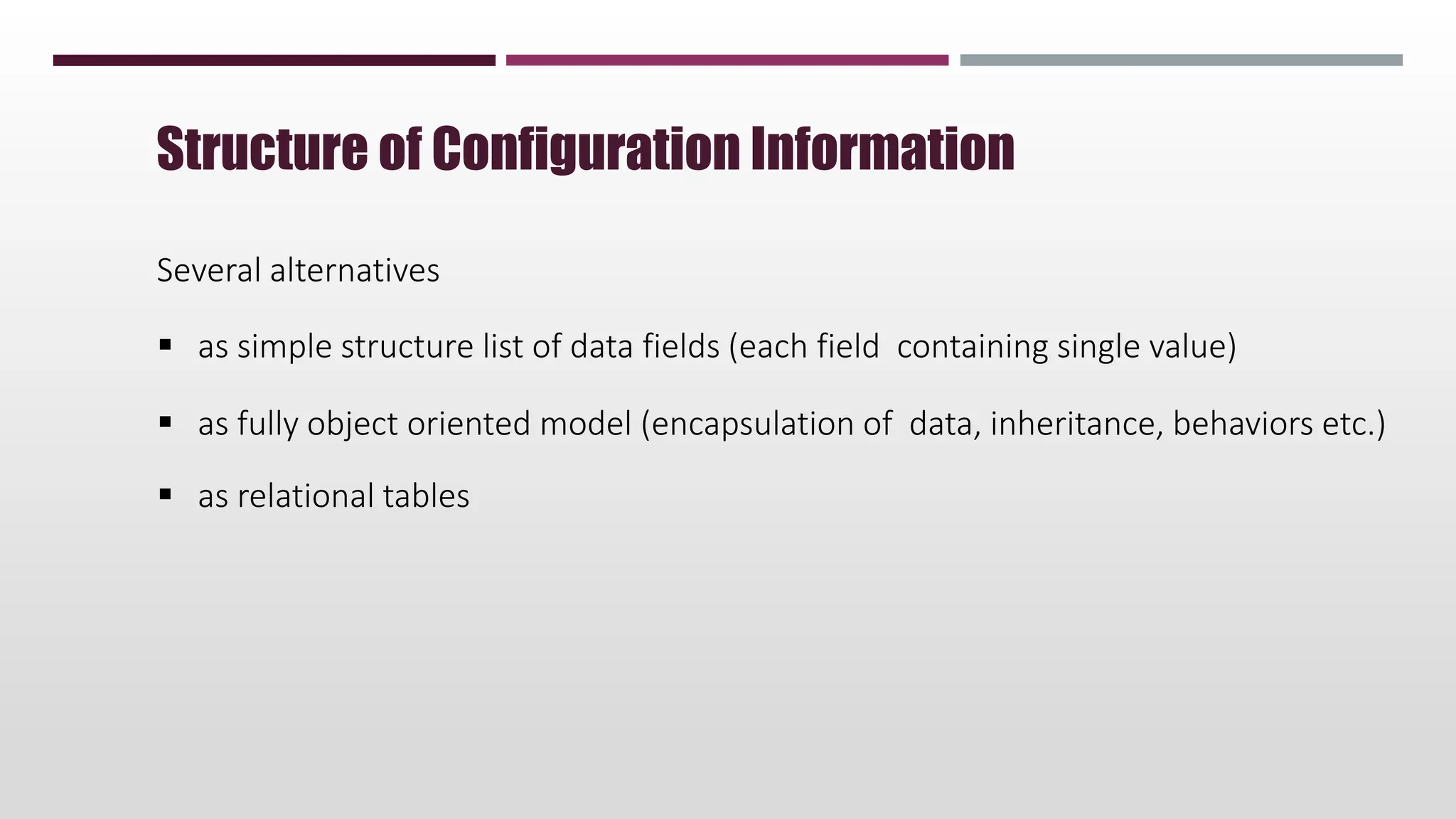
Several alternatives
 as simple structure list of data fields (each field containing single value)
 as fully object oriented model (encapsulation of data, inheritance, behaviors etc.)
 as relational tables
Structure of Configuration Information
 Although sometimes stored in manager, more typically configuration information is
stored.
• in agent
• in network element
• in a proxy for a network element
Storage Of Configuration Information
• Enable user to specify range and type of values to which specified resource
attributes at a particular agent should be set.
• Enable user to define new object types (or data element types) online (rarely
actually implemented in config. mgt systems) or off line (more common in config.
mgt systems).
• Enable user to load pre-defined attribute values(e.g. default states & values) on
a system wide, individual node or individual layer basis.
Configuration Functions
 Config. Control function should enable a manager to remotely set & modify attribute
values in agents & proxies.
 Limitations
 Mgr. authorized to make the setting/modification
 Setting/modification reflect ‘reality’ of resource
Set & Modify Attribute Values
• Data update only: modification of value(s) in agents database of values.
• Data update & resource modification: modify command affects underlying resource
(e.g. disable physical port of device).
• Data Update & Action: modification to value in Agent database causes agent to
initiate certain action(s) e.g. reinitialize parameter in router.
Categories of Modification effects
• Relationship: describes association, connection or condition that exists
between network resources e.g. Topology Relationship, Hierarchy, Physical or
Logical Connection, Management Domain.
• Management Domain: is set of resources that share a set of common management
attributes or a set of common resources that share the same management
authority.
• Configuration Mgt should allow user to add, delete & modify the
relationships among network resources.
Define / Modify Relationships
• Include mechanisms to enable user to initialize & close down network or
subnetwork operation
• Initialization: includes verification of all settable resource attributes & relationship
a proper; Notification of users of any resource, attribute or relationship requiring
modification/setting; Validation of user’s initialization commands
• Termination: includes user retrieval of specified statistics, blocks or status
information before termination procedures are completed.
Initialize & Terminate Network Operations
THANK YOU

Net Mng1.pptx

  • 1.
    Network Management Lec. Mrs.Farah Abdulkadir Habeeb Garmian Of University College Of Computer & Information Technology/ KHANAQIN Department Of Information Network
  • 2.
    NETWORK MANAGEMENT What isManagement ??? Management: defined as monitoring & controlling • the resources in computers. • the resources used in the connection & communication of computers. • the applications used in the computers. Involves: collecting of data, processing data to generate information, making decisions and enactment of activities to implement those decisions.
  • 3.
    The Management hastwo main function: 1. Controlling 2. Monitoring The result of these two function is that we achieve integration, and this integration leads to achieving the two main goals. - maximizing benefit from the resources in the network. - minimize the risks.
  • 4.
    NOTE: The data istransformed into segments, and the receiving and sending the messages, it will be in the 4th layer(transport layer)and that is work on network management layers protocols.
  • 5.
    NETWORK MANAGEMENT What isNetwork Management& Systems Management ??? Several Definitions available! Network Management (NM) provides mechanisms for the monitoring, control and coordination of all managed objects within the physical and data link layer of a network node > [IEEE] (Institute of Electrical and Electronics Engineers) Systems Management provides mechanisms for the monitoring, control and coordination of all managed objects within open systems. This is effected through application layer protocol > [IEEE] (Institute of Electrical and Electronics Engineers) Network Management is subset of Systems Management
  • 6.
    NETWORK MANAGEMENT What isNetwork Management& Systems Management (cont. 2) • Monitoring: continuous watching of resources for deterioration of function. Is more pro-active rather than re-active. • Control: make effective modifications to functioning of resources for optimization/rectification. • Co-ordination: involves both co-ordination of resources and co-ordination of monitoring/control activities.
  • 7.
    NETWORK MANAGEMENT Why Systems/networkManagement • Higher network availability • Reduce Network operational costs • Reduce network bottlenecks • Increase flexibility of operation and integration • Higher efficiency • Security
  • 8.
    NETWORK MANAGEMENT Two basicModels of Network Management • Peer-to-Peer Net. Mgt -Managers who undertake mgt activities act more as peers and there is no central manager. -More common in LAN topologies.
  • 9.
    NETWORK MANAGEMENT Two basicModels of Network Management • Hierarchical Net. Mgt - Managers responsible for specific network resources (element managers) - Allows hierarchy of managers (so called managers of managers or ‘MOMS’!) - More common in large scale (WAN) networks
  • 10.
    NETWORK MANAGEMENT Generalised Architecturefor Network Management Systems .
  • 11.
    NETWORK MANAGEMENT Extending Architecturewith Standard Network Models .
  • 12.
    NETWORK MANAGEMENT Hardware Resourcesto be Managed. • Physical media & connections • Computer Components (e.g. processors, printers) • Connectivity & Interconnections components (e.g. routers, bridges, gateways, modems, hubs, . . ) • Telecommunications devices (e.g. switches . . . )
  • 13.
    NETWORK MANAGEMENT Software resourcesto be managed. • Application s/w & software tools including clients & servers • Middleware (e.g. CORBA platform, NetWare ..) • Operating systems • Telecom Software (e.g. ATM controllers, etc.)
  • 14.
  • 15.
    ATM has twoinput devices: •Card reader - The card reader captures the account information stored on the magnetic stripe on the back of an ATM/debit or credit card. The host processor uses this information to route the transaction to the cardholder's bank. •Keypad - The keypad lets the cardholder tell the bank what kind of transaction is required (cash withdrawal, balance inquiry, etc.) and for what amount. Also, the bank requires the cardholder's personal identification number (PIN) for verification. Federal law requires that the PIN block be sent to the host processor in encrypted form.
  • 16.
    And an ATMhas four output devices: •Speaker - The speaker provides the cardholder with auditory feedback when a key is pressed. •Display screen - The display screen prompts the cardholder through each step of the transaction process. Leased-line machines commonly use a monochrome or color CRT (cathode ray tube) display. Dial-up machines commonly use a monochrome or color LCD. •Receipt printer - The receipt printer provides the cardholder with a paper receipt of the transaction. •Cash dispenser - The heart of an ATM is the safe and cash-dispensing mechanism. The entire bottom portion of most small ATMs is a safe that contains the cash.
  • 17.
    NETWORK MANAGEMENT What Protocolssupport Mgt.  As management can be reduced down to monitoring & controlling, any protocol that can 1. retrieve information 2. set/send information can be used as a management protocol.  However, two ‘specific’ mgt protocols have been agreed Internet Control Message Protocol (ICMP) from the Telecom Community (ITU) Simple Network Management Protocol (SNMP) from the computer industry (IETF)
  • 18.
    NETWORK MANAGEMENT Network ManagementMiddleware  The choice of middleware is greatly affected by the choice of management protocol  General Model (for SNMP & ICMP) is the use of the Manager -- Agent paradigm
  • 19.
    NETWORK MANAGEMENT Network ManagementAgents  Varies in size & complexity greatly depending on ICMP/SNMP usage 1. SNMP - Agent very simple. Just consists of tables of information called a Management Information Base (MIB) - Small memory footprint and processing requirements - Primitive interaction between Mgr and Agent - Master / slave relationship between SNMP Mgr & Agent i.e. mgr must call or poll agent continuously for reliable information - Standard MIB specs. for different types of devices
  • 21.
    NETWORK MANAGEMENT Network ManagementAgents (cont 2) 2. ICMP Agents - Much more complex & greater memory and processing overhead - Typically implemented on larger/more complex communication devices e.g. switches, some routers - Fully Object Oriented Information model (MIB) - Much more sophisticated interaction with manager - Much more local processing of raw data possible before returning information to manager - Agent can initiate Agent -- Manager dialogue (Alarm/Alert reporting) - Better security
  • 23.
    NETWORK MANAGEMENT Network ManagementModels ( Information Models, Network Resource Models, Management Information Bases)  Provide a standard way to describe network resources in an application and vendor-independent way for manipulation/query by network management applications  Typically defines • A modelling language for defining network resources, e.g. • Their configuration settings, e.g. WLAN SSID • Their state variables, e.g. number of connected devices • The notifications/events they generate e.g. No Internet connection • The hierarchy/connections of resources in the network • A global addressing/naming scheme for network resources
  • 24.
    NETWORK MANAGEMENT Network ManagementApplications  Generally speaking there is no uniform partition of the functional areas within network management However: Most network mgmt. applications follow (loosely) the ISO functional mgmt. areas of FCAPS: – Fault – Configuration – Security - Performance - Accounting  In ISO community these are referred to as systems mgt functions! Whereas in Internet community they are referred to as network mgt functions.
  • 25.
    NETWORK MANAGEMENT Fault Management Responsible for: • detection of a problem • fault Isolation • correction to normal operation • uses Polling of managed objects to search for error conditions and/or report alarms/alerts, • Can also use event reporting • illustrates the problem detected either as a graphic or in textual format©
  • 26.
    NETWORK MANAGEMENT Configuration Management Responsiblefor: • Changes, additions and deletions on the managed object parameter(s) • Needs to be co-ordinated with the network management systems personnel (frequently involve some manual work scheduling) • Underlies most of the other network management functional areas
  • 27.
    NETWORK MANAGEMENT Accounting Responsible for: •Usually divided into three stages: metering, tariffing and billing. • Metering logs a particular usage of the managed object • Tariffing is the means by which a charge can be calculated e.g. Flat rate (e.g. leased line), incremental rate, variable rates etc. • Billing is the selection & application of a tariffing mechanism on the metered usage and the composition of the customer bill. • Typically ignored in LAN networks where tariffing and billing are irrelevant but VERY important for Telecom Network & Service providers
  • 28.
    NETWORK MANAGEMENT Performance Management Responsiblefor: • Optimization of managed objects e.g. telephone truck line utilization, bandwidth allocation in ATM network, load balancing on distributed servers. • Identification of bottlenecks in network and implementation of corrective action. • Divides into four main functions: Performance data collection, Data analysis, Problem Reporting, Display & formatting.
  • 29.
    NETWORK MANAGEMENT Security management Responsiblefor: • administration of access controls on managed objects. • issuing of security alarm reports for violations. Several types of threat to assets: – Interruption, interception, modification and fabrication Assets: – Hardware, software, data and communication lines and networks
  • 30.
  • 31.
    NETWORK MANAGEMENT Interworking betweenDifferent Network Management Systems
  • 32.
    NETWORK MANAGEMENT Interworking betweenDifferent Network Management Systems
  • 33.
    Network Monitoring (Revisited) Recap: Net. Monitoring concerned with observing & analysing the status and behaviour of: – End Systems – Intermediate Systems – Sub networks  Challenges of Net. Monitoring : • Gaining access to monitored information (e.g. definition of monitoring information, retrieval of that info.) • Design of monitoring mechanism • Usage of monitored information (e.g. by fault or performance Accounting Management applications
  • 34.
     Static Information: •characterizes current configuration (e.g. network element) • stored in network element  Dynamic Information: • related to events in the network e.g. number of packets transmitted • collected and stored in network element but can be stored remotely (e.g. for some LAN based network elements)  Statistical: • derived from dynamic information • gathered by any systems with access to dynamic information, i.e. by network element, remote monitor, or management application Network monitoring information
  • 35.
     Managers cangather information about network element via Polling and/or Event Reporting Polling: • Request - Response interaction between manager & Agent. • Query can be specific (named parameter/object) or a general search • Example uses: investigate (ping) problem • Implementation effort centered on Manager Polling vs event reporting
  • 36.
     Event Reporting: •Agent initiative to generate periodic report & send to manager • Reporting condition(s) may be pre-configured by manager • Example uses: significant change in Managed object values, unusual event. • Can be more efficient than Polling e.g. for monitoring managed objects whose states or values change relatively infrequently • Has less communication overhead that Polling Polling Vs Event Reporting (cont.)
  • 37.
    Polling vs EventReporting (cont. 2)  Both are useful information gathering techniques  Telecoms world traditionally rely on event reporting where as SNMP world puts very little reliance on event reporting  Choice depends on: • Amount of network traffic generated by each method • Robustness in critical situations • Time delay in notifying network manager • Amount of processing in Managed devices • Particular network monitoring applications being supported • Contingencies required in case of notifying device fails before sending a report
  • 38.
    First let’s considerwhat indicators of performance are important  Two categories of Performance indication • Service Oriented Measures – relate to satisfaction of service level agreements with users • Efficiency Oriented Measures – relation to meeting network requirements at minimum cost. Performance Monitoring
  • 39.
     Availability: • Percentageof time a network system, component, or an application is available for a user  Response Time: • Length of time it takes a response to appear at a user’s terminal after a user action calls for it  Accuracy: • Percentage of time that no errors occur in the transmission and delivery of information Service Oriented Network Performance Indicators
  • 40.
     Throughput: • Rateat which application-oriented events occur e.g. transaction messages, file transfers, number of session for an application over a given time, number of calls for a circuit switched environment.  Utilisation: • Percentage of the theoretical capacity of a resource that is being used (e.g. transmission line, switch etc.) Efficiency Oriented Network Performance Indicators
  • 41.
     Expressed aspercentage of time a network system, component, or an application is available for a user => Based on reliability of individual components of network  Reliability is the probability that a component will perform its specified function for a specified time used under specified conditions  Component failure is expressed as ‘mean time between failures’ (MTBF) => Availability = MTBF (MTBF + MTTR) where MTTR is ‘Mean time between Repair’ following a failure Availability
  • 42.
     Is timeit takes to react to a given input  Achievable with (i) increased cost of computer processing power (ii) trade-offs with other requirements  Two forms of response time: • User Response Time - timespan between moment user receives complete reply to one command and enters the next command • System Response Time - timespan between moment a user enters a command and the moment a complete response is displayed on the terminal Response Time
  • 43.
     Seven elementsof response time typically found in most monitoring applications  Inbound terminal delay: delay in getting an inquiry from the terminal to the communication line. Is directly dependent on transmission rate from terminal to controller  Inbound queuing time: time required for processing by the controller or PAD* device. E.g. can be dependent on buffer/queue size and load on controller  Inbound service time: time taken to transmit over comms. link, network or other communications facility from the controller to the host’s front -end processor Elements of Response Time
  • 44.
     Processor delay:Time front-end processor, disk drives etc. on computer spend preparing a reply to the original inquiry.  Outbound queuing time: time reply spends at a port in the front-end processor waiting to be dispatched on the network or communication line.  Outbound service time: time to transmit the communications facility from the host’s front end processor to the controller. Elements of Response Time (cont. 2)
  • 45.
     Accuracy • Becauseof built-in error correction (in data link and transport protocols), accuracy is generally not a user concern • Nevertheless useful to monitor rate of errors that must be corrected  Throughput • is an application oriented measurement (calculation of the rate at which they occur) • Examples include – Number of transactions of a given type in a certain period – Number of customer sessions for a given application during a certain period of time Accuracy & Throughput
  • 46.
     Is amore fine grained measure than throughput  Concerned with percentage of time that a resource is in use over a given period of time  Useful in determining network bottlenecks and congestion  Response time usually increases exponentially as utilization of a resource increases Utilization
  • 47.
     One techniqueto measure utilization is to observe differences between planned load and actual load on various links in a network  Planned load is reflected by capacity (bits per second) of each individual link  Actual load is the measured average traffic (bits per sec)  Comparison of the planned load and actual load on each link can identify inefficient allocation of resources  A closer balance between planned load and actual load can be achieved => reducing the total capacity and resulting in more efficient usage of resources Utilization (cont. 2)
  • 48.
     Having lookedat Performance Indicators - now lets look at the actual Performance Monitoring Function/Activities.  Can be thought of as divided into three components: • Performance Measurement which is concerned with actual gathering of statistics about network traffic and timing. • Performance Analysis which is concerned with software for reducing and presenting data. • Synthetic Traffic Generation which is concerned with observation of network under controlled load(s). Performance-Monitoring Functions
  • 49.
     Often performedby Agent within network element (e.g. router) • e.g. Observes the amount of traffic into/out of a network element, number of connections (at various levels of network protocol stack), and traffic per connection  Can be expensive (in processing time) on the network element  In LANs remote (external) monitoring can be used to observe network traffic (broadcast/shared network. Performance Measurement Functions
  • 50.
     Is trafficevenly distributed among the network users or are there source-to-destination pairs with unusually heavy traffic ?  What is the percentage of each type of packet? Are some packet types of unusually high frequency ? (could indicate an error or an inefficient protocol)  What is the distribution of data packets sizes ?  What is the channel utilization and throughput ? Example Questions that Performance Measurement reported in LAN should answer
  • 51.
    Must detect andreport faults • at minimum agent will maintain a log of significant events & errors • If Managers use polling => heavy reliance on agent fault/error logs • If Agents use event reporting => importance of tight criteria for issuing fault reports in order to avoid an ’event storm’ • Fault Monitor should also anticipate faults e.g. setting thresholds for event reporting Fault Monitoring Functions
  • 52.
     Should alsoassist in isolating & diagnosing faults  For example Fault Monitoring functions might include: - Connectivity test - Protocol integrity test - Data integrity test - Data saturation test - Connection saturation test - Response time test - Function test - Loopback test Fault Monitoring functions
  • 53.
     Keeps trackof users’ usage of network resources  Typical accounting data for network may include: • user identification • receiver identification - network resource to which connection was attempted and/or made • number of packets transmitted • security levels – identify transmission and processing priorities • time stamps – for principle transmission & processing event, e.g. start and stop times Accounting Monitoring Functions
  • 54.
     Much ofnetwork control is concerned with Configuration Management and Security Management  Configuration Management is concerned with: • initialization, maintenance & shutdown of individual components and logical subsystems within total computer & communication installation  Managed resources include physical resources (e.g. server, router) and logical resources (e.g. buffer queues, timers etc.)  While network in operation, configuration management is responsible for monitoring the configuration and making changes in response to user commands Network Control
  • 55.
    Includes: •Definition of configurationinformation •Set and Modify operations (for attribute values) •Definition and Modification of Relationships •Initialization and Termination of Network Operations •Distribution of software •Examination of values and relationships •Reporting of configuration status Configuration Control Configuration Monitoring Configuration Management
  • 56.
     Describes nature& status of resources  Covers both specification of resource(s) and attributes of those resources  Resources can be physical (router) or logical (counters, timers) Configuration Information
  • 57.
    Several alternatives  assimple structure list of data fields (each field containing single value)  as fully object oriented model (encapsulation of data, inheritance, behaviors etc.)  as relational tables Structure of Configuration Information
  • 58.
     Although sometimesstored in manager, more typically configuration information is stored. • in agent • in network element • in a proxy for a network element Storage Of Configuration Information
  • 59.
    • Enable userto specify range and type of values to which specified resource attributes at a particular agent should be set. • Enable user to define new object types (or data element types) online (rarely actually implemented in config. mgt systems) or off line (more common in config. mgt systems). • Enable user to load pre-defined attribute values(e.g. default states & values) on a system wide, individual node or individual layer basis. Configuration Functions
  • 60.
     Config. Controlfunction should enable a manager to remotely set & modify attribute values in agents & proxies.  Limitations  Mgr. authorized to make the setting/modification  Setting/modification reflect ‘reality’ of resource Set & Modify Attribute Values
  • 61.
    • Data updateonly: modification of value(s) in agents database of values. • Data update & resource modification: modify command affects underlying resource (e.g. disable physical port of device). • Data Update & Action: modification to value in Agent database causes agent to initiate certain action(s) e.g. reinitialize parameter in router. Categories of Modification effects
  • 62.
    • Relationship: describesassociation, connection or condition that exists between network resources e.g. Topology Relationship, Hierarchy, Physical or Logical Connection, Management Domain. • Management Domain: is set of resources that share a set of common management attributes or a set of common resources that share the same management authority. • Configuration Mgt should allow user to add, delete & modify the relationships among network resources. Define / Modify Relationships
  • 63.
    • Include mechanismsto enable user to initialize & close down network or subnetwork operation • Initialization: includes verification of all settable resource attributes & relationship a proper; Notification of users of any resource, attribute or relationship requiring modification/setting; Validation of user’s initialization commands • Termination: includes user retrieval of specified statistics, blocks or status information before termination procedures are completed. Initialize & Terminate Network Operations
  • 64.