SCIENT INSTITUTE OF TECHNOLOGY
AN UGC AUTONOMOUS)
Approved by AICTE, and Affiliated with JNTU Hyderabad
( Ibrahimpatnam , R.R. Dist., Telangana,501506. ESTD: 2001)
2024-2025
WIRELESS VISION TECHNOLOGY
Presented by:
P.Akhila – 21C01A0437
Guide Details :
Dr.Bommidi Sridhar
PhD HOD Of ECE
TABLE OF CONTENTS
1. ABSTRACT
2. INTRODUCTION
3. WHAT CAN WIVI DO ?
4. HISTORY OD WIVI
5. HOW IT WORKS ?
6. WHY WE USE WFI SIGNALS ?
7. BASIC PRINCIPLE
8. WIVI SETUP AND WORKING
9. IDENTIFYING AND TRACKING HUMANS
10. CHALLENGS FACED IN DESIGNIND WIVI
11. MERITS & DEMERITS
12. APPLICATIONS
13. FUTURE DEVELOPMENTS
14. CONCLUSION
ABSTRACT:
 Wi-Fi, a widely used wireless
networking technology, has
evolved into Wireless Vision
(WiVi), which uses Wi-Fi signals
and MIMO communication to
detect and visualize human
motion and gestures behind
walls, enabling the
identification of people and
their locations without the need
for transmitting devices.
INTRODUCTION :
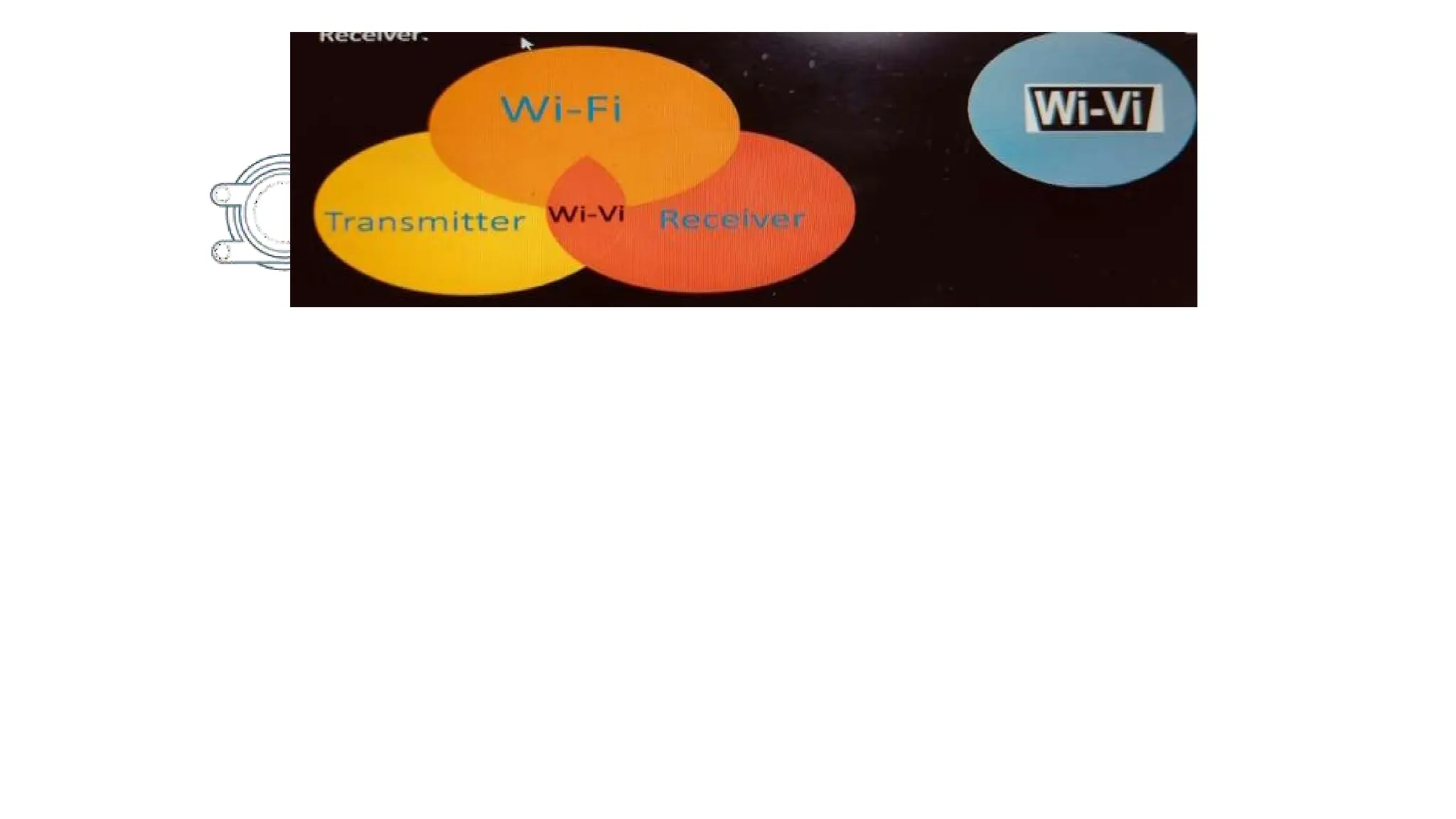
 Wi-Vi stands for Wireless Vision.
 Demonstrated by “Dina Katabi”,a MIT’s professor of
Electrical Department.
 Wi-Vi uses OFDM signals in ISM Band(at 2.4 GHz) and typical
WiFi hardware.
 Wi-Vi captures moving objects behind the walls.
WHAT CAN WIVI DO ??
Wi-Vi technology uses Wi-Fi signals to detect human motion and
objects behind walls by capturing reflections, similar to radar or
sonar, offering potential applications in fields like medicine, though it
faces challenges like the flash effect.
HISTORY OF WIVI:
 2000s: Initial research on Wi-Fi-based motion
detection
 2010: MIT researchers develop first Wi-
Vi prototype
 2013: MIT Wi-Vi achieves 90% accuracy
 2015: Improved Wi-Vi 2.0 enhances
accuracy to 95%
 2016: Research expands to multi-
sensor fusion and real-time
processing
 2020: Commercialization begins for smart
homes, healthcare, security, and search
and rescue applications
How it works ?...
 Detect the Number of Moving Humans
in a close room.
 Determine the relative location of
moving humans.
 Enable Communication through a
wall,without carrying a wireless Device.
 Can identify simple Gestures Behind a wall.
WHY WE USE WI-FI SIGNALS ?
 Wi-Fi signals can easily penetrate through walls.
 Wi-Vi relies on a simple hardware of 2.4 GHz Wi-Fi radios.
 Small enough to be portably used.
 Integrated in hand held devices.
 Low power Wi-Fi signals are used.
BASIC PRINCIPLE
 Based on the principle of RADAR and SONAR imaging.
 Wi-Vi is potentially an X-ray vision created with low
power Wi-Fi signals.
 RADAR and SONAR work on the Doppler effect.
 This technology uses reflected Wi-Fi signals to track
the movement of people behind walls.
WIVI Setup & It’s Working
Anystatic objects that the signalshit
including the wall create identical
reflections, they too are cance led out
by this nu ling effect.
Only thosereflections that change
between the two signals, such as those
from a moving object, arrive back at
the receive
Identifing and Tracking Humans :
● Previous attempts to track moving targets
through walls have done so using an array of
spaced antennas.
● Each capture the signal reflected off a
person moving through the environment
● This could be too expensive and bulky
● for use in a handheld device.
● So instead Wi-Vi uses just one receiver.
CHALLENGES FACED IN DESIGNING IN WIVI:
Flash Effect :
The flash effect happens when fast-moving objects cause strong reflections of
Wi- Fi signals, leading to misleading or distorted data. This interference can
overwhelm the system, resulting in false detections or difficulty
distinguishing between moving and stationary objects. To address this,
advanced signal processing algorithms are used to filter out these
reflections and improve the system's accuracy in detecting human motion
and objects.
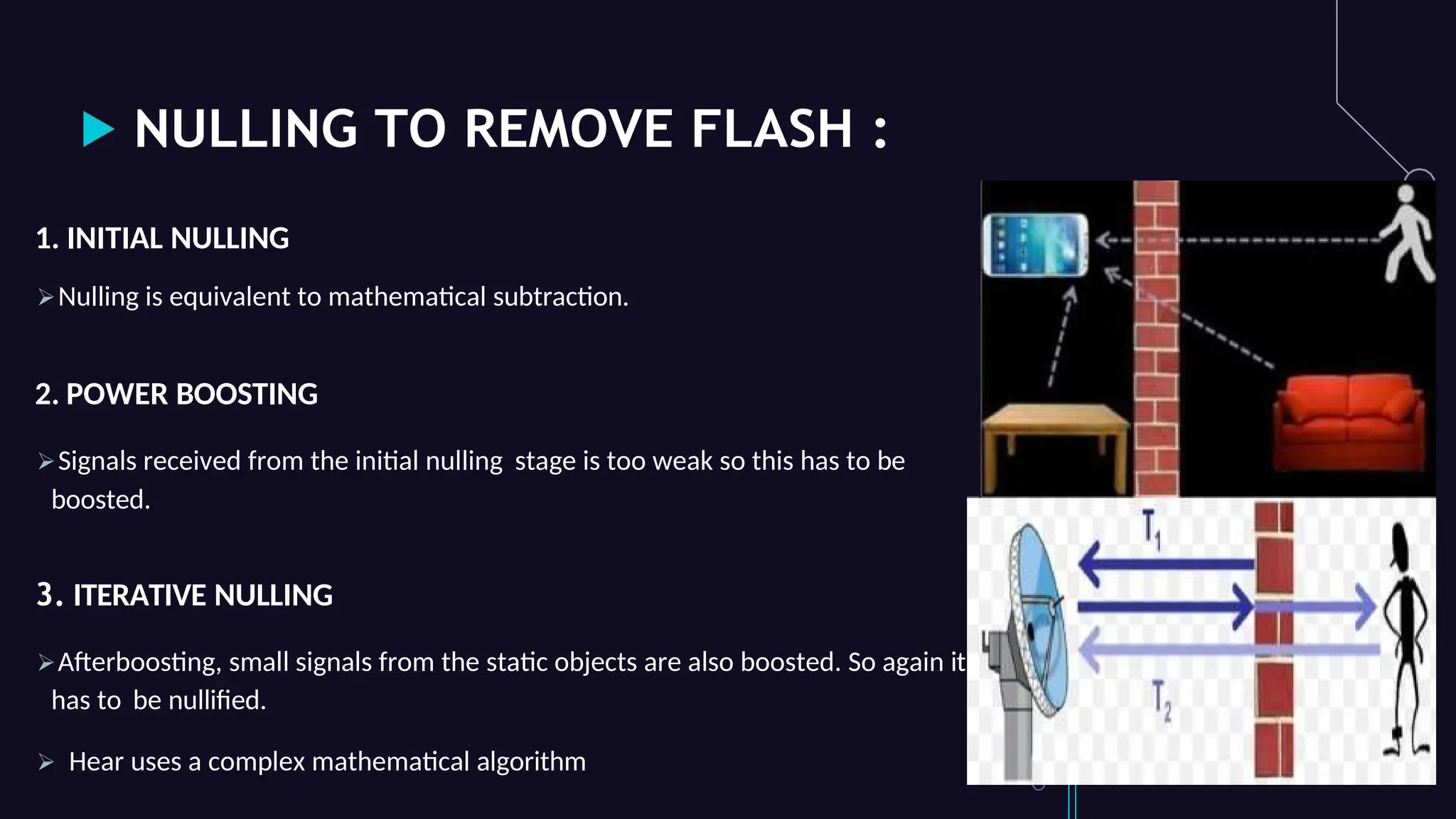
NULLING TO REMOVE FLASH :
1. INITIAL NULLING
Nulling is equivalent to mathematical subtraction.
2. POWER BOOSTING
Signals received from the initial nulling stage is too weak so this has to be
boosted.
3. ITERATIVE NULLING
Afterboosting, small signals from the static objects are also boosted. So again it
has to be nullified.
 Hear uses a complex mathematical algorithm
MERITS :
 Wi-Vi requires only few MHz of bandwidth similar as Wi-Fi.
 Its setup is Low-Cost and Low-Power.
 Wi-Vi can perform through wall imaging without access to
any device on the other side of the wall.
 Allows to detect object in Dark or Smoke.
 DEMERITS :
 Display has very Low Resolution.
 Can’t detect human behind the concrete
walls thicker than 8’
 Human needs to move at least 50 cm to
be detectable.
FUTURE DEVELOPMENTS :
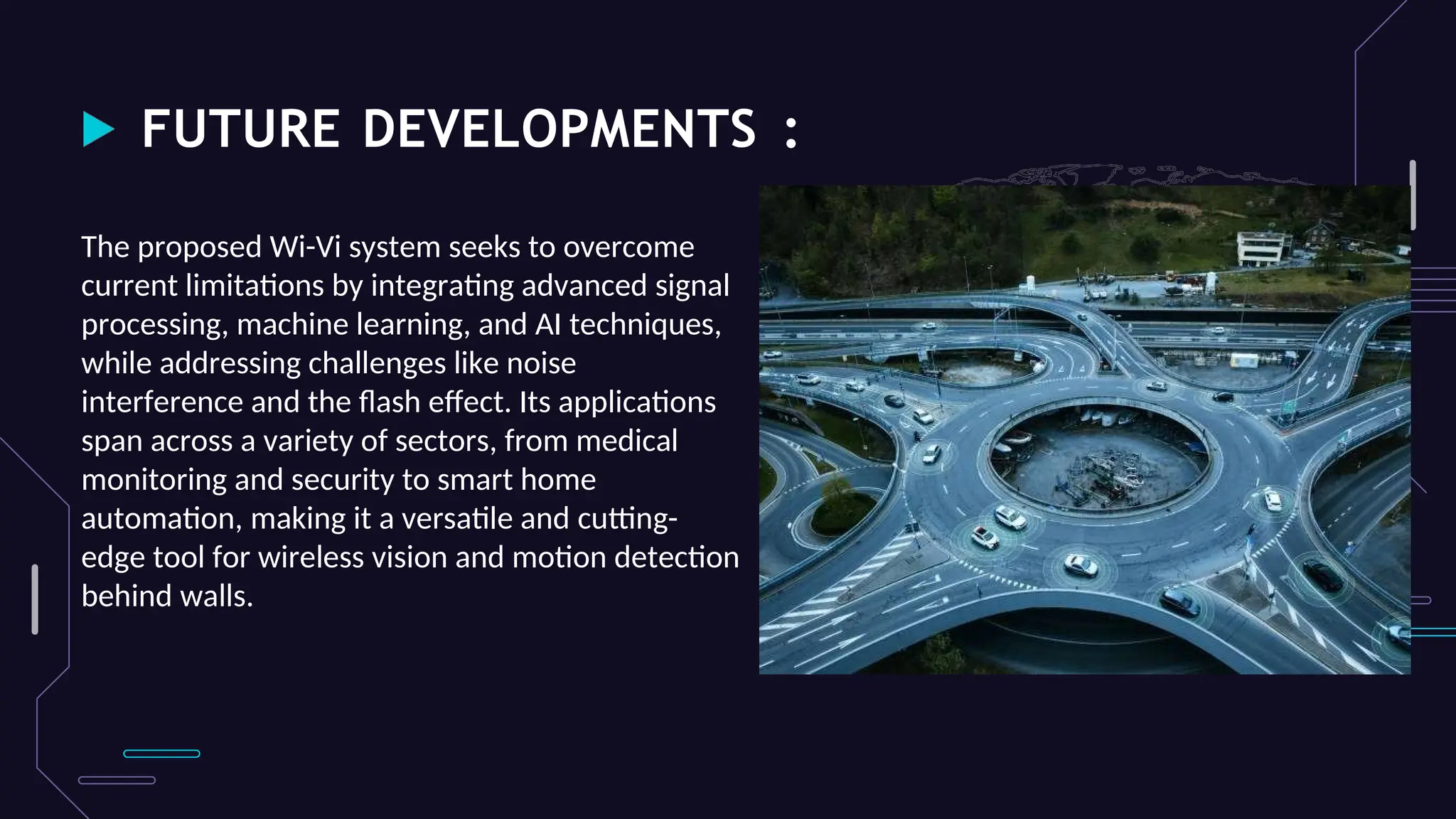
The proposed Wi-Vi system seeks to overcome
current limitations by integrating advanced signal
processing, machine learning, and AI techniques,
while addressing challenges like noise
interference and the flash effect. Its applications
span across a variety of sectors, from medical
monitoring and security to smart home
automation, making it a versatile and cutting-
edge tool for wireless vision and motion detection
behind walls.
CONCLUSION :
 Wi-Vi is a wireless technology that uses Wi-
Fi signals to detect moving individuals
behind walls or obstacles. Unlike
traditional detection systems, it does not
require the person to carry any device.
This technology is cost-effective and has
applications in disaster response,
helping locate trapped individuals, as
well as in healthcare for detecting
medical symptoms.
Any
Queries….
??
Wireless vision technology seminar presentation

Wireless vision technology seminar presentation

  • 1.
    SCIENT INSTITUTE OFTECHNOLOGY AN UGC AUTONOMOUS) Approved by AICTE, and Affiliated with JNTU Hyderabad ( Ibrahimpatnam , R.R. Dist., Telangana,501506. ESTD: 2001) 2024-2025 WIRELESS VISION TECHNOLOGY Presented by: P.Akhila – 21C01A0437 Guide Details : Dr.Bommidi Sridhar PhD HOD Of ECE
  • 2.
    TABLE OF CONTENTS 1.ABSTRACT 2. INTRODUCTION 3. WHAT CAN WIVI DO ? 4. HISTORY OD WIVI 5. HOW IT WORKS ? 6. WHY WE USE WFI SIGNALS ? 7. BASIC PRINCIPLE 8. WIVI SETUP AND WORKING 9. IDENTIFYING AND TRACKING HUMANS 10. CHALLENGS FACED IN DESIGNIND WIVI 11. MERITS & DEMERITS 12. APPLICATIONS 13. FUTURE DEVELOPMENTS 14. CONCLUSION
  • 3.
    ABSTRACT:  Wi-Fi, awidely used wireless networking technology, has evolved into Wireless Vision (WiVi), which uses Wi-Fi signals and MIMO communication to detect and visualize human motion and gestures behind walls, enabling the identification of people and their locations without the need for transmitting devices.
  • 4.
    INTRODUCTION :  Wi-Vistands for Wireless Vision.  Demonstrated by “Dina Katabi”,a MIT’s professor of Electrical Department.  Wi-Vi uses OFDM signals in ISM Band(at 2.4 GHz) and typical WiFi hardware.  Wi-Vi captures moving objects behind the walls.
  • 5.
    WHAT CAN WIVIDO ?? Wi-Vi technology uses Wi-Fi signals to detect human motion and objects behind walls by capturing reflections, similar to radar or sonar, offering potential applications in fields like medicine, though it faces challenges like the flash effect.
  • 7.
    HISTORY OF WIVI: 2000s: Initial research on Wi-Fi-based motion detection  2010: MIT researchers develop first Wi- Vi prototype  2013: MIT Wi-Vi achieves 90% accuracy  2015: Improved Wi-Vi 2.0 enhances accuracy to 95%  2016: Research expands to multi- sensor fusion and real-time processing
  • 8.
     2020: Commercializationbegins for smart homes, healthcare, security, and search and rescue applications
  • 9.
    How it works?...  Detect the Number of Moving Humans in a close room.  Determine the relative location of moving humans.  Enable Communication through a wall,without carrying a wireless Device.
  • 10.
     Can identifysimple Gestures Behind a wall.
  • 11.
    WHY WE USEWI-FI SIGNALS ?  Wi-Fi signals can easily penetrate through walls.  Wi-Vi relies on a simple hardware of 2.4 GHz Wi-Fi radios.  Small enough to be portably used.  Integrated in hand held devices.  Low power Wi-Fi signals are used.
  • 12.
    BASIC PRINCIPLE  Basedon the principle of RADAR and SONAR imaging.  Wi-Vi is potentially an X-ray vision created with low power Wi-Fi signals.  RADAR and SONAR work on the Doppler effect.  This technology uses reflected Wi-Fi signals to track the movement of people behind walls.
  • 14.
    WIVI Setup &It’s Working Anystatic objects that the signalshit including the wall create identical reflections, they too are cance led out by this nu ling effect. Only thosereflections that change between the two signals, such as those from a moving object, arrive back at the receive
  • 15.
    Identifing and TrackingHumans : ● Previous attempts to track moving targets through walls have done so using an array of spaced antennas. ● Each capture the signal reflected off a person moving through the environment ● This could be too expensive and bulky ● for use in a handheld device. ● So instead Wi-Vi uses just one receiver.
  • 16.
    CHALLENGES FACED INDESIGNING IN WIVI: Flash Effect : The flash effect happens when fast-moving objects cause strong reflections of Wi- Fi signals, leading to misleading or distorted data. This interference can overwhelm the system, resulting in false detections or difficulty distinguishing between moving and stationary objects. To address this, advanced signal processing algorithms are used to filter out these reflections and improve the system's accuracy in detecting human motion and objects.
  • 17.
    NULLING TO REMOVEFLASH : 1. INITIAL NULLING Nulling is equivalent to mathematical subtraction. 2. POWER BOOSTING Signals received from the initial nulling stage is too weak so this has to be boosted. 3. ITERATIVE NULLING Afterboosting, small signals from the static objects are also boosted. So again it has to be nullified.  Hear uses a complex mathematical algorithm
  • 18.
    MERITS :  Wi-Virequires only few MHz of bandwidth similar as Wi-Fi.  Its setup is Low-Cost and Low-Power.  Wi-Vi can perform through wall imaging without access to any device on the other side of the wall.  Allows to detect object in Dark or Smoke.  DEMERITS :  Display has very Low Resolution.  Can’t detect human behind the concrete walls thicker than 8’  Human needs to move at least 50 cm to be detectable.
  • 20.
    FUTURE DEVELOPMENTS : Theproposed Wi-Vi system seeks to overcome current limitations by integrating advanced signal processing, machine learning, and AI techniques, while addressing challenges like noise interference and the flash effect. Its applications span across a variety of sectors, from medical monitoring and security to smart home automation, making it a versatile and cutting- edge tool for wireless vision and motion detection behind walls.
  • 21.
    CONCLUSION :  Wi-Viis a wireless technology that uses Wi- Fi signals to detect moving individuals behind walls or obstacles. Unlike traditional detection systems, it does not require the person to carry any device. This technology is cost-effective and has applications in disaster response, helping locate trapped individuals, as well as in healthcare for detecting
  • 22.
  • 23.