Why Web 2.0 is Good for Learning and for Research: Principles and Prototypes Carsten Ullrich, Kerstin Borau, Heng Luo, Xiaohong Tan, Liping Shen, Ruimin Shen Shanghai Jiao Tong University
Overview Motivation Web 2.0 from a  learning perspective Web 2.0 as a  research tool Examples social bookmarking for learning object annotation microblogging for language learning Lessons learned
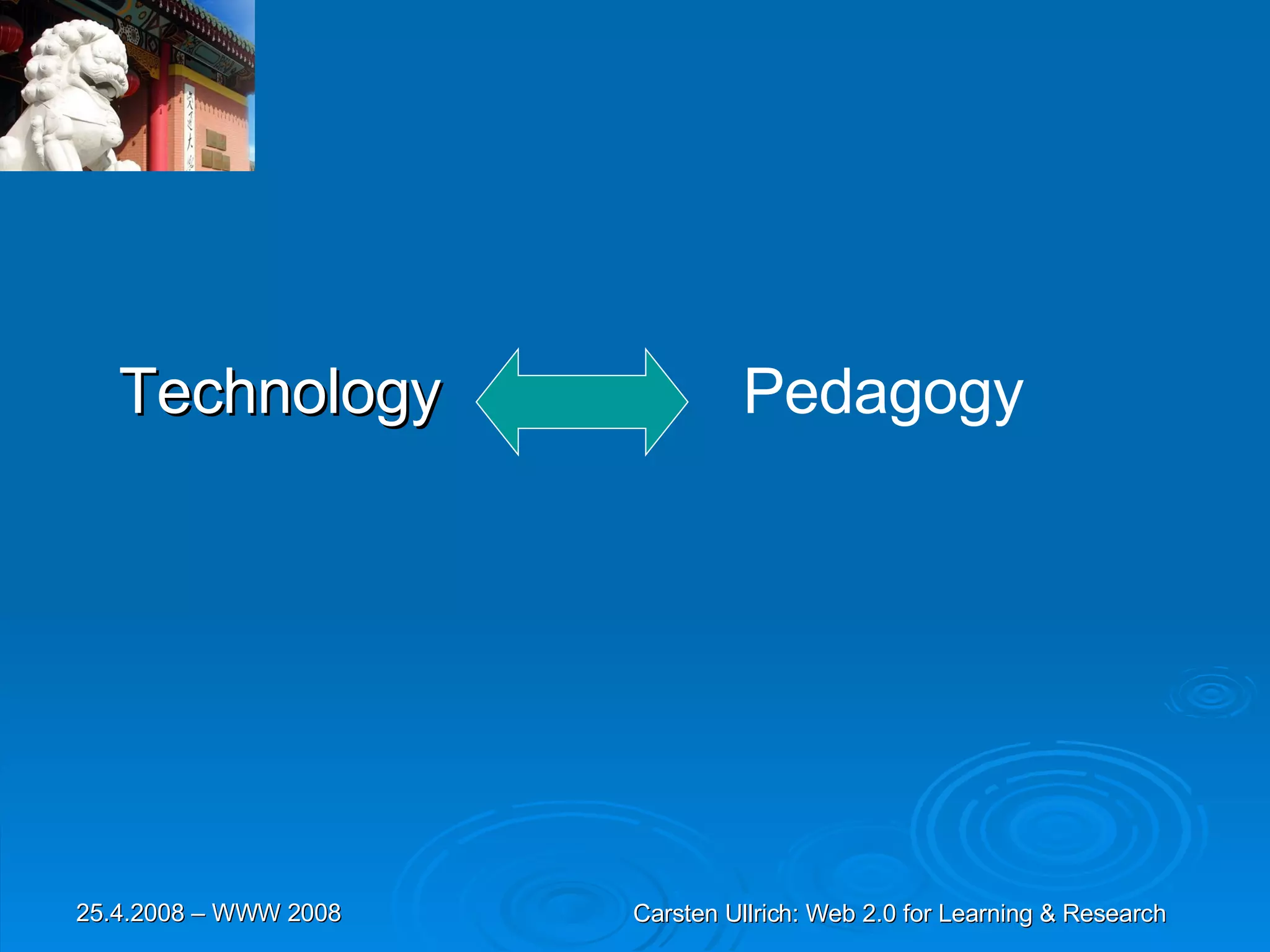
Technology Pedagogy
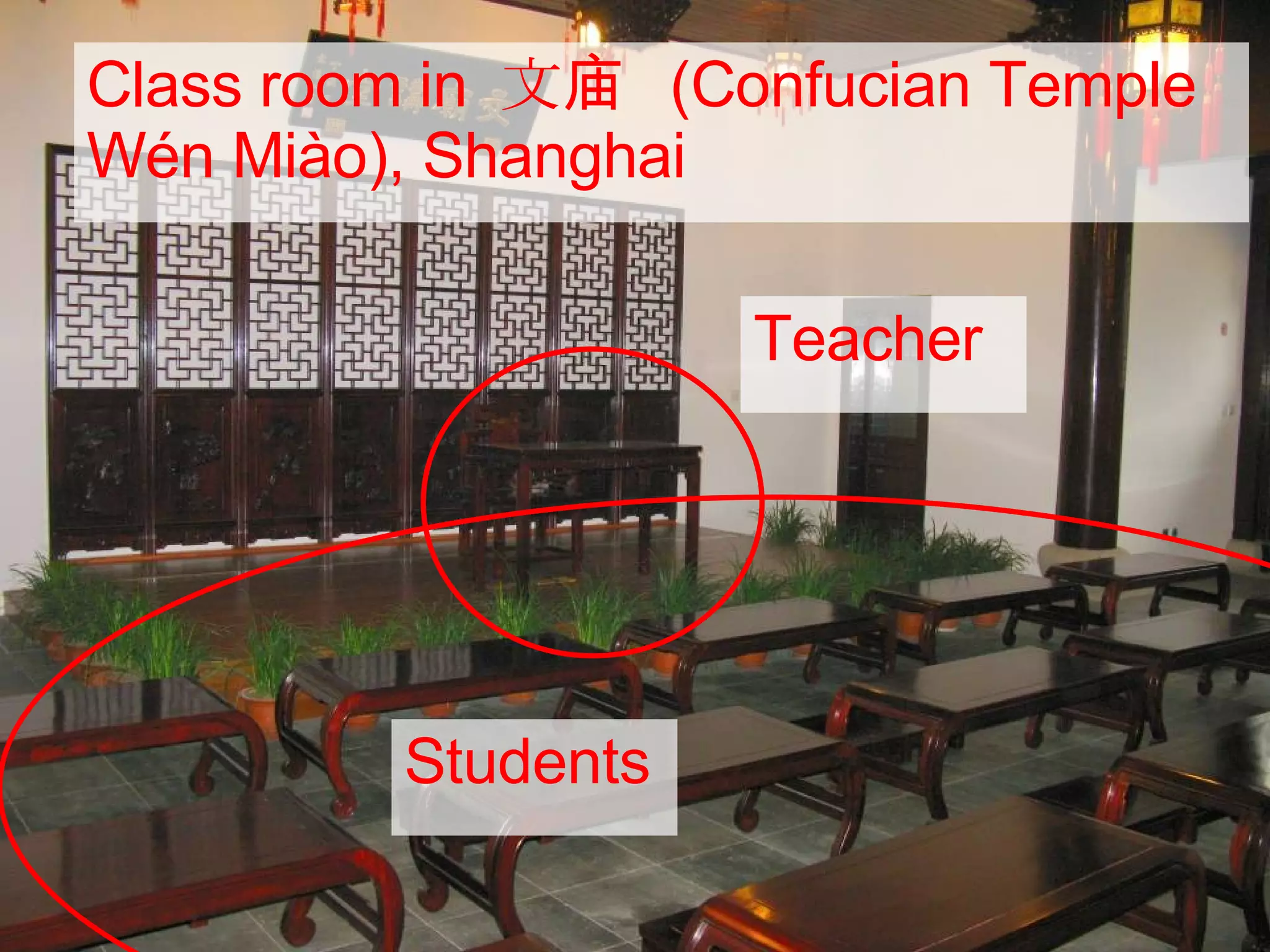
Class room in  文庙  (Confucian Temple Wén Miào), Shanghai  Teacher Students
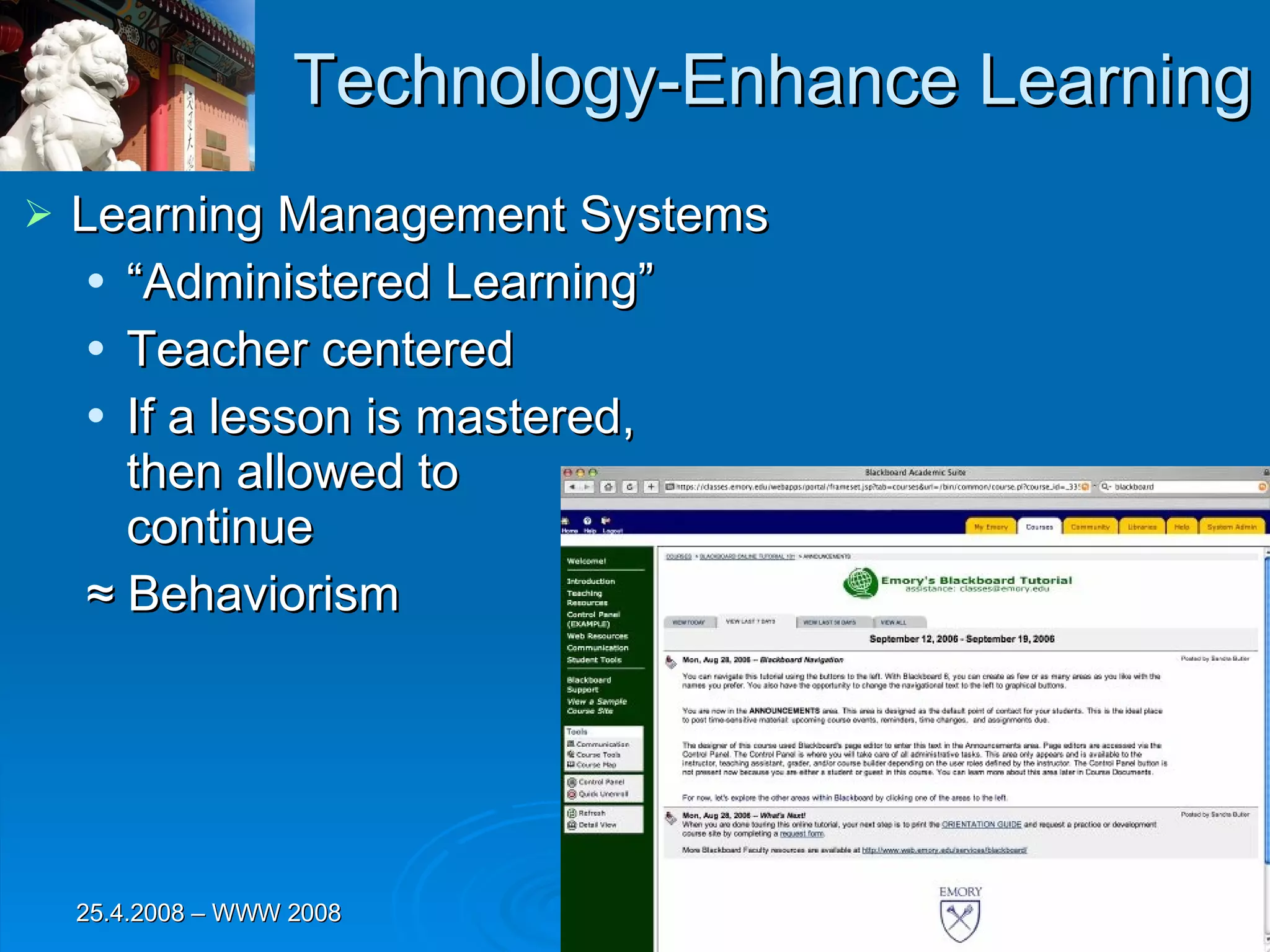
Technology-Enhance Learning Learning Management Systems “Administered Learning” Teacher centered If a lesson is mastered,  then allowed to  continue ≈ Behaviorism
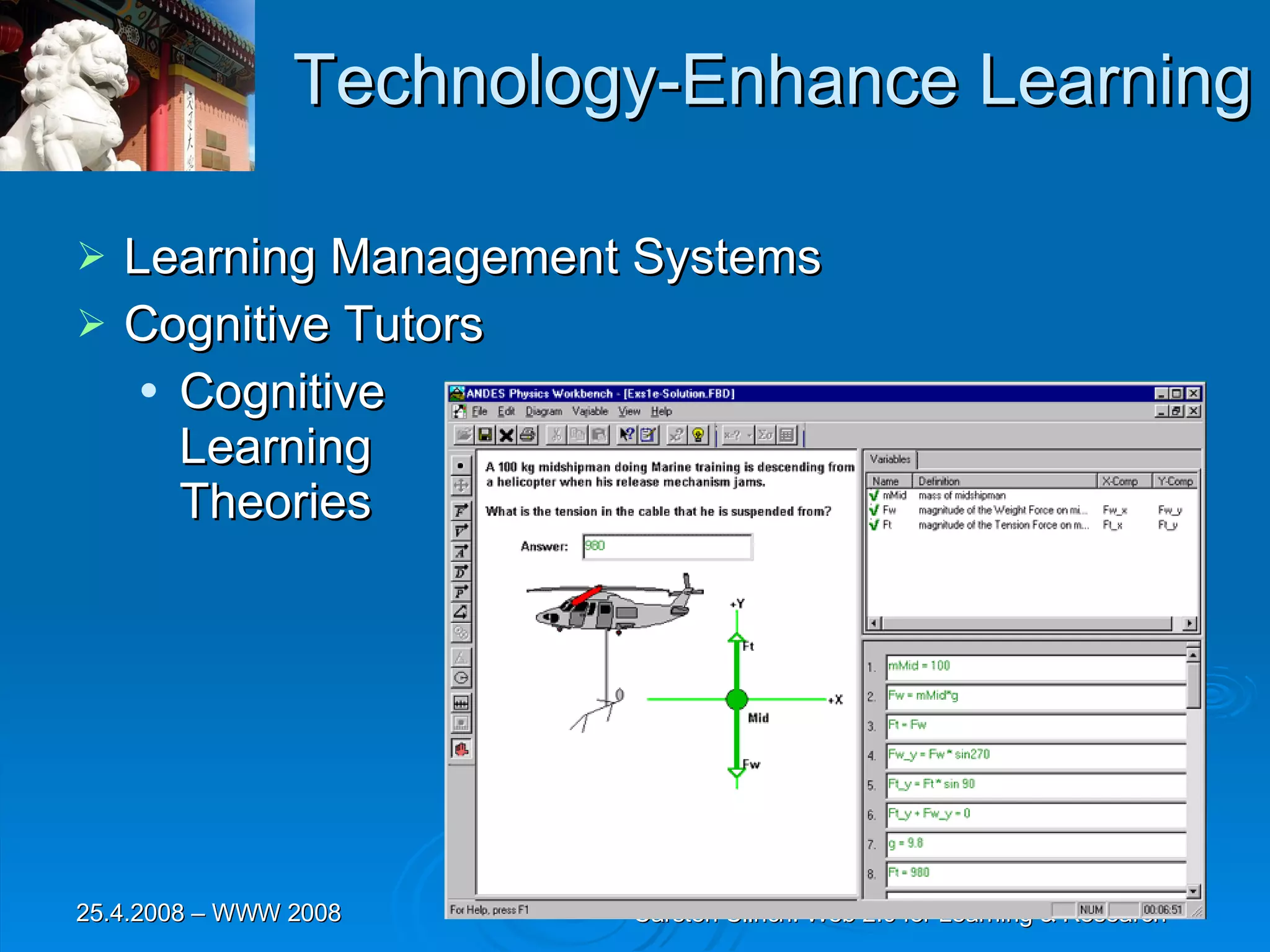
Technology-Enhance Learning Learning Management Systems Cognitive Tutors Cognitive  Learning  Theories
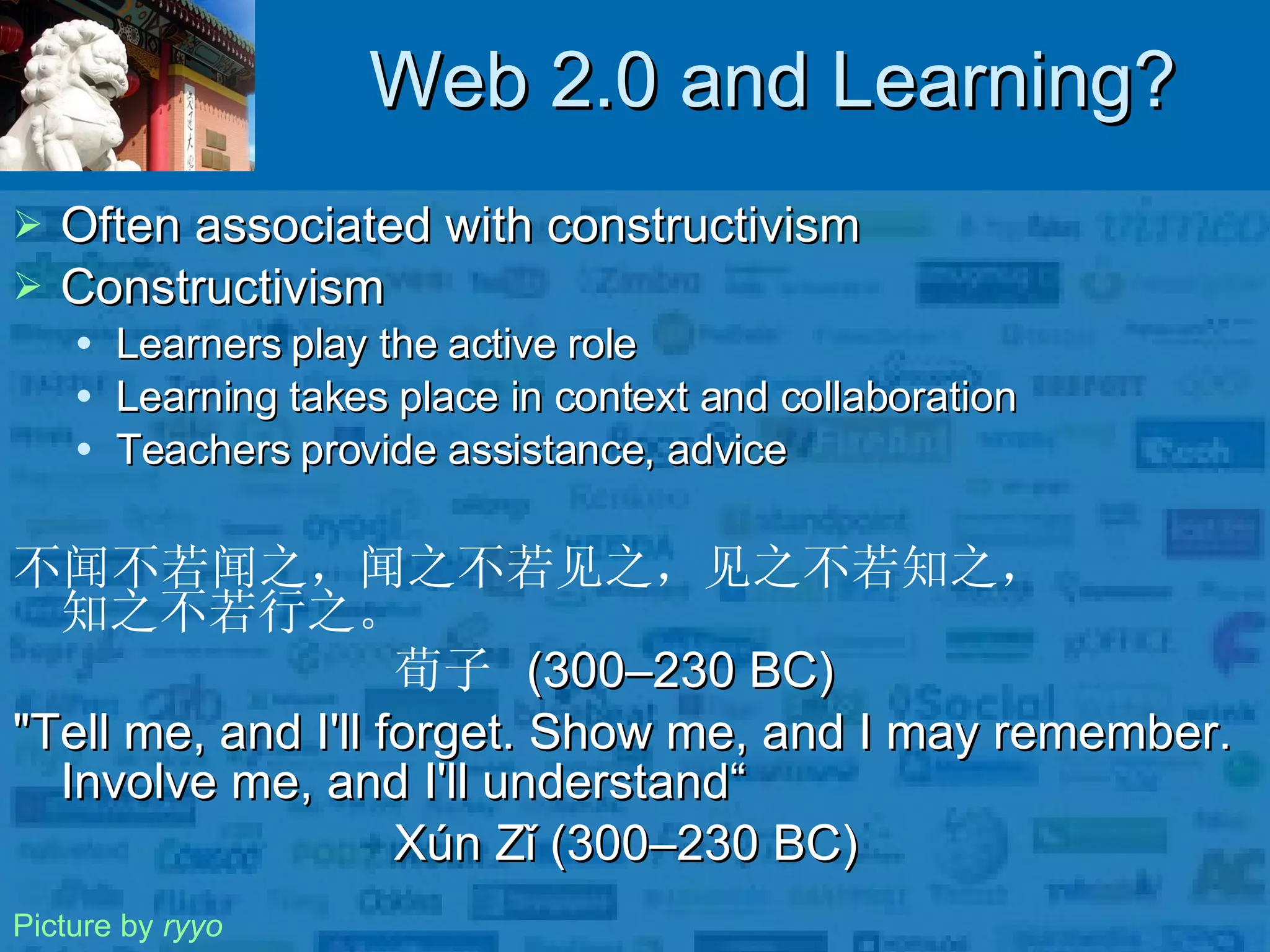
Web 2.0 and Learning? Often associated with constructivism Constructivism Learners play the active role Learning takes place in context and collaboration Teachers provide assistance, advice 不闻不若闻之,闻之不若见之,见之不若知之, 知之不若行之。 荀子   (300–230 BC) "Tell me, and I'll forget. Show me, and I may remember. Involve me, and I'll understand“ Xún Zǐ (300–230 BC) Picture by  ryyo
What is Web 2.0? Until now, no analysis of the technological foundations of Web 2.0 from an educational perspective What is Web 2.0? Tim Berners-Lee:  Works on the same standards as Web 1.0 Web always a tool for collaboration But the Web of today is different from the Web 5 years ago
Characterization of Web 2.0 In 2005, term “Web 2.0” became popular Used by Tim O’Reilly to capture principles of Web sites/services that distinguish themselves from earlier ones Here: From an educational perspective teacher/learner researcher
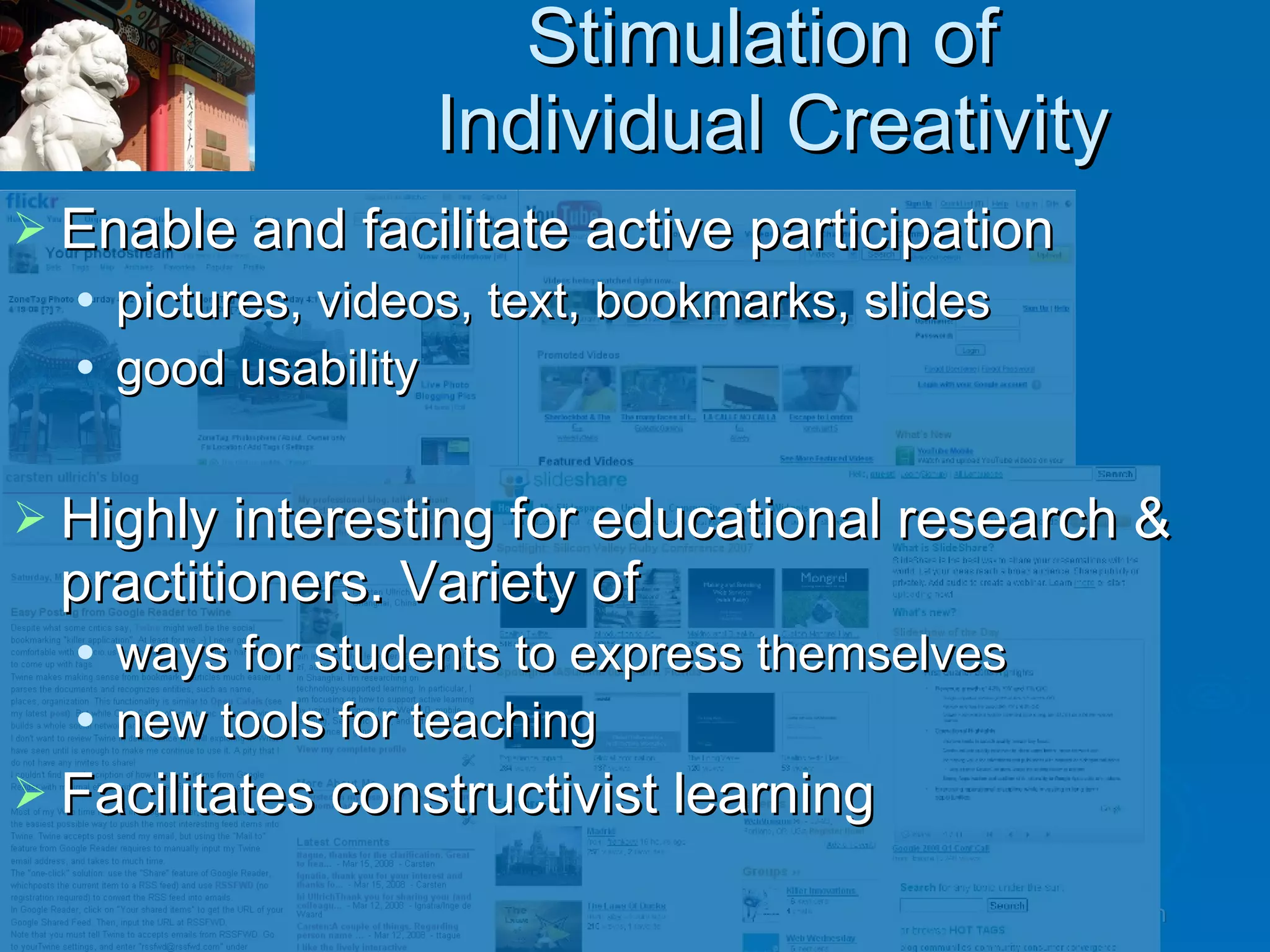
Stimulation of  Individual Creativity Enable and facilitate active participation pictures, videos, text, bookmarks, slides good usability Highly interesting for educational research & practitioners. Variety of ways for students to express themselves new tools for teaching Facilitates constructivist learning
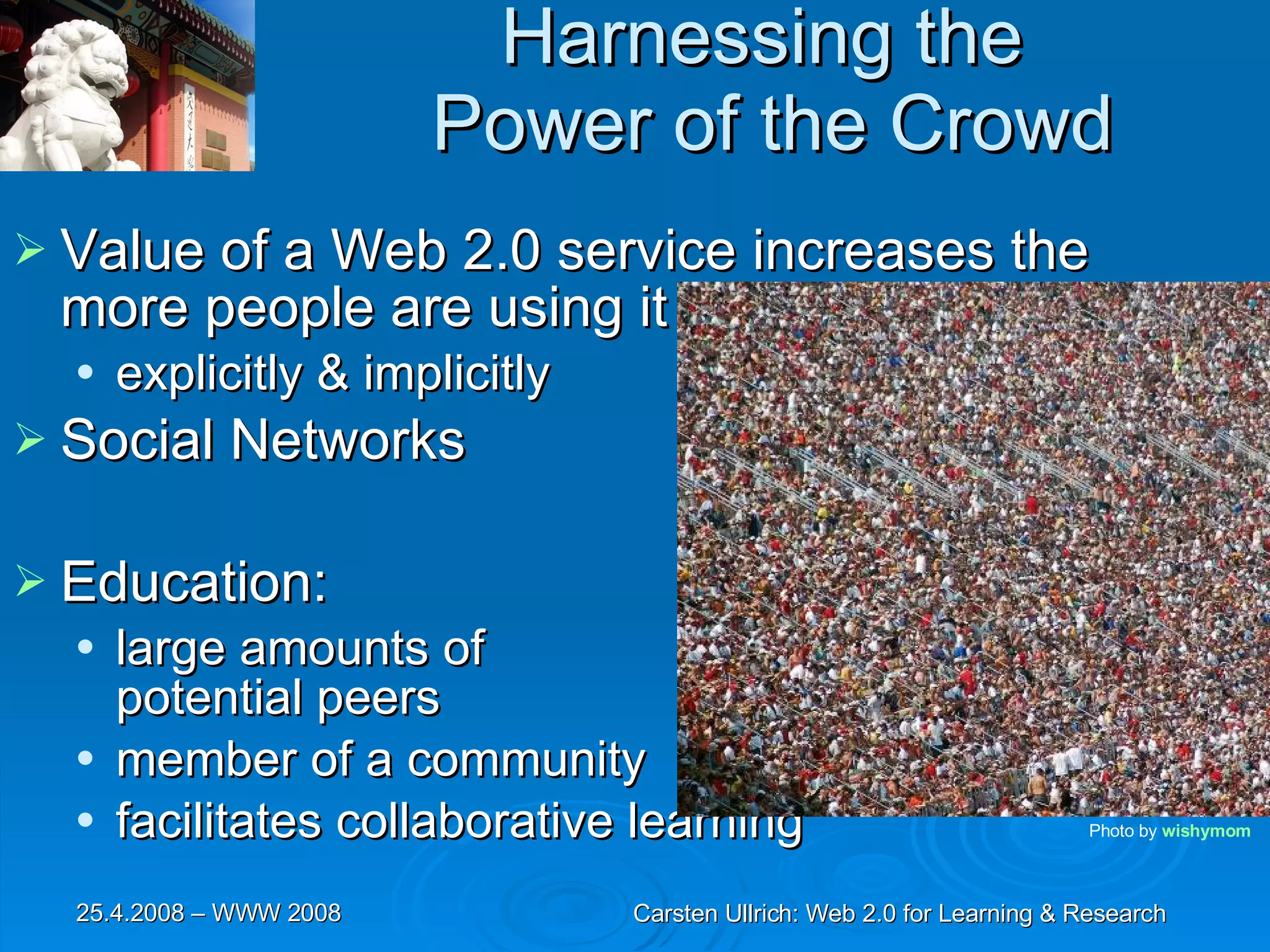
Harnessing the  Power of the Crowd Value of a Web 2.0 service increases the more people are using it explicitly & implicitly Social Networks Education: large amounts of  potential peers member of a community facilitates collaborative learning  Photo by  wishymom
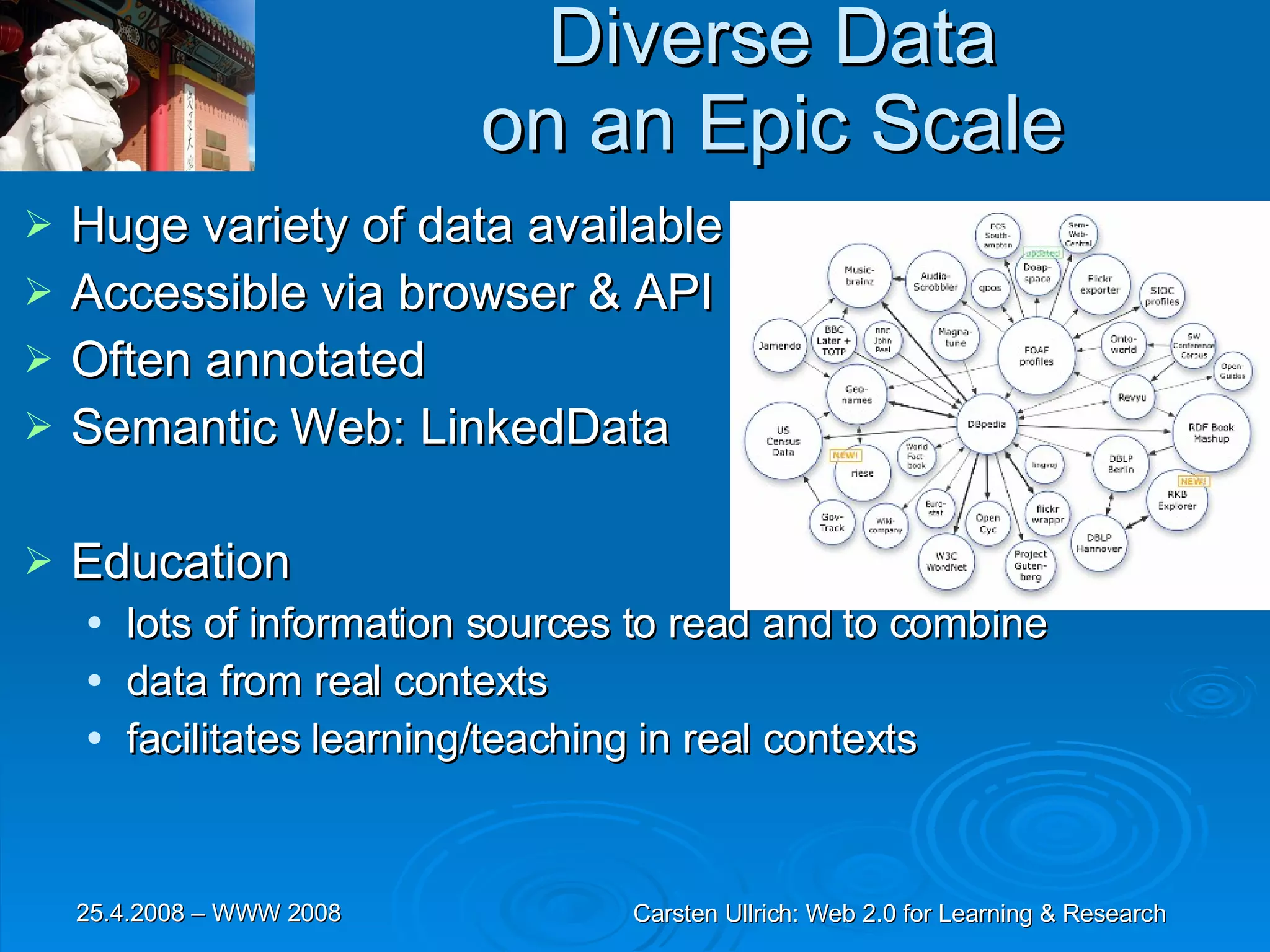
Diverse Data on an Epic Scale Huge variety of data available Accessible via browser & API Often annotated Semantic Web: LinkedData Education lots of information sources to read and to combine data from real contexts facilitates learning/teaching in real contexts
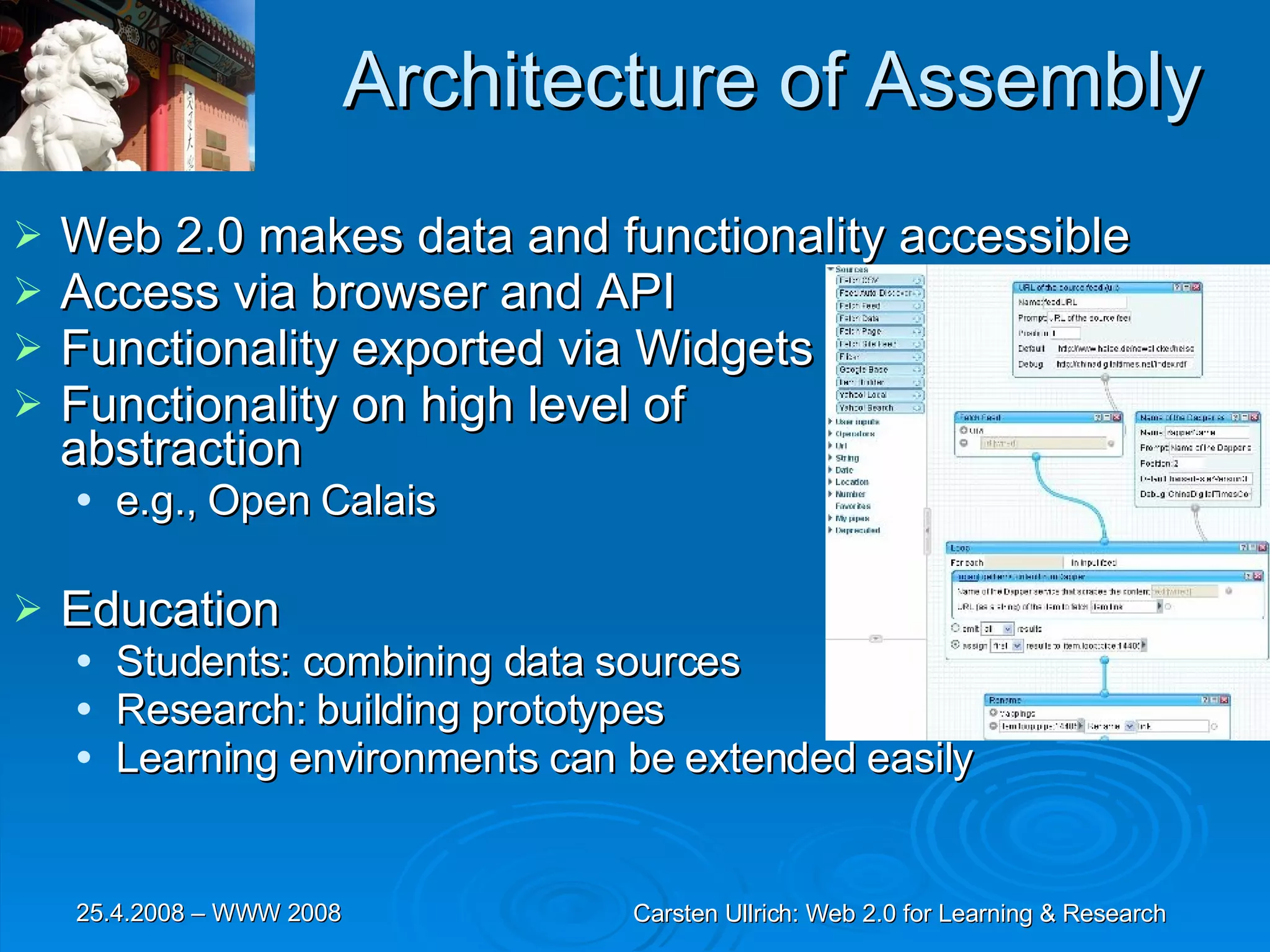
Architecture of Assembly Web 2.0 makes data and functionality accessible Access via browser and API Functionality exported via Widgets Functionality on high level of  abstraction e.g., Open Calais Education Students: combining data sources Research: building prototypes Learning environments can be extended easily
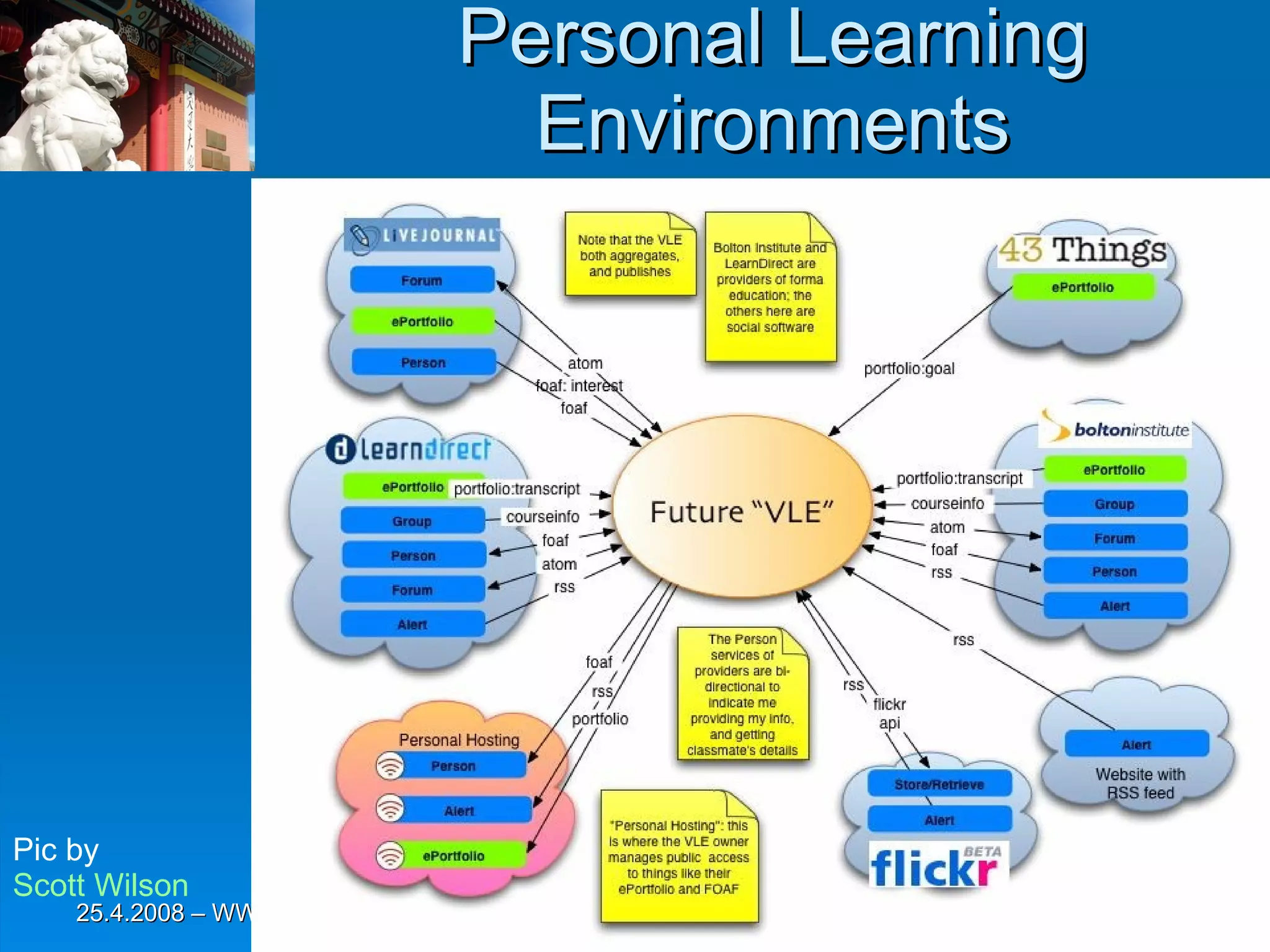
Personal Learning Environments Pic by  Scott Wilson
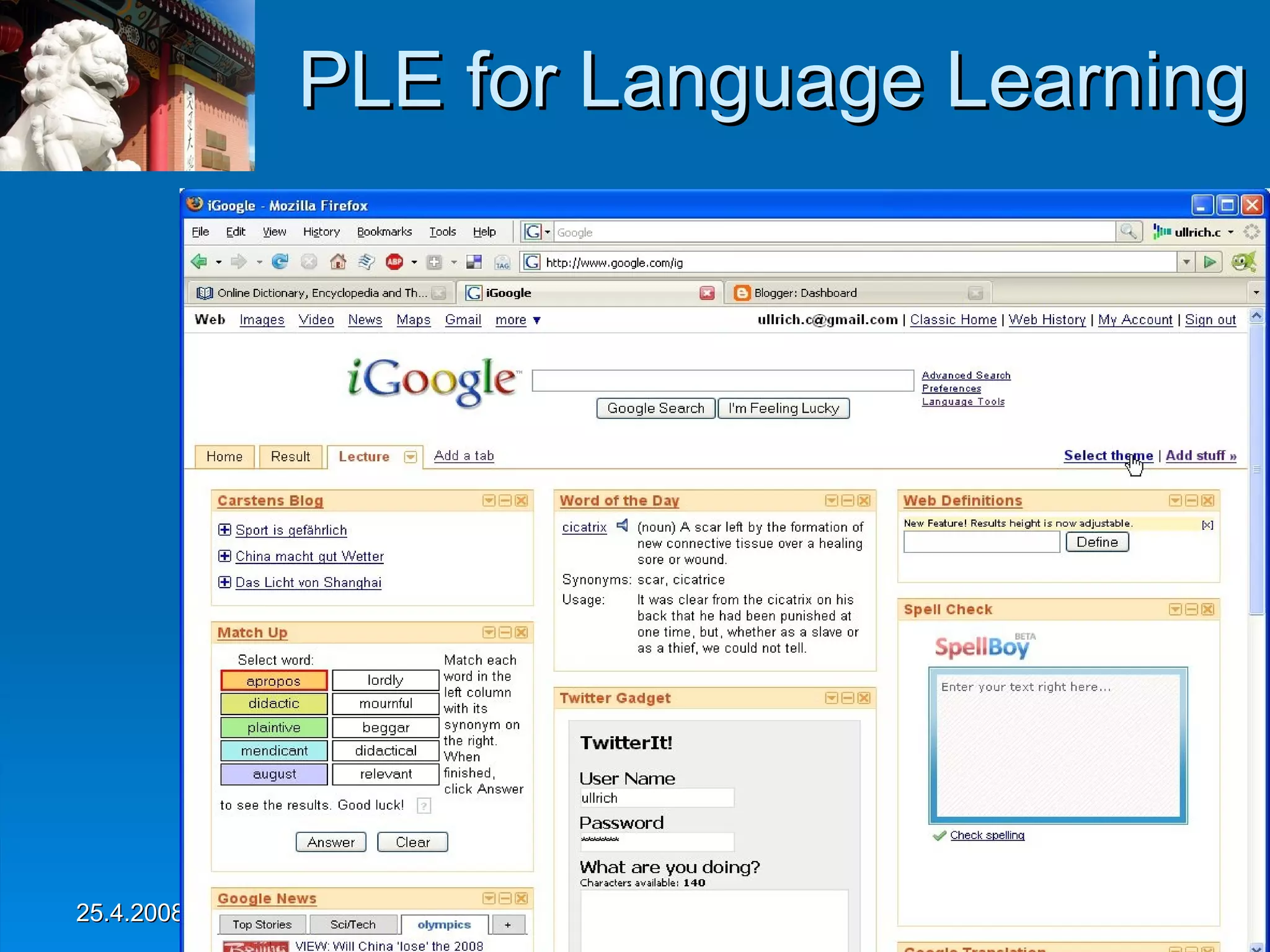
PLE for Language Learning
Perpetual Beta Software development: Web 2.0 applications constantly refined Education improvement not a bad thing but can be confusing & distracting adapting manuals developers open to feedback
Additional Principles Independent access to data Leveraging the Long Tail Lightweight models
Web 2.0 for Learning Analysis has shown that the defining principles of Web 2.0 enable social & active learning Best used for teaching & learning when exploiting these principles Active role for teacher
Web 2.0 for Research Wealth of functionality multitude of services (freely) available high-level functionality Architecture of assembly easy to combine/access services  Quick assembly of prototypes allow evaluation assessing research hypotheses
Social Bookmarking for  Learning Object Annotation Authoring learning resources is time consuming and difficult task Our goal:  support lecturers with no or little knowledge about learning resources and metadata standards integration in existing workflow & LMS Hypothesis: social bookmarking can simplify integration of existing learning material in courses Method:  lecturers bookmark resources use predefined tags
Predefined Tags Predefined tags  concepts and relationships of subject domain instructional type difficulty level To minimize noise: use of prefix sjtu:type:exercise, sjtu:kp:linear_list, sjtu:difficulty:easy
Implementation Usage of del.icio.us LMS: For each page about concept  c , look up resources in del.icio.us and add them on the page Implementation effort of prototype:  almost none
Results Lecturers’ feedback easy to use use it for students Students don’t look up external resources if the textbook is good enough Currently re-implemented in LMS with additional functionality
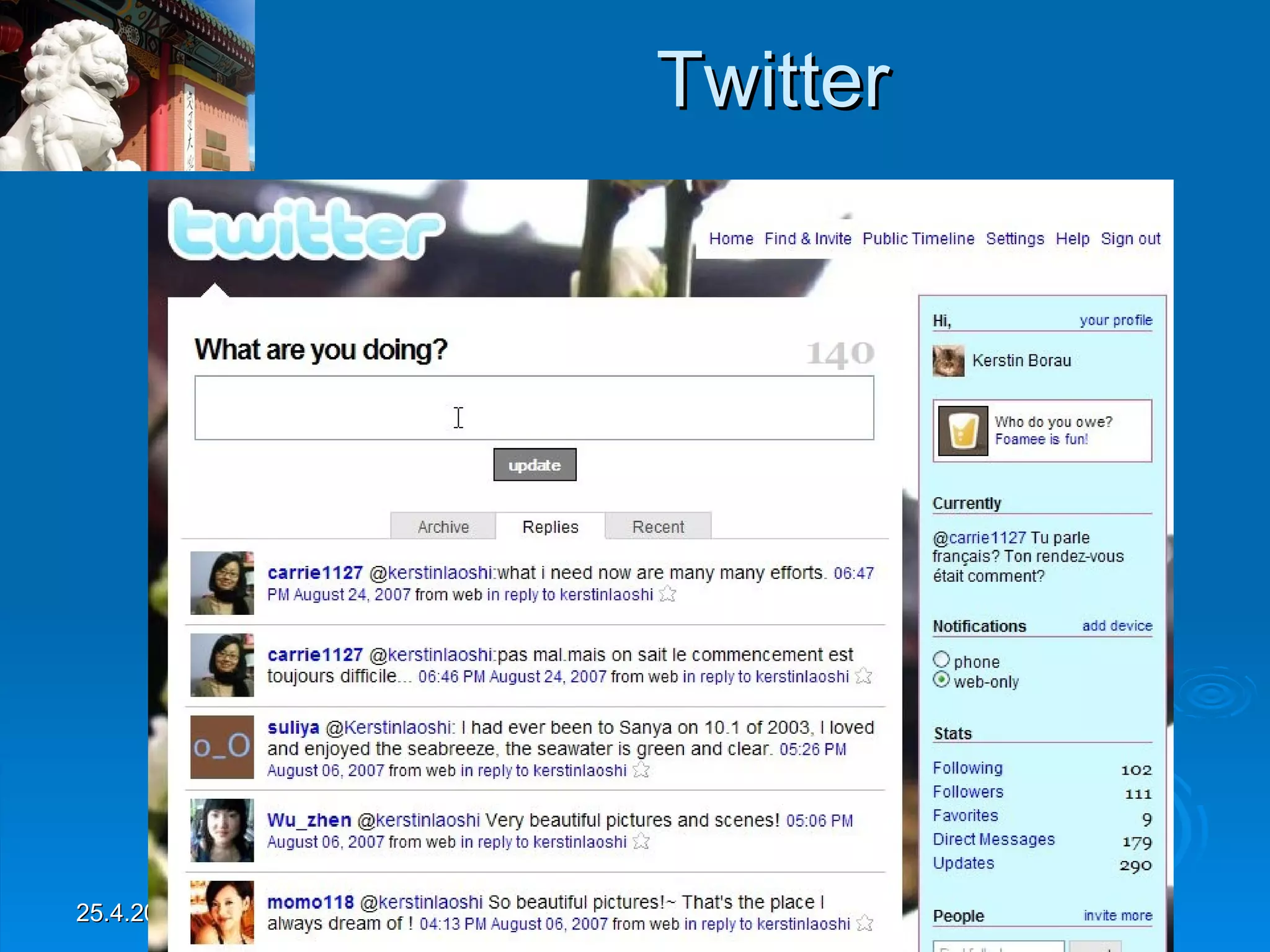
Micro-Blogging for  Language Learning Context: distant university of SJTU vocational learners: limited time, seldom active, shy Goal: provide practice possibilities Hypothesis: Micro-blogging increases sense of community reduces transactional distance to teacher quick & easy way for active participation
Twitter
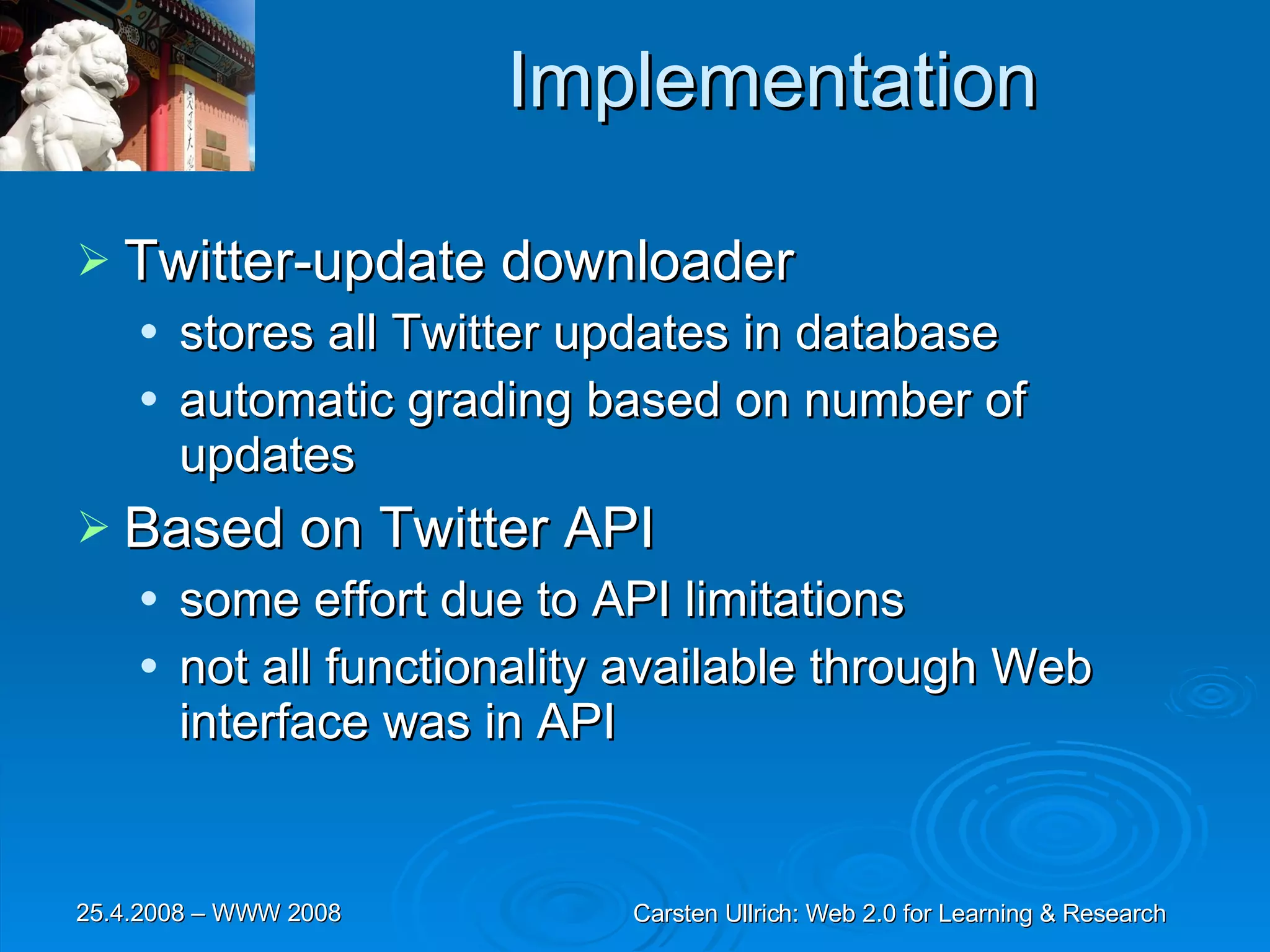
Implementation Twitter-update downloader stores all Twitter updates in database automatic grading based on number of updates Based on Twitter API some effort due to API limitations not all functionality available through Web interface was in API
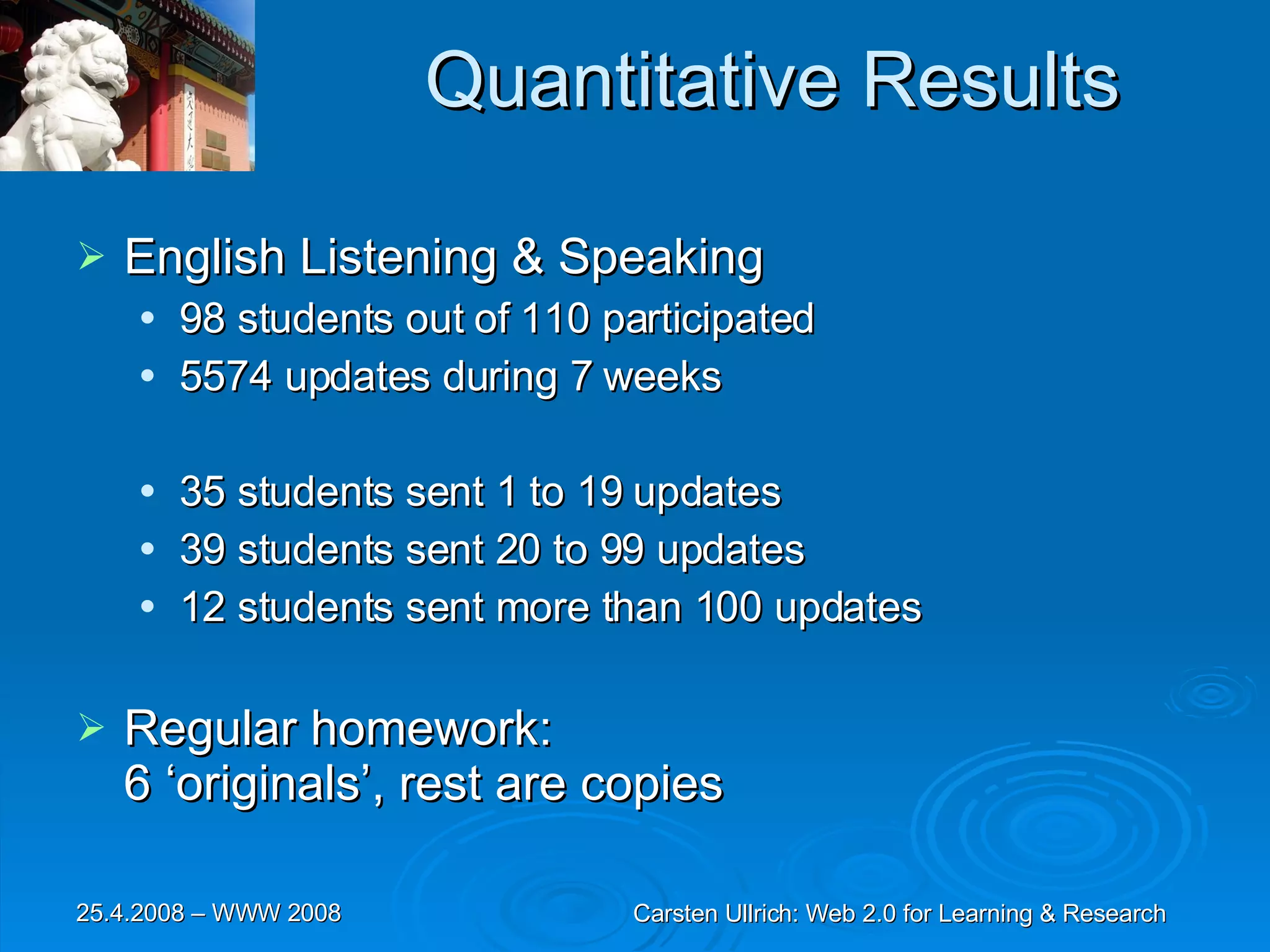
Quantitative Results English Listening & Speaking 98 students out of 110 participated 5574 updates during 7 weeks 35 students sent 1 to 19 updates 39 students sent 20 to 99 updates 12 students sent more than 100 updates Regular homework:  6 ‘originals’, rest are copies
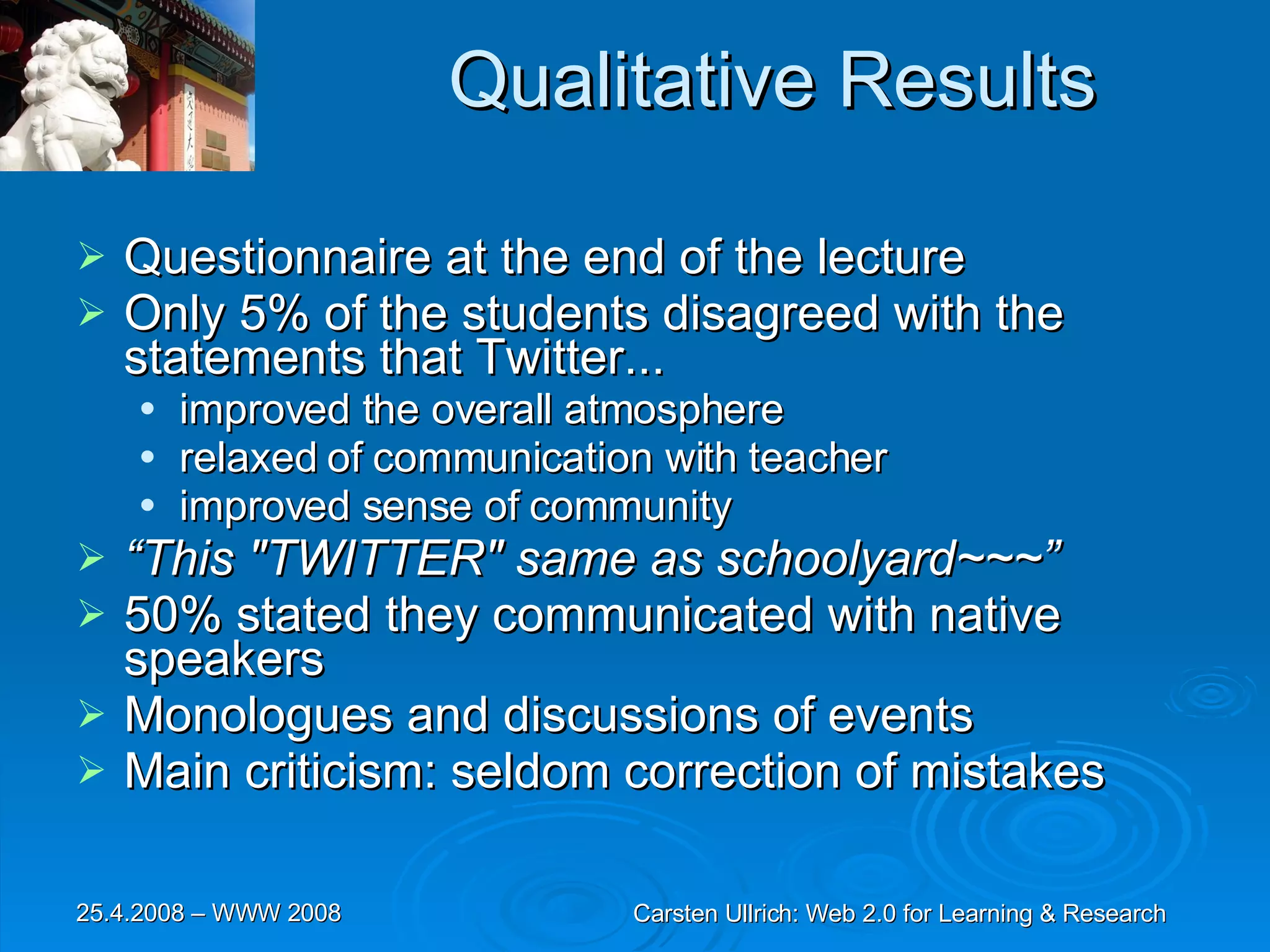
Qualitative Results Questionnaire at the end of the lecture Only 5% of the students disagreed with the statements that Twitter... improved the overall atmosphere relaxed of communication with teacher improved sense of community “ This "TWITTER" same as schoolyard~~~” 50% stated they communicated with native speakers Monologues and discussions of events Main criticism: seldom correction of mistakes
Lessons Learned:  Learning in the Web 2.0 Individual creativity: Web 2.0 services can stimulate active participation Usage of Twitter continued after lecture was over Power of the crowd: social dimension was important students encouraged each other to participate discussions But: not task-centered (posts in other languages) pejorative messages  Teacher as moderator & participator Independent access: seldom mobile usage Architecture of assembly: not used by students
Lessons Learned:  Web 2.0 for Prototypes Architecture of assembly quick prototypes     collecting feedback, requirements, suggestions BUT you become dependent of third-party API rate limits (were removed upon request) not all functionality is available as API yet another login, yet another social network changing user interfaces/metaphors    Fine for prototypes, be careful in case of regular usage
Conclusion Web 2.0 tools & learning less suited for designed instruction have potential to stimulate active participation & improve sense of community learners will think of unanticipated ways of usage requires active teacher: stimulation & monitoring one becomes dependent of third-party tools Web 2.0 & research functionality at high level of abstraction quick way to assemble prototypes one becomes dependent of third-party tools
Thank You [email_address] Slides:  http://www.slideshare.net/ullrich

Why Web 2.0 is Good for Learning and for Research: Principles and Prototypes

  • 1.
    Why Web 2.0is Good for Learning and for Research: Principles and Prototypes Carsten Ullrich, Kerstin Borau, Heng Luo, Xiaohong Tan, Liping Shen, Ruimin Shen Shanghai Jiao Tong University
  • 2.
    Overview Motivation Web2.0 from a learning perspective Web 2.0 as a research tool Examples social bookmarking for learning object annotation microblogging for language learning Lessons learned
  • 3.
  • 4.
    Class room in 文庙 (Confucian Temple Wén Miào), Shanghai Teacher Students
  • 5.
    Technology-Enhance Learning LearningManagement Systems “Administered Learning” Teacher centered If a lesson is mastered, then allowed to continue ≈ Behaviorism
  • 6.
    Technology-Enhance Learning LearningManagement Systems Cognitive Tutors Cognitive Learning Theories
  • 7.
    Web 2.0 andLearning? Often associated with constructivism Constructivism Learners play the active role Learning takes place in context and collaboration Teachers provide assistance, advice 不闻不若闻之,闻之不若见之,见之不若知之, 知之不若行之。 荀子 (300–230 BC) "Tell me, and I'll forget. Show me, and I may remember. Involve me, and I'll understand“ Xún Zǐ (300–230 BC) Picture by ryyo
  • 8.
    What is Web2.0? Until now, no analysis of the technological foundations of Web 2.0 from an educational perspective What is Web 2.0? Tim Berners-Lee: Works on the same standards as Web 1.0 Web always a tool for collaboration But the Web of today is different from the Web 5 years ago
  • 9.
    Characterization of Web2.0 In 2005, term “Web 2.0” became popular Used by Tim O’Reilly to capture principles of Web sites/services that distinguish themselves from earlier ones Here: From an educational perspective teacher/learner researcher
  • 10.
    Stimulation of Individual Creativity Enable and facilitate active participation pictures, videos, text, bookmarks, slides good usability Highly interesting for educational research & practitioners. Variety of ways for students to express themselves new tools for teaching Facilitates constructivist learning
  • 11.
    Harnessing the Power of the Crowd Value of a Web 2.0 service increases the more people are using it explicitly & implicitly Social Networks Education: large amounts of potential peers member of a community facilitates collaborative learning Photo by wishymom
  • 12.
    Diverse Data onan Epic Scale Huge variety of data available Accessible via browser & API Often annotated Semantic Web: LinkedData Education lots of information sources to read and to combine data from real contexts facilitates learning/teaching in real contexts
  • 13.
    Architecture of AssemblyWeb 2.0 makes data and functionality accessible Access via browser and API Functionality exported via Widgets Functionality on high level of abstraction e.g., Open Calais Education Students: combining data sources Research: building prototypes Learning environments can be extended easily
  • 14.
    Personal Learning EnvironmentsPic by Scott Wilson
  • 15.
  • 16.
    Perpetual Beta Softwaredevelopment: Web 2.0 applications constantly refined Education improvement not a bad thing but can be confusing & distracting adapting manuals developers open to feedback
  • 17.
    Additional Principles Independentaccess to data Leveraging the Long Tail Lightweight models
  • 18.
    Web 2.0 forLearning Analysis has shown that the defining principles of Web 2.0 enable social & active learning Best used for teaching & learning when exploiting these principles Active role for teacher
  • 19.
    Web 2.0 forResearch Wealth of functionality multitude of services (freely) available high-level functionality Architecture of assembly easy to combine/access services  Quick assembly of prototypes allow evaluation assessing research hypotheses
  • 20.
    Social Bookmarking for Learning Object Annotation Authoring learning resources is time consuming and difficult task Our goal: support lecturers with no or little knowledge about learning resources and metadata standards integration in existing workflow & LMS Hypothesis: social bookmarking can simplify integration of existing learning material in courses Method: lecturers bookmark resources use predefined tags
  • 21.
    Predefined Tags Predefinedtags concepts and relationships of subject domain instructional type difficulty level To minimize noise: use of prefix sjtu:type:exercise, sjtu:kp:linear_list, sjtu:difficulty:easy
  • 22.
    Implementation Usage ofdel.icio.us LMS: For each page about concept c , look up resources in del.icio.us and add them on the page Implementation effort of prototype: almost none
  • 23.
    Results Lecturers’ feedbackeasy to use use it for students Students don’t look up external resources if the textbook is good enough Currently re-implemented in LMS with additional functionality
  • 24.
    Micro-Blogging for Language Learning Context: distant university of SJTU vocational learners: limited time, seldom active, shy Goal: provide practice possibilities Hypothesis: Micro-blogging increases sense of community reduces transactional distance to teacher quick & easy way for active participation
  • 25.
  • 26.
    Implementation Twitter-update downloaderstores all Twitter updates in database automatic grading based on number of updates Based on Twitter API some effort due to API limitations not all functionality available through Web interface was in API
  • 27.
    Quantitative Results EnglishListening & Speaking 98 students out of 110 participated 5574 updates during 7 weeks 35 students sent 1 to 19 updates 39 students sent 20 to 99 updates 12 students sent more than 100 updates Regular homework: 6 ‘originals’, rest are copies
  • 28.
    Qualitative Results Questionnaireat the end of the lecture Only 5% of the students disagreed with the statements that Twitter... improved the overall atmosphere relaxed of communication with teacher improved sense of community “ This "TWITTER" same as schoolyard~~~” 50% stated they communicated with native speakers Monologues and discussions of events Main criticism: seldom correction of mistakes
  • 29.
    Lessons Learned: Learning in the Web 2.0 Individual creativity: Web 2.0 services can stimulate active participation Usage of Twitter continued after lecture was over Power of the crowd: social dimension was important students encouraged each other to participate discussions But: not task-centered (posts in other languages) pejorative messages  Teacher as moderator & participator Independent access: seldom mobile usage Architecture of assembly: not used by students
  • 30.
    Lessons Learned: Web 2.0 for Prototypes Architecture of assembly quick prototypes  collecting feedback, requirements, suggestions BUT you become dependent of third-party API rate limits (were removed upon request) not all functionality is available as API yet another login, yet another social network changing user interfaces/metaphors  Fine for prototypes, be careful in case of regular usage
  • 31.
    Conclusion Web 2.0tools & learning less suited for designed instruction have potential to stimulate active participation & improve sense of community learners will think of unanticipated ways of usage requires active teacher: stimulation & monitoring one becomes dependent of third-party tools Web 2.0 & research functionality at high level of abstraction quick way to assemble prototypes one becomes dependent of third-party tools
  • 32.
    Thank You [email_address]Slides: http://www.slideshare.net/ullrich