Open Discussion:
Education in 2020

Carsten Ullrich
Associate Researcher at the E-Learning
Lab of Shanghai Jiao Tong University,
China
Current Disruptors/Changes: Technology
• Technology enables
  – Inexpensive access
  – New modes of learning/certification


                       Carsten Ullrich: Education in 2020
Current Disruptors/Changes: Technology
 • MOOCs
   – Massive Open Online Courses
 • Access
   – Learner  Learner (P2P)
   – Teacher Learner
   – Institution  Learner
 • Assessment/qualifications
   – E.g. badges
   – Stack overflow, Quora
                       Carsten Ullrich: Education in 2020
Current Disruptors/Changes: Technology
 • Mobile?

 • Context

 • Adaptivity/Personalization


                      Carsten Ullrich: Education in 2020
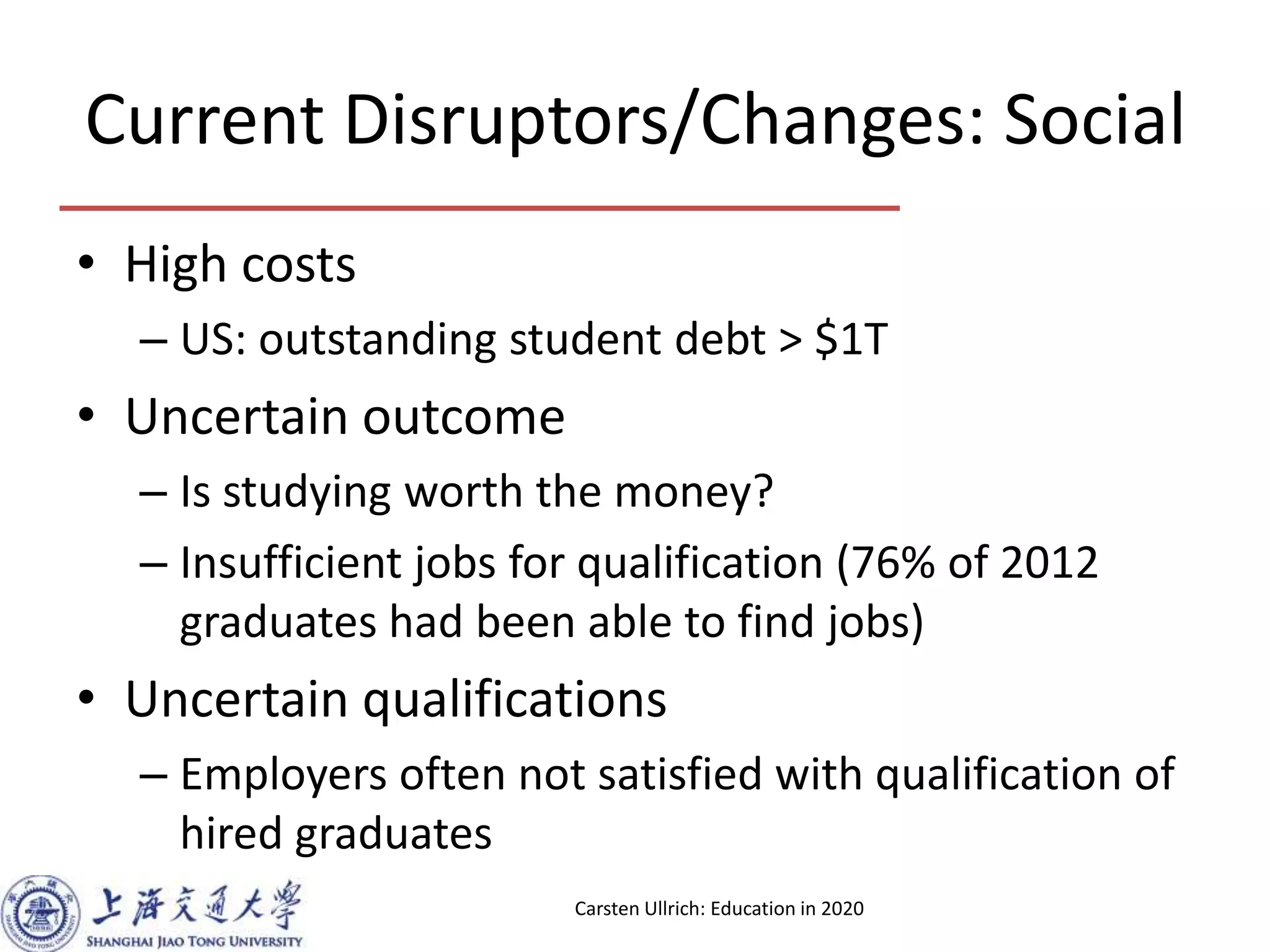
Current Disruptors/Changes: Social
• High costs
  – US: outstanding student debt > $1T
• Uncertain outcome
  – Is studying worth the money?
  – Insufficient jobs for qualification (76% of 2012
    graduates had been able to find jobs)
• Uncertain qualifications
  – Employers often not satisfied with qualification of
    hired graduates
                        Carsten Ullrich: Education in 2020
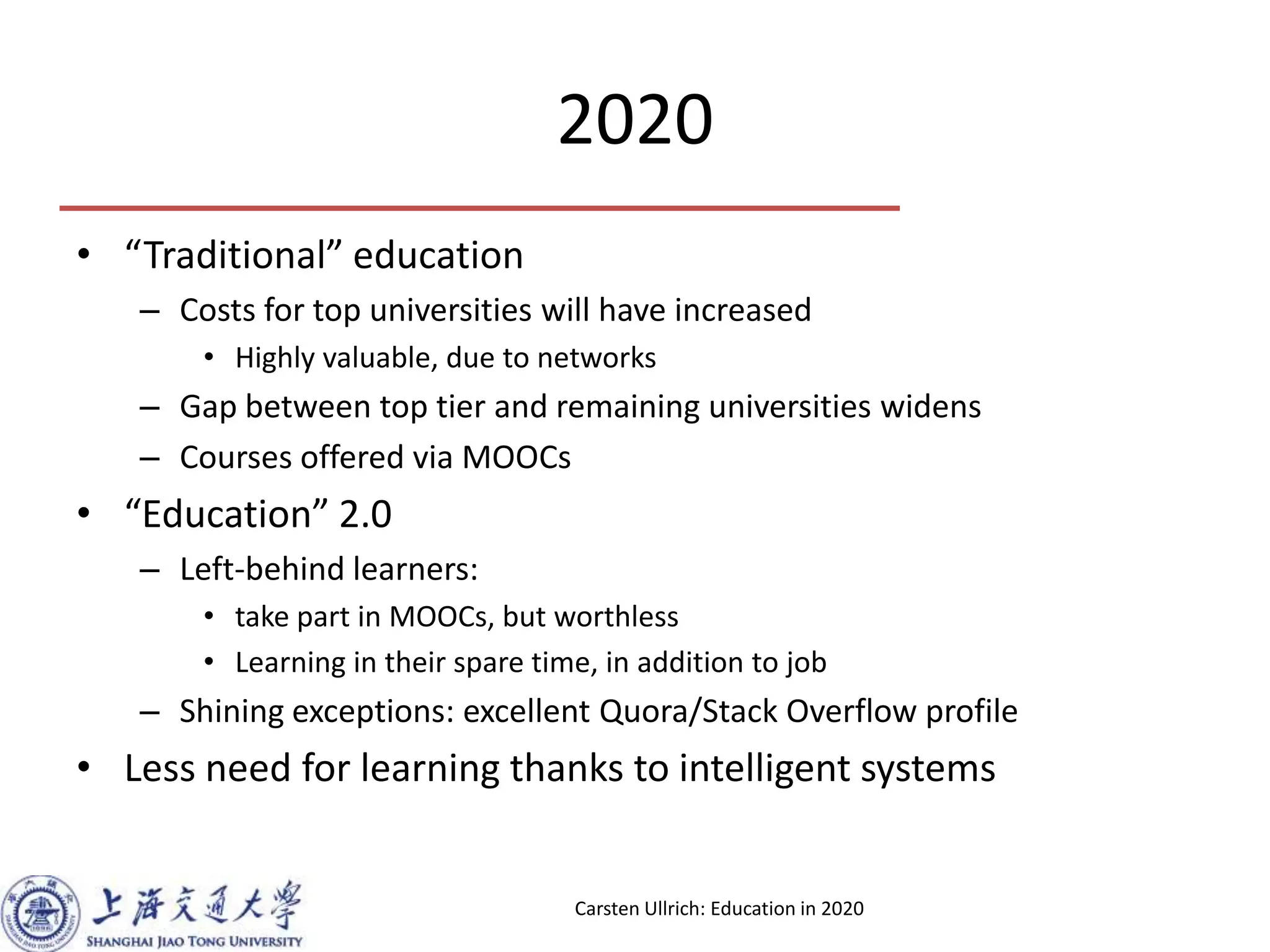
2020
• “Traditional” education
   – Costs for top universities will have increased
       • Highly valuable, due to networks
   – Gap between top tier and remaining universities widens
   – Courses offered via MOOCs
• “Education” 2.0
   – Left-behind learners:
       • take part in MOOCs, but worthless
       • Learning in their spare time, in addition to job
   – Shining exceptions: excellent Quora/Stack Overflow profile
• Less need for learning thanks to intelligent systems


                                    Carsten Ullrich: Education in 2020
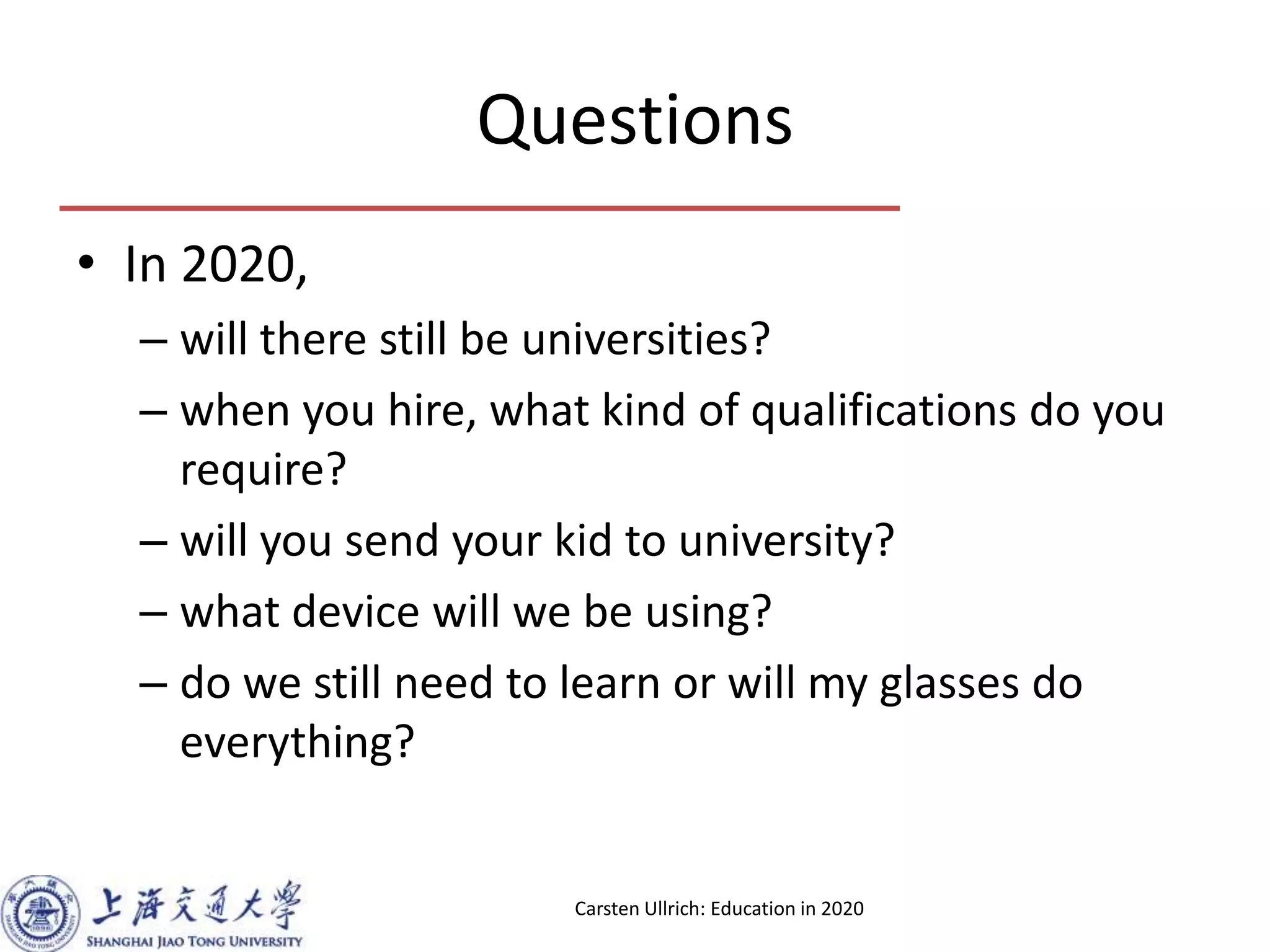
Questions
• In 2020,
  – will there still be universities?
  – when you hire, what kind of qualifications do you
    require?
  – will you send your kid to university?
  – what device will we be using?
  – do we still need to learn or will my glasses do
    everything?


                       Carsten Ullrich: Education in 2020

Education in 2020 - Open Discussion at Barcamp Spring Shanghai 2013

  • 1.
    Open Discussion: Education in2020 Carsten Ullrich Associate Researcher at the E-Learning Lab of Shanghai Jiao Tong University, China
  • 2.
    Current Disruptors/Changes: Technology •Technology enables – Inexpensive access – New modes of learning/certification Carsten Ullrich: Education in 2020
  • 3.
    Current Disruptors/Changes: Technology • MOOCs – Massive Open Online Courses • Access – Learner  Learner (P2P) – Teacher Learner – Institution  Learner • Assessment/qualifications – E.g. badges – Stack overflow, Quora Carsten Ullrich: Education in 2020
  • 4.
    Current Disruptors/Changes: Technology • Mobile? • Context • Adaptivity/Personalization Carsten Ullrich: Education in 2020
  • 5.
    Current Disruptors/Changes: Social •High costs – US: outstanding student debt > $1T • Uncertain outcome – Is studying worth the money? – Insufficient jobs for qualification (76% of 2012 graduates had been able to find jobs) • Uncertain qualifications – Employers often not satisfied with qualification of hired graduates Carsten Ullrich: Education in 2020
  • 6.
    2020 • “Traditional” education – Costs for top universities will have increased • Highly valuable, due to networks – Gap between top tier and remaining universities widens – Courses offered via MOOCs • “Education” 2.0 – Left-behind learners: • take part in MOOCs, but worthless • Learning in their spare time, in addition to job – Shining exceptions: excellent Quora/Stack Overflow profile • Less need for learning thanks to intelligent systems Carsten Ullrich: Education in 2020
  • 7.
    Questions • In 2020, – will there still be universities? – when you hire, what kind of qualifications do you require? – will you send your kid to university? – what device will we be using? – do we still need to learn or will my glasses do everything? Carsten Ullrich: Education in 2020