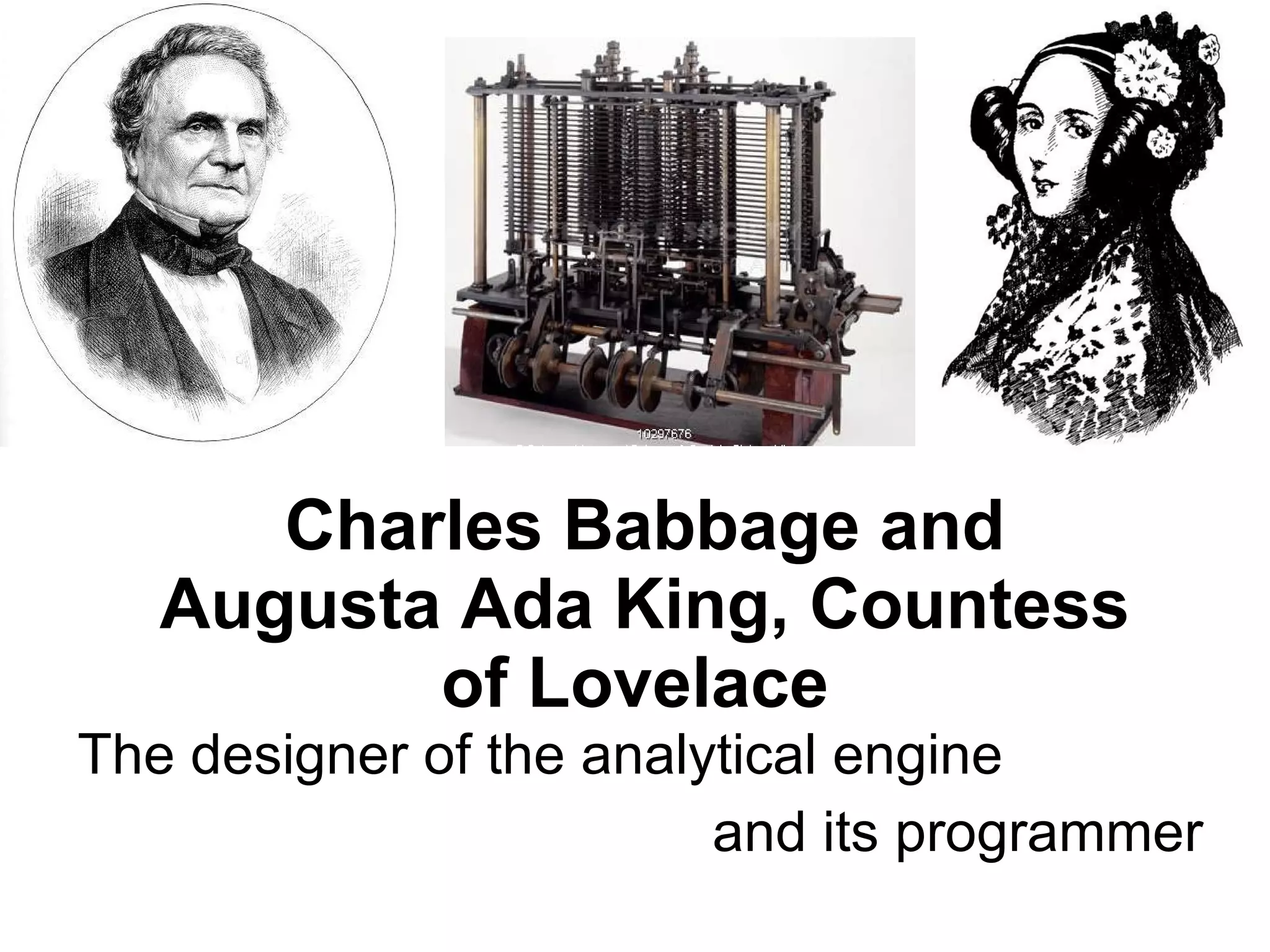
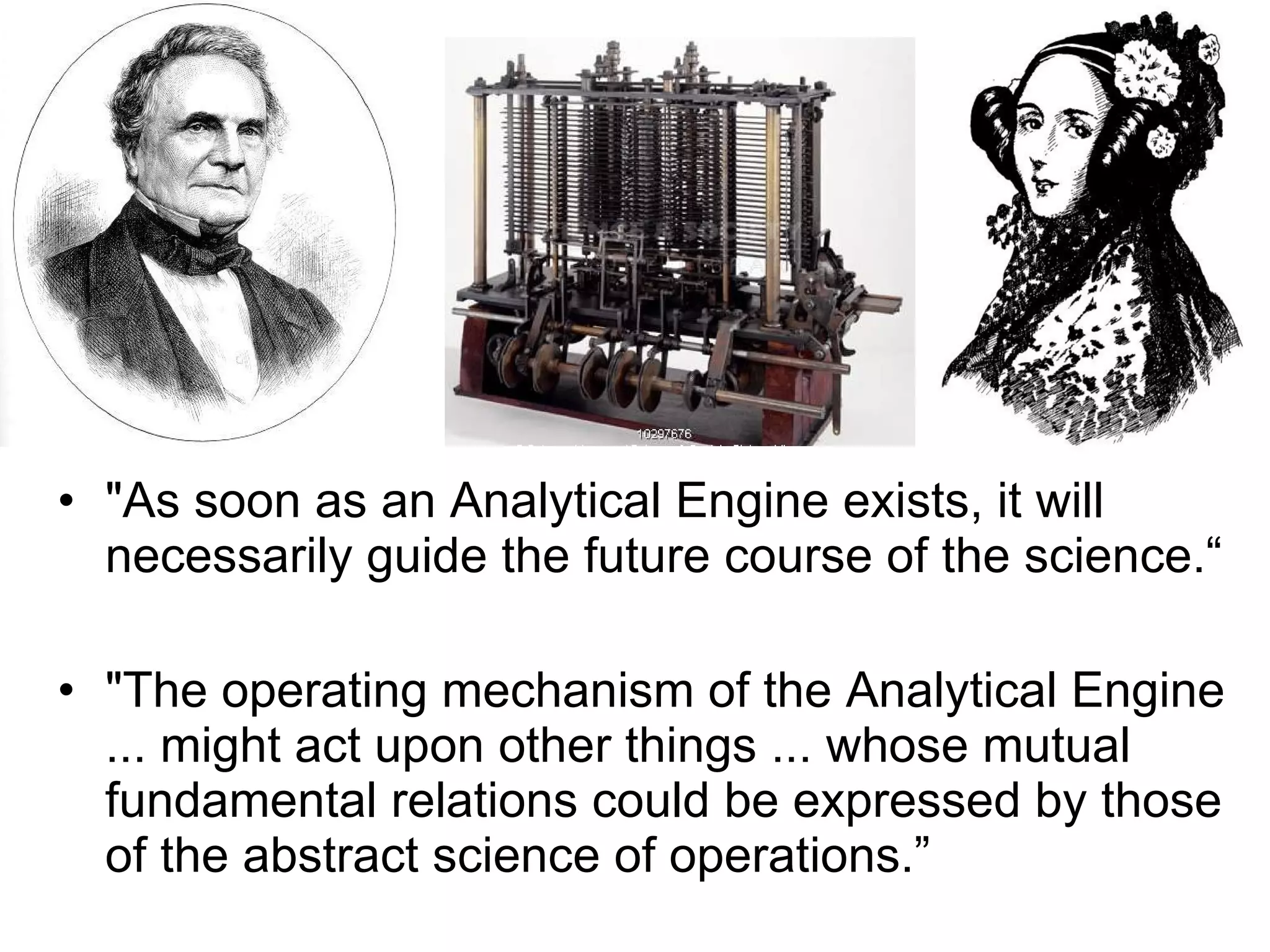
Charles Babbage and Augusta Ada King, Countess of Lovelace   The designer of the analytical engine and its programmer
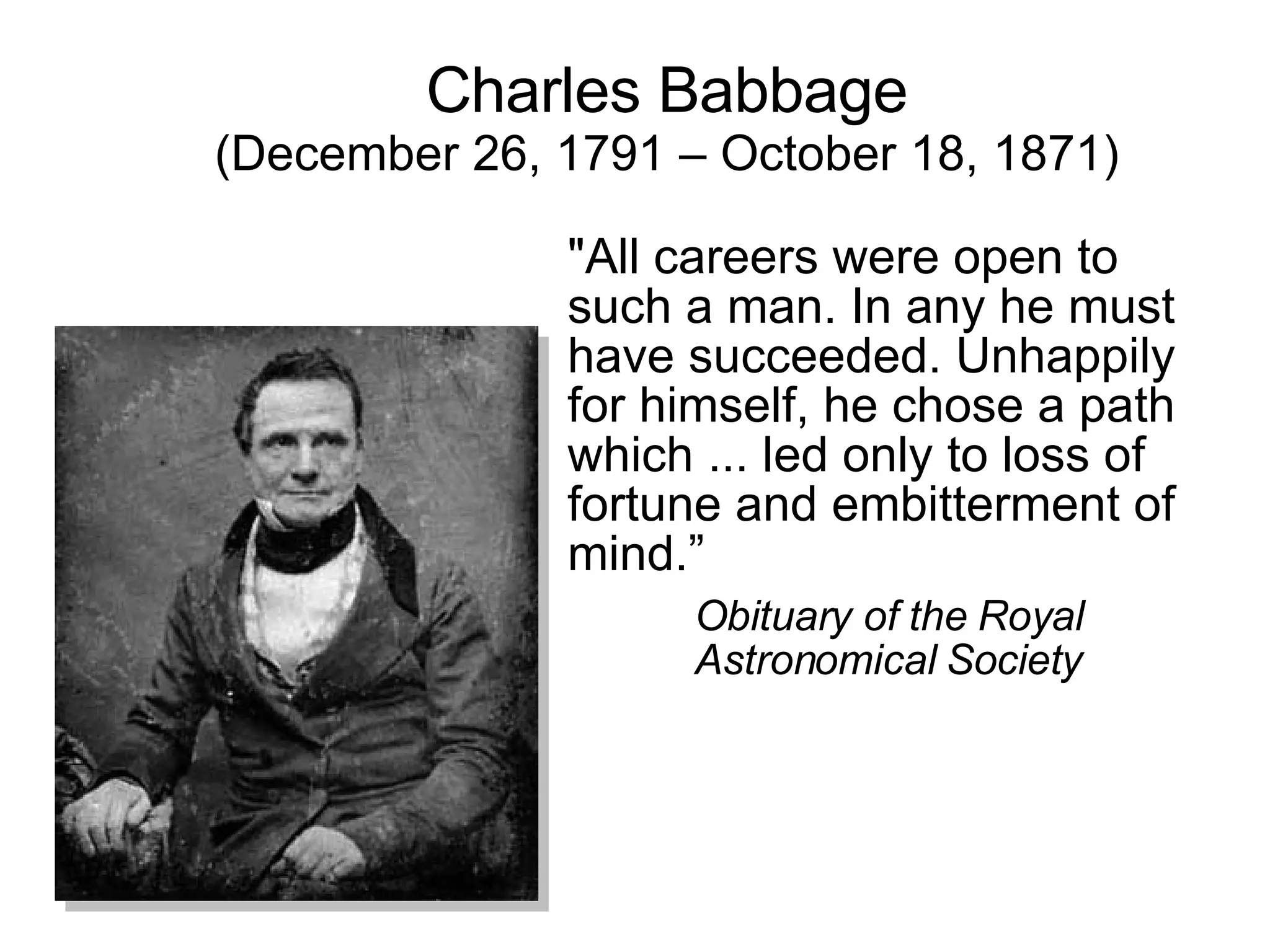
Charles Babbage (December 26, 1791 – October 18, 1871) "All careers were open to such a man. In any he must have succeeded. Unhappily for himself, he chose a path which ... led only to loss of fortune and embitterment of mind.” Obituary of the Royal Astronomical Society
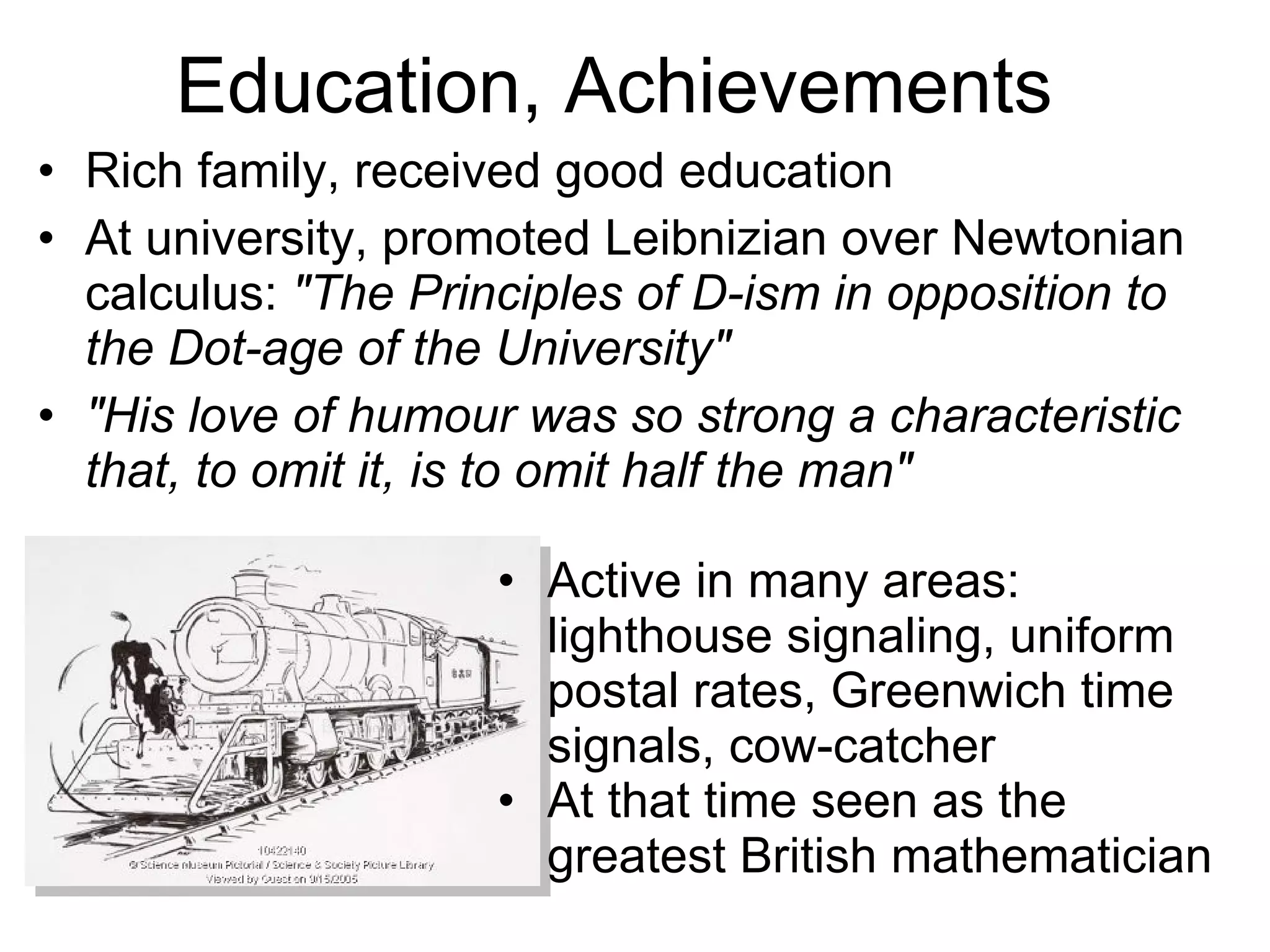
Education, Achievements Rich family, received good education At university, promoted Leibnizian over Newtonian calculus:  "The Principles of D-ism in opposition to the Dot-age of the University" "His love of humour was so strong a characteristic that, to omit it, is to omit half the man" Active in many areas: lighthouse signaling, uniform postal rates, Greenwich time signals, cow-catcher At that time seen as the greatest British mathematician
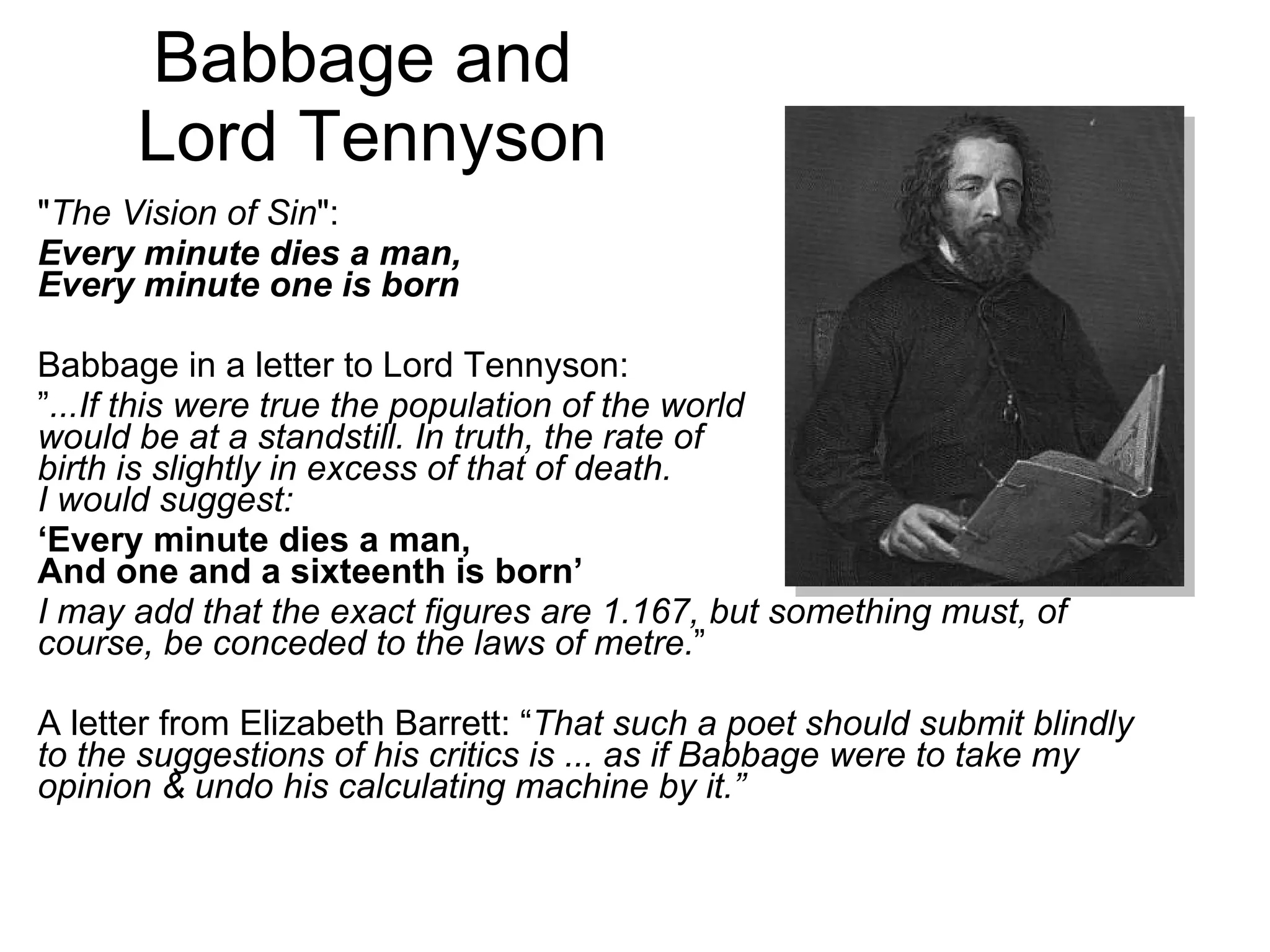
Babbage and  Lord Tennyson " The Vision of Sin ":  Every minute dies a man, Every minute one is born   Babbage in a letter to Lord Tennyson: ” ...If this were true the population of the world  would be at a standstill. In truth, the rate of birth is slightly in excess of that of death. I would suggest: ‘ Every minute dies a man, And one and a sixteenth is born’ I may add that the exact figures are 1.167, but something must, of course, be conceded to the laws of metre. ” A letter from Elizabeth Barrett: “ That such a poet should submit blindly to the suggestions of his critics is ... as if Babbage were to take my opinion & undo his calculating machine by it.”
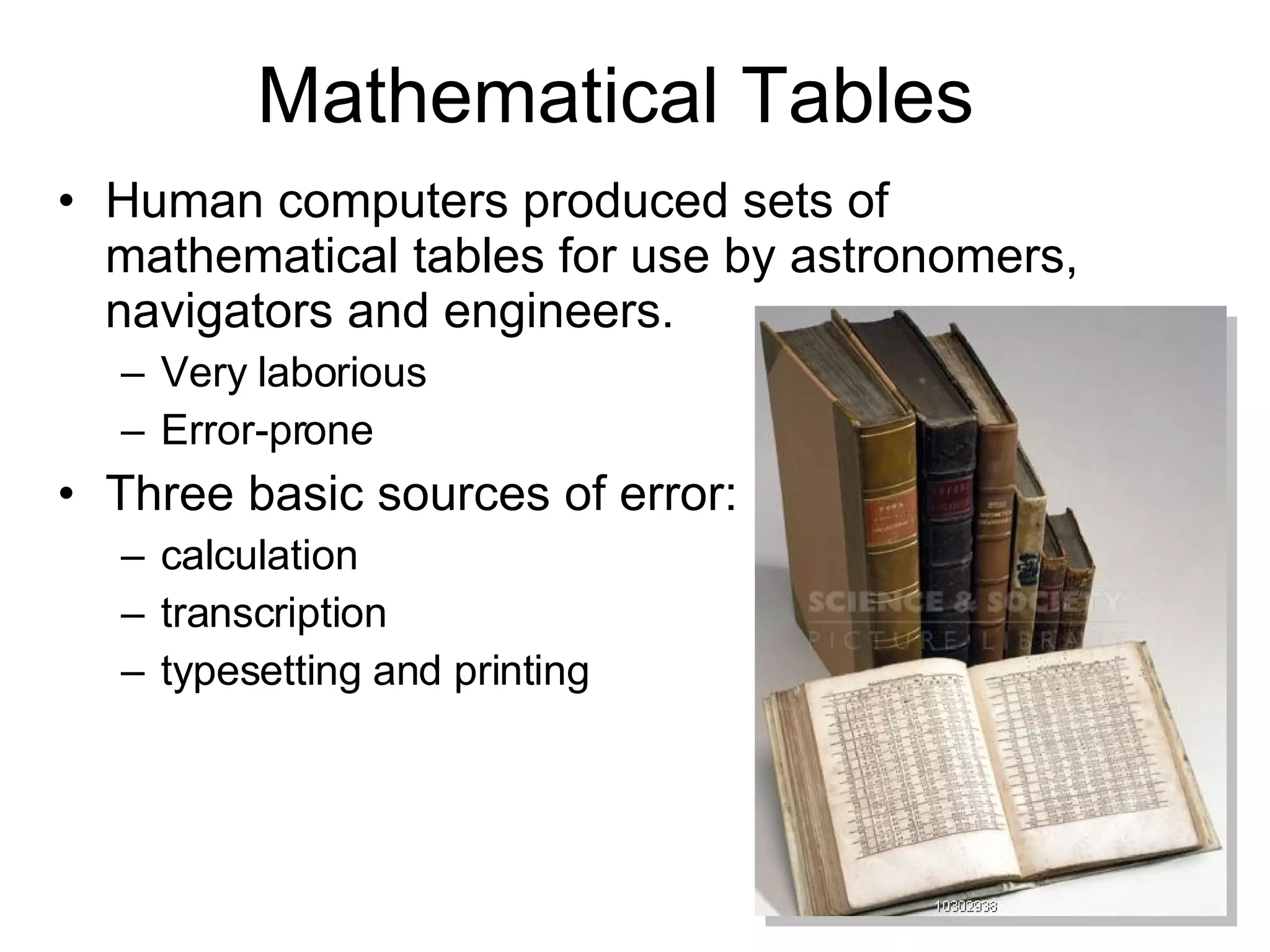
Mathematical Tables Human computers produced sets of mathematical tables for use by astronomers,  navigators and engineers.  Very laborious  Error-prone Three basic sources of error: calculation transcription typesetting and printing
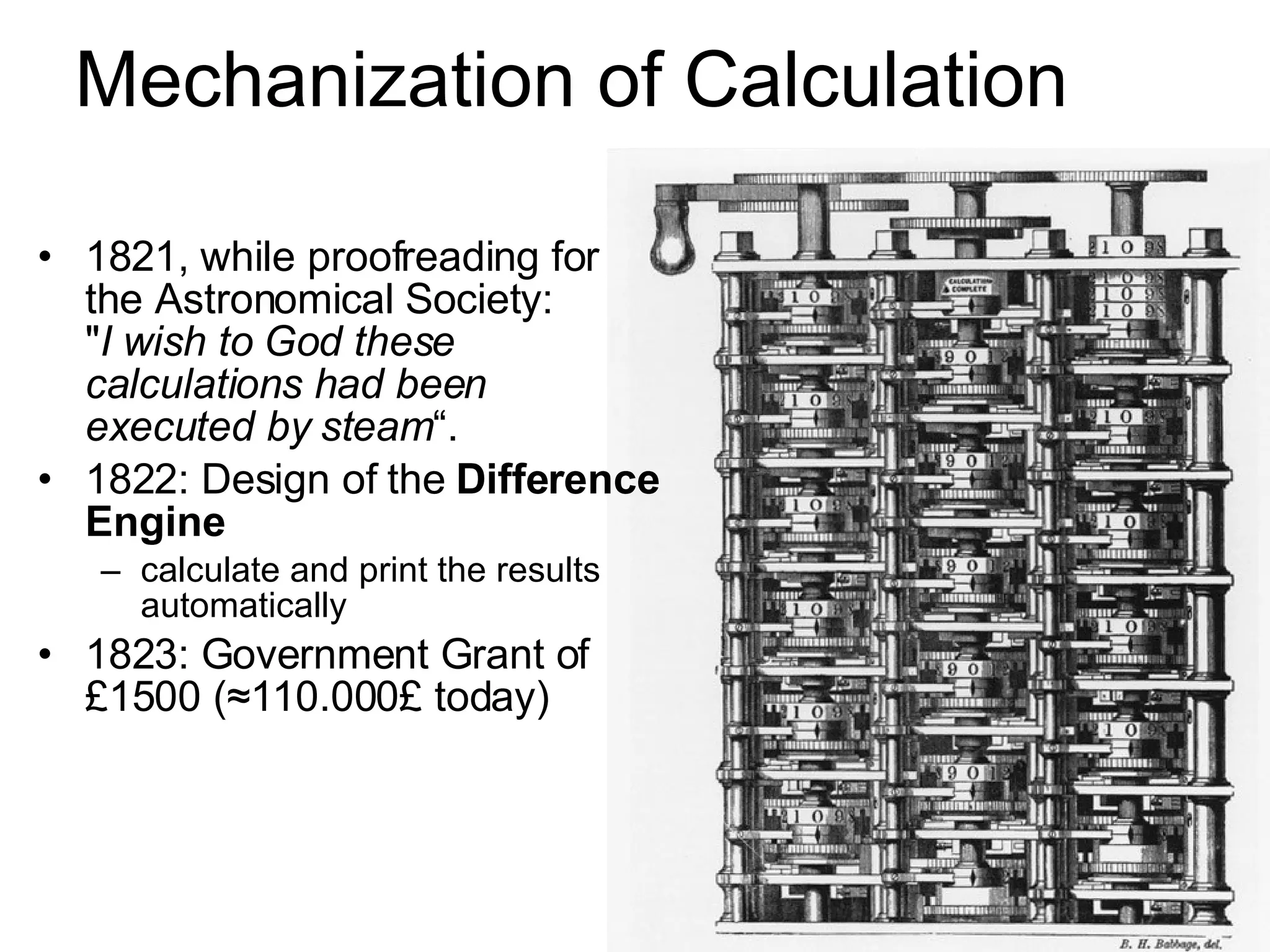
Mechanization of Calculation 18 21,  while proofreading for the Astronomical Society: " I wish to God these calculations had been executed by steam “.  1822: Design of the  Difference Engine  calculate and print the results automatically 1823: Government Grant of  £1500 (≈110.000£ today)
Construction started,  but never completed Lack of expertise Transition between craft traditions and mass-production Babbage had to invent the tools His survey of manufacturing techniques " On the Economy of Machinery and Manufactures “ Babbage's effort at gear making resulted in superior British machinery for next decades (   First World War) Babbage suffered of "creeping featuritis" and kept changing the design of the machine Dispute with the toolmaker Babbage's difficult personality and personal problems (in 1827, his wife, father, and one son died)
Abandonment of the Project 1834: Work stopped 1842: Government officially abandoned the project Costs:  £ 23.000 , including £6.000 of  Babbage’s own money  “ On two occasions I have been asked  [by members of Parliament], 'Pray,  Mr. Babbage, if you put into the machine wrong figures, will the right  answers come out?'  I am not able  rightly to apprehend the kind of  confusion of ideas that could  provoke such a question. ” In 1855, Georg and Edvard Scheutz built two Difference Engines. However, the engines failed to establish themselves and quickly fell out of use
The Analytical Engine Difference Engine:  Calculation of polynomial equations Between 1833 and 1842, design of a machine programmable to do any kind of calculation No comparable general-purpose computers until about 100 years later (Z3, Harvard Mark I) Little attempt to raise funds to build the Analytical Engine In 1878, British Association for the Advancement of Science recommended against construction
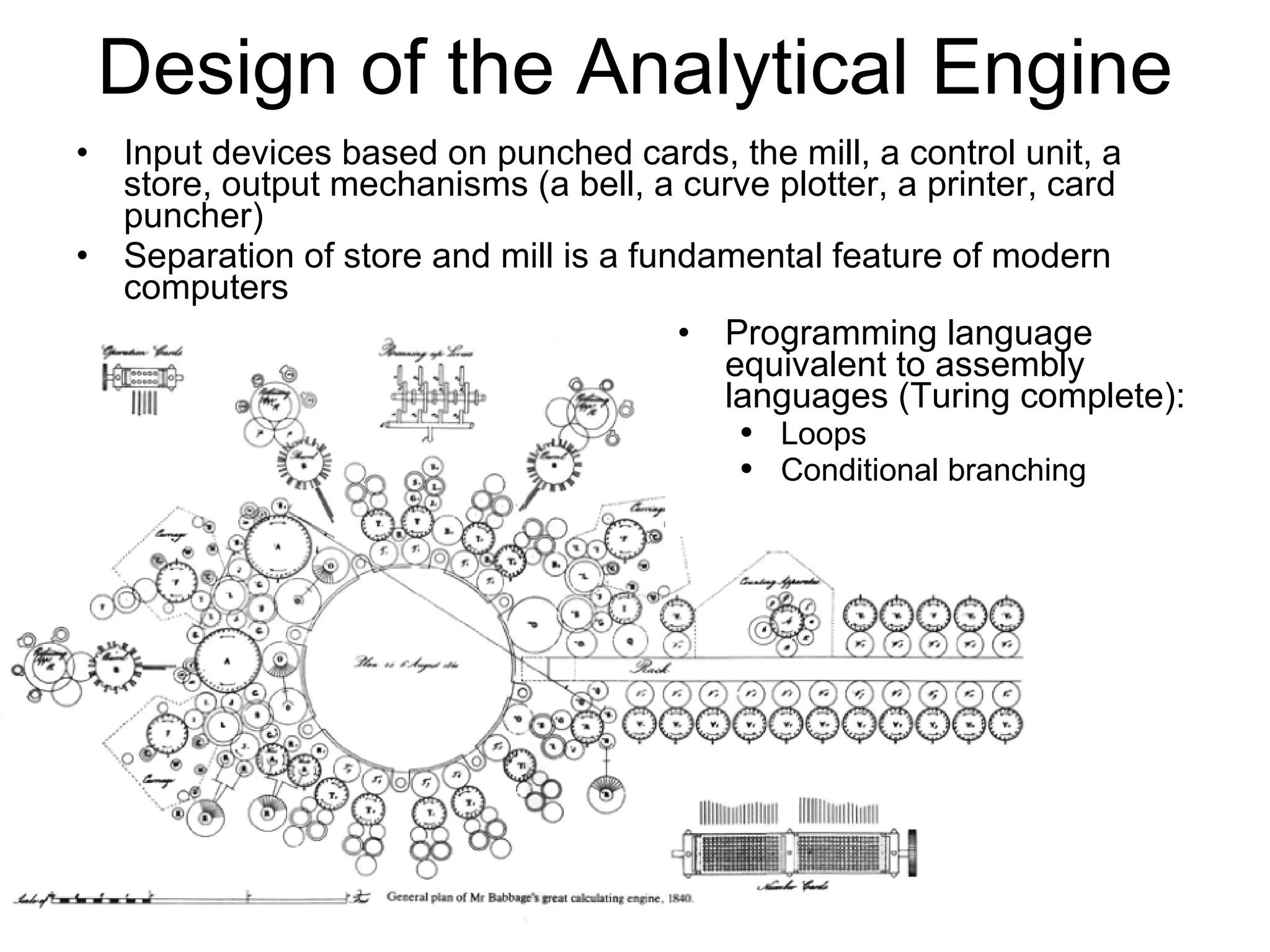
Design of the Analytical Engine Input devices based on punched cards, the mill, a control unit, a store, output mechanisms (a bell, a curve plotter, a printer, card puncher) Separation of store and mill is a fundamental feature of modern computers Programming language equivalent to assembly languages (Turing complete): Loops Conditional branching
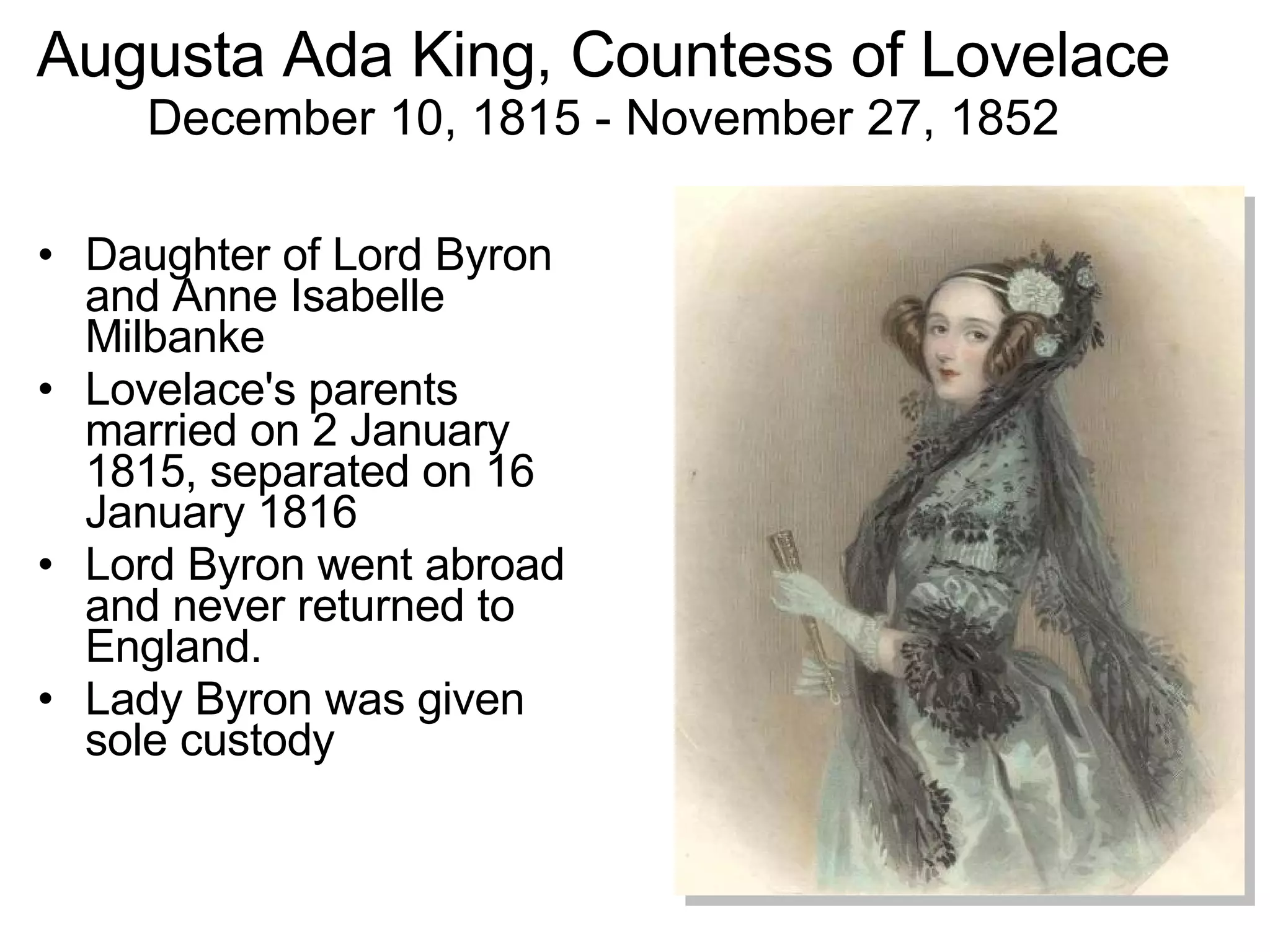
Augusta Ada King, Countess of Lovelace December 10, 1815 - November 27, 1852 Daughter of Lord Byron and Anne Isabelle Milbanke Lovelace's parents married on 2 January 1815, separated on 16 January 1816 Lord Byron went abroad and never returned to England. Lady Byron was given sole custody
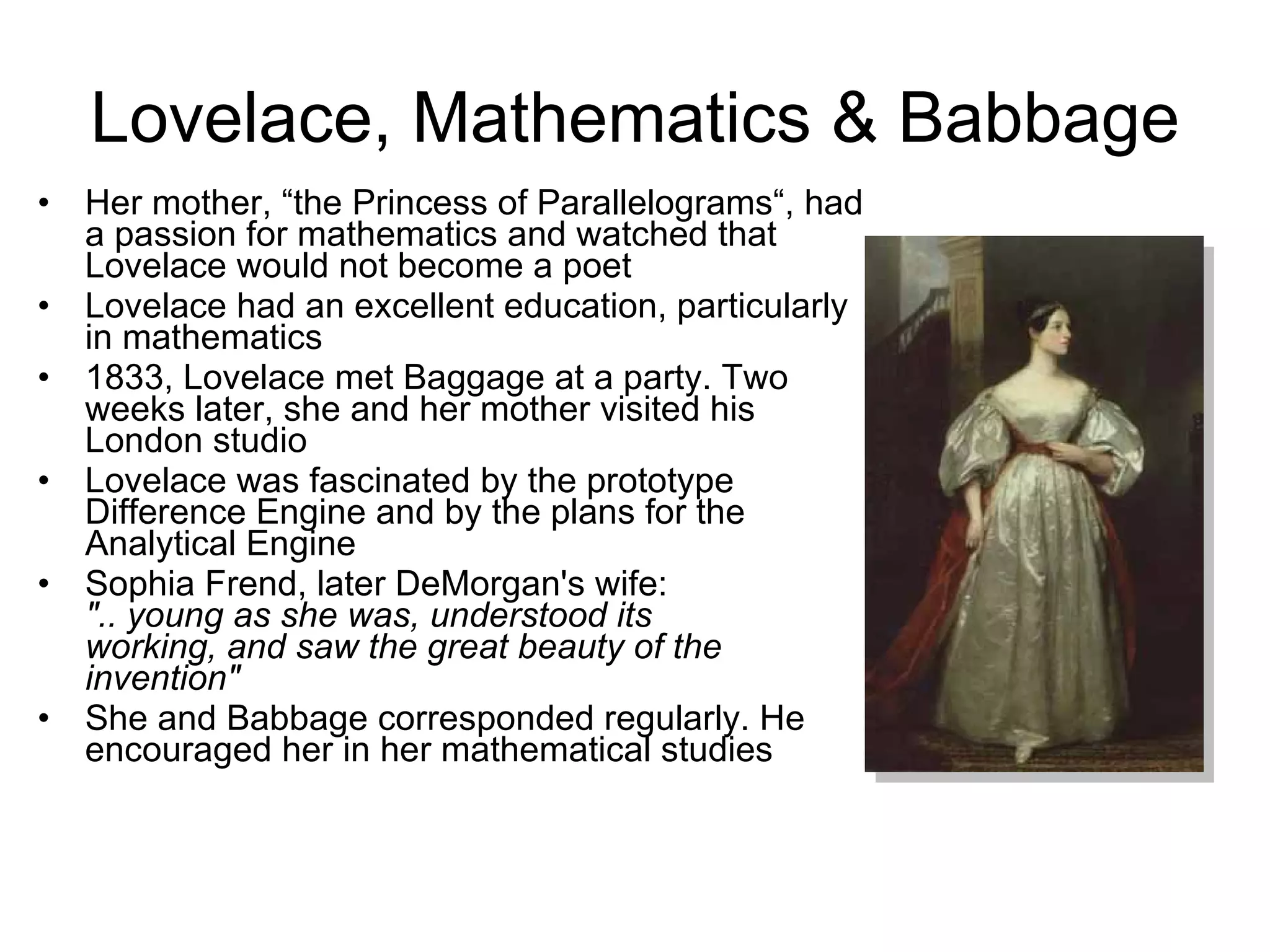
Lovelace, Mathematics & Babbage Her mother, “the Princess of Parallelograms“, had a passion for mathematics and watched that Lovelace would not become a poet Lovelace had an excellent education, particularly in mathematics 1833, Lovelace met Baggage at a party. Two weeks later, she and her mother visited his London studio Lovelace was fascinated by the prototype Difference Engine and by the plans for the Analytical Engine Sophia Frend, later DeMorgan's wife:  ".. young as she was, understood its  working, and saw the great beauty of the invention" She and Babbage corresponded regularly. He encouraged her in her mathematical studies
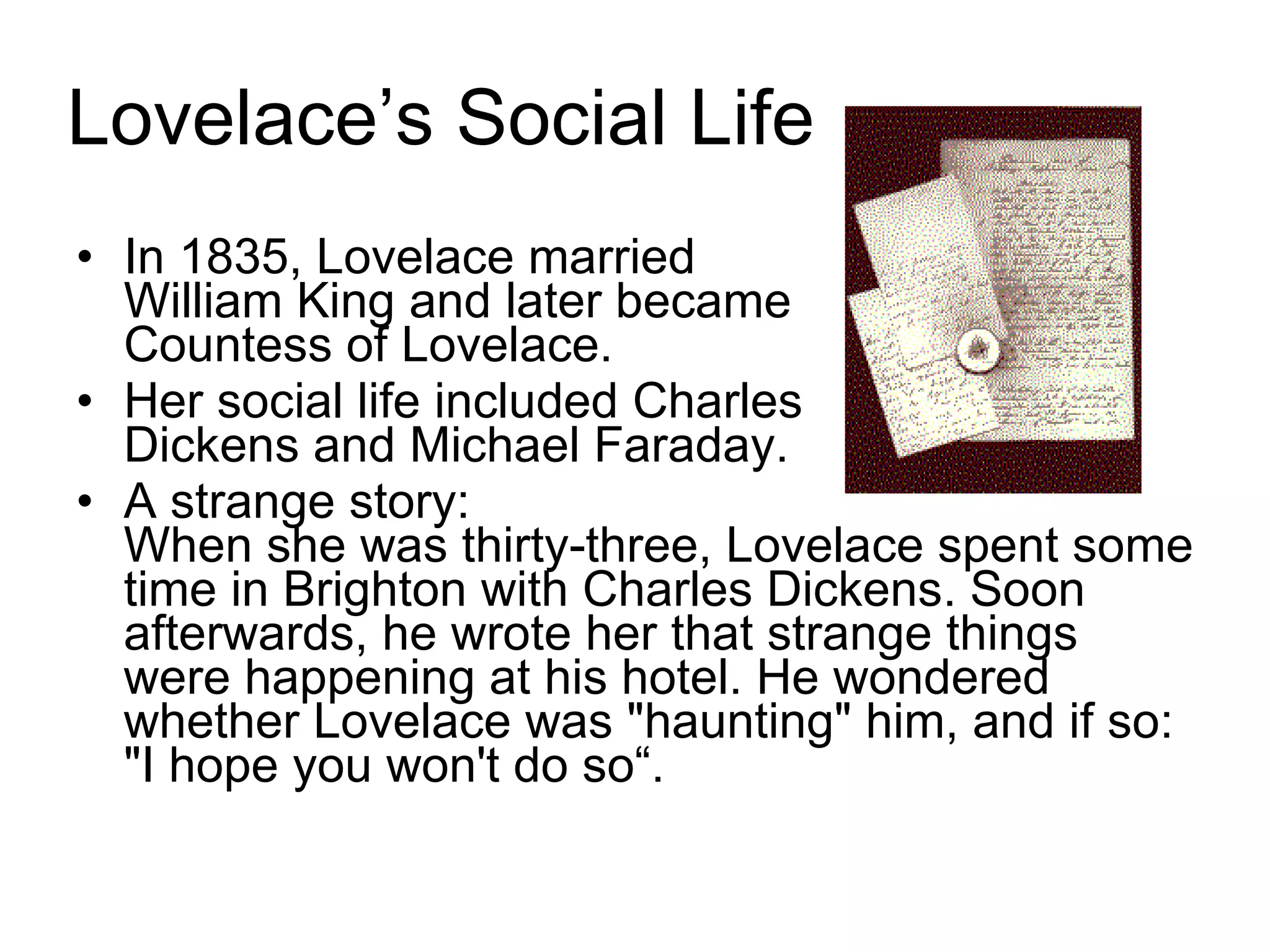
Lovelace’s Social Life In 1835, Lovelace married  William King and later became  Countess of Lovelace.  Her social life included Charles  Dickens and Michael Faraday. A strange story:  When she was thirty-three, Lovelace spent some time in Brighton with Charles Dickens. Soon afterwards, he wrote her that strange things were happening at his hotel. He wondered whether Lovelace was "haunting" him, and if so: "I hope you won't do so“.
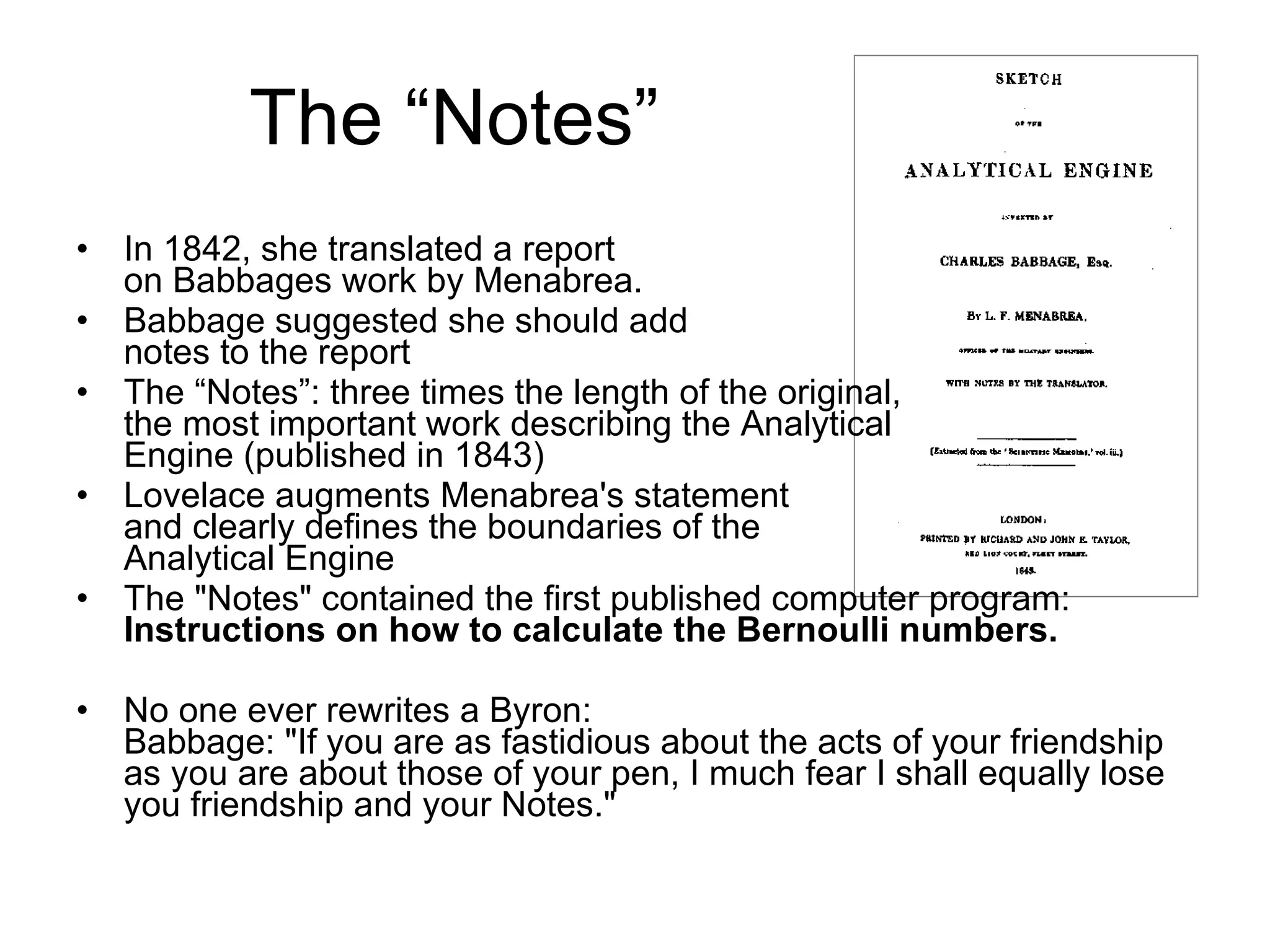
The “Notes” In 1842, she translated a report  on Babbages work by Menabrea. Babbage suggested she should add notes to the report The “Notes”: three times the length of the original,  the most important work describing the Analytical  Engine (published in 1843) Lovelace augments Menabrea's statement  and clearly defines the boundaries of the  Analytical Engine The "Notes" contained the first published computer program: Instructions on how to calculate the Bernoulli numbers. No one ever rewrites a Byron: Babbage: "If you are as fastidious about the acts of your friendship as you are about those of your pen, I much fear I shall equally lose you friendship and your Notes."
Lovelace, the first programmer? DeMorgan: "Ada's power of thinking from the beginning of the correspondance with her, has been utterly out of common way for any beginner, man or woman." Babbage correspondance with Lovelace reveals that he gave her very little help Babbage: "[She] has entered fully into almost all the very difficult and abstract questions connected with the subject." Lovelace's contributions are not undisputed. However, statements from that time clearly state her competencies:
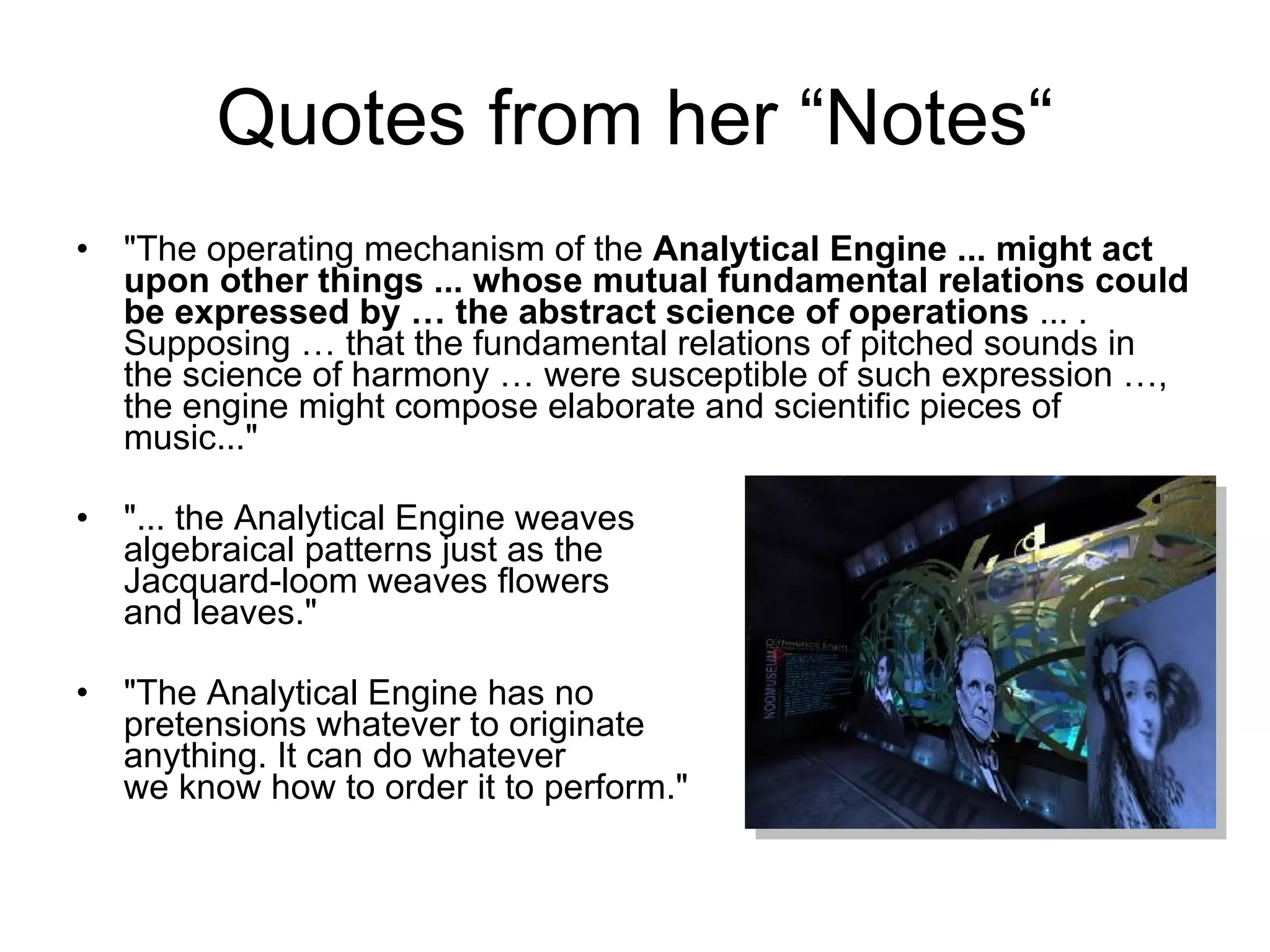
Quotes from her “Notes“ "The operating mechanism of the  Analytical Engine ... might act upon other things ... whose mutual fundamental relations could be expressed by … the abstract science of operations  ... . Supposing … that the fundamental relations of pitched sounds in the science of harmony … were susceptible of such expression …, the engine might compose elaborate and scientific pieces of music..." "... the Analytical Engine weaves  algebraical patterns just as the  Jacquard-loom weaves flowers  and leaves." "The Analytical Engine has no  pretensions whatever to originate  anything. It can do whatever  we know how to order it to perform."
After the “Notes” Lovelace's health deteriorated lack of a scientific project lack of friends with whom to discuss mathematical problems Babbage was becoming depressed at his own lack of success and failed to give necessary support Lovelace flirted with several of her male acquaintances, several scandals. Her husband destroyed over 100 of her letters to such friends.  Drinking with meals became drinking instead of meals Gambling problems, pawned some of her jewels. When she died,  £2000 gambling depths Died of cancer in 1852, aged 36.  Charles Dickens visited her at her deathbed.
Back to Babbage 1847: the design of Difference Engine No. 2 Suffered from misanthropy. Still, “... he hated mankind rather than man, and his aversion was lost in its own generality". When he died in 1871, only few people knew who he was.  Scientists: his reform of Mathematics Others: prosecutor of street music The Royal Society printed no obituary,  the Times ridiculed him
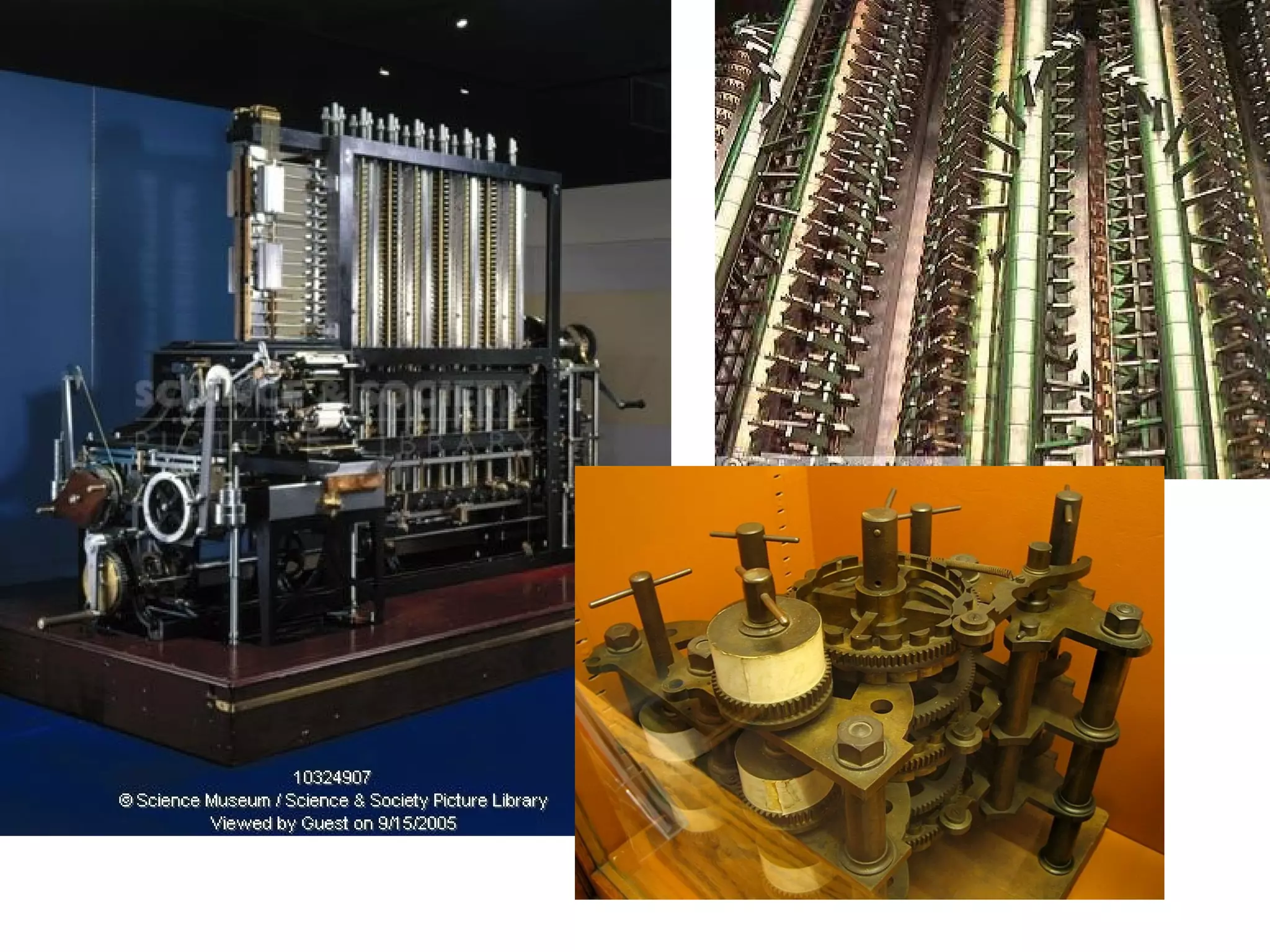
The Engines Today 1985-1991:  London Science Museum built Difference Engine No. 2 Built to the original designs and to tolerances achievable with 19th century technology 4.000 separate parts, weight of 2.6 tonnes, 2.1m high, 3.3m long and 45cm in depth Difference Engine No. 1, if built:  25.000 parts, weight of 15 tonnes Analytical engine: over 30m long and 10m wide In 2000, construction of the printer of Difference Engine No. 2.  Weight of 2.5 tonnes
 
"As soon as an Analytical Engine exists, it will necessarily guide the future course of the science.“ "The operating mechanism of the Analytical Engine ... might act upon other things ... whose mutual fundamental relations could be expressed by those of the abstract science of operations.”

Babbage & Lovelace: The designer of the analytical engine and its programmer

  • 1.
    Charles Babbage andAugusta Ada King, Countess of Lovelace The designer of the analytical engine and its programmer
  • 2.
    Charles Babbage (December26, 1791 – October 18, 1871) "All careers were open to such a man. In any he must have succeeded. Unhappily for himself, he chose a path which ... led only to loss of fortune and embitterment of mind.” Obituary of the Royal Astronomical Society
  • 3.
    Education, Achievements Richfamily, received good education At university, promoted Leibnizian over Newtonian calculus: "The Principles of D-ism in opposition to the Dot-age of the University" "His love of humour was so strong a characteristic that, to omit it, is to omit half the man" Active in many areas: lighthouse signaling, uniform postal rates, Greenwich time signals, cow-catcher At that time seen as the greatest British mathematician
  • 4.
    Babbage and Lord Tennyson " The Vision of Sin ": Every minute dies a man, Every minute one is born Babbage in a letter to Lord Tennyson: ” ...If this were true the population of the world would be at a standstill. In truth, the rate of birth is slightly in excess of that of death. I would suggest: ‘ Every minute dies a man, And one and a sixteenth is born’ I may add that the exact figures are 1.167, but something must, of course, be conceded to the laws of metre. ” A letter from Elizabeth Barrett: “ That such a poet should submit blindly to the suggestions of his critics is ... as if Babbage were to take my opinion & undo his calculating machine by it.”
  • 5.
    Mathematical Tables Humancomputers produced sets of mathematical tables for use by astronomers, navigators and engineers. Very laborious Error-prone Three basic sources of error: calculation transcription typesetting and printing
  • 6.
    Mechanization of Calculation18 21, while proofreading for the Astronomical Society: " I wish to God these calculations had been executed by steam “. 1822: Design of the Difference Engine calculate and print the results automatically 1823: Government Grant of £1500 (≈110.000£ today)
  • 7.
    Construction started, but never completed Lack of expertise Transition between craft traditions and mass-production Babbage had to invent the tools His survey of manufacturing techniques " On the Economy of Machinery and Manufactures “ Babbage's effort at gear making resulted in superior British machinery for next decades (  First World War) Babbage suffered of "creeping featuritis" and kept changing the design of the machine Dispute with the toolmaker Babbage's difficult personality and personal problems (in 1827, his wife, father, and one son died)
  • 8.
    Abandonment of theProject 1834: Work stopped 1842: Government officially abandoned the project Costs: £ 23.000 , including £6.000 of Babbage’s own money “ On two occasions I have been asked [by members of Parliament], 'Pray, Mr. Babbage, if you put into the machine wrong figures, will the right answers come out?' I am not able rightly to apprehend the kind of confusion of ideas that could provoke such a question. ” In 1855, Georg and Edvard Scheutz built two Difference Engines. However, the engines failed to establish themselves and quickly fell out of use
  • 9.
    The Analytical EngineDifference Engine: Calculation of polynomial equations Between 1833 and 1842, design of a machine programmable to do any kind of calculation No comparable general-purpose computers until about 100 years later (Z3, Harvard Mark I) Little attempt to raise funds to build the Analytical Engine In 1878, British Association for the Advancement of Science recommended against construction
  • 10.
    Design of theAnalytical Engine Input devices based on punched cards, the mill, a control unit, a store, output mechanisms (a bell, a curve plotter, a printer, card puncher) Separation of store and mill is a fundamental feature of modern computers Programming language equivalent to assembly languages (Turing complete): Loops Conditional branching
  • 11.
    Augusta Ada King,Countess of Lovelace December 10, 1815 - November 27, 1852 Daughter of Lord Byron and Anne Isabelle Milbanke Lovelace's parents married on 2 January 1815, separated on 16 January 1816 Lord Byron went abroad and never returned to England. Lady Byron was given sole custody
  • 12.
    Lovelace, Mathematics &Babbage Her mother, “the Princess of Parallelograms“, had a passion for mathematics and watched that Lovelace would not become a poet Lovelace had an excellent education, particularly in mathematics 1833, Lovelace met Baggage at a party. Two weeks later, she and her mother visited his London studio Lovelace was fascinated by the prototype Difference Engine and by the plans for the Analytical Engine Sophia Frend, later DeMorgan's wife: ".. young as she was, understood its working, and saw the great beauty of the invention" She and Babbage corresponded regularly. He encouraged her in her mathematical studies
  • 13.
    Lovelace’s Social LifeIn 1835, Lovelace married William King and later became Countess of Lovelace. Her social life included Charles Dickens and Michael Faraday. A strange story: When she was thirty-three, Lovelace spent some time in Brighton with Charles Dickens. Soon afterwards, he wrote her that strange things were happening at his hotel. He wondered whether Lovelace was "haunting" him, and if so: "I hope you won't do so“.
  • 14.
    The “Notes” In1842, she translated a report on Babbages work by Menabrea. Babbage suggested she should add notes to the report The “Notes”: three times the length of the original, the most important work describing the Analytical Engine (published in 1843) Lovelace augments Menabrea's statement and clearly defines the boundaries of the Analytical Engine The "Notes" contained the first published computer program: Instructions on how to calculate the Bernoulli numbers. No one ever rewrites a Byron: Babbage: "If you are as fastidious about the acts of your friendship as you are about those of your pen, I much fear I shall equally lose you friendship and your Notes."
  • 15.
    Lovelace, the firstprogrammer? DeMorgan: "Ada's power of thinking from the beginning of the correspondance with her, has been utterly out of common way for any beginner, man or woman." Babbage correspondance with Lovelace reveals that he gave her very little help Babbage: "[She] has entered fully into almost all the very difficult and abstract questions connected with the subject." Lovelace's contributions are not undisputed. However, statements from that time clearly state her competencies:
  • 16.
    Quotes from her“Notes“ "The operating mechanism of the Analytical Engine ... might act upon other things ... whose mutual fundamental relations could be expressed by … the abstract science of operations ... . Supposing … that the fundamental relations of pitched sounds in the science of harmony … were susceptible of such expression …, the engine might compose elaborate and scientific pieces of music..." "... the Analytical Engine weaves algebraical patterns just as the Jacquard-loom weaves flowers and leaves." "The Analytical Engine has no pretensions whatever to originate anything. It can do whatever we know how to order it to perform."
  • 17.
    After the “Notes”Lovelace's health deteriorated lack of a scientific project lack of friends with whom to discuss mathematical problems Babbage was becoming depressed at his own lack of success and failed to give necessary support Lovelace flirted with several of her male acquaintances, several scandals. Her husband destroyed over 100 of her letters to such friends. Drinking with meals became drinking instead of meals Gambling problems, pawned some of her jewels. When she died, £2000 gambling depths Died of cancer in 1852, aged 36. Charles Dickens visited her at her deathbed.
  • 18.
    Back to Babbage1847: the design of Difference Engine No. 2 Suffered from misanthropy. Still, “... he hated mankind rather than man, and his aversion was lost in its own generality". When he died in 1871, only few people knew who he was. Scientists: his reform of Mathematics Others: prosecutor of street music The Royal Society printed no obituary, the Times ridiculed him
  • 19.
    The Engines Today1985-1991: London Science Museum built Difference Engine No. 2 Built to the original designs and to tolerances achievable with 19th century technology 4.000 separate parts, weight of 2.6 tonnes, 2.1m high, 3.3m long and 45cm in depth Difference Engine No. 1, if built: 25.000 parts, weight of 15 tonnes Analytical engine: over 30m long and 10m wide In 2000, construction of the printer of Difference Engine No. 2. Weight of 2.5 tonnes
  • 20.
  • 21.
    "As soon asan Analytical Engine exists, it will necessarily guide the future course of the science.“ "The operating mechanism of the Analytical Engine ... might act upon other things ... whose mutual fundamental relations could be expressed by those of the abstract science of operations.”