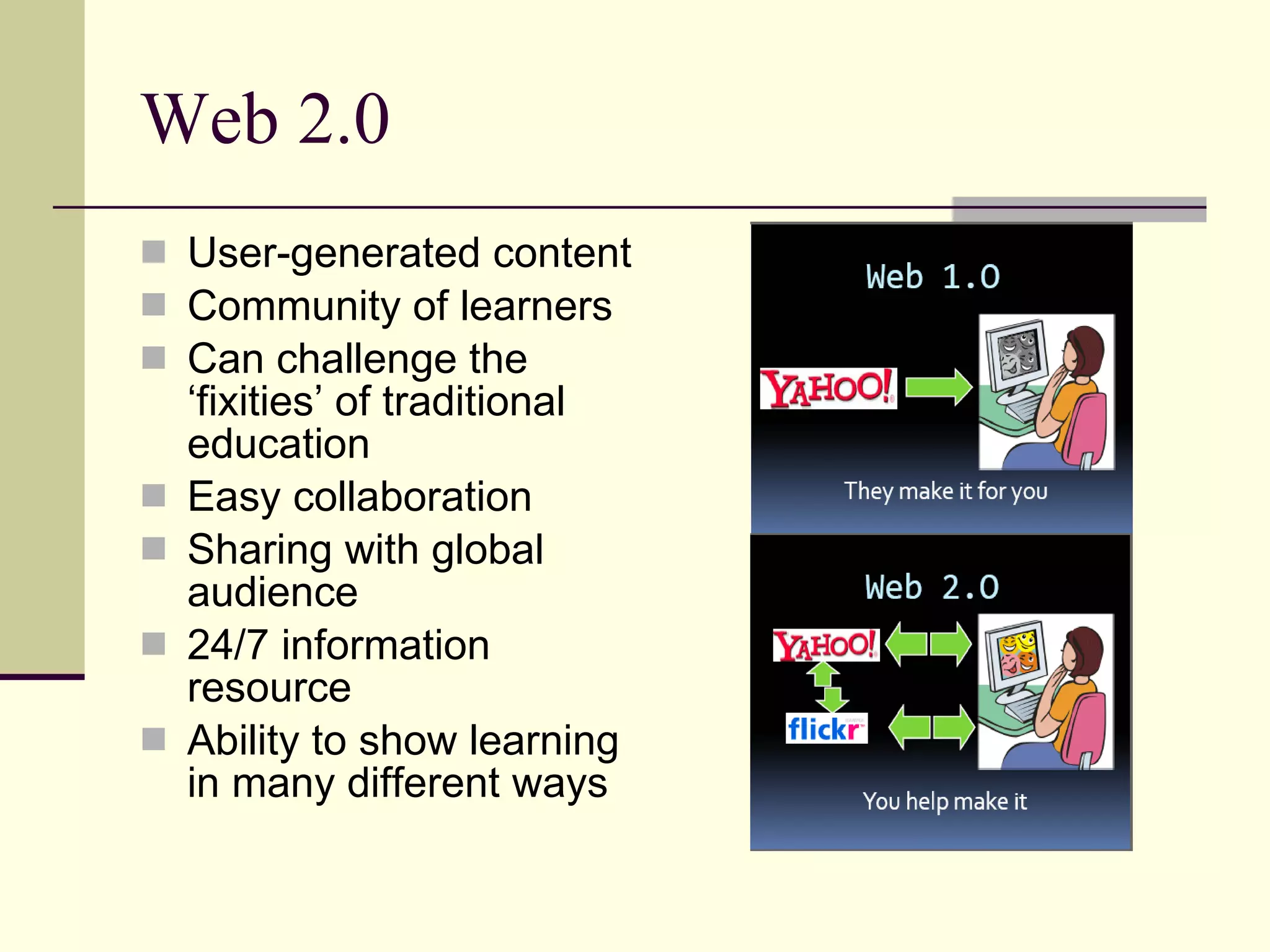
Web 2.0  User-generated content Community of learners Can challenge the ‘fixities’ of traditional education Easy collaboration Sharing with global audience 24/7 information resource Ability to show learning in many different ways
Key characteristics Presence  – users develop an online identity, profile or avatar. Modification  – Web 2.0 spaces can be personalized, spaces can be linked (YouTube, Facebook, Twitter, Flickr) User generated content  – content is created by community of users.  Web 2.0 users are  producers  and  consumers . Social participation  – Web 2.0 spaces invite participation: receiving feedback and developing content.
Educational rationale for Web 2.0 Claim Many students already engage in web 2.0 practices Web2.0 promotes knowledge sharing Developing new practices to be used in their future Enjoyable, engaging and motivational for learners and teachers Counter-Claim Digital divide- many students don’t have access to these practices Most young people’s online practices are repetitive and limited in ambition Web 2.0 may be trivial and unproductive Children, parents& teachers may have had a negative experience and find it hard
Educational rationale con’t. Claim Involve new literacy practices, real & meaningful experiences Risks & opportunities of life online can be explored through engaging with Web 2.0 Give voice to participants & offer new possibilities for social engagement & citizenship Collaboration & criticality can be developed Davies, Julia, and Guy Merchant.  Web 2.0 for Schools . 1st ed. New York: Peter Lang Publishing, 2009. Print.   Counter-claim Literacy is important & being eroded by new media Potential dangerous place – need to protect students Create an illusory sense of social engagement & actually create passive citizens Creates isolated techno-subjects who use internet for vanity publishing and recycling old ideas.
Web 2.0 tools  Blogs Wikis Podcasts Social Networking Social Bookmarking YouTube Flickr RSS Feed Reader
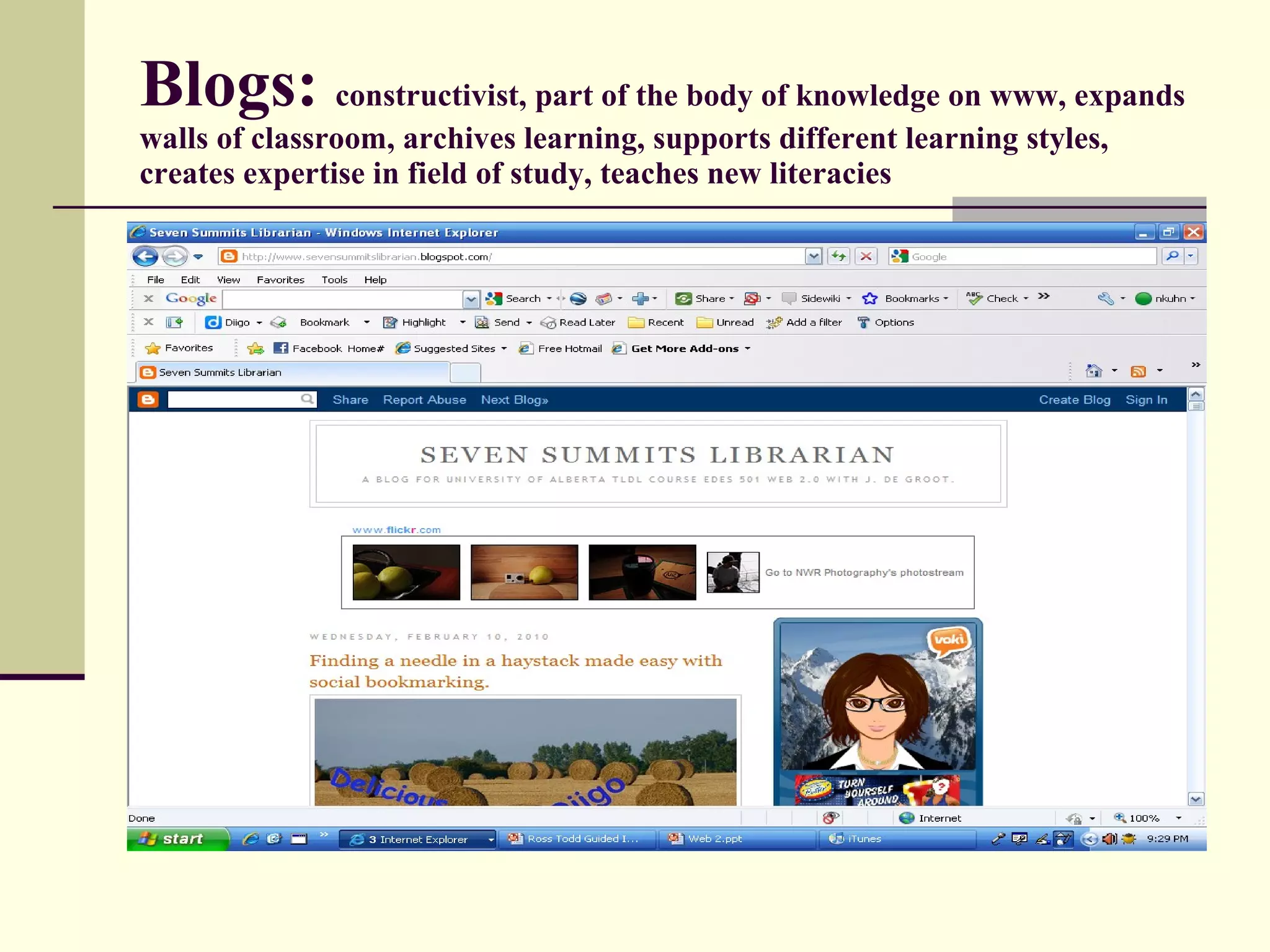
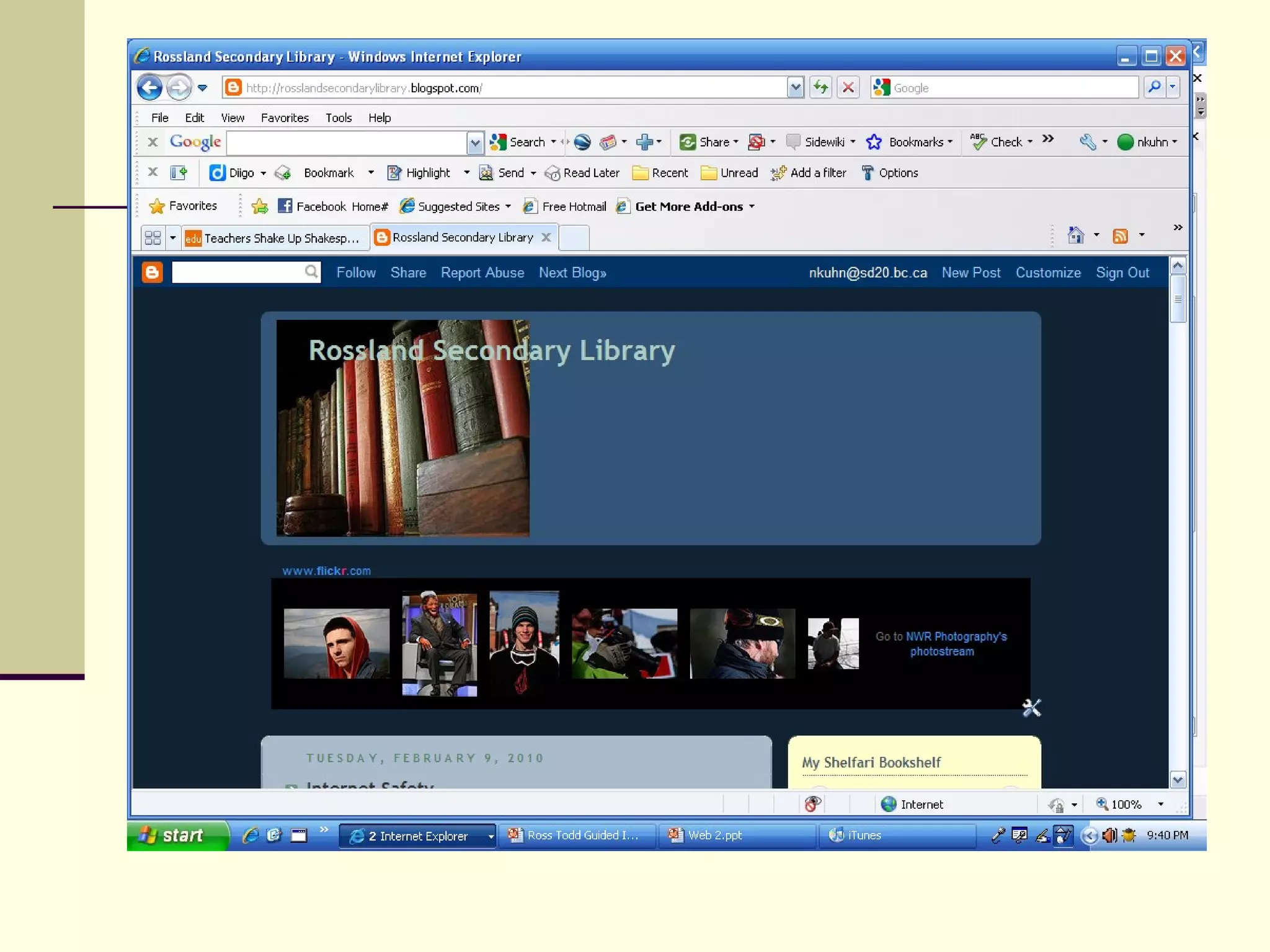
Blogs:  constructivist, part of the body of knowledge on www, expands walls of classroom, archives learning, supports different learning styles, creates expertise in field of study, teaches new literacies
 
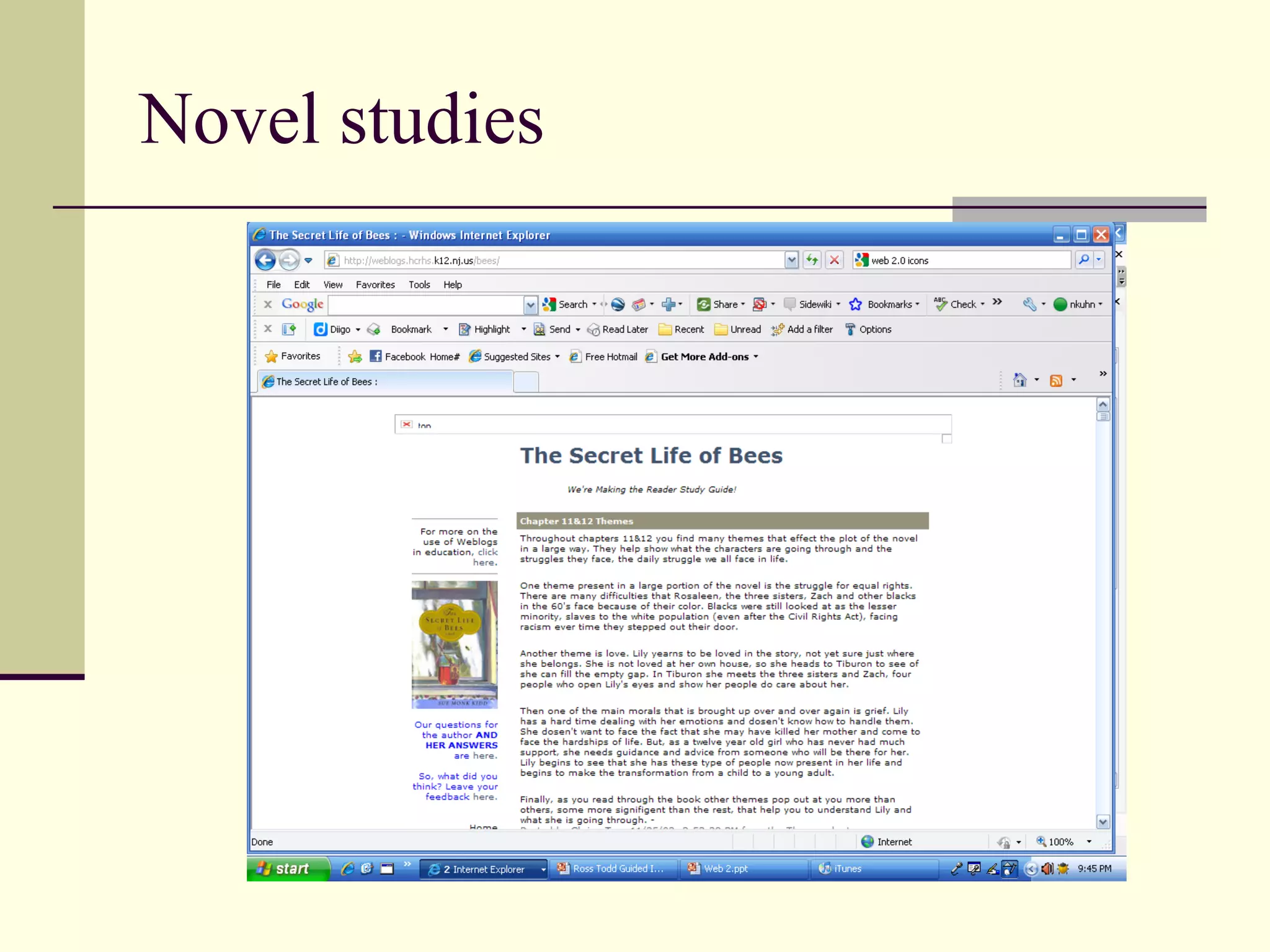
Novel studies
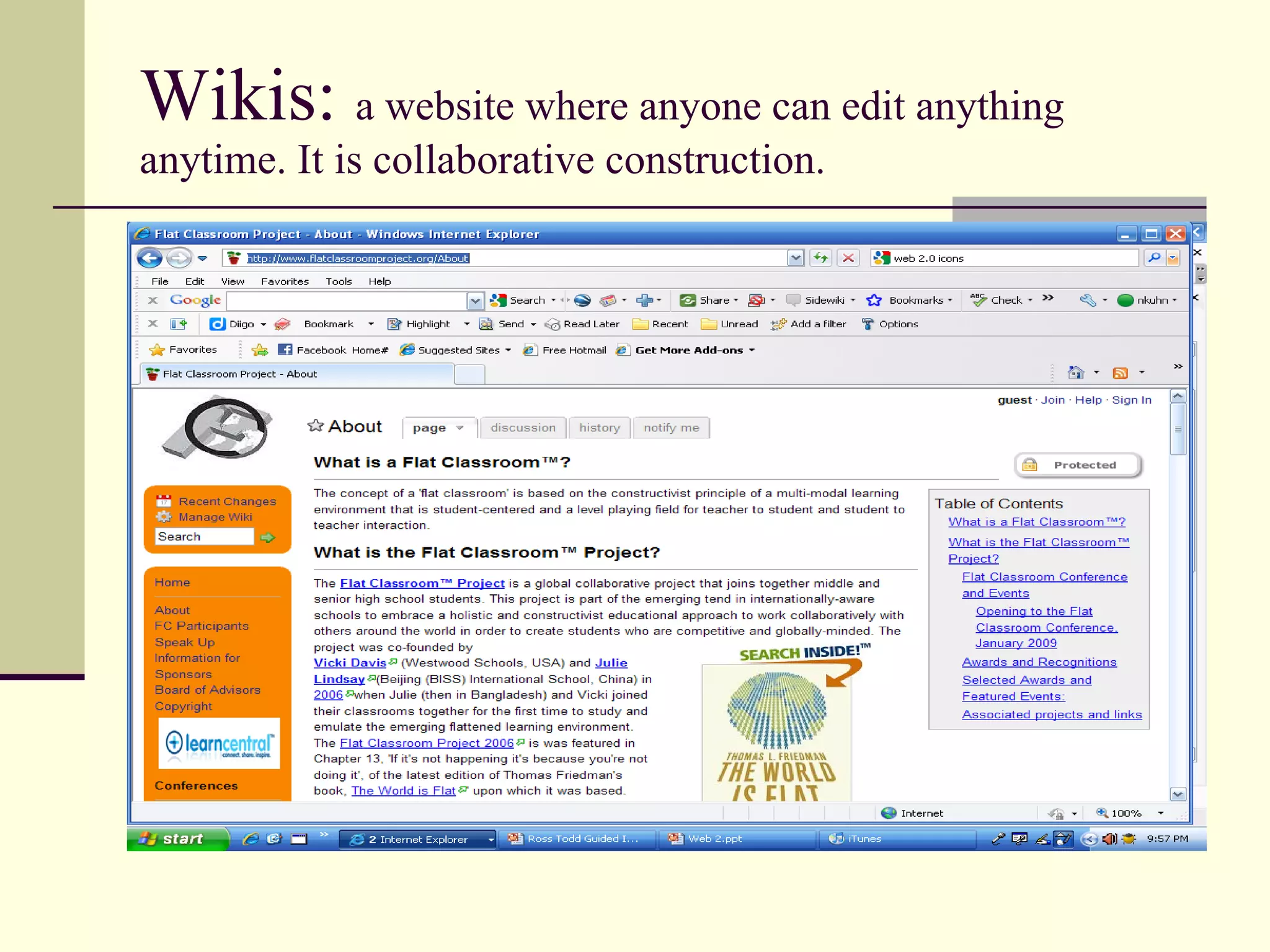
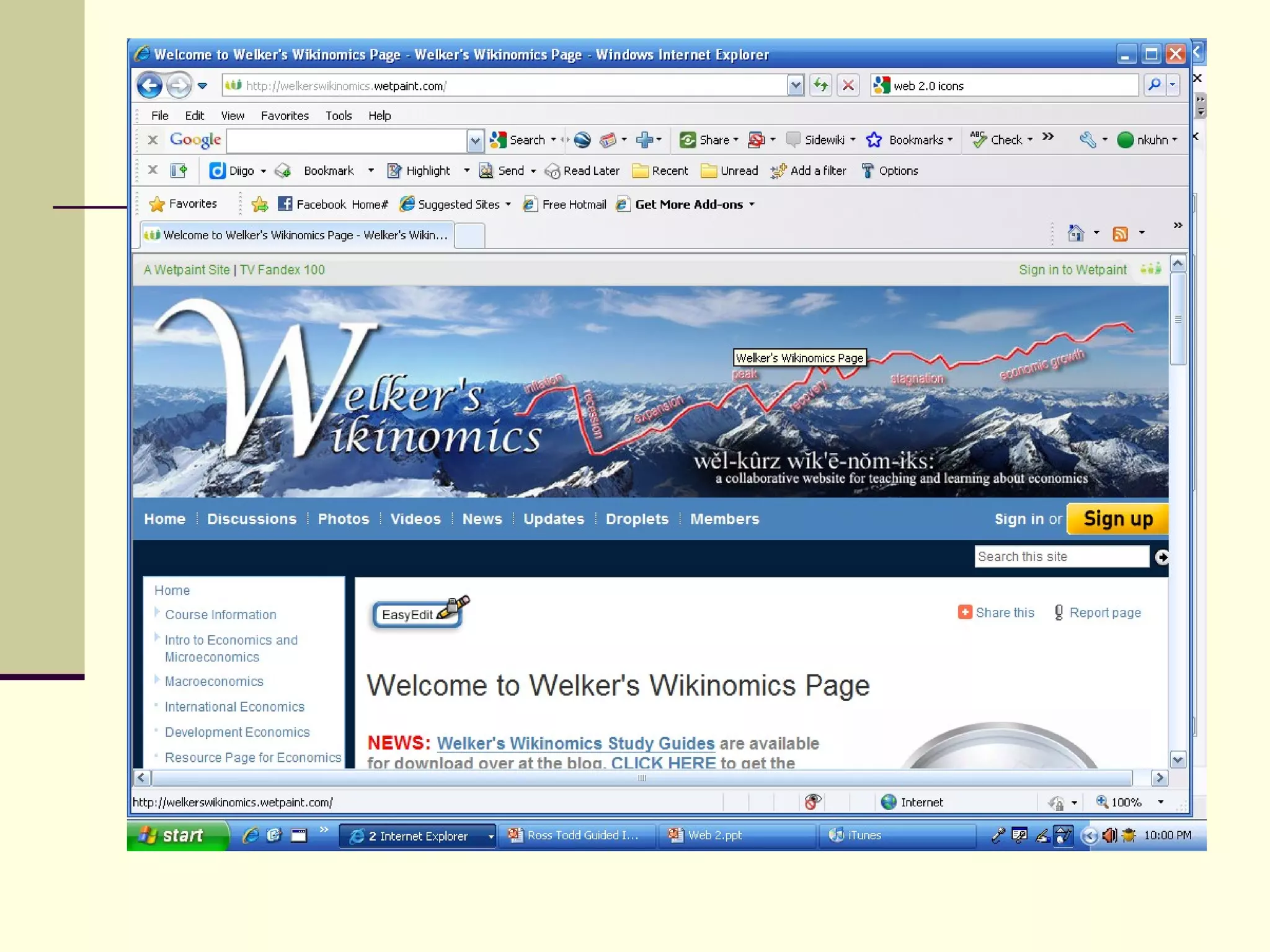
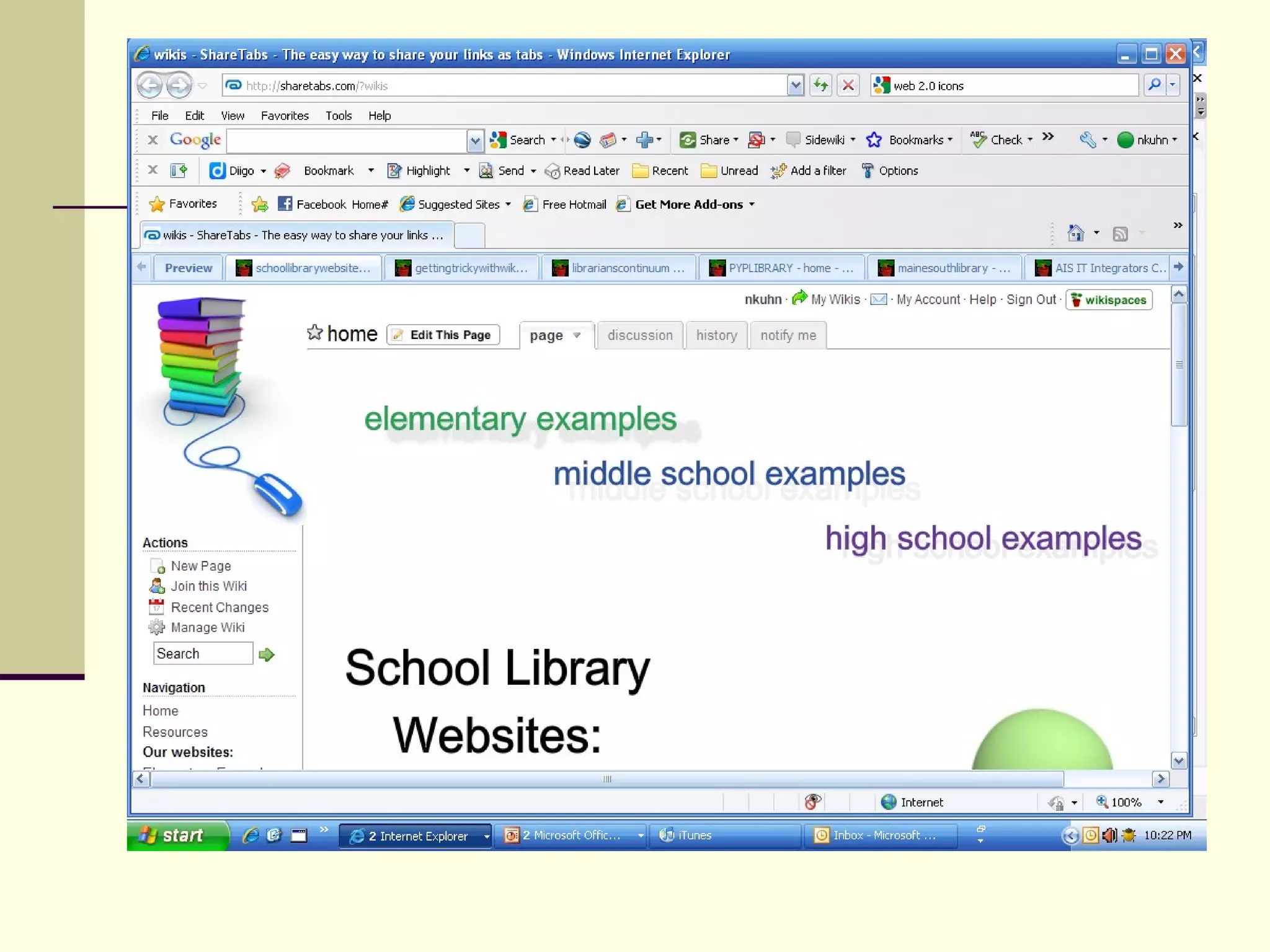
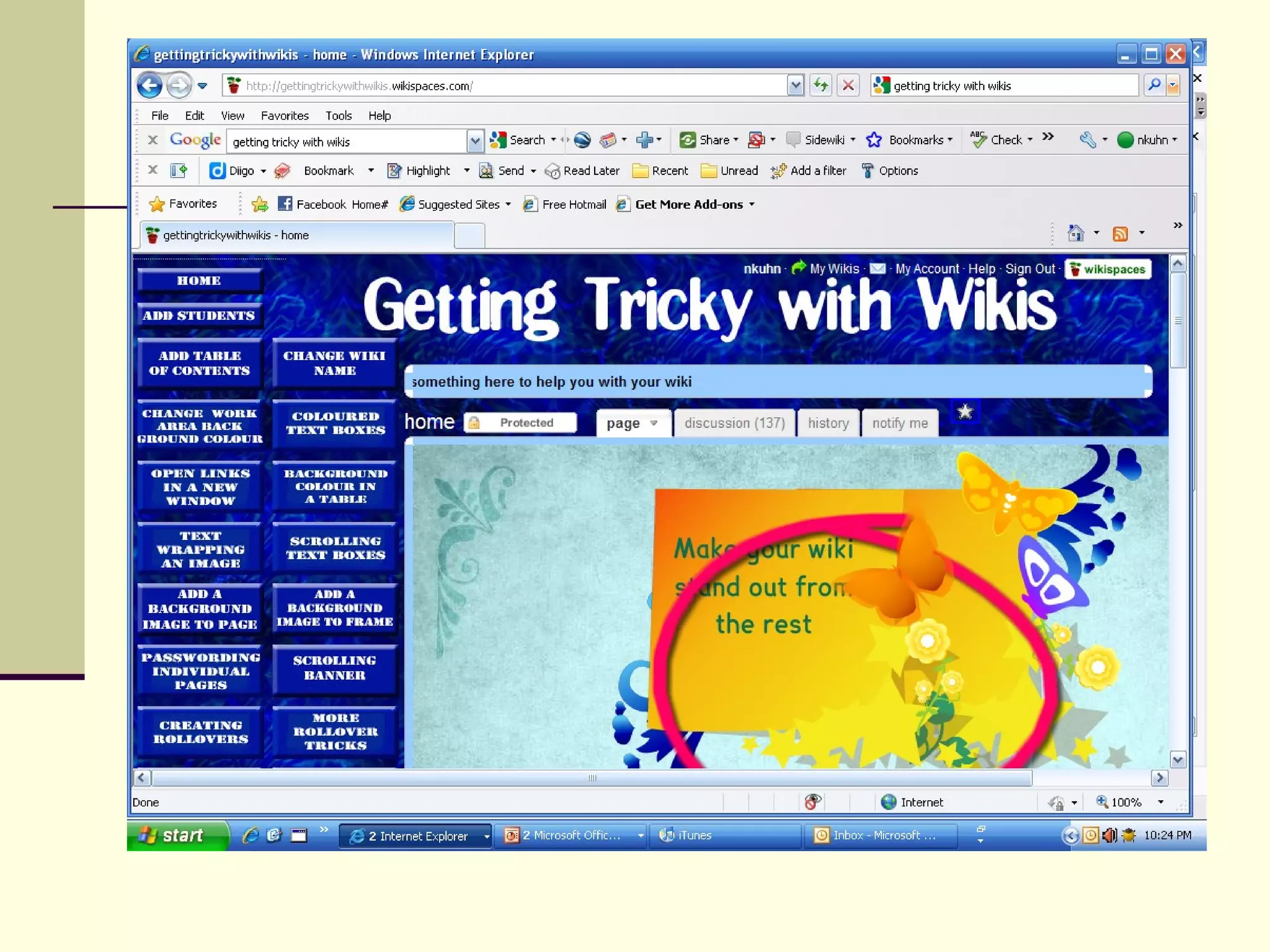
Wikis:  a website where anyone can edit anything anytime. It is collaborative construction.


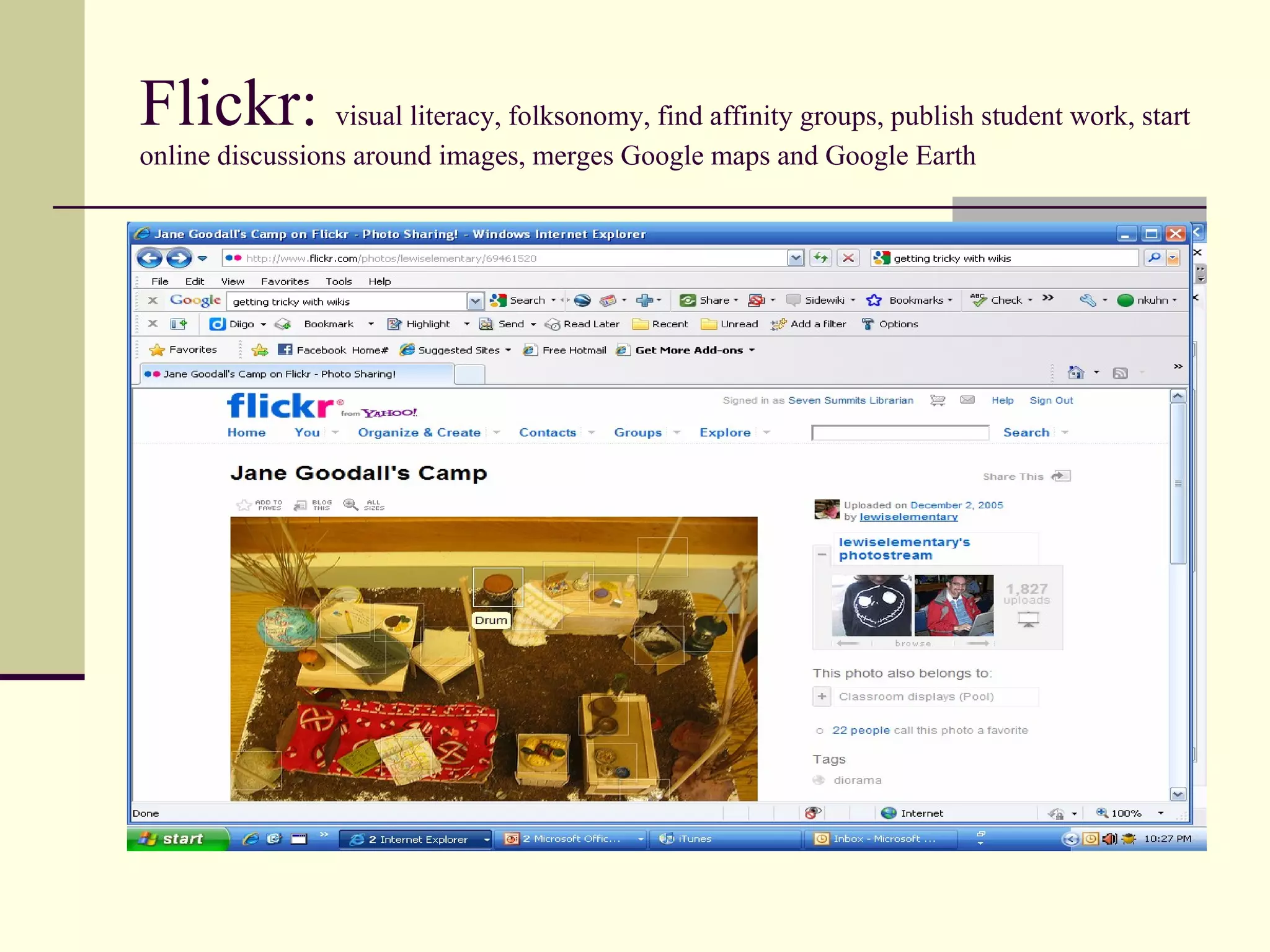
Flickr:  visual literacy, folksonomy, find affinity groups, publish student work, start online discussions around images, merges Google maps and Google Earth
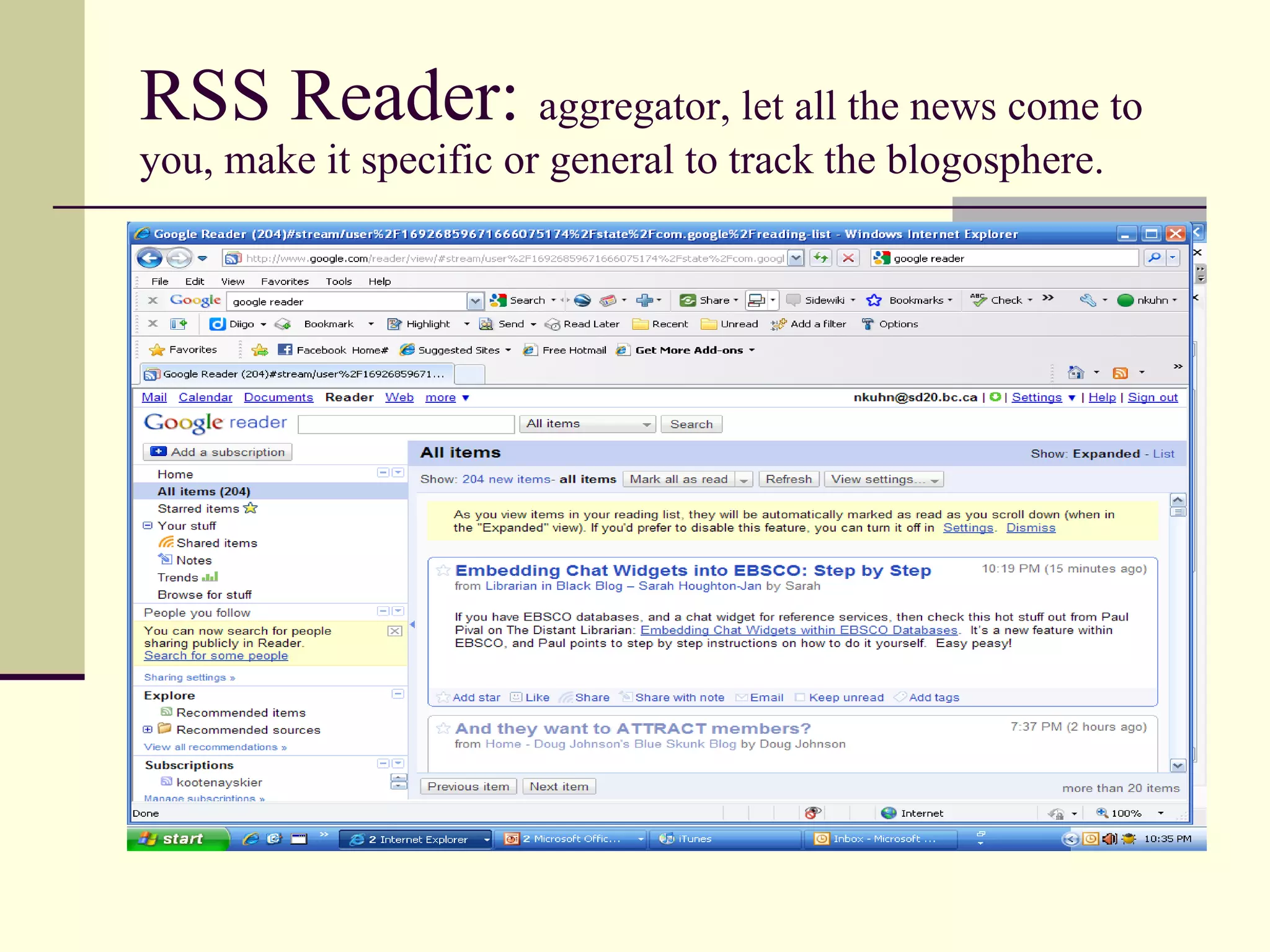
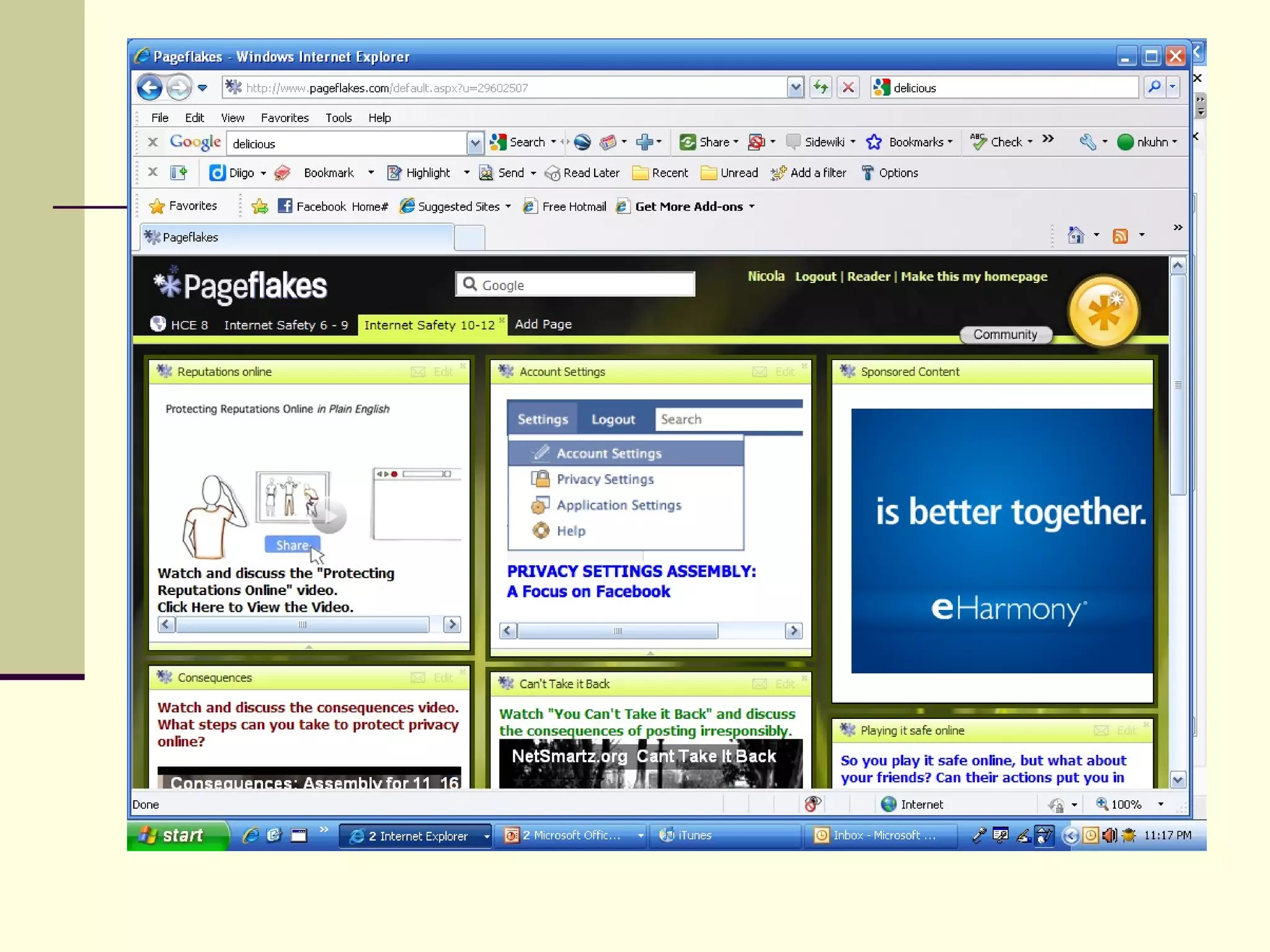
RSS Reader:  aggregator, let all the news come to you, make it specific or general to track the blogosphere.
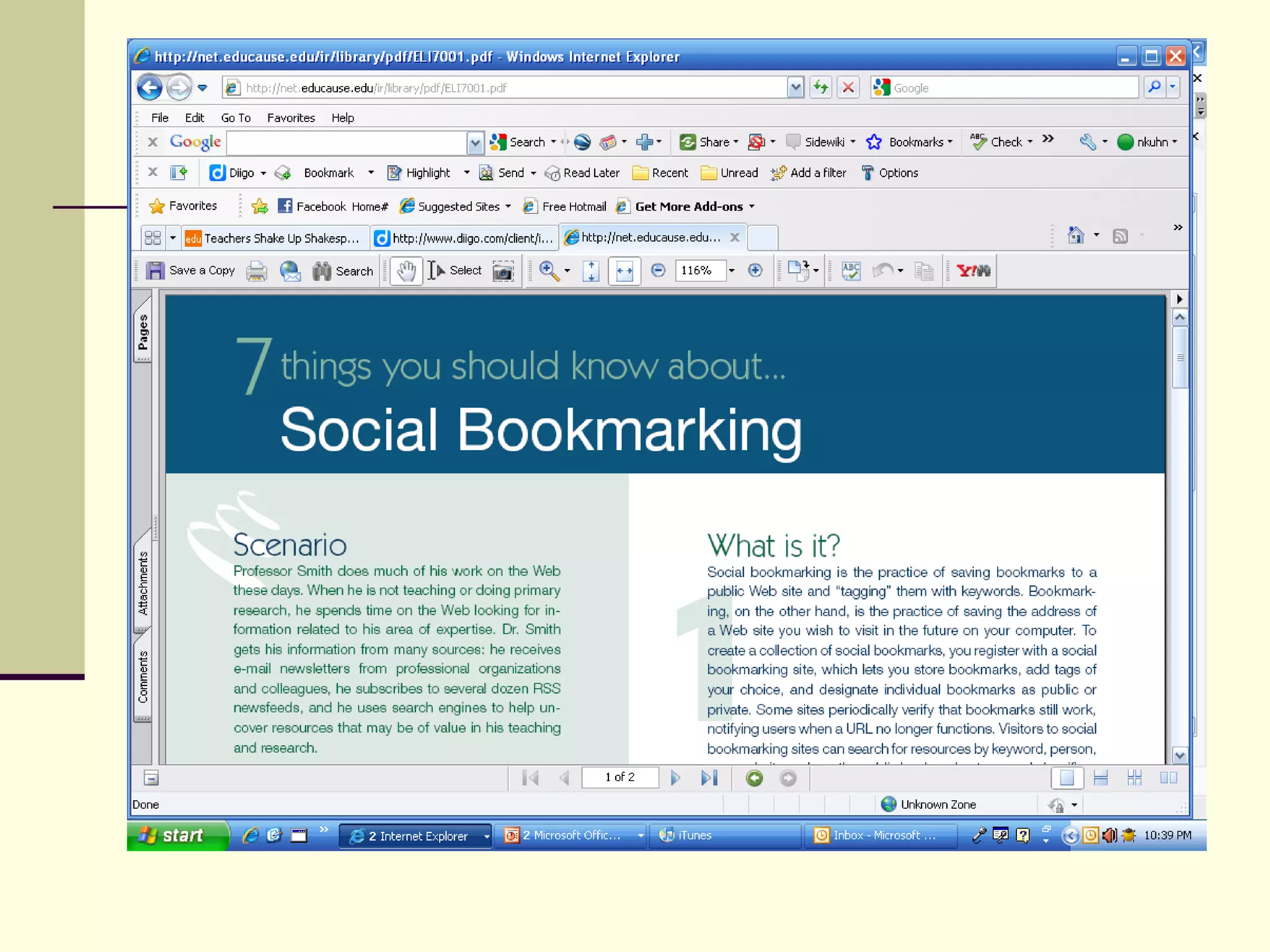
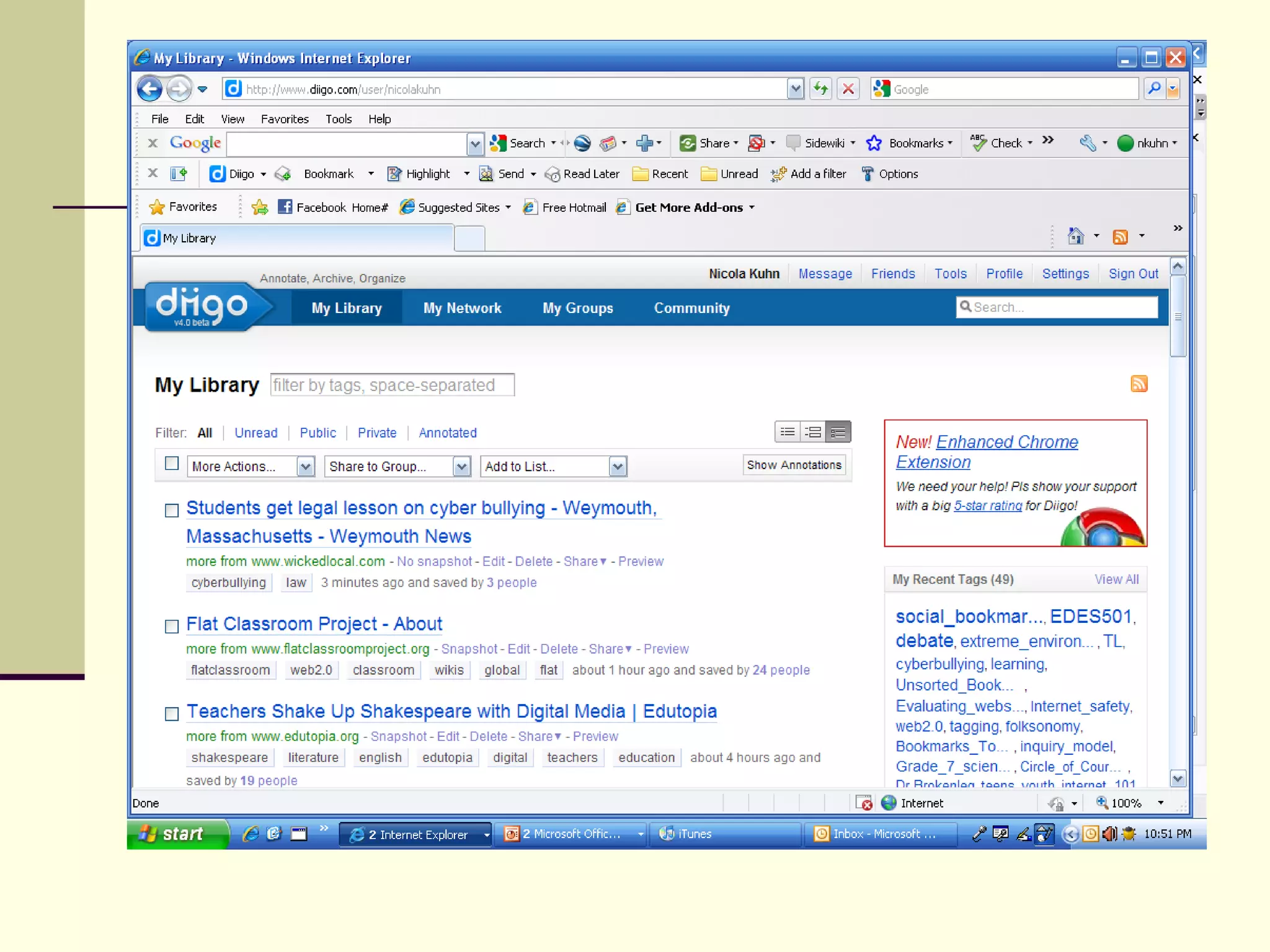
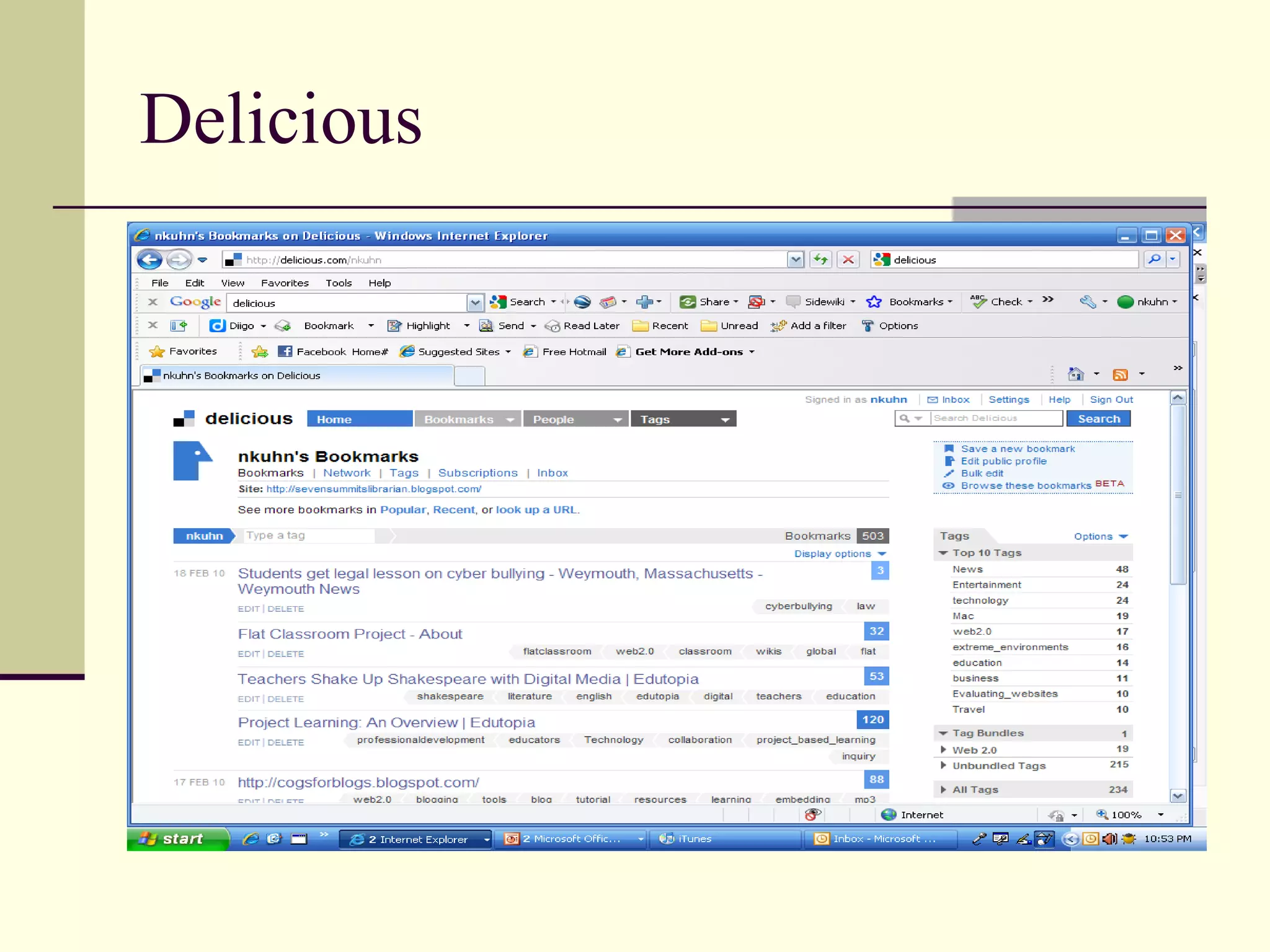
Social bookmarking: a librarian’s best friend. Bookmarks available anywhere anytime Find like minded users and share bookmarks Folksonomies and tagging Create groups and lists to organize bookmarks Makes managing and finding bookmarks easy See annotated bookmarks Highlight webpages and make sticky notes Create archives with snapshots for PDFs, username & password protected sites Create tag clouds and tagrolls to embed in your blog Close gap between library and patrons. synergy
 
 
Delicious
 
Implications of a digital environment New literacies: not just reading and writing Consumers of web must be editors and readers Must model ways of learning, creating and sharing online Fair use issues and copyright must be taught ( www.creativecommons.org ) Collaboration in virtual spaces Need to provide our students with skills to manage information they consume
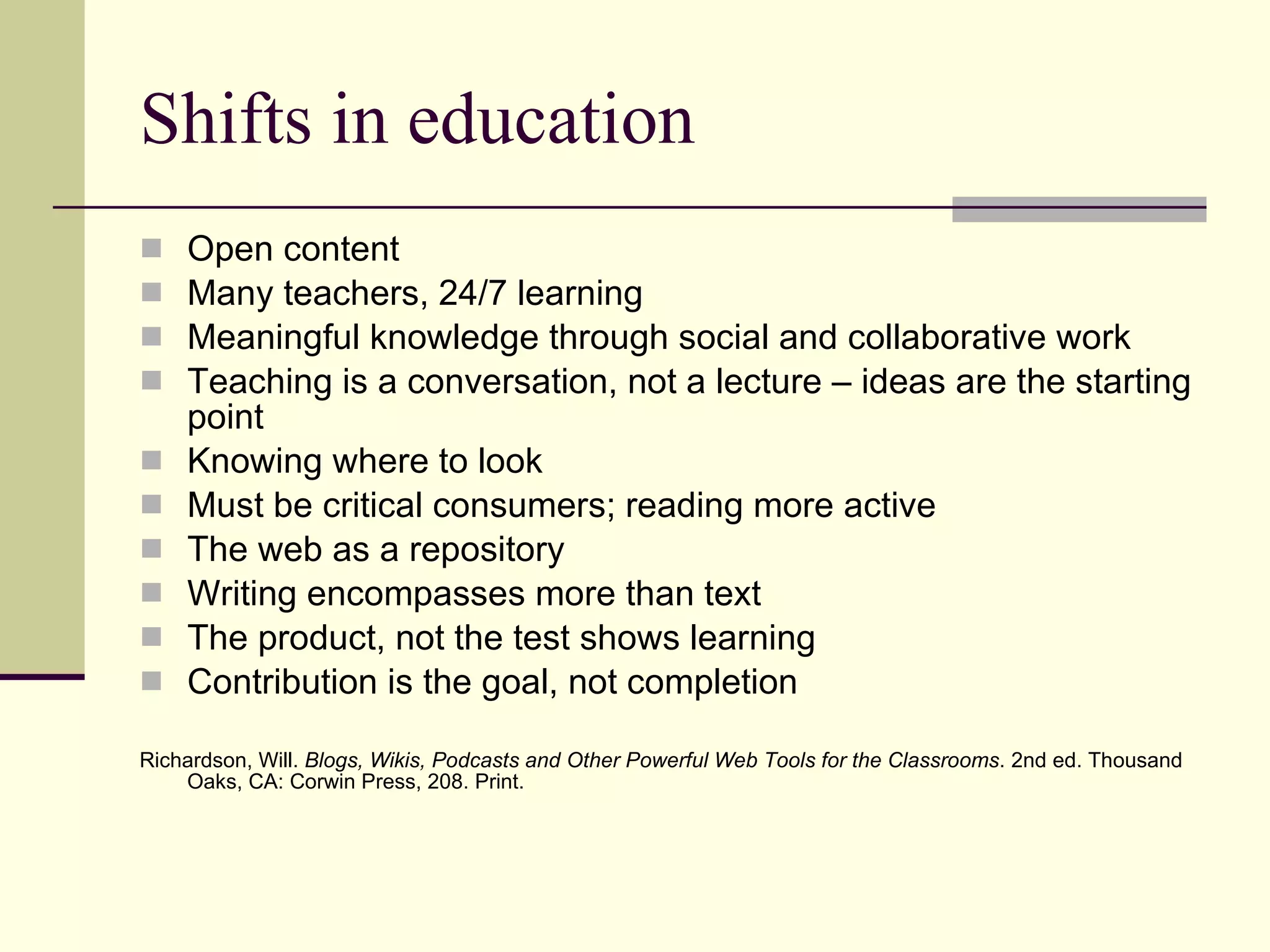
Shifts in education Open content Many teachers, 24/7 learning Meaningful knowledge through social and collaborative work Teaching is a conversation, not a lecture – ideas are the starting point  Knowing where to look  Must be critical consumers; reading more active The web as a repository Writing encompasses more than text The product, not the test shows learning Contribution is the goal, not completion Richardson, Will.  Blogs, Wikis, Podcasts and Other Powerful Web Tools for the Classrooms . 2nd ed. Thousand Oaks, CA: Corwin Press, 208. Print.

Web 2.0

  • 1.
    Web 2.0 User-generated content Community of learners Can challenge the ‘fixities’ of traditional education Easy collaboration Sharing with global audience 24/7 information resource Ability to show learning in many different ways
  • 2.
    Key characteristics Presence – users develop an online identity, profile or avatar. Modification – Web 2.0 spaces can be personalized, spaces can be linked (YouTube, Facebook, Twitter, Flickr) User generated content – content is created by community of users. Web 2.0 users are producers and consumers . Social participation – Web 2.0 spaces invite participation: receiving feedback and developing content.
  • 3.
    Educational rationale forWeb 2.0 Claim Many students already engage in web 2.0 practices Web2.0 promotes knowledge sharing Developing new practices to be used in their future Enjoyable, engaging and motivational for learners and teachers Counter-Claim Digital divide- many students don’t have access to these practices Most young people’s online practices are repetitive and limited in ambition Web 2.0 may be trivial and unproductive Children, parents& teachers may have had a negative experience and find it hard
  • 4.
    Educational rationale con’t.Claim Involve new literacy practices, real & meaningful experiences Risks & opportunities of life online can be explored through engaging with Web 2.0 Give voice to participants & offer new possibilities for social engagement & citizenship Collaboration & criticality can be developed Davies, Julia, and Guy Merchant. Web 2.0 for Schools . 1st ed. New York: Peter Lang Publishing, 2009. Print. Counter-claim Literacy is important & being eroded by new media Potential dangerous place – need to protect students Create an illusory sense of social engagement & actually create passive citizens Creates isolated techno-subjects who use internet for vanity publishing and recycling old ideas.
  • 5.
    Web 2.0 tools Blogs Wikis Podcasts Social Networking Social Bookmarking YouTube Flickr RSS Feed Reader
  • 6.
    Blogs: constructivist,part of the body of knowledge on www, expands walls of classroom, archives learning, supports different learning styles, creates expertise in field of study, teaches new literacies
  • 7.
  • 8.
  • 9.
    Wikis: awebsite where anyone can edit anything anytime. It is collaborative construction.
  • 10.
  • 11.
  • 12.
  • 13.
    Flickr: visualliteracy, folksonomy, find affinity groups, publish student work, start online discussions around images, merges Google maps and Google Earth
  • 14.
    RSS Reader: aggregator, let all the news come to you, make it specific or general to track the blogosphere.
  • 15.
    Social bookmarking: alibrarian’s best friend. Bookmarks available anywhere anytime Find like minded users and share bookmarks Folksonomies and tagging Create groups and lists to organize bookmarks Makes managing and finding bookmarks easy See annotated bookmarks Highlight webpages and make sticky notes Create archives with snapshots for PDFs, username & password protected sites Create tag clouds and tagrolls to embed in your blog Close gap between library and patrons. synergy
  • 16.
  • 17.
  • 18.
  • 19.
  • 20.
    Implications of adigital environment New literacies: not just reading and writing Consumers of web must be editors and readers Must model ways of learning, creating and sharing online Fair use issues and copyright must be taught ( www.creativecommons.org ) Collaboration in virtual spaces Need to provide our students with skills to manage information they consume
  • 21.
    Shifts in educationOpen content Many teachers, 24/7 learning Meaningful knowledge through social and collaborative work Teaching is a conversation, not a lecture – ideas are the starting point Knowing where to look Must be critical consumers; reading more active The web as a repository Writing encompasses more than text The product, not the test shows learning Contribution is the goal, not completion Richardson, Will. Blogs, Wikis, Podcasts and Other Powerful Web Tools for the Classrooms . 2nd ed. Thousand Oaks, CA: Corwin Press, 208. Print.