CHAPTE
R 2
Sources of innovation
by: M.
Razak
SOURCES OF
INNOVATION
Innovation The practical Implementation of an idea into a
new device or process.
Innovation can arise from many different sources. It can originate
with individuals, as in the familiar image of the lone inventor or users
who design solutions for their own needs. Innovation can also come
from the research efforts of universities, government laboratories and
incubators, or private nonprofit organizations. One primary engine of
innovation is firms. Firms are well suited to innovation activities
because they typically have greater resources than individuals and a
management system to marshal those resources toward a collective
purpose. Firms also face strong incentives to develop differentiating
new products and services, which may give them an advantage over
nonprofit or government-funded entities.
SOURCES OF INNOVATION
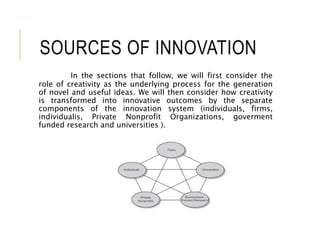
In the sections that follow, we will first consider the
role of creativity as the underlying process for the generation
of novel and useful ideas. We will then consider how creativity
is transformed into innovative outcomes by the separate
components of the innovation system (individuals, firms,
individualis, Private Nonprofit Organizations, goverment
funded research and universities ).
SOURCES OF INNOVATION
1. Individual Creativity An individual’s creative ability is
a function of his or her intellectual abilities,
knowledge, style of thinking, personality, motivation,
and environment.
Individual Creativity An individual’s creative ability is a
function of his or her intellectual abilities, knowledge
style of thinking, personality, motivation, and
environment.
Organizational Creativity The creativity of the
organization is a function of creativity of the individuals
within the organization and a variety of social processes
and contextual factors that shape the way those
individuals interact and behave.9 An organization’s
overall creativity level is thus not a simple aggregate of
the creativity of the individuals it employs. The
organization’s structure, routines, and incentives could
thwart individual creativity or amplify it.
SOURCES OF INNOVATION
2. Research and Development by Firms
Basicresearch is effort directed at increasing understanding of a
topic or field with out a specific immediate commercial application in mind. This
research advances scientific knowledge, which may (or may not) turn out to
have long-run commercial implications.
Applied research is directed at increasing understanding of a topic
to meet a specific need. In industry, this research typically has specific
commercial objectives.
Development refers to activities that apply knowledge to produce
useful devices, materials, or processes. Thus, the term research and
development refers to a range of activities that extend from early exploration of
a domain to specific commercial implementations.
3. Universities Universities in the United States performed $63.1 billion
worth of R&D in 2011, making them the second largest performer of R&D
in the United States after industry (see Figure 2.5 below). Of that, over
$40 billion was for basic research (versus applied research), making
universities the number one performer of basic research in the United
States
SOURCES OF INNOVATION
3. Government-Funded Research Governments of many
countries actively invest in research through their
own laboratories, the formation of science parks and
incubators, and grants for other public or private
research entities
4. Private Nonprofit Organizations Private nonprofit
organizations, such as private research institutes,
nonprofit hospitals, private foundations, professional
or technical societies, academic and industrial
consortia, and trade associations, also contribute to
innovation activity in a variety of complex ways. Many
nonprofit organizations perform their own research
and development activities, some fund the research
and development activities of other organizations but
do not do it themselves, and some nonprofit
organizations do both in-house research and
development and fund the development efforts of
others.
INNOVATION IN
COLLABORATIVE NETWORKS
Technology Clusters Sometimes geographical proximity appears to play a role in the
formation and innovative activity of collaborative networks. Well-known regional
clusters such as Silicon Valley’s semiconductor firms, lower Manhattan’s multimedia
cluster, and the Modena, Italy, knitwear district aptly illustrate this point. This has
spurred considerable interest in the factors that lead to the emergence of a cluster. City
and state governments, for example, might like to know how to foster the creation of a
technology cluster in their region in order to increase employment, tax revenues, and
other economic benefits. For firms, understanding the drivers and benefits of
clustering is useful for developing a strategy that ensures the firm is well positioned to
benefit from clustering.
Technology clusters may span a region as narrow as a city or as wide as a
group of neighboring countries.45 Clusters often encompass an array of industries that
are linked through relationships between suppliers, buyers, and producers of
complements. One primary reason for the emergence of regional clusters is the benefit
of proximity in knowledge exchange. Though advances in information technology have
made it easier, faster, and cheaper to transmit information great distances, several
studies indicate that knowledge does not always transfer readily via such mechanisms.
INNOVATION IN
COLLABORATIVE NETWORKS
Technological SpilloversWhile the work on technology clusters has
tended to emphasize the “stickiness” of knowledge, a related body of
research has focused on explaining the spread of knowledge across
organizational or regional boundaries.
This topic is known as technological spillovers.
Technological spillovers occur when the benefits from the research
activities of one firm (or nation or other entity) spill over to other firms
(or nations or other entities). Spillovers are thus a positive externality of
research and development efforts. Evidence suggests that technology
spillovers are a significant influence on innovative activity. For
example, in a series of studies conducted in the 1980s and 1990s,
Adam Jaffe and his coauthors found that both a firm’s patenting
activities and profits were influenced by the R&D spending of other
firms and universities in its geographical region.

Chapter 2

  • 1.
    CHAPTE R 2 Sources ofinnovation by: M. Razak
  • 2.
    SOURCES OF INNOVATION Innovation Thepractical Implementation of an idea into a new device or process. Innovation can arise from many different sources. It can originate with individuals, as in the familiar image of the lone inventor or users who design solutions for their own needs. Innovation can also come from the research efforts of universities, government laboratories and incubators, or private nonprofit organizations. One primary engine of innovation is firms. Firms are well suited to innovation activities because they typically have greater resources than individuals and a management system to marshal those resources toward a collective purpose. Firms also face strong incentives to develop differentiating new products and services, which may give them an advantage over nonprofit or government-funded entities.
  • 3.
    SOURCES OF INNOVATION Inthe sections that follow, we will first consider the role of creativity as the underlying process for the generation of novel and useful ideas. We will then consider how creativity is transformed into innovative outcomes by the separate components of the innovation system (individuals, firms, individualis, Private Nonprofit Organizations, goverment funded research and universities ).
  • 4.
    SOURCES OF INNOVATION 1.Individual Creativity An individual’s creative ability is a function of his or her intellectual abilities, knowledge, style of thinking, personality, motivation, and environment. Individual Creativity An individual’s creative ability is a function of his or her intellectual abilities, knowledge style of thinking, personality, motivation, and environment. Organizational Creativity The creativity of the organization is a function of creativity of the individuals within the organization and a variety of social processes and contextual factors that shape the way those individuals interact and behave.9 An organization’s overall creativity level is thus not a simple aggregate of the creativity of the individuals it employs. The organization’s structure, routines, and incentives could thwart individual creativity or amplify it.
  • 5.
    SOURCES OF INNOVATION 2.Research and Development by Firms Basicresearch is effort directed at increasing understanding of a topic or field with out a specific immediate commercial application in mind. This research advances scientific knowledge, which may (or may not) turn out to have long-run commercial implications. Applied research is directed at increasing understanding of a topic to meet a specific need. In industry, this research typically has specific commercial objectives. Development refers to activities that apply knowledge to produce useful devices, materials, or processes. Thus, the term research and development refers to a range of activities that extend from early exploration of a domain to specific commercial implementations. 3. Universities Universities in the United States performed $63.1 billion worth of R&D in 2011, making them the second largest performer of R&D in the United States after industry (see Figure 2.5 below). Of that, over $40 billion was for basic research (versus applied research), making universities the number one performer of basic research in the United States
  • 6.
    SOURCES OF INNOVATION 3.Government-Funded Research Governments of many countries actively invest in research through their own laboratories, the formation of science parks and incubators, and grants for other public or private research entities 4. Private Nonprofit Organizations Private nonprofit organizations, such as private research institutes, nonprofit hospitals, private foundations, professional or technical societies, academic and industrial consortia, and trade associations, also contribute to innovation activity in a variety of complex ways. Many nonprofit organizations perform their own research and development activities, some fund the research and development activities of other organizations but do not do it themselves, and some nonprofit organizations do both in-house research and development and fund the development efforts of others.
  • 7.
    INNOVATION IN COLLABORATIVE NETWORKS TechnologyClusters Sometimes geographical proximity appears to play a role in the formation and innovative activity of collaborative networks. Well-known regional clusters such as Silicon Valley’s semiconductor firms, lower Manhattan’s multimedia cluster, and the Modena, Italy, knitwear district aptly illustrate this point. This has spurred considerable interest in the factors that lead to the emergence of a cluster. City and state governments, for example, might like to know how to foster the creation of a technology cluster in their region in order to increase employment, tax revenues, and other economic benefits. For firms, understanding the drivers and benefits of clustering is useful for developing a strategy that ensures the firm is well positioned to benefit from clustering. Technology clusters may span a region as narrow as a city or as wide as a group of neighboring countries.45 Clusters often encompass an array of industries that are linked through relationships between suppliers, buyers, and producers of complements. One primary reason for the emergence of regional clusters is the benefit of proximity in knowledge exchange. Though advances in information technology have made it easier, faster, and cheaper to transmit information great distances, several studies indicate that knowledge does not always transfer readily via such mechanisms.
  • 8.
    INNOVATION IN COLLABORATIVE NETWORKS TechnologicalSpilloversWhile the work on technology clusters has tended to emphasize the “stickiness” of knowledge, a related body of research has focused on explaining the spread of knowledge across organizational or regional boundaries. This topic is known as technological spillovers. Technological spillovers occur when the benefits from the research activities of one firm (or nation or other entity) spill over to other firms (or nations or other entities). Spillovers are thus a positive externality of research and development efforts. Evidence suggests that technology spillovers are a significant influence on innovative activity. For example, in a series of studies conducted in the 1980s and 1990s, Adam Jaffe and his coauthors found that both a firm’s patenting activities and profits were influenced by the R&D spending of other firms and universities in its geographical region.