Web 2.0   Why Bother? BAISL Meeting Susan Geiger, Janurary 29, 2008
So what is Web 2.0?
The Read/Write Web : In which the Web is seen as a two-way medium, where people are both readers and writers. The main catalyst for this is social software, allowing communication and collaboration between two or more people.  --Joshua Porter Introduction to Web 2.0 http://www.squidoo.com/introtoweb20 Blogs, Wikis, Google Docs, Podcasts, YouTube, Nings
The Web as Platform : In which the Web is seen as a programming platform upon which developers create software applications. The main catalyst for this is Application Programming Interfaces, or APIs, allowing communication between two or more software applications.  -- --Joshua Porter Introduction to Web 2.0 http://www.squidoo.com/introtoweb20 Mashups—Zwillow,  Widgets—LibraryThing widget
Web 2.0 is a structural shift in information flow. It is not simply about global->local or 1->many; it is about a constantly shifting, multi-directional complex flow of information with the information evolving as it flows. It is about new network structures that emerge out of global and local structures.  --Danah Boyd Why Web2.0 Matters: Preparing for Glocalization http://www.zephoria.org/thoughts/archives/2005/09/05/why_web20_matte.html
http://flickr.com/photos/pigatto/332193181/
Too Busy to Bother ?
http://flickr.com/search/?q=school+library&l=cc&page=4


I’m Too Busy Librarians engage in this battle for superiority, based not on individual accomplishments, we’re far too modest for that, but rather on one’s “volume of busy”. The point of this battle is to prove that we do more and have less free time than our peers, and are thus more important. We have so much on our plates, we cannot possibly take on another thing, so we are increasingly forgiven from additional contribution by nature of our busy excellence.  --Ryan, Pam and Koufogiannakis, Denise (2007) Librarianship and the Culture of Busy.  Partnership : the Canadian Journal of Library and Information Practice and Research  2(1).  http://eprints.rclis.org/archive/00010597 /
I lurk I contribute very little to  the “Blogosphere” I mostly gather ideas  and tools I often feel overwhelmed My entire staff (and many of the students) are more technically adept than yours truly http://en.wikipedia.org/wiki/True_Confessions
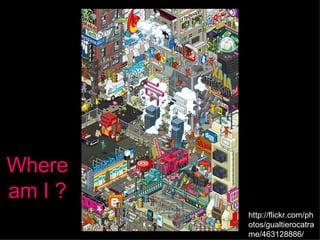
Where am I ? http://flickr.com/photos/gualtierocatrame/463128886/
I Don’t Know Much But I know we are not about
http://flickr.com/photos/jessiemoore/2073947465/
http://flickr.com/photos/zesmerelda/66493079/
 
http://flickr.com/photos/gualtierocatrame/478162606/
Information Education and We are about
Librarians are foolish to argue about the death of print or whether we will have "patrons" when library resources are no longer housed inside the walls of traditional library buildings.  Change is the coin of the information realm in a continual learning environment.   Debbie Abilock http://www.noodletools.com/debbie/bio/
Why Should I Bother? You have valuable experience to share You can find great professional development resources You will be exposed to the ideas of educators outside the school library field Your teachers and students will benefit It’s fun
23 things  CSLA Get an RSS Reader Bloglines   Google Reader Join a NING TeacherLibrarian   Ning ,  Classroom 2.0 Web Based Professional Development K-12 Online Conference Getting Started
23 Things
RSS Reader
 
Get Noticed
Expand your Influence
One thing leads to another Blog Reader Resource Shelf Poynter  Institute--Al’s morning meeting EveryBlock.com
 
TeacheLibrarian Ning
Professional Development Anytime Anywhere
How can students use this stuff? Blog their research process for major assignments Use tools like  Animoto  and  Voicethread  for preparing powerful media presentations. Use  Zoho  Polls  for original research Create personal or class pages with  igoogle  or  Pageflakes  to gather tools and RSS feeds for a particular topic. Joyce Valenza-- 21st Century Research Skills: Navigating the Shifting Information Landscape  UW-Stout Infobytes Newsletter  http://www.uwstout.edu/soe/profdev/blog/2007/11/joyce-valenza-21st-century-research.html
You can choose your own level of participation or Just come on in the water’s fine http://flickr.com/search/?l=deriv&q=dive+in http://flickr.com/photos/lizjones/485317348/

Why Bother With Web 2.0

  • 1.
    Web 2.0 Why Bother? BAISL Meeting Susan Geiger, Janurary 29, 2008
  • 2.
    So what isWeb 2.0?
  • 3.
    The Read/Write Web: In which the Web is seen as a two-way medium, where people are both readers and writers. The main catalyst for this is social software, allowing communication and collaboration between two or more people. --Joshua Porter Introduction to Web 2.0 http://www.squidoo.com/introtoweb20 Blogs, Wikis, Google Docs, Podcasts, YouTube, Nings
  • 4.
    The Web asPlatform : In which the Web is seen as a programming platform upon which developers create software applications. The main catalyst for this is Application Programming Interfaces, or APIs, allowing communication between two or more software applications. -- --Joshua Porter Introduction to Web 2.0 http://www.squidoo.com/introtoweb20 Mashups—Zwillow, Widgets—LibraryThing widget
  • 5.
    Web 2.0 isa structural shift in information flow. It is not simply about global->local or 1->many; it is about a constantly shifting, multi-directional complex flow of information with the information evolving as it flows. It is about new network structures that emerge out of global and local structures. --Danah Boyd Why Web2.0 Matters: Preparing for Glocalization http://www.zephoria.org/thoughts/archives/2005/09/05/why_web20_matte.html
  • 6.
  • 7.
    Too Busy toBother ?
  • 8.
  • 9.
  • 10.
  • 11.
  • 12.
    I’m Too BusyLibrarians engage in this battle for superiority, based not on individual accomplishments, we’re far too modest for that, but rather on one’s “volume of busy”. The point of this battle is to prove that we do more and have less free time than our peers, and are thus more important. We have so much on our plates, we cannot possibly take on another thing, so we are increasingly forgiven from additional contribution by nature of our busy excellence. --Ryan, Pam and Koufogiannakis, Denise (2007) Librarianship and the Culture of Busy. Partnership : the Canadian Journal of Library and Information Practice and Research 2(1). http://eprints.rclis.org/archive/00010597 /
  • 13.
    I lurk Icontribute very little to the “Blogosphere” I mostly gather ideas and tools I often feel overwhelmed My entire staff (and many of the students) are more technically adept than yours truly http://en.wikipedia.org/wiki/True_Confessions
  • 14.
    Where am I? http://flickr.com/photos/gualtierocatrame/463128886/
  • 15.
    I Don’t KnowMuch But I know we are not about
  • 16.
  • 17.
  • 18.
  • 19.
  • 20.
  • 21.
    Librarians are foolishto argue about the death of print or whether we will have "patrons" when library resources are no longer housed inside the walls of traditional library buildings. Change is the coin of the information realm in a continual learning environment. Debbie Abilock http://www.noodletools.com/debbie/bio/
  • 22.
    Why Should IBother? You have valuable experience to share You can find great professional development resources You will be exposed to the ideas of educators outside the school library field Your teachers and students will benefit It’s fun
  • 23.
    23 things CSLA Get an RSS Reader Bloglines Google Reader Join a NING TeacherLibrarian Ning , Classroom 2.0 Web Based Professional Development K-12 Online Conference Getting Started
  • 24.
  • 25.
  • 26.
  • 27.
  • 28.
  • 29.
    One thing leadsto another Blog Reader Resource Shelf Poynter Institute--Al’s morning meeting EveryBlock.com
  • 30.
  • 31.
  • 32.
  • 33.
    How can studentsuse this stuff? Blog their research process for major assignments Use tools like Animoto and Voicethread for preparing powerful media presentations. Use Zoho Polls for original research Create personal or class pages with igoogle or Pageflakes to gather tools and RSS feeds for a particular topic. Joyce Valenza-- 21st Century Research Skills: Navigating the Shifting Information Landscape UW-Stout Infobytes Newsletter http://www.uwstout.edu/soe/profdev/blog/2007/11/joyce-valenza-21st-century-research.html
  • 34.
    You can chooseyour own level of participation or Just come on in the water’s fine http://flickr.com/search/?l=deriv&q=dive+in http://flickr.com/photos/lizjones/485317348/