Why and How to get a PhD
(in Software Engineering)
Lionel Briand,
Doctoral School, October 26th, ICST’20
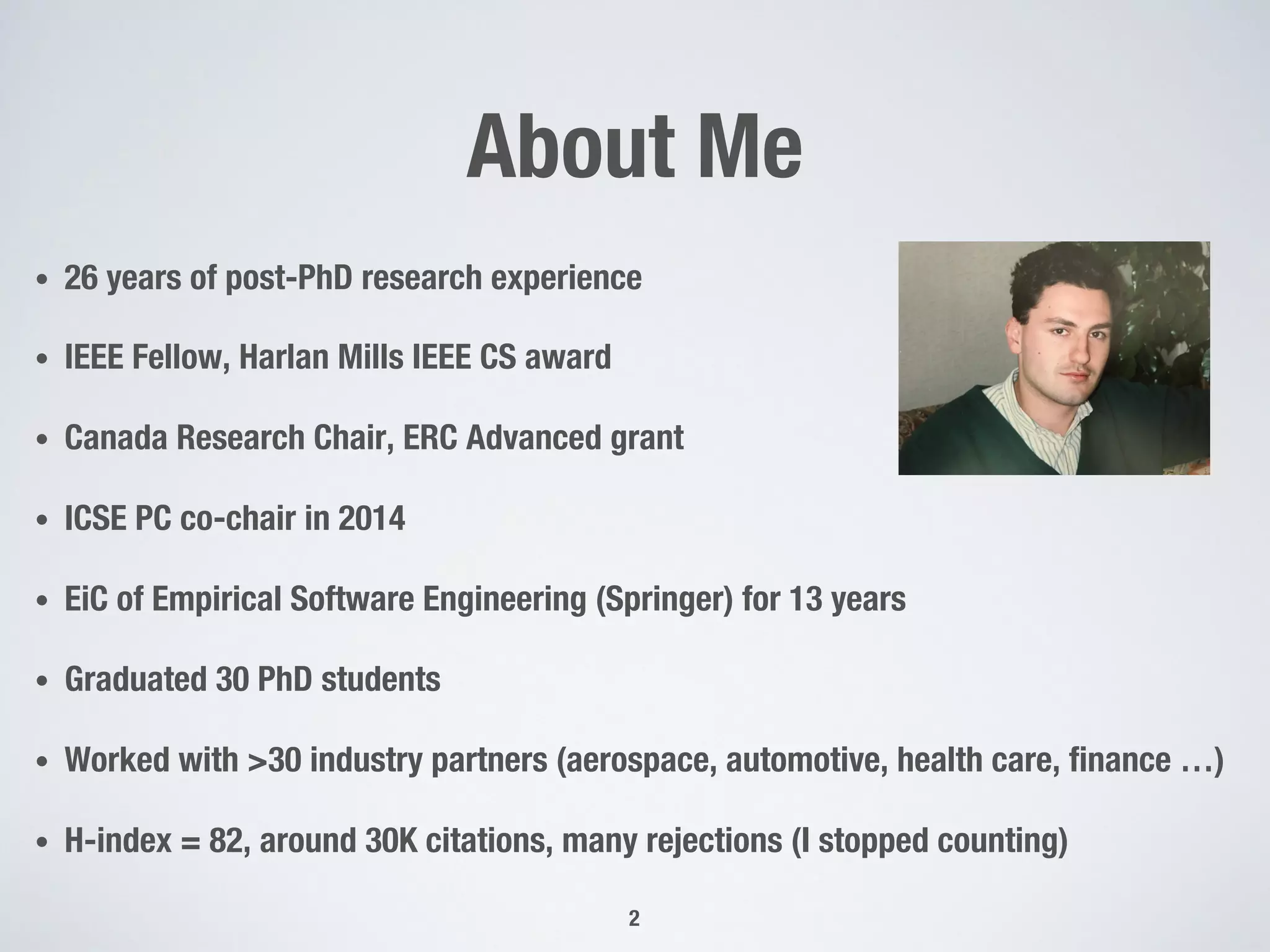
About Me
• 26 years of post-PhD research experience
• IEEE Fellow, Harlan Mills IEEE CS award
• Canada Research Chair, ERC Advanced grant
• ICSE PC co-chair in 2014
• EiC of Empirical Software Engineering (Springer) for 13 years
• Graduated 30 PhD students
• Worked with >30 industry partners (aerospace, automotive, health care, finance …)
• H-index = 82, around 30K citations, many rejections (I stopped counting)
2
Why do a PhD?
• A PhD will consume a sizable chunk of your life
• Only a small percentage of PhD graduates will get a faculty
position in academia
• Not all positions in academia are worth taking anyway …
• There are, fortunately, many other reasons to do a PhD
• It is important to know why you do it, though you are perfectly
allowed to change your mind. ;-)
3
Potential benefits of a PhD
• Gain deep technical expertise
• Learn how to solve complex problems, e.g., divide and
conquer
• Learn how to communicate complex ideas, orally and in
written form
• Learn how to construct a solid, evidence-based argument
• Completing a PhD can be a transforming experience
4
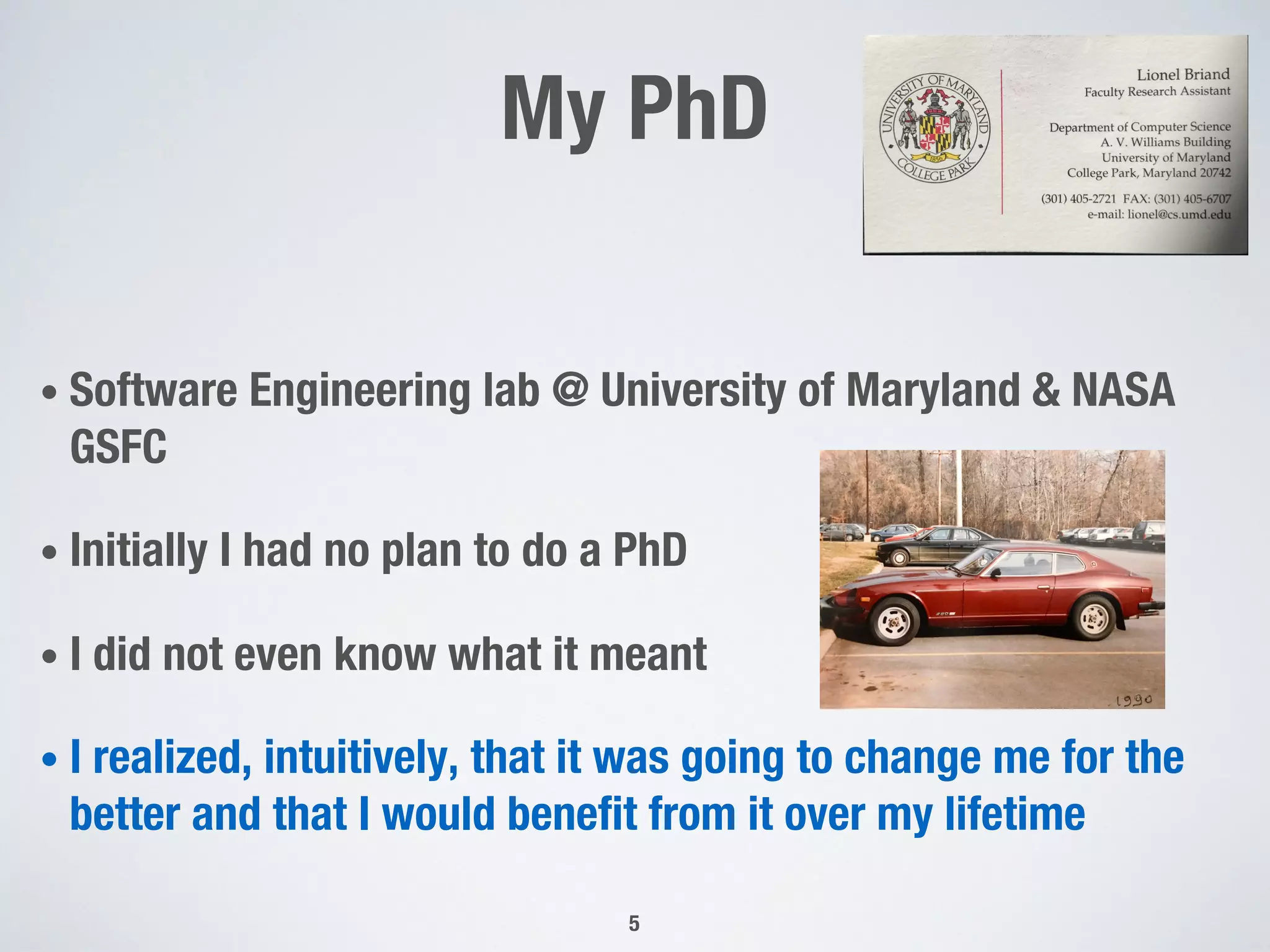
My PhD
• Software Engineering lab @ University of Maryland & NASA
GSFC
• Initially I had no plan to do a PhD
• I did not even know what it meant
• I realized, intuitively, that it was going to change me for the
better and that I would benefit from it over my lifetime
5
What to do with a PhD?
• Academic position
• Corporate R&D, e.g., Google, Amazon, ABB …
• Public R&D, e.g., Fraunhofer, INRIA, NIST
• Make the right choice for yourself, there is no right or wrong
• Regardless of your choice, your PhD experience will be useful
6
How to decide
• Do you favor teaching over engineering and technology
transfer, or vice-versa?
• Applied research versus more theoretical research
• Problem solving versus developing new “theory”
• Advising students
• There is nothing wrong with trying a career path and
eventually changing – this is not a failure
• Leaving academia does not mean you failed as a scientist
7
My Fraunhofer experience
• I was not sure about what to do with my PhD. I wanted to
keep all options open until I would figure it out
• Fraunhofer institutes run applied research projects with
industry in Germany and internationally
• Focus on industrial problems and innovation
• Combine industry experience and publishable research
8
My choice
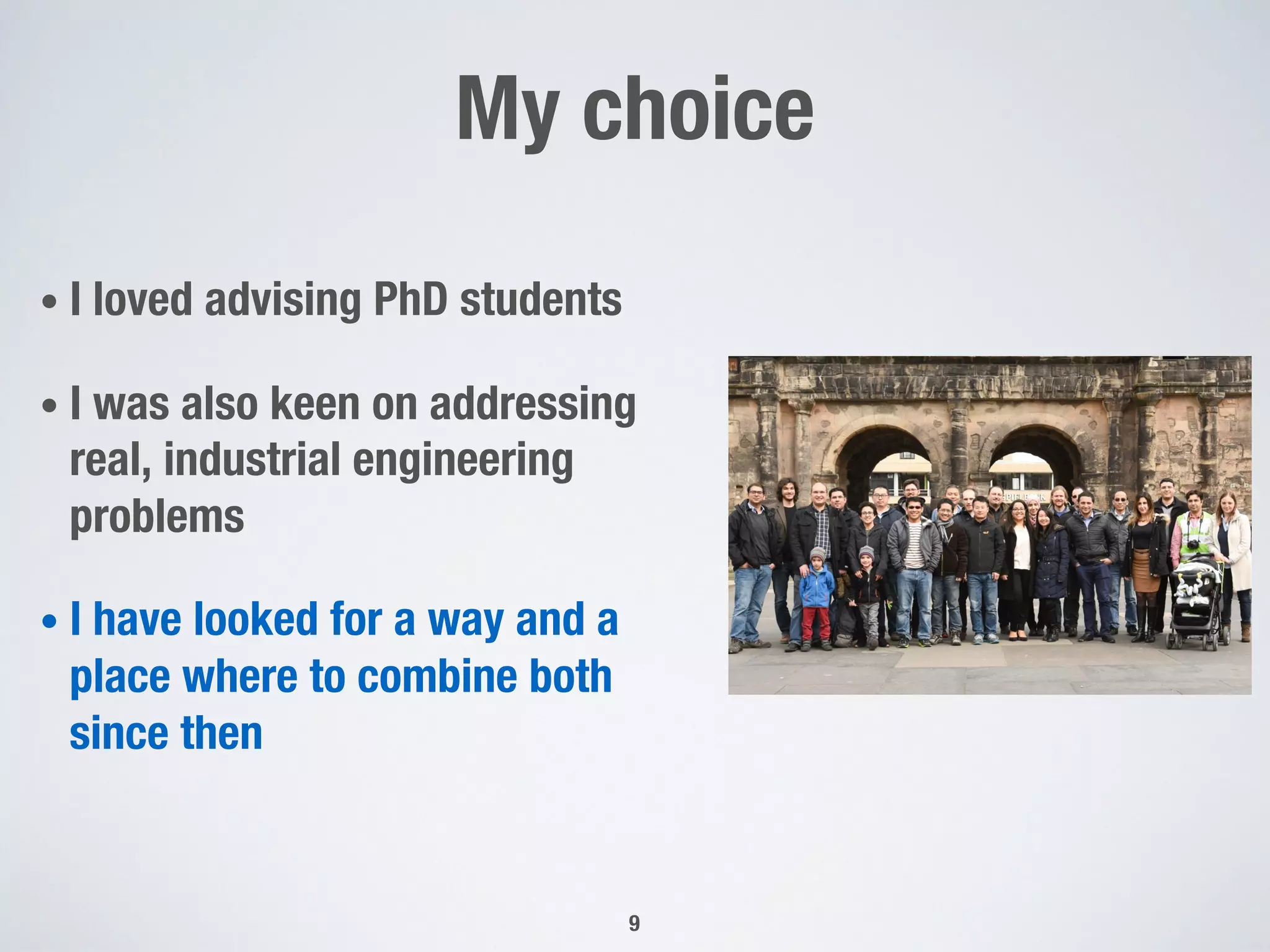
• I loved advising PhD students
• I was also keen on addressing
real, industrial engineering
problems
• I have looked for a way and a
place where to combine both
since then
9
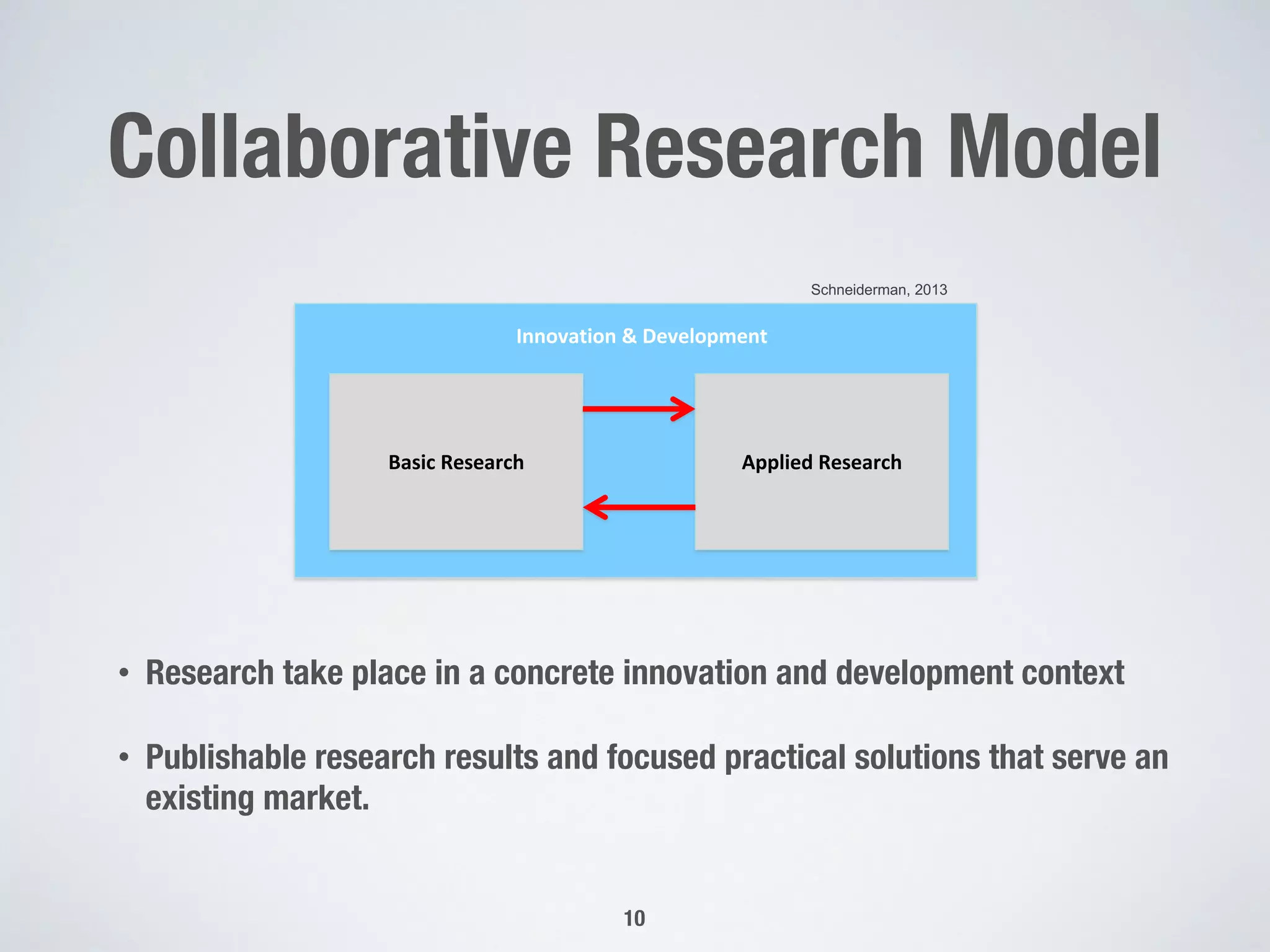
Collaborative Research Model
10
Basic Research Applied Research
Innovation & Development
Schneiderman, 2013
• Research take place in a concrete innovation and development context
• Publishable research results and focused practical solutions that serve an
existing market.
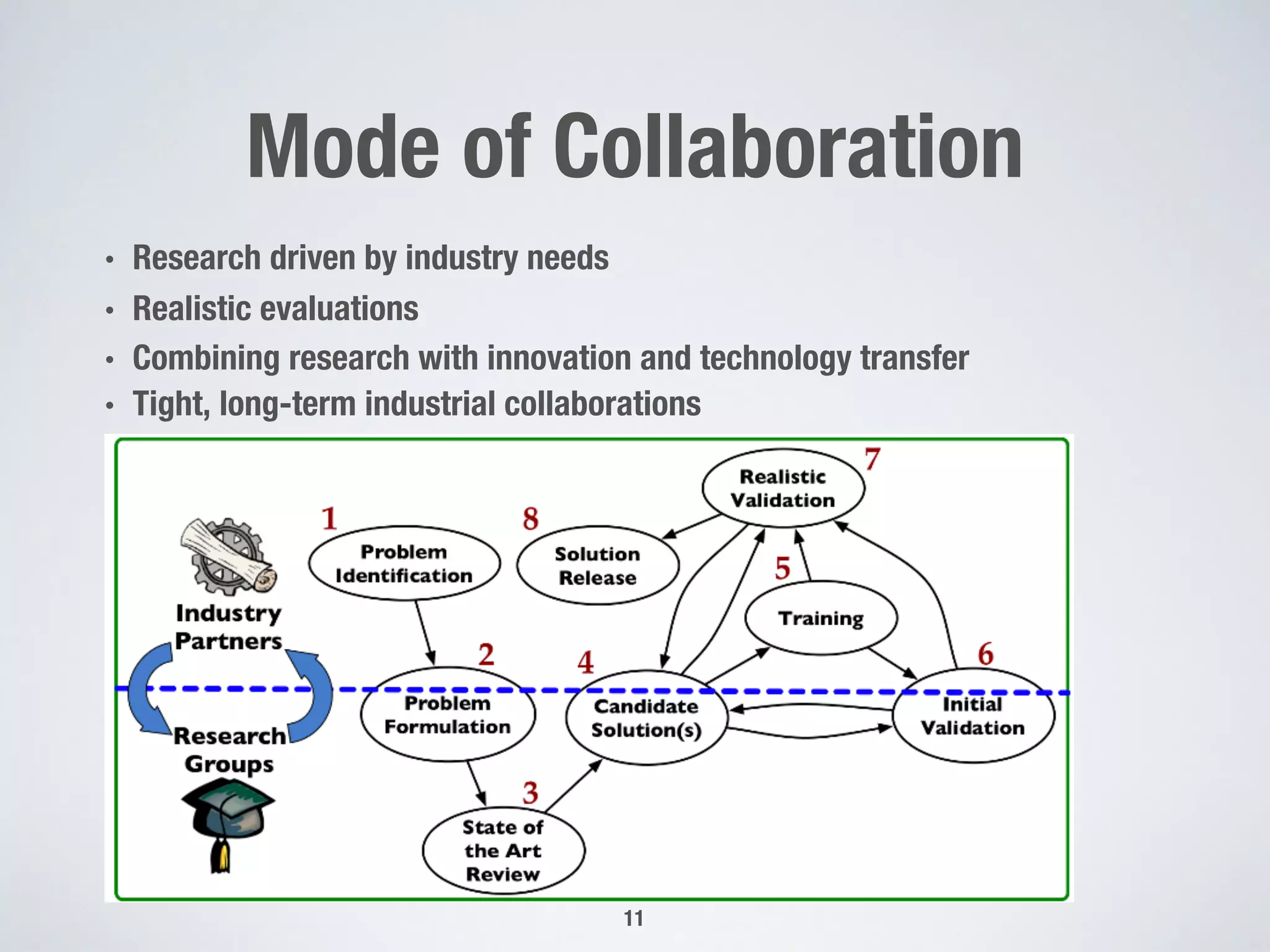
Mode of Collaboration
• Research driven by industry needs
• Realistic evaluations
• Combining research with innovation and technology transfer
• Tight, long-term industrial collaborations
11
Multidisciplinary research
• Most of the research with potentially large impact is at the
interface of different research fields
• In my research: metaheuristic search, machine learning,
constraint solving, natural language processing, control
engineering, statistics, qualitative studies …
• Software engineering takes place in application domains,
e.g., automotive
• Seek collaborations
12
Subjectivity in science
• Though mathematical rigor plays an important role, Software
Engineering is not a purely mathematical field, far from that
…
• SE is a field where human factors play a significant role and
where context is important
• There is a great deal of subjectivity in defining problems,
assessing the impact of solutions … even in what people
consider to be SE research!
13
My views on SE research
• Context- and Problem-driven research
• “The Case for Context-Driven Software Engineering Research:
Generalizability is Overrated”, IEEE Software, Sept/Oct 2017
• “Embracing the Engineering Side of Software Engineering”,
IEEE Software 29(4): 96, 2012
• http://www.lbriand.info
14
Never underestimate clarity
• You will need to develop precise arguments -- mostly in English --
to justify your research and approach, draw conclusions from your
results, and assess their impact in context
• Clarity and precision are key in presentations and papers
• This is not easy and something you will have to learn during your
PhD
• You will have to convince (highly critical) peers with different
backgrounds and assumptions
• I find this to be a challenge, even after all these years
15
A PhD is a personal challenge
• The challenges are an essential part of the journey and what
will make you grow as an individual
• Persistence, patience, resilience
• Intellectual rigor, creativity
• Develop a capacity to lead research activities
• Those are qualities you will need to develop or strengthen
overtime, if you are to be successful
16
Choose your topic carefully
• Choose a PhD research topic you are passionate about
• Take the time needed, read all the relevant literature
• Define your problem(s) precisely, including working
assumptions
• Assess what is the expected impact
• Aim at a topic with high impact, scientific and practical
17
Facing challenges
• When facing challenges (e.g., poor results, papers rejected)
• Remember why you do what you do, learn, improve and
persist
• Keep your sense of humor (you’ll need it!)
• Accept once and for all the part of subjectivity and
arbitrariness that is part of the job
18
Paper rejections
• The review process is an anonymous dialog mechanism
among scientists – or at least it should be
• Rejection is annoying, sometimes depressing, especially
for junior researchers
• Accept it, it is part of the job
• Bad reviews occur, but there is usually at least a good one
– Use the feedback! Learn from rejections!
• Remember: Writing clear and convincing papers, even
when reporting good work, is not easy
19
Problem definition and plan
• Precise problem definition and decomposition into sub-
problems
• Plan including intermediary steps with tangible, self-
contained and publishable research results
• Problem definition and plan tend to change as you gain
experience
• Write your thesis one paper at a time
20
Advisor
• Interacting and getting feedback from your advisor as often
as possible is important
• Be prepared for meetings, with clear, structured
presentations – your advisor is your first public
• Do not hesitate to brainstorm on detailed points as often as
needed
• Provide your advisor with partial drafts of papers early
• Character compatibility
21
PhD Pitfalls
• ~4-5 years may seem a long time to complete a PhD, but it
is not
• Procrastination: Have a plan, including deadlines
• Exhaustion: Maintain a healthy life style
• Wanderlust: Stay focused on your plan!
• Stuck on a problem for too long: Replan!
24
Adapted from O. Nierstrasz, “Taming your PhD”
PhD Pitfalls
• ~4-5 years may seem a long time to complete a PhD, but it
is not
• Procrastination: Have a plan, including deadlines
• Exhaustion: Maintain a healthy life style
• Wanderlust: Stay focused on your plan!
• Stuck on a problem for too long: Replan!
25
Adapted from O. Nierstrasz, “Taming your PhD”
Have an exciting an enjoyable
research journey!
Why and How to get a PhD
(in Software Engineering)
Lionel Briand,
Doctoral School, October 26th, ICST’20

Why and How to get a PhD (in Software Engineering)

  • 1.
    Why and Howto get a PhD (in Software Engineering) Lionel Briand, Doctoral School, October 26th, ICST’20
  • 2.
    About Me • 26years of post-PhD research experience • IEEE Fellow, Harlan Mills IEEE CS award • Canada Research Chair, ERC Advanced grant • ICSE PC co-chair in 2014 • EiC of Empirical Software Engineering (Springer) for 13 years • Graduated 30 PhD students • Worked with >30 industry partners (aerospace, automotive, health care, finance …) • H-index = 82, around 30K citations, many rejections (I stopped counting) 2
  • 3.
    Why do aPhD? • A PhD will consume a sizable chunk of your life • Only a small percentage of PhD graduates will get a faculty position in academia • Not all positions in academia are worth taking anyway … • There are, fortunately, many other reasons to do a PhD • It is important to know why you do it, though you are perfectly allowed to change your mind. ;-) 3
  • 4.
    Potential benefits ofa PhD • Gain deep technical expertise • Learn how to solve complex problems, e.g., divide and conquer • Learn how to communicate complex ideas, orally and in written form • Learn how to construct a solid, evidence-based argument • Completing a PhD can be a transforming experience 4
  • 5.
    My PhD • SoftwareEngineering lab @ University of Maryland & NASA GSFC • Initially I had no plan to do a PhD • I did not even know what it meant • I realized, intuitively, that it was going to change me for the better and that I would benefit from it over my lifetime 5
  • 6.
    What to dowith a PhD? • Academic position • Corporate R&D, e.g., Google, Amazon, ABB … • Public R&D, e.g., Fraunhofer, INRIA, NIST • Make the right choice for yourself, there is no right or wrong • Regardless of your choice, your PhD experience will be useful 6
  • 7.
    How to decide •Do you favor teaching over engineering and technology transfer, or vice-versa? • Applied research versus more theoretical research • Problem solving versus developing new “theory” • Advising students • There is nothing wrong with trying a career path and eventually changing – this is not a failure • Leaving academia does not mean you failed as a scientist 7
  • 8.
    My Fraunhofer experience •I was not sure about what to do with my PhD. I wanted to keep all options open until I would figure it out • Fraunhofer institutes run applied research projects with industry in Germany and internationally • Focus on industrial problems and innovation • Combine industry experience and publishable research 8
  • 9.
    My choice • Iloved advising PhD students • I was also keen on addressing real, industrial engineering problems • I have looked for a way and a place where to combine both since then 9
  • 10.
    Collaborative Research Model 10 BasicResearch Applied Research Innovation & Development Schneiderman, 2013 • Research take place in a concrete innovation and development context • Publishable research results and focused practical solutions that serve an existing market.
  • 11.
    Mode of Collaboration •Research driven by industry needs • Realistic evaluations • Combining research with innovation and technology transfer • Tight, long-term industrial collaborations 11
  • 12.
    Multidisciplinary research • Mostof the research with potentially large impact is at the interface of different research fields • In my research: metaheuristic search, machine learning, constraint solving, natural language processing, control engineering, statistics, qualitative studies … • Software engineering takes place in application domains, e.g., automotive • Seek collaborations 12
  • 13.
    Subjectivity in science •Though mathematical rigor plays an important role, Software Engineering is not a purely mathematical field, far from that … • SE is a field where human factors play a significant role and where context is important • There is a great deal of subjectivity in defining problems, assessing the impact of solutions … even in what people consider to be SE research! 13
  • 14.
    My views onSE research • Context- and Problem-driven research • “The Case for Context-Driven Software Engineering Research: Generalizability is Overrated”, IEEE Software, Sept/Oct 2017 • “Embracing the Engineering Side of Software Engineering”, IEEE Software 29(4): 96, 2012 • http://www.lbriand.info 14
  • 15.
    Never underestimate clarity •You will need to develop precise arguments -- mostly in English -- to justify your research and approach, draw conclusions from your results, and assess their impact in context • Clarity and precision are key in presentations and papers • This is not easy and something you will have to learn during your PhD • You will have to convince (highly critical) peers with different backgrounds and assumptions • I find this to be a challenge, even after all these years 15
  • 16.
    A PhD isa personal challenge • The challenges are an essential part of the journey and what will make you grow as an individual • Persistence, patience, resilience • Intellectual rigor, creativity • Develop a capacity to lead research activities • Those are qualities you will need to develop or strengthen overtime, if you are to be successful 16
  • 17.
    Choose your topiccarefully • Choose a PhD research topic you are passionate about • Take the time needed, read all the relevant literature • Define your problem(s) precisely, including working assumptions • Assess what is the expected impact • Aim at a topic with high impact, scientific and practical 17
  • 18.
    Facing challenges • Whenfacing challenges (e.g., poor results, papers rejected) • Remember why you do what you do, learn, improve and persist • Keep your sense of humor (you’ll need it!) • Accept once and for all the part of subjectivity and arbitrariness that is part of the job 18
  • 19.
    Paper rejections • Thereview process is an anonymous dialog mechanism among scientists – or at least it should be • Rejection is annoying, sometimes depressing, especially for junior researchers • Accept it, it is part of the job • Bad reviews occur, but there is usually at least a good one – Use the feedback! Learn from rejections! • Remember: Writing clear and convincing papers, even when reporting good work, is not easy 19
  • 20.
    Problem definition andplan • Precise problem definition and decomposition into sub- problems • Plan including intermediary steps with tangible, self- contained and publishable research results • Problem definition and plan tend to change as you gain experience • Write your thesis one paper at a time 20
  • 21.
    Advisor • Interacting andgetting feedback from your advisor as often as possible is important • Be prepared for meetings, with clear, structured presentations – your advisor is your first public • Do not hesitate to brainstorm on detailed points as often as needed • Provide your advisor with partial drafts of papers early • Character compatibility 21
  • 22.
    PhD Pitfalls • ~4-5years may seem a long time to complete a PhD, but it is not • Procrastination: Have a plan, including deadlines • Exhaustion: Maintain a healthy life style • Wanderlust: Stay focused on your plan! • Stuck on a problem for too long: Replan! 24 Adapted from O. Nierstrasz, “Taming your PhD”
  • 23.
    PhD Pitfalls • ~4-5years may seem a long time to complete a PhD, but it is not • Procrastination: Have a plan, including deadlines • Exhaustion: Maintain a healthy life style • Wanderlust: Stay focused on your plan! • Stuck on a problem for too long: Replan! 25 Adapted from O. Nierstrasz, “Taming your PhD” Have an exciting an enjoyable research journey!
  • 24.
    Why and Howto get a PhD (in Software Engineering) Lionel Briand, Doctoral School, October 26th, ICST’20