
Who was  EL GRECO?   Spanish Renaissance painting LA PINTURA ESPAÑOLA DEL RENACIMIENTO Ms. Aixa B. Rodriguez Belmont Preparatory High School SABE: Saturday Academy Bilingual Enrichment Identity through Art History Unit:  Hispanic/Latino Artists
Do Now: Think, Pair, Share If you move to another country, and do well in that country, and are successful and famous,  do you have to give up your home country’s identity and accept the new one? Write your answer in your journal, pair with a partner and prepare to share with the entire class.
Mannerism characteristics common to many Mannerist works include  distortion of the human figure,  a flattening of pictorial space,  intellectual sophistication Emphasized the artist's imagination rather than the reproduction of nature.
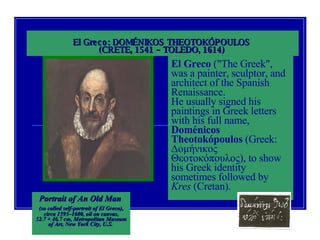
El Greco: DOMÉNIKOS THEOTOKÓPOULOS  (CRETE, 1541 – TOLEDO, 1614)   Portrait of An Old Man  (so called self-portrait of El Greco),   circa 1595–1600, oil on canvas, 52.7 × 46.7 cm, Metropolitan Museum of Art, New York City, U.S.   El Greco  ("The Greek", was a painter, sculptor, and architect of the Spanish Renaissance.  He usually signed his paintings in Greek letters with his full name,  Doménicos Theotokópoulos  (Greek:  Δομήνικος Θεοτοκόπουλος ), to show his Greek identity sometimes followed by  Kres  (Cretan).
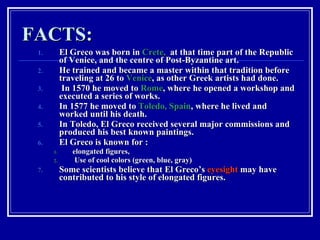
FACTS: El Greco was born in  Crete,   at that time part of the Republic of Venice, and the centre of Post-Byzantine art.  He trained and became a master within that tradition before traveling at 26 to  Venice , as other Greek artists had done. In 1570 he moved to  Rome , where he opened a workshop and executed a series of works.  In 1577 he moved to  Toledo, Spain , where he lived and worked until his death.  In Toledo, El Greco received several major commissions and produced his best known paintings. El Greco is known for : elongated figures, Use of cool colors (green, blue, gray) Some scientists believe that El Greco’s  eyesight  may have contributed to his style of elongated figures.
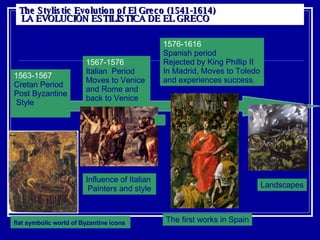
The Stylistic Evolution of El Greco (1541-1614)     LA EVOLUCIÓN ESTILÍSTICA DE EL GRECO  The first works in Spain 1563-1567  Cretan Period Post Byzantine Style 1567-1576 Italian  Period Moves to Venice  and Rome and  back to Venice 1576-1616 Spanish period Rejected by King Phillip II In Madrid, Moves to Toledo  and experiences success.  Influence of Italian  Painters and style Landscapes flat symbolic world of Byzantine icons
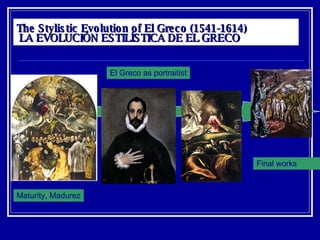
The Stylistic Evolution of El Greco (1541-1614)     LA EVOLUCIÓN ESTILÍSTICA DE EL GRECO Maturity, Madurez Final works El Greco as portraitist
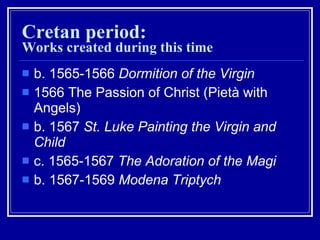
Cretan period: Works created during this time b. 1565-1566  Dormition of the Virgin   1566 The Passion of Christ (Pietà with Angels)  b. 1567  St. Luke Painting the Virgin and Child   c. 1565-1567  The Adoration of the Magi   b. 1567-1569  Modena Triptych
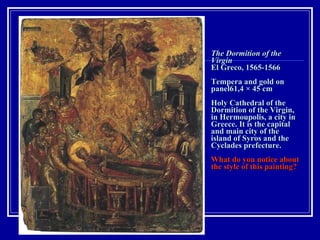
The Dormition of the Virgin  El Greco, 1565-1566 Tempera and gold on panel61,4 × 45 cm  Holy Cathedral of the  Dormition of the Virgin,  in Hermoupolis, a city in Greece. It is the capital and main city of the island of Syros and the Cyclades prefecture.  What do you notice about the style of this painting?
Italian Period:  Works create during this period Italian period (1567-1577) c. 1567-1570  The Last Supper   c. 1569-1570  The Entombment of Christ   c. 1570-1571  Purification of the Temple   c. 1570  View of Mount Sina   c. 1571-1572  Portrait of Giulio Clovio'   c. 1571-1572  A Boy Blowing on an Ember to Light a Candle (El Soplón)   1572  Charles de Guise   c. 1572  Christ Healing the Blind   c. 1576  The Annunciation
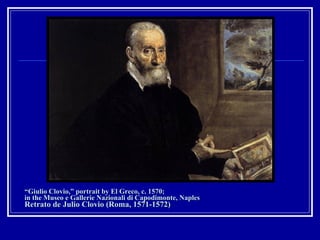
“ Giulio Clovio,” portrait by El Greco, c. 1570;  in the Museo e Gallerie Nazionali di Capodimonte, Naples  Retrato de Julio Clovio (Roma, 1571-1572)
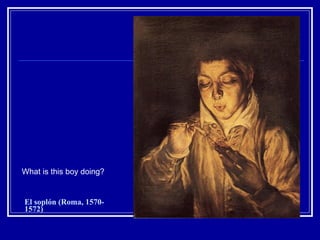
What is this boy doing? El soplón (Roma, 1570-1572)
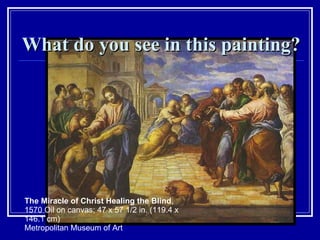
What do you see in this painting? The Miracle of Christ Healing the Blind ,  1570 Oil on canvas; 47 x 57 1/2 in. (119.4 x 146.1 cm) Metropolitan Museum of Art
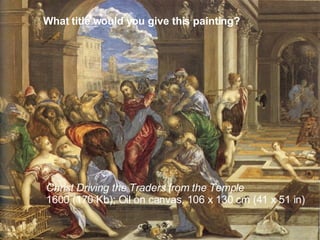
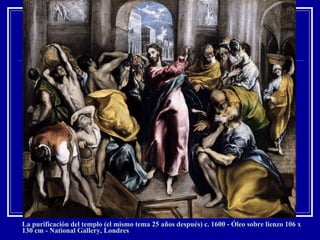
What title would you give this painting? Christ Driving the Traders from the Temple   1600 (170 Kb); Oil on canvas, 106 x 130 cm (41 x 51 in)
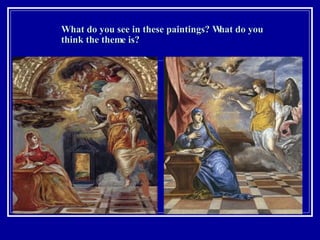
What do you see in these paintings? What do you think the theme is?
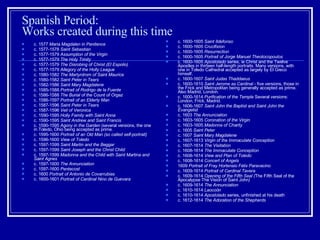
Spanish Period: Works created during this time c. 1577  Maria Magdalen in Penitence   c. 1577-1578  Saint Sebastian   c. 1577-1579  Assumption of the Virgin   c. 1577-1579  The Holy Trinity   c. 1577-1579  The Disrobing of Christ (El Espolio)   c. 1577-1579  Allegory of the Holly League   c. 1580-1582  The Martyrdrom of Saint Maurice   c. 1580-1582  Saint Peter in Tears   c. 1582-1586  Saint Mary Magdalene   c. 1585-1588  Portrait of Rodrigo de la Fuente   c. 1586-1588  The Burial of the Count of Orgaz   c. 1586-1597  Portrait of an Elderly Man   c. 1587-1596  Saint Peter in Tears   c. 1587-1596  Veil of Veronica   c. 1590-1595  Holly Family with Saint Anna   c. 1590-1595  Saint Andrew and Saint Francis   c. 1590-1595  Agony in the Garden  (several versions, the one in Toledo, Ohio being accepted as prime.  c. 1595-1600  Portrait of an Old Man (so called self-portrait)   c. 1596-1600  View of Toledo   c. 1597-1599  Saint Martin and the Beggar   c. 1597-1599  Saint Joseph and the Christ Child   c. 1597-1599  Madonna and the Child with Saint Martina and Saint Agnes   c. 1597-1600  The Annunciation   c. 1597-1600  Pentecost   c. 1600  Portrait of Antonio de Covarrubias   c. 1600-1601  Portrait of Cardinal Nino de Guevara   c. 1600-1605  Saint Ildefonso   c. 1600-1605  Crucifixion   c. 1600-1605  Resurrection   c. 1600-1605  Portrait of Jorge Manuel Theotocopoulos   c. 1600-1605  Apostolado  series, ie Christ and the Twelve Apostles in thirteen half-length portraits. Many versions, with one in Toledo Cathedral accepted as largely by El Greco himself.  c. 1600-1607  Saint Judas Thaddaeus   c. 1600-1610  Saint Jerome as Cardinal  - five versions, those in the Frick and Metropolitan being generally accepted as prime. Also Madrid, London.  c. 1600-1614  Purification of the Temple  Several versions: London, Frick, Madrid.  c. 1606-1607  Saint John the Baptist and Saint John the Evangelist   c. 1603  The Annunciation   c. 1603-1605  Coronation of the Virgin   c. 1603-1605  Madonna of Charity   c. 1605  Saint Peter   c. 1607  Saint Mary Magdalene   c. 1607-1613  Virgin of the Immaculate Conception   c. 1607-1614  The Visitation   c. 1608-1614  The Immaculate Conception   c. 1608-1614  View and Plan of Toledo   c. 1608-1614  Concert of Angels   1609  Portrait of Fray Hortensio Félix Paravacino   c. 1609-1614  Portrait of Cardinal Tavera   c. 1609-1614  Opening of the Fifth Seal ( The Fifth Seal of the Apocalypse The Vision of Saint John )   c. 1609-1614  The Annunciation   c. 1610-1614  Laocoön   c. 1610-1614  Apostolado  series, unfinished at his death  c. 1612-1614  The Adoration of the Shepherds
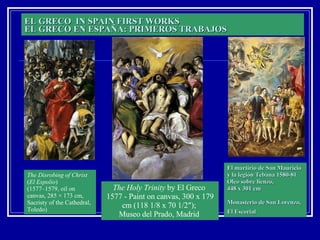
EL GRECO  IN SPAIN FIRST WORKS EL GRECO EN ESPAÑA: PRIMEROS TRABAJOS The Disrobing of Christ  ( El Espolio )  (1577–1579, oil on canvas, 285 × 173 cm,  Sacristy of the Cathedral, Toledo) The Holy Trinity  by El Greco  1577 - Paint on canvas, 300 x 179 cm (118 1/8 x 70 1/2″);  Museo del Prado, Madrid  El martirio de San Mauricio y la legión Tebana 1580-81  Oleo sobre lienzo,  448 x 301 cm Monasterio de San Lorenzo, El Escorial
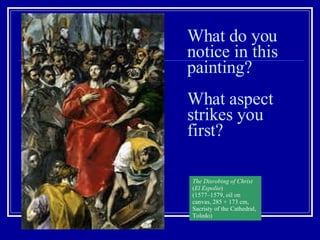
What do you notice in this painting?  What aspect strikes you first? The Disrobing of Christ  ( El Espolio )  (1577–1579, oil on canvas, 285 × 173 cm,  Sacristy of the Cathedral, Toledo)
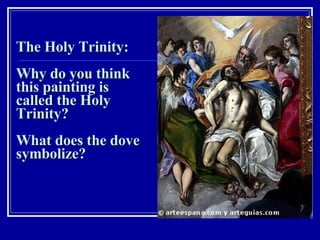
The Holy Trinity:  Why do you think this painting is called the Holy Trinity?  What does the dove symbolize?
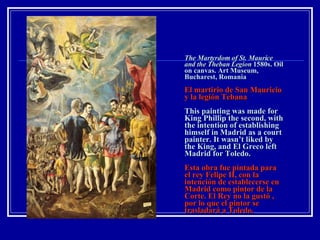
The Martyrdom of St. Maurice and the Theban Legion  1580s. Oil on canvas. Art Museum, Bucharest, Romania   El martirio de San Mauricio y la legión Tebana This painting was made for King Phillip the second, with the intention of establishing himself in Madrid as a court painter. It wasn’t liked by the King, and El Greco left Madrid for Toledo. Esta obra fue pintada para el rey Felipe II, con la intención de establecerse en Madrid como pintor de la Corte. El Rey no la gustó , por lo que el pintor se trasladará a Toledo.
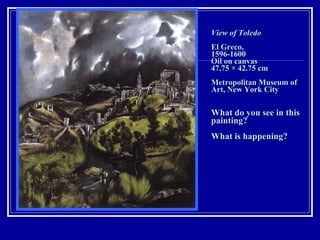
View of Toledo El Greco,  1596-1600 Oil on canvas 47.75 × 42.75 cm Metropolitan Museum of Art, New York City What do you see in this painting?  What is happening?
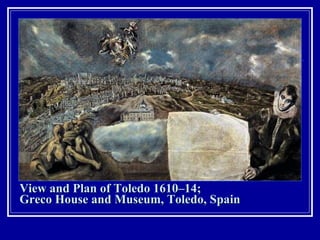
View and Plan of Toledo  1610–14;  Greco House and Museum, Toledo,  Spain
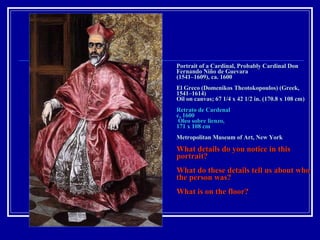
Portrait of a Cardinal, Probably Cardinal Don Fernando Niño de Guevara  (1541–1609), ca. 1600 El Greco (Domenikos Theotokopoulos) (Greek, 1541–1614) Oil on canvas; 67 1/4 x 42 1/2 in. (170.8 x 108 cm) Retrato de Cardenal c. 1600  Óleo sobre lienzo,  171 x 108 cm Metropolitan Museum of Art, New York  What details do you notice in this portrait? What do these details tell us about who the person was? What is on the floor?
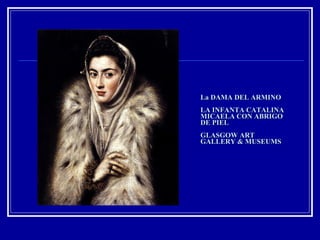
La DAMA DEL ARMINO  LA INFANTA CATALINA MICAELA CON ABRIGO DE PIEL GLASGOW ART GALLERY & MUSEUMS
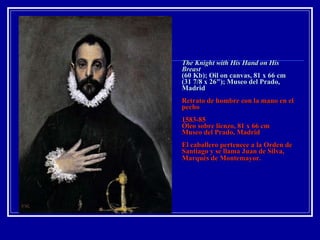
The Knight with His Hand on His Breast   (60 Kb); Oil on canvas, 81 x 66 cm (31 7/8 x 26"); Museo del Prado, Madrid   Retrato de hombre con la mano en el pecho 1583-85 Óleo sobre lienzo, 81 x 66 cm Museo del Prado, Madrid El caballero pertenece a la Orden de Santiago y se llama Juan de Silva, Marqués de Montemayor.
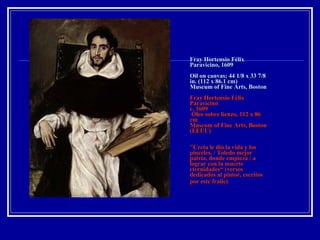
Fray Hortensio Félix Paravicino, 1609 Oil on canvas; 44 1/8 x 33 7/8 in. (112 x 86.1 cm) Museum of Fine Arts, Boston Fray Hortensio Félix Paravicino c. 1609  Óleo sobre lienzo, 112 x 86 cm Museum of Fine Arts, Boston (EEUU) "Creta le dio la vida y los pinceles, / Toledo mejor patria, donde empieza / a lograr con la muerte eternidades“ (versos dedicados al pintor, escritos por este fraile)
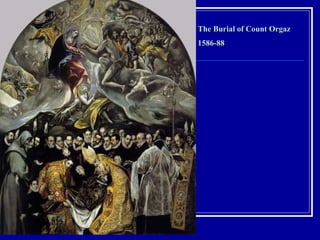
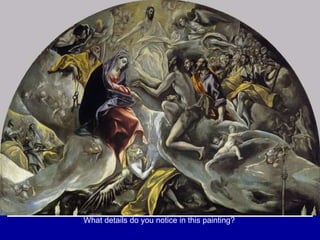
The Burial of Count Orgaz 1586-88
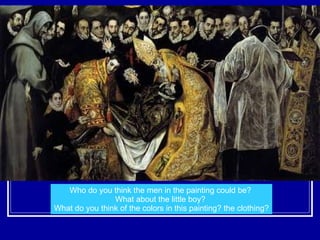
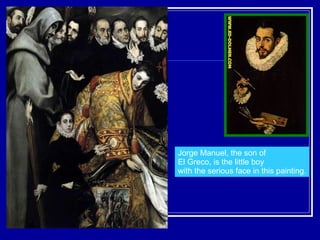
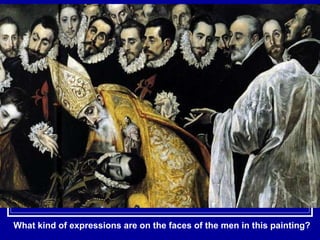
Who do you think the men in the painting could be?  What about the little boy?  What do you think of the colors in this painting? the clothing?
What details do you notice in this painting?
Jorge Manuel, the son of  El Greco, is the little boy  with the serious face in this painting.
What kind of expressions are on the faces of the men in this painting?
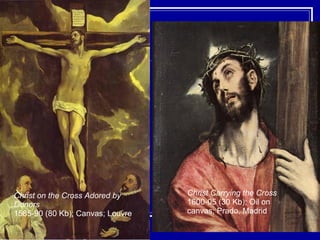
Christ Carrying the Cross   1600-05 (30 Kb); Oil on canvas; Prado, Madrid  Christ on the Cross Adored by Donors   1585-90 (80 Kb); Canvas; Louvre
La purificación del templo (el mismo tema 25 años después) c. 1600 - Óleo sobre lienzo 106 x 130 cm - National Gallery, Londres
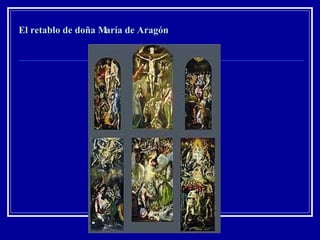
El retablo de doña María de Aragón
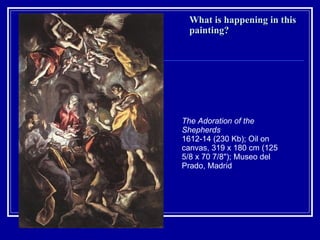
What is happening in this painting? The Adoration of the Shepherds   1612-14 (230 Kb); Oil on canvas, 319 x 180 cm (125 5/8 x 70 7/8"); Museo del Prado, Madrid
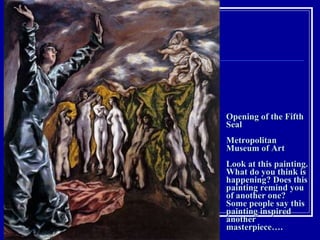
Opening of the Fifth Seal Metropolitan Museum of Art Look at this painting. What do you think is happening? Does this painting remind you of another one? Some people say this painting inspired another masterpiece….
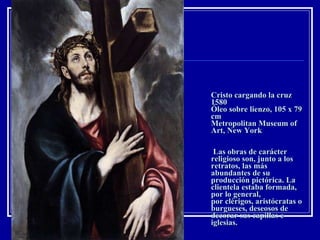
Cristo cargando la cruz 1580 Óleo sobre lienzo, 105 x 79 cm Metropolitan Museum of Art, New York  Las obras de carácter religioso son, junto a los retratos, las más abundantes de su producción pictórica. La clientela estaba formada, por lo general, por clérigos, aristócratas o burgueses, deseosos de decorar sus capillas e iglesias.
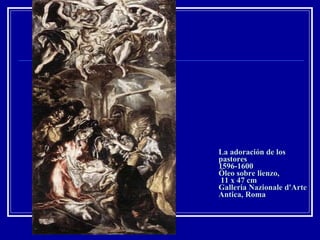
La adoración de los pastores 1596-1600 Óleo sobre lienzo,   11 x 47 cm Galleria Nazionale d'Arte Antica, Roma
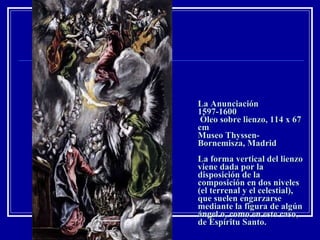
La Anunciación 1597-1600  Óleo sobre lienzo, 114 x 67 cm Museo Thyssen-Bornemisza, Madrid La forma vertical del lienzo viene dada por la disposición de la composición en dos niveles (el terrenal y el celestial), que suelen engarzarse mediante la figura de algún ángel o, como en este caso, de Espíritu Santo.
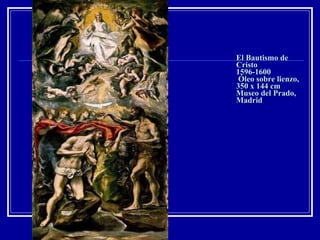
El Bautismo de Cristo 1596-1600  Óleo sobre lienzo, 350 x 144 cm Museo del Prado, Madrid
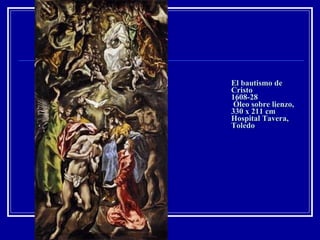
El bautismo de Cristo 1608-28  Óleo sobre lienzo, 330 x 211 cm Hospital Tavera, Toledo
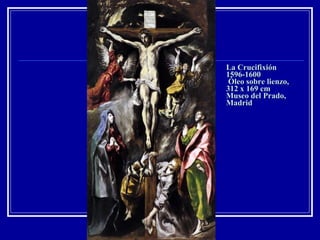
La Crucifixión 1596-1600  Óleo sobre lienzo, 312 x 169 cm Museo del Prado, Madrid
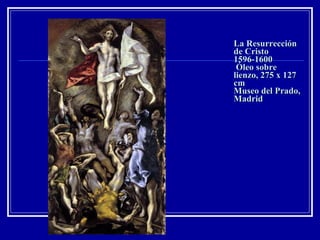
La Resurrección de Cristo 1596-1600  Óleo sobre lienzo, 275 x 127 cm Museo del Prado, Madrid
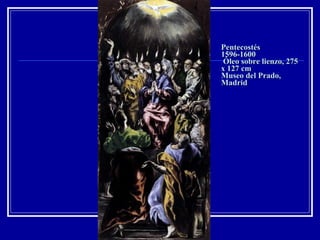
Pentecostés 1596-1600  Óleo sobre lienzo, 275 x 127 cm Museo del Prado, Madrid
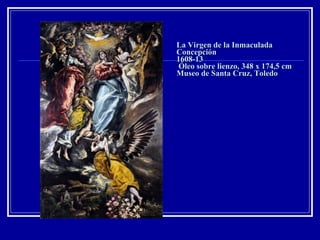
La Virgen de la Inmaculada Concepción 1608-13  Óleo sobre lienzo, 348 x 174,5 cm Museo de Santa Cruz, Toledo
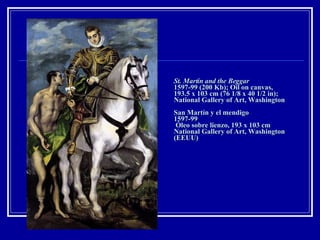
St. Martin and the Beggar   1597-99 (200 Kb); Oil on canvas, 193.5 x 103 cm (76 1/8 x 40 1/2 in); National Gallery of Art, Washington San Martín y el mendigo 1597-99  Óleo sobre lienzo, 193 x 103 cm National Gallery of Art, Washington (EEUU)
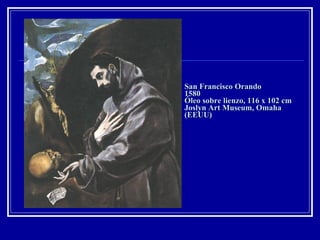
San Francisco Orando 1580 Óleo sobre lienzo, 116 x 102 cm Joslyn Art Museum, Omaha (EEUU)
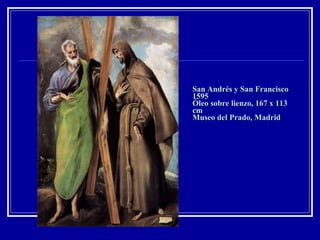
San Andrés y San Francisco 1595 Óleo sobre lienzo, 167 x 113 cm Museo del Prado, Madrid
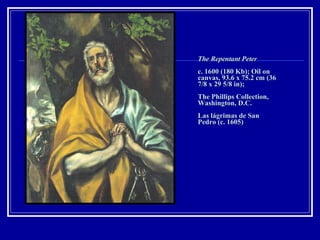
The Repentant Peter   c. 1600 (180 Kb); Oil on canvas, 93.6 x 75.2 cm (36 7/8 x 29 5/8 in);  The Phillips Collection, Washington, D.C.   Las lágrimas de San Pedro (c. 1605)
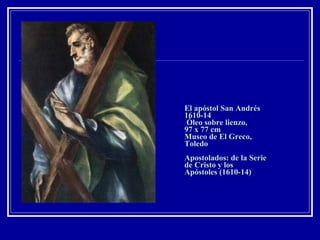
El apóstol San Andrés 1610-14  Óleo sobre lienzo,  97 x 77 cm Museo de El Greco, Toledo Apostolados: de la Serie de Cristo y los Apóstoles (1610-14)
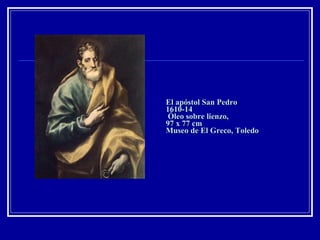
El apóstol San Pedro 1610-14  Óleo sobre lienzo,  97 x 77 cm Museo de El Greco, Toledo
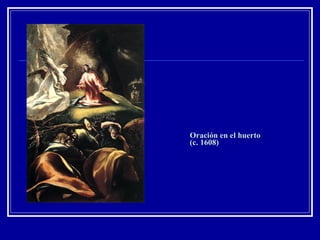
Oración en el huerto  (c. 1608)
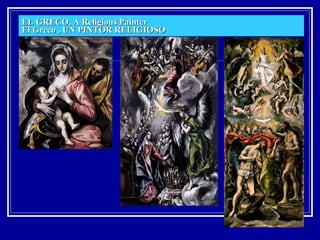
EL GRECO, A Religious Painter El Greco , UN PINTOR RELIGIOSO
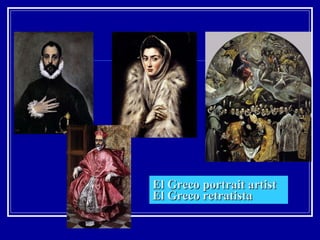
El Greco portrait artist  El Greco retratista
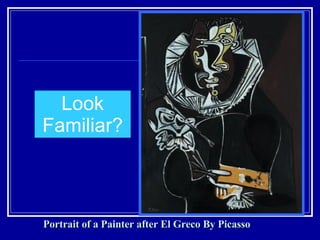
Portrait of a Painter after El Greco By Picasso Look Familiar?
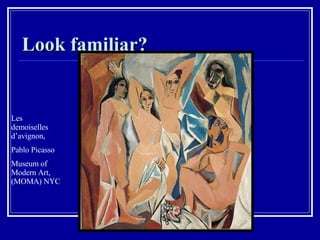
Look familiar? Les demoiselles d’avignon,  Pablo Picasso Museum of Modern Art, (MOMA) NYC

Who Was El Greco

  • 1.
    Who was EL GRECO? Spanish Renaissance painting LA PINTURA ESPAÑOLA DEL RENACIMIENTO Ms. Aixa B. Rodriguez Belmont Preparatory High School SABE: Saturday Academy Bilingual Enrichment Identity through Art History Unit: Hispanic/Latino Artists
  • 2.
    Do Now: Think,Pair, Share If you move to another country, and do well in that country, and are successful and famous, do you have to give up your home country’s identity and accept the new one? Write your answer in your journal, pair with a partner and prepare to share with the entire class.
  • 3.
    Mannerism characteristics commonto many Mannerist works include distortion of the human figure, a flattening of pictorial space, intellectual sophistication Emphasized the artist's imagination rather than the reproduction of nature.
  • 4.
    El Greco: DOMÉNIKOSTHEOTOKÓPOULOS (CRETE, 1541 – TOLEDO, 1614) Portrait of An Old Man (so called self-portrait of El Greco), circa 1595–1600, oil on canvas, 52.7 × 46.7 cm, Metropolitan Museum of Art, New York City, U.S. El Greco ("The Greek", was a painter, sculptor, and architect of the Spanish Renaissance. He usually signed his paintings in Greek letters with his full name, Doménicos Theotokópoulos (Greek: Δομήνικος Θεοτοκόπουλος ), to show his Greek identity sometimes followed by Kres (Cretan).
  • 5.
    FACTS: El Grecowas born in Crete, at that time part of the Republic of Venice, and the centre of Post-Byzantine art. He trained and became a master within that tradition before traveling at 26 to Venice , as other Greek artists had done. In 1570 he moved to Rome , where he opened a workshop and executed a series of works. In 1577 he moved to Toledo, Spain , where he lived and worked until his death. In Toledo, El Greco received several major commissions and produced his best known paintings. El Greco is known for : elongated figures, Use of cool colors (green, blue, gray) Some scientists believe that El Greco’s eyesight may have contributed to his style of elongated figures.
  • 6.
    The Stylistic Evolutionof El Greco (1541-1614) LA EVOLUCIÓN ESTILÍSTICA DE EL GRECO The first works in Spain 1563-1567 Cretan Period Post Byzantine Style 1567-1576 Italian Period Moves to Venice and Rome and back to Venice 1576-1616 Spanish period Rejected by King Phillip II In Madrid, Moves to Toledo and experiences success. Influence of Italian Painters and style Landscapes flat symbolic world of Byzantine icons
  • 7.
    The Stylistic Evolutionof El Greco (1541-1614) LA EVOLUCIÓN ESTILÍSTICA DE EL GRECO Maturity, Madurez Final works El Greco as portraitist
  • 8.
    Cretan period: Workscreated during this time b. 1565-1566 Dormition of the Virgin 1566 The Passion of Christ (Pietà with Angels) b. 1567 St. Luke Painting the Virgin and Child c. 1565-1567 The Adoration of the Magi b. 1567-1569 Modena Triptych
  • 9.
    The Dormition ofthe Virgin El Greco, 1565-1566 Tempera and gold on panel61,4 × 45 cm Holy Cathedral of the Dormition of the Virgin, in Hermoupolis, a city in Greece. It is the capital and main city of the island of Syros and the Cyclades prefecture. What do you notice about the style of this painting?
  • 10.
    Italian Period: Works create during this period Italian period (1567-1577) c. 1567-1570 The Last Supper c. 1569-1570 The Entombment of Christ c. 1570-1571 Purification of the Temple c. 1570 View of Mount Sina c. 1571-1572 Portrait of Giulio Clovio' c. 1571-1572 A Boy Blowing on an Ember to Light a Candle (El Soplón) 1572 Charles de Guise c. 1572 Christ Healing the Blind c. 1576 The Annunciation
  • 11.
    “ Giulio Clovio,”portrait by El Greco, c. 1570; in the Museo e Gallerie Nazionali di Capodimonte, Naples Retrato de Julio Clovio (Roma, 1571-1572)
  • 12.
    What is thisboy doing? El soplón (Roma, 1570-1572)
  • 13.
    What do yousee in this painting? The Miracle of Christ Healing the Blind , 1570 Oil on canvas; 47 x 57 1/2 in. (119.4 x 146.1 cm) Metropolitan Museum of Art
  • 14.
    What title wouldyou give this painting? Christ Driving the Traders from the Temple 1600 (170 Kb); Oil on canvas, 106 x 130 cm (41 x 51 in)
  • 15.
    What do yousee in these paintings? What do you think the theme is?
  • 16.
    Spanish Period: Workscreated during this time c. 1577 Maria Magdalen in Penitence c. 1577-1578 Saint Sebastian c. 1577-1579 Assumption of the Virgin c. 1577-1579 The Holy Trinity c. 1577-1579 The Disrobing of Christ (El Espolio) c. 1577-1579 Allegory of the Holly League c. 1580-1582 The Martyrdrom of Saint Maurice c. 1580-1582 Saint Peter in Tears c. 1582-1586 Saint Mary Magdalene c. 1585-1588 Portrait of Rodrigo de la Fuente c. 1586-1588 The Burial of the Count of Orgaz c. 1586-1597 Portrait of an Elderly Man c. 1587-1596 Saint Peter in Tears c. 1587-1596 Veil of Veronica c. 1590-1595 Holly Family with Saint Anna c. 1590-1595 Saint Andrew and Saint Francis c. 1590-1595 Agony in the Garden (several versions, the one in Toledo, Ohio being accepted as prime. c. 1595-1600 Portrait of an Old Man (so called self-portrait) c. 1596-1600 View of Toledo c. 1597-1599 Saint Martin and the Beggar c. 1597-1599 Saint Joseph and the Christ Child c. 1597-1599 Madonna and the Child with Saint Martina and Saint Agnes c. 1597-1600 The Annunciation c. 1597-1600 Pentecost c. 1600 Portrait of Antonio de Covarrubias c. 1600-1601 Portrait of Cardinal Nino de Guevara c. 1600-1605 Saint Ildefonso c. 1600-1605 Crucifixion c. 1600-1605 Resurrection c. 1600-1605 Portrait of Jorge Manuel Theotocopoulos c. 1600-1605 Apostolado series, ie Christ and the Twelve Apostles in thirteen half-length portraits. Many versions, with one in Toledo Cathedral accepted as largely by El Greco himself. c. 1600-1607 Saint Judas Thaddaeus c. 1600-1610 Saint Jerome as Cardinal - five versions, those in the Frick and Metropolitan being generally accepted as prime. Also Madrid, London. c. 1600-1614 Purification of the Temple Several versions: London, Frick, Madrid. c. 1606-1607 Saint John the Baptist and Saint John the Evangelist c. 1603 The Annunciation c. 1603-1605 Coronation of the Virgin c. 1603-1605 Madonna of Charity c. 1605 Saint Peter c. 1607 Saint Mary Magdalene c. 1607-1613 Virgin of the Immaculate Conception c. 1607-1614 The Visitation c. 1608-1614 The Immaculate Conception c. 1608-1614 View and Plan of Toledo c. 1608-1614 Concert of Angels 1609 Portrait of Fray Hortensio Félix Paravacino c. 1609-1614 Portrait of Cardinal Tavera c. 1609-1614 Opening of the Fifth Seal ( The Fifth Seal of the Apocalypse The Vision of Saint John ) c. 1609-1614 The Annunciation c. 1610-1614 Laocoön c. 1610-1614 Apostolado series, unfinished at his death c. 1612-1614 The Adoration of the Shepherds
  • 17.
    EL GRECO IN SPAIN FIRST WORKS EL GRECO EN ESPAÑA: PRIMEROS TRABAJOS The Disrobing of Christ ( El Espolio ) (1577–1579, oil on canvas, 285 × 173 cm, Sacristy of the Cathedral, Toledo) The Holy Trinity by El Greco 1577 - Paint on canvas, 300 x 179 cm (118 1/8 x 70 1/2″); Museo del Prado, Madrid El martirio de San Mauricio y la legión Tebana 1580-81 Oleo sobre lienzo, 448 x 301 cm Monasterio de San Lorenzo, El Escorial
  • 18.
    What do younotice in this painting? What aspect strikes you first? The Disrobing of Christ ( El Espolio ) (1577–1579, oil on canvas, 285 × 173 cm, Sacristy of the Cathedral, Toledo)
  • 19.
    The Holy Trinity: Why do you think this painting is called the Holy Trinity? What does the dove symbolize?
  • 20.
    The Martyrdom ofSt. Maurice and the Theban Legion 1580s. Oil on canvas. Art Museum, Bucharest, Romania El martirio de San Mauricio y la legión Tebana This painting was made for King Phillip the second, with the intention of establishing himself in Madrid as a court painter. It wasn’t liked by the King, and El Greco left Madrid for Toledo. Esta obra fue pintada para el rey Felipe II, con la intención de establecerse en Madrid como pintor de la Corte. El Rey no la gustó , por lo que el pintor se trasladará a Toledo.
  • 21.
    View of ToledoEl Greco, 1596-1600 Oil on canvas 47.75 × 42.75 cm Metropolitan Museum of Art, New York City What do you see in this painting? What is happening?
  • 22.
    View and Planof Toledo 1610–14; Greco House and Museum, Toledo, Spain
  • 23.
    Portrait of aCardinal, Probably Cardinal Don Fernando Niño de Guevara (1541–1609), ca. 1600 El Greco (Domenikos Theotokopoulos) (Greek, 1541–1614) Oil on canvas; 67 1/4 x 42 1/2 in. (170.8 x 108 cm) Retrato de Cardenal c. 1600 Óleo sobre lienzo, 171 x 108 cm Metropolitan Museum of Art, New York What details do you notice in this portrait? What do these details tell us about who the person was? What is on the floor?
  • 24.
    La DAMA DELARMINO LA INFANTA CATALINA MICAELA CON ABRIGO DE PIEL GLASGOW ART GALLERY & MUSEUMS
  • 25.
    The Knight withHis Hand on His Breast (60 Kb); Oil on canvas, 81 x 66 cm (31 7/8 x 26"); Museo del Prado, Madrid Retrato de hombre con la mano en el pecho 1583-85 Óleo sobre lienzo, 81 x 66 cm Museo del Prado, Madrid El caballero pertenece a la Orden de Santiago y se llama Juan de Silva, Marqués de Montemayor.
  • 26.
    Fray Hortensio FélixParavicino, 1609 Oil on canvas; 44 1/8 x 33 7/8 in. (112 x 86.1 cm) Museum of Fine Arts, Boston Fray Hortensio Félix Paravicino c. 1609 Óleo sobre lienzo, 112 x 86 cm Museum of Fine Arts, Boston (EEUU) "Creta le dio la vida y los pinceles, / Toledo mejor patria, donde empieza / a lograr con la muerte eternidades“ (versos dedicados al pintor, escritos por este fraile)
  • 27.
    The Burial ofCount Orgaz 1586-88
  • 28.
    Who do youthink the men in the painting could be? What about the little boy? What do you think of the colors in this painting? the clothing?
  • 29.
    What details doyou notice in this painting?
  • 30.
    Jorge Manuel, theson of El Greco, is the little boy with the serious face in this painting.
  • 31.
    What kind ofexpressions are on the faces of the men in this painting?
  • 32.
    Christ Carrying theCross 1600-05 (30 Kb); Oil on canvas; Prado, Madrid Christ on the Cross Adored by Donors 1585-90 (80 Kb); Canvas; Louvre
  • 33.
    La purificación deltemplo (el mismo tema 25 años después) c. 1600 - Óleo sobre lienzo 106 x 130 cm - National Gallery, Londres
  • 34.
    El retablo dedoña María de Aragón
  • 35.
    What is happeningin this painting? The Adoration of the Shepherds 1612-14 (230 Kb); Oil on canvas, 319 x 180 cm (125 5/8 x 70 7/8"); Museo del Prado, Madrid
  • 36.
    Opening of theFifth Seal Metropolitan Museum of Art Look at this painting. What do you think is happening? Does this painting remind you of another one? Some people say this painting inspired another masterpiece….
  • 37.
    Cristo cargando lacruz 1580 Óleo sobre lienzo, 105 x 79 cm Metropolitan Museum of Art, New York Las obras de carácter religioso son, junto a los retratos, las más abundantes de su producción pictórica. La clientela estaba formada, por lo general, por clérigos, aristócratas o burgueses, deseosos de decorar sus capillas e iglesias.
  • 38.
    La adoración delos pastores 1596-1600 Óleo sobre lienzo, 11 x 47 cm Galleria Nazionale d'Arte Antica, Roma
  • 39.
    La Anunciación 1597-1600 Óleo sobre lienzo, 114 x 67 cm Museo Thyssen-Bornemisza, Madrid La forma vertical del lienzo viene dada por la disposición de la composición en dos niveles (el terrenal y el celestial), que suelen engarzarse mediante la figura de algún ángel o, como en este caso, de Espíritu Santo.
  • 40.
    El Bautismo deCristo 1596-1600 Óleo sobre lienzo, 350 x 144 cm Museo del Prado, Madrid
  • 41.
    El bautismo deCristo 1608-28 Óleo sobre lienzo, 330 x 211 cm Hospital Tavera, Toledo
  • 42.
    La Crucifixión 1596-1600 Óleo sobre lienzo, 312 x 169 cm Museo del Prado, Madrid
  • 43.
    La Resurrección deCristo 1596-1600 Óleo sobre lienzo, 275 x 127 cm Museo del Prado, Madrid
  • 44.
    Pentecostés 1596-1600 Óleo sobre lienzo, 275 x 127 cm Museo del Prado, Madrid
  • 45.
    La Virgen dela Inmaculada Concepción 1608-13 Óleo sobre lienzo, 348 x 174,5 cm Museo de Santa Cruz, Toledo
  • 46.
    St. Martin andthe Beggar 1597-99 (200 Kb); Oil on canvas, 193.5 x 103 cm (76 1/8 x 40 1/2 in); National Gallery of Art, Washington San Martín y el mendigo 1597-99 Óleo sobre lienzo, 193 x 103 cm National Gallery of Art, Washington (EEUU)
  • 47.
    San Francisco Orando1580 Óleo sobre lienzo, 116 x 102 cm Joslyn Art Museum, Omaha (EEUU)
  • 48.
    San Andrés ySan Francisco 1595 Óleo sobre lienzo, 167 x 113 cm Museo del Prado, Madrid
  • 49.
    The Repentant Peter c. 1600 (180 Kb); Oil on canvas, 93.6 x 75.2 cm (36 7/8 x 29 5/8 in); The Phillips Collection, Washington, D.C. Las lágrimas de San Pedro (c. 1605)
  • 50.
    El apóstol SanAndrés 1610-14 Óleo sobre lienzo, 97 x 77 cm Museo de El Greco, Toledo Apostolados: de la Serie de Cristo y los Apóstoles (1610-14)
  • 51.
    El apóstol SanPedro 1610-14 Óleo sobre lienzo, 97 x 77 cm Museo de El Greco, Toledo
  • 52.
    Oración en elhuerto (c. 1608)
  • 53.
    EL GRECO, AReligious Painter El Greco , UN PINTOR RELIGIOSO
  • 54.
    El Greco portraitartist El Greco retratista
  • 55.
    Portrait of aPainter after El Greco By Picasso Look Familiar?
  • 56.
    Look familiar? Lesdemoiselles d’avignon, Pablo Picasso Museum of Modern Art, (MOMA) NYC