




Apparel Manufacturing Process
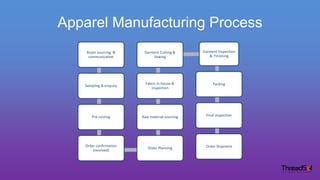
Buyer sourcing &
communication
Sampling & enquiry
Pre-costing
Order confirmation
(received)
Order Planning
Raw material sourcing
Fabric in-house &
inspection
Garment Cutting &
Sewing
Garment Inspection
& Finishing
Packing
Final inspection
Order Shipment
Who is a Merchandiser?
• As it is evident from the above process flow, efficiently executing a garment order depends highly
on effective management of this process.
• Merchandiser is the person responsible for complete planning and coordination of all the activities
within the order right from the start or procuring the order till the final shipment point.
• Merchandiser is the actual driver for every garment manufacturer order.
• He/she is responsible for managing communications, planning, programming, sourcing, controlling,
follow-ups, decision making, coordination, costing, negotiating, meeting, and forecasting for various
aspects of the order.
• The merchandiser hence actually acts as a bridge between the manufacturer and the buyer,
assuring swift execution of the orders.
Roles and Responsibilities:
• The roles and responsibilities of a merchandiser include all the planning and scheduling activities,
starting right from the buyer communications until the order is finally fulfilled.
• The merchandiser needs to ensure, right merchandise, at the right place, at the right time, in the right
quantity, at the right price, with the right promotion.
• This includes managing communications with the buyer and manufacturer’s sides both, with all the
related sourcing, coordination, negotiations, and follow-ups.
• The merchandiser follows up the order for the internal and external communications, sampling, lab
dips, confirmation for accessories and trims, preparations of the internal order sheets and purchase
orders for the raw material, production schedules(planned vs. actual), quality control, shipping
documentation, final inspection and final shipping to the customer.
Merchandiser’s Challenges
• With the advent of fast fashion, the order timelines are shrinking by the day.
• This makes the job of a merchandiser much more complicated than it ever was.
• When the time to market is short, the key to success lies in the effective management of the
order.
• The merchandiser sits in the driving seat when it comes to order management and fulfillment.
• Merchandiser acts as a bridge between the manufacturer and the buyer; hence the alignment of
the internal processes as per buyer’s needs and schedules is a merchandiser’s responsibility.
• But, for a process as complicated as apparel manufacturing is, ensuring that all the various stages
and silos with the process work in sync with the buyer requirements are an everyday challenge a
merchandiser faces on his desk.
Why Are Merchandisers Important?
• Apparel manufacturing is a complex, multi-stage process. When such a process has to be run
smoothly, within a short time frame, process management and coordination can become the
difference a successful and failed order completion.
• Merchandisers are responsible to effectively coordinate the order from the start to the end.
• In any industry, businesses tend to fall into the trap of working within functional silos.
• To keep these functional silos aligned and focused towards one common goal is the role a
merchandiser plays for the business.
• Thus, a sound merchandising team is crucial for any business to run smoothly with a shared
focus on the customer requirements.
For more insight on this topic, visit
www.stitchdiary.com

Who Is A Merchandiser?

  • 2.
    Apparel Manufacturing Process Buyersourcing & communication Sampling & enquiry Pre-costing Order confirmation (received) Order Planning Raw material sourcing Fabric in-house & inspection Garment Cutting & Sewing Garment Inspection & Finishing Packing Final inspection Order Shipment
  • 3.
    Who is aMerchandiser? • As it is evident from the above process flow, efficiently executing a garment order depends highly on effective management of this process. • Merchandiser is the person responsible for complete planning and coordination of all the activities within the order right from the start or procuring the order till the final shipment point. • Merchandiser is the actual driver for every garment manufacturer order. • He/she is responsible for managing communications, planning, programming, sourcing, controlling, follow-ups, decision making, coordination, costing, negotiating, meeting, and forecasting for various aspects of the order. • The merchandiser hence actually acts as a bridge between the manufacturer and the buyer, assuring swift execution of the orders.
  • 4.
    Roles and Responsibilities: •The roles and responsibilities of a merchandiser include all the planning and scheduling activities, starting right from the buyer communications until the order is finally fulfilled. • The merchandiser needs to ensure, right merchandise, at the right place, at the right time, in the right quantity, at the right price, with the right promotion. • This includes managing communications with the buyer and manufacturer’s sides both, with all the related sourcing, coordination, negotiations, and follow-ups. • The merchandiser follows up the order for the internal and external communications, sampling, lab dips, confirmation for accessories and trims, preparations of the internal order sheets and purchase orders for the raw material, production schedules(planned vs. actual), quality control, shipping documentation, final inspection and final shipping to the customer.
  • 5.
    Merchandiser’s Challenges • Withthe advent of fast fashion, the order timelines are shrinking by the day. • This makes the job of a merchandiser much more complicated than it ever was. • When the time to market is short, the key to success lies in the effective management of the order. • The merchandiser sits in the driving seat when it comes to order management and fulfillment. • Merchandiser acts as a bridge between the manufacturer and the buyer; hence the alignment of the internal processes as per buyer’s needs and schedules is a merchandiser’s responsibility. • But, for a process as complicated as apparel manufacturing is, ensuring that all the various stages and silos with the process work in sync with the buyer requirements are an everyday challenge a merchandiser faces on his desk.
  • 6.
    Why Are MerchandisersImportant? • Apparel manufacturing is a complex, multi-stage process. When such a process has to be run smoothly, within a short time frame, process management and coordination can become the difference a successful and failed order completion. • Merchandisers are responsible to effectively coordinate the order from the start to the end. • In any industry, businesses tend to fall into the trap of working within functional silos. • To keep these functional silos aligned and focused towards one common goal is the role a merchandiser plays for the business. • Thus, a sound merchandising team is crucial for any business to run smoothly with a shared focus on the customer requirements.
  • 7.
    For more insighton this topic, visit www.stitchdiary.com