MERCHANDISERS ROLES
AND RESPONSIBILITIES
SHWETA IYER
LECTURER
COLLEGE OF FASHION
DESIGN AND
MERCHANDISING
TOPICS TO BE COVERED
Understanding of industry
development and product
lines in manufacturing and
retail sectors
Planning product ranges and
preparing sales

Maximize profits, promotional
strategies
Develop sales forecast
Understand potential
consumer demands
Using technology
Control time line for
production process
COPYRIGHT SHWETA IYER
MODULE 1
Understanding of industry
development and product
lines in manufacturing and
retail sectors
Refer: Pg 51-75 Apparel
Merchandising the line
starts here
COPYRIGHT SHWETA IYER
APPAREL INDUSTRY IN INDIA AND
ROLE OF INTERNATIONAL BRANDS IN
THE INDIAN CONTEXT
COPYRIGHT SHWETA IYER
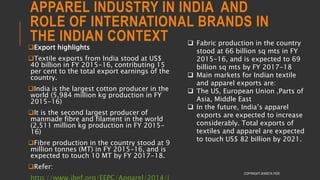
Export highlights
Textile exports from India stood at US$
40 billion in FY 2015-16, contributing 15
per cent to the total export earnings of the
country.
India is the largest cotton producer in the
world (5,984 million kg production in FY
2015-16)
It is the second largest producer of
manmade fibre and filament in the world
(2,511 million kg production in FY 2015-
16)
Fibre production in the country stood at 9
million tonnes (MT) in FY 2015-16, and is
expected to touch 10 MT by FY 2017-18.
Refer:
 Fabric production in the country
stood at 66 billion sq mts in FY
2015-16, and is expected to 69
billion sq mts by FY 2017-18
 Main markets for Indian textile
and apparel exports are:
 The US, European Union ,Parts of
Asia, Middle East
 In the future, India’s apparel
exports are expected to increase
considerably. Total exports of
textiles and apparel are expected
to touch US$ 82 billion by 2021.
ROLE OF MERCHANDISER IN
FASHION INDUSTRY
Merchandiser is the BRIDGE between the
industry and the buyer.
 He have to look after every job like buying
the raw material which is required to finish
the product, making the garment, finishing
the garment, documentation, finally shipping.
A garment export unit generally has many
department like stores, cutting, production,
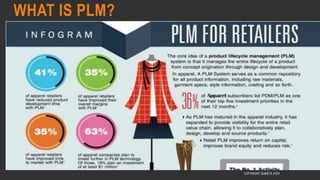
packing, checking etc. in which
Merchandising department a linking device of
all.
The job of a merchandiser is to co ordinate
with the entire department in the office as
well as the customers.
The merchandiser is the one who creates a
good relationship in between exporter &
buyer.
Life as a Trainee Merchandiser-
COPYRIGHT SHWETA IYER
WHAT TYPES OF PRODUCTS BEING
PRODUCED
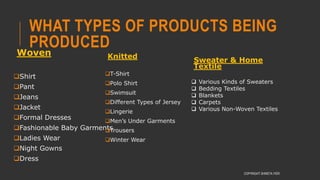
Woven
Shirt
Pant
Jeans
Jacket
Formal Dresses
Fashionable Baby Garments
Ladies Wear
Night Gowns
Dress
COPYRIGHT SHWETA IYER
Knitted
T-Shirt
Polo Shirt
Swimsuit
Different Types of Jersey
Lingerie
Men’s Under Garments
Trousers
Winter Wear
Sweater & Home
Textile
 Various Kinds of Sweaters
 Bedding Textiles
 Blankets
 Carpets
 Various Non-Woven Textiles
WHO ARE THE CUSTOMERS?
COPYRIGHT SHWETA IYER
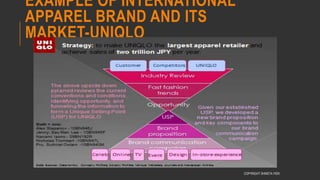
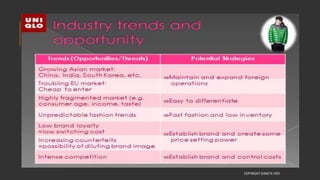
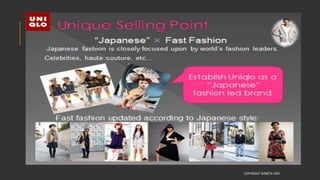
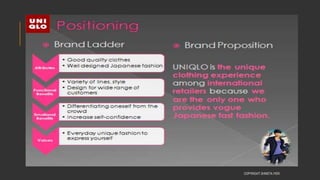
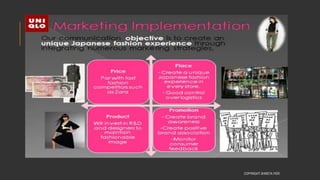
EXAMPLE OF INTERNATIONAL
APPAREL BRAND AND ITS
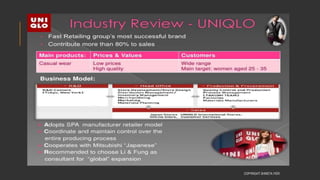
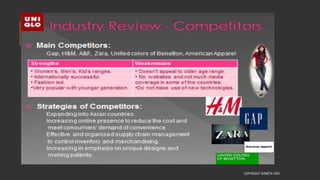
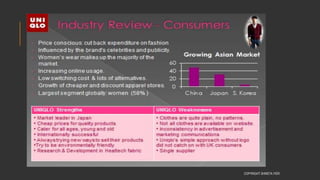
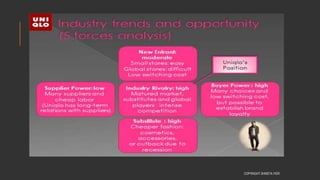
MARKET-UNIQLO
COPYRIGHT SHWETA IYER
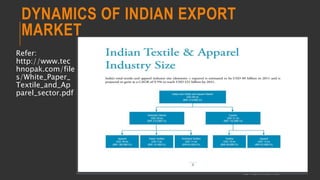
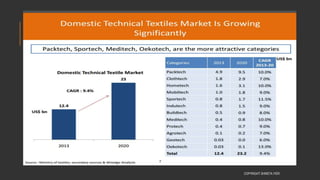
DYNAMICS OF INDIAN EXPORT
MARKET
Refer:
http://www.tec
hnopak.com/file
s/White_Paper_
Textile_and_Ap
parel_sector.pdf
COPYRIGHT SHWETA IYER
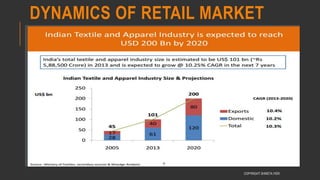
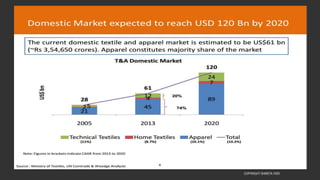
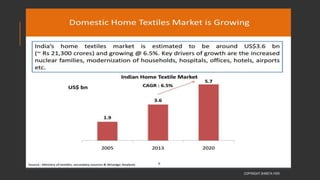
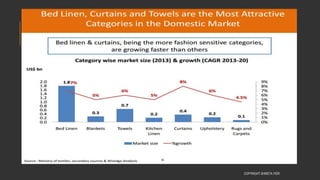
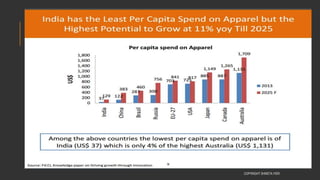
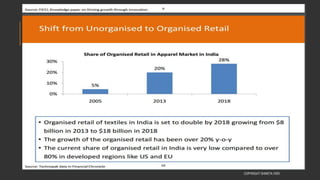
DYNAMICS OF RETAIL MARKET
COPYRIGHT SHWETA IYER
ASSIGNMENT 1
Study of any one international brand and its market on similar lines
as provided-
COPYRIGHT SHWETA IYER
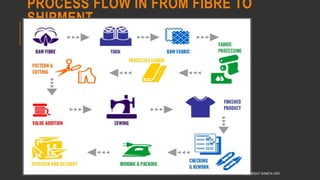
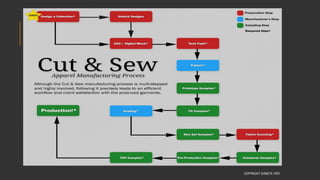
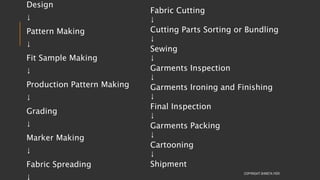
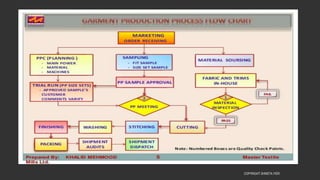
PROCESS FLOW IN FROM FIBRE TO
SHIPMENT
COPYRIGHT SHWETA IYER
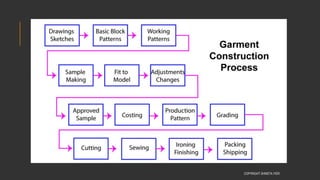
Design
↓
Pattern Making
↓
Fit Sample Making
↓
Production Pattern Making
↓
Grading
↓
Marker Making
↓
Fabric Spreading
COPYRIGHT SHWETA IYER
Fabric Cutting
↓
Cutting Parts Sorting or Bundling
↓
Sewing
↓
Garments Inspection
↓
Garments Ironing and Finishing
↓
Final Inspection
↓
Garments Packing
↓
Cartooning
↓
Shipment
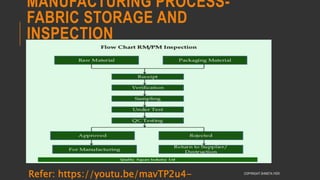
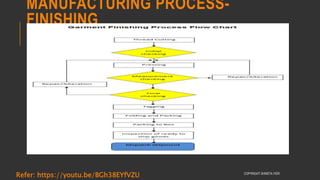
MANUFACTURING PROCESS-
FABRIC STORAGE AND
INSPECTION
COPYRIGHT SHWETA IYER
Refer: https://youtu.be/mavTP2u4-
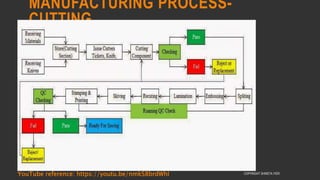
MANUFACTURING PROCESS-
CUTTING
COPYRIGHT SHWETA IYERYouTube reference: https://youtu.be/nmkS8brdWhI
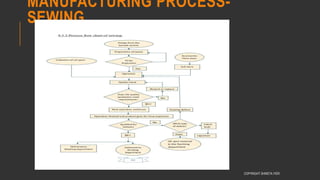
MANUFACTURING PROCESS-
SEWING
COPYRIGHT SHWETA IYER
MANUFACTURING PROCESS-
FINISHING
COPYRIGHT SHWETA IYER
Refer: https://youtu.be/BGh38EYfVZU
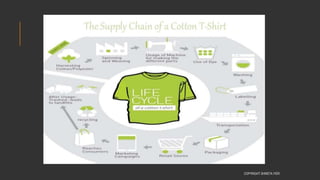
ASSIGNMENT 2
Study of different apparel products in groups ,it can be t-
shirt/shirt/trouser etc - documentation as a story line considering
yourself as the product which have scope from raw material to
shipment stage
Refer: https://youtu.be/SWrEqx1yFwQ
https://www.learnnext.com/CBSE/Class-
7/Civics/A-Shirt-in-the-Market/Life-Story-of-
a-Shirt/L-2066826.htm#container
COPYRIGHT SHWETA IYER
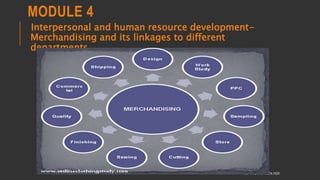
MODULE 4
Interpersonal and human resource development-
Merchandising and its linkages to different
departments
COPYRIGHT SHWETA IYER
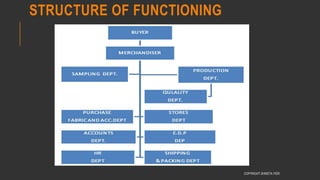
STRUCTURE OF FUNCTIONING
COPYRIGHT SHWETA IYER
ROLE OF MERCHANDISER WITH
DIFFERENT DEPARTMENTS
Role of Merchandiser with Buyer and Sampling Department:
The merchandise in the initial stages of order receipt and
conformation coordinates with the buyer and sampling
department for various approvals.
Role of Merchandiser with Buyer:
A garment merchandiser receives the techpack from the
buyer [enquiry].
 He has to work with various departments and prepare a
validity report and a feasible quote.
The quote will be intimated to the buyer, price is negotiated
and confirmed.
The purchaser order is then sent by the buyer along with the
LC.
 At the various stages of samples, prints embroideries and
accessories are sent to the buyer for approval. Once the
entire approval phase is over goods are produced and
COPYRIGHT SHWETA IYER
ROLE OF MERCHANDISING IN
SAMPLINGRole of Merchandiser with Sampling
department:
1. Here garments merchandiser arranges for
approval of the first sample it may be in
just one size, pre-production sample may
be in jumping size or entire size set,
embroidery, print approval and placement
approvals are also finalized in the
sampling stage.
2. The measurement chart is also checked
and confirmed upon any increase in
measurement will lead to an up charge.
3. The paper pattern is also completed with
all revisions asked by the Buyer. The
fabric [Knit downs, bit looms and first
taka] and accessories are approved at this COPYRIGHT SHWETA IYER
ROLE OF MERCHANDISER IN
PURCHASE
Role of Merchandiser with Purchase Department:
Purchase department is divided into two departments such as fabric
and accessories.
COPYRIGHT SHWETA IYER
WORKING PROCEDURE WITH FABRIC
DEPARTMENT:
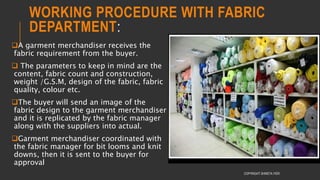
A garment merchandiser receives the
fabric requirement from the buyer.
 The parameters to keep in mind are the
content, fabric count and construction,
weight /G.S.M, design of the fabric, fabric
quality, colour etc.
The buyer will send an image of the
fabric design to the garment merchandiser
and it is replicated by the fabric manager
along with the suppliers into actual.
Garment merchandiser coordinated with
the fabric manager for bit looms and knit
downs, then it is sent to the buyer for
approval
COPYRIGHT SHWETA IYER
WORKING PROCEDURE WITH
ACCESSORIES DEPARTMENT:
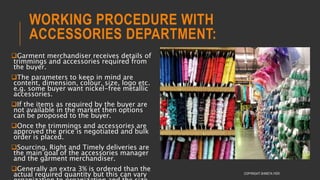
Garment merchandiser receives details of
trimmings and accessories required from
the buyer.
The parameters to keep in mind are
content, dimension, colour, size, logo etc.
e.g. some buyer want nickel-free metallic
accessories.
If the items as required by the buyer are
not available in the market then options
can be proposed to the buyer.
Once the trimmings and accessories are
approved the price is negotiated and bulk
order is placed.
Sourcing, Right and Timely deliveries are
the main goal of the accessories manager
and the garment merchandiser.
Generally an extra 3% is ordered than the
actual required quantity but this can vary COPYRIGHT SHWETA IYER
ROLE OF GARMENT MERCHANDISER
WITH STORE DEPARTMENT:
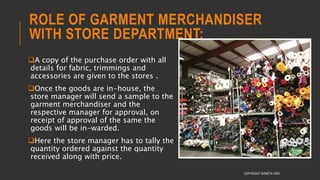
A copy of the purchase order with all
details for fabric, trimmings and
accessories are given to the stores .
Once the goods are in-house, the
store manager will send a sample to the
garment merchandiser and the
respective manager for approval, on
receipt of approval of the same the
goods will be in-warded.
Here the store manager has to tally the
quantity ordered against the quantity
received along with price.
COPYRIGHT SHWETA IYER
ROLE OF MERCHANDISER WITH
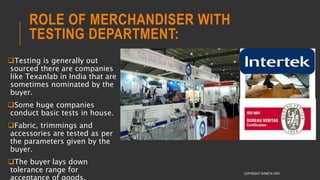
TESTING DEPARTMENT:
Testing is generally out
sourced there are companies
like Texanlab in India that are
sometimes nominated by the
buyer.
Some huge companies
conduct basic tests in house.
Fabric, trimmings and
accessories are tested as per
the parameters given by the
buyer.
The buyer lays down
tolerance range for COPYRIGHT SHWETA IYER
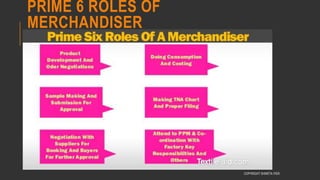
PRIME 6 ROLES OF
MERCHANDISER
COPYRIGHT SHWETA IYER
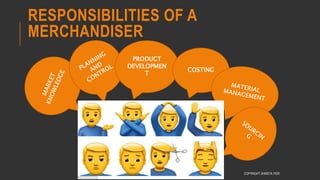
RESPONSIBILITIES OF A
MERCHANDISER
COPYRIGHT SHWETA IYER
PRODUCT
DEVELOPMEN
T
COSTING
IN SHORT
Responsibilities of Merchandiser in Garment Industry or garments
buying house-
https://youtu.be/Hc-n1Tx0Vr0
COPYRIGHT SHWETA IYER
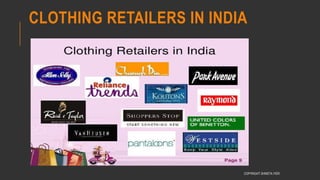
CLOTHING RETAILERS IN INDIA
COPYRIGHT SHWETA IYER
CASE STUDY 2.4 EXECUTIVE
PERSPECTIVE-KURT ERMAN-CEO
NOTATIONS
Questions related. Please answer the following:
1)How use of Sample and prototype making effect Production?
2)What is the impact of margins given by different retailers on the
customers/
3) What are the key points to be taken into account while setting up
your own business?
4)What kind of sweater lines Kurt Erman had been working on?
COPYRIGHT SHWETA IYER
LINKS AND REFERENCES-IN SHORT
https://youtu.be/f6T2k23E-Xs-Fashion Merchandiser Finds Her
Calling-YouTube Video
http://www.slideshare.net/muhundhanmurugasen/merch-24728178
http://www.garmentsmerchandising.com/roles-of-a-merchandiser-in-
garment-industry/
http://www.slideshare.net/PriyambadaKhushboo/apparel-
manufacturing-process
Apparel merchandising :line starts here:3rd edition-Jeremy A.
Rosenau,David.L.Wilson
Pg 52-64
http://textilelearner.blogspot.in/2013/12/concept-of-new-product-
development.html
COPYRIGHT SHWETA IYER
MARKET DATES-NY WOMEN’S
APPARELSpring I
Sell Dates: August -
October
Delivery: Late January -
March
Delivery Dates: 1/30 - 2/28
- 3/30
Fashion Week in New York
takes place in September as
does New York Market week.
West Coast Market follows as
do other regional shows in
the US, which are still
running well into late
October.
Spring II / Summer
Sell Dates: October -
January
Delivery: Late March - May
Delivery Dates: 3/30 - 4/30
COPYRIGHT SHWETA IYER
Fall I / Transition
 Sell Dates: Late January -
March
 Delivery: Late Middle of
July - August
 Delivery Dates: 7/15 -
8/30
 Fashion Week in New
York takes place in
February. West Coast
Market follows as do
other regional shows in
the US, which are still
running well into late
March - mid April.
Fall II
Holiday
 Sell Dates: May -
June
 Delivery: October
 Delivery Dates:
10/15 - 10/30
Resort / Cruise
 Sell Dates: June -
August
 Delivery: Late
November through
mid-January
 Delivery Dates:
11/30 - 12/30 -
1/15
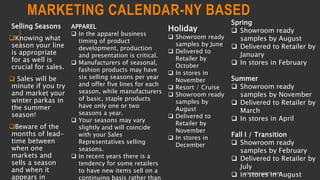
MARKETING CALENDAR-NY BASED
Selling Seasons
Knowing what
season your line
is appropriate
for as well is
crucial for sales.
 Sales will be
minute if you try
and market your
winter parkas in
the summer
season!
Beware of the
months of lead-
time between
when one
markets and
sells a season
and when it
appears in
COPYRIGHT SHWETA IYER
Spring
 Showroom ready
samples by August
 Delivered to Retailer by
January
 In stores in February
Summer
 Showroom ready
samples by November
 Delivered to Retailer by
March
 In stores in April
Fall I / Transition
 Showroom ready
samples by February
 Delivered to Retailer by
July
 In stores in August
Holiday
 Showroom ready
samples by June
 Delivered to
Retailer by
October
 In stores in
November
 Resort / Cruise
 Showroom ready
samples by
August
 Delivered to
Retailer by
November
 In stores in
December
APPAREL
 In the apparel business
timing of product
development, production
and presentation is critical.
 Manufacturers of seasonal,
fashion products may have
six selling seasons per year
and offer five lines for each
season, while manufacturers
of basic, staple products
have only one or two
seasons a year.
 Your seasons may vary
slightly and will coincide
with your Sales
Representatives selling
seasons.
 In recent years there is a
tendency for some retailers
to have new items sell on a
continuing basis rather than
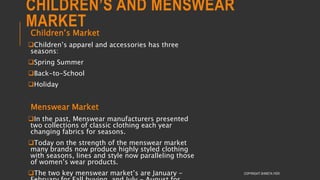
CHILDREN’S AND MENSWEAR
MARKET
Children’s Market
Children’s apparel and accessories has three
seasons:
Spring Summer
Back-to-School
Holiday
Menswear Market
In the past, Menswear manufacturers presented
two collections of classic clothing each year
changing fabrics for seasons.
Today on the strength of the menswear market
many brands now produce highly styled clothing
with seasons, lines and style now paralleling those
of women’s wear products.
The two key menswear market’s are January - COPYRIGHT SHWETA IYER
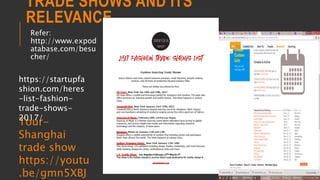
TRADE SHOWS AND ITS
RELEVANCE
Refer:
http://www.expod
atabase.com/besu
cher/
COPYRIGHT SHWETA IYER
Tour-
Shanghai
trade show
https://youtu
.be/gmn5XBJ
https://startupfa
shion.com/heres
-list-fashion-
trade-shows-
2017/
TILL HERE FOR MID TERM
COPYRIGHT SHWETA IYER
MODULE 3
Line development process
Pg 154-177-Merchandising:Line
starts here
COPYRIGHT SHWETA IYER
MODULE 2
PLANNING PRODUCT RANGES AND
PREPARING SALES
PLANNING AND CONTROL TOOLS
COPYRIGHT SHWETA IYER
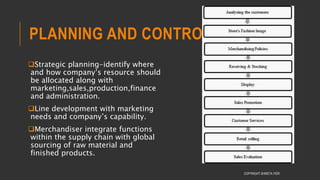
PLANNING AND CONTROL
Strategic planning-identify where
and how company’s resource should
be allocated along with
marketing,sales,production,finance
and administration.
Line development with marketing
needs and company’s capability.
Merchandiser integrate functions
within the supply chain with global
sourcing of raw material and
finished products.
COPYRIGHT SHWETA IYER
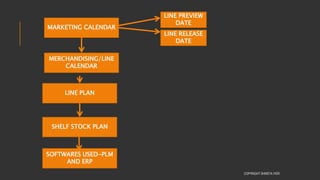
MARKETING CALENDAR
LINE PREVIEW
DATE
MERCHANDISING/LINE
CALENDAR
LINE PLAN
SHELF STOCK PLAN
LINE RELEASE
DATE
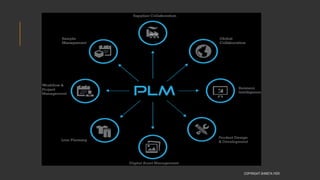
SOFTWARES USED-PLM
AND ERP
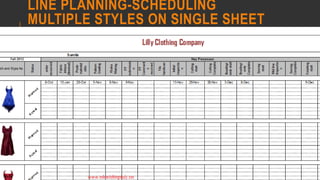
LINE PLANNING-SCHEDULING
MULTIPLE STYLES ON SINGLE SHEET
COPYRIGHT SHWETA IYER
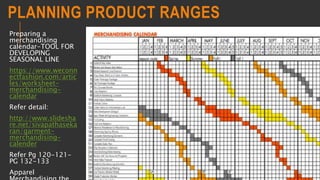
PLANNING PRODUCT RANGES
Preparing a
merchandising
calendar-TOOL FOR
DEVELOPING
SEASONAL LINE
https://www.weconn
ectfashion.com/artic
les/worksheet-
merchandising-
calendar
Refer detail:
http://www.slidesha
re.net/sivapathaseka
ran/garment-
merchandising-
calender
Refer Pg 120-121-
PG 132-133
Apparel COPYRIGHT SHWETA IYER
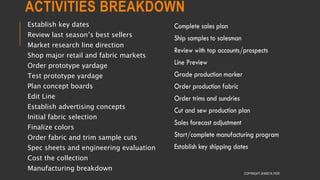
ACTIVITIES BREAKDOWN
Establish key dates
Review last season’s best sellers
Market research line direction
Shop major retail and fabric markets
Order prototype yardage
Test prototype yardage
Plan concept boards
Edit Line
Establish advertising concepts
Initial fabric selection
Finalize colors
Order fabric and trim sample cuts
Spec sheets and engineering evaluation
Cost the collection
Manufacturing breakdown
COPYRIGHT SHWETA IYER
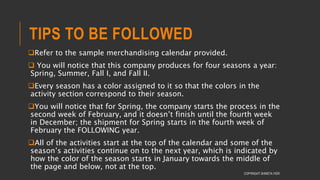
TIPS TO BE FOLLOWED
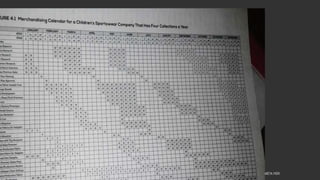
Refer to the sample merchandising calendar provided.
 You will notice that this company produces for four seasons a year:
Spring, Summer, Fall I, and Fall II.
Every season has a color assigned to it so that the colors in the
activity section correspond to their season.
You will notice that for Spring, the company starts the process in the
second week of February, and it doesn’t finish until the fourth week
in December; the shipment for Spring starts in the fourth week of
February the FOLLOWING year.
All of the activities start at the top of the calendar and some of the
season’s activities continue on to the next year, which is indicated by
how the color of the season starts in January towards the middle of
the page and below, not at the top.
COPYRIGHT SHWETA IYER
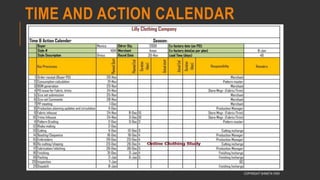
WHAT IS TIME AND ACTION
CALENDARMerchants prepare a plan in a spreadsheet listing down key
processes in one column and planned date of action for each
processes is noted in another. This planning sheet is called time and
action calendar.
Once TNA calendar is made, merchant can easily list down her daily
'to do list' for the day and start doing work one by one.
According to TNA schedule processes are executed on daily basis to
track whether an order is on track or getting delayed.
COPYRIGHT SHWETA IYER
TIME AND ACTION CALENDAR
COPYRIGHT SHWETA IYER
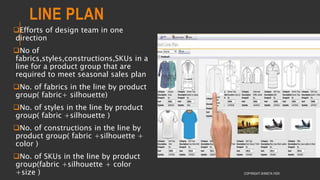
LINE PLAN
Efforts of design team in one
direction
No of
fabrics,styles,constructions,SKUs in a
line for a product group that are
required to meet seasonal sales plan
No. of fabrics in the line by product
group( fabric+ silhouette)
No. of styles in the line by product
group( fabric +silhouette )
No. of constructions in the line by
product group( fabric +silhouette +
color )
No. of SKUs in the line by product
group(fabric +silhouette + color
+size ) COPYRIGHT SHWETA IYER
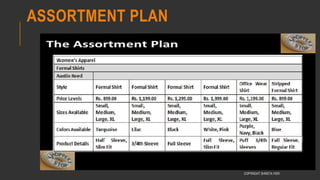
ASSORTMENT PLAN
COPYRIGHT SHWETA IYER
KNOWLEDGE OF FASHION LIFE
CYCLE
Information about where the consumer falls within the fashion life
cycle and who the target consumer is:
Fashion innovator or fashion leader demands newest fashion ,line
towards high fashion
Fashion follower-line less percentage towards high fashion and
higher percentage towards basic popular styles
COPYRIGHT SHWETA IYER
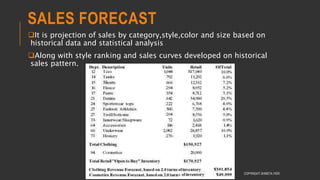
SALES FORECAST
It is projection of sales by category,style,color and size based on
historical data and statistical analysis
Along with style ranking and sales curves developed on historical
sales pattern.
COPYRIGHT SHWETA IYER
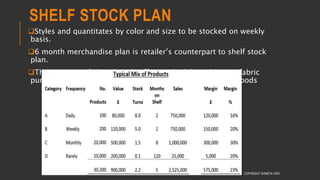
SHELF STOCK PLAN
Styles and quantitates by color and size to be stocked on weekly
basis.
6 month merchandise plan is retailer’s counterpart to shelf stock
plan.
The accuracy of plan directly effects scheduling,shipping,fabric
purchasing and inventories of raw materials and finished goods
COPYRIGHT SHWETA IYER
STYLE STATUS REPORT WITH USE
OF ERP AND PLM
Actual sales against forecast by style and time period
Piece goods, trim purchases, delivery status and inventory
Positions against forecast by time period
Production authorizations, garments in process, finished goods and
inventories by style and time
Shipments against order and time period
COPYRIGHT SHWETA IYER
WHAT IS PLM?
COPYRIGHT SHWETA IYER
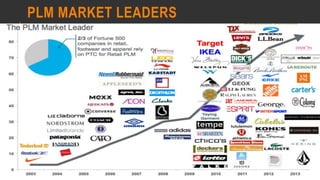
PLM MARKET LEADERS
COPYRIGHT SHWETA IYER
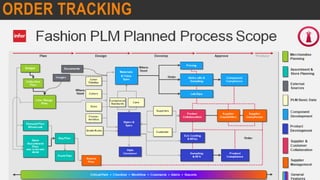
ORDER TRACKING
COPYRIGHT SHWETA IYER
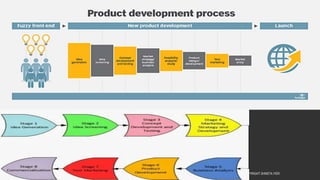
PRODUCT DEVELOPMENT
CONCEPT
The product idea concept is first developed from market and
consumer research but with consideration of the technical
aspects of the product.
Usually, it is a combination of internal company information
searching combined with consumer or, in industrial marketing,
customer discussion groups.
 In industrial product development, it has been shown that
selecting the most innovative customers for product concept
development reduces the time and improves the product
concepts.
The product idea concept research leads to a more detailed
description of the product ideas and also includes screening of
the ideas.
COPYRIGHT SHWETA IYER
PD-DESIGN
Product Development is the design and engineering required to make
products serviceable, salable, producible and profitable.
The basic concept involved in PD may be of two types:
Creative
Technical
Creative design focuses on analysis and creativity.
Technical design which involves perfecting the style, fit and patterns and
developing detailed specifications and costs.
The product can either be one that is new in market or one that is new to
your particular company or existing product that has been improved.
Product development -
https://youtu.be/fsnlRAp5Bg4
COPYRIGHT SHWETA IYER
PRODUCT DEVELOPMENT
PROCESSApparel product development involves three phases:
Pre-adoption
Line-adoption
Post-adoption
COPYRIGHT SHWETA IYER
PRE-ADOPTION PROCESSThis phase involves:
Design Features
2. Design development through
sketching, draping and CAD.
3. CAD system allows trial and
error in developing concepts for
approval without having to sew
physical samples.
4. Design process may be
conducted simultaneously in
different sequences to reduce time
for the product development.
5. Design may be original ,draw
on fabric, stored in computer or
given by the consumer.
COPYRIGHT SHWETA IYER
Piece Goods
6. Fabric selection. Material
testing for performance.
7. In the pre-adoption phase it
is make sure that the fabric or
other materials that we are
going to use would be available
in large quantity for
production.
Trims
8. Accessories selection and
testing if required.
9. The accessories and trims
that are going to be used in the
garment must be available.
LINE ADOPTION
This phase involves:
1.Integration of line development and line presentation
2. Planning a Collection
3. Developing a Collection (Design Development)
4.Developing a sample garment
5.Preparation of sales samples
COPYRIGHT SHWETA IYER
POST ADOPTION
Which designs will become styles in the line and how the styles relate to the
line planning?
This phase involves:
Perfect Styling and Fit.
Because sometimes the fitness present in the sample cannot be achieved in
the production process.
Engineering production patterns.
Assembly methods (to check the suitability in production.
Developing Styles.
Quality specifications.
Estimate detailed costs.
Estimate the operation cost.
COPYRIGHT SHWETA IYER
WHY PD?
To create mass selling products
To replace declining product
To take advantage of new technology
To defeat rivals
To maintain/increase market share
To keep up with rivals
To maintain competitive advantage
To fill gap in the market
COPYRIGHT SHWETA IYER
KEY WORDS TO LEARN-FIND OUT
BOM-
Data Warehouse
JIT-
WIP
Technical package-
Merchandising calendar-
Marketing calendar-
Line plan-
Line calendar-
COPYRIGHT SHWETA IYER
REFRENCES
http://www.slideshare.net/firoztx/final-presentation-on-
merchandising-1
http://www.slideshare.net/muhundhanmurugasen/merch-24728178
http://www.slideshare.net/E_N/merchandise-planning-step-by-
step-process
COPYRIGHT SHWETA IYER
MODULE 3
“Maintenance of comprehensive library for appropriate
data”
Go Through
http://www.sapapparel.com/_PDF/BROCHURE_APPAREL_E
N.pdf
COPYRIGHT SHWETA IYER
MODULE 4
Human resource development
COPYRIGHT SHWETA IYER

Merchandising roles and responsibilities

  • 1.
    MERCHANDISERS ROLES AND RESPONSIBILITIES SHWETAIYER LECTURER COLLEGE OF FASHION DESIGN AND MERCHANDISING
  • 2.
    TOPICS TO BECOVERED Understanding of industry development and product lines in manufacturing and retail sectors Planning product ranges and preparing sales  Maximize profits, promotional strategies Develop sales forecast Understand potential consumer demands Using technology Control time line for production process COPYRIGHT SHWETA IYER
  • 3.
    MODULE 1 Understanding ofindustry development and product lines in manufacturing and retail sectors Refer: Pg 51-75 Apparel Merchandising the line starts here COPYRIGHT SHWETA IYER
  • 4.
    APPAREL INDUSTRY ININDIA AND ROLE OF INTERNATIONAL BRANDS IN THE INDIAN CONTEXT COPYRIGHT SHWETA IYER Export highlights Textile exports from India stood at US$ 40 billion in FY 2015-16, contributing 15 per cent to the total export earnings of the country. India is the largest cotton producer in the world (5,984 million kg production in FY 2015-16) It is the second largest producer of manmade fibre and filament in the world (2,511 million kg production in FY 2015- 16) Fibre production in the country stood at 9 million tonnes (MT) in FY 2015-16, and is expected to touch 10 MT by FY 2017-18. Refer:  Fabric production in the country stood at 66 billion sq mts in FY 2015-16, and is expected to 69 billion sq mts by FY 2017-18  Main markets for Indian textile and apparel exports are:  The US, European Union ,Parts of Asia, Middle East  In the future, India’s apparel exports are expected to increase considerably. Total exports of textiles and apparel are expected to touch US$ 82 billion by 2021.
  • 5.
    ROLE OF MERCHANDISERIN FASHION INDUSTRY Merchandiser is the BRIDGE between the industry and the buyer.  He have to look after every job like buying the raw material which is required to finish the product, making the garment, finishing the garment, documentation, finally shipping. A garment export unit generally has many department like stores, cutting, production, packing, checking etc. in which Merchandising department a linking device of all. The job of a merchandiser is to co ordinate with the entire department in the office as well as the customers. The merchandiser is the one who creates a good relationship in between exporter & buyer. Life as a Trainee Merchandiser- COPYRIGHT SHWETA IYER
  • 6.
    WHAT TYPES OFPRODUCTS BEING PRODUCED Woven Shirt Pant Jeans Jacket Formal Dresses Fashionable Baby Garments Ladies Wear Night Gowns Dress COPYRIGHT SHWETA IYER Knitted T-Shirt Polo Shirt Swimsuit Different Types of Jersey Lingerie Men’s Under Garments Trousers Winter Wear Sweater & Home Textile  Various Kinds of Sweaters  Bedding Textiles  Blankets  Carpets  Various Non-Woven Textiles
  • 7.
    WHO ARE THECUSTOMERS? COPYRIGHT SHWETA IYER
  • 8.
    EXAMPLE OF INTERNATIONAL APPARELBRAND AND ITS MARKET-UNIQLO COPYRIGHT SHWETA IYER
  • 9.
  • 10.
  • 11.
  • 12.
  • 13.
  • 14.
  • 15.
  • 16.
  • 17.
  • 18.
    DYNAMICS OF INDIANEXPORT MARKET Refer: http://www.tec hnopak.com/file s/White_Paper_ Textile_and_Ap parel_sector.pdf COPYRIGHT SHWETA IYER
  • 19.
    DYNAMICS OF RETAILMARKET COPYRIGHT SHWETA IYER
  • 20.
  • 21.
  • 22.
  • 23.
  • 24.
  • 25.
  • 26.
  • 27.
  • 28.
    ASSIGNMENT 1 Study ofany one international brand and its market on similar lines as provided- COPYRIGHT SHWETA IYER
  • 29.
    PROCESS FLOW INFROM FIBRE TO SHIPMENT COPYRIGHT SHWETA IYER
  • 30.
  • 31.
  • 32.
    Design ↓ Pattern Making ↓ Fit SampleMaking ↓ Production Pattern Making ↓ Grading ↓ Marker Making ↓ Fabric Spreading COPYRIGHT SHWETA IYER Fabric Cutting ↓ Cutting Parts Sorting or Bundling ↓ Sewing ↓ Garments Inspection ↓ Garments Ironing and Finishing ↓ Final Inspection ↓ Garments Packing ↓ Cartooning ↓ Shipment
  • 33.
    MANUFACTURING PROCESS- FABRIC STORAGEAND INSPECTION COPYRIGHT SHWETA IYER Refer: https://youtu.be/mavTP2u4-
  • 34.
    MANUFACTURING PROCESS- CUTTING COPYRIGHT SHWETAIYERYouTube reference: https://youtu.be/nmkS8brdWhI
  • 35.
  • 36.
    MANUFACTURING PROCESS- FINISHING COPYRIGHT SHWETAIYER Refer: https://youtu.be/BGh38EYfVZU
  • 37.
    ASSIGNMENT 2 Study ofdifferent apparel products in groups ,it can be t- shirt/shirt/trouser etc - documentation as a story line considering yourself as the product which have scope from raw material to shipment stage Refer: https://youtu.be/SWrEqx1yFwQ https://www.learnnext.com/CBSE/Class- 7/Civics/A-Shirt-in-the-Market/Life-Story-of- a-Shirt/L-2066826.htm#container COPYRIGHT SHWETA IYER
  • 38.
  • 39.
    MODULE 4 Interpersonal andhuman resource development- Merchandising and its linkages to different departments COPYRIGHT SHWETA IYER
  • 40.
  • 41.
  • 42.
    ROLE OF MERCHANDISERWITH DIFFERENT DEPARTMENTS Role of Merchandiser with Buyer and Sampling Department: The merchandise in the initial stages of order receipt and conformation coordinates with the buyer and sampling department for various approvals. Role of Merchandiser with Buyer: A garment merchandiser receives the techpack from the buyer [enquiry].  He has to work with various departments and prepare a validity report and a feasible quote. The quote will be intimated to the buyer, price is negotiated and confirmed. The purchaser order is then sent by the buyer along with the LC.  At the various stages of samples, prints embroideries and accessories are sent to the buyer for approval. Once the entire approval phase is over goods are produced and COPYRIGHT SHWETA IYER
  • 43.
    ROLE OF MERCHANDISINGIN SAMPLINGRole of Merchandiser with Sampling department: 1. Here garments merchandiser arranges for approval of the first sample it may be in just one size, pre-production sample may be in jumping size or entire size set, embroidery, print approval and placement approvals are also finalized in the sampling stage. 2. The measurement chart is also checked and confirmed upon any increase in measurement will lead to an up charge. 3. The paper pattern is also completed with all revisions asked by the Buyer. The fabric [Knit downs, bit looms and first taka] and accessories are approved at this COPYRIGHT SHWETA IYER
  • 44.
    ROLE OF MERCHANDISERIN PURCHASE Role of Merchandiser with Purchase Department: Purchase department is divided into two departments such as fabric and accessories. COPYRIGHT SHWETA IYER
  • 45.
    WORKING PROCEDURE WITHFABRIC DEPARTMENT: A garment merchandiser receives the fabric requirement from the buyer.  The parameters to keep in mind are the content, fabric count and construction, weight /G.S.M, design of the fabric, fabric quality, colour etc. The buyer will send an image of the fabric design to the garment merchandiser and it is replicated by the fabric manager along with the suppliers into actual. Garment merchandiser coordinated with the fabric manager for bit looms and knit downs, then it is sent to the buyer for approval COPYRIGHT SHWETA IYER
  • 46.
    WORKING PROCEDURE WITH ACCESSORIESDEPARTMENT: Garment merchandiser receives details of trimmings and accessories required from the buyer. The parameters to keep in mind are content, dimension, colour, size, logo etc. e.g. some buyer want nickel-free metallic accessories. If the items as required by the buyer are not available in the market then options can be proposed to the buyer. Once the trimmings and accessories are approved the price is negotiated and bulk order is placed. Sourcing, Right and Timely deliveries are the main goal of the accessories manager and the garment merchandiser. Generally an extra 3% is ordered than the actual required quantity but this can vary COPYRIGHT SHWETA IYER
  • 47.
    ROLE OF GARMENTMERCHANDISER WITH STORE DEPARTMENT: A copy of the purchase order with all details for fabric, trimmings and accessories are given to the stores . Once the goods are in-house, the store manager will send a sample to the garment merchandiser and the respective manager for approval, on receipt of approval of the same the goods will be in-warded. Here the store manager has to tally the quantity ordered against the quantity received along with price. COPYRIGHT SHWETA IYER
  • 48.
    ROLE OF MERCHANDISERWITH TESTING DEPARTMENT: Testing is generally out sourced there are companies like Texanlab in India that are sometimes nominated by the buyer. Some huge companies conduct basic tests in house. Fabric, trimmings and accessories are tested as per the parameters given by the buyer. The buyer lays down tolerance range for COPYRIGHT SHWETA IYER
  • 49.
    PRIME 6 ROLESOF MERCHANDISER COPYRIGHT SHWETA IYER
  • 50.
    RESPONSIBILITIES OF A MERCHANDISER COPYRIGHTSHWETA IYER PRODUCT DEVELOPMEN T COSTING
  • 51.
    IN SHORT Responsibilities ofMerchandiser in Garment Industry or garments buying house- https://youtu.be/Hc-n1Tx0Vr0 COPYRIGHT SHWETA IYER
  • 52.
    CLOTHING RETAILERS ININDIA COPYRIGHT SHWETA IYER
  • 53.
    CASE STUDY 2.4EXECUTIVE PERSPECTIVE-KURT ERMAN-CEO NOTATIONS Questions related. Please answer the following: 1)How use of Sample and prototype making effect Production? 2)What is the impact of margins given by different retailers on the customers/ 3) What are the key points to be taken into account while setting up your own business? 4)What kind of sweater lines Kurt Erman had been working on? COPYRIGHT SHWETA IYER
  • 54.
    LINKS AND REFERENCES-INSHORT https://youtu.be/f6T2k23E-Xs-Fashion Merchandiser Finds Her Calling-YouTube Video http://www.slideshare.net/muhundhanmurugasen/merch-24728178 http://www.garmentsmerchandising.com/roles-of-a-merchandiser-in- garment-industry/ http://www.slideshare.net/PriyambadaKhushboo/apparel- manufacturing-process Apparel merchandising :line starts here:3rd edition-Jeremy A. Rosenau,David.L.Wilson Pg 52-64 http://textilelearner.blogspot.in/2013/12/concept-of-new-product- development.html COPYRIGHT SHWETA IYER
  • 55.
    MARKET DATES-NY WOMEN’S APPARELSpringI Sell Dates: August - October Delivery: Late January - March Delivery Dates: 1/30 - 2/28 - 3/30 Fashion Week in New York takes place in September as does New York Market week. West Coast Market follows as do other regional shows in the US, which are still running well into late October. Spring II / Summer Sell Dates: October - January Delivery: Late March - May Delivery Dates: 3/30 - 4/30 COPYRIGHT SHWETA IYER Fall I / Transition  Sell Dates: Late January - March  Delivery: Late Middle of July - August  Delivery Dates: 7/15 - 8/30  Fashion Week in New York takes place in February. West Coast Market follows as do other regional shows in the US, which are still running well into late March - mid April. Fall II Holiday  Sell Dates: May - June  Delivery: October  Delivery Dates: 10/15 - 10/30 Resort / Cruise  Sell Dates: June - August  Delivery: Late November through mid-January  Delivery Dates: 11/30 - 12/30 - 1/15
  • 56.
    MARKETING CALENDAR-NY BASED SellingSeasons Knowing what season your line is appropriate for as well is crucial for sales.  Sales will be minute if you try and market your winter parkas in the summer season! Beware of the months of lead- time between when one markets and sells a season and when it appears in COPYRIGHT SHWETA IYER Spring  Showroom ready samples by August  Delivered to Retailer by January  In stores in February Summer  Showroom ready samples by November  Delivered to Retailer by March  In stores in April Fall I / Transition  Showroom ready samples by February  Delivered to Retailer by July  In stores in August Holiday  Showroom ready samples by June  Delivered to Retailer by October  In stores in November  Resort / Cruise  Showroom ready samples by August  Delivered to Retailer by November  In stores in December APPAREL  In the apparel business timing of product development, production and presentation is critical.  Manufacturers of seasonal, fashion products may have six selling seasons per year and offer five lines for each season, while manufacturers of basic, staple products have only one or two seasons a year.  Your seasons may vary slightly and will coincide with your Sales Representatives selling seasons.  In recent years there is a tendency for some retailers to have new items sell on a continuing basis rather than
  • 57.
    CHILDREN’S AND MENSWEAR MARKET Children’sMarket Children’s apparel and accessories has three seasons: Spring Summer Back-to-School Holiday Menswear Market In the past, Menswear manufacturers presented two collections of classic clothing each year changing fabrics for seasons. Today on the strength of the menswear market many brands now produce highly styled clothing with seasons, lines and style now paralleling those of women’s wear products. The two key menswear market’s are January - COPYRIGHT SHWETA IYER
  • 58.
    TRADE SHOWS ANDITS RELEVANCE Refer: http://www.expod atabase.com/besu cher/ COPYRIGHT SHWETA IYER Tour- Shanghai trade show https://youtu .be/gmn5XBJ https://startupfa shion.com/heres -list-fashion- trade-shows- 2017/
  • 59.
    TILL HERE FORMID TERM COPYRIGHT SHWETA IYER
  • 60.
    MODULE 3 Line developmentprocess Pg 154-177-Merchandising:Line starts here COPYRIGHT SHWETA IYER
  • 61.
    MODULE 2 PLANNING PRODUCTRANGES AND PREPARING SALES PLANNING AND CONTROL TOOLS COPYRIGHT SHWETA IYER
  • 62.
    PLANNING AND CONTROL Strategicplanning-identify where and how company’s resource should be allocated along with marketing,sales,production,finance and administration. Line development with marketing needs and company’s capability. Merchandiser integrate functions within the supply chain with global sourcing of raw material and finished products. COPYRIGHT SHWETA IYER
  • 63.
    COPYRIGHT SHWETA IYER MARKETINGCALENDAR LINE PREVIEW DATE MERCHANDISING/LINE CALENDAR LINE PLAN SHELF STOCK PLAN LINE RELEASE DATE SOFTWARES USED-PLM AND ERP
  • 64.
    LINE PLANNING-SCHEDULING MULTIPLE STYLESON SINGLE SHEET COPYRIGHT SHWETA IYER
  • 65.
    PLANNING PRODUCT RANGES Preparinga merchandising calendar-TOOL FOR DEVELOPING SEASONAL LINE https://www.weconn ectfashion.com/artic les/worksheet- merchandising- calendar Refer detail: http://www.slidesha re.net/sivapathaseka ran/garment- merchandising- calender Refer Pg 120-121- PG 132-133 Apparel COPYRIGHT SHWETA IYER
  • 66.
    ACTIVITIES BREAKDOWN Establish keydates Review last season’s best sellers Market research line direction Shop major retail and fabric markets Order prototype yardage Test prototype yardage Plan concept boards Edit Line Establish advertising concepts Initial fabric selection Finalize colors Order fabric and trim sample cuts Spec sheets and engineering evaluation Cost the collection Manufacturing breakdown COPYRIGHT SHWETA IYER
  • 67.
  • 68.
    TIPS TO BEFOLLOWED Refer to the sample merchandising calendar provided.  You will notice that this company produces for four seasons a year: Spring, Summer, Fall I, and Fall II. Every season has a color assigned to it so that the colors in the activity section correspond to their season. You will notice that for Spring, the company starts the process in the second week of February, and it doesn’t finish until the fourth week in December; the shipment for Spring starts in the fourth week of February the FOLLOWING year. All of the activities start at the top of the calendar and some of the season’s activities continue on to the next year, which is indicated by how the color of the season starts in January towards the middle of the page and below, not at the top. COPYRIGHT SHWETA IYER
  • 69.
    WHAT IS TIMEAND ACTION CALENDARMerchants prepare a plan in a spreadsheet listing down key processes in one column and planned date of action for each processes is noted in another. This planning sheet is called time and action calendar. Once TNA calendar is made, merchant can easily list down her daily 'to do list' for the day and start doing work one by one. According to TNA schedule processes are executed on daily basis to track whether an order is on track or getting delayed. COPYRIGHT SHWETA IYER
  • 70.
    TIME AND ACTIONCALENDAR COPYRIGHT SHWETA IYER
  • 71.
    LINE PLAN Efforts ofdesign team in one direction No of fabrics,styles,constructions,SKUs in a line for a product group that are required to meet seasonal sales plan No. of fabrics in the line by product group( fabric+ silhouette) No. of styles in the line by product group( fabric +silhouette ) No. of constructions in the line by product group( fabric +silhouette + color ) No. of SKUs in the line by product group(fabric +silhouette + color +size ) COPYRIGHT SHWETA IYER
  • 72.
  • 73.
    KNOWLEDGE OF FASHIONLIFE CYCLE Information about where the consumer falls within the fashion life cycle and who the target consumer is: Fashion innovator or fashion leader demands newest fashion ,line towards high fashion Fashion follower-line less percentage towards high fashion and higher percentage towards basic popular styles COPYRIGHT SHWETA IYER
  • 74.
    SALES FORECAST It isprojection of sales by category,style,color and size based on historical data and statistical analysis Along with style ranking and sales curves developed on historical sales pattern. COPYRIGHT SHWETA IYER
  • 75.
    SHELF STOCK PLAN Stylesand quantitates by color and size to be stocked on weekly basis. 6 month merchandise plan is retailer’s counterpart to shelf stock plan. The accuracy of plan directly effects scheduling,shipping,fabric purchasing and inventories of raw materials and finished goods COPYRIGHT SHWETA IYER
  • 76.
    STYLE STATUS REPORTWITH USE OF ERP AND PLM Actual sales against forecast by style and time period Piece goods, trim purchases, delivery status and inventory Positions against forecast by time period Production authorizations, garments in process, finished goods and inventories by style and time Shipments against order and time period COPYRIGHT SHWETA IYER
  • 77.
  • 78.
  • 79.
  • 80.
  • 81.
    PRODUCT DEVELOPMENT CONCEPT The productidea concept is first developed from market and consumer research but with consideration of the technical aspects of the product. Usually, it is a combination of internal company information searching combined with consumer or, in industrial marketing, customer discussion groups.  In industrial product development, it has been shown that selecting the most innovative customers for product concept development reduces the time and improves the product concepts. The product idea concept research leads to a more detailed description of the product ideas and also includes screening of the ideas. COPYRIGHT SHWETA IYER
  • 82.
  • 83.
    PD-DESIGN Product Development isthe design and engineering required to make products serviceable, salable, producible and profitable. The basic concept involved in PD may be of two types: Creative Technical Creative design focuses on analysis and creativity. Technical design which involves perfecting the style, fit and patterns and developing detailed specifications and costs. The product can either be one that is new in market or one that is new to your particular company or existing product that has been improved. Product development - https://youtu.be/fsnlRAp5Bg4 COPYRIGHT SHWETA IYER
  • 84.
    PRODUCT DEVELOPMENT PROCESSApparel productdevelopment involves three phases: Pre-adoption Line-adoption Post-adoption COPYRIGHT SHWETA IYER
  • 85.
    PRE-ADOPTION PROCESSThis phaseinvolves: Design Features 2. Design development through sketching, draping and CAD. 3. CAD system allows trial and error in developing concepts for approval without having to sew physical samples. 4. Design process may be conducted simultaneously in different sequences to reduce time for the product development. 5. Design may be original ,draw on fabric, stored in computer or given by the consumer. COPYRIGHT SHWETA IYER Piece Goods 6. Fabric selection. Material testing for performance. 7. In the pre-adoption phase it is make sure that the fabric or other materials that we are going to use would be available in large quantity for production. Trims 8. Accessories selection and testing if required. 9. The accessories and trims that are going to be used in the garment must be available.
  • 86.
    LINE ADOPTION This phaseinvolves: 1.Integration of line development and line presentation 2. Planning a Collection 3. Developing a Collection (Design Development) 4.Developing a sample garment 5.Preparation of sales samples COPYRIGHT SHWETA IYER
  • 87.
    POST ADOPTION Which designswill become styles in the line and how the styles relate to the line planning? This phase involves: Perfect Styling and Fit. Because sometimes the fitness present in the sample cannot be achieved in the production process. Engineering production patterns. Assembly methods (to check the suitability in production. Developing Styles. Quality specifications. Estimate detailed costs. Estimate the operation cost. COPYRIGHT SHWETA IYER
  • 88.
    WHY PD? To createmass selling products To replace declining product To take advantage of new technology To defeat rivals To maintain/increase market share To keep up with rivals To maintain competitive advantage To fill gap in the market COPYRIGHT SHWETA IYER
  • 89.
    KEY WORDS TOLEARN-FIND OUT BOM- Data Warehouse JIT- WIP Technical package- Merchandising calendar- Marketing calendar- Line plan- Line calendar- COPYRIGHT SHWETA IYER
  • 90.
  • 91.
    MODULE 3 “Maintenance ofcomprehensive library for appropriate data” Go Through http://www.sapapparel.com/_PDF/BROCHURE_APPAREL_E N.pdf COPYRIGHT SHWETA IYER
  • 92.
    MODULE 4 Human resourcedevelopment COPYRIGHT SHWETA IYER