Who are you and makes you special?
Simon Buckingham Shum
Professor of Learning Informatics
Director, UTS Connected Intelligence Centre
@sbuckshum • Simon.BuckinghamShum.net
utscic.edu.au
Keynote, Library Data Carpentry 2016, Sydney
http://librarydatacarpentry.github.io
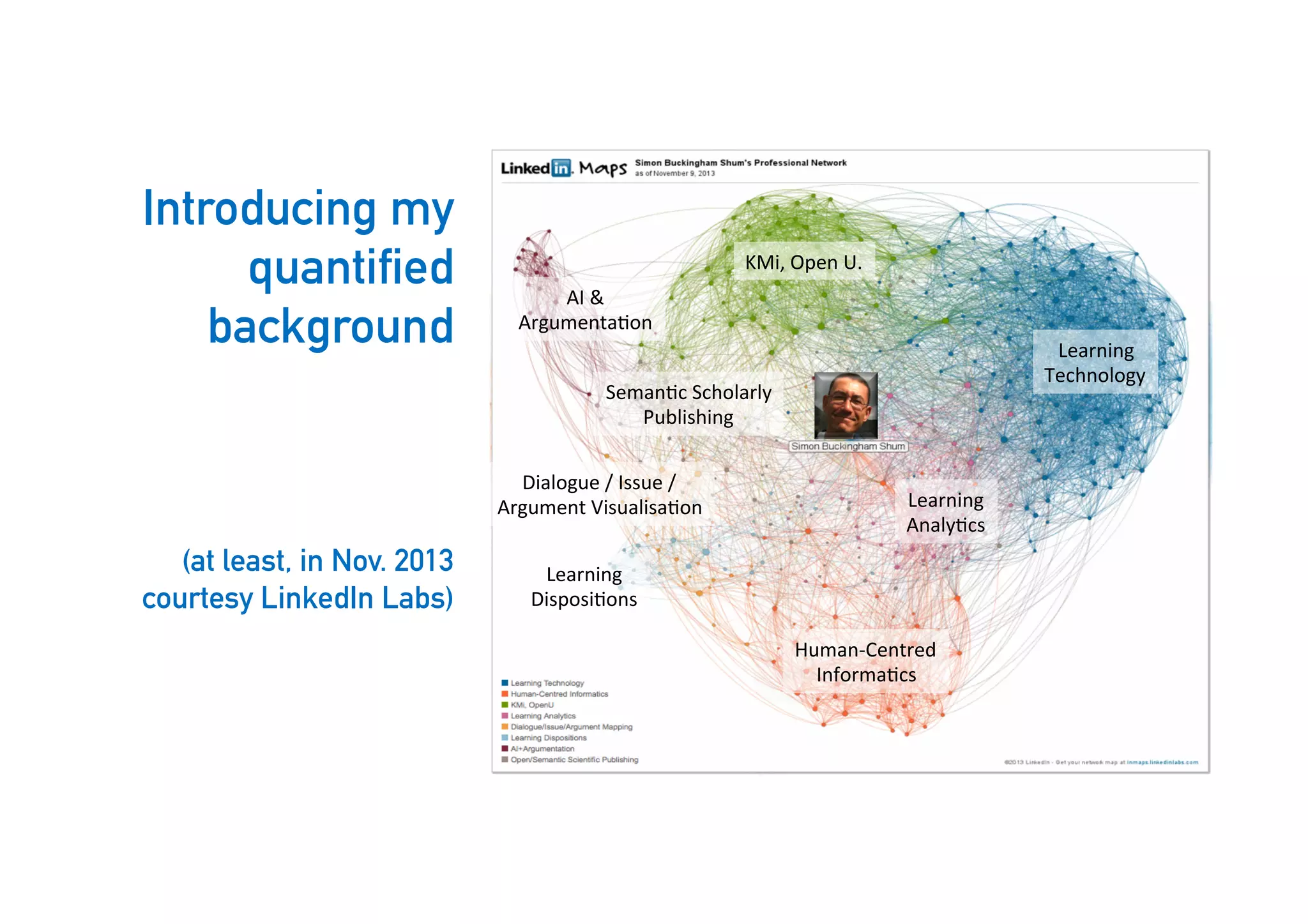
Learning	
  
Technology	
  
KMi,	
  Open	
  U.	
  
AI	
  &	
  
Argumenta<on	
  
Learning	
  
Disposi<ons	
  
Human-­‐Centred	
  	
  
Informa<cs	
  
Learning	
  
Analy<cs	
  
Seman<c	
  Scholarly	
  
Publishing	
  
Dialogue	
  /	
  Issue	
  /	
  
Argument	
  Visualisa<on	
  
Introducing my
quantified
background
(at least, in Nov. 2013
courtesy LinkedIn Labs)
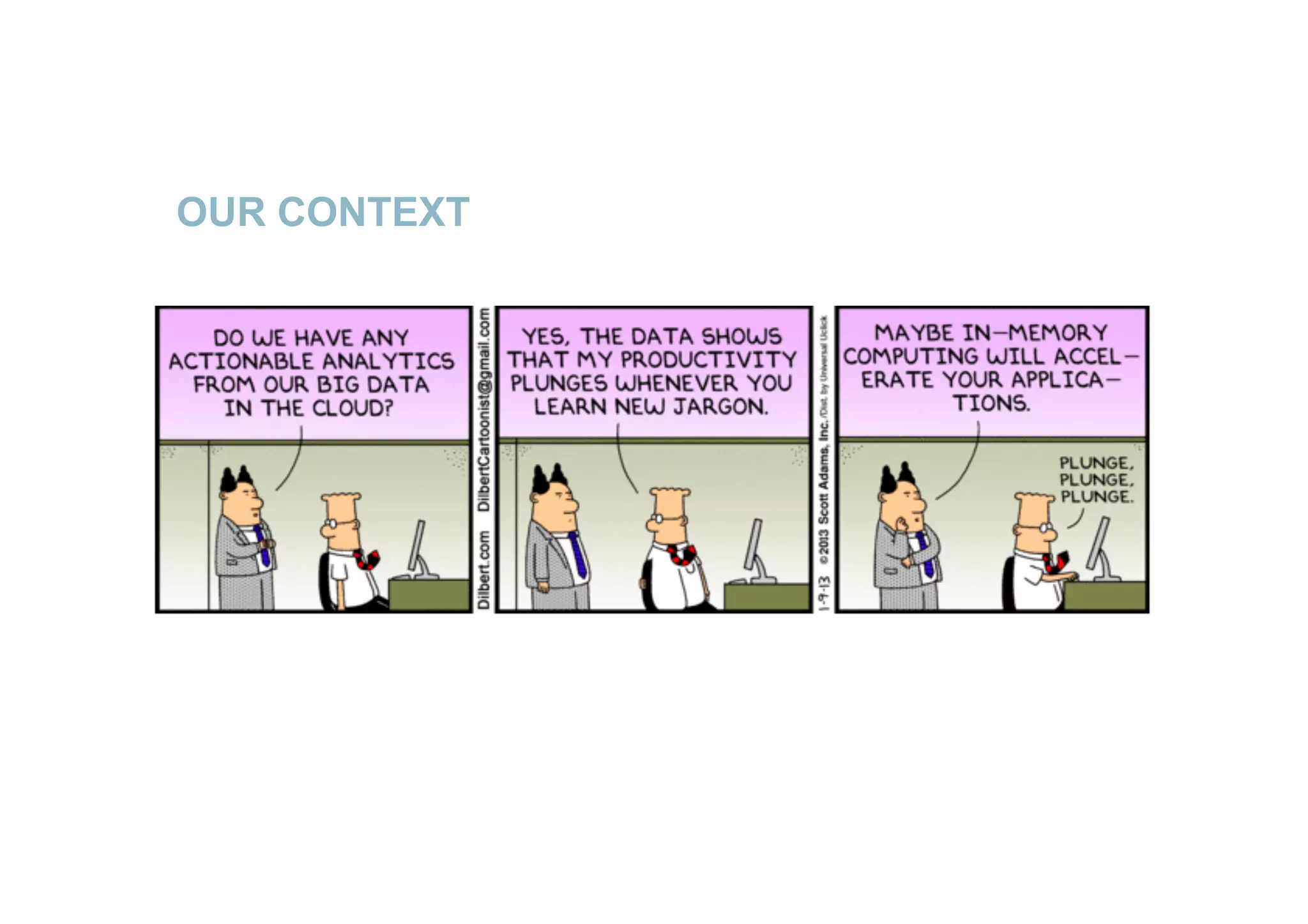
OUR CONTEXT
3
OUR CONTEXT
4
Large scale data and analytics
are pervading societal life
Data and Algorithms have deep societal
implications – good and bad – demanding
informed debate
Implications for the future workforce…
How universities teach, research, operate —
and are assessed…
How to equip graduates for
“the age of complexity” (Stephen Hawking)
2011
2011
Envisioning “the Data
Intensive University”
UTS-wide Forum to consider
the profound implications of
the data revolution
Followed by UTS-wide
consultation, strategy devpt,
and launch of CIC
UTS STRATEGIC CONVERSATION AROUND ANALYTICS
UTS CONNECTED INTELLIGENCE CENTRE
6
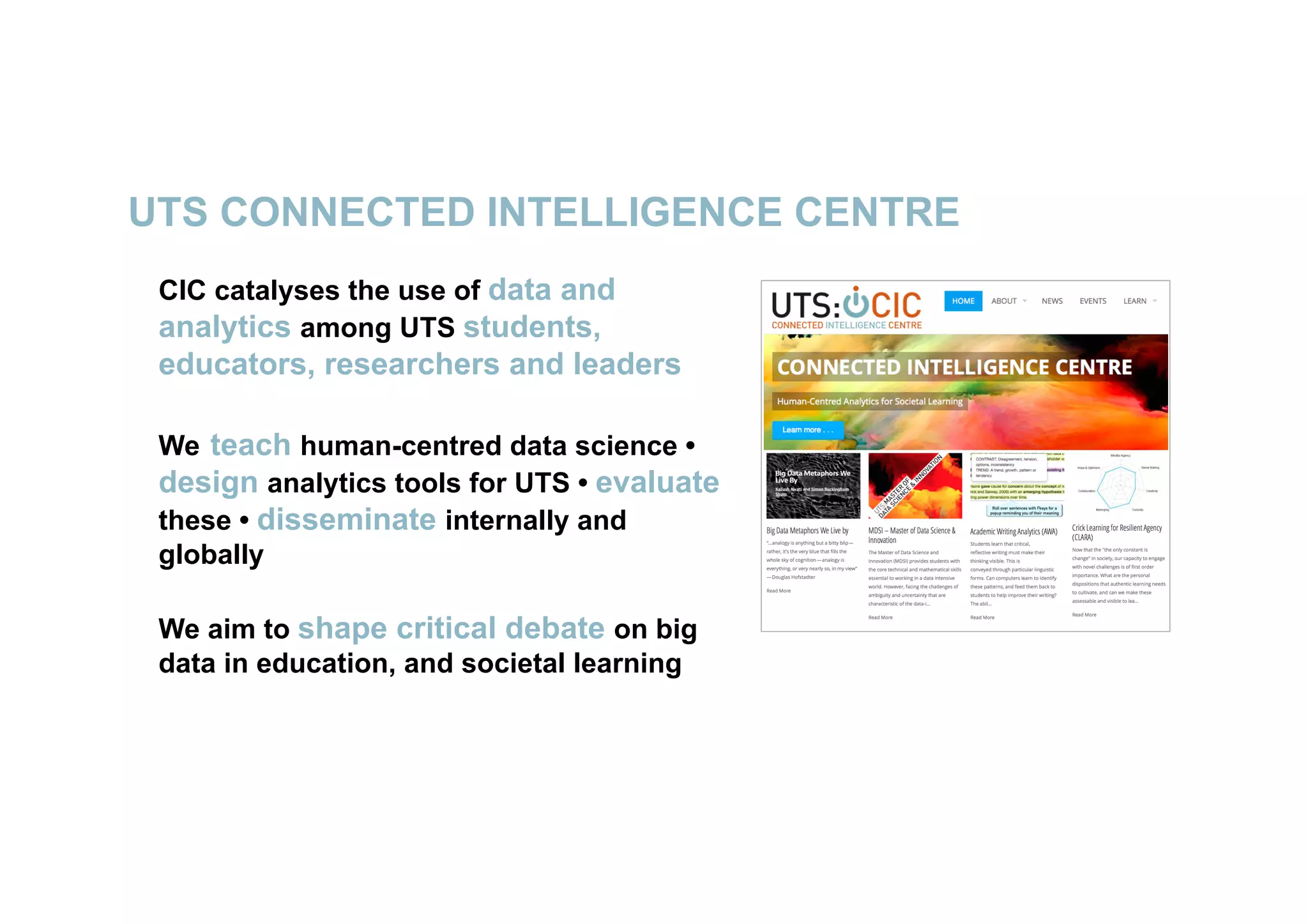
CIC catalyses the use of data and
analytics among UTS students,
educators, researchers and leaders
We teach human-centred data science •
design analytics tools for UTS • evaluate
these • disseminate internally and
globally
We aim to shape critical debate on big
data in education, and societal learning
PARTNERING
ACROSS UTS
7
Faculties
&
Institutes
Student
Support
Units
CIC
Business
Units
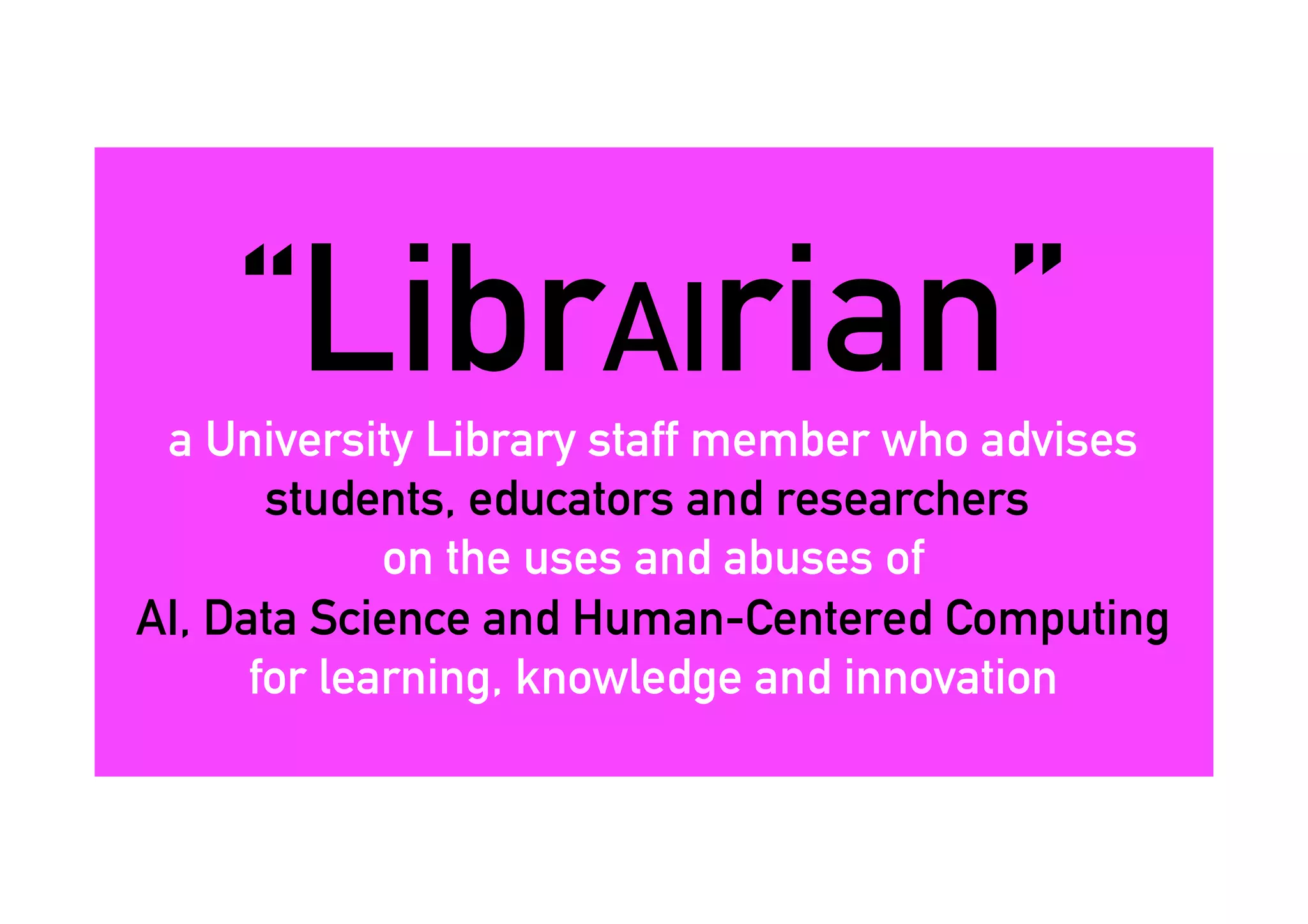
“LibrAIrian”a University Library staff member who advises
students, educators and researchers
on the uses and abuses of
AI, Data Science and Human-Centered Computing
for learning, knowledge and innovation
What’s the difference between
a LibrAIrian and a data technician?
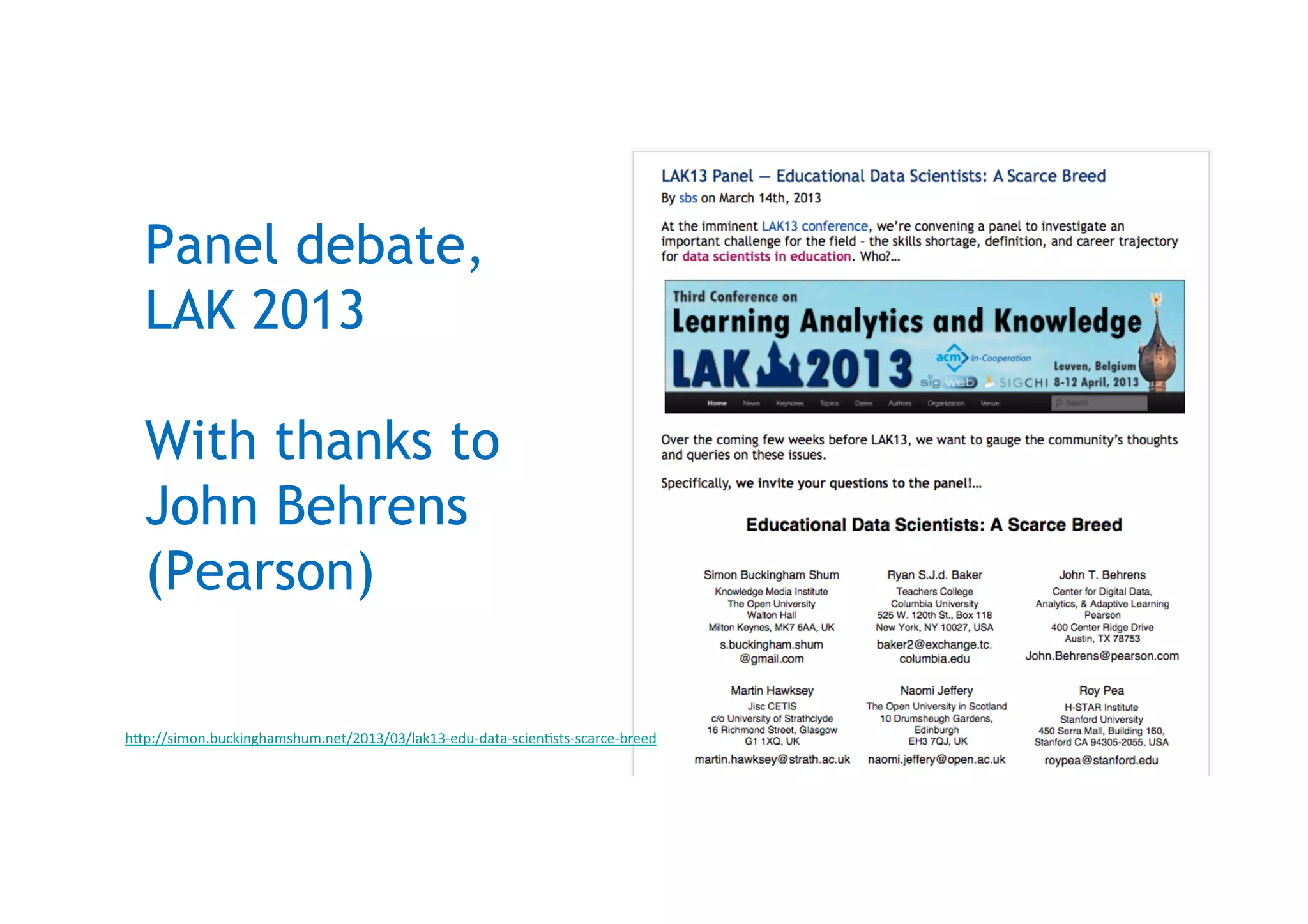
Panel debate,
LAK 2013
With thanks to
John Behrens
(Pearson)
hIp://simon.buckinghamshum.net/2013/03/lak13-­‐edu-­‐data-­‐scien<sts-­‐scarce-­‐breed	
  	
  
Things that make me crazy
“Looks cool. What does it
mean?”
“I don’t know”
“Looks great at a high level,
how have you explored it
and tested the
assumptions?”
“What assumptions?”
“What are the relevant
background issues in this
area?”
“Ask the SME, I’m just the
data person”
“Does it really make sense
to get that result?”
“I don’t know, it just came
out that way”
Be a philosopher
critical perspective
algorithmic + scholarly + creative
intelligence
18
http://www.uts.edu.au/future-students/analytics-and-data-science
A DISTINCTIVE APPROACH TO DATA SCIENCE
utscic.edu.au
machine learning • statistics • data curation • ethics • user experience • information science
visualization • narrative • social computing • learning analytics • project management
project-based learning • authentic assessment
regular, meaningful employer engagement
What’s the difference between
a LibrAIrian and a learning analytics
technician?
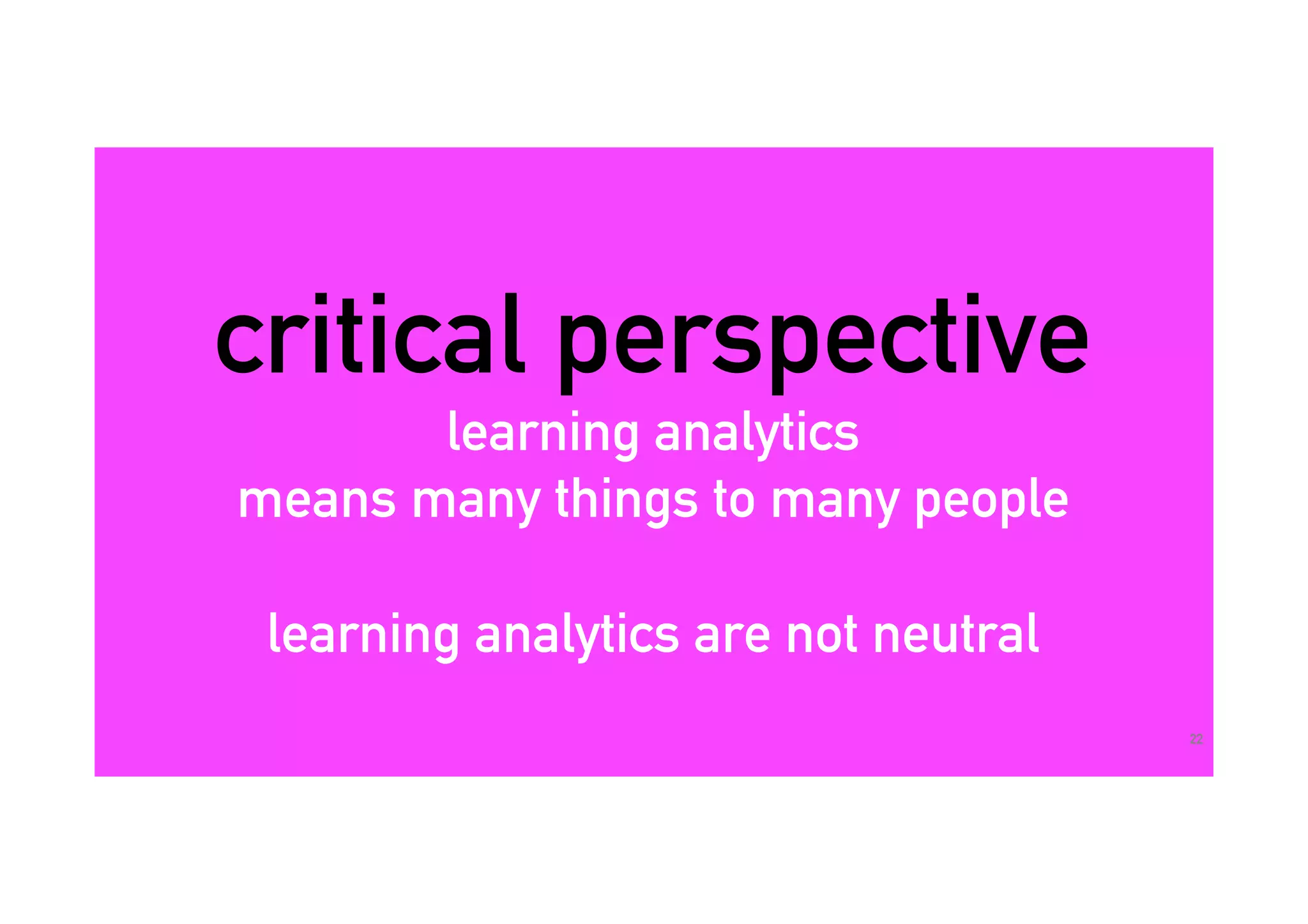
critical perspective
learning analytics
means many things to many people
learning analytics are not neutral
22
It’s out of the labs and into products: every learning tool
now has an “analytics dashboard” (a Google image search)
23
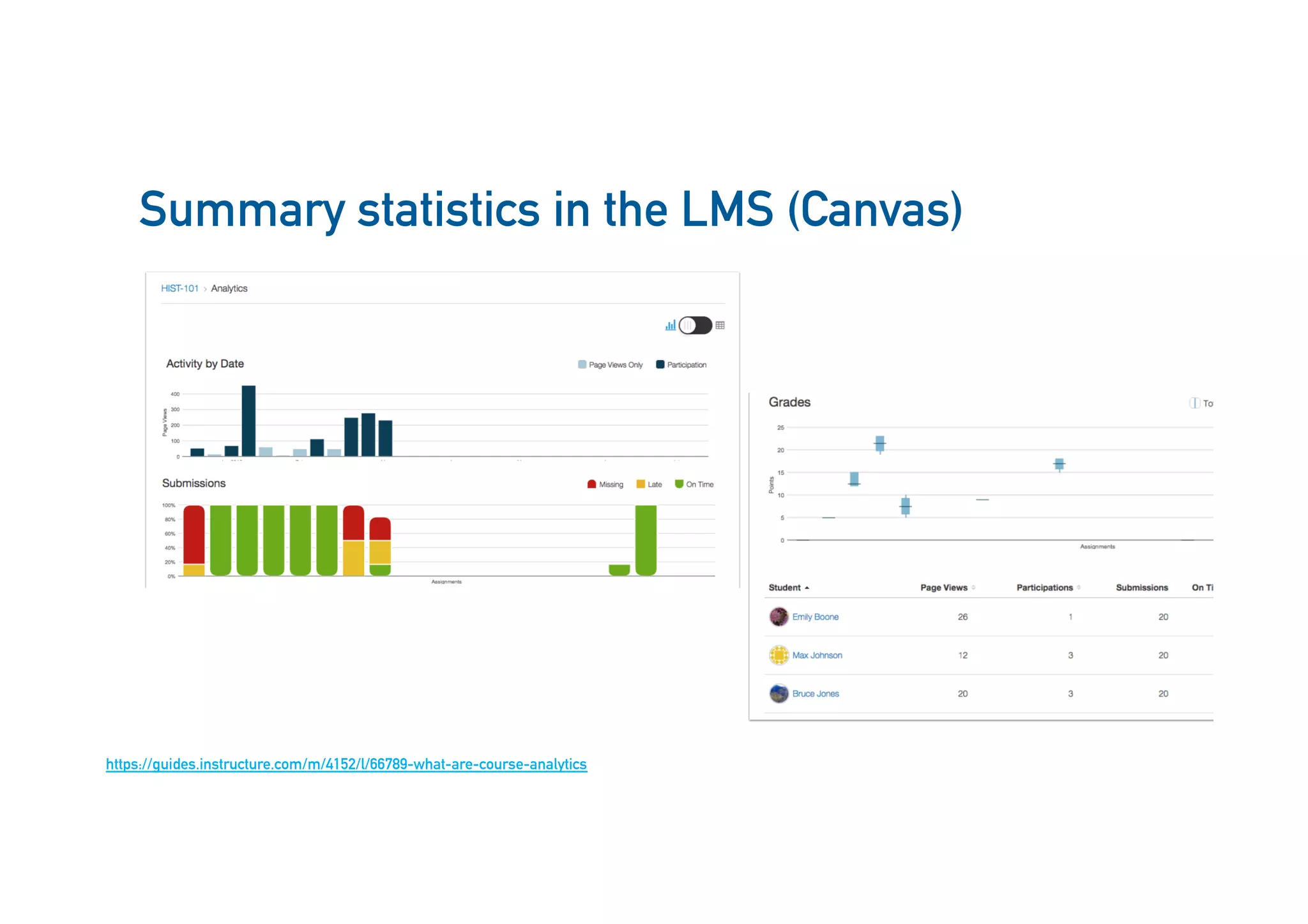
https://guides.instructure.com/m/4152/l/66789-what-are-course-analytics
Summary statistics in the LMS (Canvas)
24
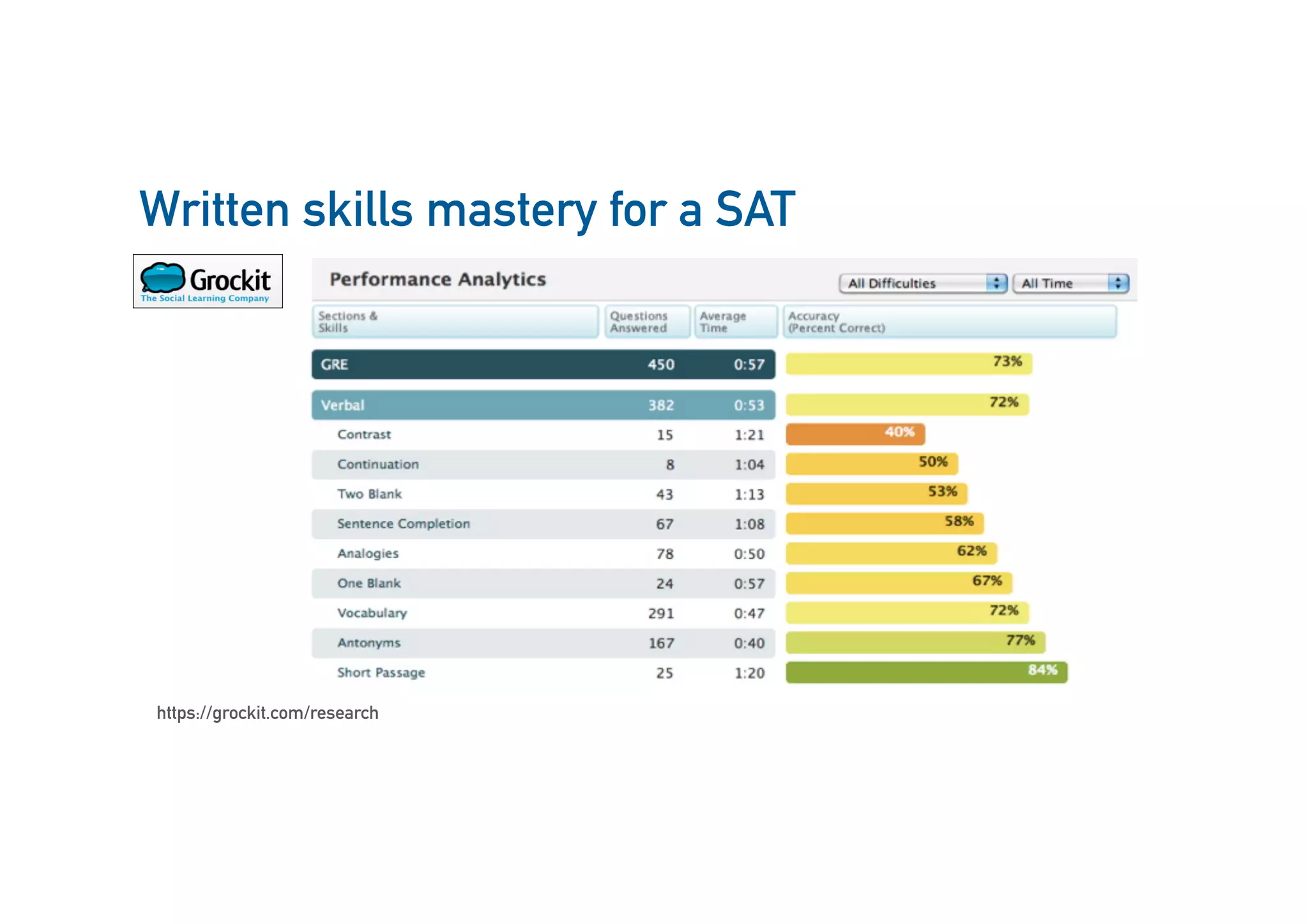
https://grockit.com/research
Written skills mastery for a SAT
25
Intelligent tutoring for skills mastery (CMU)
Lovett M, Meyer O and Thille C. (2008) The Open Learning Initiative: Measuring the effectiveness of the OLI statistics course in accelerating student
learning. Journal of Interactive Media in Education 14. http://jime.open.ac.uk/article/2008-14/352
“In this study, results showed that
OLI-Statistics students [blended
learning] learned a full semester’s
worth of material in half as much
time and performed as well or
better than students learning from
traditional instruction over a full
semester.”
26
Purdue University Signals: real time traffic-lights for
students based on predictive model
27
Campbell et al (2007). Academic Analytics: A New Tool for a New Era, EDUCAUSE
Review, vol. 42, no. 4 (July/August 2007): 40–57. http://bit.ly/lmxG2x
Validate a statistical model from:
•  ACT or SAT score
•  Overall grade-point average
•  CMS usage composite
•  CMS assessment composite
•  CMS assignment composite
•  CMS calendar composite
Predicted 66%-80% of struggling
students who needed help
Spatial clustering algorithm to provoke reflection
28Eric Coopey, R. Benjamin Shapiro, and Ethan Danahy. 2014. Collaborative spatial classification. In Proceedings of the 4th International Conference on
Learning Analytics & Knowledge (LAK '14). ACM, New York, NY, USA, 138-142. DOI= http://dx.doi.org/10.1145/2567574.2567611 	
  
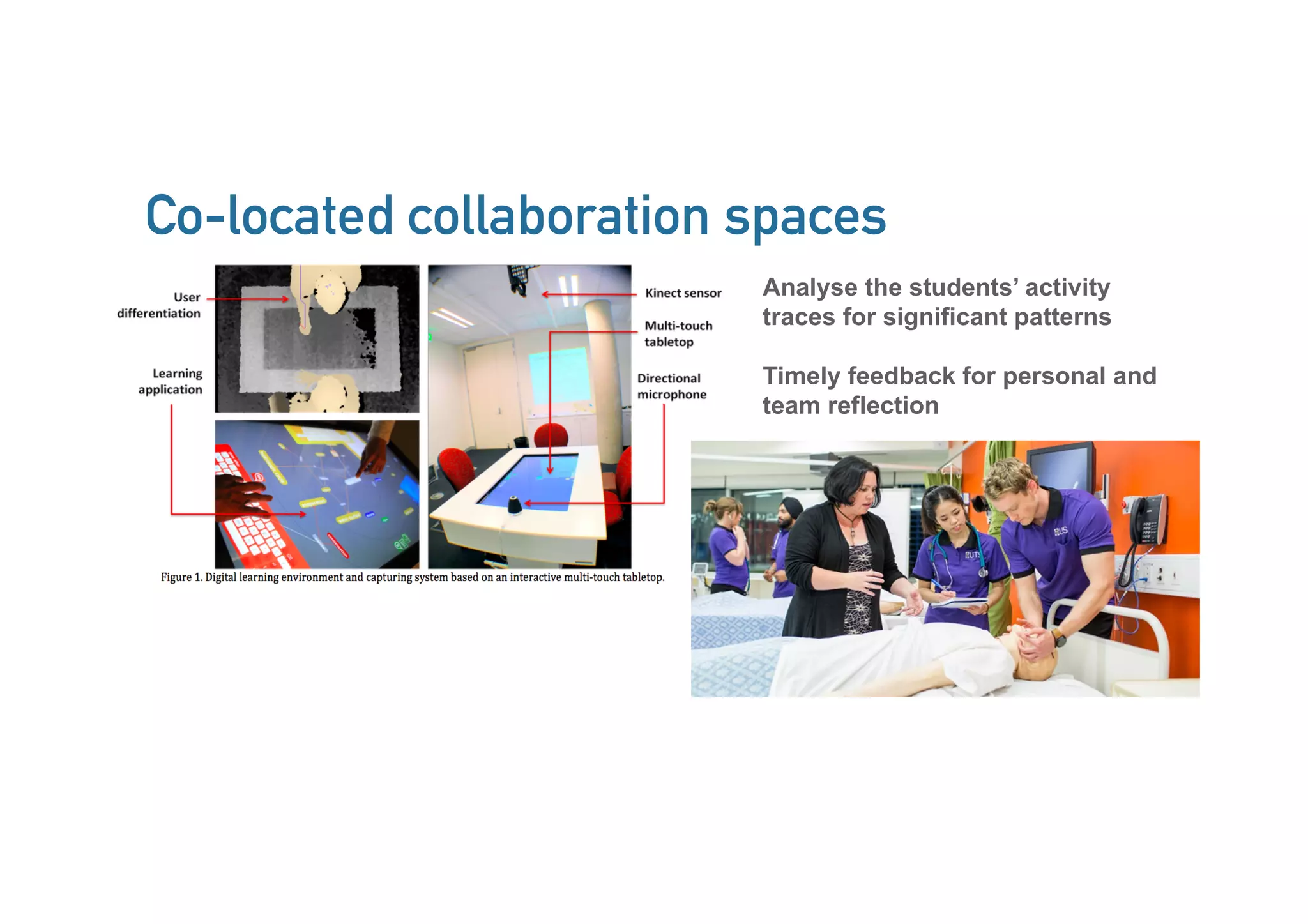
Co-located collaboration spaces
Analyse the students’ activity
traces for significant patterns
Timely feedback for personal and
team reflection
Co-located collaboration spaces
…can now be instrumented with sensors
Voice
Gesture
Pen
Touch
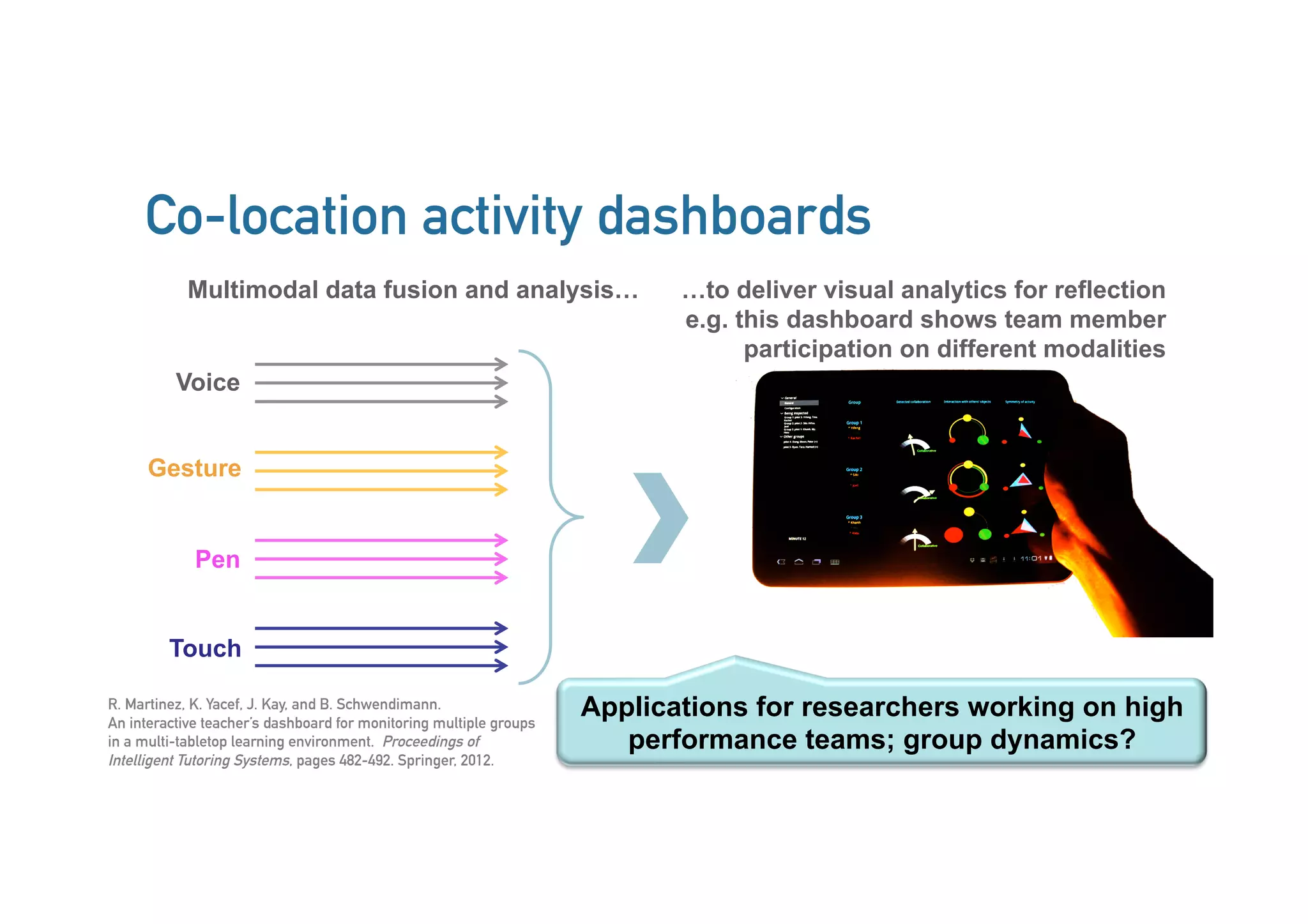
Co-location activity dashboards
Multimodal data fusion and analysis… …to deliver visual analytics for reflection
e.g. this dashboard shows team member
participation on different modalities
Applications for researchers working on high
performance teams; group dynamics?
R. Martinez, K. Yacef, J. Kay, and B. Schwendimann.
An interactive teacher’s dashboard for monitoring multiple groups
in a multi-tabletop learning environment. Proceedings of
Intelligent Tutoring Systems, pages 482-492. Springer, 2012.
Voice
Gesture
Pen
Touch
Visual analytics of f-f teamwork
R. Martinez, K. Yacef, J. Kay, and B. Schwendimann.
An interactive teacher’s dashboard for monitoring
multiple groups in a multi-tabletop learning
environment. Proceedings of Intelligent Tutoring
Systems, pages 482-492. Springer, 2012.
A field exercise…
33
Posture analysis of fieldwork students
34
Masaya Okada and Masahiro Tada. 2014. Formative assessment method of real-world learning by integrating heterogeneous elements of
behavior, knowledge, and the environment. Proceedings 4th International Conference on Learning Analytics and Knowledge (LAK '14).
ACM, New York, NY, USA, 1-10. DOI= http://dx.doi.org/10.1145/2567574.2567579 	
  
1st International Workshop on
Discourse-Centric Learning Analytics
analytics that look beneath
the surface, and quantify
linguistic proxies for ‘deeper
learning’
Beyond number / size / frequency
of posts; ‘hottest thread’
http://www.glennsasscer.com/wordpress/wp-content/uploads/2011/10/iceberg.jpg
http://solaresearch.org/events/lak/lak13/dcla13
Highlighted sentences are colour-
coded according to their broad type
Sentences have Function Keys signalling where
an academic rhetorical move has been
recognised (e.g. a claim of Novelty )
AWA: Academic Writing Analytics
ANALYTICAL writing
https://utscic.edu.au/tools/awa
Reflective writing (Nursing)
Applications for researchers working with text
corpora, e.g. interview transcripts; literature
analysis; scenario planning?
Buckingham Shum, S., Ágnes Sándor, Rosalie Goldsmith, Xiaolong Wang, Randall Bass and Mindy McWilliams (2016, In Press). Reflecting on Reflective Writing
Analytics: Assessment Challenges and Iterative Evaluation of a Prototype Tool. 6th International Learning Analytics & Knowledge Conference (LAK16). Edinburgh, UK.
ACM Press. http://dx.doi.org/10.1145/2883851.2883955 Preprint: http://bit.ly/LAK16paper
Educa<onal	
  worldview	
  
38
epistemology
pedagogyassessment
Knight, S., Buckingham Shum, S. and Littleton, K. (2014). Epistemology, Assessment, Pedagogy: Where Learning Meets Analytics in the Middle Space.
Journal of Learning Analytics, 1, (2), pp.23-47. http://epress.lib.uts.edu.au/journals/index.php/JLA/article/download/3538/4156
Knight, S. and Buckingham Shum, S. (In Press). Theory & Learning Analytics. Handbook of Learning Analytics & Educational Data Mining.
the
middle
space of
learning analytics
What epistemological
assumptions are shaping the
assessment regime, and hence
the pedagogy?
What questions are analytics used
to help answer?
To go deeper into analytics for “21st century competencies”
39
hIp://simon.buckinghamshum.net/2015/05/cfp-­‐learning-­‐analy<cs-­‐for-­‐c21-­‐competencies	
  	
  
Contributions are invited to this special issue:
•  Analytics for higher order competencies such as critical thinking,
curiosity, resilience, creativity, collaboration, sensemaking, self-
regulation, reflection/meta-cognition, transdisciplinary thinking, or
skilful improvisation
•  Theoretical arguments around the opportunities, or indeed the limits, for
analytics in illuminating particular competencies
•  Principles and methodologies for combining complementary analytical
approaches, including reflections on conventional educational
assessment instruments, and computational approaches
•  Methodologies for validating analytics
•  Analytics for learning dispositions/mindsets/“non-cognitive” factors
known to shape readiness to engage in learning
•  Analytics for different kinds of authentic assessment and inquiry-based
learning
•  Technological challenges and opportunities for lifelong, life-wide
learning analytics extending beyond formal educational contexts
•  Arguments regarding whether analytics could effect a shift in the
assessment regimes, and associated pedagogies and epistemologies,
promoted by conventional education policy
•  Analysis of the systemic organisational adoption issues for such
analytics
•  Visualisation design for different user groups, in particular, to promote
increasing learner self-awareness and capacity to take responsibility for
one’s learning
Next	
  Special	
  Issue	
  (due	
  July	
  2016)	
  
What’s the difference between
a LibrAIrian and a knowledge
infrastructure scholar?
critical perspective
knowledge infrastructures
embody values and assign power
41
Framing future knowledge
infrastructures
http://knowledgeinfrastructures.org
Framing future knowledge
infrastructures
http://knowledgeinfrastructures.org
This too, however, is not a neutral
feature. As knowledge
infrastructures shape, generate
and distribute knowledge, they do
so differentially, often in ways that
encode and reinforce existing
interests and relations of power.
[…] At scale, the effect of these
choices may be an aggregate
imbalance in the structure and
distribution of our knowledge.
Framing future knowledge
infrastructures
http://knowledgeinfrastructures.org
“Transformative infrastructures cannot be merely
technical; they must engage
fundamental changes in our
social institutions, practices,
norms and beliefs as well. For that
reason, many scholars have dropped the dualistic
vocabulary of “technical” and “social” altogether as
anything other than a first order approximation,
replacing those terms with concepts such as
collectives (Latour 2005),
assemblages (Ong & Collier 2005), or
configurations (Suchman 2007…”
Accounting tools are not neutral
Du Gay, P. and Pryke, M. (2002) Cultural Economy: Cultural Analysis and Commercial Life. Sage, London. pp. 12-13
“accounting tools...do not simply
aid the measurement of economic
activity, they shape the
reality they measure”
45
Bowker, G. C. and Star, L. S. (1999). Sorting Things Out: Classification and Its Consequences. MIT Press, Cambridge, MA, pp. 277, 278, 281
“Classification systems provide both a
warrant and a tool for forgetting
[...] what to forget and how to forget it
[...] The argument comes down to asking
not only what gets coded in but what gets
coded out of a given scheme.”
46
Selwyn, N. (2014).  Data entry: towards the critical study of digital data and education. Learning, Media and Technology.
http://dx.doi.org/10.1080/17439884.2014.921628
“observing, measuring, describing,
categorising, classifying, sorting, ordering
and ranking). […] these processes of meaning-making are never
wholly neutral, objective and ‘automated’ but are fraught with
problems and compromises, biases and
omissions.
47
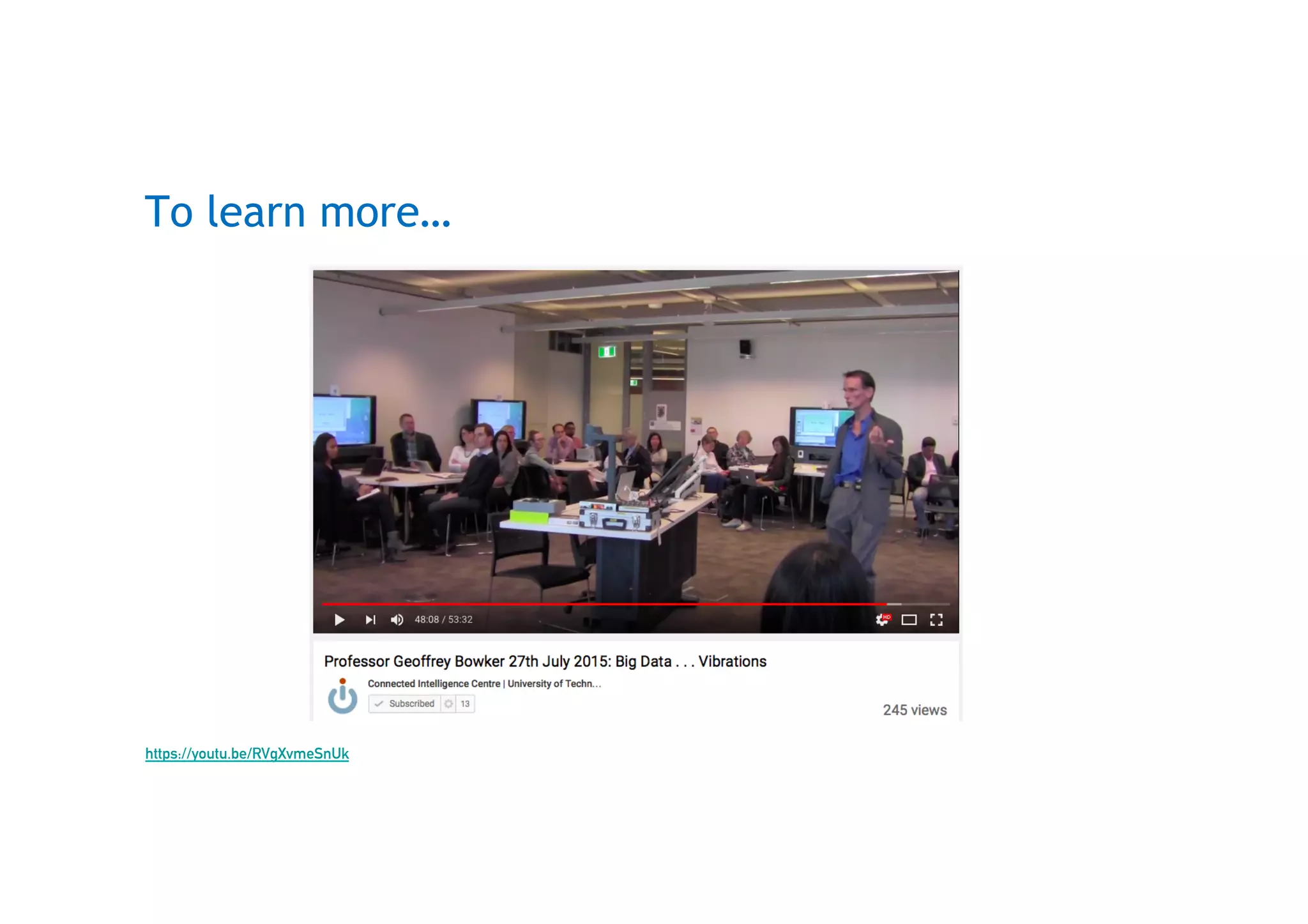
To learn more…
https://youtu.be/RVgXvmeSnUk
http://governingalgorithms.org
In	
  an	
  increasingly	
  algorithmic	
  
world	
  […]	
  What,	
  then,	
  do	
  we	
  
talk	
  about	
  when	
  we	
  talk	
  about	
  
“governing	
  algorithms”? 	
  
49
To learn more…
50
hIp://simon.buckinghamshum.net/2016/03/algorithmic-­‐accountability-­‐for-­‐learning-­‐analy<cs	
  	
  
“LibrAIrian”a University Library staff member who advises
students, educators and researchers
on the uses and abuses of
AI, Data Science and Human-Centered Computing
for learning, knowledge and innovation
51
Thank You!
Discussion…
@sbuckshum

Who are you and makes you special?

  • 1.
    Who are youand makes you special? Simon Buckingham Shum Professor of Learning Informatics Director, UTS Connected Intelligence Centre @sbuckshum • Simon.BuckinghamShum.net utscic.edu.au Keynote, Library Data Carpentry 2016, Sydney http://librarydatacarpentry.github.io
  • 2.
    Learning   Technology   KMi,  Open  U.   AI  &   Argumenta<on   Learning   Disposi<ons   Human-­‐Centred     Informa<cs   Learning   Analy<cs   Seman<c  Scholarly   Publishing   Dialogue  /  Issue  /   Argument  Visualisa<on   Introducing my quantified background (at least, in Nov. 2013 courtesy LinkedIn Labs)
  • 3.
  • 4.
    OUR CONTEXT 4 Large scaledata and analytics are pervading societal life Data and Algorithms have deep societal implications – good and bad – demanding informed debate Implications for the future workforce… How universities teach, research, operate — and are assessed… How to equip graduates for “the age of complexity” (Stephen Hawking)
  • 5.
    2011 2011 Envisioning “the Data IntensiveUniversity” UTS-wide Forum to consider the profound implications of the data revolution Followed by UTS-wide consultation, strategy devpt, and launch of CIC UTS STRATEGIC CONVERSATION AROUND ANALYTICS
  • 6.
    UTS CONNECTED INTELLIGENCECENTRE 6 CIC catalyses the use of data and analytics among UTS students, educators, researchers and leaders We teach human-centred data science • design analytics tools for UTS • evaluate these • disseminate internally and globally We aim to shape critical debate on big data in education, and societal learning
  • 7.
  • 8.
    “LibrAIrian”a University Librarystaff member who advises students, educators and researchers on the uses and abuses of AI, Data Science and Human-Centered Computing for learning, knowledge and innovation
  • 10.
    What’s the differencebetween a LibrAIrian and a data technician?
  • 11.
    Panel debate, LAK 2013 Withthanks to John Behrens (Pearson) hIp://simon.buckinghamshum.net/2013/03/lak13-­‐edu-­‐data-­‐scien<sts-­‐scarce-­‐breed    
  • 12.
  • 13.
    “Looks cool. Whatdoes it mean?” “I don’t know”
  • 14.
    “Looks great ata high level, how have you explored it and tested the assumptions?” “What assumptions?”
  • 15.
    “What are therelevant background issues in this area?” “Ask the SME, I’m just the data person”
  • 16.
    “Does it reallymake sense to get that result?” “I don’t know, it just came out that way”
  • 17.
  • 18.
    critical perspective algorithmic +scholarly + creative intelligence 18
  • 19.
  • 20.
    A DISTINCTIVE APPROACHTO DATA SCIENCE utscic.edu.au machine learning • statistics • data curation • ethics • user experience • information science visualization • narrative • social computing • learning analytics • project management project-based learning • authentic assessment regular, meaningful employer engagement
  • 21.
    What’s the differencebetween a LibrAIrian and a learning analytics technician?
  • 22.
    critical perspective learning analytics meansmany things to many people learning analytics are not neutral 22
  • 23.
    It’s out ofthe labs and into products: every learning tool now has an “analytics dashboard” (a Google image search) 23
  • 24.
  • 25.
  • 26.
    Intelligent tutoring forskills mastery (CMU) Lovett M, Meyer O and Thille C. (2008) The Open Learning Initiative: Measuring the effectiveness of the OLI statistics course in accelerating student learning. Journal of Interactive Media in Education 14. http://jime.open.ac.uk/article/2008-14/352 “In this study, results showed that OLI-Statistics students [blended learning] learned a full semester’s worth of material in half as much time and performed as well or better than students learning from traditional instruction over a full semester.” 26
  • 27.
    Purdue University Signals:real time traffic-lights for students based on predictive model 27 Campbell et al (2007). Academic Analytics: A New Tool for a New Era, EDUCAUSE Review, vol. 42, no. 4 (July/August 2007): 40–57. http://bit.ly/lmxG2x Validate a statistical model from: •  ACT or SAT score •  Overall grade-point average •  CMS usage composite •  CMS assessment composite •  CMS assignment composite •  CMS calendar composite Predicted 66%-80% of struggling students who needed help
  • 28.
    Spatial clustering algorithmto provoke reflection 28Eric Coopey, R. Benjamin Shapiro, and Ethan Danahy. 2014. Collaborative spatial classification. In Proceedings of the 4th International Conference on Learning Analytics & Knowledge (LAK '14). ACM, New York, NY, USA, 138-142. DOI= http://dx.doi.org/10.1145/2567574.2567611  
  • 29.
    Co-located collaboration spaces Analysethe students’ activity traces for significant patterns Timely feedback for personal and team reflection
  • 30.
    Co-located collaboration spaces …cannow be instrumented with sensors Voice Gesture Pen Touch
  • 31.
    Co-location activity dashboards Multimodaldata fusion and analysis… …to deliver visual analytics for reflection e.g. this dashboard shows team member participation on different modalities Applications for researchers working on high performance teams; group dynamics? R. Martinez, K. Yacef, J. Kay, and B. Schwendimann. An interactive teacher’s dashboard for monitoring multiple groups in a multi-tabletop learning environment. Proceedings of Intelligent Tutoring Systems, pages 482-492. Springer, 2012. Voice Gesture Pen Touch
  • 32.
    Visual analytics off-f teamwork R. Martinez, K. Yacef, J. Kay, and B. Schwendimann. An interactive teacher’s dashboard for monitoring multiple groups in a multi-tabletop learning environment. Proceedings of Intelligent Tutoring Systems, pages 482-492. Springer, 2012.
  • 33.
  • 34.
    Posture analysis offieldwork students 34 Masaya Okada and Masahiro Tada. 2014. Formative assessment method of real-world learning by integrating heterogeneous elements of behavior, knowledge, and the environment. Proceedings 4th International Conference on Learning Analytics and Knowledge (LAK '14). ACM, New York, NY, USA, 1-10. DOI= http://dx.doi.org/10.1145/2567574.2567579  
  • 35.
    1st International Workshopon Discourse-Centric Learning Analytics analytics that look beneath the surface, and quantify linguistic proxies for ‘deeper learning’ Beyond number / size / frequency of posts; ‘hottest thread’ http://www.glennsasscer.com/wordpress/wp-content/uploads/2011/10/iceberg.jpg http://solaresearch.org/events/lak/lak13/dcla13
  • 36.
    Highlighted sentences arecolour- coded according to their broad type Sentences have Function Keys signalling where an academic rhetorical move has been recognised (e.g. a claim of Novelty ) AWA: Academic Writing Analytics ANALYTICAL writing https://utscic.edu.au/tools/awa
  • 37.
    Reflective writing (Nursing) Applicationsfor researchers working with text corpora, e.g. interview transcripts; literature analysis; scenario planning? Buckingham Shum, S., Ágnes Sándor, Rosalie Goldsmith, Xiaolong Wang, Randall Bass and Mindy McWilliams (2016, In Press). Reflecting on Reflective Writing Analytics: Assessment Challenges and Iterative Evaluation of a Prototype Tool. 6th International Learning Analytics & Knowledge Conference (LAK16). Edinburgh, UK. ACM Press. http://dx.doi.org/10.1145/2883851.2883955 Preprint: http://bit.ly/LAK16paper
  • 38.
    Educa<onal  worldview   38 epistemology pedagogyassessment Knight,S., Buckingham Shum, S. and Littleton, K. (2014). Epistemology, Assessment, Pedagogy: Where Learning Meets Analytics in the Middle Space. Journal of Learning Analytics, 1, (2), pp.23-47. http://epress.lib.uts.edu.au/journals/index.php/JLA/article/download/3538/4156 Knight, S. and Buckingham Shum, S. (In Press). Theory & Learning Analytics. Handbook of Learning Analytics & Educational Data Mining. the middle space of learning analytics What epistemological assumptions are shaping the assessment regime, and hence the pedagogy? What questions are analytics used to help answer?
  • 39.
    To go deeperinto analytics for “21st century competencies” 39 hIp://simon.buckinghamshum.net/2015/05/cfp-­‐learning-­‐analy<cs-­‐for-­‐c21-­‐competencies     Contributions are invited to this special issue: •  Analytics for higher order competencies such as critical thinking, curiosity, resilience, creativity, collaboration, sensemaking, self- regulation, reflection/meta-cognition, transdisciplinary thinking, or skilful improvisation •  Theoretical arguments around the opportunities, or indeed the limits, for analytics in illuminating particular competencies •  Principles and methodologies for combining complementary analytical approaches, including reflections on conventional educational assessment instruments, and computational approaches •  Methodologies for validating analytics •  Analytics for learning dispositions/mindsets/“non-cognitive” factors known to shape readiness to engage in learning •  Analytics for different kinds of authentic assessment and inquiry-based learning •  Technological challenges and opportunities for lifelong, life-wide learning analytics extending beyond formal educational contexts •  Arguments regarding whether analytics could effect a shift in the assessment regimes, and associated pedagogies and epistemologies, promoted by conventional education policy •  Analysis of the systemic organisational adoption issues for such analytics •  Visualisation design for different user groups, in particular, to promote increasing learner self-awareness and capacity to take responsibility for one’s learning Next  Special  Issue  (due  July  2016)  
  • 40.
    What’s the differencebetween a LibrAIrian and a knowledge infrastructure scholar?
  • 41.
  • 42.
  • 43.
    Framing future knowledge infrastructures http://knowledgeinfrastructures.org Thistoo, however, is not a neutral feature. As knowledge infrastructures shape, generate and distribute knowledge, they do so differentially, often in ways that encode and reinforce existing interests and relations of power. […] At scale, the effect of these choices may be an aggregate imbalance in the structure and distribution of our knowledge.
  • 44.
    Framing future knowledge infrastructures http://knowledgeinfrastructures.org “Transformativeinfrastructures cannot be merely technical; they must engage fundamental changes in our social institutions, practices, norms and beliefs as well. For that reason, many scholars have dropped the dualistic vocabulary of “technical” and “social” altogether as anything other than a first order approximation, replacing those terms with concepts such as collectives (Latour 2005), assemblages (Ong & Collier 2005), or configurations (Suchman 2007…”
  • 45.
    Accounting tools arenot neutral Du Gay, P. and Pryke, M. (2002) Cultural Economy: Cultural Analysis and Commercial Life. Sage, London. pp. 12-13 “accounting tools...do not simply aid the measurement of economic activity, they shape the reality they measure” 45
  • 46.
    Bowker, G. C.and Star, L. S. (1999). Sorting Things Out: Classification and Its Consequences. MIT Press, Cambridge, MA, pp. 277, 278, 281 “Classification systems provide both a warrant and a tool for forgetting [...] what to forget and how to forget it [...] The argument comes down to asking not only what gets coded in but what gets coded out of a given scheme.” 46
  • 47.
    Selwyn, N. (2014). Data entry: towards the critical study of digital data and education. Learning, Media and Technology. http://dx.doi.org/10.1080/17439884.2014.921628 “observing, measuring, describing, categorising, classifying, sorting, ordering and ranking). […] these processes of meaning-making are never wholly neutral, objective and ‘automated’ but are fraught with problems and compromises, biases and omissions. 47
  • 48.
  • 49.
    http://governingalgorithms.org In  an  increasingly  algorithmic   world  […]  What,  then,  do  we   talk  about  when  we  talk  about   “governing  algorithms”?    49
  • 50.
  • 51.
    “LibrAIrian”a University Librarystaff member who advises students, educators and researchers on the uses and abuses of AI, Data Science and Human-Centered Computing for learning, knowledge and innovation 51
  • 52.