The Fan Company
          www.jmcproducts.com


 Sleeve and Ball Bearing
Operational Characteristics
    Technical Report
               Prepared by


            Dwayne Ganner

        JMC Mechanical Engineer


             December 2009

                 Rev 2
Technical Report
Purpose
The purpose of this document is to explain the start up RPM differences between sleeve
and ball bearing fans.

Conclusion
Sleeve bearing fans use oil instead of grease as a lubricant which has a lower viscosity.
Therefore, sleeve bearing fans will require a warm up period to reach nominal RPM
values, especially at lower operating temperatures.

Technical Information
Sleeve bearings use an oil as lubricant and ball bearings use grease. Ball and sleeve
bearing fans are chosen for various reasons by an end user. These reasons will not be
covered in detail in this document, but typically a ball bearing will be chosen for higher
speed applications, higher reliability and larger form factor sizes. Sleeve bearings are
chosen for cost savings and slower speed applications. A user of a fan may notice that
upon start up a sleeve bearing fan will have a different RPM than a ball bearing fan for
the same form factor size and nominal RPM rating. However, these same sleeve and ball
bearing fans will perform the same after both fans have been running for several minutes.
There are various technical reasons and design characteristics of both types of bearings
that contribute to these differences. The largest factor for the difference in RPM readings
at start up is due to the lubricant used in each bearing. A sleeve bearing fan uses oil and a
ball bearing fan uses grease as its lubricants.

The oil and grease lubricates are affected by two main factors: Viscosity (a substances
resistance to flow) and temperature. The viscosity of grease is typically 3-4 times higher
than an oil lubricant at the same temperature. Due to the lower viscosity of lubricating
oil the effect of temperature will be more noticeable than on grease. For example a
lubricating oil can have a viscosity 6-7 times higher when going from 40 to 100 ˚C (see
Table 1 below).

Lubricant                   Typical Viscosity Range at       Typical Viscosity Range at
                            40˚C (mm²/sec)                   100˚C (mm²/sec)
Oil                         50-70                            7-9
Grease                      200-250                          30-50

Table 1. Typical Viscosity Ranges for bearing lubricants.

Understanding the effect of temperature and viscosity of the oil lubricant used in a sleeve
bearing helps to explain the reason why a fan that uses a sleeve bearing will have a
different RPM at start up than the nominal speed. The lubrication oil heats up as the
impeller turns due to friction and current running through the motor windings which
changes the viscosity of the lubrication oil. However, the oil viscosity is changing a lot
faster compared to the thermal properties of the motor wires and other materials in the
fan. This will cause the RPM of a sleeve bearing fan to vary until the motor, impeller,
and oil reach an equilibrium operating temperature which typically takes 6-10 minutes.


Page 2 of 3
Technical Report
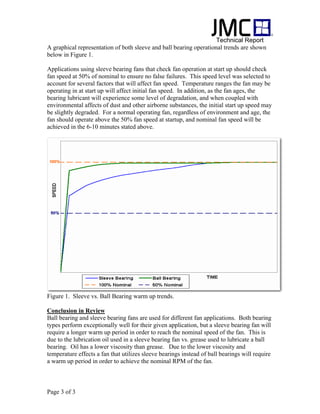
A graphical representation of both sleeve and ball bearing operational trends are shown
below in Figure 1.

Applications using sleeve bearing fans that check fan operation at start up should check
fan speed at 50% of nominal to ensure no false failures. This speed level was selected to
account for several factors that will affect fan speed. Temperature ranges the fan may be
operating in at start up will affect initial fan speed. In addition, as the fan ages, the
bearing lubricant will experience some level of degradation, and when coupled with
environmental affects of dust and other airborne substances, the initial start up speed may
be slightly degraded. For a normal operating fan, regardless of environment and age, the
fan should operate above the 50% fan speed at startup, and nominal fan speed will be
achieved in the 6-10 minutes stated above.


Figure 1. Sleeve vs. Ball Bearing warm up trends.

Conclusion in Review
Ball bearing and sleeve bearing fans are used for different fan applications. Both bearing
types perform exceptionally well for their given application, but a sleeve bearing fan will
require a longer warm up period in order to reach the nominal speed of the fan. This is
due to the lubrication oil used in a sleeve bearing fan vs. grease used to lubricate a ball
bearing. Oil has a lower viscosity than grease. Due to the lower viscosity and
temperature effects a fan that utilizes sleeve bearings instead of ball bearings will require
a warm up period in order to achieve the nominal RPM of the fan.


Page 3 of 3

Sleeve & Ball Bearing Operational Characteristics

  • 1.
    The Fan Company www.jmcproducts.com Sleeve and Ball Bearing Operational Characteristics Technical Report Prepared by Dwayne Ganner JMC Mechanical Engineer December 2009 Rev 2
  • 2.
    Technical Report Purpose The purposeof this document is to explain the start up RPM differences between sleeve and ball bearing fans. Conclusion Sleeve bearing fans use oil instead of grease as a lubricant which has a lower viscosity. Therefore, sleeve bearing fans will require a warm up period to reach nominal RPM values, especially at lower operating temperatures. Technical Information Sleeve bearings use an oil as lubricant and ball bearings use grease. Ball and sleeve bearing fans are chosen for various reasons by an end user. These reasons will not be covered in detail in this document, but typically a ball bearing will be chosen for higher speed applications, higher reliability and larger form factor sizes. Sleeve bearings are chosen for cost savings and slower speed applications. A user of a fan may notice that upon start up a sleeve bearing fan will have a different RPM than a ball bearing fan for the same form factor size and nominal RPM rating. However, these same sleeve and ball bearing fans will perform the same after both fans have been running for several minutes. There are various technical reasons and design characteristics of both types of bearings that contribute to these differences. The largest factor for the difference in RPM readings at start up is due to the lubricant used in each bearing. A sleeve bearing fan uses oil and a ball bearing fan uses grease as its lubricants. The oil and grease lubricates are affected by two main factors: Viscosity (a substances resistance to flow) and temperature. The viscosity of grease is typically 3-4 times higher than an oil lubricant at the same temperature. Due to the lower viscosity of lubricating oil the effect of temperature will be more noticeable than on grease. For example a lubricating oil can have a viscosity 6-7 times higher when going from 40 to 100 ˚C (see Table 1 below). Lubricant Typical Viscosity Range at Typical Viscosity Range at 40˚C (mm²/sec) 100˚C (mm²/sec) Oil 50-70 7-9 Grease 200-250 30-50 Table 1. Typical Viscosity Ranges for bearing lubricants. Understanding the effect of temperature and viscosity of the oil lubricant used in a sleeve bearing helps to explain the reason why a fan that uses a sleeve bearing will have a different RPM at start up than the nominal speed. The lubrication oil heats up as the impeller turns due to friction and current running through the motor windings which changes the viscosity of the lubrication oil. However, the oil viscosity is changing a lot faster compared to the thermal properties of the motor wires and other materials in the fan. This will cause the RPM of a sleeve bearing fan to vary until the motor, impeller, and oil reach an equilibrium operating temperature which typically takes 6-10 minutes. Page 2 of 3
  • 3.
    Technical Report A graphicalrepresentation of both sleeve and ball bearing operational trends are shown below in Figure 1. Applications using sleeve bearing fans that check fan operation at start up should check fan speed at 50% of nominal to ensure no false failures. This speed level was selected to account for several factors that will affect fan speed. Temperature ranges the fan may be operating in at start up will affect initial fan speed. In addition, as the fan ages, the bearing lubricant will experience some level of degradation, and when coupled with environmental affects of dust and other airborne substances, the initial start up speed may be slightly degraded. For a normal operating fan, regardless of environment and age, the fan should operate above the 50% fan speed at startup, and nominal fan speed will be achieved in the 6-10 minutes stated above. Figure 1. Sleeve vs. Ball Bearing warm up trends. Conclusion in Review Ball bearing and sleeve bearing fans are used for different fan applications. Both bearing types perform exceptionally well for their given application, but a sleeve bearing fan will require a longer warm up period in order to reach the nominal speed of the fan. This is due to the lubrication oil used in a sleeve bearing fan vs. grease used to lubricate a ball bearing. Oil has a lower viscosity than grease. Due to the lower viscosity and temperature effects a fan that utilizes sleeve bearings instead of ball bearings will require a warm up period in order to achieve the nominal RPM of the fan. Page 3 of 3