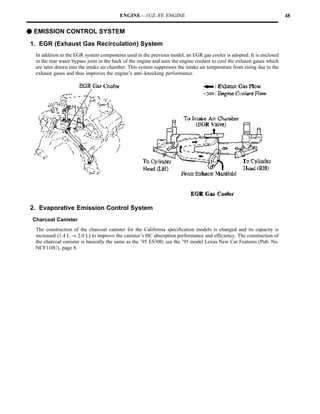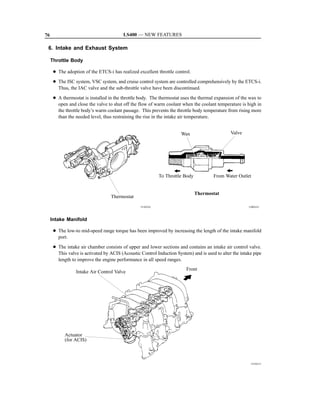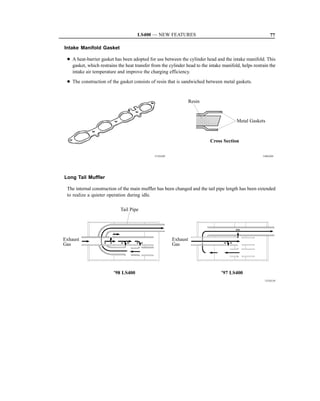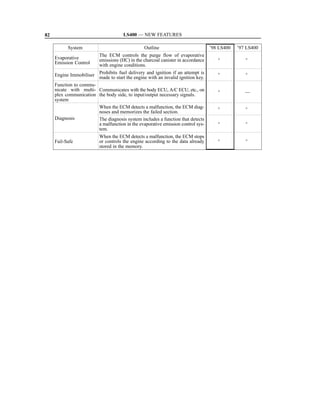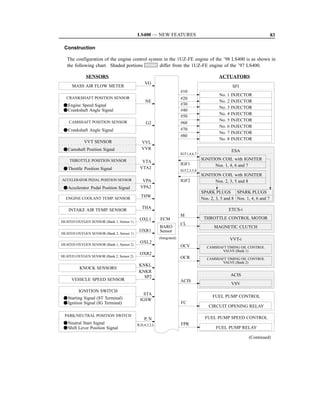
ENGINE — 1UZ–FE ENGINE                                                 81


                                                 ENGINE

1UZ–FE ENGINE
F DESCRIPTION
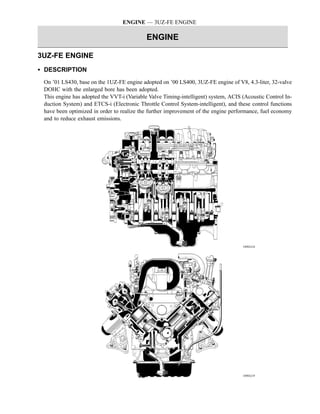
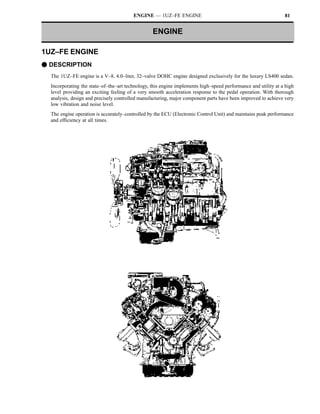
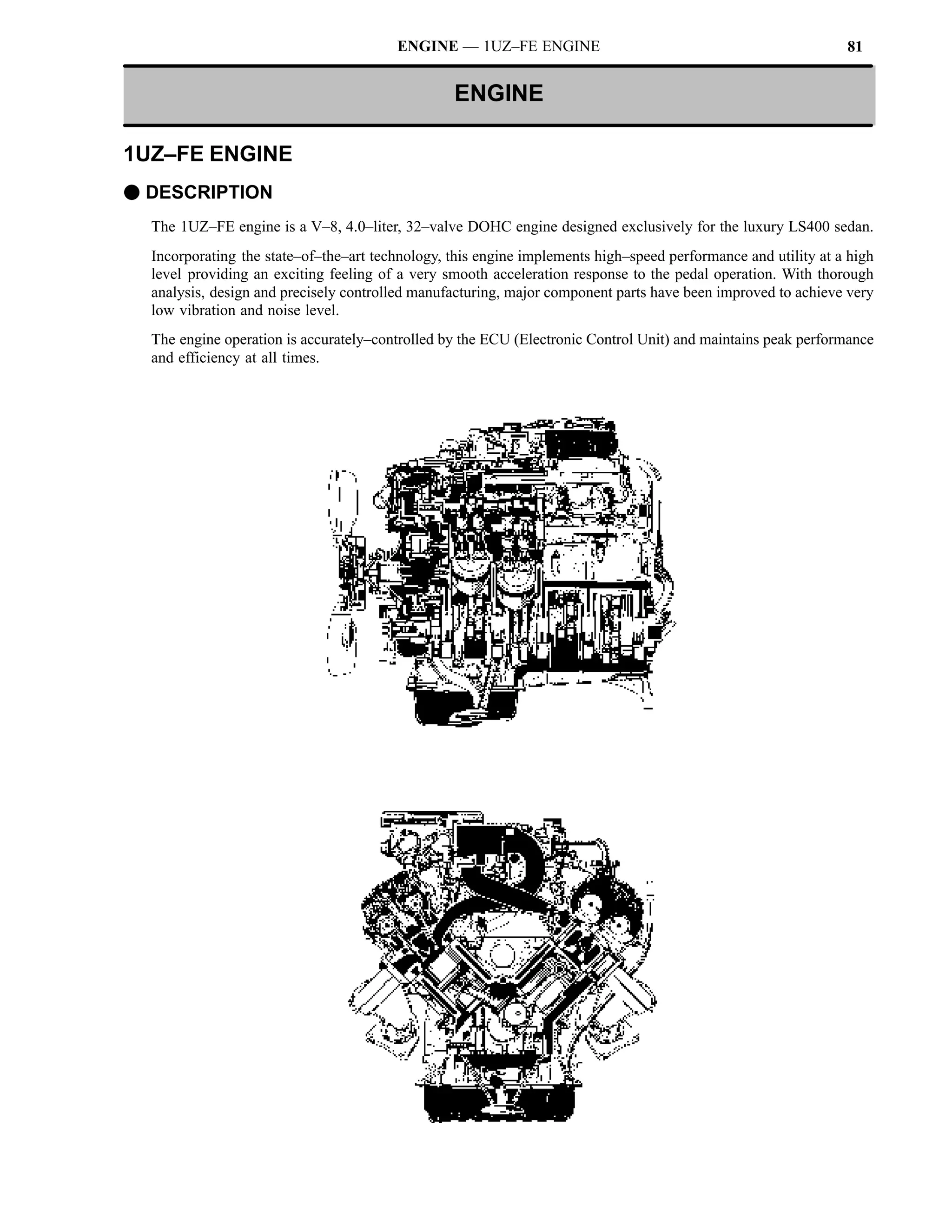
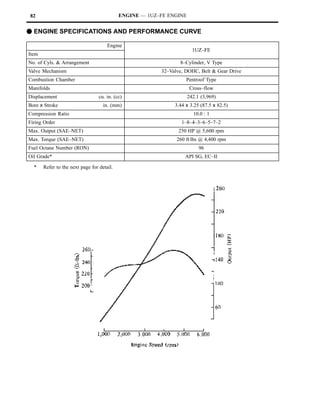
  The 1UZ–FE engine is a V–8, 4.0–liter, 32–valve DOHC engine designed exclusively for the luxury LS400 sedan.
  Incorporating the state–of–the–art technology, this engine implements high–speed performance and utility at a high
  level providing an exciting feeling of a very smooth acceleration response to the pedal operation. With thorough
  analysis, design and precisely controlled manufacturing, major component parts have been improved to achieve very
  low vibration and noise level.
  The engine operation is accurately–controlled by the ECU (Electronic Control Unit) and maintains peak performance
  and efficiency at all times.
82                                         ENGINE — 1UZ–FE ENGINE


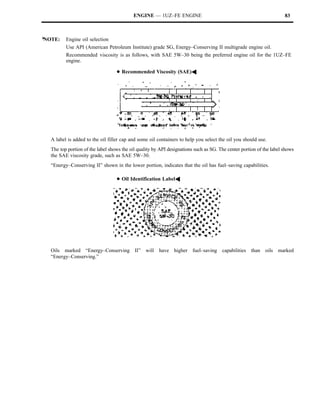
F ENGINE SPECIFICATIONS AND PERFORMANCE CURVE

                                      Engine
                                                                       1UZ–FE
                                                                       1UZ FE
Item
No. of Cyls. & Arrangement                                      8–Cylinder, V Type
Valve Mechanism                                          32–Valve, DOHC, Belt & Gear Drive
Combustion Chamber                                                 Pentroof Type
Manifolds                                                             Cross–flow
Displacement                      cu. in. (cc)                       242.1 (3,969)
Bore x Stroke                       in. (mm)                  3.44 x 3.25 (87.5 x 82.5)
Compression Ratio                                                      10.0 : 1
Firing Order                                                     1–8–4–3–6–5–7–2
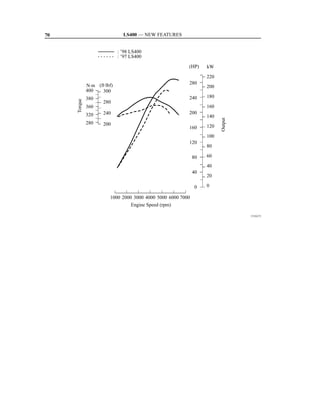
Max. Output (SAE–NET)                                           250 HP @ 5,600 rpm
Max. Torque (SAE–NET)                                          260 ft.lbs @ 4,400 rpm
Fuel Octane Number (RON)                                                  96
Oil Grade*                                                        API SG, EC–II

  *    Refer to the next page for detail.
ENGINE — 1UZ–FE ENGINE                                                     83


*NOTE: Engine oil selection
          Use API (American Petroleum Institute) grade SG, Energy–Conserving II multigrade engine oil.
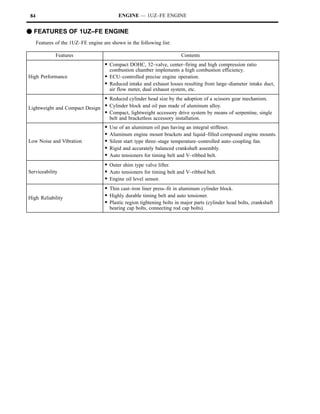
          Recommended viscosity is as follows, with SAE 5W–30 being the preferred engine oil for the 1UZ–FE
          engine.

                                   DRecommended Viscosity (SAE)A


   A label is added to the oil filler cap and some oil containers to help you select the oil you should use.
   The top portion of the label shows the oil quality by API designations such as SG. The center portion of the label shows
   the SAE viscosity grade, such as SAE 5W–30.
   “Energy–Conserving II” shown in the lower portion, indicates that the oil has fuel–saving capabilities.

                                   DOil Identification LabelA


   Oils marked “Energy–Conserving II” will have higher fuel–saving capabilities than oils marked
   “Energy–Conserving.”
84                                          ENGINE — 1UZ–FE ENGINE


F FEATURES OF 1UZ–FE ENGINE
      Features of the 1UZ–FE engine are shown in the following list:

               Features                                                    Contents
                                     S Compact DOHC, 32–valve, center–firing and high compression ratio
                                         combustion chamber implements a high combustion efficiency.
High Performance                     S ECU–controlled precise engine operation.
                                     S Reduced intake and exhaust losses resulting from large–diameter intake duct,
                                         air flow meter, dual exhaust system, etc.
                               S Reduced cylinder head size by the adoption of a scissors gear mechanism.
Lightweight and Compact Design S Cylinder block and oil pan made of aluminum alloy.
                               S Compact, lightweight accessory drive system by means of serpentine, single
                                         belt and bracketless accessory installation.
                                     S   Use of an aluminum oil pan having an integral stiffener.
                                     S   Aluminum engine mount brackets and liquid–filled compound engine mounts.
Low Noise and Vibration              S   Silent start type three–stage temperature–controlled auto–coupling fan.
                                     S   Rigid and accurately balanced crankshaft assembly.
                                     S   Auto tensioners for timing belt and V–ribbed belt.
                                     S Outer shim type valve lifter.
Serviceability                       S Auto tensioners for timing belt and V–ribbed belt.
                                     S Engine oil level sensor.
                                     S Thin cast–iron liner press–fit in aluminum cylinder block.
High Reliability                     S Highly durable timing belt and auto tensioner.
                                     S Plastic region tightening bolts in major parts (cylinder head bolts, crankshaft
                                         bearing cap bolts, connecting rod cap bolts).
ENGINE — 1UZ–FE ENGINE                                                    85


F ENGINE
1. Cylinder Head
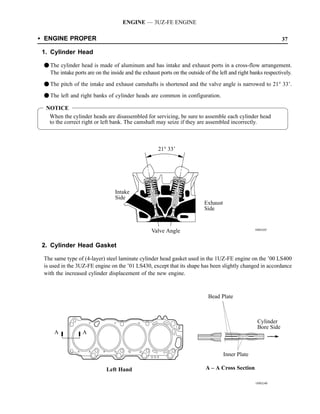
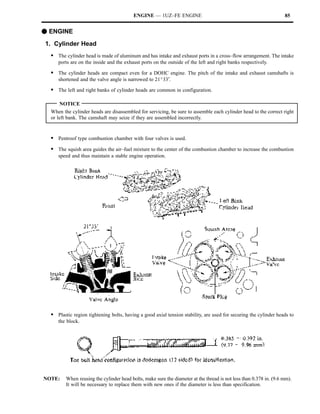
  S The cylinder head is made of aluminum and has intake and exhaust ports in a cross–flow arrangement. The intake
     ports are on the inside and the exhaust ports on the outside of the left and right banks respectively.

  S The cylinder heads are compact even for a DOHC engine. The pitch of the intake and exhaust camshafts is
     shortened and the valve angle is narrowed to 21_33′.

  S The left and right banks of cylinder heads are common in configuration.

      NOTICE
  When the cylinder heads are disassembled for servicing, be sure to assemble each cylinder head to the correct right
  or left bank. The camshaft may seize if they are assembled incorrectly.


  S Pentroof type combustion chamber with four valves is used.
  S The squish area guides the air–fuel mixture to the center of the combustion chamber to increase the combustion
     speed and thus maintain a stable engine operation.


  S Plastic region tightening bolts, having a good axial tension stability, are used for securing the cylinder heads to
     the block.


NOTE:    When reusing the cylinder head bolts, make sure the diameter at the thread is not less than 0.378 in. (9.6 mm).
         It will be necessary to replace them with new ones if the diameter is less than specification.
86                                            ENGINE — 1UZ–FE ENGINE


2. Cylinder Block
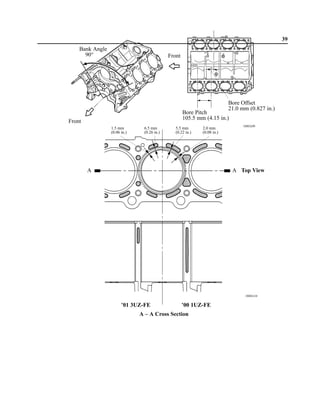
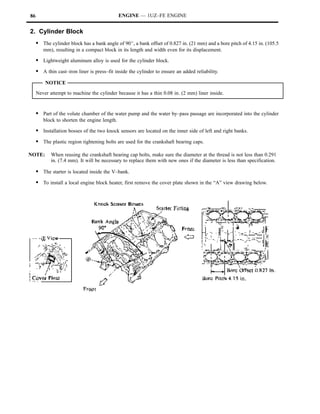
     S The cylinder block has a bank angle of 90_, a bank offset of 0.827 in. (21 mm) and a bore pitch of 4.15 in. (105.5
        mm), resulting in a compact block in its length and width even for its displacement.

     S Lightweight aluminum alloy is used for the cylinder block.
     S A thin cast–iron liner is press–fit inside the cylinder to ensure an added reliability.
         NOTICE
     Never attempt to machine the cylinder because it has a thin 0.08 in. (2 mm) liner inside.


     S Part of the volute chamber of the water pump and the water by–pass passage are incorporated into the cylinder
        block to shorten the engine length.

     S Installation bosses of the two knock sensors are located on the inner side of left and right banks.
     S The plastic region tightening bolts are used for the crankshaft bearing caps.

NOTE:       When reusing the crankshaft bearing cap bolts, make sure the diameter at the thread is not less than 0.291
            in. (7.4 mm). It will be necessary to replace them with new ones if the diameter is less than specification.

     S The starter is located inside the V–bank.
     S To install a local engine block heater, first remove the cover plate shown in the “A” view drawing below.
ENGINE — 1UZ–FE ENGINE                                             87


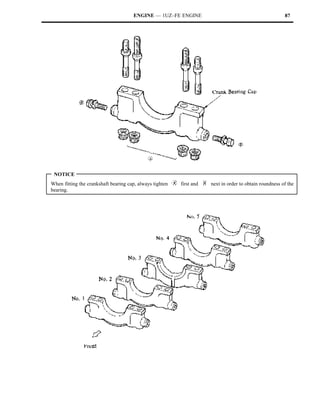
 NOTICE
When fitting the crankshaft bearing cap, always tighten   first and   next in order to obtain roundness of the
bearing.
88                                          ENGINE — 1UZ–FE ENGINE


3. Piston
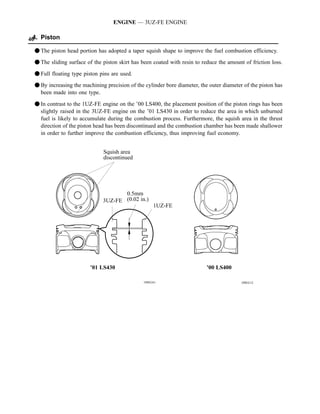
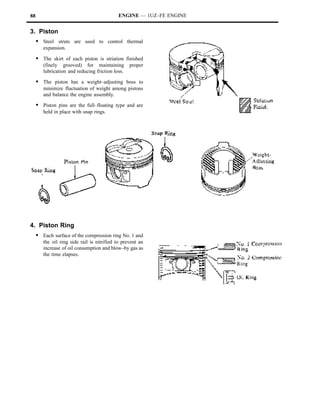
     S Steel struts are used to control thermal
        expansion.

     S The skirt of each piston is striation finished
        (finely grooved) for maintaining          proper
        lubrication and reducing friction loss.

     S The piston has a weight–adjusting boss to
        minimize fluctuation of weight among pistons
        and balance the engine assembly.

     S Piston pins are the full–floating type and are
        held in place with snap rings.


4. Piston Ring
     S Each surface of the compression ring No. 1 and
        the oil ring side rail is nitrified to prevent an
        increase of oil consumption and blow–by gas as
        the time elapses.
ENGINE — 1UZ–FE ENGINE   89


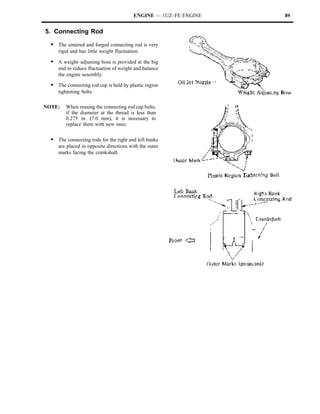
5. Connecting Rod

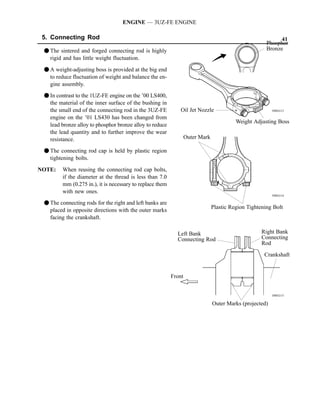
  S The sintered and forged connecting rod is very
     rigid and has little weight fluctuation.

  S A weight–adjusting boss is provided at the big
     end to reduce fluctuation of weight and balance
     the engine assembly.

  S The connecting rod cap is held by plastic region
     tightening bolts.

NOTE:    When reusing the connecting rod cap bolts,
         if the diameter at the thread is less than
         0.275 in. (7.0 mm), it is necessary to
         replace them with new ones.

  S The connecting rods for the right and left banks
     are placed in opposite directions with the outer
     marks facing the crankshaft.
90                                          ENGINE — 1UZ–FE ENGINE


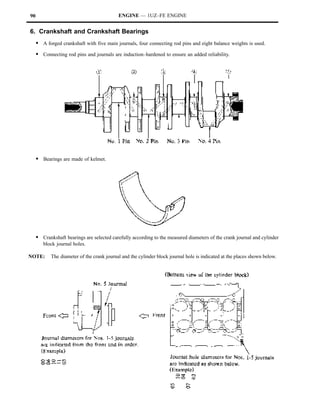
6. Crankshaft and Crankshaft Bearings
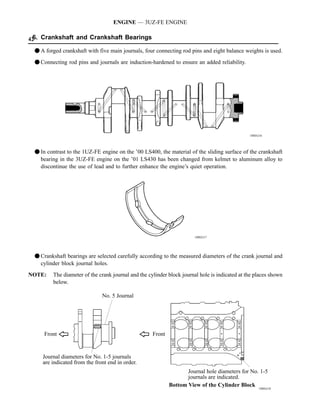
     S A forged crankshaft with five main journals, four connecting rod pins and eight balance weights is used.
     S Connecting rod pins and journals are induction–hardened to ensure an added reliability.


     S Bearings are made of kelmet.


     S Crankshaft bearings are selected carefully according to the measured diameters of the crank journal and cylinder
        block journal holes.

NOTE:       The diameter of the crank journal and the cylinder block journal hole is indicated at the places shown below.
ENGINE — 1UZ–FE ENGINE                                               91


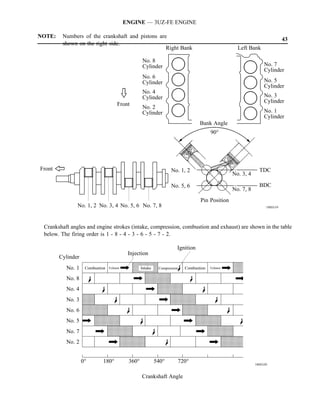
NOTE:    Numbers of the crankshaft and pistons are shown on the right side.


  Crankshaft angles and engine strokes (intake, compression, combustion and exhaust) are shown in the table below.
  The firing order is 1–8–4–3–6–5–7–2.
92                                         ENGINE — 1UZ–FE ENGINE


F VALVE MECHANISM
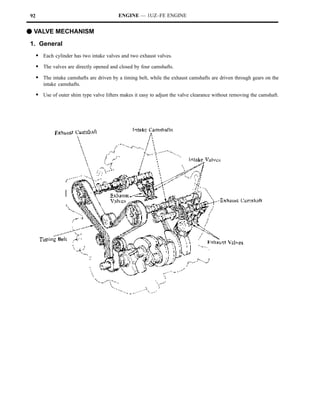
1. General
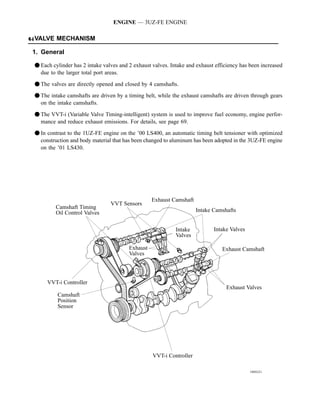
     S Each cylinder has two intake valves and two exhaust valves.
     S The valves are directly opened and closed by four camshafts.
     S The intake camshafts are driven by a timing belt, while the exhaust camshafts are driven through gears on the
        intake camshafts.

     S Use of outer shim type valve lifters makes it easy to adjust the valve clearance without removing the camshaft.
ENGINE — 1UZ–FE ENGINE                                                   93


2. Camshafts
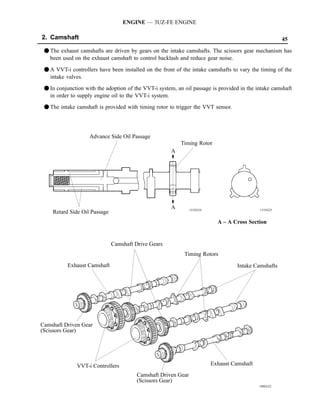
 S The exhaust camshafts are driven by gears on the intake camshafts. The scissors gear mechanism has been used
    on the exhaust camshaft to control backlash and reduce gear noise.

 S The camshaft journals and camshaft driven gear are lubricated by oil supplied to an oil passage in the center of
    the camshaft. Supply of oil from the cylinder heads to the camshafts is continuous, to prevent fluctuations in the
    oil pressure.

 S The cast iron camshafts are used. The cam nose is chill treated.
 S “T” type oil seals are used.


  NOTICE
 Be sure to follow the disassembly and reassembling procedures as directed in the Repair Manual to avoid possibility
 of damaging the cylinder head or camshaft timing gears (drive, driven and subgears).
94                                      ENGINE — 1UZ–FE ENGINE

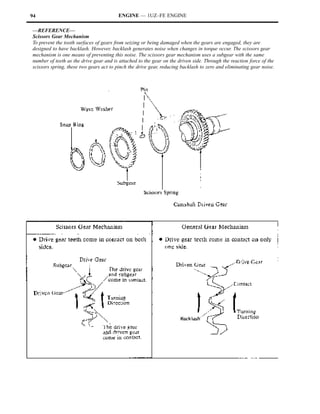
—REFERENCE—
Scissors Gear Mechanism
To prevent the tooth surfaces of gears from seizing or being damaged when the gears are engaged, they are
designed to have backlash. However, backlash generates noise when changes in torque occur. The scissors gear
mechanism is one means of preventing this noise. The scissors gear mechanism uses a subgear with the same
number of teeth as the drive gear and is attached to the gear on the driven side. Through the reaction force of the
scissors spring, these two gears act to pinch the drive gear, reducing backlash to zero and eliminating gear noise.
ENGINE — 1UZ–FE ENGINE   95


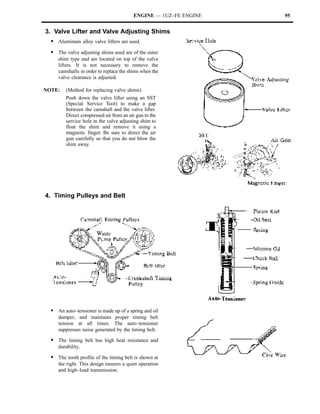
3. Valve Lifter and Valve Adjusting Shims
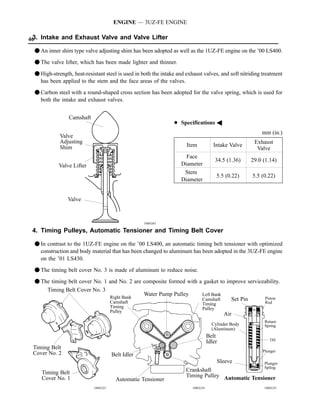
  S Aluminum alloy valve lifters are used.
  S The valve adjusting shims used are of the outer
     shim type and are located on top of the valve
     lifters. It is not necessary to remove the
     camshafts in order to replace the shims when the
     valve clearance is adjusted.

NOTE:    (Method for replacing valve shims)
         Push down the valve lifter using an SST
         (Special Service Tool) to make a gap
         between the camshaft and the valve lifter.
         Direct compressed air from an air gun to the
         service hole in the valve adjusting shim to
         float the shim and remove it using a
         magnetic finger. Be sure to direct the air
         gun carefully so that you do not blow the
         shim away.


4. Timing Pulleys and Belt


  S An auto–tensioner is made up of a spring and oil
     damper, and maintains proper timing belt
     tension at all times. The auto–tensioner
     suppresses noise generated by the timing belt.

  S The timing belt has high heat resistance and
     durability.

  S The tooth profile of the timing belt is shown at
     the right. This design ensures a quiet operation
     and high–load transmission.
96                                           ENGINE — 1UZ–FE ENGINE


F LUBRICATION SYSTEM
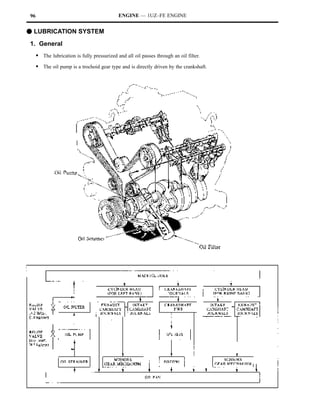
1. General
     S The lubrication is fully pressurized and all oil passes through an oil filter.
     S The oil pump is a trochoid gear type and is directly driven by the crankshaft.
ENGINE — 1UZ–FE ENGINE   97


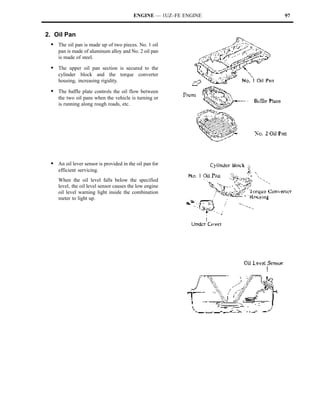
2. Oil Pan
 S The oil pan is made up of two pieces. No. 1 oil
    pan is made of aluminum alloy and No. 2 oil pan
    is made of steel.

 S The upper oil pan section is secured to the
    cylinder block and the torque converter
    housing, increasing rigidity.

 S The baffle plate controls the oil flow between
    the two oil pans when the vehicle is turning or
    is running along rough roads, etc.


 S An oil lever sensor is provided in the oil pan for
    efficient servicing.
    When the oil level falls below the specified
    level, the oil level sensor causes the low engine
    oil level warning light inside the combination
    meter to light up.
98                                          ENGINE — 1UZ–FE ENGINE


F COOLING SYSTEM
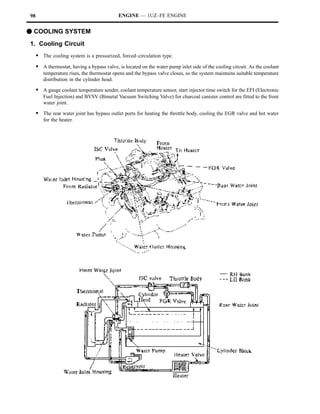
1. Cooling Circuit
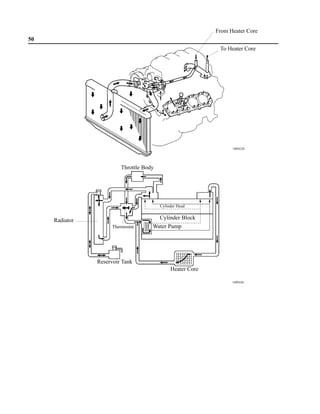
     S The cooling system is a pressurized, forced–circulation type.
     S A thermostat, having a bypass valve, is located on the water pump inlet side of the cooling circuit. As the coolant
        temperature rises, the thermostat opens and the bypass valve closes, so the system maintains suitable temperature
        distribution in the cylinder head.

     S A gauge coolant temperature sender, coolant temperature sensor, start injector time switch for the EFI (Electronic
        Fuel Injection) and BVSV (Bimetal Vacuum Switching Valve) for charcoal canister control are fitted to the front
        water joint.

     S The rear water joint has bypass outlet ports for heating the throttle body, cooling the EGR valve and hot water
        for the heater.
ENGINE — 1UZ–FE ENGINE                                                    99


2. Water Pump
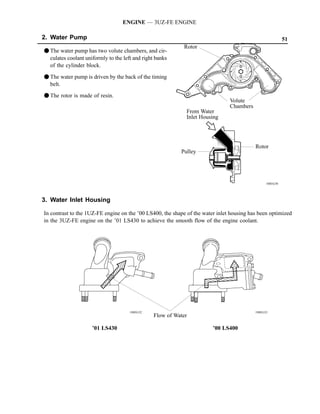
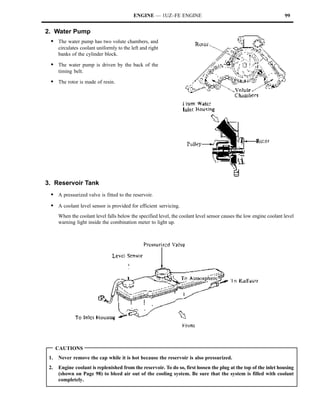
 S The water pump has two volute chambers, and
      circulates coolant uniformly to the left and right
      banks of the cylinder block.

 S The water pump is driven by the back of the
      timing belt.

 S The rotor is made of resin.


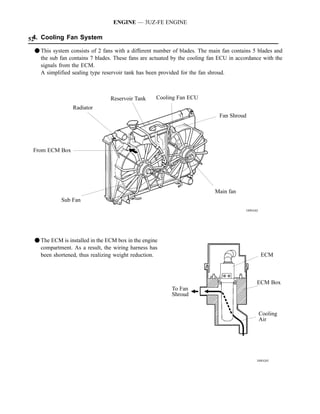
3. Reservoir Tank
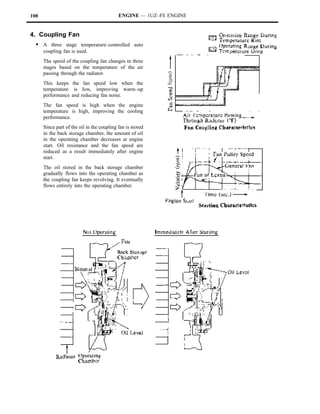
 S A pressurized valve is fitted to the reservoir.
 S A coolant level sensor is provided for efficient servicing.
      When the coolant level falls below the specified level, the coolant level sensor causes the low engine coolant level
      warning light inside the combination meter to light up.


      CAUTIONS
 1.   Never remove the cap while it is hot because the reservoir is also pressurized.
 2.   Engine coolant is replenished from the reservoir. To do so, first loosen the plug at the top of the inlet housing
      (shown on Page 98) to bleed air out of the cooling system. Be sure that the system is filled with coolant
      completely.
100                                         ENGINE — 1UZ–FE ENGINE


4. Coupling Fan
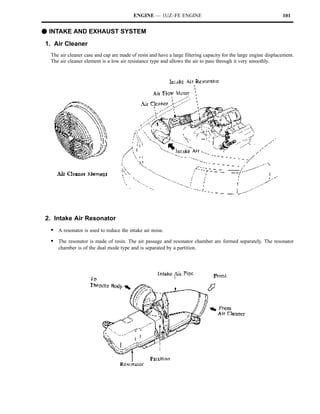
  S A three stage temperature–controlled auto
      coupling fan is used.
      The speed of the coupling fan changes in three
      stages based on the temperature of the air
      passing through the radiator.
      This keeps the fan speed low when the
      temperature is low, improving warm–up
      performance and reducing fan noise.
      The fan speed is high when the engine
      temperature is high, improving the cooling
      performance.
      Since part of the oil in the coupling fan is stored
      in the back storage chamber, the amount of oil
      in the operating chamber decreases at engine
      start. Oil resistance and the fan speed are
      reduced as a result immediately after engine
      start.
      The oil stored in the back storage chamber
      gradually flows into the operating chamber as
      the coupling fan keeps revolving. It eventually
      flows entirely into the operating chamber.
ENGINE — 1UZ–FE ENGINE                                                  101


F INTAKE AND EXHAUST SYSTEM
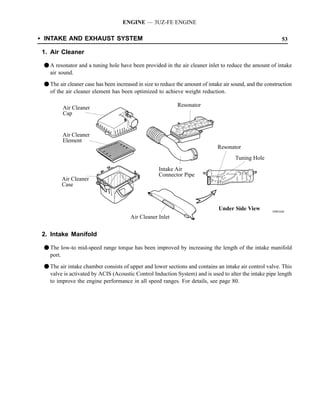
1. Air Cleaner
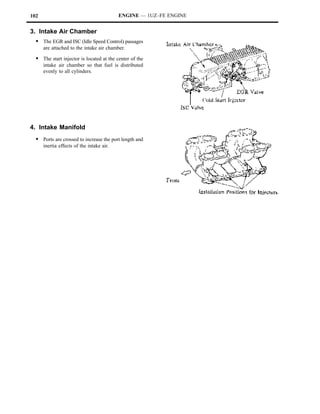
  The air cleaner case and cap are made of resin and have a large filtering capacity for the large engine displacement.
  The air cleaner element is a low air resistance type and allows the air to pass through it very smoothly.


2. Intake Air Resonator
  S A resonator is used to reduce the intake air noise.
  S The resonator is made of resin. The air passage and resonator chamber are formed separately. The resonator
     chamber is of the dual mode type and is separated by a partition.
102                                        ENGINE — 1UZ–FE ENGINE


3. Intake Air Chamber
  S The EGR and ISC (Idle Speed Control) passages
      are attached to the intake air chamber.

  S The start injector is located at the center of the
      intake air chamber so that fuel is distributed
      evenly to all cylinders.


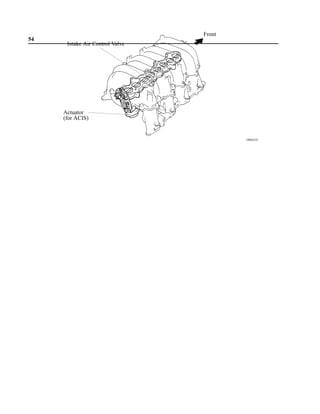
4. Intake Manifold
  S Ports are crossed to increase the port length and
      inertia effects of the intake air.
ENGINE — 1UZ–FE ENGINE                                                   103


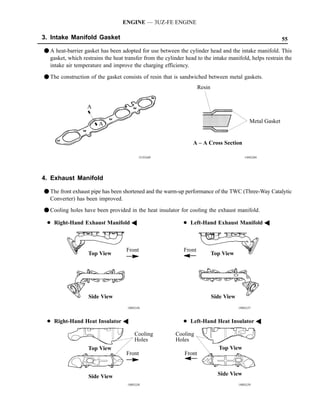
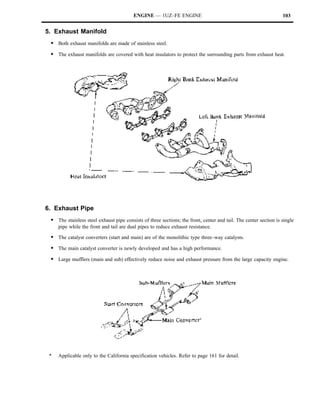
5. Exhaust Manifold
 S Both exhaust manifolds are made of stainless steel.
 S The exhaust manifolds are covered with heat insulators to protect the surrounding parts from exhaust heat.


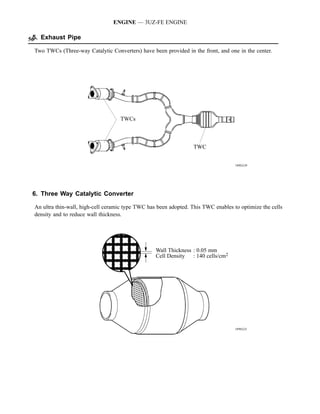
6. Exhaust Pipe
 S The stainless steel exhaust pipe consists of three sections; the front, center and tail. The center section is single
     pipe while the front and tail are dual pipes to reduce exhaust resistance.

 S The catalyst converters (start and main) are of the monolithic type three–way catalysts.
 S The main catalyst converter is newly developed and has a high performance.
 S Large mufflers (main and sub) effectively reduce noise and exhaust pressure from the large capacity engine.


 *   Applicable only to the California specification vehicles. Refer to page 161 for detail.
104                                         ENGINE — 1UZ–FE ENGINE


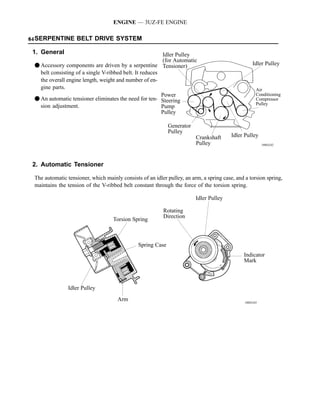
F SERPENTINE BELT DRIVE SYSTEM
   S The serpentine belt drive system drives accessory components with a single V–ribbed belt. It reduces the overall
        engine length, weight and number of engine parts.

   S An automatic tensioner eliminates the need for tension adjustment.


   S The arm is pushed by the tension spring in a
        clockwise rotation direction always centering
        around “Z”.
        The pulley’s center of rotation is bolted to the
        arm.
        For this reason, when the belt stretches with
        time, the pulley center of rotation rotates to the
        right in an arc around “Z” with the arm. Thus the
        belt tension is always maintained appropriately.

       NOTICE
       S Check the indicator mark. If it is outside the
          operation range, replace the belt.

       S When a new belt is installed, the graduations
          must be in the area indicated by “A” in the
          picture.
ENGINE — 1UZ–FE ENGINE                                              105


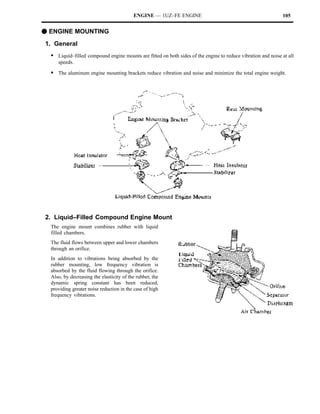
F ENGINE MOUNTING
1. General
  S Liquid–filled compound engine mounts are fitted on both sides of the engine to reduce vibration and noise at all
     speeds.

  S The aluminum engine mounting brackets reduce vibration and noise and minimize the total engine weight.


2. Liquid–Filled Compound Engine Mount
  The engine mount combines rubber with liquid
  filled chambers.
  The fluid flows between upper and lower chambers
  through an orifice.
  In addition to vibrations being absorbed by the
  rubber mounting, low frequency vibration is
  absorbed by the fluid flowing through the orifice.
  Also, by decreasing the elasticity of the rubber, the
  dynamic spring constant has been reduced,
  providing greater noise reduction in the case of high
  frequency vibrations.
106                                       ENGINE — 1UZ–FE ENGINE

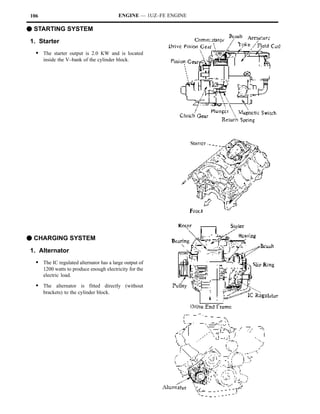
F STARTING SYSTEM
1. Starter
  S The starter output is 2.0 KW and is located
      inside the V–bank of the cylinder block.


F CHARGING SYSTEM
1. Alternator
  S The IC regulated alternator has a large output of
      1200 watts to produce enough electricity for the
      electric load.

  S The alternator is fitted directly (without
      brackets) to the cylinder block.
ENGINE — 1UZ–FE ENGINE                                                     107


F ENGINE MOUNTING
1. General
  Engine control system uses an ECU (Electronic Control Unit) with a built–in microprocessor. Stored inside the ECU
  is the data for fuel injection duration, ignition timing and idling speed, etc. which are matched with the various engine
  conditions as well as programs for calculation. The ECU utilizes these data and signals from the various sensors in
  the vehicle and makes calculations with the stored programs to determine fuel injection duration, ignition timing and
  idling speed, etc., and outputs control signals to the respective actuators which control operation.
  The engine ECU and transmission ECU are integrated into one and the ECU is called the engine and transmission
  ECU. The engine control system for the 1UZ–FE engine has the following functions:
 EFI (Electronic Fuel Injection)
  The ECU determines the fuel injection duration according to intake air volume, engine speed, coolant temperature
  and other signals and sends control signals to the fuel injectors. Also, this fuel injection duration is the basis for
  deciding the fuel injection timing. The fuel injection system in the 1UZ–FE engine is a four group injection system
  which injects fuel simultaneously into two cylinders once every two engine revolutions.
 ESA (Electronic Spark Advance)
  The ECU determines the amount of ignition advance over the initial set timing of the distributor by the intake air
  volume, engine speed, coolant temperature and other signal and sends control signals to the igniters. Also, based on
  signals from the knock sensors, the ECU controls the ignition timing at the optimum in accordance with the gasoline’s
  octane value.
 ISC (Idle Speed Control)
  By means of engine speed signals and coolant temperature signals, the ECU sends control signals to the ISC valve
  so that the actual idling speed becomes the same as the target idling speed stored in the ECU. Also, while the engine
  is warming up, the ECU, based on coolant temperature signals, sends controls signals to the ISC value to control
  engine speed to fast idle.
 EGR (Exhaust Gas Recirculation) CUT CONTROL
  The ECU sends signals to the EGR VSV to cut the EGR based on coolant temperature, engine speed, neutral start
  switch or intake air volume signals. This system maintains drivability at low coolant temperature, under light or heavy
  load conditions, or at high engine speed, etc.
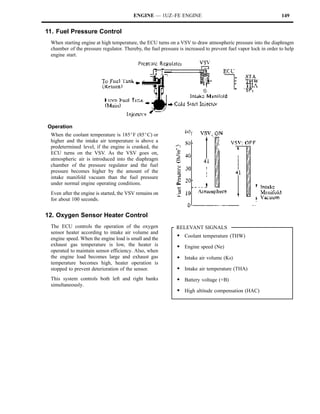
 FUEL PRESSURE CONTROL
  The ECU sends signals to the pressure regulator VSV based on coolant temperature, intake air temperature, vehicle
  speed and engine start signals, and increases the fuel pressure. This system maintains restartability and idling stability
  when the engine is hot.
 FUEL PUMP SPEED CONTROL
  The ECU, based on fuel injection duration, sends control signals to the fuel pump control relay to control the fuel
  pump speed. That is, when the engine requires a large volume of fuel, the fuel pump turns at high speeds and when
  only a small volume of fuel is required, the pump turns at low speeds.
108                                       ENGINE — 1UZ–FE ENGINE

OXYGEN SENSOR HEATER CONTROL
  Based on the intake air volume, engine start and coolant temperature signals, the ECU sends control signals to the
  oxygen sensor heater. This system maintains the oxygen sensor at the appropriate temperature in order to improve
  the detecting accuracy of oxygen concentration in the exhaust gas.
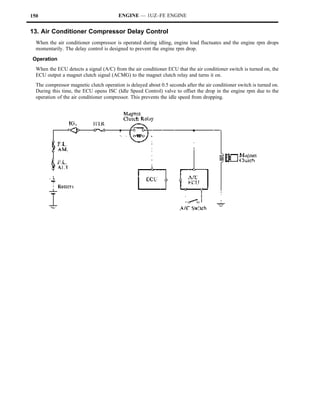
AIR CONDITIONER CONTROL
  Based on the air conditioner switch signal from the air conditioner ECU, the ECU sends control signals to the
  magnetic clutch of the air conditioner compressor. This system, the magnetic clutch operation, is delayed for a
  predetermined period after the air conditioner switch is turned on.
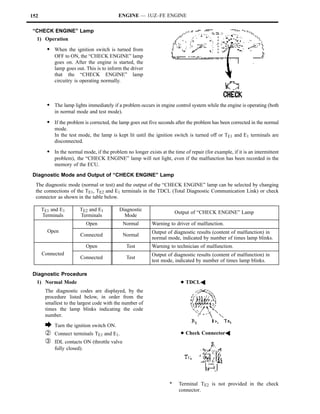
DIAGNOSIS
  The ECU is constantly monitoring signals from each sensor. If a malfunction occurs with the signals, the CHECK
  ENGINE lamp on the combination meter lights up and informs the driver of the malfunction.
  The content of the malfunction is stored in code in the ECU and when the TE1 and E1 terminals in the check connector
  or TDCL are connected, the ECU outputs the trouble code by flashing the CHECK ENGINE lamp.
FAIL–SAFE
  If the ECU judges from the signals from each sensor that there is a malfunction, it continues the engine operation using
  its own data or it stops the engine.
ENGINE — 1UZ–FE ENGINE                                              109


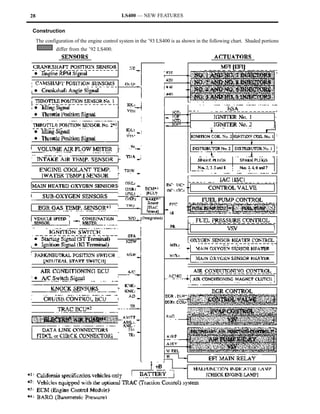
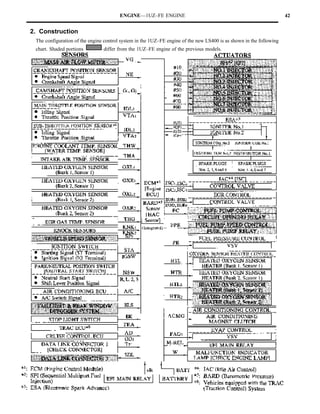
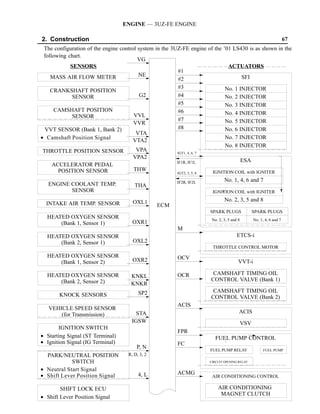
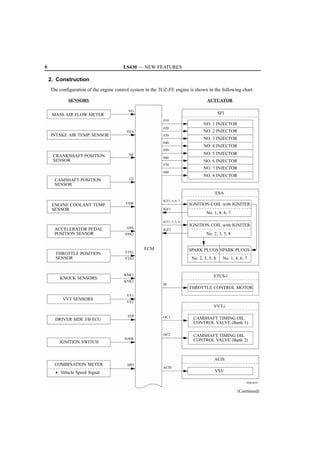
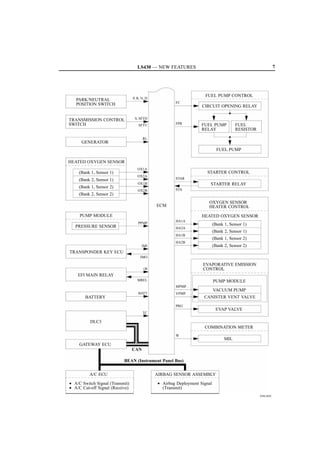
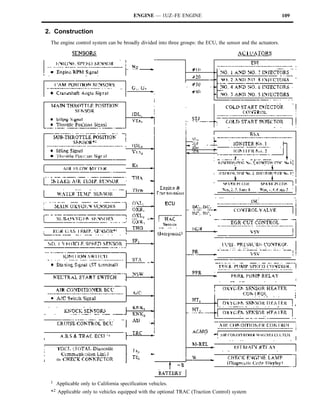
2. Construction
 The engine control system can be broadly divided into three groups: the ECU, the sensor and the actuators.


 1    Applicable only to California specification vehicles.
 *2   Applicable only to vehicles equipped with the optional TRAC (Traction Control) system
110                                    ENGINE — 1UZ–FE ENGINE


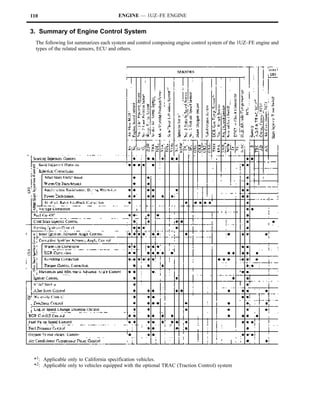
3. Summary of Engine Control System
  The following list summarizes each system and control composing engine control system of the 1UZ–FE engine and
  types of the related sensors, ECU and others.


 *1: Applicable only to California specification vehicles.
 *2: Applicable only to vehicles equipped with the optional TRAC (Traction Control) system
ENGINE — 1UZ–FE ENGINE                                 111


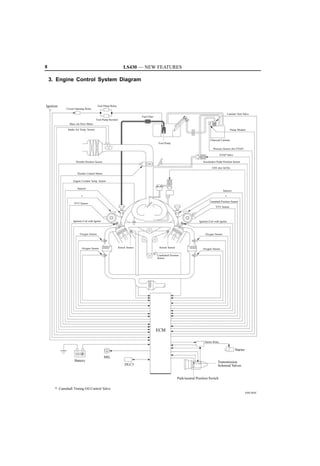
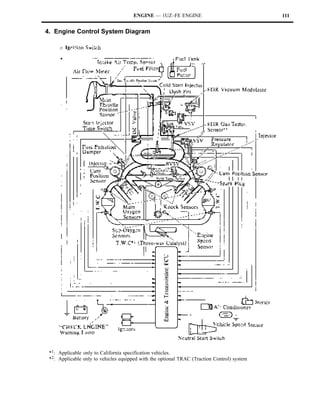
4. Engine Control System Diagram


 *1: Applicable only to California specification vehicles.
 *2: Applicable only to vehicles equipped with the optional TRAC (Traction Control) system
112                       ENGINE — 1UZ–FE ENGINE


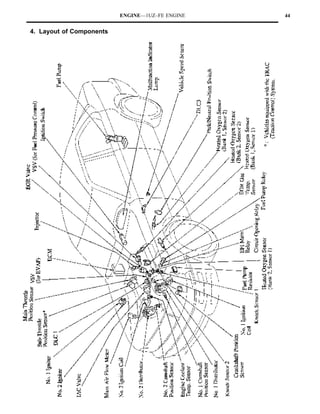
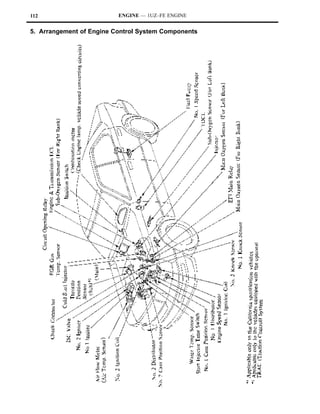
5. Arrangement of Engine Control System Components
ENGINE — 1UZ–FE ENGINE                                                     113


6. EFI (Electronic Fuel Injection)
 The EFI system consists of the following three major systems:
 1) Fuel System
 2) Air Induction System
 3) Electronic Control System


Fuel System
  1) General
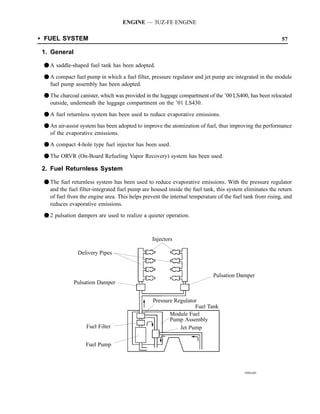
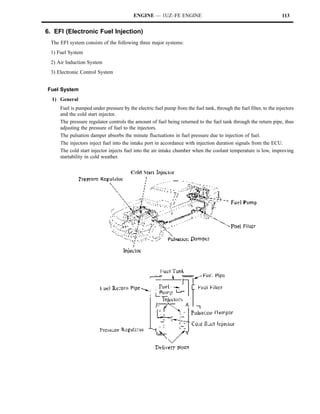
     Fuel is pumped under pressure by the electric fuel pump from the fuel tank, through the fuel filter, to the injectors
     and the cold start injector.
     The pressure regulator controls the amount of fuel being returned to the fuel tank through the return pipe, thus
     adjusting the pressure of fuel to the injectors.
     The pulsation damper absorbs the minute fluctuations in fuel pressure due to injection of fuel.
     The injectors inject fuel into the intake port in accordance with injection duration signals from the ECU.
     The cold start injector injects fuel into the air intake chamber when the coolant temperature is low, improving
     startability in cold weather.
114                                       ENGINE — 1UZ–FE ENGINE


  2) Fuel Pump
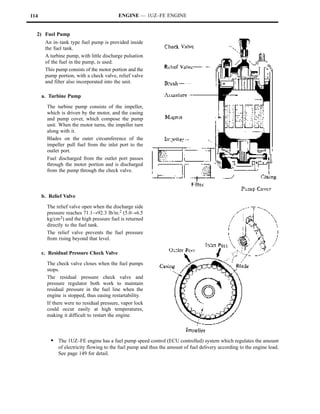
       An in–tank type fuel pump is provided inside
       the fuel tank.
       A turbine pump, with little discharge pulsation
       of the fuel in the pump, is used.
       This pump consists of the motor portion and the
       pump portion, with a check valve, relief valve
       and filter also incorporated into the unit.

      a. Turbine Pump

        The turbine pump consists of the impeller,
        which is driven by the motor, and the casing
        and pump cover, which compose the pump
        unit. When the motor turns, the impeller turn
        along with it.
        Blades on the outer circumference of the
        impeller pull fuel from the inlet port to the
        outlet port.
        Fuel discharged from the outlet port passes
        through the motor portion and is discharged
        from the pump through the check valve.


      b. Relief Valve

        The relief valve open when the discharge side
        pressure reaches 71.1!92.3 lb/in.2 (5.0!6.5
        kg/cm 2) and the high pressure fuel is returned
        directly to the fuel tank.
        The relief valve prevents the fuel pressure
        from rising beyond that level.

      c. Residual Pressure Check Valve

        The check valve closes when the fuel pumps
        stops.
        The residual pressure check valve and
        pressure regulator both work to maintain
        residual pressure in the fuel line when the
        engine is stopped, thus easing restartability.
        If there were no residual pressure, vapor lock
        could occur easily at high temperatures,
        making it difficult to restart the engine.


          S The 1UZ–FE engine has a fuel pump speed control (ECU controlled) system which regulates the amount
             of electricity flowing to the fuel pump and thus the amount of fuel delivery according to the engine load.
             See page 149 for detail.
ENGINE — 1UZ–FE ENGINE   115

3) Fuel Filter
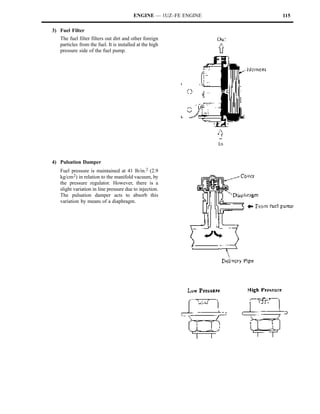
   The fuel filter filters out dirt and other foreign
   particles from the fuel. It is installed at the high
   pressure side of the fuel pump.


4) Pulsation Damper
   Fuel pressure is maintained at 41 lb/in.2 (2.9
   kg/cm 2) in relation to the manifold vacuum, by
   the pressure regulator. However, there is a
   slight variation in line pressure due to injection.
   The pulsation damper acts to absorb this
   variation by means of a diaphragm.
116                                         ENGINE — 1UZ–FE ENGINE

  5) Pressure Regulator
      a. Function

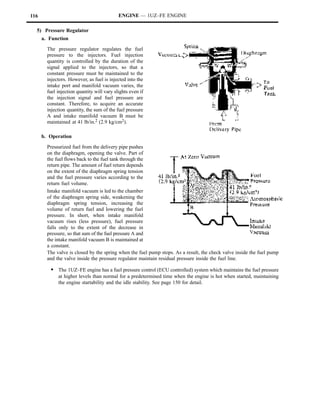
        The pressure regulator regulates the fuel
        pressure to the injectors. Fuel injection
        quantity is controlled by the duration of the
        signal applied to the injectors, so that a
        constant pressure must be maintained to the
        injectors. However, as fuel is injected into the
        intake port and manifold vacuum varies, the
        fuel injection quantity will vary slights even if
        the injection signal and fuel pressure are
        constant. Therefore, to acquire an accurate
        injection quantity, the sum of the fuel pressure
        A and intake manifold vacuum B must be
        maintained at 41 lb/in.2 (2.9 kg/cm2).

      b. Operation

        Pressurized fuel from the delivery pipe pushes
        on the diaphragm, opening the valve. Part of
        the fuel flows back to the fuel tank through the
        return pipe. The amount of fuel return depends
        on the extent of the diaphragm spring tension
        and the fuel pressure varies according to the
        return fuel volume.
        Intake manifold vacuum is led to the chamber
        of the diaphragm spring side, weakening the
        diaphragm spring tension, increasing the
        volume of return fuel and lowering the fuel
        pressure. In short, when intake manifold
        vacuum rises (less pressure), fuel pressure
        falls only to the extent of the decrease in
        pressure, so that sum of the fuel pressure A and
        the intake manifold vacuum B is maintained at
        a constant.
        The valve is closed by the spring when the fuel pump stops. As a result, the check valve inside the fuel pump
        and the valve inside the pressure regulator maintain residual pressure inside the fuel line.

         S The 1UZ–FE engine has a fuel pressure control (ECU controlled) system which maintains the fuel pressure
             at higher levels than normal for a predetermined time when the engine is hot when started, maintaining
             the engine startability and the idle stability. See page 150 for detail.
ENGINE — 1UZ–FE ENGINE   117

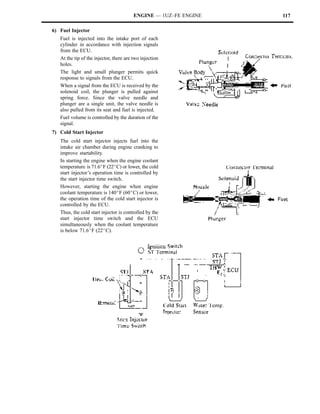
6) Fuel Injector
   Fuel is injected into the intake port of each
   cylinder in accordance with injection signals
   from the ECU.
   At the tip of the injector, there are two injection
   holes.
   The light and small plunger permits quick
   response to signals from the ECU.
   When a signal from the ECU is received by the
   solenoid coil, the plunger is pulled against
   spring force. Since the valve needle and
   plunger are a single unit, the valve needle is
   also pulled from its seat and fuel is injected.
   Fuel volume is controlled by the duration of the
   signal.
7) Cold Start Injector
   The cold start injector injects fuel into the
   intake air chamber during engine cranking to
   improve startability.
   In starting the engine when the engine coolant
   temperature is 71.6_F (22_C) or lower, the cold
   start injector’s operation time is controlled by
   the start injector time switch.
   However, starting the engine when engine
   coolant temperature is 140_F (60_C) or lower,
   the operation time of the cold start injector is
   controlled by the ECU.
   Thus, the cold start injector is controlled by the
   start injector time switch and the ECU
   simultaneously when the coolant temperature
   is below 71.6_F (22_C).
118                                       ENGINE — 1UZ–FE ENGINE

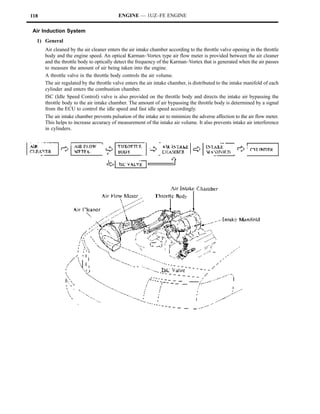
Air Induction System
  1) General
      Air cleaned by the air cleaner enters the air intake chamber according to the throttle valve opening in the throttle
      body and the engine speed. An optical Karman–Vortex type air flow meter is provided between the air cleaner
      and the throttle body to optically detect the frequency of the Karman–Vortex that is generated when the air passes
      to measure the amount of air being taken into the engine.
      A throttle valve in the throttle body controls the air volume.
      The air regulated by the throttle valve enters the air intake chamber, is distributed to the intake manifold of each
      cylinder and enters the combustion chamber.
      ISC (Idle Speed Control) valve is also provided on the throttle body and directs the intake air bypassing the
      throttle body to the air intake chamber. The amount of air bypassing the throttle body is determined by a signal
      from the ECU to control the idle speed and fast idle speed accordingly.
      The air intake chamber prevents pulsation of the intake air to minimize the adverse affection to the air flow meter.
      This helps to increase accuracy of measurement of the intake air volume. It also prevents intake air interference
      in cylinders.
ENGINE — 1UZ–FE ENGINE                                                    119

2) Construction and Operation of Main Components

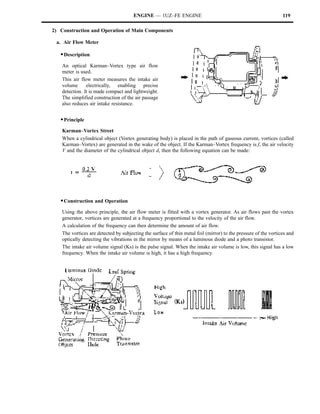
 a. Air Flow Meter

   S Description
    An optical Karman–Vortex type air flow
    meter is used.
    This air flow meter measures the intake air
    volume      electrically, enabling precise
    detection. It is made compact and lightweight.
    The simplified construction of the air passage
    also reduces air intake resistance.


   S Principle
    Karman–Vortex Street
    When a cylindrical object (Vortex generating body) is placed in the path of gaseous current, vortices (called
    Karman–Vortex) are generated in the wake of the object. If the Karman–Vortex frequency is f, the air velocity
    V and the diameter of the cylindrical object d, then the following equation can be made:


   S Construction and Operation
    Using the above principle, the air flow meter is fitted with a vortex generator. As air flows past the vortex
    generator, vortices are generated at a frequency proportional to the velocity of the air flow.
    A calculation of the frequency can then determine the amount of air flow.
    The vortices are detected by subjecting the surface of thin metal foil (mirror) to the pressure of the vortices and
    optically detecting the vibrations in the mirror by means of a luminous diode and a photo transistor.
    The intake air volume signal (Ks) is the pulse signal. When the intake air volume is low, this signal has a low
    frequency. When the intake air volume is high, it has a high frequency.
120                                        ENGINE — 1UZ–FE ENGINE


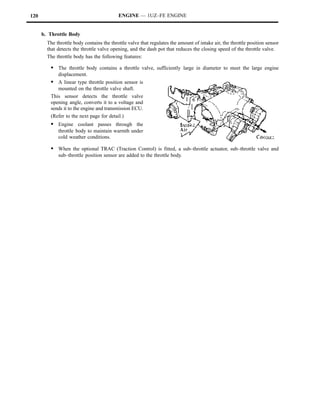
      b. Throttle Body
        The throttle body contains the throttle valve that regulates the amount of intake air, the throttle position sensor
        that detects the throttle valve opening, and the dash pot that reduces the closing speed of the throttle valve.
        The throttle body has the following features:

         S The throttle body contains a throttle valve, sufficiently large in diameter to meet the large engine
            displacement.
         S A linear type throttle position sensor is
            mounted on the throttle valve shaft.
         This sensor detects the throttle valve
         opening angle, converts it to a voltage and
         sends it to the engine and transmission ECU.
         (Refer to the next page for detail.)
         S Engine coolant passes through the
             throttle body to maintain warmth under
             cold weather conditions.

         S When the optional TRAC (Traction Control) is fitted, a sub–throttle actuator, sub–throttle valve and
             sub–throttle position sensor are added to the throttle body.
ENGINE — 1UZ–FE ENGINE                                                   121


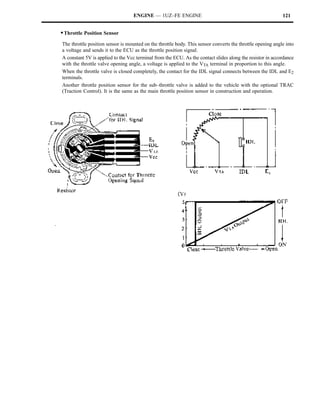
S Throttle Position Sensor
The throttle position sensor is mounted on the throttle body. This sensor converts the throttle opening angle into
a voltage and sends it to the ECU as the throttle position signal.
A constant 5V is applied to the Vcc terminal from the ECU. As the contact slides along the resistor in accordance
with the throttle valve opening angle, a voltage is applied to the VTA terminal in proportion to this angle.
When the throttle valve is closed completely, the contact for the IDL signal connects between the IDL and E2
terminals.
Another throttle position sensor for the sub–throttle valve is added to the vehicle with the optional TRAC
(Traction Control). It is the same as the main throttle position sensor in construction and operation.
122                                      ENGINE — 1UZ–FE ENGINE

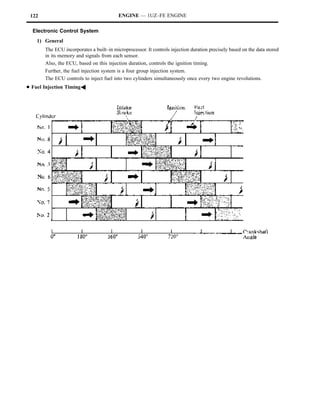
  Electronic Control System
    1) General
       The ECU incorporates a built–in microprocessor. It controls injection duration precisely based on the data stored
       in its memory and signals from each sensor.
       Also, the ECU, based on this injection duration, controls the ignition timing.
       Further, the fuel injection system is a four group injection system.
       The ECU controls to inject fuel into two cylinders simultaneously once every two engine revolutions.
DFuel Injection TimingA
ENGINE — 1UZ–FE ENGINE   123

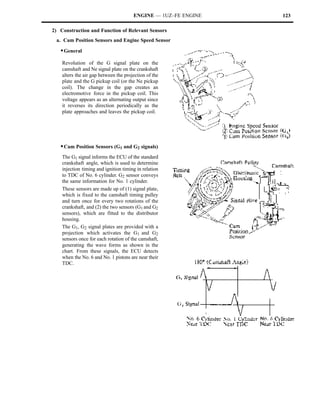
2) Construction and Function of Relevant Sensors
 a. Cam Position Sensors and Engine Speed Sensor

   S General
    Revolution of the G signal plate on the
    camshaft and Ne signal plate on the crankshaft
    alters the air gap between the projection of the
    plate and the G pickup coil (or the Ne pickup
    coil). The change in the gap creates an
    electromotive force in the pickup coil. This
    voltage appears as an alternating output since
    it reverses its direction periodically as the
    plate approaches and leaves the pickup coil.


   S Cam Position Sensors (G1 and G2 signals)
    The G1 signal informs the ECU of the standard
    crankshaft angle, which is used to determine
    injection timing and ignition timing in relation
    to TDC of No. 6 cylinder. G2 sensor conveys
    the same information for No. 1 cylinder.
    These sensors are made up of (1) signal plate,
    which is fixed to the camshaft timing pulley
    and turn once for every two rotations of the
    crankshaft, and (2) the two sensors (G1 and G2
    sensors), which are fitted to the distributor
    housing.
    The G1, G2 signal plates are provided with a
    projection which activates the G1 and G2
    sensors once for each rotation of the camshaft,
    generating the wave forms as shown in the
    chart. From these signals, the ECU detects
    when the No. 6 and No. 1 pistons are near their
    TDC.
124                                     ENGINE — 1UZ–FE ENGINE

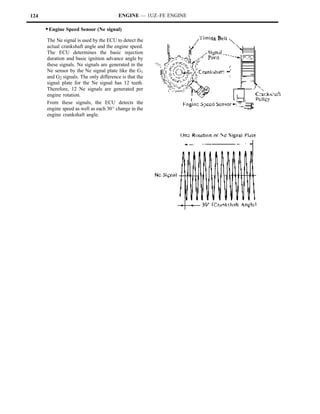
      S Engine Speed Sensor (Ne signal)
      The Ne signal is used by the ECU to detect the
      actual crankshaft angle and the engine speed.
      The ECU determines the basic injection
      duration and basic ignition advance angle by
      these signals. Ne signals are generated in the
      Ne sensor by the Ne signal plate like the G1
      and G2 signals. The only difference is that the
      signal plate for the Ne signal has 12 teeth.
      Therefore, 12 Ne signals are generated per
      engine rotation.
      From these signals, the ECU detects the
      engine speed as well as each 30_ change in the
      engine crankshaft angle.
ENGINE — 1UZ–FE ENGINE   125

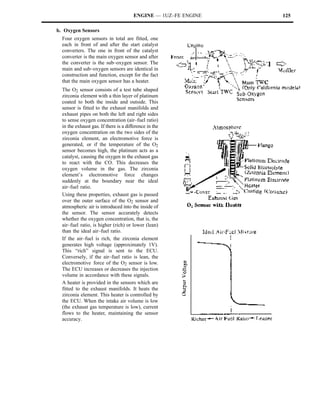
b. Oxygen Sensors
  Four oxygen sensors in total are fitted, one
  each in front of and after the start catalyst
  converters. The one in front of the catalyst
  converter is the main oxygen sensor and after
  the converter is the sub–oxygen sensor. The
  main and sub–oxygen sensors are identical in
  construction and function, except for the fact
  that the main oxygen sensor has a heater.
  The O2 sensor consists of a test tube shaped
  zirconia element with a thin layer of platinum
  coated to both the inside and outside. This
  sensor is fitted to the exhaust manifolds and
  exhaust pipes on both the left and right sides
  to sense oxygen concentration (air–fuel ratio)
  in the exhaust gas. If there is a difference in the
  oxygen concentration on the two sides of the
  zirconia element, an electromotive force is
  generated, or if the temperature of the O2
  sensor becomes high, the platinum acts as a
  catalyst, causing the oxygen in the exhaust gas
  to react with the CO. This decreases the
  oxygen volume in the gas. The zirconia
  element’s electromotive force changes
  suddenly at the boundary near the ideal
  air–fuel ratio.
  Using these properties, exhaust gas is passed
  over the outer surface of the O2 sensor and
  atmospheric air is introduced into the inside of
  the sensor. The sensor accurately detects
  whether the oxygen concentration, that is, the
  air–fuel ratio, is higher (rich) or lower (lean)
  than the ideal air–fuel ratio.
  If the air–fuel is rich, the zirconia element
  generates high voltage (approximately 1V).
  This “rich” signal is sent to the ECU.
  Conversely, if the air–fuel ratio is lean, the
  electromotive force of the O2 sensor is low.
  The ECU increases or decreases the injection
  volume in accordance with these signals.
  A heater is provided in the sensors which are
  fitted to the exhaust manifolds. It heats the
  zirconia element. This heater is controlled by
  the ECU. When the intake air volume is low
  (the exhaust gas temperature is low), current
  flows to the heater, maintaining the sensor
  accuracy.
126                                          ENGINE — 1UZ–FE ENGINE

  3) Functions of the ECU
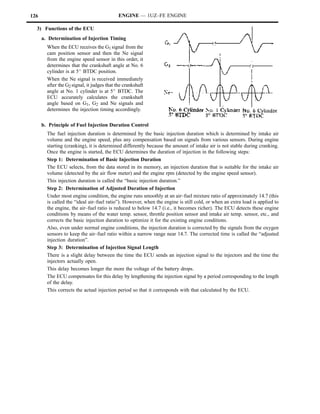
      a. Determination of Injection Timing
        When the ECU receives the G1 signal from the
        cam position sensor and then the Ne signal
        from the engine speed sensor in this order, it
        determines that the crankshaft angle at No. 6
        cylinder is at 5_ BTDC position.
        When the Ne signal is received immediately
        after the G2 signal, it judges that the crankshaft
        angle at No. 1 cylinder is at 5_ BTDC. The
        ECU accurately calculates the crankshaft
        angle based on G1, G2 and Ne signals and
        determines the injection timing accordingly.

      b. Principle of Fuel Injection Duration Control
        The fuel injection duration is determined by the basic injection duration which is determined by intake air
        volume and the engine speed, plus any compensation based on signals from various sensors. During engine
        starting (cranking), it is determined differently because the amount of intake air is not stable during cranking.
        Once the engine is started, the ECU determines the duration of injection in the following steps:
        Step 1: Determination of Basic Injection Duration
        The ECU selects, from the data stored in its memory, an injection duration that is suitable for the intake air
        volume (detected by the air flow meter) and the engine rpm (detected by the engine speed sensor).
        This injection duration is called the “basic injection duration.”
        Step 2: Determination of Adjusted Duration of Injection
        Under most engine condition, the engine runs smoothly at an air–fuel mixture ratio of approximately 14.7 (this
        is called the “ideal air–fuel ratio”). However, when the engine is still cold, or when an extra load is applied to
        the engine, the air–fuel ratio is reduced to below 14.7 (i.e., it becomes richer). The ECU detects these engine
        conditions by means of the water temp. sensor, throttle position sensor and intake air temp. sensor, etc., and
        corrects the basic injection duration to optimize it for the existing engine conditions.
        Also, even under normal engine conditions, the injection duration is corrected by the signals from the oxygen
        sensors to keep the air–fuel ratio within a narrow range near 14.7. The corrected time is called the “adjusted
        injection duration”.
        Step 3: Determination of Injection Signal Length
        There is a slight delay between the time the ECU sends an injection signal to the injectors and the time the
        injectors actually open.
        This delay becomes longer the more the voltage of the battery drops.
        The ECU compensates for this delay by lengthening the injection signal by a period corresponding to the length
        of the delay.
        This corrects the actual injection period so that it corresponds with that calculated by the ECU.
ENGINE — 1UZ–FE ENGINE                                                    127


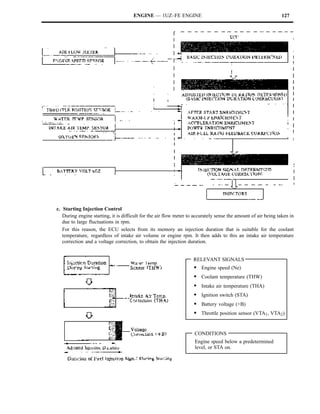
c. Starting Injection Control
   During engine starting, it is difficult for the air flow meter to accurately sense the amount of air being taken in
   due to large fluctuations in rpm.
   For this reason, the ECU selects from its memory an injection duration that is suitable for the coolant
   temperature, regardless of intake air volume or engine rpm. It then adds to this an intake air temperature
   correction and a voltage correction, to obtain the injection duration.


                                                                    RELEVANT SIGNALS
                                                                    S   Engine speed (Ne)
                                                                    S   Coolant temperature (THW)
                                                                    S   Intake air temperature (THA)
                                                                    S   Ignition switch (STA)
                                                                    S   Battery voltage (+B)
                                                                    S   Throttle position sensor (VTA1, VTA2)


                                                                    CONDITIONS
                                                                    Engine speed below a predetermined
                                                                    level, or STA on.
128                                        ENGINE — 1UZ–FE ENGINE

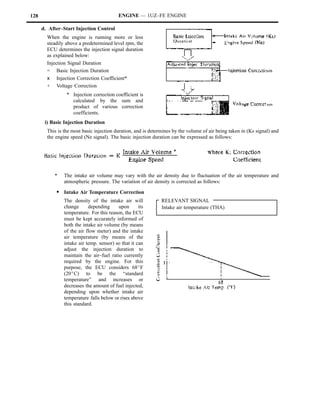
      d. After–Start Injection Control
        When the engine is running more or less
        steadily above a predetermined level rpm, the
        ECU determines the injection signal duration
        as explained below:
        Injection Signal Duration
        = Basic Injection Duration
        x Injection Correction Coefficient*
        + Voltage Correction
                 * Injection correction coefficient is
                   calculated by the sum and
                   product of various correction
                   coefficients.
       i) Basic Injection Duration
        This is the most basic injection duration, and is determines by the volume of air being taken in (Ks signal) and
        the engine speed (Ne signal). The basic injection duration can be expressed as follows:


           *    The intake air volume may vary with the air density due to fluctuation of the air temperature and
                atmospheric pressure. The variation of air density is corrected as follows:

            S Intake Air Temperature Correction
                The density of the intake air will             RELEVANT SIGNAL
                change      depending      upon      its       Intake air temperature (THA)
                temperature. For this reason, the ECU
                must be kept accurately informed of
                both the intake air volume (by means
                of the air flow meter) and the intake
                air temperature (by means of the
                intake air temp. sensor) so that it can
                adjust the injection duration to
                maintain the air–fuel ratio currently
                required by the engine. For this
                purpose, the ECU considers 68_F
                (20_C) to be the “standard
                temperature” and increases or
                decreases the amount of fuel injected,
                depending upon whether intake air
                temperature falls below or rises above
                this standard.
ENGINE — 1UZ–FE ENGINE                                           129

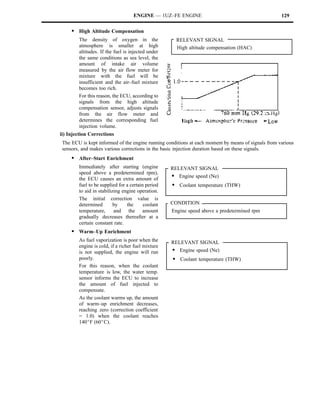
     S High Altitude Compensation
        The density of oxygen in the                 RELEVANT SIGNAL
        atmosphere is smaller at high                High altitude compensation (HAC)
        altitudes. If the fuel is injected under
        the same conditions as sea level, the
        amount of intake air volume
        measured by the air flow meter for
        mixture with the fuel will be
        insufficient and the air–fuel mixture
        becomes too rich.
        For this reason, the ECU, according to
        signals from the high altitude
        compensation sensor, adjusts signals
        from the air flow meter and
        determines the corresponding fuel
        injection volume.
ii) Injection Corrections
 The ECU is kept informed of the engine running conditions at each moment by means of signals from various
 sensors, and makes various corrections in the basic injection duration based on these signals.
     S After–Start Enrichment
        Immediately after starting (engine         RELEVANT SIGNAL
        speed above a predetermined rpm),
        the ECU causes an extra amount of
                                                   S Engine speed (Ne)
        fuel to be supplied for a certain period   S Coolant temperature (THW)
        to aid in stabilizing engine operation.
        The initial correction value is
        determined        by    the      coolant   CONDITION
        temperature,      and the amount           Engine speed above a predetermined rpm
        gradually decreases thereafter at a
        certain constant rate.
     S Warm–Up Enrichment
        As fuel vaporization is poor when the      RELEVANT SIGNAL
        engine is cold, if a richer fuel mixture
        is not supplied, the engine will run       S Engine speed (Ne)
        poorly.                                    S Coolant temperature (THW)
        For this reason, when the coolant
        temperature is low, the water temp.
        sensor informs the ECU to increase
        the amount of fuel injected to
        compensate.
        As the coolant warms up, the amount
        of warm–up enrichment decreases,
        reaching zero (correction coefficient
        = 1.0) when the coolant reaches
        140_F (60_C).
130                               ENGINE — 1UZ–FE ENGINE


      S Acceleration Enrichment During Warm–Up
        The ECU causes an extra fuel to be        RELEVANT SIGNALS
        supplied during acceleration when the     S Air flow meter (Ks)
        engine is still warming up in order to
        aid drivability.                          S   Engine speed (Ne)
        Through calculation of the amount of      S   Coolant temperature (THW)
        change in the intake air volume per
        engine revolution, the ECU detects
                                                  S   Intake air temperature (THA)
        the     engine      acceleration    or    S   Ignition switch (STA)
        deceleration       condition.     The
        correction value is determined
                                                  S   High altitude compensation (HAC)
        according to the coolant temperature
        and the strength of acceleration or       CONDITIONS
        deceleration.                             Intake air volume per engine revolution changes
        The control is performed separately       (acceleration   or deceleration) with coolant
        for each bank.                            temperature below 176_F (80_C).
                                                  However, if any of the following occurs, the ECU stops
                                                  calculating this change and halts the injection of extra
                                                  fuel:
                                                  S Engine speed falls below a predetermined rpm
                                                   S Fuel cut–off occurs
                                                   S Intake air volume becomes smaller than a certain
                                                      level


      S Power Enrichment
        When the engine is operating under        RELEVANT SIGNALS
        heavy load conditions, the injection
        volume is increased in accordance
                                                  S Throttle position (VTA1,2)
        with the engine load in order to ensure   S   Air flow meter (Ks)
        good engine operation.
                                                  S   Engine speed (Ne)
        The correction value is determined
        according to the intake air volume or     S   Coolant temperature (THW)
        throttle valve opening angle.             S   Intake air temperature (THA)
                                                  S   High altitude compensation (HAC)


                                                  CONDITIONS
                                                  Throttle valve opening angle above 60_ or intake air
                                                  volume larger than a certain level.
ENGINE — 1UZ–FE ENGINE                                                     131

     S Air–Fuel Ratio Feedback Correction
         The ECU corrects the ignition duration based on the signals from the main oxygen sensors to keep the
         air–fuel ratio within a narrow range near the ideal air–fuel ratio. (Closed look operation)
         Further, in order to prevent overheating of the catalyst and assure drivability under the following
         conditions, the air–fuel ratio feedback operation does not work: (Open loop operation)
               S During engine starting                         S During traction control
               S During after–start                             S Fuel cut–off occurs
                  enrichment
               S Coolant temperature below
                   a predetermined level
         The ECU compares the voltage of the signals sent from the main oxygen sensors with a predetermined
         voltage.
         As a result, if the voltage of the signal is higher, the air–fuel ratio is judged to be richer than the ideal
         air–fuel ratio and the amount of fuel injected is reduced at a constant rate. If the voltage of the signal
         is lower, it is judged that the air–fuel ratio is leaner than the ideal, so the amount of fuel injected is
         increased.
         In addition, the ECU corrects the skip amount of “rich” or “lean” mixture based upon signals from the
         two sub–oxygen sensors. This implements a more accurate feedback correction.


         The control is performed separately for each bank.
iii) Voltage Correction
 There is a slight delay between the time the
 ECU sends an injection signal to the injectors
 actually open. This delay becomes longer the
 more the voltage of the battery drops.
 This means that the length of time that the
 injector valves remain open would become
 shorter than that calculated by the ECU,
 causing the actual air–fuel ratio to become
 higher (i.e., leaner) than that required by the
 engine, if this were not prevented by voltage
 correction.
 In voltage correction, the ECU compensates                   RELEVANT SIGNALS
 for this delay by lengthening the injection
 signal by a period corresponding to the length               Battery voltage (+B)
 of the delay. This corrects the actual injection
 period so that it corresponds with that
 calculated by the ECU.
132                                           ENGINE — 1UZ–FE ENGINE

      e. Fuel Cut–Off

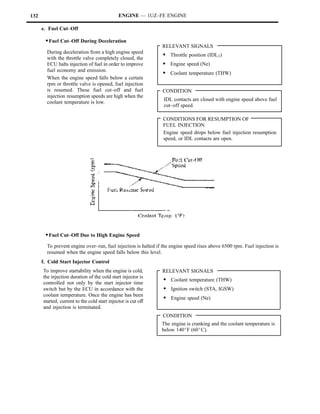
       S Fuel Cut–Off During Deceleration
                                                               RELEVANT SIGNALS
        During deceleration from a high engine speed
                                                                S Throttle position (IDL1)
        with the throttle valve completely closed, the
        ECU halts injection of fuel in order to improve         S Engine speed (Ne)
        fuel economy and emission.
                                                                S Coolant temperature (THW)
        When the engine speed falls below a certain
        rpm or throttle valve is opened, fuel injection
        is resumed. These fuel cut–off and fuel                CONDITION
        injection resumption speeds are high when the
                                                                IDL contacts are closed with engine speed above fuel
        coolant temperature is low.
                                                                cut–off speed.

                                                                CONDITIONS FOR RESUMPTION OF
                                                                FUEL INJECTION
                                                                Engine speed drops below fuel injection resumption
                                                                speed, or IDL contacts are open.


       S Fuel Cut–Off Due to High Engine Speed
        To prevent engine over–run, fuel injection is halted if the engine speed rises above 6500 rpm. Fuel injection is
        resumed when the engine speed falls below this level.
      f. Cold Start Injector Control
      To improve startability when the engine is cold,         RELEVANT SIGNALS
      the injection duration of the cold start injector is
      controlled not only by the start injector time
                                                                S Coolant temperature (THW)
      switch but by the ECU in accordance with the              S Ignition switch (STA, IGSW)
      coolant temperature. Once the engine has been
                                                                S Engine speed (Ne)
      started, current to the cold start injector is cut off
      and injection is terminated.
                                                                CONDITION
                                                               The engine is cranking and the coolant temperature is
                                                               below 140_F (60_C).
ENGINE — 1UZ–FE ENGINE                                                  133


7. ESA (Electronic Spark Advance)
General
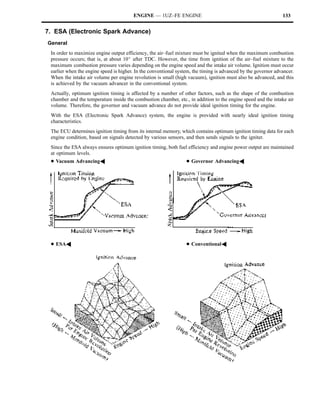
 In order to maximize engine output efficiency, the air–fuel mixture must be ignited when the maximum combustion
 pressure occurs; that is, at about 10_ after TDC. However, the time from ignition of the air–fuel mixture to the
 maximum combustion pressure varies depending on the engine speed and the intake air volume. Ignition must occur
 earlier when the engine speed is higher. In the conventional system, the timing is advanced by the governor advancer.
 When the intake air volume per engine revolution is small (high vacuum), ignition must also be advanced, and this
 is achieved by the vacuum advancer in the conventional system.
 Actually, optimum ignition timing is affected by a number of other factors, such as the shape of the combustion
 chamber and the temperature inside the combustion chamber, etc., in addition to the engine speed and the intake air
 volume. Therefore, the governor and vacuum advance do not provide ideal ignition timing for the engine.
 With the ESA (Electronic Spark Advance) system, the engine is provided with nearly ideal ignition timing
 characteristics.
 The ECU determines ignition timing from its internal memory, which contains optimum ignition timing data for each
 engine condition, based on signals detected by various sensors, and then sends signals to the igniter.
 Since the ESA always ensures optimum ignition timing, both fuel efficiency and engine power output are maintained
 at optimum levels.
 DVacuum AdvancingA                                               DGovernor AdvancingA


 DESAA                                                            DConventionalA
134                                          ENGINE — 1UZ–FE ENGINE

 Ignition Circuit
  1) Principle of Ignition
        The ignition timing is determined by the ECU based on signals (G1, G2, Ne) from sensors. When it is determined,
        the ECU sends an IGt signal to the igniter at a predetermined timing (30_ crankshaft angle) before ignition. The
        transistor inside the igniter is turned on by this signal and primary current is supplied from the battery via the
        ignition switch to the ignition coil. When the crankshaft position reaches the ignition timing, the ECU stops
        supplying the IGt signal. The transistor inside the igniter is turned off and the primary current to the ignition coil
        is cut off as a result. At this time, the secondary voltage is induced in the ignition coil. The secondary voltage
        is distributed and causes sparks from the spark plug. The counter–electromotive force that is generated when the
        primary current is shut off causes an ignition confirmation signal (IGf), which is sent to the igniter.


NOTE:     Two igniters are used in the engine, one each for four cylinders. No. 1 igniter ignites cylinders 1, 4, 6 and
          7 and No. 2 igniter ignites cylinders 2, 3, 5 and 8.

  2) Layout of Components
ENGINE — 1UZ–FE ENGINE                                                 135

Construction and Function of Relevant Sensor
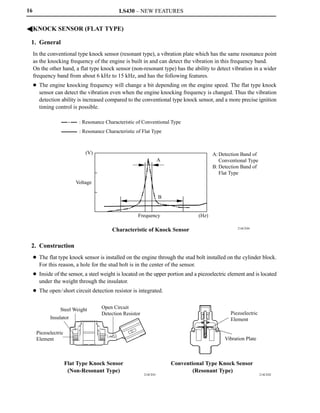
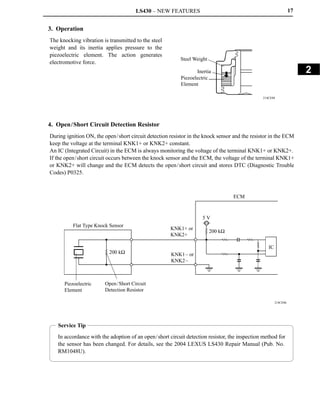
 Knock Sensor
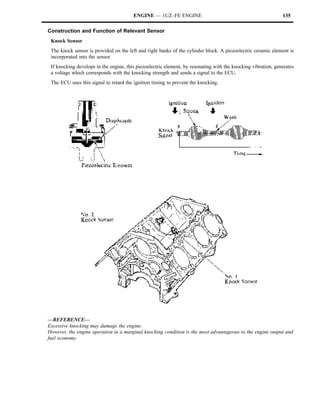
 The knock sensor is provided on the left and right banks of the cylinder block. A piezoelectric ceramic element is
 incorporated into the sensor.
 If knocking develops in the engine, this piezoelectric element, by resonating with the knocking vibration, generates
 a voltage which corresponds with the knocking strength and sends a signal to the ECU.
 The ECU uses this signal to retard the ignition timing to prevent the knocking.


—REFERENCE—
Excessive knocking may damage the engine.
However, the engine operation in a marginal knocking condition is the most advantageous to the engine output and
fuel economy.
136                                       ENGINE — 1UZ–FE ENGINE

Function of ECU

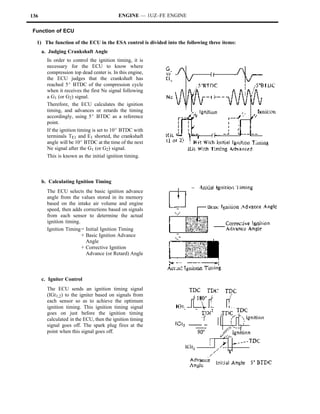
  1) The function of the ECU in the ESA control is divided into the following three items:
      a. Judging Crankshaft Angle
        In order to control the ignition timing, it is
        necessary for the ECU to know where
        compression top dead center is. In this engine,
        the ECU judges that the crankshaft has
        reached 5_ BTDC of the compression cycle
        when it receives the first Ne signal following
        a G1 (or G2) signal.
        Therefore, the ECU calculates the ignition
        timing, and advances or retards the timing
        accordingly, using 5_ BTDC as a reference
        point.
        If the ignition timing is set to 10_ BTDC with
        terminals TE1 and E1 shorted, the crankshaft
        angle will be 10_ BTDC at the time of the next
        Ne signal after the G1 (or G2) signal.
        This is known as the initial ignition timing.


      b. Calculating Ignition Timing
        The ECU selects the basic ignition advance
        angle from the values stored in its memory
        based on the intake air volume and engine
        speed, then adds corrections based on signals
        from each sensor to determine the actual
        ignition timing.
        Ignition Timing = Initial Ignition Timing
                         + Basic Ignition Advance
                           Angle
                         + Corrective Ignition
                           Advance (or Retard) Angle


      c. Igniter Control
        The ECU sends an ignition timing signal
        (IGt1,2) to the igniter based on signals from
        each sensor so as to achieve the optimum
        ignition timing. This ignition timing signal
        goes on just before the ignition timing
        calculated in the ECU, then the ignition timing
        signal goes off. The spark plug fires at the
        point when this signal goes off.
ENGINE — 1UZ–FE ENGINE                                                  137

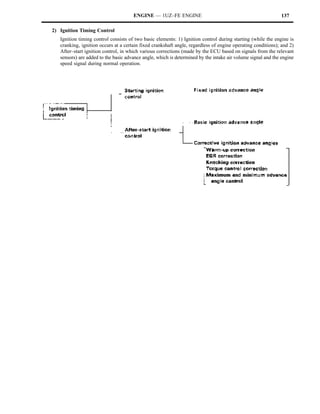
2) Ignition Timing Control
   Ignition timing control consists of two basic elements: 1) Ignition control during starting (while the engine is
   cranking, ignition occurs at a certain fixed crankshaft angle, regardless of engine operating conditions); and 2)
   After–start ignition control, in which various corrections (made by the ECU based on signals from the relevant
   sensors) are added to the basic advance angle, which is determined by the intake air volume signal and the engine
   speed signal during normal operation.
138                                       ENGINE — 1UZ–FE ENGINE

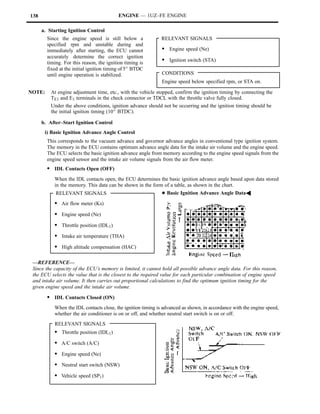
      a. Starting Ignition Control
        Since the engine speed is still below a               RELEVANT SIGNALS
        specified rpm and unstable during and
        immediately after starting, the ECU cannot            S Engine speed (Ne)
        accurately determine the correct ignition
        timing. For this reason, the ignition timing is
                                                              S Ignition switch (STA)
        fixed at the initial ignition timing of 5_ BTDC
        until engine operation is stabilized.                 CONDITIONS
                                                              Engine speed below specified rpm, or STA on.

NOTE:     At engine adjustment time, etc., with the vehicle stopped, confirm the ignition timing by connecting the
          TE1 and E1 terminals in the check connector or TDCL with the throttle valve fully closed.
          Under the above conditions, ignition advance should not be occurring and the ignition timing should be
          the initial ignition timing (10_ BTDC).

      b. After–Start Ignition Control
       i) Basic Ignition Advance Angle Control
        This corresponds to the vacuum advance and governor advance angles in conventional type ignition system.
        The memory in the ECU contains optimum advance angle data for the intake air volume and the engine speed.
        The ECU selects the basic ignition advance angle from memory according to the engine speed signals from the
        engine speed sensor and the intake air volume signals from the air flow meter.
        S IDL Contacts Open (OFF)
           When the IDL contacts open, the ECU determines the basic ignition advance angle based upon data stored
           in the memory. This data can be shown in the form of a table, as shown in the chart.
            RELEVANT SIGNALS                                  DBasic Ignition Advance Angle DataA

           S Air flow meter (Ks)
           S Engine speed (Ne)
           S Throttle position (IDL1)
           S Intake air temperature (THA)
           S High altitude compensation (HAC)

 —REFERENCE—
 Since the capacity of the ECU’s memory is limited, it cannot hold all possible advance angle data. For this reason,
 the ECU selects the value that is the closest to the required value for each particular combination of engine speed
 and intake air volume. It then carries out proportional calculations to find the optimum ignition timing for the
 given engine speed and the intake air volume.

        S IDL Contacts Closed (ON)
           When the IDL contacts close, the ignition timing is advanced as shown, in accordance with the engine speed,
           whether the air conditioner is on or off, and whether neutral start switch is on or off.
           RELEVANT SIGNALS
           S Throttle position (IDL1)
           S A/C switch (A/C)
           S Engine speed (Ne)
           S Neutral start switch (NSW)
           S Vehicle speed (SP1)
ENGINE — 1UZ–FE ENGINE                                    139

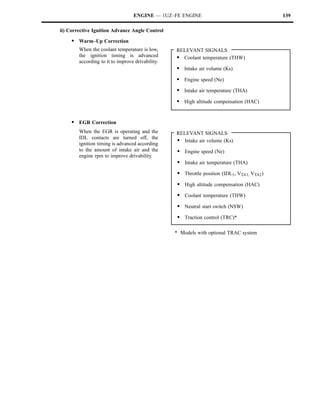
ii) Corrective Ignition Advance Angle Control

     S Warm–Up Correction
        When the coolant temperature is low,      RELEVANT SIGNALS
        the ignition timing is advanced           S Coolant temperature (THW)
        according to it to improve drivability.
                                                  S Intake air volume (Ks)
                                                  S Engine speed (Ne)
                                                  S Intake air temperature (THA)
                                                  S High altitude compensation (HAC)


     S EGR Correction
        When the EGR is operating and the         RELEVANT SIGNALS
        IDL contacts are turned off, the
        ignition timing is advanced according
                                                  S Intake air volume (Ks)
        to the amount of intake air and the        S Engine speed (Ne)
        engine rpm to improve drivability.
                                                   S Intake air temperature (THA)
                                                   S Throttle position (IDL1, VTA1, VTA2)
                                                   S High altitude compensation (HAC)
                                                   S Coolant temperature (THW)
                                                   S Neutral start switch (NSW)
                                                   S Traction control (TRC)*

                                                  * Models with optional TRAC system
140                                          ENGINE — 1UZ–FE ENGINE


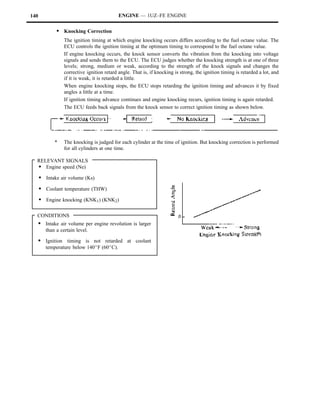
              S Knocking Correction
                  The ignition timing at which engine knocking occurs differs according to the fuel octane value. The
                  ECU controls the ignition timing at the optimum timing to correspond to the fuel octane value.
                  If engine knocking occurs, the knock sensor converts the vibration from the knocking into voltage
                  signals and sends them to the ECU. The ECU judges whether the knocking strength is at one of three
                  levels; strong, medium or weak, according to the strength of the knock signals and changes the
                  corrective ignition retard angle. That is, if knocking is strong, the ignition timing is retarded a lot, and
                  if it is weak, it is retarded a little.
                  When engine knocking stops, the ECU stops retarding the ignition timing and advances it by fixed
                  angles a little at a time.
                  If ignition timing advance continues and engine knocking recurs, ignition timing is again retarded.
                  The ECU feeds back signals from the knock sensor to correct ignition timing as shown below.


             *    The knocking is judged for each cylinder at the time of ignition. But knocking correction is performed
                  for all cylinders at one time.

  RELEVANT SIGNALS
  S Engine speed (Ne)
      S Intake air volume (Ks)
      S Coolant temperature (THW)
      S Engine knocking (KNK1) (KNK2)

  CONDITIONS
      S Intake air volume per engine revolution is larger
         than a certain level.

      S Ignition timing is not retarded at coolant
         temperature below 140_F (60_C).
ENGINE — 1UZ–FE ENGINE                                                    141

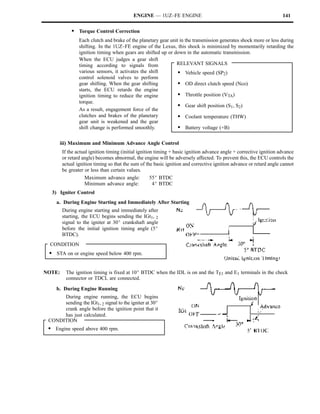
            S Torque Control Correction
                Each clutch and brake of the planetary gear unit in the transmission generates shock more or less during
                shifting. In the 1UZ–FE engine of the Lexus, this shock is minimized by momentarily retarding the
                ignition timing when gears are shifted up or down in the automatic transmission.
                When the ECU judges a gear shift
                timing according to signals from               RELEVANT SIGNALS
                various sensors, it activates the shift         S Vehicle speed (SP2)
                control solenoid valves to perform
                gear shifting. When the gear shifting           S OD direct clutch speed (Nco)
                starts, the ECU retards the engine
                ignition timing to reduce the engine            S Throttle position (VTA)
                torque.
                                                                S Gear shift position (S1, S2)
                As a result, engagement force of the
                clutches and brakes of the planetary            S Coolant temperature (THW)
                gear unit is weakened and the gear
                shift change is performed smoothly.             S Battery voltage (+B)

      iii) Maximum and Minimum Advance Angle Control
        If the actual ignition timing (initial ignition timing + basic ignition advance angle + corrective ignition advance
        or retard angle) becomes abnormal, the engine will be adversely affected. To prevent this, the ECU controls the
        actual ignition timing so that the sum of the basic ignition and corrective ignition advance or retard angle cannot
        be greater or less than certain values.
                    Maximum advance angle:            55_ BTDC
                    Minimum advance angle:             4_ BTDC
  3) Igniter Control
    a. During Engine Starting and Immediately After Starting
        During engine starting and immediately after
        starting, the ECU begins sending the IGt1, 2
        signal to the igniter at 30_ crankshaft angle
        before the initial ignition timing angle (5_
        BTDC).
  CONDITION
 S STA on or engine speed below 400 rpm.


NOTE:    The ignition timing is fixed at 10_ BTDC when the IDL is on and the TE1 and E1 terminals in the check
         connector or TDCL are connected.

    b. During Engine Running
      During engine running, the ECU begins
      sending the IGt1, 2 signal to the igniter at 30_
      crank angle before the ignition point that it
      has just calculated.
 CONDITION
 S Engine speed above 400 rpm.
142                                       ENGINE — 1UZ–FE ENGINE


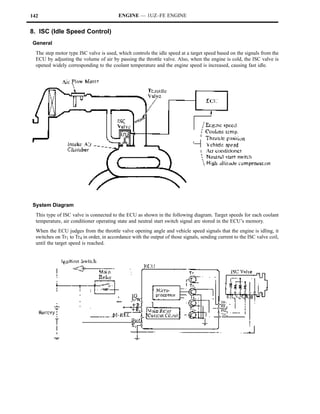
8. ISC (Idle Speed Control)
General
  The step motor type ISC valve is used, which controls the idle speed at a target speed based on the signals from the
  ECU by adjusting the volume of air by passing the throttle valve. Also, when the engine is cold, the ISC valve is
  opened widely corresponding to the coolant temperature and the engine speed is increased, causing fast idle.


System Diagram
  This type of ISC valve is connected to the ECU as shown in the following diagram. Target speeds for each coolant
  temperature, air conditioner operating state and neutral start switch signal are stored in the ECU’s memory.
  When the ECU judges from the throttle valve opening angle and vehicle speed signals that the engine is idling, it
  switches on Tr1 to Tr4 in order, in accordance with the output of those signals, sending current to the ISC valve coil,
  until the target speed is reached.
ENGINE — 1UZ–FE ENGINE                                                    143

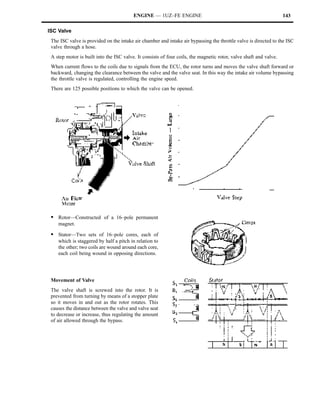
ISC Valve
 The ISC valve is provided on the intake air chamber and intake air bypassing the throttle valve is directed to the ISC
 valve through a hose.
 A step motor is built into the ISC valve. It consists of four coils, the magnetic rotor, valve shaft and valve.
 When current flows to the coils due to signals from the ECU, the rotor turns and moves the valve shaft forward or
 backward, changing the clearance between the valve and the valve seat. In this way the intake air volume bypassing
 the throttle valve is regulated, controlling the engine speed.
 There are 125 possible positions to which the valve can be opened.


 S Rotor—Constructed of a 16–pole permanent
    magnet.

 S Stator—Two sets of 16–pole cores, each of
    which is staggered by half a pitch in relation to
    the other; two coils are wound around each core,
    each coil being wound in opposing directions.


 Movement of Valve
 The valve shaft is screwed into the rotor. It is
 prevented from turning by means of a stopper plate
 so it moves in and out as the rotor rotates. This
 causes the distance between the valve and valve seat
 to decrease or increase, thus regulating the amount
 of air allowed through the bypass.
144                                        ENGINE — 1UZ–FE ENGINE

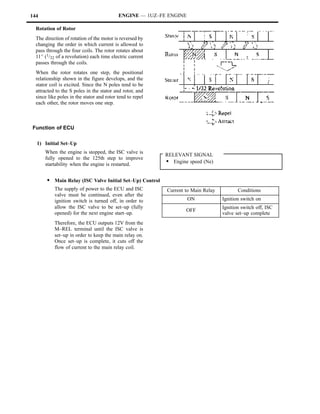
  Rotation of Rotor
  The direction of rotation of the motor is reversed by
  changing the order in which current is allowed to
  pass through the four coils. The rotor rotates about
  11_ (1/32 of a revolution) each time electric current
  passes through the coils.
  When the rotor rotates one step, the positional
  relationship shown in the figure develops, and the
  stator coil is excited. Since the N poles tend to be
  attracted to the S poles in the stator and rotor, and
  since like poles in the stator and rotor tend to repel
  each other, the rotor moves one step.


Function of ECU

  1) Initial Set–Up
      When the engine is stopped, the ISC valve is
                                                           RELEVANT SIGNAL
      fully opened to the 125th step to improve
      startability when the engine is restarted.
                                                           S Engine speed (Ne)


       S Main Relay (ISC Valve Initial Set–Up) Control
           The supply of power to the ECU and ISC          Current to Main Relay          Conditions
           valve must be continued, even after the
           ignition switch is turned off, in order to               ON             Ignition switch on
           allow the ISC valve to be set–up (fully                                 Ignition switch off, ISC
                                                                   OFF
           opened) for the next engine start–up.                                   valve set–up complete
           Therefore, the ECU outputs 12V from the
           M–REL terminal until the ISC valve is
           set–up in order to keep the main relay on.
           Once set–up is complete, it cuts off the
           flow of current to the main relay coil.
ENGINE — 1UZ–FE ENGINE   145

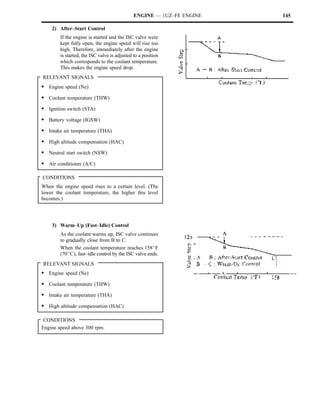
    2) After–Start Control
        If the engine is started and the ISC valve were
        kept fully open, the engine speed will rise too
        high. Therefore, immediately after the engine
        is started, the ISC valve is adjusted to a position
        which corresponds to the coolant temperature.
        This makes the engine speed drop.
RELEVANT SIGNALS
S Engine speed (Ne)
S Coolant temperature (THW)
S Ignition switch (STA)
S Battery voltage (IGSW)
S Intake air temperature (THA)
S High altitude compensation (HAC)
S Neutral start switch (NSW)
S Air conditioner (A/C)

CONDITIONS
When the engine speed rises to a certain level. (The
lower the coolant temperature, the higher this level
becomes.)


    3) Warm–Up (Fast–Idle) Control
        As the coolant warms up, ISC valve continues
        to gradually close from B to C.
        When the coolant temperature reaches 158_F
        (70_C), fast–idle control by the ISC valve ends.
RELEVANT SIGNALS
S Engine speed (Ne)
S Coolant temperature (THW)
S Intake air temperature (THA)
S High altitude compensation (HAC)

 CONDITIONS
Engine speed above 300 rpm.
146                                        ENGINE — 1UZ–FE ENGINE

  4) Feedback Control
      If there is a difference between the actual           RELEVANT SIGNALS
      engine speed and the target speed stored in the      S Throttle position (IDL1)
      memory of the ECU, then the ECU sends a
      signal to the ISC valve and increases or             S Vehicle speed (SP1)
      decreases the volume of the air bypass so that
      the actual engine speed will match the target        S Engine speed (Ne)
      speed.
                                                           S Coolant temperature (THW)
      The target speeds differ depending on engine
      conditions such as neutral start switch on or off,   S Intake air temperature (THA)
      and air conditioner switch on or off.
                                                           S Air conditioner (A/C)
                                                           S Neutral start switch (NSW)

                                                           CONDITIONS
                                                           IDL contacts close, vehicle speed is below a certain
                                                           speed, engine speed is above 300 rpm and coolant tem-
                                                           perature above 163.4_F (73_C).


      DTarget Idling SpeedA
          Air             Neutral
                                           Engine
       Conditioner         Start
                                           Speed
         Switch           Switch
                             ON            900 rpm
            ON
                            OFF            750 rpm
                             ON            650 rpm
           OFF
                            OFF            580 rpm


  5) Engine Speed Change Estimate Control
      Immediately after the air conditioner switch or      RELEVANT SIGNALS
      automatic transmission shift position is             S Engine speed (Ne)
      changed, the engine load also changes.
      To prevent the engine speed from changing the        S Air conditioner (A/C)
      ECU sends signals to the ISC valve to open or
      close it to a fixed amount before changes in the     S Neutral start switch (NSW)
      engine speed occur.
                                                           S Coolant temperature (THW)
                                                           S Vehicle speed (SP1)

                                                           CONDITIONS
                                                           When air conditioner switch or neutral start switch is
                                                           turned on or off with engine speed above 300 rpm.
ENGINE — 1UZ–FE ENGINE                                                  147


9. EGR (Exhaust Gas Recirculation) Cut–Off Control
 This system actuates the VSV (Vacuum Switching Valve) to cut the intake manifold vacuum acting on the EGR valve
 and thus shut off the EGR to maintain drivability.
  1) Purpose of the EGR System
     The EGR system is designed to recirculate the exhaust gas, properly controlled according to the driving
     condition, back into the intake air–fuel mixture. It helps to slow down combustion in the cylinder and thus lower
     the combustion temperature which, in turn, reduces the amount of NOx emission. The amount of EGR is
     regulated by the EGR vacuum modulator according to the engine load.

  2) Operation of the EGR System
     The exhaust gas pressure increases in proportion to the amount of intake air. As the throttle valve opens more
     and the amount of intake air increases, a higher exhaust gas pressure applies to the constant pressure chamber
     of the EGR valve. It pushes the diaphragm of the EGR vacuum modulator upward to narrow the “          ” passage.
     Since intake vacuum acts then on E and R ports of the throttle body, the vacuum regulated by the “     ” passage
     determined by the EGR vacuum modulator acts on the EGR vacuum chamber via the VSV. It opens the EGR
     value which, in turn, leads exhaust gas into the intake air chamber. This also causes the gas pressure inside the
     constant pressure chamber to go down which, in turn, lowers the EGR vacuum modulator diaphragm.
     The EGR valve is now under less vacuum and                        DEGR Operating (VSV OFF)A
     the valve moves until the vacuum balances
     with the spring tension. The amount of EGR
     gas is regulated as a result. As explained above,
     the EGR system controls the amount of EGR
     properly according to the exhaust gas pressure
     and the intake vacuum.


  3) EGR Cut–Off Operation
     When the VSV is turned on by a signal from the                   DEGR Cut–Off (VSV ON)A
     ECU, atmospheric air is led to the EGR valve,
     the EGR valve closes and shuts off the exhaust
     gas. This operation (EGR cut–off) is
     implemented when the following conditions
     exist:

     1)   Coolant temperature below 134.6_F (57_C)
     2)   During deceleration (throttle valve closed)
     3)   Light engine load (amount of intake air very small)
     4)   Engine speed over 4000 rpm
     5)   Engine racing (neutral start switch turned on)
148                                      ENGINE — 1UZ–FE ENGINE


10. Fuel Pump Speed Control
  This control system increases the fuel pump output by switching the fuel pump speed to high if a large amount of fuel
  is required by the engine. In normal operations where the engine speeds are low, the fuel pump rotates at low speed
  to reduce unnecessary consumption of electric power and to maintain fuel pump durability.
Operation
  1) During Engine Idling or Cruising
      The ECU is constantly calculating the fuel injection duration per fixed period of time. When the engine is idling,
      or under normal driving conditions, that is, when the fuel injection duration per fixed period of time is shorter
      than the reference value, the ECU turns on the fuel pump control relay coil. When the control relay coil is turned
      on, the point contacts side B and the current to the fuel pump flows through a resistor, causing the fuel pump to
      run at low speed.


  2) During High Engine Speed and High Load Operation
      When the engine is operated at high speeds or under heavy loads, the fuel pump control relay coil is turned off.
      The point contacts with side A and the current to the fuel pump flows directly to the pump without passing through
      a resistor, causing the fuel pump to run at high speed.
ENGINE — 1UZ–FE ENGINE                                                  149


11. Fuel Pressure Control
 When starting engine at high temperature, the ECU turns on a VSV to draw atmospheric pressure into the diaphragm
 chamber of the pressure regulator. Thereby, the fuel pressure is increased to prevent fuel vapor lock in order to help
 engine start.


Operation
 When the coolant temperature is 185_F (85_C) or
 higher and the intake air temperature is above a
 predetermined level, if the engine is cranked, the
 ECU turns on the VSV. As the VSV goes on,
 atmospheric air is introduced into the diaphragm
 chamber of the pressure regulator and the fuel
 pressure becomes higher by the amount of the
 intake manifold vacuum than the fuel pressure
 under normal engine operating conditions.
 Even after the engine is started, the VSV remains on
 for about 100 seconds.


12. Oxygen Sensor Heater Control
 The ECU controls the operation of the oxygen                 RELEVANT SIGNALS
 sensor heater according to intake air volume and
 engine speed. When the engine load is small and the
                                                              S Coolant temperature (THW)
 exhaust gas temperature is low, the heater is                S Engine speed (Ne)
 operated to maintain sensor efficiency. Also, when
 the engine load becomes large and exhaust gas                S Intake air volume (Ks)
 temperature becomes high, heater operation is
 stopped to prevent deterioration of the sensor.              S Intake air temperature (THA)
 This system controls both left and right banks               S Battery voltage (+B)
 simultaneously.
                                                              S High altitude compensation (HAC)
150                                      ENGINE — 1UZ–FE ENGINE


13. Air Conditioner Compressor Delay Control
  When the air conditioner compressor is operated during idling, engine load fluctuates and the engine rpm drops
  momentarily. The delay control is designed to prevent the engine rpm drop.
Operation
  When the ECU detects a signal (A/C) from the air conditioner ECU that the air conditioner switch is turned on, the
  ECU output a magnet clutch signal (ACMG) to the magnet clutch relay and turns it on.
  The compressor magnetic clutch operation is delayed about 0.5 seconds after the air conditioner switch is turned on.
  During this time, the ECU opens ISC (Idle Speed Control) valve to offset the drop in the engine rpm due to the
  operation of the air conditioner compressor. This prevents the idle speed from dropping.
ENGINE — 1UZ–FE ENGINE                                                  151


14. Diagnosis
General
 The ECU contains a built–in self–diagnostic system. The ECU, which is constantly monitoring all sensors, and lights
 the “CHECK ENGINE” lamp when it detects a problem in the sensors or their circuitry. At the same time, the ECU
 registers the system containing the malfunction into its memory. This information is retained in memory even after
 the ignition switch is turned off, even after the malfunction has been corrected. When the vehicle is brought into the
 workshop for service because of the problem in the system, the contents of the memory may be checked to identify
 the malfunction.
 After the problem is repaired, the diagnostic system is cleared by removing the EFI fuse for more than 10 seconds.
 The contents of the diagnostic memory can be checked by connecting terminals in the check connector or in the TDCL
 and counting the number of times the CHECK ENGINE lamp blinks.
 This self–diagnostic system has two types of malfunction detection mode; normal mode and test mode.
 In the normal mode, it detects a malfunction if a problem, shown in the diagnostic items on page 154, occurs in the
 sensors or circuitry a specified number of times or continues for more than a specified period of time. The ECU lights
 the “CHECK ENGINE” lamp.
 In the test mode, it has a more sensitive detection accuracy than the normal mode and detects a malfunction even if
 it occurs only once.
 Thereby, it detects a poor contact between terminals of the connector or momentary disconnection of the wire, which
 is difficult to detect in the normal mode. The diagnostic items in the test mode are also shown on page 154.
152                                        ENGINE — 1UZ–FE ENGINE

“CHECK ENGINE” Lamp
  1) Operation

        S When the ignition switch is turned from
           OFF to ON, the “CHECK ENGINE” lamp
           goes on. After the engine is started, the
           lamp goes out. This is to inform the driver
           that the “CHECK ENGINE” lamp
           circuitry is operating normally.


        S The lamp lights immediately if a problem occurs in engine control system while the engine is operating (both
           in normal mode and test mode).

        S If the problem is corrected, the lamp goes out five seconds after the problem has been corrected in the normal
           mode.
           In the test mode, the lamp is kept lit until the ignition switch is turned off or TE1 and E1 terminals are
           disconnected.

        S In the normal mode, if the problem no longer exists at the time of repair (for example, if it is an intermittent
           problem), the “CHECK ENGINE” lamp will not light, even if the malfunction has been recorded in the
           memory of the ECU.

Diagnostic Mode and Output of “CHECK ENGINE” Lamp
  The diagnostic mode (normal or test) and the output of the “CHECK ENGINE” lamp can be selected by changing
  the connections of the TE1, TE2 and E1 terminals in the TDCL (Total Diagnostic Communication Link) or check
  connector as shown in the table below.

      TE1 and E1        TE2 and E1         Diagnostic
                                                                        Output of “CHECK ENGINE” Lamp
      Terminals         Terminals            Mode
                           Open              Normal        Warning to driver of malfunction.
        Open                                               Output of diagnostic results (content of malfunction) in
                        Connected            Normal
                                                           normal mode, indicated by number of times lamp blinks.
                           Open                Test        Warning to technician of malfunction.
      Connected                                            Output of diagnostic results (content of malfunction) in
                        Connected              Test
                                                           test mode, indicated by number of times lamp blinks.

Diagnostic Procedure
  1) Normal Mode                                                          DTDCLA
       The diagnostic codes are displayed, by the
       procedure listed below, in order from the
       smallest to the largest code with the number of
       times the lamp blinks indicating the code
       number.
       è   Turn the ignition switch ON.
       Á   Connect terminals TE1 and E1.                                  DCheck ConnectorA
       Â   IDL contacts ON (throttle valve
           fully closed).


                                                                    *    Terminal TE2 is not provided in the check
                                                                         connector.
ENGINE — 1UZ–FE ENGINE                                                   153

  2) Test Mode

        è    First, connect terminals TE2 and E1, then turn the ignition switch on to begin the diagnosis in the test mode.
        Á    Start the engine.
        Â    Simulate the conditions of the malfunction described by the customer.
        Ã    When a malfunction occurs and the “CHECK ENGINE” lamp lights up, terminals TE1 and E1 should be
             connected for outputting the malfunction code. Lighting up of the “CHECK ENGINE” lamp and retention
             of the malfunction in the ECU memory continues until TE2 and E1 terminals are disconnected or the ignition
             switch is turned to OFF.
        Ä    End the test mode by disconnecting the terminals TE2 and E1 or turn the ignition switch OFF.

NOTE:       The test mode will not start if terminals TE2 and E1 are connected after the ignition switch is turned on or
            terminals TE1 and E1 are connected before the ignition switch is turned on.

 Diagnostic Code Display
  In both normal and test modes, the diagnostic
  results are displayed in two–digit codes.

  1) Normal
        The “CHECK ENGINE” lamp will blink about
        two times per second as shown in the chart.


  2) Malfunction
        The appropriate diagnostic code(s) will be
        displayed.
        In this case, codes 13 and 32 are indicated.


NOTE:       If two or more malfunctions are present at the same time, the lowest–numbered diagnostic code will be
            displayed first.
154                                                     ENGINE — 1UZ–FE ENGINE

  Diagnostic Items
                                 “CHECK
Code                          ENGINE” Lamp*1
 No.           Item                                                          Diagnosis                                             Trouble Area                Memory* 2
                              Normal   Test
                               Mode    Mode

                                                                                                                         S   Ne, G sensor circuit

 12     RPM Signal             ON      N.A.
                                               No “Ne” or “G” signal to ECU within 2 seconds after engine is             S   Starter signal circuit
                                                                                                                                                                  f
                                               cranked.
                                                                                                                         S   Ne, G sensor
                                                                                                                         S   ECU

                                               S   No “Ne” signal to ECU when the engine speed is above 1000             S   Ne sensor circuit
 13     RPM Signal             ON      ON          rpm.
                                                                                                                         S                                        f
                                               S                                                                             Ne sensor
                                                   The phase of the G1 or G2 signal and the Ne signal is shifted more
                                                   than the standard value.                                              S   ECU

                                                                                                                         S   Igniter circuit
14* 6
        Ignition No. 1
        Signal                 ON      N.A.    No “IGf1” signal to ECU 8–11 times in succession.                         S   Igniter                              f
                                                                                                                         S   ECU

                                                                                                                         S   Igniter circuit
15* 6
        Ignition No. 2
        Signal                 ON      N.A.    No “IGf2” signal to ECU 8–11 times in succession.                         S   Igniter                              f
                                                                                                                         S   ECU
 16     ECT Control Signal     ON      N.A.    ECT control program faulty.                                               S   ECU                                  X

                                                                                                                         S   G1 sensor circuit
 17
        Cam Position
        Sensor No. 1 Signal    N.A.    OFF     Open circuit in G1 sensor signal (G1).                                    S   G1 sensor                            X
                                                                                                                         S   ECU

                                                                                                                         S   G2 sensor circuit
 18
        Cam Position
        Sensor No. 2 Signal    N.A.    OFF     Open circuit in G2 sensor signal (G2).                                    S   G2 sensor                            X
                                                                                                                         S   ECU
                                               During air–fuel ratio feedback correction, output voltage of main
                                               oxygen sensor remains between 0.35V and 0.7V continuously for
                                                                                                                         S   Main oxygen sensor circuit
                                                                                                                                                                  f
                                               a certain period (OXL1).                                                  S   Main oxygen sensor
        Main Oxygen
 21     Sensor Signal (for
        left bank)
                               ON      ON                                                                                S   Oxygen sensor heater circuit
                                               Open circuit in oxygen sensor heater signal (HT1).                        S   Oxygen sensor heater                 f
                                                                                                                         S   ECU

                                                                                                                         S   Water temp. sensor circuit
 22
        Water Temp.
        Sensor Signal          ON      ON      Open or short circuit in water temp. sensor signal (THW).                 S   Water temp. sensor                   f
                                                                                                                         S   ECU

                                                                                                                         S   Intake air temp. sensor circuit
 24
        Intake Air Temp.
        Signal                ON*3     ON      Open or short circuit in intake air temp. sensor signal (THA).            S   Intake air temp. sensor              f
                                                                                                                         S   ECU

                                                                                                                         S   Injector circuit
                                                                                                                         S   Injector
                                                                                                                         S   Ignition system

        Air–Fuel
                                                                                                                         S   Fuel line pressure
25* 4   Ratio Lean                                                                                                       S   Oxygen sensor circuit
        Malfunction
                                               S   When air–fuel ratio feedback correction value continues at the        S   Oxygen sensor
                                                   upper (lean) limit for a certain period of time or adaptive control
                                                   value is not renewed for a certain period of time.                    S   Air flow meter
                                               S   When air–fuel ratio feedback compensation value or adaptive           S   Water temp. sensor
                                                                                                                                                                  f
                               ON      ON          control value feedback frequency is abnormally high during idle
                                                   switch on and feedback condition.
                                                                                                                         S   ECU

                                               S   When the difference of air–fuel ratio feedback compensation           S   Injector circuit
                                                   value between right and left banks is more than a certain
                                                   percentage.                                                           S   Injector

        Air–Fuel
                                                                                                                         S   Fuel line pressure
26* 4   Ratio Rich                                                                                                       S   Cold start injector
        Malfunction
                                                                                                                         S   Air flow meter
                                                                                                                         S   Water temp. sensor
                                                                                                                         S   ECU

        Sub–Oxygen
                                                                                                                         S   Sub–oxygen sensor circuit
 27     Sensor Signal (for     ON      ON      Open circuit in sub–oxygen sensor signal (OXL2).                          S   Sub–oxygen sensor                    f
        left bank)
                                                                                                                         S   ECU
ENGINE — 1UZ–FE ENGINE                                                                                155

                                “CHECK
Code                         ENGINE” Lamp*1
 No.           Item                                                     Diagnosis                                          Trouble Area                 Memory* 2
                             Normal   Test
                              Mode    Mode
                                              During air–fuel ratio feedback correction, output voltage of
                                              main oxygen sensor remains between 0.35V and 0.7V
                                                                                                             S   Main oxygen sensor circuit
                                                                                                                                                           f
                                              continuously for a certain period (OXR1).                      S   Main oxygen sensor
        Main Oxygen
 28     Sensor Signal (for
        right bank)
                              ON      ON                                                                     S   Oxygen sensor heater circuit
                                              Open circuit in oxygen sensor heater signal (HT2).             S   Oxygen sensor heater                      f
                                                                                                             S   ECU

        Sub–Oxygen
                                                                                                             S   Sub–oxygen sensor circuit
 29     Sensor Signal (for    ON      ON      Open circuit in sub–oxygen sensor signal (OXR2).               S   Sub–oxygen sensor                         f
        right bank)
                                                                                                             S   ECU

                                                                                                             S   Air flow meter circuit
 31
        Air Flow Meter
        Signal                ON      ON
                                              No “Ks” signal to ECU when the engine speed is above 300
                                              rpm.                                                           S   Air flow meter                            f
                                                                                                             S   ECU
 35     HAC Sensor Signal     ON      ON      Open circuit in altitude HAC sensor signal.                    S   ECU                                       f

                                                                                                             S   Throttle position sensor circuit
 41
        Throttle Position
        Sensor Signal        ON*3     ON
                                              Open or short circuit in throttle position sensor signal
                                              (VTA1).                                                        S   Throttle position sensor                  f
                                                                                                             S   ECU

                                                                                                             S   Starter signal circuit
 43     Starter Signal        N.A.    OFF
                                              No “STA” signal to ECU until engine speed reaches 400
                                              rpm with vehicle not moving.                                   S   Ignition switch, main relay circuit       X
                                                                                                             S   ECU

        Sub–Throttle
                                                                                                             S   Sub–throttle position sensor
 47     Position Sensor      ON*3     ON
                                              Open or short circuit in throttle position sensor signal
                                              (VTA2).                                                        S   Sub–throttle position sensor circuit      f
        Signal
                                                                                                             S   ECU

                                                                                                             S   Knock sensor circuit
 52
        Knock Sensor
        Signal 1              ON      N.A.    Open or short circuit in knock sensor signal (KNK1).           S   Knock sensor                              f
                                                                                                             S   ECU

 53
        Knock Control
        Signal                ON      N.A.    Knock control program faulty.                                  S   ECU                                       X

                                                                                                             S   Knock sensor circuit
 55
        Knock Sensor
        Signal 2              ON      N.A.    Open or short circuit in knock sensor signal (KNK2).           S   Knock sensor                              f
                                                                                                             S   ECU

                                                                                                             S   EGR system components

71* 5
        EGR System
                              ON      ON
                                              EGR gas temp. below a predetermined level during EGR           S   EGR gas temp. sensor circuit
                                                                                                                                                           f
        Malfunction                           operation.
                                                                                                             S   EGR gas temp. sensor
                                                                                                             S   ECU

                                                                                                             S   A/C amplifier
                                                                                                             S   A/C switch circuit
                                                                                                             S   Neutral start switch circuit

 51
        Switch Condition
                              N.A.    OFF
                                              No “IDL” signal or No “NSW” signal or “A/C” signal to          S   Neutral start switch
                                                                                                                                                           X
        Signal                                ECU during diagnosis check for test mode.
                                                                                                             S   Throttle position sensor circuit
                                                                                                             S   Throttle position sensor
                                                                                                             S   Accelerator pedal and cable
                                                                                                             S   ECU

   *1: ON in the diagnostic mode column indicates that the “CHECK ENGINE” lamp will light up when a diagnosis
       is conducted and a malfunction is detected. OFF indicates that the lamp will not light even if a malfunction is
       detected during a diagnosis. N.A. indicates that diagnosis is not performed for that item.
   *2: f mark in the memory column indicates that the code for a malfunction is stored in the ECU memory if that
       malfunction occurs once. X mark indicates that the code is not stored in the memory even if that malfunction
       occurs. For this reason, lamp indication of the malfunction code is limited to those times when the diagnostic
       results are output in accordance with the normal or test mode procedures.
   *3: In the normal mode, when a malfunction occurs in code Nos. 24, 41 and 47, the “CHECK ENGINE” lamp will
       light up only in California specification vehicles.
   *4: If the circuit of the main oxygen sensor is open or shorted in California specification vehicles, only code No. 25
       is stored in the ECU memory. If malfunctions occur with items other than the main oxygen sensor, code Nos. 25
       and 26 are stored simultaneously in memory for all items.
   *5: Code No. 71 is used only for California specification vehicles.
   *6: If diagnostic code “14” is displayed, check No. 1 igniter connected with harness wrapped with yellow tape.
       If diagnostic code “15” is displayed, check No. 2 igniter connected with harness not wrapped with yellow tape.
156                                       ENGINE — 1UZ–FE ENGINE


15. Fail–Safe
Fail–Safe Function
  When a malfunction is detected by any of the sensors, there is a possibility of an engine or other malfunction occurring
  if the ECU were to continue to control the engine control system in the normal way. To prevent such a problem, the
  fail–safe function of the ECU either relies on the data stored in memory to allow the engine control system to continue
  operating, or stops the engine if a hazard is anticipated.
  The following table describes the problems which can occur when trouble occurs in the various circuits, and the
  responses of the fail–safe function:

      Circuit with Abnormal
                                        Necessity of Fail–Safe Function                      Fail–Safe Function
              Signals
                              If trouble occurs in the ignition system and
                              ignition cannot take place (the ignition
  Ignition Confirmation
                              confirmation signal (IGf1,2) is not input to the       Fuel injection is stopped.
  Signal (IGf1,2) Circuit
                              ECU), the catalyst could overheat due to
                              misfiring.
                         If an open or short circuit occurs in the water
  S Water Temp. Sensor   temperature or intake air temperature signal                Fixed values (standard values)
    Signal (THW) Circuit circuit, the ECU senses that the temperature is             are used, standard values are
  S Intake Air Temp.     below –58_F (–50_C) or higher than 274.2_F                  176_F (80_C) for coolant
    Sensor Signal (THA)  (139_C). This results in the air–fuel ratio                 temperature and 68_F (20_C) for
    Circuit              becoming too rich or too lean, which leads to               intake air temperature.
                         engine stall or rough engine running.
                              If trouble occurs in the transmission control
  Transmission Control                                                               Torque control correction by the
                              program in the ECU, transmission does not
  Signal                                                                             ESA is prohibited.
                              operate properly.
                                                                                     Fixed (standard) values
                              If an open or short circuit occurs in the air flow
                                                                                     determined by the STA signal
                              meter signal circuit, it becomes impossible to
                                                                                     and IDL contacts conditions are
  Air Flow Meter Signal       detect the intake air volume and calculation if the
                                                                                     used for the fuel injection
  (Ks) Circuit                basic injection duration cannot be done. This
                                                                                     duration and the ignition timing
                              results in engine stalling or inability to start the
                                                                                     (10_ BTDC), making engine
                              engine.
                                                                                     operation possible.
                              If an open or short circuit occurs in the HAC
                              sensor signal circuit, the atmospheric pressure
  High Altitude               corrective value is either the maximum or the          A fixed value of 760 mmHg is
  Compensation Sensor         minimum value.                                         used.
  Signal (HAC) Circuit
                              This causes the engine to run rough or reduces
                              drivability.
                              When an open or short circuit occurs in the
  Main and Sub–Throttle
                              throttle position sensor signal circuit, the ECU       A fixed value of 0_ throttle valve
  Position Sensor Signal
                              detects the throttle valve as being either fully       opening angle is used.
  (VTA1,2) Circuit
                              open or fully closed to prevent engine stall.
                              If an open or short circuit occurs in the knock
  S Knock Sensor Signal       signal circuit, or if trouble occurs in the knock
    (KNK1,2) Circuit          control system inside the ECU, whether knocking The corrective retard angle value
  S Knock Control             occurs or not, ignition timing retard control will is set to the maximum value.
    System                    not be carried out by the knock control system,
                              which could lead to damage to the engine.
ENGINE — 1UZ–FE ENGINE                                                   157

 Back–Up Function
  If there is trouble with the program in the ECU and the ignition signals (IGt) are not output, the ECU controls fuel
  injection and ignition timing at predetermined levels as a back–up function to make it possible to continue to operate
  the vehicle.
  Furthermore, the injection duration is calculated from the starting signal (STA) and the throttle position signal (IDL).
  Also, the ignition timing is fixed at the initial ignition timing, 5_ BTDC, without relation to the engine speed.

NOTE:    If the engine is controlled by the back–up function, the “CHECK ENGINE” lamp lights up to warn the
         driver of the malfunction but the diagnostic code is not output.
158                               ENGINE — 1UZ–FE ENGINE


F EMISSION CONTROL SYSTEM
1. System Purpose

                 System             Abbreviation                         Purpose
Positive crankcase ventilation         PCV         Reduces HC by eliminating blow–by gas
Exhaust gas recirculation              EGR         Reduces NOx
Three–way catalyst                     TWC         Reduces HC, CO and NOx
Evaporative emission control           EVAP        Reduces evaporative HC
Air–fuel ratio feedback control         A/F        Reduces HC, CO and NOx
Electronic fuel injection               EFI        Regulates all engine conditions for reduction of
                                                   exhaust emissions.
High altitude compensator              HAC         Reduces HC and CO
ENGINE — 1UZ–FE ENGINE   159


2. Component Layout and Schematic Drawing


 *   Applicable only to the California specification vehicles.
160                                      ENGINE — 1UZ–FE ENGINE


3. Diagonal Flow Type Three–Way Catalyst (TWC)
  A new type of high–performance catalyst converter developed by improving the shape and container construction
  is used.
  It has monolithic catalysts and is diagonally arranged in relation to the flow of exhaust gas reducing the length and
  the exhaust resistance with wider cross section area.
26                                            LS400 — NEW FEATURES


F 1UZ–FE ENGINE
1. General
      The 1UZ–FE engine of the ’93 LS400 differs from the ’92 LS400 in the following areas:

                    System                                                    Outline
      Cooling System                       A newly–developed aluminum radiator is lighter in weight.
                                           Throttle body is made both compact and light (together with the throttle
      Intake System
                                           position sensor and IAC* [ISC] valve).
                                           S Fuel injectors are made more compact and light (total length shortened from
      Fuel System                            78.1 mm to 71 mm [3.07 in. —2.80 in.]).
                                           S Cold start injector has been discontinued.
      Engine Control System                Refer to 2. Engine Control System table below.
                                           S EGR and EVAP systems are controlled by ECM [engine ECU].
      Emission Control System
                                           S Secondary Air Injection system adopted for California–spec vehicles only.
      * IAC (Idle Air Control)


2. Engine Control System
 General
      The following table shows the comparison of the engine control system of the ’93 LS400’s 1UZ–FE engine to that
      of the ’92 LS400:

                System                                      Outline                          ’93 LS400      ’92 LS400
                                   S An L–type MFI [EFI] system directly detects the
                                     intake air volume with an optical Karman–Vortex
      MFI*1 [EFI]                    type volume air flow meter.                                 f              f
                                   S The fuel injection system is a 4–group type and
                                     injects to 2 cylinders each.
                                  When starting the engine, the fuel injection system
                                                                                                 f              —
                      See Page 29 sprays fuel into all cylinders at the same time.
      Cold Start Injector          The injection duration of the cold start injector is
                                   controlled by the start injector time switch and              —              f
      Control                      ECM*2 [ECU].
                                   Ignition timing is determined by the ECM*2 [ECU]
      ESA                                                                                        f              f
                                   based on signals from various sensors.
                                   A step motor type IAC [ISC] system controls the fast
      IAC*3 [ISC]                                                                                f              f
                                   idle and idle speeds.

      *1: MFI (Multiport Fuel Injection)
      *2: ECM (Engine Control Module)
      *3: IAC (Idle Air Control)
LS400 — NEW FEATURES                                              27


            System                                  Outline                            ’93 LS400   ’92 LS400
                                                         Uses a fuel pump relay
                             Under light engine loads,                                    —           f
Fuel Pump Control
        p                    pump speed is low to        and a fuel pump resistor.
                             reduce electric power       Uses fuel pump ECU
                             loss.                                                        f           —
                                                         (same as ’92 SC400)
Fuel Pressure Control        In hot engine condition, the fuel pressure is increased
                                                                                          f           f
                             to improve restartability.
                             Maintain the temperature of the oxygen sensor at an
Oxygen Sensor
                             appropriate level to increase accuracy of detection of       f           f
Heater Control
                             the oxygen concentration in the exhaust gas.
                             By controlling the air conditioning compressor in
Air Conditioning
                             accordance with the throttle valve opening angle and         f           f
Cut–Off Control
                             the vehicle speed, drivability is maintained.
                             Cuts off EGR according to the engine condition.              —           f

EGR Control                  Drives the EGR valve with step motor, controlling
                             the EGR volume in accordance with the engine                 f           —
                             conditions. (same as ’92 SC400)
                             Controls the purge flow     Controlled by TVV*5
                             of evaporative emissions                                     —           f
                                                         [BVSV] and VCV
Evaporative                  (HC) in the charcoal
Emission Control             canister in accordance      Controlled by ECM
                                                                                          f           —
                             with engine conditions.     (same as ’92 SC400)
Secondary Air              After staring a cold engine, an electric air pump
Injection Control *4       delivers secondary air to the exhaust system to                f           —
               See Page 30 decrease emissions.
Diagnosis                   When the ECM detects a malfunction, the ECM
                                                                                          f           f
                See Page 32 diagnoses and memorizes the failed section.
                            When the ECM detects a malfunction, the ECM
Fail–Safe
                            stops or controls the engine according to the data            f           f
                See Page 32
                            already stored in memory.

*4 California specification vehicles only
*5 TVV (Thermal Vacuum Valve)
28                                           LS400 — NEW FEATURES

Construction
     The configuration of the engine control system in the ’93 LS400 is as shown in the following chart. Shaded portions
              differ from the ’92 LS400.
LS400 — NEW FEATURES                                                29

MFI [EFI]
 Along with the discontinuing of the cold start injector in the 1UZ–FE engine of the ’93 LS400, the fuel injection
 system has been modified as follows, in the starting mode:

                       1UZ–FE Engine
                                                     ’93 LS400                               ’92 LS400
 Engine Condition
                                           Simultaneous injection to all
 Engine starting *1                                                                     4–Group Type *2
                                              cylinders (every 180_)
 Other than starting                               4–Group Type                             4–Group Type

 *1 Engine speed below a predetermined.
 *2 The cold start injector will also operate in accordance with the coolant temperature.


 DFuel Injection TimingA
30                                            LS400 — NEW FEATURES

Secondary Air Injection System (California specification vehicles only)
     1) General
        The Secondary Air Injection is part of the emission control system. It uses an electric air pump controlled by the
        ECM [engine ECU] to deliver air to the exhaust system. This will reduce through oxidation the CO and HC
        emitted by engine exhaust. Besides the ECM and air pump, this system is comprised of the VSV (Vacuum
        Switching Valve), ASV (Air Switching Valve), check valves, etc.
LS400 — NEW FEATURES                              31

2) Construction
 a. Electric Air Pump
    The air pump is located on the v–bank of the
    cylinder block. It is a light and compact
    electric (DC motor) air pump which is
    controlled by the ECM [engine ECU].
    The pressurized air from this pump is sprayed
    into the exhaust port after first passing through
    the ASV built in the pump. Provided that the
    VSV is on, the ASV will remain open by way
    of the stored intake manifold pressure.


                                                                        Electric Air Pump


3) Operation
   After starting a cold engine, the ECM engages
   the air pump relay to run the air pump. At the
   same time, it engages the VSV. Therefore, the
   ASV opens under intake manifold pressure,
   allowing the secondary air injection to take
   place.


                                                             RELEVANT SIGNALS
                                                         S   Engine speed (NE)
                                                         S   Coolant temperature (THW)
                                                         S   Volume Air flow meter (Ks)
                                                         S   Intake air temperature (THA)
                                                         S   Barometric pressure (HAC)
32                                             LS400 — NEW FEATURES

Diagnosis
     The diagnostic system of the ’93 LS400 has the following diagnostic trouble codes in addition to those in the ’92
     LS400. Code numbers 17 and 18 have been discontinued.
     DAdditional Diagnostic Trouble CodesA

                                        Malfunction Indicator
     Code                                    Lamp *1
                        Item                                                      Diagnosis                   Memory *2
     No.                                 Normal        Test
                                         Mode          Mode
                                                                  All conditions below are detected
                                                                  continuously for 8 sec. or more.
                   Vehicle Speed                                  (a) Vehicle speed signal: 0 km/h (mph)
       42                                 OFF            ON       (b) Engine speed: 2800 rpm or more               f
                   Sensor Signal
                                                                  (c) Park/Neutral position switch
                                                                      [Neutral start switch]: OFF
                                                                  (d) Stop light switch : OFF
                  Secondary Air
                                                                  Open or short in VSV circuit of air
      48*3       Injection System         N.A.          N.A.                                                       f
                                                                  switching valve for 5 sec. or more.
                    Malfunction
                                                                  (1) Open or short in fuel pump circuit
                                                                      for 1 sec. or more with engine
                                                                      speed 1000 rpm or less.
                                                                  (2) Open in input circuit of fuel pump
       78           Fuel Pump             OFF            ON           ECU (FPC) with engine speed                  f
                   ControlSignal                                      1000 rpm or less.
                                                                  (3) Open or short in diagnostic signal
                                                                      line (DI) of fuel pump ECU with
                                                                      engine speed 1000 rpm or less.

 *1 : “ON” displayed in the diagnosis mode column indicates that the Malfunction Indicator Lamp [CHECK Engine
      Lamp] is lighted up when a malfunction is detected. “OFF” indicates that the “CHECK” does not light up during
      malfunction diagnosis, even if a malfunction is detected. “N.A.” indicates that the item is not included in
      malfunction diagnosis.
 *2 : “f” in the memory column indicates that a diagnostic trouble code is recorded in the ECM [engine ECU] memory
      when a malfunction occurs. “x” indicates that a diagnostic trouble code is not recorded in the ECM memory even
      if a malfunction occurs.
          Accordingly, output of diagnostic results in normal or test mode is performed with the IG switch ON.
 *3 : Only for California specification vehicles.
Fail–Safe
     In addition to the ’92 LS400 fail–safe functions, the ’93 LS400 has added the electric air pump to the list of abnormal
     conditions to be detected.
     1)     In case of a malfunction in the electric air pump:
          When the ECM [engine ECU] detects a problem in the electric air pump by way of the monitor terminals AMTT
          and AML+, it will disengage the air pump relay and VSV to stop the secondary air injection.
LS400 — NEW FEATURES                                                     33


3. Emission Control System
General
 The following is a comparison chart of the 1UZ–FE engine emission control system used in the ’93 and ’92 LS400 models:
                        System                            Abbreviation            ’93 LS400            ’92 LS400
 Positive crankcase ventilation                              PCV                      f                    f
 Evaporative emission control                               EVAP                      f*1                  f
 Exhaust gas recirculation                                   EGR                      f*1                  f
 Three–way catalytic converter                               TWC                      f                    f
 Secondary air injection                                     AIR                      f*1,*2               —
 Multiport fuel injection [Electronic fuel injection]      MFI [EFI]                  f                    f
 *1 Controlled by ECM [engine ECU]. See page 26.

 *2 California specification vehicles only.

Component Layout and Schematic Drawing
86                                                                                                  APPENDIX — LS400


D LS400
Item                                                                                     Area                U.S.A.                 Canada
                                                       Body Type                                         4–Door Sedan            4–Door Sedan
                                                     Vehicle Grade                                             —                      —
                                                      Model Code                                      UCF10L–AEPGKA             UCF10L–AEPGKK
                                                                   Length               mm (in.)         4995 (198.7)                 ←
                                   Overall                         Width                mm (in.)          1830 (72.0)                 ←
                                                                   Height               mm (in.)          1415 (55.7)                 ←
                                   Wheel Base                                          mm (in.)           2815 (110.8)                ←
                                                                   Front                mm (in.)          1565 (61.6)                 ←
                                   Thread
                                                                   Rear                 mm (in.)          1565 (61.6)                 ←
                                                                   Front                mm (in.)    980 (38.6), 955 (37.6)*2          ←
                                   Effective Head Room
                                                                   Rear                 mm (in.)    935 (36.8), 907 (35.6)*2          ←
                                                                   Front                mm (in.)          1113 ( 48.8)                ←
                                   Effective Leg Room
 Majo Dime sions & Vehic Weigh s
 Major D mensio s Ve icle W ghts


                                                                   Rear                 mm (in.)           872 (34.3)                 ←
                                                                   Front                mm (in.)          1451 (57.1)                 ←
                                   Shoulder Room
                                                                   Rear                 mm (in.)          1430 (56.3)                 ←
                                                                   Front                mm (in.)           925 (36.4)                 ←
                                   Overhang
                                                                   Rear                 mm (in.)          1255 (49.4)                 ←
                                   Min. Running Ground Clearance                       mm (in.)            160 (6.3)                  ←
                                   Angle of Approach                                     degrees           17, 18 *1                  17
                                   Angle of Departure                                    degrees            16, 15*1                  16
                                                                   Front                  kg (lb)         950 (2095)              970 (2140)
                                   Curb Weight                     Rear                   kg (lb)         800 (1765)              810 (1785)
                                                                   Total                  kg (lb)         1750 (3860)             1780 (3925)
                                                                   Front                  kg (lb)         1075 (2370)                 ←
                                   Gross Vehicle Weight            Rear                   kg (lb)         1165 (2570)                 ←
                                                                   Total                  kg (lb)         2240 (4940)                 ←
                                   Fuel Tank Capacity                      L (U.S. gal, lmp. gal)        85 (22.5, 18.7)              ←
                                   Luggage Compartment Capacity                       m3 (cu.ft)         0.380 (13.42)                ←
                                   Max. Speed                                       km/h (mph)             240 (149)                  ←
                                   Max. Cruising Speed                              km/h (mph)             215 (134)                  ←
                                                                   0 to 100 km/h             sec.             7.9                     ←
                                   Acceleration
                                                                   0 to 400 m                sec.             15.8                    ←
   P rforma ce
   Perfo mance


                                                                   1st Gear         km/h (mph)              82 (48)                   ←
                                                                   2nd Gear         km/h (mph)              130 (80)                  ←
                                   Max.
                                   Max Permissible Speed
                                                                   3rd Gear         km/h (mph)                 —                      —
                                                                   4th Gear         km/h (mph)                 —                      —
                                   Turning Diameter                Wall to Wall           m (ft.)         12.0 (39.4)                 ←
                                   (Outside Front)                 Curb to Curb           m (ft.)          11.0 (36.1)                ←
                                   Engine Type                                                              1UZ–FE                    ←
                                   Valve Mechanism                                                     32–Valve, DOHC                 ←
                                   Bore x Stroke                                       mm (in.)     87.5 x 82.5 (3.44 x 3.25)         ←
                                   Displacement                                    cm3 (cu.in.)          3969 (242.2)                 ←
   Eng e
    ngine


                                   Compression                                                               10.0: 1                  ←
                                   Carburetor Type                                                         MFI [EFI]                  ←
                                   Research Octane No.                                    RON                  96                     ←
                                   Max Output (SAE–NET)                 kW/rpm (HP @ rpm)           186/5600 (250 @ 5600)             ←
                                   Max Torque (SAE–NET)              N.m/rpm (lb–ft @ rpm)          353/4400 (260 @ 4400)             ←
                                   Battery Capacity (20HR)                 Voltage & Amp. hr.                12–64                    ←
   ctrical
Electr al


                                                                                                                                      ←
   gine


                                   Generator Output                                       Watts              1200
Engin


                                   Starter Output                                           kW                2.0                     ←
                                   Clutch Type                                                                 —                      —
                                   Transmission Type                                                         A341E                    ←
                                                                   In First                                  2.531                    ←
                                                                   In Second                                 1.531                    ←
                                                                   In Third                                  1.000                    ←
                                   Transmission Gear Ratio
                                                                   In Fourth                                 0.705                    ←
                                                                   In Fifth                                    —                      —
                                                                   In Reverse                                1.880                    ←
                                   Differential Gear Ratio                                                   3.615                    ←
                                   Differential Gear Size                                    in.               8”                     ←
                                                                                                                                      ←
   Ch ssis


                                                                   Front                                Ventilated Disc
   Chassi


                                   Brake Type
                                                                   Rear                                 Ventilated Disc               ←
                                   Parking Brake Type                                                      Duo Servo                  ←
                                   Brake Booster Type and Size                               in.        Tandem 8” + 9”                ←
                                   Proportioning Valve Type                                               P & B Valve                 ←
                                                                   Front                               Double Wishbone                ←
                                   Suspension Type
                                                                   Rear                                Double Wishbone                ←
                                                                   Front                                      STD                     ←
                                   Stabilizer Bar
                                                                   Rear                                       STD                     ←
                                   Steering Gear Type                                                    Rack & Pinion                ←
                                   Steering Gear Ratio (Overall)                                             18. : 1                  ←
                                   Power Steering Type                                                   Integral Type                ←
*1: With Air Suspension, *2: With Moon Roof
35                                            ENGINE—1UZ–FE ENGINE


                                                      ENGINE

     1UZ–FE ENGINE
     F DESCRIPTION
       The 1UZ–FE engine in the ’95 LS400 is a V8, 4.0–liter, 32–valve DOHC engine. Its construction and operation are
       basically the same as those of the previous models. However, improvements made to the various areas of the engine
       result in a lightweight and low–friction engine which provides both high power output and low fuel consumption as
       well as reduced noise and vibration for an even quieter operation. The diagnosis system of this engine conforms to
       the OBD–II requirements.
ENGINE—1UZ–FE ENGINE                                             36


F ENGINE SPECIFICATIONS AND PERFORMANCE CURVE

                    1UZ–FE Engine
                                                         New                                Previous
  Item
  No. of Cyls. & Arrangement                     8–Cylinder, V Type                            ←
  Valve Mechanism                         32–Valve DOHC, Belt & Gear Drive                     ←
  Combustion Chamber                                Pentroof Type                              ←
  Manifolds                                          Cross–Flow                                ←
  Fuel System                                        SFI*1 [EFI]                           MFI*2 [EFI]
  Displacement            cm3 (cu. in.)             3969 (242.1)                               ←
  Bore x Stroke              mm (in.)          87.5 x 82.5 (3.44 x 3.25)                       ←
  Compression Ratio                                    10.4 : 1                              10.0 : 1
                                                 194 kW @ 5300 rpm                  186 kW @ 5600 rpm
  Max. Output             [SAE–NET]
                                                (260 HP @ 5300 rpm)                (250 HP @ 5600 rpm)
                                                366 N.m @ 4500 rpm                 353 N.m @ 4400 rpm
  Max. Torque             [SAE–NET]
                                               (270 ft.lbf @ 4500 rpm)            (260 ft.lbf @ 4400 rpm)
                              Open                    6_ BTDC                               3_ BTDC
                    IN
                    IN.
                              Close                  46_ ABDC                              41_ ABDC
  Valve Timing
                              Open                   46_ BBDC                                  ←
                    EX
                    EX.
                              Close                   3_ ATDC                                  ←
  Fuel Octane Number           (RON)                      96                                   ←
                                                                                    API SG, SH, EC–II,
  Oil Grade                               API SH, EC–II, ILSAC*3 or Better
                                                                                    ILSAC*3 or Better
  *1: SFI (Sequential Multiport Fuel Injection)       *2: MFI (Multiport Fuel Injection)
  * 3: ILSAC (International Lubricant Standardization and Approval Committee)
37                                            ENGINE—1UZ–FE ENGINE


     F MAJOR DIFFERENCES
       The following changes have been made to the 1UZ–FE engine.

              Item                                                     Features
                           S The water jacket configuration in the cylinder head is modified to improve the cooling
                             performance in the area surrounding the combustion chamber in order to increase the
                             engine’s anti–knocking performance.
       Engine Proper
                           S Passage holes are provided in the crankcase of the cylinder block to reduce pumping loss.
                           S The shape of the piston is modified to produce a lightweight and low–friction piston. At the
                             same time, the piston rings are given less tension to reduce friction loss.
                           S The piston pin, connecting rod, and crankshaft are made lightweight to reduce the noise and
                             vibration.
                           S The valve timing and the amount of valve lift of the intake valve are modified.
       Valve Mechanism     S The valve spring is given less tension to reduce friction loss.
                           S The crankshaft timing pulley and camshaft timing pulleys are made more lightweight.
       Lubrication
                           S In addition to making the inlet of the oil strainer more compact and lightweight, a lower plate
                              is provided to minimize the amount of air from being drawn in.
       System
                           S An aluminum alloy gasket is used on the oil drain plug of the oil pan.
       Cooling System      S The number of water pump rotor blades is increased from 7 to 12.
                           S The exhaust manifold is changed from the single type to the semi–dual type to improve
       Intake and             exhaust efficiency.
       Exhaust System      S The method for joining exhaust pipes together is changed from the flange type to the clamp
                              type.
                           S The low–frequency damping coefficient of the liquid–filled compound engine mount is
                              modified to further improve its quietness during idle.
       Engine Mounting
                           S The material of the engine rear mounting bracket is changed to aluminum alloy for weight
                              reduction as well as for reducing the noise and vibration.

       Starting System     S A compact and lightweight starter with higher torque is used to improve the engine’s
                              startability.
                           S The hot–wire type mass air flow meter improves the accuracy of the intake air volume
                              measurement.
       Engine Control
       System
                           S A sequential multiport fuel injection system improves the engine response and reduces ex-
                              haust emissions.
                           S The diagnosis system conforms to OBD–II.
                           S An EGR gas cooler is adopted in the EGR system to improve the engine’s anti–knocking
                              performance.
       Emission Control    S The charcoal canister, a component of the evaporative emission control system, is made
       System                 larger to improve its HC absorption rate and efficiency.*
                           S A TWC (Three–Way Catalytic Converter) located under the floor has been adopted on all
                              models.

       *: California Specification models only.
ENGINE—1UZ–FE ENGINE                                                           38


F ENGINE PROPER
1. Cylinder Block
  Passage holes [31 mm (1.22 in.) in diameter] are provided in the crankshaft bearing area of the cylinder block. As
  a result, the air at the bottom of the cylinder flows smoother, and pumping loss (back pressure at the bottom of the
  piston generated by the piston’s reciprocal movement) is reduced to improve the engine’s output.
                                                                DAir Flow During Engine RevolutionA


2. Piston
  S The piston skirt area is made more compact and lightweight, resulting in reduced friction loss. At the same time,
     the skirt rigidity is improved to reduce the noise and vibration.

  S The steel strut is discontinued for weight reduction.
  S The oil return hole in the oil ring groove is changed from the slot type to slotless type.
  S The piston rings are given less tension to reduce friction loss.
  S The piston pin is made shorter and thinner for weight reduction. As a result, noise and vibration are reduced.

  DPistonA


  DPiston PinA
39                                            ENGINE—1UZ–FE ENGINE


     F INTAKE AND EXHAUST SYSTEM
     1. Exhaust Manifold
       The change from the previous single type to the semi–dual type provides a smoother exhaust gas flow. Accordingly,
       the engine performance has been improved by reducing exhaust gas interference during low– and mid–range
       operation, and reducing exhaust back pressure during high–speed operation.


     2. Exhaust Pipe
       S The capacity of the sub–mufflers is increased (7.5 L x 2 → 8.8 L x 2).
       S The method for joining exhaust pipes (Fig.       below) is changed from the flange type to the clamp type.

       S The tail pipe opening is directed downward to reduce soiling of the bumper by the exhaust gas.


       f : Joining Exhaust Pipe
ENGINE—1UZ–FE ENGINE                                                         40


F ENGINE CONTROL SYSTEM
1. General
  The engine control system of the new 1UZ–FE engine is basically the same in construction and operation as that of
  the previous 1UZ–FE engine. However, the new 1UZ–FE engine uses a sequential multiport fuel injection system,
  and a diagnosis system which conforms to OBD–II.
  The engine control system of the new 1UZ–FE engine and previous 1UZ–FE engine are compared below.

          System                                     Outline                               New         Previous
                           An L–type SFI [EFI] system directly detects the intake air
                                                                                            f             —
                           volume with a hot–wire type mass air flow meter.
                           An L–type MFI*1 [EFI] system directly detects the intake
                           air volume with an optical Karman–Vortex type volume             —             f
  SFI                      air flow meter.
  (Sequential M lti t
  (S      ti l Multiport
                           The fuel injection system is a sequential multiport fuel
  Fuel Injection)                                                                           f             —
                           injection system.
  [EFI]
                           The fuel injection system is a 4–group type and injects to
                                                                                            —             f
                           2 cylinders each.
                           When starting the engine, the fuel injection system sprays
                                                                                            —             f
                           fuel into all cylinders at the same time.
                           Ignition timing is determined by the ECM*2 [engine ECU]
                           based on signals from various sensors. Corrects ignition         f             f
                           timing in response to engine knocking.
                           The torque control correction during gear shifting has
  ESA                                                                                       f             f
  (Electronic Spark        been used to minimize the shift shock.
  Advance)                 The dwell angle control is implemented by the ECM*2
                                                                                            f             —
                           [engine ECU].
                           2 knock sensors are used to further improve knock detec-
                                                                                            f             f
                           tion.
  IAC (Idle Air Control)   A step motor type IAC [ISC] system controls the fast idle
                                                                                            f             f
  [ISC]                    and idle speeds.
                                                       Uses a fuel pump relay and
                           Under light engine loads,                                        f             —
  Fuel Pump Control        pump speed is low to reduce a fuel pump resistor.
                           electric power loss.        Uses fuel pump ECU.                  —             f
                           In hot engine condition, the fuel pressure is increased to
  Fuel Pressure Control                                                                     f             f
                           improve restartability.
                           Maintains the temperature of the oxygen sensor at an ap-
  Oxygen Sensor
                           propriate level to increase accuracy of detection of the         f             f
  Heater Control
                           oxygen concentration in the exhaust gas.

  *1: MFI (Multiport Fuel Injection)
  *2: ECM (Engine Control Module)
41                                       ENGINE—1UZ–FE ENGINE


            System                                   Outline                            New   Previous
                            By controlling the air conditioning compressor ON or OFF
     Air Conditioning
                            in accordance with the engine condition, drivability is     f       f
     Cut–Off Control
                            maintained.
                            Drives the EGR valve with step motor, controlling the
     EGR Control                                                                        f       f
                            EGR volume in accordance with the engine conditions.
                            The ECM*2 [engine ECU] controls the purge flow of
     Evaporative Emission
                            evaporative emissions (HC) in the charcoal canister in      f       f
     Control
                            accordance with engine conditions.
                            When the ECM*2 [engine ECU] detects a malfunction, the
                            ECM*2 [engine ECU] diagnoses and memorizes the failed       f       f
                            section.
     Diagnosis              The diagnosis system complies with OBD–II. The diagno-
                            sis items (the failed sections) are discriminated by con-
                                                                                        f       —
                            necting the Lexus hand–held tester to the newly designed
                            data link connector 3.
                            When the ECM*2 [engine ECU] detects a malfunction, the
     Fail–Safe              ECM*2 [engine ECU] stops or controls the engine accord-     f       f
                            ing to the data already stored in memory.

     *2: ECM (Engine Control Module)
ENGINE—1UZ–FE ENGINE                                                         42


2. Construction
 The configuration of the engine control system in the 1UZ–FE engine of the new LS400 is as shown in the following
 chart. Shaded portions         differ from the 1UZ–FE engine of the previous models.
43                                            ENGINE—1UZ–FE ENGINE


     3. Engine Control System Diagram


      *1 :   ECM (Engine Control Module)
      *2 :   BARD (Barometric Pressure)
      *3 :   MIL (Malfunction Indicator Lamp) [Check Engine Lamp]
      *4 :   DLC 1 & 3 (Data Link Connector 1) [Check Connector], (Data Link Connector 3)
      *5 :   Vehicles equipped with the TRAC (Traction Control) System
ENGINE—1UZ–FE ENGINE   44


4. Layout of Components
45                                            ENGINE—1UZ–FE ENGINE


     5. Main Components of Engine Control System
     General
      The following table compares the main components of the new 1UZ–FE engine and previous 1UZ–FE engine.

                          1UZ–FE Engine
                                                             New                                  Previous
      Components
      Mass Air Flow Meter                              Hot–Wire Type                                 —
      Volume Air Flow Meter                                   —                            Karman–Vortex Type
      Crankshaft Position Sensor                    Pick–Up Coil Type, 1                             ←
      Camshaft Position Sensor                      Pick–Up Coil Type, 2                             ←
      Throttle Position Sensor                           Linear Type                                 ←
      Knock Sensor                              Built–In Piezoelectric Type, 2                       ←
                                                   Heated Oxygen Sensor
                                                                                       Main Heated Oxygen Sensors
                                                    (Bank 1, Sensor 1)
                                                                                        (LH Bank and RH Bank)
      Oxygen Sensor                                 (Bank 2, Sensor 1)
                                                                                          Sub–Oxygen Sensors
                                                    (Bank 1, Sensor 2)
                                                                                        (LH Bank and RH Bank)
                                                    (Bank 2, Sensor 2)
      Injector                                           2–Hole Type                                 ←
      IAC [ISC] Valve                                  Step Motor Type                               ←

     Mass Air Flow Meter
      The hot–wire type mass air flow meter is designed for direct electrical measurement of the intake air mass flow. It
      has the following features:

      S Compact and lightweight
      S Ability to measure a wide intake air mass flow
      S Superior response and measuring accuracy
      S Having no mechanical functions, it offers superior durability.
      For details of the principle and operation of the hot–wire type mass air flow meter, see the ’94 model Lexus New Car
      Features (Pub. No. NCF098U), page 33.
ENGINE—1UZ–FE ENGINE                                                          46


6. SFI (Sequential Multiport Fuel Injection) [EFI]
 In place of the L–type MFI (Multiport Fuel Injection) [EFI] system with an optical Karman–Vortex type volume air
 flow meter used in the previous 1UZ–FE engine, the new 1UZ–FE engine uses the L–type SFI [EFI] system with a
 hot–wire type mass air flow meter. Compared to the previous 1UZ–FE engine, the new 1UZ–FE engine with SFI [EFI]
 offers the following characteristics:

 S Adopts a hot–wire type mass air flow meter with superior measuring precision.
 S In place of the 4–group type fuel injection pattern used by the previous 1UZ–FE engine, the new 1UZ–FE adopts
     a sequential multiport fuel injection type pattern.
Fuel Injection Pattern and Fuel Injection Timing
 The new 1UZ–FE engine adopts a sequential multiport fuel injection system in which the air–fuel mixture is
 introduced into each cylinder every time the engine completes two revolutions. It also optimally regulates the
 injection timing according to the engine condition.

7. ESA (Electronic Spark Advance)
 The ESA system of the new 1UZ–FE engine is basically the same in construction and operation as that of the previous
 1UZ–FE engine. However, the dwell angle control which was executed by the igniter is now implemented by the
 ECM* [engine ECU] in the new model.

8. IAC (Idle Air Control) [ISC]
 The IAC system of the new 1UZ–FE engine is basically the same in construction and operation as that of the previous
 1UZ–FE engine. However, the new 1UZ–FE engine uses an electrical load estimate correction function. The target
 idle speed thus varies according to electrical loads such as taillights or rear window defogger.

9. Fuel Pump Control
 As in the 1UZ–FE engine of the previous models, this system switches the fuel pump speed between high and low
 speed according to engine conditions, reducing the electrical load. However, in the new 1UZ–FE engine, the fuel
 pump speed switching components has been changed from the fuel pump control ECU to fuel pump control relay and
 resistor. This system is basically the same as that used in the 1UZ–FE engine of the ’91 LS400. For details, see ’90
 LS400 New Car Features (Pub. No. NCF054U) on page 148.

10.Diagnosis
 The diagnosis system of the new 1UZ–FE engine complies with OBD–II. For OBD–II requirements, see ’94 model
 Lexus New Car Features (Pub. No. NCF098U), page 2. For details of the following items, refer to the ’95 LS400
 Repair Manual (Pub. No. RM405U1).

                    Item                                                    Contents
  Data Link Connector                          Data Link Connector 3 added for OBD–II.
                                               Perform by connecting the Lexus hand–held tester to Data Link
  Diagnostic Trouble Code Check Method
                                               Connector 3.
  Diagnostic Trouble Code                                                      —
  ECM* [Engine ECU] Memory Items               Freezed frame data added.

 *: ECM (Engine Control Module)
47                                             ENGINE—1UZ–FE ENGINE


     11.Fail–Safe
      The fail–safe functions of the new 1UZ–FE engine are as follows:

           Circuit with Abnormal Signals                                   Fail–Safe Function
                                                  Fixed values (standard values) based on the condition of the STA
      Mass Air Flow Meter Signal (VG)             signal and IDL contacts are used for the fuel injection duration and
                                                  the ignition timing (5_ BTDC), making engine operation possible.
      Engine Coolant Temp. Sensor                 Fixed value (standard value) is used: 80_C (176_F) for engine
      [Water Temp. Sensor] Signal (THW)           coolant temp.
                                                  Fixed value (standard value) is used: 20_C (68_F) for intake air
      Intake Air Temp. Sensor Signal (THA)
                                                  temp.
      Barometric Pressure Sensor
      [High Altitude Compensation Sensor]         Fixed value of 760 mmHg is used.
      Signal (HAC)
      Main and Sub Throttle Position Sensor
                                                  A fixed value of 0_ throttle valve opening angle is used.
      Signal (VTA1, 2)
      S Knock Sensor Signal (KNK1, 2)
                                                  The corrective retard angle value is set to the maximum value.
      S Knock Control System
      Ignition Confirmation Signal (IGF1, 2)      Fuel injection is stopped.
ENGINE—1UZ–FE ENGINE                                                            48


F EMISSION CONTROL SYSTEM
1. EGR (Exhaust Gas Recirculation) System
  In addition to the EGR system components used in the previous model, an EGR gas cooler is adopted. It is enclosed
  in the rear water bypass joint in the back of the engine and uses the engine coolant to cool the exhaust gases which
  are later drawn into the intake air chamber. This system suppresses the intake air temperature from rising due to the
  exhaust gases and thus improves the engine’s anti–knocking performance.


2. Evaporative Emission Control System
 Charcoal Canister
  The construction of the charcoal canister for the California specification models is changed and its capacity is
  increased (1.4 L → 2.0 L) to improve the canister’s HC absorption performance and efficiency. The construction of
  the charcoal canister is basically the same as the ’95 ES300; see the ’95 model Lexus New Car Features (Pub. No.
  NCF110U), page 8.
161                                                                                                                              APPENDIX


      MAJOR TECHNICAL SPECIFICATIONS
      Item                                                                                     Area                U.S.A.                              Canada
                                                              Body Type                                                             4 Door Sedan
                                                            Vehicle Grade                                            —                                   —
                                                             Model Code                                     UCF20L–AEPGKA                          UCF20L–AEPGKK
                                                                          Length             mm (in.)          4995 (196.7)                              ←
                                          Overall                         Width              mm (in.)           1830 (72.0)                              ←
                                                                          Height             mm (in.)           1420 (55.9)                              ←
                                          Wheel Base                                         mm (in.)           2850 (112.2)                             ←
                                                                          Front              mm (in.)           1575 (62.0)                              ←
                                          Tread
                                                                          Rear               mm (in.)           1575 (62.0)                              ←
                                                                          Front              mm (in.)     989 (38.9), 965 (37.9)*1                       ←
                                          Effective Head Room
                                                                          Rear               mm (in.)     938 (36.9), 907 (35.7)*1                       ←
                                                                          Front              mm (in.)           1109 (43.7)                              ←
                                          Effective Leg Room
       Major D mensio s Ve icle W ghts
       Majo Dime sions & Vehic Weigh s


                                                                          Rear               mm (in.)            938 (36.9)                              ←
                                                                          Front              mm (in.)           1470 (57.9)                              ←
                                          Shoulder Room
                                                                          Rear               mm (in.)           1450 (57.1)                              ←
                                                                          Front              mm (in.)            900 (35.4)                              ←
                                          Overhang
                                                                          Rear               mm (in.)           1245 (49.0)                              ←
                                          Min. Running Ground Clearance                      mm (in.)      140 (5.5), 135 (5.3)*2                     140 (5.5)
                                          Angle of Approach                                   degrees                15                                  ←
                                          Angle of Departure                                  degrees             16, 15*2                               16
                                                                          Front                kg (lb)          910 (2005)                           920 (2028)
                                          Curb Weight                     Rear                 kg (lb)          745 (1645)                           755 (1664)
                                                                          Total                kg (lb)          1655 (3650)                          1675 (3692)
                                                                          Front                kg (lb)          1050 (2315)                          1030 (2271)
                                          Gross Vehicle Weight            Rear                 kg (lb)          1105 (2435)                          1105 (2436)
                                                                          Total                kg (lb)          2155 (4750)                          2135 (4707)
                                          Fuel Tank Capacity                  L (U.S. gal., Imp. gal.)         85 (22.5, 18.7)                           ←
                                          Luggage Compartment Capacity                     m3 (cu. ft.)         0.41 (14.6)                              ←
                                          Max. Speed                                      km/h (mph)             240 (149)                               ←
                                          Max. Cruising Speed                             km/h (mph)             215 (134)                               ←
                                                                          0 to 100 km/h            sec.              —                                   —
                                          Acceleration
                                                                          0 to 400 m               sec.             15.2                                 ←
         P rforma ce
         Perfo mance


                                                                          1st Gear        km/h (mph)              73 (45)                                ←
                                                                          2nd Gear        km/h (mph)              134 (83)                               ←
                                          Max.
                                          Max Permissible Speed
                                                                          3rd Gear        km/h (mph)                 —                                   —
                                                                          4th Gear        km/h (mph)                 —                                   —
                                          Turning Diameter                Wall to Wall          m (ft.)          11.4 (37.4)                             ←
                                          (Outside Front)                 Curb to Curb          m (ft.)         10.6 (34.8)                              ←
                                          Engine Type                                                             1UZ–FE                                 ←
                                          Valve Mechanism                                                     32 Valve, DOHC                             ←
                                          Bore x Stroke                                     mm (in.)      87.5 x 82.5 (3.44 x 3.25)                      ←
                                          Displacement                                   cm3 (cu. in.)         3969 (242.1)                              ←
         Eng e
          ngine


                                          Compression Ratio                                                       10.4 : 1                               ←
                                          Carburetor Type                                                           SFI                                  ←
                                          Research Octane No.                                   RON                  96                                  ←
                                          Max. Output (SAE–NET)                kW/rpm (HP @ rpm)           194/5300 (260@5300)                           ←
                                          Max. Torque (SAE–NET)             N.m/rpm (lb–ft @ rpm)          366/4500 (270@4500)                           ←
                                          Battery Capacity (5HR)                  Voltage & Amp. hr.               12–55                                 ←
         ctrical
      Electr al


                                                                                                                                                         ←
         gine


                                          Generator [Alternator] Output                         Watts               960
      Engin


                                          Starter Output                                          kW                2.0                                  ←
                                          Clutch Type                                                                —                                   —
                                          Transmission Type                                                        A340E                                 ←
                                                                          In First                                 2.804                                 ←
                                                                          In Second                                1.531                                 ←
                                                                          In Third                                 1.000                                 ←
                                          Transmission Gear Ratio
                                                                          In Fourth                                0.705                                 ←
                                                                          In Fifth                                   —                                   —
                                                                          In Reverse                               2.393                                 ←
                                          Differential Gear Ratio                                                  3.615                                 ←
                                          Differential Gear Size                                   in.               8”                                  ←
                                                                                                                                                         ←
         Ch ssis


                                                                          Front                               Ventilated Disc
         Chassi


                                          Brake Type
                                                                          Rear                                Ventilated Disc                            ←
                                          Parking Brake Type                                                     Duo Servo                               ←
                                          Brake Booster Type and Size                              in.        Tandem, 8” + 9”                            ←
                                          Proportioning Valve Type                                                   —                                   —
                                                                          Front                              Double Wishbone                             ←
                                          Suspension Type
                                                                          Rear                               Double Wishbone                             ←
                                                                          Front                                     STD                                  ←
                                          Stabilizer Bar
                                                                          Rear                                      STD                                  ←
                                          Steering Gear Type                                                   Rack & Pinion                             ←
                                          Steering Gear Ratio (Overall)                                           18.7 : 1                               ←
                                          Power Steering Type                                                  Integral Type                             ←
                                         *1 : with Air Suspension
                                         *2 : with Moon Roof
58                             LS400—OUTLINE OF NEW FEATURES

                                                LS400

OUTLINE OF NEW FEATURES
  Since its introduction, the LS400 has won a reputation as a high–performance and high–quality luxury
  sedan.
  The following improvements have been made for the 1996 model year.

 1. 1UZ–FE Engine (See GENERAL 1996 FEATURES for Details)
  A diagnosis function for the evaporative emission control system has been added to the diagnosis system.

 2. Cruise Control System

  For the ’95 model, the shift position in which driver can set the cruise control speed has been changed from
  only “D” range to “D” range or “3rd” range.
20                                              LS400— NEW FEATURES

NEW FEATURES
D INTERIOR EQUIPMENT
 1. Power Outlet
     A power outlet is provided in the lower center console box to enable accessories such as portable telephone to be
     connected. As a result, the power cord of a portable telephone can be stored inside the console box, thus improving
     the appearance around the console box.


D 1UZ–FE ENGINE
 1. Engine Control System
     The following changes have been made to the engine control system.
  IAC (Idle Air Control)
     With the shift lever in the “D” range and the air conditioner ON, the idle speed has been changed from 700 rpm
     to 650 rpm.
  Engine Immobiliser System
     The engine immobiliser system has been designed to prevent the vehicle from being stolen. The system uses a transponder
     key computer that stores the ID code of the authorizes ignition key. If an attempt is made to start the engine using and
     unauthorized key, the transponder key computer emits a signal to the ECM to prohibit fuel delivery and ignition to disable
     the engine effectively. For details, see page 40 in the Engine Immobiliser System section.
LS400 — NEW FEATURES                                                 71

3. Major Differences

The following changes have been made to the 1UZ-FE engine.
            System                                            Features
                               D An upright intake port has been adopted to improve the intake effi-
                                  ciency.
                               D A taper squish configuration has been adopted to improve the com-
                                  bustion efficiency.
                               D A steel laminate type cylinder head gasket has been adopted to im-
  Engine Proper
                                  prove its reliability.
                               D The cylinder block and the crankshaft have been made more rigid to
                                  realize a quieter operation.
                               D The skirt portion of the piston has been changed in shape and applied
                                  with resin coating to reduce friction.
                               D The VVT-i system is used to improve fuel economy, engine perfor-
                                  mance and reduce exhust emissions.
                               D The valve adjusting shim has been changed from the outer shim type
  Valve Mechanism
                                  to the inner shim type.
                               D The valve diameter of the intake and exhaust valves has been in-
                                  creased to reduce intake and exhaust resistance.
                               Reinforcement ribs have been added to the No. 1 oil pan to improve
  Lubrication System           the rigidity of the coupling of the engine with the transmission, and
                               to reduce noise.
                               The opening valve diameter of the thermostat has been increased to
  Cooling System
                               improve the cooling performance.
                               D A long port intake manifold is used to improve the engine’s torque
                                 in the low-to mid speed range.
  Intake and Exhaust System    D ACIS (Acoustic Control Induction System) is used to deliver high
                                 power output in all engine speed ranges.
                               D A long tail muffler is used to ensure quieter operation during idling.
                               D A fuel returnless system has been adopted to reduce evaporative
                                 emissions.
                               D An air assist fuel injection system is used to promote atomizing of
  Fuel System
                                 the fuel for improved fuel economy.
                               D 4-hole type fuel injectors have been adopted to improve the atomiza-
                                 tion of fuel.
                               D The DIS (Direct Ignition System) is used to enhance the reliability
  Ignition System                of the ignition system.
                               D Iridium-tipped spark plugs have been adopted to improve ignition.
                               D ETCS-i has been adopted to realize excellent controllability and
                                 comfort of the vehicle.
  Engine Control System
                               D The cruise control system and the engine immobiliser system have
                                 been integrated with the ECM.
LS400 — NEW FEATURES                                            69

D1UZ-FE ENGINE

 1. Description

 The 1UZ-FE engine has adopted the VVT-i (Variable Valve Timing-intelligent) system and the ACIS (Acous-
 tic Control Induction System) to improve engine performance and fuel economy and to reduce exhaust
 emissions.
 In addition, it has adopted the ETCS-i (Electronic Throttle Control System-intelligent) to ensure excellent
 controllability of the vehicle and to improve its comfort.

 2. Engine Specifications and Performance Curve
                     1UZ-FE Engine
                                                  ’98 LS400                          ’97 LS400
  Item
  No. of Cyls. & Arrangement                  8-Cylinder, V Type                         z
                                              32-Valve DOHC,
  Valve Mechanism                                                                        z
                                              Belt & Gear Drive
  Combustion Chamber                            Pentroof Type                            z
  Manifolds                                      Cross-Flow                              z
  Fuel System                                        SFI                                 z
  Displacement           cm3 (cu. in.)           3969 (242.1)                            z
  BoreStroke               mm (in.)        87.582.5 (3.443.25)                        z
  Compression Ratio                                10.5 : 1                           10.4 : 1
                                             216 kW @ 6000 rpm                 194 kW @ 5300 rpm
  Max. Output            [SAE-NET]
                                             (290HP @ 6000rpm)                 (260HP @ 5300 rpm)
                                             407 N!m @ 4000 rpm                366 N!m @ 4500 rpm
  Max. Torque            [SAE-NET]
                                            (300 ft!lbf @ 4000 rpm)           (270 ft!lbf @ 4500 rpm)
                         Open                  –14A~36A BTDC                         6A BTDC
                Intake
  Valve                  Close                 64A~14A ABDC                         46A BTDC
  Timing                 Open                     46A BBDC                               z
              Exhaust
                         Close                    3A ATDC                                z
  Fuel Octane Number          (RON)                   96                                 z
  Oil Grade                              API SH EC-II, SJ EC or ILSAC        API SH EC-II or ILSAC
70                             LS400 — NEW FEATURES


                             : ’98 LS400
                             : ’97 LS400

                                                         (HP)     kW

                                                                  220
                                                         280
              N·m (ft·lbf)                                        200
              400   300
              380                                        240      180
     Torque


                     280
              360                                                 160
              320    240                                 200
                                                                  140


                                                                        Output
              280    200
                                                         160      120

                                                                  100
                                                         120
                                                                  80

                                                             80   60

                                                                  40
                                                             40
                                                                  20

                                                              0   0

                        1000 2000 3000 4000 5000 6000 7000
                                 Engine Speed (rpm)

                                                                                 151EG73
LS400 — NEW FEATURES                                                 71

3. Major Differences

The following changes have been made to the 1UZ-FE engine.
            System                                            Features
                               D An upright intake port has been adopted to improve the intake effi-
                                  ciency.
                               D A taper squish configuration has been adopted to improve the com-
                                  bustion efficiency.
                               D A steel laminate type cylinder head gasket has been adopted to im-
  Engine Proper
                                  prove its reliability.
                               D The cylinder block and the crankshaft have been made more rigid to
                                  realize a quieter operation.
                               D The skirt portion of the piston has been changed in shape and applied
                                  with resin coating to reduce friction.
                               D The VVT-i system is used to improve fuel economy, engine perfor-
                                  mance and reduce exhust emissions.
                               D The valve adjusting shim has been changed from the outer shim type
  Valve Mechanism
                                  to the inner shim type.
                               D The valve diameter of the intake and exhaust valves has been in-
                                  creased to reduce intake and exhaust resistance.
                               Reinforcement ribs have been added to the No. 1 oil pan to improve
  Lubrication System           the rigidity of the coupling of the engine with the transmission, and
                               to reduce noise.
                               The opening valve diameter of the thermostat has been increased to
  Cooling System
                               improve the cooling performance.
                               D A long port intake manifold is used to improve the engine’s torque
                                 in the low-to mid speed range.
  Intake and Exhaust System    D ACIS (Acoustic Control Induction System) is used to deliver high
                                 power output in all engine speed ranges.
                               D A long tail muffler is used to ensure quieter operation during idling.
                               D A fuel returnless system has been adopted to reduce evaporative
                                 emissions.
                               D An air assist fuel injection system is used to promote atomizing of
  Fuel System
                                 the fuel for improved fuel economy.
                               D 4-hole type fuel injectors have been adopted to improve the atomiza-
                                 tion of fuel.
                               D The DIS (Direct Ignition System) is used to enhance the reliability
  Ignition System                of the ignition system.
                               D Iridium-tipped spark plugs have been adopted to improve ignition.
                               D ETCS-i has been adopted to realize excellent controllability and
                                 comfort of the vehicle.
  Engine Control System
                               D The cruise control system and the engine immobiliser system have
                                 been integrated with the ECM.
72                                        LS400 — NEW FEATURES

 4. Engine Proper

     Cylinder Head Cover Gasket

     The cross sectional shape of the cylinder head cover
     gasket has been changed to improve its reliability.


                                                                   ’98 LS400               ’97 LS400

                                                                                                       151EG33


     Cylinder Head

      F The intake port has been changed to the upright type to improve intake efficiency.
      F A taper squish combustion chamber has been adopted to improve anti-knocking performance and intake
        efficiency. In addition, engine performance and fuel economy have been improved.

      D Cylinder Head A


         Intake Port                                        Intake Port


                                 ’98 LS400                                     ’97 LS400
                                                                                                       151EG03

      D Taper Squish Combustion Chamber A

                           Taper Squish                                        Squish Area


            Taper Squish Combustion Chamber                           Conventional Combustion Chamber
                                                                                                       151EG04
LS400 — NEW FEATURES                                                73

Cylinder Head Gasket

 The cylinder head gasket has been changed from the previous carbon graphite type to the steel laminate
 type to improve reliability and to minimize the deformation of the cylinder bore. This reduced the consump-
 tion rate of engine oil, improved fuel economy, and reduced exhaust emissions.


                                                                       Bead Plate


      A          A’


                                                                               Inner Plate

                                                                       A – A’ Cross Section


                                                                                                      151EG71


Piston

 F Along with the improved engine performance, the piston skirt has been changed in shape and applied
   with resin coating to reduce friction loss.

 F The piston head portion has adopted a taper squish shape to improve the fuel combustion efficiency.

                            Taper Squish Shape


                                               Resin
                                               Coating


                ’98 LS400                                                 ’97 LS400
                                                                                                      151EG41
74                                       LS400 — NEW FEATURES

 5. Valve Mechanism

     Camshaft

     F In conjunction with the adoption of the VVT-i system, the scissors gear has been relocated from the center
       of the camshaft to the front of the camshaft.

     F In conjunction with the adoption of the VVT-i system, an oil passage is provided in the intake camshaft
       in order to supply engine oil to the VVT-i system.
     F The intake camshaft is provided with timing rotor to trigger the VVT sensor.


                   Advance Side Oil Passage                    A Timing Rotor


         Retard Side Oil Passage
                                                               A’                   A – A’ Cross Section


                                                  151EG24                                                 151EG25


                                                                            Timing Rotor
                                       Camshaft Drive Gear
                 Exhaust Camshaft
                                                                                            Intake Camshafts


 Camshaft Driven Gear
 (Scissors Gear)


                         Valve Timing                                          Exhaust Camshaft
                         Controller Assy
                                               Camshaft Driven Gear
                                               (Scissors Gear)
                                                                                                           151EG26
LS400 — NEW FEATURES                                                  75

 Intake and Exhaust Valve and Valve Lifter

   F The valve face diameter of the intake and exhaust valves has been increased to improve the intake and
     exhaust efficiency. In addition, the stem diameter has been reduced to reduce the intake and exhaust resis-
     tance and for weight reduction.
   F In conjunction with the increase in the amount of valve lift, the valve lifter has been changed to the inner
     shim type. Accordingly, the valve lifter has been changed from aluminum to steel.
   F The valve lifter, which has been made lighter and thinner, provides crowning on its side sliding portion
     to reduce noise and friction.
   F The cross sectional shape of the valve spring has been changed from egg-shape to a round shape with
     a smaller diameter for weight reduction.


Camshaft                             Crowning          D Specifications A
Valve                                                                                                  mm (in.)
Adjusting                                                      Valve         Intake              Exhaust
Shim
                                                                                   Pre-                  Pre-
                                                        Item            New                   New
                                                                                   vious                 vious
Valve Lifter
                                                           Face          34.5      33.5       29.0       28.0
                                                         Diameter       (1.36)    (1.32)     (1.14)     (1.10)
                                                          Stem           5.5        6.0       5.5         6.0
                                                         Diameter       (0.22)    (0.24)     (0.22)     (0.24)
  Valve
                                            151EG34


 Timing Belt Cover

   F The timing belt cover No. 3 is made of aluminum                   Timing Belt Cover No. 3
     to reduce noise.
   F The timing belt cover No. 1 and No. 2 are com-
     posite formed with a gasket to improve service-
     ability.


                                                                                                           151EG12
76                                       LS400 — NEW FEATURES

 6. Intake and Exhaust System

     Throttle Body

      D The adoption of the ETCS-i has realized excellent throttle control.
      D The ISC system, VSC system, and cruise control system are controlled comprehensively by the ETCS-i.
        Thus, the IAC valve and the sub-throttle valve have been discontinued.
      D A thermostat is installed in the throttle body. The thermostat uses the thermal expansion of the wax to
        open and close the valve to shut off the flow of warm coolant when the coolant temperature is high in
        the throttle body’s warm coolant passage. This prevents the throttle body temperature from rising more
        than the needed level, thus restraining the rise in the intake air temperature.


                                                                       Wax                      Valve


                                                            To Throttle Body           From Water Outlet


                                                                               Thermostat
                                   Thermostat
                                                  151EG21                                                150EG21


     Intake Manifold

      D The low-to mid-speed range torque has been improved by increasing the length of the intake manifold
        port.
      D The intake air chamber consists of upper and lower sections and contains an intake air control valve.
        This valve is activated by ACIS (Acoustic Control Induction System) and is used to alter the intake pipe
        length to improve the engine performance in all speed ranges.
                                                                         Front
                 Intake Air Control Valve


            Actuator
            (for ACIS)


                                                                                                          151EG11
LS400 — NEW FEATURES                                                  77

Intake Manifold Gasket

 D A heat-barrier gasket has been adopted for use between the cylinder head and the intake manifold. This
   gasket, which restrains the heat transfer from the cylinder head to the intake manifold, helps restrain the
   intake air temperature and improve the charging efficiency.
 D The construction of the gasket consists of resin that is sandwiched between metal gaskets.


                                                                  Resin


                                                                                         Metal Gaskets


                                                                           Cross Section

                                              151EG69                                                  144EG04


Long Tail Muffler

 The internal construction of the main muffler has been changed and the tail pipe length has been extended
 to realize a quieter operation during idle.

                            Tail Pipe


Exhaust                                                 Exhaust
Gas                                                     Gas


                         ’98 LS400                                               ’97 LS400
                                                                                                        151EG10
LS400 — NEW FEATURES                                             81

    9. Engine Control System

    General

     The engine control system has been changed from that of the ’97 LS400 in the areas described below.
e    F The VVT-i, ETCS-i, and ACIS systems have been adopted.

     F The cruise control system and the engine immobiliser system have been integrated with the ECM.
     F A function to communicate with the multiplex communication system has been added.
     The engine control system of the 1UZ-FE engine in the ’98 LS400 and ’97 LS400 are compared below.

            System                                  Outline                          ’98 LS400   ’97 LS400
      SFI                   A L-type SFI system directly detects the intake air vol-     _          _
       Sequential           ume with a hot-wire type mass air flow meter.
       Multiport Fuel       The fuel injection system is a sequential multiport fuel
       Injection                                                                         _          _
                            injection system.
                            Ignition timing is determined by the ECM based on
                            signals from various sensors. Corrects ignition timing       _          _
                            in response to engine knocking.
      ESA
       Electronic Spark     The torque control correction during gear shifting has     _            _
       Advance              been used to minimize the shift shock.
                            2 knock sensors are used to further improve knock          _            _
                            detection.
      IAC                   A step motor type IAC system controls the fast idle        —            _
      (Idle Air Control)    and idle speeds.
      VVT-i
        Valiable Valve     Controls the intake camshaft to an optimal valve tim-       _            —
        Timing-intelligent ing in accordance with the engine condition.
      ETCS-i                Optimally controls the throttle valve opening in accor-
                            dance with the amount of the accelerator pedal effort,
       Electronic           and the conditions of the engine and the vehicle, and      _            —
       Throttle Control     comprehensively controls the ISC, cruise control, and
       System-intelligent   the VSC system.
      ACIS                  The intake air passages are switched according to the
       Acoustic Control     engine speed and throttle valve opening angle to pro-      _            —
       Induction System     vide high performance in all speed ranges.

      Fuel Pump Control     Under light engine loads, pump speed is low to reduce      _            _
                            electric power loss.
      Fuel Pressure         In hot engine condition, the fuel pressure is increased    —            _
      Control               to improve restartability.
                            Maintains the temperature of the oxygen sensor at an
      Oxygen Sensor         appropriate level to increase accuracy of detection of     _            _
      Heater Control        the oxygen concentration in the exhaust gas.
                            By controlling the air conditioning compressor ON or
      Air Conditioning      OFF in accordance with the engine condition, driv-         _            _
      Cut-Off Control       ability is maintained.
                            Drives the EGR valve with step motor, controlling the
      EGR Control           EGR volume in accordance with the engine condi-            —            _
                            tions.

                                                                                                 (Continued)
82                                    LS400 — NEW FEATURES

           System                               Outline                           ’98 LS400   ’97 LS400
                          The ECM controls the purge flow of evaporative
     Evaporative          emissions (HC) in the charcoal canister in accordance      _           _
     Emission Control     with engine conditions.
     Engine Immobiliser Prohibits fuel delivery and ignition if an attempt is        _           _
                        made to start the engine with an invalid ignition key.
     Function to commu-
     nicate with multi- Communicates with the body ECU, A/C ECU, etc., on
                                                                                     _           —
     plex communication the body side, to input/output necessary signals.
     system
                        When the ECM detects a malfunction, the ECM diag-            _           _
                        noses and memorizes the failed section.
     Diagnosis          The diagnosis system includes a function that detects
                        a malfunction in the evaporative emission control sys-       _           _
                        tem.
                          When the ECM detects a malfunction, the ECM stops
     Fail-Safe            or controls the engine according to the data already       _           _
                          stored in the memory.
LS400 — NEW FEATURES                                                              83

 Construction

   The configuration of the engine control system in the 1UZ-FE engine of the ’98 LS400 is as shown in
   the following chart. Shaded portions         differ from the 1UZ-FE engine of the ’97 LS400.

             SENSORS                                                                         ACTUATORS
                                              VG
      MASS AIR FLOW METER                                                                           SFI
                                                                       #10
                                                                                             No. 1 INJECTOR
   CRANKSHAFT POSITION SENSOR                                          #20
                                               NE                                            No. 2 INJECTOR
 F Engine Speed Signal                                                 #30
                                                                                             No. 3 INJECTOR
 F Crankshaft Angle Signal                                             #40
                                                                                             No. 4 INJECTOR
                                                                       #50
    CAMSHAFT POSITION SENSOR                                                                 No. 5 INJECTOR
                                               G2                      #60
                                                                                             No. 6 INJECTOR
 F Crankshaft Angle Signal                                             #70
                                                                                             No. 7 INJECTOR
                                                                       #80
                                                                                             No. 8 INJECTOR
            VVT SENSOR                      VVL
 F Camshaft Position Signal                 VVR                                                     ESA
                                                                       IGT1,4,6,7
    THROTTLE POSITION SENSOR                                                        IGNITION COIL with IGNITER
                                            VTA
                                                                       IGF1               Nos. 1, 4, 6 and 7
 F Throttle Position Signal                VTA2
                                                                       IGT2,3,5,8
                                                                                    IGNITION COIL with IGNITER
ACCELERATOR PEDAL POSITION SENSOR            VPA                       IGF2               Nos. 2, 3, 5 and 8
 F Accelerator Pedal Position Signal        VPA2
                                                                                    SPARK PLUGS SPARK PLUGS
                                            THW
  ENGINE COOLANT TEMP. SENSOR                                                       Nos. 2, 3, 5 and 8 Nos. 1, 4, 6 and 7

                                             THA                                                  ETCS-i
    INTAKE AIR TEMP. SENSOR
                                                                       M
                                           OXL1         ECM                          THROTTLE CONTROL MOTOR
HEATED OXYGEN SENSOR (Bank 1, Sensor 1)
                                                                       CL
                                                        BARO                              MAGNETIC CLUTCH
                                           OXR1         Sensor
HEATED OXYGEN SENSOR (Bank 2, Sensor 1)
                                                        (Integrated)                               VVT-i
                                           OXL2
HEATED OXYGEN SENSOR (Bank 1, Sensor 2)                                OCV             CAMSHAFT TIMING OIL CONTROL
                                                                                              VALVE (Bank 1)
                                           OXR2
HEATED OXYGEN SENSOR (Bank 2, Sensor 2)                                OCR             CAMSHAFT TIMING OIL CONTROL
                                                                                              VALVE (Bank 2)
                                           KNKL
          KNOCK SENSORS
                                           KNKR
                                             SP2                                                   ACIS
     VEHICLE SPEED SENSOR                                              ACIS
                                                                                                    VSV
         IGNITION SWITCH
                                             STA
 F Starting Signal (ST Terminal)                                                          FUEL PUMP CONTROL
                                           IGSW
 F Ignition Signal (IG Terminal)                                       FC
                                                                                        CIRCUIT OPENING RELAY

  PARK/NEUTRAL POSITION SWITCH
                                              P, N                                    FUEL PUMP SPEED CONTROL
 F Neutral Start Signal                   R,D,4,3,2,L                  FPR
 F Shift Lever Position Signal                                                              FUEL PUMP RELAY

                                                                                                             (Continued)
84                              LS400 — NEW FEATURES


                                 MPX1
      AIR CONDITIONING ECU                                  AIR CONDITIONING CONTROL
                                                  ACMG
                                                            AIR CONDITIONING MAGNET CLUTCH
                                  MPX2
            BODY ECU
                                                            OXYGEN SENSOR HEATER CONTROL

                                                  HTL        HEATED OXYGEN SENSOR HEATER
                                   STP                              (Bank 1, Sensor 1)
       STOP LIGHT SWITCH
                                                  HTR        HEATED OXYGEN SENSOR HEATER
                                                                    (Bank 2, Sensor 1)
                                 PTNK
     VAPOR PRESSURE SENSOR                        HTL2       HEATED OXYGEN SENSOR HEATER
                                                                    (Bank 1, Sensor 2)

                                  TRC             HTR2       HEATED OXYGEN SENSOR HEATER
      ABS  TRAC  VSC ECU                                          (Bank 2, Sensor 2)
                                  ENG
                                 TXCT                              EVAP CONTROL
        TRANSPONDER KEY          RXCK             PRG
           AMPLIFIER                                                     VSV
                                 CODE

                                                            VAPOR PRESSURE CONTROL
                                  KSW             TPC
     UNLOCK WARNING SWITCH                                               VSV
                                   TC
     DATA LINK CONNECTOR 1                        IMLD
                                                            THEFT DETERRENT INDICATOR LIGHT

                                   SIL            MREL
      DATA LINK CONNECTOR 3                                       EFI MAIN RELAY

                                 SNWI             W         MALFUNCTION INDICATOR LAMP
     PATTERN SELECT SWITCH
                                  PWR


                                            +B   BATT, BM
                           EFI MAIN RELAY        BATTERY
LS400 — NEW FEATURES                                                             85

  Engine Control System Diagram
Ignition Switch
                         Fuel Pump Relay                                                (
                                                                               VSV for Vapor
                                                                                   Pressure Sensor
                                                                                                      (     Vapor Pressure
                                                                                                            Sensor
                                                             Fuel Filter
        Intake Air         Mass Air
        Tep. Sensor        Flow Meter
                                                        Fuel Pump                                           Charcoal
                                                                                                            Canister

                                                                      Accelerator Pedal
                                             Throttle                 Position Sensor
                                             Control Motor                                       VSV (for EVAP)
                  Throttle Position Sensor
                                                                                                VSV (for ACIS)
                      Camshaft Timing
                      Oil Control Valve                                                     Camshaft Timing
                                                                                            Oil Control Valve
                                             Injector
                                                                             Injector
                Camshaft Position
                Sensor                                                                          VVT Sensor
                  VVT Sensor
                       Igniter                   *1                                               Igniter

                             *2                                                                 *2


                                                                      Knock Sensor
                                             Knock
                                             Sensor
                             *2                                                                  *2


                                                             Crankshaft
                                                             Position Sensor


                                                                     ECM
                                                                                                                 Starter
                                                                                                 Air
                                                                                                 Conditioner
                          MIL
                                                  DLC1
                                                                                                                  Vehicle
            Battery                                                                                               Speed
                                                                                                                  Sensor
                                                   DLC3

                                                                                        Park/Neutral Position Sensor
*1:   Engine Coolant Temp. Sensor
*2:   Heated Oxygen Sensor
                                                                                                                           151EG06
86                                      LS400 — NEW FEATURES

     Main Components of Engine Control System

      1) General

       The following table compares the main components of the 1UZ-FE engine in the ’98 LS400 and
       ’97 LS400.
                                    1UZ-FE Engine              ’98 LS400                     ’97 LS400
       Components
       Mass Air Flow Meter                                   Hot-Wire Type                    !
       Crankshaft Position Sensor                         Pick-Up Coil Type, 1                !
       Camshaft Position Sensor                           Pick-Up Coil Type, 1        Pick-Up Coil Type, 2
       VVT Sensor                                         Pick-Up Coil Type, 2                   —
       Throttle Position Sensor                              Linear Type, 2                 Linear Type, 1
       Accelerator Pedal Position Sensor                     Linear Type, 2                      —
       Knock Sensor                                       Built-In Piezoelectric                 !
                                                                 Type, 2
                                                          Heated Oxygen Sensor
                                                           (Bank 1, Sensor 1)
       Oxygen Sensor                                       (Bank 2, Sensor 1)                    !
                                                           (Bank 1, Sensor 2)
                                                           (Bank 2, Sensor 2)
       Injector                                            4-Hole Type with           2-Hole Type without
                                                                Air Assist                 Air Assist
       IAC Valve                                                    —                   Step Motor Type


      2) Mass Air Flow Meter

       The hot wire type mass air flow meter has been
       changed to the plug-in type. Its basic operation
       is the same as that of the previous type.


                                                                                 Hot-Wire
                                                           Intake Air                          Thermistor
                                                           Temp. Sensor                                      150EG29
LS400 — NEW FEATURES                                               87

3) Crankshaft Position Sensor

 The timing rotor of the crankshaft position sensor
                                                          Timing Rotor
 has been changed from the previous 12 teeth to
 34 teeth, with 2 teeth missing. It detects the crank-
 shaft angle at 10S intervals.


                                                                        Crankshaft Position Sensor
                                                                                                     151EG18


4) Camshaft Position Sensor

 The camshaft position sensor is mounted on the                Timing Rotor
 left bank cylinder head. To detect the camshaft
 position, a protrusion that is provided on the tim-
 ing pulley is used to generate 1 pulse for every
 2 revolutions of the crankshaft.


                                                                    Camshaft Position Sensor         151EG19


5) VVT Sensor

 A VVT sensor is mounted on the intake side of                                              VVT Sensor
                                                         Timing Rotor
 each cylinder head. To detect the camshaft posi-
 tion, a timing rotor that is provided on the intake
 camshaft is used to generate 3 pulses for every
 2 revolutions of the crankshaft.


                                                                              Intake Camshaft
                                                                                                     151EG20
88                                       LS400 — NEW FEATURES

     VVT-i (Valiable Valve Timing-intelligent) System

      1) General

       The VVT-i system is designed to control the intake camshaft within a wide range of 50° (of crankshaft
       angle) to provide a valve timing that is optimally suited to the engine condition, thus realizing improved
       torque in all the speed ranges and fuel economy, and exhust emissions.

              Camshaft Timing                           VVT Sensor
              Oil Control Valve
                                                                                 ECM


         VVT-i
         Controller


                                                 Oil Pump

            Crankshaft
            Position Sensor

                                                                                                           151EG27

      2) Construction and Operation

       a. VVT-i Controller
        The VVT-i Controller comprises the outer gear that is driven by the timing belt, the inner gear that
        is affixed to the camshaft and a movable piston that is placed between the outer gear and inner gear.
        Having helical splines (twisted, vertical grooves) on its inner and outer periphery, the piston moves
        in the axial direction to shift the phase of the outer gear and inner gear, thus causing the valve timing
        to change continuously.
        The VVT tube drives the exhaust camshaft via the scissors gear that is installed on the back.
                                       Timing Pulley
                                                            VVT Tube
                          Piston
                                                                             Intake Camshaft


             Inner Gear


                                                                            Exhaust Camshaft
                          Outer Gear


                                                                          Scissors Gear
                                                                                                          151EG29
LS400 — NEW FEATURES                                                         89

b. Camshaft Timing Oil Control Valve
 F The camshaft timing oil control valve controls     To Timing Pulley
   the spool valve position in accordance with (Advanced Side) (Retard Side)
   the command of the ECM thus allocating the                                                            Coil
   hydraulic pressure that is applied to the intake
   camshaft timing pulley to the advance and the
   retard side. When the engine is stopped, the
   camshaft timing oil control valve is in the
   most retarded state.                                    Drain       Drain
                                                    Spring    Oil Pressure                            Plunger
                                                                             Spool
                                                                             Valve                           151EG28


 F By the command of the ECM, when the cam-                         Exhaust      Variable Angle (50S)
   shaft timing oil control valve is in the position                Valve
   given in Fig. 1, hydraulic pressure is applied


                                                       Valve Lift
   from the left side of the piston, which causes                                                     Intake
   the piston to move to the right. Because of                                                        Valve
   the twist in the helical splines that are cut out
   in the piston, the intake camshaft rotates in
   the advance direction in relation to the cam-                                          Crankshaft Angle
   shaft timing pulley. When the camshaft tim-
                                                                              Valve Timing
   ing oil control valve is in the position given
   in Fig. 2, the piston moves to the left and ro-                                                           150EG31

   tates in the retard direction. Furthermore, the
   camshaft timing oil control valve shuts off the
   oil passages to maintain the hydraulic pres-
   sure at both sides of the piston, thus maintain-
   ing the phase at that position. This enables
   the phase to be set to a desired position.


                                         Camshaft Timing
Piston                                   Oil Control Valve


                         Intake
                         Camshaft         Drain                                               Drain
                                    Oil Pressure                                                Oil Pressure
         Timing Pulley

                   Fig. 1                                                        Fig. 2
                                             151EG08                                                     151EG09
90                                                LS400 — NEW FEATURES

     c. ECM
     In proportion to the engine speed, intake air volume, throttle position and coolant temperature, the
     ECM searches an optimal valve timing under each driving condition and control the camshaft timing
     oil control valve. In addition, the ECM uses signal from the VVT sensors and the crankshaft position
     sensor to detect the actual valve timing, thus performing feedback control to achieve the target valve
     timing.

     D Operation During Various Driving Conditions A
                                                                                    Full Load Performance


                                        Range 4


                                                                                                        Range 5
                Engine Load


                                                                                                  Range 2


                                                                                       Range 3

                              Range 1                   Engine Speed
                                                                                                                     150EG74


       Range                    Conditions                                       Operation
                                                   The valve timing is set to the advance angle 0° (most retarded
          1                    Idle Operation
                                                   angle), and because of the lack of overlap, the idle rpm is stabilized.
                                                   The valve timing is advanced to increase the amount valve overlap.
          2            Medium load range           Thus, the internal EGR rate is increased and the pumping loss is
                                                   decreased resulting in improved fuel economy.
                                       The valve timing is retarded to decrease the amount of valve over-
          3                   Low load range
                                       lap, thus ensuring the engine’s stability.
                                       The valve timing is advanced to advance the timing of the closing
                     High load, low-to
          4                            of the intake valve. The volumetric efficiency is thus improved re-
                    medium-speed range
                                       sulting in improved low-to medium-speed range torque.
                                                   The valve timing is retarded to retard the timing of the closing of
                              High load, high
          5                                        the intake valve resulting in improved volumetric in the high-
                               speed range
                                                   speed range.
                         Engine started and        When the engine is started and stopped, the valve timing is at the
         —
                              stopped              most retarded state.
                                                   The valve timing is fixed to the advanced side to quicken the timing
                              High load at low
         —                                         of the intake valve closure, thus improving the volumetric efficien-
                                temperature
                                                   cy and torque.
LS400 — NEW FEATURES                                                 91

ETCS-i (Electronic Throttle Control System-intelligent)

 1) General

  F The ETCS-i system, which realizes excellent throttle control in all the operating ranges, has been
    adopted.
  F In the conventional throttle body, the throttle valve opening is determined invariably by the amount
    of the accelerator pedal effort. In contrast, the ETCS-i uses the ECM to calculate the optimal throttle
    valve opening that is appropriate for the respective driving condition and uses a throttle control motor
    to control the opening.

  F The ETCS-i controls the ISC (Idle Speed Control) system, the cruise control system, and the VSC
    (Vehicle Skid Control).
  F A duplicate system is provided to ensure a high level of reliability, and the system shuts off in case
    of an abnormal condition. Even when the system is shut off, the accelerator pedal can be used to
    operate the vehicle in the limp mode.


               Accelerator Pedal
               Position Sensor          Throttle Valve
                                                                    Throttle Position
                                                                    Sensor

                                                                                         Throttle Control
                                                                                         Motor
                                                                      Magnetic
                                                                      Clutch


                                                                                         ABS  TRAC
                                              ECM                                         VSC ECU


                                                                                                      150EG41
92                                        LS400 — NEW FEATURES

     2) Construction

                                        Limp Mode Lever


                                                       Throttle Valve


                                                                                        Throttle Position Sensor


          Accelerator Pedal
          Position Sensor


                                                                                                        Throttle Control
                                                                                                        Motor

                                                       Magnetic Clutch

                                                                                                                     151EG01

      a. Accelerator Pedal Position Sensor
       The accelerator pedal position sensor, which is mounted on the throttle body, is integrated with the
       throttle lever, which is connected to the cable that extends from the accelerator pedal.
       The accelerator pedal position sensor converts the amount of accelerator pedal effort into two types
       of electrical signals with distinct output characteristics. The signals are then input into the ECM.


                                                                            V
                           Close                                            5
                                                           Output Voltage


                                                                                VPA2
                                    Open
                                                                                              VPA
                                                                            0
            E2 VPA2 VPA            VC                                           Close               Open
                                            150EG40                                                                 150EG39
                                                                            Accelerator Pedal Depressed Angle


      b. Throttle Position Sensor
       The throttle position sensor converts the throttle valve opening into an electrical signal and inputs into
       the ECM. The output characteristics are the same as those of the accelerator position pedal sensor.

      c. Throttle Control Motor
       A DC motor with excellent response and minimal power consumption is used for the throttle control
       motor. The ECM performs the duty ratio control of the direction and the amperage of the current that
       flows to the throttle control motor in order to regulate the opening of the throttle valve.
LS400 — NEW FEATURES                                                  93

 d. Magnetic Clutch
  Ordinarily, the magnetic clutch engages the clutch to enable the throttle control motor to open and
  close the throttle valve. In case that a malfunction occurs in the system, this clutch is disengaged to
  prevent the throttle control motor to open and close the throttle valve.

3) Operation

 The ECM drives the throttle control motor by determining the target throttle valve opening in accordance
 with the respective operating condition.

         a. Non-linear Control
         b. Idle Speed Control
         c. Shift Shock Reduction Control
         d. TRAC Throttle Control
         e. VSC Coordination Control
         f. Cruise Control

 a. Non-linear Control
  F Controls the throttle to an optimal throttle valve opening that is appropriate for the driving condition
    such as the amount of the accelerator pedal effort and the engine rpm in order to realize excellent
    throttle control and comfort in all operating ranges.

  D Control Examples During Acceleration and Deceleration A

                                                                                   : With control
                                                                                   : No control

                        ↑
   Vehicle’s
   Longitudinal G
                        0


  Throttle Valve         ↑
  Opening Angle

                         0

  Ignition Timing       ↑

                         0
                                                                             Time →
                                                                                                      150EG37
94                                                                LS400 — NEW FEATURES

      F In situations in which low-µ surface conditions can be anticipated, such as when driving in the snow,
        the throttle valve can be controlled to help vehicle stability while driving over the slippery surface.
        This is accomplished by turning ON the SNOW switch, which, in response to the amount of the
        accelerator pedal effort that is applied, reduces the engine output from that of the normal driving
        level.

      D Control Example During Startoff Acceleration in 1st Gear on Packed Snow Surface (TRAC OFF) A


                                                                                                      : Amount of Slippage
                    Throttle Valve Opening Angle


                                                                                                      : Actual Throttle
                                                   Rear Wheel                                           Valve Opening
                                                                                                        Angle
      Wheel Speed


                                                                           Throttle
                                                                Front      Valve
                                                                Wheel                             Amount of Accelerator
                                                                                                  Pedal Effort

           0                      0
                                                         Normal Mode                  Snow Mode
                                                                                                                    151EG40

     b. Shift Shock Reduction Control
      The throttle control is synchronized to the ECT (Electronically Controlled Transmission) control during
      the shifting of the transmission in order to reduce the shift shock.

     c. Idle Speed Control
      Previously, a step motor type IAC valve was used to perform idle speed control such as fast idle during
      cold operating conditions and idle-up. In conjunction with the adoption of the ETCS-i, idle speed control
      is now performed by the throttle control motor, which controls the throttle valve opening.
     d. TRAC Throttle Control

      As part of the TRAC system, the throttle valve is closed by a demand signal from the ABS  TRAC
       VSC ECU if an excessive amount of slippage is created at a driving wheel, thus facilitating the
      vehicle in ensuring stability and driving force.
     e. VSC Coordination Control

      In order to bring the effectiveness of the VSC system control into full play, the throttle valve opening
      angle is controlled by effecting a coordination control with the ABS  TRAC  VSC ECU.
     f. Cruise Control
      Previously, the vehicle speed was controlled by the cruise control actuator, which opened and closed
      the throttle valve. Along with the adoption of the ETCS-i, the vehicle speed is now controlled by the
      throttle control motor, which controls the throttle valve.
LS400 — NEW FEATURES                                                95

4) Fail-Safe

 If an abnormal condition occurs with the ETCS-i, the MIL illuminates to alert the driver. At the same
 time, the current to the throttle control motor and magnetic clutch are cut off in order not to operate
 the ETCS-i. This enables the return spring to close the throttle valve.
 Even in this situation, the accelerator pedal can be used to operate the limp mode lever, which operates
 the throttle valve to enable the vehicle to be driven in the limp mode.


               Limp Mode Lever                     Open                Throttle
                                                                       Position Sensor


                                                                                            Throttle
                                                                                            Control
                                                                                            Motor
                                                                           Magnetic
                                                                           Clutch
                                                  Throttle
                                                  Valve


               Accelerator Pedal
               Position Sensor


                                                                                                   150EG42

5) Diagnosis

 The diagnostic trouble codes can be output via DLC3 to an OBD-II scan tool or a hand-held tool. For
 details, refer to the ’98 LS400 Repair Manual (Pub. No. RM578U).
96                                       LS400 — NEW FEATURES

     ACIS (Acoustic Control Induction System)

      1) General

       The ACIS (Acoustic Control Induction System) is realized by using a bulkhead to divide the intake
       manifold into 2 stages, with an intake air control valve in the bulkhead being opened and closed to vary
       the effective length of the intake manifold in accordance with the engine speed and throttle valve opening
       angle. This increases the power output in all ranges from low to high speed.

       D System Diagram A


                                              Throttle Position Sensor


                                                                         Actuator


                                                                                    VSV
                                                  Intake Air
                                                  Control Valve                           Vacuum Tank


                       ECM


                                                               Crankshaft Position Sensor
                                                                                                           151EG13
LS400 — NEW FEATURES                                               97

2) Construction

 a. Intake Air Control Valve

  The intake air control valve, which is provided             Intake Air                       Front
  in the middle of the intake manifold in the intake          Control Valve
  air chamber, opens and closes to change the ef-
  fective length of the intake manifold in two
  stages.


                                                                  Actuator                          151EG11

 b. VSV (Vacuum Switching Valve)

  Controls the vacuum that is applied to the actuator by way of the signal (ACIS) that is output by the
  ECM.

                                                          From Vacuum Tank
                                                       To Actuator


      Atmosphere


                                                                                                    151EG42

 c. Vacuum Tank
  Equipped with an internal check valve, the vacuum tank stores the vacuum that is applied to the actuator
  in order to maintain the intake air control valve fully closed even during low-vacuum conditions.
98                                       LS400 — NEW FEATURES

     3) Operation

      a. When the Intake Control Valve Closes (VSV ON)

       The ECM activates the VSV to match the longer pulsation cycle so that the negative pressure acts
       on the diaphragm chamber of the actuator. This closes the control valve. As a result, the effective
       length of the intake manifold is lengthened and the intake efficiency in the low-to-medium speed range
       is improved due to the dynamic effect of the intake air, thereby increasing the power output.

                                         : Effective Intake Manifold Length
                                                                                                             VSV ON


                                                             Throttle Valve Opening Angle
                                                                                            60°


                                                                                                   2500          4900 (rpm)
                                                                                                  Engine Speed

                                                  151EG14                                                             151EG16


      b. When the Intake Control Valve Open (VSV OFF)
       The ECM deactivates the VSV to match the shorter pulsation cycle so that the atmospheric air is led
       into the diaphragm chamber of the actuator and opens the control valve. When the control valve is
       open, the effective length of the intake air chamber is shortened and the peak intake efficiency is shifted
       to the high engine speed range, thus providing greater output at high engine speeds.

                                         : Effective Intake Manifold Length
                                                                                                      VSV ON
                                                             Throttle Valve Opening Angle


                                                                                            60°


                                                                                                   2500          4900 (rpm)
                                                                                                  Engine Speed

                                                  151EG15                                                             151EG17
LS400 — NEW FEATURES                                               99

Function to Communicate with Multiplex Communication System

 The ECM communicates with the meter ECU, air conditioning ECU, body ECU, etc., of the multiplex
 communication system.
 The main output signals from the ECM are as follows:

 F Signals from the Indicator Lights in the Speedometer (Oil Pressure Signal, Oil Level Signal and Genera-
   tor L Terninal Signal)
 F Engine Coolant Temp. Signal
 F Engine Speed Signal

 F Signals related to the Air Conditioning System (Refrigerant Pressure Signal and Compressor Speed Sig-
   nal)
 The main input signals to the ECM are as follows:

 F Air Conditioning Signal
 F Electrical Load Signal (Taillight and Rear Window Defogger System)

Engine Immobiliser System

 The transponder key computer, which was previously separate, is now enclosed in the ECM. For details,
 see page 167.
86                                LS400 — OUTLINE OF NEW FEATURES

                                                   LS400

OUTLINE OF NEW FEATURES
     Since its introduction, the LS400 has won a reputation as a high-performance and high-quality luxury sedan.
     The following improvements have been made for the 1999 model year.

 1. Interior Equipment

     A wood shift knob has been provided as standard equipment.

 2. 1UZ-FE Engine

     D A service port for inspecting the evaporative emission control system has been provided between the
       charcoal canister and VSV for EVAP. For details, see the General 1999 Features section.
     D To support T-LEV, the amount of palladium, which is a constituent of the catalyst, has been increased
       in order to further reduce the amount of hydrocarbons (HC) that are contained in the exhaust gases.

 3. Steering

     An ultrasonic motor that features high torque characteristics has been adopted for the tilt motor and the
     telescopic motor, thus achieving a compact and lightweight steering column.

 4. Lighting

     The daytime running light system is standard equipment on models for the U.S.A.
     The basic construction and operation are the same as in the models for Canada.

 5. Combination Meter

     A blank mode, in which no cruise information appears on the multi-information display, has been provided.

 6. SRS Airbag

     D On models for Canada, the inflator for the airbag for the driver has been made compact.
     D The silicon coating of the bag has been discontinued.

 7. Outside Rearview Mirror

     The activation of the reverse shift linked mirror function and the method for operating this function have
     been changed.
LS400 — OUTLINE OF NEW FEATURES             87


                                  161LS07
6                                          LS400 – NEW FEATURES

NEW FEATURES
JENGINE

    1. Fuel System

    ORVR System
     The ORVR (On-Board Refueling Vapor Recovery) is a system that uses a charcoal canister, which is pro-
     vided onboard, to recover the fuel vapor that is generated during refueling. This reduces the discharge of
     fuel vapor into the atmosphere.

                                    Intake Air Chamber
                                                                 Fuel Tank Over
                                                                 Fill Check Valve
                                          VSV (for EVAP)                        Vapor Pressure
                                                   ECM                          Sensor
        VSV (for Canister                                Vapor
        Closed Valve)
                                                                                                        Fuel Inlet Pipe


        VSV (for Pressure      Charcoal                                                          Fuel
        Switching Valve)       Canister


                                                                                                         173LS01
                                                                         Fuel Pump

      1) Operation
       When the fuel tank cap is removed, atmosphere applies to the fuel tank over fill check valve’s chamber
       A. Refueling causes the internal pressure of the fuel tank to increase, the vapor flows to the charcoal can-
       ister while maintaining valve B pressed, thus allowing the vapor to become absorbed by the charcoal can-
       ister. When the tank is full, valve C closes, thus shutting off the passage to the charcoal canister.

                                               Valve B                 Chamber A

                                                                                            From Fuel Inlet Pipe
                                                                                            (Atmosphere)
            To Charcoal Canister


                                           Vapor
                                                                             Valve C
                                                                                                  159EG09


                                          Fuel Tank Over Fill Check Valve
ENGINE — 3UZ-FE ENGINE

                                            ENGINE

3UZ-FE ENGINE
SDESCRIPTION
 On ’01 LS430, base on the 1UZ-FE engine adopted on ’00 LS400, 3UZ-FE engine of V8, 4.3-liter, 32-valve
 DOHC with the enlarged bore has been adopted.
 This engine has adopted the VVT-i (Variable Valve Timing-intelligent) system, ACIS (Acoustic Control In-
 duction System) and ETCS-i (Electronic Throttle Control System-intelligent), and these control functions
 have been optimized in order to realize the further improvement of the engine performance, fuel economy
 and to reduce exhaust emissions.


                                                                                    189EG18


                                                                                    189EG19
ENGINE — 3UZ-FE ENGINE

34 D Engine Specifications A
                 Engine Type                                     3UZ-FE                                      1UZ-FE
   No. of Cyls.  Arrangement                              8-Cylinder, V Type                                      !
                                                           32-Valve DOHC,
   Valve Mechanism                                                                                                 !
                                                           Belt  Gear Drive
   Combustion Chamber                                        Pentroof Type                                         !
   Manifolds                                                   Cross-Flow                                          !
   Fuel System                                                         SFI                                         !
   Displacement                cm3 (cu. in.)                  4293 (261.9)                                 3969 (242.1)
   Bore × Stroke                     mm (in.)          91.0 × 82.5 (3.58 × 3.25)                  87.5 × 82.5 (3.44 × 3.25)
   Compression Ratio                                             10.5 : 1                                          !
                                                         216 kW @ 5600 rpm                         216 kW @ 6000 rpm
   Max. Output                  [SAE-NET]
                                                         (290 HP @ 5600 rpm)                       (290 HP @ 6000 rpm)
                                                          434 N⋅m @ 3400 rpm                       407 N⋅m @ 4000 rpm
   Max. Torque                  [SAE-NET]
                                                         (320 ft⋅lbf @ 3400 rpm)                  (300 ft⋅lbf @ 4000 rpm)
                                     Open                  –14° ~ 31° BTDC                               –14° ~ 36° BTDC
                      Intake
                                     Close                  64° ~ 19° ABDC                               64° ~ 14° ABDC
   Valve Timing
                                     Open                      46° BBDC                                            !
                      Exhaust
                                     Close                      3° ATDC                                            !
   Fuel Octane Number                       RON                95 or more                                          !
   Oil Grade                                             API SJ, EC or ILSAC                                       !

  D Performance Curve A
                                                                                             (HP) KW
                       N·m (ft·lb)                                                         300     220
                      480      360                                                         280
                                                                                                   200
                      440                                                                  260
                               320
                                                                                           240     180
               Torque 400
                               280
                      360                                                                  220     160

                      320      240                                                         200
                                                                                                   140
                                                                                           180
                      280      200
                                                                                           160     120
                                                                                                          Output
                                                                                           140
                                                                                                   100
                                                                                           120
                                                                                                   80
                                                                                           100

                                                                                            80     60

                                                                                            60
                                                                                                   40
                                                                                            40
                                                                                                   20
                                                                                            20

                                                                                                   0

                                     1000    2000 3000     4000 5000         6000   7000
                                                                                                             189EG20
                                                  Engine Speed (rpm)
ENGINE — 3UZ-FE ENGINE

SMAJOR DIFFERENCES                                                                                    35

 The major differences between the new 3UZ-FE engine on the ’01 LS430 and the 1UZ-FE engine on the
 ’00 LS400 are the following:
           System                                             Features
                              • The water passage outside of the cylinder head bolts has been changed
                                to improve the flow of the water around the valve seats, thus reducing
                                the temperature of the combustion chamber.
                              • The cylinder bore has been increased in size, and the thickness of the
                                liner has been decreased.
                              • The shape of the cylinder head gasket has been changed in conjunc-
                                tion with the increase in the size of the cylinder bore.
                              • The material strength of the cylinder head bolts has been changed to
  Engine Proper                 increase their axial tension. As a result, the head gaskets tightening
                                has been improved.
                              • The piston diameter has been increased in size, and its shape has been
                                optimized to achieve weight reduction.
                              • The material of the inner surface of the bushing in the small end of the
                                connecting rod has been changed from lead bronze alloy to phosphor
                                bronze alloy.
                              • The material of the sliding surface of the crankshaft bearing has been
                                changed from kelmet to aluminum alloy.
                              • An electric cooling fan system has been adopted.
  Cooling System              • The shape of the water inlet housing has been optimized to increase
                                the water flow and to achieve weight reduction.
                              • A resonator and a tuning hole have been provided in the air cleaner
                                inlet to reduce the amount of intake air sound.
                              • The air cleaner case has been increased in size to reduce the amount
                                of intake air sound, and the construction of the air cleaner element has
                                been optimized to achieve weight reduction.
                              • A stainless steel exhaust manifold with a single-pipe construction has
  Intake and Exhaust System
                                been adopted. As a result, the warm-up performance of the TWC
                                (Three-way Catalytic Converter) has been improved.
                              • Two TWCs (Three-way Catalytic Converters) have been provided in
                                the front, and one in the center.
                              • Ultra thin-wall, high-cell ceramic type TWCs have been adopted.
                              • A link-less type throttle body has been adopted.
                              • A saddle-shaped fuel tank has been adopted.
                              • A compact fuel pump in which a fuel filter, pressure regulator and jet
  Fuel System                   pump are integrated in the module fuel pump assembly has been
                                adopted.
                              • The charcoal canister has been relocated.
                              The construction of the ignition coil has been optimized to achieve a
  Ignition System
                              compact and lightweight configuration.
• Torque activated power train control has been newly adopted for the
36                             control of ETCS-i. Also, the fail-safe control has been reconsidered
                               with the adoption of the link-less type throttle body.
                             • The ECM steplessly controls the speeds of the two fans along with the
     Engine Control System     adoption of an electric cooling fan system.
                             • A fuel cut control is adopted to stop the fuel pump when the airbag is
                               deployed at the front or side collision.
                             • A DTC (Diagnostic Trouble Code) has been newly adopted for indi-
                               cating a thermostat malfunction.
                             The ECM has been installed in the engine compartment for improved
     Others
                             serviceability.
ENGINE — 3UZ-FE ENGINE

SENGINE PROPER                                                                                                  37

1. Cylinder Head

 F The cylinder head is made of aluminum and has intake and exhaust ports in a cross-flow arrangement.
   The intake ports are on the inside and the exhaust ports on the outside of the left and right banks respectively.

 F The pitch of the intake and exhaust camshafts is shortened and the valve angle is narrowed to 21° 33’.
 F The left and right banks of cylinder heads are common in configuration.

  NOTICE
   When the cylinder heads are disassembled for servicing, be sure to assemble each cylinder head
   to the correct right or left bank. The camshaft may seize if they are assembled incorrectly.


                                                     21° 33’


                                  Intake
                                  Side
                                                                           Exhaust
                                                                           Side


                                                  Valve Angle                                      188EG05


2. Cylinder Head Gasket

 The same type of (4-layer) steel laminate cylinder head gasket used in the 1UZ-FE engine on the ’00 LS400
 is used in the 3UZ-FE engine on the ’01 LS430, except that its shape has been slightly changed in accordance
 with the increased cylinder displacement of the new engine.


                                                                             Bead Plate


                                                                                                    Cylinder
                                                                                                    Bore Side
     A            A


                                                                                     Inner Plate

                             Left Hand                                      A – A Cross Section

                                                                                                   189EG40
ENGINE — 3UZ-FE ENGINE

38 Cylinder Block
 3.

 F The cylinder block has a bank angle of 90°, a bank offset of 21 mm (0.827 in.) and a bore pitch of 105.5
   mm (4.15 in.), resulting in a compact block in its length and width even for its displacement.

 F Light weight aluminum alloy is used for the cylinder block.
 F In contrast to the 1UZ-FE engine on the ’00 LS400, the liner thickness in the 3UZ-FE engine on the ’01
   LS430 has been changed from 2 mm (0.08 in.) to 1.5 mm (0.06 in.) to achieve weight reduction and im-
   proved cooling performance. It is not possible to bore this liner due to its thinness. The thickness of the
   wall has been changed from 5.5 mm (0.22 in.) to 6.5 mm (0.26 in.), and the shape of the water passage
   between the bores has been optimized to improve both cooling performance and rigidity.
39
    Bank Angle
      90°                                   Front


                                                                         Bore Offset
                                                                         21.0 mm (0.827 in.)
                                                    Bore Pitch
                                                    105.5 mm (4.15 in.)
Front
                                                                               188EG09
                 1.5 mm        6.5 mm          5.5 mm       2.0 mm
                 (0.06 in.)    (0.26 in.)      (0.22 in.)   (0.08 in.)


        A                                                                 A Top View


                                                                                188EG10


                       ’01 3UZ-FE                   ’00 1UZ-FE
                              A – A Cross Section
ENGINE — 3UZ-FE ENGINE

40 Piston
 4.

 F The piston head portion has adopted a taper squish shape to improve the fuel combustion efficiency.
 F The sliding surface of the piston skirt has been coated with resin to reduce the amount of friction loss.

 F Full floating type piston pins are used.
 F By increasing the machining precision of the cylinder bore diameter, the outer diameter of the piston has
   been made into one type.

 F In contrast to the 1UZ-FE engine on the ’00 LS400, the placement position of the piston rings has been
   slightly raised in the 3UZ-FE engine on the ’01 LS430 in order to reduce the area in which unburned
   fuel is likely to accumulate during the combustion process. Furthermore, the squish area in the thrust
   direction of the piston head has been discontinued and the combustion chamber has been made shallower
   in order to further improve the combustion efficiency, thus improving fuel economy.


                              Squish area
                              discontinued


                                     0.5mm
                              3UZ-FE (0.02 in.)
                                                     1UZ-FE


                        ’01 LS430                                          ’00 LS400

                                                189EG41                                   188EG12
ENGINE — 3UZ-FE ENGINE

 5. Connecting Rod                                                                                           41
                                                                                                       Phosphor
 F The sintered and forged connecting rod is highly                                                    Bronze
   rigid and has little weight fluctuation.

 F A weight-adjusting boss is provided at the big end
   to reduce fluctuation of weight and balance the en-
   gine assembly.
 F In contrast to the 1UZ-FE engine on the ’00 LS400,
   the material of the inner surface of the bushing in
   the small end of the connecting rod in the 3UZ-FE           Oil Jet Nozzle                             188EG13

   engine on the ’01 LS430 has been changed from
                                                                                          Weight Adjusting Boss
   lead bronze alloy to phosphor bronze alloy to reduce
   the lead quantity and to further improve the wear
   resistance.                                                     Outer Mark

 F The connecting rod cap is held by plastic region
   tightening bolts.

NOTE:    When reusing the connecting rod cap bolts,
         if the diameter at the thread is less than 7.0
         mm (0.275 in.), it is necessary to replace them
         with new ones.
                                                                                                          188EG14

 F The connecting rods for the right and left banks are
                                                                                Plastic Region Tightening Bolt
   placed in opposite directions with the outer marks
   facing the crankshaft.

                                                             Left Bank                               Right Bank
                                                             Connecting Rod                          Connecting
                                                                                                     Rod

                                                                                                      Crankshaft


                                                           Front


                                                                                                          188EG15

                                                                                Outer Marks (projected)
ENGINE — 3UZ-FE ENGINE

42 Crankshaft and Crankshaft Bearings
 6.

 F A forged crankshaft with five main journals, four connecting rod pins and eight balance weights is used.
 F Connecting rod pins and journals are induction-hardened to ensure an added reliability.


                                                                                               188EG16


 F In contrast to the 1UZ-FE engine on the ’00 LS400, the material of the sliding surface of the crankshaft
   bearing in the 3UZ-FE engine on the ’01 LS430 has been changed from kelmet to aluminum alloy to
   discontinue the use of lead and to further enhance the engine’s quiet operation.


                                                                      188EG17


 F Crankshaft bearings are selected carefully according to the measured diameters of the crank journal and
   cylinder block journal holes.
NOTE:   The diameter of the crank journal and the cylinder block journal hole is indicated at the places shown
        below.

                              No. 5 Journal


     Front                                          Front


    Journal diameters for No. 1-5 journals
    are indicated from the front end in order.
                                                                   Journal hole diameters for No. 1-5
                                                                   journals are indicated.
                                                            Bottom View of the Cylinder Block
                                                                                                    188EG18
ENGINE — 3UZ-FE ENGINE

NOTE:    Numbers of the crankshaft and pistons are
                                                                                                                               43
         shown on the right side.
                                                  Right Bank                                          Left Bank

                                                    No. 8
                                                    Cylinder                                                        No. 7
                                                                                                                    Cylinder
                                                    No. 6
                                                    Cylinder                                                        No. 5
                                                                                                                    Cylinder
                                                    No. 4
                                                    Cylinder                                                        No. 3
                                                                                                                    Cylinder
                                      Front
                                                    No. 2
                                                    Cylinder                                                        No. 1
                                                                                                                    Cylinder
                                                                                    Bank Angle
                                                                                          90°


Front                                                               No. 1, 2                                     TDC
                                                                                                    No. 3, 4

                                                                    No. 5, 6                                     BDC
                                                                                                    No. 7, 8
                                                                                    Pin Position
               No. 1, 2 No. 3, 4 No. 5, 6 No. 7, 8                                                                   188EG19


 Crankshaft angles and engine strokes (intake, compression, combustion and exhaust) are shown in the table
 below. The firing order is 1 - 8 - 4 - 3 - 6 - 5 - 7 - 2.

                                                                       Ignition
                                            Injection
        Cylinder
          No. 1     Combustion   Exhaust           Intake    Compression     Combustion   Exhaust


          No. 8
          No. 4
          No. 3
          No. 6
          No. 5
          No. 7
          No. 2


                   0°        180°           360°            540°           720°                                188EG20


                                                   Crankshaft Angle
ENGINE — 3UZ-FE ENGINE

SVALVE MECHANISM
44

1. General

 F Each cylinder has 2 intake valves and 2 exhaust valves. Intake and exhaust efficiency has been increased
   due to the larger total port areas.

 F The valves are directly opened and closed by 4 camshafts.
 F The intake camshafts are driven by a timing belt, while the exhaust camshafts are driven through gears
   on the intake camshafts.

 F The VVT-i (Variable Valve Timing-intelligent) system is used to improve fuel economy, engine perfor-
   mance and reduce exhaust emissions. For details, see page 69.
 F In contrast to the 1UZ-FE engine on the ’00 LS400, an automatic timing belt tensioner with optimized
   construction and body material that has been changed to aluminum has been adopted in the 3UZ-FE engine
   on the ’01 LS430.


                                                   Exhaust Camshaft
                                 VVT Sensors
          Camshaft Timing
          Oil Control Valves                                          Intake Camshafts


                                                             Intake          Intake Valves
                                                             Valves

                                         Exhaust                                 Exhaust Camshaft
                                         Valves


      VVT-i Controller
                                                                                   Exhaust Valves
          Camshaft
          Position
          Sensor


                                                   VVT-i Controller

                                                                                             188EG21
ENGINE — 3UZ-FE ENGINE

2. Camshaft                                                                                           45

 F The exhaust camshafts are driven by gears on the intake camshafts. The scissors gear mechanism has
   been used on the exhaust camshaft to control backlash and reduce gear noise.

 F A VVT-i controllers have been installed on the front of the intake camshafts to vary the timing of the
   intake valves.
 F In conjunction with the adoption of the VVT-i system, an oil passage is provided in the intake camshaft
   in order to supply engine oil to the VVT-i system.
 F The intake camshaft is provided with timing rotor to trigger the VVT sensor.


                    Advance Side Oil Passage
                                                          Timing Rotor
                                                      A


                                                      A        151EG24                      151EG25
    Retard Side Oil Passage
                                                                           A – A Cross Section


                              Camshaft Drive Gears
                                                            Timing Rotors
          Exhaust Camshaft                                                         Intake Camshafts


Camshaft Driven Gear
(Scissors Gear)


              VVT-i Controllers                                          Exhaust Camshaft
                                        Camshaft Driven Gear
                                        (Scissors Gear)
                                                                                            188EG22
ENGINE — 3UZ-FE ENGINE

46 Intake and Exhaust Valve and Valve Lifter
 3.

 F An inner shim type valve adjusting shim has been adopted as well as the 1UZ-FE engine on the ’00 LS400.
 F The valve lifter, which has been made lighter and thinner.

 F High-strength, heat-resistant steel is used in both the intake and exhaust valves, and soft nitriding treatment
   has been applied to the stem and the face areas of the valves.
 F Carbon steel with a round-shaped cross section has been adopted for the valve spring, which is used for
   both the intake and exhaust valves.


                Camshaft
                                                                D Specifications A
                                                                                                         mm (in.)
            Valve
            Adjusting                                                                                 Exhaust
            Shim                                                      Item            Intake Valve
                                                                                                       Valve
                                                                     Face
                                                                                       34.5 (1.36)   29.0 (1.14)
            Valve Lifter                                           Diameter
                                                                    Stem
                                                                                       5.5 (0.22)    5.5 (0.22)
                                                                   Diameter


                Valve


                                                   188EG63

 4. Timing Pulleys, Automatic Tensioner and Timing Belt Cover

 F In contrast to the 1UZ-FE engine on the ’00 LS400, an automatic timing belt tensioner with optimized
   construction and body material that has been changed to aluminum has been adopted in the 3UZ-FE engine
   on the ’01 LS430.
 F The timing belt cover No. 3 is made of aluminum to reduce noise.
 F The timing belt cover No. 1 and No. 2 are composite formed with a gasket to improve serviceability.
     Timing Belt Cover No. 3
                                             Water Pump Pulley      Left Bank
                               Right Bank                           Camshaft     Set Pin      Piston
                               Camshaft                                       Timing                       Rod
                                      Timing                                  Pulley
                                      Pulley
                                                                                           Air
                                                                                                          Return
                                                                                     Cylinder Body        Spring
                                                                                     (Aluminum)
                                                                                   Belt
                                                                                                             Oil
                                                                                   Idler
 Timing Belt
                                                                                                         Plunger
 Cover No. 2                          Belt Idler
                                                                                       Sleeve             Plunger
                                                                                                   Spling
    Timing Belt                                                       Crankshaft
    Cover No. 1                                                       Timing Pulley Automatic Tensioner
                                        Automatic Tensioner
                            188EG23                                      188EG24                          188EG25
ENGINE — 3UZ-FE ENGINE

SLUBRICATION SYSTEM                                                                                      47

 F The lubrication circuit is fully pressurized and oil passes through an oil filter.
 F The trochoid gear type oil pump is directly driven by the crankshaft.

 F Along with the adoption of the VVT-i (Variable Valve Timing-intelligent), right bank and left bank cylinder
   heads are provided with VVT-i controllers and camshaft timing oil control valves. This system is operated
   by the engine oil.
Camshaft Timing
48                      Oil Control Valves


         VVT-i Controllers


                                                                                             189EG42

                                 Oil Pump


                                                     MAIN OIL HOLE

                         CYLINDER HEAD           CAMSHAFT TIMING     CRANKSHAFT   CAMSHAFT TIMING       CYLINDER HEAD
                                                    OIL CONTROL                     OIL CONTROL
                         (FOR LEFT BANK)            VALVE FILTER      JOURNALS      VALVE FILTER        (FOR RIGHT BANK)
                                                  (FOR LEFT BANK)                 (FOR RIGHT BANK)

BYPASS     OIL FILTER    EXHAUST       INTAKE                        CRANKSHAFT                          INTAKE    EXHAUST
VALVE                   CAMSHAFT      CAMSHAFT    CAMSHAFT TIMING       PINS       CAMSHAFT TIMING     CAMSHAFT   CAMSHAFT
                        JOURNALS      JOURNALS   OIL CONTROL VALVE                OIL CONTROL VALVE    JOURNALS   JOURNALS
                                                   (FOR LEFT BANK)                 (FOR RIGHT BANK)


RELIEF                                                   VVT-i                        VVT-i
VALVE      OIL PUMP                                   CONTROLLER      OIL JETS    CONTROLLER
                                                       (FOR LEFT                   (FOR RIGHT
                                                         BANK)                       BANK)


              OIL            SCISSORS GEAR
                                                                     PISTONS
                                                                                                          SCISSORS GEAR
           STRAINER           MECHANISM                                                                    MECHANISM


                                                           OIL PAN


                                                                                                                  188EG27
ENGINE — 3UZ-FE ENGINE

SCOOLING SYSTEM                                                                                         49

1. General

 F The cooling system is a pressurized, forced-circulation type.

 F A thermostat, having a by-pass valve, is located on the water pump inlet side of the cooling circuit. As
   the coolant temperature rises, the thermostat opens and the by-pass valve closes, so the system maintains
   suitable temperature distribution in the cylinder head.
 F In contrast to the 1UZ-FE engine on the ’00 LS400, the shape of the water inlet housing has been optimized
   in the 3UZ-FE engine on the ’01 LS430 to achieve the smooth flow of the engine coolant.

 F In contrast to the 1UZ-FE engine on the ’00 LS400, in which a fluid coupling type cooling fan was used,
   the 3UZ-FE engine on the ’01 LS430 has adopted an electric cooling fan system.
 F The ECM is installed in the ECM box in the engine compartment. As a result, the wiring harness has
   been shortened, thus realizing weight reduction.
From Heater Core
50
                                                             To Heater Core


                                                                  188EG28


                         Throttle Body


                                         Cylinder Head


     Radiator                            Cylinder Block
                     Thermostat      Water Pump


                Reservoir Tank
                                              Heater Core

                                                                  189EG01
ENGINE — 3UZ-FE ENGINE

2. Water Pump                                                                                             51
                                                            Rotor
F The water pump has two volute chambers, and cir-
  culates coolant uniformly to the left and right banks
  of the cylinder block.

F The water pump is driven by the back of the timing
  belt.
F The rotor is made of resin.
                                                                               Volute
                                                                               Chambers
                                                             From Water
                                                             Inlet Housing


                                                                                          Rotor
                                                           Pulley


                                                                                                188EG30


3. Water Inlet Housing

In contrast to the 1UZ-FE engine on the ’00 LS400, the shape of the water inlet housing has been optimized
in the 3UZ-FE engine on the ’01 LS430 to achieve the smooth flow of the engine coolant.


                                      188EG32                                             188EG33
                                                 Flow of Water

                     ’01 LS430                                          ’00 LS400
ENGINE — 3UZ-FE ENGINE

52 Cooling Fan System
 4.

 F This system consists of 2 fans with a different number of blades. The main fan contains 5 blades and
   the sub fan contains 7 blades. These fans are actuated by the cooling fan ECU in accordance with the
   signals from the ECM.
   A simplified sealing type reservoir tank has been provided for the fan shroud.


                                Reservoir Tank     Cooling Fan ECU
                Radiator
                                                                             Fan Shroud


 From ECM Box


                                                                           Main fan
            Sub Fan
                                                                                        189EG02


 F The ECM is installed in the ECM box in the engine
   compartment. As a result, the wiring harness has
   been shortened, thus realizing weight reduction.                                               ECM


                                                                                              ECM Box
                                                         To Fan
                                                         Shroud


                                                                                                  Cooling
                                                                                                  Air


                                                                                              189EG03
ENGINE — 3UZ-FE ENGINE

SINTAKE AND EXHAUST SYSTEM                                                                                   53

 1. Air Cleaner

 F A resonator and a tuning hole have been provided in the air cleaner inlet to reduce the amount of intake
   air sound.

 F The air cleaner case has been increased in size to reduce the amount of intake air sound, and the construction
   of the air cleaner element has been optimized to achieve weight reduction.

         Air Cleaner                                         Resonator
         Cap


         Air Cleaner
         Element
                                                                               Resonator
                                                                                       Tuning Hole
                                                    Intake Air
                                                    Connector Pipe
         Air Cleaner
         Case


                                                                               Under Side View          189EG04
                                        Air Cleaner Inlet


 2. Intake Manifold

 F The low-to mid-speed range torque has been improved by increasing the length of the intake manifold
   port.

 F The air intake chamber consists of upper and lower sections and contains an intake air control valve. This
   valve is activated by ACIS (Acoustic Control Induction System) and is used to alter the intake pipe length
   to improve the engine performance in all speed ranges. For details, see page 80.
Front
54
      Intake Air Control Valve


     Actuator
     (for ACIS)


                                         188EG35
ENGINE — 3UZ-FE ENGINE

3. Intake Manifold Gasket                                                                                     55

F A heat-barrier gasket has been adopted for use between the cylinder head and the intake manifold. This
  gasket, which restrains the heat transfer from the cylinder head to the intake manifold, helps restrain the
  intake air temperature and improve the charging efficiency.

F The construction of the gasket consists of resin that is sandwiched between metal gaskets.
                                                                     Resin


                   A

                        A                                                                      Metal Gasket


                                                                 A – A Cross Section

                                          151EG69                                           144EG04


4. Exhaust Manifold

F The front exhaust pipe has been shortened and the warm-up performance of the TWC (Three-Way Catalytic
  Converter) has been improved.
F Cooling holes have been provided in the heat insulator for cooling the exhaust manifold.

 D Right-Hand Exhaust Manifold A                             D Left-Hand Exhaust Manifold A


                                    Front                    Front
                   Top View                                                  Top View


                   Side View                                                 Side View
                                    188EG36                                              188EG37


 D Right-Hand Heat Insulator A                               D Left-Hand Heat Insulator A

                                        Cooling          Cooling
                                        Holes            Holes
                   Top View                                                    Top View
                                    Front                    Front


                   Side View                                                   Side View
                                    188EG38                                              188EG39
ENGINE — 3UZ-FE ENGINE

56 Exhaust Pipe
 5.

 Two TWCs (Three-way Catalytic Converters) have been provided in the front, and one in the center.


                                    TWCs


                                                                   TWC


                                                                                    189EG39


 6. Three Way Catalytic Converter

 An ultra thin-wall, high-cell ceramic type TWC has been adopted. This TWC enables to optimize the cells
 density and to reduce wall thickness.


                                                   Wall Thickness : 0.05 mm
                                                   Cell Density : 140 cells/cm2


                                                                                    189EG21
ENGINE — 3UZ-FE ENGINE

SFUEL SYSTEM                                                                                             57

1. General

 F A saddle-shaped fuel tank has been adopted.

 F A compact fuel pump in which a fuel filter, pressure regulator and jet pump are integrated in the module
   fuel pump assembly has been adopted.
 F The charcoal canister, which was provided in the luggage compartment of the ’00 LS400, has been relocated
   outside, underneath the luggage compartment on the ’01 LS430.

 F A fuel returnless system has been used to reduce evaporative emissions.
 F An air-assist system has been adopted to improve the atomization of fuel, thus improving the performance
   of the evaporative emissions.
 F A compact 4-hole type fuel injector has been used.

 F The ORVR (On-Board Refueling Vapor Recovery) system has been used.

2. Fuel Returnless System

 F The fuel returnless system has been used to reduce evaporative emissions. With the pressure regulator
   and the fuel filter-integrated fuel pump are housed inside the fuel tank, this system eliminates the return
   of fuel from the engine area. This helps prevent the internal temperature of the fuel tank from rising, and
   reduces evaporative emissions.
 F 2 pulsation dampers are used to realize a quieter operation.


                                                Injectors

               Delivery Pipes


                                                                           Pulsation Damper
              Pulsation Damper


                                                Pressure Regulator
                                                                 Fuel Tank
                                                       Module Fuel
                                                       Pump Assembly
                   Fuel Filter                             Jet Pump

                   Fuel Pump


                                                                                         189EG05
ENGINE — 3UZ-FE ENGINE

58 Air-Assist System
 3.

 This system is designed to regulate air intake (atmospheric side) using the throttle valve, and direct it to
 the nozzle of the fuel injector inside the intake manifold (negative pressure side). This promotes atomization
 of the fuel while reducing emissions and improving fuel economy and idle stability.


    Throttle Valve                             Air Passage


                                                                      Injector


          Throttle Body


                                                                                              151EG35


 4. Fuel Injector

 F A compact 4-hole type fuel injector has been used.

 F Air introduced from the throttle body and air gallery
   flows through the air chamber formed by the O-ring
   and insulator under the fuel injector and then is
   mixed with the fuel. This design promotes atomiza-
   tion of the fuel.

                                                                                               Insulator


                                                                                                 Air Gallery


                                                                                 O-Ring
                                                                                                    151EG36
ENGINE — 3UZ-FE ENGINE

5. Fuel Tank                                                                                             59
F The fuel tank adopts a saddle shape to allow the propeller shaft to pass through its center portion. Also,
  a jet pump is provided to transfer the fuel from the side of the tank without the fuel pump to the side
  with the fuel pump.
F Two sender gauges, the main and sub sender gauges, are provided to improve the accuracy of the fuel
  gauge.

Jet Pump

 A jet pump is adopted in the fuel tank. Since the propeller shaft is located below its center bottom, the
 fuel tank of the new LS430 is shaped as indicated below.
 A fuel tank with such a shape tends to cause the fuel to be dispersed into both chamber A and chamber
 B when the fuel level is low, stopping the fuel in chamber B from being pumped out. To prevent this from
 occurring, a jet pump has been provided to transfer the fuel from chamber B to chamber A.
 This is accomplished by utilizing the flow of the fuel, so that the vacuum created by the fuel, as it passes
 through the venturi is used to suck the fuel out of chamber B and send it to chamber A.


    Fuel Filter                            Engine
                           Pressure Regulator


                                                                                          From Fuel
                                                                                          Pump

                                                                From Chamber B

    Fuel                                                            To Chamber A
    Pump                      Jet Pump
             Chamber A                   Chamber B                                 Jet Pump
                                                     152EG06                                   152EG07


Fuel Sender Gauge

 Two sender gauges, the main and sub, are provided to improve the accuracy of the fuel gauge. These sender
 gauges, which are provided inline in chambers A and B, send the signals representing the residual volume
 of fuel in both chambers via the luggage room junction block ECU to the meter ECU. Based on the signals
 from the 2 sender gauges and the fuel injection volume data from the ECM, the meter ECU calculates
 the residual volume of fuel and actuates the fuel gauge in the combination meter.

 D System Diagram A
                      BEAN                               BEAN

              Luggage             Gateway
              Room Junction                          Meter ECU             ECM
              Block ECU           ECU

                                                                         Low Fuel Level Warning Light

                                                                           Fuel Gauge
    Main                                                   Sub
    Sender                                                 Sender
    Gauge      Chamber A            Chamber B              Gauge
                                                                                              189EG06
ENGINE — 3UZ-FE ENGINE

60 Module Fuel Pump Assembly
 6.

  The main sender gauge, fuel pump, fuel filter, pressure
  regulator and jet pump have been integrated.                                       Fuel Filter

                                                                                              Jet Pump
                                                            Main
                                                            Sender
                                                            Gauge


                                                                                             Pressure
                                                                                             Regulator

                                                                                     Fuel Pump

                                                                                                   163EG35


 7. ORVR System

  General

   The ORVR (On-Board Refueling Vapor Recovery) is a system that uses a charcoal canister, which is provided
   onboard, to recover the fuel vapor that is generated during refueling. This reduces the discharge of fuel
   vapor into the atmosphere.


                                  Intake Air Chamber
                                                              Fuel Tank Over
                                                     Vapor    Fill Check Valve
                                                     Pressure
                            VSV (for EVAP)           Sensor
                                       ECM
                                           Vapor
                                                                                             Fuel Inlet
                                                                                             Pipe
VSV
(for Canister
Closed Valve)
                 Charcoal      VSV                                                    Fuel
                 Canister      (for
                               Pressure
                               Switching
                               Valve)

                                                                                             179EG20
                                                            Fuel Pump
ENGINE — 3UZ-FE ENGINE

Operation                                                                                                   61
 When the fuel tank cap is removed, atmosphere applies to the fuel tank over fill check valve’s chamber
 A. Refueling causes the internal pressure of the fuel tank to increase, the vapor flows to the charcoal canister
 while maintaining valve B pressed, thus allowing the vapor to become absorbed by the charcoal canister.
 When the tank is full, valve C closes, thus shutting off the passage to the charcoal canister.


                                                             Chamber A
                                          Valve B


                                                                                From Fuel Inlet Pipe
                                                                                Atmosphere: When the
     To Charcoal Canister                                                       fuel tank cap is removed


                                         Vapor
                                                                     Valve C


                                     Fuel Tank Over Fill Check Valve
                                                                                                179EG13
ENGINE — 3UZ-FE ENGINE

SIGNITION SYSTEM
62

 1. General

  F A DIS (Direct Ignition System) has been adopted. The DIS improves the ignition timing accuracy, reduces
    high-voltage loss, and enhances the overall reliability of the ignition system by eliminating the distributor.
    The DIS in this engine is an independent ignition system which has one ignition coil (with igniter) for each
    cylinder.
  F Iridium-tipped spark plugs have been adopted.
  F In contrast to the 1UZ-FE engine on the ’00 LS400, compact and lightweight ignition coils with an opti-
    mized construction have been adopted in the 3UZ-FE engine on the ’01 LS430.


                                                                              Ignition Coil (With Igniter)
                                      ECM                            +B
                  Camshaft     G2     IGT 1                                                   No. 1 Cylinder
                  Position
                  Sensor
                                      IGT 2                                                   No. 2 Cylinder
                                      IGT 3                                                   No. 3 Cylinder

                  Crankshaft   NE     IGT 4                                                   No. 4 Cylinder
                  Position
                  Sensor
                                      IGT 5                                                   No. 5 Cylinder
                                      IGT 6                                                   No. 6 Cylinder
                                      IGT 7                                                   No. 7 Cylinder
                  Various
                  Sensors             IGT 8                                                   No. 8 Cylinder
                                      IF 1L
                                      IF 2R
                                      IF 1R
                                      IF 2L

                                                                                            188EG62
ENGINE — 3UZ-FE ENGINE

2. Spark Plug                                                                                                  63

Iridium-tipped spark plugs have been adopted to realize a 120,000-mile (192,000 km) maintenance-free opera-
tion. Their center electrode is made of iridium, which excels in wear resistance. As a result, the center electrode
is made with a smaller diameter and improved the ignition performance.


                                                        D Recommended Spark Plugs A

                                                                 DENSO                        SK20R11
                                                                   NGK                        IFR6A11
                                                                                            1.0 – 1.1 mm
                                                                Plug Gap
                                                                                         (0.0394 – 0.043 in.)


       0.7 mm
                                        Iridium Tip


                                              151EG39


3. Ignition Coil (with Igniter)
                                                                                          Igniter
The DIS provides 8 ignition coils, one for each cylin-
der. The spark plug caps, which provide contact to the
spark plugs, are integrated with an ignition coil. Also,
an igniter is enclosed to simplify the system. However,
in contrast to the 1UZ-FE engine on the ’00 LS400,
compact and lightweight ignition coils with an opti-
mized construction have been adopted in the 3UZ-FE
engine on the ’01 LS430.
                                                                                              Iron Core
                                                                    Plug Cap


                                                                                                     188EG41


                                                                      Ignition Coil Cross Section
ENGINE — 3UZ-FE ENGINE

SSERPENTINE BELT DRIVE SYSTEM
64

 1. General                                              Idler Pulley
                                                         (for Automatic
 F Accessory components are driven by a serpentine Tensioner)                                      Idler Pulley
   belt consisting of a single V-ribbed belt. It reduces
   the overall engine length, weight and number of en-
   gine parts.                                                                                       Air
                                                         Power                                       Conditioning
 F An automatic tensioner eliminates the need for ten- Steering                                      Compressor
                                                                                                     Pulley
   sion adjustment.                                      Pump
                                                         Pulley

                                                             Generator
                                                             Pulley
                                                                         Crankshaft      Idler Pulley
                                                                         Pulley                          188EG42


 2. Automatic Tensioner

 The automatic tensioner, which mainly consists of an idler pulley, an arm, a spring case, and a torsion spring,
 maintains the tension of the V-ribbed belt constant through the force of the torsion spring.

                                                                         Idler Pulley

                                                          Rotating
                                                          Direction
                                    Torsion Spring


                                               Spring Case
                                                                                              Indicator
                                                                                              Mark


                Idler Pulley
                                      Arm                                                      188EG43
ENGINE — 3UZ-FE ENGINE

SENGINE CONTROL SYSTEM                                                                                   65

1. General

 The engine control system of the 3UZ-FE engine on the ’01 LS430 is basically same in construction and
 operation as that of the 1UZ-FE engine for the ’00 LS400.
 The engine control system of the 3UZ-FE engine in the ’01 LS430 and 1UZ-FE engine in the ’00 LS400
 are compared below.
         System                                    Outline                              3UZ-FE    1UZ-FE
   SFI
    Sequential           An L-type SFI system directly detects the intake air mass
                                                                                          _          _
    Multiport Fuel       with a hot wire type air flow meter.
    Injection
                         Ignition timing is determined by the ECM based on sig-
                         nals from various sensors. The ECM corrects ignition             _          _
   ESA                   timing in response to engine knocking.
    Electronic Spark
    El t i S k           2 knock sensors are used to improve knock detection.             _          _
    Advance
                         The torque control correction during gear shifting has
                                                                                          _          _
                         been used to minimize the shift shock.
   VVT-i                 Controls the intake camshaft to an optimal valve timing
    Variable Valve       in accordance with the engine condition. For details, see        _          _
    Timing-intelligent   page 69.
                         Optimally controls the throttle valve opening in accor-
                         dance with the amount of accelerator pedal effort and the
                         condition of the engine and the vehicle. In addition, com-
                                                                                          _          _
                         prehensively controls the ISC, snow mode control, cruise
                         control, VSC system and TRAC systems. For details, see
   ETCS-i
                         page 74.
    Electronic
    Throttle Control     Controls the throttle valve opening to effect adaptive la-
                                                                                          _          —
    System-intelligent
     y            g      ser cruise control.*
                         Torque activated power train control has been adopted.
                         Also, the fail-safe control has been reconsidered with the
                                                                                          _          —
                         adoption of the link-less type throttle body. For details,
                         see page 74.
   ACIS                  The intake air passages are switched according to the en-
    Acoustic Control     gine speed and throttle valve angle to increase perfor-          _          _
    Induction System     mance in all speed ranges. For details, see page 80.
                         The fuel pump speed is controlled by the fuel pump relay
                                                                                          _          _
                         and the fuel pump resistor.
   Fuel Pump Control     The operation of the fuel pump will stop when the airbag
                         is deployed at the front or side collision. For details, see     _          —
                         page 84.
                         Maintains the temperature of the oxygen sensor at an ap-
   Oxygen Sensor
                         propriate level to increase accuracy of detection of the ox-     _          _
   Heater Control
                         ygen concentration in the exhaust gas.
                         An electric cooling fan system has been adopted. The ECM
                         steplessly controls the speed of the fans in accordance with
   Cooling Fan
                         the engine coolant temperature, vehicle speed, engine            _          —
   Control
                         speed, and air conditioning operating conditions. As a re-
                         sult, the cooling performance has been improved.
  *: with Adaptive Laser Cruise Control                                                          (Continued)
66        System                                     Outline                               3UZ-FE   1UZ-FE
                          By controlling the air conditioning compressor ON or OFF
     Air Conditioning
                          in accordance with the engine condition, drivability is main-      _        _
     Cut-Off Control
                          tained.
                          The ECM controls the purge flow of evaporative emissions
                          (HC) in the charcoal canister in accordance with engine con-       _        _
                          ditions.
     Evaporative
     Emission Control     Using 3 VSVs and a vapor pressure sensor, the ECM detects
                          any evaporative emission leakage occurring between the
                                                                                             _        _
                          fuel tank and the charcoal canister through the changes in the
                          tank pressure. For details, see page 85.
                          Prohibits fuel delivery and ignition if an attempt is made to
     Engine Immobiliser                                                                      _        _
                          start the engine with an invalid ignition key.
     Function to
     communicate with
                          Communicates with the meter ECU, A/C ECU, etc., on the
     multiplex                                                                               _        _
                          body side, to input/output necessary signals.
     communication
     system
                          When the ECM detects a malfunction, the ECM diagnoses
                                                                                             _        _
                          and memorizes the failed section.
     Diagnosis
                          The diagnosis system includes a function that detects a mal-
                                                                                             _        —
                          function in the thermostat.
                          When the ECM detects a malfunction, the ECM stops or
     Fail-Safe            controls the engine according to the data already stored in        _        _
                          the memory.
ENGINE — 3UZ-FE ENGINE

2. Construction                                                                                                      67
 The configuration of the engine control system in the 3UZ-FE engine of the ’01 LS430 is as shown in the
 following chart.
                                         VG
            SENSORS                                                           ACTUATORS
                                                          #1
    MASS AIR FLOW METER                  NE                                         SFI
                                                          #2
                                                          #3                 No. 1 INJECTOR
    CRANKSHAFT POSITION
             SENSOR                       G2              #4                 No. 2 INJECTOR
                                                          #5                 No. 3 INJECTOR
      CAMSHAFT POSITION                                   #6
                                       VVL                                   No. 4 INJECTOR
             SENSOR
                                                          #7                 No. 5 INJECTOR
                                       VVR
  VVT SENSOR (Bank 1, Bank 2)                             #8                 No. 6 INJECTOR
                                        VTA
• Camshaft Position Signal             VTA2
                                                                             No. 7 INJECTOR
                                                                             No. 8 INJECTOR
 THROTTLE POSITION SENSOR               VPA              IGT1, 4, 6, 7
                                       VPA2
                                                         IF1R, IF1L                ESA
     ACCELERATOR PEDAL
       POSITION SENSOR                 THW                             IGNITION COIL with IGNITER
                                                         IGT2, 3, 5, 8

                                                        IF2R, IF2L            No. 1, 4, 6 and 7
   ENGINE COOLANT TEMP.                THA
          SENSOR                                                       IGNITION COIL with IGNITER

                                      OXL1                                    No. 2, 3, 5 and 8
  INTAKE AIR TEMP. SENSOR                        ECM
                                                                      SPARK PLUGS                SPARK PLUGS
  HEATED OXYGEN SENSOR                                                 No. 2, 3, 5 and 8         No. 1, 4, 6 and 7
      (Bank 1, Sensor 1)              OXR1
                                                        M
  HEATED OXYGEN SENSOR                                                                ETCS-i
      (Bank 2, Sensor 1)              OXL2
                                                                       THROTTLE CONTROL MOTOR
  HEATED OXYGEN SENSOR                                  OCV
      (Bank 1, Sensor 2)              OXR2                                             VVT-i

  HEATED OXYGEN SENSOR                                  OCR            CAMSHAFT TIMING OIL
                                     KNKL
      (Bank 2, Sensor 2)                                              CONTROL VALVE (Bank 1)
                                     KNKR
                                         SP2                           CAMSHAFT TIMING OIL
       KNOCK SENSORS                                                  CONTROL VALVE (Bank 2)
                                                        ACIS
   VEHICLE SPEED SENSOR
                                       STA                                             ACIS
       (for Transmission)
                                     IGSW                                                  VSV
       IGNITION SWITCH
                                                        FPR
• Starting Signal (ST Terminal)                                          FUEL PUMP CONTROL
• Ignition Signal (IG Terminal)                         FC
                                        P, N                          FUEL PUMP RELAY                  FUEL PUMP
  PARK/NEUTRAL POSITION             R, D, 3, 2
            SWITCH                                                    CIRCUIT OPENING RELAY

• Neutral Start Signal
                                                        ACMG
• Shift Lever Position Signal            4, L                          AIR CONDITIONING CONTROL

        SHIFT LOCK ECU                                                    AIR CONDITIONING
                                                                           MAGNET CLUTCH
• Shift Lever Position Signal
(Continued)
68
ENGINE — 3UZ-FE ENGINE

                                                                                                 69
  PASSENGER SIDE JUNCTION               MPX1                        OXYGEN SENSOR
        BLOCK ECU                                                   HEATER CONTROL
         SNOW                PWR                       HTL      HEATED OXYGEN SENSOR
                       PATTERN                                   HEATER (Bank 1, Sensor 1)
    SNOW
                        SELECT
   SWITCH                                              HTR      HEATED OXYGEN SENSOR
                       SWITCH
                                                                 HEATER (Bank 2, Sensor 1)

                                        MPX2           HTL2     HEATED OXYGEN SENSOR
    AIR CONDITIONING ECU                                         HEATER (Bank 1, Sensor 2)
                                                       HTR2     HEATED OXYGEN SENSOR
                                         STP                     HEATER (Bank 2, Sensor 2)
      STOP LIGHT SWITCH

                                                ECM
                                        PTNK                    EVAPORATIVE EMISSION
   VAPOR PRESSURE SENSOR                                             CONTROL
                                                       CCV                  VSV
                                         TRC                     (for Canister Closed Valve)
      SKID CONTROL ECU                   ENG
                                                       TBP                   VSV
                                         ELC                    (for Pressure Switching Valve)
   DISTANCE CONTROL ECU*                 LCS           PRG
                                                                      VSV (for EVAP)

                                        LGND
    LASER RADAR SENSOR*                                         COOLING FAN CONTROL
                                                       RFC
                                         IMI                        COOLING FAN ECU
  ENGINE IMMOBILISER ECU                 IMO
                                                       MREL
                                                                     EFI MAIN RELAY
                                         CCS
   CRUISE CONTROL SWITCH
                                        CCHG*
                                                       W        MALFUNCTION INDICATOR
                                          SIL                          LAMP
   DATA LINK CONNECTOR 3
                                          TC


                                                +B    BATT
                              EFI MAIN RELAY          BATTERY

*: with Adaptive Laser Cruise Control
ENGINE — 3UZ-FE ENGINE

70 Engine Control System Diagram
 3.


                                                                           Vapor
 Ignition                                                                  Pressure
                                Fuel Pump                                  Sensor
                                Resistor

            Circuit Opening
            Relay                                                                                                                      VSV
                                                                                                                                       (for EVAP)
                                            Fuel Pump
                                                                                                                                   VSV
                         Intake Air Relay                                                                                          for Pressure
                         Temp. Sensor                                                                                              Switching
                                                                                                                                   Valve
                                                Mass                                                                                VSV
                                                Air Flow
                                                Meter
                                                                                                                          Charcoal for Canister
                                                                                                                          Canister Closed Valve
                                                                      Fuel Pump
                                                                                              Accelerator pedal
                                                            Throttle Position
                                                                                              position sensor
                                                            Sensor


                                                           Throttle                                     VSV (for ACIS)
                                                           Control Motor
                                                           Injector                               Injector
                          Camshaft Timing                                                                       Camshaft Timing
                          Oil Control Valve                                                                     Oil Control Valve
                                                                                                                       Camshaft Position
                         VVT Sensor                                                                                    Sensor
                                                               *1                                                         VVT Sensor
                           Ignition Coil                                                                                   Ignition Coil
                           (with Igniter)                                                                                  (with Igniter)


                                      *2                                                                             *2


                                                             Knock                       Knock
                                                             Sensor                      Sensor

                                                                                      Crankshaft Position
                                     *2
                                                                                      Sensor                         *2


                                                                                      ECM


                                                                                                                                                   Starter
                                                                                                                    Air
                                                                                                                    Conditioning              Vehicle Speed Sensor
                                  MIL                                                                                                           (for Transmission)

               Battery                                                                                                        Park/Neutral Position Switch

                                                                  DLC3

    *1: Engine Coolant Temp. Sensor                                                                          Electronic Controlled
    *2: Heated Oxygen Sensor                                                                                 Transmission Solenoid
                                                                                                             Valves
                                                                                                                                                             189EG08
ENGINE — 3UZ-FE ENGINE

 4. Layout of Main Components                                                                          71


                 Ignition Coil with Igniter
                                                 VVT Sensor
                                                 (Bank 1)
                                                          Heated Oxygen Sensor
             VSV (for EVAP)      Knock Sensor             (Bank 2, Sensor 2)               VSV
                                 (Bank 2)                                                  (for
Throttle Control                                                          Fuel Pump        Pressure
Motor                                Injector                                              Switching
          VVT Sensor                                                                       Valve)
          (Bank 2)
Mass Air
Flow Meter
VSV
(for Canister
Closed
Valve)

                                                                                              Vaper
                                                                                              Pressure
                                                                             DLC 3            Sensor
                                                                          Neutral Start Switch

Camshaft                                                                  Heated Oxygen Sensor
Timing Oil                                                                (Bank 1, Sensor 2)
Control Valve
(Bank 2)                                                                  Accelerator Pedal Position
                                                                          Sensor
Engine Coolant
Temp. Sensor                                        VSV for ACIS          Heated Oxygen Sensor
                                                                          (Bank 1, Sensor 1)
 Throttle Position
 Sensor                                              Knock Sensor                         189EG09
           Crankshaft                                (Bank 1)
           Position Camshaft
           Sensor     Position     ECM
                                                   Heated Oxygen Sensor
                      Sensor                       (Bank 2, Sensor 1)

                                          Camshaft
                                          Timing Oil
                                          Control Valve
                                          (Bank 1)
ENGINE — 3UZ-FE ENGINE

72 Main Components of Engine Control System
 5.

 General

  The following table compares the main components of the 3UZ-FE engine in the ’01 LS430 and 1UZ-FE
  engine in the ’00 LS400.
           Engine Type                                3UZ-FE                            1UZ-FE
           Components                          Outline             Quantity   Outline         Quantity
   Mass Air Flow Meter                     Hot-Wire Type              1                   
   Crankshaft Position
                                     Pick-Up Coil Type (36-2)         1                   
   Sensor (Rotor Teeth)
   Camshaft Position Sensor
                                       Pick-Up Coil Type (1)          1                   
   (Rotor Teeth)
   VVT Sensor                          Pick-Up Coil Type (3)          2                   
   Throttle Position Sensor                 Linear Type               2                   
   Accelerator Pedal
                                            Linear Type               2                   
   Position Sensor
   Knock Sensor                     Built-In Piezoelectric Type       2                   
   Oxygen Sensor
     (Bank 1, Sensor 1)
     (Bank 2, Sensor 1)                  With Heater Type             4                   
     (Bank 1, Sensor 2)
     (Bank 2, Sensor 2)
                                         4-Hole Type with
   Injector                                                           8                   
                                            Air Assist


 Mass Air Flow Meter

  A hot-wire type mass air flow meter has been
  adopted. This mass air flow meter, which is a plug-in
  type, allows a portion of the intake air to flow through
  the detection area. By directly measuring the mass
  and the flow rate of the intake air, the detection preci-    Intake Air
  sion has been improved and the intake air resistance         Temp. Sensor
  has been reduced.


                                                                  Hot-Wire                       189EG10
ENGINE — 3UZ-FE ENGINE

Crankshaft Position Sensor                                                                               73

 The timing rotor of the crankshaft consists of 34             Timing Rotor
 teeth, with 2 teeth missing. The crankshaft position
 sensor outputs the crankshaft rotation signals every
 10°, and the missing teeth are used to determine the
 top-dead-center.


                                                                         Crankshaft Position Sensor
Camshaft Position Sensor                                                                       151EG18


 The camshaft position sensor is mounted on the left         Timing Rotor
 bank cylinder head. To detect the camshaft position,
 a protrusion that is provided on the timing pulley is
 used to generate 1 pulse for every 2 revolutions of
 the crankshaft.


VVT Sensor                                                   Camshaft Position Sensor
                                                                                               151EG19


 A VVT sensor is mounted on the intake side of each       Timing Rotor
 cylinder head. To detect the camshaft position, a tim-                           VVT Sensor
 ing rotor that is provided on the intake camshaft is
 used to generate 3 pulses for every 2 revolutions of
 the crankshaft.


                                                                          Intake Camshaft
                                                                                               151EG20
ENGINE — 3UZ-FE ENGINE

74 VVT-i (Variable Valve Timing-intelligent) System
 6.

  General

   The VVT-i system is designed to control the intake camshaft within a wide range of 45° (of crankshaft
   angle) to provide a valve timing that is optimally suited to the engine condition, thus realizing improved
   torque in all the speed ranges and fuel economy, and reduce exhaust emissions.

                                            VVT Sensors
                                                                                         Mass Air
     Camshaft Timing                                                                     Flow Meter
     Oil Control Valves                                                 ECM
                                                                                       Throttle
 Engine Coolant                                                                        Position Sensor
 Temp. Sensor


        VVT-i
        Controllers


                                          Oil Pump

        Crankshaft
        Position Sensor                                                                         188EG47


                                                           ECM

  Crankshaft Position Sensor                      Target Valve Timing                       Camshaft Timing
                                                                                            Oil Control Valves

  Mass Air Flow Meter
                                                                     Feedback
                                                                                       Duty Control
  Throttle Position Sensor

  Engine Coolant Temp. Sensor                          Correction

  VVT Sensors                                    Actual Valve Timing
                                                                                                 157EG23
ENGINE — 3UZ-FE ENGINE

Construction and Operation                                                                                      75

 1) VVT-i Controller

  The VVT-i controller comprises the outer gear that is driven by the timing belt, the inner gear that is
  affixed to the camshaft and a movable piston that is placed between the outer gear and inner gear. Having
  helical splines (twisted, vertical grooves) on its inner and outer periphery, the piston moves in the axial
  direction to shift the phase of the outer gear and inner gear, thus causing the valve timing to change continu-
  ously.
  The VVT tube drives the exhaust camshaft via the scissors gear that is installed on the back.

                               VVT-i Controller
                                                    VVT Tube


             Piston
                                                                    Intake Camshaft


        Inner Gear


                                                                    Exhaust Camshaft
              Outer Gear


                                                                     Scissors Gear
                                                                                                151EG29


 2) Camshaft Timing Oil Control Valve

  The camshaft timing oil control valve controls the
                                                          To VVT-i            To VVT-i
  spool valve position in accordance with the duty        Controller          Controller
  control from the ECM thus allocating the hydraulic      (Advance Side)      (Retard Side)
  pressure that is applied to the VVT-i controller to
  the advance and the retard side. When the engine                                                         Coil
  is stopped, the camshaft timing oil control valve        Spring
  is in the most retarded state.


                                                              Drain    Drain                        Plunger
                                                                                        Spool
                                                        Spring                          Valve
                                                                 Oil Pressure


                                                                                                      165EG34
ENGINE — 3UZ-FE ENGINE

76Operation

   F The camshaft timing oil control valve selects the path to the VVT-i controller according to the advance,
     retard or hold signal from the ECM. The VVT-i controller rotates the intake camshaft in the timing advance
     or retard position or holds it according to the position where the oil pressure is applied.
                                                          Camshaft Timing Oil
                          Operation                       Control Valve Drive Signal
                                                                                                     Description

                                    Camshaft Timing
              Piston                Oil Control Valve                                     When the camshaft timing oil
                                                               Advance Signal
                                                                                          control valve is positioned as il-
                                                                                          lustrated in accordance with the
    Advance


                                                                                          advance signal from the ECM,
                                                                                          the oil pressure is applied to the
                                                                                          chamber at the advance side.
                                                                                          Then, the twist of the helical
                                Intake                                                    spline causes the camshaft to ro-
                                Camshaft          Drain
                                           Oil Pressure                                   tate in the direction of timing ad-
                                                                 Duty Ratio
                Timing Pulley                                                             vance.
                                                188EG48                         157EG35


                                                                Retard Signal
                                                                                          When the camshaft timing oil
                                                                                          control valve is positioned as il-
                                                                                          lustrated in accordance with the
     Retard


                                                                                          retard signal from the ECM, the
                                                                                          oil pressure is applied to the
                                                                                          chamber at the retard side. Then,
                                                                                          the twist of the helical spline
                                       Drain                                              causes the camshaft to rotate in
                                          Oil Pressure
                                                                                          the direction of timing retard.
                                                                 Duty Ratio
                                                188EG49                         157EG36


                                                                                          The ECM calculates the target
                                                                                          timing angle according to the trav-
                                                                 Hold Signal
                                                                                          eling state to perform control as
                                                                                          described above. After setting at
                                                                                          the target timing, the valve timing
                                                                                          is held by keeping the camshaft
     Hold


                                                                                          timing oil control valve in the neu-
                                                                                          tral position unless the traveling
                                                                                          state changes.
                                                                                          This adjusts the valve timing at
                                                                 Duty Ratio
                                                                                          the desired target position and pre-
                                                                                          vents the engine oil from running
                                                188EG50                         157EG37   out when it is unnecessary.
ENGINE — 3UZ-FE ENGINE

F In proportion to the engine speed, intake air volume, throttle position and water temperature, the ECM77
  calculates an optimal valve timing under each driving condition and control the camshaft timing oil control
  valve. In addition, ECM uses signal from the VVT sensors and the crankshaft position sensor to detect
  the actual valve timing, thus performing feed back control to achieve the target valve timing.

D Operation During Various Driving Condition (Conceptual Diagram) A

                                                                        Full Load Performance


                                            Range 4
                                                                  Range 5

   Engine Load
                                                                        Range 3


                                                                        Range 1, 2


                                                                                              150EG34
                                               Engine Speed

 Operation State Range               Valve Timing                        Objective                      Effect
                                        TDC
                                                 Latest Timing

                                                                                                 Stabilized
                                                                 Eliminating overlap to re-      idling rpm
 During Idling        1       EX                        IN       duce blow back to the in-
                                                                 take side                       Better fuel
                                                                                                 economy

                                        BDC           188EG51


                                              To Retard Side


                                                                                                 Ensured
                                                                 Decreasing overlap to           engine
 At Light Load        2       EX                        IN       eliminate blow back to the      stability
                                                                 intake side


                                                      188EG64


                                              To Advance Side

                                                                                                 Better fuel
                                                                 Increasing overlap to           economy
 At Medium                    EX                        IN
                      3                                          increase internal EGR for       Improved
 load
                                                                 pumping loss elimination        emission
                                                                                                 control
                                                      188EG65
ENGINE — 3UZ-FE ENGINE

78   Operation State Range         Valve Timing                         Objective                 Effect
                                         TDC

                                                                                              Improved
     In Low to                                                  Advancing the intake
                                                                                              torque in
     Medium Speed            EX                         IN      valve close timing for vol-
                      4                                                                       low to
     Range with                                                 umetric efficiency
                                                                                              medium
     Heavy Load                                                 improvement
                                                 To Advance
                                                                                              speed range
                                                 Side
                                         BDC          188EG66


                                                                Retarding the intake valve
     In High Speed
                             EX                         IN      close timing for volumetric   Improved
     Range with       5
                                                                efficiency                    output
     Heavy Load
                                                                improvement
                             To Retard
                             Side
                                                      188EG67


                                               Latest Timing

                                                                Eliminating overlap to pre-
                                                                vent blow back to the in-     Stabilized
     At Low                                                     take side leads to the lean   fast idle rpm
                      —      EX                          IN
     Temperatures                                               burning condition, and sta-   Better fuel
                                                                bilizes the idling speed at   economy
                                                                fast idling.
                                                      188EG52


                                                Latest Timing


     Upon Starting/                                             Eliminating overlap to
                                                                                              Improved
     Stopping the     —      EX                         IN      minimize blow back to the
                                                                                              startability
     Engine                                                     intake side


                                                      188EG53
ENGINE — 3UZ-FE ENGINE

7. ETCS-i (Electronic Throttle Control System-intelligent)                                                   79

General

 F The ETCS-i system, which realizes excellent throttle control in all the operating ranges, has been adopted.
   However, in the new 3UZ-FE engine, the accelerator cable has been discontinued, and an accelerator posi-
   tion sensor has been provided on the accelerator pedal. Accordingly, the limp-mode control during the fail-
   safe mode has been changed.
 F In the conventional throttle body, the throttle valve opening is determined invariably by the amount of the
   accelerator pedal effort. In contrast, the ETCS-i uses the ECM to calculate the optimal throttle valve open-
   ing that is appropriate for the respective driving condition and uses a throttle control motor to control the
   opening.

 F The ETCS-i controls the ISC (Idle Speed Control) system, the snow mode control system, the cruise con-
   trol system, the TRAC (Traction Control) system, and the VSC (Vehicle Skid Control) system. In addition
   to these controls, a function to control the adaptive laser cruise control has been added to the model with
   the adaptive laser cruise control.
 F The torque-activated power train control has been newly adopted. This control enables the engine to gener-
   ate the necessary torque as desired by the driver, as well as to realize a smooth engine output characteristic.


                                         Throttle Valve          Throttle Position
                                                                 Sensor
       Accelerator Pedal
       Position Sensor
                                                                         Throttle
                                                                         Control
                                                                         Motor


                                                                           Skid
                                                                           Control
                                                                           ECU

                 Mass Air                                                  Distance
                                              ECM                          Control         Laser Rador
                 Flow Meter                                                                Sensor*
                                                                           ECU*


                                                                   BEAN Passenger
                                                                        Side Junction      Snow Switch
                                                                        Block ECU


                                   Ignition          Fuel
                                   Coils             Injectors

                                                                                                189EG11
  *: with Adaptive Laser Cruise Control
ENGINE — 3UZ-FE ENGINE

80Construction


                                         Throttle Control Moter


                                                                                   Throttle Valve


                                                                                               Throttle Position
                                                                                               Sensor


                               Reduction
                               Gears            Throttle Return Spring
                                                                                                         188EG55


   1) Accelerator Pedal Position Sensor

    The accelerator pedal position sensor is attached to the accelerator pedal. This sensor converts the accelera-
    tor pedal depressed angles into electric signals with two differing characteristics and outputs them to the
    ECM. One is the VPA signal that linearly outputs the voltage along the entire range of the accelerator
    pedal depressed angle. The other is the VPA2 signal that outputs an offset voltage.


                                                                   V
                                                                   5
                                Close
                                                                                       VPA2
                                                              Output Voltage


                                            Open
                                                                                               VPA


              EP2   VPA2 VCP2 EP1 VPA    VCP1                              0   Close                 Open
                                                    188EG56                                                        188EG57
                                                                               Accelerator Pedal Depressed Angle
ENGINE — 3UZ-FE ENGINE

2) Throttle Position Sensor                                                                                         81
 The throttle position sensor is attached to the throttle body. This sensor converts the throttle valve opening
 angles into electric signals with two differing characteristics and outputs them to the ECM. One is the
 VTA signal that linearly outputs the voltage along the entire range of the throttle valve opening angle.
 The other is the VTA2 signal that outputs an offset voltage.


                                                                       V
                              Close
                                                                       5


                                                          Output Voltage
                                         Open                               VTA2


                                                                                           VTA

                                                                       0   Close
        E2                                                                                       Open
                 VTA2      VTA        VC
                                                                           Throttle Valve Opening Angle
                                               150EG40                                                    150EG39


3) Throttle Control Motor

 A DC motor with excellent response and minimal power consumption is used for the throttle control motor.
 The ECM performs the duty ratio control of the direction and the amperage of the current that flows to
 the throttle control motor in order to regulate the opening angle of the throttle valve.
ENGINE — 3UZ-FE ENGINE

82Operation

   The ECM drives the throttle control motor by determining the target throttle valve opening in accordance
   with the respective operating condition.
   In addition to the controls listed below, functions to effect torque-activated power train control and radar
   cruise control (on models with adaptive laser cruise control) have been added.

      1) Torque Activated Power Train Control  New Control
      2) Nomal-mode Control, Power–mode control and Snow-mode Control
      3) Idle Speed Control

      4) Shift Shock Reduction Control
      5) TRAC Throttle Control
      6) VSC Coordination Control

      7) Cruise Control
      8) Adaptive Laser Cruise Control  New Control
   1) Torque Activated Power Train Control

    Controls the throttle to an optimal throttle valve opening that is appropriate for the driving condition such
    as the amount of the accelerator pedal effort and the engine operating condition. As a result, excellent
    throttle control and comfort in all operating ranges, as well as smooth startoff acceleration and elastic
    acceleration have been achieved.


                                                                                           With Control
                                                                                           No Control
  Vehicle’s
  Longitudinal G

                    0
                                                    Time !

  Throttle Valve
  Opening Angle

                    0

  Accelerator
  Pedal Depressed
  Angle                                                Constant Opening
                    0
                                                                                                     188EG58
ENGINE — 3UZ-FE ENGINE

2) Normal-mode Control, Power-mode control and Snow-mode Control                                       83
 F Controls the throttle to an optimal throttle valve opening that is appropriate for the driving condition
   such as the amount of the accelerator pedal effort and the engine operating condition in order to realize
   excellent throttle control and comfort in all operating ranges.
 F If turning ON the POWER switch of the pattern select switch and selecting the power-mode, the throttle
   valve opening angle is controlled to react more directly to operation of the accelerator pedal than the
   normal mode. With this, sporty driving is realized.

 F In situations in which low-µ surface conditions can be anticipated, such as when driving in the snow,
   the throttle valve can be controlled to help vehicle stability while driving over the slippery surface.
   This is accomplished by turning on the SNOW switch of the pattern select switch, which, in response
   to the amount of the accelerator pedal effort that is applied, reduces the engine output from that of
   the normal driving level.


                                                                  Power-mode

              Throttle Valve                                      Normal-mode
              Opening Angle

                                                                 Snow-mode


                                  Accelerator Pedal
                                  Opening Angle
                                                                           189EG38

                                 Conceptual Diagram

3) Idle Speed Control

 Controls the ECM and the throttle valve in order to constantly effect ideal idle speed control.
4) Shift Shock Reduction Control

 The throttle control is synchronized to the ECT (Electronically Controlled Transmission) control during
 the shifting of the transmission in order to reduce the shift shock.
5) TRAC Throttle Control

 As part of the TRAC system, the throttle valve is closed by a demand signal from the skid control ECU
 if an excessive amount of slippage is created at a driving wheel, thus facilitating the vehicle in ensuring
 stability and driving force.
6) VSC Coordination Control

 In order to bring the effectiveness of the VSC system control into full play, the throttle valve opening
 angle is controlled by effecting a coordination control with the skid control ECU.
7) Cruise Control

 An ECM with an integrated cruise control ECU directly actuates the throttle valve to effect the operation
 of the cruise control.
ENGINE — 3UZ-FE ENGINE

84 8) Adaptive Laser Cruise Control
    In addition to the functions provided by the conventional cruise control, the adaptive laser cruise control
    uses a laser radar sensor and a distance control ECU to determine the distance of the vehicle driven ahead,
    its direction, and relative speed. Thus, the system can effect deceleration cruising control, follow-up cruis-
    ing control, cruising at a fixed speed control, and acceleration cruising control. To make these controls
    possible, the ECM controls the throttle valve.

  Fail-Safe

   If an abnormal condition occurs with the ETCS-i system, the malfunction indicator lamp in the combination
   meter illuminates to inform the driver.
   The accelerator pedal position sensor comprises two sensor circuits. Therefore, if an abnormal condition
   occurs in the accelerator pedal position sensor, and the ECM detects the abnormal voltage difference of
   the signals between these two sensor circuits, the ECM transfers to the limp mode by limiting the accelerator
   opening signal.
   If an abnormal condition occurs in the throttle body system which comprises two sensor circuits, the ECM
   detects the abnormal voltage difference of the signals between these two circuits and cuts off the current
   to the throttle motor, causing the throttle valve to close. However, when the throttle motor is OFF, because
   a return spring is provided in the throttle valve, the force of the spring keeps the throttle valve slightly
   open from the fully closed state. In this state, fuel injection control and ignition timing retard control are
   effected in accordance with the accelerator opening, thus enabling the vehicle to be operated within the
   range of idling and limp mode.


                          Injectors                    ECM                    Ignition Coils


               Accelerator Pedal                                 Open
               Position Sensor


                                                                               Return
                                                Throttle                       Spring     Throttle
                                                Position       Throttle                   Control
                                                Sensor         Valve                      Motor

                  Accelerator Pedal                          Throttle Body                         189EG43


  Diagnosis

   The diagnostic trouble codes can be output to a LEXUS hand-held tester via the DLC 3.
   For details, refer to the 2001 LEXUS LS430 Repair Manual (Pub. No. RM812U).
ENGINE — 3UZ-FE ENGINE

8. ACIS (Acoustic Control Induction System)                                                              85

General

 The ACIS (Acoustic Control Induction System) is realized by using a bulkhead to divide the intake manifold
 into 2 stages, with an intake air control valve in the bulkhead being opened and closed to vary the effective
 length of the intake manifold in accordance with the engine speed and throttle valve opening angle. This
 increases the power output in all ranges from low to high speed.

 D System Diagram A


                                       Throttle Position Sensor


                                                                     Actuator


                                                                             VSV
                                   Intake Air Control
                                   Valve                                           Vacuum Tank


                 ECM


                                                               Crankshaft Position Sensor
                                                                                              151EG13
ENGINE — 3UZ-FE ENGINE

86Construction

   1) Intake Air Control Valve

    The intake air control valve, which is provided in
                                                            Intake Air                                 Front
    the middle of the intake manifold in the intake air     Control Valve
    chamber, opens and closes to change the effective
    length of the intake manifold in two stages.


                                                                                                  188EG35
                                                          Actuator
   2) VSV (Vacuum Switching Valve)

    Controls the vacuum that is applied to the actuator by way of the signal (ACIS) that is output by the
    ECM.


                                                                 From Vacuum Tank
                                                            To Actuator


       Atmosphere        è


                                                                                 151EG42


   3) Vacuum Tank

    Equipped with an internal check valve, the vacuum tank stores the vacuum that is applied to the actuator
    in order to maintain the intake air control valve fully closed even during low-vacuum conditions.
ENGINE — 3UZ-FE ENGINE

Operation                                                                                                                87

 1) When the Intake Control Valve Closes (VSV ON)

  The ECM activates the VSV to match the longer pulsation cycle so that the negative pressure acts on
  the diaphragm chamber of the actuator. This closes the control valve. As a result, the effective length
  of the intake manifold is lengthened and the intake efficiency in the low-to-medium speed range is improved
  due to the dynamic effect of the intake air, thereby increasing the power output.

                                              : Effective Intake Manifold Length
                                                                                                 VSV ON


                                                    Throttle Valve Opening Angle
                                                                                   60°


                                  151EG14
                                                                                                        4700   (rpm)
                                                                                         Engine Speed
                                                                                                               189EG22


 2) When the Intake Control Valve Open (VSV OFF)

  The ECM deactivates the VSV to match the shorter pulsation cycle so that atmospheric air is led into
  the diaphragm chamber of the actuator and opens the control valve. When the control valve is open, the
  effective length of the intake air chamber is shortened and peak intake efficiency is shifted to the high
  engine speed range, thus providing greater output at high engine speeds.
88
               : Effective Intake Manifold Length
                                             VSV OFF


                    Throttle Valve Opening Angle
                                                   60°


                                                                        4700   (rpm)
     151EG15                                             Engine Speed

                                                                               189EG23
ENGINE — 3UZ-FE ENGINE

9. Cooling Fan System                                                                                            89

General

 A cooling fan system has been adopted by the 3UZ-FE engine on the ’01 LS430. To achieve an optimal
 fan speed in accordance with the engine coolant temperature, vehicle speed, engine speed, and air condition-
 ing operating conditions, the ECM calculates the proper fan speed and sends the signals to the cooling
 fan ECU. Upon receiving the signals from the ECM, the cooling fan ECU actuates the fan motors.
 Also, the fan speed is controlled by ECM using the stepless control.

 D Wiring Diagram A


                                             Crankshaft
                                             Position Sensor
                                                                         Vehicle Speed Signal
                                                                         (for Transmission)

                          Engine Coolant
                          Temp. Sensor                                         BEAN
                                                   ECM
                                                                       Air Condi-    Center
                                                                       tioning ECU   Cluster Panel


                                                                                            Air Conditioning Switch
                                                                                Air Conditioning
                                                                                Pressure Sensor
                          Fan Main
                          Relay

     Ignition                                                                           Fan Motor No. 1
                                                  Cooling
     Switch                                       Fan ECU
                                                                                        Fan Motor No. 2


                       Ignition
                       Relay


   Battery


                                                                                                     189EG12
ENGINE — 3UZ-FE ENGINE

90Operation

   As illustrated below, the ECM determines the required fan speed by selecting the fastest fan speed from
   among the following:
   (A) The fan speed required by the engine coolant temperature, (B) the fan speed required by the air condition-
   ing refrigerant pressure, (C) the fan speed required by the engine speed, and (D) the fan speed required
   by the vehicle speed.


             Fan                                                    Fan
             Speed                                                  Speed


                           Engine Coolant                                             Refrigerant
                           Temperature                                                Pressure
                 (A) Fan speed required by                           (B) Fan speed required by air
                     engine coolant temperature                          conditioning refrigerant
                                                 189EG13                 pressure                    189EG14


             Fan                                                    Fan
             Speed                                                  Speed


                                        Engine                                            Vehicle
                                        Speed                                             Speed
                  (C) Fan speed required                                    (D) Fan speed required
                      by engine speed                                           by vehicle speed
                                                 189EG15                                             189EG16


10. Fuel Pump Control

  A fuel cut control is adopted to stop the fuel pump when the airbag is deployed at the front or side collision.
  In this system, the airbag deployment signal from the airbag sensor assembly is detected by the ECM, which
  turns OFF the circuit opening relay.
  After the fuel cut control has been activated, turning the ignition switch from OFF to ON cancels the fuel
  cut control, thus engine can be restarted.

                     Front Airbag
                     Sensor
                     Assembly                                                                   Circuit
                                                                                                Opening
                                                                                                Relay
                     Side and Curtain     Airbag
                     Shield Airbag        Sensor           BEAN
                     Sensor               Assembly
                                                                     ECM
                     Assembly

                                                                                                 Fuel Pump
                     Curtain Shield                                                              Resistor
                     Airbag Sensor                                Fuel Pump
                     Assembly                                     Relay
                                                                                                Fuel Pump
                                                                                                Motor

                                                                                                               189EG17
ENGINE — 3UZ-FE ENGINE

11. Evaporative Emission Control System                                                                       91

 General

   As in the ’00 LS400, the vacuum type has been adopted on the ’01 LS430 to detect leaks in the evaporative
   emission control system. This vacuum type detects leaks by forcefully introducing the purge vacuum into
   the entire system and monitoring the changes in the pressure. It consists of the following main components:

 D A VSV (for canister closed valve) that closes the fresh air line from the air cleaner to the charcoal canister
   has been adopted.
 D A VSV (for pressure switching valve) that opens the evaporator line between the fuel tank and the charcoal
   canister has been adopted.

 D Function to close the purge line from the air intake chamber to the charcoal canister for this system is
   added to the original functions of VSV (for EVAP).
 D A vapor pressure sensor that measures the pressure in the fuel tank while checking for evaporative emission
   leaks and sends signals to the ECM has been adopted.


                                                                   Tank Valve
                                                        Vacuum     Assembly
      ORVR (On-Board Refueling                          Check                       Tank Pressure
      Vapor Recovery) Valve            Vapor            Valve                       Valve
                                       Pressure
                                       Sensor                                       Charcoal Canister
    To Intake
    Manifold                                      Pressure
VSV                                               Switching
(for EVAP)                                        Valve

  From Air
  Cleaner
                Purge
                Valve
                  Service
                  Port        Purge Line

                             Fresh Air Line
Canister                                                                         Air Inlet Valve
Closed                                               Air Drain    Air Valve
             VSV                                     Valve        Assembly
Valve        (for Canister             VSV
             Closed Valve)             (for Pressure                                                    189EG31
                                       Switching Valve)
ENGINE — 3UZ-FE ENGINE

92Operation

   1) Purge Flow

    When the engine has reached predetermined parameters (closed loop, engine coolant temp. above 74°C
    (165°F), etc.), stored fuel vapors are purged from the chacoal canister whenever the purge valve is opened
    by the ECM. At the appropriate time, the ECM will turn on the VSV (for EVAP).
    The ECM will change the duty ratio cycle of the VSV (for EVAP) thus controlling purge flow volume.
    Purge flow volume is determined by manifold pressure and the duty ratio cycle of the VSV (for EVAP).
    Atmospheric pressure is allowed into the canister to ensure that purge flow is constantly maintained when-
    ever purge vacuum is applied to the canister.

                                                                 Close
        To Intake
        Manifold
                Open

 From
 Air Cleaner                                                         Close

 Open


                                                                              Open
                                                                   Close                            189EG32


   2) ORVR (On-Board Refueling Vapor Recovery)

    During refueling, low pressure above the diaphragm in the onboard recovery valve lifts allowing fuel
    vapors into the charcoal canister. At the same time, the air drain valve opens and the charcoal absorbs
    the fuel vapors.


                                   Open                      Close


                                                                Close

                Close


                                                                        Close                      189EG26
                                                        TO         Close
                                                        Atmosphere
ENGINE — 3UZ-FE ENGINE

   3) Monitor                                                                                                     93
     The monitor sequence begins with a cold engine start. The intake air temp. and engine coolant temp.
     sensors must have approximately the same temperature reading. The ECM is constantly monitoring fuel
     tank pressure. As the temperature of the fuel increases, pressure slowly rises. The ECM will purge the
     charcoal canister at the appropriate time. With VSV (for pressure switching valve) closed, pressure will
     continue to rise in fuel tank.


                                                                 Close
         To Intake
         Manifold
                 Open
  From
  Air Cleaner                                                      Close

 Open


                                                                               Open
                                                                  Close                                 189EG32


Canister       Open
Closed Valve   Close

Pressure        Open
Switching Valve Close

Purge Valve    Open
               Close


                                                                                                   Abnormal
                                                                                                   Vapor Pressure
                                                                                             Normal
                                                                                             Vapor Pressure


                                                     Negative       Fuel Tank      VSV (for Canister
               Cold Start                            Pressure       Charcoal        Closed Valve), VSV
          Engine Coolant/Intake Air                  Occurs         Canister Leak   (for Pressure Switching
          Near Same Temp.                                           Check           Valve) Testing
                                                                                                        189EG33
ENGINE — 3UZ-FE ENGINE

94 4) DTC P0440 (Evaporative Emission Control System Malfunction)
    Initially, when the canister closed valve is closed, and the pressure switching valve and the purge valve
    are opened, a vacuum is applied to the purge line from the air intake to the charcoal canister and to the
    evaporator line from the charcoal canister to the fuel tank. Next, the purge valve is closed in order to
    maintain a vacuum from the VSV (for EVAP) to the inside of the fuel tank. Then, any subsequent changes
    in the pressure are monitored by the vapor pressure sensor in order to check for evaporative emission
    leaks.
    If a leak is detected, the MIL (Malfunction Indicator Lamp) illuminates to inform the driver. Also, the
    DTC (Diagnostic Trouble Code) can be accessed through the use of a LEXUS hand-held tester.
    For details on the DTCs, refer to the 2001 LEXUS LS430 Repair Manual (Pub. No. RM812U).

                                                               Close


              Close

                                                                  Open


   Close                                                      Close        Close
                                                                                                  189EG34


   5) DTC P0441 (Evaporative Emission Control System Incorrect Purge Flow)

    At a predetermined point, the ECM closed the canister closed valve and opens the pressure switching
    valve causing a pressure drop in the entire EVAP system. The ECM continues to operate the VSV (for
    EVAP) until the pressure is lowered to a specified point at which time the ECM closed the purge valve.
    If the pressure did not drop, or if the drop in pressure increased beyond the specified limit, the ECM
    judges the VSV (for EVAP) and related components to be faulty and the MIL illuminates to inform the
    driver. Also, the DTC can be accessed through the use of a LEXUS hand-held tester.
    For details on the DTCs, refer to the 2001 LEXUS LS430 Repair Manual (Pub. No. RM812U).


                                                                 Close
         To Intake
         Manifold
                Open

                                                                  Open

 Close


                                                                  Close      Close                189EG35
ENGINE — 3UZ-FE ENGINE

 6) DTC P0446 (Evaporative Emission Control System Vent Control Malfunction)                                 95
  a. Canister Closed Valve

   This stage checks the VSV (for canister closed valve) and vent (air inlet side) operation. When the vapor
   pressure rises to a specified pint, the ECM opens the canister closed valve. Pressure will increase rapidly
   because of the air allowed into the system. No increase or an increase below specified rate of pressure
   increase indicates a restriction on the air inlet side. If a malfunction is detected, the MIL illuminates
   to inform the driver. Also, the DTC can be accessed through the use of a LEXUS hand-held tester.
   For details on the DTCs, refer to the 2001 LEXUS LS430 Repair Manual (Pub. No. RM812U).

                                                                    Close


               Close

 From
 Air Cleaner                                                       Close
Open


                                                                  Close      Open
                                                                                                   189EG36


  b. Pressure Switching Valve
   The ECM closes the pressure switching Valve. This action blocks air entering the tank side of the system.
   The pressure rise is no longer as great. If there was no change in pressure, the ECM will conclude the
   pressure switching valve did not close. If a malfunction is detected, the MIL illuminates to inform the
   driver. Also, the DTC can be accessed through the use of a LEXUS hand-held tester.
   For details on the DTCs, refer to the 2001 LEXUS LS430 Repair Manual (Pub. No. RM812U).


                                                                  Close


               Close


                                                                  Close

 Close


                                                                 Close      Close                  189EG37
MAJOR TECHNICAL SPECIFICATIONS
 Item                                                                             Area                 U.S.A.                           Canada
                                                         Body Type                                                   4-Door Sedan
                                                       Vehicle Grade                                                       —
                                                         Model Code                              UCF30L-AEAGKA                      UCF30L-AEAGKK
                                                                  Length          mm (in.)          4995 (196.7)                          ←         5
                                        Overall                   Width           mm (in.)           1830 (72.0)                          ←
                                                                  Height*         mm (in.)    1490 (58.7), 1470 (57.9)*1                  ←
                                        Wheel Base                                mm (in.)          2925 (115.2)                          ←
                                                                  Front           mm (in.)    1570 (61.8), 1575 (62.0)*1                  ←
                                        Tread
                                                                  Rear            mm (in.)    1570 (61.8), 1575 (62.0)*1                  ←         10
                                                                  Front           mm (in.)    1005 (33.6), 967 (38.1)*2                   ←
                                        Effective Head Room
                                                                                               963 (37.9), 964 (38.0)*2                   ←
    Major Dimension  Vehicle Weights


                                                                  Rear            mm (in.)
                                                                  Front           mm (in.)           1118 (44.0)                          ←
                                        Effective Leg Room
                                                                  Rear            mm (in.)           954 (37.6)                           ←
                                                                  Front           mm (in.)           1481 (58.3)                          ←         15
                                        Shoulder Room
                                                                  Rear            mm (in.)           1479 (58.2)                          ←
                                                                  Front           mm (in.)           835 (32.9)                           ←
                                        Overhang
                                                                  Rear            mm (in.)           1235 (48.6)                          ←
                                        Min. Running Ground Clearance            mm (in.)       145 (5.7), 150 (5.9)*1                    ←
                                        Angle of Approach                          degrees           16°, 18° *1                          ←         20
                                        Angle of Departure                         degrees               15°                              ←
                                                                  Front            kg (lb)           950 (2094)                           ←
                                        Curb Weight               Rear             kg (lb)           845 (1863)                           ←
                                                                  Total            kg (lb)           1795 (3957)                          ←
                                                                  Front            kg (lb)           1115 (2458)                          ←         25
                                        Gross Vehicle Weight      Rear             kg (lb)           1215 (2679)                      1210 (2668)
                                                                  Total            kg (lb)           2330 (5137)                      2325 (5126)
                                        Fuel Tank Capacity           L (US. gal., lmp.gal.)        84 (22.2, 18.5)                        ←
                                        Luggage Compartment Capacity            m3 (cu.ft.)          0.45 (16.0)                          ←
                                        Max. Speed                            km/h (mph)              210 (130)                           ←         30
                                        Max. Cruising Speed                   km/h (mph)              190 (118)                           ←
                                                                  0 to 60 mph          sec.              6.3                              ←
                                        Acceleration
                                                                                                                                          ←
  Performance


                                                                  0 to 400 m           sec.             14.7
                                                                  1st Gear km/h (mph)                  68 (42)                            ←

                                        Max. Permissible          2nd Gear km/h (mph)                 104 (65)                            ←         35
                                        Speed
                                         p                        3rd Gear km/h (mph)                 160 (99)                            ←
                                                                  4th Gear km/h (mph)                    —                                —

                                        Turning Diameter          Wall to Wall      m (ft.)          11.4 (37.4)                          ←
                                        (Outside Front)           Curb to Curb      m (ft.)          10.7 (35.1)                          ←
                                        Engine Type                                                    3UZ-FE                             ←         40
                                        Valve Mechanism                                           32-Valve, DOHC                          ←
                                        Bore × Stroke                             mm (in.)    91.0 × 82.5 (3.58 × 3.25)                   ←
                                        Displacement                          cm3 (cu.in.)          4293 (261.9)                          ←
  Engine


                                        Compression Ratio                                              10.5 : 1                           ←
                                        Carburetor Type                                                  SFI                              ←         45
                                        Research Octane No.                          RON             95 or more                           ←
                                        Max. Output (SAE-NET)          kW/rpm (HP@rpm)         216/5600 (290@5600)                        ←
                                        Max. Torque (SAE-NET) N·m/rpm (lb-ft@rpm)              434/3400 (320@3400)                        ←
                                        Battery Capacity (5HR)         Voltage  Amp. Hr.              12 – 55                            ←
Electrical
 Engine


                                        Alternator Output                            Watts              1560                              ←         50
                                        Starter Output                                 kW                2.0                              ←


                                                                                                                                                    55


                                                                                                                                                    60
  Chassis


                                                                                                                                                    65


                                                                                                                                                    70
Clutch Type                                                      —          —
       Transmission Type                                            A650E          ←
                                  In First                             3.357       ←
                                  In Second                            2.180       ←

       Transmission Gear          In Third                             1.424       ←   363
       Ratio                      In Fourth                            1.000       ←
                                  In Fifth                             0.753       ←
                                  In Reverse                           3.431       ←
       Differential Gear Ratio                                         3.266       ←
       Differential Gear Size                      in.                  8”         ←
                                  Front                         Ventilated Disc    ←
       Brake Type
                                  Rear                          Ventilated Disc    ←
       Parking Brake Type                                         Duo Servo        ←
       Brake Booster Type and Size                 in.        Tandem 8.5” + 8.5”   ←
       Proportioning Valve Type                                         —          —
                                  Front                       Double Wishbone      ←
       Suspension Type
                                  Rear                        Double Wishbone      ←
                                  Front                                STD         ←
       Stabilizer Bar
                                  Rear                                 STD         ←
       Steering Gear Type                                       Rack  Pinion      ←
       Steering Gear Ratio (Overall)                                   15.7        ←
       Power Steering Type                                       Integral Type     ←

*: Unladen Vehicle      *1: With Air Suspension   *2: With Moon Roof
NEW MODEL OUTLINE
 MECHANISM
                                                                                                                    21

Obsessed with superior performance, as well as con-
cern for the environment.
The LS430 contains limitless possibilities.
      Engine
     The V8 4.3L 3UZ-FE engine has been adopted.
     The V8 4.3L 3UZ-FE engine developed through the incorporation of the latest technology, achieving an improve-
     ment in total performance by enlarging the bore, based on the 1UZ-FE engine installed in the previous LS400,
     and improvements of other engine parts.
     This engine turns smoothly and runs dynamically. With the VVT-i (Variable Valve Timing-intelligent) system, ACIS
     (Acoustic Control Induction System), ETCS-i (Electronic Throttle Control System-intelligent) and optimal utilization
     of their control functions, excellent engine performance is ensured. The engine features good fuel economy, clean ex-
     haust gas performance, and is packed with superior performance features that are just what you would expect from
     an engine mounted on the LEXUS flagship.

     D Outline of the 3UZ-FE Engine A
      Overall Engine Displacement                    cm3 (cu.in.)                      4,293 (261.9)
      Bore × Stroke                                      mm (in.)               91 × 82.5 (3.58 × 3.259)
                                                                                 216 kW @ 5,600 rpm
      Maximum Output                                  [SAE-NET]
                                                                                 (290 HP @ 5,600 rpm)
                                                                                 434 N·m @ 3,400 rpm
      Maximum Torque                                  [SAE-NET]
                                                                                (320 ft·lbf @ 3,400 rpm)
     D Performance Curve A
                                                                                 (HP) KW
                   N·m (ft·lb)                                                 300     220
                 480       360                                                 280
                                                                                       200
                 440                                                           260
                          320
                                                                               240     180
        Torque 400
                          280
                 360                                                           220     160

                 320      240                                                  200
                                                                                       140
                                                                               180
                 280      200
                                                                               160     120

                                                                               140
                                                                                       100
                                                                               120
                                                                                       80
                                                                               100

                                                                                80     60

                                                                                60
                                                                                       40
                                                                                40
                                                                                       20
                                                                                20

                                                                                       0

                                 1000   2000 3000   4000 5000    6000   7000
                                                                                                 189EG20
                                            Engine Speed (rpm)
NEW MODEL OUTLINE

22

     FEATURES OF 3UZ-FE ENGINE

     1.   Powerful in practical range
     2.   Acceleration without stress
     3.   Excellent fuel efficiency
     4.   The engine passes U-LEV (Ultra-Low Emission Vehicle) exhaust emissions
          requirements

                                         Item                                 1   2   3   4
      Displacement increased from 4.0 liters to 4.3 liters                    S   S
      Adoption of ETCS-i (Electronic Throttle Control System-intelligent)
      VVT-i (Variable Valve Timing-intelligent)                               S       S   S
      Reduced overall engine weight                                                   S
      Adoption of a thin-walled high-density cell catalytic converter                     S
      Shorter length exhaust manifolds allows the catalytic converter to be
                                                                                          S
      placed closer to the engine
NEW MODEL OUTLINE
MECHANISM
                                                                                                                    23


   Suspension
   This is a highly sophisticated suspension that puts polish on supple driving perfor-
   mance.

   Front Suspension                                               Rear Suspension
   A newly refinded high-mount double wishbone                     As with the front suspension, a newly refinded
   suspension has been adopted. Also, by locating the              double wishbone suspension has been adopted. By
   power steering gear assembly in front of the axle,              enlarging the stroke, ensuring torsional rigidity
   calm, flat running is realized, particularly during             and ensuring camber rigidity, flat riding comfort
   high speed driving. The steering angle has also                 and superior vehicle stability are realized wherever
   been increased to its maximum, making the mini-                 you drive.
   mum turning radius smaller.


                                                                                                  189MO38


   Air Suspension (Option)
   Combining the features of air springs for extreme suppleness with new shock absorber control functions, the air suspen-
   sion ensures riding comfort and quietness newer experienced before.
NEW MODEL OUTLINE
     SAFETY
24

Various technologies have been poured into this car to
assure that it is the top class in safety.
     Active Safety
        To the farthest extent possible, to prevent accidents before they happen.

        ABS with EBD (Electronic Brake force Distribution)
        In order to prevent the tires from locking during emergency braking and assure vehicle stability and steerability,
        ABS has been installed. Furthermore, ABS hydraulic control equipment can be used and EBD, which appropriate-
        ly divides the braking force between the front and rear and between the right and left wheels in accordance with
        the vehicle’s driving state, can be included as a part of a set. With EBD, braking pedal force, particularly when
        the vehicle is loaded, is lightened, and a superior braking effect and performance can be assured.


        TRAC (Traction Control) System
        The TRAC is provided to ensure the proper drive force and to achieve excellent straightline performance and
        cornering stability on slippery roads.


        VSC (Vehicle Skid Control)
        When hazard avoidance actions are taken and the vehicle’s equilibrium is destabilized, the VSC system applies
        the brakes to the appropriate wheel, generating a yaw moment and this helps to stabilize the vehicle.


        Brake Assist
        For drivers who cannot pump the brake pedal hard during emergency braking, with this system, in an emergency,
        brake pedal depressing speed can be accelerated and greater braking force can be generated. Also, when greater
        braking force is required, high braking pedal depression speed can be achieved, even when the vehicle is loaded.
NEW MODEL OUTLINE
SAFETY
                                                                                                                      25


   Passive Safety
   We carry on a constant and thorough search to discover and implement various
   things that can be done to the car to make it safe; just in case.

   LEXUS Link (Option for U.S.A.)
   If an accident occurs and the airbags are deployed, this system makes an emergency call to a LEXUS link center
   automatically. And since the vehicle’s position is communicated by GPS to LEXUS link center, rescue operations
   can be conducted smoothly. Even in the event of an accident in which the airbags are not deployed, an emergency
   call can be placed by button operation.
   Furthermore, the following functions are adopted.


      GPS Satellite


                                                            Cellular Service


                                                                                         LEXUS LINK Center

                                                                                                            189MO39


   F Conversations with the LEXUS link center can be recorded and played back.
   F If a driver forgets to lock the door, the user can inform the LEXUS link center, which can then, by remote operation,
     lock the door.
   F If a driver locks the keys in the car, the user can inform the LEXUS link center, which can then, by remote operation,
     unlock the door.
   F When the vehicle is stolen, the Mayday ECU receives a signal from the theft deterrent ECU and, automatically
     informs the LEXUS link center of the theft, and the vehicle’s location by GPS (Global Positioning System).
NEW MODEL OUTLINE

26


     SRS Airbag System
     The LS430 is equipped with SRS (Supplement Restraint System) front airbags and SRS side airbags on both
     driver and front passenger; it’s also equipped with curtain shield airbags, front and rear, to help prevent secondary
     injuries during collisions.

        F 2-stage Airbag System for Front Passenger
            Two newly installed electrical (deceleration sensor) type front airbag sensor assembly mounted on the center
            floor under the instrument panel.

        F Curtain Shield Airbag (Front/Rear Seat)                                   Curtain Shield Airbag
            If the sensors, mounted in the bottom of the cen-
            ter pillar and of the rear quarter pillar, detects
            an impact from the side, a side airbag is
            deployed, and at the same time, a curtain shield
            airbag is deployed. This enables the passengers
            to avoid direct impact to the head from objects
            inside the car, such as the pillar garnish, and
            from objects outside the car, such as power poles.


                                                                                                              Curtain Shield Airbag
                                                                                                              Sensor Assembly


                                                               Side Airbag                         Side and Curtain Shield
                                                                                                   Airbag Sensor Assembly
                                                                                                                          189MO35

     Seat Belts with Pretensioner and Force Limiter
     Seat belt for the front seats and the rear outside seats are equipped with pretensioners, which snugly restraint the occu-
     pants at the time of a collision, and force limiters, which soften the impact to the chest from the seat belt itself.


     Head Impact Protection Structure
     A head impact protection structure has been adopted. With this type of construction, if the occupant’s head hits against
     the roof side rail and pillar in reaction to a collision, the inner panel of the roof side rail and pillar collapses to help reduce
     the impact.


     Laminated Door Glass (Option)
     2-layer laminated glass is used for all the door windows. In the event of an accident, etc., pieces of broken glass are pre-
     vented from scattering. Laminated glass can shut out ultraviolet rays approximate 100%, which consequently presents
     deterioration of interior trim from sunshine.
NEW MODEL OUTLINE
SAFETY
                                                                                                                 27

   Impact Absorbing Structure
   The impact absorbing body adopted for the new LS430 effectively absorbs and distributes the impact from front
   and side collision to ease the impact on the driver and passengers, and the high-strength cabin minimizes deforma-
   tion of the cabin itself.
                                                           Reinforcement


       Enlarged Bumper Reinforcement


                                                                        Side Impact Protection Beam    189MO36

                                 Side Member
                                               Rocker Panel Front End

   Compatibility
   Enlarged bumper reinforcement for impact in wide area of another vehicle for considering harmness.
   Adopted tailored blank to front side member and front end of member for crushable construction for consider-
   ation.


   Frontal Collision
   The side member, as an impact absorbing structure, strengthens parts connected to the cabin, to minimize cabin
   deformation.
   We raised the edge in front of the rocker panels to create a crumple zone, which enables impact absorption and
   also minimizes cabin deformation.


   Side Collision
   Impact absorbing efficiency has been provided by placing a side impact protection beam inside the door, to rein-
   force it.
   The front seat rod and brace have been provided, allowing the energy of a side collision to be transmitted to the
   floor tunnel in order to minimize the deformation of cabin space.


                                                                                            Rod

                                                                                            Brace

                                                                                            Rod


                                                                                             189MO37


   Reasonable Repair Cost
   LS430’s large bumper reinforcements absorb collision impact across a boarder area and strengthened body structure
   help to keep damage low level to large and expensive parts.
NEW MODEL OUTLINE
     ENVIRONMENT
28

In the current era of environmental protection we fully
take into consideration and actively implement the re-
use and recycling of resources and parts as well as the
reduction of environmentally harmful materials.
      Recycling Activities
        Recycling of plastic materials as well as the conventional recycling of metal materials are aggressively promoted.


        TSOP, TPO  TPU
         TSOP: The Super Olefin Polymer, TPO: Thermoplastic olefin, TPU: Thermoplastic polyurethane

        TSOP, TPO and TPU, which have excellent recycling characteristics, are used in many parts. Additionally, chlorine
        use is reduced as much as possible.
        A sample of parts made of TSOP, TPO and TPU:
         Front  rear bumper covers
         Lower door molding
         Rocker molding
         Pillar garnish (Front, center)
         Roof side inner garnish
         Door Trim
         Instrument Panel
         Door Scuff Plate
         Rear Seat Side Garnish
         Door Flame Garnish

                                                                                                        189MO40


        Use of Recycled Materials
        Recycled materials are used in the following parts:
        Luggage trims
        Lower instrument under cover, No. 1  No. 2
        Engine under cover No. 2
        Front fender splashshield
        Engine under cover bracket
        Dash silencers


                                                                                                         189MO41
NEW MODEL OUTLINE
ENVIRONMENT
                                                         29


   Reducing the Use of Environmentally
                         Harmful Materials (Lead)
   The use of lead is considerably cut back.

   Parts in which use of lead has been reduced:
    Radiator
    Heater core
    Battery cable terminals
    Fuel tank
    Wire harness covering
    Light bulbs and window glass
    Drive shaft lubricating grease
2                                 LS430 – OUTLINE OF NEW FEATURES


                                                   LS430

OUTLINE OF NEW FEATURES
The following changes are made for the 2002 model year.

    1. Engine
    The logic of the ECM for detecting evaporative emission leakage has been changed to increase the detection
    range from the 2001 LS430. In conjunction with this change, the DTC (Diagnostic Trouble Code) P0442 has
    been added.
    No changes have been made to the system configuration.

    2. Door Lock Control System
    The One-motion open function has been added to the passenger’s side. The function which enables the pas-
    senger to unlock the passenger’s door by pulling the passenger’s door inside handle.

    3. SRS Airbag System
    D Dual-stage SRS airbag system has been adopted for driver airbag, that controls the airbag deployment out-
      put optimum by judging the extent of impact, seat position and whether or not the seat belt is fasten.
      In accordance with the adoption of the Dual-stage SRS airbag system, a seat position sensor has been add-
      ed for the driver seat.
    D The Airbag sensor assembly transmits the airbag deployment signal to the door lock ECU via the BEAN
      (Body Electronics Area Network) and sends in addition directly the airbag deployment signal to the door
      lock ECU via Theft deterrent ECU for collision door lock release control.

    4. Compass
    A compass display has been adopted on the Inside rear view mirror to the Canada models without GPS (Glob-
    al Positioning System) voice navigation system.

    5. Multi Display
    The GPS voice navigation system has been added to the Canada models as optional equipment.

    6. Audio
    The voice recognition function has been added which this function enables the operation of the AM/FM ra-
    dio, cassette player and 6-CD automatic changer.
LS430 – OUTLINE OF NEW FEATURES             3

EXTERIOR APPEARANCE


                                                               1


                                                 213LS03
16                                 LS430 – OUTLINE OF NEW FEATURES


                                                   LS430

OUTLINE OF NEW FEATURES
The flagship sedan of the LEXUS lineup, the LS430 is the ultimate sedan into which all automotive technology
has been concentrated.
The following changes are made for the 2003 model year.

  1. Tire and Disc Wheel
     D The 225/55R17 size tire has been changed from optional to standard equipment.
     D The size 225/60R16 tire has been discontinued.

  2. 3UZ-FE Engine
     To comply with the OBD-II regulations, all the DTCs (Diagnostic Trouble Codes) have been made to
     correspond to the SAE controlled codes. Some of the DTCs have been further divided into smaller detection
     areas than in the past, and new DTCs have been assigned to them.
     For details, see the General 2003 Features section.

  3. Stabilizer Bar
     The front stabilizer bar has been changed from the solid type to the hollow type.
16                                           LS430 – NEW FEATURES


AKNOCK SENSOR (FLAT TYPE)

 1. General
     In the conventional type knock sensor (resonant type), a vibration plate which has the same resonance point
     as the knocking frequency of the engine is built in and can detect the vibration in this frequency band.
     On the other hand, a flat type knock sensor (non-resonant type) has the ability to detect vibration in a wider
     frequency band from about 6 kHz to 15 kHz, and has the following features.
     D The engine knocking frequency will change a bit depending on the engine speed. The flat type knock
       sensor can detect the vibration even when the engine knocking frequency is changed. Thus the vibration
       detection ability is increased compared to the conventional type knock sensor, and a more precise ignition
       timing control is possible.

                           : Resonance Characteristic of Conventional Type
                           : Resonance Characteristic of Flat Type


                              (V)                                                        A: Detection Band of
                                                                    A                       Conventional Type
                                                                                         B: Detection Band of
                                                                                            Flat Type
                          Voltage

                                                                    B


                                                      Frequency                   (Hz)

                                                                                                    214CE04
                                          Characteristic of Knock Sensor

 2. Construction
     D The flat type knock sensor is installed on the engine through the stud bolt installed on the cylinder block.
       For this reason, a hole for the stud bolt is in the center of the sensor.
     D Inside of the sensor, a steel weight is located on the upper portion and a piezoelectric element and is located
       under the weight through the insulator.
     D The open/short circuit detection resistor is integrated.


                 Steel Weight        Open Circuit
                                     Detection Resistor                                         Piezoelectric
             Insulator                                                                          Element

      Piezoelectric
      Element                                                                                 Vibration Plate


                      Flat Type Knock Sensor                            Conventional Type Knock Sensor
                       (Non-Resonant Type)                                      (Resonant Type)
                                                          214CE01                                               214CE02
LS430 – NEW FEATURES                                                       17


3. Operation
The knocking vibration is transmitted to the steel
weight and its inertia applies pressure to the
piezoelectric element. The action generates
                                                          Steel Weight
electromotive force.
                                                                 Inertia                                              2
                                                          Piezoelectric
                                                          Element

                                                                                               214CE08


4. Open/Short Circuit Detection Resistor
During ignition ON, the open/short circuit detection resistor in the knock sensor and the resistor in the ECM
keep the voltage at the terminal KNK1+ or KNK2+ constant.
An IC (Integrated Circuit) in the ECM is always monitoring the voltage of the terminal KNK1+ or KNK2+.
If the open/short circuit occurs between the knock sensor and the ECM, the voltage of the terminal KNK1+
or KNK2+ will change and the ECM detects the open/short circuit and stores DTC (Diagnostic Trouble
Codes) P0325.


                                                                                  ECM


                                                                    5V
          Flat Type Knock Sensor
                                                     KNK1+ or
                                                                         200 kΩ
                                                     KNK2+

                                                                                                  IC
                          200 kΩ                      KNK1– or
                                                      KNK2–


      Piezoelectric     Open/ Short Circuit
      Element           Detection Resistor

                                                                                                       214CE06


   Service Tip
   In accordance with the adoption of an open/short circuit detection resistor, the inspection method for
   the sensor has been changed. For details, see the 2004 LEXUS LS430 Repair Manual (Pub. No.
   RM1048U).
LS430


        259LSW50
4                               LS430 — OUTLINE OF NEW FEATURES

                                                  LS430

OUTLINE OF NEW FEATURES
The following changes are made for the 2005 model year.

    1. 3UZ-FE Engine
    The ECM outputs the VIN (Vehicle Identification Number) to the hand-held tester for OBD II (On-Board
    Diagnosis II).

    2. Tires
    All-season type is added to the optional 245/45R18 tires.

    3. LEXUS Link System
    Cellular networks in the United States are changing from analog to digital. Therefore, LEXUS stopped
    production of analog LEXUS Link system. However, the microphone for the LEXUS link system is
    continued for use with voice recognition.
4                                        LS430 — NEW FEATURES

NEW FEATURES
D3UZ-FE ENGINE (ENGINE CONTROL SYSTEM)
    1. General
    The engine control system of the 3UZ-FE engine on the ’06 LS430 has the following system.
                                                                                                     Model
            System                                     Outline
                                                                                              ’06 Model    ’05 Model
     SFI
                             An L-type SFI system directly detects the intake air mass with
      Sequential Multiport                                                                       A            A
      Fuel Injection         a hot wire type mass air flow meter.

     ESA                     Ignition timing is determined by the ECM based on signals
      Electronic Spark       from various sensors. The ECM corrects ignition timing in           A            A
      Advance                response to engine knocking.
     ETCS-i                  Optimally controls the throttle valve opening in accordance
      Electronic Throttle
                             with the amount of accelerator pedal effort and engine and          A            A
      Control
                             vehicle conditions.
      System-intelligent
     VVT-i
                             Controls the intake camshaft to optimal valve timing in
      Variable Valve                                                                             A            A
                             accordance with the engine condition.
      Timing-intelligent
     ACIS                    The intake air passages are switched according to the engine
      Acoustic Control       speed and throttle valve opening angle to provided high             A            A
      Induction System       performance in all speed ranges.
                             The ECM steplessly controls the speed of the fans in
                             accordance with the engine coolant temperature, vehicle
     Cooling Fan Control                                                                         A            A
                             speed, engine speed, and air conditioning operation
                             conditions.
                             • The ECM controls fuel pump speed by switching the circuit
                               to the fuel pump resistor.
     Fuel Pump Control                                                                           A            A
                             • The fuel pump is stopped, when the SRS airbag is deployed
                               in front, side, or rear side collision.
                             Maintains the temperature of the oxygen sensor at an
     Oxygen Sensor
                             appropriate level to increase accuracy of detection of the          A            A
     Heater Control          oxygen concentration in the exhaust gas.
                             The ECM controls the purge flow of evaporative emission
                             (HC) in the charcoal canister in accordance with engine             A            A
                             conditions.
                             Using three VSVs and a vapor pressure sensor, the ECM
                             detects any evaporative emission leakage occurring between
     Evaporative Emission                                                                        —            A
                             the fuel tank and the charcoal canister through pressure
     Control
     [See page 9]            changes in the fuel tank.
                             Approximately five hours after the ignition switch has been
                             turned OFF, the ECM operates the leak detection pump to
                             detect any evaporative emission leakage occurring between           A            —
                             the fuel tank and the charcoal canister through pressure
                             changes in the fuel tank.
                                                                                                          (Continued)
LS430 — NEW FEATURES                                                      5


                                                                                              Model
        System                                  Outline
                                                                                       ’06 Model   ’05 Model
Air Conditioning     By turning the A/C compressor ON or OFF in accordance with
                                                                                          A           A
Cut-off Control      the engine condition, drivability is maintained.
                     Prohibits fuel delivery and ignition if an attempt is made to
Engine Immobilizer                                                                        A           A
                     start the engine with an invalid ignition key.
Diagnosis            When the ECM detects a malfunction, the ECM diagnoses and
                                                                                          A           A
[See page 21]        memorizes the failed section.
                     When the ECM detects a malfunction, the ECM stops or
Fail-safe            controls the engine according to the data already stored in the      A           A
                     memory.
6                                      LS430 — NEW FEATURES

    2. Construction
    The configuration of the engine control system in the 3UZ-FE engine is shown in the following chart.

            SENSORS                                                                 ACTUATOR

                                          VG
     MASS AIR FLOW METER                                                                     SFI
                                                           #10
                                                                                  NO. 1 INJECTOR
                                                           #20
                                         THA                                      NO. 2 INJECTOR
    INTAKE AIR TEMP. SENSOR                                #30
                                                                                  NO. 3 INJECTOR
                                                           #40
                                                                                  NO. 4 INJECTOR
                                                           #50
                                          NE                                      NO. 5 INJECTOR
     CRANKSHAFT POSITION                                   #60
     SENSOR                                                                       NO. 6 INJECTOR
                                                           #70
                                                                                  NO. 7 INJECTOR
                                                           #80
                                                                                  NO. 8 INJECTOR
      CAMSHAFT POSITION                   G2
      SENSOR
                                                                                         ESA
                                                           IGT1, 4, 6, 7
     ENGINE COOLANT TEMP.                THW                               IGNITION COIL with IGNITER
     SENSOR                                                IGF1
                                                                                    No. 1, 4, 6, 7
                                                           IGT2, 3, 5, 8
                                                                           IGNITION COIL with IGNITER
      ACCELERATOR PEDAL                  VPA               IGF2
      POSITION SENSOR                   VPA2                                        No. 2, 3, 5, 8


                                                  ECM                      SPARK PLUGS SPARK PLUGS
      THROTTLE POSITION                 VTA1
      SENSOR                            VTA2                                No. 2, 3, 5, 8     No. 1, 4, 6, 7


                                        KNK1                                            ETCS-i
        KNOCK SENSORS
                                        KNK2
                                                           M
                                                                           THROTTLE CONTROL MOTOR
                                         VV1
          VVT SENSORS
                                         VV2
                                                                                        VVT-i

                                          STP              OC1
      DRIVER SIDE J/B ECU                                                    CAMSHAFT TIMING OIL
                                                                             CONTROL VALVE (Bank 1)

                                                           OC2               CAMSHAFT TIMING OIL
                                        IGSW                                 CONTROL VALVE (Bank 2)
        IGNITION SWITCH


                                                                                         ACIS
      COMBINATION METER                  SPD
                                                           ACIS
      • Vehicle Speed Signal                                                             VSV

                                                                                                            030LS01C


                                                                                                       (Continued)
LS430 — NEW FEATURES                                                     7


                                                                    FUEL PUMP CONTROL
   PARK/NEUTRAL                  P, R, N, D
                                                      FC
   POSITION SWITCH                                                 CIRCUIT OPENING RELAY


TRANSMISSION CONTROL              S, SFTD
SWITCH                              SFTU              FPR          FUEL PUMP           FUEL
                                                                   RELAY               RESISTOR

                                       RL
      GENERATOR
                                                                             FUEL PUMP

HEATED OXYGEN SENSOR
                                    OX1A
    (Bank 1, Sensor 1)                                               STARTER CONTROL
                                    OX2A
    (Bank 2, Sensor 1)                                STAR
                                    OX1B                               STARTER RELAY
    (Bank 1, Sensor 2)
                                    OX2B              STA
    (Bank 2, Sensor 2)
                                                                      OXYGEN SENSOR
                                              ECM                     HEATER CONTROL
     PUMP MODULE                                                   HEATED OXYGEN SENSOR
                                                      HA1A
                                    PPMP                                   (Bank 1, Sensor 1)
   PRESSURE SENSOR                                    HA2A
                                                                           (Bank 2, Sensor 1)
                                                      HA1B
                                                                           (Bank 1, Sensor 2)
                                                      HA2B
                                       IMI                                 (Bank 2, Sensor 2)
TRANSPONDER KEY ECU
                                      IMO

                                                                   EVAPORATIVE EMISSION
                                       +B                          CONTROL
    EFI MAIN RELAY
                                    MREL                                   PUMP MODULE
                                                      MPMP
                                                                           VACUUM PUMP
                                    BATT              VPMP
       BATTERY                                                      CANISTER VENT VALVE
                                                      PRG
                                                                            EVAP VALVE
                                       TC

          DLC3
                                                                    COMBINATION METER
                                                      W
                                                                                 MIL
     GATEWAY ECU
                                 CAN

                           BEAN (Instrument Panel Bus)


          A/C ECU                             AIRBAG SENSOR ASSEMBLY
• A/C Switch Signal (Transmit)                • Airbag Deployment Signal
• A/C Cut-off Signal (Receive)                  (Transmit)
                                                                                                  030LS02C
8                                                                LS430 — NEW FEATURES

    3. Engine Control System Diagram


Ignition                                 Fuel Pump Relay
             Circuit Opening Relay
                                                                                                                                                      Canister Vent Valve
                                                                            Fuel Filter
                                        Fuel Pump Resistor
               Mass Air Flow Meter

              Intake Air Temp. Sensor                                                                                                                   Pump Module


                                                                                                                                   Charcoal Canister
                                                                                           Fuel Pump

                                                                                                                                      Pressure Sensor (for EVAP)

                                                                                                                                              EVAP Valve

                    Throttle Position Sensor                                                                                Accelerator Pedal Position Sensor

                                                                                                                                     VSV (for ACIS)

                     Throttle Control Motor

                  Engine Coolant Temp. Sensor

                      Injector
                                                                                                                                                Injector

                         *                                                                                                                        *
                                                                                                                                  Camshaft Position Sensor
                   VVT Sensor
                                                                                                                                        VVT Sensor


                  Ignition Coil with Igniter                                                                             Ignition Coil with Igniter


                        Oxygen Sensor                                                                                         Oxygen Sensor


                          Oxygen Sensor                      Knock Sensor                   Knock Sensor                    Oxygen Sensor

                                                                                          Crankshaft Position
                                                                                          Sensor


                                                                                          ECM

                                                                                                                              Starter Relay

                                                                                                                                                            Starter

                                               MIL
                   Battery                                                                                                                Transmission
                                                                  DLC3                                                                    Solenoid Valves


                                                                                                           Park/neutral Position Switch

      *: Camshaft Timing Oil Control Valve
                                                                                                                                                                      030LS03C
LS430 — NEW FEATURES                                                   9

4. Evaporative Emission Control System

General

 The evaporative emission control system prevents the vapor gas that is created in the fuel tank from being
 released directly into the atmosphere.
 F The charcoal canister stores the vapor gas that has been created in the fuel tank.
 F The ECM controls the EVAP valve in accordance with the driving conditions in order to direct the vapor
    gas into the engine, where it is burned.
 F In this system, the ECM checks the evaporative emission leak and outputs DTC (Diagnostic Trouble
    Codes) in the event of a malfunction. An evaporative emission leak check consists of an application of
    a vacuum pressure to the system and monitoring the changes in the system pressure in order to detect
    a leakage.
 F This system consists of an EVAP valve, charcoal canister, refueling valve, pump module, and ECM.
 F An ORVR (Onboard Refueling Vapor Recovery) function is provided in the refueling valve.
 F The pressure sensor has been included to the pump module.
 F An air filter has been provided on the fresh air line. This air filter is maintenance-free.
 F The EVAP service port has been removed.
 F The following are the typical conditions for enabling an evaporative emission leak check:
                         •   Five hours have elapsed after the engine has been turned OFF*.
                         •   Altitude: Below 2400 m (8000 feet)
  Typical Enabling       •   Battery Voltage: 10.5 V or more
  Condition              •   Ignition switch: OFF
                         •   Engine Coolant Temperature: 4.4 to 35°C (40 to 95°F)
                         •   Intake Air Temperature: 4.4 to 35°C (40 to 95°F)

 *: If engine coolant temperature does not drop below 35°C (95°F), this time should be extended to 7 hours.
    Even after that, if the temperature is not less than 35°C (95°F), the time should be extended to 9.5 hours.


   Service Tip
The pump module performs fuel evaporative emission leakage check. This check is done approximately
five hours after the engine is turned off. So you may hear sound coming from underneath the vehicle
near the luggage compartment for several minutes. It does not indicate a malfunction.
• Pinpoint pressure test procedure is adopted by pressurizing the fresh air line that runs from the pump
   module to the air filler neck. For details, see the 2006 LEXUS LS430 Repair Manual (Pub. No.
   RM00B0U).
10                                              LS430 — NEW FEATURES

     System Diagram


            To IN Manifold
                                                                                        Refueling Valve


      EVAP Valve
                                                                                         Restrictor
                                                                                         Passage


                                              Fuel Tank                      Pump Module
                                                                                                      Charcoal
                                                                                                      Canister
                                                                                           Canister
            Purge Air Line                     Air Filter                                  Vent
                                                                                           Valve
                             Fresh Air Line
                                                                          M
                                                                     Vacuum Pump
           ECM                                                        Pump Motor
                                                                                    P
                                                                      Pressure Sensor


                                                                                                           060XA15C


     Layout of Main Component


                                                                  Front


                                                                                        Fuel Tank


                                                                                         Charcoal Canister


                                                     Air Filter

                                                            Pump Module                                    030LS04C
LS430 — NEW FEATURES                                                      11

Function of Main Component

               Component                                                 Function
                                         Contains activated charcoal to absorb the vapor gas that is crated in the
  Charcoal Canister
                                         fuel tank.
                                         Controls the flow rate of the vapor gas from the fuel tank to the charcoal
                                         canister when the system is purging or during refueling.
  Refueling Valve
                      Restrictor         Prevents a large amount of vacuum during purge operation or system
                      Passage            monitoring operation from affecting the pressure in the fuel tank.
                                         Fresh air goes into the charcoal canister and the cleaned drain air goes
  Fresh Air Line
                                         out into the atmosphere.
                      Canister Vent      Opens and closes the fresh air line in accordance with the signals from
                      Valve              the ECM.
                      Vacuum Pump       Applies vacuum pressure to the evaporative emission system in
  Pump Module
                      Pump Motor         accordance with the signals from the ECM.
                                         Detects the pressure in the evaporative emission system and sends the
                      Pressure Sensor
                                         signals to the ECM.
                                         Opens in accordance with the signals from the ECM when the system is
                                         purging, in order to send the vapor gas that was absorbed by the charcoal
  EVAP Valve
                                         canister into the intake manifold. In system monitoring mode, this valve
                                         controls the introduction of the vacuum into the fuel tank.
  Air Filter                             Prevents dust and debris in the fresh air from entering the system.
                                         Controls the pump module and the EVAP valve in accordance with the
                                         signals from various sensors, in order to achieve a purge volume that suits
  ECM
                                         the driving conditions. In addition, the ECM monitors the system for any
                                         leakage and outputs a DTC if a malfunction is found.
12                                            LS430 — NEW FEATURES

     Construction and Operation

      1) Refueling Valve

        The refueling valve consists of chamber A, chamber B, and the restrictor passage. A constant atmospheric
        pressure is applied to chamber A.
        F During refueling, the internal pressure of the fuel tank increases. This pressure causes the refueling
           valve to lift up, allowing the fuel vapors to enter the charcoal canister.
        F The restrictor passage prevents the large amount of vacuum that is created during purge operation or
           system monitoring operation from entering the fuel tank, and limits the flow of the vapor gas from the
           fuel tank to the charcoal canister. If a large volume of vapor gas recirculates into the intake manifold,
           it will affect the air-fuel ratio control of the engine. Therefore, the role of the restrictor passage is to help
           prevent this from occurring.

                           Chamber A

      Fresh Air
      Line
      Refueling
      Valve (Open)
      Chamber B
                                                Charcoal
                                                Canister

     From Fuel                                                  To Fuel
     Tank                                                       Tank

                                                                 Positive Pressure
       Internal Pressure                                         (Fuel Tank Pressure)
                              Restrictor
                              Passage
                                                                                              Negative Pressure
                                                                                                                                  030LS05C
                                                                                              (Intake Manifold Pressure)

                      During Refueling                                         During Purge Operation or
                                                                               System Monitoring Operation

      2) Fuel Inlet (Fresh Air Inlet)

        In accordance with the change of structure of the evaporative emission control system, the location of a
        fresh air line inlet has been changed from the air cleaner section to the near fuel inlet. The flesh air from
        the atmosphere and drain air cleaned by the charcoal canister will go in and out of the system through the
        passage shown below.
                                Fuel Tank Cap
                                                    Fresh Air


                                                                                                   To Charcoal Canister

                                                                                        Cleaned Drain Air
                                            Fuel Inlet Pipe

                                                                                                                           228TU119
LS430 — NEW FEATURES                                                           13

3) Pump module

 Pump module consists of the canister vent valve, pressure sensor, vacuum pump, and pump motor.
 F The canister vent valve switches the passages in accordance with the signals received from the ECM.
 F A DC type brushless motor is used for the pump motor.
 F A vane type vacuum pump is used.

                                                                                       Canister Vent Valve
                                                                                                        Fresh Air
 Fresh Air                                            Pressure Sensor


                                                Pump Motor


                                            Vacuum Pump


                  Pressure Sensor
                                           D13N15

                                                                                   Charcoal Canister
                                                                                                              D13N16


 D Simple Diagram A


                                                 Pump Module


                                              Canister Vent
                                              Valve (OFF)
                Fresh Air

                                             Filter
                                                                                            To Charcoal
                                     M                                                      Canister
                            Vacuum Pump
                             Pump Motor
                                                      P
                                    Pressure Sensor                     Filter


                                                      Reference Orifice
                                                      [0.5 mm, (0.020 in.) Diameter]

                                                                                                           060XA16C
14                                         LS430 — NEW FEATURES

     System Operation

      1) Purge Flow Control

       When the engine has reached predetermined parameters (closed loop, engine coolant temp. above 80°C
       (176°F), etc), stored fuel vapors are purged from the charcoal canister whenever the EVAP valve is opened
       by the ECM.
       The ECM will change the duty ratio cycle of the EVAP valve, thus controlling purge flow volume. Purge
       flow volume is determined by intake manifold pressure and the duty ratio cycle of the EVAP valve.
       Atmospheric pressure is allowed into the charcoal canister to ensure that purge flow is constantly
       maintained whenever purge vacuum is applied to the charcoal canister.

            To IN Manifold
                             Atmosphere


      EVAP Valve
      (Open)


                    ECM


                                                                                                         060XA17C


      2) ORVR (On-Board Refueling Vapor Recovery)

       When the internal pressure of the fuel tank increases during refueling, this pressure causes the diaphragm
       in the refueling valve to lift up, allowing the fuel vapors to enter the charcoal canister. Because the canister
       vent valve is always open (even when the engine is stopped) when the system is in a mode other than the
       monitoring mode, the air that has been cleaned through the charcoal canister is discharged outside the
       vehicle via the fresh air line. If the vehicle is refueled in system monitoring mode, the ECM will recognize
       the refueling by way of the pressure sensor, which detects the sudden pressure increase in the fuel tank,
       and will open the canister vent valve.
                                                                                     Open


                   Close


                                                                                                         060XA18C
LS430 — NEW FEATURES                                                      15

3) EVAP Leak Check

 a. General

  The EVAP leak check operates in accordance with the following timing chart:

  D Timing Chart A


   EVAP        ON (Open)
   Valve       OFF (Close)

   Canister       ON
   Vent
   Valve    OFF (Vent)

                       ON
   Pump Motor
                       OFF


     Atmospheric Pressure


   System
   Pressure
              0.02 in. Pressure


                                  1)     2)                   3)              4)         5)         6)

                                                                                                     060XA19C


   Order              Operation                                 Description                               Time
              Atmospheric Pressure      ECM turns canister vent valve OFF (vent) and measures
     1)                                                                                                     —
              Measurement               EVAP system pressure to memorize atmospheric pressure.
                                        Vacuum pump creates negative pressure (vacuum) through
              0.02 in. Leak
     2)                                 0.02 in. orifice and the pressure is measured. ECM               20 sec.
              Pressure Measurement
                                        determines this as 0.02 in. leak pressure.
                                        Vacuum pump creates negative pressure (vacuum) in EVAP
                                        system and EVAP system pressure is measured. If stabilized
                                        pressure is larger than 0.02 in. leak pressure, ECM Within 15
     3)       EVAP Leak Check
                                        determines EVAP system has a leak.                         min.
                                        If EVAP pressure does not stabilize within 15 minutes, ECM
                                        cancels EVAP monitor.
                                        ECM opens EVAP valve and measure EVAP pressure
     4)       EVAP Valve Monitor                                                                         10 sec.
                                        increase. If increase is large, ECM interprets this as normal.
                                        Vacuum pump creates negative pressure (vacuum) through
              Repeat 0.02 in. Leak
     5)                                 0.02 in. orifice and pressure is measured. ECM determines        20 sec.
              Pressure Measurement
                                        this as 0.02 in. leak pressure.
                                        ECM measures atmospheric pressure and records monitor
     6)       Final Check                                                                                   —
                                        result.
16                                       LS430 — NEW FEATURES

     b. Atmospheric Pressure Measurement
      1) When the ignition switch is turned OFF, the EVAP valve and the canister vent valve are turned OFF.
         Therefore, the atmospheric pressure is introduced into the charcoal canister.
      2) The ECM measures the atmospheric pressure through the signals provided by the pressure sensor.
      3) If the measurement value is out of standards, the ECM actuates the vacuum pump in order to monitor
         the changes in the pressure.


                      Atmosphere
       EVAP Valve
       (OFF)


                                                                 Pump Module

                                                                Canister Vent
                                                                Valve (OFF)

                                                                M
             ECM                                         Vacuum Pump 
                                                         Pump Motor
                                                                        P
                                                          Pressure Sensor


                                                                                              060XA20C


          EVAP            ON (Open)
          Valve           OFF (Close)

          Canister               ON
          Vent
                          OFF (Vent)
          Valve
                                 ON
          Pump Motor
                                 OFF


                  Atmospheric Pressure
          System Pressure


                                                                                               D13N22


                             Atmospheric Pressure Measurement
LS430 — NEW FEATURES                                                   17

c. 0.02 in. Leak Pressure Measurement
 1) The canister vent valve remains off, and the ECM introduces atmospheric pressure into the charcoal
    canister and actuates the vacuum pump in order to create a negative pressure.
 2) At this time, the pressure will not decrease beyond a 0.02 in. pressure due to the atmospheric pressure
    that enters through a 0.02 in. diameter reference orifice.
 3) The ECM compares the logic value and this pressure, and stores it as a 0.02 in. leak pressure in its
    memory.
 4) If the measurement value is below the standard, the ECM will determine that the reference orifice
    is clogged and store DTC (Diagnostic Trouble Code) P043E in its memory.
 5) If the measurement value is above the standard, the ECM will determine that a high flow rate pressure
    is passing through the reference orifice and store DTCs (Diagnostic Trouble Codes) P043F, P2401
    and P2402 in its memory.


                   Atmosphere
EVAP Valve
(OFF)


                                                                       Pump Module

                                                                       Canister Vent
                                                                       Valve (OFF)


                                                                       M
        ECM                                                     Vacuum Pump 
                                                                Pump Motor
                                                                              P
                                                              Pressure Sensor
                                                                               Reference Orifice


                                                                                                   060XA21C


                        ON (Open)
      EVAP Valve        OFF (Close)

                             ON
      Canister
      Vent Valve     OFF (Vent)

                             ON
      Pump Motor             OFF


             Atmospheric Pressure


      System Pressure


                   0.02 in. Pressure


                                       0.02 in. Pressure Measurement
                                                                                                    060XA22C
18                                            LS430 — NEW FEATURES

     d. EVAP Leak Check
      1) While actuating the vacuum pump, the ECM turns ON the canister vent valve in order to introduce
         a vacuum into the charcoal canister.
      2) When the pressure in the system stabilizes, the ECM compares this pressure and the 0.02 in. pressure
         in order to check for a leakage.
      3) If the detection value is below the 0.02 in. pressure, the ECM determines that there is no leakage.
      4) If the detection value is above the 0.02 in. pressure and near atmospheric pressure, the ECM
         determines that there is a gross leakage (large hole) and stores DTC P0455 in its memory.
      5) If the detection value is above the 0.02 in. pressure, the ECM determines that there is a small leakage
         and stores DTC P0456 in its memory.

                    Atmosphere

     EVAP Valve
     (OFF)


                                                                     Pump Module
                                                                                                      Vacuum
                                                                 Canister Vent
                                                                 Valve (ON)


                                                                  M
                                                             Vacuum Pump 
          ECM                                                Pump Motor
                                                                              P
                                                            Pressure Sensor
                                                                                  Reference Orifice

                                                                                                          060XA23C


                           ON (Open)
             EVAP Valve
                           OFF (Close)

             Canister              ON
             Vent Valve
                           OFF (Vent)

                                   ON
             Pump Motor
                                   OFF


                  Atmospheric Pressure                             P0455


             System Pressure
                                                                        P0456

                          0.02 in. Pressure
                                                               Normal


                                                             EVAP Leak Check
                                                                                                           060XA24C
LS430 — NEW FEATURES                                               19

e. EVAP Valve Monitor
 1) After completing an EVAP leak check, the ECM turns ON (open) the EVAP valve with the vacuum
    pump actuated, and introduces the atmospheric pressure from the intake manifold to the charcoal
    canister.
 2) If the pressure change at this time is within the normal range, the ECM determines the condition to
    be normal.
 3) If the pressure is out of the normal range, the ECM will stop the EVAP valve monitor and store DTC
    P0441 in its memory.
       Atmosphere

                Atmosphere

EVAP Valve
(ON)


                                                            Pump Module

                                                               Canister Vent Valve (ON)


                                                           M

     ECM
                                                                     P
                                                      Pressure Sensor

                                                                                              060XA25C


                    ON (Open)
      EVAP Valve
                    OFF (Close)

      Canister              ON
      Vent Valve    OFF (Vent)

                            ON
      Pump Motor
                            OFF


           Atmospheric Pressure


      System Pressure
                                                                   Normal

                   0.02 in. Pressure
                                                                                    P0441


                                                                         EVAP Valve Monitor
                                                                                               060XA26C
20                                          LS430 — NEW FEATURES

     f. Repeat 0.02 in. Leak Pressure Measurement
      1) While the ECM operates the vacuum pump, the EVAP valve and canister vent valve turns off and
         a repeat 0.02 in. leak pressure measurement is performed.
      2) The ECM compares the measured pressure with the pressure during EVAP leak check.
      3) If the pressure during the EVAP leak check is below the measured value, the ECM determines that
         there is no leakage.
      4) If the pressure during the EVAP leak check is above the measured value, the ECM determines that
         there is a small leakage and stores DTC P0456 in its memory.


                        Atmosphere
     EVAP Valve
     (OFF)


                                                                  Pump Module

                                                               Canister Vent
                                                               Valve (OFF)


                                                           M
                                                       Vacuum Pump 
            ECM                                        Pump Motor
                                                                     P
                                                       Pressure Sensor
                                                                         Reference Orifice


                                                                                                        060XA27C


                         ON (Open)
           EVAP Valve
                         OFF (Close)

           Canister              ON
           Vent Valve    OFF (Vent)

                                 ON
           Pump Motor
                                 OFF


               Atmospheric Pressure


           System Pressure

                                                                     P0456
                        0.02 in. Pressure
                                                                Normal


                                                                                Repeat 0.02 in. Pressure Measurement

                                                                                                           060XA28C
LS430 — NEW FEATURES                                           21

5. Diagnosis
The following DTCs (Diagnostic Trouble Codes) are added.
   DTC                  Detection Item              DTC                Detection Item
             Evaporate Emission System Reference            Evaporative Emission System Leak
   P043E                                            P2402
             Orifice Clog Up                                Detection Pump Control Circuit High
             Evaporate Emission System Reference            Evaporate Emission System Switching
   P043F                                            P2419
             Orifice High Flow                              Valve Control Circuit Low
             Evaporative Emission Control System            Evaporate Emission System Switching
   P0450                                            P2420
             Pressure Sensor/Switch                         Valve Control Circuit High
             Evaporative Emission System Leak               ECM/PCM Internal Engine Off Timer
   P2401                                            P2610
             Detection Pump Control Circuit Low             Performance

1uzto3uz history

  • 1.
    ENGINE — 1UZ–FEENGINE 81 ENGINE 1UZ–FE ENGINE F DESCRIPTION The 1UZ–FE engine is a V–8, 4.0–liter, 32–valve DOHC engine designed exclusively for the luxury LS400 sedan. Incorporating the state–of–the–art technology, this engine implements high–speed performance and utility at a high level providing an exciting feeling of a very smooth acceleration response to the pedal operation. With thorough analysis, design and precisely controlled manufacturing, major component parts have been improved to achieve very low vibration and noise level. The engine operation is accurately–controlled by the ECU (Electronic Control Unit) and maintains peak performance and efficiency at all times.
  • 2.
    82 ENGINE — 1UZ–FE ENGINE F ENGINE SPECIFICATIONS AND PERFORMANCE CURVE Engine 1UZ–FE 1UZ FE Item No. of Cyls. & Arrangement 8–Cylinder, V Type Valve Mechanism 32–Valve, DOHC, Belt & Gear Drive Combustion Chamber Pentroof Type Manifolds Cross–flow Displacement cu. in. (cc) 242.1 (3,969) Bore x Stroke in. (mm) 3.44 x 3.25 (87.5 x 82.5) Compression Ratio 10.0 : 1 Firing Order 1–8–4–3–6–5–7–2 Max. Output (SAE–NET) 250 HP @ 5,600 rpm Max. Torque (SAE–NET) 260 ft.lbs @ 4,400 rpm Fuel Octane Number (RON) 96 Oil Grade* API SG, EC–II * Refer to the next page for detail.
  • 3.
    ENGINE — 1UZ–FEENGINE 83 *NOTE: Engine oil selection Use API (American Petroleum Institute) grade SG, Energy–Conserving II multigrade engine oil. Recommended viscosity is as follows, with SAE 5W–30 being the preferred engine oil for the 1UZ–FE engine. DRecommended Viscosity (SAE)A A label is added to the oil filler cap and some oil containers to help you select the oil you should use. The top portion of the label shows the oil quality by API designations such as SG. The center portion of the label shows the SAE viscosity grade, such as SAE 5W–30. “Energy–Conserving II” shown in the lower portion, indicates that the oil has fuel–saving capabilities. DOil Identification LabelA Oils marked “Energy–Conserving II” will have higher fuel–saving capabilities than oils marked “Energy–Conserving.”
  • 4.
    84 ENGINE — 1UZ–FE ENGINE F FEATURES OF 1UZ–FE ENGINE Features of the 1UZ–FE engine are shown in the following list: Features Contents S Compact DOHC, 32–valve, center–firing and high compression ratio combustion chamber implements a high combustion efficiency. High Performance S ECU–controlled precise engine operation. S Reduced intake and exhaust losses resulting from large–diameter intake duct, air flow meter, dual exhaust system, etc. S Reduced cylinder head size by the adoption of a scissors gear mechanism. Lightweight and Compact Design S Cylinder block and oil pan made of aluminum alloy. S Compact, lightweight accessory drive system by means of serpentine, single belt and bracketless accessory installation. S Use of an aluminum oil pan having an integral stiffener. S Aluminum engine mount brackets and liquid–filled compound engine mounts. Low Noise and Vibration S Silent start type three–stage temperature–controlled auto–coupling fan. S Rigid and accurately balanced crankshaft assembly. S Auto tensioners for timing belt and V–ribbed belt. S Outer shim type valve lifter. Serviceability S Auto tensioners for timing belt and V–ribbed belt. S Engine oil level sensor. S Thin cast–iron liner press–fit in aluminum cylinder block. High Reliability S Highly durable timing belt and auto tensioner. S Plastic region tightening bolts in major parts (cylinder head bolts, crankshaft bearing cap bolts, connecting rod cap bolts).
  • 5.
    ENGINE — 1UZ–FEENGINE 85 F ENGINE 1. Cylinder Head S The cylinder head is made of aluminum and has intake and exhaust ports in a cross–flow arrangement. The intake ports are on the inside and the exhaust ports on the outside of the left and right banks respectively. S The cylinder heads are compact even for a DOHC engine. The pitch of the intake and exhaust camshafts is shortened and the valve angle is narrowed to 21_33′. S The left and right banks of cylinder heads are common in configuration. NOTICE When the cylinder heads are disassembled for servicing, be sure to assemble each cylinder head to the correct right or left bank. The camshaft may seize if they are assembled incorrectly. S Pentroof type combustion chamber with four valves is used. S The squish area guides the air–fuel mixture to the center of the combustion chamber to increase the combustion speed and thus maintain a stable engine operation. S Plastic region tightening bolts, having a good axial tension stability, are used for securing the cylinder heads to the block. NOTE: When reusing the cylinder head bolts, make sure the diameter at the thread is not less than 0.378 in. (9.6 mm). It will be necessary to replace them with new ones if the diameter is less than specification.
  • 6.
    86 ENGINE — 1UZ–FE ENGINE 2. Cylinder Block S The cylinder block has a bank angle of 90_, a bank offset of 0.827 in. (21 mm) and a bore pitch of 4.15 in. (105.5 mm), resulting in a compact block in its length and width even for its displacement. S Lightweight aluminum alloy is used for the cylinder block. S A thin cast–iron liner is press–fit inside the cylinder to ensure an added reliability. NOTICE Never attempt to machine the cylinder because it has a thin 0.08 in. (2 mm) liner inside. S Part of the volute chamber of the water pump and the water by–pass passage are incorporated into the cylinder block to shorten the engine length. S Installation bosses of the two knock sensors are located on the inner side of left and right banks. S The plastic region tightening bolts are used for the crankshaft bearing caps. NOTE: When reusing the crankshaft bearing cap bolts, make sure the diameter at the thread is not less than 0.291 in. (7.4 mm). It will be necessary to replace them with new ones if the diameter is less than specification. S The starter is located inside the V–bank. S To install a local engine block heater, first remove the cover plate shown in the “A” view drawing below.
  • 7.
    ENGINE — 1UZ–FEENGINE 87 NOTICE When fitting the crankshaft bearing cap, always tighten first and next in order to obtain roundness of the bearing.
  • 8.
    88 ENGINE — 1UZ–FE ENGINE 3. Piston S Steel struts are used to control thermal expansion. S The skirt of each piston is striation finished (finely grooved) for maintaining proper lubrication and reducing friction loss. S The piston has a weight–adjusting boss to minimize fluctuation of weight among pistons and balance the engine assembly. S Piston pins are the full–floating type and are held in place with snap rings. 4. Piston Ring S Each surface of the compression ring No. 1 and the oil ring side rail is nitrified to prevent an increase of oil consumption and blow–by gas as the time elapses.
  • 9.
    ENGINE — 1UZ–FEENGINE 89 5. Connecting Rod S The sintered and forged connecting rod is very rigid and has little weight fluctuation. S A weight–adjusting boss is provided at the big end to reduce fluctuation of weight and balance the engine assembly. S The connecting rod cap is held by plastic region tightening bolts. NOTE: When reusing the connecting rod cap bolts, if the diameter at the thread is less than 0.275 in. (7.0 mm), it is necessary to replace them with new ones. S The connecting rods for the right and left banks are placed in opposite directions with the outer marks facing the crankshaft.
  • 10.
    90 ENGINE — 1UZ–FE ENGINE 6. Crankshaft and Crankshaft Bearings S A forged crankshaft with five main journals, four connecting rod pins and eight balance weights is used. S Connecting rod pins and journals are induction–hardened to ensure an added reliability. S Bearings are made of kelmet. S Crankshaft bearings are selected carefully according to the measured diameters of the crank journal and cylinder block journal holes. NOTE: The diameter of the crank journal and the cylinder block journal hole is indicated at the places shown below.
  • 11.
    ENGINE — 1UZ–FEENGINE 91 NOTE: Numbers of the crankshaft and pistons are shown on the right side. Crankshaft angles and engine strokes (intake, compression, combustion and exhaust) are shown in the table below. The firing order is 1–8–4–3–6–5–7–2.
  • 12.
    92 ENGINE — 1UZ–FE ENGINE F VALVE MECHANISM 1. General S Each cylinder has two intake valves and two exhaust valves. S The valves are directly opened and closed by four camshafts. S The intake camshafts are driven by a timing belt, while the exhaust camshafts are driven through gears on the intake camshafts. S Use of outer shim type valve lifters makes it easy to adjust the valve clearance without removing the camshaft.
  • 13.
    ENGINE — 1UZ–FEENGINE 93 2. Camshafts S The exhaust camshafts are driven by gears on the intake camshafts. The scissors gear mechanism has been used on the exhaust camshaft to control backlash and reduce gear noise. S The camshaft journals and camshaft driven gear are lubricated by oil supplied to an oil passage in the center of the camshaft. Supply of oil from the cylinder heads to the camshafts is continuous, to prevent fluctuations in the oil pressure. S The cast iron camshafts are used. The cam nose is chill treated. S “T” type oil seals are used. NOTICE Be sure to follow the disassembly and reassembling procedures as directed in the Repair Manual to avoid possibility of damaging the cylinder head or camshaft timing gears (drive, driven and subgears).
  • 14.
    94 ENGINE — 1UZ–FE ENGINE —REFERENCE— Scissors Gear Mechanism To prevent the tooth surfaces of gears from seizing or being damaged when the gears are engaged, they are designed to have backlash. However, backlash generates noise when changes in torque occur. The scissors gear mechanism is one means of preventing this noise. The scissors gear mechanism uses a subgear with the same number of teeth as the drive gear and is attached to the gear on the driven side. Through the reaction force of the scissors spring, these two gears act to pinch the drive gear, reducing backlash to zero and eliminating gear noise.
  • 15.
    ENGINE — 1UZ–FEENGINE 95 3. Valve Lifter and Valve Adjusting Shims S Aluminum alloy valve lifters are used. S The valve adjusting shims used are of the outer shim type and are located on top of the valve lifters. It is not necessary to remove the camshafts in order to replace the shims when the valve clearance is adjusted. NOTE: (Method for replacing valve shims) Push down the valve lifter using an SST (Special Service Tool) to make a gap between the camshaft and the valve lifter. Direct compressed air from an air gun to the service hole in the valve adjusting shim to float the shim and remove it using a magnetic finger. Be sure to direct the air gun carefully so that you do not blow the shim away. 4. Timing Pulleys and Belt S An auto–tensioner is made up of a spring and oil damper, and maintains proper timing belt tension at all times. The auto–tensioner suppresses noise generated by the timing belt. S The timing belt has high heat resistance and durability. S The tooth profile of the timing belt is shown at the right. This design ensures a quiet operation and high–load transmission.
  • 16.
    96 ENGINE — 1UZ–FE ENGINE F LUBRICATION SYSTEM 1. General S The lubrication is fully pressurized and all oil passes through an oil filter. S The oil pump is a trochoid gear type and is directly driven by the crankshaft.
  • 17.
    ENGINE — 1UZ–FEENGINE 97 2. Oil Pan S The oil pan is made up of two pieces. No. 1 oil pan is made of aluminum alloy and No. 2 oil pan is made of steel. S The upper oil pan section is secured to the cylinder block and the torque converter housing, increasing rigidity. S The baffle plate controls the oil flow between the two oil pans when the vehicle is turning or is running along rough roads, etc. S An oil lever sensor is provided in the oil pan for efficient servicing. When the oil level falls below the specified level, the oil level sensor causes the low engine oil level warning light inside the combination meter to light up.
  • 18.
    98 ENGINE — 1UZ–FE ENGINE F COOLING SYSTEM 1. Cooling Circuit S The cooling system is a pressurized, forced–circulation type. S A thermostat, having a bypass valve, is located on the water pump inlet side of the cooling circuit. As the coolant temperature rises, the thermostat opens and the bypass valve closes, so the system maintains suitable temperature distribution in the cylinder head. S A gauge coolant temperature sender, coolant temperature sensor, start injector time switch for the EFI (Electronic Fuel Injection) and BVSV (Bimetal Vacuum Switching Valve) for charcoal canister control are fitted to the front water joint. S The rear water joint has bypass outlet ports for heating the throttle body, cooling the EGR valve and hot water for the heater.
  • 19.
    ENGINE — 1UZ–FEENGINE 99 2. Water Pump S The water pump has two volute chambers, and circulates coolant uniformly to the left and right banks of the cylinder block. S The water pump is driven by the back of the timing belt. S The rotor is made of resin. 3. Reservoir Tank S A pressurized valve is fitted to the reservoir. S A coolant level sensor is provided for efficient servicing. When the coolant level falls below the specified level, the coolant level sensor causes the low engine coolant level warning light inside the combination meter to light up. CAUTIONS 1. Never remove the cap while it is hot because the reservoir is also pressurized. 2. Engine coolant is replenished from the reservoir. To do so, first loosen the plug at the top of the inlet housing (shown on Page 98) to bleed air out of the cooling system. Be sure that the system is filled with coolant completely.
  • 20.
    100 ENGINE — 1UZ–FE ENGINE 4. Coupling Fan S A three stage temperature–controlled auto coupling fan is used. The speed of the coupling fan changes in three stages based on the temperature of the air passing through the radiator. This keeps the fan speed low when the temperature is low, improving warm–up performance and reducing fan noise. The fan speed is high when the engine temperature is high, improving the cooling performance. Since part of the oil in the coupling fan is stored in the back storage chamber, the amount of oil in the operating chamber decreases at engine start. Oil resistance and the fan speed are reduced as a result immediately after engine start. The oil stored in the back storage chamber gradually flows into the operating chamber as the coupling fan keeps revolving. It eventually flows entirely into the operating chamber.
  • 21.
    ENGINE — 1UZ–FEENGINE 101 F INTAKE AND EXHAUST SYSTEM 1. Air Cleaner The air cleaner case and cap are made of resin and have a large filtering capacity for the large engine displacement. The air cleaner element is a low air resistance type and allows the air to pass through it very smoothly. 2. Intake Air Resonator S A resonator is used to reduce the intake air noise. S The resonator is made of resin. The air passage and resonator chamber are formed separately. The resonator chamber is of the dual mode type and is separated by a partition.
  • 22.
    102 ENGINE — 1UZ–FE ENGINE 3. Intake Air Chamber S The EGR and ISC (Idle Speed Control) passages are attached to the intake air chamber. S The start injector is located at the center of the intake air chamber so that fuel is distributed evenly to all cylinders. 4. Intake Manifold S Ports are crossed to increase the port length and inertia effects of the intake air.
  • 23.
    ENGINE — 1UZ–FEENGINE 103 5. Exhaust Manifold S Both exhaust manifolds are made of stainless steel. S The exhaust manifolds are covered with heat insulators to protect the surrounding parts from exhaust heat. 6. Exhaust Pipe S The stainless steel exhaust pipe consists of three sections; the front, center and tail. The center section is single pipe while the front and tail are dual pipes to reduce exhaust resistance. S The catalyst converters (start and main) are of the monolithic type three–way catalysts. S The main catalyst converter is newly developed and has a high performance. S Large mufflers (main and sub) effectively reduce noise and exhaust pressure from the large capacity engine. * Applicable only to the California specification vehicles. Refer to page 161 for detail.
  • 24.
    104 ENGINE — 1UZ–FE ENGINE F SERPENTINE BELT DRIVE SYSTEM S The serpentine belt drive system drives accessory components with a single V–ribbed belt. It reduces the overall engine length, weight and number of engine parts. S An automatic tensioner eliminates the need for tension adjustment. S The arm is pushed by the tension spring in a clockwise rotation direction always centering around “Z”. The pulley’s center of rotation is bolted to the arm. For this reason, when the belt stretches with time, the pulley center of rotation rotates to the right in an arc around “Z” with the arm. Thus the belt tension is always maintained appropriately. NOTICE S Check the indicator mark. If it is outside the operation range, replace the belt. S When a new belt is installed, the graduations must be in the area indicated by “A” in the picture.
  • 25.
    ENGINE — 1UZ–FEENGINE 105 F ENGINE MOUNTING 1. General S Liquid–filled compound engine mounts are fitted on both sides of the engine to reduce vibration and noise at all speeds. S The aluminum engine mounting brackets reduce vibration and noise and minimize the total engine weight. 2. Liquid–Filled Compound Engine Mount The engine mount combines rubber with liquid filled chambers. The fluid flows between upper and lower chambers through an orifice. In addition to vibrations being absorbed by the rubber mounting, low frequency vibration is absorbed by the fluid flowing through the orifice. Also, by decreasing the elasticity of the rubber, the dynamic spring constant has been reduced, providing greater noise reduction in the case of high frequency vibrations.
  • 26.
    106 ENGINE — 1UZ–FE ENGINE F STARTING SYSTEM 1. Starter S The starter output is 2.0 KW and is located inside the V–bank of the cylinder block. F CHARGING SYSTEM 1. Alternator S The IC regulated alternator has a large output of 1200 watts to produce enough electricity for the electric load. S The alternator is fitted directly (without brackets) to the cylinder block.
  • 27.
    ENGINE — 1UZ–FEENGINE 107 F ENGINE MOUNTING 1. General Engine control system uses an ECU (Electronic Control Unit) with a built–in microprocessor. Stored inside the ECU is the data for fuel injection duration, ignition timing and idling speed, etc. which are matched with the various engine conditions as well as programs for calculation. The ECU utilizes these data and signals from the various sensors in the vehicle and makes calculations with the stored programs to determine fuel injection duration, ignition timing and idling speed, etc., and outputs control signals to the respective actuators which control operation. The engine ECU and transmission ECU are integrated into one and the ECU is called the engine and transmission ECU. The engine control system for the 1UZ–FE engine has the following functions: EFI (Electronic Fuel Injection) The ECU determines the fuel injection duration according to intake air volume, engine speed, coolant temperature and other signals and sends control signals to the fuel injectors. Also, this fuel injection duration is the basis for deciding the fuel injection timing. The fuel injection system in the 1UZ–FE engine is a four group injection system which injects fuel simultaneously into two cylinders once every two engine revolutions. ESA (Electronic Spark Advance) The ECU determines the amount of ignition advance over the initial set timing of the distributor by the intake air volume, engine speed, coolant temperature and other signal and sends control signals to the igniters. Also, based on signals from the knock sensors, the ECU controls the ignition timing at the optimum in accordance with the gasoline’s octane value. ISC (Idle Speed Control) By means of engine speed signals and coolant temperature signals, the ECU sends control signals to the ISC valve so that the actual idling speed becomes the same as the target idling speed stored in the ECU. Also, while the engine is warming up, the ECU, based on coolant temperature signals, sends controls signals to the ISC value to control engine speed to fast idle. EGR (Exhaust Gas Recirculation) CUT CONTROL The ECU sends signals to the EGR VSV to cut the EGR based on coolant temperature, engine speed, neutral start switch or intake air volume signals. This system maintains drivability at low coolant temperature, under light or heavy load conditions, or at high engine speed, etc. FUEL PRESSURE CONTROL The ECU sends signals to the pressure regulator VSV based on coolant temperature, intake air temperature, vehicle speed and engine start signals, and increases the fuel pressure. This system maintains restartability and idling stability when the engine is hot. FUEL PUMP SPEED CONTROL The ECU, based on fuel injection duration, sends control signals to the fuel pump control relay to control the fuel pump speed. That is, when the engine requires a large volume of fuel, the fuel pump turns at high speeds and when only a small volume of fuel is required, the pump turns at low speeds.
  • 28.
    108 ENGINE — 1UZ–FE ENGINE OXYGEN SENSOR HEATER CONTROL Based on the intake air volume, engine start and coolant temperature signals, the ECU sends control signals to the oxygen sensor heater. This system maintains the oxygen sensor at the appropriate temperature in order to improve the detecting accuracy of oxygen concentration in the exhaust gas. AIR CONDITIONER CONTROL Based on the air conditioner switch signal from the air conditioner ECU, the ECU sends control signals to the magnetic clutch of the air conditioner compressor. This system, the magnetic clutch operation, is delayed for a predetermined period after the air conditioner switch is turned on. DIAGNOSIS The ECU is constantly monitoring signals from each sensor. If a malfunction occurs with the signals, the CHECK ENGINE lamp on the combination meter lights up and informs the driver of the malfunction. The content of the malfunction is stored in code in the ECU and when the TE1 and E1 terminals in the check connector or TDCL are connected, the ECU outputs the trouble code by flashing the CHECK ENGINE lamp. FAIL–SAFE If the ECU judges from the signals from each sensor that there is a malfunction, it continues the engine operation using its own data or it stops the engine.
  • 29.
    ENGINE — 1UZ–FEENGINE 109 2. Construction The engine control system can be broadly divided into three groups: the ECU, the sensor and the actuators. 1 Applicable only to California specification vehicles. *2 Applicable only to vehicles equipped with the optional TRAC (Traction Control) system
  • 30.
    110 ENGINE — 1UZ–FE ENGINE 3. Summary of Engine Control System The following list summarizes each system and control composing engine control system of the 1UZ–FE engine and types of the related sensors, ECU and others. *1: Applicable only to California specification vehicles. *2: Applicable only to vehicles equipped with the optional TRAC (Traction Control) system
  • 31.
    ENGINE — 1UZ–FEENGINE 111 4. Engine Control System Diagram *1: Applicable only to California specification vehicles. *2: Applicable only to vehicles equipped with the optional TRAC (Traction Control) system
  • 32.
    112 ENGINE — 1UZ–FE ENGINE 5. Arrangement of Engine Control System Components
  • 33.
    ENGINE — 1UZ–FEENGINE 113 6. EFI (Electronic Fuel Injection) The EFI system consists of the following three major systems: 1) Fuel System 2) Air Induction System 3) Electronic Control System Fuel System 1) General Fuel is pumped under pressure by the electric fuel pump from the fuel tank, through the fuel filter, to the injectors and the cold start injector. The pressure regulator controls the amount of fuel being returned to the fuel tank through the return pipe, thus adjusting the pressure of fuel to the injectors. The pulsation damper absorbs the minute fluctuations in fuel pressure due to injection of fuel. The injectors inject fuel into the intake port in accordance with injection duration signals from the ECU. The cold start injector injects fuel into the air intake chamber when the coolant temperature is low, improving startability in cold weather.
  • 34.
    114 ENGINE — 1UZ–FE ENGINE 2) Fuel Pump An in–tank type fuel pump is provided inside the fuel tank. A turbine pump, with little discharge pulsation of the fuel in the pump, is used. This pump consists of the motor portion and the pump portion, with a check valve, relief valve and filter also incorporated into the unit. a. Turbine Pump The turbine pump consists of the impeller, which is driven by the motor, and the casing and pump cover, which compose the pump unit. When the motor turns, the impeller turn along with it. Blades on the outer circumference of the impeller pull fuel from the inlet port to the outlet port. Fuel discharged from the outlet port passes through the motor portion and is discharged from the pump through the check valve. b. Relief Valve The relief valve open when the discharge side pressure reaches 71.1!92.3 lb/in.2 (5.0!6.5 kg/cm 2) and the high pressure fuel is returned directly to the fuel tank. The relief valve prevents the fuel pressure from rising beyond that level. c. Residual Pressure Check Valve The check valve closes when the fuel pumps stops. The residual pressure check valve and pressure regulator both work to maintain residual pressure in the fuel line when the engine is stopped, thus easing restartability. If there were no residual pressure, vapor lock could occur easily at high temperatures, making it difficult to restart the engine. S The 1UZ–FE engine has a fuel pump speed control (ECU controlled) system which regulates the amount of electricity flowing to the fuel pump and thus the amount of fuel delivery according to the engine load. See page 149 for detail.
  • 35.
    ENGINE — 1UZ–FEENGINE 115 3) Fuel Filter The fuel filter filters out dirt and other foreign particles from the fuel. It is installed at the high pressure side of the fuel pump. 4) Pulsation Damper Fuel pressure is maintained at 41 lb/in.2 (2.9 kg/cm 2) in relation to the manifold vacuum, by the pressure regulator. However, there is a slight variation in line pressure due to injection. The pulsation damper acts to absorb this variation by means of a diaphragm.
  • 36.
    116 ENGINE — 1UZ–FE ENGINE 5) Pressure Regulator a. Function The pressure regulator regulates the fuel pressure to the injectors. Fuel injection quantity is controlled by the duration of the signal applied to the injectors, so that a constant pressure must be maintained to the injectors. However, as fuel is injected into the intake port and manifold vacuum varies, the fuel injection quantity will vary slights even if the injection signal and fuel pressure are constant. Therefore, to acquire an accurate injection quantity, the sum of the fuel pressure A and intake manifold vacuum B must be maintained at 41 lb/in.2 (2.9 kg/cm2). b. Operation Pressurized fuel from the delivery pipe pushes on the diaphragm, opening the valve. Part of the fuel flows back to the fuel tank through the return pipe. The amount of fuel return depends on the extent of the diaphragm spring tension and the fuel pressure varies according to the return fuel volume. Intake manifold vacuum is led to the chamber of the diaphragm spring side, weakening the diaphragm spring tension, increasing the volume of return fuel and lowering the fuel pressure. In short, when intake manifold vacuum rises (less pressure), fuel pressure falls only to the extent of the decrease in pressure, so that sum of the fuel pressure A and the intake manifold vacuum B is maintained at a constant. The valve is closed by the spring when the fuel pump stops. As a result, the check valve inside the fuel pump and the valve inside the pressure regulator maintain residual pressure inside the fuel line. S The 1UZ–FE engine has a fuel pressure control (ECU controlled) system which maintains the fuel pressure at higher levels than normal for a predetermined time when the engine is hot when started, maintaining the engine startability and the idle stability. See page 150 for detail.
  • 37.
    ENGINE — 1UZ–FEENGINE 117 6) Fuel Injector Fuel is injected into the intake port of each cylinder in accordance with injection signals from the ECU. At the tip of the injector, there are two injection holes. The light and small plunger permits quick response to signals from the ECU. When a signal from the ECU is received by the solenoid coil, the plunger is pulled against spring force. Since the valve needle and plunger are a single unit, the valve needle is also pulled from its seat and fuel is injected. Fuel volume is controlled by the duration of the signal. 7) Cold Start Injector The cold start injector injects fuel into the intake air chamber during engine cranking to improve startability. In starting the engine when the engine coolant temperature is 71.6_F (22_C) or lower, the cold start injector’s operation time is controlled by the start injector time switch. However, starting the engine when engine coolant temperature is 140_F (60_C) or lower, the operation time of the cold start injector is controlled by the ECU. Thus, the cold start injector is controlled by the start injector time switch and the ECU simultaneously when the coolant temperature is below 71.6_F (22_C).
  • 38.
    118 ENGINE — 1UZ–FE ENGINE Air Induction System 1) General Air cleaned by the air cleaner enters the air intake chamber according to the throttle valve opening in the throttle body and the engine speed. An optical Karman–Vortex type air flow meter is provided between the air cleaner and the throttle body to optically detect the frequency of the Karman–Vortex that is generated when the air passes to measure the amount of air being taken into the engine. A throttle valve in the throttle body controls the air volume. The air regulated by the throttle valve enters the air intake chamber, is distributed to the intake manifold of each cylinder and enters the combustion chamber. ISC (Idle Speed Control) valve is also provided on the throttle body and directs the intake air bypassing the throttle body to the air intake chamber. The amount of air bypassing the throttle body is determined by a signal from the ECU to control the idle speed and fast idle speed accordingly. The air intake chamber prevents pulsation of the intake air to minimize the adverse affection to the air flow meter. This helps to increase accuracy of measurement of the intake air volume. It also prevents intake air interference in cylinders.
  • 39.
    ENGINE — 1UZ–FEENGINE 119 2) Construction and Operation of Main Components a. Air Flow Meter S Description An optical Karman–Vortex type air flow meter is used. This air flow meter measures the intake air volume electrically, enabling precise detection. It is made compact and lightweight. The simplified construction of the air passage also reduces air intake resistance. S Principle Karman–Vortex Street When a cylindrical object (Vortex generating body) is placed in the path of gaseous current, vortices (called Karman–Vortex) are generated in the wake of the object. If the Karman–Vortex frequency is f, the air velocity V and the diameter of the cylindrical object d, then the following equation can be made: S Construction and Operation Using the above principle, the air flow meter is fitted with a vortex generator. As air flows past the vortex generator, vortices are generated at a frequency proportional to the velocity of the air flow. A calculation of the frequency can then determine the amount of air flow. The vortices are detected by subjecting the surface of thin metal foil (mirror) to the pressure of the vortices and optically detecting the vibrations in the mirror by means of a luminous diode and a photo transistor. The intake air volume signal (Ks) is the pulse signal. When the intake air volume is low, this signal has a low frequency. When the intake air volume is high, it has a high frequency.
  • 40.
    120 ENGINE — 1UZ–FE ENGINE b. Throttle Body The throttle body contains the throttle valve that regulates the amount of intake air, the throttle position sensor that detects the throttle valve opening, and the dash pot that reduces the closing speed of the throttle valve. The throttle body has the following features: S The throttle body contains a throttle valve, sufficiently large in diameter to meet the large engine displacement. S A linear type throttle position sensor is mounted on the throttle valve shaft. This sensor detects the throttle valve opening angle, converts it to a voltage and sends it to the engine and transmission ECU. (Refer to the next page for detail.) S Engine coolant passes through the throttle body to maintain warmth under cold weather conditions. S When the optional TRAC (Traction Control) is fitted, a sub–throttle actuator, sub–throttle valve and sub–throttle position sensor are added to the throttle body.
  • 41.
    ENGINE — 1UZ–FEENGINE 121 S Throttle Position Sensor The throttle position sensor is mounted on the throttle body. This sensor converts the throttle opening angle into a voltage and sends it to the ECU as the throttle position signal. A constant 5V is applied to the Vcc terminal from the ECU. As the contact slides along the resistor in accordance with the throttle valve opening angle, a voltage is applied to the VTA terminal in proportion to this angle. When the throttle valve is closed completely, the contact for the IDL signal connects between the IDL and E2 terminals. Another throttle position sensor for the sub–throttle valve is added to the vehicle with the optional TRAC (Traction Control). It is the same as the main throttle position sensor in construction and operation.
  • 42.
    122 ENGINE — 1UZ–FE ENGINE Electronic Control System 1) General The ECU incorporates a built–in microprocessor. It controls injection duration precisely based on the data stored in its memory and signals from each sensor. Also, the ECU, based on this injection duration, controls the ignition timing. Further, the fuel injection system is a four group injection system. The ECU controls to inject fuel into two cylinders simultaneously once every two engine revolutions. DFuel Injection TimingA
  • 43.
    ENGINE — 1UZ–FEENGINE 123 2) Construction and Function of Relevant Sensors a. Cam Position Sensors and Engine Speed Sensor S General Revolution of the G signal plate on the camshaft and Ne signal plate on the crankshaft alters the air gap between the projection of the plate and the G pickup coil (or the Ne pickup coil). The change in the gap creates an electromotive force in the pickup coil. This voltage appears as an alternating output since it reverses its direction periodically as the plate approaches and leaves the pickup coil. S Cam Position Sensors (G1 and G2 signals) The G1 signal informs the ECU of the standard crankshaft angle, which is used to determine injection timing and ignition timing in relation to TDC of No. 6 cylinder. G2 sensor conveys the same information for No. 1 cylinder. These sensors are made up of (1) signal plate, which is fixed to the camshaft timing pulley and turn once for every two rotations of the crankshaft, and (2) the two sensors (G1 and G2 sensors), which are fitted to the distributor housing. The G1, G2 signal plates are provided with a projection which activates the G1 and G2 sensors once for each rotation of the camshaft, generating the wave forms as shown in the chart. From these signals, the ECU detects when the No. 6 and No. 1 pistons are near their TDC.
  • 44.
    124 ENGINE — 1UZ–FE ENGINE S Engine Speed Sensor (Ne signal) The Ne signal is used by the ECU to detect the actual crankshaft angle and the engine speed. The ECU determines the basic injection duration and basic ignition advance angle by these signals. Ne signals are generated in the Ne sensor by the Ne signal plate like the G1 and G2 signals. The only difference is that the signal plate for the Ne signal has 12 teeth. Therefore, 12 Ne signals are generated per engine rotation. From these signals, the ECU detects the engine speed as well as each 30_ change in the engine crankshaft angle.
  • 45.
    ENGINE — 1UZ–FEENGINE 125 b. Oxygen Sensors Four oxygen sensors in total are fitted, one each in front of and after the start catalyst converters. The one in front of the catalyst converter is the main oxygen sensor and after the converter is the sub–oxygen sensor. The main and sub–oxygen sensors are identical in construction and function, except for the fact that the main oxygen sensor has a heater. The O2 sensor consists of a test tube shaped zirconia element with a thin layer of platinum coated to both the inside and outside. This sensor is fitted to the exhaust manifolds and exhaust pipes on both the left and right sides to sense oxygen concentration (air–fuel ratio) in the exhaust gas. If there is a difference in the oxygen concentration on the two sides of the zirconia element, an electromotive force is generated, or if the temperature of the O2 sensor becomes high, the platinum acts as a catalyst, causing the oxygen in the exhaust gas to react with the CO. This decreases the oxygen volume in the gas. The zirconia element’s electromotive force changes suddenly at the boundary near the ideal air–fuel ratio. Using these properties, exhaust gas is passed over the outer surface of the O2 sensor and atmospheric air is introduced into the inside of the sensor. The sensor accurately detects whether the oxygen concentration, that is, the air–fuel ratio, is higher (rich) or lower (lean) than the ideal air–fuel ratio. If the air–fuel is rich, the zirconia element generates high voltage (approximately 1V). This “rich” signal is sent to the ECU. Conversely, if the air–fuel ratio is lean, the electromotive force of the O2 sensor is low. The ECU increases or decreases the injection volume in accordance with these signals. A heater is provided in the sensors which are fitted to the exhaust manifolds. It heats the zirconia element. This heater is controlled by the ECU. When the intake air volume is low (the exhaust gas temperature is low), current flows to the heater, maintaining the sensor accuracy.
  • 46.
    126 ENGINE — 1UZ–FE ENGINE 3) Functions of the ECU a. Determination of Injection Timing When the ECU receives the G1 signal from the cam position sensor and then the Ne signal from the engine speed sensor in this order, it determines that the crankshaft angle at No. 6 cylinder is at 5_ BTDC position. When the Ne signal is received immediately after the G2 signal, it judges that the crankshaft angle at No. 1 cylinder is at 5_ BTDC. The ECU accurately calculates the crankshaft angle based on G1, G2 and Ne signals and determines the injection timing accordingly. b. Principle of Fuel Injection Duration Control The fuel injection duration is determined by the basic injection duration which is determined by intake air volume and the engine speed, plus any compensation based on signals from various sensors. During engine starting (cranking), it is determined differently because the amount of intake air is not stable during cranking. Once the engine is started, the ECU determines the duration of injection in the following steps: Step 1: Determination of Basic Injection Duration The ECU selects, from the data stored in its memory, an injection duration that is suitable for the intake air volume (detected by the air flow meter) and the engine rpm (detected by the engine speed sensor). This injection duration is called the “basic injection duration.” Step 2: Determination of Adjusted Duration of Injection Under most engine condition, the engine runs smoothly at an air–fuel mixture ratio of approximately 14.7 (this is called the “ideal air–fuel ratio”). However, when the engine is still cold, or when an extra load is applied to the engine, the air–fuel ratio is reduced to below 14.7 (i.e., it becomes richer). The ECU detects these engine conditions by means of the water temp. sensor, throttle position sensor and intake air temp. sensor, etc., and corrects the basic injection duration to optimize it for the existing engine conditions. Also, even under normal engine conditions, the injection duration is corrected by the signals from the oxygen sensors to keep the air–fuel ratio within a narrow range near 14.7. The corrected time is called the “adjusted injection duration”. Step 3: Determination of Injection Signal Length There is a slight delay between the time the ECU sends an injection signal to the injectors and the time the injectors actually open. This delay becomes longer the more the voltage of the battery drops. The ECU compensates for this delay by lengthening the injection signal by a period corresponding to the length of the delay. This corrects the actual injection period so that it corresponds with that calculated by the ECU.
  • 47.
    ENGINE — 1UZ–FEENGINE 127 c. Starting Injection Control During engine starting, it is difficult for the air flow meter to accurately sense the amount of air being taken in due to large fluctuations in rpm. For this reason, the ECU selects from its memory an injection duration that is suitable for the coolant temperature, regardless of intake air volume or engine rpm. It then adds to this an intake air temperature correction and a voltage correction, to obtain the injection duration. RELEVANT SIGNALS S Engine speed (Ne) S Coolant temperature (THW) S Intake air temperature (THA) S Ignition switch (STA) S Battery voltage (+B) S Throttle position sensor (VTA1, VTA2) CONDITIONS Engine speed below a predetermined level, or STA on.
  • 48.
    128 ENGINE — 1UZ–FE ENGINE d. After–Start Injection Control When the engine is running more or less steadily above a predetermined level rpm, the ECU determines the injection signal duration as explained below: Injection Signal Duration = Basic Injection Duration x Injection Correction Coefficient* + Voltage Correction * Injection correction coefficient is calculated by the sum and product of various correction coefficients. i) Basic Injection Duration This is the most basic injection duration, and is determines by the volume of air being taken in (Ks signal) and the engine speed (Ne signal). The basic injection duration can be expressed as follows: * The intake air volume may vary with the air density due to fluctuation of the air temperature and atmospheric pressure. The variation of air density is corrected as follows: S Intake Air Temperature Correction The density of the intake air will RELEVANT SIGNAL change depending upon its Intake air temperature (THA) temperature. For this reason, the ECU must be kept accurately informed of both the intake air volume (by means of the air flow meter) and the intake air temperature (by means of the intake air temp. sensor) so that it can adjust the injection duration to maintain the air–fuel ratio currently required by the engine. For this purpose, the ECU considers 68_F (20_C) to be the “standard temperature” and increases or decreases the amount of fuel injected, depending upon whether intake air temperature falls below or rises above this standard.
  • 49.
    ENGINE — 1UZ–FEENGINE 129 S High Altitude Compensation The density of oxygen in the RELEVANT SIGNAL atmosphere is smaller at high High altitude compensation (HAC) altitudes. If the fuel is injected under the same conditions as sea level, the amount of intake air volume measured by the air flow meter for mixture with the fuel will be insufficient and the air–fuel mixture becomes too rich. For this reason, the ECU, according to signals from the high altitude compensation sensor, adjusts signals from the air flow meter and determines the corresponding fuel injection volume. ii) Injection Corrections The ECU is kept informed of the engine running conditions at each moment by means of signals from various sensors, and makes various corrections in the basic injection duration based on these signals. S After–Start Enrichment Immediately after starting (engine RELEVANT SIGNAL speed above a predetermined rpm), the ECU causes an extra amount of S Engine speed (Ne) fuel to be supplied for a certain period S Coolant temperature (THW) to aid in stabilizing engine operation. The initial correction value is determined by the coolant CONDITION temperature, and the amount Engine speed above a predetermined rpm gradually decreases thereafter at a certain constant rate. S Warm–Up Enrichment As fuel vaporization is poor when the RELEVANT SIGNAL engine is cold, if a richer fuel mixture is not supplied, the engine will run S Engine speed (Ne) poorly. S Coolant temperature (THW) For this reason, when the coolant temperature is low, the water temp. sensor informs the ECU to increase the amount of fuel injected to compensate. As the coolant warms up, the amount of warm–up enrichment decreases, reaching zero (correction coefficient = 1.0) when the coolant reaches 140_F (60_C).
  • 50.
    130 ENGINE — 1UZ–FE ENGINE S Acceleration Enrichment During Warm–Up The ECU causes an extra fuel to be RELEVANT SIGNALS supplied during acceleration when the S Air flow meter (Ks) engine is still warming up in order to aid drivability. S Engine speed (Ne) Through calculation of the amount of S Coolant temperature (THW) change in the intake air volume per engine revolution, the ECU detects S Intake air temperature (THA) the engine acceleration or S Ignition switch (STA) deceleration condition. The correction value is determined S High altitude compensation (HAC) according to the coolant temperature and the strength of acceleration or CONDITIONS deceleration. Intake air volume per engine revolution changes The control is performed separately (acceleration or deceleration) with coolant for each bank. temperature below 176_F (80_C). However, if any of the following occurs, the ECU stops calculating this change and halts the injection of extra fuel: S Engine speed falls below a predetermined rpm S Fuel cut–off occurs S Intake air volume becomes smaller than a certain level S Power Enrichment When the engine is operating under RELEVANT SIGNALS heavy load conditions, the injection volume is increased in accordance S Throttle position (VTA1,2) with the engine load in order to ensure S Air flow meter (Ks) good engine operation. S Engine speed (Ne) The correction value is determined according to the intake air volume or S Coolant temperature (THW) throttle valve opening angle. S Intake air temperature (THA) S High altitude compensation (HAC) CONDITIONS Throttle valve opening angle above 60_ or intake air volume larger than a certain level.
  • 51.
    ENGINE — 1UZ–FEENGINE 131 S Air–Fuel Ratio Feedback Correction The ECU corrects the ignition duration based on the signals from the main oxygen sensors to keep the air–fuel ratio within a narrow range near the ideal air–fuel ratio. (Closed look operation) Further, in order to prevent overheating of the catalyst and assure drivability under the following conditions, the air–fuel ratio feedback operation does not work: (Open loop operation) S During engine starting S During traction control S During after–start S Fuel cut–off occurs enrichment S Coolant temperature below a predetermined level The ECU compares the voltage of the signals sent from the main oxygen sensors with a predetermined voltage. As a result, if the voltage of the signal is higher, the air–fuel ratio is judged to be richer than the ideal air–fuel ratio and the amount of fuel injected is reduced at a constant rate. If the voltage of the signal is lower, it is judged that the air–fuel ratio is leaner than the ideal, so the amount of fuel injected is increased. In addition, the ECU corrects the skip amount of “rich” or “lean” mixture based upon signals from the two sub–oxygen sensors. This implements a more accurate feedback correction. The control is performed separately for each bank. iii) Voltage Correction There is a slight delay between the time the ECU sends an injection signal to the injectors actually open. This delay becomes longer the more the voltage of the battery drops. This means that the length of time that the injector valves remain open would become shorter than that calculated by the ECU, causing the actual air–fuel ratio to become higher (i.e., leaner) than that required by the engine, if this were not prevented by voltage correction. In voltage correction, the ECU compensates RELEVANT SIGNALS for this delay by lengthening the injection signal by a period corresponding to the length Battery voltage (+B) of the delay. This corrects the actual injection period so that it corresponds with that calculated by the ECU.
  • 52.
    132 ENGINE — 1UZ–FE ENGINE e. Fuel Cut–Off S Fuel Cut–Off During Deceleration RELEVANT SIGNALS During deceleration from a high engine speed S Throttle position (IDL1) with the throttle valve completely closed, the ECU halts injection of fuel in order to improve S Engine speed (Ne) fuel economy and emission. S Coolant temperature (THW) When the engine speed falls below a certain rpm or throttle valve is opened, fuel injection is resumed. These fuel cut–off and fuel CONDITION injection resumption speeds are high when the IDL contacts are closed with engine speed above fuel coolant temperature is low. cut–off speed. CONDITIONS FOR RESUMPTION OF FUEL INJECTION Engine speed drops below fuel injection resumption speed, or IDL contacts are open. S Fuel Cut–Off Due to High Engine Speed To prevent engine over–run, fuel injection is halted if the engine speed rises above 6500 rpm. Fuel injection is resumed when the engine speed falls below this level. f. Cold Start Injector Control To improve startability when the engine is cold, RELEVANT SIGNALS the injection duration of the cold start injector is controlled not only by the start injector time S Coolant temperature (THW) switch but by the ECU in accordance with the S Ignition switch (STA, IGSW) coolant temperature. Once the engine has been S Engine speed (Ne) started, current to the cold start injector is cut off and injection is terminated. CONDITION The engine is cranking and the coolant temperature is below 140_F (60_C).
  • 53.
    ENGINE — 1UZ–FEENGINE 133 7. ESA (Electronic Spark Advance) General In order to maximize engine output efficiency, the air–fuel mixture must be ignited when the maximum combustion pressure occurs; that is, at about 10_ after TDC. However, the time from ignition of the air–fuel mixture to the maximum combustion pressure varies depending on the engine speed and the intake air volume. Ignition must occur earlier when the engine speed is higher. In the conventional system, the timing is advanced by the governor advancer. When the intake air volume per engine revolution is small (high vacuum), ignition must also be advanced, and this is achieved by the vacuum advancer in the conventional system. Actually, optimum ignition timing is affected by a number of other factors, such as the shape of the combustion chamber and the temperature inside the combustion chamber, etc., in addition to the engine speed and the intake air volume. Therefore, the governor and vacuum advance do not provide ideal ignition timing for the engine. With the ESA (Electronic Spark Advance) system, the engine is provided with nearly ideal ignition timing characteristics. The ECU determines ignition timing from its internal memory, which contains optimum ignition timing data for each engine condition, based on signals detected by various sensors, and then sends signals to the igniter. Since the ESA always ensures optimum ignition timing, both fuel efficiency and engine power output are maintained at optimum levels. DVacuum AdvancingA DGovernor AdvancingA DESAA DConventionalA
  • 54.
    134 ENGINE — 1UZ–FE ENGINE Ignition Circuit 1) Principle of Ignition The ignition timing is determined by the ECU based on signals (G1, G2, Ne) from sensors. When it is determined, the ECU sends an IGt signal to the igniter at a predetermined timing (30_ crankshaft angle) before ignition. The transistor inside the igniter is turned on by this signal and primary current is supplied from the battery via the ignition switch to the ignition coil. When the crankshaft position reaches the ignition timing, the ECU stops supplying the IGt signal. The transistor inside the igniter is turned off and the primary current to the ignition coil is cut off as a result. At this time, the secondary voltage is induced in the ignition coil. The secondary voltage is distributed and causes sparks from the spark plug. The counter–electromotive force that is generated when the primary current is shut off causes an ignition confirmation signal (IGf), which is sent to the igniter. NOTE: Two igniters are used in the engine, one each for four cylinders. No. 1 igniter ignites cylinders 1, 4, 6 and 7 and No. 2 igniter ignites cylinders 2, 3, 5 and 8. 2) Layout of Components
  • 55.
    ENGINE — 1UZ–FEENGINE 135 Construction and Function of Relevant Sensor Knock Sensor The knock sensor is provided on the left and right banks of the cylinder block. A piezoelectric ceramic element is incorporated into the sensor. If knocking develops in the engine, this piezoelectric element, by resonating with the knocking vibration, generates a voltage which corresponds with the knocking strength and sends a signal to the ECU. The ECU uses this signal to retard the ignition timing to prevent the knocking. —REFERENCE— Excessive knocking may damage the engine. However, the engine operation in a marginal knocking condition is the most advantageous to the engine output and fuel economy.
  • 56.
    136 ENGINE — 1UZ–FE ENGINE Function of ECU 1) The function of the ECU in the ESA control is divided into the following three items: a. Judging Crankshaft Angle In order to control the ignition timing, it is necessary for the ECU to know where compression top dead center is. In this engine, the ECU judges that the crankshaft has reached 5_ BTDC of the compression cycle when it receives the first Ne signal following a G1 (or G2) signal. Therefore, the ECU calculates the ignition timing, and advances or retards the timing accordingly, using 5_ BTDC as a reference point. If the ignition timing is set to 10_ BTDC with terminals TE1 and E1 shorted, the crankshaft angle will be 10_ BTDC at the time of the next Ne signal after the G1 (or G2) signal. This is known as the initial ignition timing. b. Calculating Ignition Timing The ECU selects the basic ignition advance angle from the values stored in its memory based on the intake air volume and engine speed, then adds corrections based on signals from each sensor to determine the actual ignition timing. Ignition Timing = Initial Ignition Timing + Basic Ignition Advance Angle + Corrective Ignition Advance (or Retard) Angle c. Igniter Control The ECU sends an ignition timing signal (IGt1,2) to the igniter based on signals from each sensor so as to achieve the optimum ignition timing. This ignition timing signal goes on just before the ignition timing calculated in the ECU, then the ignition timing signal goes off. The spark plug fires at the point when this signal goes off.
  • 57.
    ENGINE — 1UZ–FEENGINE 137 2) Ignition Timing Control Ignition timing control consists of two basic elements: 1) Ignition control during starting (while the engine is cranking, ignition occurs at a certain fixed crankshaft angle, regardless of engine operating conditions); and 2) After–start ignition control, in which various corrections (made by the ECU based on signals from the relevant sensors) are added to the basic advance angle, which is determined by the intake air volume signal and the engine speed signal during normal operation.
  • 58.
    138 ENGINE — 1UZ–FE ENGINE a. Starting Ignition Control Since the engine speed is still below a RELEVANT SIGNALS specified rpm and unstable during and immediately after starting, the ECU cannot S Engine speed (Ne) accurately determine the correct ignition timing. For this reason, the ignition timing is S Ignition switch (STA) fixed at the initial ignition timing of 5_ BTDC until engine operation is stabilized. CONDITIONS Engine speed below specified rpm, or STA on. NOTE: At engine adjustment time, etc., with the vehicle stopped, confirm the ignition timing by connecting the TE1 and E1 terminals in the check connector or TDCL with the throttle valve fully closed. Under the above conditions, ignition advance should not be occurring and the ignition timing should be the initial ignition timing (10_ BTDC). b. After–Start Ignition Control i) Basic Ignition Advance Angle Control This corresponds to the vacuum advance and governor advance angles in conventional type ignition system. The memory in the ECU contains optimum advance angle data for the intake air volume and the engine speed. The ECU selects the basic ignition advance angle from memory according to the engine speed signals from the engine speed sensor and the intake air volume signals from the air flow meter. S IDL Contacts Open (OFF) When the IDL contacts open, the ECU determines the basic ignition advance angle based upon data stored in the memory. This data can be shown in the form of a table, as shown in the chart. RELEVANT SIGNALS DBasic Ignition Advance Angle DataA S Air flow meter (Ks) S Engine speed (Ne) S Throttle position (IDL1) S Intake air temperature (THA) S High altitude compensation (HAC) —REFERENCE— Since the capacity of the ECU’s memory is limited, it cannot hold all possible advance angle data. For this reason, the ECU selects the value that is the closest to the required value for each particular combination of engine speed and intake air volume. It then carries out proportional calculations to find the optimum ignition timing for the given engine speed and the intake air volume. S IDL Contacts Closed (ON) When the IDL contacts close, the ignition timing is advanced as shown, in accordance with the engine speed, whether the air conditioner is on or off, and whether neutral start switch is on or off. RELEVANT SIGNALS S Throttle position (IDL1) S A/C switch (A/C) S Engine speed (Ne) S Neutral start switch (NSW) S Vehicle speed (SP1)
  • 59.
    ENGINE — 1UZ–FEENGINE 139 ii) Corrective Ignition Advance Angle Control S Warm–Up Correction When the coolant temperature is low, RELEVANT SIGNALS the ignition timing is advanced S Coolant temperature (THW) according to it to improve drivability. S Intake air volume (Ks) S Engine speed (Ne) S Intake air temperature (THA) S High altitude compensation (HAC) S EGR Correction When the EGR is operating and the RELEVANT SIGNALS IDL contacts are turned off, the ignition timing is advanced according S Intake air volume (Ks) to the amount of intake air and the S Engine speed (Ne) engine rpm to improve drivability. S Intake air temperature (THA) S Throttle position (IDL1, VTA1, VTA2) S High altitude compensation (HAC) S Coolant temperature (THW) S Neutral start switch (NSW) S Traction control (TRC)* * Models with optional TRAC system
  • 60.
    140 ENGINE — 1UZ–FE ENGINE S Knocking Correction The ignition timing at which engine knocking occurs differs according to the fuel octane value. The ECU controls the ignition timing at the optimum timing to correspond to the fuel octane value. If engine knocking occurs, the knock sensor converts the vibration from the knocking into voltage signals and sends them to the ECU. The ECU judges whether the knocking strength is at one of three levels; strong, medium or weak, according to the strength of the knock signals and changes the corrective ignition retard angle. That is, if knocking is strong, the ignition timing is retarded a lot, and if it is weak, it is retarded a little. When engine knocking stops, the ECU stops retarding the ignition timing and advances it by fixed angles a little at a time. If ignition timing advance continues and engine knocking recurs, ignition timing is again retarded. The ECU feeds back signals from the knock sensor to correct ignition timing as shown below. * The knocking is judged for each cylinder at the time of ignition. But knocking correction is performed for all cylinders at one time. RELEVANT SIGNALS S Engine speed (Ne) S Intake air volume (Ks) S Coolant temperature (THW) S Engine knocking (KNK1) (KNK2) CONDITIONS S Intake air volume per engine revolution is larger than a certain level. S Ignition timing is not retarded at coolant temperature below 140_F (60_C).
  • 61.
    ENGINE — 1UZ–FEENGINE 141 S Torque Control Correction Each clutch and brake of the planetary gear unit in the transmission generates shock more or less during shifting. In the 1UZ–FE engine of the Lexus, this shock is minimized by momentarily retarding the ignition timing when gears are shifted up or down in the automatic transmission. When the ECU judges a gear shift timing according to signals from RELEVANT SIGNALS various sensors, it activates the shift S Vehicle speed (SP2) control solenoid valves to perform gear shifting. When the gear shifting S OD direct clutch speed (Nco) starts, the ECU retards the engine ignition timing to reduce the engine S Throttle position (VTA) torque. S Gear shift position (S1, S2) As a result, engagement force of the clutches and brakes of the planetary S Coolant temperature (THW) gear unit is weakened and the gear shift change is performed smoothly. S Battery voltage (+B) iii) Maximum and Minimum Advance Angle Control If the actual ignition timing (initial ignition timing + basic ignition advance angle + corrective ignition advance or retard angle) becomes abnormal, the engine will be adversely affected. To prevent this, the ECU controls the actual ignition timing so that the sum of the basic ignition and corrective ignition advance or retard angle cannot be greater or less than certain values. Maximum advance angle: 55_ BTDC Minimum advance angle: 4_ BTDC 3) Igniter Control a. During Engine Starting and Immediately After Starting During engine starting and immediately after starting, the ECU begins sending the IGt1, 2 signal to the igniter at 30_ crankshaft angle before the initial ignition timing angle (5_ BTDC). CONDITION S STA on or engine speed below 400 rpm. NOTE: The ignition timing is fixed at 10_ BTDC when the IDL is on and the TE1 and E1 terminals in the check connector or TDCL are connected. b. During Engine Running During engine running, the ECU begins sending the IGt1, 2 signal to the igniter at 30_ crank angle before the ignition point that it has just calculated. CONDITION S Engine speed above 400 rpm.
  • 62.
    142 ENGINE — 1UZ–FE ENGINE 8. ISC (Idle Speed Control) General The step motor type ISC valve is used, which controls the idle speed at a target speed based on the signals from the ECU by adjusting the volume of air by passing the throttle valve. Also, when the engine is cold, the ISC valve is opened widely corresponding to the coolant temperature and the engine speed is increased, causing fast idle. System Diagram This type of ISC valve is connected to the ECU as shown in the following diagram. Target speeds for each coolant temperature, air conditioner operating state and neutral start switch signal are stored in the ECU’s memory. When the ECU judges from the throttle valve opening angle and vehicle speed signals that the engine is idling, it switches on Tr1 to Tr4 in order, in accordance with the output of those signals, sending current to the ISC valve coil, until the target speed is reached.
  • 63.
    ENGINE — 1UZ–FEENGINE 143 ISC Valve The ISC valve is provided on the intake air chamber and intake air bypassing the throttle valve is directed to the ISC valve through a hose. A step motor is built into the ISC valve. It consists of four coils, the magnetic rotor, valve shaft and valve. When current flows to the coils due to signals from the ECU, the rotor turns and moves the valve shaft forward or backward, changing the clearance between the valve and the valve seat. In this way the intake air volume bypassing the throttle valve is regulated, controlling the engine speed. There are 125 possible positions to which the valve can be opened. S Rotor—Constructed of a 16–pole permanent magnet. S Stator—Two sets of 16–pole cores, each of which is staggered by half a pitch in relation to the other; two coils are wound around each core, each coil being wound in opposing directions. Movement of Valve The valve shaft is screwed into the rotor. It is prevented from turning by means of a stopper plate so it moves in and out as the rotor rotates. This causes the distance between the valve and valve seat to decrease or increase, thus regulating the amount of air allowed through the bypass.
  • 64.
    144 ENGINE — 1UZ–FE ENGINE Rotation of Rotor The direction of rotation of the motor is reversed by changing the order in which current is allowed to pass through the four coils. The rotor rotates about 11_ (1/32 of a revolution) each time electric current passes through the coils. When the rotor rotates one step, the positional relationship shown in the figure develops, and the stator coil is excited. Since the N poles tend to be attracted to the S poles in the stator and rotor, and since like poles in the stator and rotor tend to repel each other, the rotor moves one step. Function of ECU 1) Initial Set–Up When the engine is stopped, the ISC valve is RELEVANT SIGNAL fully opened to the 125th step to improve startability when the engine is restarted. S Engine speed (Ne) S Main Relay (ISC Valve Initial Set–Up) Control The supply of power to the ECU and ISC Current to Main Relay Conditions valve must be continued, even after the ignition switch is turned off, in order to ON Ignition switch on allow the ISC valve to be set–up (fully Ignition switch off, ISC OFF opened) for the next engine start–up. valve set–up complete Therefore, the ECU outputs 12V from the M–REL terminal until the ISC valve is set–up in order to keep the main relay on. Once set–up is complete, it cuts off the flow of current to the main relay coil.
  • 65.
    ENGINE — 1UZ–FEENGINE 145 2) After–Start Control If the engine is started and the ISC valve were kept fully open, the engine speed will rise too high. Therefore, immediately after the engine is started, the ISC valve is adjusted to a position which corresponds to the coolant temperature. This makes the engine speed drop. RELEVANT SIGNALS S Engine speed (Ne) S Coolant temperature (THW) S Ignition switch (STA) S Battery voltage (IGSW) S Intake air temperature (THA) S High altitude compensation (HAC) S Neutral start switch (NSW) S Air conditioner (A/C) CONDITIONS When the engine speed rises to a certain level. (The lower the coolant temperature, the higher this level becomes.) 3) Warm–Up (Fast–Idle) Control As the coolant warms up, ISC valve continues to gradually close from B to C. When the coolant temperature reaches 158_F (70_C), fast–idle control by the ISC valve ends. RELEVANT SIGNALS S Engine speed (Ne) S Coolant temperature (THW) S Intake air temperature (THA) S High altitude compensation (HAC) CONDITIONS Engine speed above 300 rpm.
  • 66.
    146 ENGINE — 1UZ–FE ENGINE 4) Feedback Control If there is a difference between the actual RELEVANT SIGNALS engine speed and the target speed stored in the S Throttle position (IDL1) memory of the ECU, then the ECU sends a signal to the ISC valve and increases or S Vehicle speed (SP1) decreases the volume of the air bypass so that the actual engine speed will match the target S Engine speed (Ne) speed. S Coolant temperature (THW) The target speeds differ depending on engine conditions such as neutral start switch on or off, S Intake air temperature (THA) and air conditioner switch on or off. S Air conditioner (A/C) S Neutral start switch (NSW) CONDITIONS IDL contacts close, vehicle speed is below a certain speed, engine speed is above 300 rpm and coolant tem- perature above 163.4_F (73_C). DTarget Idling SpeedA Air Neutral Engine Conditioner Start Speed Switch Switch ON 900 rpm ON OFF 750 rpm ON 650 rpm OFF OFF 580 rpm 5) Engine Speed Change Estimate Control Immediately after the air conditioner switch or RELEVANT SIGNALS automatic transmission shift position is S Engine speed (Ne) changed, the engine load also changes. To prevent the engine speed from changing the S Air conditioner (A/C) ECU sends signals to the ISC valve to open or close it to a fixed amount before changes in the S Neutral start switch (NSW) engine speed occur. S Coolant temperature (THW) S Vehicle speed (SP1) CONDITIONS When air conditioner switch or neutral start switch is turned on or off with engine speed above 300 rpm.
  • 67.
    ENGINE — 1UZ–FEENGINE 147 9. EGR (Exhaust Gas Recirculation) Cut–Off Control This system actuates the VSV (Vacuum Switching Valve) to cut the intake manifold vacuum acting on the EGR valve and thus shut off the EGR to maintain drivability. 1) Purpose of the EGR System The EGR system is designed to recirculate the exhaust gas, properly controlled according to the driving condition, back into the intake air–fuel mixture. It helps to slow down combustion in the cylinder and thus lower the combustion temperature which, in turn, reduces the amount of NOx emission. The amount of EGR is regulated by the EGR vacuum modulator according to the engine load. 2) Operation of the EGR System The exhaust gas pressure increases in proportion to the amount of intake air. As the throttle valve opens more and the amount of intake air increases, a higher exhaust gas pressure applies to the constant pressure chamber of the EGR valve. It pushes the diaphragm of the EGR vacuum modulator upward to narrow the “ ” passage. Since intake vacuum acts then on E and R ports of the throttle body, the vacuum regulated by the “ ” passage determined by the EGR vacuum modulator acts on the EGR vacuum chamber via the VSV. It opens the EGR value which, in turn, leads exhaust gas into the intake air chamber. This also causes the gas pressure inside the constant pressure chamber to go down which, in turn, lowers the EGR vacuum modulator diaphragm. The EGR valve is now under less vacuum and DEGR Operating (VSV OFF)A the valve moves until the vacuum balances with the spring tension. The amount of EGR gas is regulated as a result. As explained above, the EGR system controls the amount of EGR properly according to the exhaust gas pressure and the intake vacuum. 3) EGR Cut–Off Operation When the VSV is turned on by a signal from the DEGR Cut–Off (VSV ON)A ECU, atmospheric air is led to the EGR valve, the EGR valve closes and shuts off the exhaust gas. This operation (EGR cut–off) is implemented when the following conditions exist: 1) Coolant temperature below 134.6_F (57_C) 2) During deceleration (throttle valve closed) 3) Light engine load (amount of intake air very small) 4) Engine speed over 4000 rpm 5) Engine racing (neutral start switch turned on)
  • 68.
    148 ENGINE — 1UZ–FE ENGINE 10. Fuel Pump Speed Control This control system increases the fuel pump output by switching the fuel pump speed to high if a large amount of fuel is required by the engine. In normal operations where the engine speeds are low, the fuel pump rotates at low speed to reduce unnecessary consumption of electric power and to maintain fuel pump durability. Operation 1) During Engine Idling or Cruising The ECU is constantly calculating the fuel injection duration per fixed period of time. When the engine is idling, or under normal driving conditions, that is, when the fuel injection duration per fixed period of time is shorter than the reference value, the ECU turns on the fuel pump control relay coil. When the control relay coil is turned on, the point contacts side B and the current to the fuel pump flows through a resistor, causing the fuel pump to run at low speed. 2) During High Engine Speed and High Load Operation When the engine is operated at high speeds or under heavy loads, the fuel pump control relay coil is turned off. The point contacts with side A and the current to the fuel pump flows directly to the pump without passing through a resistor, causing the fuel pump to run at high speed.
  • 69.
    ENGINE — 1UZ–FEENGINE 149 11. Fuel Pressure Control When starting engine at high temperature, the ECU turns on a VSV to draw atmospheric pressure into the diaphragm chamber of the pressure regulator. Thereby, the fuel pressure is increased to prevent fuel vapor lock in order to help engine start. Operation When the coolant temperature is 185_F (85_C) or higher and the intake air temperature is above a predetermined level, if the engine is cranked, the ECU turns on the VSV. As the VSV goes on, atmospheric air is introduced into the diaphragm chamber of the pressure regulator and the fuel pressure becomes higher by the amount of the intake manifold vacuum than the fuel pressure under normal engine operating conditions. Even after the engine is started, the VSV remains on for about 100 seconds. 12. Oxygen Sensor Heater Control The ECU controls the operation of the oxygen RELEVANT SIGNALS sensor heater according to intake air volume and engine speed. When the engine load is small and the S Coolant temperature (THW) exhaust gas temperature is low, the heater is S Engine speed (Ne) operated to maintain sensor efficiency. Also, when the engine load becomes large and exhaust gas S Intake air volume (Ks) temperature becomes high, heater operation is stopped to prevent deterioration of the sensor. S Intake air temperature (THA) This system controls both left and right banks S Battery voltage (+B) simultaneously. S High altitude compensation (HAC)
  • 70.
    150 ENGINE — 1UZ–FE ENGINE 13. Air Conditioner Compressor Delay Control When the air conditioner compressor is operated during idling, engine load fluctuates and the engine rpm drops momentarily. The delay control is designed to prevent the engine rpm drop. Operation When the ECU detects a signal (A/C) from the air conditioner ECU that the air conditioner switch is turned on, the ECU output a magnet clutch signal (ACMG) to the magnet clutch relay and turns it on. The compressor magnetic clutch operation is delayed about 0.5 seconds after the air conditioner switch is turned on. During this time, the ECU opens ISC (Idle Speed Control) valve to offset the drop in the engine rpm due to the operation of the air conditioner compressor. This prevents the idle speed from dropping.
  • 71.
    ENGINE — 1UZ–FEENGINE 151 14. Diagnosis General The ECU contains a built–in self–diagnostic system. The ECU, which is constantly monitoring all sensors, and lights the “CHECK ENGINE” lamp when it detects a problem in the sensors or their circuitry. At the same time, the ECU registers the system containing the malfunction into its memory. This information is retained in memory even after the ignition switch is turned off, even after the malfunction has been corrected. When the vehicle is brought into the workshop for service because of the problem in the system, the contents of the memory may be checked to identify the malfunction. After the problem is repaired, the diagnostic system is cleared by removing the EFI fuse for more than 10 seconds. The contents of the diagnostic memory can be checked by connecting terminals in the check connector or in the TDCL and counting the number of times the CHECK ENGINE lamp blinks. This self–diagnostic system has two types of malfunction detection mode; normal mode and test mode. In the normal mode, it detects a malfunction if a problem, shown in the diagnostic items on page 154, occurs in the sensors or circuitry a specified number of times or continues for more than a specified period of time. The ECU lights the “CHECK ENGINE” lamp. In the test mode, it has a more sensitive detection accuracy than the normal mode and detects a malfunction even if it occurs only once. Thereby, it detects a poor contact between terminals of the connector or momentary disconnection of the wire, which is difficult to detect in the normal mode. The diagnostic items in the test mode are also shown on page 154.
  • 72.
    152 ENGINE — 1UZ–FE ENGINE “CHECK ENGINE” Lamp 1) Operation S When the ignition switch is turned from OFF to ON, the “CHECK ENGINE” lamp goes on. After the engine is started, the lamp goes out. This is to inform the driver that the “CHECK ENGINE” lamp circuitry is operating normally. S The lamp lights immediately if a problem occurs in engine control system while the engine is operating (both in normal mode and test mode). S If the problem is corrected, the lamp goes out five seconds after the problem has been corrected in the normal mode. In the test mode, the lamp is kept lit until the ignition switch is turned off or TE1 and E1 terminals are disconnected. S In the normal mode, if the problem no longer exists at the time of repair (for example, if it is an intermittent problem), the “CHECK ENGINE” lamp will not light, even if the malfunction has been recorded in the memory of the ECU. Diagnostic Mode and Output of “CHECK ENGINE” Lamp The diagnostic mode (normal or test) and the output of the “CHECK ENGINE” lamp can be selected by changing the connections of the TE1, TE2 and E1 terminals in the TDCL (Total Diagnostic Communication Link) or check connector as shown in the table below. TE1 and E1 TE2 and E1 Diagnostic Output of “CHECK ENGINE” Lamp Terminals Terminals Mode Open Normal Warning to driver of malfunction. Open Output of diagnostic results (content of malfunction) in Connected Normal normal mode, indicated by number of times lamp blinks. Open Test Warning to technician of malfunction. Connected Output of diagnostic results (content of malfunction) in Connected Test test mode, indicated by number of times lamp blinks. Diagnostic Procedure 1) Normal Mode DTDCLA The diagnostic codes are displayed, by the procedure listed below, in order from the smallest to the largest code with the number of times the lamp blinks indicating the code number. è Turn the ignition switch ON. Á Connect terminals TE1 and E1. DCheck ConnectorA Â IDL contacts ON (throttle valve fully closed). * Terminal TE2 is not provided in the check connector.
  • 73.
    ENGINE — 1UZ–FEENGINE 153 2) Test Mode è First, connect terminals TE2 and E1, then turn the ignition switch on to begin the diagnosis in the test mode. Á Start the engine. Â Simulate the conditions of the malfunction described by the customer. Ã When a malfunction occurs and the “CHECK ENGINE” lamp lights up, terminals TE1 and E1 should be connected for outputting the malfunction code. Lighting up of the “CHECK ENGINE” lamp and retention of the malfunction in the ECU memory continues until TE2 and E1 terminals are disconnected or the ignition switch is turned to OFF. Ä End the test mode by disconnecting the terminals TE2 and E1 or turn the ignition switch OFF. NOTE: The test mode will not start if terminals TE2 and E1 are connected after the ignition switch is turned on or terminals TE1 and E1 are connected before the ignition switch is turned on. Diagnostic Code Display In both normal and test modes, the diagnostic results are displayed in two–digit codes. 1) Normal The “CHECK ENGINE” lamp will blink about two times per second as shown in the chart. 2) Malfunction The appropriate diagnostic code(s) will be displayed. In this case, codes 13 and 32 are indicated. NOTE: If two or more malfunctions are present at the same time, the lowest–numbered diagnostic code will be displayed first.
  • 74.
    154 ENGINE — 1UZ–FE ENGINE Diagnostic Items “CHECK Code ENGINE” Lamp*1 No. Item Diagnosis Trouble Area Memory* 2 Normal Test Mode Mode S Ne, G sensor circuit 12 RPM Signal ON N.A. No “Ne” or “G” signal to ECU within 2 seconds after engine is S Starter signal circuit f cranked. S Ne, G sensor S ECU S No “Ne” signal to ECU when the engine speed is above 1000 S Ne sensor circuit 13 RPM Signal ON ON rpm. S f S Ne sensor The phase of the G1 or G2 signal and the Ne signal is shifted more than the standard value. S ECU S Igniter circuit 14* 6 Ignition No. 1 Signal ON N.A. No “IGf1” signal to ECU 8–11 times in succession. S Igniter f S ECU S Igniter circuit 15* 6 Ignition No. 2 Signal ON N.A. No “IGf2” signal to ECU 8–11 times in succession. S Igniter f S ECU 16 ECT Control Signal ON N.A. ECT control program faulty. S ECU X S G1 sensor circuit 17 Cam Position Sensor No. 1 Signal N.A. OFF Open circuit in G1 sensor signal (G1). S G1 sensor X S ECU S G2 sensor circuit 18 Cam Position Sensor No. 2 Signal N.A. OFF Open circuit in G2 sensor signal (G2). S G2 sensor X S ECU During air–fuel ratio feedback correction, output voltage of main oxygen sensor remains between 0.35V and 0.7V continuously for S Main oxygen sensor circuit f a certain period (OXL1). S Main oxygen sensor Main Oxygen 21 Sensor Signal (for left bank) ON ON S Oxygen sensor heater circuit Open circuit in oxygen sensor heater signal (HT1). S Oxygen sensor heater f S ECU S Water temp. sensor circuit 22 Water Temp. Sensor Signal ON ON Open or short circuit in water temp. sensor signal (THW). S Water temp. sensor f S ECU S Intake air temp. sensor circuit 24 Intake Air Temp. Signal ON*3 ON Open or short circuit in intake air temp. sensor signal (THA). S Intake air temp. sensor f S ECU S Injector circuit S Injector S Ignition system Air–Fuel S Fuel line pressure 25* 4 Ratio Lean S Oxygen sensor circuit Malfunction S When air–fuel ratio feedback correction value continues at the S Oxygen sensor upper (lean) limit for a certain period of time or adaptive control value is not renewed for a certain period of time. S Air flow meter S When air–fuel ratio feedback compensation value or adaptive S Water temp. sensor f ON ON control value feedback frequency is abnormally high during idle switch on and feedback condition. S ECU S When the difference of air–fuel ratio feedback compensation S Injector circuit value between right and left banks is more than a certain percentage. S Injector Air–Fuel S Fuel line pressure 26* 4 Ratio Rich S Cold start injector Malfunction S Air flow meter S Water temp. sensor S ECU Sub–Oxygen S Sub–oxygen sensor circuit 27 Sensor Signal (for ON ON Open circuit in sub–oxygen sensor signal (OXL2). S Sub–oxygen sensor f left bank) S ECU
  • 75.
    ENGINE — 1UZ–FEENGINE 155 “CHECK Code ENGINE” Lamp*1 No. Item Diagnosis Trouble Area Memory* 2 Normal Test Mode Mode During air–fuel ratio feedback correction, output voltage of main oxygen sensor remains between 0.35V and 0.7V S Main oxygen sensor circuit f continuously for a certain period (OXR1). S Main oxygen sensor Main Oxygen 28 Sensor Signal (for right bank) ON ON S Oxygen sensor heater circuit Open circuit in oxygen sensor heater signal (HT2). S Oxygen sensor heater f S ECU Sub–Oxygen S Sub–oxygen sensor circuit 29 Sensor Signal (for ON ON Open circuit in sub–oxygen sensor signal (OXR2). S Sub–oxygen sensor f right bank) S ECU S Air flow meter circuit 31 Air Flow Meter Signal ON ON No “Ks” signal to ECU when the engine speed is above 300 rpm. S Air flow meter f S ECU 35 HAC Sensor Signal ON ON Open circuit in altitude HAC sensor signal. S ECU f S Throttle position sensor circuit 41 Throttle Position Sensor Signal ON*3 ON Open or short circuit in throttle position sensor signal (VTA1). S Throttle position sensor f S ECU S Starter signal circuit 43 Starter Signal N.A. OFF No “STA” signal to ECU until engine speed reaches 400 rpm with vehicle not moving. S Ignition switch, main relay circuit X S ECU Sub–Throttle S Sub–throttle position sensor 47 Position Sensor ON*3 ON Open or short circuit in throttle position sensor signal (VTA2). S Sub–throttle position sensor circuit f Signal S ECU S Knock sensor circuit 52 Knock Sensor Signal 1 ON N.A. Open or short circuit in knock sensor signal (KNK1). S Knock sensor f S ECU 53 Knock Control Signal ON N.A. Knock control program faulty. S ECU X S Knock sensor circuit 55 Knock Sensor Signal 2 ON N.A. Open or short circuit in knock sensor signal (KNK2). S Knock sensor f S ECU S EGR system components 71* 5 EGR System ON ON EGR gas temp. below a predetermined level during EGR S EGR gas temp. sensor circuit f Malfunction operation. S EGR gas temp. sensor S ECU S A/C amplifier S A/C switch circuit S Neutral start switch circuit 51 Switch Condition N.A. OFF No “IDL” signal or No “NSW” signal or “A/C” signal to S Neutral start switch X Signal ECU during diagnosis check for test mode. S Throttle position sensor circuit S Throttle position sensor S Accelerator pedal and cable S ECU *1: ON in the diagnostic mode column indicates that the “CHECK ENGINE” lamp will light up when a diagnosis is conducted and a malfunction is detected. OFF indicates that the lamp will not light even if a malfunction is detected during a diagnosis. N.A. indicates that diagnosis is not performed for that item. *2: f mark in the memory column indicates that the code for a malfunction is stored in the ECU memory if that malfunction occurs once. X mark indicates that the code is not stored in the memory even if that malfunction occurs. For this reason, lamp indication of the malfunction code is limited to those times when the diagnostic results are output in accordance with the normal or test mode procedures. *3: In the normal mode, when a malfunction occurs in code Nos. 24, 41 and 47, the “CHECK ENGINE” lamp will light up only in California specification vehicles. *4: If the circuit of the main oxygen sensor is open or shorted in California specification vehicles, only code No. 25 is stored in the ECU memory. If malfunctions occur with items other than the main oxygen sensor, code Nos. 25 and 26 are stored simultaneously in memory for all items. *5: Code No. 71 is used only for California specification vehicles. *6: If diagnostic code “14” is displayed, check No. 1 igniter connected with harness wrapped with yellow tape. If diagnostic code “15” is displayed, check No. 2 igniter connected with harness not wrapped with yellow tape.
  • 76.
    156 ENGINE — 1UZ–FE ENGINE 15. Fail–Safe Fail–Safe Function When a malfunction is detected by any of the sensors, there is a possibility of an engine or other malfunction occurring if the ECU were to continue to control the engine control system in the normal way. To prevent such a problem, the fail–safe function of the ECU either relies on the data stored in memory to allow the engine control system to continue operating, or stops the engine if a hazard is anticipated. The following table describes the problems which can occur when trouble occurs in the various circuits, and the responses of the fail–safe function: Circuit with Abnormal Necessity of Fail–Safe Function Fail–Safe Function Signals If trouble occurs in the ignition system and ignition cannot take place (the ignition Ignition Confirmation confirmation signal (IGf1,2) is not input to the Fuel injection is stopped. Signal (IGf1,2) Circuit ECU), the catalyst could overheat due to misfiring. If an open or short circuit occurs in the water S Water Temp. Sensor temperature or intake air temperature signal Fixed values (standard values) Signal (THW) Circuit circuit, the ECU senses that the temperature is are used, standard values are S Intake Air Temp. below –58_F (–50_C) or higher than 274.2_F 176_F (80_C) for coolant Sensor Signal (THA) (139_C). This results in the air–fuel ratio temperature and 68_F (20_C) for Circuit becoming too rich or too lean, which leads to intake air temperature. engine stall or rough engine running. If trouble occurs in the transmission control Transmission Control Torque control correction by the program in the ECU, transmission does not Signal ESA is prohibited. operate properly. Fixed (standard) values If an open or short circuit occurs in the air flow determined by the STA signal meter signal circuit, it becomes impossible to and IDL contacts conditions are Air Flow Meter Signal detect the intake air volume and calculation if the used for the fuel injection (Ks) Circuit basic injection duration cannot be done. This duration and the ignition timing results in engine stalling or inability to start the (10_ BTDC), making engine engine. operation possible. If an open or short circuit occurs in the HAC sensor signal circuit, the atmospheric pressure High Altitude corrective value is either the maximum or the A fixed value of 760 mmHg is Compensation Sensor minimum value. used. Signal (HAC) Circuit This causes the engine to run rough or reduces drivability. When an open or short circuit occurs in the Main and Sub–Throttle throttle position sensor signal circuit, the ECU A fixed value of 0_ throttle valve Position Sensor Signal detects the throttle valve as being either fully opening angle is used. (VTA1,2) Circuit open or fully closed to prevent engine stall. If an open or short circuit occurs in the knock S Knock Sensor Signal signal circuit, or if trouble occurs in the knock (KNK1,2) Circuit control system inside the ECU, whether knocking The corrective retard angle value S Knock Control occurs or not, ignition timing retard control will is set to the maximum value. System not be carried out by the knock control system, which could lead to damage to the engine.
  • 77.
    ENGINE — 1UZ–FEENGINE 157 Back–Up Function If there is trouble with the program in the ECU and the ignition signals (IGt) are not output, the ECU controls fuel injection and ignition timing at predetermined levels as a back–up function to make it possible to continue to operate the vehicle. Furthermore, the injection duration is calculated from the starting signal (STA) and the throttle position signal (IDL). Also, the ignition timing is fixed at the initial ignition timing, 5_ BTDC, without relation to the engine speed. NOTE: If the engine is controlled by the back–up function, the “CHECK ENGINE” lamp lights up to warn the driver of the malfunction but the diagnostic code is not output.
  • 78.
    158 ENGINE — 1UZ–FE ENGINE F EMISSION CONTROL SYSTEM 1. System Purpose System Abbreviation Purpose Positive crankcase ventilation PCV Reduces HC by eliminating blow–by gas Exhaust gas recirculation EGR Reduces NOx Three–way catalyst TWC Reduces HC, CO and NOx Evaporative emission control EVAP Reduces evaporative HC Air–fuel ratio feedback control A/F Reduces HC, CO and NOx Electronic fuel injection EFI Regulates all engine conditions for reduction of exhaust emissions. High altitude compensator HAC Reduces HC and CO
  • 79.
    ENGINE — 1UZ–FEENGINE 159 2. Component Layout and Schematic Drawing * Applicable only to the California specification vehicles.
  • 80.
    160 ENGINE — 1UZ–FE ENGINE 3. Diagonal Flow Type Three–Way Catalyst (TWC) A new type of high–performance catalyst converter developed by improving the shape and container construction is used. It has monolithic catalysts and is diagonally arranged in relation to the flow of exhaust gas reducing the length and the exhaust resistance with wider cross section area.
  • 81.
    26 LS400 — NEW FEATURES F 1UZ–FE ENGINE 1. General The 1UZ–FE engine of the ’93 LS400 differs from the ’92 LS400 in the following areas: System Outline Cooling System A newly–developed aluminum radiator is lighter in weight. Throttle body is made both compact and light (together with the throttle Intake System position sensor and IAC* [ISC] valve). S Fuel injectors are made more compact and light (total length shortened from Fuel System 78.1 mm to 71 mm [3.07 in. —2.80 in.]). S Cold start injector has been discontinued. Engine Control System Refer to 2. Engine Control System table below. S EGR and EVAP systems are controlled by ECM [engine ECU]. Emission Control System S Secondary Air Injection system adopted for California–spec vehicles only. * IAC (Idle Air Control) 2. Engine Control System General The following table shows the comparison of the engine control system of the ’93 LS400’s 1UZ–FE engine to that of the ’92 LS400: System Outline ’93 LS400 ’92 LS400 S An L–type MFI [EFI] system directly detects the intake air volume with an optical Karman–Vortex MFI*1 [EFI] type volume air flow meter. f f S The fuel injection system is a 4–group type and injects to 2 cylinders each. When starting the engine, the fuel injection system f — See Page 29 sprays fuel into all cylinders at the same time. Cold Start Injector The injection duration of the cold start injector is controlled by the start injector time switch and — f Control ECM*2 [ECU]. Ignition timing is determined by the ECM*2 [ECU] ESA f f based on signals from various sensors. A step motor type IAC [ISC] system controls the fast IAC*3 [ISC] f f idle and idle speeds. *1: MFI (Multiport Fuel Injection) *2: ECM (Engine Control Module) *3: IAC (Idle Air Control)
  • 82.
    LS400 — NEWFEATURES 27 System Outline ’93 LS400 ’92 LS400 Uses a fuel pump relay Under light engine loads, — f Fuel Pump Control p pump speed is low to and a fuel pump resistor. reduce electric power Uses fuel pump ECU loss. f — (same as ’92 SC400) Fuel Pressure Control In hot engine condition, the fuel pressure is increased f f to improve restartability. Maintain the temperature of the oxygen sensor at an Oxygen Sensor appropriate level to increase accuracy of detection of f f Heater Control the oxygen concentration in the exhaust gas. By controlling the air conditioning compressor in Air Conditioning accordance with the throttle valve opening angle and f f Cut–Off Control the vehicle speed, drivability is maintained. Cuts off EGR according to the engine condition. — f EGR Control Drives the EGR valve with step motor, controlling the EGR volume in accordance with the engine f — conditions. (same as ’92 SC400) Controls the purge flow Controlled by TVV*5 of evaporative emissions — f [BVSV] and VCV Evaporative (HC) in the charcoal Emission Control canister in accordance Controlled by ECM f — with engine conditions. (same as ’92 SC400) Secondary Air After staring a cold engine, an electric air pump Injection Control *4 delivers secondary air to the exhaust system to f — See Page 30 decrease emissions. Diagnosis When the ECM detects a malfunction, the ECM f f See Page 32 diagnoses and memorizes the failed section. When the ECM detects a malfunction, the ECM Fail–Safe stops or controls the engine according to the data f f See Page 32 already stored in memory. *4 California specification vehicles only *5 TVV (Thermal Vacuum Valve)
  • 83.
    28 LS400 — NEW FEATURES Construction The configuration of the engine control system in the ’93 LS400 is as shown in the following chart. Shaded portions differ from the ’92 LS400.
  • 84.
    LS400 — NEWFEATURES 29 MFI [EFI] Along with the discontinuing of the cold start injector in the 1UZ–FE engine of the ’93 LS400, the fuel injection system has been modified as follows, in the starting mode: 1UZ–FE Engine ’93 LS400 ’92 LS400 Engine Condition Simultaneous injection to all Engine starting *1 4–Group Type *2 cylinders (every 180_) Other than starting 4–Group Type 4–Group Type *1 Engine speed below a predetermined. *2 The cold start injector will also operate in accordance with the coolant temperature. DFuel Injection TimingA
  • 85.
    30 LS400 — NEW FEATURES Secondary Air Injection System (California specification vehicles only) 1) General The Secondary Air Injection is part of the emission control system. It uses an electric air pump controlled by the ECM [engine ECU] to deliver air to the exhaust system. This will reduce through oxidation the CO and HC emitted by engine exhaust. Besides the ECM and air pump, this system is comprised of the VSV (Vacuum Switching Valve), ASV (Air Switching Valve), check valves, etc.
  • 86.
    LS400 — NEWFEATURES 31 2) Construction a. Electric Air Pump The air pump is located on the v–bank of the cylinder block. It is a light and compact electric (DC motor) air pump which is controlled by the ECM [engine ECU]. The pressurized air from this pump is sprayed into the exhaust port after first passing through the ASV built in the pump. Provided that the VSV is on, the ASV will remain open by way of the stored intake manifold pressure. Electric Air Pump 3) Operation After starting a cold engine, the ECM engages the air pump relay to run the air pump. At the same time, it engages the VSV. Therefore, the ASV opens under intake manifold pressure, allowing the secondary air injection to take place. RELEVANT SIGNALS S Engine speed (NE) S Coolant temperature (THW) S Volume Air flow meter (Ks) S Intake air temperature (THA) S Barometric pressure (HAC)
  • 87.
    32 LS400 — NEW FEATURES Diagnosis The diagnostic system of the ’93 LS400 has the following diagnostic trouble codes in addition to those in the ’92 LS400. Code numbers 17 and 18 have been discontinued. DAdditional Diagnostic Trouble CodesA Malfunction Indicator Code Lamp *1 Item Diagnosis Memory *2 No. Normal Test Mode Mode All conditions below are detected continuously for 8 sec. or more. Vehicle Speed (a) Vehicle speed signal: 0 km/h (mph) 42 OFF ON (b) Engine speed: 2800 rpm or more f Sensor Signal (c) Park/Neutral position switch [Neutral start switch]: OFF (d) Stop light switch : OFF Secondary Air Open or short in VSV circuit of air 48*3 Injection System N.A. N.A. f switching valve for 5 sec. or more. Malfunction (1) Open or short in fuel pump circuit for 1 sec. or more with engine speed 1000 rpm or less. (2) Open in input circuit of fuel pump 78 Fuel Pump OFF ON ECU (FPC) with engine speed f ControlSignal 1000 rpm or less. (3) Open or short in diagnostic signal line (DI) of fuel pump ECU with engine speed 1000 rpm or less. *1 : “ON” displayed in the diagnosis mode column indicates that the Malfunction Indicator Lamp [CHECK Engine Lamp] is lighted up when a malfunction is detected. “OFF” indicates that the “CHECK” does not light up during malfunction diagnosis, even if a malfunction is detected. “N.A.” indicates that the item is not included in malfunction diagnosis. *2 : “f” in the memory column indicates that a diagnostic trouble code is recorded in the ECM [engine ECU] memory when a malfunction occurs. “x” indicates that a diagnostic trouble code is not recorded in the ECM memory even if a malfunction occurs. Accordingly, output of diagnostic results in normal or test mode is performed with the IG switch ON. *3 : Only for California specification vehicles. Fail–Safe In addition to the ’92 LS400 fail–safe functions, the ’93 LS400 has added the electric air pump to the list of abnormal conditions to be detected. 1) In case of a malfunction in the electric air pump: When the ECM [engine ECU] detects a problem in the electric air pump by way of the monitor terminals AMTT and AML+, it will disengage the air pump relay and VSV to stop the secondary air injection.
  • 88.
    LS400 — NEWFEATURES 33 3. Emission Control System General The following is a comparison chart of the 1UZ–FE engine emission control system used in the ’93 and ’92 LS400 models: System Abbreviation ’93 LS400 ’92 LS400 Positive crankcase ventilation PCV f f Evaporative emission control EVAP f*1 f Exhaust gas recirculation EGR f*1 f Three–way catalytic converter TWC f f Secondary air injection AIR f*1,*2 — Multiport fuel injection [Electronic fuel injection] MFI [EFI] f f *1 Controlled by ECM [engine ECU]. See page 26. *2 California specification vehicles only. Component Layout and Schematic Drawing
  • 89.
    86 APPENDIX — LS400 D LS400 Item Area U.S.A. Canada Body Type 4–Door Sedan 4–Door Sedan Vehicle Grade — — Model Code UCF10L–AEPGKA UCF10L–AEPGKK Length mm (in.) 4995 (198.7) ← Overall Width mm (in.) 1830 (72.0) ← Height mm (in.) 1415 (55.7) ← Wheel Base mm (in.) 2815 (110.8) ← Front mm (in.) 1565 (61.6) ← Thread Rear mm (in.) 1565 (61.6) ← Front mm (in.) 980 (38.6), 955 (37.6)*2 ← Effective Head Room Rear mm (in.) 935 (36.8), 907 (35.6)*2 ← Front mm (in.) 1113 ( 48.8) ← Effective Leg Room Majo Dime sions & Vehic Weigh s Major D mensio s Ve icle W ghts Rear mm (in.) 872 (34.3) ← Front mm (in.) 1451 (57.1) ← Shoulder Room Rear mm (in.) 1430 (56.3) ← Front mm (in.) 925 (36.4) ← Overhang Rear mm (in.) 1255 (49.4) ← Min. Running Ground Clearance mm (in.) 160 (6.3) ← Angle of Approach degrees 17, 18 *1 17 Angle of Departure degrees 16, 15*1 16 Front kg (lb) 950 (2095) 970 (2140) Curb Weight Rear kg (lb) 800 (1765) 810 (1785) Total kg (lb) 1750 (3860) 1780 (3925) Front kg (lb) 1075 (2370) ← Gross Vehicle Weight Rear kg (lb) 1165 (2570) ← Total kg (lb) 2240 (4940) ← Fuel Tank Capacity L (U.S. gal, lmp. gal) 85 (22.5, 18.7) ← Luggage Compartment Capacity m3 (cu.ft) 0.380 (13.42) ← Max. Speed km/h (mph) 240 (149) ← Max. Cruising Speed km/h (mph) 215 (134) ← 0 to 100 km/h sec. 7.9 ← Acceleration 0 to 400 m sec. 15.8 ← P rforma ce Perfo mance 1st Gear km/h (mph) 82 (48) ← 2nd Gear km/h (mph) 130 (80) ← Max. Max Permissible Speed 3rd Gear km/h (mph) — — 4th Gear km/h (mph) — — Turning Diameter Wall to Wall m (ft.) 12.0 (39.4) ← (Outside Front) Curb to Curb m (ft.) 11.0 (36.1) ← Engine Type 1UZ–FE ← Valve Mechanism 32–Valve, DOHC ← Bore x Stroke mm (in.) 87.5 x 82.5 (3.44 x 3.25) ← Displacement cm3 (cu.in.) 3969 (242.2) ← Eng e ngine Compression 10.0: 1 ← Carburetor Type MFI [EFI] ← Research Octane No. RON 96 ← Max Output (SAE–NET) kW/rpm (HP @ rpm) 186/5600 (250 @ 5600) ← Max Torque (SAE–NET) N.m/rpm (lb–ft @ rpm) 353/4400 (260 @ 4400) ← Battery Capacity (20HR) Voltage & Amp. hr. 12–64 ← ctrical Electr al ← gine Generator Output Watts 1200 Engin Starter Output kW 2.0 ← Clutch Type — — Transmission Type A341E ← In First 2.531 ← In Second 1.531 ← In Third 1.000 ← Transmission Gear Ratio In Fourth 0.705 ← In Fifth — — In Reverse 1.880 ← Differential Gear Ratio 3.615 ← Differential Gear Size in. 8” ← ← Ch ssis Front Ventilated Disc Chassi Brake Type Rear Ventilated Disc ← Parking Brake Type Duo Servo ← Brake Booster Type and Size in. Tandem 8” + 9” ← Proportioning Valve Type P & B Valve ← Front Double Wishbone ← Suspension Type Rear Double Wishbone ← Front STD ← Stabilizer Bar Rear STD ← Steering Gear Type Rack & Pinion ← Steering Gear Ratio (Overall) 18. : 1 ← Power Steering Type Integral Type ← *1: With Air Suspension, *2: With Moon Roof
  • 90.
    35 ENGINE—1UZ–FE ENGINE ENGINE 1UZ–FE ENGINE F DESCRIPTION The 1UZ–FE engine in the ’95 LS400 is a V8, 4.0–liter, 32–valve DOHC engine. Its construction and operation are basically the same as those of the previous models. However, improvements made to the various areas of the engine result in a lightweight and low–friction engine which provides both high power output and low fuel consumption as well as reduced noise and vibration for an even quieter operation. The diagnosis system of this engine conforms to the OBD–II requirements.
  • 91.
    ENGINE—1UZ–FE ENGINE 36 F ENGINE SPECIFICATIONS AND PERFORMANCE CURVE 1UZ–FE Engine New Previous Item No. of Cyls. & Arrangement 8–Cylinder, V Type ← Valve Mechanism 32–Valve DOHC, Belt & Gear Drive ← Combustion Chamber Pentroof Type ← Manifolds Cross–Flow ← Fuel System SFI*1 [EFI] MFI*2 [EFI] Displacement cm3 (cu. in.) 3969 (242.1) ← Bore x Stroke mm (in.) 87.5 x 82.5 (3.44 x 3.25) ← Compression Ratio 10.4 : 1 10.0 : 1 194 kW @ 5300 rpm 186 kW @ 5600 rpm Max. Output [SAE–NET] (260 HP @ 5300 rpm) (250 HP @ 5600 rpm) 366 N.m @ 4500 rpm 353 N.m @ 4400 rpm Max. Torque [SAE–NET] (270 ft.lbf @ 4500 rpm) (260 ft.lbf @ 4400 rpm) Open 6_ BTDC 3_ BTDC IN IN. Close 46_ ABDC 41_ ABDC Valve Timing Open 46_ BBDC ← EX EX. Close 3_ ATDC ← Fuel Octane Number (RON) 96 ← API SG, SH, EC–II, Oil Grade API SH, EC–II, ILSAC*3 or Better ILSAC*3 or Better *1: SFI (Sequential Multiport Fuel Injection) *2: MFI (Multiport Fuel Injection) * 3: ILSAC (International Lubricant Standardization and Approval Committee)
  • 92.
    37 ENGINE—1UZ–FE ENGINE F MAJOR DIFFERENCES The following changes have been made to the 1UZ–FE engine. Item Features S The water jacket configuration in the cylinder head is modified to improve the cooling performance in the area surrounding the combustion chamber in order to increase the engine’s anti–knocking performance. Engine Proper S Passage holes are provided in the crankcase of the cylinder block to reduce pumping loss. S The shape of the piston is modified to produce a lightweight and low–friction piston. At the same time, the piston rings are given less tension to reduce friction loss. S The piston pin, connecting rod, and crankshaft are made lightweight to reduce the noise and vibration. S The valve timing and the amount of valve lift of the intake valve are modified. Valve Mechanism S The valve spring is given less tension to reduce friction loss. S The crankshaft timing pulley and camshaft timing pulleys are made more lightweight. Lubrication S In addition to making the inlet of the oil strainer more compact and lightweight, a lower plate is provided to minimize the amount of air from being drawn in. System S An aluminum alloy gasket is used on the oil drain plug of the oil pan. Cooling System S The number of water pump rotor blades is increased from 7 to 12. S The exhaust manifold is changed from the single type to the semi–dual type to improve Intake and exhaust efficiency. Exhaust System S The method for joining exhaust pipes together is changed from the flange type to the clamp type. S The low–frequency damping coefficient of the liquid–filled compound engine mount is modified to further improve its quietness during idle. Engine Mounting S The material of the engine rear mounting bracket is changed to aluminum alloy for weight reduction as well as for reducing the noise and vibration. Starting System S A compact and lightweight starter with higher torque is used to improve the engine’s startability. S The hot–wire type mass air flow meter improves the accuracy of the intake air volume measurement. Engine Control System S A sequential multiport fuel injection system improves the engine response and reduces ex- haust emissions. S The diagnosis system conforms to OBD–II. S An EGR gas cooler is adopted in the EGR system to improve the engine’s anti–knocking performance. Emission Control S The charcoal canister, a component of the evaporative emission control system, is made System larger to improve its HC absorption rate and efficiency.* S A TWC (Three–Way Catalytic Converter) located under the floor has been adopted on all models. *: California Specification models only.
  • 93.
    ENGINE—1UZ–FE ENGINE 38 F ENGINE PROPER 1. Cylinder Block Passage holes [31 mm (1.22 in.) in diameter] are provided in the crankshaft bearing area of the cylinder block. As a result, the air at the bottom of the cylinder flows smoother, and pumping loss (back pressure at the bottom of the piston generated by the piston’s reciprocal movement) is reduced to improve the engine’s output. DAir Flow During Engine RevolutionA 2. Piston S The piston skirt area is made more compact and lightweight, resulting in reduced friction loss. At the same time, the skirt rigidity is improved to reduce the noise and vibration. S The steel strut is discontinued for weight reduction. S The oil return hole in the oil ring groove is changed from the slot type to slotless type. S The piston rings are given less tension to reduce friction loss. S The piston pin is made shorter and thinner for weight reduction. As a result, noise and vibration are reduced. DPistonA DPiston PinA
  • 94.
    39 ENGINE—1UZ–FE ENGINE F INTAKE AND EXHAUST SYSTEM 1. Exhaust Manifold The change from the previous single type to the semi–dual type provides a smoother exhaust gas flow. Accordingly, the engine performance has been improved by reducing exhaust gas interference during low– and mid–range operation, and reducing exhaust back pressure during high–speed operation. 2. Exhaust Pipe S The capacity of the sub–mufflers is increased (7.5 L x 2 → 8.8 L x 2). S The method for joining exhaust pipes (Fig. below) is changed from the flange type to the clamp type. S The tail pipe opening is directed downward to reduce soiling of the bumper by the exhaust gas. f : Joining Exhaust Pipe
  • 95.
    ENGINE—1UZ–FE ENGINE 40 F ENGINE CONTROL SYSTEM 1. General The engine control system of the new 1UZ–FE engine is basically the same in construction and operation as that of the previous 1UZ–FE engine. However, the new 1UZ–FE engine uses a sequential multiport fuel injection system, and a diagnosis system which conforms to OBD–II. The engine control system of the new 1UZ–FE engine and previous 1UZ–FE engine are compared below. System Outline New Previous An L–type SFI [EFI] system directly detects the intake air f — volume with a hot–wire type mass air flow meter. An L–type MFI*1 [EFI] system directly detects the intake air volume with an optical Karman–Vortex type volume — f SFI air flow meter. (Sequential M lti t (S ti l Multiport The fuel injection system is a sequential multiport fuel Fuel Injection) f — injection system. [EFI] The fuel injection system is a 4–group type and injects to — f 2 cylinders each. When starting the engine, the fuel injection system sprays — f fuel into all cylinders at the same time. Ignition timing is determined by the ECM*2 [engine ECU] based on signals from various sensors. Corrects ignition f f timing in response to engine knocking. The torque control correction during gear shifting has ESA f f (Electronic Spark been used to minimize the shift shock. Advance) The dwell angle control is implemented by the ECM*2 f — [engine ECU]. 2 knock sensors are used to further improve knock detec- f f tion. IAC (Idle Air Control) A step motor type IAC [ISC] system controls the fast idle f f [ISC] and idle speeds. Uses a fuel pump relay and Under light engine loads, f — Fuel Pump Control pump speed is low to reduce a fuel pump resistor. electric power loss. Uses fuel pump ECU. — f In hot engine condition, the fuel pressure is increased to Fuel Pressure Control f f improve restartability. Maintains the temperature of the oxygen sensor at an ap- Oxygen Sensor propriate level to increase accuracy of detection of the f f Heater Control oxygen concentration in the exhaust gas. *1: MFI (Multiport Fuel Injection) *2: ECM (Engine Control Module)
  • 96.
    41 ENGINE—1UZ–FE ENGINE System Outline New Previous By controlling the air conditioning compressor ON or OFF Air Conditioning in accordance with the engine condition, drivability is f f Cut–Off Control maintained. Drives the EGR valve with step motor, controlling the EGR Control f f EGR volume in accordance with the engine conditions. The ECM*2 [engine ECU] controls the purge flow of Evaporative Emission evaporative emissions (HC) in the charcoal canister in f f Control accordance with engine conditions. When the ECM*2 [engine ECU] detects a malfunction, the ECM*2 [engine ECU] diagnoses and memorizes the failed f f section. Diagnosis The diagnosis system complies with OBD–II. The diagno- sis items (the failed sections) are discriminated by con- f — necting the Lexus hand–held tester to the newly designed data link connector 3. When the ECM*2 [engine ECU] detects a malfunction, the Fail–Safe ECM*2 [engine ECU] stops or controls the engine accord- f f ing to the data already stored in memory. *2: ECM (Engine Control Module)
  • 97.
    ENGINE—1UZ–FE ENGINE 42 2. Construction The configuration of the engine control system in the 1UZ–FE engine of the new LS400 is as shown in the following chart. Shaded portions differ from the 1UZ–FE engine of the previous models.
  • 98.
    43 ENGINE—1UZ–FE ENGINE 3. Engine Control System Diagram *1 : ECM (Engine Control Module) *2 : BARD (Barometric Pressure) *3 : MIL (Malfunction Indicator Lamp) [Check Engine Lamp] *4 : DLC 1 & 3 (Data Link Connector 1) [Check Connector], (Data Link Connector 3) *5 : Vehicles equipped with the TRAC (Traction Control) System
  • 99.
    ENGINE—1UZ–FE ENGINE 44 4. Layout of Components
  • 100.
    45 ENGINE—1UZ–FE ENGINE 5. Main Components of Engine Control System General The following table compares the main components of the new 1UZ–FE engine and previous 1UZ–FE engine. 1UZ–FE Engine New Previous Components Mass Air Flow Meter Hot–Wire Type — Volume Air Flow Meter — Karman–Vortex Type Crankshaft Position Sensor Pick–Up Coil Type, 1 ← Camshaft Position Sensor Pick–Up Coil Type, 2 ← Throttle Position Sensor Linear Type ← Knock Sensor Built–In Piezoelectric Type, 2 ← Heated Oxygen Sensor Main Heated Oxygen Sensors (Bank 1, Sensor 1) (LH Bank and RH Bank) Oxygen Sensor (Bank 2, Sensor 1) Sub–Oxygen Sensors (Bank 1, Sensor 2) (LH Bank and RH Bank) (Bank 2, Sensor 2) Injector 2–Hole Type ← IAC [ISC] Valve Step Motor Type ← Mass Air Flow Meter The hot–wire type mass air flow meter is designed for direct electrical measurement of the intake air mass flow. It has the following features: S Compact and lightweight S Ability to measure a wide intake air mass flow S Superior response and measuring accuracy S Having no mechanical functions, it offers superior durability. For details of the principle and operation of the hot–wire type mass air flow meter, see the ’94 model Lexus New Car Features (Pub. No. NCF098U), page 33.
  • 101.
    ENGINE—1UZ–FE ENGINE 46 6. SFI (Sequential Multiport Fuel Injection) [EFI] In place of the L–type MFI (Multiport Fuel Injection) [EFI] system with an optical Karman–Vortex type volume air flow meter used in the previous 1UZ–FE engine, the new 1UZ–FE engine uses the L–type SFI [EFI] system with a hot–wire type mass air flow meter. Compared to the previous 1UZ–FE engine, the new 1UZ–FE engine with SFI [EFI] offers the following characteristics: S Adopts a hot–wire type mass air flow meter with superior measuring precision. S In place of the 4–group type fuel injection pattern used by the previous 1UZ–FE engine, the new 1UZ–FE adopts a sequential multiport fuel injection type pattern. Fuel Injection Pattern and Fuel Injection Timing The new 1UZ–FE engine adopts a sequential multiport fuel injection system in which the air–fuel mixture is introduced into each cylinder every time the engine completes two revolutions. It also optimally regulates the injection timing according to the engine condition. 7. ESA (Electronic Spark Advance) The ESA system of the new 1UZ–FE engine is basically the same in construction and operation as that of the previous 1UZ–FE engine. However, the dwell angle control which was executed by the igniter is now implemented by the ECM* [engine ECU] in the new model. 8. IAC (Idle Air Control) [ISC] The IAC system of the new 1UZ–FE engine is basically the same in construction and operation as that of the previous 1UZ–FE engine. However, the new 1UZ–FE engine uses an electrical load estimate correction function. The target idle speed thus varies according to electrical loads such as taillights or rear window defogger. 9. Fuel Pump Control As in the 1UZ–FE engine of the previous models, this system switches the fuel pump speed between high and low speed according to engine conditions, reducing the electrical load. However, in the new 1UZ–FE engine, the fuel pump speed switching components has been changed from the fuel pump control ECU to fuel pump control relay and resistor. This system is basically the same as that used in the 1UZ–FE engine of the ’91 LS400. For details, see ’90 LS400 New Car Features (Pub. No. NCF054U) on page 148. 10.Diagnosis The diagnosis system of the new 1UZ–FE engine complies with OBD–II. For OBD–II requirements, see ’94 model Lexus New Car Features (Pub. No. NCF098U), page 2. For details of the following items, refer to the ’95 LS400 Repair Manual (Pub. No. RM405U1). Item Contents Data Link Connector Data Link Connector 3 added for OBD–II. Perform by connecting the Lexus hand–held tester to Data Link Diagnostic Trouble Code Check Method Connector 3. Diagnostic Trouble Code — ECM* [Engine ECU] Memory Items Freezed frame data added. *: ECM (Engine Control Module)
  • 102.
    47 ENGINE—1UZ–FE ENGINE 11.Fail–Safe The fail–safe functions of the new 1UZ–FE engine are as follows: Circuit with Abnormal Signals Fail–Safe Function Fixed values (standard values) based on the condition of the STA Mass Air Flow Meter Signal (VG) signal and IDL contacts are used for the fuel injection duration and the ignition timing (5_ BTDC), making engine operation possible. Engine Coolant Temp. Sensor Fixed value (standard value) is used: 80_C (176_F) for engine [Water Temp. Sensor] Signal (THW) coolant temp. Fixed value (standard value) is used: 20_C (68_F) for intake air Intake Air Temp. Sensor Signal (THA) temp. Barometric Pressure Sensor [High Altitude Compensation Sensor] Fixed value of 760 mmHg is used. Signal (HAC) Main and Sub Throttle Position Sensor A fixed value of 0_ throttle valve opening angle is used. Signal (VTA1, 2) S Knock Sensor Signal (KNK1, 2) The corrective retard angle value is set to the maximum value. S Knock Control System Ignition Confirmation Signal (IGF1, 2) Fuel injection is stopped.
  • 103.
    ENGINE—1UZ–FE ENGINE 48 F EMISSION CONTROL SYSTEM 1. EGR (Exhaust Gas Recirculation) System In addition to the EGR system components used in the previous model, an EGR gas cooler is adopted. It is enclosed in the rear water bypass joint in the back of the engine and uses the engine coolant to cool the exhaust gases which are later drawn into the intake air chamber. This system suppresses the intake air temperature from rising due to the exhaust gases and thus improves the engine’s anti–knocking performance. 2. Evaporative Emission Control System Charcoal Canister The construction of the charcoal canister for the California specification models is changed and its capacity is increased (1.4 L → 2.0 L) to improve the canister’s HC absorption performance and efficiency. The construction of the charcoal canister is basically the same as the ’95 ES300; see the ’95 model Lexus New Car Features (Pub. No. NCF110U), page 8.
  • 104.
    161 APPENDIX MAJOR TECHNICAL SPECIFICATIONS Item Area U.S.A. Canada Body Type 4 Door Sedan Vehicle Grade — — Model Code UCF20L–AEPGKA UCF20L–AEPGKK Length mm (in.) 4995 (196.7) ← Overall Width mm (in.) 1830 (72.0) ← Height mm (in.) 1420 (55.9) ← Wheel Base mm (in.) 2850 (112.2) ← Front mm (in.) 1575 (62.0) ← Tread Rear mm (in.) 1575 (62.0) ← Front mm (in.) 989 (38.9), 965 (37.9)*1 ← Effective Head Room Rear mm (in.) 938 (36.9), 907 (35.7)*1 ← Front mm (in.) 1109 (43.7) ← Effective Leg Room Major D mensio s Ve icle W ghts Majo Dime sions & Vehic Weigh s Rear mm (in.) 938 (36.9) ← Front mm (in.) 1470 (57.9) ← Shoulder Room Rear mm (in.) 1450 (57.1) ← Front mm (in.) 900 (35.4) ← Overhang Rear mm (in.) 1245 (49.0) ← Min. Running Ground Clearance mm (in.) 140 (5.5), 135 (5.3)*2 140 (5.5) Angle of Approach degrees 15 ← Angle of Departure degrees 16, 15*2 16 Front kg (lb) 910 (2005) 920 (2028) Curb Weight Rear kg (lb) 745 (1645) 755 (1664) Total kg (lb) 1655 (3650) 1675 (3692) Front kg (lb) 1050 (2315) 1030 (2271) Gross Vehicle Weight Rear kg (lb) 1105 (2435) 1105 (2436) Total kg (lb) 2155 (4750) 2135 (4707) Fuel Tank Capacity L (U.S. gal., Imp. gal.) 85 (22.5, 18.7) ← Luggage Compartment Capacity m3 (cu. ft.) 0.41 (14.6) ← Max. Speed km/h (mph) 240 (149) ← Max. Cruising Speed km/h (mph) 215 (134) ← 0 to 100 km/h sec. — — Acceleration 0 to 400 m sec. 15.2 ← P rforma ce Perfo mance 1st Gear km/h (mph) 73 (45) ← 2nd Gear km/h (mph) 134 (83) ← Max. Max Permissible Speed 3rd Gear km/h (mph) — — 4th Gear km/h (mph) — — Turning Diameter Wall to Wall m (ft.) 11.4 (37.4) ← (Outside Front) Curb to Curb m (ft.) 10.6 (34.8) ← Engine Type 1UZ–FE ← Valve Mechanism 32 Valve, DOHC ← Bore x Stroke mm (in.) 87.5 x 82.5 (3.44 x 3.25) ← Displacement cm3 (cu. in.) 3969 (242.1) ← Eng e ngine Compression Ratio 10.4 : 1 ← Carburetor Type SFI ← Research Octane No. RON 96 ← Max. Output (SAE–NET) kW/rpm (HP @ rpm) 194/5300 (260@5300) ← Max. Torque (SAE–NET) N.m/rpm (lb–ft @ rpm) 366/4500 (270@4500) ← Battery Capacity (5HR) Voltage & Amp. hr. 12–55 ← ctrical Electr al ← gine Generator [Alternator] Output Watts 960 Engin Starter Output kW 2.0 ← Clutch Type — — Transmission Type A340E ← In First 2.804 ← In Second 1.531 ← In Third 1.000 ← Transmission Gear Ratio In Fourth 0.705 ← In Fifth — — In Reverse 2.393 ← Differential Gear Ratio 3.615 ← Differential Gear Size in. 8” ← ← Ch ssis Front Ventilated Disc Chassi Brake Type Rear Ventilated Disc ← Parking Brake Type Duo Servo ← Brake Booster Type and Size in. Tandem, 8” + 9” ← Proportioning Valve Type — — Front Double Wishbone ← Suspension Type Rear Double Wishbone ← Front STD ← Stabilizer Bar Rear STD ← Steering Gear Type Rack & Pinion ← Steering Gear Ratio (Overall) 18.7 : 1 ← Power Steering Type Integral Type ← *1 : with Air Suspension *2 : with Moon Roof
  • 105.
    58 LS400—OUTLINE OF NEW FEATURES LS400 OUTLINE OF NEW FEATURES Since its introduction, the LS400 has won a reputation as a high–performance and high–quality luxury sedan. The following improvements have been made for the 1996 model year. 1. 1UZ–FE Engine (See GENERAL 1996 FEATURES for Details) A diagnosis function for the evaporative emission control system has been added to the diagnosis system. 2. Cruise Control System For the ’95 model, the shift position in which driver can set the cruise control speed has been changed from only “D” range to “D” range or “3rd” range.
  • 106.
    20 LS400— NEW FEATURES NEW FEATURES D INTERIOR EQUIPMENT 1. Power Outlet A power outlet is provided in the lower center console box to enable accessories such as portable telephone to be connected. As a result, the power cord of a portable telephone can be stored inside the console box, thus improving the appearance around the console box. D 1UZ–FE ENGINE 1. Engine Control System The following changes have been made to the engine control system. IAC (Idle Air Control) With the shift lever in the “D” range and the air conditioner ON, the idle speed has been changed from 700 rpm to 650 rpm. Engine Immobiliser System The engine immobiliser system has been designed to prevent the vehicle from being stolen. The system uses a transponder key computer that stores the ID code of the authorizes ignition key. If an attempt is made to start the engine using and unauthorized key, the transponder key computer emits a signal to the ECM to prohibit fuel delivery and ignition to disable the engine effectively. For details, see page 40 in the Engine Immobiliser System section.
  • 107.
    LS400 — NEWFEATURES 71 3. Major Differences The following changes have been made to the 1UZ-FE engine. System Features D An upright intake port has been adopted to improve the intake effi- ciency. D A taper squish configuration has been adopted to improve the com- bustion efficiency. D A steel laminate type cylinder head gasket has been adopted to im- Engine Proper prove its reliability. D The cylinder block and the crankshaft have been made more rigid to realize a quieter operation. D The skirt portion of the piston has been changed in shape and applied with resin coating to reduce friction. D The VVT-i system is used to improve fuel economy, engine perfor- mance and reduce exhust emissions. D The valve adjusting shim has been changed from the outer shim type Valve Mechanism to the inner shim type. D The valve diameter of the intake and exhaust valves has been in- creased to reduce intake and exhaust resistance. Reinforcement ribs have been added to the No. 1 oil pan to improve Lubrication System the rigidity of the coupling of the engine with the transmission, and to reduce noise. The opening valve diameter of the thermostat has been increased to Cooling System improve the cooling performance. D A long port intake manifold is used to improve the engine’s torque in the low-to mid speed range. Intake and Exhaust System D ACIS (Acoustic Control Induction System) is used to deliver high power output in all engine speed ranges. D A long tail muffler is used to ensure quieter operation during idling. D A fuel returnless system has been adopted to reduce evaporative emissions. D An air assist fuel injection system is used to promote atomizing of Fuel System the fuel for improved fuel economy. D 4-hole type fuel injectors have been adopted to improve the atomiza- tion of fuel. D The DIS (Direct Ignition System) is used to enhance the reliability Ignition System of the ignition system. D Iridium-tipped spark plugs have been adopted to improve ignition. D ETCS-i has been adopted to realize excellent controllability and comfort of the vehicle. Engine Control System D The cruise control system and the engine immobiliser system have been integrated with the ECM.
  • 108.
    LS400 — NEWFEATURES 69 D1UZ-FE ENGINE 1. Description The 1UZ-FE engine has adopted the VVT-i (Variable Valve Timing-intelligent) system and the ACIS (Acous- tic Control Induction System) to improve engine performance and fuel economy and to reduce exhaust emissions. In addition, it has adopted the ETCS-i (Electronic Throttle Control System-intelligent) to ensure excellent controllability of the vehicle and to improve its comfort. 2. Engine Specifications and Performance Curve 1UZ-FE Engine ’98 LS400 ’97 LS400 Item No. of Cyls. & Arrangement 8-Cylinder, V Type z 32-Valve DOHC, Valve Mechanism z Belt & Gear Drive Combustion Chamber Pentroof Type z Manifolds Cross-Flow z Fuel System SFI z Displacement cm3 (cu. in.) 3969 (242.1) z BoreStroke mm (in.) 87.582.5 (3.443.25) z Compression Ratio 10.5 : 1 10.4 : 1 216 kW @ 6000 rpm 194 kW @ 5300 rpm Max. Output [SAE-NET] (290HP @ 6000rpm) (260HP @ 5300 rpm) 407 N!m @ 4000 rpm 366 N!m @ 4500 rpm Max. Torque [SAE-NET] (300 ft!lbf @ 4000 rpm) (270 ft!lbf @ 4500 rpm) Open –14A~36A BTDC 6A BTDC Intake Valve Close 64A~14A ABDC 46A BTDC Timing Open 46A BBDC z Exhaust Close 3A ATDC z Fuel Octane Number (RON) 96 z Oil Grade API SH EC-II, SJ EC or ILSAC API SH EC-II or ILSAC
  • 109.
    70 LS400 — NEW FEATURES : ’98 LS400 : ’97 LS400 (HP) kW 220 280 N·m (ft·lbf) 200 400 300 380 240 180 Torque 280 360 160 320 240 200 140 Output 280 200 160 120 100 120 80 80 60 40 40 20 0 0 1000 2000 3000 4000 5000 6000 7000 Engine Speed (rpm) 151EG73
  • 110.
    LS400 — NEWFEATURES 71 3. Major Differences The following changes have been made to the 1UZ-FE engine. System Features D An upright intake port has been adopted to improve the intake effi- ciency. D A taper squish configuration has been adopted to improve the com- bustion efficiency. D A steel laminate type cylinder head gasket has been adopted to im- Engine Proper prove its reliability. D The cylinder block and the crankshaft have been made more rigid to realize a quieter operation. D The skirt portion of the piston has been changed in shape and applied with resin coating to reduce friction. D The VVT-i system is used to improve fuel economy, engine perfor- mance and reduce exhust emissions. D The valve adjusting shim has been changed from the outer shim type Valve Mechanism to the inner shim type. D The valve diameter of the intake and exhaust valves has been in- creased to reduce intake and exhaust resistance. Reinforcement ribs have been added to the No. 1 oil pan to improve Lubrication System the rigidity of the coupling of the engine with the transmission, and to reduce noise. The opening valve diameter of the thermostat has been increased to Cooling System improve the cooling performance. D A long port intake manifold is used to improve the engine’s torque in the low-to mid speed range. Intake and Exhaust System D ACIS (Acoustic Control Induction System) is used to deliver high power output in all engine speed ranges. D A long tail muffler is used to ensure quieter operation during idling. D A fuel returnless system has been adopted to reduce evaporative emissions. D An air assist fuel injection system is used to promote atomizing of Fuel System the fuel for improved fuel economy. D 4-hole type fuel injectors have been adopted to improve the atomiza- tion of fuel. D The DIS (Direct Ignition System) is used to enhance the reliability Ignition System of the ignition system. D Iridium-tipped spark plugs have been adopted to improve ignition. D ETCS-i has been adopted to realize excellent controllability and comfort of the vehicle. Engine Control System D The cruise control system and the engine immobiliser system have been integrated with the ECM.
  • 111.
    72 LS400 — NEW FEATURES 4. Engine Proper Cylinder Head Cover Gasket The cross sectional shape of the cylinder head cover gasket has been changed to improve its reliability. ’98 LS400 ’97 LS400 151EG33 Cylinder Head F The intake port has been changed to the upright type to improve intake efficiency. F A taper squish combustion chamber has been adopted to improve anti-knocking performance and intake efficiency. In addition, engine performance and fuel economy have been improved. D Cylinder Head A Intake Port Intake Port ’98 LS400 ’97 LS400 151EG03 D Taper Squish Combustion Chamber A Taper Squish Squish Area Taper Squish Combustion Chamber Conventional Combustion Chamber 151EG04
  • 112.
    LS400 — NEWFEATURES 73 Cylinder Head Gasket The cylinder head gasket has been changed from the previous carbon graphite type to the steel laminate type to improve reliability and to minimize the deformation of the cylinder bore. This reduced the consump- tion rate of engine oil, improved fuel economy, and reduced exhaust emissions. Bead Plate A A’ Inner Plate A – A’ Cross Section 151EG71 Piston F Along with the improved engine performance, the piston skirt has been changed in shape and applied with resin coating to reduce friction loss. F The piston head portion has adopted a taper squish shape to improve the fuel combustion efficiency. Taper Squish Shape Resin Coating ’98 LS400 ’97 LS400 151EG41
  • 113.
    74 LS400 — NEW FEATURES 5. Valve Mechanism Camshaft F In conjunction with the adoption of the VVT-i system, the scissors gear has been relocated from the center of the camshaft to the front of the camshaft. F In conjunction with the adoption of the VVT-i system, an oil passage is provided in the intake camshaft in order to supply engine oil to the VVT-i system. F The intake camshaft is provided with timing rotor to trigger the VVT sensor. Advance Side Oil Passage A Timing Rotor Retard Side Oil Passage A’ A – A’ Cross Section 151EG24 151EG25 Timing Rotor Camshaft Drive Gear Exhaust Camshaft Intake Camshafts Camshaft Driven Gear (Scissors Gear) Valve Timing Exhaust Camshaft Controller Assy Camshaft Driven Gear (Scissors Gear) 151EG26
  • 114.
    LS400 — NEWFEATURES 75 Intake and Exhaust Valve and Valve Lifter F The valve face diameter of the intake and exhaust valves has been increased to improve the intake and exhaust efficiency. In addition, the stem diameter has been reduced to reduce the intake and exhaust resis- tance and for weight reduction. F In conjunction with the increase in the amount of valve lift, the valve lifter has been changed to the inner shim type. Accordingly, the valve lifter has been changed from aluminum to steel. F The valve lifter, which has been made lighter and thinner, provides crowning on its side sliding portion to reduce noise and friction. F The cross sectional shape of the valve spring has been changed from egg-shape to a round shape with a smaller diameter for weight reduction. Camshaft Crowning D Specifications A Valve mm (in.) Adjusting Valve Intake Exhaust Shim Pre- Pre- Item New New vious vious Valve Lifter Face 34.5 33.5 29.0 28.0 Diameter (1.36) (1.32) (1.14) (1.10) Stem 5.5 6.0 5.5 6.0 Diameter (0.22) (0.24) (0.22) (0.24) Valve 151EG34 Timing Belt Cover F The timing belt cover No. 3 is made of aluminum Timing Belt Cover No. 3 to reduce noise. F The timing belt cover No. 1 and No. 2 are com- posite formed with a gasket to improve service- ability. 151EG12
  • 115.
    76 LS400 — NEW FEATURES 6. Intake and Exhaust System Throttle Body D The adoption of the ETCS-i has realized excellent throttle control. D The ISC system, VSC system, and cruise control system are controlled comprehensively by the ETCS-i. Thus, the IAC valve and the sub-throttle valve have been discontinued. D A thermostat is installed in the throttle body. The thermostat uses the thermal expansion of the wax to open and close the valve to shut off the flow of warm coolant when the coolant temperature is high in the throttle body’s warm coolant passage. This prevents the throttle body temperature from rising more than the needed level, thus restraining the rise in the intake air temperature. Wax Valve To Throttle Body From Water Outlet Thermostat Thermostat 151EG21 150EG21 Intake Manifold D The low-to mid-speed range torque has been improved by increasing the length of the intake manifold port. D The intake air chamber consists of upper and lower sections and contains an intake air control valve. This valve is activated by ACIS (Acoustic Control Induction System) and is used to alter the intake pipe length to improve the engine performance in all speed ranges. Front Intake Air Control Valve Actuator (for ACIS) 151EG11
  • 116.
    LS400 — NEWFEATURES 77 Intake Manifold Gasket D A heat-barrier gasket has been adopted for use between the cylinder head and the intake manifold. This gasket, which restrains the heat transfer from the cylinder head to the intake manifold, helps restrain the intake air temperature and improve the charging efficiency. D The construction of the gasket consists of resin that is sandwiched between metal gaskets. Resin Metal Gaskets Cross Section 151EG69 144EG04 Long Tail Muffler The internal construction of the main muffler has been changed and the tail pipe length has been extended to realize a quieter operation during idle. Tail Pipe Exhaust Exhaust Gas Gas ’98 LS400 ’97 LS400 151EG10
  • 117.
    LS400 — NEWFEATURES 81 9. Engine Control System General The engine control system has been changed from that of the ’97 LS400 in the areas described below. e F The VVT-i, ETCS-i, and ACIS systems have been adopted. F The cruise control system and the engine immobiliser system have been integrated with the ECM. F A function to communicate with the multiplex communication system has been added. The engine control system of the 1UZ-FE engine in the ’98 LS400 and ’97 LS400 are compared below. System Outline ’98 LS400 ’97 LS400 SFI A L-type SFI system directly detects the intake air vol- _ _ Sequential ume with a hot-wire type mass air flow meter. Multiport Fuel The fuel injection system is a sequential multiport fuel Injection _ _ injection system. Ignition timing is determined by the ECM based on signals from various sensors. Corrects ignition timing _ _ in response to engine knocking. ESA Electronic Spark The torque control correction during gear shifting has _ _ Advance been used to minimize the shift shock. 2 knock sensors are used to further improve knock _ _ detection. IAC A step motor type IAC system controls the fast idle — _ (Idle Air Control) and idle speeds. VVT-i Valiable Valve Controls the intake camshaft to an optimal valve tim- _ — Timing-intelligent ing in accordance with the engine condition. ETCS-i Optimally controls the throttle valve opening in accor- dance with the amount of the accelerator pedal effort, Electronic and the conditions of the engine and the vehicle, and _ — Throttle Control comprehensively controls the ISC, cruise control, and System-intelligent the VSC system. ACIS The intake air passages are switched according to the Acoustic Control engine speed and throttle valve opening angle to pro- _ — Induction System vide high performance in all speed ranges. Fuel Pump Control Under light engine loads, pump speed is low to reduce _ _ electric power loss. Fuel Pressure In hot engine condition, the fuel pressure is increased — _ Control to improve restartability. Maintains the temperature of the oxygen sensor at an Oxygen Sensor appropriate level to increase accuracy of detection of _ _ Heater Control the oxygen concentration in the exhaust gas. By controlling the air conditioning compressor ON or Air Conditioning OFF in accordance with the engine condition, driv- _ _ Cut-Off Control ability is maintained. Drives the EGR valve with step motor, controlling the EGR Control EGR volume in accordance with the engine condi- — _ tions. (Continued)
  • 118.
    82 LS400 — NEW FEATURES System Outline ’98 LS400 ’97 LS400 The ECM controls the purge flow of evaporative Evaporative emissions (HC) in the charcoal canister in accordance _ _ Emission Control with engine conditions. Engine Immobiliser Prohibits fuel delivery and ignition if an attempt is _ _ made to start the engine with an invalid ignition key. Function to commu- nicate with multi- Communicates with the body ECU, A/C ECU, etc., on _ — plex communication the body side, to input/output necessary signals. system When the ECM detects a malfunction, the ECM diag- _ _ noses and memorizes the failed section. Diagnosis The diagnosis system includes a function that detects a malfunction in the evaporative emission control sys- _ _ tem. When the ECM detects a malfunction, the ECM stops Fail-Safe or controls the engine according to the data already _ _ stored in the memory.
  • 119.
    LS400 — NEWFEATURES 83 Construction The configuration of the engine control system in the 1UZ-FE engine of the ’98 LS400 is as shown in the following chart. Shaded portions differ from the 1UZ-FE engine of the ’97 LS400. SENSORS ACTUATORS VG MASS AIR FLOW METER SFI #10 No. 1 INJECTOR CRANKSHAFT POSITION SENSOR #20 NE No. 2 INJECTOR F Engine Speed Signal #30 No. 3 INJECTOR F Crankshaft Angle Signal #40 No. 4 INJECTOR #50 CAMSHAFT POSITION SENSOR No. 5 INJECTOR G2 #60 No. 6 INJECTOR F Crankshaft Angle Signal #70 No. 7 INJECTOR #80 No. 8 INJECTOR VVT SENSOR VVL F Camshaft Position Signal VVR ESA IGT1,4,6,7 THROTTLE POSITION SENSOR IGNITION COIL with IGNITER VTA IGF1 Nos. 1, 4, 6 and 7 F Throttle Position Signal VTA2 IGT2,3,5,8 IGNITION COIL with IGNITER ACCELERATOR PEDAL POSITION SENSOR VPA IGF2 Nos. 2, 3, 5 and 8 F Accelerator Pedal Position Signal VPA2 SPARK PLUGS SPARK PLUGS THW ENGINE COOLANT TEMP. SENSOR Nos. 2, 3, 5 and 8 Nos. 1, 4, 6 and 7 THA ETCS-i INTAKE AIR TEMP. SENSOR M OXL1 ECM THROTTLE CONTROL MOTOR HEATED OXYGEN SENSOR (Bank 1, Sensor 1) CL BARO MAGNETIC CLUTCH OXR1 Sensor HEATED OXYGEN SENSOR (Bank 2, Sensor 1) (Integrated) VVT-i OXL2 HEATED OXYGEN SENSOR (Bank 1, Sensor 2) OCV CAMSHAFT TIMING OIL CONTROL VALVE (Bank 1) OXR2 HEATED OXYGEN SENSOR (Bank 2, Sensor 2) OCR CAMSHAFT TIMING OIL CONTROL VALVE (Bank 2) KNKL KNOCK SENSORS KNKR SP2 ACIS VEHICLE SPEED SENSOR ACIS VSV IGNITION SWITCH STA F Starting Signal (ST Terminal) FUEL PUMP CONTROL IGSW F Ignition Signal (IG Terminal) FC CIRCUIT OPENING RELAY PARK/NEUTRAL POSITION SWITCH P, N FUEL PUMP SPEED CONTROL F Neutral Start Signal R,D,4,3,2,L FPR F Shift Lever Position Signal FUEL PUMP RELAY (Continued)
  • 120.
    84 LS400 — NEW FEATURES MPX1 AIR CONDITIONING ECU AIR CONDITIONING CONTROL ACMG AIR CONDITIONING MAGNET CLUTCH MPX2 BODY ECU OXYGEN SENSOR HEATER CONTROL HTL HEATED OXYGEN SENSOR HEATER STP (Bank 1, Sensor 1) STOP LIGHT SWITCH HTR HEATED OXYGEN SENSOR HEATER (Bank 2, Sensor 1) PTNK VAPOR PRESSURE SENSOR HTL2 HEATED OXYGEN SENSOR HEATER (Bank 1, Sensor 2) TRC HTR2 HEATED OXYGEN SENSOR HEATER ABS TRAC VSC ECU (Bank 2, Sensor 2) ENG TXCT EVAP CONTROL TRANSPONDER KEY RXCK PRG AMPLIFIER VSV CODE VAPOR PRESSURE CONTROL KSW TPC UNLOCK WARNING SWITCH VSV TC DATA LINK CONNECTOR 1 IMLD THEFT DETERRENT INDICATOR LIGHT SIL MREL DATA LINK CONNECTOR 3 EFI MAIN RELAY SNWI W MALFUNCTION INDICATOR LAMP PATTERN SELECT SWITCH PWR +B BATT, BM EFI MAIN RELAY BATTERY
  • 121.
    LS400 — NEWFEATURES 85 Engine Control System Diagram Ignition Switch Fuel Pump Relay ( VSV for Vapor Pressure Sensor ( Vapor Pressure Sensor Fuel Filter Intake Air Mass Air Tep. Sensor Flow Meter Fuel Pump Charcoal Canister Accelerator Pedal Throttle Position Sensor Control Motor VSV (for EVAP) Throttle Position Sensor VSV (for ACIS) Camshaft Timing Oil Control Valve Camshaft Timing Oil Control Valve Injector Injector Camshaft Position Sensor VVT Sensor VVT Sensor Igniter *1 Igniter *2 *2 Knock Sensor Knock Sensor *2 *2 Crankshaft Position Sensor ECM Starter Air Conditioner MIL DLC1 Vehicle Battery Speed Sensor DLC3 Park/Neutral Position Sensor *1: Engine Coolant Temp. Sensor *2: Heated Oxygen Sensor 151EG06
  • 122.
    86 LS400 — NEW FEATURES Main Components of Engine Control System 1) General The following table compares the main components of the 1UZ-FE engine in the ’98 LS400 and ’97 LS400. 1UZ-FE Engine ’98 LS400 ’97 LS400 Components Mass Air Flow Meter Hot-Wire Type ! Crankshaft Position Sensor Pick-Up Coil Type, 1 ! Camshaft Position Sensor Pick-Up Coil Type, 1 Pick-Up Coil Type, 2 VVT Sensor Pick-Up Coil Type, 2 — Throttle Position Sensor Linear Type, 2 Linear Type, 1 Accelerator Pedal Position Sensor Linear Type, 2 — Knock Sensor Built-In Piezoelectric ! Type, 2 Heated Oxygen Sensor (Bank 1, Sensor 1) Oxygen Sensor (Bank 2, Sensor 1) ! (Bank 1, Sensor 2) (Bank 2, Sensor 2) Injector 4-Hole Type with 2-Hole Type without Air Assist Air Assist IAC Valve — Step Motor Type 2) Mass Air Flow Meter The hot wire type mass air flow meter has been changed to the plug-in type. Its basic operation is the same as that of the previous type. Hot-Wire Intake Air Thermistor Temp. Sensor 150EG29
  • 123.
    LS400 — NEWFEATURES 87 3) Crankshaft Position Sensor The timing rotor of the crankshaft position sensor Timing Rotor has been changed from the previous 12 teeth to 34 teeth, with 2 teeth missing. It detects the crank- shaft angle at 10S intervals. Crankshaft Position Sensor 151EG18 4) Camshaft Position Sensor The camshaft position sensor is mounted on the Timing Rotor left bank cylinder head. To detect the camshaft position, a protrusion that is provided on the tim- ing pulley is used to generate 1 pulse for every 2 revolutions of the crankshaft. Camshaft Position Sensor 151EG19 5) VVT Sensor A VVT sensor is mounted on the intake side of VVT Sensor Timing Rotor each cylinder head. To detect the camshaft posi- tion, a timing rotor that is provided on the intake camshaft is used to generate 3 pulses for every 2 revolutions of the crankshaft. Intake Camshaft 151EG20
  • 124.
    88 LS400 — NEW FEATURES VVT-i (Valiable Valve Timing-intelligent) System 1) General The VVT-i system is designed to control the intake camshaft within a wide range of 50° (of crankshaft angle) to provide a valve timing that is optimally suited to the engine condition, thus realizing improved torque in all the speed ranges and fuel economy, and exhust emissions. Camshaft Timing VVT Sensor Oil Control Valve ECM VVT-i Controller Oil Pump Crankshaft Position Sensor 151EG27 2) Construction and Operation a. VVT-i Controller The VVT-i Controller comprises the outer gear that is driven by the timing belt, the inner gear that is affixed to the camshaft and a movable piston that is placed between the outer gear and inner gear. Having helical splines (twisted, vertical grooves) on its inner and outer periphery, the piston moves in the axial direction to shift the phase of the outer gear and inner gear, thus causing the valve timing to change continuously. The VVT tube drives the exhaust camshaft via the scissors gear that is installed on the back. Timing Pulley VVT Tube Piston Intake Camshaft Inner Gear Exhaust Camshaft Outer Gear Scissors Gear 151EG29
  • 125.
    LS400 — NEWFEATURES 89 b. Camshaft Timing Oil Control Valve F The camshaft timing oil control valve controls To Timing Pulley the spool valve position in accordance with (Advanced Side) (Retard Side) the command of the ECM thus allocating the Coil hydraulic pressure that is applied to the intake camshaft timing pulley to the advance and the retard side. When the engine is stopped, the camshaft timing oil control valve is in the most retarded state. Drain Drain Spring Oil Pressure Plunger Spool Valve 151EG28 F By the command of the ECM, when the cam- Exhaust Variable Angle (50S) shaft timing oil control valve is in the position Valve given in Fig. 1, hydraulic pressure is applied Valve Lift from the left side of the piston, which causes Intake the piston to move to the right. Because of Valve the twist in the helical splines that are cut out in the piston, the intake camshaft rotates in the advance direction in relation to the cam- Crankshaft Angle shaft timing pulley. When the camshaft tim- Valve Timing ing oil control valve is in the position given in Fig. 2, the piston moves to the left and ro- 150EG31 tates in the retard direction. Furthermore, the camshaft timing oil control valve shuts off the oil passages to maintain the hydraulic pres- sure at both sides of the piston, thus maintain- ing the phase at that position. This enables the phase to be set to a desired position. Camshaft Timing Piston Oil Control Valve Intake Camshaft Drain Drain Oil Pressure Oil Pressure Timing Pulley Fig. 1 Fig. 2 151EG08 151EG09
  • 126.
    90 LS400 — NEW FEATURES c. ECM In proportion to the engine speed, intake air volume, throttle position and coolant temperature, the ECM searches an optimal valve timing under each driving condition and control the camshaft timing oil control valve. In addition, the ECM uses signal from the VVT sensors and the crankshaft position sensor to detect the actual valve timing, thus performing feedback control to achieve the target valve timing. D Operation During Various Driving Conditions A Full Load Performance Range 4 Range 5 Engine Load Range 2 Range 3 Range 1 Engine Speed 150EG74 Range Conditions Operation The valve timing is set to the advance angle 0° (most retarded 1 Idle Operation angle), and because of the lack of overlap, the idle rpm is stabilized. The valve timing is advanced to increase the amount valve overlap. 2 Medium load range Thus, the internal EGR rate is increased and the pumping loss is decreased resulting in improved fuel economy. The valve timing is retarded to decrease the amount of valve over- 3 Low load range lap, thus ensuring the engine’s stability. The valve timing is advanced to advance the timing of the closing High load, low-to 4 of the intake valve. The volumetric efficiency is thus improved re- medium-speed range sulting in improved low-to medium-speed range torque. The valve timing is retarded to retard the timing of the closing of High load, high 5 the intake valve resulting in improved volumetric in the high- speed range speed range. Engine started and When the engine is started and stopped, the valve timing is at the — stopped most retarded state. The valve timing is fixed to the advanced side to quicken the timing High load at low — of the intake valve closure, thus improving the volumetric efficien- temperature cy and torque.
  • 127.
    LS400 — NEWFEATURES 91 ETCS-i (Electronic Throttle Control System-intelligent) 1) General F The ETCS-i system, which realizes excellent throttle control in all the operating ranges, has been adopted. F In the conventional throttle body, the throttle valve opening is determined invariably by the amount of the accelerator pedal effort. In contrast, the ETCS-i uses the ECM to calculate the optimal throttle valve opening that is appropriate for the respective driving condition and uses a throttle control motor to control the opening. F The ETCS-i controls the ISC (Idle Speed Control) system, the cruise control system, and the VSC (Vehicle Skid Control). F A duplicate system is provided to ensure a high level of reliability, and the system shuts off in case of an abnormal condition. Even when the system is shut off, the accelerator pedal can be used to operate the vehicle in the limp mode. Accelerator Pedal Position Sensor Throttle Valve Throttle Position Sensor Throttle Control Motor Magnetic Clutch ABS TRAC ECM VSC ECU 150EG41
  • 128.
    92 LS400 — NEW FEATURES 2) Construction Limp Mode Lever Throttle Valve Throttle Position Sensor Accelerator Pedal Position Sensor Throttle Control Motor Magnetic Clutch 151EG01 a. Accelerator Pedal Position Sensor The accelerator pedal position sensor, which is mounted on the throttle body, is integrated with the throttle lever, which is connected to the cable that extends from the accelerator pedal. The accelerator pedal position sensor converts the amount of accelerator pedal effort into two types of electrical signals with distinct output characteristics. The signals are then input into the ECM. V Close 5 Output Voltage VPA2 Open VPA 0 E2 VPA2 VPA VC Close Open 150EG40 150EG39 Accelerator Pedal Depressed Angle b. Throttle Position Sensor The throttle position sensor converts the throttle valve opening into an electrical signal and inputs into the ECM. The output characteristics are the same as those of the accelerator position pedal sensor. c. Throttle Control Motor A DC motor with excellent response and minimal power consumption is used for the throttle control motor. The ECM performs the duty ratio control of the direction and the amperage of the current that flows to the throttle control motor in order to regulate the opening of the throttle valve.
  • 129.
    LS400 — NEWFEATURES 93 d. Magnetic Clutch Ordinarily, the magnetic clutch engages the clutch to enable the throttle control motor to open and close the throttle valve. In case that a malfunction occurs in the system, this clutch is disengaged to prevent the throttle control motor to open and close the throttle valve. 3) Operation The ECM drives the throttle control motor by determining the target throttle valve opening in accordance with the respective operating condition. a. Non-linear Control b. Idle Speed Control c. Shift Shock Reduction Control d. TRAC Throttle Control e. VSC Coordination Control f. Cruise Control a. Non-linear Control F Controls the throttle to an optimal throttle valve opening that is appropriate for the driving condition such as the amount of the accelerator pedal effort and the engine rpm in order to realize excellent throttle control and comfort in all operating ranges. D Control Examples During Acceleration and Deceleration A : With control : No control ↑ Vehicle’s Longitudinal G 0 Throttle Valve ↑ Opening Angle 0 Ignition Timing ↑ 0 Time → 150EG37
  • 130.
    94 LS400 — NEW FEATURES F In situations in which low-µ surface conditions can be anticipated, such as when driving in the snow, the throttle valve can be controlled to help vehicle stability while driving over the slippery surface. This is accomplished by turning ON the SNOW switch, which, in response to the amount of the accelerator pedal effort that is applied, reduces the engine output from that of the normal driving level. D Control Example During Startoff Acceleration in 1st Gear on Packed Snow Surface (TRAC OFF) A : Amount of Slippage Throttle Valve Opening Angle : Actual Throttle Rear Wheel Valve Opening Angle Wheel Speed Throttle Front Valve Wheel Amount of Accelerator Pedal Effort 0 0 Normal Mode Snow Mode 151EG40 b. Shift Shock Reduction Control The throttle control is synchronized to the ECT (Electronically Controlled Transmission) control during the shifting of the transmission in order to reduce the shift shock. c. Idle Speed Control Previously, a step motor type IAC valve was used to perform idle speed control such as fast idle during cold operating conditions and idle-up. In conjunction with the adoption of the ETCS-i, idle speed control is now performed by the throttle control motor, which controls the throttle valve opening. d. TRAC Throttle Control As part of the TRAC system, the throttle valve is closed by a demand signal from the ABS TRAC VSC ECU if an excessive amount of slippage is created at a driving wheel, thus facilitating the vehicle in ensuring stability and driving force. e. VSC Coordination Control In order to bring the effectiveness of the VSC system control into full play, the throttle valve opening angle is controlled by effecting a coordination control with the ABS TRAC VSC ECU. f. Cruise Control Previously, the vehicle speed was controlled by the cruise control actuator, which opened and closed the throttle valve. Along with the adoption of the ETCS-i, the vehicle speed is now controlled by the throttle control motor, which controls the throttle valve.
  • 131.
    LS400 — NEWFEATURES 95 4) Fail-Safe If an abnormal condition occurs with the ETCS-i, the MIL illuminates to alert the driver. At the same time, the current to the throttle control motor and magnetic clutch are cut off in order not to operate the ETCS-i. This enables the return spring to close the throttle valve. Even in this situation, the accelerator pedal can be used to operate the limp mode lever, which operates the throttle valve to enable the vehicle to be driven in the limp mode. Limp Mode Lever Open Throttle Position Sensor Throttle Control Motor Magnetic Clutch Throttle Valve Accelerator Pedal Position Sensor 150EG42 5) Diagnosis The diagnostic trouble codes can be output via DLC3 to an OBD-II scan tool or a hand-held tool. For details, refer to the ’98 LS400 Repair Manual (Pub. No. RM578U).
  • 132.
    96 LS400 — NEW FEATURES ACIS (Acoustic Control Induction System) 1) General The ACIS (Acoustic Control Induction System) is realized by using a bulkhead to divide the intake manifold into 2 stages, with an intake air control valve in the bulkhead being opened and closed to vary the effective length of the intake manifold in accordance with the engine speed and throttle valve opening angle. This increases the power output in all ranges from low to high speed. D System Diagram A Throttle Position Sensor Actuator VSV Intake Air Control Valve Vacuum Tank ECM Crankshaft Position Sensor 151EG13
  • 133.
    LS400 — NEWFEATURES 97 2) Construction a. Intake Air Control Valve The intake air control valve, which is provided Intake Air Front in the middle of the intake manifold in the intake Control Valve air chamber, opens and closes to change the ef- fective length of the intake manifold in two stages. Actuator 151EG11 b. VSV (Vacuum Switching Valve) Controls the vacuum that is applied to the actuator by way of the signal (ACIS) that is output by the ECM. From Vacuum Tank To Actuator Atmosphere 151EG42 c. Vacuum Tank Equipped with an internal check valve, the vacuum tank stores the vacuum that is applied to the actuator in order to maintain the intake air control valve fully closed even during low-vacuum conditions.
  • 134.
    98 LS400 — NEW FEATURES 3) Operation a. When the Intake Control Valve Closes (VSV ON) The ECM activates the VSV to match the longer pulsation cycle so that the negative pressure acts on the diaphragm chamber of the actuator. This closes the control valve. As a result, the effective length of the intake manifold is lengthened and the intake efficiency in the low-to-medium speed range is improved due to the dynamic effect of the intake air, thereby increasing the power output. : Effective Intake Manifold Length VSV ON Throttle Valve Opening Angle 60° 2500 4900 (rpm) Engine Speed 151EG14 151EG16 b. When the Intake Control Valve Open (VSV OFF) The ECM deactivates the VSV to match the shorter pulsation cycle so that the atmospheric air is led into the diaphragm chamber of the actuator and opens the control valve. When the control valve is open, the effective length of the intake air chamber is shortened and the peak intake efficiency is shifted to the high engine speed range, thus providing greater output at high engine speeds. : Effective Intake Manifold Length VSV ON Throttle Valve Opening Angle 60° 2500 4900 (rpm) Engine Speed 151EG15 151EG17
  • 135.
    LS400 — NEWFEATURES 99 Function to Communicate with Multiplex Communication System The ECM communicates with the meter ECU, air conditioning ECU, body ECU, etc., of the multiplex communication system. The main output signals from the ECM are as follows: F Signals from the Indicator Lights in the Speedometer (Oil Pressure Signal, Oil Level Signal and Genera- tor L Terninal Signal) F Engine Coolant Temp. Signal F Engine Speed Signal F Signals related to the Air Conditioning System (Refrigerant Pressure Signal and Compressor Speed Sig- nal) The main input signals to the ECM are as follows: F Air Conditioning Signal F Electrical Load Signal (Taillight and Rear Window Defogger System) Engine Immobiliser System The transponder key computer, which was previously separate, is now enclosed in the ECM. For details, see page 167.
  • 136.
    86 LS400 — OUTLINE OF NEW FEATURES LS400 OUTLINE OF NEW FEATURES Since its introduction, the LS400 has won a reputation as a high-performance and high-quality luxury sedan. The following improvements have been made for the 1999 model year. 1. Interior Equipment A wood shift knob has been provided as standard equipment. 2. 1UZ-FE Engine D A service port for inspecting the evaporative emission control system has been provided between the charcoal canister and VSV for EVAP. For details, see the General 1999 Features section. D To support T-LEV, the amount of palladium, which is a constituent of the catalyst, has been increased in order to further reduce the amount of hydrocarbons (HC) that are contained in the exhaust gases. 3. Steering An ultrasonic motor that features high torque characteristics has been adopted for the tilt motor and the telescopic motor, thus achieving a compact and lightweight steering column. 4. Lighting The daytime running light system is standard equipment on models for the U.S.A. The basic construction and operation are the same as in the models for Canada. 5. Combination Meter A blank mode, in which no cruise information appears on the multi-information display, has been provided. 6. SRS Airbag D On models for Canada, the inflator for the airbag for the driver has been made compact. D The silicon coating of the bag has been discontinued. 7. Outside Rearview Mirror The activation of the reverse shift linked mirror function and the method for operating this function have been changed.
  • 137.
    LS400 — OUTLINEOF NEW FEATURES 87 161LS07
  • 138.
    6 LS400 – NEW FEATURES NEW FEATURES JENGINE 1. Fuel System ORVR System The ORVR (On-Board Refueling Vapor Recovery) is a system that uses a charcoal canister, which is pro- vided onboard, to recover the fuel vapor that is generated during refueling. This reduces the discharge of fuel vapor into the atmosphere. Intake Air Chamber Fuel Tank Over Fill Check Valve VSV (for EVAP) Vapor Pressure ECM Sensor VSV (for Canister Vapor Closed Valve) Fuel Inlet Pipe VSV (for Pressure Charcoal Fuel Switching Valve) Canister 173LS01 Fuel Pump 1) Operation When the fuel tank cap is removed, atmosphere applies to the fuel tank over fill check valve’s chamber A. Refueling causes the internal pressure of the fuel tank to increase, the vapor flows to the charcoal can- ister while maintaining valve B pressed, thus allowing the vapor to become absorbed by the charcoal can- ister. When the tank is full, valve C closes, thus shutting off the passage to the charcoal canister. Valve B Chamber A From Fuel Inlet Pipe (Atmosphere) To Charcoal Canister Vapor Valve C 159EG09 Fuel Tank Over Fill Check Valve
  • 139.
    ENGINE — 3UZ-FEENGINE ENGINE 3UZ-FE ENGINE SDESCRIPTION On ’01 LS430, base on the 1UZ-FE engine adopted on ’00 LS400, 3UZ-FE engine of V8, 4.3-liter, 32-valve DOHC with the enlarged bore has been adopted. This engine has adopted the VVT-i (Variable Valve Timing-intelligent) system, ACIS (Acoustic Control In- duction System) and ETCS-i (Electronic Throttle Control System-intelligent), and these control functions have been optimized in order to realize the further improvement of the engine performance, fuel economy and to reduce exhaust emissions. 189EG18 189EG19
  • 140.
    ENGINE — 3UZ-FEENGINE 34 D Engine Specifications A Engine Type 3UZ-FE 1UZ-FE No. of Cyls. Arrangement 8-Cylinder, V Type ! 32-Valve DOHC, Valve Mechanism ! Belt Gear Drive Combustion Chamber Pentroof Type ! Manifolds Cross-Flow ! Fuel System SFI ! Displacement cm3 (cu. in.) 4293 (261.9) 3969 (242.1) Bore × Stroke mm (in.) 91.0 × 82.5 (3.58 × 3.25) 87.5 × 82.5 (3.44 × 3.25) Compression Ratio 10.5 : 1 ! 216 kW @ 5600 rpm 216 kW @ 6000 rpm Max. Output [SAE-NET] (290 HP @ 5600 rpm) (290 HP @ 6000 rpm) 434 N⋅m @ 3400 rpm 407 N⋅m @ 4000 rpm Max. Torque [SAE-NET] (320 ft⋅lbf @ 3400 rpm) (300 ft⋅lbf @ 4000 rpm) Open –14° ~ 31° BTDC –14° ~ 36° BTDC Intake Close 64° ~ 19° ABDC 64° ~ 14° ABDC Valve Timing Open 46° BBDC ! Exhaust Close 3° ATDC ! Fuel Octane Number RON 95 or more ! Oil Grade API SJ, EC or ILSAC ! D Performance Curve A (HP) KW N·m (ft·lb) 300 220 480 360 280 200 440 260 320 240 180 Torque 400 280 360 220 160 320 240 200 140 180 280 200 160 120 Output 140 100 120 80 100 80 60 60 40 40 20 20 0 1000 2000 3000 4000 5000 6000 7000 189EG20 Engine Speed (rpm)
  • 141.
    ENGINE — 3UZ-FEENGINE SMAJOR DIFFERENCES 35 The major differences between the new 3UZ-FE engine on the ’01 LS430 and the 1UZ-FE engine on the ’00 LS400 are the following: System Features • The water passage outside of the cylinder head bolts has been changed to improve the flow of the water around the valve seats, thus reducing the temperature of the combustion chamber. • The cylinder bore has been increased in size, and the thickness of the liner has been decreased. • The shape of the cylinder head gasket has been changed in conjunc- tion with the increase in the size of the cylinder bore. • The material strength of the cylinder head bolts has been changed to Engine Proper increase their axial tension. As a result, the head gaskets tightening has been improved. • The piston diameter has been increased in size, and its shape has been optimized to achieve weight reduction. • The material of the inner surface of the bushing in the small end of the connecting rod has been changed from lead bronze alloy to phosphor bronze alloy. • The material of the sliding surface of the crankshaft bearing has been changed from kelmet to aluminum alloy. • An electric cooling fan system has been adopted. Cooling System • The shape of the water inlet housing has been optimized to increase the water flow and to achieve weight reduction. • A resonator and a tuning hole have been provided in the air cleaner inlet to reduce the amount of intake air sound. • The air cleaner case has been increased in size to reduce the amount of intake air sound, and the construction of the air cleaner element has been optimized to achieve weight reduction. • A stainless steel exhaust manifold with a single-pipe construction has Intake and Exhaust System been adopted. As a result, the warm-up performance of the TWC (Three-way Catalytic Converter) has been improved. • Two TWCs (Three-way Catalytic Converters) have been provided in the front, and one in the center. • Ultra thin-wall, high-cell ceramic type TWCs have been adopted. • A link-less type throttle body has been adopted. • A saddle-shaped fuel tank has been adopted. • A compact fuel pump in which a fuel filter, pressure regulator and jet Fuel System pump are integrated in the module fuel pump assembly has been adopted. • The charcoal canister has been relocated. The construction of the ignition coil has been optimized to achieve a Ignition System compact and lightweight configuration.
  • 142.
    • Torque activatedpower train control has been newly adopted for the 36 control of ETCS-i. Also, the fail-safe control has been reconsidered with the adoption of the link-less type throttle body. • The ECM steplessly controls the speeds of the two fans along with the Engine Control System adoption of an electric cooling fan system. • A fuel cut control is adopted to stop the fuel pump when the airbag is deployed at the front or side collision. • A DTC (Diagnostic Trouble Code) has been newly adopted for indi- cating a thermostat malfunction. The ECM has been installed in the engine compartment for improved Others serviceability.
  • 143.
    ENGINE — 3UZ-FEENGINE SENGINE PROPER 37 1. Cylinder Head F The cylinder head is made of aluminum and has intake and exhaust ports in a cross-flow arrangement. The intake ports are on the inside and the exhaust ports on the outside of the left and right banks respectively. F The pitch of the intake and exhaust camshafts is shortened and the valve angle is narrowed to 21° 33’. F The left and right banks of cylinder heads are common in configuration. NOTICE When the cylinder heads are disassembled for servicing, be sure to assemble each cylinder head to the correct right or left bank. The camshaft may seize if they are assembled incorrectly. 21° 33’ Intake Side Exhaust Side Valve Angle 188EG05 2. Cylinder Head Gasket The same type of (4-layer) steel laminate cylinder head gasket used in the 1UZ-FE engine on the ’00 LS400 is used in the 3UZ-FE engine on the ’01 LS430, except that its shape has been slightly changed in accordance with the increased cylinder displacement of the new engine. Bead Plate Cylinder Bore Side A A Inner Plate Left Hand A – A Cross Section 189EG40
  • 144.
    ENGINE — 3UZ-FEENGINE 38 Cylinder Block 3. F The cylinder block has a bank angle of 90°, a bank offset of 21 mm (0.827 in.) and a bore pitch of 105.5 mm (4.15 in.), resulting in a compact block in its length and width even for its displacement. F Light weight aluminum alloy is used for the cylinder block. F In contrast to the 1UZ-FE engine on the ’00 LS400, the liner thickness in the 3UZ-FE engine on the ’01 LS430 has been changed from 2 mm (0.08 in.) to 1.5 mm (0.06 in.) to achieve weight reduction and im- proved cooling performance. It is not possible to bore this liner due to its thinness. The thickness of the wall has been changed from 5.5 mm (0.22 in.) to 6.5 mm (0.26 in.), and the shape of the water passage between the bores has been optimized to improve both cooling performance and rigidity.
  • 145.
    39 Bank Angle 90° Front Bore Offset 21.0 mm (0.827 in.) Bore Pitch 105.5 mm (4.15 in.) Front 188EG09 1.5 mm 6.5 mm 5.5 mm 2.0 mm (0.06 in.) (0.26 in.) (0.22 in.) (0.08 in.) A A Top View 188EG10 ’01 3UZ-FE ’00 1UZ-FE A – A Cross Section
  • 146.
    ENGINE — 3UZ-FEENGINE 40 Piston 4. F The piston head portion has adopted a taper squish shape to improve the fuel combustion efficiency. F The sliding surface of the piston skirt has been coated with resin to reduce the amount of friction loss. F Full floating type piston pins are used. F By increasing the machining precision of the cylinder bore diameter, the outer diameter of the piston has been made into one type. F In contrast to the 1UZ-FE engine on the ’00 LS400, the placement position of the piston rings has been slightly raised in the 3UZ-FE engine on the ’01 LS430 in order to reduce the area in which unburned fuel is likely to accumulate during the combustion process. Furthermore, the squish area in the thrust direction of the piston head has been discontinued and the combustion chamber has been made shallower in order to further improve the combustion efficiency, thus improving fuel economy. Squish area discontinued 0.5mm 3UZ-FE (0.02 in.) 1UZ-FE ’01 LS430 ’00 LS400 189EG41 188EG12
  • 147.
    ENGINE — 3UZ-FEENGINE 5. Connecting Rod 41 Phosphor F The sintered and forged connecting rod is highly Bronze rigid and has little weight fluctuation. F A weight-adjusting boss is provided at the big end to reduce fluctuation of weight and balance the en- gine assembly. F In contrast to the 1UZ-FE engine on the ’00 LS400, the material of the inner surface of the bushing in the small end of the connecting rod in the 3UZ-FE Oil Jet Nozzle 188EG13 engine on the ’01 LS430 has been changed from Weight Adjusting Boss lead bronze alloy to phosphor bronze alloy to reduce the lead quantity and to further improve the wear resistance. Outer Mark F The connecting rod cap is held by plastic region tightening bolts. NOTE: When reusing the connecting rod cap bolts, if the diameter at the thread is less than 7.0 mm (0.275 in.), it is necessary to replace them with new ones. 188EG14 F The connecting rods for the right and left banks are Plastic Region Tightening Bolt placed in opposite directions with the outer marks facing the crankshaft. Left Bank Right Bank Connecting Rod Connecting Rod Crankshaft Front 188EG15 Outer Marks (projected)
  • 148.
    ENGINE — 3UZ-FEENGINE 42 Crankshaft and Crankshaft Bearings 6. F A forged crankshaft with five main journals, four connecting rod pins and eight balance weights is used. F Connecting rod pins and journals are induction-hardened to ensure an added reliability. 188EG16 F In contrast to the 1UZ-FE engine on the ’00 LS400, the material of the sliding surface of the crankshaft bearing in the 3UZ-FE engine on the ’01 LS430 has been changed from kelmet to aluminum alloy to discontinue the use of lead and to further enhance the engine’s quiet operation. 188EG17 F Crankshaft bearings are selected carefully according to the measured diameters of the crank journal and cylinder block journal holes. NOTE: The diameter of the crank journal and the cylinder block journal hole is indicated at the places shown below. No. 5 Journal Front Front Journal diameters for No. 1-5 journals are indicated from the front end in order. Journal hole diameters for No. 1-5 journals are indicated. Bottom View of the Cylinder Block 188EG18
  • 149.
    ENGINE — 3UZ-FEENGINE NOTE: Numbers of the crankshaft and pistons are 43 shown on the right side. Right Bank Left Bank No. 8 Cylinder No. 7 Cylinder No. 6 Cylinder No. 5 Cylinder No. 4 Cylinder No. 3 Cylinder Front No. 2 Cylinder No. 1 Cylinder Bank Angle 90° Front No. 1, 2 TDC No. 3, 4 No. 5, 6 BDC No. 7, 8 Pin Position No. 1, 2 No. 3, 4 No. 5, 6 No. 7, 8 188EG19 Crankshaft angles and engine strokes (intake, compression, combustion and exhaust) are shown in the table below. The firing order is 1 - 8 - 4 - 3 - 6 - 5 - 7 - 2. Ignition Injection Cylinder No. 1 Combustion Exhaust Intake Compression Combustion Exhaust No. 8 No. 4 No. 3 No. 6 No. 5 No. 7 No. 2 0° 180° 360° 540° 720° 188EG20 Crankshaft Angle
  • 150.
    ENGINE — 3UZ-FEENGINE SVALVE MECHANISM 44 1. General F Each cylinder has 2 intake valves and 2 exhaust valves. Intake and exhaust efficiency has been increased due to the larger total port areas. F The valves are directly opened and closed by 4 camshafts. F The intake camshafts are driven by a timing belt, while the exhaust camshafts are driven through gears on the intake camshafts. F The VVT-i (Variable Valve Timing-intelligent) system is used to improve fuel economy, engine perfor- mance and reduce exhaust emissions. For details, see page 69. F In contrast to the 1UZ-FE engine on the ’00 LS400, an automatic timing belt tensioner with optimized construction and body material that has been changed to aluminum has been adopted in the 3UZ-FE engine on the ’01 LS430. Exhaust Camshaft VVT Sensors Camshaft Timing Oil Control Valves Intake Camshafts Intake Intake Valves Valves Exhaust Exhaust Camshaft Valves VVT-i Controller Exhaust Valves Camshaft Position Sensor VVT-i Controller 188EG21
  • 151.
    ENGINE — 3UZ-FEENGINE 2. Camshaft 45 F The exhaust camshafts are driven by gears on the intake camshafts. The scissors gear mechanism has been used on the exhaust camshaft to control backlash and reduce gear noise. F A VVT-i controllers have been installed on the front of the intake camshafts to vary the timing of the intake valves. F In conjunction with the adoption of the VVT-i system, an oil passage is provided in the intake camshaft in order to supply engine oil to the VVT-i system. F The intake camshaft is provided with timing rotor to trigger the VVT sensor. Advance Side Oil Passage Timing Rotor A A 151EG24 151EG25 Retard Side Oil Passage A – A Cross Section Camshaft Drive Gears Timing Rotors Exhaust Camshaft Intake Camshafts Camshaft Driven Gear (Scissors Gear) VVT-i Controllers Exhaust Camshaft Camshaft Driven Gear (Scissors Gear) 188EG22
  • 152.
    ENGINE — 3UZ-FEENGINE 46 Intake and Exhaust Valve and Valve Lifter 3. F An inner shim type valve adjusting shim has been adopted as well as the 1UZ-FE engine on the ’00 LS400. F The valve lifter, which has been made lighter and thinner. F High-strength, heat-resistant steel is used in both the intake and exhaust valves, and soft nitriding treatment has been applied to the stem and the face areas of the valves. F Carbon steel with a round-shaped cross section has been adopted for the valve spring, which is used for both the intake and exhaust valves. Camshaft D Specifications A mm (in.) Valve Adjusting Exhaust Shim Item Intake Valve Valve Face 34.5 (1.36) 29.0 (1.14) Valve Lifter Diameter Stem 5.5 (0.22) 5.5 (0.22) Diameter Valve 188EG63 4. Timing Pulleys, Automatic Tensioner and Timing Belt Cover F In contrast to the 1UZ-FE engine on the ’00 LS400, an automatic timing belt tensioner with optimized construction and body material that has been changed to aluminum has been adopted in the 3UZ-FE engine on the ’01 LS430. F The timing belt cover No. 3 is made of aluminum to reduce noise. F The timing belt cover No. 1 and No. 2 are composite formed with a gasket to improve serviceability. Timing Belt Cover No. 3 Water Pump Pulley Left Bank Right Bank Camshaft Set Pin Piston Camshaft Timing Rod Timing Pulley Pulley Air Return Cylinder Body Spring (Aluminum) Belt Oil Idler Timing Belt Plunger Cover No. 2 Belt Idler Sleeve Plunger Spling Timing Belt Crankshaft Cover No. 1 Timing Pulley Automatic Tensioner Automatic Tensioner 188EG23 188EG24 188EG25
  • 153.
    ENGINE — 3UZ-FEENGINE SLUBRICATION SYSTEM 47 F The lubrication circuit is fully pressurized and oil passes through an oil filter. F The trochoid gear type oil pump is directly driven by the crankshaft. F Along with the adoption of the VVT-i (Variable Valve Timing-intelligent), right bank and left bank cylinder heads are provided with VVT-i controllers and camshaft timing oil control valves. This system is operated by the engine oil.
  • 154.
    Camshaft Timing 48 Oil Control Valves VVT-i Controllers 189EG42 Oil Pump MAIN OIL HOLE CYLINDER HEAD CAMSHAFT TIMING CRANKSHAFT CAMSHAFT TIMING CYLINDER HEAD OIL CONTROL OIL CONTROL (FOR LEFT BANK) VALVE FILTER JOURNALS VALVE FILTER (FOR RIGHT BANK) (FOR LEFT BANK) (FOR RIGHT BANK) BYPASS OIL FILTER EXHAUST INTAKE CRANKSHAFT INTAKE EXHAUST VALVE CAMSHAFT CAMSHAFT CAMSHAFT TIMING PINS CAMSHAFT TIMING CAMSHAFT CAMSHAFT JOURNALS JOURNALS OIL CONTROL VALVE OIL CONTROL VALVE JOURNALS JOURNALS (FOR LEFT BANK) (FOR RIGHT BANK) RELIEF VVT-i VVT-i VALVE OIL PUMP CONTROLLER OIL JETS CONTROLLER (FOR LEFT (FOR RIGHT BANK) BANK) OIL SCISSORS GEAR PISTONS SCISSORS GEAR STRAINER MECHANISM MECHANISM OIL PAN 188EG27
  • 155.
    ENGINE — 3UZ-FEENGINE SCOOLING SYSTEM 49 1. General F The cooling system is a pressurized, forced-circulation type. F A thermostat, having a by-pass valve, is located on the water pump inlet side of the cooling circuit. As the coolant temperature rises, the thermostat opens and the by-pass valve closes, so the system maintains suitable temperature distribution in the cylinder head. F In contrast to the 1UZ-FE engine on the ’00 LS400, the shape of the water inlet housing has been optimized in the 3UZ-FE engine on the ’01 LS430 to achieve the smooth flow of the engine coolant. F In contrast to the 1UZ-FE engine on the ’00 LS400, in which a fluid coupling type cooling fan was used, the 3UZ-FE engine on the ’01 LS430 has adopted an electric cooling fan system. F The ECM is installed in the ECM box in the engine compartment. As a result, the wiring harness has been shortened, thus realizing weight reduction.
  • 156.
    From Heater Core 50 To Heater Core 188EG28 Throttle Body Cylinder Head Radiator Cylinder Block Thermostat Water Pump Reservoir Tank Heater Core 189EG01
  • 157.
    ENGINE — 3UZ-FEENGINE 2. Water Pump 51 Rotor F The water pump has two volute chambers, and cir- culates coolant uniformly to the left and right banks of the cylinder block. F The water pump is driven by the back of the timing belt. F The rotor is made of resin. Volute Chambers From Water Inlet Housing Rotor Pulley 188EG30 3. Water Inlet Housing In contrast to the 1UZ-FE engine on the ’00 LS400, the shape of the water inlet housing has been optimized in the 3UZ-FE engine on the ’01 LS430 to achieve the smooth flow of the engine coolant. 188EG32 188EG33 Flow of Water ’01 LS430 ’00 LS400
  • 158.
    ENGINE — 3UZ-FEENGINE 52 Cooling Fan System 4. F This system consists of 2 fans with a different number of blades. The main fan contains 5 blades and the sub fan contains 7 blades. These fans are actuated by the cooling fan ECU in accordance with the signals from the ECM. A simplified sealing type reservoir tank has been provided for the fan shroud. Reservoir Tank Cooling Fan ECU Radiator Fan Shroud From ECM Box Main fan Sub Fan 189EG02 F The ECM is installed in the ECM box in the engine compartment. As a result, the wiring harness has been shortened, thus realizing weight reduction. ECM ECM Box To Fan Shroud Cooling Air 189EG03
  • 159.
    ENGINE — 3UZ-FEENGINE SINTAKE AND EXHAUST SYSTEM 53 1. Air Cleaner F A resonator and a tuning hole have been provided in the air cleaner inlet to reduce the amount of intake air sound. F The air cleaner case has been increased in size to reduce the amount of intake air sound, and the construction of the air cleaner element has been optimized to achieve weight reduction. Air Cleaner Resonator Cap Air Cleaner Element Resonator Tuning Hole Intake Air Connector Pipe Air Cleaner Case Under Side View 189EG04 Air Cleaner Inlet 2. Intake Manifold F The low-to mid-speed range torque has been improved by increasing the length of the intake manifold port. F The air intake chamber consists of upper and lower sections and contains an intake air control valve. This valve is activated by ACIS (Acoustic Control Induction System) and is used to alter the intake pipe length to improve the engine performance in all speed ranges. For details, see page 80.
  • 160.
    Front 54 Intake Air Control Valve Actuator (for ACIS) 188EG35
  • 161.
    ENGINE — 3UZ-FEENGINE 3. Intake Manifold Gasket 55 F A heat-barrier gasket has been adopted for use between the cylinder head and the intake manifold. This gasket, which restrains the heat transfer from the cylinder head to the intake manifold, helps restrain the intake air temperature and improve the charging efficiency. F The construction of the gasket consists of resin that is sandwiched between metal gaskets. Resin A A Metal Gasket A – A Cross Section 151EG69 144EG04 4. Exhaust Manifold F The front exhaust pipe has been shortened and the warm-up performance of the TWC (Three-Way Catalytic Converter) has been improved. F Cooling holes have been provided in the heat insulator for cooling the exhaust manifold. D Right-Hand Exhaust Manifold A D Left-Hand Exhaust Manifold A Front Front Top View Top View Side View Side View 188EG36 188EG37 D Right-Hand Heat Insulator A D Left-Hand Heat Insulator A Cooling Cooling Holes Holes Top View Top View Front Front Side View Side View 188EG38 188EG39
  • 162.
    ENGINE — 3UZ-FEENGINE 56 Exhaust Pipe 5. Two TWCs (Three-way Catalytic Converters) have been provided in the front, and one in the center. TWCs TWC 189EG39 6. Three Way Catalytic Converter An ultra thin-wall, high-cell ceramic type TWC has been adopted. This TWC enables to optimize the cells density and to reduce wall thickness. Wall Thickness : 0.05 mm Cell Density : 140 cells/cm2 189EG21
  • 163.
    ENGINE — 3UZ-FEENGINE SFUEL SYSTEM 57 1. General F A saddle-shaped fuel tank has been adopted. F A compact fuel pump in which a fuel filter, pressure regulator and jet pump are integrated in the module fuel pump assembly has been adopted. F The charcoal canister, which was provided in the luggage compartment of the ’00 LS400, has been relocated outside, underneath the luggage compartment on the ’01 LS430. F A fuel returnless system has been used to reduce evaporative emissions. F An air-assist system has been adopted to improve the atomization of fuel, thus improving the performance of the evaporative emissions. F A compact 4-hole type fuel injector has been used. F The ORVR (On-Board Refueling Vapor Recovery) system has been used. 2. Fuel Returnless System F The fuel returnless system has been used to reduce evaporative emissions. With the pressure regulator and the fuel filter-integrated fuel pump are housed inside the fuel tank, this system eliminates the return of fuel from the engine area. This helps prevent the internal temperature of the fuel tank from rising, and reduces evaporative emissions. F 2 pulsation dampers are used to realize a quieter operation. Injectors Delivery Pipes Pulsation Damper Pulsation Damper Pressure Regulator Fuel Tank Module Fuel Pump Assembly Fuel Filter Jet Pump Fuel Pump 189EG05
  • 164.
    ENGINE — 3UZ-FEENGINE 58 Air-Assist System 3. This system is designed to regulate air intake (atmospheric side) using the throttle valve, and direct it to the nozzle of the fuel injector inside the intake manifold (negative pressure side). This promotes atomization of the fuel while reducing emissions and improving fuel economy and idle stability. Throttle Valve Air Passage Injector Throttle Body 151EG35 4. Fuel Injector F A compact 4-hole type fuel injector has been used. F Air introduced from the throttle body and air gallery flows through the air chamber formed by the O-ring and insulator under the fuel injector and then is mixed with the fuel. This design promotes atomiza- tion of the fuel. Insulator Air Gallery O-Ring 151EG36
  • 165.
    ENGINE — 3UZ-FEENGINE 5. Fuel Tank 59 F The fuel tank adopts a saddle shape to allow the propeller shaft to pass through its center portion. Also, a jet pump is provided to transfer the fuel from the side of the tank without the fuel pump to the side with the fuel pump. F Two sender gauges, the main and sub sender gauges, are provided to improve the accuracy of the fuel gauge. Jet Pump A jet pump is adopted in the fuel tank. Since the propeller shaft is located below its center bottom, the fuel tank of the new LS430 is shaped as indicated below. A fuel tank with such a shape tends to cause the fuel to be dispersed into both chamber A and chamber B when the fuel level is low, stopping the fuel in chamber B from being pumped out. To prevent this from occurring, a jet pump has been provided to transfer the fuel from chamber B to chamber A. This is accomplished by utilizing the flow of the fuel, so that the vacuum created by the fuel, as it passes through the venturi is used to suck the fuel out of chamber B and send it to chamber A. Fuel Filter Engine Pressure Regulator From Fuel Pump From Chamber B Fuel To Chamber A Pump Jet Pump Chamber A Chamber B Jet Pump 152EG06 152EG07 Fuel Sender Gauge Two sender gauges, the main and sub, are provided to improve the accuracy of the fuel gauge. These sender gauges, which are provided inline in chambers A and B, send the signals representing the residual volume of fuel in both chambers via the luggage room junction block ECU to the meter ECU. Based on the signals from the 2 sender gauges and the fuel injection volume data from the ECM, the meter ECU calculates the residual volume of fuel and actuates the fuel gauge in the combination meter. D System Diagram A BEAN BEAN Luggage Gateway Room Junction Meter ECU ECM Block ECU ECU Low Fuel Level Warning Light Fuel Gauge Main Sub Sender Sender Gauge Chamber A Chamber B Gauge 189EG06
  • 166.
    ENGINE — 3UZ-FEENGINE 60 Module Fuel Pump Assembly 6. The main sender gauge, fuel pump, fuel filter, pressure regulator and jet pump have been integrated. Fuel Filter Jet Pump Main Sender Gauge Pressure Regulator Fuel Pump 163EG35 7. ORVR System General The ORVR (On-Board Refueling Vapor Recovery) is a system that uses a charcoal canister, which is provided onboard, to recover the fuel vapor that is generated during refueling. This reduces the discharge of fuel vapor into the atmosphere. Intake Air Chamber Fuel Tank Over Vapor Fill Check Valve Pressure VSV (for EVAP) Sensor ECM Vapor Fuel Inlet Pipe VSV (for Canister Closed Valve) Charcoal VSV Fuel Canister (for Pressure Switching Valve) 179EG20 Fuel Pump
  • 167.
    ENGINE — 3UZ-FEENGINE Operation 61 When the fuel tank cap is removed, atmosphere applies to the fuel tank over fill check valve’s chamber A. Refueling causes the internal pressure of the fuel tank to increase, the vapor flows to the charcoal canister while maintaining valve B pressed, thus allowing the vapor to become absorbed by the charcoal canister. When the tank is full, valve C closes, thus shutting off the passage to the charcoal canister. Chamber A Valve B From Fuel Inlet Pipe Atmosphere: When the To Charcoal Canister fuel tank cap is removed Vapor Valve C Fuel Tank Over Fill Check Valve 179EG13
  • 168.
    ENGINE — 3UZ-FEENGINE SIGNITION SYSTEM 62 1. General F A DIS (Direct Ignition System) has been adopted. The DIS improves the ignition timing accuracy, reduces high-voltage loss, and enhances the overall reliability of the ignition system by eliminating the distributor. The DIS in this engine is an independent ignition system which has one ignition coil (with igniter) for each cylinder. F Iridium-tipped spark plugs have been adopted. F In contrast to the 1UZ-FE engine on the ’00 LS400, compact and lightweight ignition coils with an opti- mized construction have been adopted in the 3UZ-FE engine on the ’01 LS430. Ignition Coil (With Igniter) ECM +B Camshaft G2 IGT 1 No. 1 Cylinder Position Sensor IGT 2 No. 2 Cylinder IGT 3 No. 3 Cylinder Crankshaft NE IGT 4 No. 4 Cylinder Position Sensor IGT 5 No. 5 Cylinder IGT 6 No. 6 Cylinder IGT 7 No. 7 Cylinder Various Sensors IGT 8 No. 8 Cylinder IF 1L IF 2R IF 1R IF 2L 188EG62
  • 169.
    ENGINE — 3UZ-FEENGINE 2. Spark Plug 63 Iridium-tipped spark plugs have been adopted to realize a 120,000-mile (192,000 km) maintenance-free opera- tion. Their center electrode is made of iridium, which excels in wear resistance. As a result, the center electrode is made with a smaller diameter and improved the ignition performance. D Recommended Spark Plugs A DENSO SK20R11 NGK IFR6A11 1.0 – 1.1 mm Plug Gap (0.0394 – 0.043 in.) 0.7 mm Iridium Tip 151EG39 3. Ignition Coil (with Igniter) Igniter The DIS provides 8 ignition coils, one for each cylin- der. The spark plug caps, which provide contact to the spark plugs, are integrated with an ignition coil. Also, an igniter is enclosed to simplify the system. However, in contrast to the 1UZ-FE engine on the ’00 LS400, compact and lightweight ignition coils with an opti- mized construction have been adopted in the 3UZ-FE engine on the ’01 LS430. Iron Core Plug Cap 188EG41 Ignition Coil Cross Section
  • 170.
    ENGINE — 3UZ-FEENGINE SSERPENTINE BELT DRIVE SYSTEM 64 1. General Idler Pulley (for Automatic F Accessory components are driven by a serpentine Tensioner) Idler Pulley belt consisting of a single V-ribbed belt. It reduces the overall engine length, weight and number of en- gine parts. Air Power Conditioning F An automatic tensioner eliminates the need for ten- Steering Compressor Pulley sion adjustment. Pump Pulley Generator Pulley Crankshaft Idler Pulley Pulley 188EG42 2. Automatic Tensioner The automatic tensioner, which mainly consists of an idler pulley, an arm, a spring case, and a torsion spring, maintains the tension of the V-ribbed belt constant through the force of the torsion spring. Idler Pulley Rotating Direction Torsion Spring Spring Case Indicator Mark Idler Pulley Arm 188EG43
  • 171.
    ENGINE — 3UZ-FEENGINE SENGINE CONTROL SYSTEM 65 1. General The engine control system of the 3UZ-FE engine on the ’01 LS430 is basically same in construction and operation as that of the 1UZ-FE engine for the ’00 LS400. The engine control system of the 3UZ-FE engine in the ’01 LS430 and 1UZ-FE engine in the ’00 LS400 are compared below. System Outline 3UZ-FE 1UZ-FE SFI Sequential An L-type SFI system directly detects the intake air mass _ _ Multiport Fuel with a hot wire type air flow meter. Injection Ignition timing is determined by the ECM based on sig- nals from various sensors. The ECM corrects ignition _ _ ESA timing in response to engine knocking. Electronic Spark El t i S k 2 knock sensors are used to improve knock detection. _ _ Advance The torque control correction during gear shifting has _ _ been used to minimize the shift shock. VVT-i Controls the intake camshaft to an optimal valve timing Variable Valve in accordance with the engine condition. For details, see _ _ Timing-intelligent page 69. Optimally controls the throttle valve opening in accor- dance with the amount of accelerator pedal effort and the condition of the engine and the vehicle. In addition, com- _ _ prehensively controls the ISC, snow mode control, cruise control, VSC system and TRAC systems. For details, see ETCS-i page 74. Electronic Throttle Control Controls the throttle valve opening to effect adaptive la- _ — System-intelligent y g ser cruise control.* Torque activated power train control has been adopted. Also, the fail-safe control has been reconsidered with the _ — adoption of the link-less type throttle body. For details, see page 74. ACIS The intake air passages are switched according to the en- Acoustic Control gine speed and throttle valve angle to increase perfor- _ _ Induction System mance in all speed ranges. For details, see page 80. The fuel pump speed is controlled by the fuel pump relay _ _ and the fuel pump resistor. Fuel Pump Control The operation of the fuel pump will stop when the airbag is deployed at the front or side collision. For details, see _ — page 84. Maintains the temperature of the oxygen sensor at an ap- Oxygen Sensor propriate level to increase accuracy of detection of the ox- _ _ Heater Control ygen concentration in the exhaust gas. An electric cooling fan system has been adopted. The ECM steplessly controls the speed of the fans in accordance with Cooling Fan the engine coolant temperature, vehicle speed, engine _ — Control speed, and air conditioning operating conditions. As a re- sult, the cooling performance has been improved. *: with Adaptive Laser Cruise Control (Continued)
  • 172.
    66 System Outline 3UZ-FE 1UZ-FE By controlling the air conditioning compressor ON or OFF Air Conditioning in accordance with the engine condition, drivability is main- _ _ Cut-Off Control tained. The ECM controls the purge flow of evaporative emissions (HC) in the charcoal canister in accordance with engine con- _ _ ditions. Evaporative Emission Control Using 3 VSVs and a vapor pressure sensor, the ECM detects any evaporative emission leakage occurring between the _ _ fuel tank and the charcoal canister through the changes in the tank pressure. For details, see page 85. Prohibits fuel delivery and ignition if an attempt is made to Engine Immobiliser _ _ start the engine with an invalid ignition key. Function to communicate with Communicates with the meter ECU, A/C ECU, etc., on the multiplex _ _ body side, to input/output necessary signals. communication system When the ECM detects a malfunction, the ECM diagnoses _ _ and memorizes the failed section. Diagnosis The diagnosis system includes a function that detects a mal- _ — function in the thermostat. When the ECM detects a malfunction, the ECM stops or Fail-Safe controls the engine according to the data already stored in _ _ the memory.
  • 173.
    ENGINE — 3UZ-FEENGINE 2. Construction 67 The configuration of the engine control system in the 3UZ-FE engine of the ’01 LS430 is as shown in the following chart. VG SENSORS ACTUATORS #1 MASS AIR FLOW METER NE SFI #2 #3 No. 1 INJECTOR CRANKSHAFT POSITION SENSOR G2 #4 No. 2 INJECTOR #5 No. 3 INJECTOR CAMSHAFT POSITION #6 VVL No. 4 INJECTOR SENSOR #7 No. 5 INJECTOR VVR VVT SENSOR (Bank 1, Bank 2) #8 No. 6 INJECTOR VTA • Camshaft Position Signal VTA2 No. 7 INJECTOR No. 8 INJECTOR THROTTLE POSITION SENSOR VPA IGT1, 4, 6, 7 VPA2 IF1R, IF1L ESA ACCELERATOR PEDAL POSITION SENSOR THW IGNITION COIL with IGNITER IGT2, 3, 5, 8 IF2R, IF2L No. 1, 4, 6 and 7 ENGINE COOLANT TEMP. THA SENSOR IGNITION COIL with IGNITER OXL1 No. 2, 3, 5 and 8 INTAKE AIR TEMP. SENSOR ECM SPARK PLUGS SPARK PLUGS HEATED OXYGEN SENSOR No. 2, 3, 5 and 8 No. 1, 4, 6 and 7 (Bank 1, Sensor 1) OXR1 M HEATED OXYGEN SENSOR ETCS-i (Bank 2, Sensor 1) OXL2 THROTTLE CONTROL MOTOR HEATED OXYGEN SENSOR OCV (Bank 1, Sensor 2) OXR2 VVT-i HEATED OXYGEN SENSOR OCR CAMSHAFT TIMING OIL KNKL (Bank 2, Sensor 2) CONTROL VALVE (Bank 1) KNKR SP2 CAMSHAFT TIMING OIL KNOCK SENSORS CONTROL VALVE (Bank 2) ACIS VEHICLE SPEED SENSOR STA ACIS (for Transmission) IGSW VSV IGNITION SWITCH FPR • Starting Signal (ST Terminal) FUEL PUMP CONTROL • Ignition Signal (IG Terminal) FC P, N FUEL PUMP RELAY FUEL PUMP PARK/NEUTRAL POSITION R, D, 3, 2 SWITCH CIRCUIT OPENING RELAY • Neutral Start Signal ACMG • Shift Lever Position Signal 4, L AIR CONDITIONING CONTROL SHIFT LOCK ECU AIR CONDITIONING MAGNET CLUTCH • Shift Lever Position Signal
  • 174.
  • 175.
    ENGINE — 3UZ-FEENGINE 69 PASSENGER SIDE JUNCTION MPX1 OXYGEN SENSOR BLOCK ECU HEATER CONTROL SNOW PWR HTL HEATED OXYGEN SENSOR PATTERN HEATER (Bank 1, Sensor 1) SNOW SELECT SWITCH HTR HEATED OXYGEN SENSOR SWITCH HEATER (Bank 2, Sensor 1) MPX2 HTL2 HEATED OXYGEN SENSOR AIR CONDITIONING ECU HEATER (Bank 1, Sensor 2) HTR2 HEATED OXYGEN SENSOR STP HEATER (Bank 2, Sensor 2) STOP LIGHT SWITCH ECM PTNK EVAPORATIVE EMISSION VAPOR PRESSURE SENSOR CONTROL CCV VSV TRC (for Canister Closed Valve) SKID CONTROL ECU ENG TBP VSV ELC (for Pressure Switching Valve) DISTANCE CONTROL ECU* LCS PRG VSV (for EVAP) LGND LASER RADAR SENSOR* COOLING FAN CONTROL RFC IMI COOLING FAN ECU ENGINE IMMOBILISER ECU IMO MREL EFI MAIN RELAY CCS CRUISE CONTROL SWITCH CCHG* W MALFUNCTION INDICATOR SIL LAMP DATA LINK CONNECTOR 3 TC +B BATT EFI MAIN RELAY BATTERY *: with Adaptive Laser Cruise Control
  • 176.
    ENGINE — 3UZ-FEENGINE 70 Engine Control System Diagram 3. Vapor Ignition Pressure Fuel Pump Sensor Resistor Circuit Opening Relay VSV (for EVAP) Fuel Pump VSV Intake Air Relay for Pressure Temp. Sensor Switching Valve Mass VSV Air Flow Meter Charcoal for Canister Canister Closed Valve Fuel Pump Accelerator pedal Throttle Position position sensor Sensor Throttle VSV (for ACIS) Control Motor Injector Injector Camshaft Timing Camshaft Timing Oil Control Valve Oil Control Valve Camshaft Position VVT Sensor Sensor *1 VVT Sensor Ignition Coil Ignition Coil (with Igniter) (with Igniter) *2 *2 Knock Knock Sensor Sensor Crankshaft Position *2 Sensor *2 ECM Starter Air Conditioning Vehicle Speed Sensor MIL (for Transmission) Battery Park/Neutral Position Switch DLC3 *1: Engine Coolant Temp. Sensor Electronic Controlled *2: Heated Oxygen Sensor Transmission Solenoid Valves 189EG08
  • 177.
    ENGINE — 3UZ-FEENGINE 4. Layout of Main Components 71 Ignition Coil with Igniter VVT Sensor (Bank 1) Heated Oxygen Sensor VSV (for EVAP) Knock Sensor (Bank 2, Sensor 2) VSV (Bank 2) (for Throttle Control Fuel Pump Pressure Motor Injector Switching VVT Sensor Valve) (Bank 2) Mass Air Flow Meter VSV (for Canister Closed Valve) Vaper Pressure DLC 3 Sensor Neutral Start Switch Camshaft Heated Oxygen Sensor Timing Oil (Bank 1, Sensor 2) Control Valve (Bank 2) Accelerator Pedal Position Sensor Engine Coolant Temp. Sensor VSV for ACIS Heated Oxygen Sensor (Bank 1, Sensor 1) Throttle Position Sensor Knock Sensor 189EG09 Crankshaft (Bank 1) Position Camshaft Sensor Position ECM Heated Oxygen Sensor Sensor (Bank 2, Sensor 1) Camshaft Timing Oil Control Valve (Bank 1)
  • 178.
    ENGINE — 3UZ-FEENGINE 72 Main Components of Engine Control System 5. General The following table compares the main components of the 3UZ-FE engine in the ’01 LS430 and 1UZ-FE engine in the ’00 LS400. Engine Type 3UZ-FE 1UZ-FE Components Outline Quantity Outline Quantity Mass Air Flow Meter Hot-Wire Type 1 Crankshaft Position Pick-Up Coil Type (36-2) 1 Sensor (Rotor Teeth) Camshaft Position Sensor Pick-Up Coil Type (1) 1 (Rotor Teeth) VVT Sensor Pick-Up Coil Type (3) 2 Throttle Position Sensor Linear Type 2 Accelerator Pedal Linear Type 2 Position Sensor Knock Sensor Built-In Piezoelectric Type 2 Oxygen Sensor (Bank 1, Sensor 1) (Bank 2, Sensor 1) With Heater Type 4 (Bank 1, Sensor 2) (Bank 2, Sensor 2) 4-Hole Type with Injector 8 Air Assist Mass Air Flow Meter A hot-wire type mass air flow meter has been adopted. This mass air flow meter, which is a plug-in type, allows a portion of the intake air to flow through the detection area. By directly measuring the mass and the flow rate of the intake air, the detection preci- Intake Air sion has been improved and the intake air resistance Temp. Sensor has been reduced. Hot-Wire 189EG10
  • 179.
    ENGINE — 3UZ-FEENGINE Crankshaft Position Sensor 73 The timing rotor of the crankshaft consists of 34 Timing Rotor teeth, with 2 teeth missing. The crankshaft position sensor outputs the crankshaft rotation signals every 10°, and the missing teeth are used to determine the top-dead-center. Crankshaft Position Sensor Camshaft Position Sensor 151EG18 The camshaft position sensor is mounted on the left Timing Rotor bank cylinder head. To detect the camshaft position, a protrusion that is provided on the timing pulley is used to generate 1 pulse for every 2 revolutions of the crankshaft. VVT Sensor Camshaft Position Sensor 151EG19 A VVT sensor is mounted on the intake side of each Timing Rotor cylinder head. To detect the camshaft position, a tim- VVT Sensor ing rotor that is provided on the intake camshaft is used to generate 3 pulses for every 2 revolutions of the crankshaft. Intake Camshaft 151EG20
  • 180.
    ENGINE — 3UZ-FEENGINE 74 VVT-i (Variable Valve Timing-intelligent) System 6. General The VVT-i system is designed to control the intake camshaft within a wide range of 45° (of crankshaft angle) to provide a valve timing that is optimally suited to the engine condition, thus realizing improved torque in all the speed ranges and fuel economy, and reduce exhaust emissions. VVT Sensors Mass Air Camshaft Timing Flow Meter Oil Control Valves ECM Throttle Engine Coolant Position Sensor Temp. Sensor VVT-i Controllers Oil Pump Crankshaft Position Sensor 188EG47 ECM Crankshaft Position Sensor Target Valve Timing Camshaft Timing Oil Control Valves Mass Air Flow Meter Feedback Duty Control Throttle Position Sensor Engine Coolant Temp. Sensor Correction VVT Sensors Actual Valve Timing 157EG23
  • 181.
    ENGINE — 3UZ-FEENGINE Construction and Operation 75 1) VVT-i Controller The VVT-i controller comprises the outer gear that is driven by the timing belt, the inner gear that is affixed to the camshaft and a movable piston that is placed between the outer gear and inner gear. Having helical splines (twisted, vertical grooves) on its inner and outer periphery, the piston moves in the axial direction to shift the phase of the outer gear and inner gear, thus causing the valve timing to change continu- ously. The VVT tube drives the exhaust camshaft via the scissors gear that is installed on the back. VVT-i Controller VVT Tube Piston Intake Camshaft Inner Gear Exhaust Camshaft Outer Gear Scissors Gear 151EG29 2) Camshaft Timing Oil Control Valve The camshaft timing oil control valve controls the To VVT-i To VVT-i spool valve position in accordance with the duty Controller Controller control from the ECM thus allocating the hydraulic (Advance Side) (Retard Side) pressure that is applied to the VVT-i controller to the advance and the retard side. When the engine Coil is stopped, the camshaft timing oil control valve Spring is in the most retarded state. Drain Drain Plunger Spool Spring Valve Oil Pressure 165EG34
  • 182.
    ENGINE — 3UZ-FEENGINE 76Operation F The camshaft timing oil control valve selects the path to the VVT-i controller according to the advance, retard or hold signal from the ECM. The VVT-i controller rotates the intake camshaft in the timing advance or retard position or holds it according to the position where the oil pressure is applied. Camshaft Timing Oil Operation Control Valve Drive Signal Description Camshaft Timing Piston Oil Control Valve When the camshaft timing oil Advance Signal control valve is positioned as il- lustrated in accordance with the Advance advance signal from the ECM, the oil pressure is applied to the chamber at the advance side. Then, the twist of the helical Intake spline causes the camshaft to ro- Camshaft Drain Oil Pressure tate in the direction of timing ad- Duty Ratio Timing Pulley vance. 188EG48 157EG35 Retard Signal When the camshaft timing oil control valve is positioned as il- lustrated in accordance with the Retard retard signal from the ECM, the oil pressure is applied to the chamber at the retard side. Then, the twist of the helical spline Drain causes the camshaft to rotate in Oil Pressure the direction of timing retard. Duty Ratio 188EG49 157EG36 The ECM calculates the target timing angle according to the trav- Hold Signal eling state to perform control as described above. After setting at the target timing, the valve timing is held by keeping the camshaft Hold timing oil control valve in the neu- tral position unless the traveling state changes. This adjusts the valve timing at Duty Ratio the desired target position and pre- vents the engine oil from running 188EG50 157EG37 out when it is unnecessary.
  • 183.
    ENGINE — 3UZ-FEENGINE F In proportion to the engine speed, intake air volume, throttle position and water temperature, the ECM77 calculates an optimal valve timing under each driving condition and control the camshaft timing oil control valve. In addition, ECM uses signal from the VVT sensors and the crankshaft position sensor to detect the actual valve timing, thus performing feed back control to achieve the target valve timing. D Operation During Various Driving Condition (Conceptual Diagram) A Full Load Performance Range 4 Range 5 Engine Load Range 3 Range 1, 2 150EG34 Engine Speed Operation State Range Valve Timing Objective Effect TDC Latest Timing Stabilized Eliminating overlap to re- idling rpm During Idling 1 EX IN duce blow back to the in- take side Better fuel economy BDC 188EG51 To Retard Side Ensured Decreasing overlap to engine At Light Load 2 EX IN eliminate blow back to the stability intake side 188EG64 To Advance Side Better fuel Increasing overlap to economy At Medium EX IN 3 increase internal EGR for Improved load pumping loss elimination emission control 188EG65
  • 184.
    ENGINE — 3UZ-FEENGINE 78 Operation State Range Valve Timing Objective Effect TDC Improved In Low to Advancing the intake torque in Medium Speed EX IN valve close timing for vol- 4 low to Range with umetric efficiency medium Heavy Load improvement To Advance speed range Side BDC 188EG66 Retarding the intake valve In High Speed EX IN close timing for volumetric Improved Range with 5 efficiency output Heavy Load improvement To Retard Side 188EG67 Latest Timing Eliminating overlap to pre- vent blow back to the in- Stabilized At Low take side leads to the lean fast idle rpm — EX IN Temperatures burning condition, and sta- Better fuel bilizes the idling speed at economy fast idling. 188EG52 Latest Timing Upon Starting/ Eliminating overlap to Improved Stopping the — EX IN minimize blow back to the startability Engine intake side 188EG53
  • 185.
    ENGINE — 3UZ-FEENGINE 7. ETCS-i (Electronic Throttle Control System-intelligent) 79 General F The ETCS-i system, which realizes excellent throttle control in all the operating ranges, has been adopted. However, in the new 3UZ-FE engine, the accelerator cable has been discontinued, and an accelerator posi- tion sensor has been provided on the accelerator pedal. Accordingly, the limp-mode control during the fail- safe mode has been changed. F In the conventional throttle body, the throttle valve opening is determined invariably by the amount of the accelerator pedal effort. In contrast, the ETCS-i uses the ECM to calculate the optimal throttle valve open- ing that is appropriate for the respective driving condition and uses a throttle control motor to control the opening. F The ETCS-i controls the ISC (Idle Speed Control) system, the snow mode control system, the cruise con- trol system, the TRAC (Traction Control) system, and the VSC (Vehicle Skid Control) system. In addition to these controls, a function to control the adaptive laser cruise control has been added to the model with the adaptive laser cruise control. F The torque-activated power train control has been newly adopted. This control enables the engine to gener- ate the necessary torque as desired by the driver, as well as to realize a smooth engine output characteristic. Throttle Valve Throttle Position Sensor Accelerator Pedal Position Sensor Throttle Control Motor Skid Control ECU Mass Air Distance ECM Control Laser Rador Flow Meter Sensor* ECU* BEAN Passenger Side Junction Snow Switch Block ECU Ignition Fuel Coils Injectors 189EG11 *: with Adaptive Laser Cruise Control
  • 186.
    ENGINE — 3UZ-FEENGINE 80Construction Throttle Control Moter Throttle Valve Throttle Position Sensor Reduction Gears Throttle Return Spring 188EG55 1) Accelerator Pedal Position Sensor The accelerator pedal position sensor is attached to the accelerator pedal. This sensor converts the accelera- tor pedal depressed angles into electric signals with two differing characteristics and outputs them to the ECM. One is the VPA signal that linearly outputs the voltage along the entire range of the accelerator pedal depressed angle. The other is the VPA2 signal that outputs an offset voltage. V 5 Close VPA2 Output Voltage Open VPA EP2 VPA2 VCP2 EP1 VPA VCP1 0 Close Open 188EG56 188EG57 Accelerator Pedal Depressed Angle
  • 187.
    ENGINE — 3UZ-FEENGINE 2) Throttle Position Sensor 81 The throttle position sensor is attached to the throttle body. This sensor converts the throttle valve opening angles into electric signals with two differing characteristics and outputs them to the ECM. One is the VTA signal that linearly outputs the voltage along the entire range of the throttle valve opening angle. The other is the VTA2 signal that outputs an offset voltage. V Close 5 Output Voltage Open VTA2 VTA 0 Close E2 Open VTA2 VTA VC Throttle Valve Opening Angle 150EG40 150EG39 3) Throttle Control Motor A DC motor with excellent response and minimal power consumption is used for the throttle control motor. The ECM performs the duty ratio control of the direction and the amperage of the current that flows to the throttle control motor in order to regulate the opening angle of the throttle valve.
  • 188.
    ENGINE — 3UZ-FEENGINE 82Operation The ECM drives the throttle control motor by determining the target throttle valve opening in accordance with the respective operating condition. In addition to the controls listed below, functions to effect torque-activated power train control and radar cruise control (on models with adaptive laser cruise control) have been added. 1) Torque Activated Power Train Control New Control 2) Nomal-mode Control, Power–mode control and Snow-mode Control 3) Idle Speed Control 4) Shift Shock Reduction Control 5) TRAC Throttle Control 6) VSC Coordination Control 7) Cruise Control 8) Adaptive Laser Cruise Control New Control 1) Torque Activated Power Train Control Controls the throttle to an optimal throttle valve opening that is appropriate for the driving condition such as the amount of the accelerator pedal effort and the engine operating condition. As a result, excellent throttle control and comfort in all operating ranges, as well as smooth startoff acceleration and elastic acceleration have been achieved. With Control No Control Vehicle’s Longitudinal G 0 Time ! Throttle Valve Opening Angle 0 Accelerator Pedal Depressed Angle Constant Opening 0 188EG58
  • 189.
    ENGINE — 3UZ-FEENGINE 2) Normal-mode Control, Power-mode control and Snow-mode Control 83 F Controls the throttle to an optimal throttle valve opening that is appropriate for the driving condition such as the amount of the accelerator pedal effort and the engine operating condition in order to realize excellent throttle control and comfort in all operating ranges. F If turning ON the POWER switch of the pattern select switch and selecting the power-mode, the throttle valve opening angle is controlled to react more directly to operation of the accelerator pedal than the normal mode. With this, sporty driving is realized. F In situations in which low-µ surface conditions can be anticipated, such as when driving in the snow, the throttle valve can be controlled to help vehicle stability while driving over the slippery surface. This is accomplished by turning on the SNOW switch of the pattern select switch, which, in response to the amount of the accelerator pedal effort that is applied, reduces the engine output from that of the normal driving level. Power-mode Throttle Valve Normal-mode Opening Angle Snow-mode Accelerator Pedal Opening Angle 189EG38 Conceptual Diagram 3) Idle Speed Control Controls the ECM and the throttle valve in order to constantly effect ideal idle speed control. 4) Shift Shock Reduction Control The throttle control is synchronized to the ECT (Electronically Controlled Transmission) control during the shifting of the transmission in order to reduce the shift shock. 5) TRAC Throttle Control As part of the TRAC system, the throttle valve is closed by a demand signal from the skid control ECU if an excessive amount of slippage is created at a driving wheel, thus facilitating the vehicle in ensuring stability and driving force. 6) VSC Coordination Control In order to bring the effectiveness of the VSC system control into full play, the throttle valve opening angle is controlled by effecting a coordination control with the skid control ECU. 7) Cruise Control An ECM with an integrated cruise control ECU directly actuates the throttle valve to effect the operation of the cruise control.
  • 190.
    ENGINE — 3UZ-FEENGINE 84 8) Adaptive Laser Cruise Control In addition to the functions provided by the conventional cruise control, the adaptive laser cruise control uses a laser radar sensor and a distance control ECU to determine the distance of the vehicle driven ahead, its direction, and relative speed. Thus, the system can effect deceleration cruising control, follow-up cruis- ing control, cruising at a fixed speed control, and acceleration cruising control. To make these controls possible, the ECM controls the throttle valve. Fail-Safe If an abnormal condition occurs with the ETCS-i system, the malfunction indicator lamp in the combination meter illuminates to inform the driver. The accelerator pedal position sensor comprises two sensor circuits. Therefore, if an abnormal condition occurs in the accelerator pedal position sensor, and the ECM detects the abnormal voltage difference of the signals between these two sensor circuits, the ECM transfers to the limp mode by limiting the accelerator opening signal. If an abnormal condition occurs in the throttle body system which comprises two sensor circuits, the ECM detects the abnormal voltage difference of the signals between these two circuits and cuts off the current to the throttle motor, causing the throttle valve to close. However, when the throttle motor is OFF, because a return spring is provided in the throttle valve, the force of the spring keeps the throttle valve slightly open from the fully closed state. In this state, fuel injection control and ignition timing retard control are effected in accordance with the accelerator opening, thus enabling the vehicle to be operated within the range of idling and limp mode. Injectors ECM Ignition Coils Accelerator Pedal Open Position Sensor Return Throttle Spring Throttle Position Throttle Control Sensor Valve Motor Accelerator Pedal Throttle Body 189EG43 Diagnosis The diagnostic trouble codes can be output to a LEXUS hand-held tester via the DLC 3. For details, refer to the 2001 LEXUS LS430 Repair Manual (Pub. No. RM812U).
  • 191.
    ENGINE — 3UZ-FEENGINE 8. ACIS (Acoustic Control Induction System) 85 General The ACIS (Acoustic Control Induction System) is realized by using a bulkhead to divide the intake manifold into 2 stages, with an intake air control valve in the bulkhead being opened and closed to vary the effective length of the intake manifold in accordance with the engine speed and throttle valve opening angle. This increases the power output in all ranges from low to high speed. D System Diagram A Throttle Position Sensor Actuator VSV Intake Air Control Valve Vacuum Tank ECM Crankshaft Position Sensor 151EG13
  • 192.
    ENGINE — 3UZ-FEENGINE 86Construction 1) Intake Air Control Valve The intake air control valve, which is provided in Intake Air Front the middle of the intake manifold in the intake air Control Valve chamber, opens and closes to change the effective length of the intake manifold in two stages. 188EG35 Actuator 2) VSV (Vacuum Switching Valve) Controls the vacuum that is applied to the actuator by way of the signal (ACIS) that is output by the ECM. From Vacuum Tank To Actuator Atmosphere è 151EG42 3) Vacuum Tank Equipped with an internal check valve, the vacuum tank stores the vacuum that is applied to the actuator in order to maintain the intake air control valve fully closed even during low-vacuum conditions.
  • 193.
    ENGINE — 3UZ-FEENGINE Operation 87 1) When the Intake Control Valve Closes (VSV ON) The ECM activates the VSV to match the longer pulsation cycle so that the negative pressure acts on the diaphragm chamber of the actuator. This closes the control valve. As a result, the effective length of the intake manifold is lengthened and the intake efficiency in the low-to-medium speed range is improved due to the dynamic effect of the intake air, thereby increasing the power output. : Effective Intake Manifold Length VSV ON Throttle Valve Opening Angle 60° 151EG14 4700 (rpm) Engine Speed 189EG22 2) When the Intake Control Valve Open (VSV OFF) The ECM deactivates the VSV to match the shorter pulsation cycle so that atmospheric air is led into the diaphragm chamber of the actuator and opens the control valve. When the control valve is open, the effective length of the intake air chamber is shortened and peak intake efficiency is shifted to the high engine speed range, thus providing greater output at high engine speeds.
  • 194.
    88 : Effective Intake Manifold Length VSV OFF Throttle Valve Opening Angle 60° 4700 (rpm) 151EG15 Engine Speed 189EG23
  • 195.
    ENGINE — 3UZ-FEENGINE 9. Cooling Fan System 89 General A cooling fan system has been adopted by the 3UZ-FE engine on the ’01 LS430. To achieve an optimal fan speed in accordance with the engine coolant temperature, vehicle speed, engine speed, and air condition- ing operating conditions, the ECM calculates the proper fan speed and sends the signals to the cooling fan ECU. Upon receiving the signals from the ECM, the cooling fan ECU actuates the fan motors. Also, the fan speed is controlled by ECM using the stepless control. D Wiring Diagram A Crankshaft Position Sensor Vehicle Speed Signal (for Transmission) Engine Coolant Temp. Sensor BEAN ECM Air Condi- Center tioning ECU Cluster Panel Air Conditioning Switch Air Conditioning Pressure Sensor Fan Main Relay Ignition Fan Motor No. 1 Cooling Switch Fan ECU Fan Motor No. 2 Ignition Relay Battery 189EG12
  • 196.
    ENGINE — 3UZ-FEENGINE 90Operation As illustrated below, the ECM determines the required fan speed by selecting the fastest fan speed from among the following: (A) The fan speed required by the engine coolant temperature, (B) the fan speed required by the air condition- ing refrigerant pressure, (C) the fan speed required by the engine speed, and (D) the fan speed required by the vehicle speed. Fan Fan Speed Speed Engine Coolant Refrigerant Temperature Pressure (A) Fan speed required by (B) Fan speed required by air engine coolant temperature conditioning refrigerant 189EG13 pressure 189EG14 Fan Fan Speed Speed Engine Vehicle Speed Speed (C) Fan speed required (D) Fan speed required by engine speed by vehicle speed 189EG15 189EG16 10. Fuel Pump Control A fuel cut control is adopted to stop the fuel pump when the airbag is deployed at the front or side collision. In this system, the airbag deployment signal from the airbag sensor assembly is detected by the ECM, which turns OFF the circuit opening relay. After the fuel cut control has been activated, turning the ignition switch from OFF to ON cancels the fuel cut control, thus engine can be restarted. Front Airbag Sensor Assembly Circuit Opening Relay Side and Curtain Airbag Shield Airbag Sensor BEAN Sensor Assembly ECM Assembly Fuel Pump Curtain Shield Resistor Airbag Sensor Fuel Pump Assembly Relay Fuel Pump Motor 189EG17
  • 197.
    ENGINE — 3UZ-FEENGINE 11. Evaporative Emission Control System 91 General As in the ’00 LS400, the vacuum type has been adopted on the ’01 LS430 to detect leaks in the evaporative emission control system. This vacuum type detects leaks by forcefully introducing the purge vacuum into the entire system and monitoring the changes in the pressure. It consists of the following main components: D A VSV (for canister closed valve) that closes the fresh air line from the air cleaner to the charcoal canister has been adopted. D A VSV (for pressure switching valve) that opens the evaporator line between the fuel tank and the charcoal canister has been adopted. D Function to close the purge line from the air intake chamber to the charcoal canister for this system is added to the original functions of VSV (for EVAP). D A vapor pressure sensor that measures the pressure in the fuel tank while checking for evaporative emission leaks and sends signals to the ECM has been adopted. Tank Valve Vacuum Assembly ORVR (On-Board Refueling Check Tank Pressure Vapor Recovery) Valve Vapor Valve Valve Pressure Sensor Charcoal Canister To Intake Manifold Pressure VSV Switching (for EVAP) Valve From Air Cleaner Purge Valve Service Port Purge Line Fresh Air Line Canister Air Inlet Valve Closed Air Drain Air Valve VSV Valve Assembly Valve (for Canister VSV Closed Valve) (for Pressure 189EG31 Switching Valve)
  • 198.
    ENGINE — 3UZ-FEENGINE 92Operation 1) Purge Flow When the engine has reached predetermined parameters (closed loop, engine coolant temp. above 74°C (165°F), etc.), stored fuel vapors are purged from the chacoal canister whenever the purge valve is opened by the ECM. At the appropriate time, the ECM will turn on the VSV (for EVAP). The ECM will change the duty ratio cycle of the VSV (for EVAP) thus controlling purge flow volume. Purge flow volume is determined by manifold pressure and the duty ratio cycle of the VSV (for EVAP). Atmospheric pressure is allowed into the canister to ensure that purge flow is constantly maintained when- ever purge vacuum is applied to the canister. Close To Intake Manifold Open From Air Cleaner Close Open Open Close 189EG32 2) ORVR (On-Board Refueling Vapor Recovery) During refueling, low pressure above the diaphragm in the onboard recovery valve lifts allowing fuel vapors into the charcoal canister. At the same time, the air drain valve opens and the charcoal absorbs the fuel vapors. Open Close Close Close Close 189EG26 TO Close Atmosphere
  • 199.
    ENGINE — 3UZ-FEENGINE 3) Monitor 93 The monitor sequence begins with a cold engine start. The intake air temp. and engine coolant temp. sensors must have approximately the same temperature reading. The ECM is constantly monitoring fuel tank pressure. As the temperature of the fuel increases, pressure slowly rises. The ECM will purge the charcoal canister at the appropriate time. With VSV (for pressure switching valve) closed, pressure will continue to rise in fuel tank. Close To Intake Manifold Open From Air Cleaner Close Open Open Close 189EG32 Canister Open Closed Valve Close Pressure Open Switching Valve Close Purge Valve Open Close Abnormal Vapor Pressure Normal Vapor Pressure Negative Fuel Tank VSV (for Canister Cold Start Pressure Charcoal Closed Valve), VSV Engine Coolant/Intake Air Occurs Canister Leak (for Pressure Switching Near Same Temp. Check Valve) Testing 189EG33
  • 200.
    ENGINE — 3UZ-FEENGINE 94 4) DTC P0440 (Evaporative Emission Control System Malfunction) Initially, when the canister closed valve is closed, and the pressure switching valve and the purge valve are opened, a vacuum is applied to the purge line from the air intake to the charcoal canister and to the evaporator line from the charcoal canister to the fuel tank. Next, the purge valve is closed in order to maintain a vacuum from the VSV (for EVAP) to the inside of the fuel tank. Then, any subsequent changes in the pressure are monitored by the vapor pressure sensor in order to check for evaporative emission leaks. If a leak is detected, the MIL (Malfunction Indicator Lamp) illuminates to inform the driver. Also, the DTC (Diagnostic Trouble Code) can be accessed through the use of a LEXUS hand-held tester. For details on the DTCs, refer to the 2001 LEXUS LS430 Repair Manual (Pub. No. RM812U). Close Close Open Close Close Close 189EG34 5) DTC P0441 (Evaporative Emission Control System Incorrect Purge Flow) At a predetermined point, the ECM closed the canister closed valve and opens the pressure switching valve causing a pressure drop in the entire EVAP system. The ECM continues to operate the VSV (for EVAP) until the pressure is lowered to a specified point at which time the ECM closed the purge valve. If the pressure did not drop, or if the drop in pressure increased beyond the specified limit, the ECM judges the VSV (for EVAP) and related components to be faulty and the MIL illuminates to inform the driver. Also, the DTC can be accessed through the use of a LEXUS hand-held tester. For details on the DTCs, refer to the 2001 LEXUS LS430 Repair Manual (Pub. No. RM812U). Close To Intake Manifold Open Open Close Close Close 189EG35
  • 201.
    ENGINE — 3UZ-FEENGINE 6) DTC P0446 (Evaporative Emission Control System Vent Control Malfunction) 95 a. Canister Closed Valve This stage checks the VSV (for canister closed valve) and vent (air inlet side) operation. When the vapor pressure rises to a specified pint, the ECM opens the canister closed valve. Pressure will increase rapidly because of the air allowed into the system. No increase or an increase below specified rate of pressure increase indicates a restriction on the air inlet side. If a malfunction is detected, the MIL illuminates to inform the driver. Also, the DTC can be accessed through the use of a LEXUS hand-held tester. For details on the DTCs, refer to the 2001 LEXUS LS430 Repair Manual (Pub. No. RM812U). Close Close From Air Cleaner Close Open Close Open 189EG36 b. Pressure Switching Valve The ECM closes the pressure switching Valve. This action blocks air entering the tank side of the system. The pressure rise is no longer as great. If there was no change in pressure, the ECM will conclude the pressure switching valve did not close. If a malfunction is detected, the MIL illuminates to inform the driver. Also, the DTC can be accessed through the use of a LEXUS hand-held tester. For details on the DTCs, refer to the 2001 LEXUS LS430 Repair Manual (Pub. No. RM812U). Close Close Close Close Close Close 189EG37
  • 202.
    MAJOR TECHNICAL SPECIFICATIONS Item Area U.S.A. Canada Body Type 4-Door Sedan Vehicle Grade — Model Code UCF30L-AEAGKA UCF30L-AEAGKK Length mm (in.) 4995 (196.7) ← 5 Overall Width mm (in.) 1830 (72.0) ← Height* mm (in.) 1490 (58.7), 1470 (57.9)*1 ← Wheel Base mm (in.) 2925 (115.2) ← Front mm (in.) 1570 (61.8), 1575 (62.0)*1 ← Tread Rear mm (in.) 1570 (61.8), 1575 (62.0)*1 ← 10 Front mm (in.) 1005 (33.6), 967 (38.1)*2 ← Effective Head Room 963 (37.9), 964 (38.0)*2 ← Major Dimension Vehicle Weights Rear mm (in.) Front mm (in.) 1118 (44.0) ← Effective Leg Room Rear mm (in.) 954 (37.6) ← Front mm (in.) 1481 (58.3) ← 15 Shoulder Room Rear mm (in.) 1479 (58.2) ← Front mm (in.) 835 (32.9) ← Overhang Rear mm (in.) 1235 (48.6) ← Min. Running Ground Clearance mm (in.) 145 (5.7), 150 (5.9)*1 ← Angle of Approach degrees 16°, 18° *1 ← 20 Angle of Departure degrees 15° ← Front kg (lb) 950 (2094) ← Curb Weight Rear kg (lb) 845 (1863) ← Total kg (lb) 1795 (3957) ← Front kg (lb) 1115 (2458) ← 25 Gross Vehicle Weight Rear kg (lb) 1215 (2679) 1210 (2668) Total kg (lb) 2330 (5137) 2325 (5126) Fuel Tank Capacity L (US. gal., lmp.gal.) 84 (22.2, 18.5) ← Luggage Compartment Capacity m3 (cu.ft.) 0.45 (16.0) ← Max. Speed km/h (mph) 210 (130) ← 30 Max. Cruising Speed km/h (mph) 190 (118) ← 0 to 60 mph sec. 6.3 ← Acceleration ← Performance 0 to 400 m sec. 14.7 1st Gear km/h (mph) 68 (42) ← Max. Permissible 2nd Gear km/h (mph) 104 (65) ← 35 Speed p 3rd Gear km/h (mph) 160 (99) ← 4th Gear km/h (mph) — — Turning Diameter Wall to Wall m (ft.) 11.4 (37.4) ← (Outside Front) Curb to Curb m (ft.) 10.7 (35.1) ← Engine Type 3UZ-FE ← 40 Valve Mechanism 32-Valve, DOHC ← Bore × Stroke mm (in.) 91.0 × 82.5 (3.58 × 3.25) ← Displacement cm3 (cu.in.) 4293 (261.9) ← Engine Compression Ratio 10.5 : 1 ← Carburetor Type SFI ← 45 Research Octane No. RON 95 or more ← Max. Output (SAE-NET) kW/rpm (HP@rpm) 216/5600 (290@5600) ← Max. Torque (SAE-NET) N·m/rpm (lb-ft@rpm) 434/3400 (320@3400) ← Battery Capacity (5HR) Voltage Amp. Hr. 12 – 55 ← Electrical Engine Alternator Output Watts 1560 ← 50 Starter Output kW 2.0 ← 55 60 Chassis 65 70
  • 203.
    Clutch Type — — Transmission Type A650E ← In First 3.357 ← In Second 2.180 ← Transmission Gear In Third 1.424 ← 363 Ratio In Fourth 1.000 ← In Fifth 0.753 ← In Reverse 3.431 ← Differential Gear Ratio 3.266 ← Differential Gear Size in. 8” ← Front Ventilated Disc ← Brake Type Rear Ventilated Disc ← Parking Brake Type Duo Servo ← Brake Booster Type and Size in. Tandem 8.5” + 8.5” ← Proportioning Valve Type — — Front Double Wishbone ← Suspension Type Rear Double Wishbone ← Front STD ← Stabilizer Bar Rear STD ← Steering Gear Type Rack Pinion ← Steering Gear Ratio (Overall) 15.7 ← Power Steering Type Integral Type ← *: Unladen Vehicle *1: With Air Suspension *2: With Moon Roof
  • 204.
    NEW MODEL OUTLINE MECHANISM 21 Obsessed with superior performance, as well as con- cern for the environment. The LS430 contains limitless possibilities. Engine The V8 4.3L 3UZ-FE engine has been adopted. The V8 4.3L 3UZ-FE engine developed through the incorporation of the latest technology, achieving an improve- ment in total performance by enlarging the bore, based on the 1UZ-FE engine installed in the previous LS400, and improvements of other engine parts. This engine turns smoothly and runs dynamically. With the VVT-i (Variable Valve Timing-intelligent) system, ACIS (Acoustic Control Induction System), ETCS-i (Electronic Throttle Control System-intelligent) and optimal utilization of their control functions, excellent engine performance is ensured. The engine features good fuel economy, clean ex- haust gas performance, and is packed with superior performance features that are just what you would expect from an engine mounted on the LEXUS flagship. D Outline of the 3UZ-FE Engine A Overall Engine Displacement cm3 (cu.in.) 4,293 (261.9) Bore × Stroke mm (in.) 91 × 82.5 (3.58 × 3.259) 216 kW @ 5,600 rpm Maximum Output [SAE-NET] (290 HP @ 5,600 rpm) 434 N·m @ 3,400 rpm Maximum Torque [SAE-NET] (320 ft·lbf @ 3,400 rpm) D Performance Curve A (HP) KW N·m (ft·lb) 300 220 480 360 280 200 440 260 320 240 180 Torque 400 280 360 220 160 320 240 200 140 180 280 200 160 120 140 100 120 80 100 80 60 60 40 40 20 20 0 1000 2000 3000 4000 5000 6000 7000 189EG20 Engine Speed (rpm)
  • 205.
    NEW MODEL OUTLINE 22 FEATURES OF 3UZ-FE ENGINE 1. Powerful in practical range 2. Acceleration without stress 3. Excellent fuel efficiency 4. The engine passes U-LEV (Ultra-Low Emission Vehicle) exhaust emissions requirements Item 1 2 3 4 Displacement increased from 4.0 liters to 4.3 liters S S Adoption of ETCS-i (Electronic Throttle Control System-intelligent) VVT-i (Variable Valve Timing-intelligent) S S S Reduced overall engine weight S Adoption of a thin-walled high-density cell catalytic converter S Shorter length exhaust manifolds allows the catalytic converter to be S placed closer to the engine
  • 206.
    NEW MODEL OUTLINE MECHANISM 23 Suspension This is a highly sophisticated suspension that puts polish on supple driving perfor- mance. Front Suspension Rear Suspension A newly refinded high-mount double wishbone As with the front suspension, a newly refinded suspension has been adopted. Also, by locating the double wishbone suspension has been adopted. By power steering gear assembly in front of the axle, enlarging the stroke, ensuring torsional rigidity calm, flat running is realized, particularly during and ensuring camber rigidity, flat riding comfort high speed driving. The steering angle has also and superior vehicle stability are realized wherever been increased to its maximum, making the mini- you drive. mum turning radius smaller. 189MO38 Air Suspension (Option) Combining the features of air springs for extreme suppleness with new shock absorber control functions, the air suspen- sion ensures riding comfort and quietness newer experienced before.
  • 207.
    NEW MODEL OUTLINE SAFETY 24 Various technologies have been poured into this car to assure that it is the top class in safety. Active Safety To the farthest extent possible, to prevent accidents before they happen. ABS with EBD (Electronic Brake force Distribution) In order to prevent the tires from locking during emergency braking and assure vehicle stability and steerability, ABS has been installed. Furthermore, ABS hydraulic control equipment can be used and EBD, which appropriate- ly divides the braking force between the front and rear and between the right and left wheels in accordance with the vehicle’s driving state, can be included as a part of a set. With EBD, braking pedal force, particularly when the vehicle is loaded, is lightened, and a superior braking effect and performance can be assured. TRAC (Traction Control) System The TRAC is provided to ensure the proper drive force and to achieve excellent straightline performance and cornering stability on slippery roads. VSC (Vehicle Skid Control) When hazard avoidance actions are taken and the vehicle’s equilibrium is destabilized, the VSC system applies the brakes to the appropriate wheel, generating a yaw moment and this helps to stabilize the vehicle. Brake Assist For drivers who cannot pump the brake pedal hard during emergency braking, with this system, in an emergency, brake pedal depressing speed can be accelerated and greater braking force can be generated. Also, when greater braking force is required, high braking pedal depression speed can be achieved, even when the vehicle is loaded.
  • 208.
    NEW MODEL OUTLINE SAFETY 25 Passive Safety We carry on a constant and thorough search to discover and implement various things that can be done to the car to make it safe; just in case. LEXUS Link (Option for U.S.A.) If an accident occurs and the airbags are deployed, this system makes an emergency call to a LEXUS link center automatically. And since the vehicle’s position is communicated by GPS to LEXUS link center, rescue operations can be conducted smoothly. Even in the event of an accident in which the airbags are not deployed, an emergency call can be placed by button operation. Furthermore, the following functions are adopted. GPS Satellite Cellular Service LEXUS LINK Center 189MO39 F Conversations with the LEXUS link center can be recorded and played back. F If a driver forgets to lock the door, the user can inform the LEXUS link center, which can then, by remote operation, lock the door. F If a driver locks the keys in the car, the user can inform the LEXUS link center, which can then, by remote operation, unlock the door. F When the vehicle is stolen, the Mayday ECU receives a signal from the theft deterrent ECU and, automatically informs the LEXUS link center of the theft, and the vehicle’s location by GPS (Global Positioning System).
  • 209.
    NEW MODEL OUTLINE 26 SRS Airbag System The LS430 is equipped with SRS (Supplement Restraint System) front airbags and SRS side airbags on both driver and front passenger; it’s also equipped with curtain shield airbags, front and rear, to help prevent secondary injuries during collisions. F 2-stage Airbag System for Front Passenger Two newly installed electrical (deceleration sensor) type front airbag sensor assembly mounted on the center floor under the instrument panel. F Curtain Shield Airbag (Front/Rear Seat) Curtain Shield Airbag If the sensors, mounted in the bottom of the cen- ter pillar and of the rear quarter pillar, detects an impact from the side, a side airbag is deployed, and at the same time, a curtain shield airbag is deployed. This enables the passengers to avoid direct impact to the head from objects inside the car, such as the pillar garnish, and from objects outside the car, such as power poles. Curtain Shield Airbag Sensor Assembly Side Airbag Side and Curtain Shield Airbag Sensor Assembly 189MO35 Seat Belts with Pretensioner and Force Limiter Seat belt for the front seats and the rear outside seats are equipped with pretensioners, which snugly restraint the occu- pants at the time of a collision, and force limiters, which soften the impact to the chest from the seat belt itself. Head Impact Protection Structure A head impact protection structure has been adopted. With this type of construction, if the occupant’s head hits against the roof side rail and pillar in reaction to a collision, the inner panel of the roof side rail and pillar collapses to help reduce the impact. Laminated Door Glass (Option) 2-layer laminated glass is used for all the door windows. In the event of an accident, etc., pieces of broken glass are pre- vented from scattering. Laminated glass can shut out ultraviolet rays approximate 100%, which consequently presents deterioration of interior trim from sunshine.
  • 210.
    NEW MODEL OUTLINE SAFETY 27 Impact Absorbing Structure The impact absorbing body adopted for the new LS430 effectively absorbs and distributes the impact from front and side collision to ease the impact on the driver and passengers, and the high-strength cabin minimizes deforma- tion of the cabin itself. Reinforcement Enlarged Bumper Reinforcement Side Impact Protection Beam 189MO36 Side Member Rocker Panel Front End Compatibility Enlarged bumper reinforcement for impact in wide area of another vehicle for considering harmness. Adopted tailored blank to front side member and front end of member for crushable construction for consider- ation. Frontal Collision The side member, as an impact absorbing structure, strengthens parts connected to the cabin, to minimize cabin deformation. We raised the edge in front of the rocker panels to create a crumple zone, which enables impact absorption and also minimizes cabin deformation. Side Collision Impact absorbing efficiency has been provided by placing a side impact protection beam inside the door, to rein- force it. The front seat rod and brace have been provided, allowing the energy of a side collision to be transmitted to the floor tunnel in order to minimize the deformation of cabin space. Rod Brace Rod 189MO37 Reasonable Repair Cost LS430’s large bumper reinforcements absorb collision impact across a boarder area and strengthened body structure help to keep damage low level to large and expensive parts.
  • 211.
    NEW MODEL OUTLINE ENVIRONMENT 28 In the current era of environmental protection we fully take into consideration and actively implement the re- use and recycling of resources and parts as well as the reduction of environmentally harmful materials. Recycling Activities Recycling of plastic materials as well as the conventional recycling of metal materials are aggressively promoted. TSOP, TPO TPU TSOP: The Super Olefin Polymer, TPO: Thermoplastic olefin, TPU: Thermoplastic polyurethane TSOP, TPO and TPU, which have excellent recycling characteristics, are used in many parts. Additionally, chlorine use is reduced as much as possible. A sample of parts made of TSOP, TPO and TPU: Front rear bumper covers Lower door molding Rocker molding Pillar garnish (Front, center) Roof side inner garnish Door Trim Instrument Panel Door Scuff Plate Rear Seat Side Garnish Door Flame Garnish 189MO40 Use of Recycled Materials Recycled materials are used in the following parts: Luggage trims Lower instrument under cover, No. 1 No. 2 Engine under cover No. 2 Front fender splashshield Engine under cover bracket Dash silencers 189MO41
  • 212.
    NEW MODEL OUTLINE ENVIRONMENT 29 Reducing the Use of Environmentally Harmful Materials (Lead) The use of lead is considerably cut back. Parts in which use of lead has been reduced: Radiator Heater core Battery cable terminals Fuel tank Wire harness covering Light bulbs and window glass Drive shaft lubricating grease
  • 213.
    2 LS430 – OUTLINE OF NEW FEATURES LS430 OUTLINE OF NEW FEATURES The following changes are made for the 2002 model year. 1. Engine The logic of the ECM for detecting evaporative emission leakage has been changed to increase the detection range from the 2001 LS430. In conjunction with this change, the DTC (Diagnostic Trouble Code) P0442 has been added. No changes have been made to the system configuration. 2. Door Lock Control System The One-motion open function has been added to the passenger’s side. The function which enables the pas- senger to unlock the passenger’s door by pulling the passenger’s door inside handle. 3. SRS Airbag System D Dual-stage SRS airbag system has been adopted for driver airbag, that controls the airbag deployment out- put optimum by judging the extent of impact, seat position and whether or not the seat belt is fasten. In accordance with the adoption of the Dual-stage SRS airbag system, a seat position sensor has been add- ed for the driver seat. D The Airbag sensor assembly transmits the airbag deployment signal to the door lock ECU via the BEAN (Body Electronics Area Network) and sends in addition directly the airbag deployment signal to the door lock ECU via Theft deterrent ECU for collision door lock release control. 4. Compass A compass display has been adopted on the Inside rear view mirror to the Canada models without GPS (Glob- al Positioning System) voice navigation system. 5. Multi Display The GPS voice navigation system has been added to the Canada models as optional equipment. 6. Audio The voice recognition function has been added which this function enables the operation of the AM/FM ra- dio, cassette player and 6-CD automatic changer.
  • 214.
    LS430 – OUTLINEOF NEW FEATURES 3 EXTERIOR APPEARANCE 1 213LS03
  • 215.
    16 LS430 – OUTLINE OF NEW FEATURES LS430 OUTLINE OF NEW FEATURES The flagship sedan of the LEXUS lineup, the LS430 is the ultimate sedan into which all automotive technology has been concentrated. The following changes are made for the 2003 model year. 1. Tire and Disc Wheel D The 225/55R17 size tire has been changed from optional to standard equipment. D The size 225/60R16 tire has been discontinued. 2. 3UZ-FE Engine To comply with the OBD-II regulations, all the DTCs (Diagnostic Trouble Codes) have been made to correspond to the SAE controlled codes. Some of the DTCs have been further divided into smaller detection areas than in the past, and new DTCs have been assigned to them. For details, see the General 2003 Features section. 3. Stabilizer Bar The front stabilizer bar has been changed from the solid type to the hollow type.
  • 216.
    16 LS430 – NEW FEATURES AKNOCK SENSOR (FLAT TYPE) 1. General In the conventional type knock sensor (resonant type), a vibration plate which has the same resonance point as the knocking frequency of the engine is built in and can detect the vibration in this frequency band. On the other hand, a flat type knock sensor (non-resonant type) has the ability to detect vibration in a wider frequency band from about 6 kHz to 15 kHz, and has the following features. D The engine knocking frequency will change a bit depending on the engine speed. The flat type knock sensor can detect the vibration even when the engine knocking frequency is changed. Thus the vibration detection ability is increased compared to the conventional type knock sensor, and a more precise ignition timing control is possible. : Resonance Characteristic of Conventional Type : Resonance Characteristic of Flat Type (V) A: Detection Band of A Conventional Type B: Detection Band of Flat Type Voltage B Frequency (Hz) 214CE04 Characteristic of Knock Sensor 2. Construction D The flat type knock sensor is installed on the engine through the stud bolt installed on the cylinder block. For this reason, a hole for the stud bolt is in the center of the sensor. D Inside of the sensor, a steel weight is located on the upper portion and a piezoelectric element and is located under the weight through the insulator. D The open/short circuit detection resistor is integrated. Steel Weight Open Circuit Detection Resistor Piezoelectric Insulator Element Piezoelectric Element Vibration Plate Flat Type Knock Sensor Conventional Type Knock Sensor (Non-Resonant Type) (Resonant Type) 214CE01 214CE02
  • 217.
    LS430 – NEWFEATURES 17 3. Operation The knocking vibration is transmitted to the steel weight and its inertia applies pressure to the piezoelectric element. The action generates Steel Weight electromotive force. Inertia 2 Piezoelectric Element 214CE08 4. Open/Short Circuit Detection Resistor During ignition ON, the open/short circuit detection resistor in the knock sensor and the resistor in the ECM keep the voltage at the terminal KNK1+ or KNK2+ constant. An IC (Integrated Circuit) in the ECM is always monitoring the voltage of the terminal KNK1+ or KNK2+. If the open/short circuit occurs between the knock sensor and the ECM, the voltage of the terminal KNK1+ or KNK2+ will change and the ECM detects the open/short circuit and stores DTC (Diagnostic Trouble Codes) P0325. ECM 5V Flat Type Knock Sensor KNK1+ or 200 kΩ KNK2+ IC 200 kΩ KNK1– or KNK2– Piezoelectric Open/ Short Circuit Element Detection Resistor 214CE06 Service Tip In accordance with the adoption of an open/short circuit detection resistor, the inspection method for the sensor has been changed. For details, see the 2004 LEXUS LS430 Repair Manual (Pub. No. RM1048U).
  • 218.
    LS430 259LSW50
  • 219.
    4 LS430 — OUTLINE OF NEW FEATURES LS430 OUTLINE OF NEW FEATURES The following changes are made for the 2005 model year. 1. 3UZ-FE Engine The ECM outputs the VIN (Vehicle Identification Number) to the hand-held tester for OBD II (On-Board Diagnosis II). 2. Tires All-season type is added to the optional 245/45R18 tires. 3. LEXUS Link System Cellular networks in the United States are changing from analog to digital. Therefore, LEXUS stopped production of analog LEXUS Link system. However, the microphone for the LEXUS link system is continued for use with voice recognition.
  • 220.
    4 LS430 — NEW FEATURES NEW FEATURES D3UZ-FE ENGINE (ENGINE CONTROL SYSTEM) 1. General The engine control system of the 3UZ-FE engine on the ’06 LS430 has the following system. Model System Outline ’06 Model ’05 Model SFI An L-type SFI system directly detects the intake air mass with Sequential Multiport A A Fuel Injection a hot wire type mass air flow meter. ESA Ignition timing is determined by the ECM based on signals Electronic Spark from various sensors. The ECM corrects ignition timing in A A Advance response to engine knocking. ETCS-i Optimally controls the throttle valve opening in accordance Electronic Throttle with the amount of accelerator pedal effort and engine and A A Control vehicle conditions. System-intelligent VVT-i Controls the intake camshaft to optimal valve timing in Variable Valve A A accordance with the engine condition. Timing-intelligent ACIS The intake air passages are switched according to the engine Acoustic Control speed and throttle valve opening angle to provided high A A Induction System performance in all speed ranges. The ECM steplessly controls the speed of the fans in accordance with the engine coolant temperature, vehicle Cooling Fan Control A A speed, engine speed, and air conditioning operation conditions. • The ECM controls fuel pump speed by switching the circuit to the fuel pump resistor. Fuel Pump Control A A • The fuel pump is stopped, when the SRS airbag is deployed in front, side, or rear side collision. Maintains the temperature of the oxygen sensor at an Oxygen Sensor appropriate level to increase accuracy of detection of the A A Heater Control oxygen concentration in the exhaust gas. The ECM controls the purge flow of evaporative emission (HC) in the charcoal canister in accordance with engine A A conditions. Using three VSVs and a vapor pressure sensor, the ECM detects any evaporative emission leakage occurring between Evaporative Emission — A the fuel tank and the charcoal canister through pressure Control [See page 9] changes in the fuel tank. Approximately five hours after the ignition switch has been turned OFF, the ECM operates the leak detection pump to detect any evaporative emission leakage occurring between A — the fuel tank and the charcoal canister through pressure changes in the fuel tank. (Continued)
  • 221.
    LS430 — NEWFEATURES 5 Model System Outline ’06 Model ’05 Model Air Conditioning By turning the A/C compressor ON or OFF in accordance with A A Cut-off Control the engine condition, drivability is maintained. Prohibits fuel delivery and ignition if an attempt is made to Engine Immobilizer A A start the engine with an invalid ignition key. Diagnosis When the ECM detects a malfunction, the ECM diagnoses and A A [See page 21] memorizes the failed section. When the ECM detects a malfunction, the ECM stops or Fail-safe controls the engine according to the data already stored in the A A memory.
  • 222.
    6 LS430 — NEW FEATURES 2. Construction The configuration of the engine control system in the 3UZ-FE engine is shown in the following chart. SENSORS ACTUATOR VG MASS AIR FLOW METER SFI #10 NO. 1 INJECTOR #20 THA NO. 2 INJECTOR INTAKE AIR TEMP. SENSOR #30 NO. 3 INJECTOR #40 NO. 4 INJECTOR #50 NE NO. 5 INJECTOR CRANKSHAFT POSITION #60 SENSOR NO. 6 INJECTOR #70 NO. 7 INJECTOR #80 NO. 8 INJECTOR CAMSHAFT POSITION G2 SENSOR ESA IGT1, 4, 6, 7 ENGINE COOLANT TEMP. THW IGNITION COIL with IGNITER SENSOR IGF1 No. 1, 4, 6, 7 IGT2, 3, 5, 8 IGNITION COIL with IGNITER ACCELERATOR PEDAL VPA IGF2 POSITION SENSOR VPA2 No. 2, 3, 5, 8 ECM SPARK PLUGS SPARK PLUGS THROTTLE POSITION VTA1 SENSOR VTA2 No. 2, 3, 5, 8 No. 1, 4, 6, 7 KNK1 ETCS-i KNOCK SENSORS KNK2 M THROTTLE CONTROL MOTOR VV1 VVT SENSORS VV2 VVT-i STP OC1 DRIVER SIDE J/B ECU CAMSHAFT TIMING OIL CONTROL VALVE (Bank 1) OC2 CAMSHAFT TIMING OIL IGSW CONTROL VALVE (Bank 2) IGNITION SWITCH ACIS COMBINATION METER SPD ACIS • Vehicle Speed Signal VSV 030LS01C (Continued)
  • 223.
    LS430 — NEWFEATURES 7 FUEL PUMP CONTROL PARK/NEUTRAL P, R, N, D FC POSITION SWITCH CIRCUIT OPENING RELAY TRANSMISSION CONTROL S, SFTD SWITCH SFTU FPR FUEL PUMP FUEL RELAY RESISTOR RL GENERATOR FUEL PUMP HEATED OXYGEN SENSOR OX1A (Bank 1, Sensor 1) STARTER CONTROL OX2A (Bank 2, Sensor 1) STAR OX1B STARTER RELAY (Bank 1, Sensor 2) OX2B STA (Bank 2, Sensor 2) OXYGEN SENSOR ECM HEATER CONTROL PUMP MODULE HEATED OXYGEN SENSOR HA1A PPMP (Bank 1, Sensor 1) PRESSURE SENSOR HA2A (Bank 2, Sensor 1) HA1B (Bank 1, Sensor 2) HA2B IMI (Bank 2, Sensor 2) TRANSPONDER KEY ECU IMO EVAPORATIVE EMISSION +B CONTROL EFI MAIN RELAY MREL PUMP MODULE MPMP VACUUM PUMP BATT VPMP BATTERY CANISTER VENT VALVE PRG EVAP VALVE TC DLC3 COMBINATION METER W MIL GATEWAY ECU CAN BEAN (Instrument Panel Bus) A/C ECU AIRBAG SENSOR ASSEMBLY • A/C Switch Signal (Transmit) • Airbag Deployment Signal • A/C Cut-off Signal (Receive) (Transmit) 030LS02C
  • 224.
    8 LS430 — NEW FEATURES 3. Engine Control System Diagram Ignition Fuel Pump Relay Circuit Opening Relay Canister Vent Valve Fuel Filter Fuel Pump Resistor Mass Air Flow Meter Intake Air Temp. Sensor Pump Module Charcoal Canister Fuel Pump Pressure Sensor (for EVAP) EVAP Valve Throttle Position Sensor Accelerator Pedal Position Sensor VSV (for ACIS) Throttle Control Motor Engine Coolant Temp. Sensor Injector Injector * * Camshaft Position Sensor VVT Sensor VVT Sensor Ignition Coil with Igniter Ignition Coil with Igniter Oxygen Sensor Oxygen Sensor Oxygen Sensor Knock Sensor Knock Sensor Oxygen Sensor Crankshaft Position Sensor ECM Starter Relay Starter MIL Battery Transmission DLC3 Solenoid Valves Park/neutral Position Switch *: Camshaft Timing Oil Control Valve 030LS03C
  • 225.
    LS430 — NEWFEATURES 9 4. Evaporative Emission Control System General The evaporative emission control system prevents the vapor gas that is created in the fuel tank from being released directly into the atmosphere. F The charcoal canister stores the vapor gas that has been created in the fuel tank. F The ECM controls the EVAP valve in accordance with the driving conditions in order to direct the vapor gas into the engine, where it is burned. F In this system, the ECM checks the evaporative emission leak and outputs DTC (Diagnostic Trouble Codes) in the event of a malfunction. An evaporative emission leak check consists of an application of a vacuum pressure to the system and monitoring the changes in the system pressure in order to detect a leakage. F This system consists of an EVAP valve, charcoal canister, refueling valve, pump module, and ECM. F An ORVR (Onboard Refueling Vapor Recovery) function is provided in the refueling valve. F The pressure sensor has been included to the pump module. F An air filter has been provided on the fresh air line. This air filter is maintenance-free. F The EVAP service port has been removed. F The following are the typical conditions for enabling an evaporative emission leak check: • Five hours have elapsed after the engine has been turned OFF*. • Altitude: Below 2400 m (8000 feet) Typical Enabling • Battery Voltage: 10.5 V or more Condition • Ignition switch: OFF • Engine Coolant Temperature: 4.4 to 35°C (40 to 95°F) • Intake Air Temperature: 4.4 to 35°C (40 to 95°F) *: If engine coolant temperature does not drop below 35°C (95°F), this time should be extended to 7 hours. Even after that, if the temperature is not less than 35°C (95°F), the time should be extended to 9.5 hours. Service Tip The pump module performs fuel evaporative emission leakage check. This check is done approximately five hours after the engine is turned off. So you may hear sound coming from underneath the vehicle near the luggage compartment for several minutes. It does not indicate a malfunction. • Pinpoint pressure test procedure is adopted by pressurizing the fresh air line that runs from the pump module to the air filler neck. For details, see the 2006 LEXUS LS430 Repair Manual (Pub. No. RM00B0U).
  • 226.
    10 LS430 — NEW FEATURES System Diagram To IN Manifold Refueling Valve EVAP Valve Restrictor Passage Fuel Tank Pump Module Charcoal Canister Canister Purge Air Line Air Filter Vent Valve Fresh Air Line M Vacuum Pump ECM Pump Motor P Pressure Sensor 060XA15C Layout of Main Component Front Fuel Tank Charcoal Canister Air Filter Pump Module 030LS04C
  • 227.
    LS430 — NEWFEATURES 11 Function of Main Component Component Function Contains activated charcoal to absorb the vapor gas that is crated in the Charcoal Canister fuel tank. Controls the flow rate of the vapor gas from the fuel tank to the charcoal canister when the system is purging or during refueling. Refueling Valve Restrictor Prevents a large amount of vacuum during purge operation or system Passage monitoring operation from affecting the pressure in the fuel tank. Fresh air goes into the charcoal canister and the cleaned drain air goes Fresh Air Line out into the atmosphere. Canister Vent Opens and closes the fresh air line in accordance with the signals from Valve the ECM. Vacuum Pump Applies vacuum pressure to the evaporative emission system in Pump Module Pump Motor accordance with the signals from the ECM. Detects the pressure in the evaporative emission system and sends the Pressure Sensor signals to the ECM. Opens in accordance with the signals from the ECM when the system is purging, in order to send the vapor gas that was absorbed by the charcoal EVAP Valve canister into the intake manifold. In system monitoring mode, this valve controls the introduction of the vacuum into the fuel tank. Air Filter Prevents dust and debris in the fresh air from entering the system. Controls the pump module and the EVAP valve in accordance with the signals from various sensors, in order to achieve a purge volume that suits ECM the driving conditions. In addition, the ECM monitors the system for any leakage and outputs a DTC if a malfunction is found.
  • 228.
    12 LS430 — NEW FEATURES Construction and Operation 1) Refueling Valve The refueling valve consists of chamber A, chamber B, and the restrictor passage. A constant atmospheric pressure is applied to chamber A. F During refueling, the internal pressure of the fuel tank increases. This pressure causes the refueling valve to lift up, allowing the fuel vapors to enter the charcoal canister. F The restrictor passage prevents the large amount of vacuum that is created during purge operation or system monitoring operation from entering the fuel tank, and limits the flow of the vapor gas from the fuel tank to the charcoal canister. If a large volume of vapor gas recirculates into the intake manifold, it will affect the air-fuel ratio control of the engine. Therefore, the role of the restrictor passage is to help prevent this from occurring. Chamber A Fresh Air Line Refueling Valve (Open) Chamber B Charcoal Canister From Fuel To Fuel Tank Tank Positive Pressure Internal Pressure (Fuel Tank Pressure) Restrictor Passage Negative Pressure 030LS05C (Intake Manifold Pressure) During Refueling During Purge Operation or System Monitoring Operation 2) Fuel Inlet (Fresh Air Inlet) In accordance with the change of structure of the evaporative emission control system, the location of a fresh air line inlet has been changed from the air cleaner section to the near fuel inlet. The flesh air from the atmosphere and drain air cleaned by the charcoal canister will go in and out of the system through the passage shown below. Fuel Tank Cap Fresh Air To Charcoal Canister Cleaned Drain Air Fuel Inlet Pipe 228TU119
  • 229.
    LS430 — NEWFEATURES 13 3) Pump module Pump module consists of the canister vent valve, pressure sensor, vacuum pump, and pump motor. F The canister vent valve switches the passages in accordance with the signals received from the ECM. F A DC type brushless motor is used for the pump motor. F A vane type vacuum pump is used. Canister Vent Valve Fresh Air Fresh Air Pressure Sensor Pump Motor Vacuum Pump Pressure Sensor D13N15 Charcoal Canister D13N16 D Simple Diagram A Pump Module Canister Vent Valve (OFF) Fresh Air Filter To Charcoal M Canister Vacuum Pump Pump Motor P Pressure Sensor Filter Reference Orifice [0.5 mm, (0.020 in.) Diameter] 060XA16C
  • 230.
    14 LS430 — NEW FEATURES System Operation 1) Purge Flow Control When the engine has reached predetermined parameters (closed loop, engine coolant temp. above 80°C (176°F), etc), stored fuel vapors are purged from the charcoal canister whenever the EVAP valve is opened by the ECM. The ECM will change the duty ratio cycle of the EVAP valve, thus controlling purge flow volume. Purge flow volume is determined by intake manifold pressure and the duty ratio cycle of the EVAP valve. Atmospheric pressure is allowed into the charcoal canister to ensure that purge flow is constantly maintained whenever purge vacuum is applied to the charcoal canister. To IN Manifold Atmosphere EVAP Valve (Open) ECM 060XA17C 2) ORVR (On-Board Refueling Vapor Recovery) When the internal pressure of the fuel tank increases during refueling, this pressure causes the diaphragm in the refueling valve to lift up, allowing the fuel vapors to enter the charcoal canister. Because the canister vent valve is always open (even when the engine is stopped) when the system is in a mode other than the monitoring mode, the air that has been cleaned through the charcoal canister is discharged outside the vehicle via the fresh air line. If the vehicle is refueled in system monitoring mode, the ECM will recognize the refueling by way of the pressure sensor, which detects the sudden pressure increase in the fuel tank, and will open the canister vent valve. Open Close 060XA18C
  • 231.
    LS430 — NEWFEATURES 15 3) EVAP Leak Check a. General The EVAP leak check operates in accordance with the following timing chart: D Timing Chart A EVAP ON (Open) Valve OFF (Close) Canister ON Vent Valve OFF (Vent) ON Pump Motor OFF Atmospheric Pressure System Pressure 0.02 in. Pressure 1) 2) 3) 4) 5) 6) 060XA19C Order Operation Description Time Atmospheric Pressure ECM turns canister vent valve OFF (vent) and measures 1) — Measurement EVAP system pressure to memorize atmospheric pressure. Vacuum pump creates negative pressure (vacuum) through 0.02 in. Leak 2) 0.02 in. orifice and the pressure is measured. ECM 20 sec. Pressure Measurement determines this as 0.02 in. leak pressure. Vacuum pump creates negative pressure (vacuum) in EVAP system and EVAP system pressure is measured. If stabilized pressure is larger than 0.02 in. leak pressure, ECM Within 15 3) EVAP Leak Check determines EVAP system has a leak. min. If EVAP pressure does not stabilize within 15 minutes, ECM cancels EVAP monitor. ECM opens EVAP valve and measure EVAP pressure 4) EVAP Valve Monitor 10 sec. increase. If increase is large, ECM interprets this as normal. Vacuum pump creates negative pressure (vacuum) through Repeat 0.02 in. Leak 5) 0.02 in. orifice and pressure is measured. ECM determines 20 sec. Pressure Measurement this as 0.02 in. leak pressure. ECM measures atmospheric pressure and records monitor 6) Final Check — result.
  • 232.
    16 LS430 — NEW FEATURES b. Atmospheric Pressure Measurement 1) When the ignition switch is turned OFF, the EVAP valve and the canister vent valve are turned OFF. Therefore, the atmospheric pressure is introduced into the charcoal canister. 2) The ECM measures the atmospheric pressure through the signals provided by the pressure sensor. 3) If the measurement value is out of standards, the ECM actuates the vacuum pump in order to monitor the changes in the pressure. Atmosphere EVAP Valve (OFF) Pump Module Canister Vent Valve (OFF) M ECM Vacuum Pump Pump Motor P Pressure Sensor 060XA20C EVAP ON (Open) Valve OFF (Close) Canister ON Vent OFF (Vent) Valve ON Pump Motor OFF Atmospheric Pressure System Pressure D13N22 Atmospheric Pressure Measurement
  • 233.
    LS430 — NEWFEATURES 17 c. 0.02 in. Leak Pressure Measurement 1) The canister vent valve remains off, and the ECM introduces atmospheric pressure into the charcoal canister and actuates the vacuum pump in order to create a negative pressure. 2) At this time, the pressure will not decrease beyond a 0.02 in. pressure due to the atmospheric pressure that enters through a 0.02 in. diameter reference orifice. 3) The ECM compares the logic value and this pressure, and stores it as a 0.02 in. leak pressure in its memory. 4) If the measurement value is below the standard, the ECM will determine that the reference orifice is clogged and store DTC (Diagnostic Trouble Code) P043E in its memory. 5) If the measurement value is above the standard, the ECM will determine that a high flow rate pressure is passing through the reference orifice and store DTCs (Diagnostic Trouble Codes) P043F, P2401 and P2402 in its memory. Atmosphere EVAP Valve (OFF) Pump Module Canister Vent Valve (OFF) M ECM Vacuum Pump Pump Motor P Pressure Sensor Reference Orifice 060XA21C ON (Open) EVAP Valve OFF (Close) ON Canister Vent Valve OFF (Vent) ON Pump Motor OFF Atmospheric Pressure System Pressure 0.02 in. Pressure 0.02 in. Pressure Measurement 060XA22C
  • 234.
    18 LS430 — NEW FEATURES d. EVAP Leak Check 1) While actuating the vacuum pump, the ECM turns ON the canister vent valve in order to introduce a vacuum into the charcoal canister. 2) When the pressure in the system stabilizes, the ECM compares this pressure and the 0.02 in. pressure in order to check for a leakage. 3) If the detection value is below the 0.02 in. pressure, the ECM determines that there is no leakage. 4) If the detection value is above the 0.02 in. pressure and near atmospheric pressure, the ECM determines that there is a gross leakage (large hole) and stores DTC P0455 in its memory. 5) If the detection value is above the 0.02 in. pressure, the ECM determines that there is a small leakage and stores DTC P0456 in its memory. Atmosphere EVAP Valve (OFF) Pump Module Vacuum Canister Vent Valve (ON) M Vacuum Pump ECM Pump Motor P Pressure Sensor Reference Orifice 060XA23C ON (Open) EVAP Valve OFF (Close) Canister ON Vent Valve OFF (Vent) ON Pump Motor OFF Atmospheric Pressure P0455 System Pressure P0456 0.02 in. Pressure Normal EVAP Leak Check 060XA24C
  • 235.
    LS430 — NEWFEATURES 19 e. EVAP Valve Monitor 1) After completing an EVAP leak check, the ECM turns ON (open) the EVAP valve with the vacuum pump actuated, and introduces the atmospheric pressure from the intake manifold to the charcoal canister. 2) If the pressure change at this time is within the normal range, the ECM determines the condition to be normal. 3) If the pressure is out of the normal range, the ECM will stop the EVAP valve monitor and store DTC P0441 in its memory. Atmosphere Atmosphere EVAP Valve (ON) Pump Module Canister Vent Valve (ON) M ECM P Pressure Sensor 060XA25C ON (Open) EVAP Valve OFF (Close) Canister ON Vent Valve OFF (Vent) ON Pump Motor OFF Atmospheric Pressure System Pressure Normal 0.02 in. Pressure P0441 EVAP Valve Monitor 060XA26C
  • 236.
    20 LS430 — NEW FEATURES f. Repeat 0.02 in. Leak Pressure Measurement 1) While the ECM operates the vacuum pump, the EVAP valve and canister vent valve turns off and a repeat 0.02 in. leak pressure measurement is performed. 2) The ECM compares the measured pressure with the pressure during EVAP leak check. 3) If the pressure during the EVAP leak check is below the measured value, the ECM determines that there is no leakage. 4) If the pressure during the EVAP leak check is above the measured value, the ECM determines that there is a small leakage and stores DTC P0456 in its memory. Atmosphere EVAP Valve (OFF) Pump Module Canister Vent Valve (OFF) M Vacuum Pump ECM Pump Motor P Pressure Sensor Reference Orifice 060XA27C ON (Open) EVAP Valve OFF (Close) Canister ON Vent Valve OFF (Vent) ON Pump Motor OFF Atmospheric Pressure System Pressure P0456 0.02 in. Pressure Normal Repeat 0.02 in. Pressure Measurement 060XA28C
  • 237.
    LS430 — NEWFEATURES 21 5. Diagnosis The following DTCs (Diagnostic Trouble Codes) are added. DTC Detection Item DTC Detection Item Evaporate Emission System Reference Evaporative Emission System Leak P043E P2402 Orifice Clog Up Detection Pump Control Circuit High Evaporate Emission System Reference Evaporate Emission System Switching P043F P2419 Orifice High Flow Valve Control Circuit Low Evaporative Emission Control System Evaporate Emission System Switching P0450 P2420 Pressure Sensor/Switch Valve Control Circuit High Evaporative Emission System Leak ECM/PCM Internal Engine Off Timer P2401 P2610 Detection Pump Control Circuit Low Performance