ROLLING BEARING’S
LUBRICATION
UDITHA JAYASEKARA
LIBERTY MOTOR ASSOCIATE PVT LTD
Content
• Lubricant in the rolling bearing Benefits
• Lubrication methods
• Lubricant selection
• The supply of lubricant to bearings
• Contaminants in the lubricant
• Lubricant testing
• Storage and handling
• Dry running and media lubrication, coatings
Lubricant in the rolling bearing Benefits
• Alleviation of friction and wear
• Removal of friction heat
• Longer bearing life
• Rust prevention
• Protection against contamination by foreign matter
Lubrication methods
• Grease lubrication
The advantages of grease lubrication include:
■ very little design work required
■ sealing action supported by the grease
■ long operating life with maintenance-free lubrication, eliminating the
requirement for lubrication devices
■ suitability for speed parameters
■ longer emergency running phase in case of lubrication supply failure
■ low frictional torque.
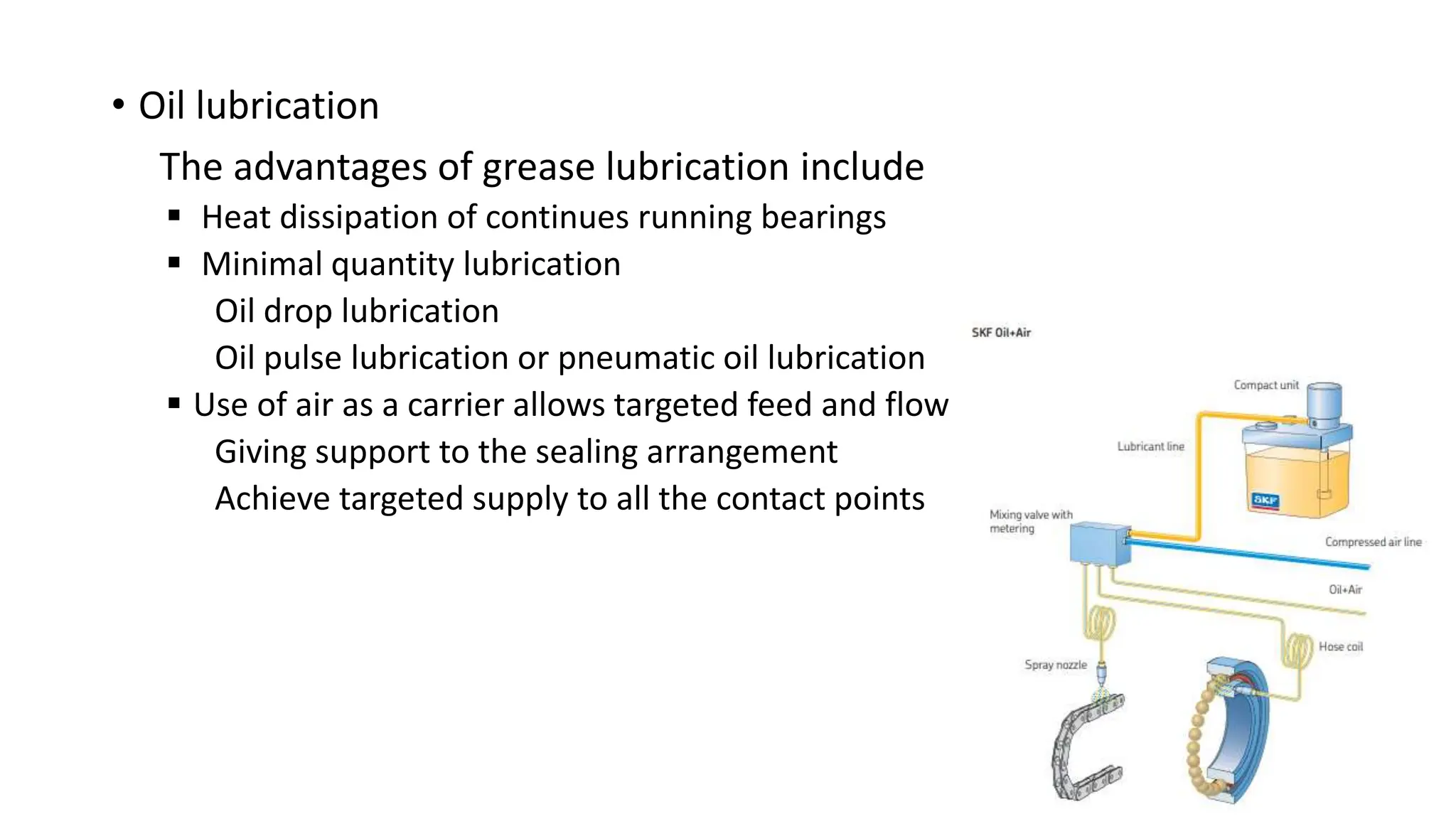
• Oil lubrication
The advantages of grease lubrication include
 Heat dissipation of continues running bearings
 Minimal quantity lubrication
Oil drop lubrication
Oil pulse lubrication or pneumatic oil lubrication
 Use of air as a carrier allows targeted feed and flow
Giving support to the sealing arrangement
Achieve targeted supply to all the contact points
Selection of the lubrication method
• Operating conditions
• Running behavior
• Running noise
• Friction
• Temperature
• Reliable operation (preventing premature failure from wear, fatigue,
corrosion, or environmental damage)
• Installation and maintenance costs for the lubrication system
Lubricant selection
Selecting a suitable Lubricant
• Suitable grease with a mineral base oil and lithium thickener
• Temperatures range from –30 to +110 °C (–20 to +230 °F)
• Synthetic base oil (High speeds, high temperatures or extended
service life)
• Ester/mineral based oil with calcium complex thickener (for screw
drive thrust ball bearings)
• Alternative greases (Lithium soap grease with a mineral base oil and
EP additives : Ex : EP 2 & 3)
• Operating temperatures < 10 °C (50 °F) or > 100 °C (210 °F)
• Bearing speed is very high or very low
• Static operation, infrequent rotation or oscillation
• Bearings are subjected to vibration
• Bearings are subjected to heavy loads or shock loads
• Water resistance is important
• screw drive bearings at low speeds, under heavy loads or exposed to vibration
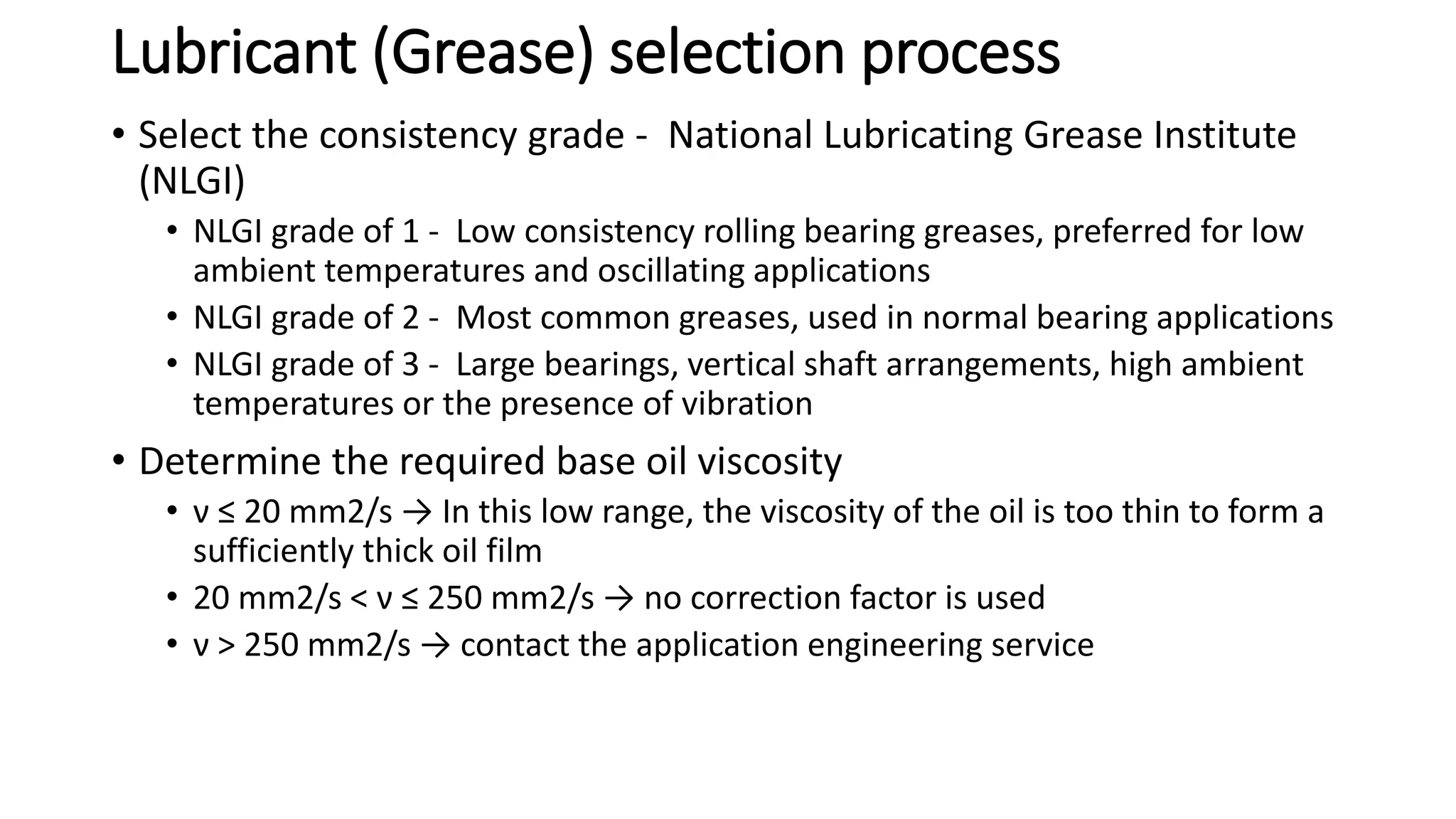
Lubricant (Grease) selection process
• Select the consistency grade - National Lubricating Grease Institute
(NLGI)
• NLGI grade of 1 - Low consistency rolling bearing greases, preferred for low
ambient temperatures and oscillating applications
• NLGI grade of 2 - Most common greases, used in normal bearing applications
• NLGI grade of 3 - Large bearings, vertical shaft arrangements, high ambient
temperatures or the presence of vibration
• Determine the required base oil viscosity
• ν ≤ 20 mm2/s → In this low range, the viscosity of the oil is too thin to form a
sufficiently thick oil film
• 20 mm2/s < ν ≤ 250 mm2/s → no correction factor is used
• ν > 250 mm2/s → contact the application engineering service
• Verify the presence of EP additives
• Operating temperature range
• Super-precision bearings
• very heavy loads (P > 0,15 C)
• shock loads
• low speeds
• periods of static loading
• frequent starts and stops during a work cycle
• Check additional requirements
• The following recommendations are provided as guidelines
• For superior resistance to water wash-out, consider grease with a calcium thickener over
a lithium thickener
• For good rust protection, select an appropriate additive
• If there are high vibration levels, choose grease with a high mechanical stability
Initial Grease Fill
• Super-precision bearings - operate - high speeds – 30%
• Open angular contact thrust ball bearings - Screw drives - 25 to 35%
• Freshly greased bearings - operate - low speeds
• Too much grease evenly spread in the bearing. Ignoring the initial
operation period can result in temperature spikes and early bearing
malfunction.
• Sealed bearings with high-grade, low-viscosity grease - 15%
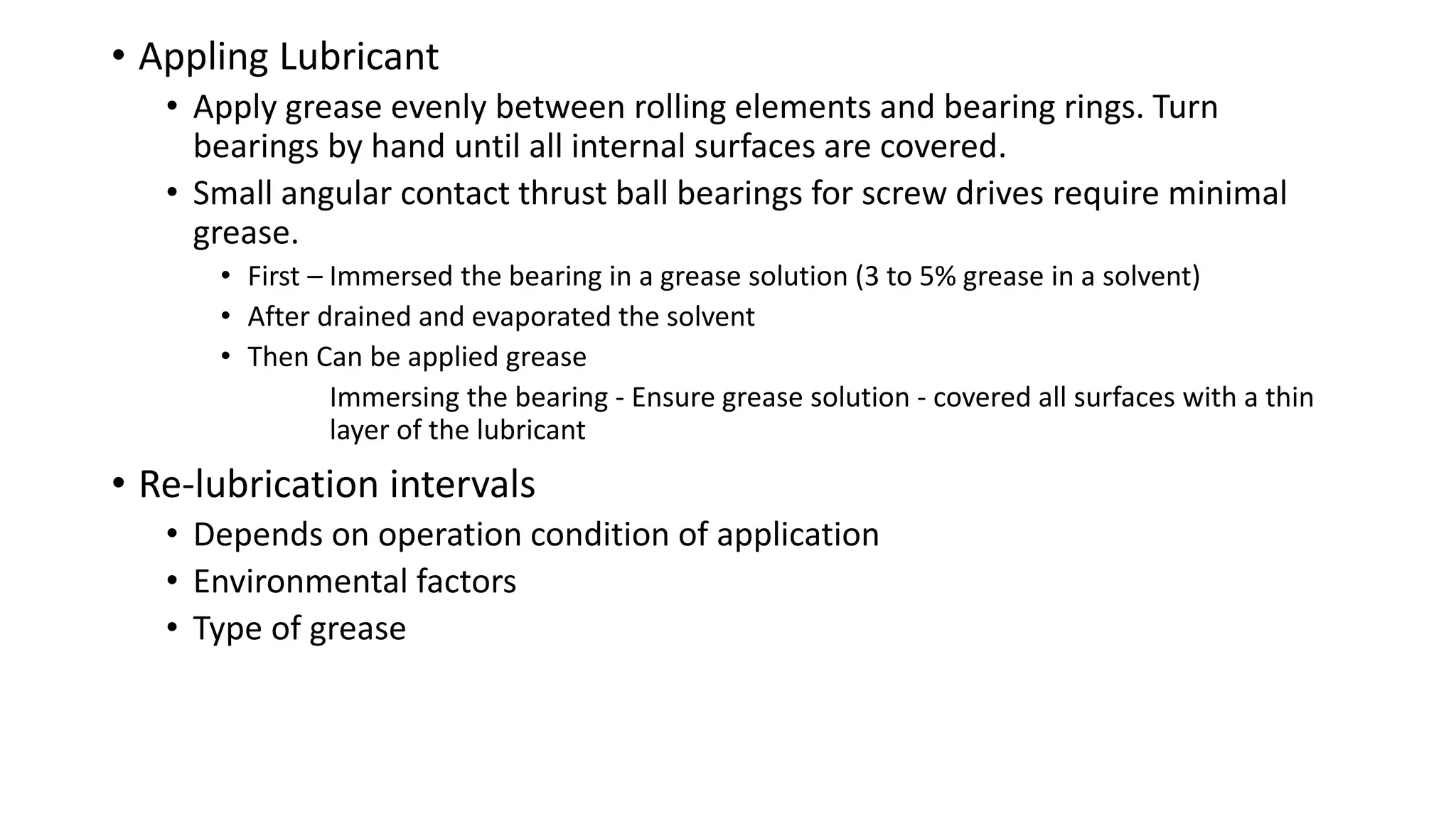
• Appling Lubricant
• Apply grease evenly between rolling elements and bearing rings. Turn
bearings by hand until all internal surfaces are covered.
• Small angular contact thrust ball bearings for screw drives require minimal
grease.
• First – Immersed the bearing in a grease solution (3 to 5% grease in a solvent)
• After drained and evaporated the solvent
• Then Can be applied grease
Immersing the bearing - Ensure grease solution - covered all surfaces with a thin
layer of the lubricant
• Re-lubrication intervals
• Depends on operation condition of application
• Environmental factors
• Type of grease
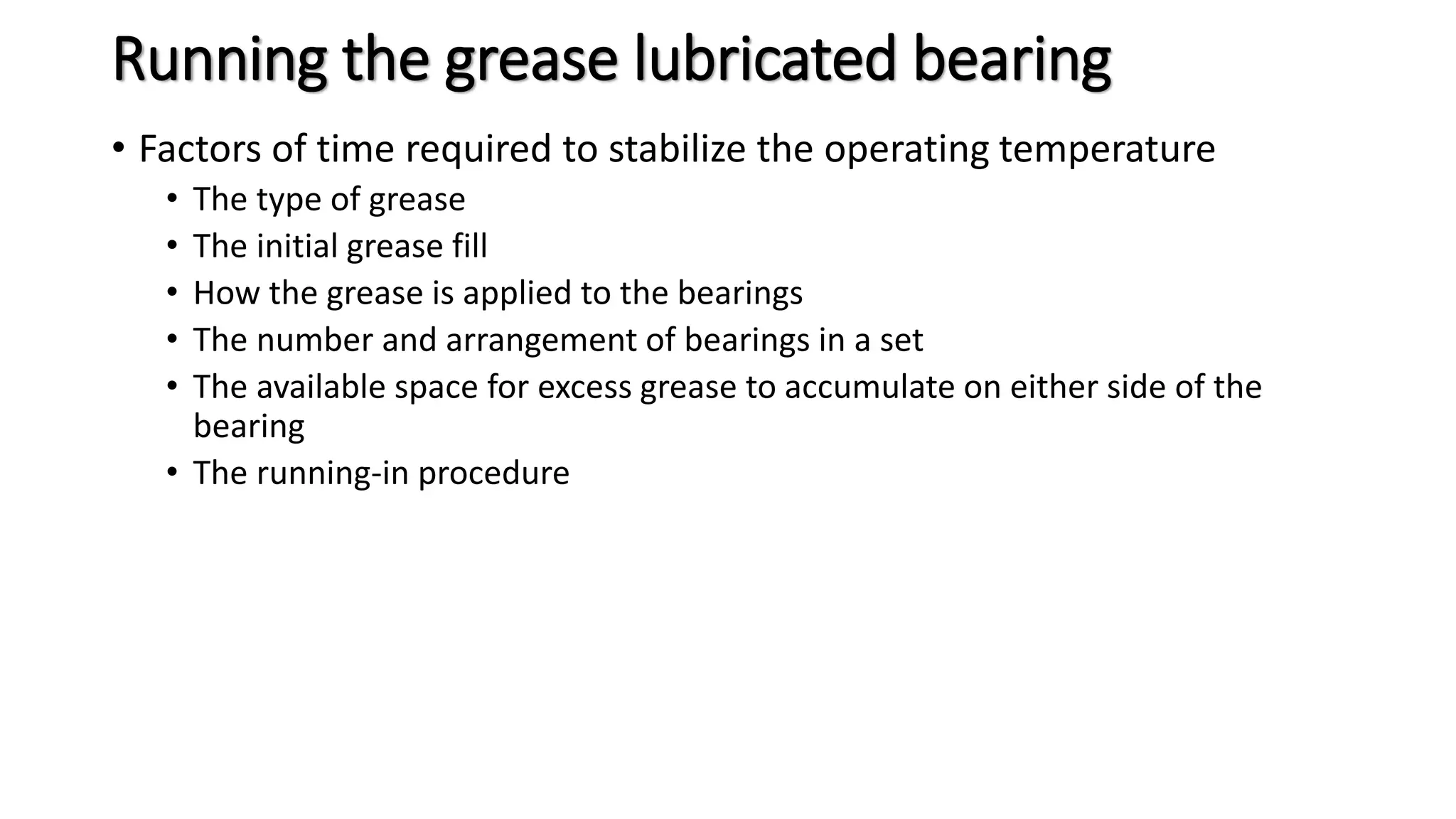
Running the grease lubricated bearing
• Factors of time required to stabilize the operating temperature
• The type of grease
• The initial grease fill
• How the grease is applied to the bearings
• The number and arrangement of bearings in a set
• The available space for excess grease to accumulate on either side of the
bearing
• The running-in procedure
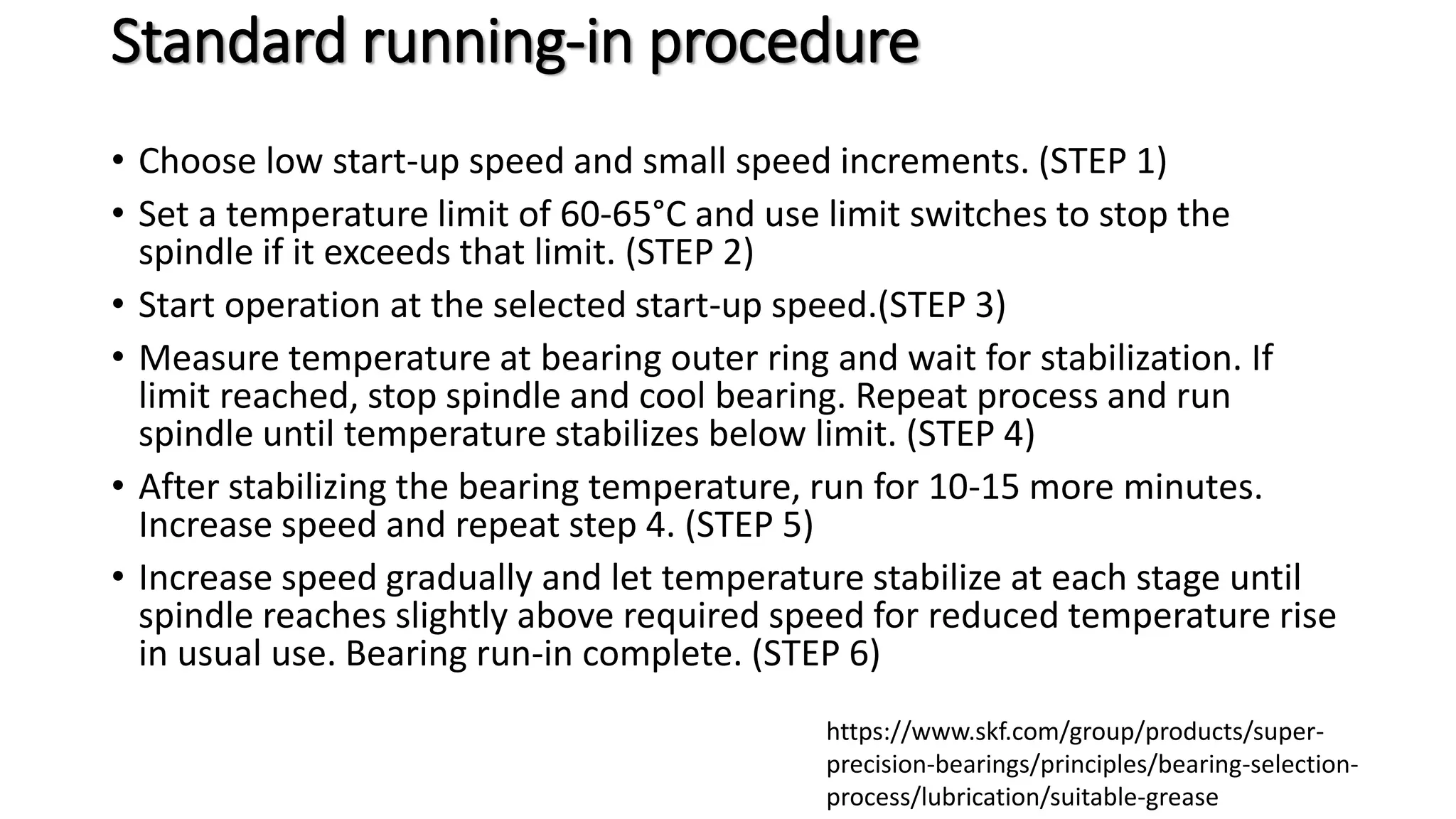
Standard running-in procedure
• Choose low start-up speed and small speed increments. (STEP 1)
• Set a temperature limit of 60-65°C and use limit switches to stop the
spindle if it exceeds that limit. (STEP 2)
• Start operation at the selected start-up speed.(STEP 3)
• Measure temperature at bearing outer ring and wait for stabilization. If
limit reached, stop spindle and cool bearing. Repeat process and run
spindle until temperature stabilizes below limit. (STEP 4)
• After stabilizing the bearing temperature, run for 10-15 more minutes.
Increase speed and repeat step 4. (STEP 5)
• Increase speed gradually and let temperature stabilize at each stage until
spindle reaches slightly above required speed for reduced temperature rise
in usual use. Bearing run-in complete. (STEP 6)
https://www.skf.com/group/products/super-
precision-bearings/principles/bearing-selection-
process/lubrication/suitable-grease
Short running-in procedure
• Select a starting speed approximately 20 to 25% of the attainable speed for grease
lubrication and choose a relatively large speed increment (STEP 1)
• Decide on an absolute temperature limit, usually 60 to 65 °C . It is advisable to set the
machine with limit switches that stop the spindle if the temperature rise exceeds the
limits set.(STEP 2)
• Start operation at the chosen start-up speed. (STEP 3)
• Monitor the temperature by taking measurements at the bearing outer ring position
until the temperature reaches the limit. Care should be taken as the temperature
increase may be very rapid.(STEP 4)
• Stop operation and let the outer ring of the bearing cool down by 5 to 10 °C.(STEP 5)
• Start operation at the same speed a second time and monitor the temperature until the
limit is reached again.(STEP 6)
• Repeat steps 5 and 6 until the temperature stabilizes for 10 to 15 minutes below the
limit. The bearing is run-in at that particular speed.(STEP 7)
• Increase the speed by one increment and repeat steps 4 to 7.(STEP 8)
• Proceed until the bearing is running at one speed increment above the required
operating speed. This results in a lower temperature rise during normal operation. The
bearing is now properly run-in.(STEP 8)
• Mobilux EP 1, 2, and 3 – Same as NLGI 1, 2, and 3 other brands also
same LP 1 to 3 and different between some property changer are
done by some manufactures and they are also matched with different
operation condtions
ROLLING BEARING’S LUBRICATION.pptx

ROLLING BEARING’S LUBRICATION.pptx

  • 1.
  • 2.
    Content • Lubricant inthe rolling bearing Benefits • Lubrication methods • Lubricant selection • The supply of lubricant to bearings • Contaminants in the lubricant • Lubricant testing • Storage and handling • Dry running and media lubrication, coatings
  • 3.
    Lubricant in therolling bearing Benefits • Alleviation of friction and wear • Removal of friction heat • Longer bearing life • Rust prevention • Protection against contamination by foreign matter
  • 4.
    Lubrication methods • Greaselubrication The advantages of grease lubrication include: ■ very little design work required ■ sealing action supported by the grease ■ long operating life with maintenance-free lubrication, eliminating the requirement for lubrication devices ■ suitability for speed parameters ■ longer emergency running phase in case of lubrication supply failure ■ low frictional torque.
  • 5.
    • Oil lubrication Theadvantages of grease lubrication include  Heat dissipation of continues running bearings  Minimal quantity lubrication Oil drop lubrication Oil pulse lubrication or pneumatic oil lubrication  Use of air as a carrier allows targeted feed and flow Giving support to the sealing arrangement Achieve targeted supply to all the contact points
  • 6.
    Selection of thelubrication method • Operating conditions • Running behavior • Running noise • Friction • Temperature • Reliable operation (preventing premature failure from wear, fatigue, corrosion, or environmental damage) • Installation and maintenance costs for the lubrication system
  • 8.
  • 9.
    Selecting a suitableLubricant • Suitable grease with a mineral base oil and lithium thickener • Temperatures range from –30 to +110 °C (–20 to +230 °F) • Synthetic base oil (High speeds, high temperatures or extended service life) • Ester/mineral based oil with calcium complex thickener (for screw drive thrust ball bearings) • Alternative greases (Lithium soap grease with a mineral base oil and EP additives : Ex : EP 2 & 3) • Operating temperatures < 10 °C (50 °F) or > 100 °C (210 °F) • Bearing speed is very high or very low • Static operation, infrequent rotation or oscillation • Bearings are subjected to vibration • Bearings are subjected to heavy loads or shock loads • Water resistance is important • screw drive bearings at low speeds, under heavy loads or exposed to vibration
  • 10.
    Lubricant (Grease) selectionprocess • Select the consistency grade - National Lubricating Grease Institute (NLGI) • NLGI grade of 1 - Low consistency rolling bearing greases, preferred for low ambient temperatures and oscillating applications • NLGI grade of 2 - Most common greases, used in normal bearing applications • NLGI grade of 3 - Large bearings, vertical shaft arrangements, high ambient temperatures or the presence of vibration • Determine the required base oil viscosity • ν ≤ 20 mm2/s → In this low range, the viscosity of the oil is too thin to form a sufficiently thick oil film • 20 mm2/s < ν ≤ 250 mm2/s → no correction factor is used • ν > 250 mm2/s → contact the application engineering service
  • 11.
    • Verify thepresence of EP additives • Operating temperature range • Super-precision bearings • very heavy loads (P > 0,15 C) • shock loads • low speeds • periods of static loading • frequent starts and stops during a work cycle • Check additional requirements • The following recommendations are provided as guidelines • For superior resistance to water wash-out, consider grease with a calcium thickener over a lithium thickener • For good rust protection, select an appropriate additive • If there are high vibration levels, choose grease with a high mechanical stability
  • 12.
    Initial Grease Fill •Super-precision bearings - operate - high speeds – 30% • Open angular contact thrust ball bearings - Screw drives - 25 to 35% • Freshly greased bearings - operate - low speeds • Too much grease evenly spread in the bearing. Ignoring the initial operation period can result in temperature spikes and early bearing malfunction. • Sealed bearings with high-grade, low-viscosity grease - 15%
  • 13.
    • Appling Lubricant •Apply grease evenly between rolling elements and bearing rings. Turn bearings by hand until all internal surfaces are covered. • Small angular contact thrust ball bearings for screw drives require minimal grease. • First – Immersed the bearing in a grease solution (3 to 5% grease in a solvent) • After drained and evaporated the solvent • Then Can be applied grease Immersing the bearing - Ensure grease solution - covered all surfaces with a thin layer of the lubricant • Re-lubrication intervals • Depends on operation condition of application • Environmental factors • Type of grease
  • 14.
    Running the greaselubricated bearing • Factors of time required to stabilize the operating temperature • The type of grease • The initial grease fill • How the grease is applied to the bearings • The number and arrangement of bearings in a set • The available space for excess grease to accumulate on either side of the bearing • The running-in procedure
  • 15.
    Standard running-in procedure •Choose low start-up speed and small speed increments. (STEP 1) • Set a temperature limit of 60-65°C and use limit switches to stop the spindle if it exceeds that limit. (STEP 2) • Start operation at the selected start-up speed.(STEP 3) • Measure temperature at bearing outer ring and wait for stabilization. If limit reached, stop spindle and cool bearing. Repeat process and run spindle until temperature stabilizes below limit. (STEP 4) • After stabilizing the bearing temperature, run for 10-15 more minutes. Increase speed and repeat step 4. (STEP 5) • Increase speed gradually and let temperature stabilize at each stage until spindle reaches slightly above required speed for reduced temperature rise in usual use. Bearing run-in complete. (STEP 6) https://www.skf.com/group/products/super- precision-bearings/principles/bearing-selection- process/lubrication/suitable-grease
  • 17.
    Short running-in procedure •Select a starting speed approximately 20 to 25% of the attainable speed for grease lubrication and choose a relatively large speed increment (STEP 1) • Decide on an absolute temperature limit, usually 60 to 65 °C . It is advisable to set the machine with limit switches that stop the spindle if the temperature rise exceeds the limits set.(STEP 2) • Start operation at the chosen start-up speed. (STEP 3) • Monitor the temperature by taking measurements at the bearing outer ring position until the temperature reaches the limit. Care should be taken as the temperature increase may be very rapid.(STEP 4) • Stop operation and let the outer ring of the bearing cool down by 5 to 10 °C.(STEP 5) • Start operation at the same speed a second time and monitor the temperature until the limit is reached again.(STEP 6) • Repeat steps 5 and 6 until the temperature stabilizes for 10 to 15 minutes below the limit. The bearing is run-in at that particular speed.(STEP 7) • Increase the speed by one increment and repeat steps 4 to 7.(STEP 8) • Proceed until the bearing is running at one speed increment above the required operating speed. This results in a lower temperature rise during normal operation. The bearing is now properly run-in.(STEP 8)
  • 18.
    • Mobilux EP1, 2, and 3 – Same as NLGI 1, 2, and 3 other brands also same LP 1 to 3 and different between some property changer are done by some manufactures and they are also matched with different operation condtions