STEREOTACTIC RADIOSURGERY FOR THE
TREATMENT OF TRIGEMINAL NEURALGIA
Clinical White Paper

Trigeminal neuralgia (TN) is well defined and one of the most common causes of facial pain, especially in
the elderly. It usually occurs as one-sided, severe, brief, recurrent episodes of spontaneous or stimulationtriggered facial pain in the territory of one or more branches of the trigeminal nerve 1,2.

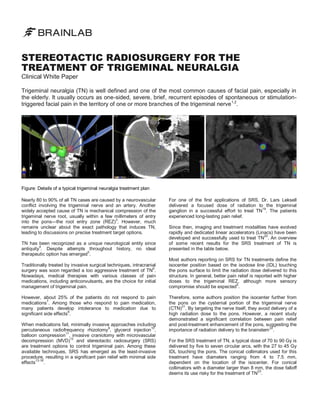
Figure: Details of a typical trigeminal neuralgia treatment plan
Nearly 80 to 90% of all TN cases are caused by a neurovascular
conflict involving the trigeminal nerve and an artery. Another
widely accepted cause of TN is mechanical compression of the
trigeminal nerve root, usually within a few millimeters of entry
3
into the pons—the root entry zone (REZ) . However, much
remains unclear about the exact pathology that induces TN,
leading to discussions on precise treatment target options.
TN has been recognized as a unique neurological entity since
4
antiquity . Despite attempts throughout history, no ideal
5
therapeutic option has emerged .
Traditionally treated by invasive surgical techniques, intracranial
surgery was soon regarded a too aggressive treatment of TN6.
Nowadays, medical therapies with various classes of pain
medications, including anticonvulsants, are the choice for initial
management of trigeminal pain.
However, about 25% of the patients do not respond to pain
medications7. Among those who respond to pain medication,
many patients develop intolerance to medication due to
significant side effects8.
When medications fail, minimally invasive approaches including
9
10
percutaneous radiofrequency rhizotomy , glycerol injection ,
11
balloon compression , invasive craniotomy with microvascular
12
decompression (MVD) and stereotactic radiosurgery (SRS)
are treatment options to control trigeminal pain. Among these
available techniques, SRS has emerged as the least-invasive
procedure, resulting in a significant pain relief with minimal side
effects13-18.

For one of the first applications of SRS, Dr. Lars Leksell
delivered a focused dose of radiation to the trigeminal
ganglion in a successful effort to treat TN19. The patients
experienced long-lasting pain relief.
Since then, imaging and treatment modalities have evolved
rapidly and dedicated linear accelerators (Linacs) have been
20
developed and successfully used to treat TN . An overview
of some recent results for the SRS treatment of TN is
presented in the table below.
Most authors reporting on SRS for TN treatments define the
isocenter position based on the isodose line (IDL) touching
the pons surface to limit the radiation dose delivered to this
structure. In general, better pain relief is reported with higher
doses to the trigeminal REZ, although more sensory
5
compromise should be expected .
Therefore, some authors position the isocenter further from
the pons on the cysternal portion of the trigeminal nerve
21
(CTN) . By targeting the nerve itself, they avoid delivery of a
high radiation dose to the pons. However, a recent study
demonstrated a significant correlation between pain relief
and post-treatment enhancement of the pons, suggesting the
22
importance of radiation delivery to the brainstem .
For the SRS treatment of TN, a typical dose of 70 to 90 Gy is
delivered by five to seven circular arcs, with the 27 to 45 Gy
IDL touching the pons. The conical collimators used for this
treatment have diameters ranging from 4 to 7.5 mm,
dependent on the location of the isocenter. For conical
collimators with a diameter larger than 8 mm, the dose falloff
23
deems its use risky for the treatment of TN .
Based on the recent literature—see the table below—SRS for
TN has emerged as the safest procedure, leading to complete
pain relief without medications or more than 50% pain relief
with decreased medications for more than 70% of patients.

This is in distinction to microvascular decompression where
approximately 20% of patients may have recurrence within
24
the first five years after a successful initial outcome .
With a low risk of facial sensation loss being the most
common side effect of SRS25, dedicated linear-accelerator
radiosurgery can be considered as an effective treatment for
15
both primary and recurrent trigeminal pain . Moreover, it is
the only treatment to recommend without hesitation to
patients who are medically frail or have some
contraindication to anesthesia.

However, it should be noted that the overall likelihood of
achieving a pain-free outcome without medications is lower
than it is for MVD. Following radiosurgery, up to 50% of
patients can have recurrence of pain within 3 years.

Overview of the recent clinical literature on SRS for trigeminal neuralgia
Author

Institution

Year

# Patients

Dose (Gy)

% Success

% Relapse

18

Los Angeles Medical Center,
Los Angeles

2003

25

90

100 at 18 months

32 at 8 months

15

David Geffen School of
Medicine, Los Angeles

2003

41

70 - 90

87 at 23 months

25 at 7 months

David Geffen School of
Medicine, Los Angeles

2004

17

90

95 at 21 months

23 at 8 months

Los Angeles Medical Center,
Los Angeles

2004

32

85 - 90

78 at 8 months

N/A

David Geffen School of
Medicine, Los Angeles

2006

37

70 - 90

67 at 13 months

10 at 7 months

Centre Hospitalier Universitaire
Vaudois, Lausanne

2007

17

50 - 56

100 at 12 months

29 at 8 months

16

Los Angeles Medical Center,
Los Angeles

2008

82

85 - 90

85 at 18 months

19 at 18 months

17

Baylor College of Medicine,
Houston

2009

20

80 - 90

95 at 14 months

N/A

Goss

Smith

Frighetto

13

14

Chen

Gorgulho

22

21

Pusztaszeri

Chen

Zahra

The success rate is defined as the combined number of patients that experienced either complete pain relief without medications or more than 50% pain relief with
decreased medications. This corresponds to a Barrow Neurological Institute (BNI) pain intensity score of III or higher.
References
[1]
[2]
[3]
[4]
[5]
[6]
[7]
[8]
[9]
[10]
[11]

Merskey H. et al., Descriptions of chronic pain syndromes and definitions of pain terms,
IASP Press, Seattle 1994, pp. 59–71
Rozen T.D. et al., Wolff’s Headache and Other Head Pain, Oxford University Press,
New York 2001, pp. 509
Love S. et al., Brain 124, 2347, 2001
Cole C.D. et al., Neurosurg Focus 18, E4, 2005
Gorgulho A. et al., Surg Neurol 66, 350, 2006
Horsley V. et al., BMJ 2, 1139, 1891
Fields H.L., N Engl J Med 334, 1125, 1996
Zakrzewska J.M. et al., Oral Surg Oral Med O 74(4), 439, 1992
Taha J.M. et al., J Neurosurg 83, 989, 1995
Lunsford L.D. et al., Arch Neurol 42, 146, 1985
Brown J.A. et al., Neurosurgery 32, 570, 1993

Europe | +49 89 99 1568 0 | de_sales@brainlab.com
North America | +1 800 784 7700 | us_sales@brainlab.com
Latin America | +55 11 3355 3370 | br_sales@brainlab.com

RT_WP_E_TN_APR11

[12]
[13]
[14]
[15]
[16]
[17]
[18]
[19]
[20]
[21]
[22]
[23]
[24]
[25]

Jannetta P.J., J Neurosurg 26, 159, 1967
Frighetto L. et al., Neurol 62, 660, 2004
Chen J.C.T. et al., J Neurosurg 101, 346, 2004
Smith Z.A. et al., J Neurosurg 99, 511, 2003
Chen J.C.T. et al., Neurosurg 62, A53, 2008
Zahra H. et al., Technol Cancer Res T 8(6), 407, 2009
Goss B.W. et al., Neurosurg 53, 823, 2003
Leksell L., Acta Chir Scand 137, 311, 1971
Solberg T.D. et al., J Neurosurg 101, 373, 2004
Pusztaszeri M. et al., Swiss Med Wkly 137, 682, 2007
Gorgulho A. et al., Surg Neurol 66, 127, 2006
Solberg T.D. et al., J Radiosurgery 1, 115, 1998
Barker F.G. et al., N Engl J Med 334, 1077, 1996
Maesawa S. et al., J Neurosurg 94, 14, 2001

Asia Pacific | +852 2417 1881 | hk_sales@brainlab.com
Japan | +81 3 3769 6900 | jp_sales@brainlab.com

Stereotactic Radiosurgery for the Treatment of Trigeminal Neuralgia Clinical White Paper

  • 1.
    STEREOTACTIC RADIOSURGERY FORTHE TREATMENT OF TRIGEMINAL NEURALGIA Clinical White Paper Trigeminal neuralgia (TN) is well defined and one of the most common causes of facial pain, especially in the elderly. It usually occurs as one-sided, severe, brief, recurrent episodes of spontaneous or stimulationtriggered facial pain in the territory of one or more branches of the trigeminal nerve 1,2. Figure: Details of a typical trigeminal neuralgia treatment plan Nearly 80 to 90% of all TN cases are caused by a neurovascular conflict involving the trigeminal nerve and an artery. Another widely accepted cause of TN is mechanical compression of the trigeminal nerve root, usually within a few millimeters of entry 3 into the pons—the root entry zone (REZ) . However, much remains unclear about the exact pathology that induces TN, leading to discussions on precise treatment target options. TN has been recognized as a unique neurological entity since 4 antiquity . Despite attempts throughout history, no ideal 5 therapeutic option has emerged . Traditionally treated by invasive surgical techniques, intracranial surgery was soon regarded a too aggressive treatment of TN6. Nowadays, medical therapies with various classes of pain medications, including anticonvulsants, are the choice for initial management of trigeminal pain. However, about 25% of the patients do not respond to pain medications7. Among those who respond to pain medication, many patients develop intolerance to medication due to significant side effects8. When medications fail, minimally invasive approaches including 9 10 percutaneous radiofrequency rhizotomy , glycerol injection , 11 balloon compression , invasive craniotomy with microvascular 12 decompression (MVD) and stereotactic radiosurgery (SRS) are treatment options to control trigeminal pain. Among these available techniques, SRS has emerged as the least-invasive procedure, resulting in a significant pain relief with minimal side effects13-18. For one of the first applications of SRS, Dr. Lars Leksell delivered a focused dose of radiation to the trigeminal ganglion in a successful effort to treat TN19. The patients experienced long-lasting pain relief. Since then, imaging and treatment modalities have evolved rapidly and dedicated linear accelerators (Linacs) have been 20 developed and successfully used to treat TN . An overview of some recent results for the SRS treatment of TN is presented in the table below. Most authors reporting on SRS for TN treatments define the isocenter position based on the isodose line (IDL) touching the pons surface to limit the radiation dose delivered to this structure. In general, better pain relief is reported with higher doses to the trigeminal REZ, although more sensory 5 compromise should be expected . Therefore, some authors position the isocenter further from the pons on the cysternal portion of the trigeminal nerve 21 (CTN) . By targeting the nerve itself, they avoid delivery of a high radiation dose to the pons. However, a recent study demonstrated a significant correlation between pain relief and post-treatment enhancement of the pons, suggesting the 22 importance of radiation delivery to the brainstem . For the SRS treatment of TN, a typical dose of 70 to 90 Gy is delivered by five to seven circular arcs, with the 27 to 45 Gy IDL touching the pons. The conical collimators used for this treatment have diameters ranging from 4 to 7.5 mm, dependent on the location of the isocenter. For conical collimators with a diameter larger than 8 mm, the dose falloff 23 deems its use risky for the treatment of TN .
  • 2.
    Based on therecent literature—see the table below—SRS for TN has emerged as the safest procedure, leading to complete pain relief without medications or more than 50% pain relief with decreased medications for more than 70% of patients. This is in distinction to microvascular decompression where approximately 20% of patients may have recurrence within 24 the first five years after a successful initial outcome . With a low risk of facial sensation loss being the most common side effect of SRS25, dedicated linear-accelerator radiosurgery can be considered as an effective treatment for 15 both primary and recurrent trigeminal pain . Moreover, it is the only treatment to recommend without hesitation to patients who are medically frail or have some contraindication to anesthesia. However, it should be noted that the overall likelihood of achieving a pain-free outcome without medications is lower than it is for MVD. Following radiosurgery, up to 50% of patients can have recurrence of pain within 3 years. Overview of the recent clinical literature on SRS for trigeminal neuralgia Author Institution Year # Patients Dose (Gy) % Success % Relapse 18 Los Angeles Medical Center, Los Angeles 2003 25 90 100 at 18 months 32 at 8 months 15 David Geffen School of Medicine, Los Angeles 2003 41 70 - 90 87 at 23 months 25 at 7 months David Geffen School of Medicine, Los Angeles 2004 17 90 95 at 21 months 23 at 8 months Los Angeles Medical Center, Los Angeles 2004 32 85 - 90 78 at 8 months N/A David Geffen School of Medicine, Los Angeles 2006 37 70 - 90 67 at 13 months 10 at 7 months Centre Hospitalier Universitaire Vaudois, Lausanne 2007 17 50 - 56 100 at 12 months 29 at 8 months 16 Los Angeles Medical Center, Los Angeles 2008 82 85 - 90 85 at 18 months 19 at 18 months 17 Baylor College of Medicine, Houston 2009 20 80 - 90 95 at 14 months N/A Goss Smith Frighetto 13 14 Chen Gorgulho 22 21 Pusztaszeri Chen Zahra The success rate is defined as the combined number of patients that experienced either complete pain relief without medications or more than 50% pain relief with decreased medications. This corresponds to a Barrow Neurological Institute (BNI) pain intensity score of III or higher. References [1] [2] [3] [4] [5] [6] [7] [8] [9] [10] [11] Merskey H. et al., Descriptions of chronic pain syndromes and definitions of pain terms, IASP Press, Seattle 1994, pp. 59–71 Rozen T.D. et al., Wolff’s Headache and Other Head Pain, Oxford University Press, New York 2001, pp. 509 Love S. et al., Brain 124, 2347, 2001 Cole C.D. et al., Neurosurg Focus 18, E4, 2005 Gorgulho A. et al., Surg Neurol 66, 350, 2006 Horsley V. et al., BMJ 2, 1139, 1891 Fields H.L., N Engl J Med 334, 1125, 1996 Zakrzewska J.M. et al., Oral Surg Oral Med O 74(4), 439, 1992 Taha J.M. et al., J Neurosurg 83, 989, 1995 Lunsford L.D. et al., Arch Neurol 42, 146, 1985 Brown J.A. et al., Neurosurgery 32, 570, 1993 Europe | +49 89 99 1568 0 | de_sales@brainlab.com North America | +1 800 784 7700 | us_sales@brainlab.com Latin America | +55 11 3355 3370 | br_sales@brainlab.com RT_WP_E_TN_APR11 [12] [13] [14] [15] [16] [17] [18] [19] [20] [21] [22] [23] [24] [25] Jannetta P.J., J Neurosurg 26, 159, 1967 Frighetto L. et al., Neurol 62, 660, 2004 Chen J.C.T. et al., J Neurosurg 101, 346, 2004 Smith Z.A. et al., J Neurosurg 99, 511, 2003 Chen J.C.T. et al., Neurosurg 62, A53, 2008 Zahra H. et al., Technol Cancer Res T 8(6), 407, 2009 Goss B.W. et al., Neurosurg 53, 823, 2003 Leksell L., Acta Chir Scand 137, 311, 1971 Solberg T.D. et al., J Neurosurg 101, 373, 2004 Pusztaszeri M. et al., Swiss Med Wkly 137, 682, 2007 Gorgulho A. et al., Surg Neurol 66, 127, 2006 Solberg T.D. et al., J Radiosurgery 1, 115, 1998 Barker F.G. et al., N Engl J Med 334, 1077, 1996 Maesawa S. et al., J Neurosurg 94, 14, 2001 Asia Pacific | +852 2417 1881 | hk_sales@brainlab.com Japan | +81 3 3769 6900 | jp_sales@brainlab.com