STEREOTACTIC RADIOTHERAPY OF
RECURRENT MALIGNANT GLIOMAS
Clinical White Paper

Tumors of the central nervous system (CNS) represent approximately 176,000 newly diagnosed cases
worldwide per year, with an estimated annual mortality of 128,000 1,2. Malignant gliomas comprise 30% of all
primary CNS tumors and remain one of the greatest challenges in oncology today, despite access to state of-the-art surgery, imaging, radiotherapy and chemotherapy 3.

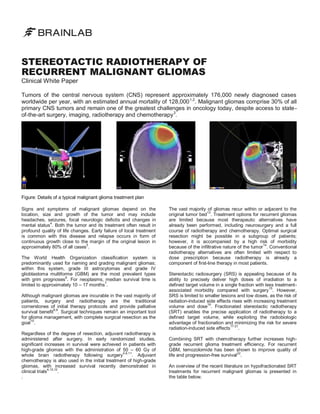
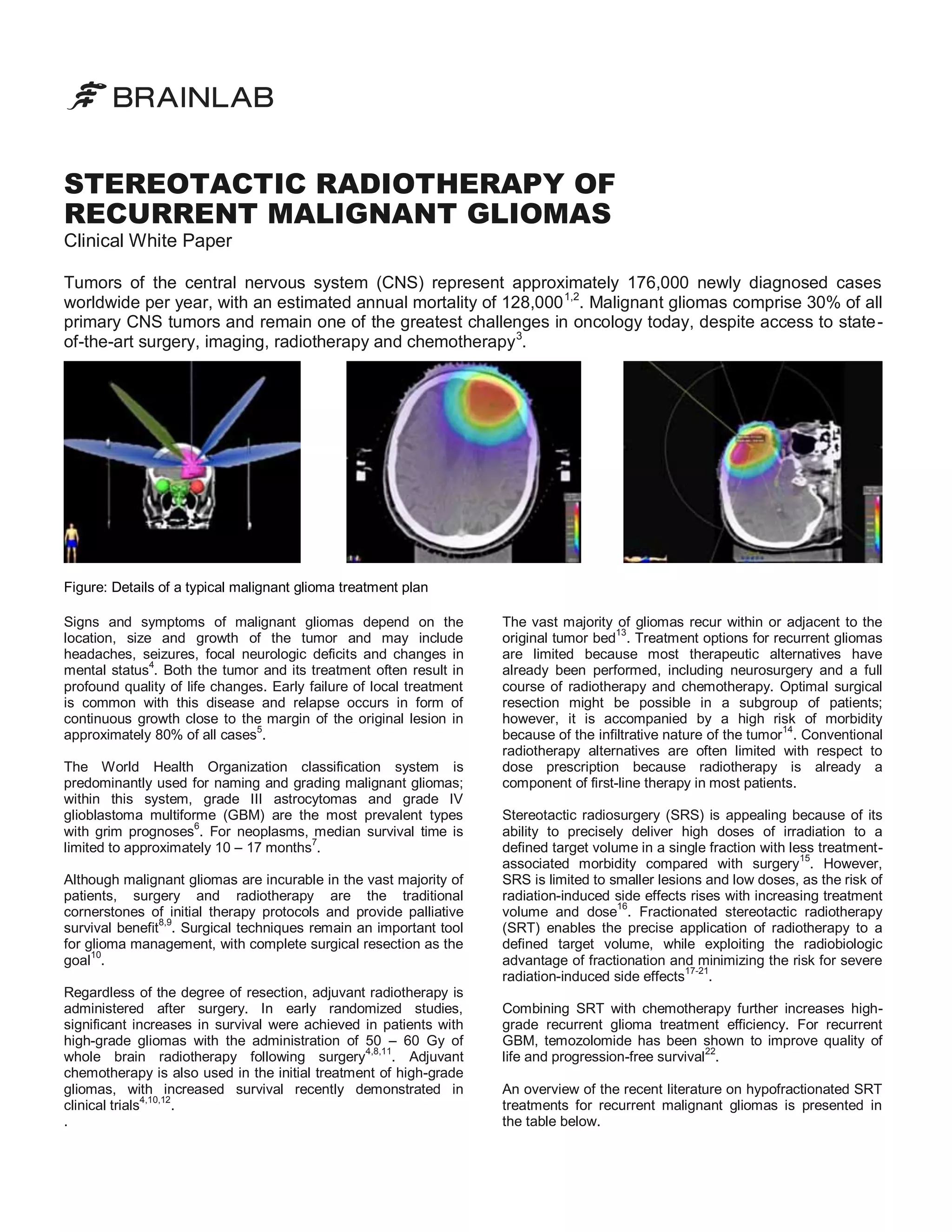
Figure: Details of a typical malignant glioma treatment plan
Signs and symptoms of malignant gliomas depend on the
location, size and growth of the tumor and may include
headaches, seizures, focal neurologic deficits and changes in
4
mental status . Both the tumor and its treatment often result in
profound quality of life changes. Early failure of local treatment
is common with this disease and relapse occurs in form of
continuous growth close to the margin of the original lesion in
5
approximately 80% of all cases .
The World Health Organization classification system is
predominantly used for naming and grading malignant gliomas;
within this system, grade III astrocytomas and grade IV
glioblastoma multiforme (GBM) are the most prevalent types
6
with grim prognoses . For neoplasms, median survival time is
7
limited to approximately 10 – 17 months .
Although malignant gliomas are incurable in the vast majority of
patients, surgery and radiotherapy are the traditional
cornerstones of initial therapy protocols and provide palliative
8,9
survival benefit . Surgical techniques remain an important tool
for glioma management, with complete surgical resection as the
10
goal .
Regardless of the degree of resection, adjuvant radiotherapy is
administered after surgery. In early randomized studies,
significant increases in survival were achieved in patients with
high-grade gliomas with the administration of 50 – 60 Gy of
4,8,11
. Adjuvant
whole brain radiotherapy following surgery
chemotherapy is also used in the initial treatment of high-grade
gliomas, with increased survival recently demonstrated in
4,10,12
.
clinical trials
.

The vast majority of gliomas recur within or adjacent to the
original tumor bed13. Treatment options for recurrent gliomas
are limited because most therapeutic alternatives have
already been performed, including neurosurgery and a full
course of radiotherapy and chemotherapy. Optimal surgical
resection might be possible in a subgroup of patients;
however, it is accompanied by a high risk of morbidity
because of the infiltrative nature of the tumor14. Conventional
radiotherapy alternatives are often limited with respect to
dose prescription because radiotherapy is already a
component of first-line therapy in most patients.
Stereotactic radiosurgery (SRS) is appealing because of its
ability to precisely deliver high doses of irradiation to a
defined target volume in a single fraction with less treatment15
associated morbidity compared with surgery . However,
SRS is limited to smaller lesions and low doses, as the risk of
radiation-induced side effects rises with increasing treatment
16
volume and dose . Fractionated stereotactic radiotherapy
(SRT) enables the precise application of radiotherapy to a
defined target volume, while exploiting the radiobiologic
advantage of fractionation and minimizing the risk for severe
17-21
.
radiation-induced side effects
Combining SRT with chemotherapy further increases highgrade recurrent glioma treatment efficiency. For recurrent
GBM, temozolomide has been shown to improve quality of
life and progression-free survival22.
An overview of the recent literature on hypofractionated SRT
treatments for recurrent malignant gliomas is presented in
the table below.
In each of these studies, all patients had the initial tumor
surgically resected followed by a full course of conventional
radiotherapy with a median dose of 60 Gy. At the time of
recurrence, a typical dose of 3 to 5 Gy was delivered in a
limited number of fractions, independent of the tumor grade or
volume.

Comparing the reported radiation-induced toxicity rates
suggests a correlation to the delivered dose per fraction,
18
independent of the tumor grade . The observed toxicity is
about 1% for a typical dose of 3 Gy per fraction and
increases to about 10 % for doses of 5 Gy per fraction.
In the absence of any randomized trial data, these individual
results suggest that SRT is a reasonable treatment option for
recurrent malignant gliomas. Because of its non-invasive
nature and low toxicity rates, SRT can provide symptom
palliation while assuring a patient´s quality of life.

The resulting overall survival, expressed in the number of
months following stereotactic re-irradiation, ranges from 20
months for low-grade to approximately 10 months for highgrade recurrent malignant gliomas.

Overview of the recent clinical literature on SRT for recurrent malignant gliomas
Institution

Year

#
Lesions

WHO
Grade

Time from
RT to SRT
(months)

Mean Vol
(cm³)

Mean
Dose
(Gy)

#
Fractions

% IDL
covering
PTV

Overall
Survival
(months)

%
Toxicity

University of
Heidelberg

2005

71

II

48

42

36

12

90

22

0

18

Charité University
Hospital, Berlin

2006

5

III

22

17

25

5

80

21

12

19

John Hopkins
University, Baltimore

2010

42

III

11

22

35

10

90

10

1

University of
Heidelberg

2005

42

III

32

56

36

12

90

16

0

University Hospital,
Erlangen

2007

15

III & IV

10

22

35

5

90

12

20

21

Klinikum Rechts der
Isar, Munich

2005

44

III & IV

16

20

30

6

100

13

14

18

Charité University
Hospital, Berlin

2006

20

IV

12

17

25

5

80

8

12

19

John Hopkins
Universiy, Baltimore

2010

105

IV

8

22

35

10

90

11

1

University of
Heidelberg

2005

59

IV

10

48

36

12

90

8

0

Author

Combs

Wurm

17

Fogh

Combs

17

Ernst-

20

Stecken

Grosu

Wurm

Fogh

Combs

17

Overall survival is expressed in the number of months following stereotactic re-irradiation.
References
[1]
[2]
[3]
[4]
[5]
[6]
[7]
[8]
[9]
[10]
[11]

Parkin D.M. et al., Int J Cancer 94, 153, 2001
Jemal A. et al., CA Cancer J Clin 56, 106, 2006
Ohgaki H. et al., Cancer Res 64, 6892, 2004
Grossman S.A. et al., Semin Oncol 31, 635, 2004
Gaspar L.E. et al., Int J Radiat Oncol Biol Phys 24, 55, 1992
Kleihues P. et al., Brain Pathol 3, 255, 1993
Nieder C. et al., Exp Rev Neurother 4, 691, 2004
Walker M.D. et al., J Neurosurg 49, 333, 1978
Simpson J.R. et al., Int J Radiat Oncol Biol Phys 26, 239, 1993
Brandes A.A. et al., Semin Oncol 30, 4, 2003
Walker M.D. et al., N Engl J Med 303, 1323, 1980

Europe | +49 89 99 1568 0 | de_sales@brainlab.com
North America | +1 800 784 7700 | us_sales@brainlab.com
Latin America | +55 11 3355 3370 | br_sales@brainlab.com

RT_WP_E_GLIOMA_APR11

[12]
[13]
[14]
[15]
[16]
[17]
[18]
[19]
[20]
[21]
[22]

Carpentier A., Lancet Neurol 4, 4, 2005
Combs S.E. et al., J Neurooncol 71, 319, 2005
Dirks P. et al., Can J Surg 36, 271, 1993
Cho K.H. et al., Int J Radiat Oncol Biol Phys 45, 1133, 1999
Hall W.A. et al., J Clin Oncol 13, 1642, 1995
Combs S.E. et al., J Clin Oncol 23, 8863, 2005
Wurm R.E. et al., Int J Radiat Oncol Biol Phys 66, S26, 2006
Fogh S.E. et al., J Clin Oncol 28, 3048, 2010
Ernst-Stecken A. et al., J Neurooncol 81, 287, 2007
Grosu A.L. et al., Int J Radiat Oncol Biol Phys 63, 511, 2005
Reardon D.A. et al., J Clin Oncol 24, 1253, 2006

Asia Pacific | +852 2417 1881 | hk_sales@brainlab.com
Japan | +81 3 3769 6900 | jp_sales@brainlab.com

Stereotactic Radiotherapy of Recurrent Malignant Gliomas Clinical White Paper

  • 1.
    STEREOTACTIC RADIOTHERAPY OF RECURRENTMALIGNANT GLIOMAS Clinical White Paper Tumors of the central nervous system (CNS) represent approximately 176,000 newly diagnosed cases worldwide per year, with an estimated annual mortality of 128,000 1,2. Malignant gliomas comprise 30% of all primary CNS tumors and remain one of the greatest challenges in oncology today, despite access to state of-the-art surgery, imaging, radiotherapy and chemotherapy 3. Figure: Details of a typical malignant glioma treatment plan Signs and symptoms of malignant gliomas depend on the location, size and growth of the tumor and may include headaches, seizures, focal neurologic deficits and changes in 4 mental status . Both the tumor and its treatment often result in profound quality of life changes. Early failure of local treatment is common with this disease and relapse occurs in form of continuous growth close to the margin of the original lesion in 5 approximately 80% of all cases . The World Health Organization classification system is predominantly used for naming and grading malignant gliomas; within this system, grade III astrocytomas and grade IV glioblastoma multiforme (GBM) are the most prevalent types 6 with grim prognoses . For neoplasms, median survival time is 7 limited to approximately 10 – 17 months . Although malignant gliomas are incurable in the vast majority of patients, surgery and radiotherapy are the traditional cornerstones of initial therapy protocols and provide palliative 8,9 survival benefit . Surgical techniques remain an important tool for glioma management, with complete surgical resection as the 10 goal . Regardless of the degree of resection, adjuvant radiotherapy is administered after surgery. In early randomized studies, significant increases in survival were achieved in patients with high-grade gliomas with the administration of 50 – 60 Gy of 4,8,11 . Adjuvant whole brain radiotherapy following surgery chemotherapy is also used in the initial treatment of high-grade gliomas, with increased survival recently demonstrated in 4,10,12 . clinical trials . The vast majority of gliomas recur within or adjacent to the original tumor bed13. Treatment options for recurrent gliomas are limited because most therapeutic alternatives have already been performed, including neurosurgery and a full course of radiotherapy and chemotherapy. Optimal surgical resection might be possible in a subgroup of patients; however, it is accompanied by a high risk of morbidity because of the infiltrative nature of the tumor14. Conventional radiotherapy alternatives are often limited with respect to dose prescription because radiotherapy is already a component of first-line therapy in most patients. Stereotactic radiosurgery (SRS) is appealing because of its ability to precisely deliver high doses of irradiation to a defined target volume in a single fraction with less treatment15 associated morbidity compared with surgery . However, SRS is limited to smaller lesions and low doses, as the risk of radiation-induced side effects rises with increasing treatment 16 volume and dose . Fractionated stereotactic radiotherapy (SRT) enables the precise application of radiotherapy to a defined target volume, while exploiting the radiobiologic advantage of fractionation and minimizing the risk for severe 17-21 . radiation-induced side effects Combining SRT with chemotherapy further increases highgrade recurrent glioma treatment efficiency. For recurrent GBM, temozolomide has been shown to improve quality of life and progression-free survival22. An overview of the recent literature on hypofractionated SRT treatments for recurrent malignant gliomas is presented in the table below.
  • 2.
    In each ofthese studies, all patients had the initial tumor surgically resected followed by a full course of conventional radiotherapy with a median dose of 60 Gy. At the time of recurrence, a typical dose of 3 to 5 Gy was delivered in a limited number of fractions, independent of the tumor grade or volume. Comparing the reported radiation-induced toxicity rates suggests a correlation to the delivered dose per fraction, 18 independent of the tumor grade . The observed toxicity is about 1% for a typical dose of 3 Gy per fraction and increases to about 10 % for doses of 5 Gy per fraction. In the absence of any randomized trial data, these individual results suggest that SRT is a reasonable treatment option for recurrent malignant gliomas. Because of its non-invasive nature and low toxicity rates, SRT can provide symptom palliation while assuring a patient´s quality of life. The resulting overall survival, expressed in the number of months following stereotactic re-irradiation, ranges from 20 months for low-grade to approximately 10 months for highgrade recurrent malignant gliomas. Overview of the recent clinical literature on SRT for recurrent malignant gliomas Institution Year # Lesions WHO Grade Time from RT to SRT (months) Mean Vol (cm³) Mean Dose (Gy) # Fractions % IDL covering PTV Overall Survival (months) % Toxicity University of Heidelberg 2005 71 II 48 42 36 12 90 22 0 18 Charité University Hospital, Berlin 2006 5 III 22 17 25 5 80 21 12 19 John Hopkins University, Baltimore 2010 42 III 11 22 35 10 90 10 1 University of Heidelberg 2005 42 III 32 56 36 12 90 16 0 University Hospital, Erlangen 2007 15 III & IV 10 22 35 5 90 12 20 21 Klinikum Rechts der Isar, Munich 2005 44 III & IV 16 20 30 6 100 13 14 18 Charité University Hospital, Berlin 2006 20 IV 12 17 25 5 80 8 12 19 John Hopkins Universiy, Baltimore 2010 105 IV 8 22 35 10 90 11 1 University of Heidelberg 2005 59 IV 10 48 36 12 90 8 0 Author Combs Wurm 17 Fogh Combs 17 Ernst- 20 Stecken Grosu Wurm Fogh Combs 17 Overall survival is expressed in the number of months following stereotactic re-irradiation. References [1] [2] [3] [4] [5] [6] [7] [8] [9] [10] [11] Parkin D.M. et al., Int J Cancer 94, 153, 2001 Jemal A. et al., CA Cancer J Clin 56, 106, 2006 Ohgaki H. et al., Cancer Res 64, 6892, 2004 Grossman S.A. et al., Semin Oncol 31, 635, 2004 Gaspar L.E. et al., Int J Radiat Oncol Biol Phys 24, 55, 1992 Kleihues P. et al., Brain Pathol 3, 255, 1993 Nieder C. et al., Exp Rev Neurother 4, 691, 2004 Walker M.D. et al., J Neurosurg 49, 333, 1978 Simpson J.R. et al., Int J Radiat Oncol Biol Phys 26, 239, 1993 Brandes A.A. et al., Semin Oncol 30, 4, 2003 Walker M.D. et al., N Engl J Med 303, 1323, 1980 Europe | +49 89 99 1568 0 | de_sales@brainlab.com North America | +1 800 784 7700 | us_sales@brainlab.com Latin America | +55 11 3355 3370 | br_sales@brainlab.com RT_WP_E_GLIOMA_APR11 [12] [13] [14] [15] [16] [17] [18] [19] [20] [21] [22] Carpentier A., Lancet Neurol 4, 4, 2005 Combs S.E. et al., J Neurooncol 71, 319, 2005 Dirks P. et al., Can J Surg 36, 271, 1993 Cho K.H. et al., Int J Radiat Oncol Biol Phys 45, 1133, 1999 Hall W.A. et al., J Clin Oncol 13, 1642, 1995 Combs S.E. et al., J Clin Oncol 23, 8863, 2005 Wurm R.E. et al., Int J Radiat Oncol Biol Phys 66, S26, 2006 Fogh S.E. et al., J Clin Oncol 28, 3048, 2010 Ernst-Stecken A. et al., J Neurooncol 81, 287, 2007 Grosu A.L. et al., Int J Radiat Oncol Biol Phys 63, 511, 2005 Reardon D.A. et al., J Clin Oncol 24, 1253, 2006 Asia Pacific | +852 2417 1881 | hk_sales@brainlab.com Japan | +81 3 3769 6900 | jp_sales@brainlab.com