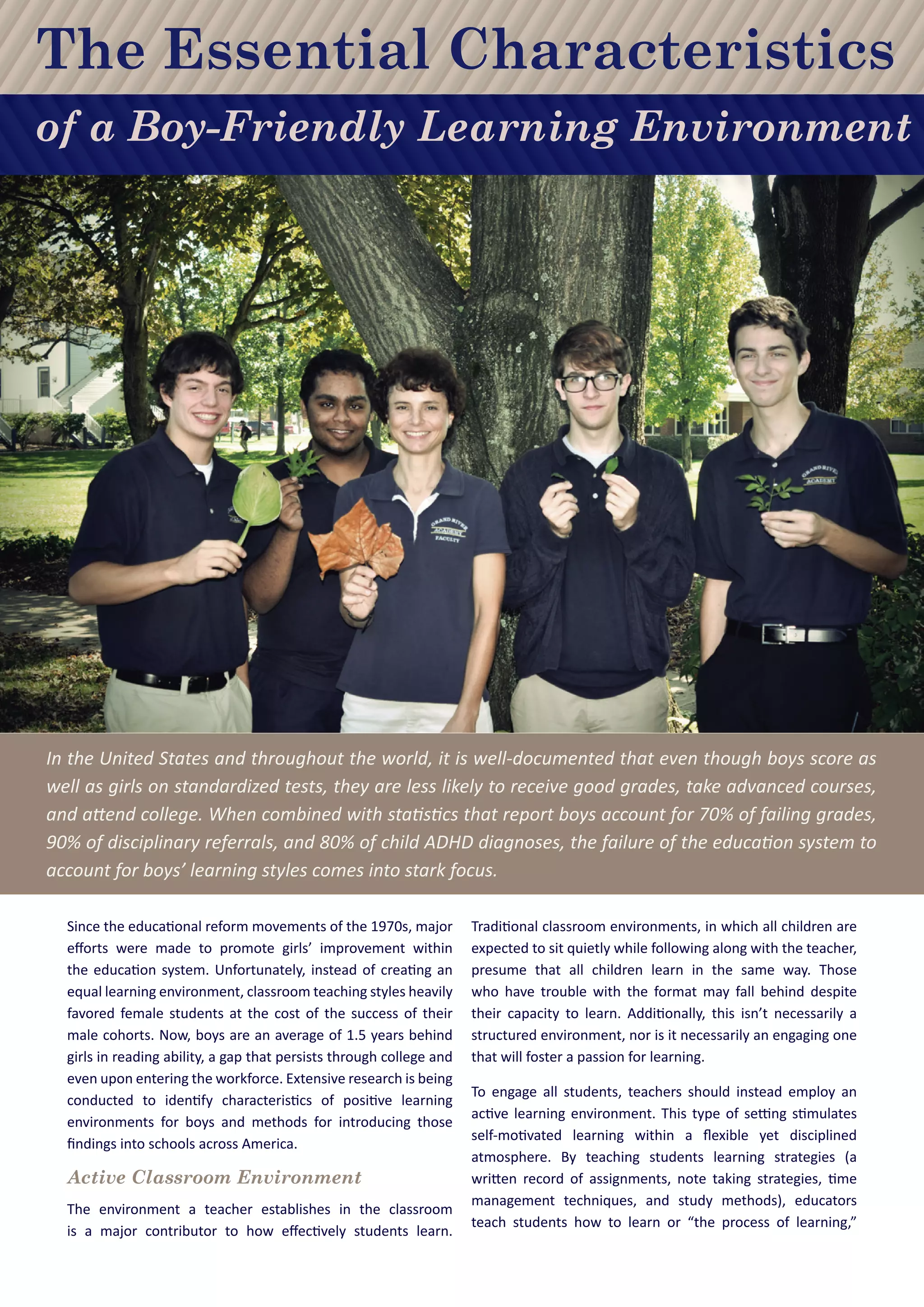
In the United States and throughout the world, it is well-documented that even though boys score as
well as girls on standardized tests, they are less likely to receive good grades, take advanced courses,
and attend college. When combined with statistics that report boys account for 70% of failing grades,
90% of disciplinary referrals, and 80% of child ADHD diagnoses, the failure of the education system to
account for boys’ learning styles comes into stark focus.
Since the educational reform movements of the 1970s, major
efforts were made to promote girls’ improvement within
the education system. Unfortunately, instead of creating an
equal learning environment, classroom teaching styles heavily
favored female students at the cost of the success of their
male cohorts. Now, boys are an average of 1.5 years behind
girls in reading ability, a gap that persists through college and
even upon entering the workforce. Extensive research is being
conducted to identify characteristics of positive learning
environments for boys and methods for introducing those
findings into schools across America.
Active Classroom Environment
The environment a teacher establishes in the classroom
is a major contributor to how effectively students learn.
Traditional classroom environments, in which all children are
expected to sit quietly while following along with the teacher,
presume that all children learn in the same way. Those
who have trouble with the format may fall behind despite
their capacity to learn. Additionally, this isn’t necessarily a
structured environment, nor is it necessarily an engaging one
that will foster a passion for learning.
To engage all students, teachers should instead employ an
active learning environment. This type of setting stimulates
self-motivated learning within a flexible yet disciplined
atmosphere. By teaching students learning strategies (a
written record of assignments, note taking strategies, time
management techniques, and study methods), educators
teach students how to learn or “the process of learning,”
and students become empowered to pursue knowledge more
eagerly and successfully. An active classroom also demands that
the students are presented with choices. By having the freedom to
choose between projects, students are more willing to take on the
challenges that learning entails. By having a say in their education,
students not only take on the responsibility of learning, but have a
more meaningful and lasting experience while doing it.
In an active learning classroom, students learn more about
themselves and what subjects or type of work motivates them.
They also gain a deeper understanding of the people around them.
By seeing what their classmates are interested in, they learn to
appreciate these interests and develop compassion for the needs
of others. In having an active voice in the classroom, students will
feel not only more responsible for their learning, but also for their
behavior, particularly if they help create a classroom constitution
or discuss appropriate classroom behavior. Instead of feeling
helpless and distracted in the classroom, students become willing
participants and are more able to exercise self-discipline.
“Guide on the Side” Mentality
Traditional classrooms are structured to follow a teacher through
exercises, skill acquisition, and learning curriculum-
mandated materials. In this model, sometimes referred
to as “sage on the stage,” all responsibility for the
children’s learning is placed squarely on the teacher,
and students are more or less passive recipients of
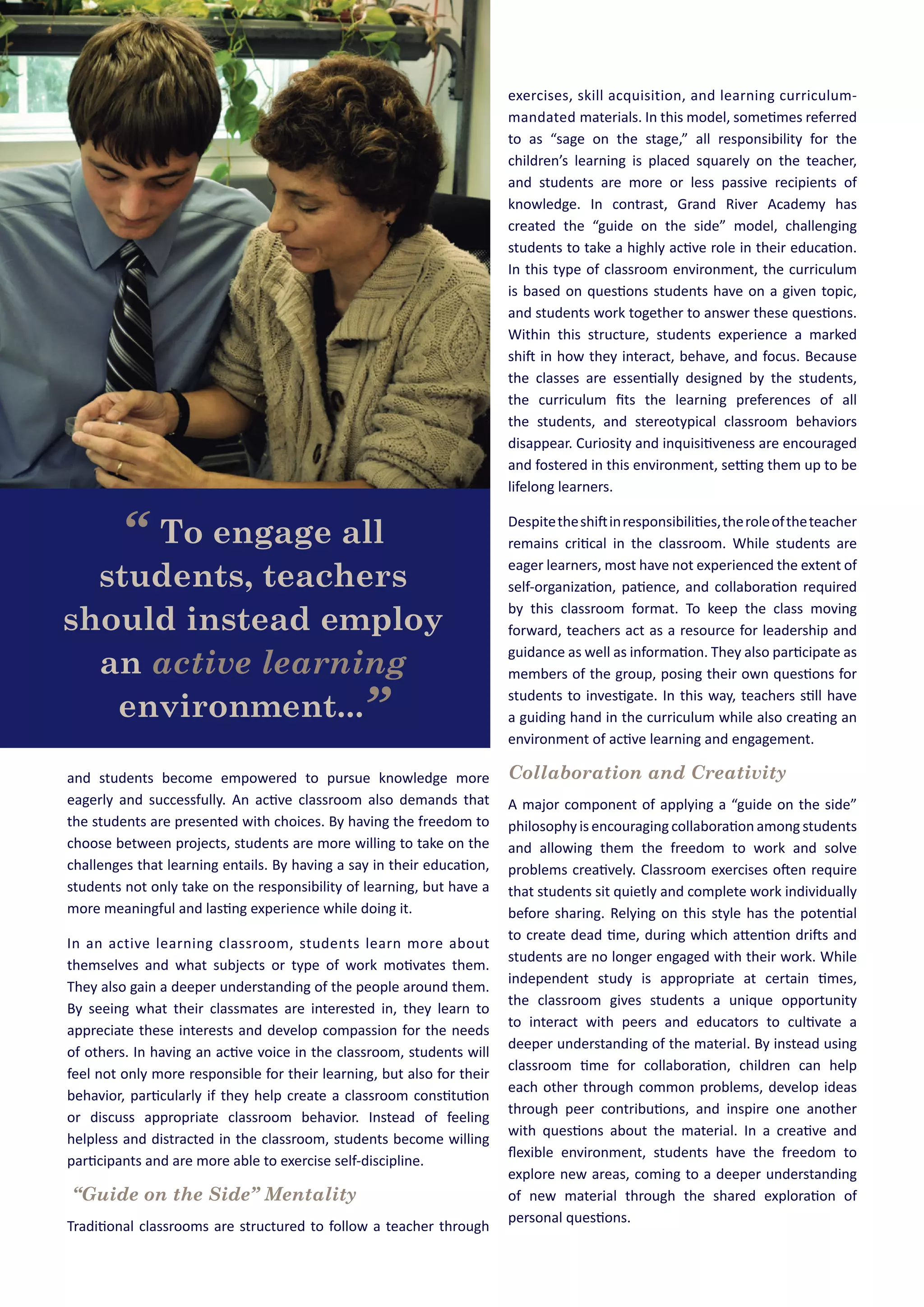
knowledge. In contrast, Grand River Academy has
created the “guide on the side” model, challenging
students to take a highly active role in their education.
In this type of classroom environment, the curriculum
is based on questions students have on a given topic,
and students work together to answer these questions.
Within this structure, students experience a marked
shift in how they interact, behave, and focus. Because
the classes are essentially designed by the students,
the curriculum fits the learning preferences of all
the students, and stereotypical classroom behaviors
disappear. Curiosity and inquisitiveness are encouraged
and fostered in this environment, setting them up to be
lifelong learners.
Despitetheshiftinresponsibilities,theroleoftheteacher
remains critical in the classroom. While students are
eager learners, most have not experienced the extent of
self-organization, patience, and collaboration required
by this classroom format. To keep the class moving
forward, teachers act as a resource for leadership and
guidance as well as information. They also participate as
members of the group, posing their own questions for
students to investigate. In this way, teachers still have
a guiding hand in the curriculum while also creating an
environment of active learning and engagement.
Collaboration and Creativity
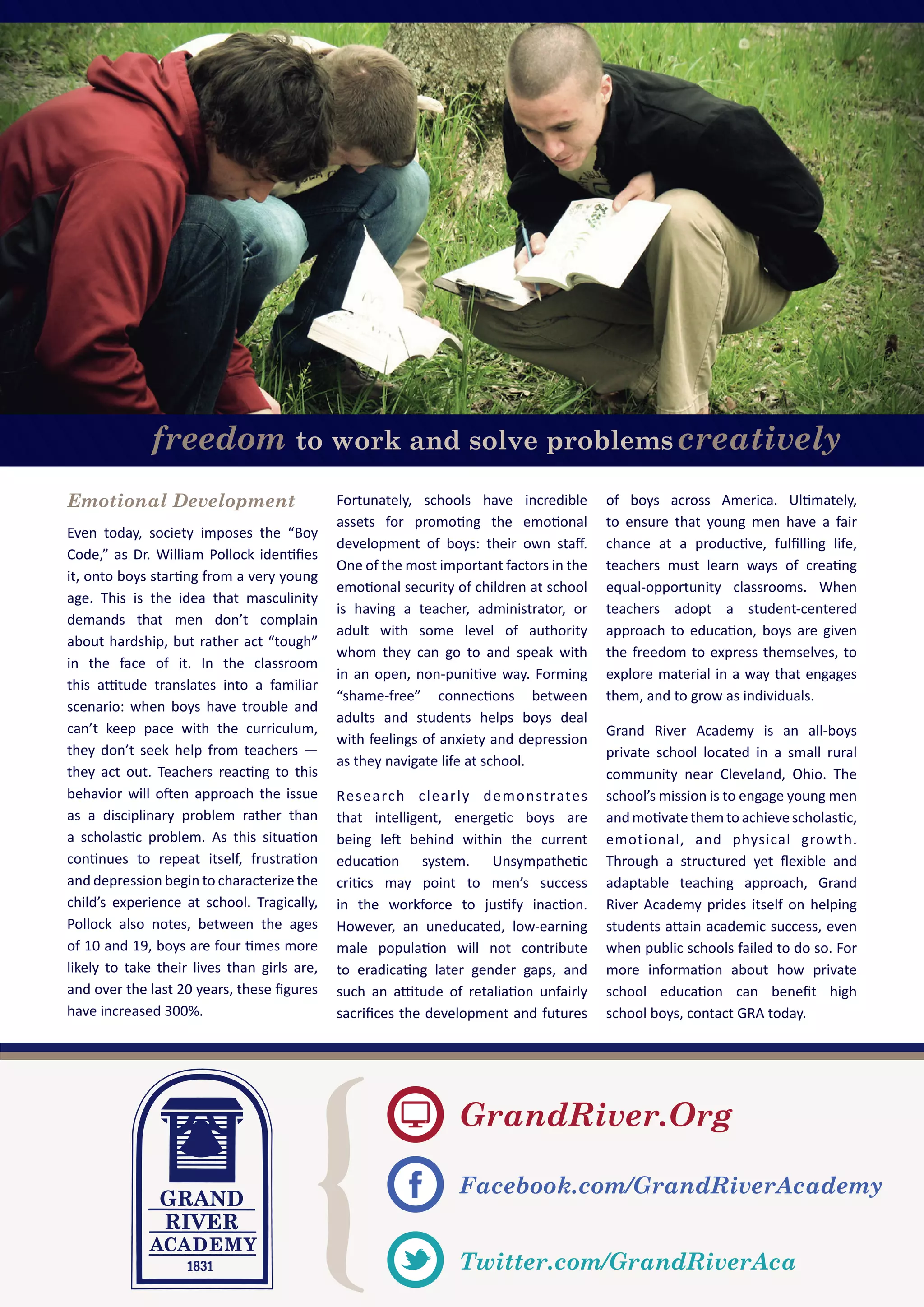
A major component of applying a “guide on the side”
philosophy is encouraging collaboration among students
and allowing them the freedom to work and solve
problems creatively. Classroom exercises often require
that students sit quietly and complete work individually
before sharing. Relying on this style has the potential
to create dead time, during which attention drifts and
students are no longer engaged with their work. While
independent study is appropriate at certain times,
the classroom gives students a unique opportunity
to interact with peers and educators to cultivate a
deeper understanding of the material. By instead using
classroom time for collaboration, children can help
each other through common problems, develop ideas
through peer contributions, and inspire one another
with questions about the material. In a creative and
flexible environment, students have the freedom to
explore new areas, coming to a deeper understanding
of new material through the shared exploration of
personal questions.
“ To engage all
students, teachers
should instead employ
an active learning
environment...”
freedom to work and solve problemscreatively
GrandRiver.Org
Facebook.com/GrandRiverAcademy
Twitter.com/GrandRiverAca
Emotional Development
Even today, society imposes the “Boy
Code,” as Dr. William Pollock identifies
it, onto boys starting from a very young
age. This is the idea that masculinity
demands that men don’t complain
about hardship, but rather act “tough”
in the face of it. In the classroom
this attitude translates into a familiar
scenario: when boys have trouble and
can’t keep pace with the curriculum,
they don’t seek help from teachers —
they act out. Teachers reacting to this
behavior will often approach the issue
as a disciplinary problem rather than
a scholastic problem. As this situation
continues to repeat itself, frustration
and depression begin to characterize the
child’s experience at school. Tragically,
Pollock also notes, between the ages
of 10 and 19, boys are four times more
likely to take their lives than girls are,
and over the last 20 years, these figures
have increased 300%.
Fortunately, schools have incredible
assets for promoting the emotional
development of boys: their own staff.
One of the most important factors in the
emotional security of children at school
is having a teacher, administrator, or
adult with some level of authority
whom they can go to and speak with
in an open, non-punitive way. Forming
“shame-free” connections between
adults and students helps boys deal
with feelings of anxiety and depression
as they navigate life at school.
Research clearly demonstrates
that intelligent, energetic boys are
being left behind within the current
education system. Unsympathetic
critics may point to men’s success
in the workforce to justify inaction.
However, an uneducated, low-earning
male population will not contribute
to eradicating later gender gaps, and
such an attitude of retaliation unfairly
sacrifices the development and futures
of boys across America. Ultimately,
to ensure that young men have a fair
chance at a productive, fulfilling life,
teachers must learn ways of creating
equal-opportunity classrooms. When
teachers adopt a student-centered
approach to education, boys are given
the freedom to express themselves, to
explore material in a way that engages
them, and to grow as individuals.
Grand River Academy is an all-boys
private school located in a small rural
community near Cleveland, Ohio. The
school’s mission is to engage young men
andmotivatethemtoachievescholastic,
emotional, and physical growth.
Through a structured yet flexible and
adaptable teaching approach, Grand
River Academy prides itself on helping
students attain academic success, even
when public schools failed to do so. For
more information about how private
school education can benefit high
school boys, contact GRA today.

White Paper: The Essential Characteristics of a Boy-Friendly Learning Environment

  • 2.
    In the UnitedStates and throughout the world, it is well-documented that even though boys score as well as girls on standardized tests, they are less likely to receive good grades, take advanced courses, and attend college. When combined with statistics that report boys account for 70% of failing grades, 90% of disciplinary referrals, and 80% of child ADHD diagnoses, the failure of the education system to account for boys’ learning styles comes into stark focus. Since the educational reform movements of the 1970s, major efforts were made to promote girls’ improvement within the education system. Unfortunately, instead of creating an equal learning environment, classroom teaching styles heavily favored female students at the cost of the success of their male cohorts. Now, boys are an average of 1.5 years behind girls in reading ability, a gap that persists through college and even upon entering the workforce. Extensive research is being conducted to identify characteristics of positive learning environments for boys and methods for introducing those findings into schools across America. Active Classroom Environment The environment a teacher establishes in the classroom is a major contributor to how effectively students learn. Traditional classroom environments, in which all children are expected to sit quietly while following along with the teacher, presume that all children learn in the same way. Those who have trouble with the format may fall behind despite their capacity to learn. Additionally, this isn’t necessarily a structured environment, nor is it necessarily an engaging one that will foster a passion for learning. To engage all students, teachers should instead employ an active learning environment. This type of setting stimulates self-motivated learning within a flexible yet disciplined atmosphere. By teaching students learning strategies (a written record of assignments, note taking strategies, time management techniques, and study methods), educators teach students how to learn or “the process of learning,”
  • 3.
    and students becomeempowered to pursue knowledge more eagerly and successfully. An active classroom also demands that the students are presented with choices. By having the freedom to choose between projects, students are more willing to take on the challenges that learning entails. By having a say in their education, students not only take on the responsibility of learning, but have a more meaningful and lasting experience while doing it. In an active learning classroom, students learn more about themselves and what subjects or type of work motivates them. They also gain a deeper understanding of the people around them. By seeing what their classmates are interested in, they learn to appreciate these interests and develop compassion for the needs of others. In having an active voice in the classroom, students will feel not only more responsible for their learning, but also for their behavior, particularly if they help create a classroom constitution or discuss appropriate classroom behavior. Instead of feeling helpless and distracted in the classroom, students become willing participants and are more able to exercise self-discipline. “Guide on the Side” Mentality Traditional classrooms are structured to follow a teacher through exercises, skill acquisition, and learning curriculum- mandated materials. In this model, sometimes referred to as “sage on the stage,” all responsibility for the children’s learning is placed squarely on the teacher, and students are more or less passive recipients of knowledge. In contrast, Grand River Academy has created the “guide on the side” model, challenging students to take a highly active role in their education. In this type of classroom environment, the curriculum is based on questions students have on a given topic, and students work together to answer these questions. Within this structure, students experience a marked shift in how they interact, behave, and focus. Because the classes are essentially designed by the students, the curriculum fits the learning preferences of all the students, and stereotypical classroom behaviors disappear. Curiosity and inquisitiveness are encouraged and fostered in this environment, setting them up to be lifelong learners. Despitetheshiftinresponsibilities,theroleoftheteacher remains critical in the classroom. While students are eager learners, most have not experienced the extent of self-organization, patience, and collaboration required by this classroom format. To keep the class moving forward, teachers act as a resource for leadership and guidance as well as information. They also participate as members of the group, posing their own questions for students to investigate. In this way, teachers still have a guiding hand in the curriculum while also creating an environment of active learning and engagement. Collaboration and Creativity A major component of applying a “guide on the side” philosophy is encouraging collaboration among students and allowing them the freedom to work and solve problems creatively. Classroom exercises often require that students sit quietly and complete work individually before sharing. Relying on this style has the potential to create dead time, during which attention drifts and students are no longer engaged with their work. While independent study is appropriate at certain times, the classroom gives students a unique opportunity to interact with peers and educators to cultivate a deeper understanding of the material. By instead using classroom time for collaboration, children can help each other through common problems, develop ideas through peer contributions, and inspire one another with questions about the material. In a creative and flexible environment, students have the freedom to explore new areas, coming to a deeper understanding of new material through the shared exploration of personal questions. “ To engage all students, teachers should instead employ an active learning environment...”
  • 4.
    freedom to workand solve problemscreatively GrandRiver.Org Facebook.com/GrandRiverAcademy Twitter.com/GrandRiverAca Emotional Development Even today, society imposes the “Boy Code,” as Dr. William Pollock identifies it, onto boys starting from a very young age. This is the idea that masculinity demands that men don’t complain about hardship, but rather act “tough” in the face of it. In the classroom this attitude translates into a familiar scenario: when boys have trouble and can’t keep pace with the curriculum, they don’t seek help from teachers — they act out. Teachers reacting to this behavior will often approach the issue as a disciplinary problem rather than a scholastic problem. As this situation continues to repeat itself, frustration and depression begin to characterize the child’s experience at school. Tragically, Pollock also notes, between the ages of 10 and 19, boys are four times more likely to take their lives than girls are, and over the last 20 years, these figures have increased 300%. Fortunately, schools have incredible assets for promoting the emotional development of boys: their own staff. One of the most important factors in the emotional security of children at school is having a teacher, administrator, or adult with some level of authority whom they can go to and speak with in an open, non-punitive way. Forming “shame-free” connections between adults and students helps boys deal with feelings of anxiety and depression as they navigate life at school. Research clearly demonstrates that intelligent, energetic boys are being left behind within the current education system. Unsympathetic critics may point to men’s success in the workforce to justify inaction. However, an uneducated, low-earning male population will not contribute to eradicating later gender gaps, and such an attitude of retaliation unfairly sacrifices the development and futures of boys across America. Ultimately, to ensure that young men have a fair chance at a productive, fulfilling life, teachers must learn ways of creating equal-opportunity classrooms. When teachers adopt a student-centered approach to education, boys are given the freedom to express themselves, to explore material in a way that engages them, and to grow as individuals. Grand River Academy is an all-boys private school located in a small rural community near Cleveland, Ohio. The school’s mission is to engage young men andmotivatethemtoachievescholastic, emotional, and physical growth. Through a structured yet flexible and adaptable teaching approach, Grand River Academy prides itself on helping students attain academic success, even when public schools failed to do so. For more information about how private school education can benefit high school boys, contact GRA today.