Enabling Semantically Aware 
Software Applications 
Trish Whetzel, PhD 
Outreach Coordinator 
THE NATIONAL CENTER FOR 
BIOMEDICAL ONTOLOGY
Outline 
• Overview of NCBO 
• NCBO Software 
– BioPortal 
– Ontology Widgets 
– Annotator 
– Resource Index 
• Future Plans 
2
National Center for 
Biomedical Ontology 
• Mission 
– To create software for the application of 
ontologies in biomedical science and clinical 
care 
• NCBO Partners 
– Stanford University - Dr. Mark A. Musen 
– Mayo Clinic - Dr. Christopher G. Chute 
– University of Victoria - Dr. Margaret-Anne 
Storey 
– University of Buffalo - Dr. Barry Smith
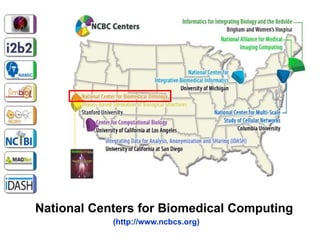
National Centers for Biomedical Computing 
(http://www.ncbcs.org)
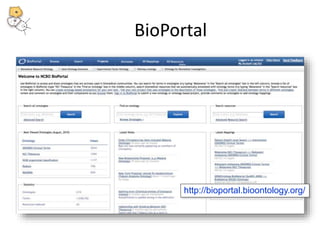
BioPortal 
http://bioportal.bioontology.org/
BioPortal 
• Library of Ontologies 
– NCBO BioPortal includes Biomedical ontology 
content, e.g. UMLS terminologies 
• Architecture 
– Backend includes LexEVS and Protégé 
– Web Interface uses Ruby on Rails, Flex, and PHP 
• Web services 
– REST Web services 
6
BioPortal 
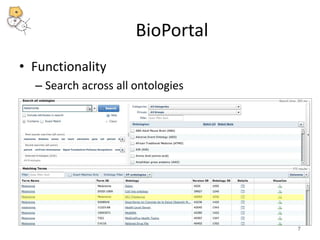
• Functionality 
– Search across all ontologies 
7
BioPortal 
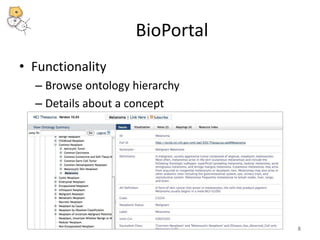
• Functionality 
– Browse ontology hierarchy 
– Details about a concept 
8
BioPortal 
• Functionality 
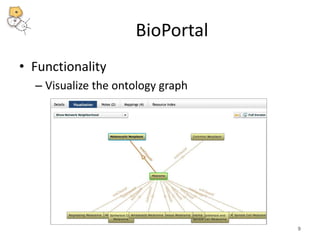
– Visualize the ontology graph 
9
BioPortal 
• Functionality 
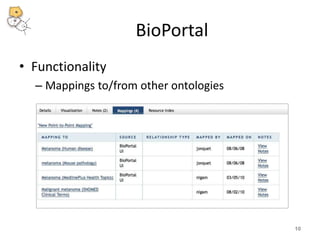
– Mappings to/from other ontologies 
10
BioPortal 
• Functionality 
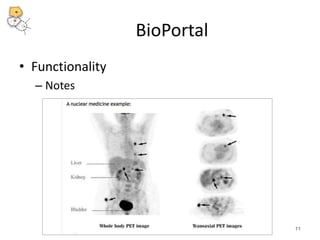
– Notes 
11
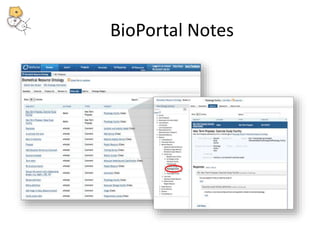
BioPortal Notes 
• Notes 
– Provide a mechanism to collect structured 
information 
– Integration with ontology editing programs 
– Alerts – Email and RSS
Use Case for BioPortal Notes 
• Ontology Enrichment 
– Expansion of the ontology based on user need for 
terms 
• Constraints 
– Existing trackers do not collect structured 
information 
– No programmatic access to tracker 
– Lack of integration with ontology editing 
programs 
13
BioPortal Notes
Ontology Widgets 
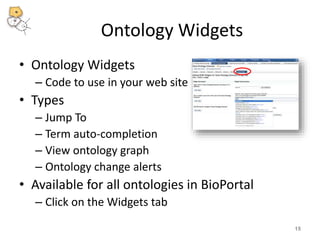
• Ontology Widgets 
– Code to use in your web site 
• Types 
– Jump To 
– Term auto-completion 
– View ontology graph 
– Ontology change alerts 
• Available for all ontologies in BioPortal 
– Click on the Widgets tab 
15
Ontology Widgets 
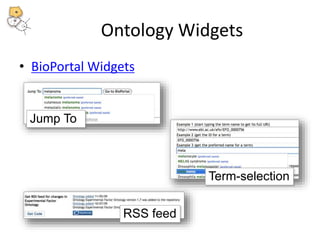
• BioPortal Widgets 
RSS feed 
Term-selection 
Jump To
Ontology Widgets 
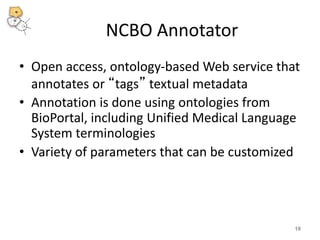
• BioPortal Widgets 
Tree widget 
Visualization
NCBO Annotator 
• Open access, ontology-based Web service that 
annotates or “tags” textual metadata 
• Annotation is done using ontologies from 
BioPortal, including Unified Medical Language 
System terminologies 
• Variety of parameters that can be customized 
18
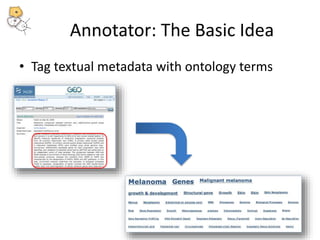
Annotator: The Basic Idea 
• Tag textual metadata with ontology terms 
19
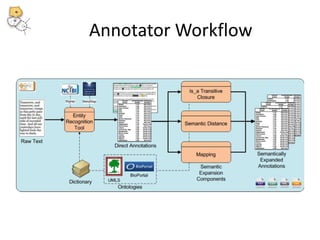
Annotator Workflow
Annotator - Parameters 
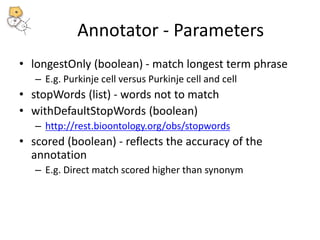
• longestOnly (boolean) - match longest term phrase 
– E.g. Purkinje cell versus Purkinje cell and cell 
• stopWords (list) - words not to match 
• withDefaultStopWords (boolean) 
– http://rest.bioontology.org/obs/stopwords 
• scored (boolean) - reflects the accuracy of the 
annotation 
– E.g. Direct match scored higher than synonym
Annotator - Parameters 
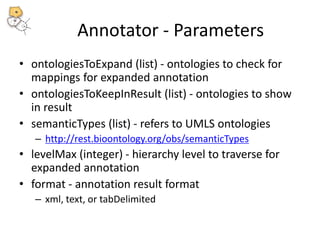
• ontologiesToExpand (list) - ontologies to check for 
mappings for expanded annotation 
• ontologiesToKeepInResult (list) - ontologies to show 
in result 
• semanticTypes (list) - refers to UMLS ontologies 
– http://rest.bioontology.org/obs/semanticTypes 
• levelMax (integer) - hierarchy level to traverse for 
expanded annotation 
• format - annotation result format 
– xml, text, or tabDelimited
Semantic Expansion 
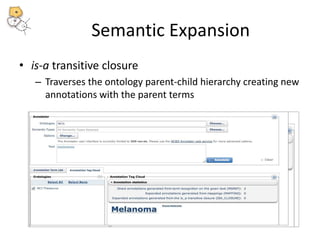
• is-a transitive closure 
– Traverses the ontology parent-child hierarchy creating new 
annotations with the parent terms
Semantic Expansion 
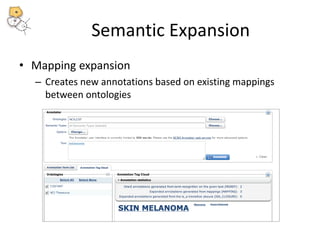
• Mapping expansion 
– Creates new annotations based on existing mappings 
between ontologies
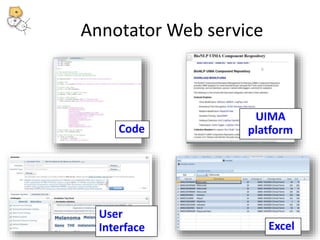
Annotator Web service 
Code 
UIMA 
platform 
Excel 
User 
Interface
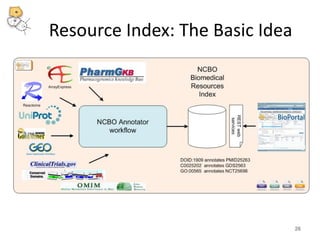
Resource Index: The Basic Idea 
26
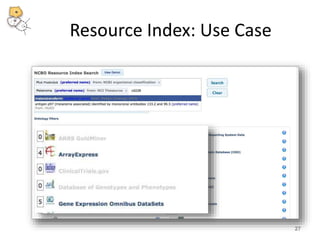
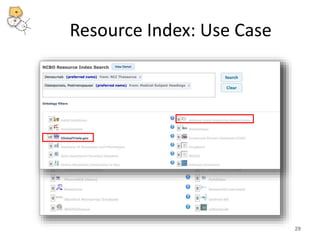
Resource Index: Use Case 
27
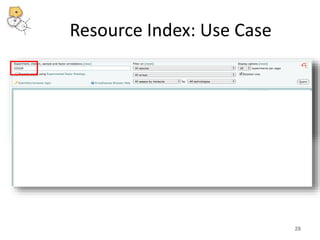
Resource Index: Use Case 
28
Resource Index: Use Case 
29
Future Plans 
• Services that allow use of ontologies via an 
enhanced version of BioPortal 
• Integration of ontology authoring, publishing, 
and peer review 
• A comprehensive ontology-based index of 
online biomedical resources 
• Analytic methods to summarize and profile 
biomedical data sets
References 
• BioPortal 
– http://bioportal.bioontology.org 
• Annotator 
– http://www.bioontology.org/wiki/index.php/Annotator_Web_s 
ervice 
• Resource Index 
– http://www.bioontology.org/wiki/index.php/NCBO_Biomedical_ 
Resources_Index 
• Web service documentation: 
– http://www.bioontology.org/wiki/index.php/NCBO_REST_servic 
es 
• Trish Whetzel 
– whetzel@stanford.edu

Enabling Semantically Aware Software Applications

  • 1.
    Enabling Semantically Aware Software Applications Trish Whetzel, PhD Outreach Coordinator THE NATIONAL CENTER FOR BIOMEDICAL ONTOLOGY
  • 2.
    Outline • Overviewof NCBO • NCBO Software – BioPortal – Ontology Widgets – Annotator – Resource Index • Future Plans 2
  • 3.
    National Center for Biomedical Ontology • Mission – To create software for the application of ontologies in biomedical science and clinical care • NCBO Partners – Stanford University - Dr. Mark A. Musen – Mayo Clinic - Dr. Christopher G. Chute – University of Victoria - Dr. Margaret-Anne Storey – University of Buffalo - Dr. Barry Smith
  • 4.
    National Centers forBiomedical Computing (http://www.ncbcs.org)
  • 5.
  • 6.
    BioPortal • Libraryof Ontologies – NCBO BioPortal includes Biomedical ontology content, e.g. UMLS terminologies • Architecture – Backend includes LexEVS and Protégé – Web Interface uses Ruby on Rails, Flex, and PHP • Web services – REST Web services 6
  • 7.
    BioPortal • Functionality – Search across all ontologies 7
  • 8.
    BioPortal • Functionality – Browse ontology hierarchy – Details about a concept 8
  • 9.
    BioPortal • Functionality – Visualize the ontology graph 9
  • 10.
    BioPortal • Functionality – Mappings to/from other ontologies 10
  • 11.
  • 12.
    BioPortal Notes •Notes – Provide a mechanism to collect structured information – Integration with ontology editing programs – Alerts – Email and RSS
  • 13.
    Use Case forBioPortal Notes • Ontology Enrichment – Expansion of the ontology based on user need for terms • Constraints – Existing trackers do not collect structured information – No programmatic access to tracker – Lack of integration with ontology editing programs 13
  • 14.
  • 15.
    Ontology Widgets •Ontology Widgets – Code to use in your web site • Types – Jump To – Term auto-completion – View ontology graph – Ontology change alerts • Available for all ontologies in BioPortal – Click on the Widgets tab 15
  • 16.
    Ontology Widgets •BioPortal Widgets RSS feed Term-selection Jump To
  • 17.
    Ontology Widgets •BioPortal Widgets Tree widget Visualization
  • 18.
    NCBO Annotator •Open access, ontology-based Web service that annotates or “tags” textual metadata • Annotation is done using ontologies from BioPortal, including Unified Medical Language System terminologies • Variety of parameters that can be customized 18
  • 19.
    Annotator: The BasicIdea • Tag textual metadata with ontology terms 19
  • 20.
  • 21.
    Annotator - Parameters • longestOnly (boolean) - match longest term phrase – E.g. Purkinje cell versus Purkinje cell and cell • stopWords (list) - words not to match • withDefaultStopWords (boolean) – http://rest.bioontology.org/obs/stopwords • scored (boolean) - reflects the accuracy of the annotation – E.g. Direct match scored higher than synonym
  • 22.
    Annotator - Parameters • ontologiesToExpand (list) - ontologies to check for mappings for expanded annotation • ontologiesToKeepInResult (list) - ontologies to show in result • semanticTypes (list) - refers to UMLS ontologies – http://rest.bioontology.org/obs/semanticTypes • levelMax (integer) - hierarchy level to traverse for expanded annotation • format - annotation result format – xml, text, or tabDelimited
  • 23.
    Semantic Expansion •is-a transitive closure – Traverses the ontology parent-child hierarchy creating new annotations with the parent terms
  • 24.
    Semantic Expansion •Mapping expansion – Creates new annotations based on existing mappings between ontologies
  • 25.
    Annotator Web service Code UIMA platform Excel User Interface
  • 26.
    Resource Index: TheBasic Idea 26
  • 27.
  • 28.
  • 29.
  • 30.
    Future Plans •Services that allow use of ontologies via an enhanced version of BioPortal • Integration of ontology authoring, publishing, and peer review • A comprehensive ontology-based index of online biomedical resources • Analytic methods to summarize and profile biomedical data sets
  • 31.
    References • BioPortal – http://bioportal.bioontology.org • Annotator – http://www.bioontology.org/wiki/index.php/Annotator_Web_s ervice • Resource Index – http://www.bioontology.org/wiki/index.php/NCBO_Biomedical_ Resources_Index • Web service documentation: – http://www.bioontology.org/wiki/index.php/NCBO_REST_servic es • Trish Whetzel – whetzel@stanford.edu

Editor's Notes

  • #12 DAS28 RA Scale – Radiological changes typical of RA on hand and wrist x-rays is one criteria Example images can be added as Notes
  • #16 SimTK - https://simtk.org/home/simtk --physics-based simulations of biological structures GMiner - http://gminer.mcw.edu/ -Ontolgoy-indexed annotations from GEO, widget used to get more information on term (Jump To) aTag Generator - http://hcls.deri.org/atag/generator/ - aTags ("associative tags") are snippets of HTML that capture the information that is most important to you in a machine-readable, interlinked format, making it easier for you and others to see the big picture. RNSA – various tools, e.g. RadLex viewer, propose new terms
  • #20 GSE12391 http://www.ncbi.nlm.nih.gov/geo/query/acc.cgi?acc=GSE12391
  • #26 Elsevier SciVerse Karen Dowell, Jackson Lab Shai-shen Orr, Mark Davis’s lab Sean Mooney’s group Ida Sim, UCSF Simon Twigger, Medical college of Wisconsin Nathan Baker, Washington Univ. Amit Seth, Wright State Univ. Neil Sarkar, University of Vermont Larry Hunter, University of Colorado, Denver
  • #27 Search takes into account concept information, e.g. synonyms Ability to link related resource records
  • #28 Use Case: Find all experiments from Array Express that involve Mtf -/- mice and melanoma http://www.ebi.ac.uk/microarray-as/ae/browse.html?detailedview=on&keywords=E-GEOD-6817 (Array Express) Melanoma from NCI Thesaurus MTF -/- from Protein Ontology CD228 from Protein Ontology Mus musculus from NCBI taxonomy
  • #31 - New architecture Linking BioPortal to WebProtege Adding more resources into Resource Index Over-representation of terms other than just Gene Ontology terms