The Chemical Analysis 
Metadata Platform (ChAMP): 
Thoughts and Ideas on the 
Semantic Identification of 
Analytical Metrics 
Stuart J. Chalk, Department of Chemistry, University of North Florida 
Antony Williams and Valery Tkachenko, RSC Cheminformatics 
schalk@unf.edu 
2014 Fall ACS Meeting
Overview 
 Initial Idea 
 Motivation 
 Why a Platform? 
 Pieces of the Puzzle 
 Existing Resources 
 What are the Most Important Metadata? 
 Minimum Information About a Chemical Analysis? 
 Different Perspectives on a Chemical Analysis 
 Example: Metadata Categories in XML 
 Example: Metadata Categories in JSON-LD 
 Planned Activities 
 Conclusion
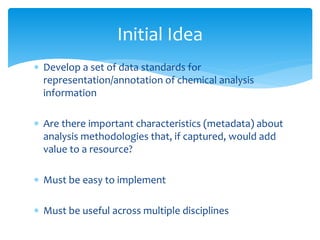
Initial Idea 
 Develop a set of data standards for 
representation/annotation of chemical analysis 
information 
 Are there important characteristics (metadata) about 
analysis methodologies that, if captured, would add 
value to a resource? 
 Must be easy to implement 
 Must be useful across multiple disciplines
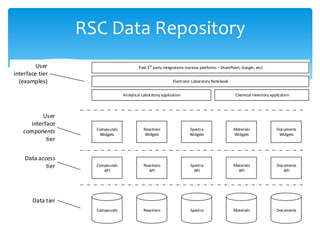
RSC Data Repository 
Compounds 
Widgets 
Compounds 
API 
Paid 3rd party integrations (various platforms – SharePoint, Google, etc) 
Reactions 
Widgets 
Reactions 
API 
Spectra 
Widgets 
Spectra 
API 
Materials 
Widgets 
Materials 
API 
Documents 
Widgets 
Documents 
API 
Compounds Reactions Spectra Materials Documents 
User 
interface 
components 
tier 
Data access 
tier 
Data tier 
Analytical Laboratory application 
User 
interface tier 
(examples) Electronic Laboratory Notebook 
Chemical Inventory application
Motivation 
 Access to knowledge in existing literature 
 Annotation of research in future publications 
 Annotation of unpublished/self published 
(but potentially useful) work 
 Annotation of data captured in ELN’s 
 Data ingest into the RSC’s Data Repository 
 Complements/enhances existing activities 
 The haystack is so big – we need to make it 
easy to make the needle show up
Why a Platform? 
 Develop it to be as broadly applicable as possible 
 Chemical analysis is a not tangible like a spectrum 
 Users have domain specific needs 
 Users has a favorite/required format to store 
information 
 SQL Relational Database 
 Excel Spreadsheet 
 XML, YAML 
 JSON or JSON-LD 
 ChAMP should define the types of metadata and 
general organization of the information, not the 
format it is stored in (this is like MIAME [1]) 
[1] http://www.mged.org/Workgroups/MIAME/miame.html
First Thoughts 
 Covers metadata for a chemical analysis methodology 
not raw analytical instrument data 
 Two main sections? 
 Fundamental method development 
 Method application 
 How big should the platform scope be? 
 What information is most important? 
 How do we get community involvement/buy-in?
Pieces of the Puzzle 
 Ontology of chemical analysis terms 
 Taxonomy of chemical analysis metadata 
 Controlled vocabularies for specific metadata items 
 Definitions of required metadata (in context) 
 Naming and design rules
Existing Resources 
 Ontologies 
 Chemical Methods Ontology (CMO) [2] 
 SemanticScience CHEMINF Ontology [3] 
 Chemical Entities of Biological Interest (ChEBI) [4] 
 “Ontology on Property” by René Dybkær [5] 
 Ontobee (ontology search) [6] 
[2] http://www.rsc.org/ontologies/CMO/ 
[3] https://code.google.com/p/semanticscience/ 
[4] http://www.ebi.ac.uk/chebi/ 
[5] http://ontology.iupac.org/ 
[6] http://www.ontobee.org/
Existing Resources 
 Controlled Vocabularies/Taxonomies 
 MESH [6] 
 LCSH [7] 
 CAS Subject Headings [8] 
 IUPAC Orange Book [9] 
 IUPAC Gold Book [10] 
 … do they address how to organize the metadata? 
[6] http://www.ncbi.nlm.nih.gov/mesh 
[7] http://id.loc.gov/authorities/subjects.html 
[8] http://cas.org 
[9] http://iupac.org/publications/analytical_compendium 
[10] http://goldbook.iupac.org/
 Other 
Existing Resources 
 JCAMP-DX [11] 
 Analytical Information Markup Language (AnIML) [12] 
 Units Markup Language (UnitsML) [13] 
 NASA Quantities, Units, Dimensions and Data Types [14] 
 Electronic Laboratory Notebook Manifest 
(elnItemManifest) [15] 
[11] JCAMP-DX – http://www.jcamp-dx.org/ 
[12] AnIML – http://animl.sourceforge.net/ 
[13] UnitsML – http://unitsml.nist.gov/ 
[14] QUDT– http://qudt.org/ 
[15] elnItemManifest –http://www.jcheminf.com/content/5/1/52
What are the 
Most Important Metadata? 
 Depends on who you talk to… 
 Platform should describe (as completely as possible) 
the types of metadata important in analysis… 
 … but leave the description of what’s important to 
the users 
 Standards for different industries, with different 
requirements, could be developed based on the 
platform
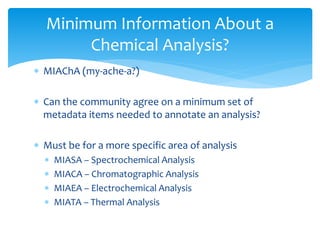
Minimum Information About a 
Chemical Analysis? 
 MIAChA (my-ache-a?) 
 Can the community agree on a minimum set of 
metadata items needed to annotate an analysis? 
 Must be for a more specific area of analysis 
 MIASA – Spectrochemical Analysis 
 MIACA – Chromatographic Analysis 
 MIAEA – Electrochemical Analysis 
 MIATA – Thermal Analysis
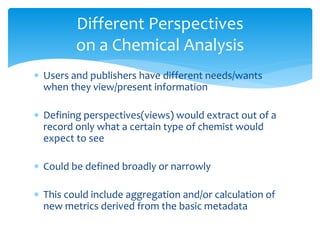
Different Perspectives 
on a Chemical Analysis 
 Users and publishers have different needs/wants 
when they view/present information 
 Defining perspectives(views) would extract out of a 
record only what a certain type of chemist would 
expect to see 
 Could be defined broadly or narrowly 
 This could include aggregation and/or calculation of 
new metrics derived from the basic metadata
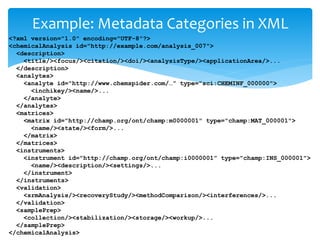
Example: Metadata Categories in XML 
<?xml version="1.0" encoding="UTF-8"?> 
<chemicalAnalysis id="http://example.com/analysis_007"> 
<description> 
<title/><focus/><citation/><doi/><analysisType/><applicationArea/>... 
</description> 
<analytes> 
<analyte id="http://www.chemspider.com/…” type="sci:CHEMINF_000000"> 
<inchikey/><name/>... 
</analyte> 
</analytes> 
<matrices> 
<matrix id="http://champ.org/ont/champ:m0000001" type="champ:MAT_000001"> 
<name/><state/><form/>... 
</matrix> 
</matrices> 
<instruments> 
<instrument id="http://champ.org/ont/champ:i0000001” type="champ:INS_000001"> 
<name/><description/><settings/>... 
</instrument> 
</instruments> 
<validation> 
<srmAnalysis/><recoveryStudy/><methodComparison/><interferences/>... 
</validation> 
<samplePrep> 
<collection/><stabilization/><storage/><workup/>... 
</samplePrep> 
</chemicalAnalysis>
Example: Metadata Categories in JSON-LD 
{ 
"@context":"http://champ.org/chemicalanalysis.jsonld", 
“@id”: “http://example.com/analysis_007”, 
“description”: { “title”: …, “focus”: …, “citation”: …, “doi”: … 
“analysisType”: …, “applicationArea”: … } 
"analytes": [{"@id”: …, "@type”: …, "inchikey”: …, "name": … },… ], 
"matrices": [{"@id”: …, "@type": …, "name": …, “state”: …, “form”: … }, … ] 
"instruments": [{"@id": …, "@type": …, "name": …, "description”: …, 
"settings": … }, … ], 
"metrics": { "detection limit”: …, “linear dynamic range”: … }, 
“validation”: { "reference material": …, “recovery study”: …, 
“method comparison”: …, “interferences”: … }, 
“samplePrep”: { “collection”: …, “stabilization”: …, “storage”: …, 
“workup”: … } 
}
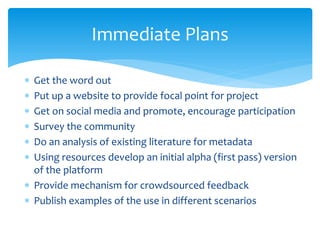
Immediate Plans 
 Get the word out 
 Put up a website to provide focal point for project 
 Get on social media and promote, encourage participation 
 Survey the community 
 Do an analysis of existing literature for metadata 
 Using resources develop an initial alpha (first pass) version 
of the platform 
 Provide mechanism for crowdsourced feedback 
 Publish examples of the use in different scenarios
Longer Term Plan 
 Version 1 of platform 
 Controlled vocabularies 
 Example documents 
 Example applications
Conclusion 
 This approach to metadata identification will provide 
value to existing resources 
 It will enhance basic searching 
 It will allow semantic searching 
 It will provide efficient annotation of large amounts 
of curated data that is not from traditional publishing
Conclusion 
 It also fits well with the mission of the 
Research Data Alliance (RDA) [16] 
 RDA Vision: Researchers and innovators openly sharing 
data across technologies, disciplines, and countries to 
address the grand challenges of society. 
 RDA Mission: The Research Data Alliance (RDA) builds 
the social and technical bridges that enable open 
sharing of data. 
[16] http://rd-alliance.org
Questions? 
 schalk@unf.edu 
 Phone: 904-620-5311 
 Skype: stuartchalk 
 LinkedIn/Slidehare: https://www.linkedin.com/in/stuchalk 
 ORCID: http://orcid.org/0000-0002-0703-7776 
 ResearcherID: http://www.researcherid.com/rid/D-8577-2013

ACS 248th Paper 71 ChAMP Project

  • 1.
    The Chemical Analysis Metadata Platform (ChAMP): Thoughts and Ideas on the Semantic Identification of Analytical Metrics Stuart J. Chalk, Department of Chemistry, University of North Florida Antony Williams and Valery Tkachenko, RSC Cheminformatics schalk@unf.edu 2014 Fall ACS Meeting
  • 2.
    Overview  InitialIdea  Motivation  Why a Platform?  Pieces of the Puzzle  Existing Resources  What are the Most Important Metadata?  Minimum Information About a Chemical Analysis?  Different Perspectives on a Chemical Analysis  Example: Metadata Categories in XML  Example: Metadata Categories in JSON-LD  Planned Activities  Conclusion
  • 3.
    Initial Idea Develop a set of data standards for representation/annotation of chemical analysis information  Are there important characteristics (metadata) about analysis methodologies that, if captured, would add value to a resource?  Must be easy to implement  Must be useful across multiple disciplines
  • 4.
    RSC Data Repository Compounds Widgets Compounds API Paid 3rd party integrations (various platforms – SharePoint, Google, etc) Reactions Widgets Reactions API Spectra Widgets Spectra API Materials Widgets Materials API Documents Widgets Documents API Compounds Reactions Spectra Materials Documents User interface components tier Data access tier Data tier Analytical Laboratory application User interface tier (examples) Electronic Laboratory Notebook Chemical Inventory application
  • 5.
    Motivation  Accessto knowledge in existing literature  Annotation of research in future publications  Annotation of unpublished/self published (but potentially useful) work  Annotation of data captured in ELN’s  Data ingest into the RSC’s Data Repository  Complements/enhances existing activities  The haystack is so big – we need to make it easy to make the needle show up
  • 6.
    Why a Platform?  Develop it to be as broadly applicable as possible  Chemical analysis is a not tangible like a spectrum  Users have domain specific needs  Users has a favorite/required format to store information  SQL Relational Database  Excel Spreadsheet  XML, YAML  JSON or JSON-LD  ChAMP should define the types of metadata and general organization of the information, not the format it is stored in (this is like MIAME [1]) [1] http://www.mged.org/Workgroups/MIAME/miame.html
  • 7.
    First Thoughts Covers metadata for a chemical analysis methodology not raw analytical instrument data  Two main sections?  Fundamental method development  Method application  How big should the platform scope be?  What information is most important?  How do we get community involvement/buy-in?
  • 8.
    Pieces of thePuzzle  Ontology of chemical analysis terms  Taxonomy of chemical analysis metadata  Controlled vocabularies for specific metadata items  Definitions of required metadata (in context)  Naming and design rules
  • 9.
    Existing Resources Ontologies  Chemical Methods Ontology (CMO) [2]  SemanticScience CHEMINF Ontology [3]  Chemical Entities of Biological Interest (ChEBI) [4]  “Ontology on Property” by René Dybkær [5]  Ontobee (ontology search) [6] [2] http://www.rsc.org/ontologies/CMO/ [3] https://code.google.com/p/semanticscience/ [4] http://www.ebi.ac.uk/chebi/ [5] http://ontology.iupac.org/ [6] http://www.ontobee.org/
  • 10.
    Existing Resources Controlled Vocabularies/Taxonomies  MESH [6]  LCSH [7]  CAS Subject Headings [8]  IUPAC Orange Book [9]  IUPAC Gold Book [10]  … do they address how to organize the metadata? [6] http://www.ncbi.nlm.nih.gov/mesh [7] http://id.loc.gov/authorities/subjects.html [8] http://cas.org [9] http://iupac.org/publications/analytical_compendium [10] http://goldbook.iupac.org/
  • 11.
     Other ExistingResources  JCAMP-DX [11]  Analytical Information Markup Language (AnIML) [12]  Units Markup Language (UnitsML) [13]  NASA Quantities, Units, Dimensions and Data Types [14]  Electronic Laboratory Notebook Manifest (elnItemManifest) [15] [11] JCAMP-DX – http://www.jcamp-dx.org/ [12] AnIML – http://animl.sourceforge.net/ [13] UnitsML – http://unitsml.nist.gov/ [14] QUDT– http://qudt.org/ [15] elnItemManifest –http://www.jcheminf.com/content/5/1/52
  • 12.
    What are the Most Important Metadata?  Depends on who you talk to…  Platform should describe (as completely as possible) the types of metadata important in analysis…  … but leave the description of what’s important to the users  Standards for different industries, with different requirements, could be developed based on the platform
  • 13.
    Minimum Information Abouta Chemical Analysis?  MIAChA (my-ache-a?)  Can the community agree on a minimum set of metadata items needed to annotate an analysis?  Must be for a more specific area of analysis  MIASA – Spectrochemical Analysis  MIACA – Chromatographic Analysis  MIAEA – Electrochemical Analysis  MIATA – Thermal Analysis
  • 14.
    Different Perspectives ona Chemical Analysis  Users and publishers have different needs/wants when they view/present information  Defining perspectives(views) would extract out of a record only what a certain type of chemist would expect to see  Could be defined broadly or narrowly  This could include aggregation and/or calculation of new metrics derived from the basic metadata
  • 15.
    Example: Metadata Categoriesin XML <?xml version="1.0" encoding="UTF-8"?> <chemicalAnalysis id="http://example.com/analysis_007"> <description> <title/><focus/><citation/><doi/><analysisType/><applicationArea/>... </description> <analytes> <analyte id="http://www.chemspider.com/…” type="sci:CHEMINF_000000"> <inchikey/><name/>... </analyte> </analytes> <matrices> <matrix id="http://champ.org/ont/champ:m0000001" type="champ:MAT_000001"> <name/><state/><form/>... </matrix> </matrices> <instruments> <instrument id="http://champ.org/ont/champ:i0000001” type="champ:INS_000001"> <name/><description/><settings/>... </instrument> </instruments> <validation> <srmAnalysis/><recoveryStudy/><methodComparison/><interferences/>... </validation> <samplePrep> <collection/><stabilization/><storage/><workup/>... </samplePrep> </chemicalAnalysis>
  • 16.
    Example: Metadata Categoriesin JSON-LD { "@context":"http://champ.org/chemicalanalysis.jsonld", “@id”: “http://example.com/analysis_007”, “description”: { “title”: …, “focus”: …, “citation”: …, “doi”: … “analysisType”: …, “applicationArea”: … } "analytes": [{"@id”: …, "@type”: …, "inchikey”: …, "name": … },… ], "matrices": [{"@id”: …, "@type": …, "name": …, “state”: …, “form”: … }, … ] "instruments": [{"@id": …, "@type": …, "name": …, "description”: …, "settings": … }, … ], "metrics": { "detection limit”: …, “linear dynamic range”: … }, “validation”: { "reference material": …, “recovery study”: …, “method comparison”: …, “interferences”: … }, “samplePrep”: { “collection”: …, “stabilization”: …, “storage”: …, “workup”: … } }
  • 17.
    Immediate Plans Get the word out  Put up a website to provide focal point for project  Get on social media and promote, encourage participation  Survey the community  Do an analysis of existing literature for metadata  Using resources develop an initial alpha (first pass) version of the platform  Provide mechanism for crowdsourced feedback  Publish examples of the use in different scenarios
  • 18.
    Longer Term Plan  Version 1 of platform  Controlled vocabularies  Example documents  Example applications
  • 19.
    Conclusion  Thisapproach to metadata identification will provide value to existing resources  It will enhance basic searching  It will allow semantic searching  It will provide efficient annotation of large amounts of curated data that is not from traditional publishing
  • 20.
    Conclusion  Italso fits well with the mission of the Research Data Alliance (RDA) [16]  RDA Vision: Researchers and innovators openly sharing data across technologies, disciplines, and countries to address the grand challenges of society.  RDA Mission: The Research Data Alliance (RDA) builds the social and technical bridges that enable open sharing of data. [16] http://rd-alliance.org
  • 21.
    Questions?  schalk@unf.edu  Phone: 904-620-5311  Skype: stuartchalk  LinkedIn/Slidehare: https://www.linkedin.com/in/stuchalk  ORCID: http://orcid.org/0000-0002-0703-7776  ResearcherID: http://www.researcherid.com/rid/D-8577-2013