NCBO Tools and Web Services 
Trish Whetzel 
Outreach Coordinator
Outline 
• NCBO Background 
• Ontology Web Services 
• Ontology Widgets 
• NCBO Annotator 
• NCBO Resource Index 
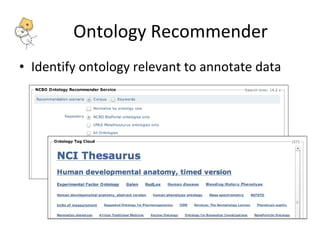
• Ontology Recommender 
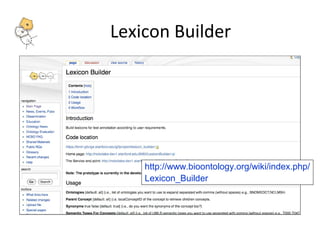
• Lexicon Builder
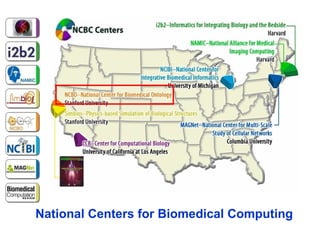
National Centers for Biomedical Computing
National Center for 
Biomedical Ontology 
• Mission 
– To create software for the application of 
ontologies in biomedical science and clinical 
care 
• NCBO Partners 
– Stanford University - Dr. Mark A. Musen 
– Mayo Clinic - Dr. Christopher G. Chute 
– University of Buffalo - Dr. Barry Smith 
– University of Victoria - Dr. Margaret-Anne 
Storey
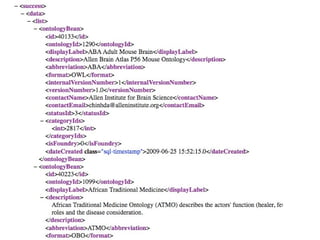
RESTful Web Services 
• Accessed via HTTP 
– http://rest.bioontology.org/bioportal/ 
• Each unique URL is a representation of some 
object 
• Operations include GET, POST, PUT, DELETE 
• Lightweight, easy to build
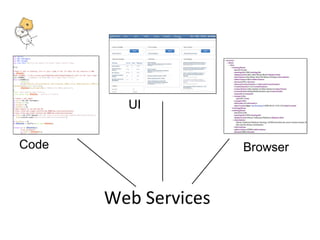
Web Services 
Code 
UI 
Browser
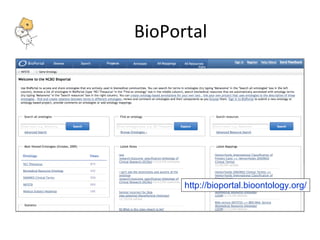
BioPortal 
http://bioportal.bioontology.org/
Ontology Widgets 
• See BioPortal ( 
http://bioportal.bioontology.org/ontologies/42490#widgets) 
– Term selection - autocomplete widget 
– Jump To - view term details in BioPortal 
– Visualization - view ontology 
– RSS feed - track updates to ontology, e.g. upload 
of new versions, notes, mappings
Ontology Web Services 
• Ontology Metadata - get information about an 
ontology 
• Term - get details about a term 
• Search - find term in any ontology 
• Hierarchy - traverse ontology hierarchy 
• Notes - get contents of notes 
• Mappings - get mapped terms 
http://www.bioontology.org/wiki/index.php/NCBO_REST_services
Applications Using 
NCBO Web Services 
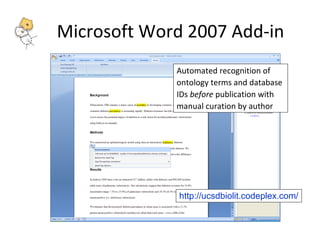
• Microsoft Word 2007 Add-in for 
Ontology Recognition 
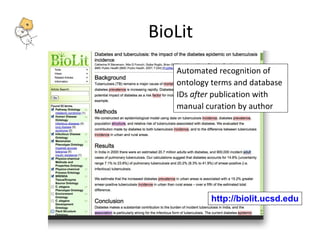
• BioLit 
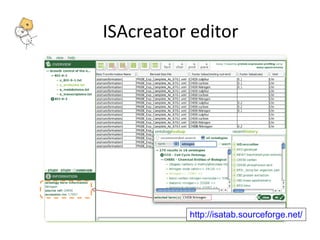
• ISAcreator 
• For full list, see 
http://www.bioontology.org/tools
Microsoft Word 2007 Add-in 
Automated recognition of 
ontology terms and database 
IDs before publication with 
manual curation by author 
http://ucsdbiolit.codeplex.com/
BioLit 
Automated recognition of 
ontology terms and database 
IDs after publication with 
manual curation by author 
http://biolit.ucsd.edu
ISAcreator editor 
http://isatab.sourceforge.net/
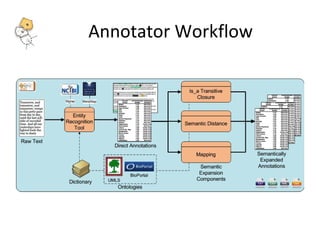
NCBO Annotator 
• Open access, ontology-based Web service that 
annotates or “tags” textual metadata 
• Annotation is done using ontologies from 
BioPortal, which includes OBO Foundry and 
Unified Medical Language System ontologies 
• Variety of parameters that can be customized
Annotator Workflow
Access to Annotator 
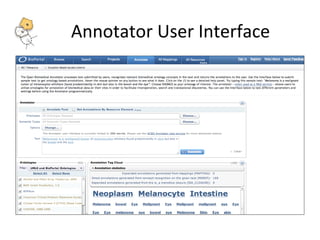
• BioPortal 
– User-friendly interface to test Annotator 
• Web service (REST) 
– Direct programmatic access 
• User Guide and Sample Client Code 
– http://www.bioontology.org/wiki/index.php/Annotator_Web_service
Annotator User Interface
Annotator Usage 
• Production release 
– April 2009 
• Data processed 
– 66 million calls 
– more than 259 gigabytes of data
Annotator Users 
• Rat Genome Database - example use case 
• See 
http://www.bioontology.org/wiki/index.php/ 
NCBO_Annotator_community for additional 
use cases from the Annotator user community
Rat Genome Database 
• Use case 
– Are any of these genes associated with my disease or 
phenotype? 
– Is this candidate gene expressed in my tissue of interest? 
• Annotate Gene Expression Omnibus (GEO) records 
with the Annotator using 
– Mouse Gross Adult anatomy ontology, Rat strain ontology, 
Medical Subject Headings (MeSH), NCI Thesaurus 
– Pilot test to annotate 30 GEO datasets and associated 
sample records
Rat Genome Database 
• Results 
– Rat Strain ontology 
• High number of false positives due to short length of many rat 
strains (2-3 letters) and similarity to common words and variety of 
words used to describe strains that were not included as 
synonyms 
– Mouse adult gross anatomy 
• Low number of false positives 
• Annotation of 192 datasets resulted in precision and recall of 
84.0% and 94.8% 
• Ability to link expression results of a gene (based on Affymetrix 
probe set) to anatomical location 
– Manual curation of results needed, but much less 
burdensome by the initial automated results
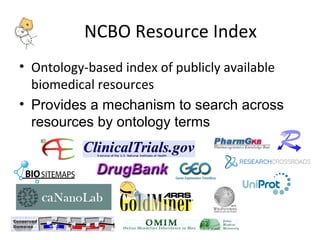
NCBO Resource Index 
• Ontology-based index of publicly available 
biomedical resources 
• Provides a mechanism to search across 
resources by ontology terms
Ontology Recommender 
• Identify ontology relevant to annotate data
Lexicon Builder 
http://www.bioontology.org/wiki/index.php/ 
Lexicon_Builder
Acknowledgements 
• Annotator Development 
– Nigam Shah 
– Clement Jonquet 
– Fan Meng 
– Mark Musen 
• Feedback 
– Simon Twigger 
– Karen Dowell 
– Robin Smith
References 
• BioPortal 
– http://bioportal.bioontology.org 
• NCBO REST Web services 
– http://www.bioontology.org/wiki/index.php/NCBO_REST_ 
services 
• NCBO Annotator Web Service 
– http://www.bioontology.org/wiki/index.php/Annotator_ 
Web_service 
• NCBO Resource Index Web Service 
– http://www.bioontology.org/wiki/index.php/Resource_In 
dex

NCBO Tools and Web services

  • 1.
    NCBO Tools andWeb Services Trish Whetzel Outreach Coordinator
  • 2.
    Outline • NCBOBackground • Ontology Web Services • Ontology Widgets • NCBO Annotator • NCBO Resource Index • Ontology Recommender • Lexicon Builder
  • 3.
    National Centers forBiomedical Computing
  • 4.
    National Center for Biomedical Ontology • Mission – To create software for the application of ontologies in biomedical science and clinical care • NCBO Partners – Stanford University - Dr. Mark A. Musen – Mayo Clinic - Dr. Christopher G. Chute – University of Buffalo - Dr. Barry Smith – University of Victoria - Dr. Margaret-Anne Storey
  • 5.
    RESTful Web Services • Accessed via HTTP – http://rest.bioontology.org/bioportal/ • Each unique URL is a representation of some object • Operations include GET, POST, PUT, DELETE • Lightweight, easy to build
  • 6.
    Web Services Code UI Browser
  • 8.
  • 9.
    Ontology Widgets •See BioPortal ( http://bioportal.bioontology.org/ontologies/42490#widgets) – Term selection - autocomplete widget – Jump To - view term details in BioPortal – Visualization - view ontology – RSS feed - track updates to ontology, e.g. upload of new versions, notes, mappings
  • 10.
    Ontology Web Services • Ontology Metadata - get information about an ontology • Term - get details about a term • Search - find term in any ontology • Hierarchy - traverse ontology hierarchy • Notes - get contents of notes • Mappings - get mapped terms http://www.bioontology.org/wiki/index.php/NCBO_REST_services
  • 11.
    Applications Using NCBOWeb Services • Microsoft Word 2007 Add-in for Ontology Recognition • BioLit • ISAcreator • For full list, see http://www.bioontology.org/tools
  • 12.
    Microsoft Word 2007Add-in Automated recognition of ontology terms and database IDs before publication with manual curation by author http://ucsdbiolit.codeplex.com/
  • 13.
    BioLit Automated recognitionof ontology terms and database IDs after publication with manual curation by author http://biolit.ucsd.edu
  • 14.
  • 15.
    NCBO Annotator •Open access, ontology-based Web service that annotates or “tags” textual metadata • Annotation is done using ontologies from BioPortal, which includes OBO Foundry and Unified Medical Language System ontologies • Variety of parameters that can be customized
  • 16.
  • 17.
    Access to Annotator • BioPortal – User-friendly interface to test Annotator • Web service (REST) – Direct programmatic access • User Guide and Sample Client Code – http://www.bioontology.org/wiki/index.php/Annotator_Web_service
  • 18.
  • 19.
    Annotator Usage •Production release – April 2009 • Data processed – 66 million calls – more than 259 gigabytes of data
  • 20.
    Annotator Users •Rat Genome Database - example use case • See http://www.bioontology.org/wiki/index.php/ NCBO_Annotator_community for additional use cases from the Annotator user community
  • 21.
    Rat Genome Database • Use case – Are any of these genes associated with my disease or phenotype? – Is this candidate gene expressed in my tissue of interest? • Annotate Gene Expression Omnibus (GEO) records with the Annotator using – Mouse Gross Adult anatomy ontology, Rat strain ontology, Medical Subject Headings (MeSH), NCI Thesaurus – Pilot test to annotate 30 GEO datasets and associated sample records
  • 22.
    Rat Genome Database • Results – Rat Strain ontology • High number of false positives due to short length of many rat strains (2-3 letters) and similarity to common words and variety of words used to describe strains that were not included as synonyms – Mouse adult gross anatomy • Low number of false positives • Annotation of 192 datasets resulted in precision and recall of 84.0% and 94.8% • Ability to link expression results of a gene (based on Affymetrix probe set) to anatomical location – Manual curation of results needed, but much less burdensome by the initial automated results
  • 23.
    NCBO Resource Index • Ontology-based index of publicly available biomedical resources • Provides a mechanism to search across resources by ontology terms
  • 24.
    Ontology Recommender •Identify ontology relevant to annotate data
  • 25.
  • 26.
    Acknowledgements • AnnotatorDevelopment – Nigam Shah – Clement Jonquet – Fan Meng – Mark Musen • Feedback – Simon Twigger – Karen Dowell – Robin Smith
  • 27.
    References • BioPortal – http://bioportal.bioontology.org • NCBO REST Web services – http://www.bioontology.org/wiki/index.php/NCBO_REST_ services • NCBO Annotator Web Service – http://www.bioontology.org/wiki/index.php/Annotator_ Web_service • NCBO Resource Index Web Service – http://www.bioontology.org/wiki/index.php/Resource_In dex