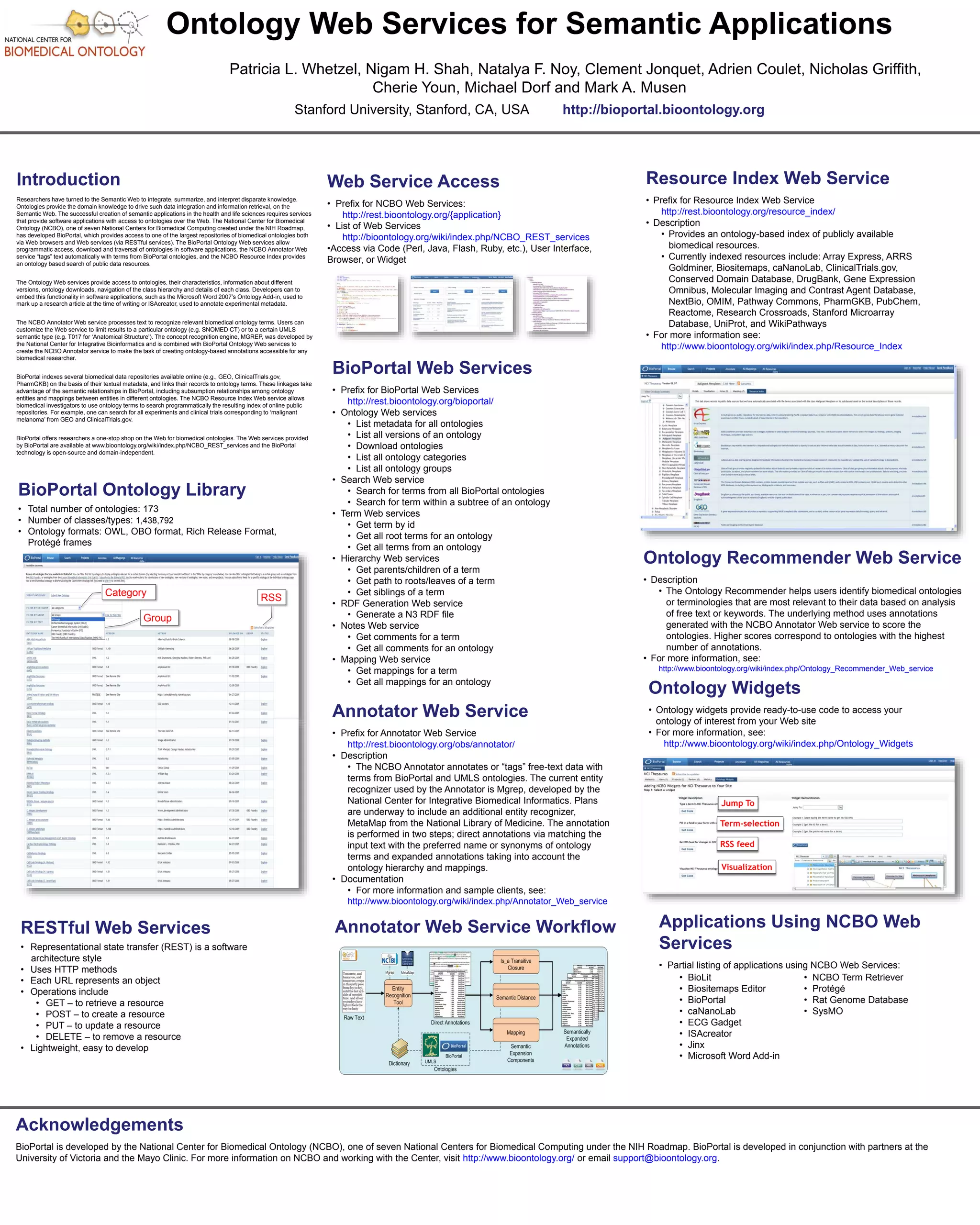
Ontology Web Services for Semantic Applications 
Patricia L. Whetzel, Nigam H. Shah, Natalya F. Noy, Clement Jonquet, Adrien Coulet, Nicholas Griffith, 
Cherie Youn, Michael Dorf and Mark A. Musen 
Stanford University, Stanford, CA, USA http://bioportal.bioontology.org 
Introduction 
Researchers have turned to the Semantic Web to integrate, summarize, and interpret disparate knowledge. 
Ontologies provide the domain knowledge to drive such data integration and information retrieval, on the 
Semantic Web. The successful creation of semantic applications in the health and life sciences requires services 
that provide software applications with access to ontologies over the Web. The National Center for Biomedical 
Ontology (NCBO), one of seven National Centers for Biomedical Computing created under the NIH Roadmap, 
has developed BioPortal, which provides access to one of the largest repositories of biomedical ontologies both 
via Web browsers and Web services (via RESTful services). The BioPortal Ontology Web services allow 
programmatic access, download and traversal of ontologies in software applications, the NCBO Annotator Web 
service “tags” text automatically with terms from BioPortal ontologies, and the NCBO Resource Index provides 
an ontology based search of public data resources. 
The Ontology Web services provide access to ontologies, their characteristics, information about different 
versions, ontology downloads, navigation of the class hierarchy and details of each class. Developers can to 
embed this functionality in software applications, such as the Microsoft Word 2007’s Ontology Add-in, used to 
mark up a research article at the time of writing or ISAcreator, used to annotate experimental metadata. 
The NCBO Annotator Web service processes text to recognize relevant biomedical ontology terms. Users can 
customize the Web service to limit results to a particular ontology (e.g. SNOMED CT) or to a certain UMLS 
semantic type (e.g. T017 for ‘Anatomical Structure’). The concept recognition engine, MGREP, was developed by 
the National Center for Integrative Bioinformatics and is combined with BioPortal Ontology Web services to 
create the NCBO Annotator service to make the task of creating ontology-based annotations accessible for any 
biomedical researcher. 
BioPortal indexes several biomedical data repositories available online (e.g., GEO, ClinicalTrials.gov, 
PharmGKB) on the basis of their textual metadata, and links their records to ontology terms. These linkages take 
advantage of the semantic relationships in BioPortal, including subsumption relationships among ontology 
entities and mappings between entities in different ontologies. The NCBO Resource Index Web service allows 
biomedical investigators to use ontology terms to search programmatically the resulting index of online public 
repositories. For example, one can search for all experiments and clinical trials corresponding to ‘malignant 
melanoma’ from GEO and ClinicalTrials.gov. 
BioPortal offers researchers a one-stop shop on the Web for biomedical ontologies. The Web services provided 
by BioPortal are available at www.bioontology.org/wiki/index.php/NCBO_REST_services and the BioPortal 
technology is open-source and domain-independent. 
BioPortal Ontology Library 
• Total number of ontologies: 173 
• Number of classes/types: 1,438,792 
• Ontology formats: OWL, OBO format, Rich Release Format, 
Protégé frames 
Category 
Group 
RESTful Web Services 
• Representational state transfer (REST) is a software 
architecture style 
• Uses HTTP methods 
• Each URL represents an object 
• Operations include 
• GET – to retrieve a resource 
• POST – to create a resource 
• PUT – to update a resource 
• DELETE – to remove a resource 
• Lightweight, easy to develop 
Resource Index Web Service 
• Prefix for Resource Index Web Service 
http://rest.bioontology.org/resource_index/ 
• Description 
• Provides an ontology-based index of publicly available 
biomedical resources. 
• Currently indexed resources include: Array Express, ARRS 
Goldminer, Biositemaps, caNanoLab, ClinicalTrials.gov, 
Conserved Domain Database, DrugBank, Gene Expression 
Omnibus, Molecular Imaging and Contrast Agent Database, 
NextBio, OMIM, Pathway Commons, PharmGKB, PubChem, 
Reactome, Research Crossroads, Stanford Microarray 
Database, UniProt, and WikiPathways 
• For more information see: 
http://www.bioontology.org/wiki/index.php/Resource_Index 
Ontology Recommender Web Service 
• Description 
• The Ontology Recommender helps users identify biomedical ontologies 
or terminologies that are most relevant to their data based on analysis 
of free text or keywords. The underlying method uses annotations 
generated with the NCBO Annotator Web service to score the 
ontologies. Higher scores correspond to ontologies with the highest 
number of annotations. 
• For more information, see: 
http://www.bioontology.org/wiki/index.php/Ontology_Recommender_Web_service 
Web Service Access 
• Prefix for NCBO Web Services: 
http://rest.bioontology.org/{application} 
• List of Web Services 
http://bioontology.org/wiki/index.php/NCBO_REST_services 
•Access via Code (Perl, Java, Flash, Ruby, etc.), User Interface, 
Browser, or Widget 
BioPortal Web Services 
• Prefix for BioPortal Web Services 
http://rest.bioontology.org/bioportal/ 
• Ontology Web services 
• List metadata for all ontologies 
• List all versions of an ontology 
• Download ontologies 
• List all ontology categories 
• List all ontology groups 
• Search Web service 
• Search for terms from all BioPortal ontologies 
• Search for term within a subtree of an ontology 
• Term Web services 
• Get term by id 
• Get all root terms for an ontology 
• Get all terms from an ontology 
• Hierarchy Web services 
• Get parents/children of a term 
• Get path to roots/leaves of a term 
• Get siblings of a term 
• RDF Generation Web service 
• Generate a N3 RDF file 
• Notes Web service 
• Get comments for a term 
• Get all comments for an ontology 
• Mapping Web service 
• Get mappings for a term 
• Get all mappings for an ontology 
Ontology Widgets 
• Ontology widgets provide ready-to-use code to access your 
ontology of interest from your Web site 
• For more information, see: 
http://www.bioontology.org/wiki/index.php/Ontology_Widgets 
Jump To 
Term-selection 
RSS feed 
Visualization 
Applications Using NCBO Web 
Services 
• Partial listing of applications using NCBO Web Services: 
RSS 
Annotator Web Service 
• Prefix for Annotator Web Service 
http://rest.bioontology.org/obs/annotator/ 
• Description 
• The NCBO Annotator annotates or “tags” free-text data with 
terms from BioPortal and UMLS ontologies. The current entity 
recognizer used by the Annotator is Mgrep, developed by the 
National Center for Integrative Biomedical Informatics. Plans 
are underway to include an additional entity recognizer, 
MetaMap from the National Library of Medicine. The annotation 
is performed in two steps; direct annotations via matching the 
input text with the preferred name or synonyms of ontology 
terms and expanded annotations taking into account the 
ontology hierarchy and mappings. 
• Documentation 
• For more information and sample clients, see: 
http://www.bioontology.org/wiki/index.php/Annotator_Web_service 
Annotator Web Service Workflow 
• BioLit 
• Biositemaps Editor 
• BioPortal 
• caNanoLab 
• ECG Gadget 
• ISAcreator 
• Jinx 
• Microsoft Word Add-in 
• NCBO Term Retriever 
• Protégé 
• Rat Genome Database 
• SysMO 
Acknowledgements 
BioPortal is developed by the National Center for Biomedical Ontology (NCBO), one of seven National Centers for Biomedical Computing under the NIH Roadmap. BioPortal is developed in conjunction with partners at the 
University of Victoria and the Mayo Clinic. For more information on NCBO and working with the Center, visit http://www.bioontology.org/ or email support@bioontology.org.

Ontology Web Services for Semantic Applications

  • 1.
    Ontology Web Servicesfor Semantic Applications Patricia L. Whetzel, Nigam H. Shah, Natalya F. Noy, Clement Jonquet, Adrien Coulet, Nicholas Griffith, Cherie Youn, Michael Dorf and Mark A. Musen Stanford University, Stanford, CA, USA http://bioportal.bioontology.org Introduction Researchers have turned to the Semantic Web to integrate, summarize, and interpret disparate knowledge. Ontologies provide the domain knowledge to drive such data integration and information retrieval, on the Semantic Web. The successful creation of semantic applications in the health and life sciences requires services that provide software applications with access to ontologies over the Web. The National Center for Biomedical Ontology (NCBO), one of seven National Centers for Biomedical Computing created under the NIH Roadmap, has developed BioPortal, which provides access to one of the largest repositories of biomedical ontologies both via Web browsers and Web services (via RESTful services). The BioPortal Ontology Web services allow programmatic access, download and traversal of ontologies in software applications, the NCBO Annotator Web service “tags” text automatically with terms from BioPortal ontologies, and the NCBO Resource Index provides an ontology based search of public data resources. The Ontology Web services provide access to ontologies, their characteristics, information about different versions, ontology downloads, navigation of the class hierarchy and details of each class. Developers can to embed this functionality in software applications, such as the Microsoft Word 2007’s Ontology Add-in, used to mark up a research article at the time of writing or ISAcreator, used to annotate experimental metadata. The NCBO Annotator Web service processes text to recognize relevant biomedical ontology terms. Users can customize the Web service to limit results to a particular ontology (e.g. SNOMED CT) or to a certain UMLS semantic type (e.g. T017 for ‘Anatomical Structure’). The concept recognition engine, MGREP, was developed by the National Center for Integrative Bioinformatics and is combined with BioPortal Ontology Web services to create the NCBO Annotator service to make the task of creating ontology-based annotations accessible for any biomedical researcher. BioPortal indexes several biomedical data repositories available online (e.g., GEO, ClinicalTrials.gov, PharmGKB) on the basis of their textual metadata, and links their records to ontology terms. These linkages take advantage of the semantic relationships in BioPortal, including subsumption relationships among ontology entities and mappings between entities in different ontologies. The NCBO Resource Index Web service allows biomedical investigators to use ontology terms to search programmatically the resulting index of online public repositories. For example, one can search for all experiments and clinical trials corresponding to ‘malignant melanoma’ from GEO and ClinicalTrials.gov. BioPortal offers researchers a one-stop shop on the Web for biomedical ontologies. The Web services provided by BioPortal are available at www.bioontology.org/wiki/index.php/NCBO_REST_services and the BioPortal technology is open-source and domain-independent. BioPortal Ontology Library • Total number of ontologies: 173 • Number of classes/types: 1,438,792 • Ontology formats: OWL, OBO format, Rich Release Format, Protégé frames Category Group RESTful Web Services • Representational state transfer (REST) is a software architecture style • Uses HTTP methods • Each URL represents an object • Operations include • GET – to retrieve a resource • POST – to create a resource • PUT – to update a resource • DELETE – to remove a resource • Lightweight, easy to develop Resource Index Web Service • Prefix for Resource Index Web Service http://rest.bioontology.org/resource_index/ • Description • Provides an ontology-based index of publicly available biomedical resources. • Currently indexed resources include: Array Express, ARRS Goldminer, Biositemaps, caNanoLab, ClinicalTrials.gov, Conserved Domain Database, DrugBank, Gene Expression Omnibus, Molecular Imaging and Contrast Agent Database, NextBio, OMIM, Pathway Commons, PharmGKB, PubChem, Reactome, Research Crossroads, Stanford Microarray Database, UniProt, and WikiPathways • For more information see: http://www.bioontology.org/wiki/index.php/Resource_Index Ontology Recommender Web Service • Description • The Ontology Recommender helps users identify biomedical ontologies or terminologies that are most relevant to their data based on analysis of free text or keywords. The underlying method uses annotations generated with the NCBO Annotator Web service to score the ontologies. Higher scores correspond to ontologies with the highest number of annotations. • For more information, see: http://www.bioontology.org/wiki/index.php/Ontology_Recommender_Web_service Web Service Access • Prefix for NCBO Web Services: http://rest.bioontology.org/{application} • List of Web Services http://bioontology.org/wiki/index.php/NCBO_REST_services •Access via Code (Perl, Java, Flash, Ruby, etc.), User Interface, Browser, or Widget BioPortal Web Services • Prefix for BioPortal Web Services http://rest.bioontology.org/bioportal/ • Ontology Web services • List metadata for all ontologies • List all versions of an ontology • Download ontologies • List all ontology categories • List all ontology groups • Search Web service • Search for terms from all BioPortal ontologies • Search for term within a subtree of an ontology • Term Web services • Get term by id • Get all root terms for an ontology • Get all terms from an ontology • Hierarchy Web services • Get parents/children of a term • Get path to roots/leaves of a term • Get siblings of a term • RDF Generation Web service • Generate a N3 RDF file • Notes Web service • Get comments for a term • Get all comments for an ontology • Mapping Web service • Get mappings for a term • Get all mappings for an ontology Ontology Widgets • Ontology widgets provide ready-to-use code to access your ontology of interest from your Web site • For more information, see: http://www.bioontology.org/wiki/index.php/Ontology_Widgets Jump To Term-selection RSS feed Visualization Applications Using NCBO Web Services • Partial listing of applications using NCBO Web Services: RSS Annotator Web Service • Prefix for Annotator Web Service http://rest.bioontology.org/obs/annotator/ • Description • The NCBO Annotator annotates or “tags” free-text data with terms from BioPortal and UMLS ontologies. The current entity recognizer used by the Annotator is Mgrep, developed by the National Center for Integrative Biomedical Informatics. Plans are underway to include an additional entity recognizer, MetaMap from the National Library of Medicine. The annotation is performed in two steps; direct annotations via matching the input text with the preferred name or synonyms of ontology terms and expanded annotations taking into account the ontology hierarchy and mappings. • Documentation • For more information and sample clients, see: http://www.bioontology.org/wiki/index.php/Annotator_Web_service Annotator Web Service Workflow • BioLit • Biositemaps Editor • BioPortal • caNanoLab • ECG Gadget • ISAcreator • Jinx • Microsoft Word Add-in • NCBO Term Retriever • Protégé • Rat Genome Database • SysMO Acknowledgements BioPortal is developed by the National Center for Biomedical Ontology (NCBO), one of seven National Centers for Biomedical Computing under the NIH Roadmap. BioPortal is developed in conjunction with partners at the University of Victoria and the Mayo Clinic. For more information on NCBO and working with the Center, visit http://www.bioontology.org/ or email support@bioontology.org.