From data-driven journalism to people-centred reporting
@LeilaHaddou @PaulBradshaw,
The Times, Birmingham City University, BBC
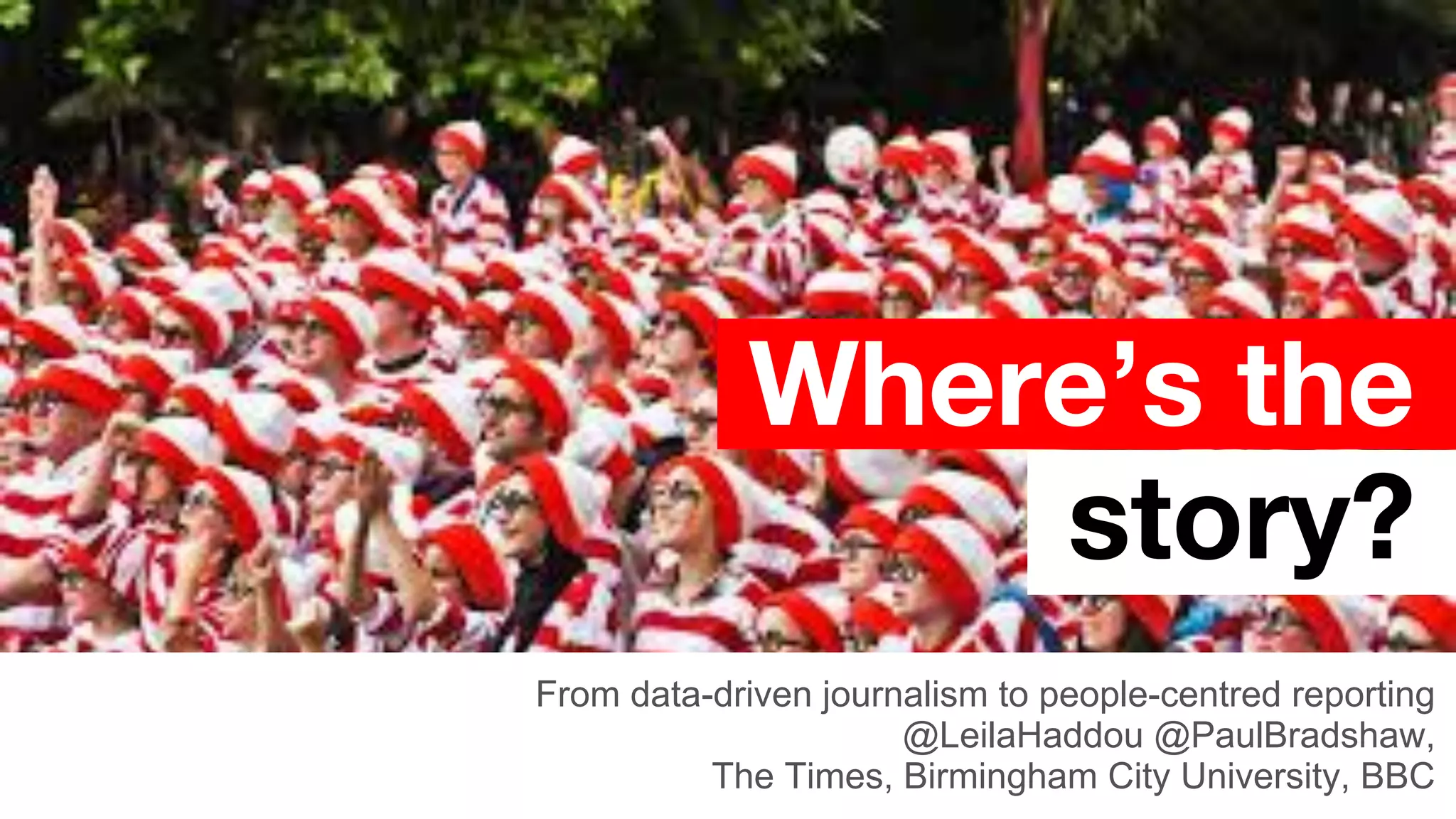
Where’s the
story?
Prologue:
What’s the problem?
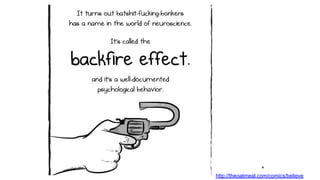
**
http://theoatmeal.com/comics/believe
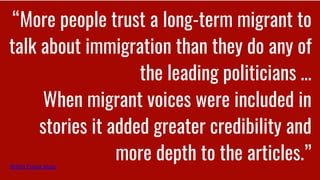
“More people trust a long-term migrant to
talk about immigration than they do any of
the leading politicians …
When migrant voices were included in
stories it added greater credibility and
more depth to the articles.”British Future study
Chapter 1:
Mapping the territory
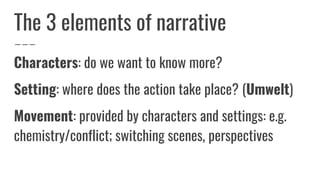
The 3 elements of narrative
Characters: do we want to know more?
Setting: where does the action take place? (Umwelt)
Movement: provided by characters and settings: e.g.
chemistry/conflict; switching scenes, perspectives
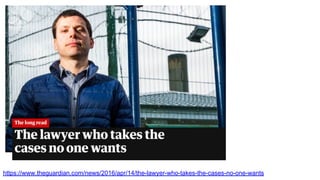
https://www.theguardian.com/news/2016/apr/14/the-lawyer-who-takes-the-cases-no-one-wants
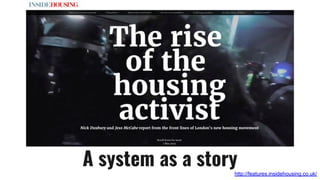
A system as a storyhttp://features.insidehousing.co.uk/
Now, your turn.
Pick a subject, and map...
● What characters (or types) are there?
● What settings?
● What movement? (conflict, needs, wants, physical,
emotional)
Slow movement (not news)
● Company -> maximise profit, protect brand
● Regulator -> prevent breaches? Compile data?
● Politician -> stimulate investment, create jobs, ££
● Politician -> reduce healthcare costs, save ££
● Politician -> raise ££, win votes, ?
● Campaigner -> raise ££, effect change?
Follow the...
● Money: who pays, who chases?
● Power: who reports, who exercises it?
● Incentives: why do people do things?
● Passion: who cares?
● (Cover public & private sector, experts, charities,
activists, customers)
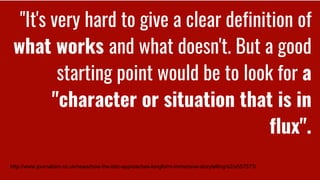
"It's very hard to give a clear definition of
what works and what doesn't. But a good
starting point would be to look for a
"character or situation that is in
flux".
http://www.journalism.co.uk/news/how-the-bbc-approaches-longform-immersive-storytelling/s2/a557573/
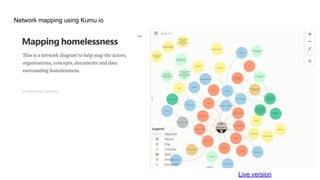
Network mapping using Kumu.io
Live version
Chapter 2:
Meet the people
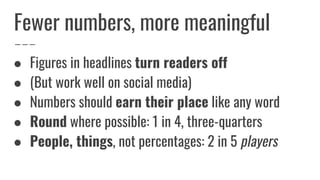
Fewer numbers, more meaningful
● Figures in headlines turn readers off
● (But work well on social media)
● Numbers should earn their place like any word
● Round where possible: 1 in 4, three-quarters
● People, things, not percentages: 2 in 5 players
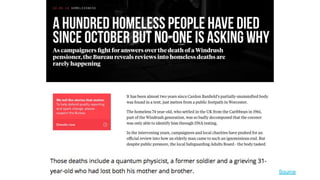
Source
Tools - OSINT
● LinkedIn advanced search
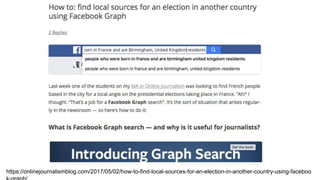
● Facebook graph searches
● Twitter, Instagram search by location/date
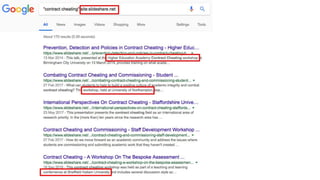
● Via Google using site:, filetype:, etc.
● Dataminr and Crowdtangle (organisation account)
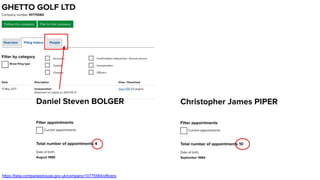
https://beta.companieshouse.gov.uk/company/10775584/officers
https://onlinejournalismblog.com/2017/05/02/how-to-find-local-sources-for-an-election-in-another-country-using-faceboo
Chapter 3:
Piecing together the puzzle
*
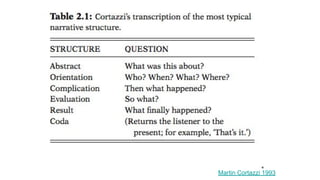
Martin Cortazzi 1993
*
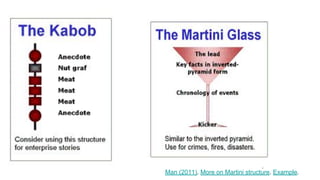
Man (2011). More on Martini structure. Example.
*
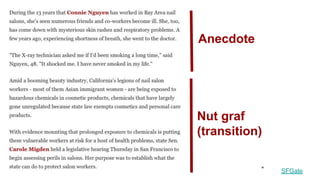
SFGate
Anecdote
Nut graf
(transition)
**
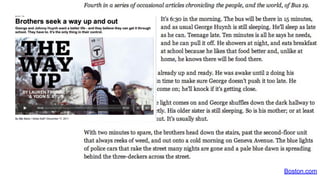
Boston.com
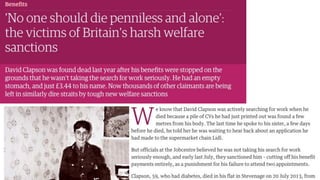
https://www.theguardian.com/news/2016/apr/13/how-boots-went-rogue
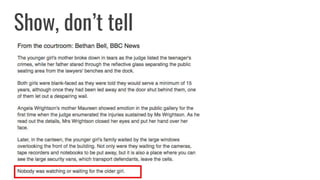
Show, don’t tell
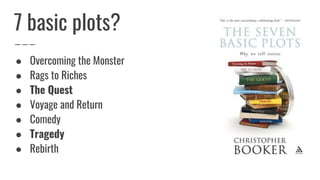
● Overcoming the Monster
● Rags to Riches
● The Quest
● Voyage and Return
● Comedy
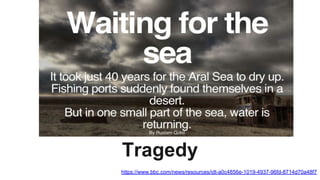
● Tragedy
● Rebirth
7 basic plots?
Voyage and return
http://www.iq4news.com/playing-with-their-dreams/
Tragedy
https://www.bbc.com/news/resources/idt-a0c4856e-1019-4937-96fd-8714d70a48f7
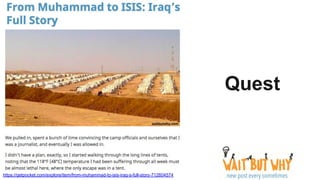
Quest
https://getpocket.com/explore/item/from-muhammad-to-isis-iraq-s-full-story-712604574
The resolution...
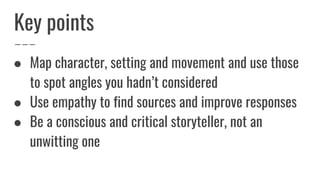
● Map character, setting and movement and use those
to spot angles you hadn’t considered
● Use empathy to find sources and improve responses
● Be a conscious and critical storyteller, not an
unwitting one

Key points
Other stuff you can read...
● Mark Blaine: The Digital Reporter’s Notebook
● Mark Lee Hunter et al: Story Based Inquiry
● Podcast: Framing The Story
● James B. Stewart: Follow The Story
● Kenneth Kobre: Video Journalism
Questions?
@LeilaHaddou
@PaulBradshaw

Where's the story?