Packaging the Web
Planning online feature packages with interactive
multimedia content
Is this package
spontaneous or
planned in
advance?
SPONTANEOUS
 Breaking news
 Time-sensitive
 Focused on sharing accurate
information quickly
 SEO: Think, “What are readers
Googling right now?”
 Likely uses: Liveblogging,
microblogging, curation
PLANNED
 Event coverage
 Historical retrospectives
 Anniversaries
 On a calendar
 Likely uses: Multiple alternate
story forms, menu options,
separate “opener” page
“The UK’s referendum: All you need to
know”
BBC
“Ten Years After Katrina”
ESPN
Which is more
important, speed
or depth?
SPEED
 Breaking news
 Readers need information
quickly, efficiently
 Not a lot of planning time for
journalists
 Likely uses: out-of-the box
tools, curation tools, mobile
creation
DEPTH
 Creating an experience
 Reader might already know
the basics
 Backward planned from
anticipated publish date
 Time to learn new skills or
experiment with new tools
 Likely uses: Tools that require
more customization
“What Happened on the Germanwings
Flight”
The New York Times
“A global guide to the first world war”
The Guardian
Is the focus of the
package
information or
experience?
INFORMATION
 Breaking news
 Who, what, when, where
 Data, numbers
 Technical explanation
 Goal: Understanding, gaining
knowledge
 Likely uses: data
visualizations, maps, timelines,
quizzes
EXPERIENCE
 Not necessarily immediately
timely
 Why and how
 Visuals, testaments
 Description, scene setting
 Goal: Understanding,
empathy, feeling something
 Likely uses: video, photo
slideshows or galleries, audio
“Why America’s schools have a money
problem”
NPR
“Rebuilding Haiti”
Rue 89
Is this a visual
story?
VISUAL
 Photo
 Candid
 Environmental
 Reader-submitted
 Video
 Interactive
 Virtual reality
NON-VISUAL
 Data
 Maps
 Documents
 Illustrations
“Fewer Helmets, More Deaths”
The New York Times
”Mars: An interactive journey”
The Washington Post
“A New Whitney”
The New York Times
“A decade into the Katrina diaspora”
The Washington Post
Is there a single
narrative / angle,
or are there
multiple angles?
STORY-PLUS
 Breaking news
 Who, what, when,
where
 Data, numbers
 Technical
explanation
 Goal:
Understanding,
gaining knowledge
 Likely uses: data
visualizations, maps,
timelines, quizzes
GUIDED
NARRATIVE
 Breaking news
 Who, what, when,
where
 Data, numbers
 Technical
explanation
 Goal:
Understanding,
gaining knowledge
 Likely uses: data
visualizations, maps,
timelines, quizzes
MENU OF
STORIES
 Breaking news
 Who, what, when,
where
 Data, numbers
 Technical
explanation
 Goal:
Understanding,
gaining knowledge
 Likely uses: data
visualizations, maps,
timelines, quizzes
“A Game of Chicken”
The Oregonian
“Look at This: Rainforests”
NPR
“Bypassed by the Miracle” series
The Texas Tribune
Will the story
include field
reporting, or is it
more interview-
heavy?
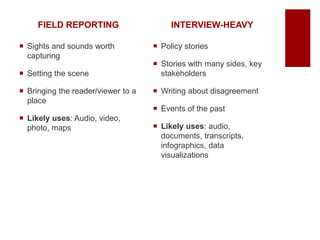
FIELD REPORTING
 Sights and sounds worth
capturing
 Setting the scene
 Bringing the reader/viewer to a
place
 Likely uses: Audio, video,
photo, maps
INTERVIEW-HEAVY
 Policy stories
 Stories with many sides, key
stakeholders
 Writing about disagreement
 Events of the past
 Likely uses: audio,
documents, transcripts,
infographics, data
visualizations
“The Bus Station”
NPR
“Prison bankers cash in on captive
customers”
Center for Public Integrity
Are any of the following
particularly relevant:
sound, time/chronology,
sequence, data,
geographic location?
“Dear Architects: Sound Matters”
The New York Times
“See the entire history of the Oscars
diversity problem in one chart”
TIME
“How Trump Happened”
The Wall Street Journal
“The 45-Minute Mystery of Freddie
Gray’s Death”
The Baltimore Sun
“Hillary Clinton’s Debt to Feminism”
Bloomberg Politics
“Here’s where the federal government
owns the most land”
TIME
How many people will it
take to create this
package?
For more, visit…
 https://www.pinterest.com/mlbalmeo/interactive-
storytelling/

8 Questions for Packaging the Web

  • 1.
    Packaging the Web Planningonline feature packages with interactive multimedia content
  • 2.
    Is this package spontaneousor planned in advance?
  • 3.
    SPONTANEOUS  Breaking news Time-sensitive  Focused on sharing accurate information quickly  SEO: Think, “What are readers Googling right now?”  Likely uses: Liveblogging, microblogging, curation PLANNED  Event coverage  Historical retrospectives  Anniversaries  On a calendar  Likely uses: Multiple alternate story forms, menu options, separate “opener” page
  • 4.
    “The UK’s referendum:All you need to know” BBC
  • 5.
    “Ten Years AfterKatrina” ESPN
  • 6.
    Which is more important,speed or depth?
  • 7.
    SPEED  Breaking news Readers need information quickly, efficiently  Not a lot of planning time for journalists  Likely uses: out-of-the box tools, curation tools, mobile creation DEPTH  Creating an experience  Reader might already know the basics  Backward planned from anticipated publish date  Time to learn new skills or experiment with new tools  Likely uses: Tools that require more customization
  • 8.
    “What Happened onthe Germanwings Flight” The New York Times
  • 9.
    “A global guideto the first world war” The Guardian
  • 10.
    Is the focusof the package information or experience?
  • 11.
    INFORMATION  Breaking news Who, what, when, where  Data, numbers  Technical explanation  Goal: Understanding, gaining knowledge  Likely uses: data visualizations, maps, timelines, quizzes EXPERIENCE  Not necessarily immediately timely  Why and how  Visuals, testaments  Description, scene setting  Goal: Understanding, empathy, feeling something  Likely uses: video, photo slideshows or galleries, audio
  • 12.
    “Why America’s schoolshave a money problem” NPR
  • 13.
  • 14.
    Is this avisual story?
  • 15.
    VISUAL  Photo  Candid Environmental  Reader-submitted  Video  Interactive  Virtual reality NON-VISUAL  Data  Maps  Documents  Illustrations
  • 16.
    “Fewer Helmets, MoreDeaths” The New York Times
  • 17.
    ”Mars: An interactivejourney” The Washington Post
  • 18.
  • 19.
    “A decade intothe Katrina diaspora” The Washington Post
  • 20.
    Is there asingle narrative / angle, or are there multiple angles?
  • 21.
    STORY-PLUS  Breaking news Who, what, when, where  Data, numbers  Technical explanation  Goal: Understanding, gaining knowledge  Likely uses: data visualizations, maps, timelines, quizzes GUIDED NARRATIVE  Breaking news  Who, what, when, where  Data, numbers  Technical explanation  Goal: Understanding, gaining knowledge  Likely uses: data visualizations, maps, timelines, quizzes MENU OF STORIES  Breaking news  Who, what, when, where  Data, numbers  Technical explanation  Goal: Understanding, gaining knowledge  Likely uses: data visualizations, maps, timelines, quizzes
  • 22.
    “A Game ofChicken” The Oregonian
  • 23.
    “Look at This:Rainforests” NPR
  • 24.
    “Bypassed by theMiracle” series The Texas Tribune
  • 25.
    Will the story includefield reporting, or is it more interview- heavy?
  • 26.
    FIELD REPORTING  Sightsand sounds worth capturing  Setting the scene  Bringing the reader/viewer to a place  Likely uses: Audio, video, photo, maps INTERVIEW-HEAVY  Policy stories  Stories with many sides, key stakeholders  Writing about disagreement  Events of the past  Likely uses: audio, documents, transcripts, infographics, data visualizations
  • 27.
  • 28.
    “Prison bankers cashin on captive customers” Center for Public Integrity
  • 29.
    Are any ofthe following particularly relevant: sound, time/chronology, sequence, data, geographic location?
  • 30.
    “Dear Architects: SoundMatters” The New York Times
  • 31.
    “See the entirehistory of the Oscars diversity problem in one chart” TIME
  • 32.
    “How Trump Happened” TheWall Street Journal
  • 33.
    “The 45-Minute Mysteryof Freddie Gray’s Death” The Baltimore Sun
  • 34.
    “Hillary Clinton’s Debtto Feminism” Bloomberg Politics
  • 35.
    “Here’s where thefederal government owns the most land” TIME
  • 36.
    How many peoplewill it take to create this package?
  • 37.
    For more, visit… https://www.pinterest.com/mlbalmeo/interactive- storytelling/

Editor's Notes

  • #3 Knowing about an event in advance allows reporters and editors to plan coverage based upon expected stories. Being able to plan ahead means reporters, photographers and designers know, at least generally, what they might expect, which helps them to predict possible angles and reporting opportunities. Sometimes, though, breaking news happens and newsrooms have to do the best they can in the time they have. In those cases, tools like Storify or ScribbleLive can be a quick, easy way to cover a story.
  • #7 For time-sensitive stories, being able to give your readers information quickly and clearly is likely more important than designing an “experience” for readers. Instead, online packages focused on speed generally publish information in short bursts and smaller posts and stories may be packaged together in one central location. Stories focused on depth, though, allow more time for design and preparation of the experience. In some cases, newsrooms plan story packages long in advance of an anticipated release date.
  • #11 Online stories that are focused on delivering information often lean toward certain storytelling modes — stories, infographics, data visualizations like charts and graphs, lists, timelines and maps. If the focus is more on experience, editors may decide to use tools that immerse the reader/viewer into the story. These might include audio or video, photo galleries, using Web design to emphasize narrative parts of the story, or other tools that bring the reader into the story.
  • #15 Visual stories can sometimes lend themselves to greater use of photography and video, whether as standalone components or as supplemental materials. If the story doesn’t have much of a visual component — say, a budget story or coverage of a city council meeting — those may not be your best option.
  • #21 This question drives the way you might present an online story package. The three basic models are: Story-plus: The journalist produces on basic story and all other materials are supplemental to that story. The add-ons serve as illustrative examples but are not stories in and of themselves. Guided narrative: The story is designed to lead the reader from one point to the next. As the reader finishes one part s/he is prompted to “continue” to the next part, and the order in which the parts are presented is planned and designed by the journalists or editors. Menu of stories: Several stories are packaged together and the reader chooses where to go from a menu that shows him/her all of the options. This works best when each part can stand alone, and the reader does not need to have information from one story before understanding another part.
  • #26 If there is an opportunity for the reporter to head out into the field to see or experience something first-hand, it’s likely that the reporter can also collect photos, audio or video that would enhance the online package. This may lead to a video component, integrated sound clips, or photo slideshows. However, if the story is primarily based on interviews, the reporter may take a different approach. There may be the opportunity to enhance the story with embedded documents, clips from the interviews, or data related to the story, but it’s less likely that a compelling video story (at least, a standalone story) will be possible. The exception to this would be to include short video clips from emotional parts of the interview.
  • #30 If the answer to any of the following is ‘yes,’ you should consider: SOUND: audio clips, audioslideshow TIME: interactive timeline SEQUENCE: step-by-step, slideshow DATA: data visualization tool, chart/graph maker, infographic creator GEOGRAPHY: interactive map
  • #37 This is an important question to consider once you have planned out the design for your package. If you have three reporters working on the package, you will need to ensure that they each have a checklist of what to collect and who to talk to. Obviously, the more people you have working on a package, the more that you can do. Yet, even if it’s just one reporter, there are still several ways to integrate multimedia and design a complete package.