gsk.com
AI & Big Data Expo, London
Where AI Will (And Won’t) Revolutionize Biomedicine
Paul Agapow (Statistics & Data Science Innovation Hub)
Background & disclaimer
• Previously a health informatician, biomedical ML
researcher, bioinformatician, “computer guy”,
disease chaser, epi-informatician, phylogeneticist,
evolutionary biologist, immunologist, biochemist
…
• Now a director @GSK
• This presentation is intended as a survey of the
state of the industry. It does not reflect thought,
policy or projects in progress at GSK
• There are no conflicts of interest
To make a
new drug,
you must
first solve for
everything
3
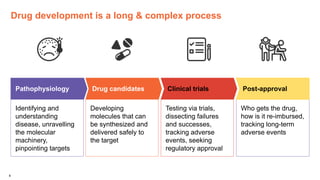
Clinical trials
Identifying and
understanding
disease, unravelling
the molecular
machinery,
pinpointing targets
Drug development is a long & complex process
4
Pathophysiology
Developing
molecules that can
be synthesized and
delivered safely to
the target
Drug candidates
Testing via trials,
dissecting failures
and successes,
tracking adverse
events, seeking
regulatory approval
Who gets the drug,
how is it re-imbursed,
tracking long-term
adverse events
Post-approval
5
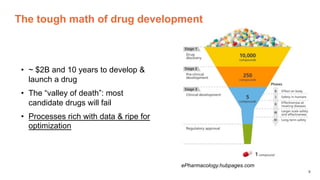
• ~ $2B and 10 years to develop &
launch a drug
• The “valley of death”: most
candidate drugs will fail
• Processes rich with data & ripe for
optimization
ePharmacology.hubpages.com
The tough math of drug development
10 June 2021 6
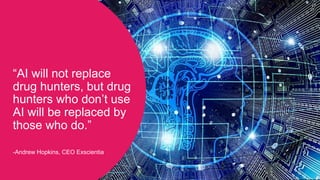
“AI will not replace
drug hunters, but drug
hunters who don’t use
AI will be replaced by
those who do.”
-Andrew Hopkins, CEO Exscientia
7
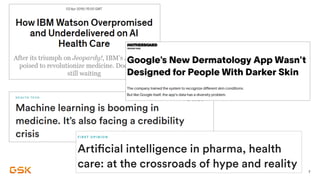
8
25 November 2022
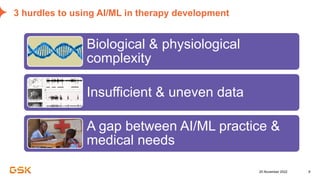
3 hurdles to using AI/ML in therapy development
Biological & physiological
complexity
Insufficient & uneven data
A gap between AI/ML practice &
medical needs
12 July 2021 9
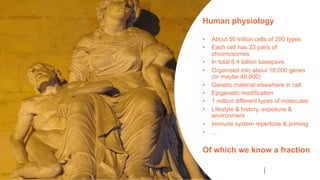
Human physiology
• About 50 trillion cells of 200 types
• Each cell has 23 pairs of
chromosomes
• In total 6.4 billion basepairs
• Organised into about 18,000 genes
(or maybe 40,000)
• Genetic material elsewhere in cell
• Epigenetic modification
• 1 million different types of molecules
• Lifestyle & history, exposure &
environment
• Immune system repertoire & priming
• …
Of which we know a fraction
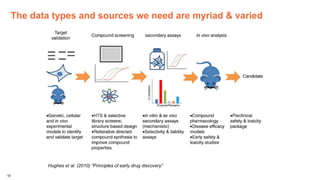
The data types and sources we need are myriad & varied
10
Hughes et al. (2010) ”Principles of early drug discovery”
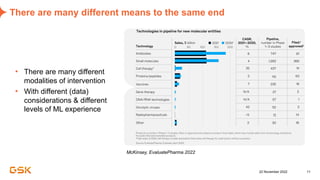
• There are many different
modalities of intervention
• With different (data)
considerations & different
levels of ML experience
22 November 2022 11
There are many different means to the same end
McKinsey, EvaluatePharma 2022
It’s often not
the right data
• Difficult / expesive to generate
• Unstructured
• Unlabeled
• The wrong type
• Sparse, unevenly sampled
• WEIRD
• In different formats and silos
12
24 November 2022 13
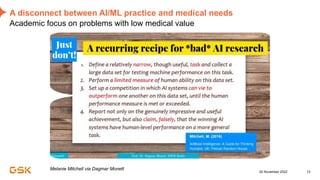
Melanie Mitchell via Dagmar Monett
A disconnect between AI/ML practice and medical needs
Academic focus on problems with low medical value
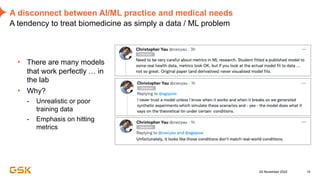
• There are many models
that work perfectly … in
the lab
• Why?
- Unrealistic or poor
training data
- Emphasis on hitting
metrics
24 November 2022 14
A disconnect between AI/ML practice and medical needs
A tendency to treat biomedicine as simply a data / ML problem
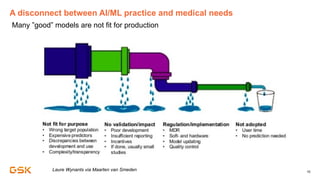
15
Laure Wynants via Maarten van Smeden
A disconnect between AI/ML practice and medical needs
Many ”good” models are not fit for production
25 November 2022 16
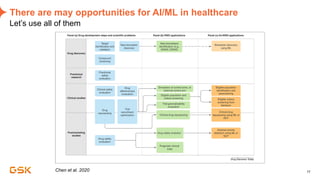
Where and how can AI/ML be effective?
Chen et al. 2020 17
There are may opportunities for AI/ML in healthcare
Let’s use all of them
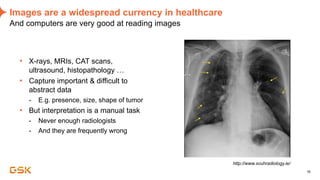
http://www.svuhradiology.ie/
18
• X-rays, MRIs, CAT scans,
ultrasound, histopathology …
• Capture important & difficult to
abstract data
- E.g. presence, size, shape of tumor
• But interpretation is a manual task
- Never enough radiologists
- And they are frequently wrong
Images are a widespread currency in healthcare
And computers are very good at reading images
19
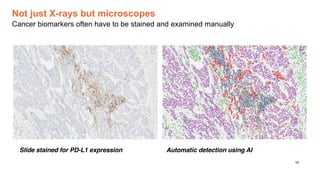
Slide stained for PD-L1 expression Automatic detection using AI
Not just X-rays but microscopes
Cancer biomarkers often have to be stained and examined manually
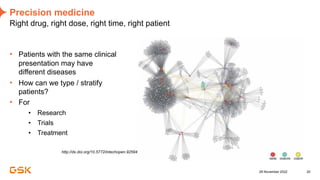
• Patients with the same clinical
presentation may have
different diseases
• How can we type / stratify
patients?
• For
• Research
• Trials
• Treatment
28 November 2022 20
http://dx.doi.org/10.5772/intechopen.92594
Precision medicine
Right drug, right dose, right time, right patient
10 June 2021 21
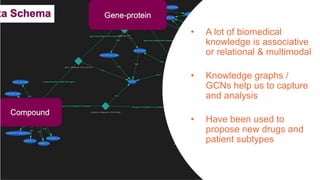
• A lot of biomedical
knowledge is associative
or relational & multimodal
• Knowledge graphs /
GCNs help us to capture
and analysis
• Have been used to
propose new drugs and
patient subtypes
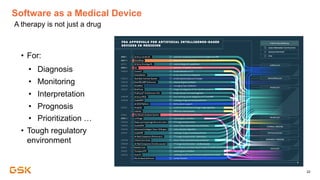
Software as a Medical Device
22
• For:
• Diagnosis
• Monitoring
• Interpretation
• Prognosis
• Prioritization …
• Tough regulatory
environment
A therapy is not just a drug
Click to enter
title here
Why not join us?
23
Academic Press (2021)
Click to enter
title here
Some light
reading
24
Academic Press (2021)
Click to enter
title here
References
25
Academic Press (2021)
• Fleming (2018) “How artificial intelligence is changing drug discovery”,
doi: https://doi.org/10.1038/d41586-018-05267-x
• Mak et al. (2019) “Artificial intelligence in drug development: present
status and future prospects”, doi: 10.1016/j.drudis.2018.11.014
• Farghali et al. (2021) “The potential applications of artificial intelligence in
drug discovery and development”, doi: 10.33549/physiolres.934765
• Zou et al. (2021) “Enhanced Patient-Centricity: How the
Biopharmaceutical Industry Is Optimizing Patient Care through
AI/ML/DL”, doi: 10.3390/healthcare10101997
• Víctor Gallego et al. (2021) “AI in drug development: a multidisciplinary
perspective”, doi: 10.1007/s11030-021-10266-8
• Chen et al. (2021) “Applications of artificial intelligence in drug
development using real-world data”, doi: 10.1016/j.drudis.2020.12.013
• Rashid (2021) “Artificial Intelligence Effecting a Paradigm Shift in Drug
Development”, doi: 10.1177/2472630320956931