When
the
‘Chain’
Becomes a
Shackle
By Gillian Martin
Trainer, Speaker & Social Entrepreneur
Captivating Solutions Consultancy
Many organizations are characterized by a
Chain of Command in which there is a line of
authority extending from persons at the top of
the hierarchy to those at the bottom
Persons at the lower end are aware of the
channels they must go through in order for
decisions to be made
A chain of command clearly reduces the
likelihood of chaos and promotes a structured
style of decision making
However, it must be noted that this ‘chain’ can
become a shackle
When the ‘chain’ becomes a shackle, persons
are restricted
When persons are restricted, their ideas might
not be welcomed by members at the upper
end of the hierarchy
This could result in the organization being
robbed of creativity
When the chain becomes a shackle, it inhibits
the use of quick solutions to improve internal
operations and service
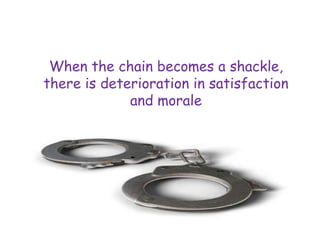
When the chain becomes a shackle,
there is deterioration in satisfaction
and morale
In order to prevent the ‘chain’ from becoming
a shackle, greater freedom of expression must
be encouraged in organizations
This can be achieved with the implementation
of the following:
• Suggestion boxes
• Rewards for valuable suggestions
• ‘Open door’ policy
• Meetings with action plan
• Surveys
• Greater empowerment of persons
In his popular speech, “I Had a Dream”, Martin
Luther King Jr. repetitively begged: “let
freedom ring”
If an organization is to truly benefit from the
creativity of its members, there must be a
willingness to “let freedom ring”
All honour be to the Lord Jesus Christ for
making this presentation possible
Captivating Solutions Consultancy is the provider
of over 200 training programmes for churches.
Some of the programmes include:
Organizational Culture: “Your Mark, Your
Message”
Leadership: “The Anchor”
Team Building: “Harmony at Work”
Attaining Team Goals: “Momentum
Maintained – Goal Attained II”
Capacity Building: “Fully Loaded”
Communication Skills: “Communicate.
Connect. Collaborate.”

When the Chain Becomes a Shackle

  • 1.
    When the ‘Chain’ Becomes a Shackle By GillianMartin Trainer, Speaker & Social Entrepreneur Captivating Solutions Consultancy
  • 2.
    Many organizations arecharacterized by a Chain of Command in which there is a line of authority extending from persons at the top of the hierarchy to those at the bottom
  • 3.
    Persons at thelower end are aware of the channels they must go through in order for decisions to be made
  • 4.
    A chain ofcommand clearly reduces the likelihood of chaos and promotes a structured style of decision making
  • 5.
    However, it mustbe noted that this ‘chain’ can become a shackle
  • 6.
    When the ‘chain’becomes a shackle, persons are restricted
  • 7.
    When persons arerestricted, their ideas might not be welcomed by members at the upper end of the hierarchy
  • 8.
    This could resultin the organization being robbed of creativity
  • 9.
    When the chainbecomes a shackle, it inhibits the use of quick solutions to improve internal operations and service
  • 10.
    When the chainbecomes a shackle, there is deterioration in satisfaction and morale
  • 11.
    In order toprevent the ‘chain’ from becoming a shackle, greater freedom of expression must be encouraged in organizations
  • 12.
    This can beachieved with the implementation of the following: • Suggestion boxes • Rewards for valuable suggestions • ‘Open door’ policy • Meetings with action plan • Surveys • Greater empowerment of persons
  • 13.
    In his popularspeech, “I Had a Dream”, Martin Luther King Jr. repetitively begged: “let freedom ring”
  • 14.
    If an organizationis to truly benefit from the creativity of its members, there must be a willingness to “let freedom ring”
  • 15.
    All honour beto the Lord Jesus Christ for making this presentation possible
  • 16.
    Captivating Solutions Consultancyis the provider of over 200 training programmes for churches. Some of the programmes include: Organizational Culture: “Your Mark, Your Message” Leadership: “The Anchor” Team Building: “Harmony at Work” Attaining Team Goals: “Momentum Maintained – Goal Attained II” Capacity Building: “Fully Loaded” Communication Skills: “Communicate. Connect. Collaborate.”