What's New in Upcoming Apache
Spark 2.3?
Xiao Li
Feb 8, 2018
About Me
• Software Engineerat Databricks
• Apache Spark Committer and PMC Member
• Previously, IBM Master Inventor
• Spark SQL, Database Replication,Information Integration
• Ph.D. in University of Florida
• Github: gatorsmile
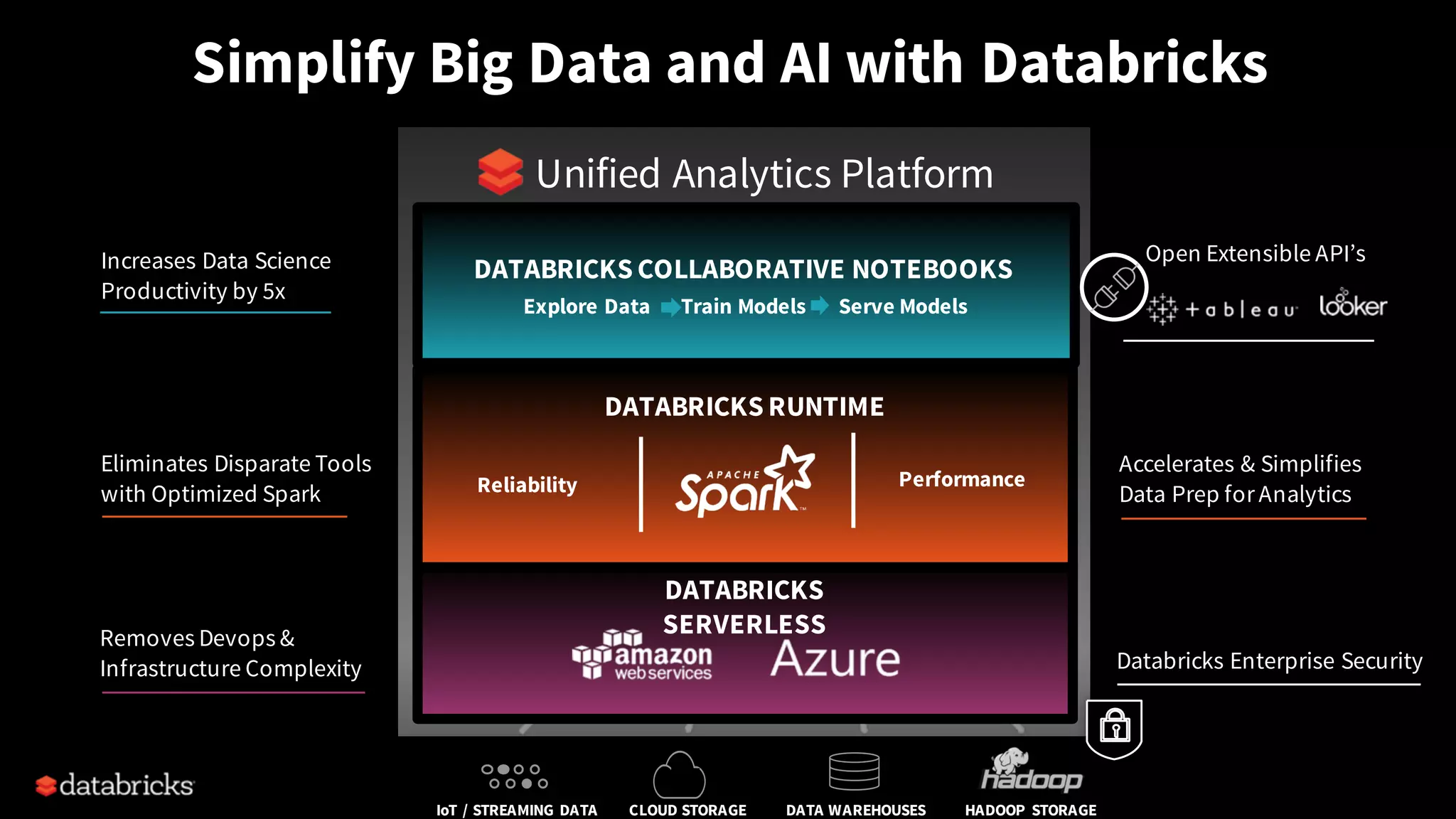
Simplify Big Data and AI with Databricks
Unified Analytics Platform
DATA WAREHOUSESCLOUD STORAGE HADOOP STORAGEIoT / STREAMING DATA
DATABRICKS
SERVERLESSRemoves Devops &
Infrastructure Complexity
DATABRICKS RUNTIME
Reliability
Eliminates Disparate Tools
with Optimized Spark
Explore Data Train Models Serve Models
DATABRICKS COLLABORATIVE NOTEBOOKSIncreases Data Science
Productivity by 5x
Databricks Enterprise Security
Open Extensible API’s
Accelerates & Simplifies
Data Prep for Analytics
Performance
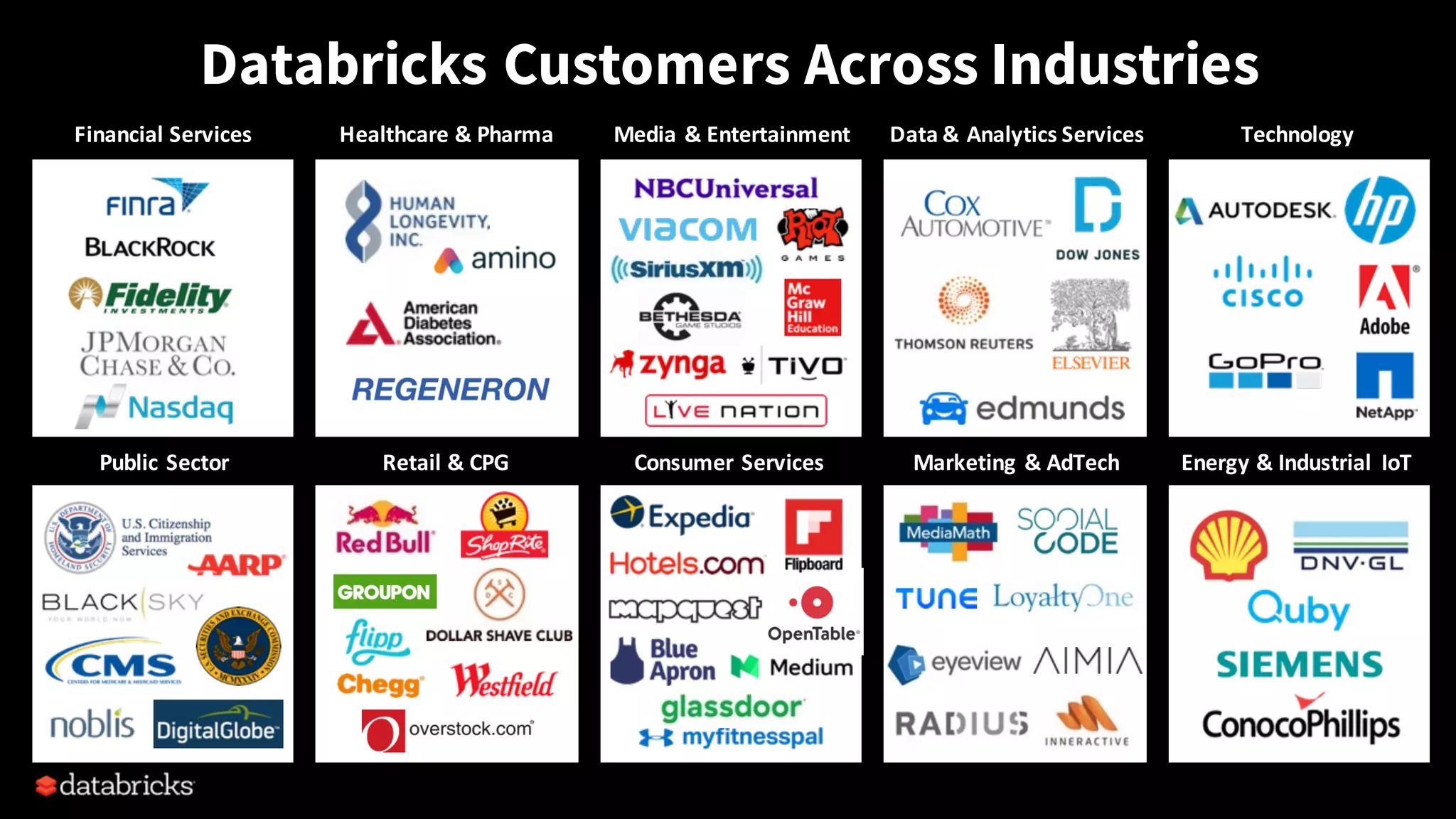
Databricks Customers Across Industries
Financial	Services Healthcare	&	Pharma Media	&	Entertainment Technology
Public	Sector Retail	&	CPG		 Consumer	Services Energy	&	Industrial	 IoTMarketing	&	AdTech
Data	&	Analytics	Services
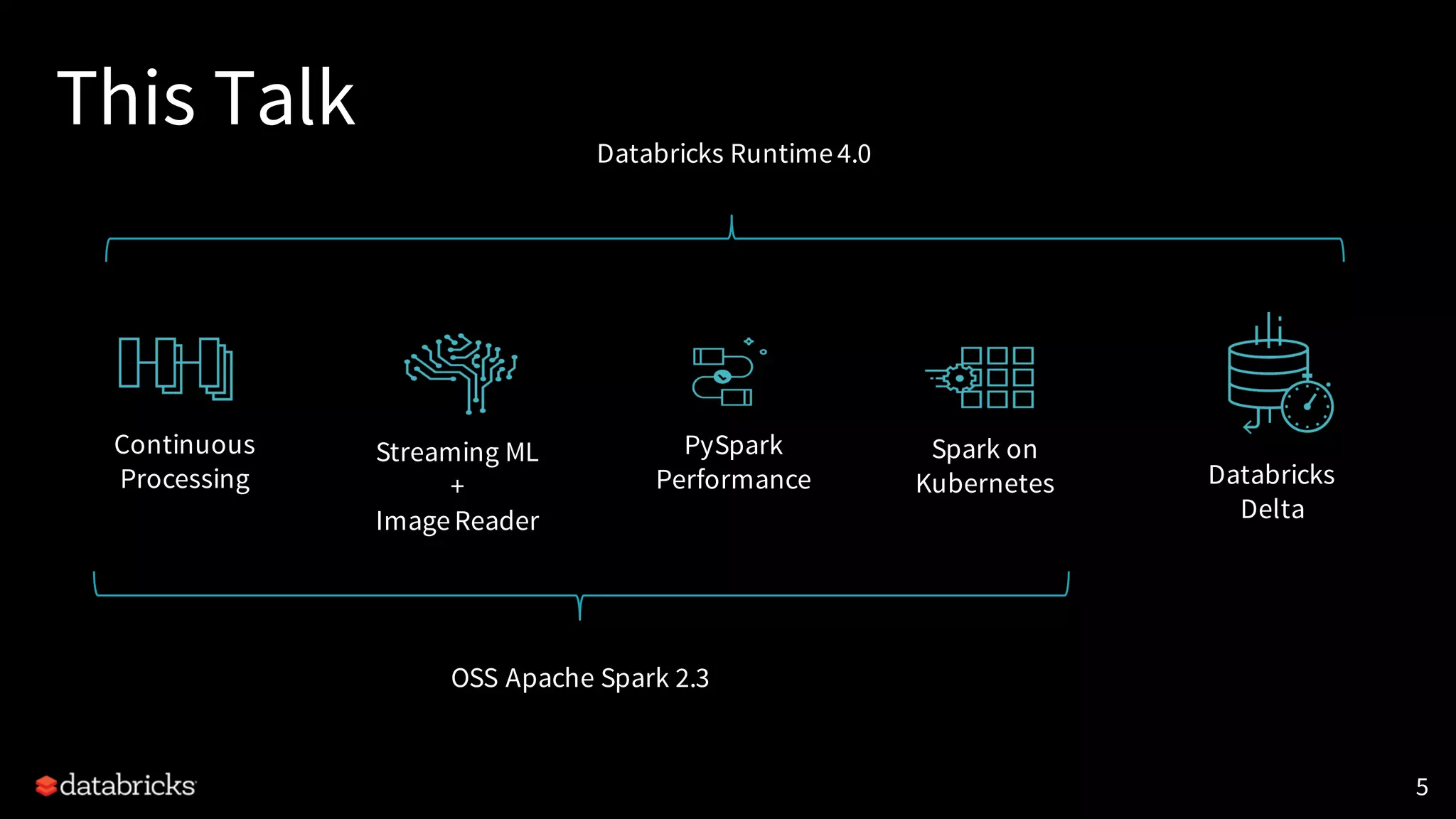
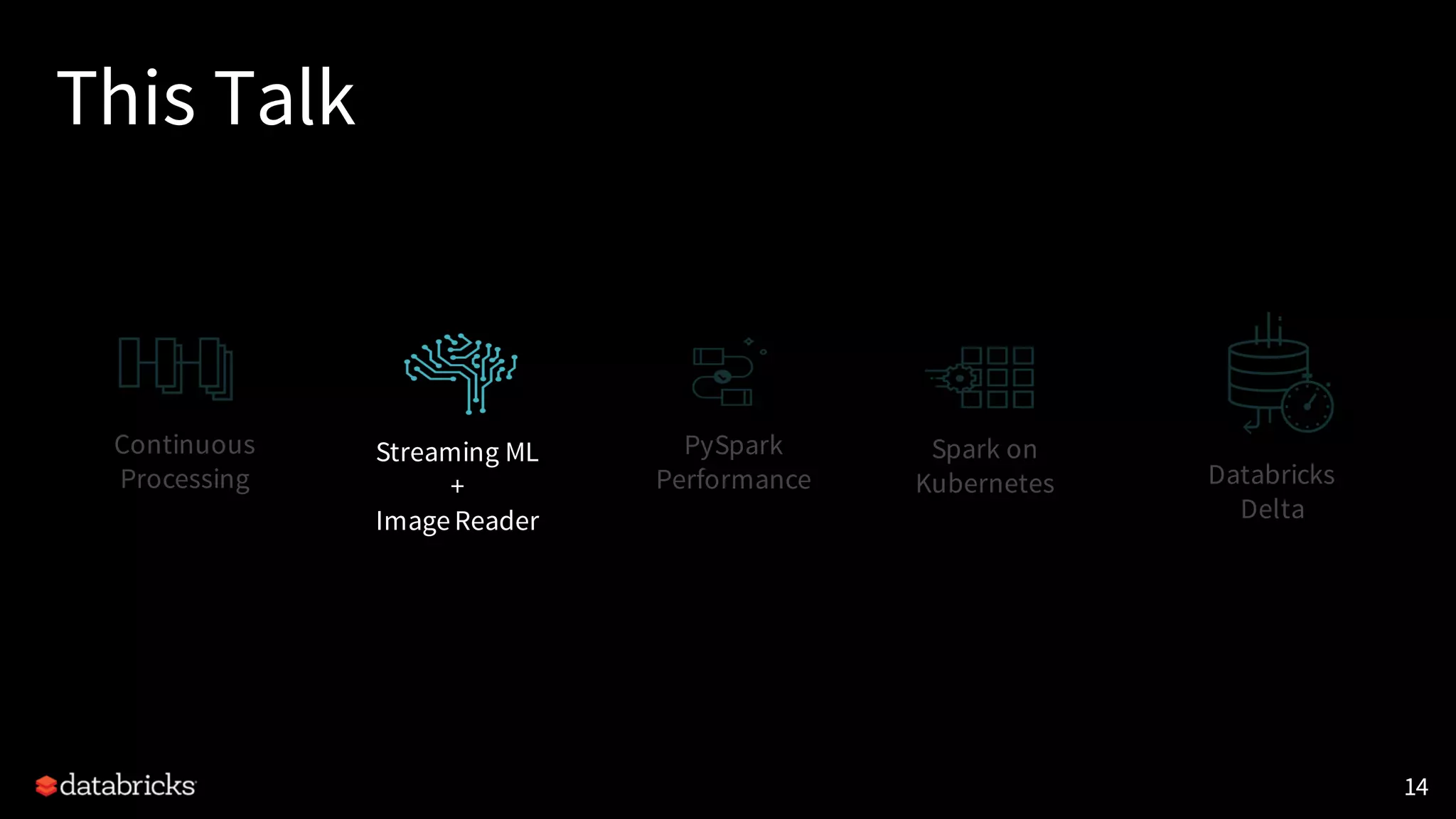
This Talk
5
Continuous
Processing
Spark on
Kubernetes
PySpark
Performance
Streaming ML
+
ImageReader
Databricks
Delta
OSS Apache Spark 2.3
Databricks Runtime4.0
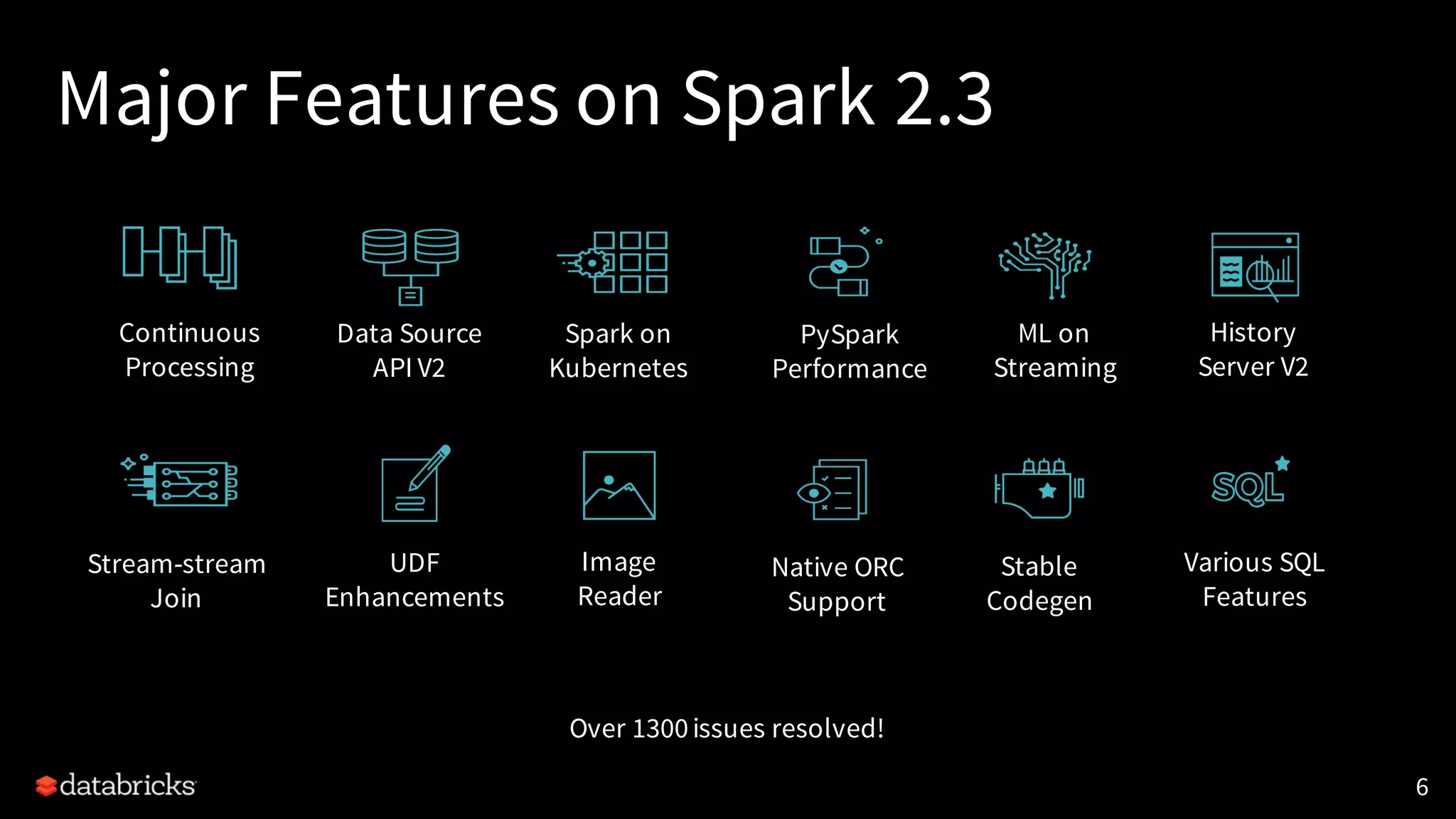
Major Features on Spark 2.3
6
Continuous
Processing
Data Source
API V2
Stream-stream
Join
Spark on
Kubernetes
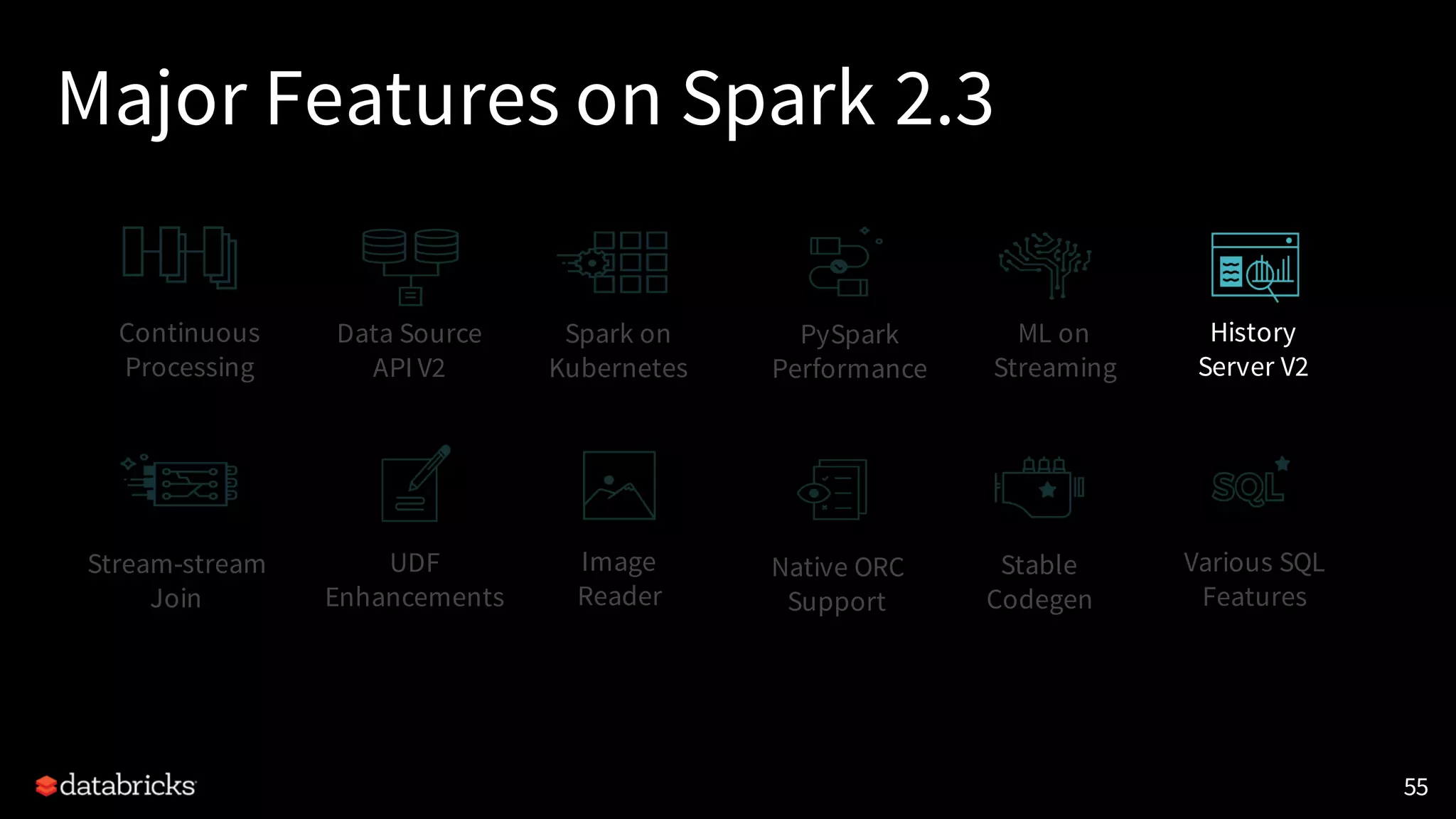
History
Server V2
UDF
Enhancements
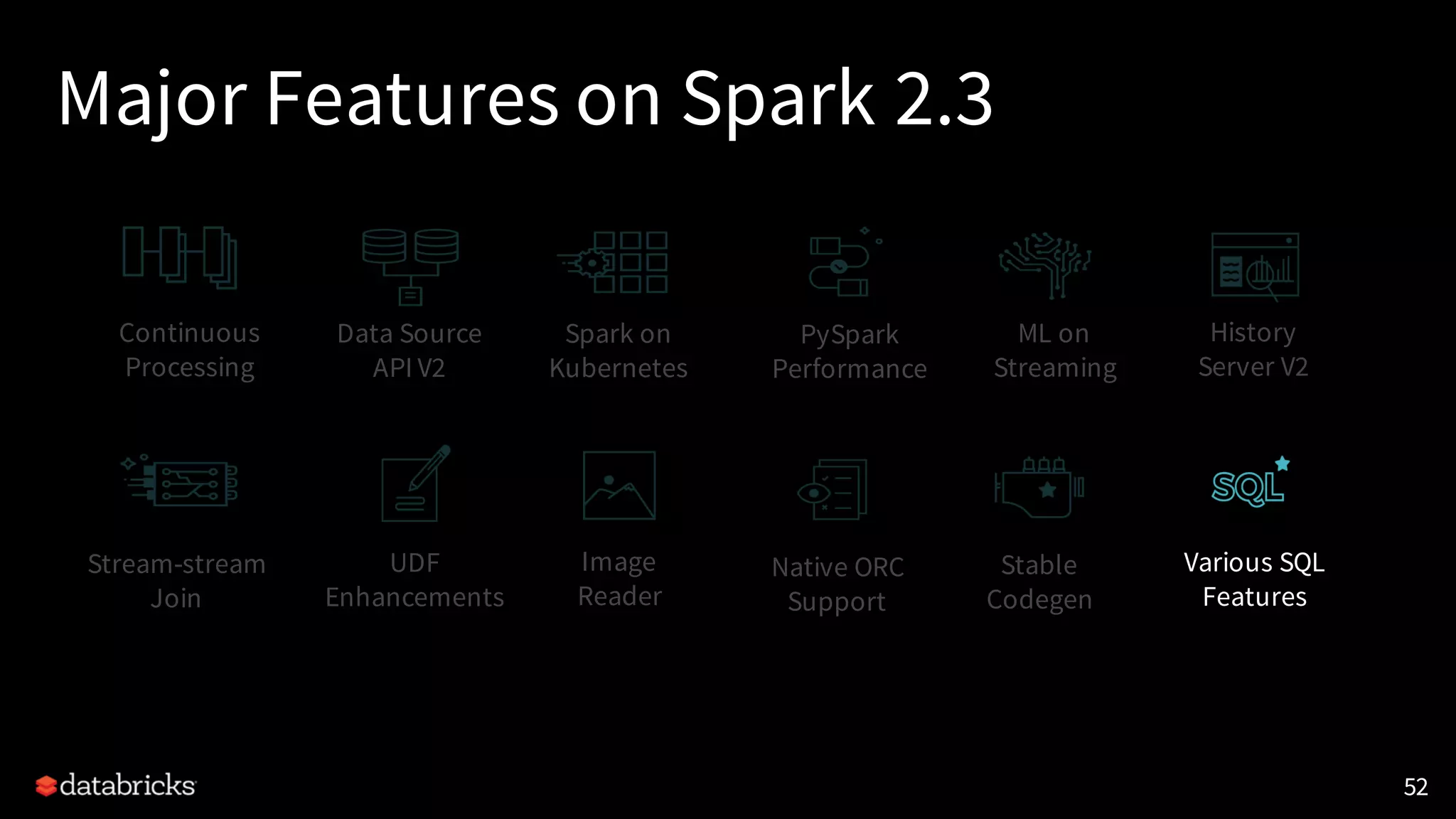
Various SQL
Features
PySpark
Performance
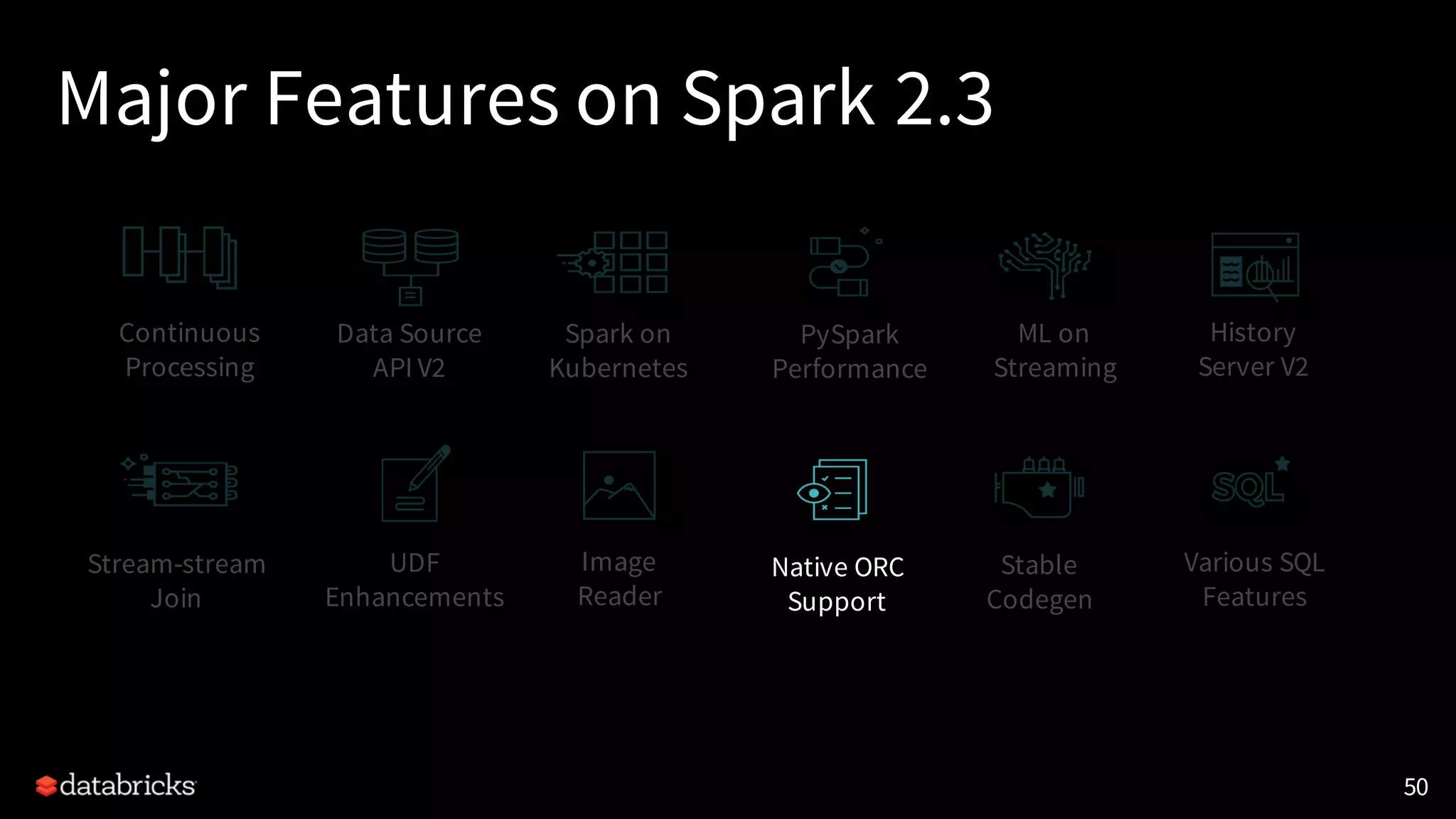
Native ORC
Support
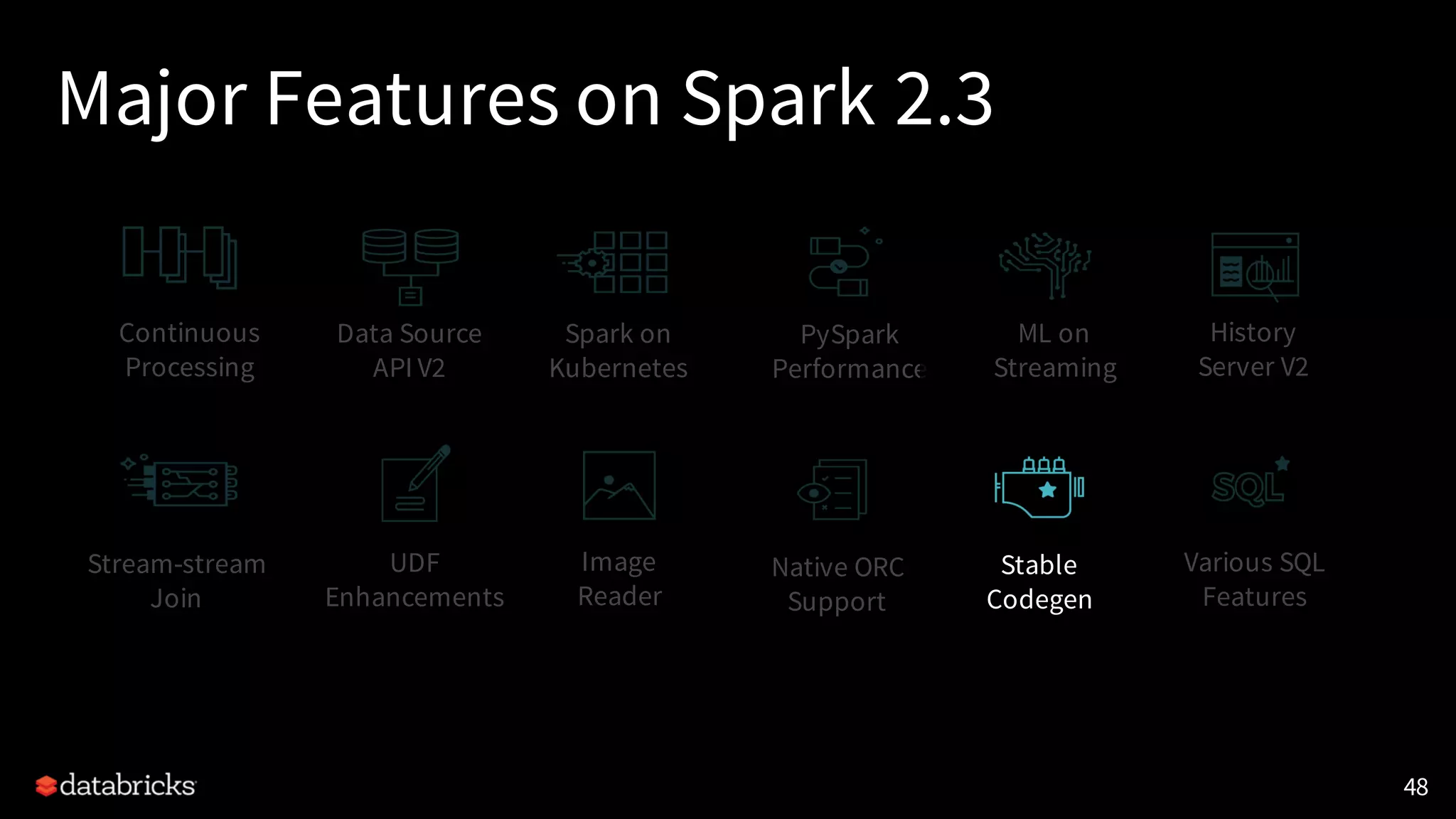
Stable
Codegen
Image
Reader
ML on
Streaming
Over 1300issues resolved!
This Talk
7
Continuous
Processing
Spark on
Kubernetes
PySpark
Performance
Streaming ML
+
ImageReader
Databricks
Delta
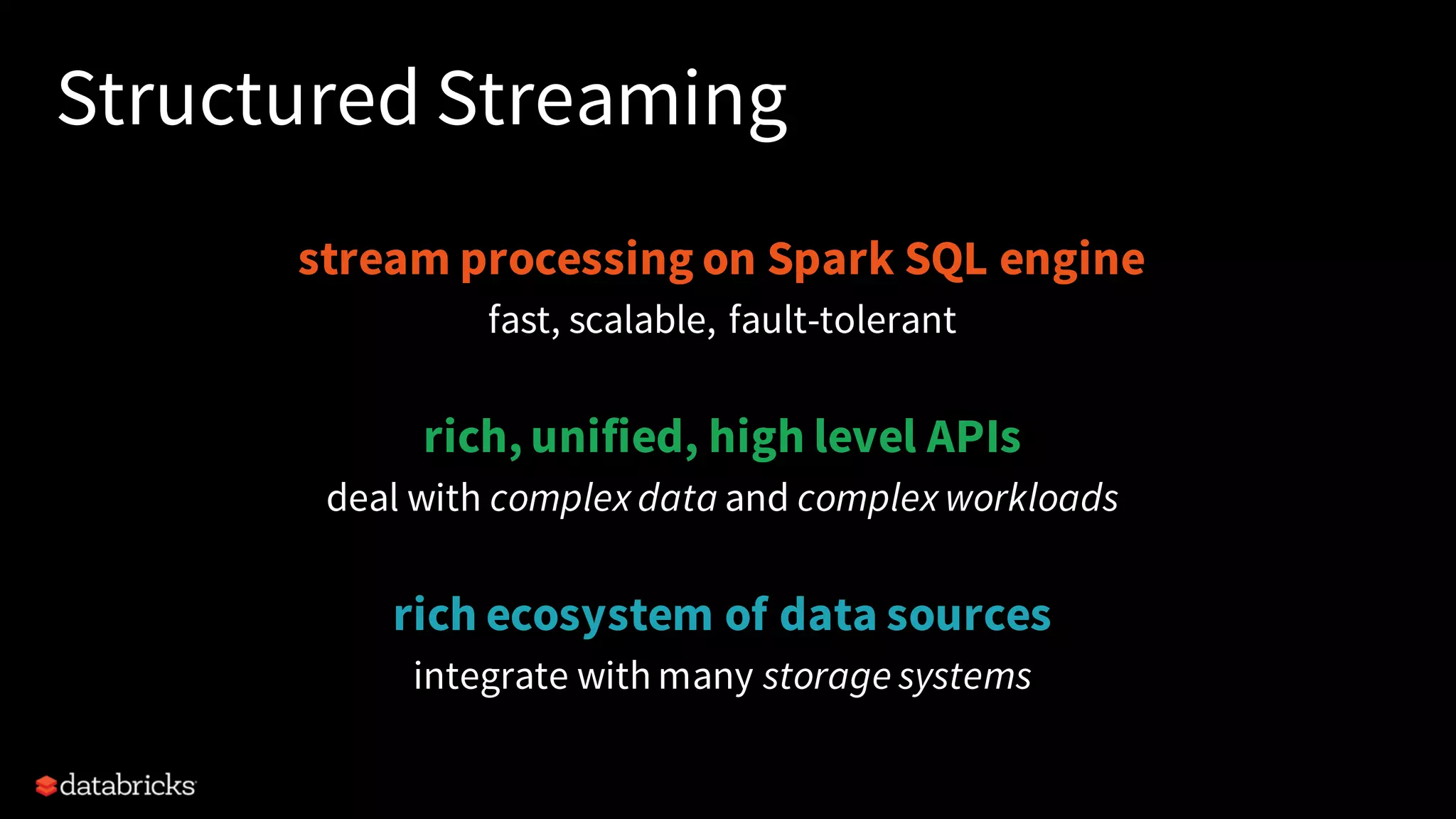
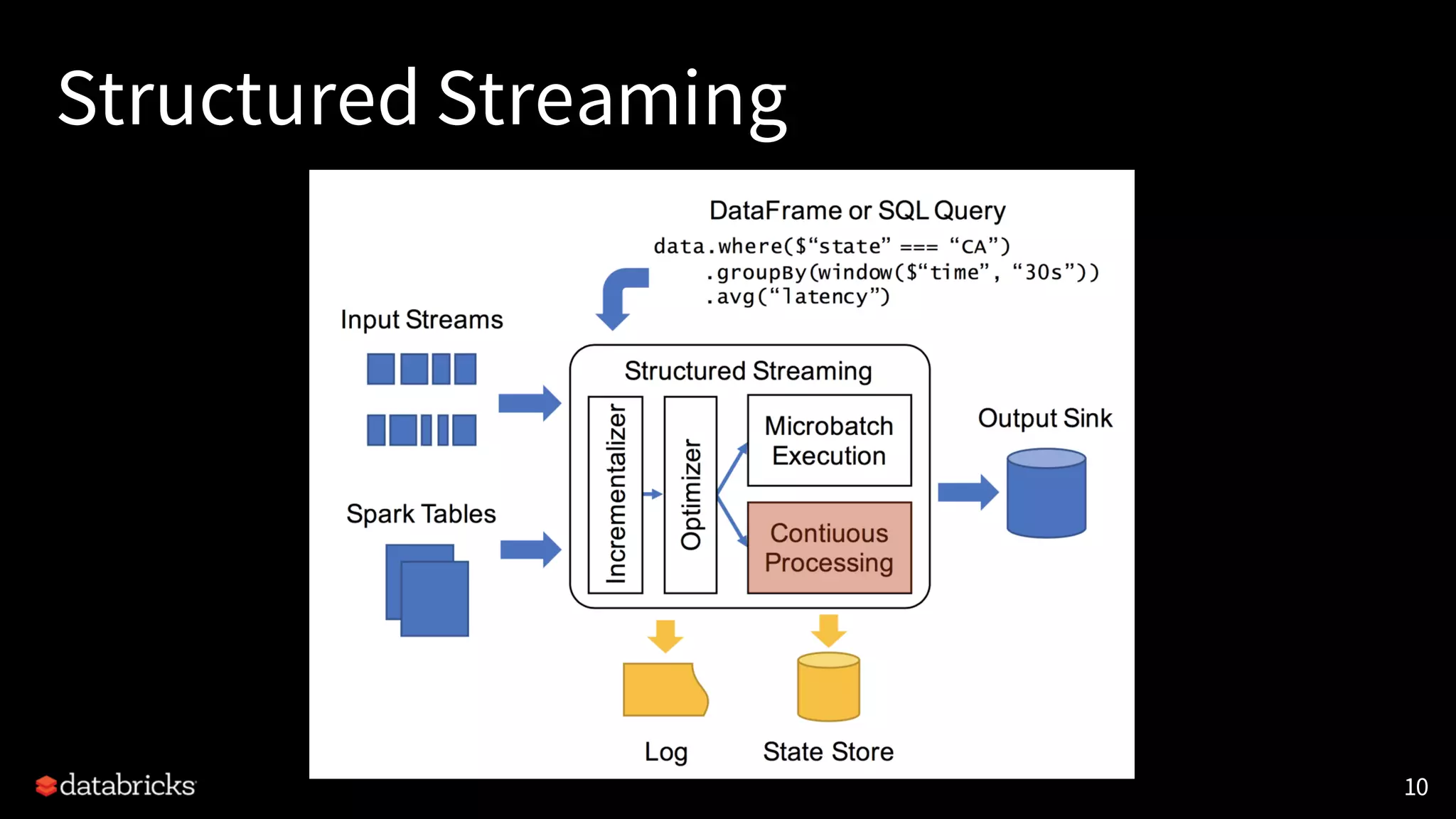
Structured Streaming
stream processing on Spark SQL engine
fast, scalable, fault-tolerant
rich, unified, high level APIs
deal with complex data and complex workloads
rich ecosystem of data sources
integrate with many storage systems
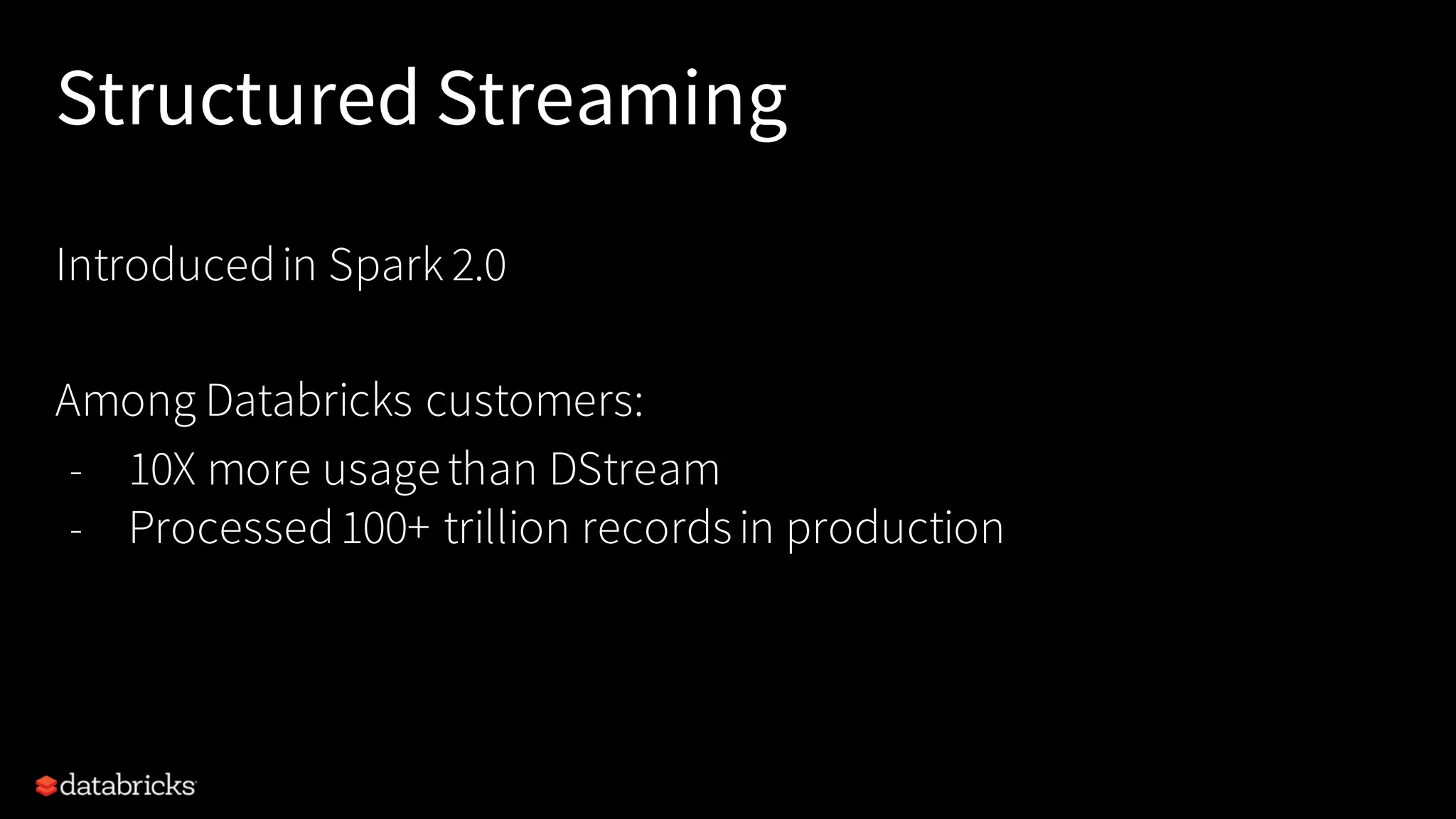
Structured Streaming
Introducedin Spark 2.0
Among Databricks customers:
- 10X more usagethan DStream
- Processed100+ trillion recordsin production
Structured Streaming
10
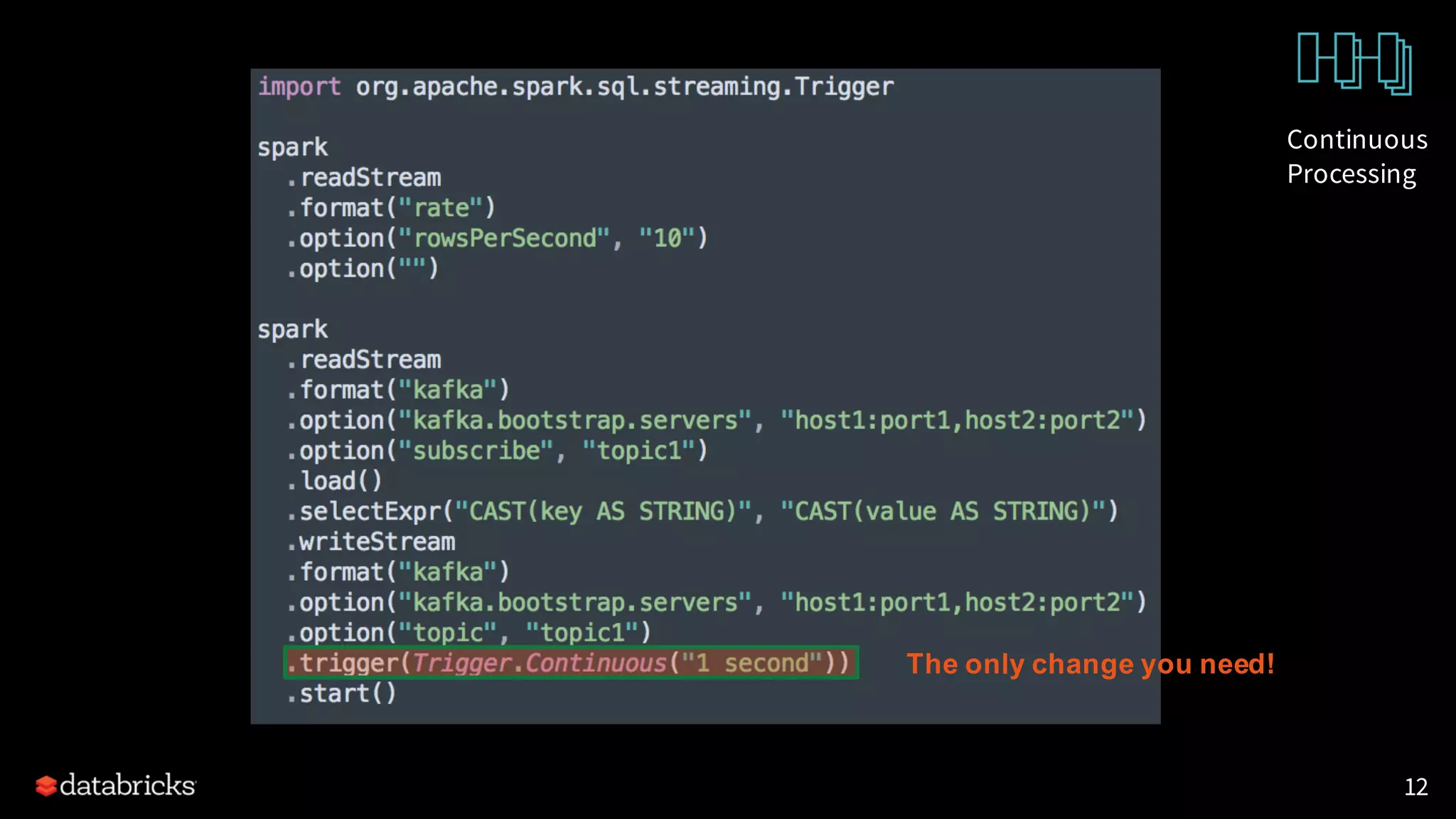
Continuous Processing Execution Mode
Micro-batch Processing (since 2.0 release)
• Lower end-to-end latencies of ~100ms
• Exactly-once fault-tolerance guarantees
Continuous Processing (since 2.3 release) [SPARK-20928]
• A new streaming execution mode
(experimental)
• Low (~1 ms) end-to-end latency
• At-least-once guarantees
11
12
Continuous
Processing
The only change you need!
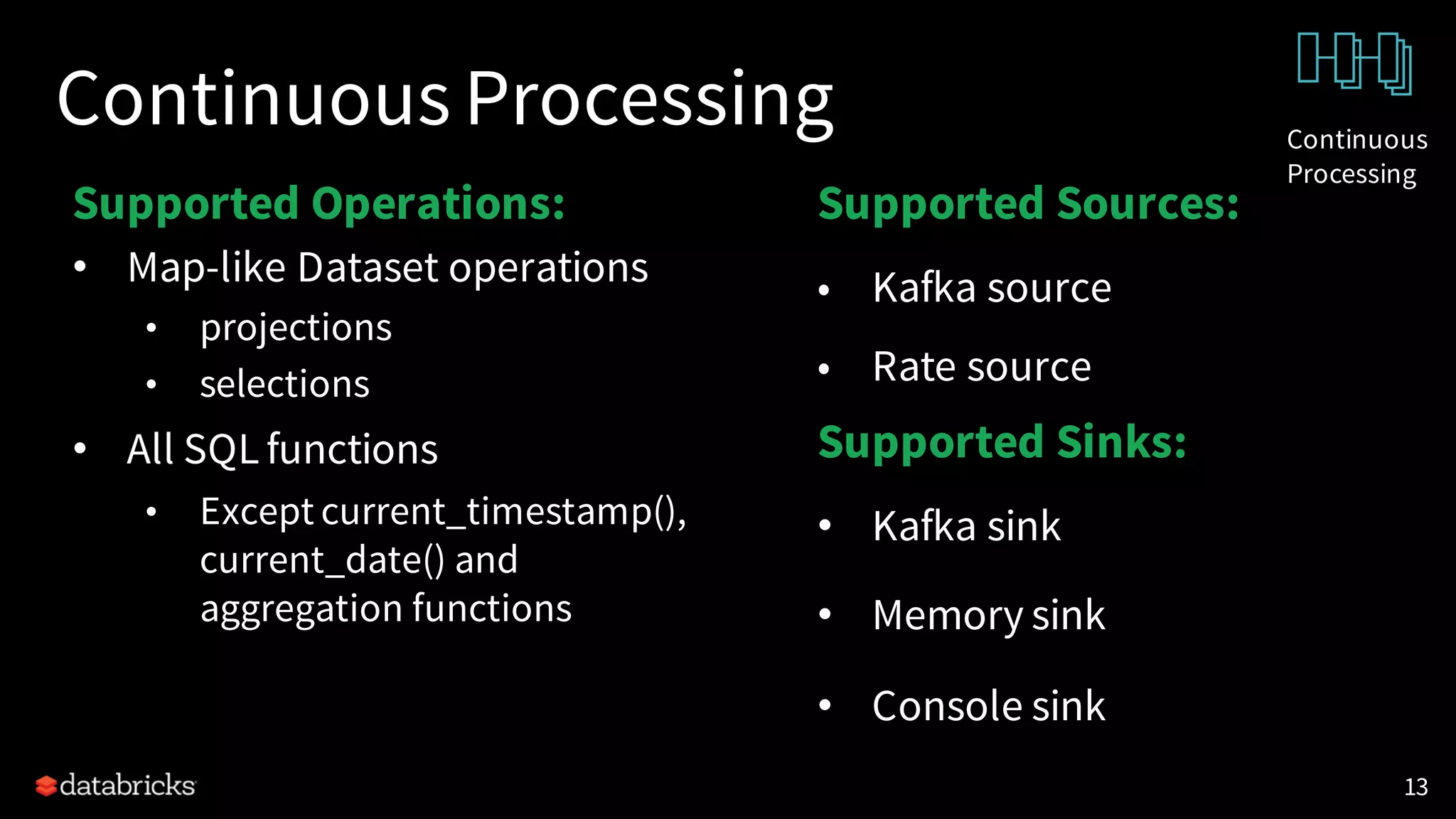
Continuous Processing
Supported Operations:
• Map-like Dataset operations
• projections
• selections
• All SQL functions
• Except current_timestamp(),
current_date() and
aggregation functions
13
Supported Sources:
• Kafka source
• Rate source
Supported Sinks:
• Kafka sink
• Memory sink
• Console sink
Continuous
Processing
This Talk
14
Continuous
Processing
Spark on
Kubernetes
PySpark
Performance
Streaming ML
+
ImageReader
Databricks
Delta
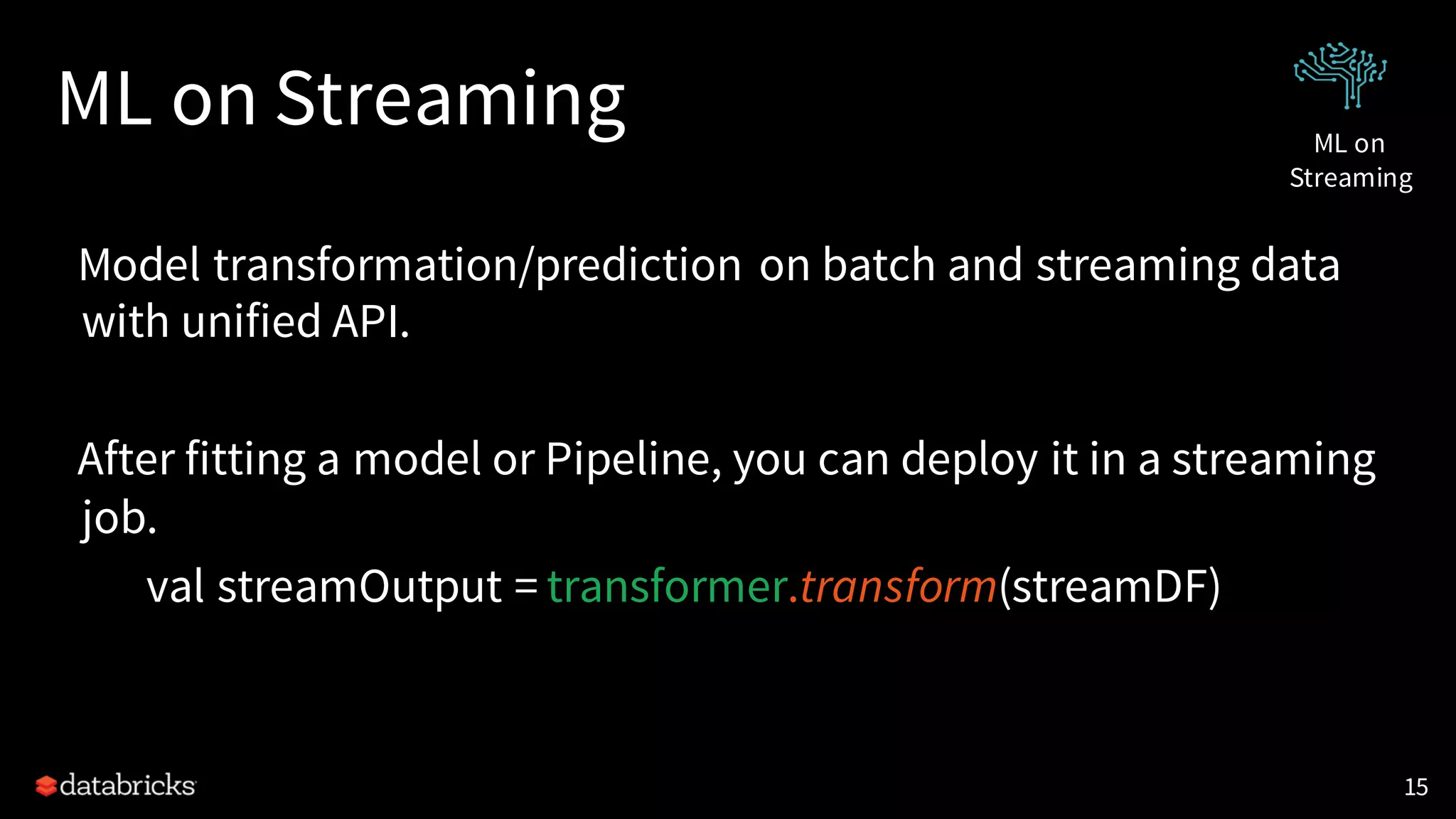
ML on Streaming
Model transformation/prediction on batch and streaming data
with unified API.
After fitting a model or Pipeline, you can deploy it in a streaming
job.
val streamOutput = transformer.transform(streamDF)
15
ML on
Streaming
Demo
Notebook:
https://databricks-prod-
cloudfront.cloud.databricks.com/public/4027ec902e239c93eaaa87
14f173bcfc/1212468499849361/649180143457189/715175985472402
3/latest.html
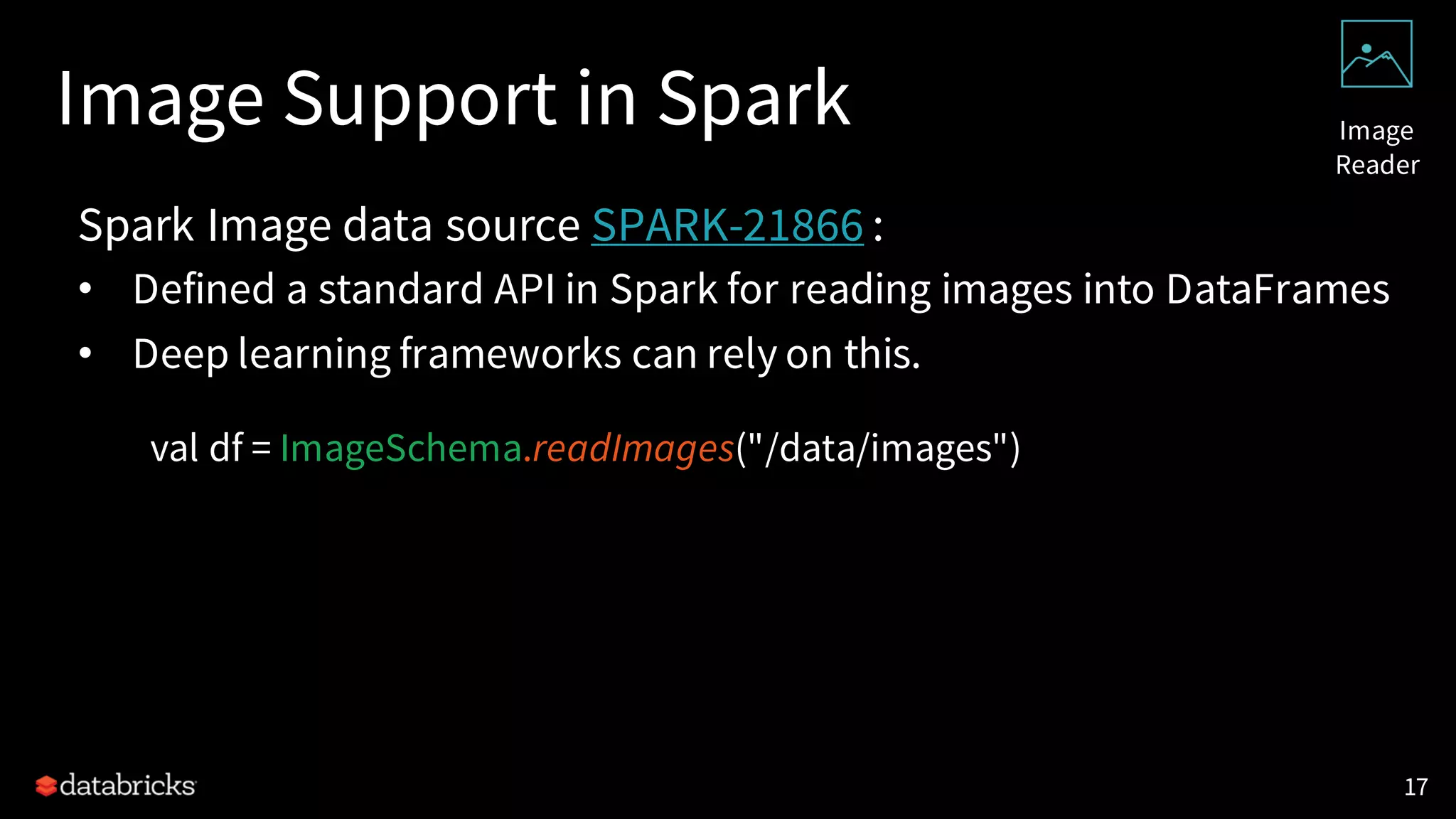
Image Support in Spark
Spark Image data source SPARK-21866 :
• Defined a standard API in Spark for reading images into DataFrames
• Deep learning frameworks can rely on this.
val df = ImageSchema.readImages("/data/images")
17
Image
Reader
This Talk
18
Continuous
Processing
Spark on
Kubernetes
PySpark
Performance
Streaming ML
+
ImageReader
Databricks
Delta
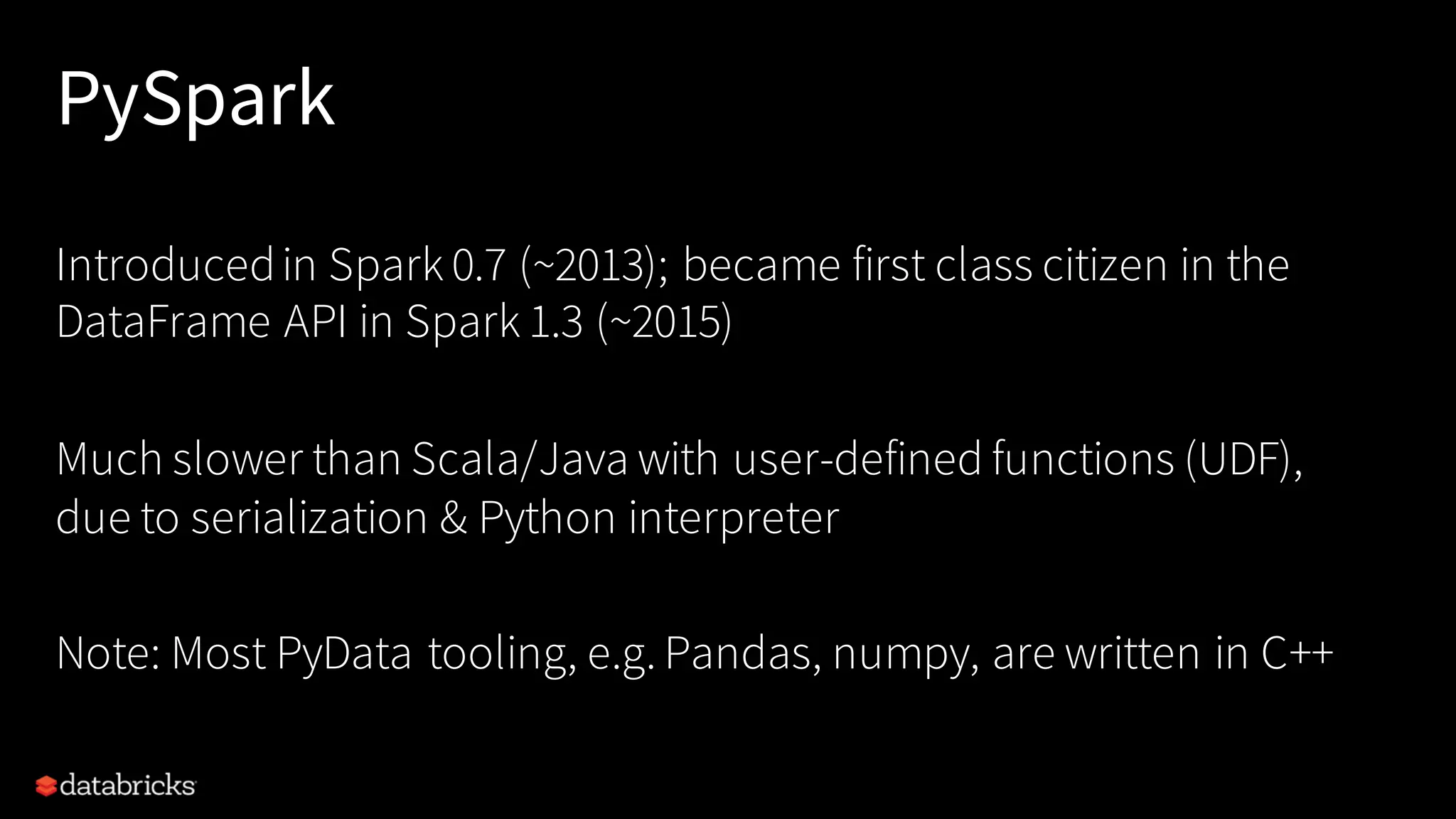
PySpark
Introducedin Spark 0.7 (~2013); became first class citizen in the
DataFrame API in Spark 1.3 (~2015)
Much slower than Scala/Java with user-defined functions (UDF),
due to serialization & Python interpreter
Note: Most PyData tooling, e.g. Pandas, numpy, are written in C++
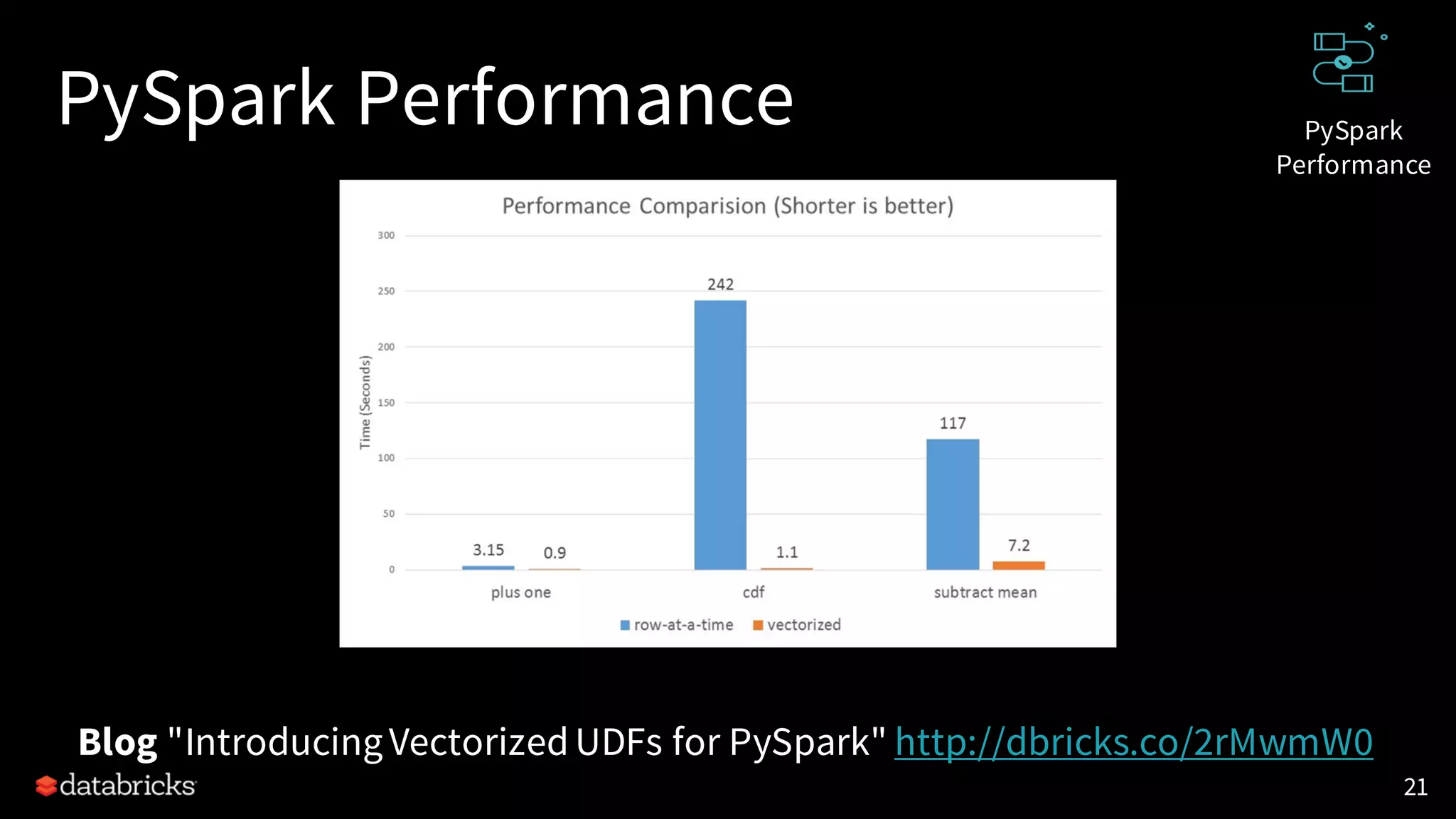
PySpark Performance
Fast data serialization and execution using vectorized formats
[SPARK-22216] [SPARK-21187]
• Conversion from/to Pandas
df.toPandas()
createDataFrame(pandas_df)
• Pandas/Vectorized UDFs: UDF using Pandas to process data
• Scalar Pandas UDFs
• Grouped Map Pandas UDFs
20
PySpark Performance
21
PySpark
Performance
Blog "IntroducingVectorizedUDFs for PySpark" http://dbricks.co/2rMwmW0
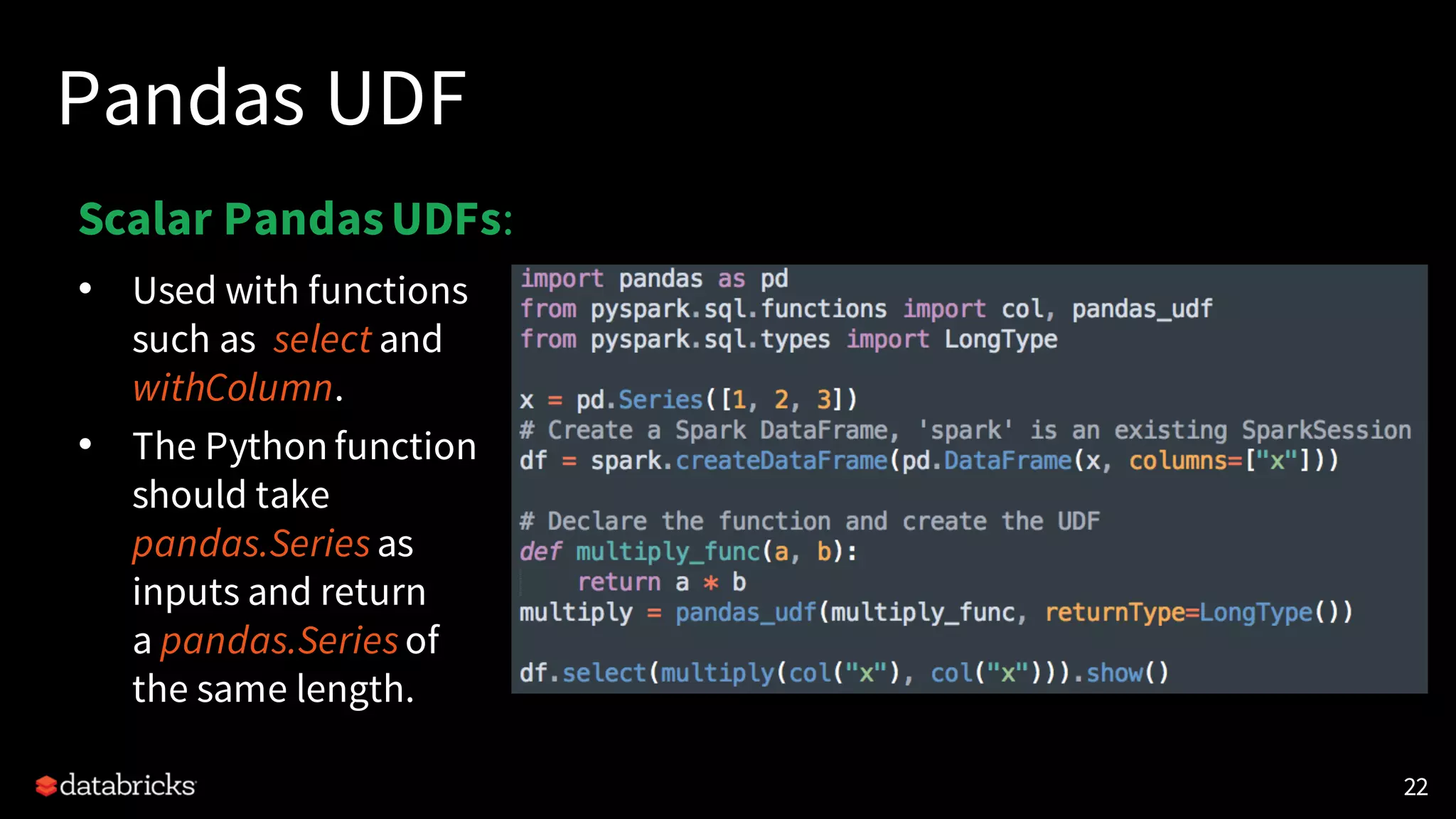
Pandas UDF
• Used with functions
such as select and
withColumn.
• The Python function
should take
pandas.Seriesas
inputs and return
a pandas.Seriesof
the same length.
22
Scalar PandasUDFs:
Pandas UDF
23
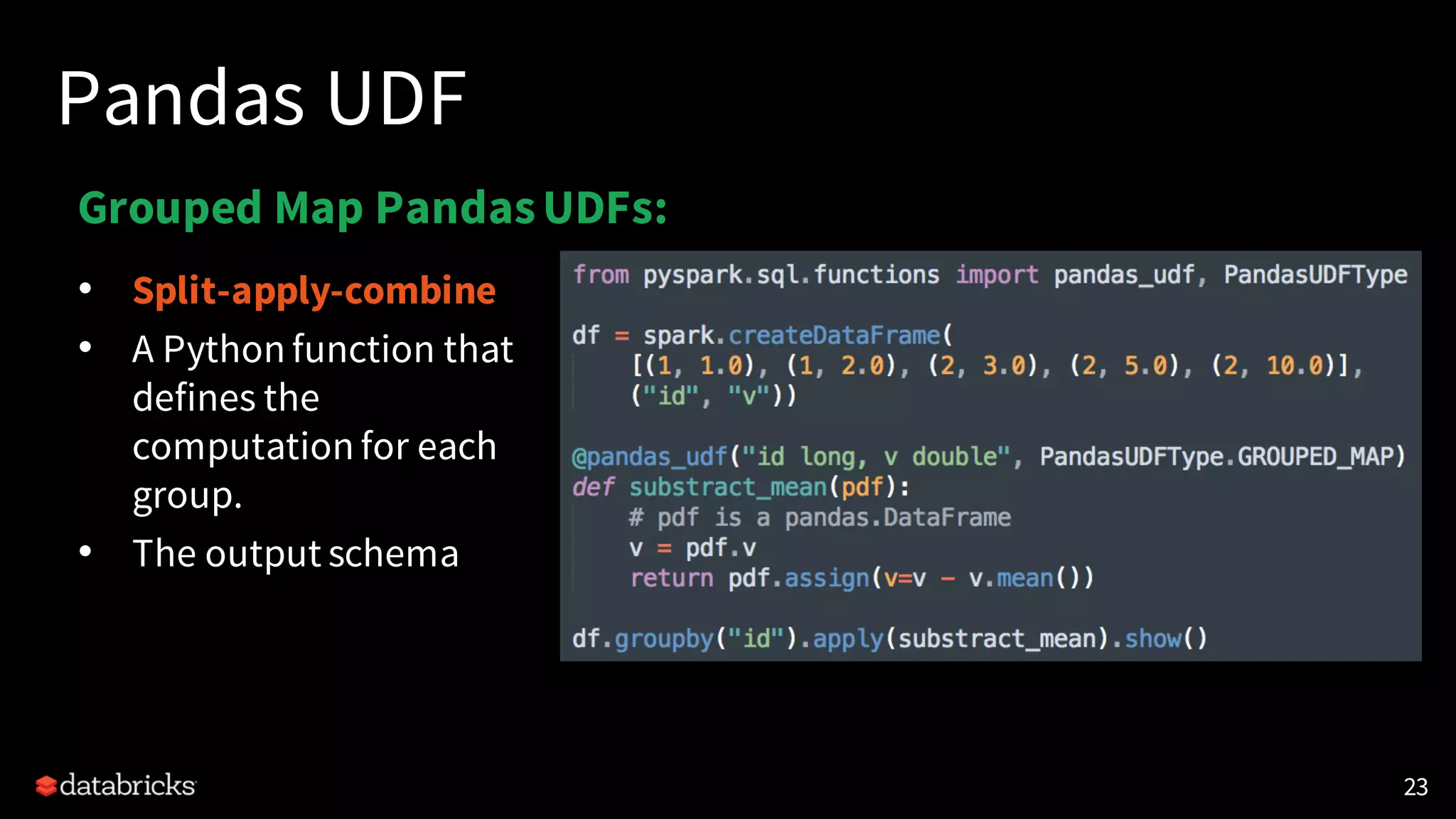
Grouped Map PandasUDFs:
• Split-apply-combine
• A Python function that
defines the
computation for each
group.
• The output schema
Demo
Notebook:
https://databricks-prod-
cloudfront.cloud.databricks.com/public/4027ec902e239c93eaaa87
14f173bcfc/1212468499849361/421914239386310/715175985472402
3/latest.html
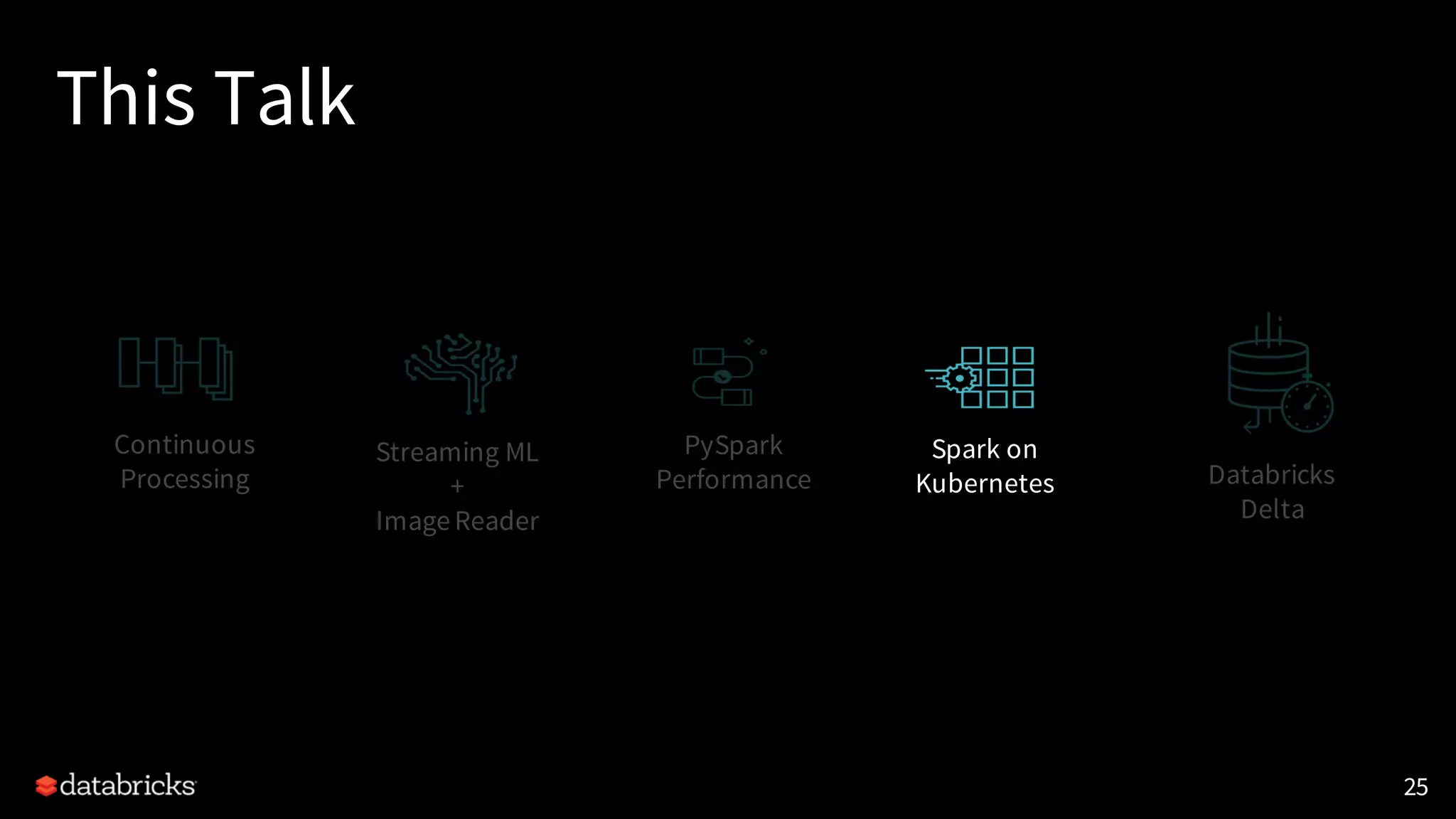
This Talk
25
Continuous
Processing
Spark on
Kubernetes
PySpark
Performance
Streaming ML
+
ImageReader
Databricks
Delta
Native Spark App in K8S
• New Spark scheduler backend
• Driver runs in a Kubernetespod created by
the submission client and creates pods that
run the executors in response to requests
from the Spark scheduler. [K8S-34377]
[SPARK-18278]
• Make direct use of Kubernetes clusters for
multi-tenancy and sharing through
Namespaces and Quotas, as well as
administrative features such as Pluggable
Authorization, and Logging.
27
on
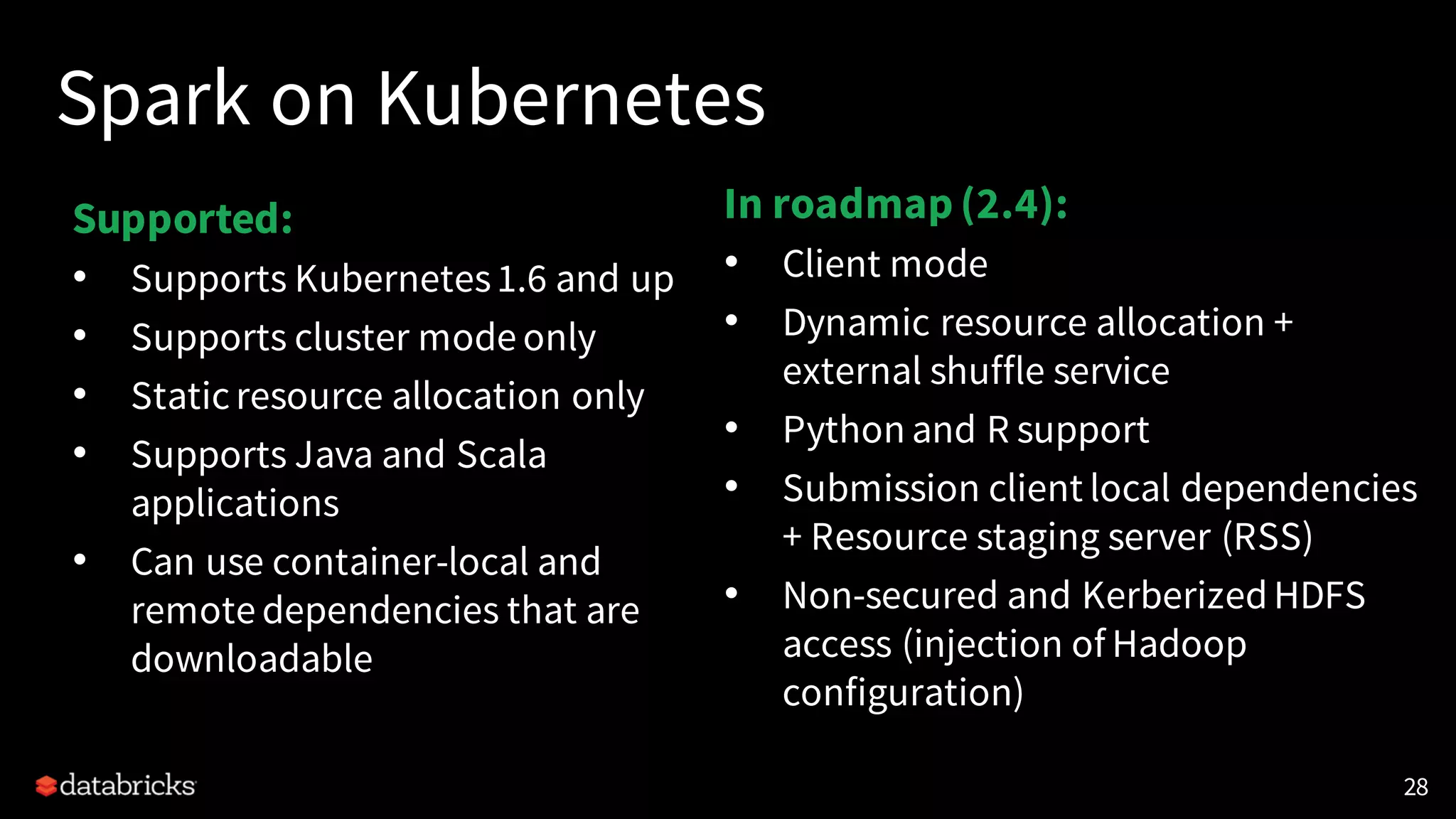
Spark on Kubernetes
Supported:
• Supports Kubernetes1.6 and up
• Supports cluster mode only
• Staticresource allocation only
• Supports Java and Scala
applications
• Can use container-local and
remote dependencies that are
downloadable
28
In roadmap (2.4):
• Client mode
• Dynamic resource allocation +
external shuffle service
• Python and R support
• Submission client local dependencies
+ Resource staging server (RSS)
• Non-secured and KerberizedHDFS
access (injection of Hadoop
configuration)
This Talk
29
Continuous
Processing
Spark on
Kubernetes
PySpark
Performance
Streaming ML
+
ImageReader
Databricks
Delta
30
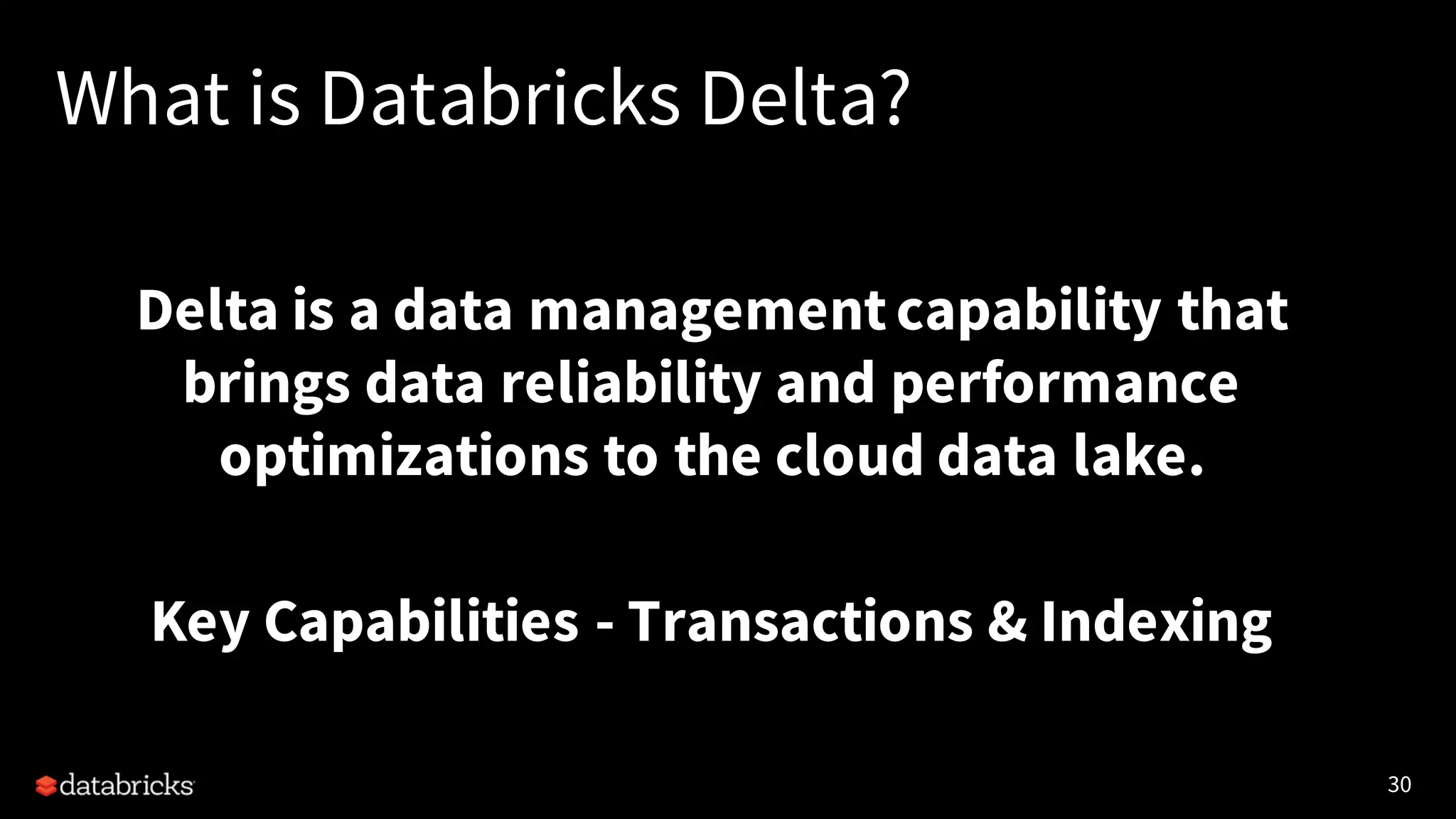
What is Databricks Delta?
Delta is a data managementcapability that
brings data reliability and performance
optimizations to the cloud data lake.
Key Capabilities - Transactions & Indexing
31
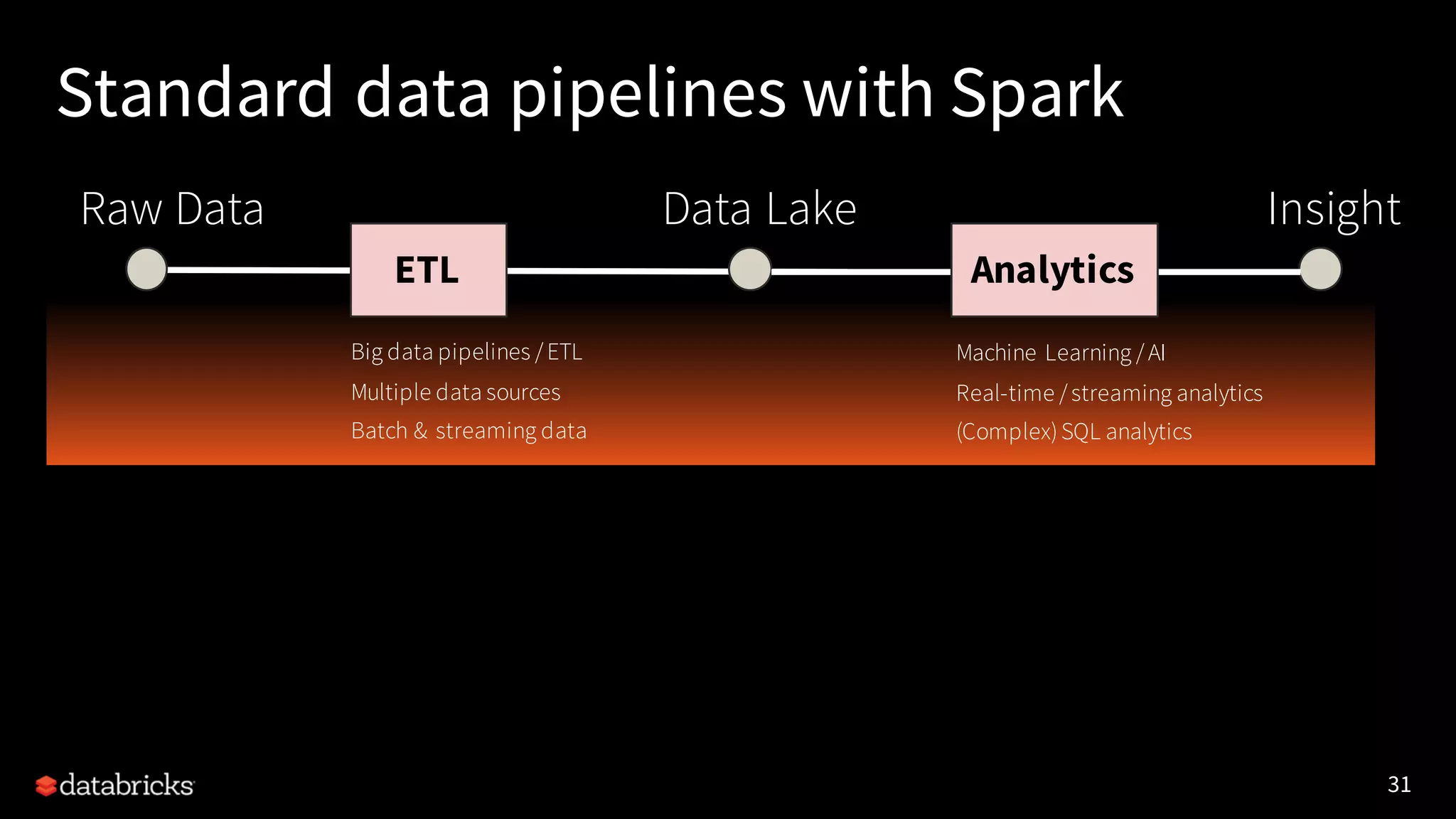
Standard data pipelines with Spark
Raw Data InsightData Lake
Big data pipelines /ETL
Multiple data sources
Batch & streaming data
Machine Learning /AI
Real-time /streaming analytics
(Complex)SQL analytics
ETL Analytics
32
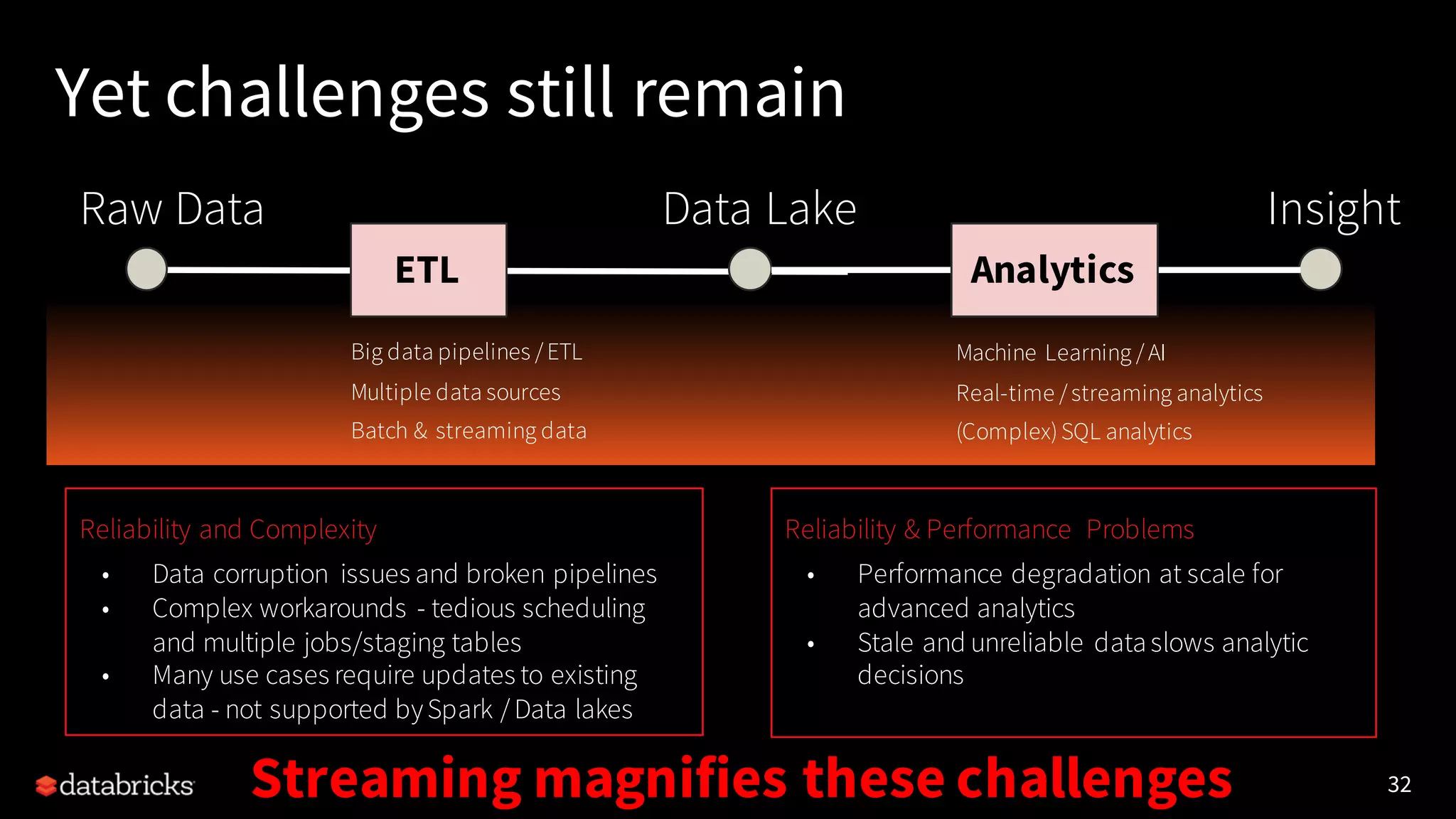
Yet challenges still remain
Raw Data InsightData Lake
Reliability & Performance Problems
• Performance degradation at scale for
advanced analytics
• Stale and unreliable dataslows analytic
decisions
Reliability and Complexity
• Data corruption issues and broken pipelines
• Complex workarounds - tedious scheduling
and multiple jobs/staging tables
• Many use cases require updates to existing
data - not supported bySpark /Data lakes
Big data pipelines /ETL
Multiple data sources
Batch & streaming data
Machine Learning /AI
Real-time /streaming analytics
(Complex)SQL analytics
Streaming magnifies these challenges
AnalyticsETL
33
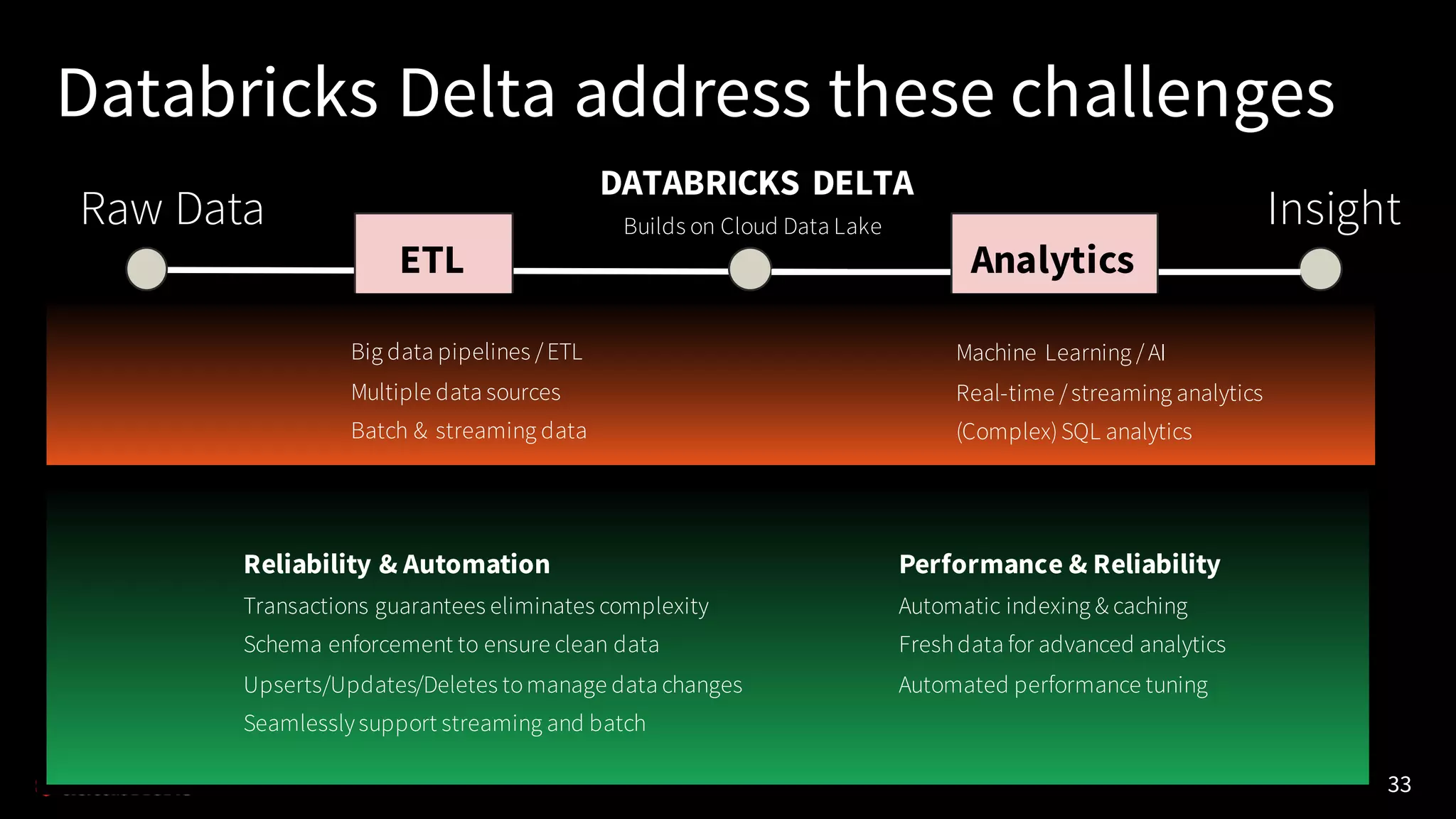
Databricks Delta address these challenges
Raw Data Insight
ETL Analytics
Big data pipelines /ETL
Multiple data sources
Batch & streaming data
Machine Learning /AI
Real-time /streaming analytics
(Complex)SQL analytics
DATABRICKS DELTA
Builds on Cloud Data Lake
Reliability & Automation
Transactions guarantees eliminates complexity
Schema enforcement to ensure clean data
Upserts/Updates/Deletes tomanage data changes
Seamlesslysupport streaming and batch
Performance & Reliability
Automatic indexing & caching
Freshdata for advanced analytics
Automated performance tuning
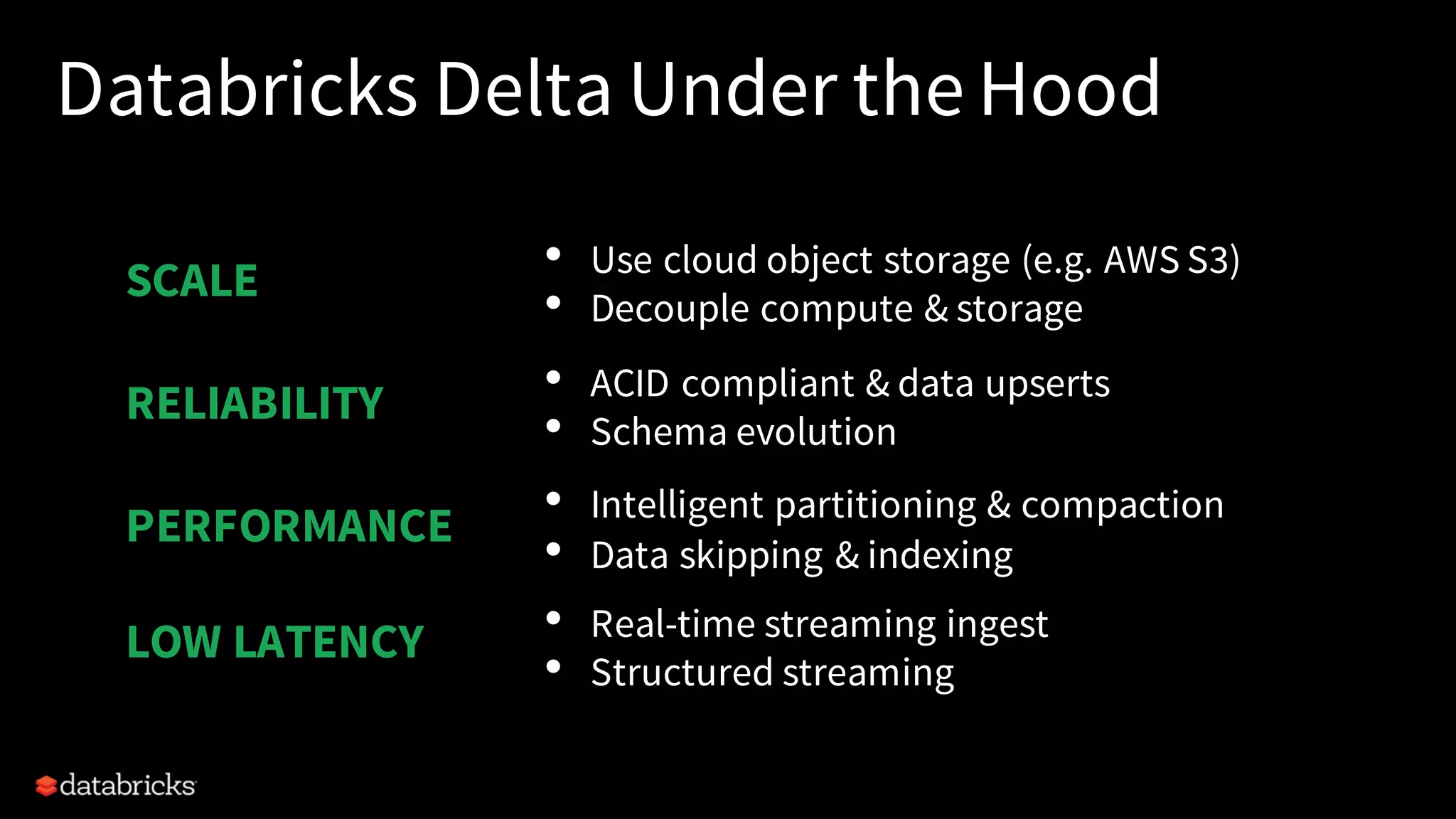
Databricks Delta Under the Hood
• Use cloud object storage (e.g. AWS S3)
• Decouple compute & storage
• ACID compliant & data upserts
• Schema evolution
• Intelligent partitioning & compaction
• Data skipping & indexing
• Real-time streaming ingest
• Structured streaming
SCALE
PERFORMANCE
RELIABILITY
LOW LATENCY
35
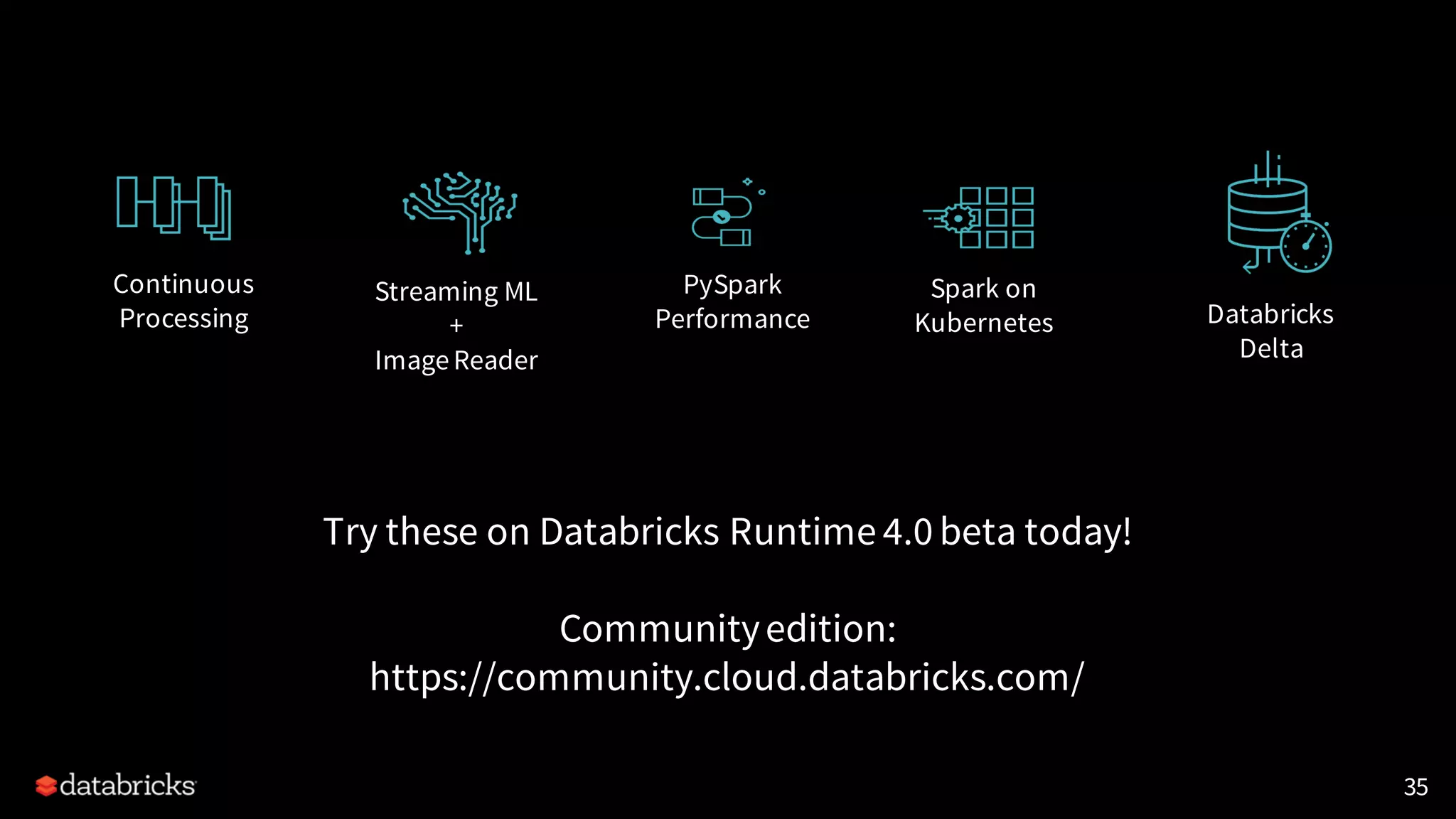
Continuous
Processing
Spark on
Kubernetes
PySpark
Performance
Streaming ML
+
ImageReader
Databricks
Delta
Try these on Databricks Runtime 4.0 beta today!
Communityedition:
https://community.cloud.databricks.com/
Thank you
36
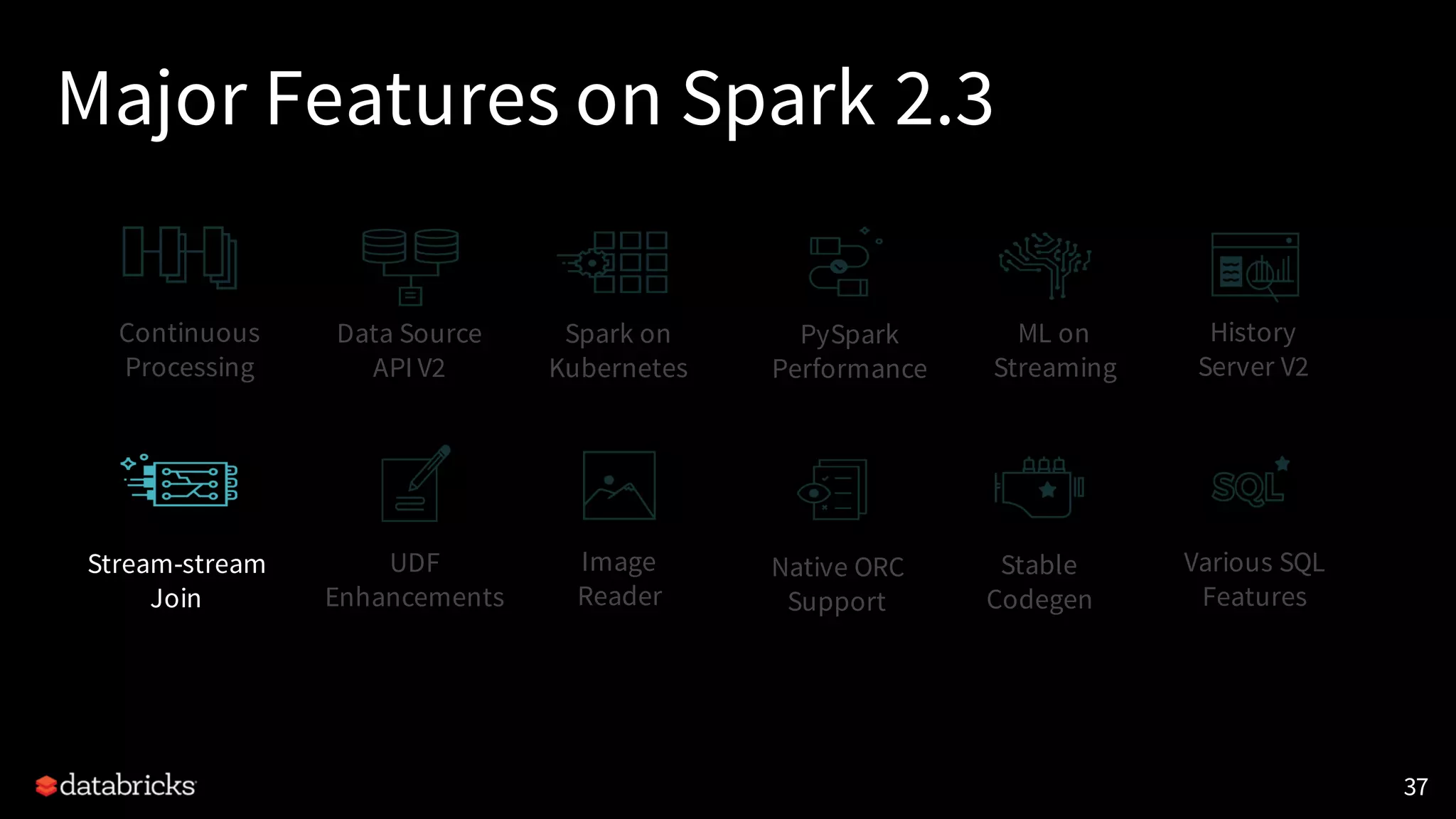
Major Features on Spark 2.3
37
Continuous
Processing
Data Source
API V2
Stream-stream
Join
Spark on
Kubernetes
History
Server V2
UDF
Enhancements
Various SQL
Features
PySpark
Performance
Native ORC
Support
Stable
Codegen
Image
Reader
ML on
Streaming
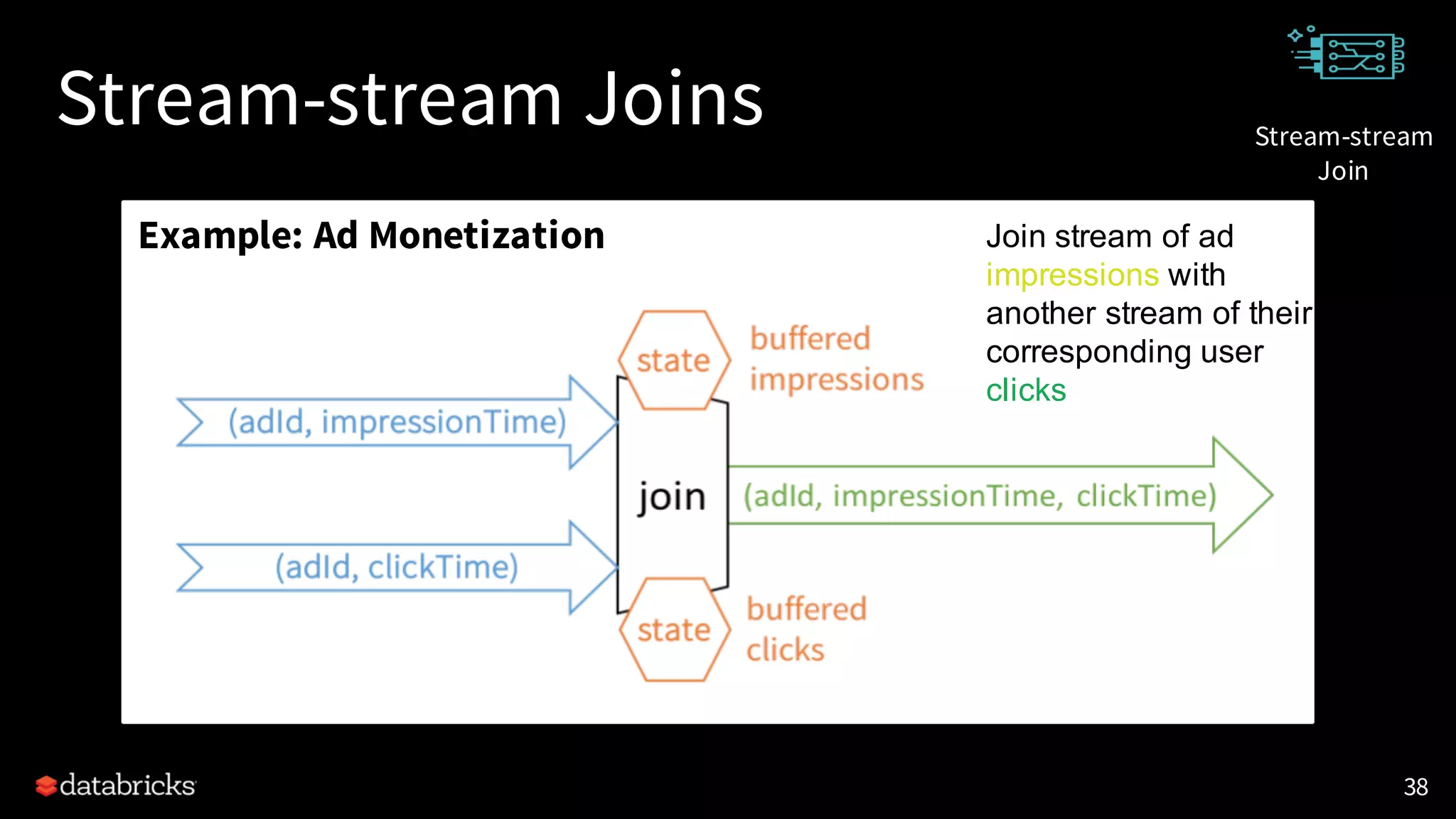
Stream-stream Joins
38
Stream-stream
Join
Example: Ad Monetization Join stream of ad
impressions with
another stream of their
corresponding user
clicks
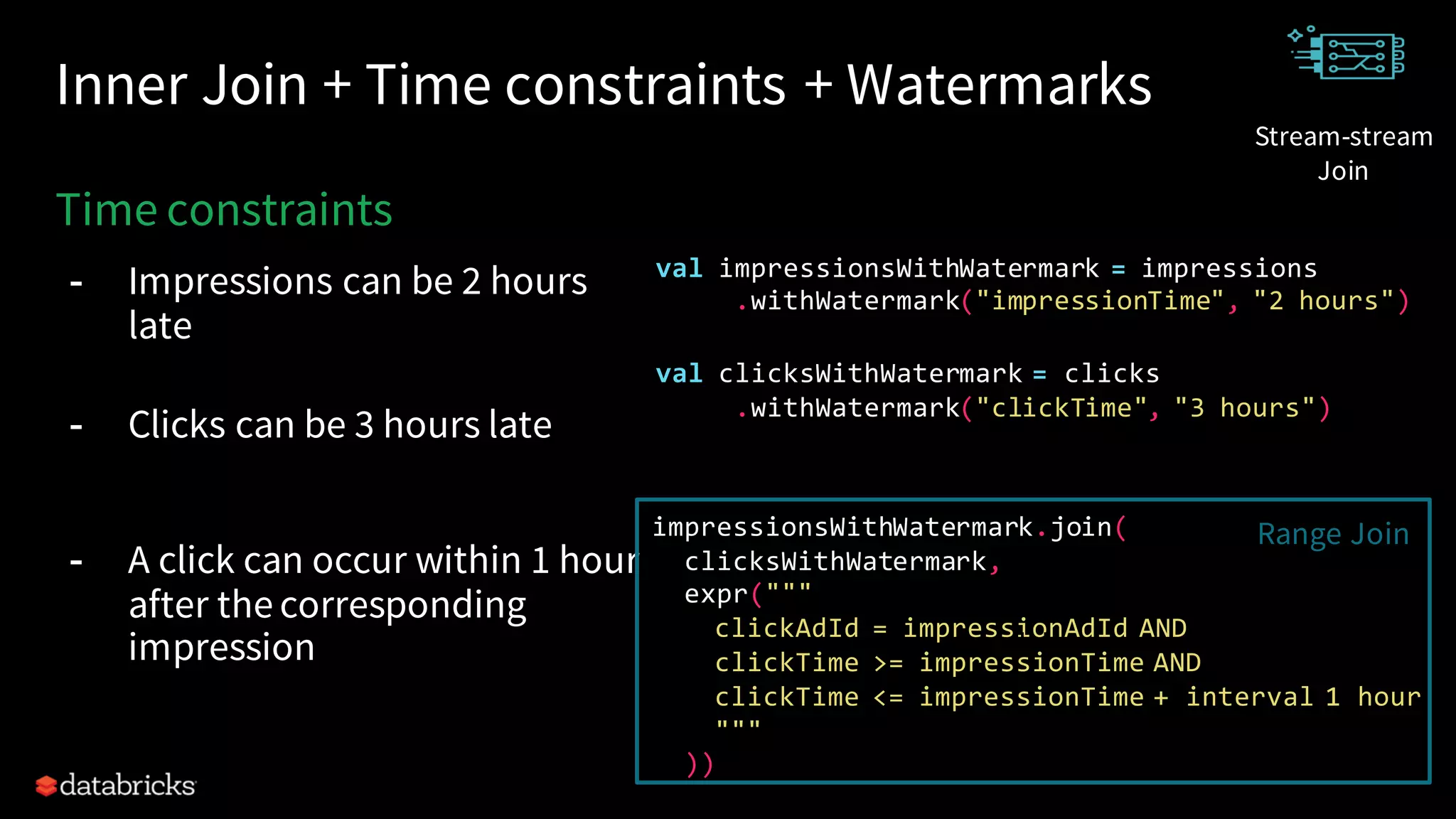
Inner Join + Time constraints + Watermarks
time constraints
Time constraints
- Impressions can be 2 hours
late
- Clicks can be 3 hours late
- A click can occur within 1 hour
after the corresponding
impression
val impressionsWithWatermark = impressions
.withWatermark("impressionTime", "2 hours")
val clicksWithWatermark = clicks
.withWatermark("clickTime", "3 hours")
impressionsWithWatermark.join(
clicksWithWatermark,
expr("""
clickAdId = impressionAdId AND
clickTime >= impressionTime AND
clickTime <= impressionTime + interval 1 hour
"""
))
Join
Range Join
Stream-stream
Join
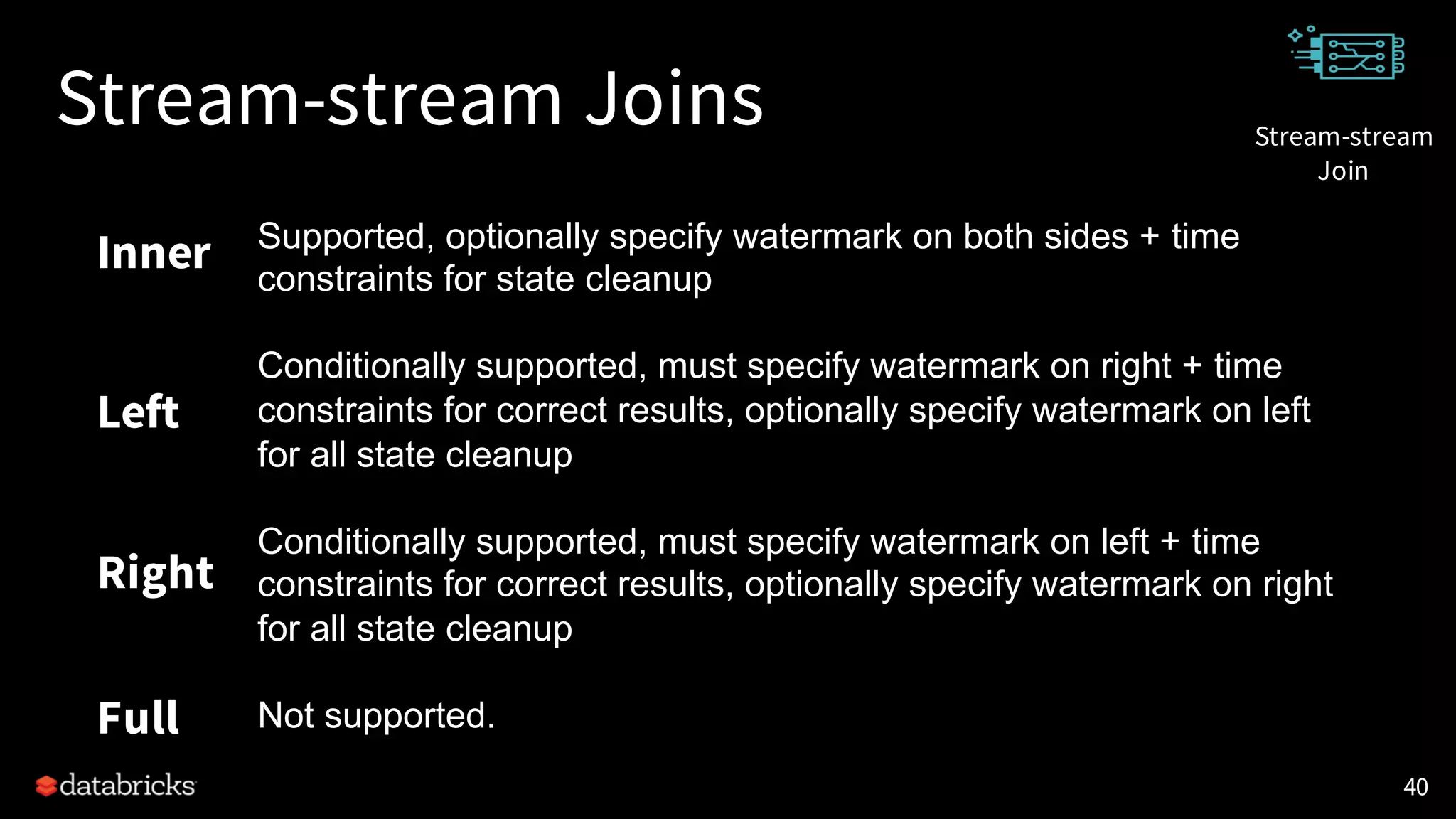
Stream-stream Joins
Inner
40
Supported, optionally specify watermark on both sides + time
constraints for state cleanup
Conditionally supported, must specify watermark on right + time
constraints for correct results, optionally specify watermark on left
for all state cleanup
Conditionally supported, must specify watermark on left + time
constraints for correct results, optionally specify watermark on right
for all state cleanup
Not supported.
Left
Right
Full
Stream-stream
Join
Major Features on Spark 2.3
41
Continuous
Processing
Data Source
API V2
Stream-stream
Join
Spark on
Kubernetes
History
Server V2
UDF
Enhancements
Various SQL
Features
PySpark
Performance
Native ORC
Support
Stable
Codegen
Image
Reader
ML on
Streaming
What’s Wrong With V1?
• Leak upper level API in the data source (DataFrame/SQLContext)
• Hard to extend the Data Source API for more optimizations
• Zero transaction guarantee in the write APIs
Data Source
API V2
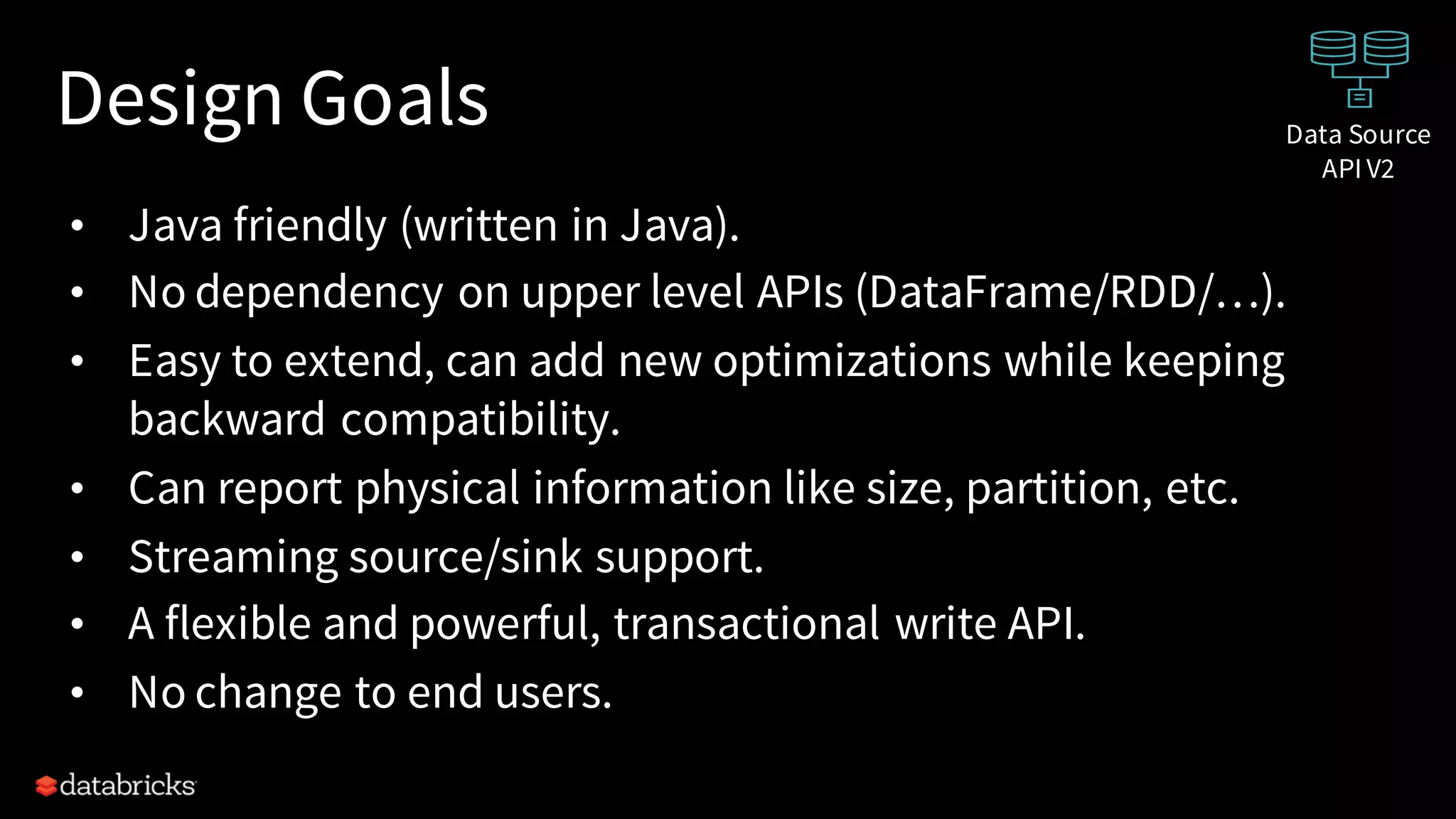
Design Goals
• Java friendly (written in Java).
• No dependency on upper level APIs (DataFrame/RDD/…).
• Easy to extend, can add new optimizations while keeping
backward compatibility.
• Can report physical information like size, partition, etc.
• Streaming source/sink support.
• A flexible and powerful, transactional write API.
• No change to end users.
Data Source
API V2
Features in Spark 2.3
• Support both row-based scan and columnar scan.
• Column pruning and filter pushdown.
• Can report basic statistics and data partitioning.
• Transactional write API.
• Streaming source and sink support for both micro-batch
and continuous mode.
• Spark 2.4 + : more enhancements
Data Source
API V2
Major Features on Spark 2.3
45
Continuous
Processing
Data Source
API V2
Stream-stream
Join
Spark on
Kubernetes
History
Server V2
UDF
Enhancements
Various SQL
Features
PySpark
Performance
Native ORC
Support
Stable
Codegen
Image
Reader
ML on
Streaming
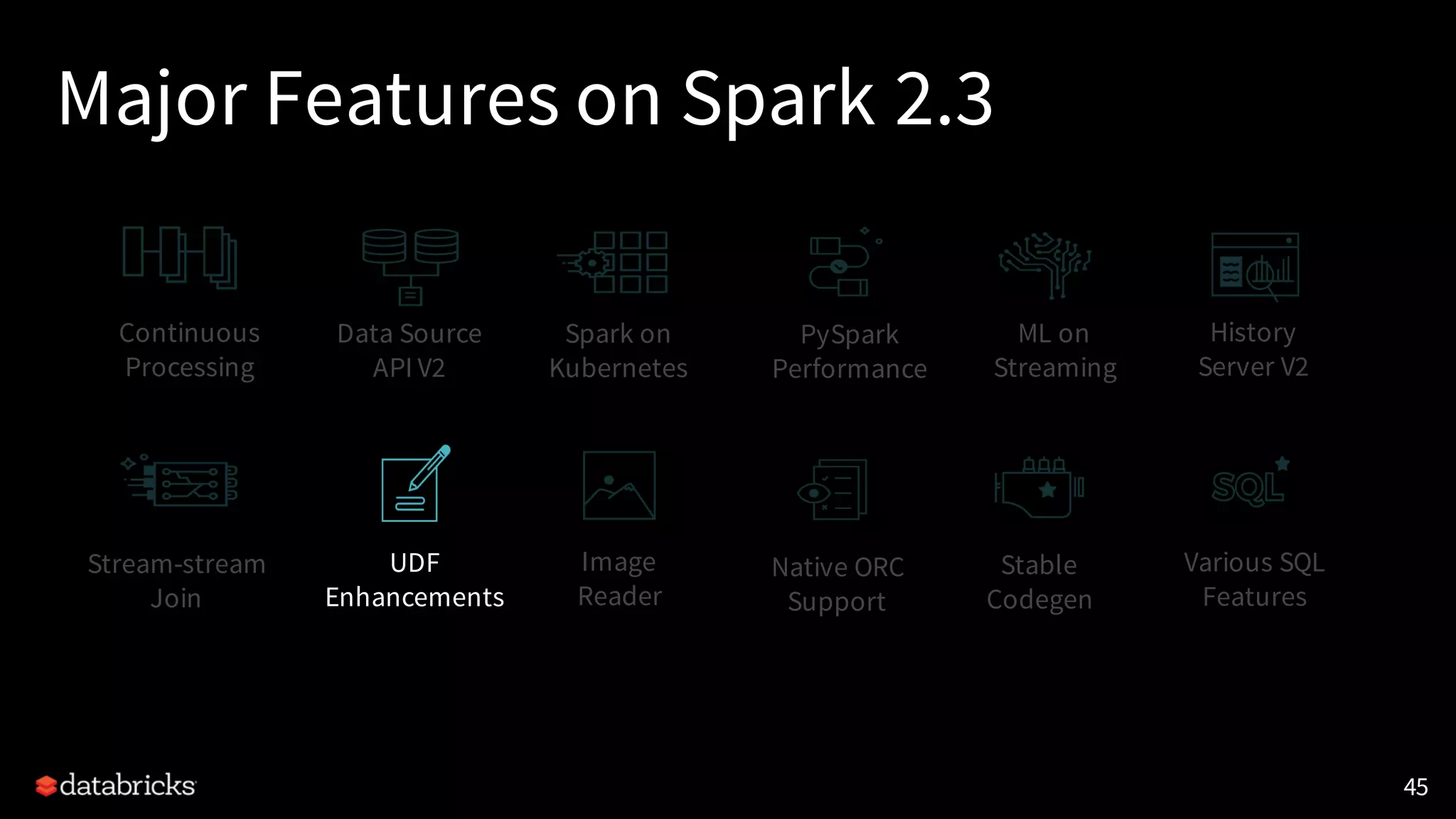
UDF Enhancement
• [SPARK-19285] Implement UDF0 (SQL UDF that has 0 arguments)
• [SPARK-22945] Add java UDF APIs in the functions object
• [SPARK-21499] Support creating SQL function for Spark
UDAF(UserDefinedAggregateFunction)
• [SPARK-20586][SPARK-20416][SPARK-20668] AnnotateUDF with
Name, Nullability and Determinism
46
UDF
Enhancements
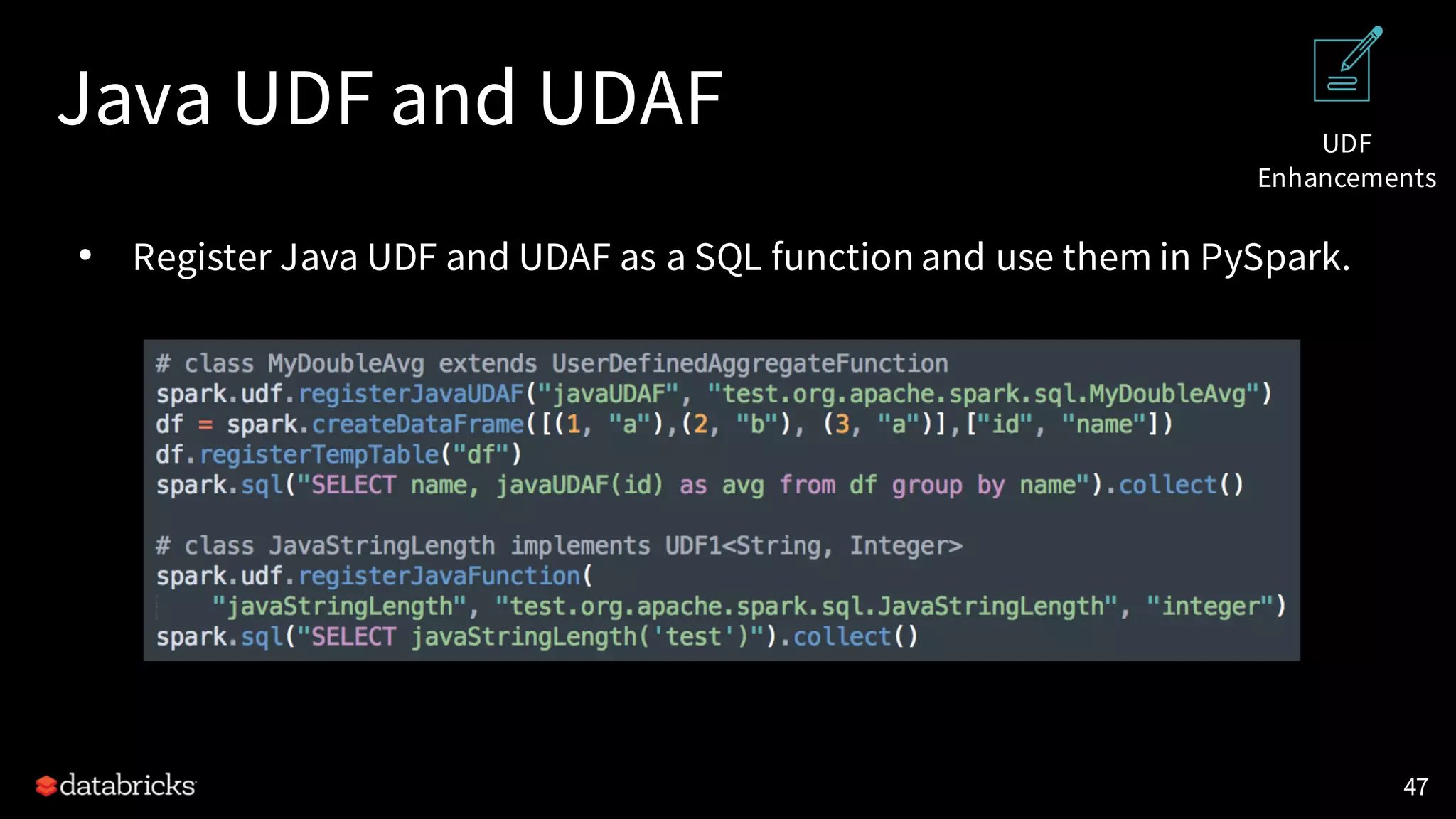
Java UDF and UDAF
47
UDF
Enhancements
• Register Java UDF and UDAF as a SQL function and use them in PySpark.
Major Features on Spark 2.3
48
Continuous
Processing
Data Source
API V2
Stream-stream
Join
Spark on
Kubernetes
History
Server V2
UDF
Enhancements
Various SQL
Features
PySpark
Performance
Native ORC
Support
Stable
Codegen
Image
Reader
ML on
Streaming
Stable Codegen
• [SPARK-22510] [SPARK-22692] Stabilize the codegen
framework to avoid hitting the 64KB JVM bytecode limit
on the Java method and Java compiler constant pool
limit.
• [SPARK-21871] Turn off whole-stage codegen when the
bytecode of the generated Java function is larger than
spark.sql.codegen.hugeMethodLimit. The limit of
method bytecode for JIT optimization on HotSpot is 8K.
49
Stable
Codegen
Major Features on Spark 2.3
50
Continuous
Processing
Data Source
API V2
Stream-stream
Join
Spark on
Kubernetes
History
Server V2
UDF
Enhancements
Various SQL
Features
PySpark
Performance
Native ORC
Support
Stable
Codegen
Image
Reader
ML on
Streaming
Vectorized ORC Reader
• [SPARK-20682] Add new ORCFileFormat based on ORC 1.4.1.
spark.sql.orc.impl= native (default) / hive (Hive 1.2.1)
• [SPARK-16060] Vectorized ORC reader
spark.sql.orc.enableVectorizedReader = true (default) / false
• Enable filter pushdown for ORC files by default
51
Major Features on Spark 2.3
52
Continuous
Processing
Data Source
API V2
Stream-stream
Join
Spark on
Kubernetes
History
Server V2
UDF
Enhancements
Various SQL
Features
PySpark
Performance
Native ORC
Support
Stable
Codegen
Image
Reader
ML on
Streaming
Performance
• [SPARK-21975]Histogram support in cost-based optimizer
• Enhancementsin rule-based optimizer and planner
[SPARK-22489][SPARK-22916][SPARK-22895][SPARK-20758]
[SPARK-22266][SPARK-19122][SPARK-22662][SPARK-21652]
(e.g., constant propagation)
• [SPARK-20331]Broaden support for Hive partition pruning
predicate pushdown. (e.g. date = 20161011 or date = 20161014)
• [SPARK-20822]Vectorizedreader for table cache
53
API
• Improved ANSI SQL compliance and Dataset/DataFrame APIs
• More built-in functions [SPARK-20746]
• Better Hive compatibility
• [SPARK-20236] Support Dynamic Partition Overwrite
• [SPARK-17729] Enable Creating Hive Bucketed Tables
• [SPARK-4131] Support INSERT OVERWRITE DIRECTORY
54
Major Features on Spark 2.3
55
Continuous
Processing
Data Source
API V2
Stream-stream
Join
Spark on
Kubernetes
History
Server V2
UDF
Enhancements
Various SQL
Features
PySpark
Performance
Native ORC
Support
Stable
Codegen
Image
Reader
ML on
Streaming
History Server Using K-V Store
Stateless and non-scalableHistory Server V1:
• Requires parsing the event logs (that means, so slow!)
• Requires storing app lists and UI in the memory (and then OOM!)
[SPARK-18085] K-V store-based History Server V2:
• Store app lists and UI in a persistent K-V store (LevelDB)
• spark.history.store.path – once specified, LevelDB is being used;
otherwise, in-memoryKV-store (still stateless like V1)
• V2 still can read the event log wrote by V1
56
History
Server V2
Thank you
57

What's New in Upcoming Apache Spark 2.3

  • 1.
    What's New inUpcoming Apache Spark 2.3? Xiao Li Feb 8, 2018
  • 2.
    About Me • SoftwareEngineerat Databricks • Apache Spark Committer and PMC Member • Previously, IBM Master Inventor • Spark SQL, Database Replication,Information Integration • Ph.D. in University of Florida • Github: gatorsmile
  • 3.
    Simplify Big Dataand AI with Databricks Unified Analytics Platform DATA WAREHOUSESCLOUD STORAGE HADOOP STORAGEIoT / STREAMING DATA DATABRICKS SERVERLESSRemoves Devops & Infrastructure Complexity DATABRICKS RUNTIME Reliability Eliminates Disparate Tools with Optimized Spark Explore Data Train Models Serve Models DATABRICKS COLLABORATIVE NOTEBOOKSIncreases Data Science Productivity by 5x Databricks Enterprise Security Open Extensible API’s Accelerates & Simplifies Data Prep for Analytics Performance
  • 4.
    Databricks Customers AcrossIndustries Financial Services Healthcare & Pharma Media & Entertainment Technology Public Sector Retail & CPG Consumer Services Energy & Industrial IoTMarketing & AdTech Data & Analytics Services
  • 5.
    This Talk 5 Continuous Processing Spark on Kubernetes PySpark Performance StreamingML + ImageReader Databricks Delta OSS Apache Spark 2.3 Databricks Runtime4.0
  • 6.
    Major Features onSpark 2.3 6 Continuous Processing Data Source API V2 Stream-stream Join Spark on Kubernetes History Server V2 UDF Enhancements Various SQL Features PySpark Performance Native ORC Support Stable Codegen Image Reader ML on Streaming Over 1300issues resolved!
  • 7.
  • 8.
    Structured Streaming stream processingon Spark SQL engine fast, scalable, fault-tolerant rich, unified, high level APIs deal with complex data and complex workloads rich ecosystem of data sources integrate with many storage systems
  • 9.
    Structured Streaming Introducedin Spark2.0 Among Databricks customers: - 10X more usagethan DStream - Processed100+ trillion recordsin production
  • 10.
  • 11.
    Continuous Processing ExecutionMode Micro-batch Processing (since 2.0 release) • Lower end-to-end latencies of ~100ms • Exactly-once fault-tolerance guarantees Continuous Processing (since 2.3 release) [SPARK-20928] • A new streaming execution mode (experimental) • Low (~1 ms) end-to-end latency • At-least-once guarantees 11
  • 12.
  • 13.
    Continuous Processing Supported Operations: •Map-like Dataset operations • projections • selections • All SQL functions • Except current_timestamp(), current_date() and aggregation functions 13 Supported Sources: • Kafka source • Rate source Supported Sinks: • Kafka sink • Memory sink • Console sink Continuous Processing
  • 14.
  • 15.
    ML on Streaming Modeltransformation/prediction on batch and streaming data with unified API. After fitting a model or Pipeline, you can deploy it in a streaming job. val streamOutput = transformer.transform(streamDF) 15 ML on Streaming
  • 16.
  • 17.
    Image Support inSpark Spark Image data source SPARK-21866 : • Defined a standard API in Spark for reading images into DataFrames • Deep learning frameworks can rely on this. val df = ImageSchema.readImages("/data/images") 17 Image Reader
  • 18.
  • 19.
    PySpark Introducedin Spark 0.7(~2013); became first class citizen in the DataFrame API in Spark 1.3 (~2015) Much slower than Scala/Java with user-defined functions (UDF), due to serialization & Python interpreter Note: Most PyData tooling, e.g. Pandas, numpy, are written in C++
  • 20.
    PySpark Performance Fast dataserialization and execution using vectorized formats [SPARK-22216] [SPARK-21187] • Conversion from/to Pandas df.toPandas() createDataFrame(pandas_df) • Pandas/Vectorized UDFs: UDF using Pandas to process data • Scalar Pandas UDFs • Grouped Map Pandas UDFs 20
  • 21.
  • 22.
    Pandas UDF • Usedwith functions such as select and withColumn. • The Python function should take pandas.Seriesas inputs and return a pandas.Seriesof the same length. 22 Scalar PandasUDFs:
  • 23.
    Pandas UDF 23 Grouped MapPandasUDFs: • Split-apply-combine • A Python function that defines the computation for each group. • The output schema
  • 24.
  • 25.
  • 27.
    Native Spark Appin K8S • New Spark scheduler backend • Driver runs in a Kubernetespod created by the submission client and creates pods that run the executors in response to requests from the Spark scheduler. [K8S-34377] [SPARK-18278] • Make direct use of Kubernetes clusters for multi-tenancy and sharing through Namespaces and Quotas, as well as administrative features such as Pluggable Authorization, and Logging. 27 on
  • 28.
    Spark on Kubernetes Supported: •Supports Kubernetes1.6 and up • Supports cluster mode only • Staticresource allocation only • Supports Java and Scala applications • Can use container-local and remote dependencies that are downloadable 28 In roadmap (2.4): • Client mode • Dynamic resource allocation + external shuffle service • Python and R support • Submission client local dependencies + Resource staging server (RSS) • Non-secured and KerberizedHDFS access (injection of Hadoop configuration)
  • 29.
  • 30.
    30 What is DatabricksDelta? Delta is a data managementcapability that brings data reliability and performance optimizations to the cloud data lake. Key Capabilities - Transactions & Indexing
  • 31.
    31 Standard data pipelineswith Spark Raw Data InsightData Lake Big data pipelines /ETL Multiple data sources Batch & streaming data Machine Learning /AI Real-time /streaming analytics (Complex)SQL analytics ETL Analytics
  • 32.
    32 Yet challenges stillremain Raw Data InsightData Lake Reliability & Performance Problems • Performance degradation at scale for advanced analytics • Stale and unreliable dataslows analytic decisions Reliability and Complexity • Data corruption issues and broken pipelines • Complex workarounds - tedious scheduling and multiple jobs/staging tables • Many use cases require updates to existing data - not supported bySpark /Data lakes Big data pipelines /ETL Multiple data sources Batch & streaming data Machine Learning /AI Real-time /streaming analytics (Complex)SQL analytics Streaming magnifies these challenges AnalyticsETL
  • 33.
    33 Databricks Delta addressthese challenges Raw Data Insight ETL Analytics Big data pipelines /ETL Multiple data sources Batch & streaming data Machine Learning /AI Real-time /streaming analytics (Complex)SQL analytics DATABRICKS DELTA Builds on Cloud Data Lake Reliability & Automation Transactions guarantees eliminates complexity Schema enforcement to ensure clean data Upserts/Updates/Deletes tomanage data changes Seamlesslysupport streaming and batch Performance & Reliability Automatic indexing & caching Freshdata for advanced analytics Automated performance tuning
  • 34.
    Databricks Delta Underthe Hood • Use cloud object storage (e.g. AWS S3) • Decouple compute & storage • ACID compliant & data upserts • Schema evolution • Intelligent partitioning & compaction • Data skipping & indexing • Real-time streaming ingest • Structured streaming SCALE PERFORMANCE RELIABILITY LOW LATENCY
  • 35.
    35 Continuous Processing Spark on Kubernetes PySpark Performance Streaming ML + ImageReader Databricks Delta Trythese on Databricks Runtime 4.0 beta today! Communityedition: https://community.cloud.databricks.com/
  • 36.
  • 37.
    Major Features onSpark 2.3 37 Continuous Processing Data Source API V2 Stream-stream Join Spark on Kubernetes History Server V2 UDF Enhancements Various SQL Features PySpark Performance Native ORC Support Stable Codegen Image Reader ML on Streaming
  • 38.
    Stream-stream Joins 38 Stream-stream Join Example: AdMonetization Join stream of ad impressions with another stream of their corresponding user clicks
  • 39.
    Inner Join +Time constraints + Watermarks time constraints Time constraints - Impressions can be 2 hours late - Clicks can be 3 hours late - A click can occur within 1 hour after the corresponding impression val impressionsWithWatermark = impressions .withWatermark("impressionTime", "2 hours") val clicksWithWatermark = clicks .withWatermark("clickTime", "3 hours") impressionsWithWatermark.join( clicksWithWatermark, expr(""" clickAdId = impressionAdId AND clickTime >= impressionTime AND clickTime <= impressionTime + interval 1 hour """ )) Join Range Join Stream-stream Join
  • 40.
    Stream-stream Joins Inner 40 Supported, optionallyspecify watermark on both sides + time constraints for state cleanup Conditionally supported, must specify watermark on right + time constraints for correct results, optionally specify watermark on left for all state cleanup Conditionally supported, must specify watermark on left + time constraints for correct results, optionally specify watermark on right for all state cleanup Not supported. Left Right Full Stream-stream Join
  • 41.
    Major Features onSpark 2.3 41 Continuous Processing Data Source API V2 Stream-stream Join Spark on Kubernetes History Server V2 UDF Enhancements Various SQL Features PySpark Performance Native ORC Support Stable Codegen Image Reader ML on Streaming
  • 42.
    What’s Wrong WithV1? • Leak upper level API in the data source (DataFrame/SQLContext) • Hard to extend the Data Source API for more optimizations • Zero transaction guarantee in the write APIs Data Source API V2
  • 43.
    Design Goals • Javafriendly (written in Java). • No dependency on upper level APIs (DataFrame/RDD/…). • Easy to extend, can add new optimizations while keeping backward compatibility. • Can report physical information like size, partition, etc. • Streaming source/sink support. • A flexible and powerful, transactional write API. • No change to end users. Data Source API V2
  • 44.
    Features in Spark2.3 • Support both row-based scan and columnar scan. • Column pruning and filter pushdown. • Can report basic statistics and data partitioning. • Transactional write API. • Streaming source and sink support for both micro-batch and continuous mode. • Spark 2.4 + : more enhancements Data Source API V2
  • 45.
    Major Features onSpark 2.3 45 Continuous Processing Data Source API V2 Stream-stream Join Spark on Kubernetes History Server V2 UDF Enhancements Various SQL Features PySpark Performance Native ORC Support Stable Codegen Image Reader ML on Streaming
  • 46.
    UDF Enhancement • [SPARK-19285]Implement UDF0 (SQL UDF that has 0 arguments) • [SPARK-22945] Add java UDF APIs in the functions object • [SPARK-21499] Support creating SQL function for Spark UDAF(UserDefinedAggregateFunction) • [SPARK-20586][SPARK-20416][SPARK-20668] AnnotateUDF with Name, Nullability and Determinism 46 UDF Enhancements
  • 47.
    Java UDF andUDAF 47 UDF Enhancements • Register Java UDF and UDAF as a SQL function and use them in PySpark.
  • 48.
    Major Features onSpark 2.3 48 Continuous Processing Data Source API V2 Stream-stream Join Spark on Kubernetes History Server V2 UDF Enhancements Various SQL Features PySpark Performance Native ORC Support Stable Codegen Image Reader ML on Streaming
  • 49.
    Stable Codegen • [SPARK-22510][SPARK-22692] Stabilize the codegen framework to avoid hitting the 64KB JVM bytecode limit on the Java method and Java compiler constant pool limit. • [SPARK-21871] Turn off whole-stage codegen when the bytecode of the generated Java function is larger than spark.sql.codegen.hugeMethodLimit. The limit of method bytecode for JIT optimization on HotSpot is 8K. 49 Stable Codegen
  • 50.
    Major Features onSpark 2.3 50 Continuous Processing Data Source API V2 Stream-stream Join Spark on Kubernetes History Server V2 UDF Enhancements Various SQL Features PySpark Performance Native ORC Support Stable Codegen Image Reader ML on Streaming
  • 51.
    Vectorized ORC Reader •[SPARK-20682] Add new ORCFileFormat based on ORC 1.4.1. spark.sql.orc.impl= native (default) / hive (Hive 1.2.1) • [SPARK-16060] Vectorized ORC reader spark.sql.orc.enableVectorizedReader = true (default) / false • Enable filter pushdown for ORC files by default 51
  • 52.
    Major Features onSpark 2.3 52 Continuous Processing Data Source API V2 Stream-stream Join Spark on Kubernetes History Server V2 UDF Enhancements Various SQL Features PySpark Performance Native ORC Support Stable Codegen Image Reader ML on Streaming
  • 53.
    Performance • [SPARK-21975]Histogram supportin cost-based optimizer • Enhancementsin rule-based optimizer and planner [SPARK-22489][SPARK-22916][SPARK-22895][SPARK-20758] [SPARK-22266][SPARK-19122][SPARK-22662][SPARK-21652] (e.g., constant propagation) • [SPARK-20331]Broaden support for Hive partition pruning predicate pushdown. (e.g. date = 20161011 or date = 20161014) • [SPARK-20822]Vectorizedreader for table cache 53
  • 54.
    API • Improved ANSISQL compliance and Dataset/DataFrame APIs • More built-in functions [SPARK-20746] • Better Hive compatibility • [SPARK-20236] Support Dynamic Partition Overwrite • [SPARK-17729] Enable Creating Hive Bucketed Tables • [SPARK-4131] Support INSERT OVERWRITE DIRECTORY 54
  • 55.
    Major Features onSpark 2.3 55 Continuous Processing Data Source API V2 Stream-stream Join Spark on Kubernetes History Server V2 UDF Enhancements Various SQL Features PySpark Performance Native ORC Support Stable Codegen Image Reader ML on Streaming
  • 56.
    History Server UsingK-V Store Stateless and non-scalableHistory Server V1: • Requires parsing the event logs (that means, so slow!) • Requires storing app lists and UI in the memory (and then OOM!) [SPARK-18085] K-V store-based History Server V2: • Store app lists and UI in a persistent K-V store (LevelDB) • spark.history.store.path – once specified, LevelDB is being used; otherwise, in-memoryKV-store (still stateless like V1) • V2 still can read the event log wrote by V1 56 History Server V2
  • 57.