What’s in Your
Filter Bubble?Or,
how has the internet censored
                   you today?
• Personalization
• Editorial Role
• The web is a land
  of opportunity (ie $
  $$$$)
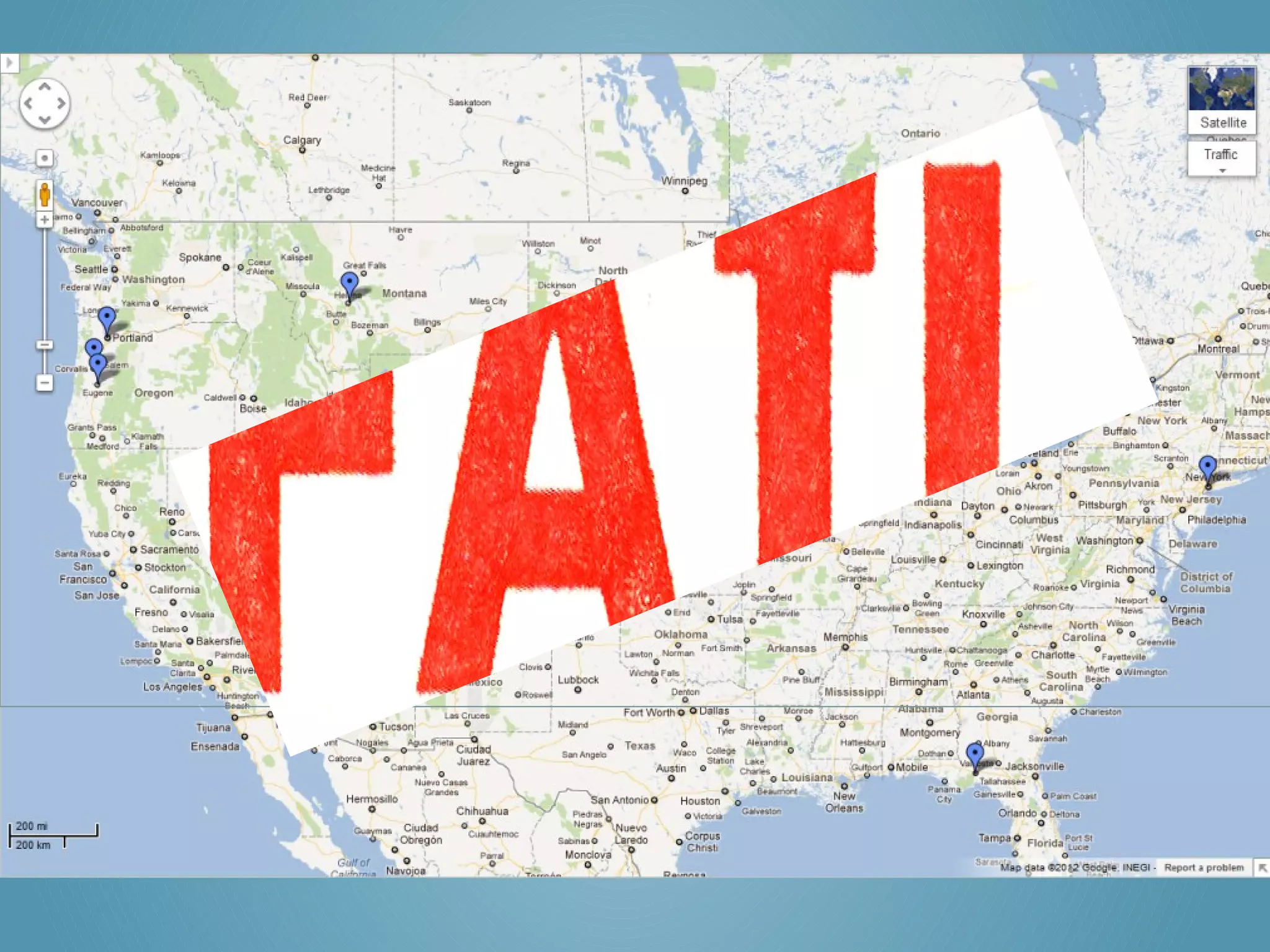
In Portland:
                                                                Me – 30s, Female, Librarian, far left

                                                                S. – 30s, male, PhD but works for a
                                                                health insurance company, Libertarian

                                                                D. – 40s, female, model maker, far left


                     In Helena:
                     A. – 30s, Female, Librarian, politics
                     unknown


In Corvallis:                                                     In NYC:
L. – 30s ?, Female, Librarian, politics                           D. – 30s, Female, Librarian, far
unknown                                                           left
In Eugene:                                                        L. – 30s, Female, Librarian, far left
M. – 30s, Female, Librarian, far left


                          In Tallahassee:
                          A. – 30s, Male, Librarian, politics
                          unknown
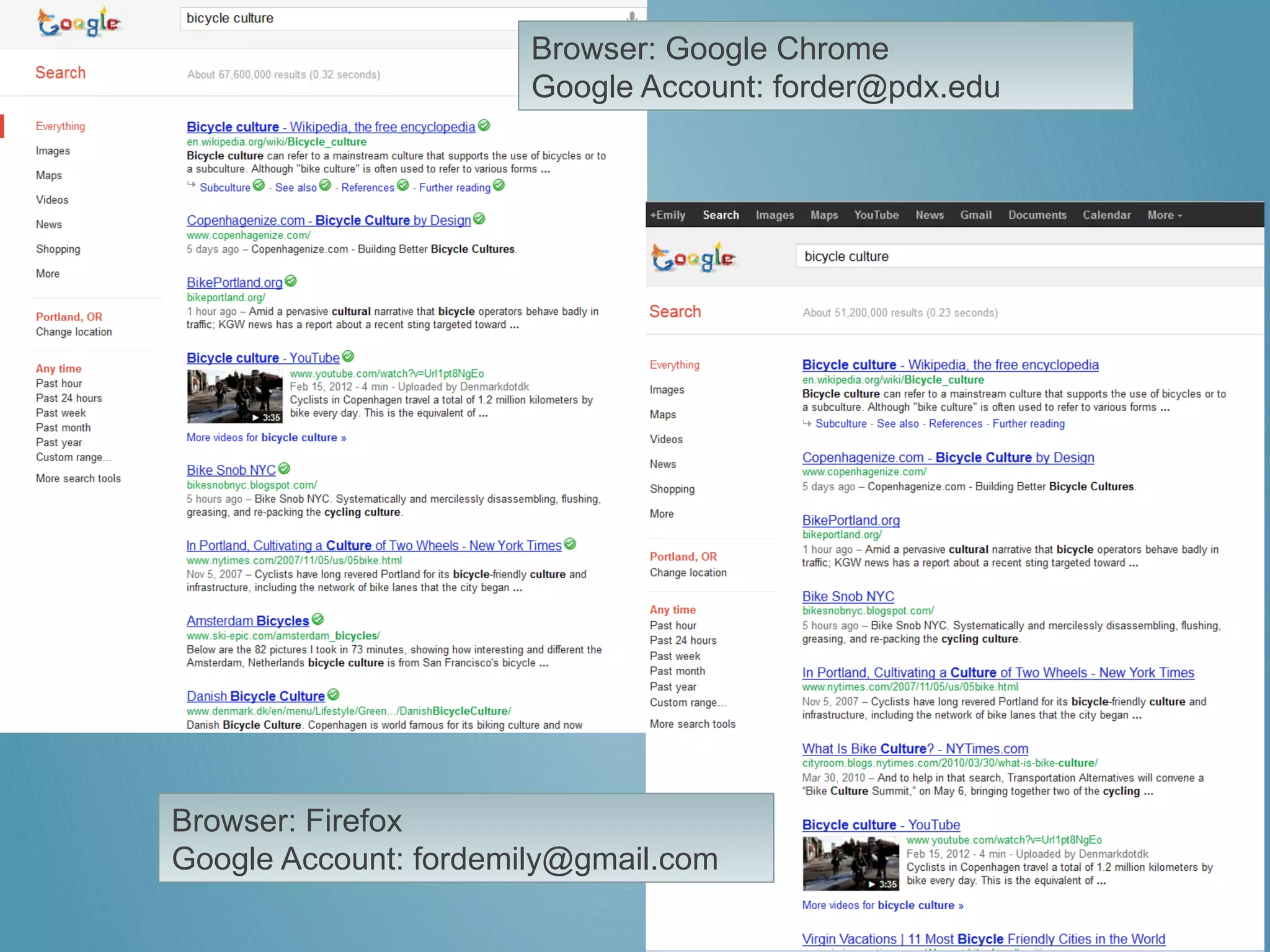
Browser: Google Chrome
                       Google Account: forder@pdx.edu


Browser: Firefox
Google Account: fordemily@gmail.com
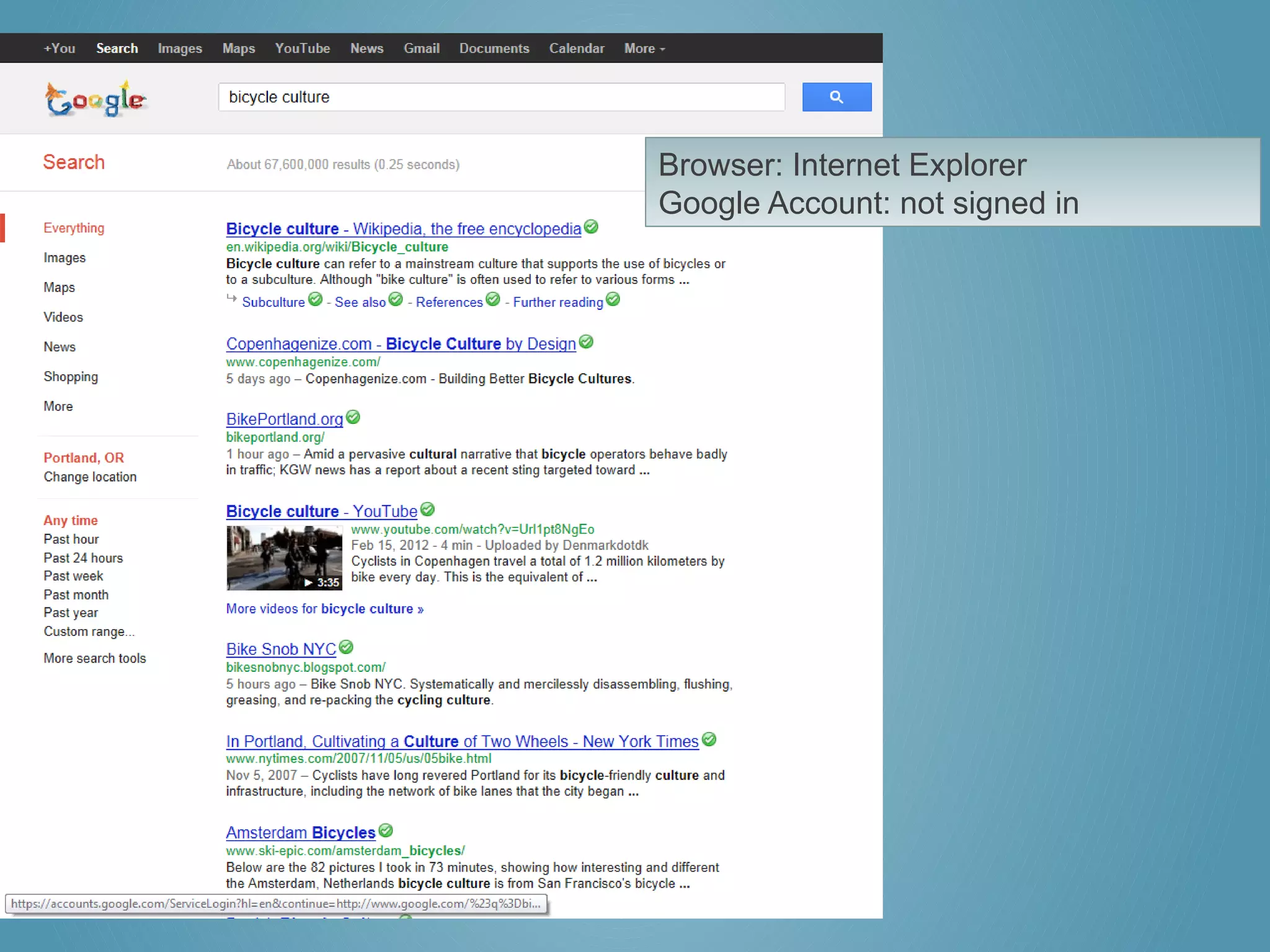
Browser: Internet Explorer
Google Account: not signed in
And then this
happened…
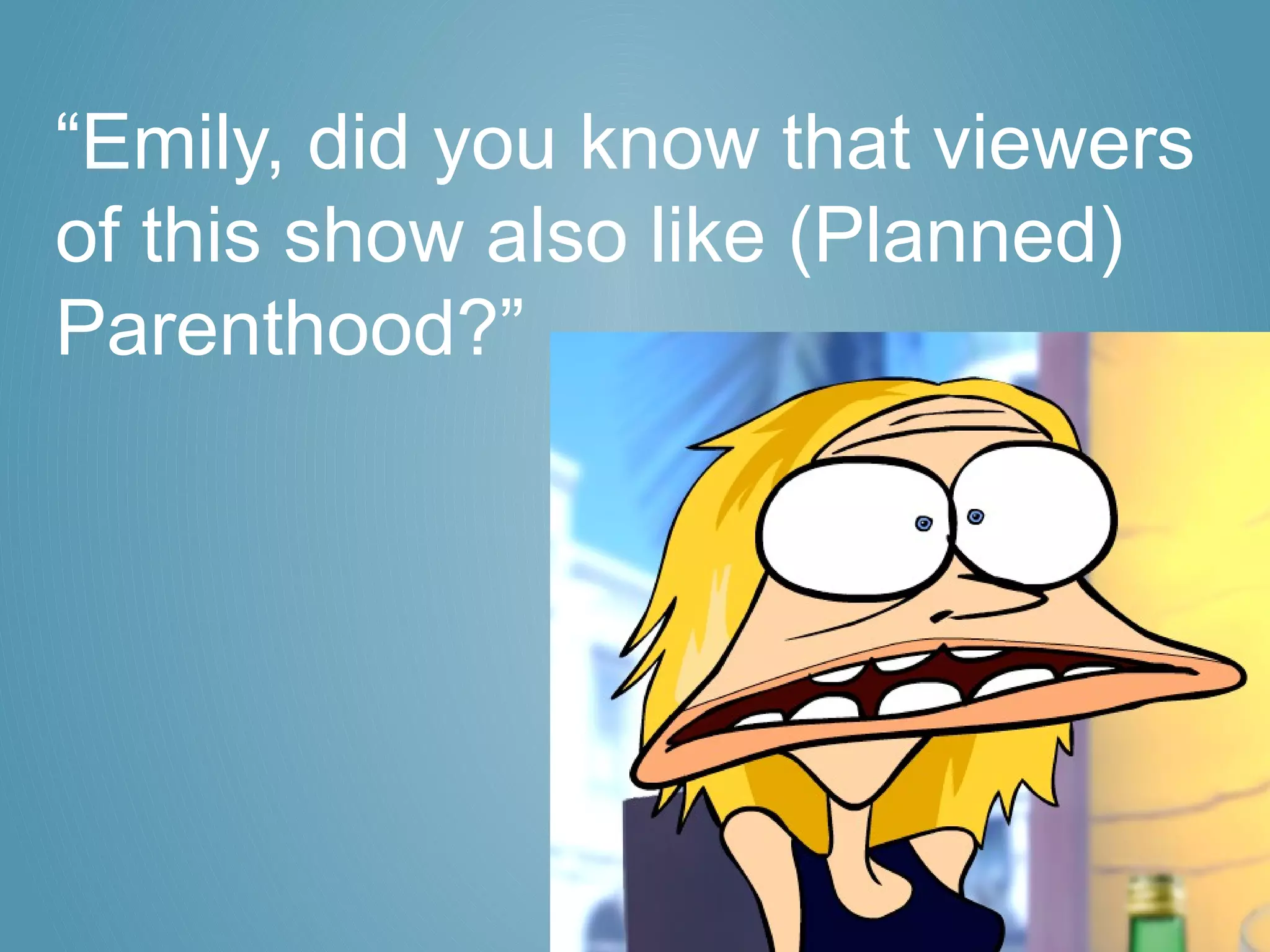
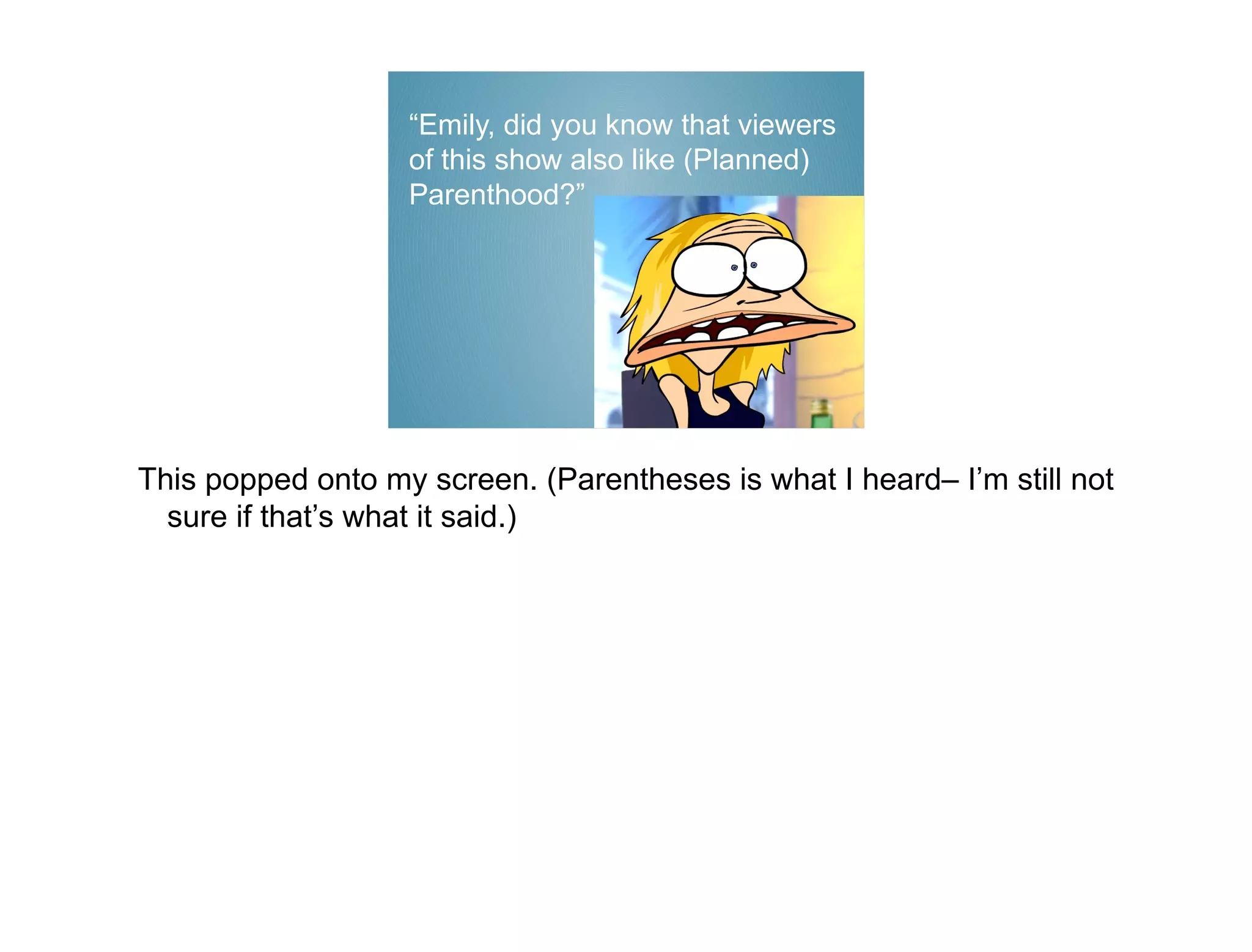
“Emily, did you know that viewers
of this show also like (Planned)
Parenthood?”
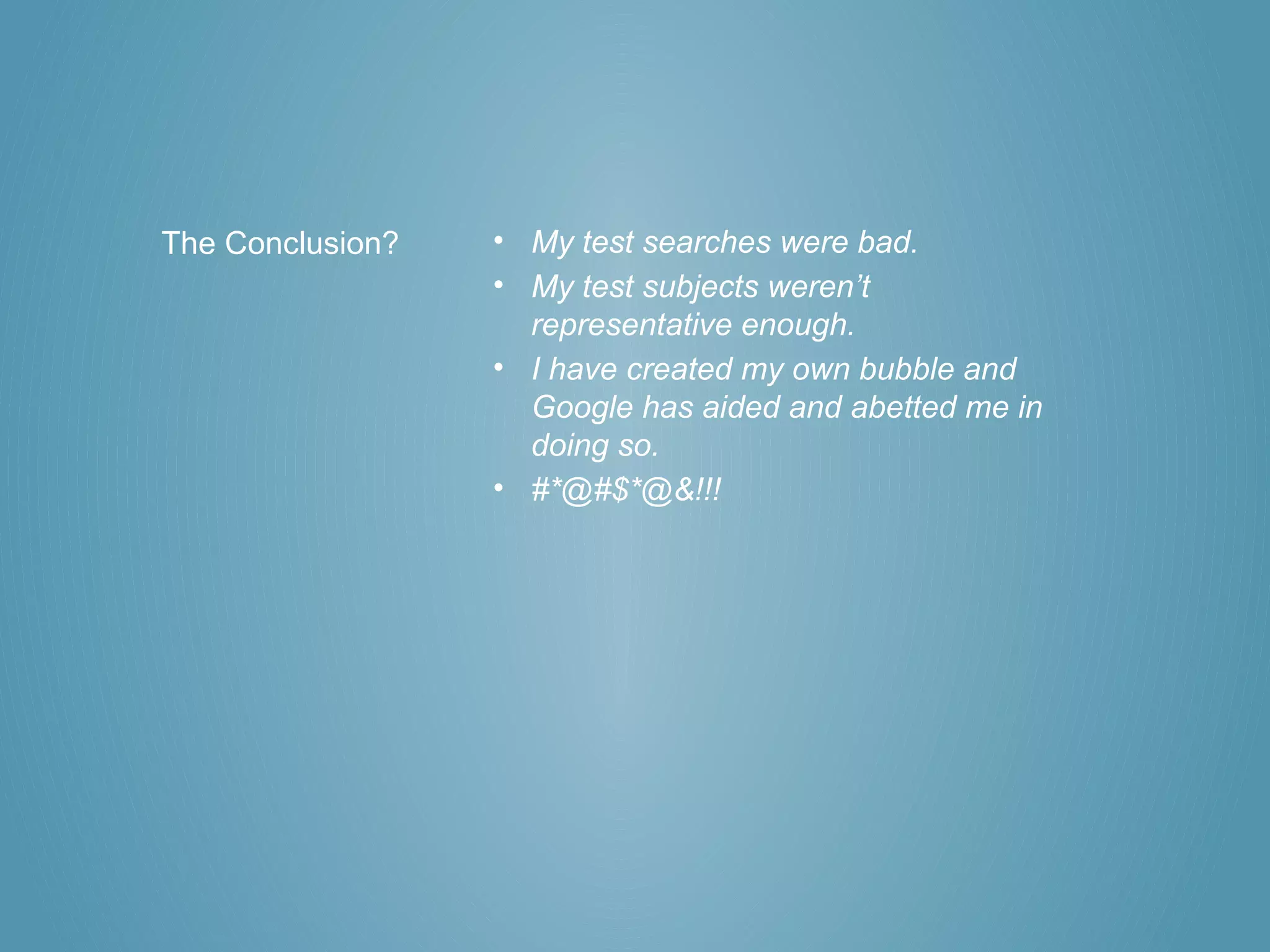
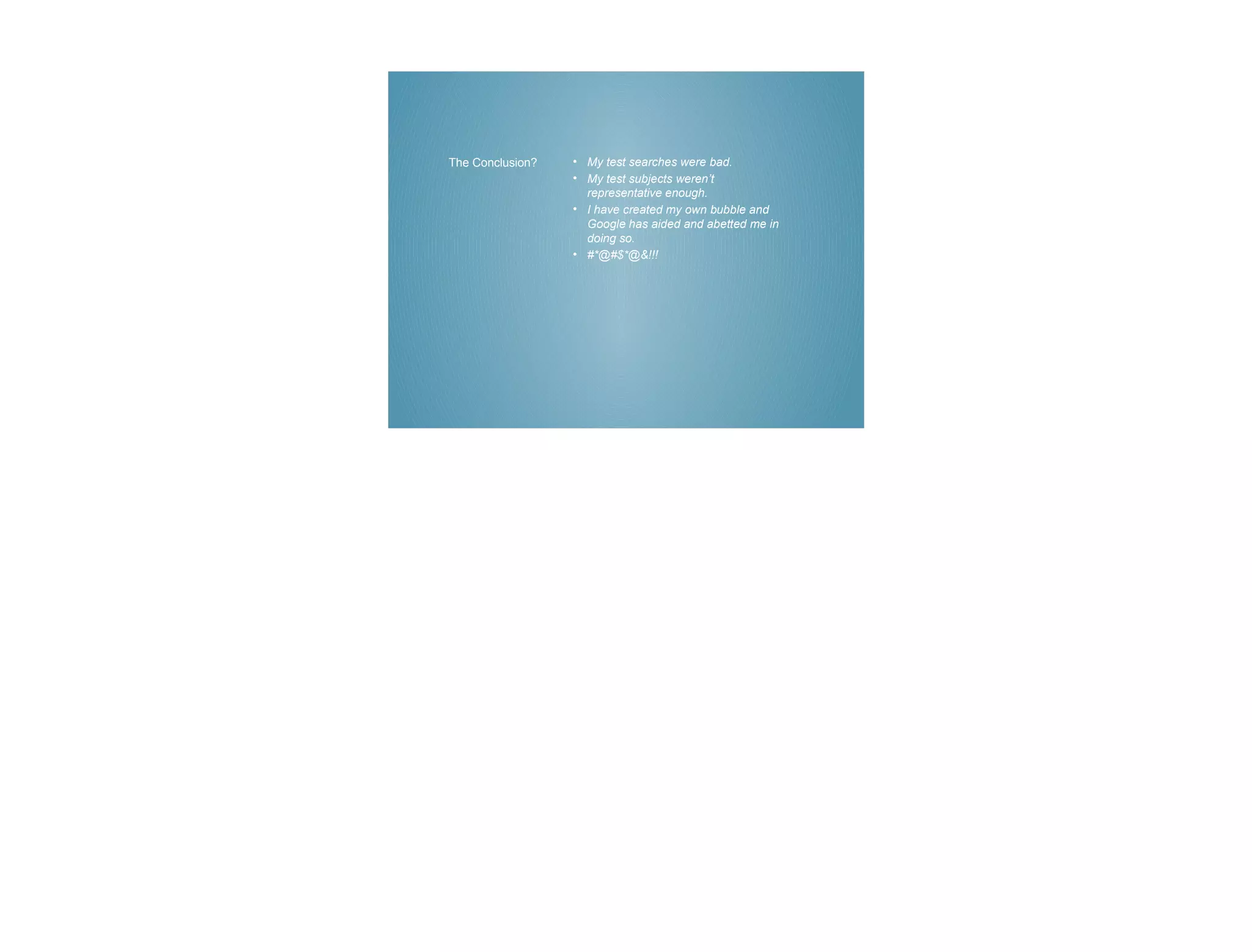
The Conclusion?   • My test searches were bad.
                  • My test subjects weren’t
                    representative enough.
                  • I have created my own bubble and
                    Google has aided and abetted me in
                    doing so.
                  • #*@#$*@&!!!
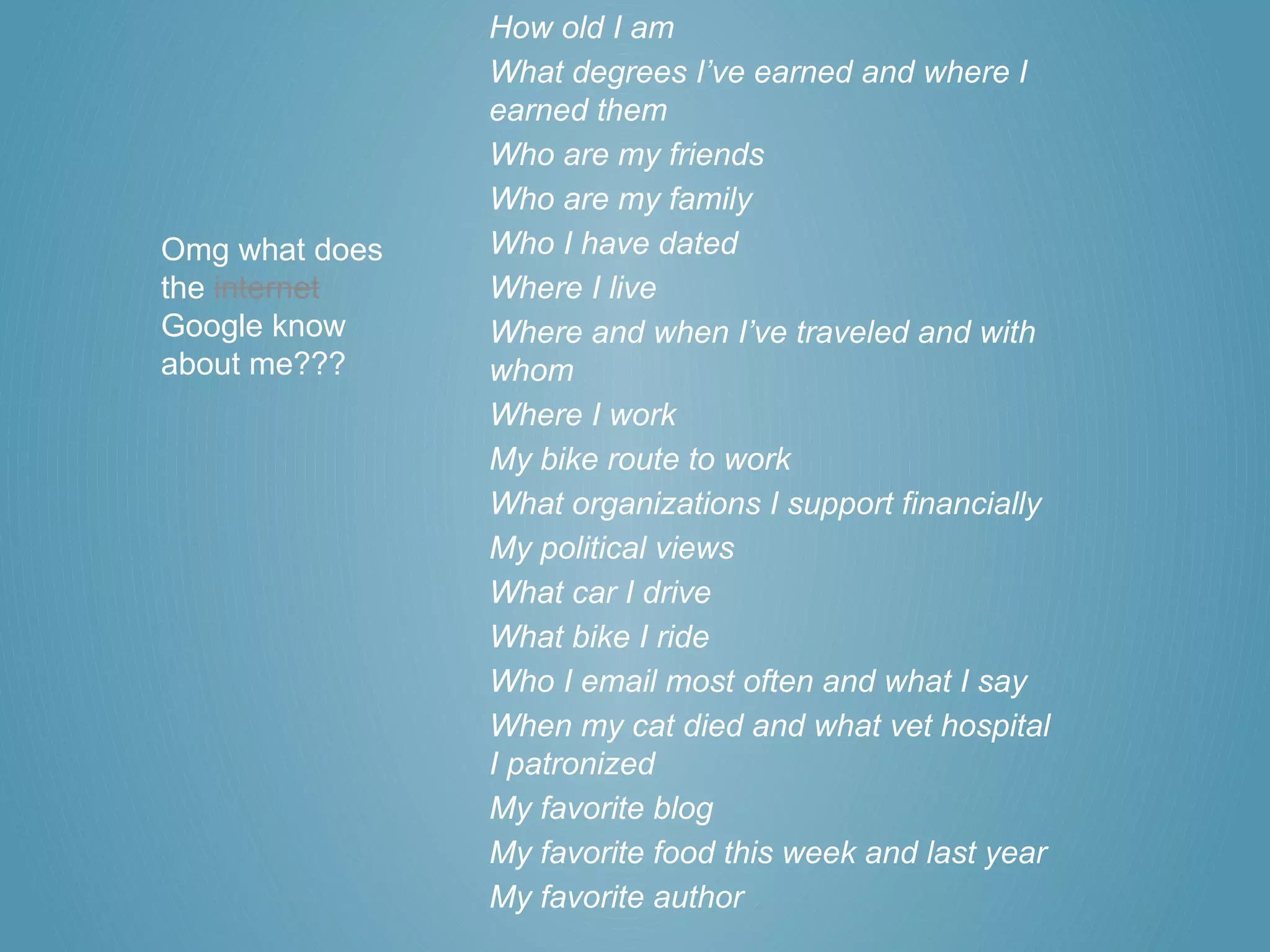
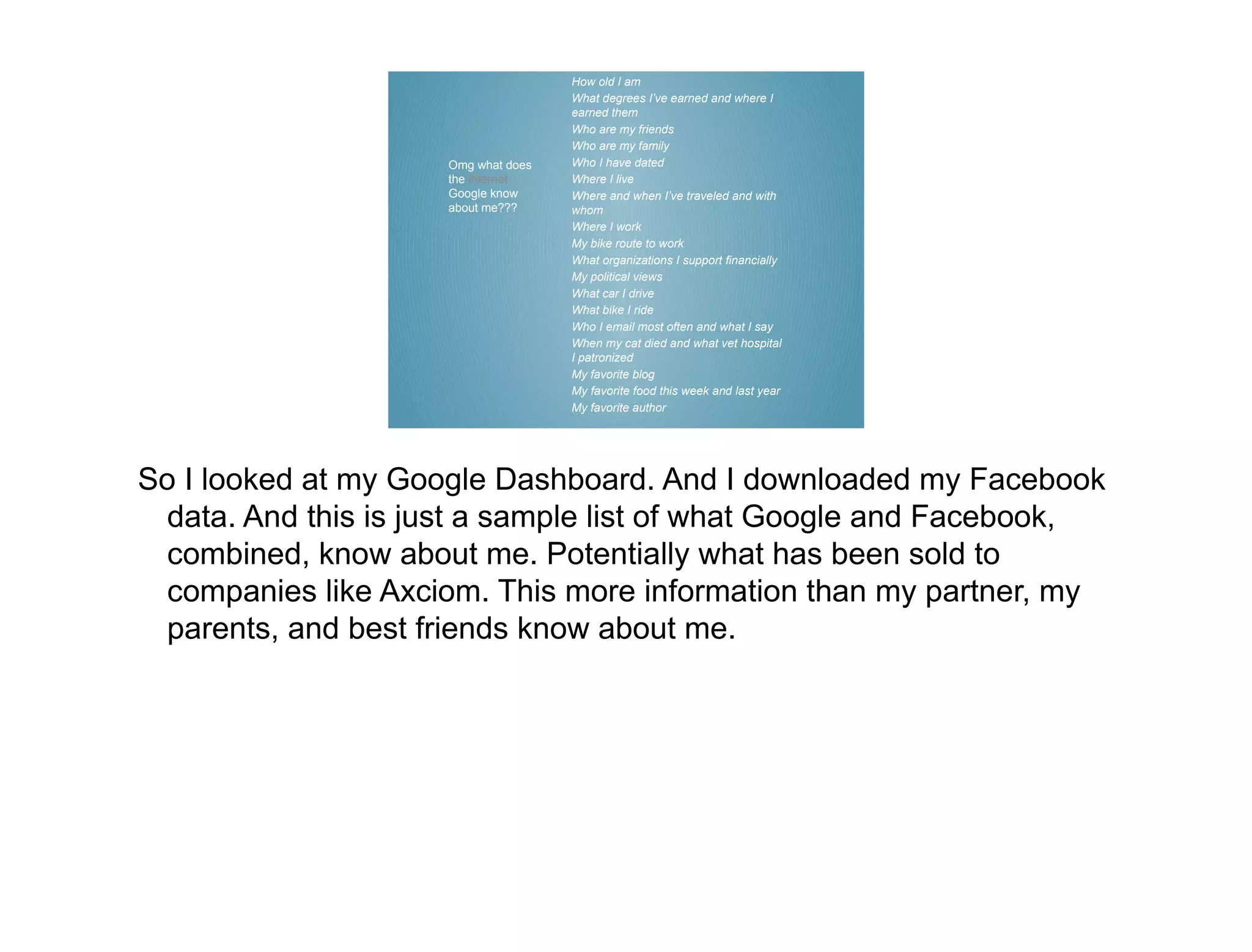
How old I am
                What degrees I’ve earned and where I
                earned them
                Who are my friends
                Who are my family
Omg what does   Who I have dated
the internet    Where I live
Google know     Where and when I’ve traveled and with
about me???     whom
                Where I work
                My bike route to work
                What organizations I support financially
                My political views
                What car I drive
                What bike I ride
                Who I email most often and what I say
                When my cat died and what vet hospital
                I patronized
                My favorite blog
                My favorite food this week and last year
                My favorite author
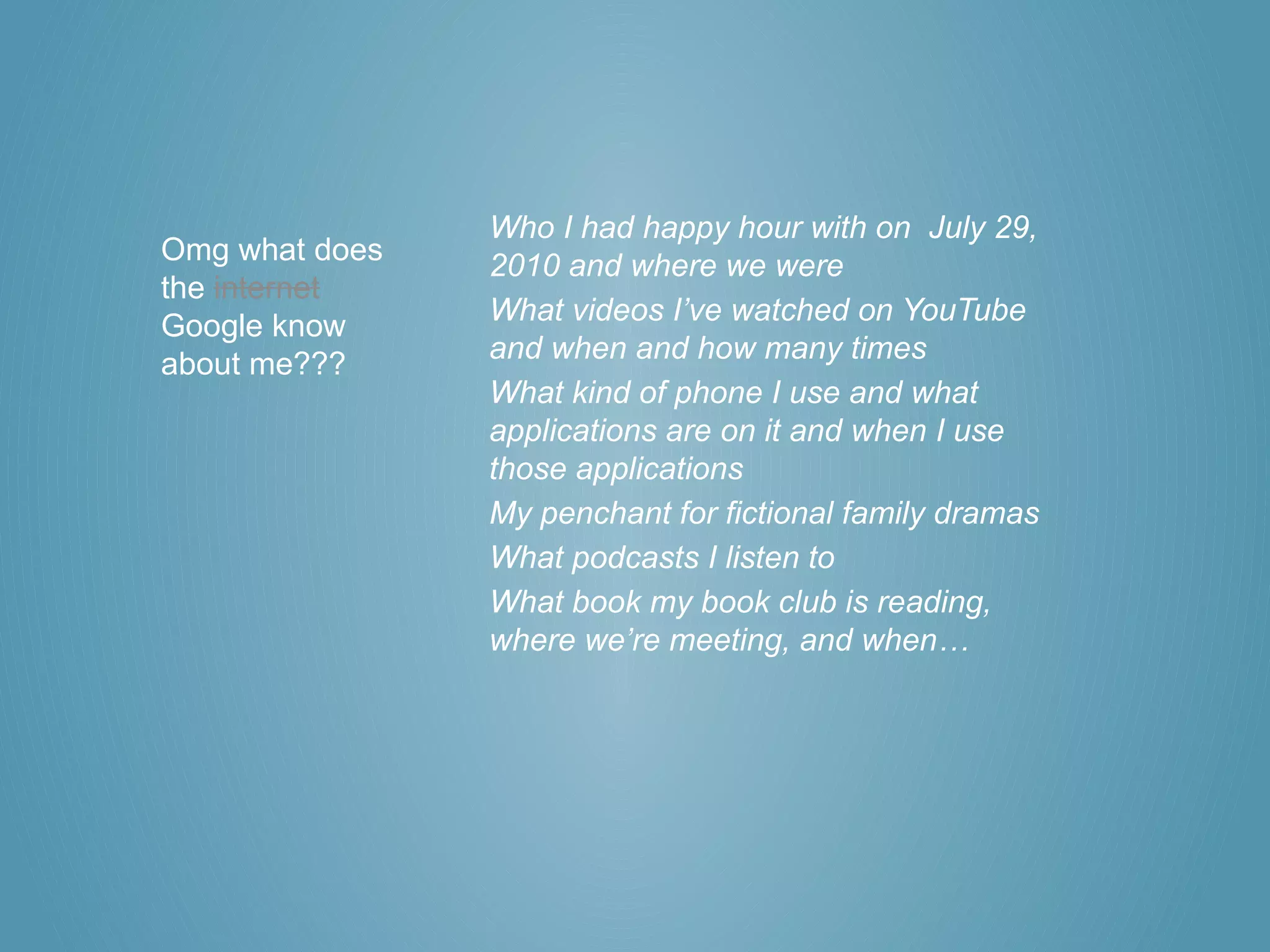
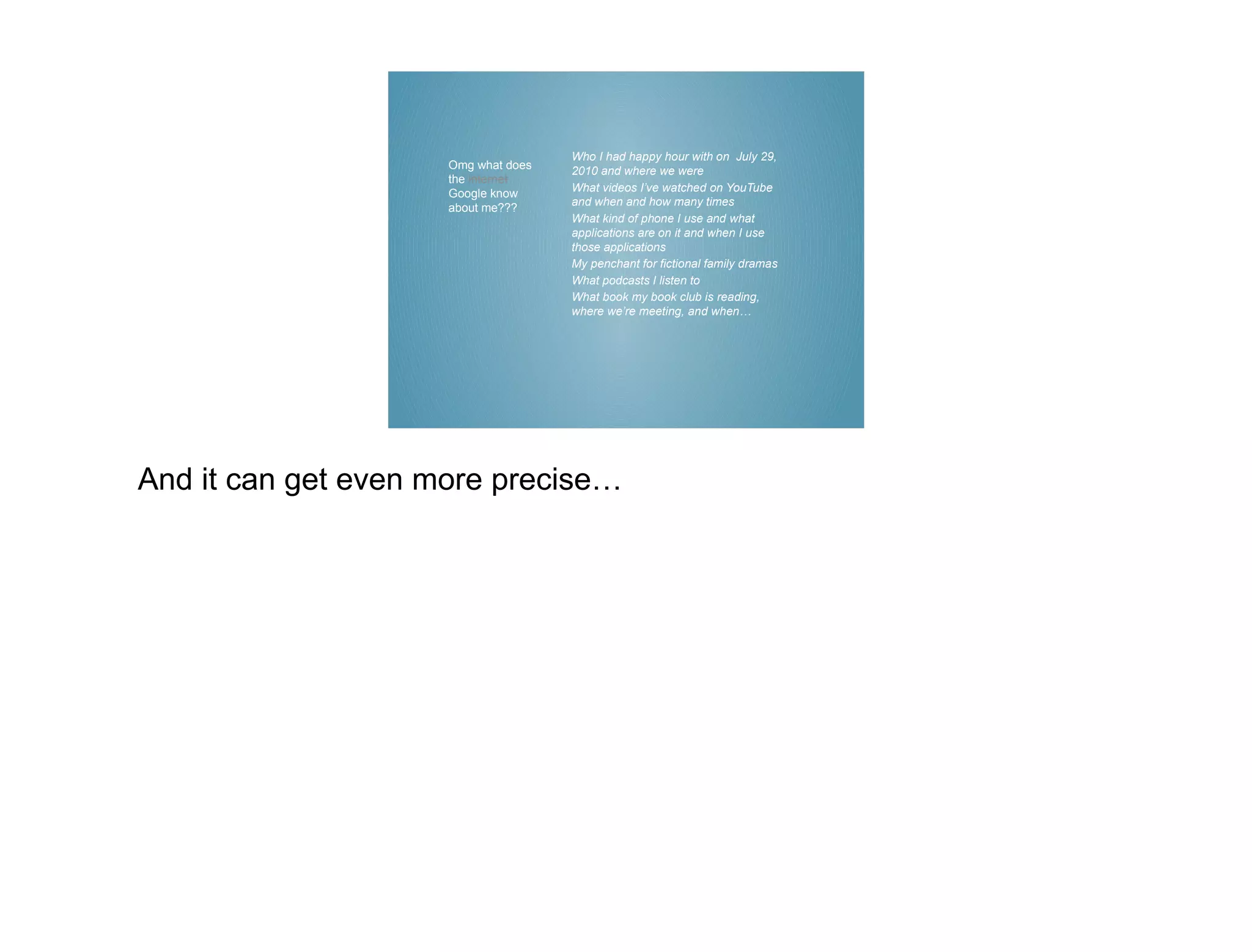
Who I had happy hour with on July 29,
Omg what does   2010 and where we were
the internet
                What videos I’ve watched on YouTube
Google know
                and when and how many times
about me???
                What kind of phone I use and what
                applications are on it and when I use
                those applications
                My penchant for fictional family dramas
                What podcasts I listen to
                What book my book club is reading,
                where we’re meeting, and when…
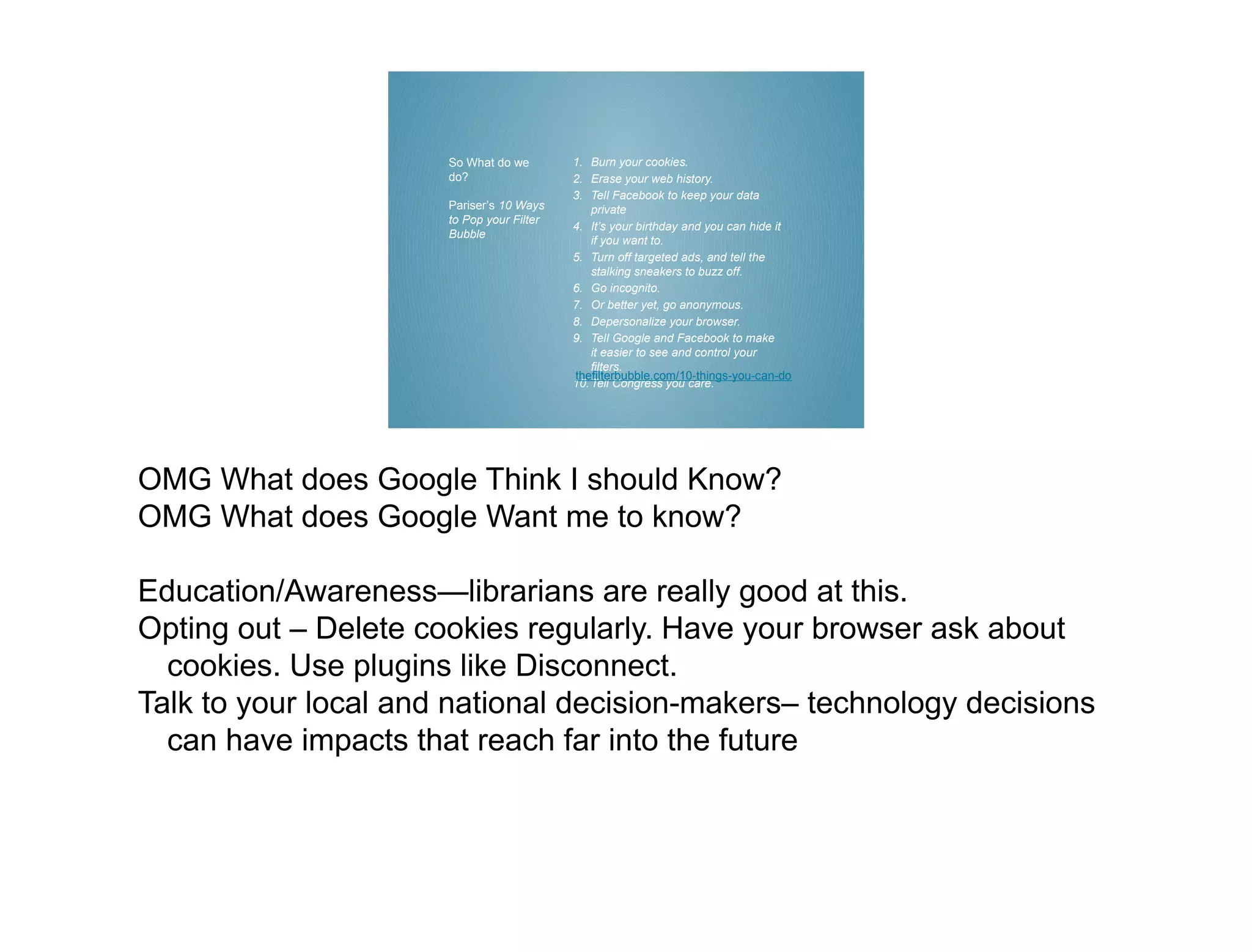
So What do we        1. Burn your cookies.
do?                  2. Erase your web history.
                     3. Tell Facebook to keep your data
Pariser’s 10 Ways        private
to Pop your Filter
                     4. It’s your birthday and you can hide it
Bubble
                         if you want to.
                     5. Turn off targeted ads, and tell the
                         stalking sneakers to buzz off.
                     6. Go incognito.
                     7. Or better yet, go anonymous.
                     8. Depersonalize your browser.
                     9. Tell Google and Facebook to make
                         it easier to see and control your
                         filters.
                     thefilterbubble.com/10-things-you-can-do
                     10. Tell Congress you care.
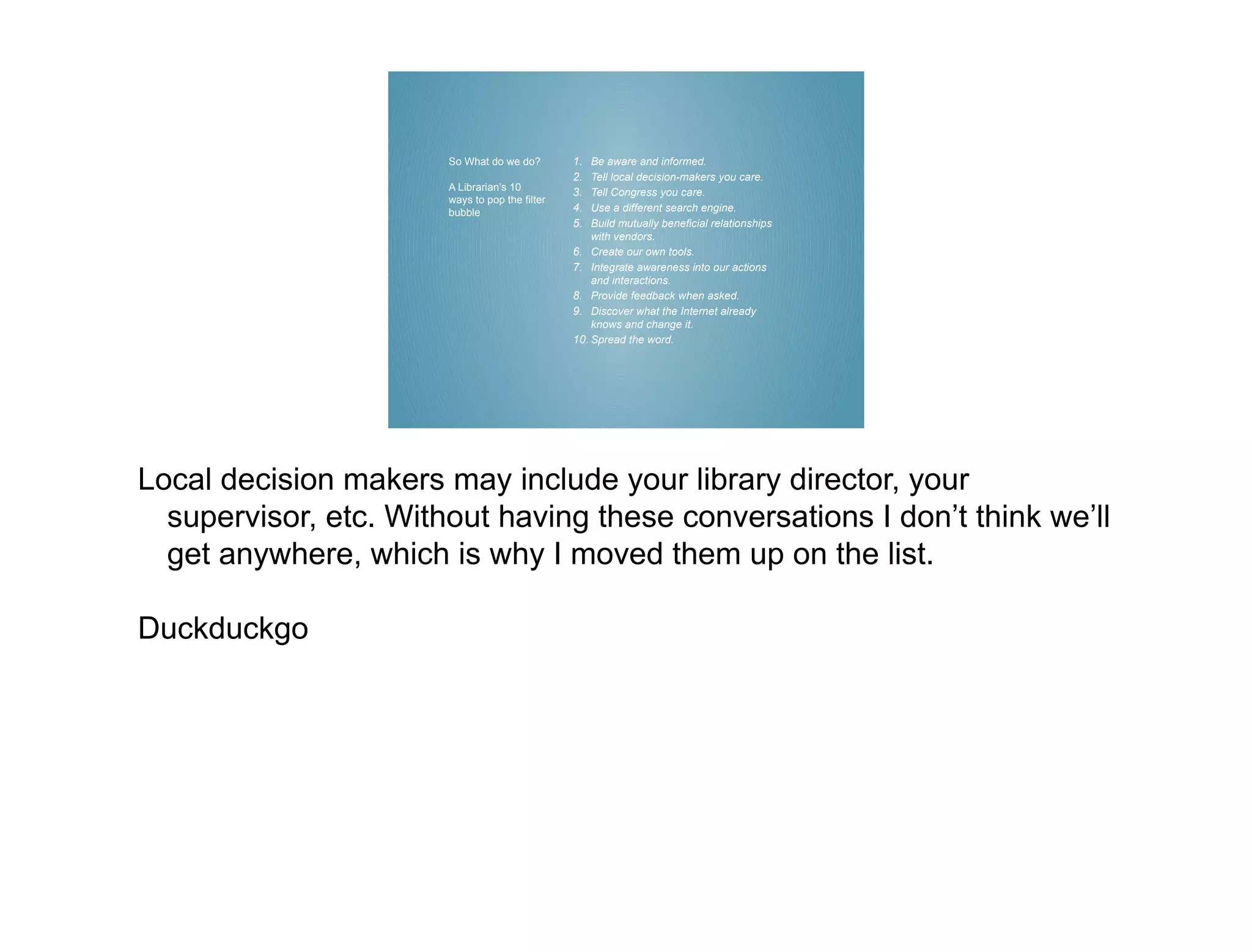
So What do we do?        1.  Be aware and informed.
                         2.  Tell local decision-makers you care.
A Librarian’s 10
                         3.  Tell Congress you care.
ways to pop the filter
bubble                   4.  Use a different search engine.
                         5.  Build mutually beneficial relationships
                             with vendors.
                         6. Create our own tools.
                         7. Integrate awareness into our actions
                             and interactions.
                         8. Provide feedback when asked.
                         9. Discover what the Internet already
                             knows and change it.
                         10. Spread the word.
Thanks to the        •   flickr.com/photos/39580703@N02/6122020531/
folks who have       •   flickr.com/photos/cakper/5978028199/
licensed their       •   flickr.com/photos/mirindas/5890851809/
flickr images with
                     •   flickr.com/photos/ncc_badiey/3095099782/
creative commons
licenses.            •   flickr.com/photos/84568447@N00/2278294489/
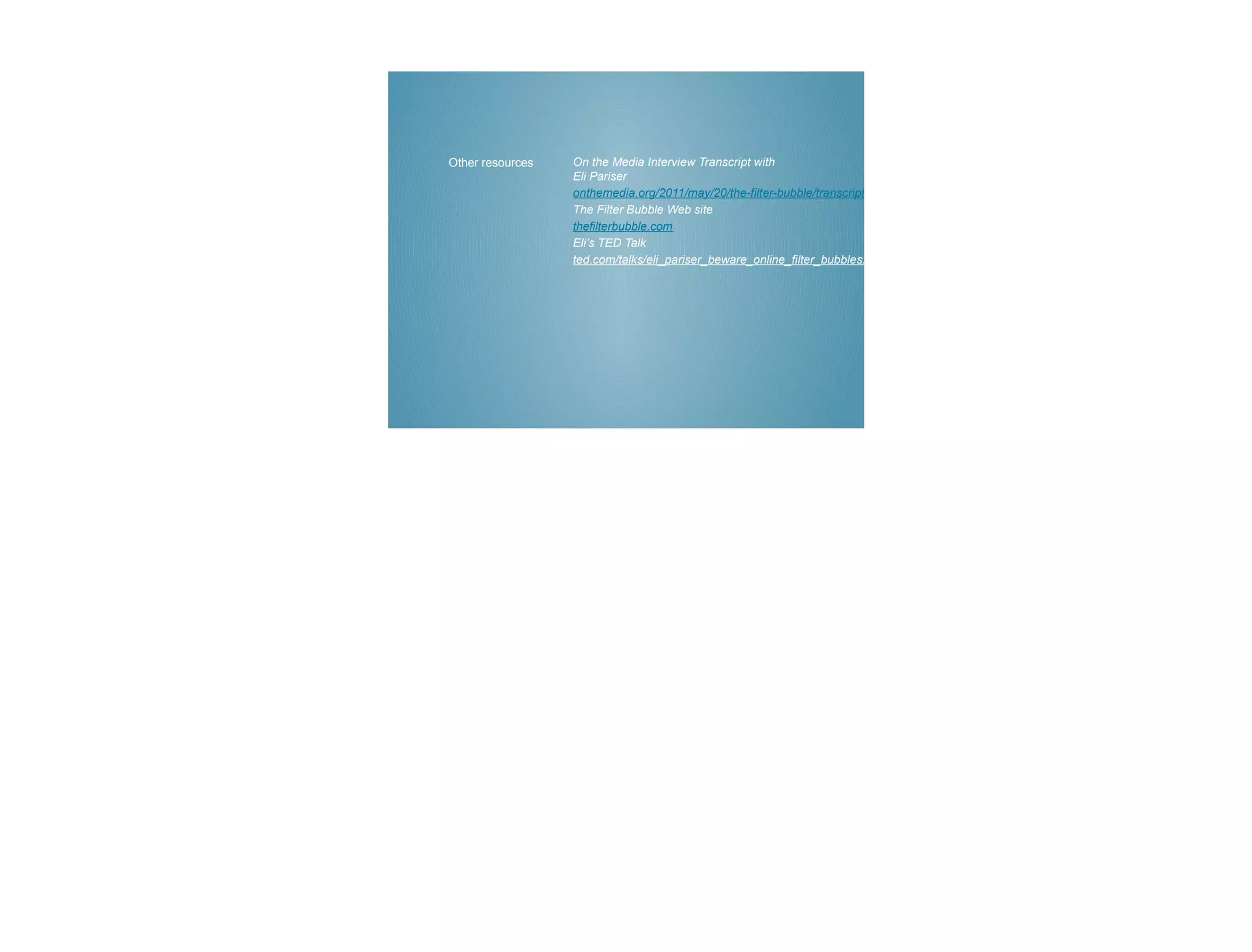
Other resources   On the Media Interview Transcript with
                  Eli Pariser
                  onthemedia.org/2011/may/20/the-filter-bubble/transcript
                  The Filter Bubble Web site
                  thefilterbubble.com
                  Eli’s TED Talk
                  ted.com/talks/eli_pariser_beware_online_filter_bubbles.
Questions/   Emily Ford
comments/    Urban & Public Affairs Librarian
ETC          Portland State University
             Branford P. Millar Library

             forder@pdx.edu
What’s in Your
Filter Bubble?Or,
how has the internet censored
                   you today?
• Personalization
                                          • Editorial Role
                                          • The web is a land
                                            of opportunity (ie $
                                            $$$$)


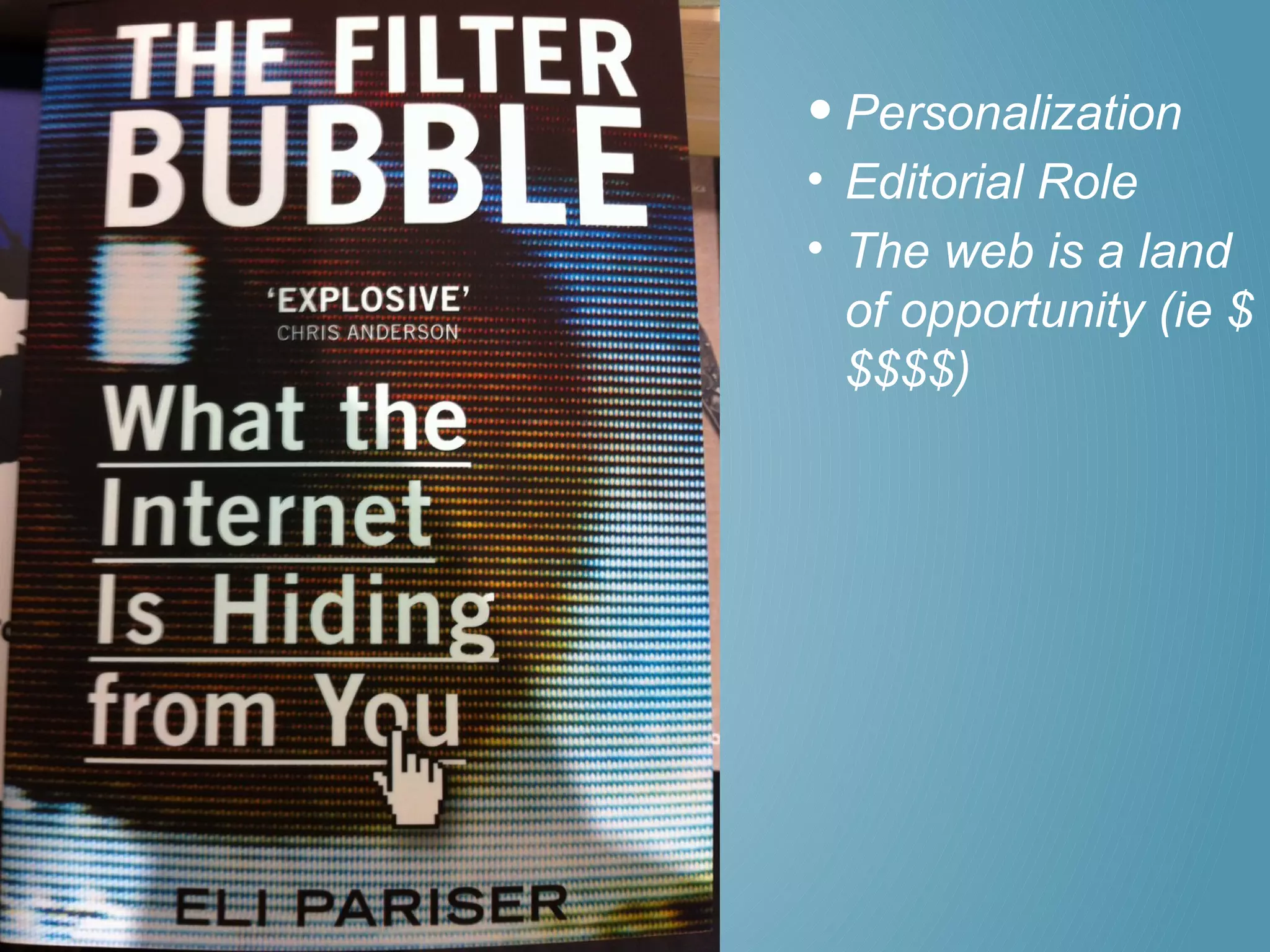
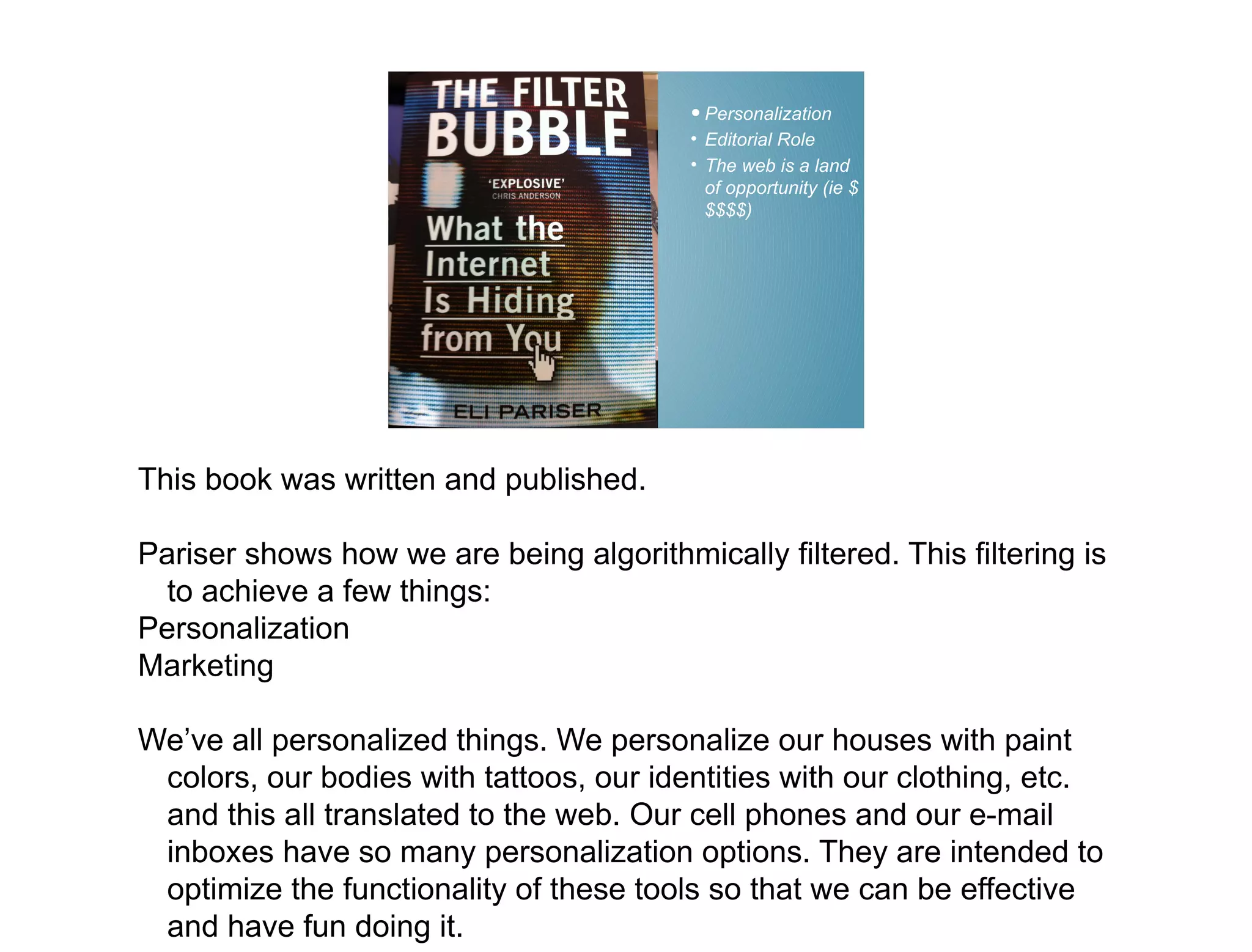
This book was written and published.

Pariser shows how we are being algorithmically filtered. This filtering is
  to achieve a few things:
Personalization
Marketing

We’ve all personalized things. We personalize our houses with paint
 colors, our bodies with tattoos, our identities with our clothing, etc.
 and this all translated to the web. Our cell phones and our e-mail
 inboxes have so many personalization options. They are intended to
 optimize the functionality of these tools so that we can be effective
 and have fun doing it.
If my world was indeed captured in a little bubble, I wanted to
   investigate it and understand it. So I decided I’d try to
   (unscientifically) see if I could find evidence of my filter bubble.

I tried to repeat the gist of what Pariser did when he talked about
   having two separate people google the same thing at the same time
   and see what happened. In his case, “
   Brooke Gladstone: …Even a small search yields different results for
   different people, says Pariser, as when two people he knows
   searched “BP” during the oil spill.
   ELI PARISER:
   And one person saw information about the oil spill - what you can do
   about it, the environmental consequences - and another person saw
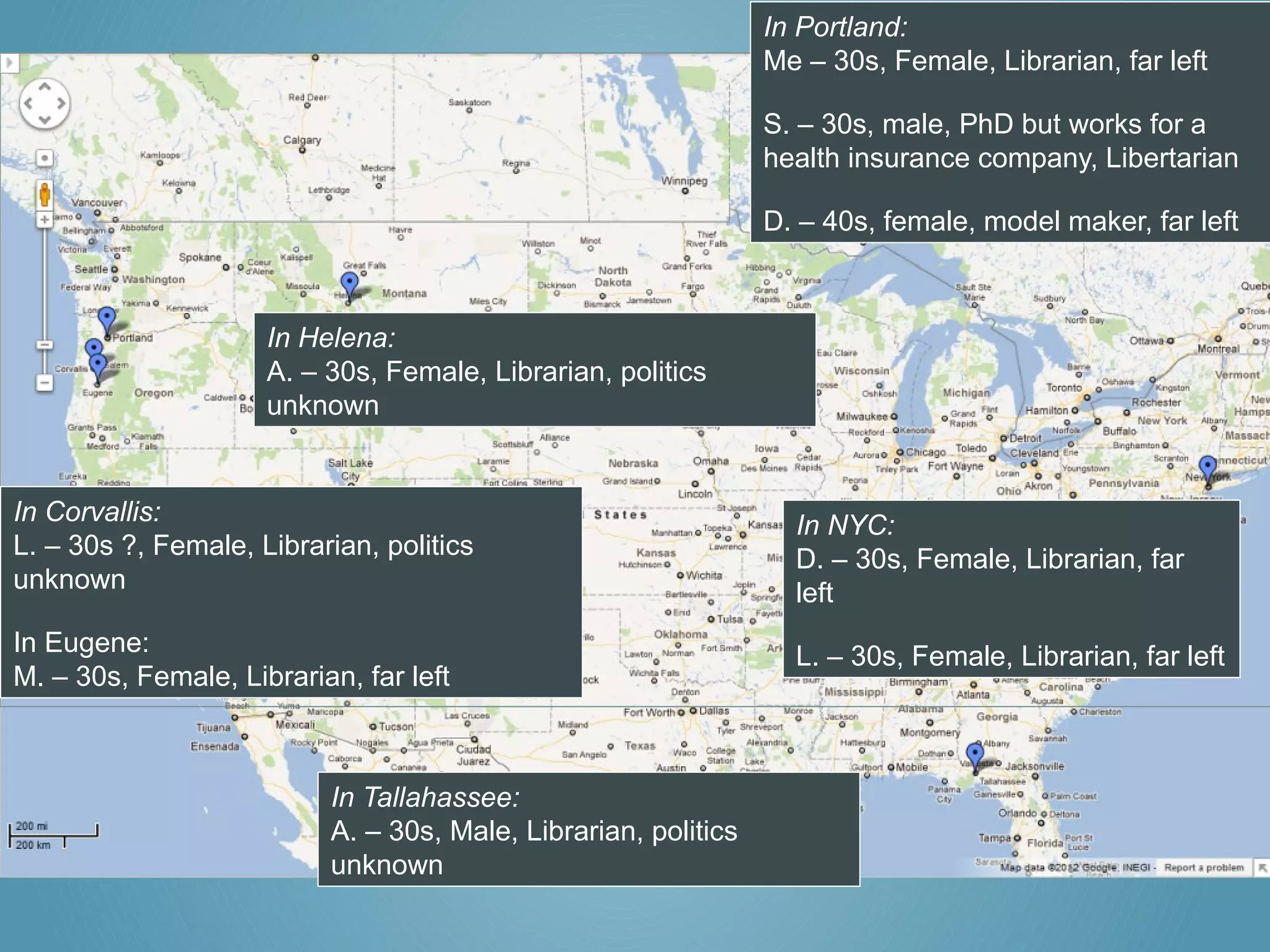
In Portland:
                                                                                   Me – 30s, Female, Librarian, far left

                                                                                   S. – 30s, male, PhD but works for a
                                                                                   health insurance company, Libertarian

                                                                                   D. – 40s, female, model maker, far left


                                        In Helena:
                                        A. – 30s, Female, Librarian, politics
                                        unknown


                   In Corvallis:                                                     In NYC:
                   L. – 30s ?, Female, Librarian, politics                           D. – 30s, Female, Librarian, far
                   unknown                                                           left
                   In Eugene:                                                        L. – 30s, Female, Librarian, far left
                   M. – 30s, Female, Librarian, far left


                                             In Tallahassee:
                                             A. – 30s, Male, Librarian, politics
                                             unknown


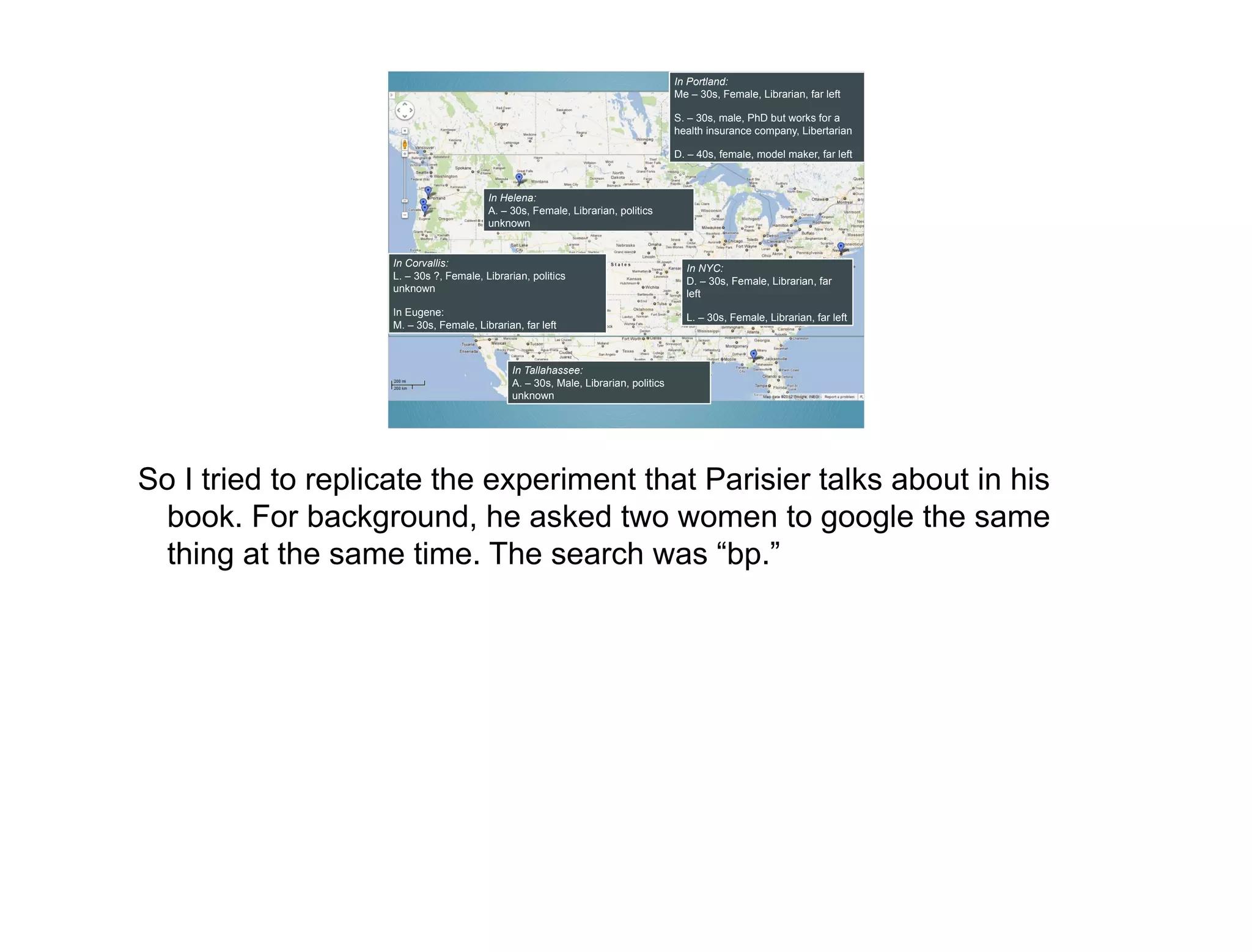
So I tried to replicate the experiment that Parisier talks about in his
  book. For background, he asked two women to google the same
  thing at the same time. The search was “bp.”
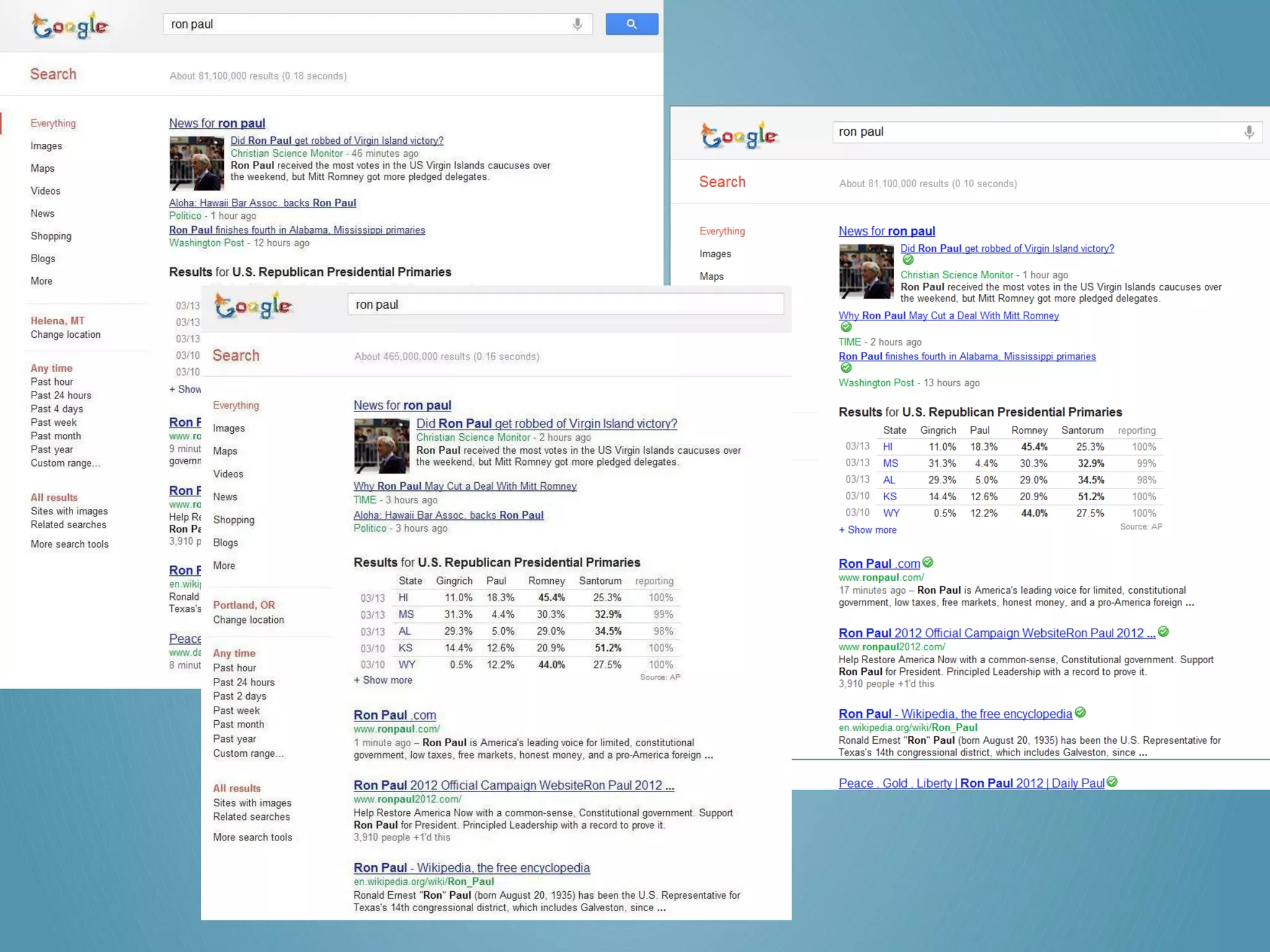
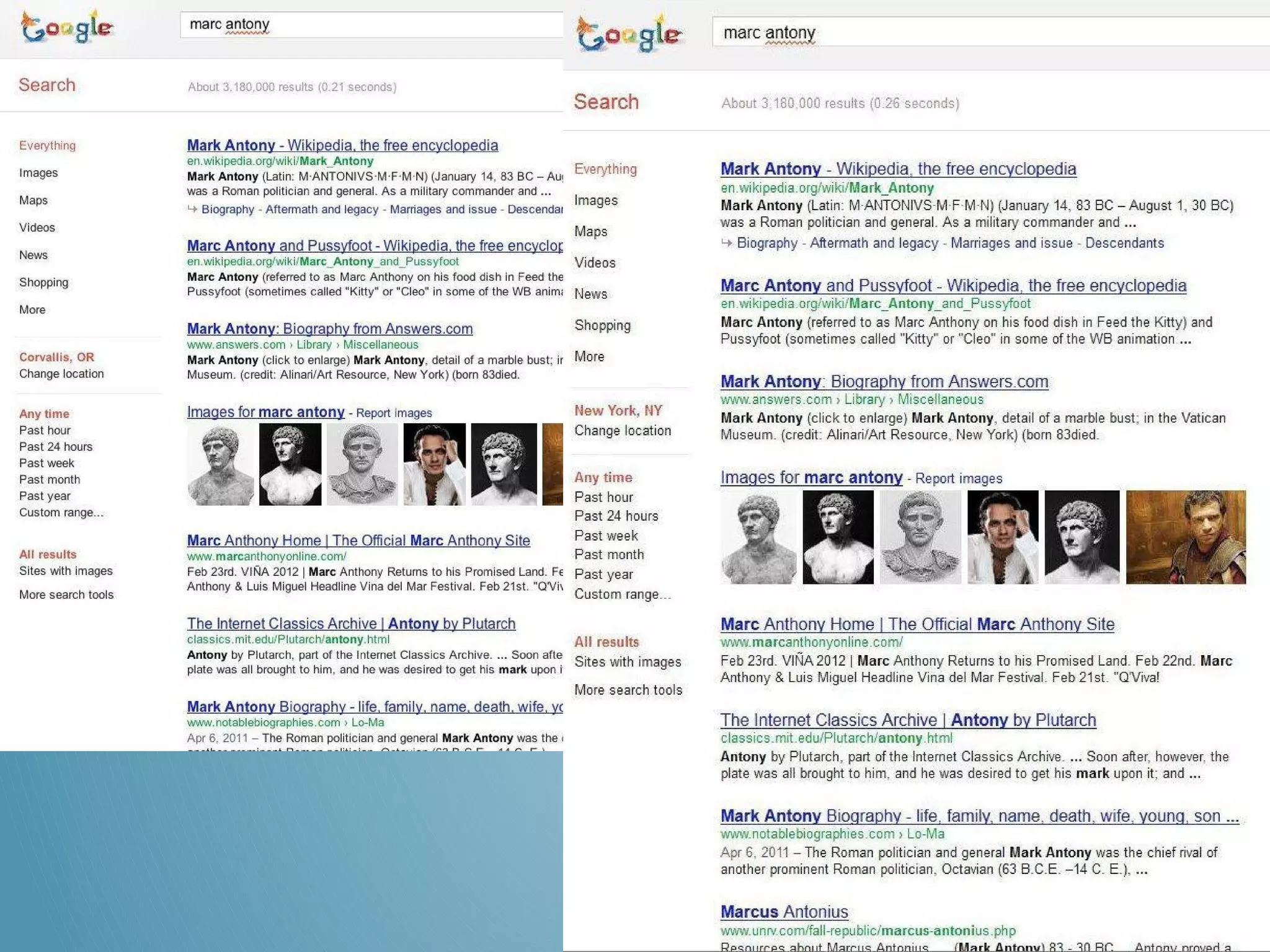
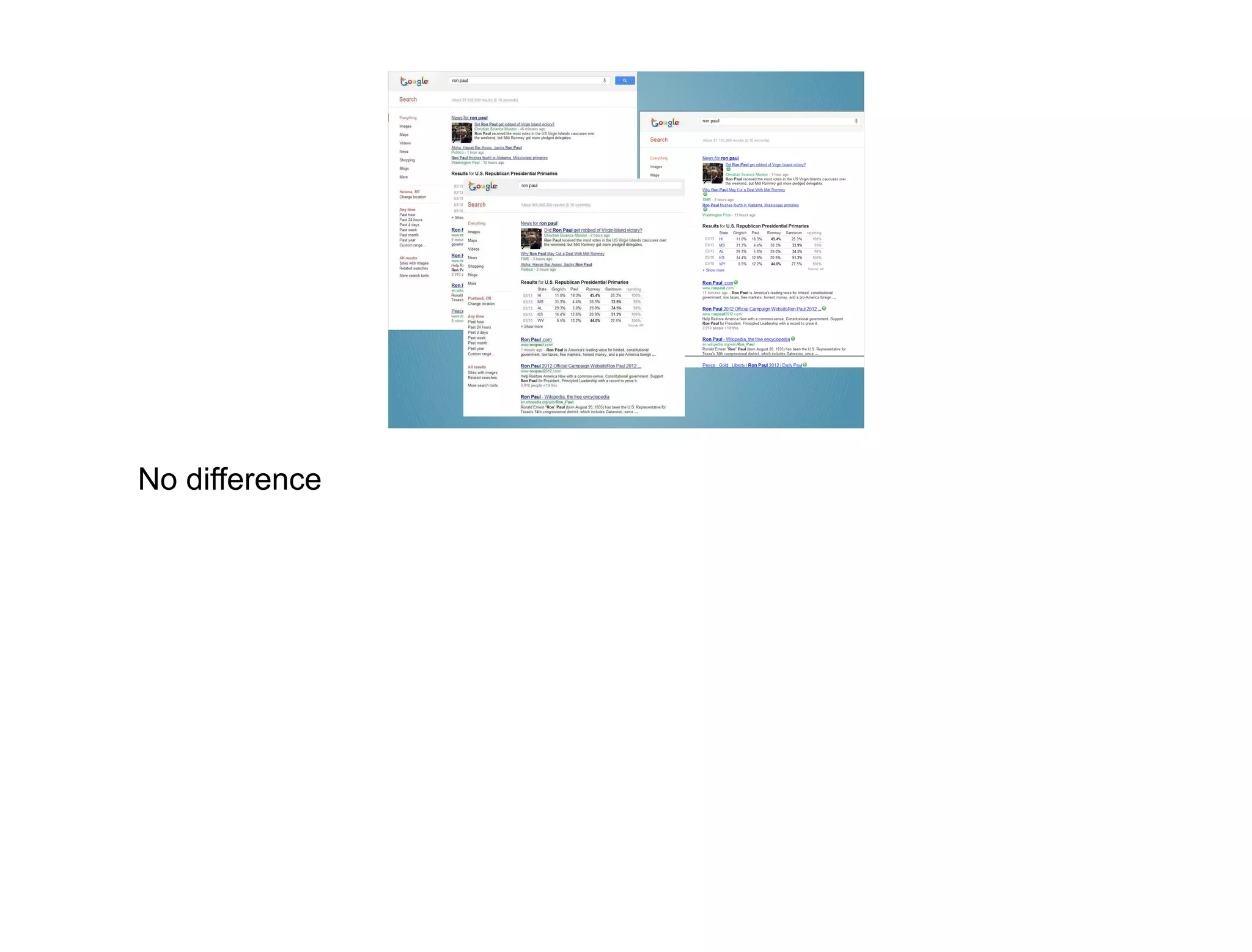
No difference
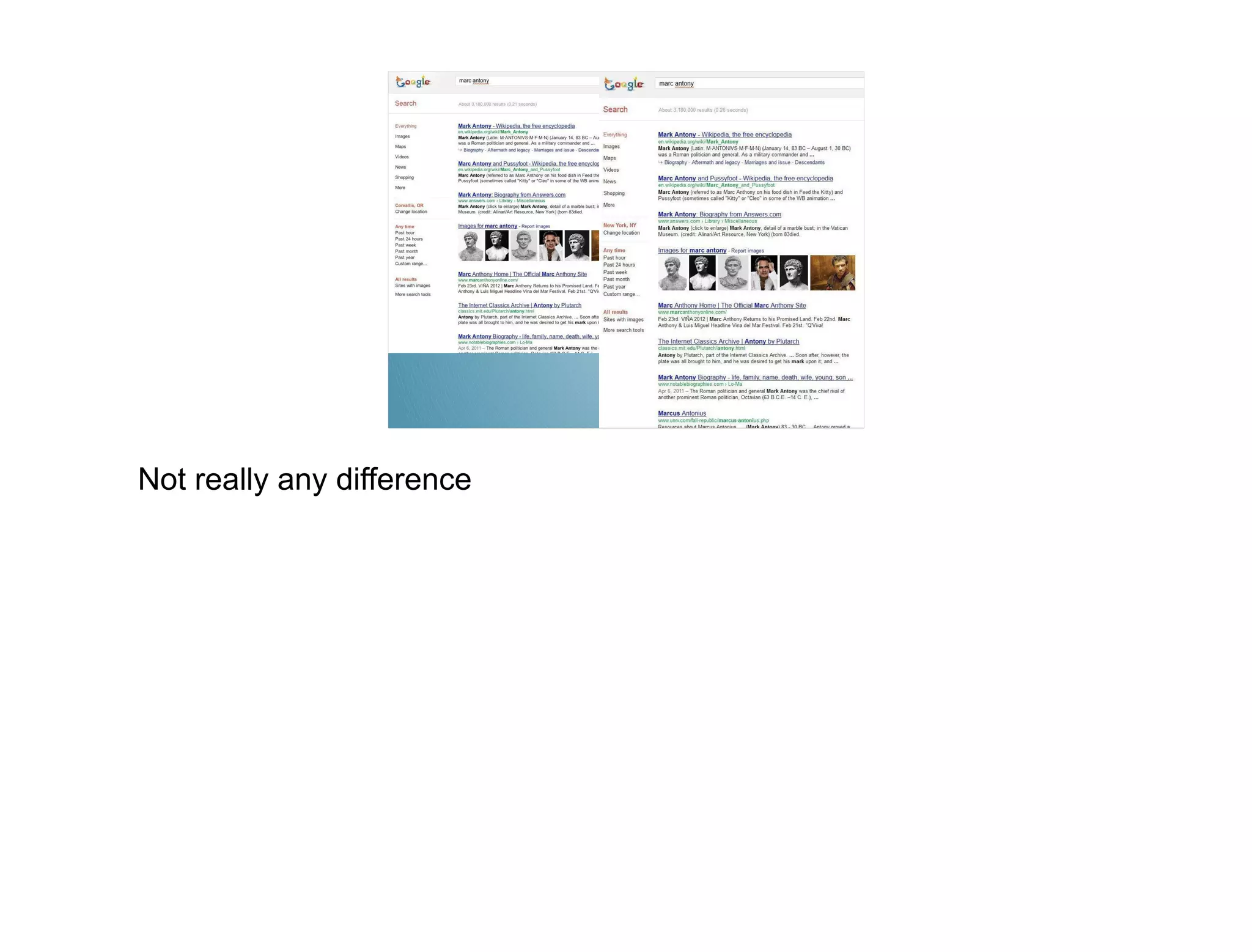
Not really any difference
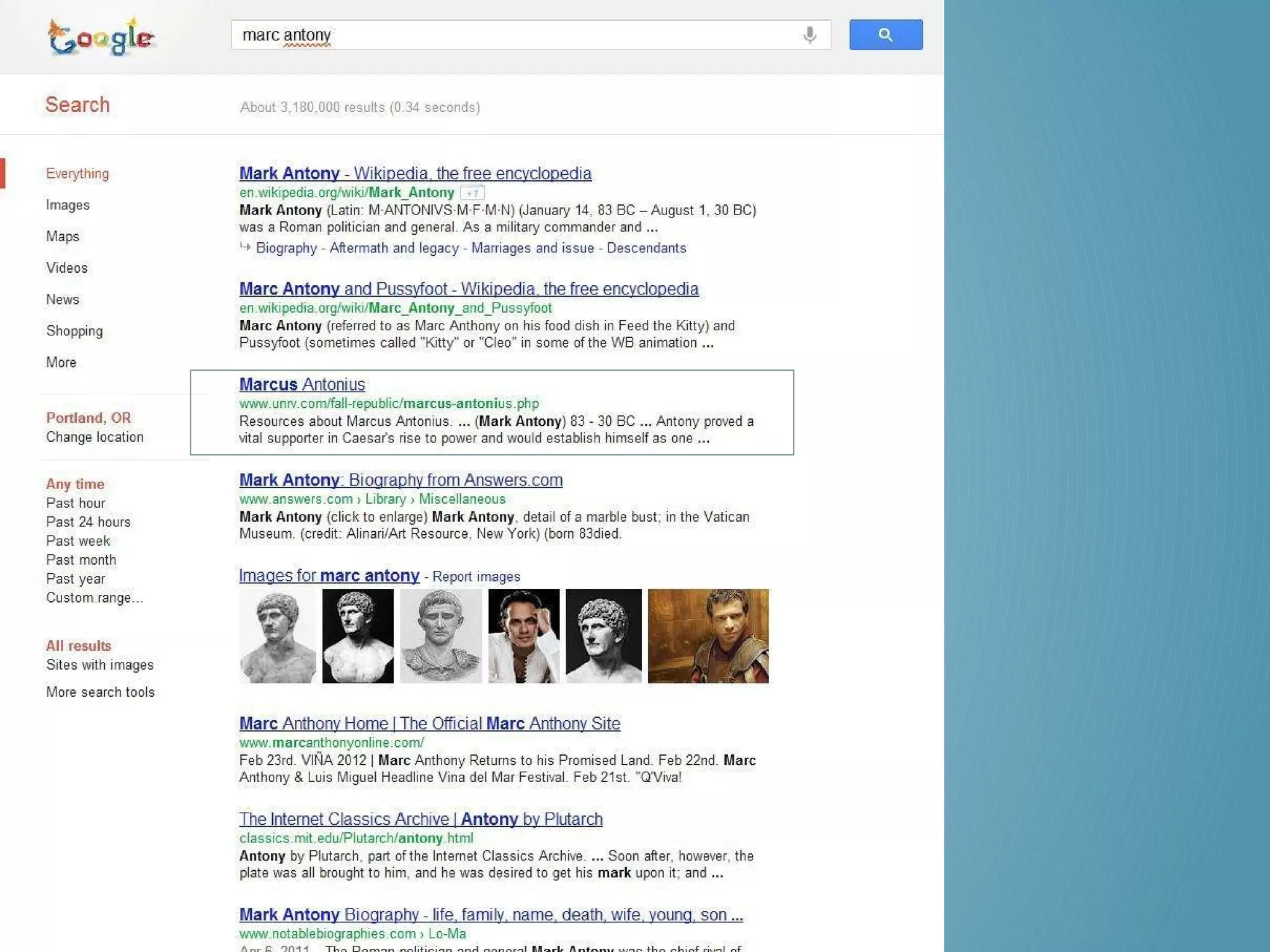
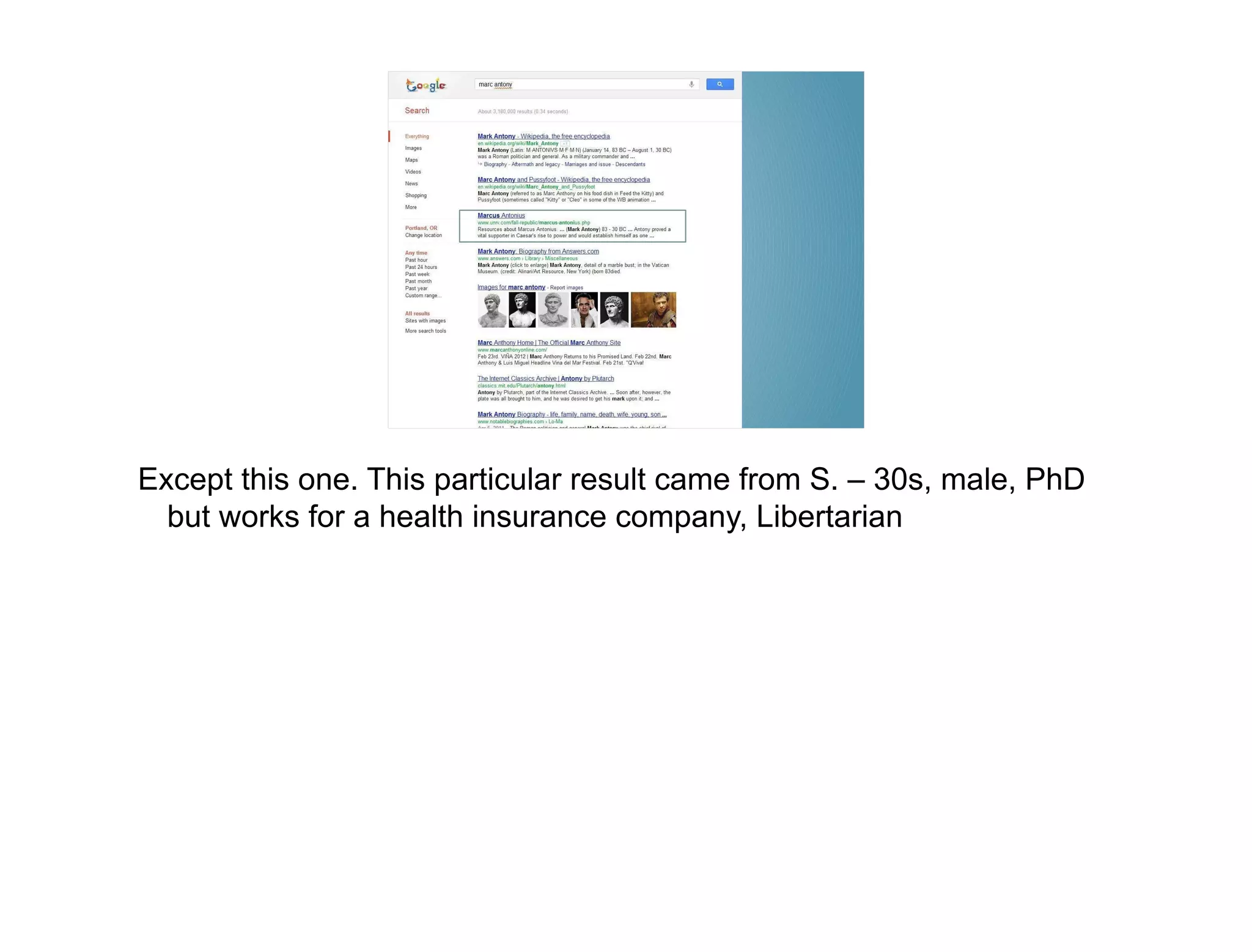
Except this one. This particular result came from S. – 30s, male, PhD
  but works for a health insurance company, Libertarian
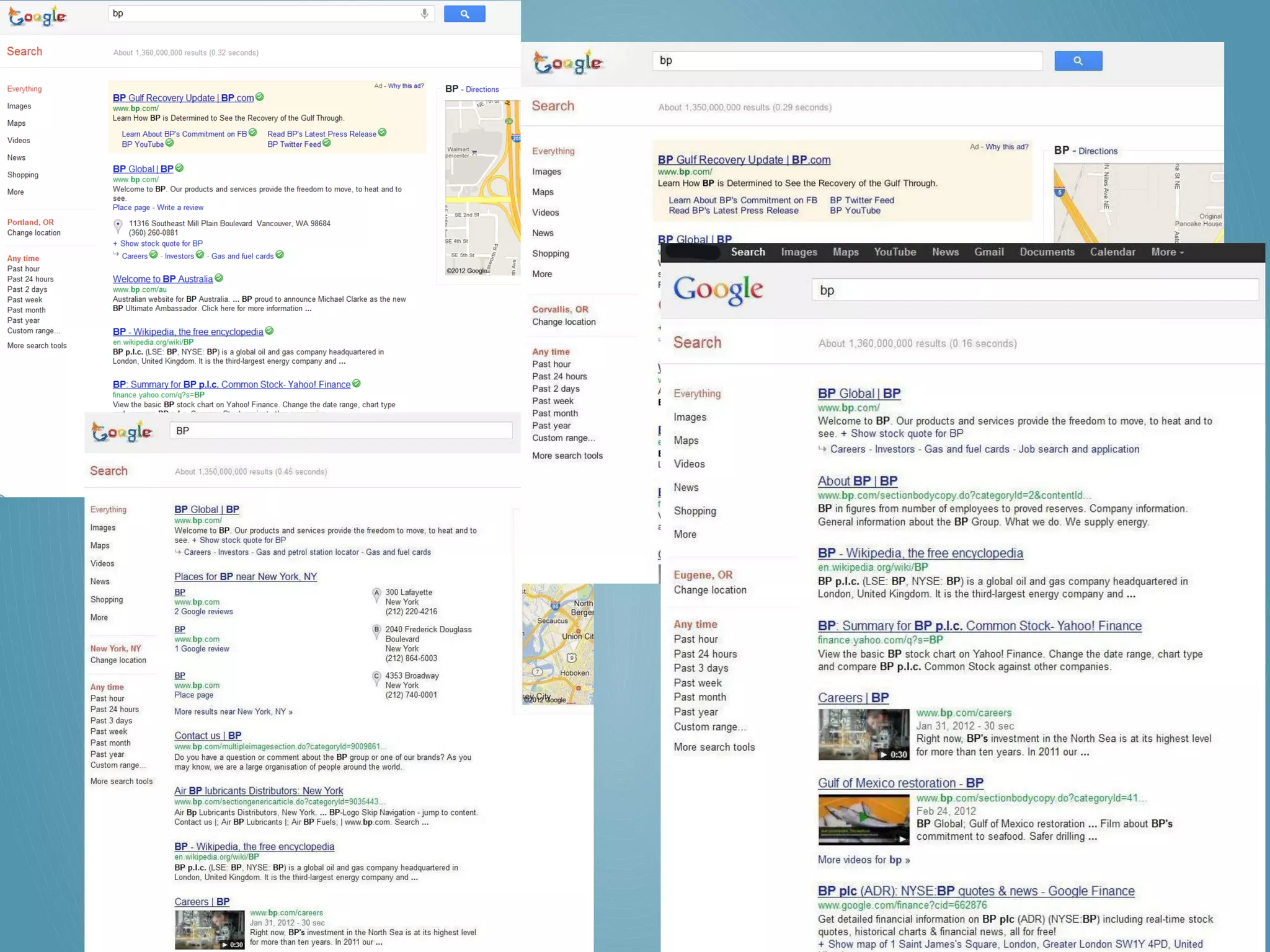
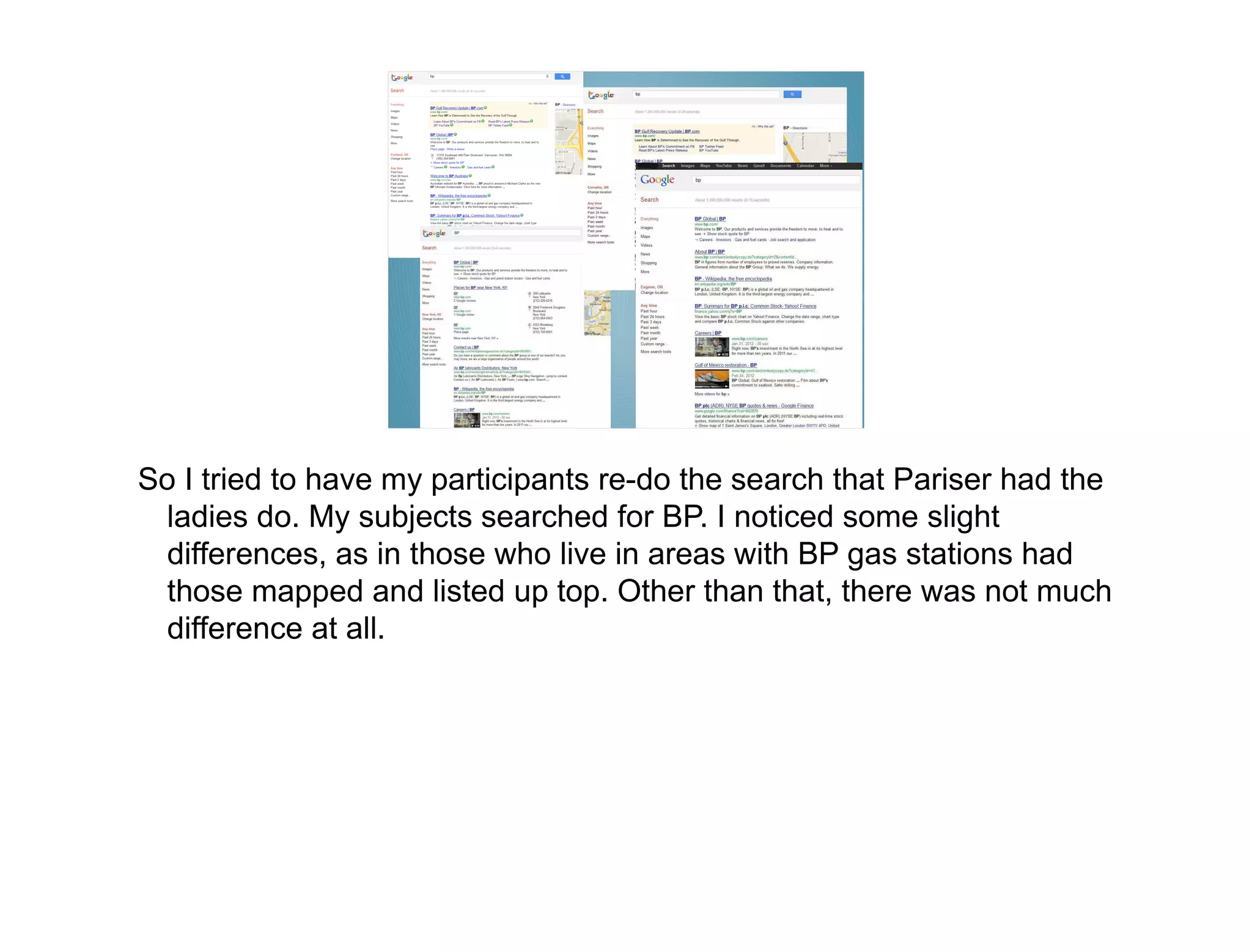
So I tried to have my participants re-do the search that Pariser had the
  ladies do. My subjects searched for BP. I noticed some slight
  differences, as in those who live in areas with BP gas stations had
  those mapped and listed up top. Other than that, there was not much
  difference at all.
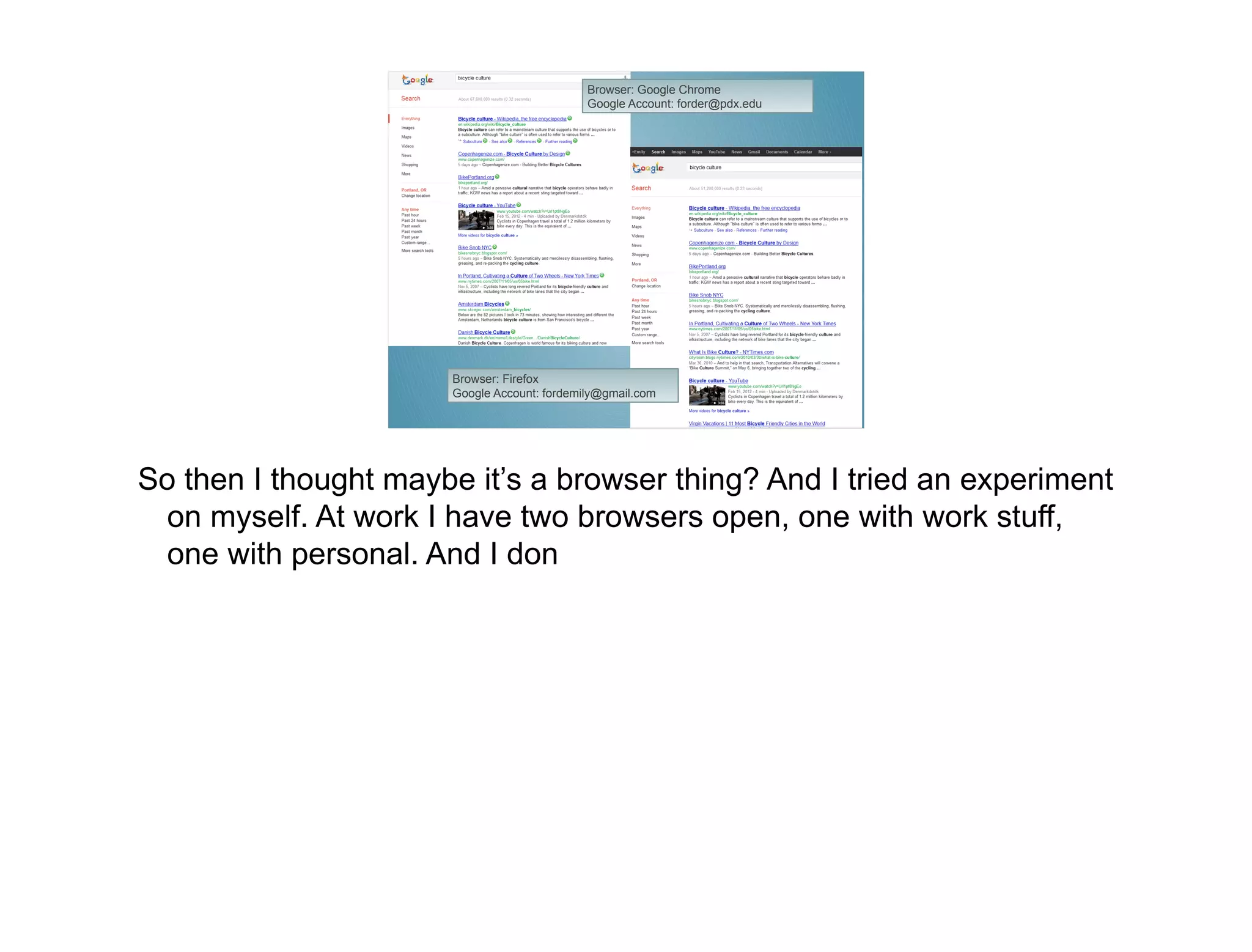
Browser: Google Chrome
                                             Google Account: forder@pdx.edu


                      Browser: Firefox
                      Google Account: fordemily@gmail.com


So then I thought maybe it’s a browser thing? And I tried an experiment
  on myself. At work I have two browsers open, one with work stuff,
  one with personal. And I don
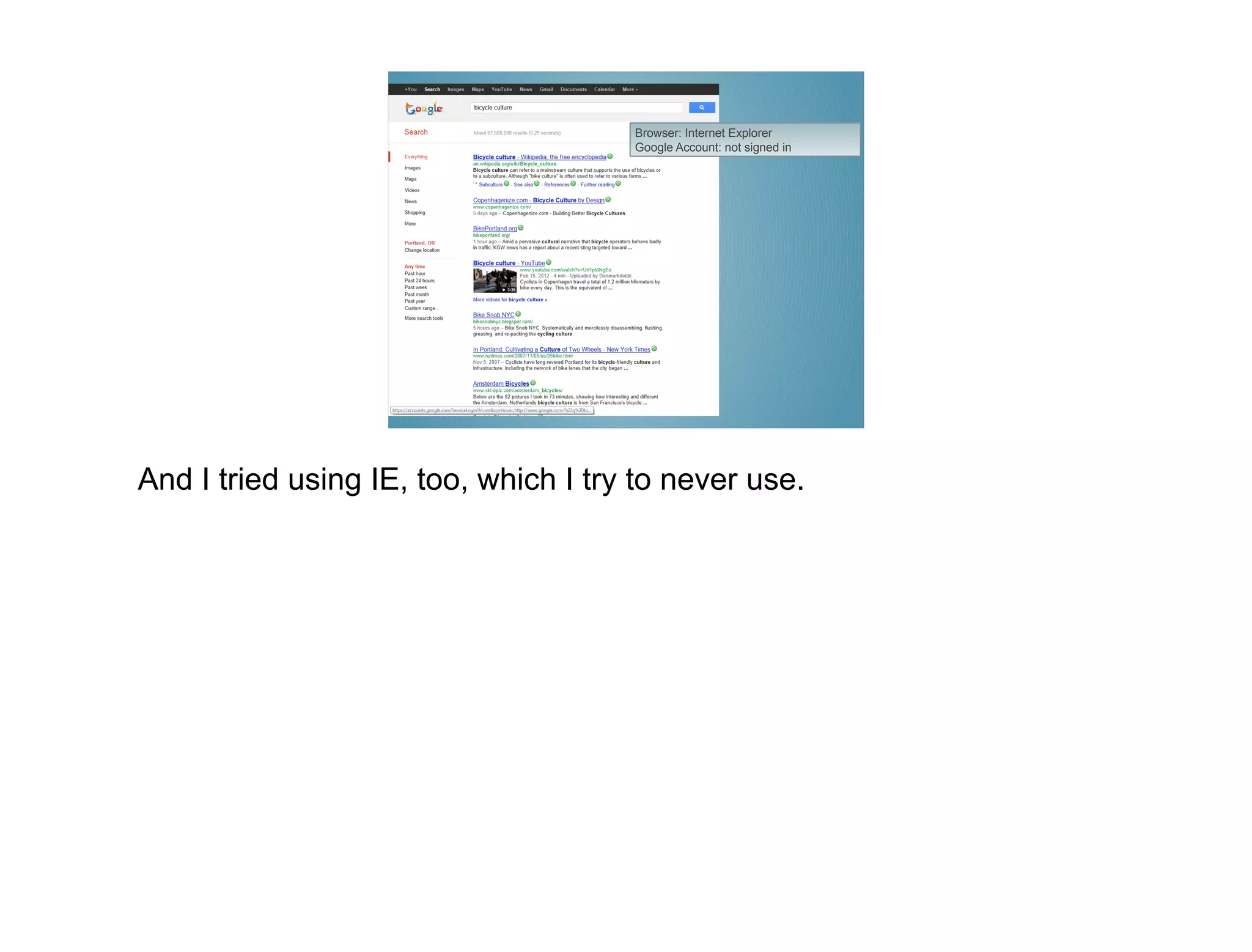
Browser: Internet Explorer
                                      Google Account: not signed in


And I tried using IE, too, which I try to never use.
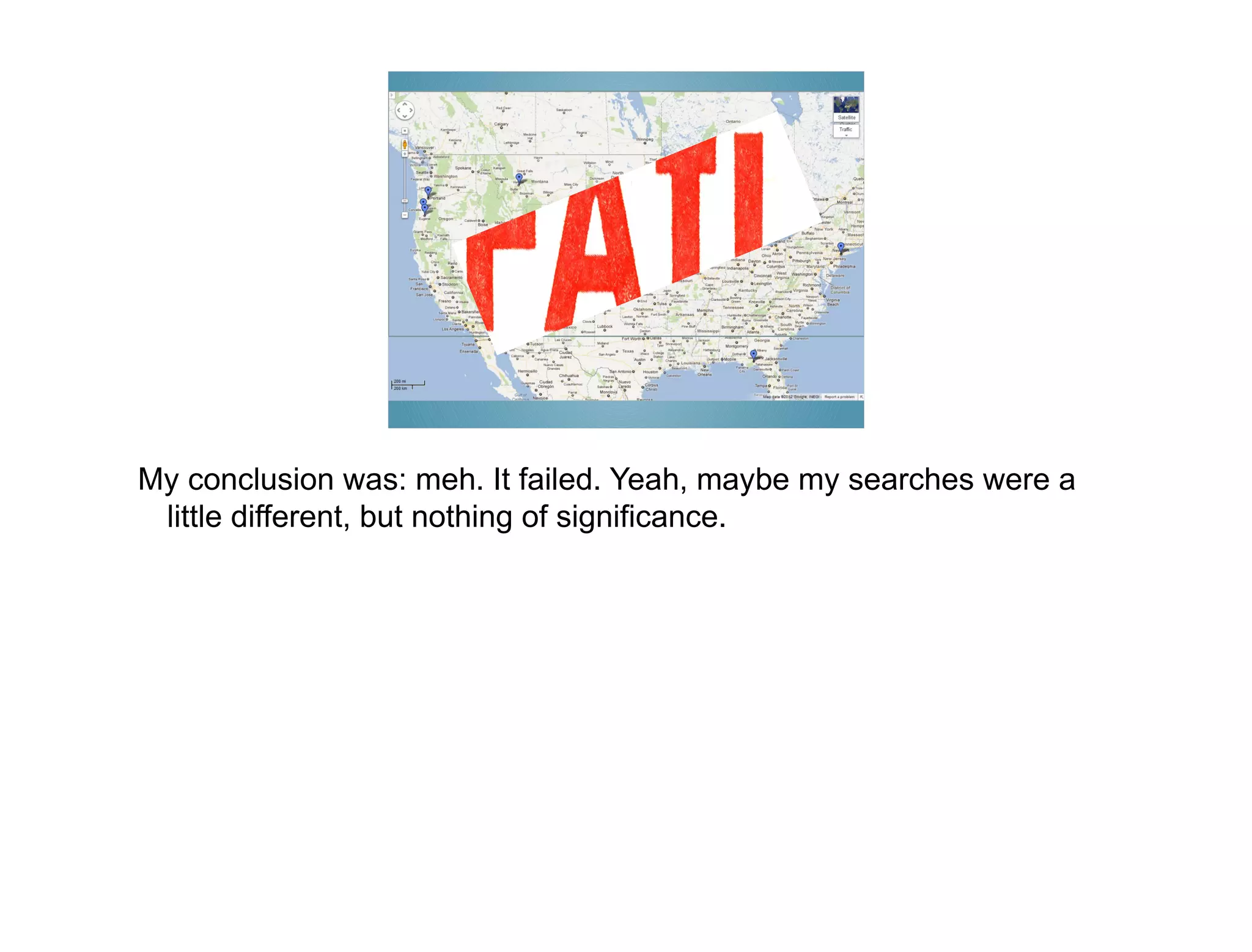
My conclusion was: meh. It failed. Yeah, maybe my searches were a
 little different, but nothing of significance.
And then this
                      happened…


I was innocently curled up on my big arm chair sipping on wine with the
   dog sleeping by my feet, about to watch one of my shows on Hulu (I
   don’t have cable).
“Emily, did you know that viewers
                   of this show also like (Planned)
                   Parenthood?”


This popped onto my screen. (Parentheses is what I heard– I’m still not
  sure if that’s what it said.)
The Conclusion?   • My test searches were bad.
                  • My test subjects weren’t
                    representative enough.
                  • I have created my own bubble and
                    Google has aided and abetted me in
                    doing so.
                  • #*@#$*@&!!!
How old I am
                                     What degrees I’ve earned and where I
                                     earned them
                                     Who are my friends
                                     Who are my family
                     Omg what does   Who I have dated
                     the internet    Where I live
                     Google know     Where and when I’ve traveled and with
                     about me???     whom
                                     Where I work
                                     My bike route to work
                                     What organizations I support financially
                                     My political views
                                     What car I drive
                                     What bike I ride
                                     Who I email most often and what I say
                                     When my cat died and what vet hospital
                                     I patronized
                                     My favorite blog
                                     My favorite food this week and last year
                                     My favorite author


So I looked at my Google Dashboard. And I downloaded my Facebook
  data. And this is just a sample list of what Google and Facebook,
  combined, know about me. Potentially what has been sold to
  companies like Axciom. This more information than my partner, my
  parents, and best friends know about me.
Who I had happy hour with on July 29,
                     Omg what does   2010 and where we were
                     the internet
                     Google know     What videos I’ve watched on YouTube
                                     and when and how many times
                     about me???
                                     What kind of phone I use and what
                                     applications are on it and when I use
                                     those applications
                                     My penchant for fictional family dramas
                                     What podcasts I listen to
                                     What book my book club is reading,
                                     where we’re meeting, and when…


And it can get even more precise…
So What do we        1. Burn your cookies.
                      do?                  2. Erase your web history.
                                           3. Tell Facebook to keep your data
                      Pariser’s 10 Ways        private
                      to Pop your Filter
                                           4. It’s your birthday and you can hide it
                      Bubble
                                               if you want to.
                                           5. Turn off targeted ads, and tell the
                                               stalking sneakers to buzz off.
                                           6. Go incognito.
                                           7. Or better yet, go anonymous.
                                           8. Depersonalize your browser.
                                           9. Tell Google and Facebook to make
                                               it easier to see and control your
                                               filters.
                                           thefilterbubble.com/10-things-you-can-do
                                           10. Tell Congress you care.


OMG What does Google Think I should Know?
OMG What does Google Want me to know?

Education/Awareness—librarians are really good at this.
Opting out – Delete cookies regularly. Have your browser ask about
  cookies. Use plugins like Disconnect.
Talk to your local and national decision-makers– technology decisions
  can have impacts that reach far into the future
So What do we do?        1.  Be aware and informed.
                                                2.  Tell local decision-makers you care.
                       A Librarian’s 10
                                                3.  Tell Congress you care.
                       ways to pop the filter
                       bubble                   4.  Use a different search engine.
                                                5.  Build mutually beneficial relationships
                                                    with vendors.
                                                6. Create our own tools.
                                                7. Integrate awareness into our actions
                                                    and interactions.
                                                8. Provide feedback when asked.
                                                9. Discover what the Internet already
                                                    knows and change it.
                                                10. Spread the word.


Local decision makers may include your library director, your
  supervisor, etc. Without having these conversations I don’t think we’ll
  get anywhere, which is why I moved them up on the list.

Duckduckgo
Thanks to the        •   flickr.com/photos/39580703@N02/6122020531/
folks who have       •   flickr.com/photos/cakper/5978028199/
licensed their       •   flickr.com/photos/mirindas/5890851809/
flickr images with
                     •   flickr.com/photos/ncc_badiey/3095099782/
creative commons
licenses.            •   flickr.com/photos/84568447@N00/2278294489/
Other resources   On the Media Interview Transcript with
                  Eli Pariser
                  onthemedia.org/2011/may/20/the-filter-bubble/transcript/
                  The Filter Bubble Web site
                  thefilterbubble.com
                  Eli’s TED Talk
                  ted.com/talks/eli_pariser_beware_online_filter_bubbles.html
Questions/   Emily Ford
comments/    Urban & Public Affairs Librarian
ETC          Portland State University
             Branford P. Millar Library

             forder@pdx.edu

What's in your filter bubble? Or, how has the internet censored you today?

  • 1.
    What’s in Your FilterBubble?Or, how has the internet censored you today?
  • 2.
    • Personalization • EditorialRole • The web is a land of opportunity (ie $ $$$$)
  • 4.
    In Portland: Me – 30s, Female, Librarian, far left S. – 30s, male, PhD but works for a health insurance company, Libertarian D. – 40s, female, model maker, far left In Helena: A. – 30s, Female, Librarian, politics unknown In Corvallis: In NYC: L. – 30s ?, Female, Librarian, politics D. – 30s, Female, Librarian, far unknown left In Eugene: L. – 30s, Female, Librarian, far left M. – 30s, Female, Librarian, far left In Tallahassee: A. – 30s, Male, Librarian, politics unknown
  • 9.
    Browser: Google Chrome Google Account: forder@pdx.edu Browser: Firefox Google Account: fordemily@gmail.com
  • 10.
    Browser: Internet Explorer GoogleAccount: not signed in
  • 12.
  • 13.
    “Emily, did youknow that viewers of this show also like (Planned) Parenthood?”
  • 15.
    The Conclusion? • My test searches were bad. • My test subjects weren’t representative enough. • I have created my own bubble and Google has aided and abetted me in doing so. • #*@#$*@&!!!
  • 16.
    How old Iam What degrees I’ve earned and where I earned them Who are my friends Who are my family Omg what does Who I have dated the internet Where I live Google know Where and when I’ve traveled and with about me??? whom Where I work My bike route to work What organizations I support financially My political views What car I drive What bike I ride Who I email most often and what I say When my cat died and what vet hospital I patronized My favorite blog My favorite food this week and last year My favorite author
  • 17.
    Who I hadhappy hour with on July 29, Omg what does 2010 and where we were the internet What videos I’ve watched on YouTube Google know and when and how many times about me??? What kind of phone I use and what applications are on it and when I use those applications My penchant for fictional family dramas What podcasts I listen to What book my book club is reading, where we’re meeting, and when…
  • 18.
    So What dowe 1. Burn your cookies. do? 2. Erase your web history. 3. Tell Facebook to keep your data Pariser’s 10 Ways private to Pop your Filter 4. It’s your birthday and you can hide it Bubble if you want to. 5. Turn off targeted ads, and tell the stalking sneakers to buzz off. 6. Go incognito. 7. Or better yet, go anonymous. 8. Depersonalize your browser. 9. Tell Google and Facebook to make it easier to see and control your filters. thefilterbubble.com/10-things-you-can-do 10. Tell Congress you care.
  • 19.
    So What dowe do? 1. Be aware and informed. 2. Tell local decision-makers you care. A Librarian’s 10 3. Tell Congress you care. ways to pop the filter bubble 4. Use a different search engine. 5. Build mutually beneficial relationships with vendors. 6. Create our own tools. 7. Integrate awareness into our actions and interactions. 8. Provide feedback when asked. 9. Discover what the Internet already knows and change it. 10. Spread the word.
  • 20.
    Thanks to the • flickr.com/photos/39580703@N02/6122020531/ folks who have • flickr.com/photos/cakper/5978028199/ licensed their • flickr.com/photos/mirindas/5890851809/ flickr images with • flickr.com/photos/ncc_badiey/3095099782/ creative commons licenses. • flickr.com/photos/84568447@N00/2278294489/
  • 21.
    Other resources On the Media Interview Transcript with Eli Pariser onthemedia.org/2011/may/20/the-filter-bubble/transcript The Filter Bubble Web site thefilterbubble.com Eli’s TED Talk ted.com/talks/eli_pariser_beware_online_filter_bubbles.
  • 22.
    Questions/ Emily Ford comments/ Urban & Public Affairs Librarian ETC Portland State University Branford P. Millar Library forder@pdx.edu
  • 23.
    What’s in Your FilterBubble?Or, how has the internet censored you today?
  • 24.
    • Personalization • Editorial Role • The web is a land of opportunity (ie $ $$$$) This book was written and published. Pariser shows how we are being algorithmically filtered. This filtering is to achieve a few things: Personalization Marketing We’ve all personalized things. We personalize our houses with paint colors, our bodies with tattoos, our identities with our clothing, etc. and this all translated to the web. Our cell phones and our e-mail inboxes have so many personalization options. They are intended to optimize the functionality of these tools so that we can be effective and have fun doing it.
  • 25.
    If my worldwas indeed captured in a little bubble, I wanted to investigate it and understand it. So I decided I’d try to (unscientifically) see if I could find evidence of my filter bubble. I tried to repeat the gist of what Pariser did when he talked about having two separate people google the same thing at the same time and see what happened. In his case, “ Brooke Gladstone: …Even a small search yields different results for different people, says Pariser, as when two people he knows searched “BP” during the oil spill. ELI PARISER: And one person saw information about the oil spill - what you can do about it, the environmental consequences - and another person saw
  • 26.
    In Portland: Me – 30s, Female, Librarian, far left S. – 30s, male, PhD but works for a health insurance company, Libertarian D. – 40s, female, model maker, far left In Helena: A. – 30s, Female, Librarian, politics unknown In Corvallis: In NYC: L. – 30s ?, Female, Librarian, politics D. – 30s, Female, Librarian, far unknown left In Eugene: L. – 30s, Female, Librarian, far left M. – 30s, Female, Librarian, far left In Tallahassee: A. – 30s, Male, Librarian, politics unknown So I tried to replicate the experiment that Parisier talks about in his book. For background, he asked two women to google the same thing at the same time. The search was “bp.”
  • 27.
  • 28.
    Not really anydifference
  • 29.
    Except this one.This particular result came from S. – 30s, male, PhD but works for a health insurance company, Libertarian
  • 30.
    So I triedto have my participants re-do the search that Pariser had the ladies do. My subjects searched for BP. I noticed some slight differences, as in those who live in areas with BP gas stations had those mapped and listed up top. Other than that, there was not much difference at all.
  • 31.
    Browser: Google Chrome Google Account: forder@pdx.edu Browser: Firefox Google Account: fordemily@gmail.com So then I thought maybe it’s a browser thing? And I tried an experiment on myself. At work I have two browsers open, one with work stuff, one with personal. And I don
  • 32.
    Browser: Internet Explorer Google Account: not signed in And I tried using IE, too, which I try to never use.
  • 33.
    My conclusion was:meh. It failed. Yeah, maybe my searches were a little different, but nothing of significance.
  • 34.
    And then this happened… I was innocently curled up on my big arm chair sipping on wine with the dog sleeping by my feet, about to watch one of my shows on Hulu (I don’t have cable).
  • 35.
    “Emily, did youknow that viewers of this show also like (Planned) Parenthood?” This popped onto my screen. (Parentheses is what I heard– I’m still not sure if that’s what it said.)
  • 37.
    The Conclusion? • My test searches were bad. • My test subjects weren’t representative enough. • I have created my own bubble and Google has aided and abetted me in doing so. • #*@#$*@&!!!
  • 38.
    How old Iam What degrees I’ve earned and where I earned them Who are my friends Who are my family Omg what does Who I have dated the internet Where I live Google know Where and when I’ve traveled and with about me??? whom Where I work My bike route to work What organizations I support financially My political views What car I drive What bike I ride Who I email most often and what I say When my cat died and what vet hospital I patronized My favorite blog My favorite food this week and last year My favorite author So I looked at my Google Dashboard. And I downloaded my Facebook data. And this is just a sample list of what Google and Facebook, combined, know about me. Potentially what has been sold to companies like Axciom. This more information than my partner, my parents, and best friends know about me.
  • 39.
    Who I hadhappy hour with on July 29, Omg what does 2010 and where we were the internet Google know What videos I’ve watched on YouTube and when and how many times about me??? What kind of phone I use and what applications are on it and when I use those applications My penchant for fictional family dramas What podcasts I listen to What book my book club is reading, where we’re meeting, and when… And it can get even more precise…
  • 40.
    So What dowe 1. Burn your cookies. do? 2. Erase your web history. 3. Tell Facebook to keep your data Pariser’s 10 Ways private to Pop your Filter 4. It’s your birthday and you can hide it Bubble if you want to. 5. Turn off targeted ads, and tell the stalking sneakers to buzz off. 6. Go incognito. 7. Or better yet, go anonymous. 8. Depersonalize your browser. 9. Tell Google and Facebook to make it easier to see and control your filters. thefilterbubble.com/10-things-you-can-do 10. Tell Congress you care. OMG What does Google Think I should Know? OMG What does Google Want me to know? Education/Awareness—librarians are really good at this. Opting out – Delete cookies regularly. Have your browser ask about cookies. Use plugins like Disconnect. Talk to your local and national decision-makers– technology decisions can have impacts that reach far into the future
  • 41.
    So What dowe do? 1. Be aware and informed. 2. Tell local decision-makers you care. A Librarian’s 10 3. Tell Congress you care. ways to pop the filter bubble 4. Use a different search engine. 5. Build mutually beneficial relationships with vendors. 6. Create our own tools. 7. Integrate awareness into our actions and interactions. 8. Provide feedback when asked. 9. Discover what the Internet already knows and change it. 10. Spread the word. Local decision makers may include your library director, your supervisor, etc. Without having these conversations I don’t think we’ll get anywhere, which is why I moved them up on the list. Duckduckgo
  • 42.
    Thanks to the • flickr.com/photos/39580703@N02/6122020531/ folks who have • flickr.com/photos/cakper/5978028199/ licensed their • flickr.com/photos/mirindas/5890851809/ flickr images with • flickr.com/photos/ncc_badiey/3095099782/ creative commons licenses. • flickr.com/photos/84568447@N00/2278294489/
  • 43.
    Other resources On the Media Interview Transcript with Eli Pariser onthemedia.org/2011/may/20/the-filter-bubble/transcript/ The Filter Bubble Web site thefilterbubble.com Eli’s TED Talk ted.com/talks/eli_pariser_beware_online_filter_bubbles.html
  • 44.
    Questions/ Emily Ford comments/ Urban & Public Affairs Librarian ETC Portland State University Branford P. Millar Library forder@pdx.edu