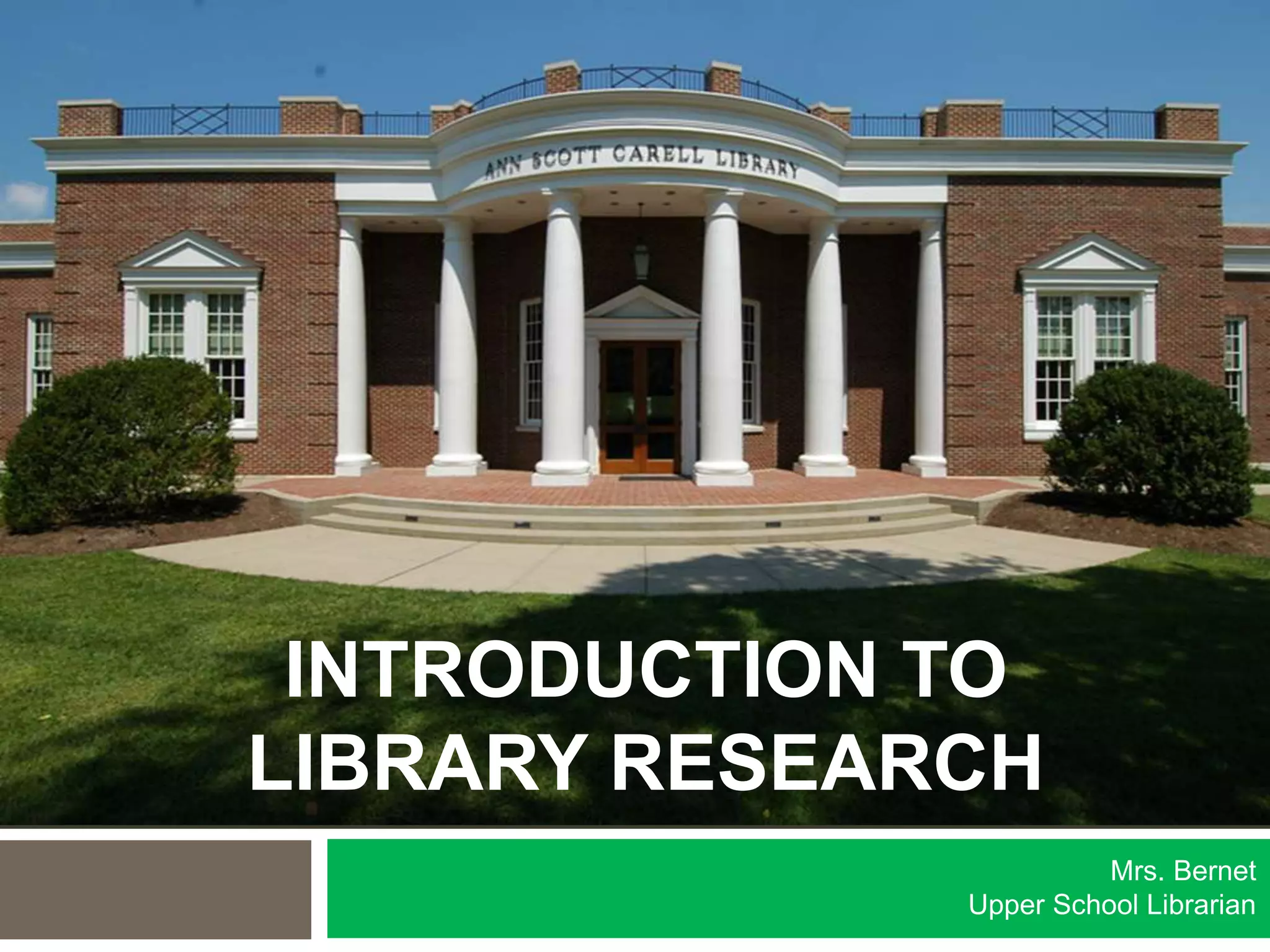
INTRODUCTION TO
LIBRARY RESEARCH
Mrs. Bernet
Upper School Librarian
Welcome to
Upper School Research
 Introduction
 Who am I and How can I help
you
 kristin.bernet@ harpethhall.org
 Honor
 Academic integrity
 What is “Plagiarism” and why
should you care?
 How to avoid plagiarism
 Library Resources
 Print, Electronic, A/V,
Periodicals, databases, etc…
 Destiny & LibGuides
 Critical Thinking
 Creating a search query
 C.A.R.P. Method for evaluating
online sources
 EasyBib
 MLA Citation format
 Bibliography analysis & note
cards
What is “Honor” and how does it
relate to academic integrity?
 Cheat
 Plagiarize
 Misinformation
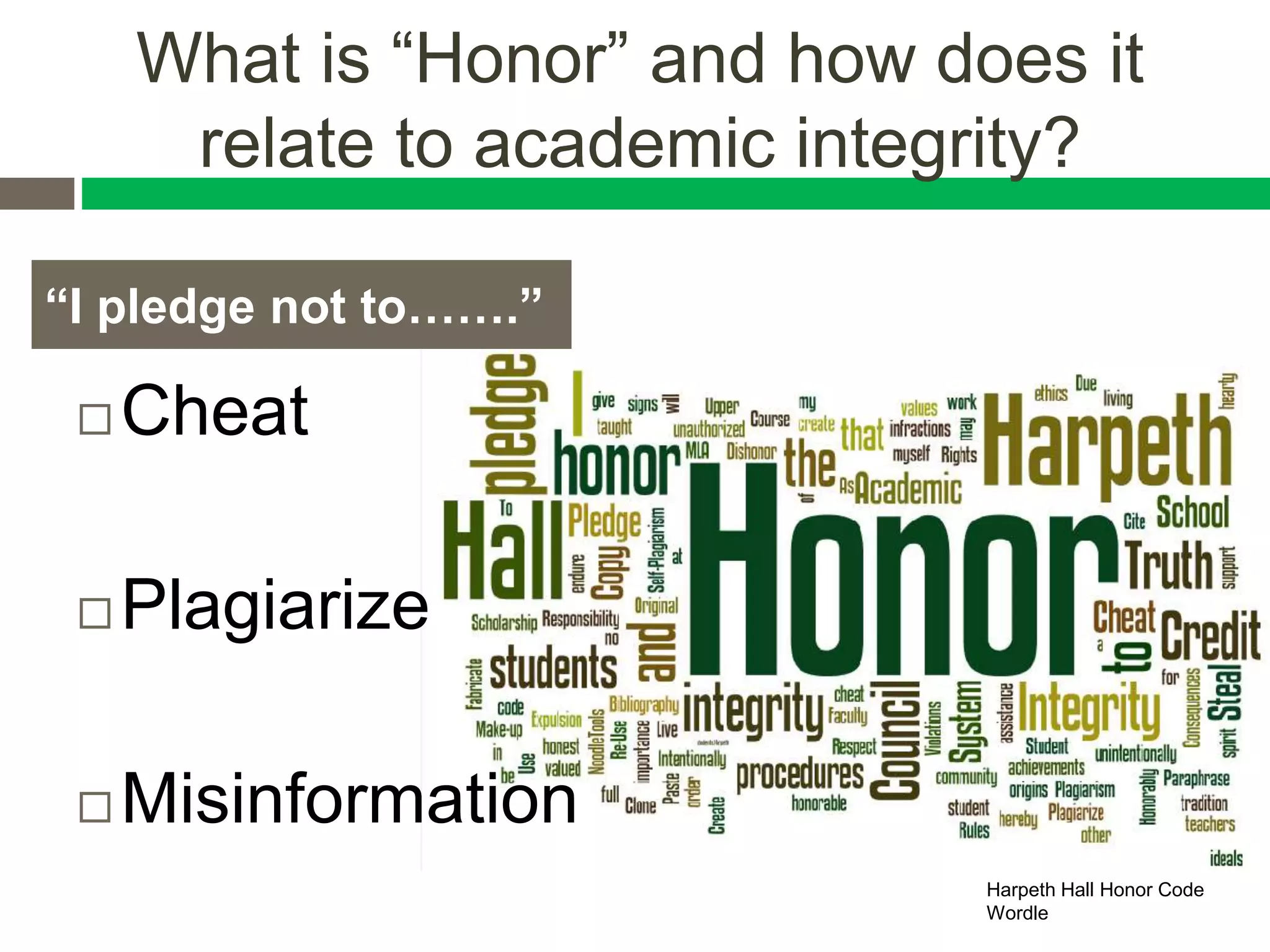
“I pledge not to…….”
Harpeth Hall Honor Code
Wordle
What is Plagiarism?
What is
“Plagiarism”
 Paraphrasing?
 Copy and pasting
from the web
(“There was no
author”)?
 Pictures and
Images?
 Common
knowledge?
Self-Plagiarism?
Examples of Common
Plagiarism
 Cutting and pasting
from electronic
sources without
citations
 Faking a citation
 Careless
paraphrasing
 Buying research
papers
 Not giving credit
Types of Plagiarism
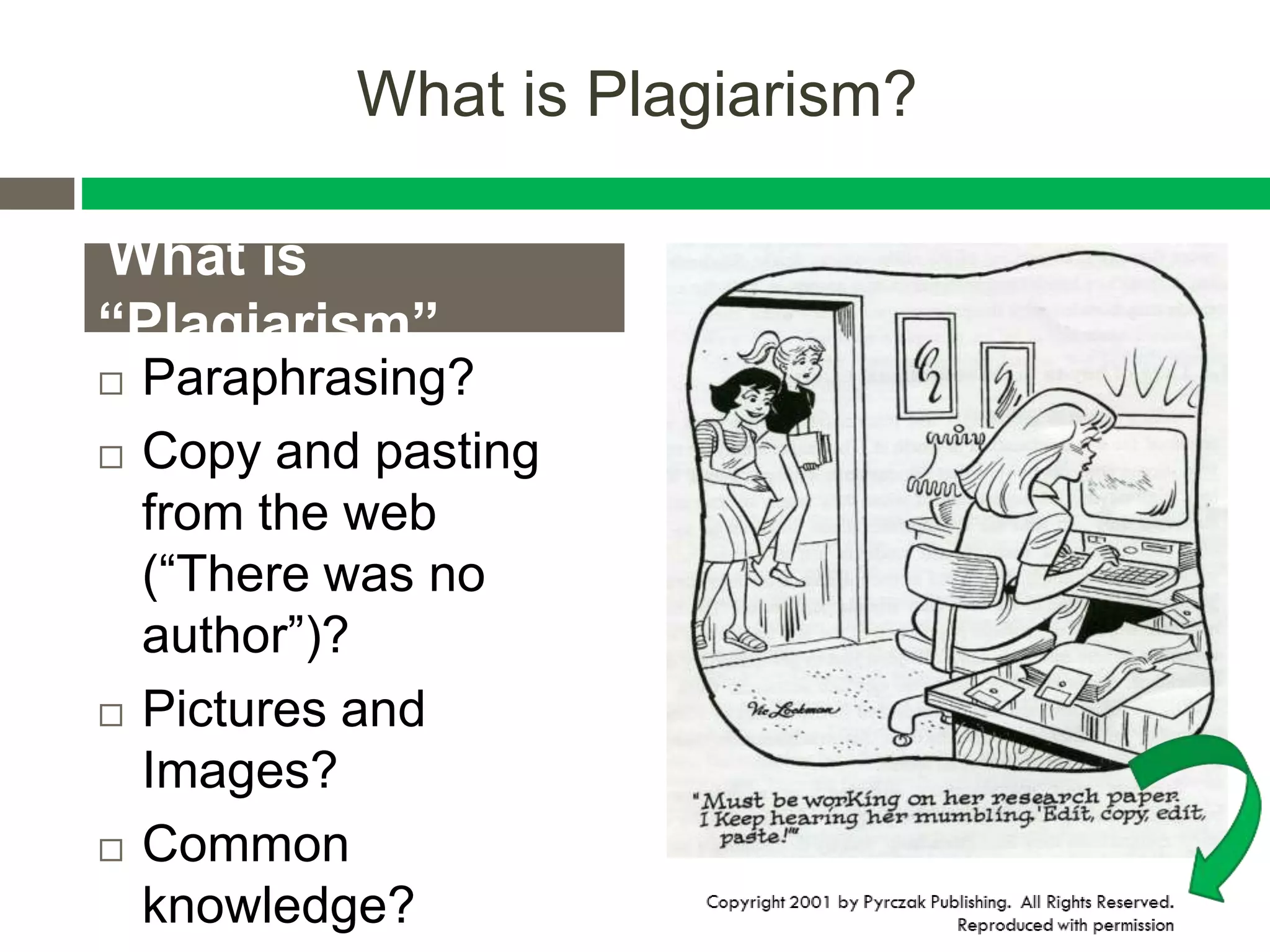
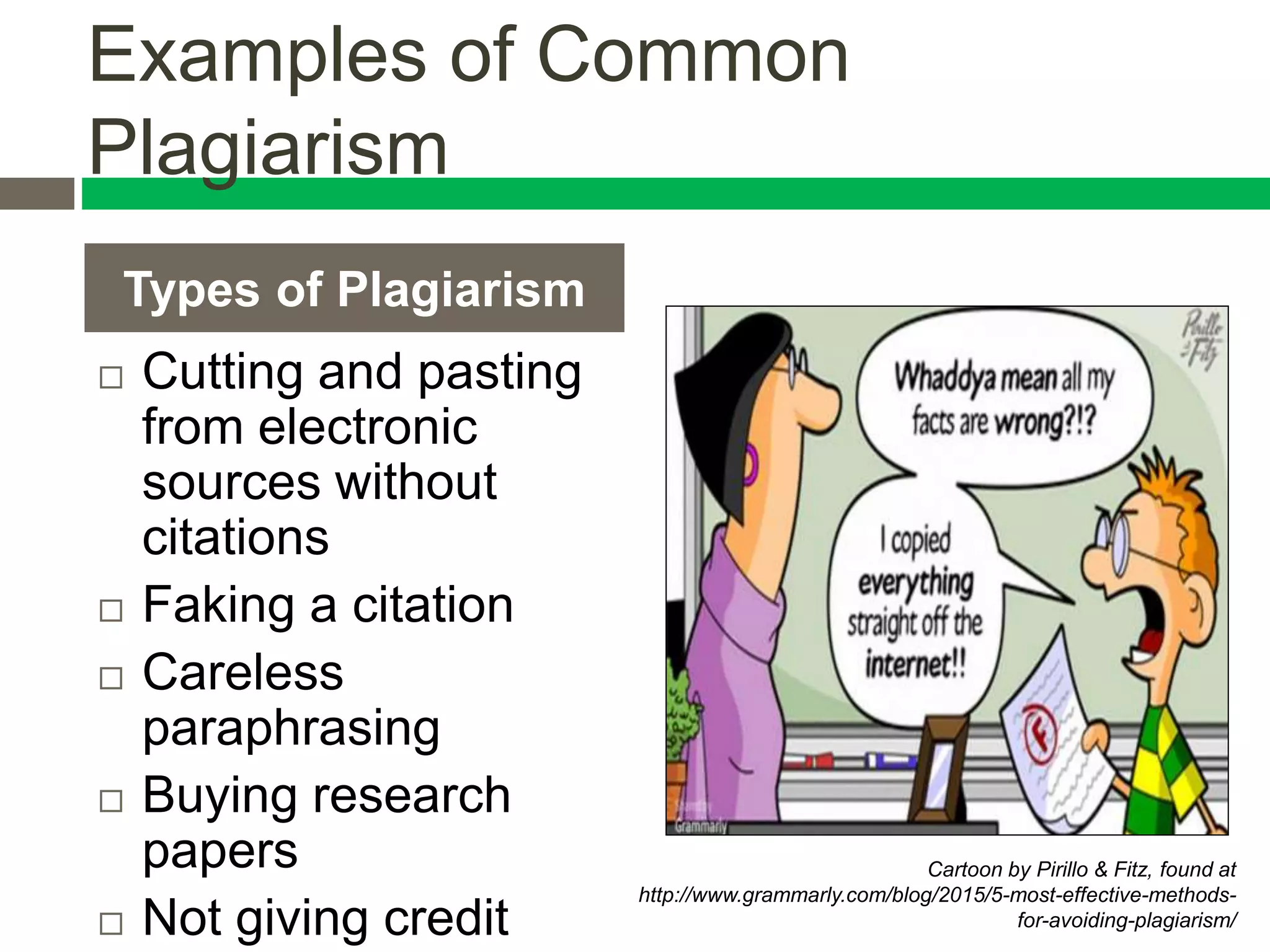
Cartoon by Pirillo & Fitz, found at
http://www.grammarly.com/blog/2015/5-most-effective-methods-
for-avoiding-plagiarism/
How to Avoid
Plagiarizing
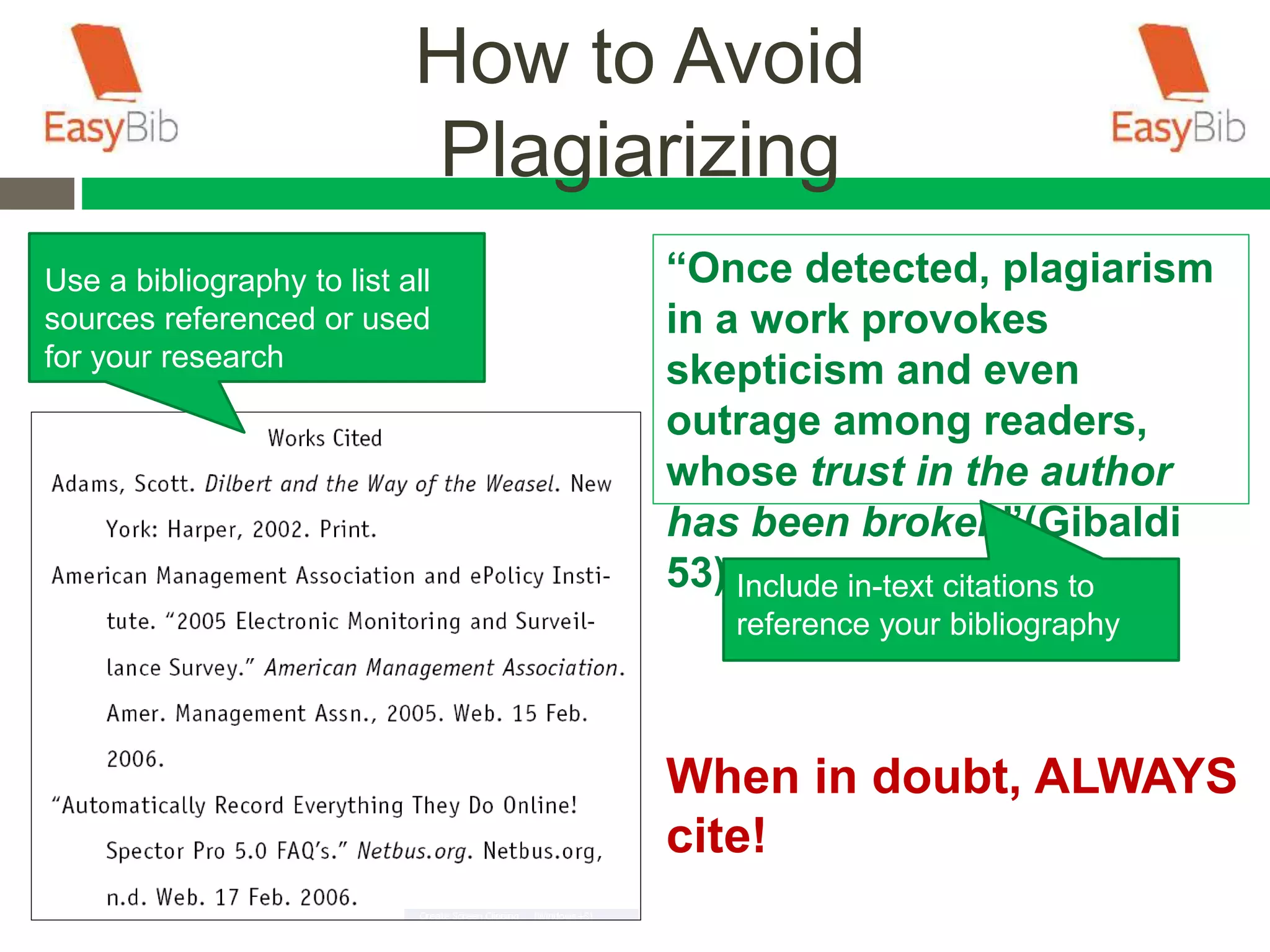
Use a bibliography to list all
sources referenced or used
for your research
“Once detected, plagiarism
in a work provokes
skepticism and even
outrage among readers,
whose trust in the author
has been broken”(Gibaldi
53).Include in-text citations to
reference your bibliography
When in doubt, ALWAYS
cite!
Resources Available In The
Library
 Reference Books
 Periodicals
 Fiction and Non-
fiction
 A/V equipment
 Databases
 eBooks
 Image Files
 Writing Guide
 LibGuide Project
Pages
Tangible Resources Electronic Resources
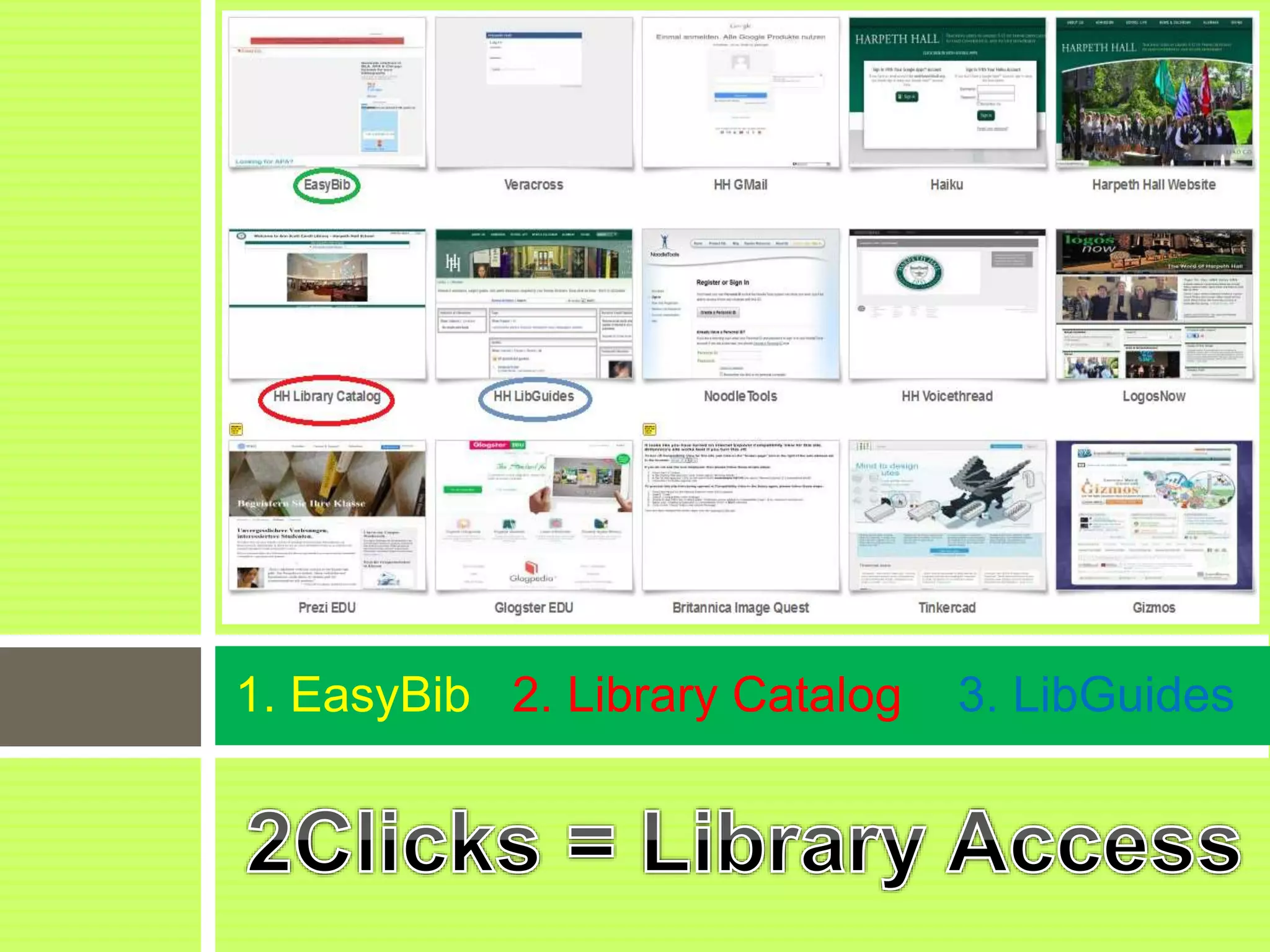
1. EasyBib 2. Library Catalog 3. LibGuides
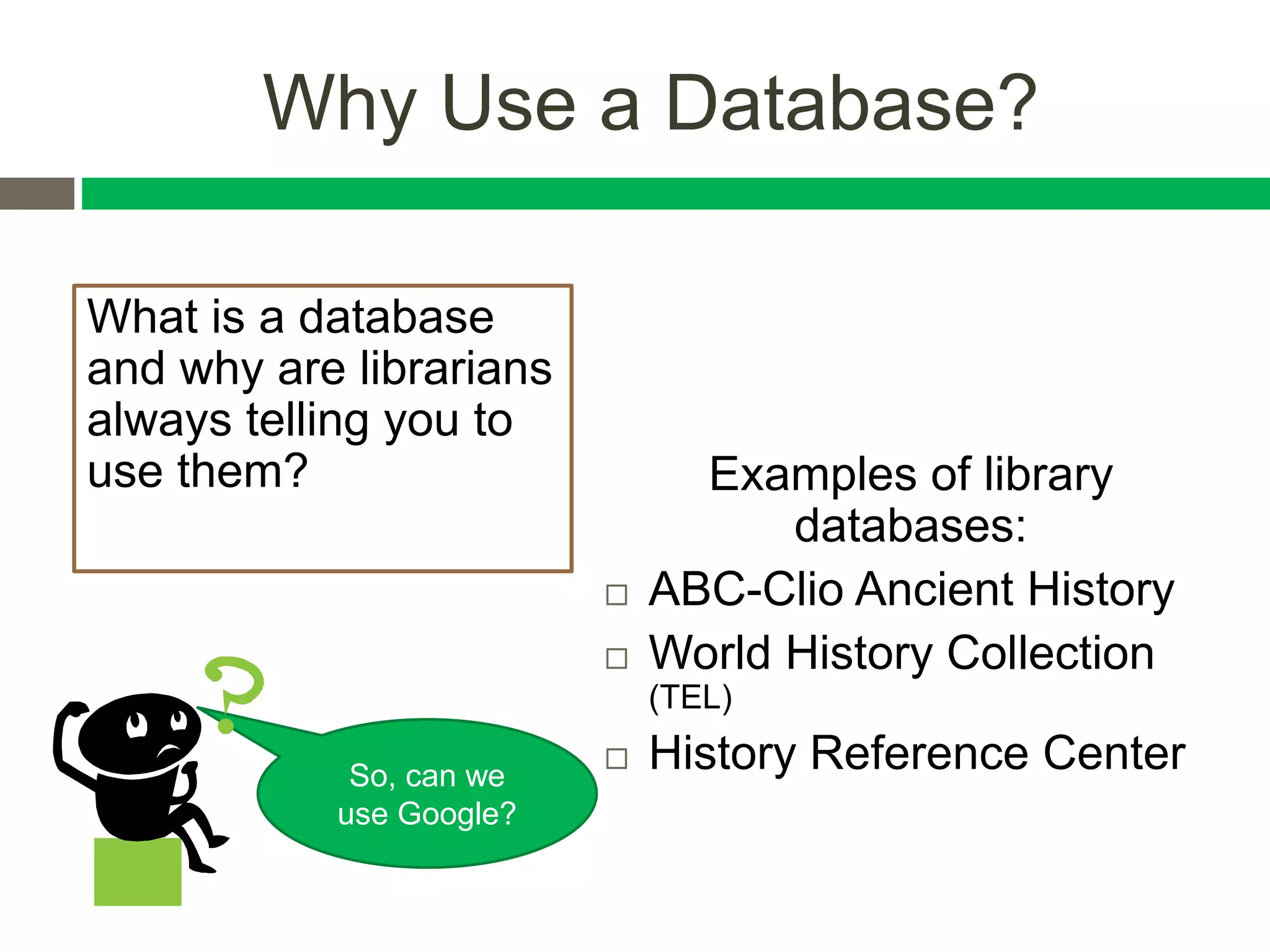
Why Use a Database?
What is a database
and why are librarians
always telling you to
use them? Examples of library
databases:
 ABC-Clio Ancient History
 World History Collection
(TEL)
 History Reference CenterSo, can we
use Google?
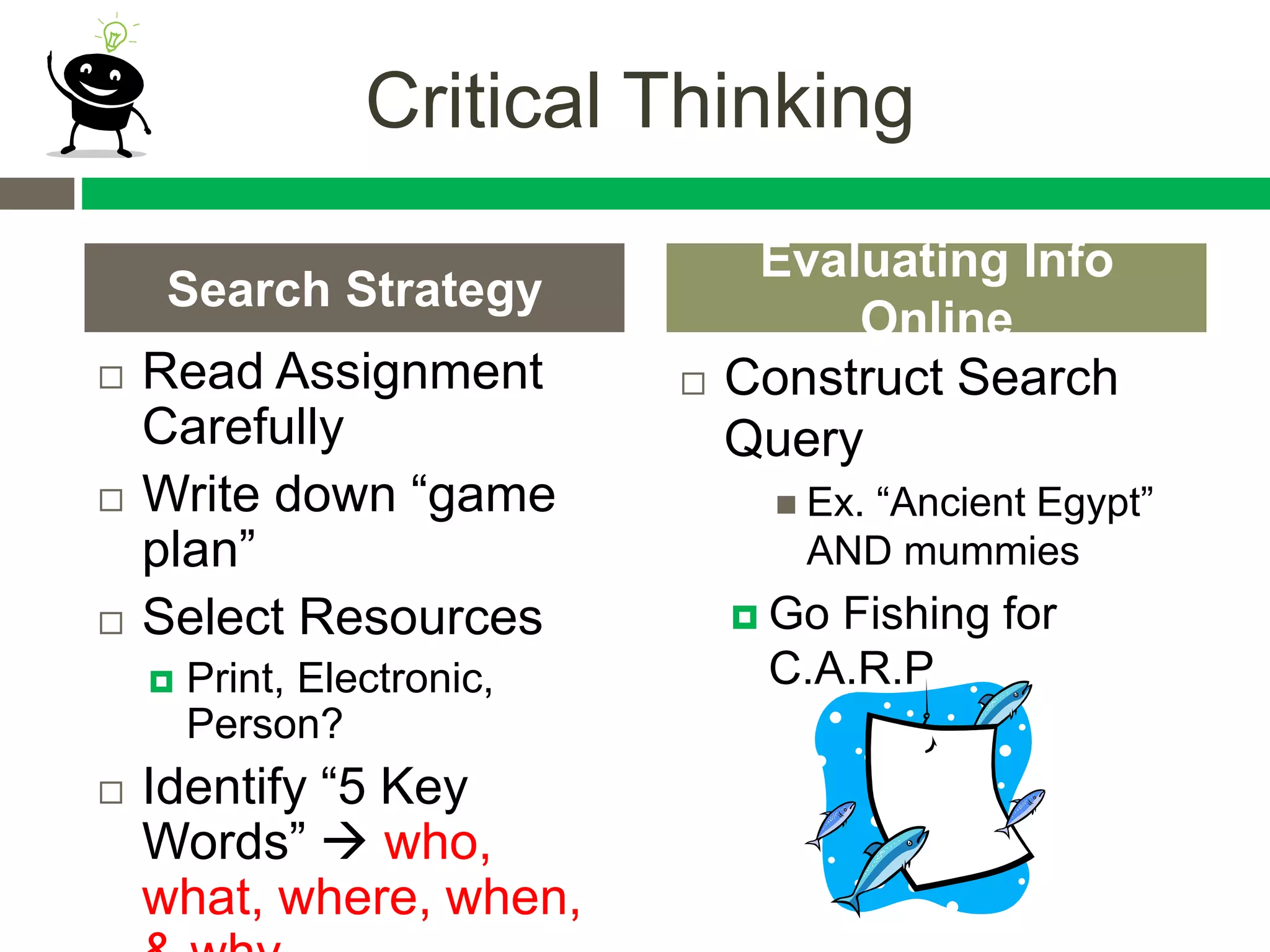
Critical Thinking
 Read Assignment
Carefully
 Write down “game
plan”
 Select Resources
 Print, Electronic,
Person?
 Identify “5 Key
Words”  who,
what, where, when,
 Construct Search
Query
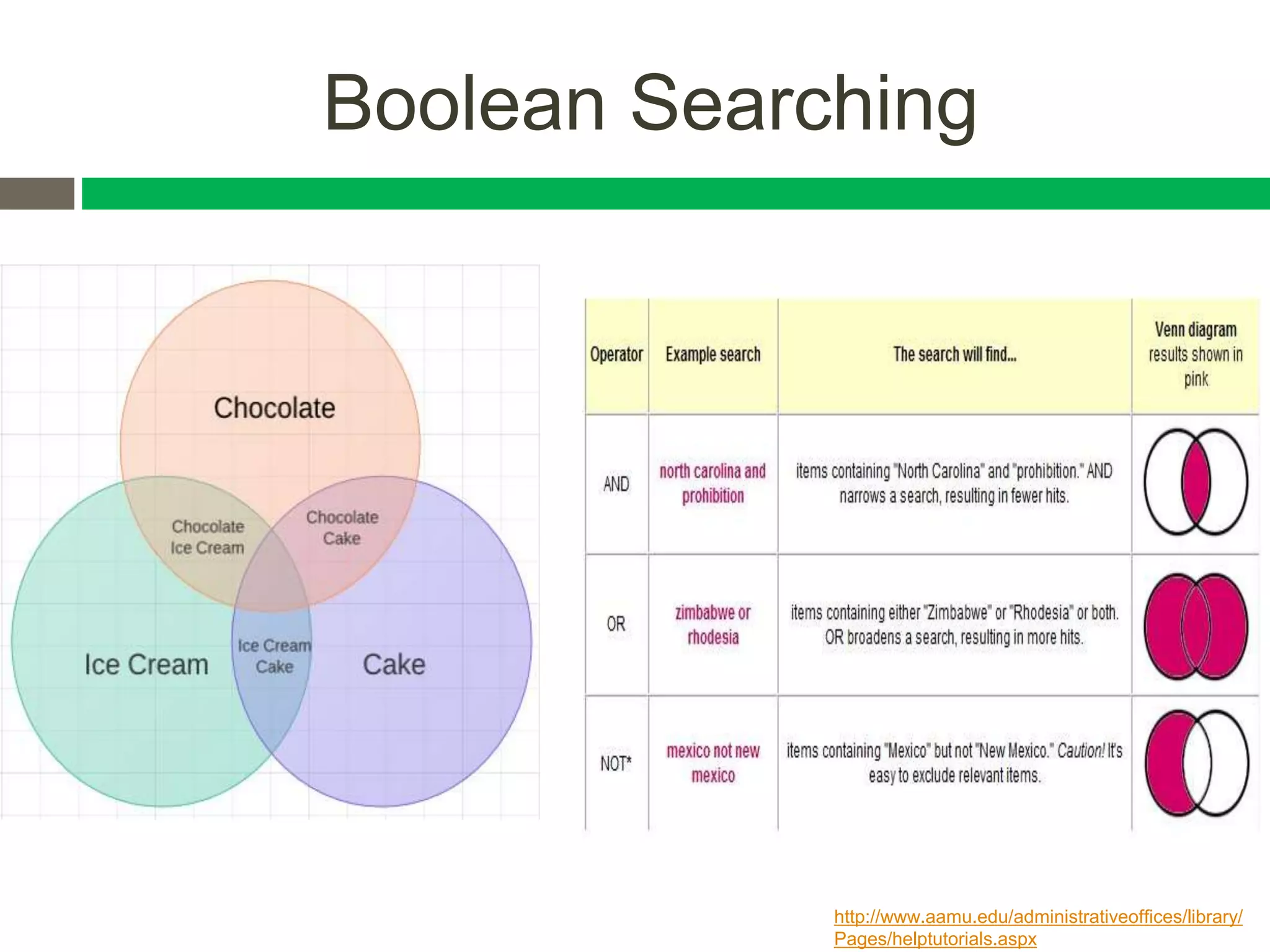
 Ex. “Ancient Egypt”
AND mummies
 Go Fishing for
C.A.R.P
Search Strategy
Evaluating Info
Online
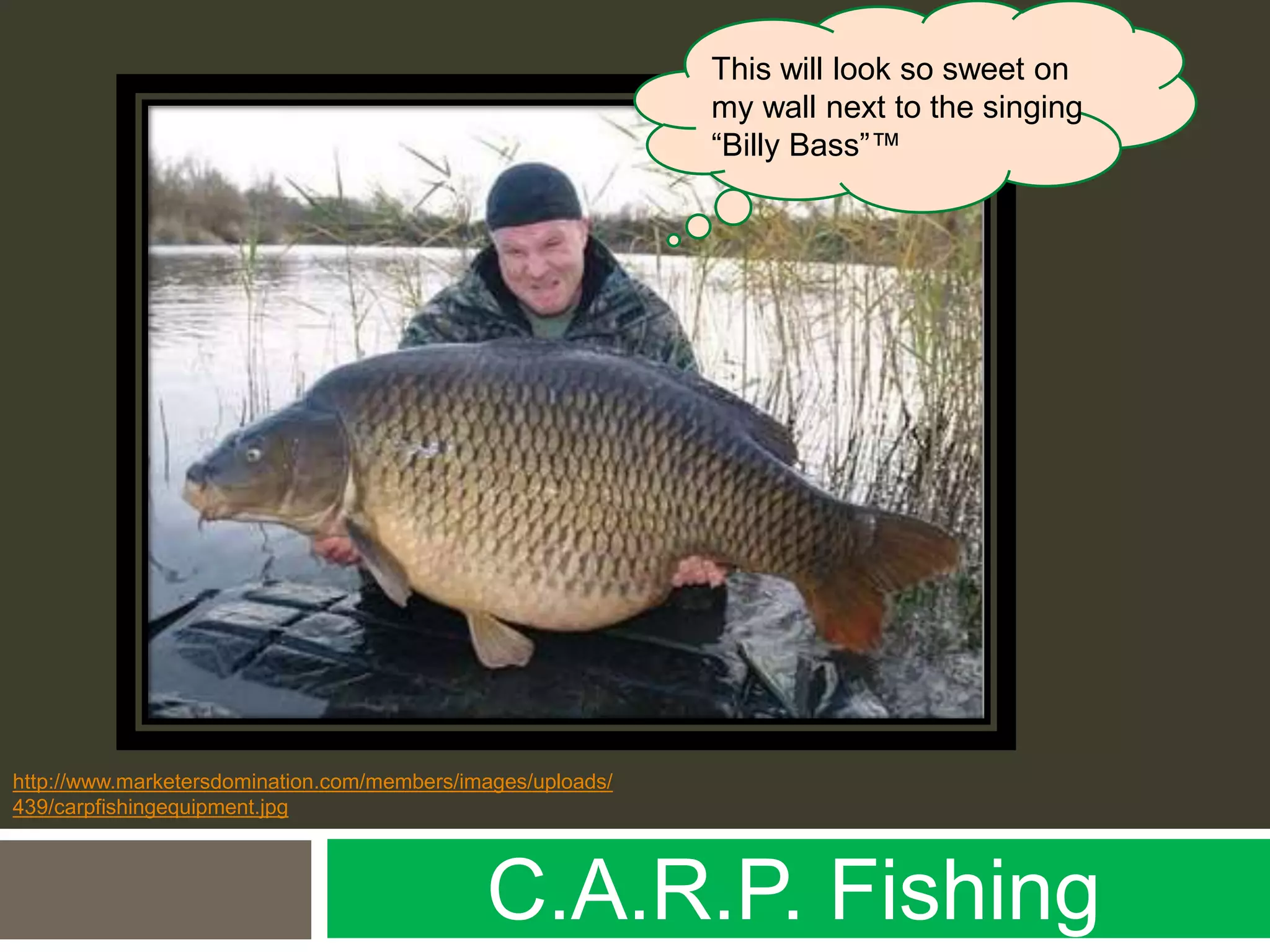
C.A.R.P. Fishing
http://www.marketersdomination.com/members/images/uploads/
439/carpfishingequipment.jpg
This will look so sweet on
my wall next to the singing
“Billy Bass”™
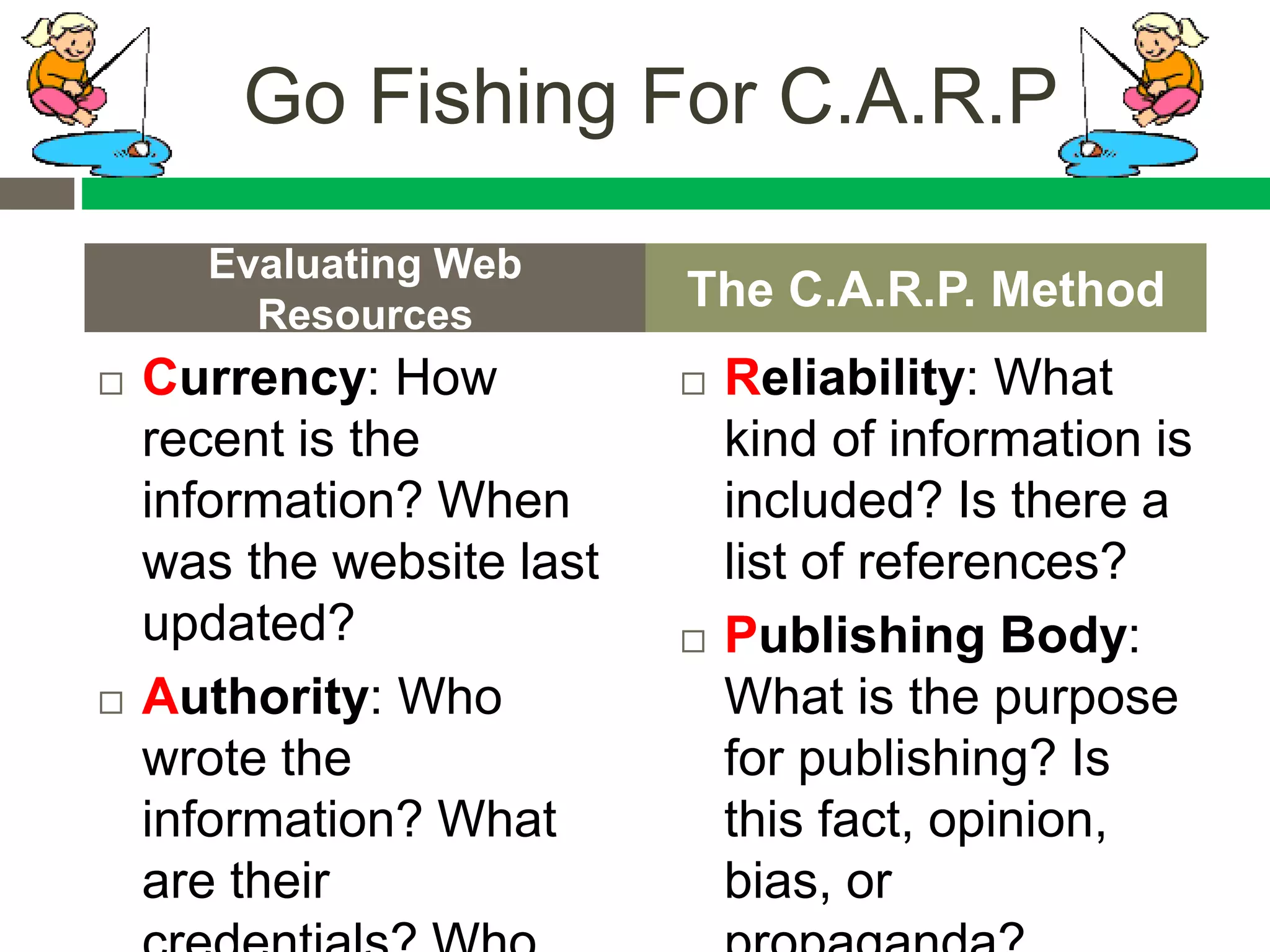
 Currency: How
recent is the
information? When
was the website last
updated?
 Authority: Who
wrote the
information? What
are their
 Reliability: What
kind of information is
included? Is there a
list of references?
 Publishing Body:
What is the purpose
for publishing? Is
this fact, opinion,
bias, or
Evaluating Web
Resources
The C.A.R.P. Method
Go Fishing For C.A.R.P
LET’S GO HILLBILLY
HAND FISHING FOR
C.A.R.P.
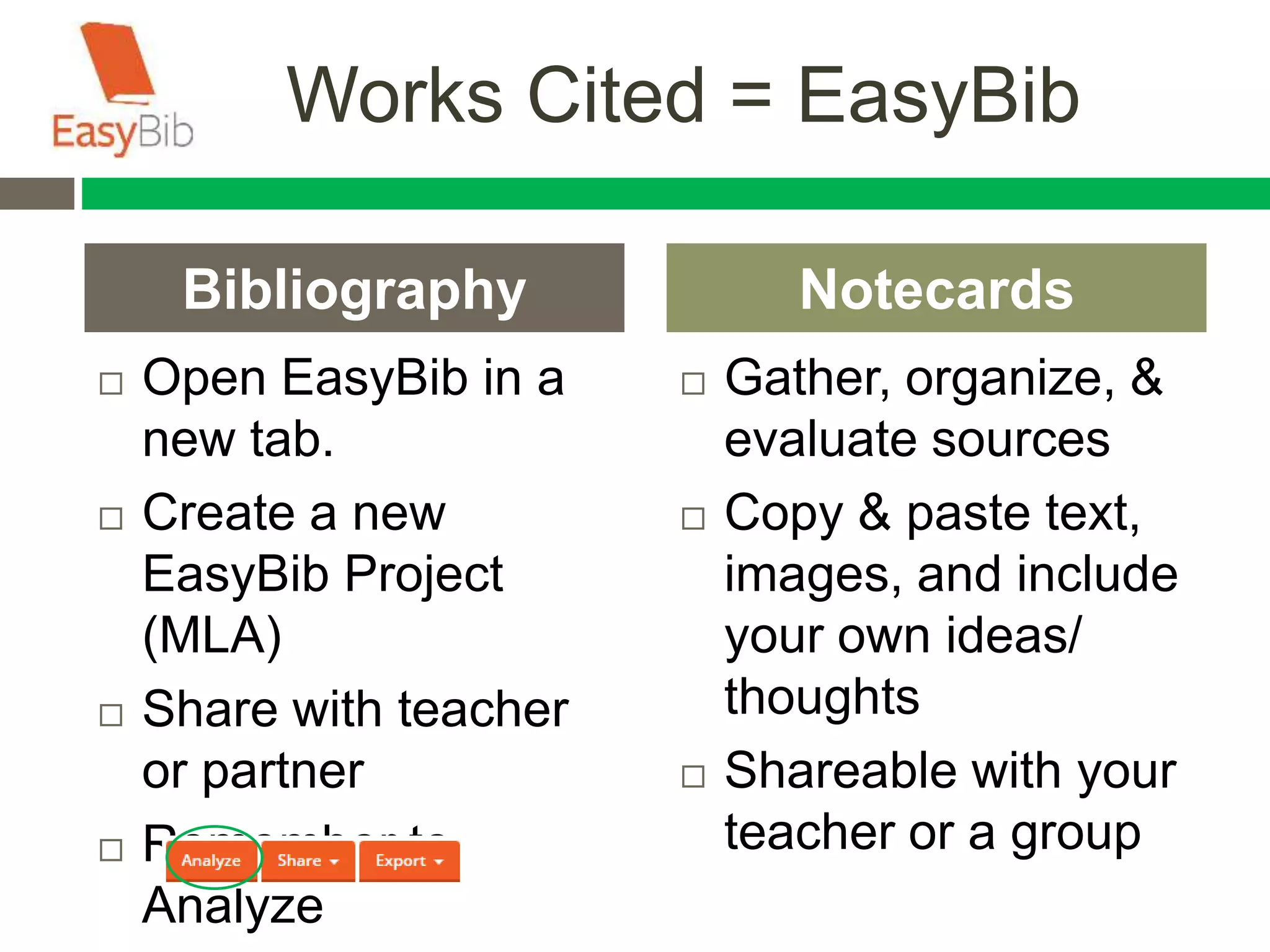
Works Cited = EasyBib
 Open EasyBib in a
new tab.
 Create a new
EasyBib Project
(MLA)
 Share with teacher
or partner
 Remember to
Analyze
 Gather, organize, &
evaluate sources
 Copy & paste text,
images, and include
your own ideas/
thoughts
 Shareable with your
teacher or a group
Bibliography Notecards
Questions? Comments?
Mrs. Bernet
Ann Scott Carell Library
kristin.bernet@harpethhall.org
(615) 346-0133
Office Hours: 7:30am- 3:30pm
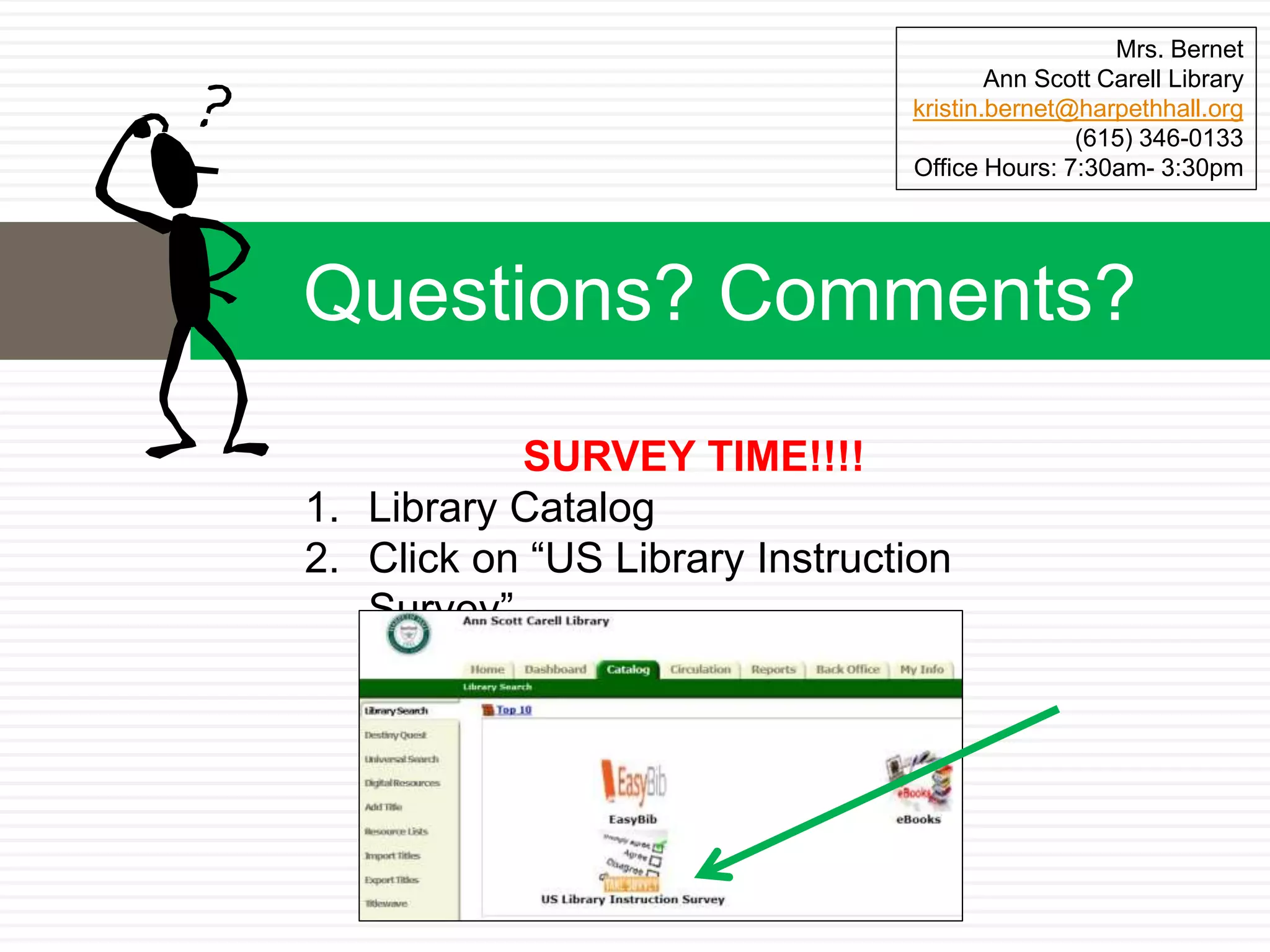
SURVEY TIME!!!!
1. Library Catalog
2. Click on “US Library Instruction
Survey”
INTRODUCTION TO
LIBRARY RESEARCH
Mrs. Bernet
Upper School Librarian
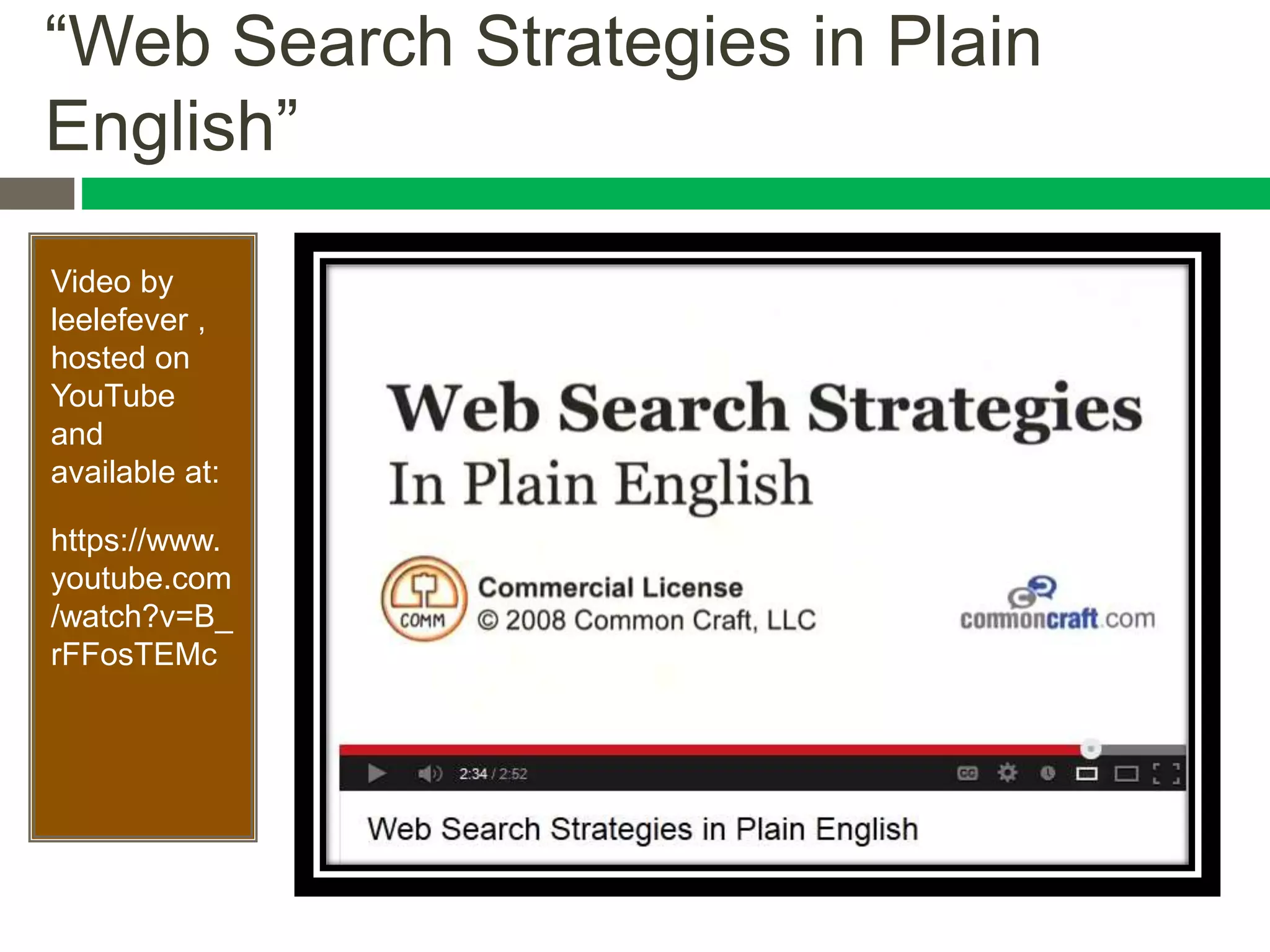
“Web Search Strategies in Plain
English”
Video by
leelefever ,
hosted on
YouTube
and
available at:
https://www.
youtube.com
/watch?v=B_
rFFosTEMc
Works Cited
1. Bailey, Jonathan. “Self-Plagiarism: Ethical Shortcut or Moral Scourge?” Plaigarism Today: Content
Theft, Copy Right Infringment, and Plagiarism. Jonathan Bailey, 7 Sept. 2011. Web. 16 Aug. 2012.
<http://www.plagiarismtoday.com/2011/09/07/self-plagiarism-ethical-shortcut-or-moral-scourge/>.
Cartoon image for Self-Plagiarism slide
2. Chiliv8. “Thou Shalt Not Copy and Paste: Plagiarism Detection Software.” Chiliv8, PhD:
Neuroscience Meets Rock’n’Roll. WordPress, 8 Mar. 2012. Web. 16 Aug. 2012.
<http://chiliv8.wordpress.com/2012/03/08/thou-shalt-not-copy-and-paste-plagiarism-detection-
software/>. Image of Bart Simpson, courtesy of Fox Television, from opening credits.
3. Gibaldi, Joseph. “2.2 Consequences of Plagiarism.” MLA Handbook for Writers of Research
Papers. By Joseph Gibaldi. 7th ed. New York: MLA, 2009. 52-53.
4. Laurence, Ray. “Childhood in the Roman Empire.” History Today 55.10 (2005): 21-27. World
History Collection. Web. 20 Aug. 2012.
<http://search.ebscohost.com/login.aspx?direct=true&db=wdh&AN=18455273&site=ehost-live>.
5. Lightman, Marjorie, Benjamin Lightman, and Marjorie Lightman. A to Z of Ancient Greek and
Roman Women. Rev. ed. New York: Facts On File, 2008.
6. Salowey, Christina A., and Frank N. Magill. Great Lives from History. Pasadena: Salem, 2004.
Print. HH Library Skorina, Diane. “Boolean Operators.” The Myrin Virtual Library: Psychology
LibGuide. Ursinus College, n.d. Web. 17 Aug. 2012. <http://libguides.ursinus.edu/psychology>. Image
for Boolean Operators
7. Thomas, Ronald. “Carp Reels Which Type Are Best.” Marketers Domination: The Tools Needed for
Domination. Marketers Domination, n.d. Web. 20 Aug. 2012.
<http://www.marketersdomination.com/members/images/uploads/439/carpfishingequipment.jpg>.
Photograph of large trophy carp.
8. Western Kentucky University. WKU Dishonesty Wordle. Process for Academic Dishonesty.
Western Kentucky University, 10 Oct. 2011. Web. 16 Aug. 2012.
<http://www.wku.edu/handbook/academic-dishonesty.php>. Wordle created by Western Kentucky
University for their Process for Academic Dishonesty webpage
EasyBib
 ALWAYS export
Boolean Searching
http://www.aamu.edu/administrativeoffices/library/
Pages/helptutorials.aspx
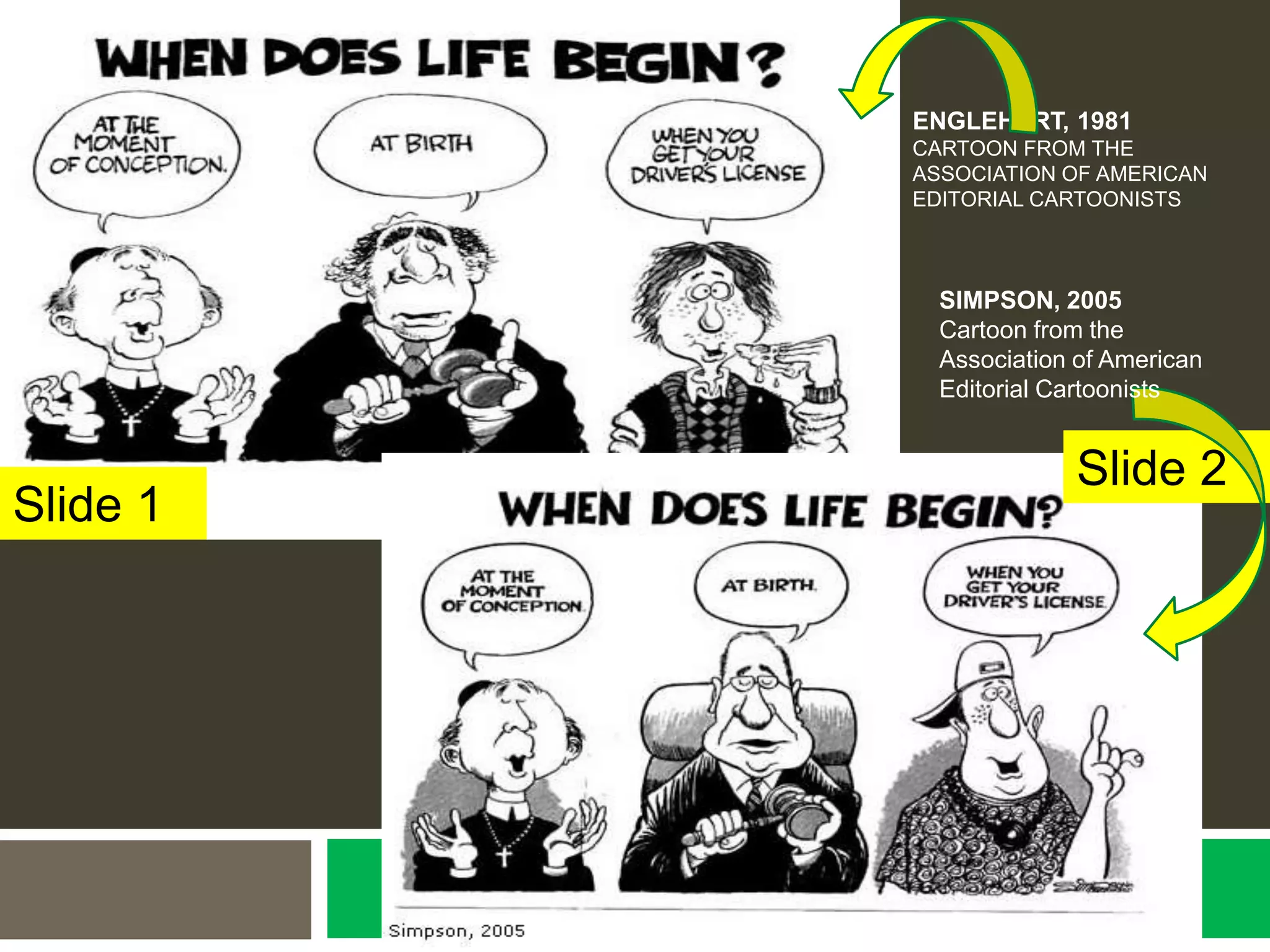
ENGLEHART, 1981
CARTOON FROM THE
ASSOCIATION OF AMERICAN
EDITORIAL CARTOONISTS
Slide 1
Slide 2
SIMPSON, 2005
Cartoon from the
Association of American
Editorial Cartoonists

The C.A.R.P. Method

  • 1.
    INTRODUCTION TO LIBRARY RESEARCH Mrs.Bernet Upper School Librarian
  • 2.
    Welcome to Upper SchoolResearch  Introduction  Who am I and How can I help you  kristin.bernet@ harpethhall.org  Honor  Academic integrity  What is “Plagiarism” and why should you care?  How to avoid plagiarism  Library Resources  Print, Electronic, A/V, Periodicals, databases, etc…  Destiny & LibGuides  Critical Thinking  Creating a search query  C.A.R.P. Method for evaluating online sources  EasyBib  MLA Citation format  Bibliography analysis & note cards
  • 3.
    What is “Honor”and how does it relate to academic integrity?  Cheat  Plagiarize  Misinformation “I pledge not to…….” Harpeth Hall Honor Code Wordle
  • 4.
    What is Plagiarism? Whatis “Plagiarism”  Paraphrasing?  Copy and pasting from the web (“There was no author”)?  Pictures and Images?  Common knowledge? Self-Plagiarism?
  • 5.
    Examples of Common Plagiarism Cutting and pasting from electronic sources without citations  Faking a citation  Careless paraphrasing  Buying research papers  Not giving credit Types of Plagiarism Cartoon by Pirillo & Fitz, found at http://www.grammarly.com/blog/2015/5-most-effective-methods- for-avoiding-plagiarism/
  • 6.
    How to Avoid Plagiarizing Usea bibliography to list all sources referenced or used for your research “Once detected, plagiarism in a work provokes skepticism and even outrage among readers, whose trust in the author has been broken”(Gibaldi 53).Include in-text citations to reference your bibliography When in doubt, ALWAYS cite!
  • 7.
    Resources Available InThe Library  Reference Books  Periodicals  Fiction and Non- fiction  A/V equipment  Databases  eBooks  Image Files  Writing Guide  LibGuide Project Pages Tangible Resources Electronic Resources
  • 8.
    1. EasyBib 2.Library Catalog 3. LibGuides
  • 9.
    Why Use aDatabase? What is a database and why are librarians always telling you to use them? Examples of library databases:  ABC-Clio Ancient History  World History Collection (TEL)  History Reference CenterSo, can we use Google?
  • 10.
    Critical Thinking  ReadAssignment Carefully  Write down “game plan”  Select Resources  Print, Electronic, Person?  Identify “5 Key Words”  who, what, where, when,  Construct Search Query  Ex. “Ancient Egypt” AND mummies  Go Fishing for C.A.R.P Search Strategy Evaluating Info Online
  • 11.
  • 12.
     Currency: How recentis the information? When was the website last updated?  Authority: Who wrote the information? What are their  Reliability: What kind of information is included? Is there a list of references?  Publishing Body: What is the purpose for publishing? Is this fact, opinion, bias, or Evaluating Web Resources The C.A.R.P. Method Go Fishing For C.A.R.P
  • 13.
    LET’S GO HILLBILLY HANDFISHING FOR C.A.R.P.
  • 14.
    Works Cited =EasyBib  Open EasyBib in a new tab.  Create a new EasyBib Project (MLA)  Share with teacher or partner  Remember to Analyze  Gather, organize, & evaluate sources  Copy & paste text, images, and include your own ideas/ thoughts  Shareable with your teacher or a group Bibliography Notecards
  • 15.
    Questions? Comments? Mrs. Bernet AnnScott Carell Library kristin.bernet@harpethhall.org (615) 346-0133 Office Hours: 7:30am- 3:30pm SURVEY TIME!!!! 1. Library Catalog 2. Click on “US Library Instruction Survey”
  • 16.
    INTRODUCTION TO LIBRARY RESEARCH Mrs.Bernet Upper School Librarian
  • 17.
    “Web Search Strategiesin Plain English” Video by leelefever , hosted on YouTube and available at: https://www. youtube.com /watch?v=B_ rFFosTEMc
  • 18.
    Works Cited 1. Bailey,Jonathan. “Self-Plagiarism: Ethical Shortcut or Moral Scourge?” Plaigarism Today: Content Theft, Copy Right Infringment, and Plagiarism. Jonathan Bailey, 7 Sept. 2011. Web. 16 Aug. 2012. <http://www.plagiarismtoday.com/2011/09/07/self-plagiarism-ethical-shortcut-or-moral-scourge/>. Cartoon image for Self-Plagiarism slide 2. Chiliv8. “Thou Shalt Not Copy and Paste: Plagiarism Detection Software.” Chiliv8, PhD: Neuroscience Meets Rock’n’Roll. WordPress, 8 Mar. 2012. Web. 16 Aug. 2012. <http://chiliv8.wordpress.com/2012/03/08/thou-shalt-not-copy-and-paste-plagiarism-detection- software/>. Image of Bart Simpson, courtesy of Fox Television, from opening credits. 3. Gibaldi, Joseph. “2.2 Consequences of Plagiarism.” MLA Handbook for Writers of Research Papers. By Joseph Gibaldi. 7th ed. New York: MLA, 2009. 52-53. 4. Laurence, Ray. “Childhood in the Roman Empire.” History Today 55.10 (2005): 21-27. World History Collection. Web. 20 Aug. 2012. <http://search.ebscohost.com/login.aspx?direct=true&db=wdh&AN=18455273&site=ehost-live>. 5. Lightman, Marjorie, Benjamin Lightman, and Marjorie Lightman. A to Z of Ancient Greek and Roman Women. Rev. ed. New York: Facts On File, 2008. 6. Salowey, Christina A., and Frank N. Magill. Great Lives from History. Pasadena: Salem, 2004. Print. HH Library Skorina, Diane. “Boolean Operators.” The Myrin Virtual Library: Psychology LibGuide. Ursinus College, n.d. Web. 17 Aug. 2012. <http://libguides.ursinus.edu/psychology>. Image for Boolean Operators 7. Thomas, Ronald. “Carp Reels Which Type Are Best.” Marketers Domination: The Tools Needed for Domination. Marketers Domination, n.d. Web. 20 Aug. 2012. <http://www.marketersdomination.com/members/images/uploads/439/carpfishingequipment.jpg>. Photograph of large trophy carp. 8. Western Kentucky University. WKU Dishonesty Wordle. Process for Academic Dishonesty. Western Kentucky University, 10 Oct. 2011. Web. 16 Aug. 2012. <http://www.wku.edu/handbook/academic-dishonesty.php>. Wordle created by Western Kentucky University for their Process for Academic Dishonesty webpage
  • 19.
  • 20.
  • 21.
    ENGLEHART, 1981 CARTOON FROMTHE ASSOCIATION OF AMERICAN EDITORIAL CARTOONISTS Slide 1 Slide 2 SIMPSON, 2005 Cartoon from the Association of American Editorial Cartoonists

Editor's Notes

  • #4 Academic Integrity: you represent not only yourself but your parents, your beliefs, and your school “Think Critically, Live Honorably, and Lead Confidently” Ex. In 2002 reports of wide spread plagiarism led to a 20 month long investigation at the Univ. of VA which ultimately led to the expulsion of over 45 students. Teachers are not dumb. They know every trick in the book and they are looking for plagiarism. When you get to college they even use software to detect plagiarism. At Hopkins we used TurnitIn. *Turnitin for Admissions is used to detect plagiarism in college applications.
  • #5 From MLA 7th ed: “Plagiarism is derived from the Latin Word plagiarius (“kidnapper”), to plagiarize means “to commit literary theft” and to “present as new and original an idea or product derived from an existing source” – Merriam-Webster’s collegiate Dictionary 11th ed; 2003 Quotations must be identical to the original, using a narrow segment of the source. They must match the source document word for word and must be attributed to the original author. Paraphrasing involves putting a passage from source material into your own words. A paraphrase must also be attributed to the original source. Paraphrased material is usually shorter than the original passage, taking a somewhat broader segment of the source and condensing it slightly. Summarizing involves putting the main idea(s) into your own words, including only the main point(s). Once again, it is necessary to attribute summarized ideas to the original source. Summaries are significantly shorter than the original and take a broad overview of the source material
  • #7 The best way to avoid plagiarizing is to be aware of what you are doing (researching, writing, brainstorming) and to always give credit where its due. The burden of proof is on you. You can not claim ignorance. It is your responsibility to cite where every source came from. If anything is not wholly and 100% an original idea or product then you MUST cite it. NoodleTools will help you format your cites but when in doubt add as much information as possible. The key is to give enough information that a stranger would be able to track down that source. Citations are like breadcrumbs leading back to the original source that you found.
  • #8 What is Tangible? 24/7 access to resources from home. Q: Where can you access this information (physically go to the library, go online to Library Catalog  How to get to library catalog online
  • #9 Let’s take a couple minutes to look at the catalog and some of our resources Catalog (books/ serials/ DVD) Image Quest Guide to Writing News Upper School Projects (World cultures page) * What is “Net Traker” review and update project page
  • #11 What if you want to look beyond a database and search the open web?
  • #15 Congratulations! You’ve all found excellent and appropriate resources for your project. You’ve done the reading and are now ready to write your paper. What do you do with all of those resources that you’ve used? By now, Everyone know that you have to give credit where it’s due and avoid plagiarizing. So how do you create a bibliography?
  • #18 https://www.youtube.com/watch?v=B_rFFosTEMc
  • #21 Boolean Searching Broaden or narrow your search by combing words or phrases using the Boolean operators AND, OR, and NOT. The results of performing Boolean searches are sometimes illustrated by the diagrams below (called Venn diagrams.) The diagrams show graphically how using the AND operator narrows a search, using OR broadens a search, and using NOT excludes material from a search. Many databases and search engines have an Advanced Search interface that allows for Boolean searching; you can also try just using a Boolean operator in the main search box.
  • #22 Famous Examples of Plagiarism: - Hunger Games and Battle Royale A young Helen Keller was accused in 1892 of plagiarizing Margaret T. Canby's story The Frost Fairies in her short story The Frost King. She was brought before a tribunal of the Perkins Institute for the Blind, where she was acquitted by a single vote. She said she was worried she may have read The Frost Fairies and forgotten it, "remained paranoid about plagiarism ever after"[47][48] and said that this led her to write an autobiography: the one thing she knew must be original In 1973 The Beatles were sued for plagiarizing Chuck Berry's "You Can't Catch Me" in their hit "Come Together". John Lennon and producer Morris Levy signed an agreement before trial. (wikipedia)