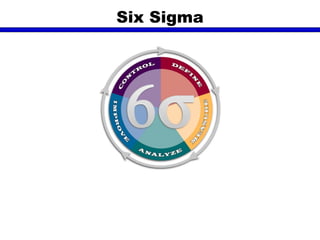
Six Sigma
What Is Six Sigma ?
• A metric — standard deviations in a normal curve
• A goal — 3.4 defects per million opportunities
• A rigorous, process focused methodology
– the DMAIC process
• A management
philosophy
Business
and/or Customer
Requirement
1
2
3
4
5
6σ
Defects Good
Where Does Six Sigma Come From?
• Necessity is the mother of invention
– Motorola was losing market share to foreign rivals who
had better quality and lower cost.
– A Japanese firm took over a Motorola television factory.
After implementing changes, the factory was producing
with 1/20th the defect rate. Same people, same
equipment, same designs…..different management and
different processes.
• “Our quality stinks.” — Art Sundry, Motorola
©2005 Tyg Lucas
• Late 1970s Mikel Harry (the man with two first names), a
senior staff engineer, is using statistical analysis for
problem solving. He was working in the Government
Electronics Group (GEG)
• Though certainly not the first to apply statistical thinking to
manufacturing analysis, he is the one who went on to
refine a methodology and then call it “Six Sigma.” He
wrote an internal paper called “The Strategic Vision for
Accelerating Six Sigma Within Motorola."
Who Developed Six Sigma ?
• Bill Smith and throughput yield:
– Motorola had quality issues even on products that had
highly capable processes. Why?
– Bill Smith (sometimes referred to as the father of Six
Sigma) examines the issue.
– Individual yields are combined into a “rolled throughput
yield.” (So a 100-component product with individual
yields of 99.9% still only gives a completed product with
90% reliability.)
– He also developed many of the tools and techniques
that became the Six Sigma methodology.
Why Six of Those Sigmas ?
Six Sigma Early Development
• By the mid-1980s, Bob Galvin, Motorola CEO, has the
company focused on improving quality.
• 1988, Motorola wins the first Malcolm Baldridge Quality
Award. Part of winning this national quality award is the
agreement to share the methods used to achieve the high
levels of quality.
• Other companies initiate “Six Sigma” programs, notably
Larry Bossidy at Allied Signal.
• Larry tells his friend Jack Welch about it. Jack applies it at
GE in a very big, very GE way.
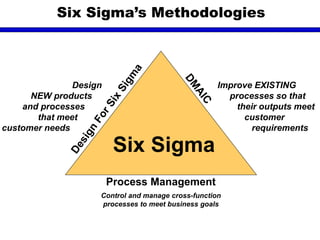
Six Sigma’s Methodologies
Six Sigma
Process Management
Improve EXISTING
processes so that
their outputs meet
customer
requirements
Control and manage cross-function
processes to meet business goals
Design
NEW products
and processes
that meet
customer needs
• Project management
• Voice of the Customer
• Process mapping
• Data collection
• Data graphs
• Gage R&R
• Operational definitions
• Process Capability
Assessment
• Hypothesis testing
• Regression analysis
• Designed experiments
• Statistical process control
• FMEA
• Stakeholder analysis
• Implementation planning
• Tollgate reviews
Common Six Sigma Tools
nothing new here . . .
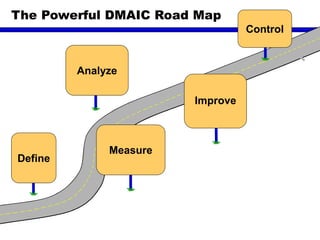
Analyze
Define
Measure
Improve
Control
The Powerful DMAIC Road Map
Define
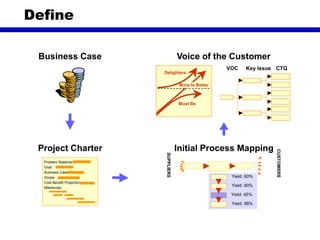
Define
Project Charter
Problem Statement:
Goal:
Business Case:
Scope:
Cost Benefit Projection:
Milestones:
VOC Key Issue CTQ
Delighters
More Is Better
Must Be
Voice of the CustomerBusiness Case
Initial Process Mapping
OutputsProcessInputs
Yield: 60%
Yield: 90%
Yield: 45%
Yield: 98%
CUSTOMERS
SUPPLIERS
Measure
Measure
Col # 1 2 3 4 5 6
Inspector A B
Sample # 1st Trial 2nd Trial Diff 1st Trial 2nd Trial Diff
1 2.0 1.0 1.0 1.5 1.5 0.0
2 2.0 3.0 1.0 2.5 2.5 0.0
3 1.5 1.0 0.5 2.0 1.5 0.5
4 3.0 3.0 0.0 2.0 2.5 0.5
5 2.0 1.5 0.5 1.5 0.5 1.0
Totals 10.5 9.5 3.0 9.5 8.5 2.0
Averages 2.1 1.9 0.6 1.9 1.7 0.4
Sum 4.0 Sum 3.6
XA 2.0 XB 1.8R
A
R
B
Validate Measurement
Systems
Display Data
0
1000
-1000
10 20 30
UCL
X
LCL
D B F A C E Other
Identify the Metrics
Data Collection Plan
Operational Definition and Procedures
Data Collection Plan
What questions do you want to answer?
Data
What Measure type/
Data type
How
measured
Related
conditions
Sampling
notes
How/
where
How will you ensure
consistency and stability?
What is your plan for
starting data collection?
How will the data be displayed?
Prioritize the Metrics
I1
I2
I3
I4
O1 O2 O3 O4
FMEA
Identify Process Capability
LSL USL
Cp = 0.4
s = 2.7
Measure
the
process
I P O
Input
Measures
Process
Measures
Output
Measures
Analyze
Analyze
.
VA NVA
Process Door
Regression Analysis
Chi-Square
c²
Regression
t-test
ANOVA
X1
Y
Hypothesis-Testing Design of Experiments
.
Cause & Effect
Data Door
22
21
20
19
18
17
16
15
14
13
12
1 2 3 4 5 6 7 8 9 10
X
O
n
X
O
n
X
O
n
X
O
n
X
O
n
X
O
n
X
O
n
X
O
n
O
n
X
O
n
.
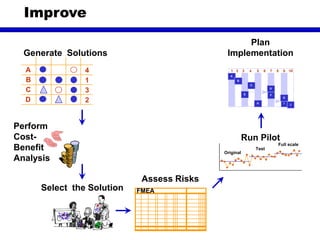
Improve
Perform
Cost-
Benefit
Analysis
Generate Solutions
A
B
C
D
4
1
3
2
Assess Risks
Run Pilot
Test
Full scale
Original
2 4 86 10
G
1 3 5 7 9
A
B
C
D
FE
JIH
G
Plan
Implementation
Select the Solution
Improve
FMEA
Control
Control
Evaluate Project
Results
.
UCL
LCL
Ownership &
Monitoring
Before After
Step 4 changes
implemented
} Improvement
Target
} Remaining Gap
Good
}Improvement
Before After
A1 A2 A3 A4 A2 A1 A3 A4
Process Change
Management
Learnings
Recommendations
Results
•
•
•
next
Key Learnings
QC Process Chart
Work
Instructions
Control/Check Points Response to Abnormality
NotesCode # Charac-
teristics
Control
LimitsMethodWho
Immediate
Fix
Permanent
Fix WhoFlowchart
2
12
Product Name
Process Name
Process Code #
Date of Issue: Issued by: Approved by:
Revision Date Reason Signature
1
Document &
Standardize
Training
Curriculum
Training
Manual
Fill to here
.
Closure
LSL USL
s = 3.7
Cp = 1.4
s = 2.7
Cp = 0.4
Process
Owner
A Philosophy ?
• Identify the process and customers right up front.
• Time spent identifying root causes and not just symptoms
is time well spent. D, M, A, then I !!
• “Show me the Data !” (valid data please)
• Great ideas with poor support will fail.
• Put good people in a bad process and the process will
win every time.
• Y = f (x)
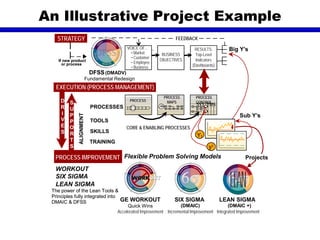
An Illustrative Project Example
PROCESSES
TOOLS
SKILLS
TRAINING
LEAN SIGMA
(DMAIC +)
Integrated Improvement
Y1
y1
VOICE OF...
• Market
Customer•
Employee•
• Business
FEEDBACK
CORE & ENABLING PROCESSES
PROCESS
MAPS SYSTEMS
EXECUTION (PROCESS MANAGEMENT)
WORKOUT
SIX SIGMA
LEAN SIGMA
STRATEGY
If new product
or process
Big Y’s
Sub Y’s
PROCESS
DFSS(DMADV)
Fundamental Redesign
D
R
I
V
E
S
S
U
P
P
O
R
T
S
Flexible Problem Solving Models
Y1
y1
VOICE OF...
• Market
• Customer
• Employee
• Business
BUSINESS
OBJECTIVES
RESULTS:
Top-Level
Indicators
(Dashboards)
PROCESS
MAPS
SYSTEMS
PROCESS IMPROVEMENT
STRATEGY
If new product
or process
Projects
PROCESS
DFSS
D
R
I
V
E
S
S
U
P
P
O
R
T
S
PROCESS
CONTROL
ALIGNMENT
SIX SIGMA
(DMAIC)
Incremental Improvement
GE WORKOUT
Quick Wins
Accelerated Improvement
The power of the Lean Tools &
Principles fully integrated into
DMAIC & DFSS
The power of the Lean Tools &
Principles fully integrated into
DMAIC & DFSS
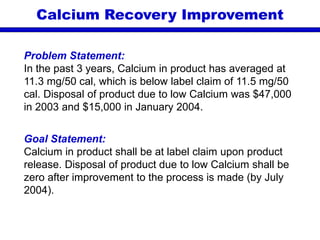
Problem Statement:
In the past 3 years, Calcium in product has averaged at
11.3 mg/50 cal, which is below label claim of 11.5 mg/50
cal. Disposal of product due to low Calcium was $47,000
in 2003 and $15,000 in January 2004.
Goal Statement:
Calcium in product shall be at label claim upon product
release. Disposal of product due to low Calcium shall be
zero after improvement to the process is made (by July
2004).
Calcium Recovery Improvement
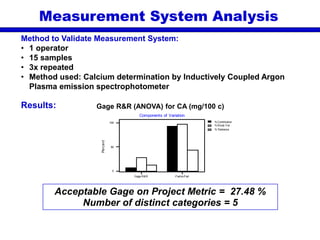
%Contribution
%Study Var
%Tolerance
Gage R&R Part-to-Part
0
50
100
Components of Variation
Percent
Gage R&R (ANOVA) f or Ca (mg/100 c
Measurement System Analysis
Acceptable Gage on Project Metric = 27.48 %
Number of distinct categories = 5
Method to Validate Measurement System:
• 1 operator
• 15 samples
• 3x repeated
• Method used: Calcium determination by Inductively Coupled Argon
Plasma emission spectrophotometer
Results: Gage R&R (ANOVA) for CA (mg/100 c)
24 ©2005 Tyg Lucas
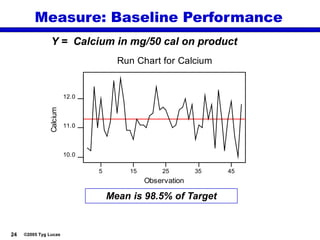
Y = Calcium in mg/50 cal on product
Measure: Baseline Performance
453525155
12.0
11.0
10.0
Observation
Calcium
Run Chart for Calcium
Mean is 98.5% of Target
©2005 Tyg Lucas
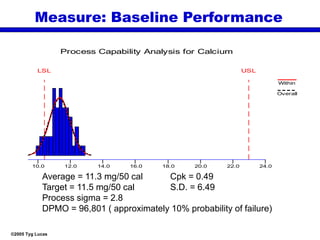
10.0 12.0 14.0 16.0 18.0 20.0 22.0 24.0
LSL USL
Process Capability Analysis for Calcium
Within
Overall
Average = 11.3 mg/50 cal Cpk = 0.49
Target = 11.5 mg/50 cal S.D. = 6.49
Process sigma = 2.8
DPMO = 96,801 ( approximately 10% probability of failure)
Measure: Baseline Performance
©2005 Tyg Lucas
Measure
The team had a several page detailed process flow map
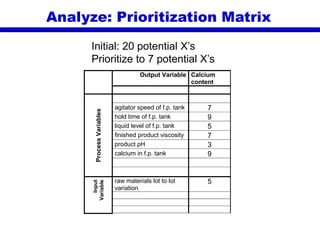
Analyze: Prioritization Matrix
Initial: 20 potential X’s
Prioritize to 7 potential X’s
Output Variable Calcium
content
agitator speed of f.p. tank 7
hold time of f.p. tank 9
liquid level of f.p. tank 5
finished product viscosity 7
product pH 3
calcium in f.p. tank 9
ProcessVariables
raw materials lot to lot
variation
5
Input
Variable
28 ©2005 Tyg Lucas
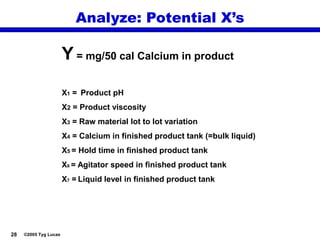
Analyze: Potential X’s
Y = mg/50 cal Calcium in product
X1 = Product pH
X2 = Product viscosity
X3 = Raw material lot to lot variation
X4 = Calcium in finished product tank (=bulk liquid)
X5 = Hold time in finished product tank
X6 = Agitator speed in finished product tank
X7 = Liquid level in finished product tank
©2005 Tyg Lucas
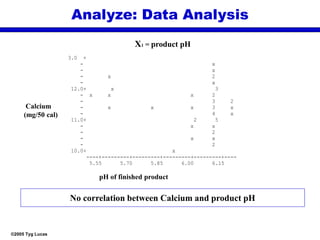
Analyze: Data Analysis
Calcium
(mg/50 cal)
pH of finished product
X1 = product pH
No correlation between Calcium and product pH
3.0 +
- x
- x
- x 2
- x
12.0+ x 3
- x x x 2
- 3 2
- x x x 3 x
- 4 x
11.0+ 2 5
- x x
- 2
- x x
- 2
10.0+ x
----+---------+---------+---------+---------+----
5.55 5.70 5.85 6.00 6.15
©2005 Tyg Lucas
Analyze: Data Analysis
Calcium
(mg/50 cal)
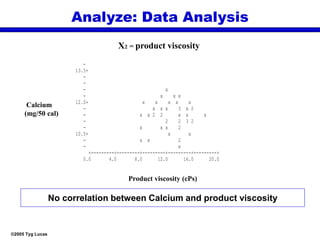
Product viscosity (cPs)
X2 = product viscosity
-
13.5+
-
-
- x
- x x x
12.0+ x x x x x
- x x x 3 x 2
- x x 2 2 x x x
- 2 2 3 2
- x x x 2
10.5+ x x
- x x 2
- x
+---------+---------+---------+---------+---------+
0.0 4.0 8.0 12.0 16.0 20.0
No correlation between Calcium and product viscosity
©2005 Tyg Lucas
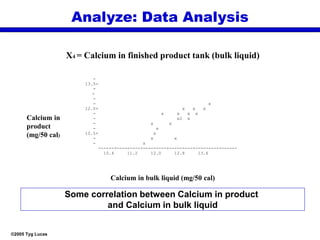
X4 = Calcium in finished product tank (bulk liquid)
-
13.5+
-
-
-
- x
12.0+ x x x
- x x x x
- x2 x
- x x
- x
10.5+ x
- x x
- x
------+---------+---------+---------+---------+------
10.4 11.2 12.0 12.8 13.6
Calcium in
product
(mg/50 cal)
Calcium in bulk liquid (mg/50 cal)
Some correlation between Calcium in product
and Calcium in bulk liquid
Analyze: Data Analysis
©2005 Tyg Lucas
Calcium
in product
(mg/50 cal)
hold time (hrs)
0 10 20 30 40
10.0
10.5
11.0
11.5
12.0
12.5
O = B01
+ = B53
x = B48
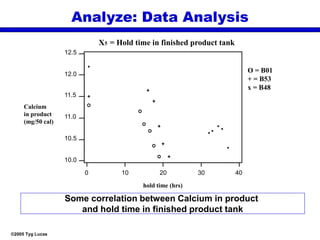
X5 = Hold time in finished product tank
Some correlation between Calcium in product
and hold time in finished product tank
Analyze: Data Analysis
©2005 Tyg Lucas
Analyze: Critical X’s
Y =f (X4, X5, X6, X7, X8)
X4 = Calcium in finished product tank
X5 = Hold time in finished product tank
X6 = Agitator speed in finished product tank
X7 = Liquid level in finished product tank
X8 = Agitator on-off
©2005 Tyg Lucas
0 10 20 30 40
10.0
10.5
11.0
11.5
12.0
12.5
ti i h f C 1
Calcium
in product
(mg/50 cal)
hold time (hrs)
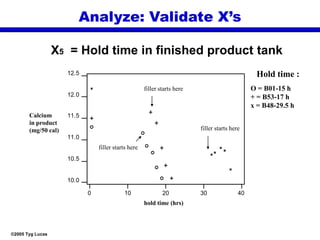
O = B01-15 h
+ = B53-17 h
x = B48-29.5 h
X5 = Hold time in finished product tank
Analyze: Validate X’s
filler starts here
filler starts here
filler starts here
Hold time :
©2005 Tyg Lucas
Improve: Pilot
0.0
0.5
6.0
12.0
16.5
17.5
18.5
19.5
22.0
0 10 20
0
.50
10.0
hold time-hr
Calcium(mg/50cal)
124
122
120
123 123 124 123 122
119
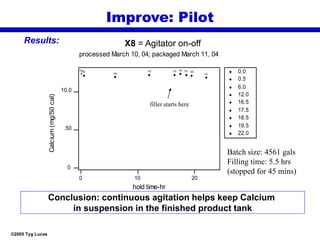
processed March 10, 04; packaged March 11, 04
Batch size: 4561 gals
Filling time: 5.5 hrs
(stopped for 45 mins)
Conclusion: continuous agitation helps keep Calcium
in suspension in the finished product tank
X8 = Agitator on-off
filler starts here
Results:
©2005 Tyg Lucas
Improve: Risk Analysis
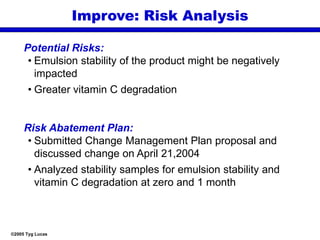
Potential Risks:
• Emulsion stability of the product might be negatively
impacted
• Greater vitamin C degradation
Risk Abatement Plan:
• Submitted Change Management Plan proposal and
discussed change on April 21,2004
• Analyzed stability samples for emulsion stability and
vitamin C degradation at zero and 1 month
©2005 Tyg Lucas
Control & Monitoring Plans
Control Plan:
• Manufacturing Batch Records will be modified to
include change in agitation schedule from 30 minutes
on-off to continuous
Monitoring Plan:
• Routine QC practice will be utilized (each batch
produced is tested for Calcium)
• Pull out data 3 months from now and review results
©2005 Tyg Lucas
Project Summary
Lessons Learned:
• Validating measurement system using Gage R&R is critical to
understanding the source of variation in the data.
• Drilling down the potential X’s and analyzing the data are keys to
finding the right solution
• Team members participation and involvement are key success
factors in any given projects
• Continuous agitation in tanks 20–23 helps keep Calcium in
suspension. Agitation schedule for other products stored in these
tanks needs to be re-evaluated
• Future/on-going projects that require products to be run at small
batch size (for example:Batjuice) should avoid using tanks with poor
agitation design (tanks 20–23)
Additional Project Opportunities:
• Product B+
©2005 Tyg Lucas
But Does it Work in IT/Systems ?
• Do you have processes ?
The IT organization at Raytheon Aircraft saved $500,000 from a
single project in 2002.
The nine CIOs at Textron saved a total of $5 million in six months.
One team of engineers at Fidelity Wide Processing expects to
deliver $6 million to $8 million in cost reductions this year.
— Tracy Mayor
The CIO Service Center
©2005 Tyg Lucas
What’s Next ?
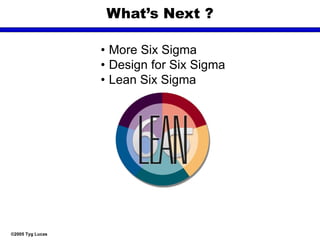
• More Six Sigma
• Design for Six Sigma
• Lean Six Sigma

What+Is+Six+Sigma

  • 1.
  • 2.
    What Is SixSigma ? • A metric — standard deviations in a normal curve • A goal — 3.4 defects per million opportunities • A rigorous, process focused methodology – the DMAIC process • A management philosophy Business and/or Customer Requirement 1 2 3 4 5 6σ Defects Good
  • 3.
    Where Does SixSigma Come From? • Necessity is the mother of invention – Motorola was losing market share to foreign rivals who had better quality and lower cost. – A Japanese firm took over a Motorola television factory. After implementing changes, the factory was producing with 1/20th the defect rate. Same people, same equipment, same designs…..different management and different processes. • “Our quality stinks.” — Art Sundry, Motorola ©2005 Tyg Lucas
  • 4.
    • Late 1970sMikel Harry (the man with two first names), a senior staff engineer, is using statistical analysis for problem solving. He was working in the Government Electronics Group (GEG) • Though certainly not the first to apply statistical thinking to manufacturing analysis, he is the one who went on to refine a methodology and then call it “Six Sigma.” He wrote an internal paper called “The Strategic Vision for Accelerating Six Sigma Within Motorola." Who Developed Six Sigma ?
  • 5.
    • Bill Smithand throughput yield: – Motorola had quality issues even on products that had highly capable processes. Why? – Bill Smith (sometimes referred to as the father of Six Sigma) examines the issue. – Individual yields are combined into a “rolled throughput yield.” (So a 100-component product with individual yields of 99.9% still only gives a completed product with 90% reliability.) – He also developed many of the tools and techniques that became the Six Sigma methodology. Why Six of Those Sigmas ?
  • 6.
    Six Sigma EarlyDevelopment • By the mid-1980s, Bob Galvin, Motorola CEO, has the company focused on improving quality. • 1988, Motorola wins the first Malcolm Baldridge Quality Award. Part of winning this national quality award is the agreement to share the methods used to achieve the high levels of quality. • Other companies initiate “Six Sigma” programs, notably Larry Bossidy at Allied Signal. • Larry tells his friend Jack Welch about it. Jack applies it at GE in a very big, very GE way.
  • 7.
    Six Sigma’s Methodologies SixSigma Process Management Improve EXISTING processes so that their outputs meet customer requirements Control and manage cross-function processes to meet business goals Design NEW products and processes that meet customer needs
  • 8.
    • Project management •Voice of the Customer • Process mapping • Data collection • Data graphs • Gage R&R • Operational definitions • Process Capability Assessment • Hypothesis testing • Regression analysis • Designed experiments • Statistical process control • FMEA • Stakeholder analysis • Implementation planning • Tollgate reviews Common Six Sigma Tools nothing new here . . .
  • 9.
  • 10.
  • 11.
    Define Project Charter Problem Statement: Goal: BusinessCase: Scope: Cost Benefit Projection: Milestones: VOC Key Issue CTQ Delighters More Is Better Must Be Voice of the CustomerBusiness Case Initial Process Mapping OutputsProcessInputs Yield: 60% Yield: 90% Yield: 45% Yield: 98% CUSTOMERS SUPPLIERS
  • 12.
  • 13.
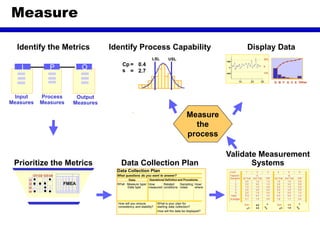
    Measure Col # 12 3 4 5 6 Inspector A B Sample # 1st Trial 2nd Trial Diff 1st Trial 2nd Trial Diff 1 2.0 1.0 1.0 1.5 1.5 0.0 2 2.0 3.0 1.0 2.5 2.5 0.0 3 1.5 1.0 0.5 2.0 1.5 0.5 4 3.0 3.0 0.0 2.0 2.5 0.5 5 2.0 1.5 0.5 1.5 0.5 1.0 Totals 10.5 9.5 3.0 9.5 8.5 2.0 Averages 2.1 1.9 0.6 1.9 1.7 0.4 Sum 4.0 Sum 3.6 XA 2.0 XB 1.8R A R B Validate Measurement Systems Display Data 0 1000 -1000 10 20 30 UCL X LCL D B F A C E Other Identify the Metrics Data Collection Plan Operational Definition and Procedures Data Collection Plan What questions do you want to answer? Data What Measure type/ Data type How measured Related conditions Sampling notes How/ where How will you ensure consistency and stability? What is your plan for starting data collection? How will the data be displayed? Prioritize the Metrics I1 I2 I3 I4 O1 O2 O3 O4 FMEA Identify Process Capability LSL USL Cp = 0.4 s = 2.7 Measure the process I P O Input Measures Process Measures Output Measures
  • 14.
  • 15.
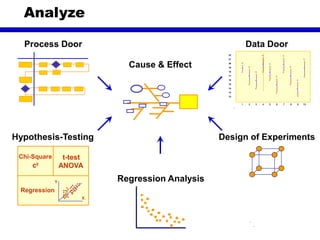
    Analyze . VA NVA Process Door RegressionAnalysis Chi-Square c² Regression t-test ANOVA X1 Y Hypothesis-Testing Design of Experiments . Cause & Effect Data Door 22 21 20 19 18 17 16 15 14 13 12 1 2 3 4 5 6 7 8 9 10 X O n X O n X O n X O n X O n X O n X O n X O n O n X O n .
  • 16.
  • 17.
    Perform Cost- Benefit Analysis Generate Solutions A B C D 4 1 3 2 Assess Risks RunPilot Test Full scale Original 2 4 86 10 G 1 3 5 7 9 A B C D FE JIH G Plan Implementation Select the Solution Improve FMEA
  • 18.
  • 19.
    Control Evaluate Project Results . UCL LCL Ownership & Monitoring BeforeAfter Step 4 changes implemented } Improvement Target } Remaining Gap Good }Improvement Before After A1 A2 A3 A4 A2 A1 A3 A4 Process Change Management Learnings Recommendations Results • • • next Key Learnings QC Process Chart Work Instructions Control/Check Points Response to Abnormality NotesCode # Charac- teristics Control LimitsMethodWho Immediate Fix Permanent Fix WhoFlowchart 2 12 Product Name Process Name Process Code # Date of Issue: Issued by: Approved by: Revision Date Reason Signature 1 Document & Standardize Training Curriculum Training Manual Fill to here . Closure LSL USL s = 3.7 Cp = 1.4 s = 2.7 Cp = 0.4 Process Owner
  • 20.
    A Philosophy ? •Identify the process and customers right up front. • Time spent identifying root causes and not just symptoms is time well spent. D, M, A, then I !! • “Show me the Data !” (valid data please) • Great ideas with poor support will fail. • Put good people in a bad process and the process will win every time. • Y = f (x)
  • 21.
    An Illustrative ProjectExample PROCESSES TOOLS SKILLS TRAINING LEAN SIGMA (DMAIC +) Integrated Improvement Y1 y1 VOICE OF... • Market Customer• Employee• • Business FEEDBACK CORE & ENABLING PROCESSES PROCESS MAPS SYSTEMS EXECUTION (PROCESS MANAGEMENT) WORKOUT SIX SIGMA LEAN SIGMA STRATEGY If new product or process Big Y’s Sub Y’s PROCESS DFSS(DMADV) Fundamental Redesign D R I V E S S U P P O R T S Flexible Problem Solving Models Y1 y1 VOICE OF... • Market • Customer • Employee • Business BUSINESS OBJECTIVES RESULTS: Top-Level Indicators (Dashboards) PROCESS MAPS SYSTEMS PROCESS IMPROVEMENT STRATEGY If new product or process Projects PROCESS DFSS D R I V E S S U P P O R T S PROCESS CONTROL ALIGNMENT SIX SIGMA (DMAIC) Incremental Improvement GE WORKOUT Quick Wins Accelerated Improvement The power of the Lean Tools & Principles fully integrated into DMAIC & DFSS The power of the Lean Tools & Principles fully integrated into DMAIC & DFSS
  • 22.
    Problem Statement: In thepast 3 years, Calcium in product has averaged at 11.3 mg/50 cal, which is below label claim of 11.5 mg/50 cal. Disposal of product due to low Calcium was $47,000 in 2003 and $15,000 in January 2004. Goal Statement: Calcium in product shall be at label claim upon product release. Disposal of product due to low Calcium shall be zero after improvement to the process is made (by July 2004). Calcium Recovery Improvement
  • 23.
    %Contribution %Study Var %Tolerance Gage R&RPart-to-Part 0 50 100 Components of Variation Percent Gage R&R (ANOVA) f or Ca (mg/100 c Measurement System Analysis Acceptable Gage on Project Metric = 27.48 % Number of distinct categories = 5 Method to Validate Measurement System: • 1 operator • 15 samples • 3x repeated • Method used: Calcium determination by Inductively Coupled Argon Plasma emission spectrophotometer Results: Gage R&R (ANOVA) for CA (mg/100 c)
  • 24.
    24 ©2005 TygLucas Y = Calcium in mg/50 cal on product Measure: Baseline Performance 453525155 12.0 11.0 10.0 Observation Calcium Run Chart for Calcium Mean is 98.5% of Target
  • 25.
    ©2005 Tyg Lucas 10.012.0 14.0 16.0 18.0 20.0 22.0 24.0 LSL USL Process Capability Analysis for Calcium Within Overall Average = 11.3 mg/50 cal Cpk = 0.49 Target = 11.5 mg/50 cal S.D. = 6.49 Process sigma = 2.8 DPMO = 96,801 ( approximately 10% probability of failure) Measure: Baseline Performance
  • 26.
    ©2005 Tyg Lucas Measure Theteam had a several page detailed process flow map
  • 27.
    Analyze: Prioritization Matrix Initial:20 potential X’s Prioritize to 7 potential X’s Output Variable Calcium content agitator speed of f.p. tank 7 hold time of f.p. tank 9 liquid level of f.p. tank 5 finished product viscosity 7 product pH 3 calcium in f.p. tank 9 ProcessVariables raw materials lot to lot variation 5 Input Variable
  • 28.
    28 ©2005 TygLucas Analyze: Potential X’s Y = mg/50 cal Calcium in product X1 = Product pH X2 = Product viscosity X3 = Raw material lot to lot variation X4 = Calcium in finished product tank (=bulk liquid) X5 = Hold time in finished product tank X6 = Agitator speed in finished product tank X7 = Liquid level in finished product tank
  • 29.
    ©2005 Tyg Lucas Analyze:Data Analysis Calcium (mg/50 cal) pH of finished product X1 = product pH No correlation between Calcium and product pH 3.0 + - x - x - x 2 - x 12.0+ x 3 - x x x 2 - 3 2 - x x x 3 x - 4 x 11.0+ 2 5 - x x - 2 - x x - 2 10.0+ x ----+---------+---------+---------+---------+---- 5.55 5.70 5.85 6.00 6.15
  • 30.
    ©2005 Tyg Lucas Analyze:Data Analysis Calcium (mg/50 cal) Product viscosity (cPs) X2 = product viscosity - 13.5+ - - - x - x x x 12.0+ x x x x x - x x x 3 x 2 - x x 2 2 x x x - 2 2 3 2 - x x x 2 10.5+ x x - x x 2 - x +---------+---------+---------+---------+---------+ 0.0 4.0 8.0 12.0 16.0 20.0 No correlation between Calcium and product viscosity
  • 31.
    ©2005 Tyg Lucas X4= Calcium in finished product tank (bulk liquid) - 13.5+ - - - - x 12.0+ x x x - x x x x - x2 x - x x - x 10.5+ x - x x - x ------+---------+---------+---------+---------+------ 10.4 11.2 12.0 12.8 13.6 Calcium in product (mg/50 cal) Calcium in bulk liquid (mg/50 cal) Some correlation between Calcium in product and Calcium in bulk liquid Analyze: Data Analysis
  • 32.
    ©2005 Tyg Lucas Calcium inproduct (mg/50 cal) hold time (hrs) 0 10 20 30 40 10.0 10.5 11.0 11.5 12.0 12.5 O = B01 + = B53 x = B48 X5 = Hold time in finished product tank Some correlation between Calcium in product and hold time in finished product tank Analyze: Data Analysis
  • 33.
    ©2005 Tyg Lucas Analyze:Critical X’s Y =f (X4, X5, X6, X7, X8) X4 = Calcium in finished product tank X5 = Hold time in finished product tank X6 = Agitator speed in finished product tank X7 = Liquid level in finished product tank X8 = Agitator on-off
  • 34.
    ©2005 Tyg Lucas 010 20 30 40 10.0 10.5 11.0 11.5 12.0 12.5 ti i h f C 1 Calcium in product (mg/50 cal) hold time (hrs) O = B01-15 h + = B53-17 h x = B48-29.5 h X5 = Hold time in finished product tank Analyze: Validate X’s filler starts here filler starts here filler starts here Hold time :
  • 35.
    ©2005 Tyg Lucas Improve:Pilot 0.0 0.5 6.0 12.0 16.5 17.5 18.5 19.5 22.0 0 10 20 0 .50 10.0 hold time-hr Calcium(mg/50cal) 124 122 120 123 123 124 123 122 119 processed March 10, 04; packaged March 11, 04 Batch size: 4561 gals Filling time: 5.5 hrs (stopped for 45 mins) Conclusion: continuous agitation helps keep Calcium in suspension in the finished product tank X8 = Agitator on-off filler starts here Results:
  • 36.
    ©2005 Tyg Lucas Improve:Risk Analysis Potential Risks: • Emulsion stability of the product might be negatively impacted • Greater vitamin C degradation Risk Abatement Plan: • Submitted Change Management Plan proposal and discussed change on April 21,2004 • Analyzed stability samples for emulsion stability and vitamin C degradation at zero and 1 month
  • 37.
    ©2005 Tyg Lucas Control& Monitoring Plans Control Plan: • Manufacturing Batch Records will be modified to include change in agitation schedule from 30 minutes on-off to continuous Monitoring Plan: • Routine QC practice will be utilized (each batch produced is tested for Calcium) • Pull out data 3 months from now and review results
  • 38.
    ©2005 Tyg Lucas ProjectSummary Lessons Learned: • Validating measurement system using Gage R&R is critical to understanding the source of variation in the data. • Drilling down the potential X’s and analyzing the data are keys to finding the right solution • Team members participation and involvement are key success factors in any given projects • Continuous agitation in tanks 20–23 helps keep Calcium in suspension. Agitation schedule for other products stored in these tanks needs to be re-evaluated • Future/on-going projects that require products to be run at small batch size (for example:Batjuice) should avoid using tanks with poor agitation design (tanks 20–23) Additional Project Opportunities: • Product B+
  • 39.
    ©2005 Tyg Lucas ButDoes it Work in IT/Systems ? • Do you have processes ? The IT organization at Raytheon Aircraft saved $500,000 from a single project in 2002. The nine CIOs at Textron saved a total of $5 million in six months. One team of engineers at Fidelity Wide Processing expects to deliver $6 million to $8 million in cost reductions this year. — Tracy Mayor The CIO Service Center
  • 40.
    ©2005 Tyg Lucas What’sNext ? • More Six Sigma • Design for Six Sigma • Lean Six Sigma