WHAT CAN ART TELL US ABOUT AFRICANS
IN ANCIENT GREECE?
PPT by Aixa B. Rodriguez
ESL/Visual Arts
High School of World Cultures Bronx NY
Based on:
Hemingway, Sean, and Colette Hemingway. "Africans in Ancient Greek
Art". In Heilbrunn Timeline of Art History. New York: The Metropolitan
Museum of Art, 2000–.
http://www.metmuseum.org/toah/hd/afrg/hd_afrg.htm (January 2008)
Narrow Understanding
 All black Africans were known as
Ethiopians to the ancient Greeks, as
the fifth-century B.C. historian
Herodotus tells us.
 Iconography was narrowly defined
by Greek artists in the
 Archaic (ca. 700–480 B.C.) and
 Classical (ca. 480–323 B.C.) periods, black skin color being the
primary identifying physical characteristic.
 High quality fine art depictions of Africans appear in the
Hellenistic period. (ca. 323–31 B.C.),
Lack of Geographical
Knowledge
Most ancient Greeks had only
a vague understanding of
African geography.
They believed that the land of
the Ethiopians was located
south of Egypt.
Clues in Literature
 Tales of Ethiopia as a
mythical land at the farthest
edges of the earth are
recorded in some of the
earliest Greek literature of
the eighth century B.C.,
including the epic poems of
Homer.
 Greek gods and heroes,
like Menelaos, were
believed to have visited this
place on the fringes of the
known world.
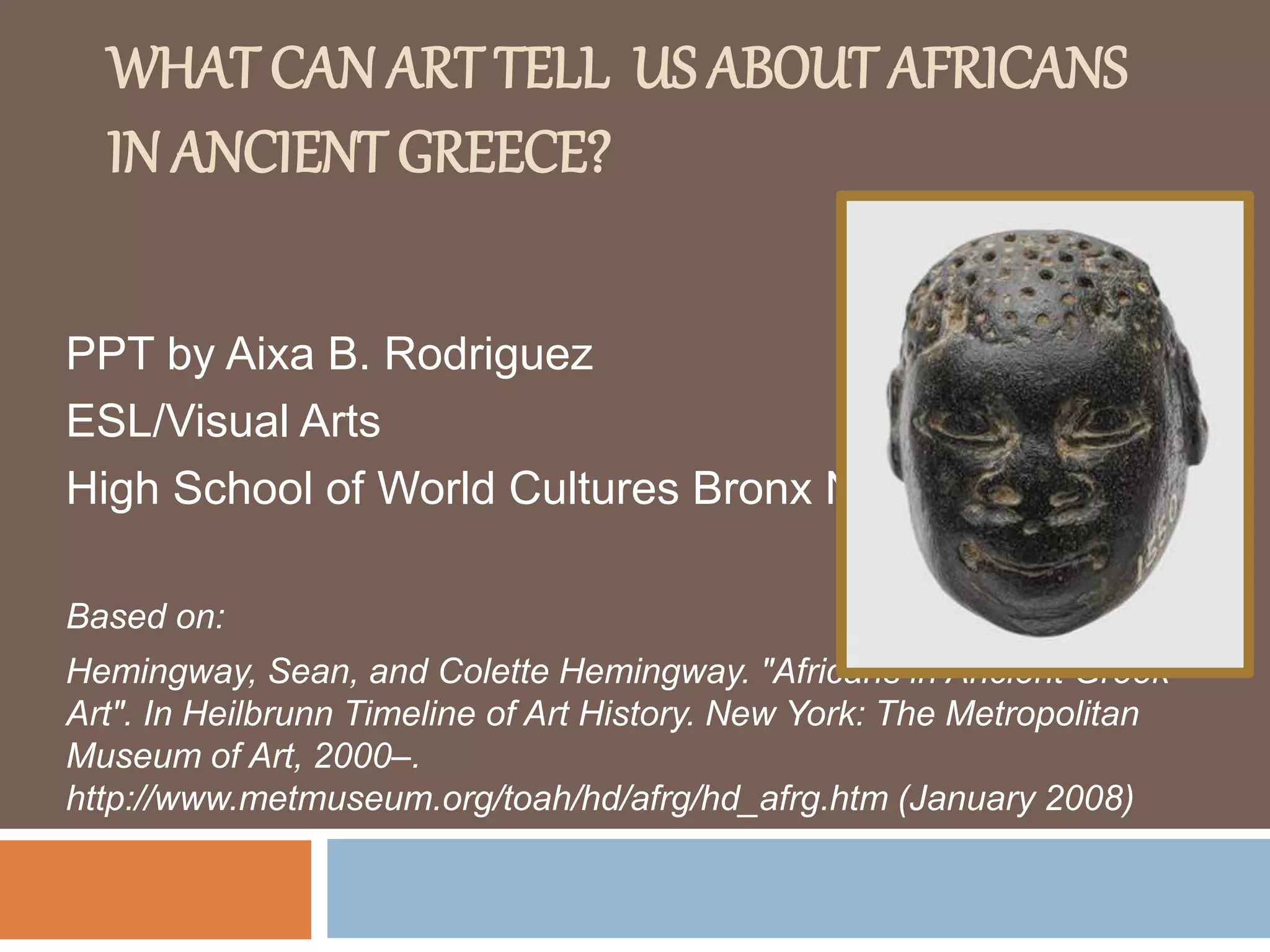
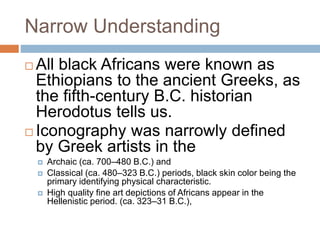
Pendant in the form of the head of an
African (known as Ethiopian), 9th–8th
century b.c.
Cypriot; Said to be from Amathus,
Cyprus
Chlorite The Cesnola Collection,
Purchased by subscription, 1874–76
Clues in Mythology
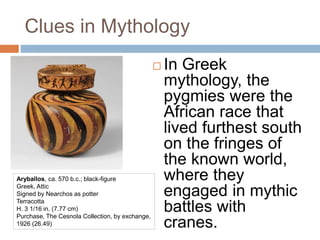
 In Greek
mythology, the
pygmies were the
African race that
lived furthest south
on the fringes of
the known world,
where they
engaged in mythic
battles with
cranes.
Aryballos, ca. 570 b.c.; black-figure
Greek, Attic
Signed by Nearchos as potter
Terracotta
H. 3 1/16 in. (7.77 cm)
Purchase, The Cesnola Collection, by exchange,
1926 (26.49)
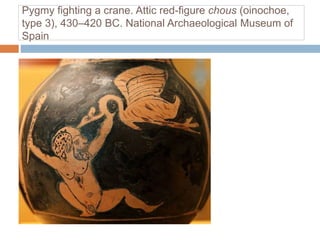
Pygmy fighting a crane. Attic red-figure chous (oinochoe,
type 3), 430–420 BC. National Archaeological Museum of
Spain
Drama: Plays, Masks
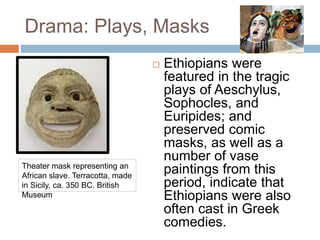
 Ethiopians were
featured in the tragic
plays of Aeschylus,
Sophocles, and
Euripides; and
preserved comic
masks, as well as a
number of vase
paintings from this
period, indicate that
Ethiopians were also
often cast in Greek
comedies.
Theater mask representing an
African slave. Terracotta, made
in Sicily, ca. 350 BC. British
Museum
Trade Connections
 However, long
before Homer, the
seafaring
civilization of
Bronze Age Crete,
known today as
Minoan,
established trade
connections with
Egypt.
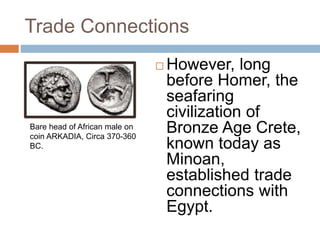
Bare head of African male on
coin ARKADIA, Circa 370-360
BC.
Civilization Collapse- End of
Trade
The collapse of the Minoan and
Mycenaean palaces at the end
of the Late Bronze Age, severs
trade connections with Egypt
and the Near East .
Greece entered a period of
impoverishment and limited
contact.
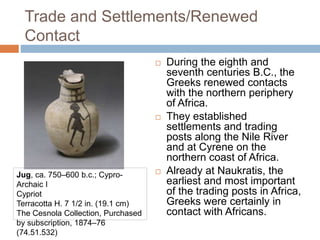
Trade and Settlements/Renewed
Contact
 During the eighth and
seventh centuries B.C., the
Greeks renewed contacts
with the northern periphery
of Africa.
 They established
settlements and trading
posts along the Nile River
and at Cyrene on the
northern coast of Africa.
 Already at Naukratis, the
earliest and most important
of the trading posts in Africa,
Greeks were certainly in
contact with Africans.
Jug, ca. 750–600 b.c.; Cypro-
Archaic I
Cypriot
Terracotta H. 7 1/2 in. (19.1 cm)
The Cesnola Collection, Purchased
by subscription, 1874–76
(74.51.532)
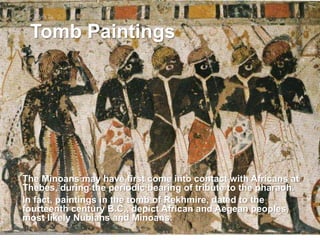
 The Minoans may have first come into contact with Africans at
Thebes, during the periodic bearing of tribute to the pharaoh.
 In fact, paintings in the tomb of Rekhmire, dated to the
fourteenth century B.C., depict African and Aegean peoples,
most likely Nubians and Minoans.
Tomb Paintings
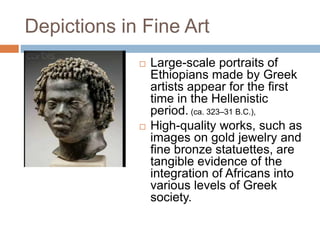
Depictions in Fine Art
 Large-scale portraits of
Ethiopians made by Greek
artists appear for the first
time in the Hellenistic
period. (ca. 323–31 B.C.),
 High-quality works, such as
images on gold jewelry and
fine bronze statuettes, are
tangible evidence of the
integration of Africans into
various levels of Greek
society.
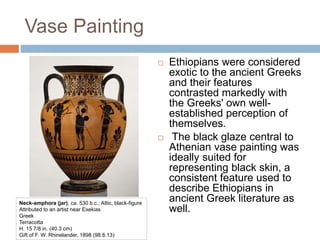
Vase Painting
 Ethiopians were considered
exotic to the ancient Greeks
and their features
contrasted markedly with
the Greeks' own well-
established perception of
themselves.
 The black glaze central to
Athenian vase painting was
ideally suited for
representing black skin, a
consistent feature used to
describe Ethiopians in
ancient Greek literature as
well.
Neck-amphora (jar), ca. 530 b.c.; Attic, black-figure
Attributed to an artist near Exekias
Greek
Terracotta
H. 15 7/8 in. (40.3 cm)
Gift of F. W. Rhinelander, 1898 (98.8.13)
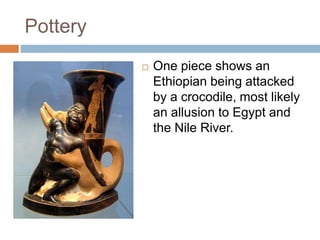
Pottery
 One piece shows an
Ethiopian being attacked
by a crocodile, most likely
an allusion to Egypt and
the Nile River.
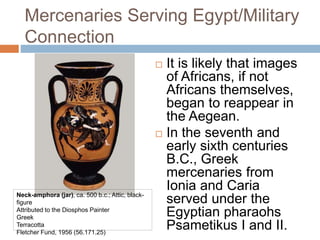
Mercenaries Serving Egypt/Military
Connection
 It is likely that images
of Africans, if not
Africans themselves,
began to reappear in
the Aegean.
 In the seventh and
early sixth centuries
B.C., Greek
mercenaries from
Ionia and Caria
served under the
Egyptian pharaohs
Psametikus I and II.
Neck-amphora (jar), ca. 500 b.c.; Attic, black-
figure
Attributed to the Diosphos Painter
Greek
Terracotta
Fletcher Fund, 1956 (56.171.25)
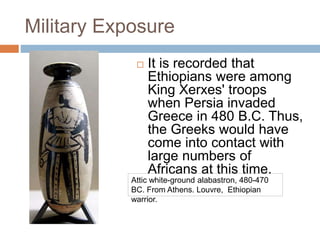
Military Exposure
 It is recorded that
Ethiopians were among
King Xerxes' troops
when Persia invaded
Greece in 480 B.C. Thus,
the Greeks would have
come into contact with
large numbers of
Africans at this time.
Attic white-ground alabastron, 480-470
BC. From Athens. Louvre, Ethiopian
warrior.
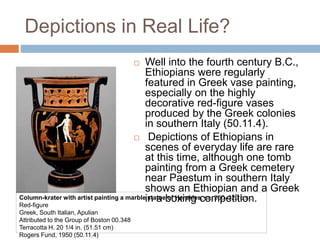
Depictions in Real Life?
 Well into the fourth century B.C.,
Ethiopians were regularly
featured in Greek vase painting,
especially on the highly
decorative red-figure vases
produced by the Greek colonies
in southern Italy (50.11.4).
 Depictions of Ethiopians in
scenes of everyday life are rare
at this time, although one tomb
painting from a Greek cemetery
near Paestum in southern Italy
shows an Ethiopian and a Greek
in a boxing competition.Column-krater with artist painting a marble statue of Herakles, ca. 350–320 b.c.;
Red-figure
Greek, South Italian, Apulian
Attributed to the Group of Boston 00.348
Terracotta H. 20 1/4 in. (51.51 cm)
Rogers Fund, 1950 (50.11.4)
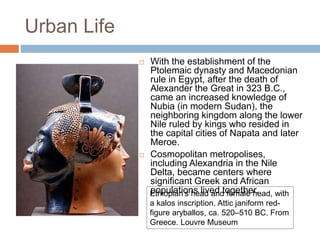
Urban Life
 With the establishment of the
Ptolemaic dynasty and Macedonian
rule in Egypt, after the death of
Alexander the Great in 323 B.C.,
came an increased knowledge of
Nubia (in modern Sudan), the
neighboring kingdom along the lower
Nile ruled by kings who resided in
the capital cities of Napata and later
Meroe.
 Cosmopolitan metropolises,
including Alexandria in the Nile
Delta, became centers where
significant Greek and African
populations lived together.Ethiopian's head and female head, with
a kalos inscription. Attic janiform red-
figure aryballos, ca. 520–510 BC. From
Greece. Louvre Museum
A Large Minority ?
 During the Hellenistic period (ca.
323–31 B.C.), the repertoire of
African imagery in Greek art
expanded greatly.
 While scenes related to
Ethiopians in mythology became
less common, many more types
occurred that suggest they
constituted a large minority .
Statuette of an African (known as
Ethiopian), 3rd–2nd century b.c.
Greek
Bronze H. 7 1/5 in. (18.29 cm)
Rogers Fund, 1918 (18.145.10)
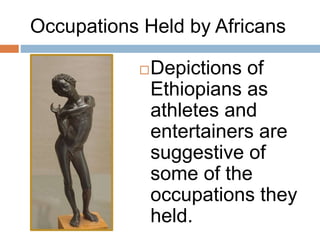
Occupations Held by Africans
Depictions of
Ethiopians as
athletes and
entertainers are
suggestive of
some of the
occupations they
held.
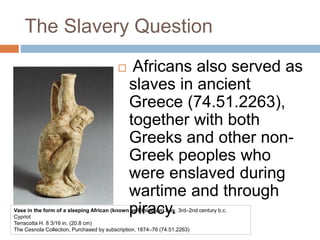
The Slavery Question
 Africans also served as
slaves in ancient
Greece (74.51.2263),
together with both
Greeks and other non-
Greek peoples who
were enslaved during
wartime and through
piracy.Vase in the form of a sleeping African (known as Ethiopian) boy, 3rd–2nd century b.c.
Cypriot
Terracotta H. 8 3/16 in. (20.8 cm)
The Cesnola Collection, Purchased by subscription, 1874–76 (74.51.2263)
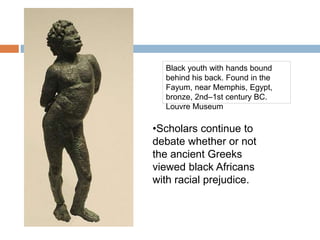
Black youth with hands bound
behind his back. Found in the
Fayum, near Memphis, Egypt,
bronze, 2nd–1st century BC.
Louvre Museum
•Scholars continue to
debate whether or not
the ancient Greeks
viewed black Africans
with racial prejudice.

Whatcanarttellusaboutafricansin 101009100638-phpapp01

  • 1.
    WHAT CAN ARTTELL US ABOUT AFRICANS IN ANCIENT GREECE? PPT by Aixa B. Rodriguez ESL/Visual Arts High School of World Cultures Bronx NY Based on: Hemingway, Sean, and Colette Hemingway. "Africans in Ancient Greek Art". In Heilbrunn Timeline of Art History. New York: The Metropolitan Museum of Art, 2000–. http://www.metmuseum.org/toah/hd/afrg/hd_afrg.htm (January 2008)
  • 2.
    Narrow Understanding  Allblack Africans were known as Ethiopians to the ancient Greeks, as the fifth-century B.C. historian Herodotus tells us.  Iconography was narrowly defined by Greek artists in the  Archaic (ca. 700–480 B.C.) and  Classical (ca. 480–323 B.C.) periods, black skin color being the primary identifying physical characteristic.  High quality fine art depictions of Africans appear in the Hellenistic period. (ca. 323–31 B.C.),
  • 3.
    Lack of Geographical Knowledge Mostancient Greeks had only a vague understanding of African geography. They believed that the land of the Ethiopians was located south of Egypt.
  • 4.
    Clues in Literature Tales of Ethiopia as a mythical land at the farthest edges of the earth are recorded in some of the earliest Greek literature of the eighth century B.C., including the epic poems of Homer.  Greek gods and heroes, like Menelaos, were believed to have visited this place on the fringes of the known world. Pendant in the form of the head of an African (known as Ethiopian), 9th–8th century b.c. Cypriot; Said to be from Amathus, Cyprus Chlorite The Cesnola Collection, Purchased by subscription, 1874–76
  • 5.
    Clues in Mythology In Greek mythology, the pygmies were the African race that lived furthest south on the fringes of the known world, where they engaged in mythic battles with cranes. Aryballos, ca. 570 b.c.; black-figure Greek, Attic Signed by Nearchos as potter Terracotta H. 3 1/16 in. (7.77 cm) Purchase, The Cesnola Collection, by exchange, 1926 (26.49)
  • 6.
    Pygmy fighting acrane. Attic red-figure chous (oinochoe, type 3), 430–420 BC. National Archaeological Museum of Spain
  • 7.
    Drama: Plays, Masks Ethiopians were featured in the tragic plays of Aeschylus, Sophocles, and Euripides; and preserved comic masks, as well as a number of vase paintings from this period, indicate that Ethiopians were also often cast in Greek comedies. Theater mask representing an African slave. Terracotta, made in Sicily, ca. 350 BC. British Museum
  • 8.
    Trade Connections  However,long before Homer, the seafaring civilization of Bronze Age Crete, known today as Minoan, established trade connections with Egypt. Bare head of African male on coin ARKADIA, Circa 370-360 BC.
  • 9.
    Civilization Collapse- Endof Trade The collapse of the Minoan and Mycenaean palaces at the end of the Late Bronze Age, severs trade connections with Egypt and the Near East . Greece entered a period of impoverishment and limited contact.
  • 10.
    Trade and Settlements/Renewed Contact During the eighth and seventh centuries B.C., the Greeks renewed contacts with the northern periphery of Africa.  They established settlements and trading posts along the Nile River and at Cyrene on the northern coast of Africa.  Already at Naukratis, the earliest and most important of the trading posts in Africa, Greeks were certainly in contact with Africans. Jug, ca. 750–600 b.c.; Cypro- Archaic I Cypriot Terracotta H. 7 1/2 in. (19.1 cm) The Cesnola Collection, Purchased by subscription, 1874–76 (74.51.532)
  • 11.
     The Minoansmay have first come into contact with Africans at Thebes, during the periodic bearing of tribute to the pharaoh.  In fact, paintings in the tomb of Rekhmire, dated to the fourteenth century B.C., depict African and Aegean peoples, most likely Nubians and Minoans. Tomb Paintings
  • 12.
    Depictions in FineArt  Large-scale portraits of Ethiopians made by Greek artists appear for the first time in the Hellenistic period. (ca. 323–31 B.C.),  High-quality works, such as images on gold jewelry and fine bronze statuettes, are tangible evidence of the integration of Africans into various levels of Greek society.
  • 13.
    Vase Painting  Ethiopianswere considered exotic to the ancient Greeks and their features contrasted markedly with the Greeks' own well- established perception of themselves.  The black glaze central to Athenian vase painting was ideally suited for representing black skin, a consistent feature used to describe Ethiopians in ancient Greek literature as well. Neck-amphora (jar), ca. 530 b.c.; Attic, black-figure Attributed to an artist near Exekias Greek Terracotta H. 15 7/8 in. (40.3 cm) Gift of F. W. Rhinelander, 1898 (98.8.13)
  • 14.
    Pottery  One pieceshows an Ethiopian being attacked by a crocodile, most likely an allusion to Egypt and the Nile River.
  • 15.
    Mercenaries Serving Egypt/Military Connection It is likely that images of Africans, if not Africans themselves, began to reappear in the Aegean.  In the seventh and early sixth centuries B.C., Greek mercenaries from Ionia and Caria served under the Egyptian pharaohs Psametikus I and II. Neck-amphora (jar), ca. 500 b.c.; Attic, black- figure Attributed to the Diosphos Painter Greek Terracotta Fletcher Fund, 1956 (56.171.25)
  • 16.
    Military Exposure  Itis recorded that Ethiopians were among King Xerxes' troops when Persia invaded Greece in 480 B.C. Thus, the Greeks would have come into contact with large numbers of Africans at this time. Attic white-ground alabastron, 480-470 BC. From Athens. Louvre, Ethiopian warrior.
  • 17.
    Depictions in RealLife?  Well into the fourth century B.C., Ethiopians were regularly featured in Greek vase painting, especially on the highly decorative red-figure vases produced by the Greek colonies in southern Italy (50.11.4).  Depictions of Ethiopians in scenes of everyday life are rare at this time, although one tomb painting from a Greek cemetery near Paestum in southern Italy shows an Ethiopian and a Greek in a boxing competition.Column-krater with artist painting a marble statue of Herakles, ca. 350–320 b.c.; Red-figure Greek, South Italian, Apulian Attributed to the Group of Boston 00.348 Terracotta H. 20 1/4 in. (51.51 cm) Rogers Fund, 1950 (50.11.4)
  • 18.
    Urban Life  Withthe establishment of the Ptolemaic dynasty and Macedonian rule in Egypt, after the death of Alexander the Great in 323 B.C., came an increased knowledge of Nubia (in modern Sudan), the neighboring kingdom along the lower Nile ruled by kings who resided in the capital cities of Napata and later Meroe.  Cosmopolitan metropolises, including Alexandria in the Nile Delta, became centers where significant Greek and African populations lived together.Ethiopian's head and female head, with a kalos inscription. Attic janiform red- figure aryballos, ca. 520–510 BC. From Greece. Louvre Museum
  • 19.
    A Large Minority?  During the Hellenistic period (ca. 323–31 B.C.), the repertoire of African imagery in Greek art expanded greatly.  While scenes related to Ethiopians in mythology became less common, many more types occurred that suggest they constituted a large minority . Statuette of an African (known as Ethiopian), 3rd–2nd century b.c. Greek Bronze H. 7 1/5 in. (18.29 cm) Rogers Fund, 1918 (18.145.10)
  • 20.
    Occupations Held byAfricans Depictions of Ethiopians as athletes and entertainers are suggestive of some of the occupations they held.
  • 21.
    The Slavery Question Africans also served as slaves in ancient Greece (74.51.2263), together with both Greeks and other non- Greek peoples who were enslaved during wartime and through piracy.Vase in the form of a sleeping African (known as Ethiopian) boy, 3rd–2nd century b.c. Cypriot Terracotta H. 8 3/16 in. (20.8 cm) The Cesnola Collection, Purchased by subscription, 1874–76 (74.51.2263)
  • 22.
    Black youth withhands bound behind his back. Found in the Fayum, near Memphis, Egypt, bronze, 2nd–1st century BC. Louvre Museum •Scholars continue to debate whether or not the ancient Greeks viewed black Africans with racial prejudice.