What’s New in
PostgreSQL 17
Presented by
Mukul Mahto
Mydbops
Mydbops MyWebinar - 35
Aug 23rd, 2024
Consulting
Services
Consulting
Services
Managed
Services
❏ Database Management and
consultancy provider
❏ Founded in 2016
❏ Assisted 800+ happy customers
❏ AWS partners
❏ PCI & ISO certified
About Us
❏ Introduction to PostgreSQL 17
❏ Performance Optimization
❏ Partitioning & Distributed Workloads
❏ Developer Workflow Enhancement
❏ Security Features
❏ Backup and Export Management
❏ Monitoring
Agenda
PostgreSQL 17
Key Enhancements
- Performance Boosts
- High Availability
- Developer Features
- Security
Why Upgrade?
- Boosted Efficiency
- High Availability
- Cutting-Edge Features
Performance Optimization
❏ Improved Vacuum Mechanism
New Data Structure: Efficient radix tree replaces old array.
Dynamic Memory Allocation: No 1GB limit.
Faster TID Lookup: Speedier Tuple ID searches.
20x Memory Reduction with New Data Structure
❏ Reduced WAL Volume for Vacuum
Single record for freezing and pruning.
Faster Sync: Reduced sync and write time.
Mark Items as LP_UNUSED Instead of LP_DEAD: Reduces WAL volume
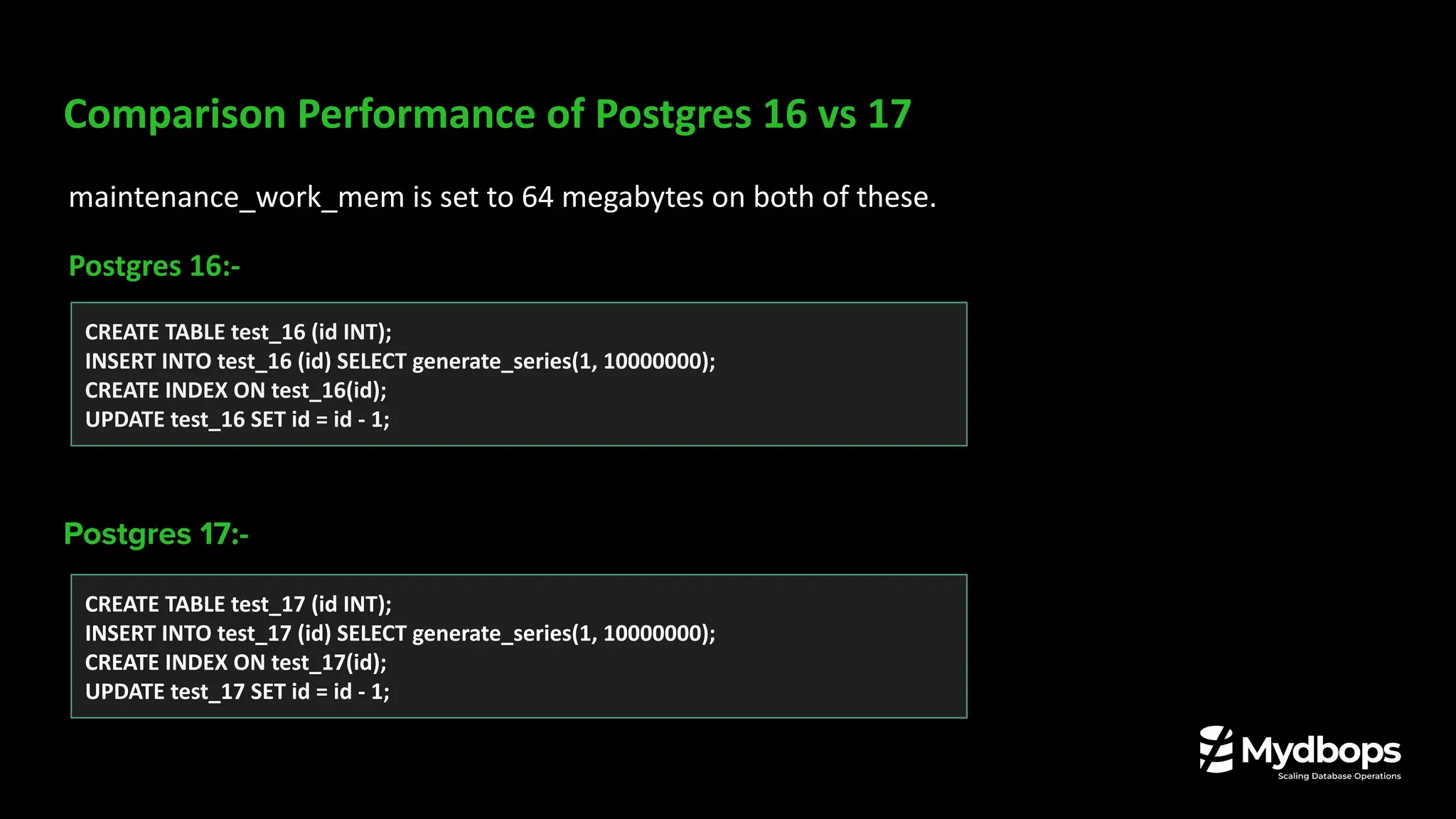
Comparison Performance of Postgres 16 vs 17
maintenance_work_mem is set to 64 megabytes on both of these.
Postgres 16:-
Postgres 17:-
CREATE TABLE test_16 (id INT);
INSERT INTO test_16 (id) SELECT generate_series(1, 10000000);
CREATE INDEX ON test_16(id);
UPDATE test_16 SET id = id - 1;
CREATE TABLE test_17 (id INT);
INSERT INTO test_17 (id) SELECT generate_series(1, 10000000);
CREATE INDEX ON test_17(id);
UPDATE test_17 SET id = id - 1;
Postgres 17
Postgres 16
-[ RECORD 1 ]------+---------------
pid | 21830
datid | 16384
datname | pg16
relid | 16389
phase | vacuuming heap
heap_blks_total | 88496
heap_blks_scanned | 88496
heap_blks_vacuumed| 7478
index_vacuum_count | 1
max_dead_tuples | 11184809
num_dead_tuples | 10000000
-[ RECORD 1 ]--------+---------------
pid | 21971
datid | 16389
datname | pg17
relid | 16468
phase | vacuuming heap
heap_blks_total | 88496
heap_blks_scanned | 88496
heap_blks_vacuumed | 27040
index_vacuum_count | 0
max_dead_tuple_byte | 67108864
dead_tuple_bytes | 2556928
num_dead_item_ids | 10000000
indexes_total | 0
indexes_processed | 0
Postgres 16 Postgres 17
2024-08-19 10:49:17.351 UTC [21830] LOG: automatic vacuum of table
"pg16.public.test_16": index scans: 1
pages: 0 removed, 88496 remain, 88496 scanned (100.00% of total)
tuples: 3180676 removed, 10000000 remain, 0 are dead but not
yet removable
removable cutoff: 747, which was 0 XIDs old when operation ended
new relfrozenxid: 745, which is 2 XIDs ahead of previous value
frozen: 0 pages from table (0.00% of total) had 0 tuples frozen
index scan needed: 44248 pages from table (50.00% of total) had
10000000 dead item identifiers removed
index "test_16_id_idx": pages: 54840 in total, 0 newly deleted, 0
currently deleted, 0 reusable
avg read rate: 24.183 MB/s, avg write rate: 22.317 MB/s
buffer usage: 119566 hits, 156585 misses, 144501 dirtied
WAL usage: 201465 records, 60976 full page images, 233670948
bytes
system usage: CPU: user: 9.04 s, system: 3.56 s, elapsed: 50.58 s
2024-08-19 10:51:54.081 UTC [21959] LOG: automatic vacuum of table
"pg17.public.test_17": index scans: 0
pages: 0 removed, 76831 remain, 76831 scanned (100.00% of total)
tuples: 0 removed, 10000000 remain, 0 are dead but not yet
removable
removable cutoff: 827, which was 1 XIDs old when operation ended
new relfrozenxid: 825, which is 1 XIDs ahead of previous value
frozen: 0 pages from table (0.00% of total) had 0 tuples frozen
index scan not needed: 0 pages from table (0.00% of total) had 0
dead item identifiers removed
avg read rate: 34.779 MB/s, avg write rate: 19.580 MB/s
buffer usage: 79090 hits, 74631 misses, 42016 dirtied
WAL usage: 4969 records, 2 full page images, 309554 bytes
system usage: CPU: user: 2.71 s, system: 1.14 s, elapsed: 16.76 s
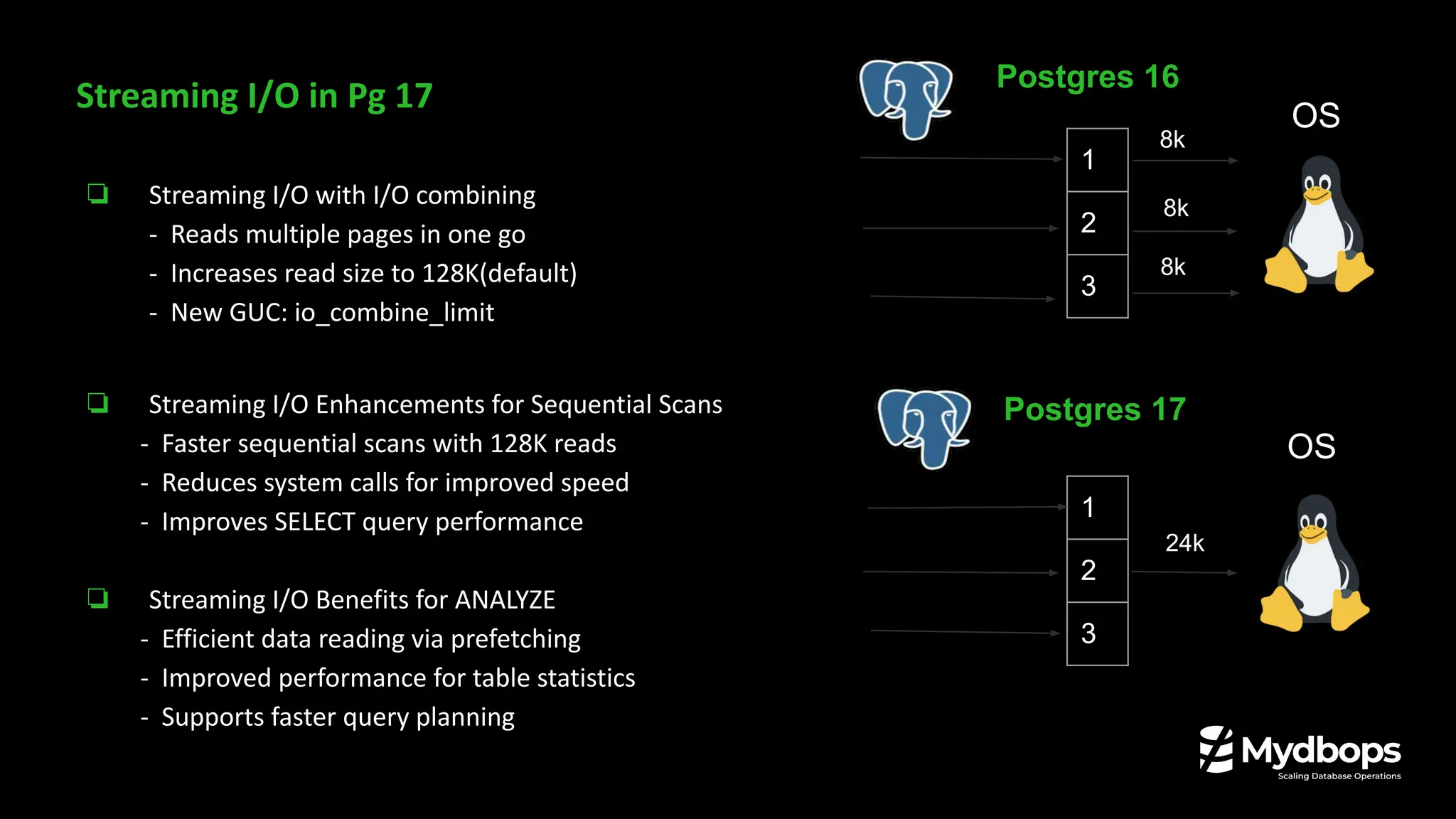
Streaming I/O in Pg 17
❏ Streaming I/O with I/O combining
- Reads multiple pages in one go
- Increases read size to 128K(default)
- New GUC: io_combine_limit
❏ Streaming I/O Enhancements for Sequential Scans
- Faster sequential scans with 128K reads
- Reduces system calls for improved speed
- Improves SELECT query performance
❏ Streaming I/O Benefits for ANALYZE
- Efficient data reading via prefetching
- Improved performance for table statistics
- Supports faster query planning
1
2
3
1
2
3
8k
8k
8k
24k
Postgres 16
Postgres 17
OS
OS
Postgres 16
pg16=# EXPLAIN (ANALYZE, BUFFERS) SELECT COUNT(*) FROM test_16;
QUERY PLAN
------------------------------------------------------------------------------------------------------------------------------
Aggregate (cost=212496.60..212496.61 rows=1 width=8) (actual time=2869.400..2869.401 rows=1 loops=1)
Buffers: shared hit=416 read=88080
-> Seq Scan on test_16 (cost=0.00..187696.48 rows=9920048 width=0) (actual time=145.205..2082.923 rows=10000000 loops=1)
Buffers: shared hit=416 read=88080
Planning Time: 0.059 ms
JIT:
Functions: 2
Options: Inlining false, Optimization false, Expressions true, Deforming true
Timing: Generation 0.316 ms, Inlining 0.000 ms, Optimization 0.120 ms, Emission 1.452 ms, Total 1.888 ms
Execution Time: 2869.794 ms
(10 rows)
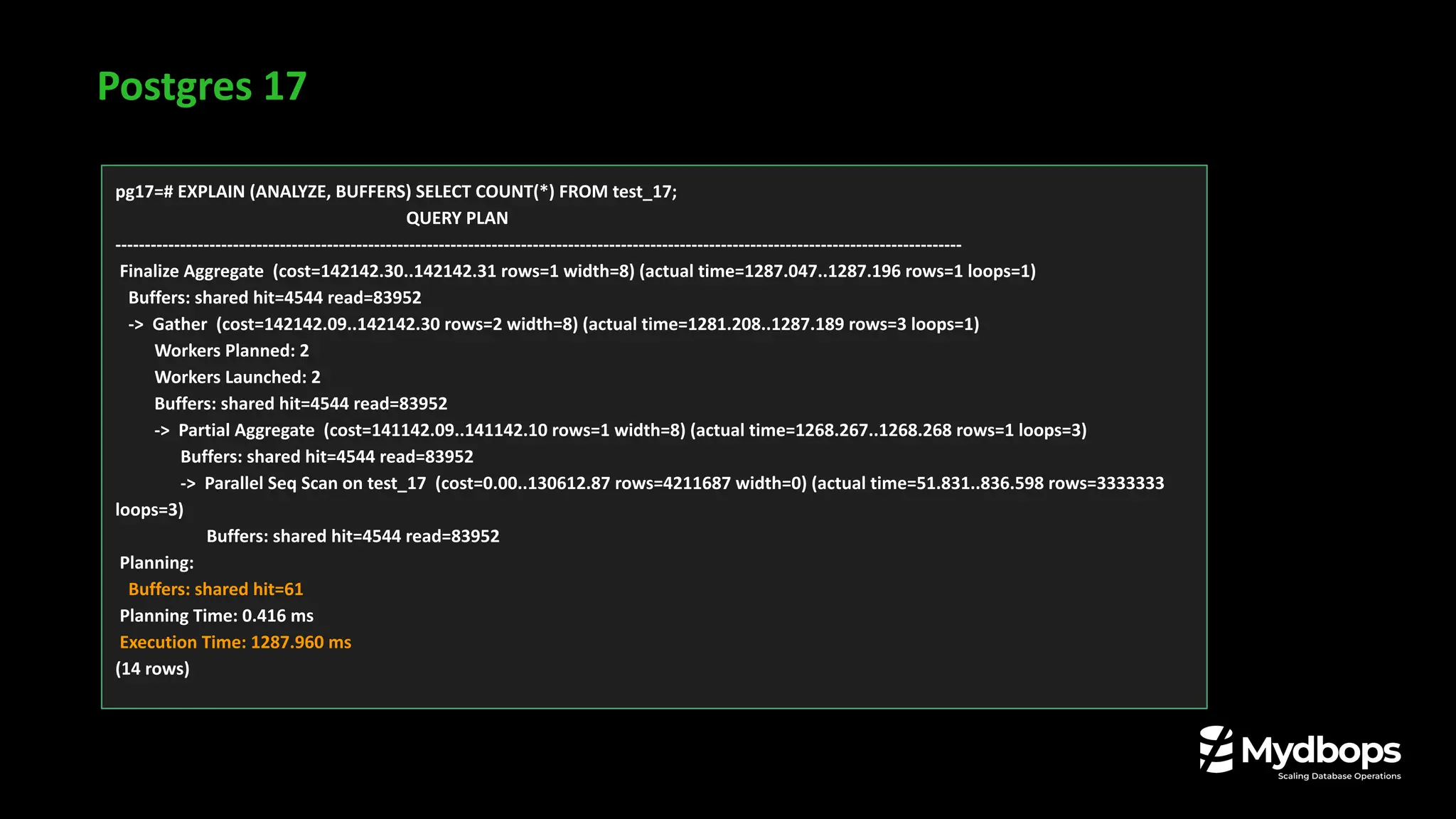
Postgres 17
pg17=# EXPLAIN (ANALYZE, BUFFERS) SELECT COUNT(*) FROM test_17;
QUERY PLAN
------------------------------------------------------------------------------------------------------------------------------------------------
Finalize Aggregate (cost=142142.30..142142.31 rows=1 width=8) (actual time=1287.047..1287.196 rows=1 loops=1)
Buffers: shared hit=4544 read=83952
-> Gather (cost=142142.09..142142.30 rows=2 width=8) (actual time=1281.208..1287.189 rows=3 loops=1)
Workers Planned: 2
Workers Launched: 2
Buffers: shared hit=4544 read=83952
-> Partial Aggregate (cost=141142.09..141142.10 rows=1 width=8) (actual time=1268.267..1268.268 rows=1 loops=3)
Buffers: shared hit=4544 read=83952
-> Parallel Seq Scan on test_17 (cost=0.00..130612.87 rows=4211687 width=0) (actual time=51.831..836.598 rows=3333333
loops=3)
Buffers: shared hit=4544 read=83952
Planning:
Buffers: shared hit=61
Planning Time: 0.416 ms
Execution Time: 1287.960 ms
(14 rows)
● Configurable Cache Sizes: Adjustable SLRU cache.
● Banked Cache: Efficient data eviction by bank.
● Separate Locks: Each bank uses its own lock.
Improved SLRU Performance
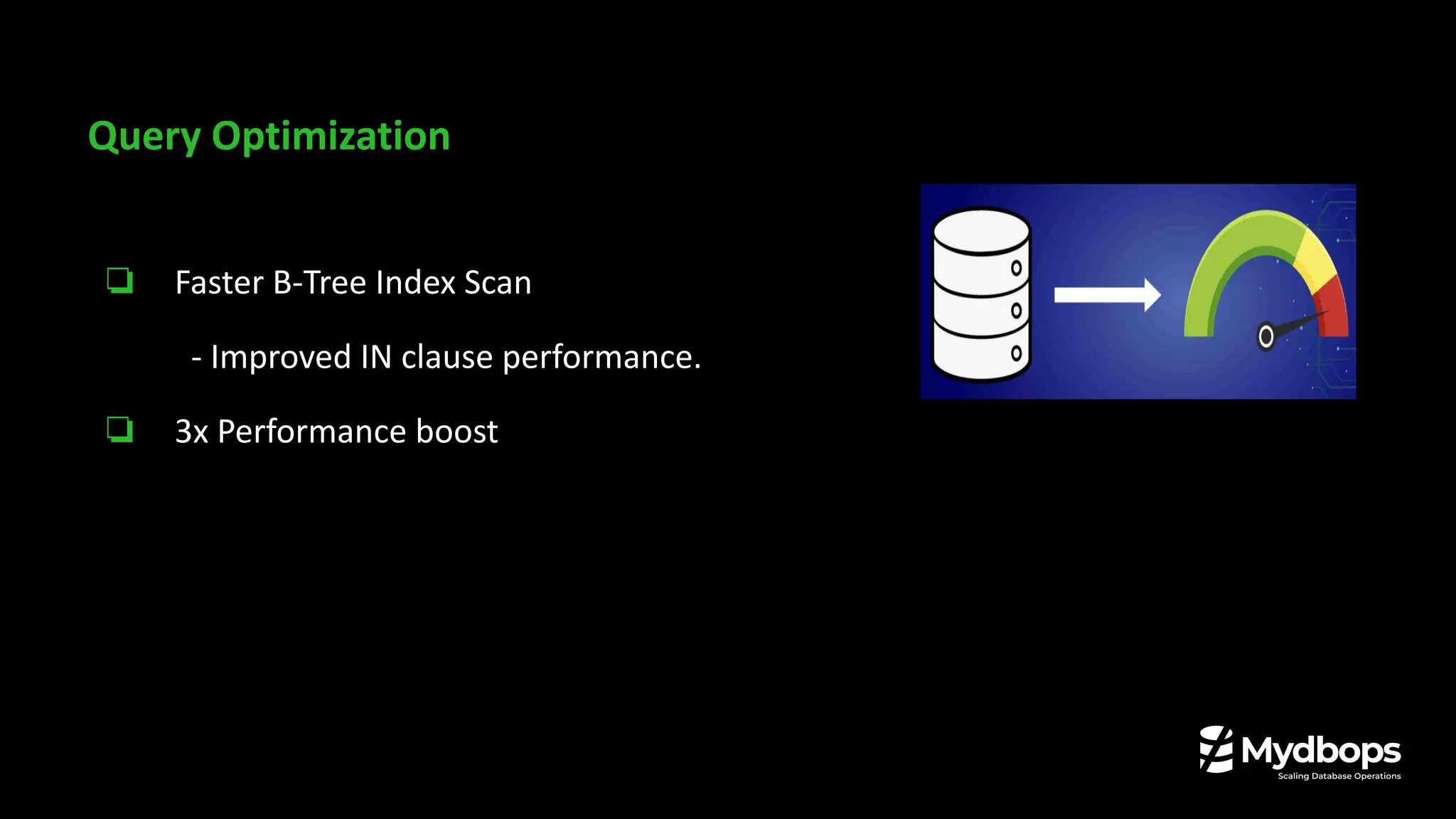
Query Optimization
❏ Faster B-Tree Index Scan
- Improved IN clause performance.
❏ 3x Performance boost
Postgres 16
Postgres 17
pg16=# EXPLAIN (ANALYZE, BUFFERS) SELECT * FROM test_16 WHERE id IN (1, 2, 3, 4, 45, 6, 10007);
QUERY PLAN
------------------------------------------------------------------------------------------------------------------------------
Index Only Scan using test_16_id_idx on test_16 (cost=0.43..31.17 rows=7 width=4) (actual time=0.052..1.277 rows=7 loops=1)
Index Cond: (id = ANY ('{1,2,3,4,45,6,10007}'::integer[]))
Heap Fetches: 0
Buffers: shared hit=24 read=1
Planning:
Buffers: shared hit=61
Planning Time: 0.401 ms
Execution Time: 1.293 ms
(8 rows)
pg17=# EXPLAIN (ANALYZE, BUFFERS) SELECT * FROM test_17 WHERE id IN (1, 2, 3, 4, 45, 6, 10007);
QUERY PLAN
------------------------------------------------------------------------------------------------------------------------------
Index Only Scan using test_17_id_idx on test_17 (cost=0.43..31.17 rows=7 width=4) (actual time=0.056..0.542 rows=7 loops=1)
Index Cond: (id = ANY ('{1,2,3,4,45,6,10007}'::integer[]))
Heap Fetches: 0
Buffers: shared hit=6 read=1
Planning:
Buffers: shared hit=70
Planning Time: 0.452 ms
Execution Time: 0.564 ms
(8 rows)
Performance Boost with Constraints
❏ NULL Constraint Optimization
- Skips unnecessary checks for faster queries.
❏ Impact of NOT NULL on Execution
- Reduces processing for more efficient scans.
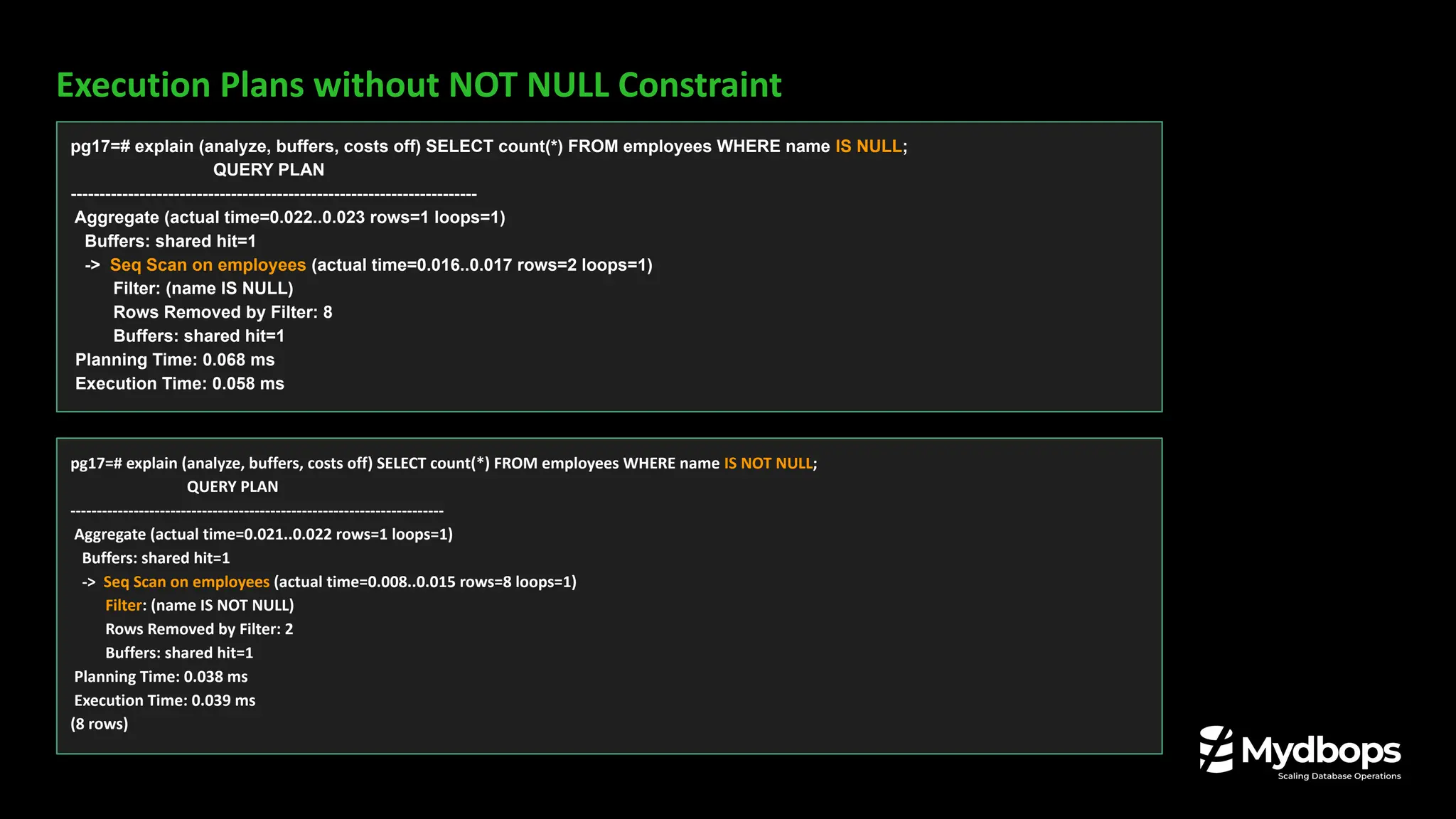
Execution Plans without NOT NULL Constraint
pg17=# explain (analyze, buffers, costs off) SELECT count(*) FROM employees WHERE name IS NULL;
QUERY PLAN
-----------------------------------------------------------------------
Aggregate (actual time=0.022..0.023 rows=1 loops=1)
Buffers: shared hit=1
-> Seq Scan on employees (actual time=0.016..0.017 rows=2 loops=1)
Filter: (name IS NULL)
Rows Removed by Filter: 8
Buffers: shared hit=1
Planning Time: 0.068 ms
Execution Time: 0.058 ms
pg17=# explain (analyze, buffers, costs off) SELECT count(*) FROM employees WHERE name IS NOT NULL;
QUERY PLAN
-----------------------------------------------------------------------
Aggregate (actual time=0.021..0.022 rows=1 loops=1)
Buffers: shared hit=1
-> Seq Scan on employees (actual time=0.008..0.015 rows=8 loops=1)
Filter: (name IS NOT NULL)
Rows Removed by Filter: 2
Buffers: shared hit=1
Planning Time: 0.038 ms
Execution Time: 0.039 ms
(8 rows)
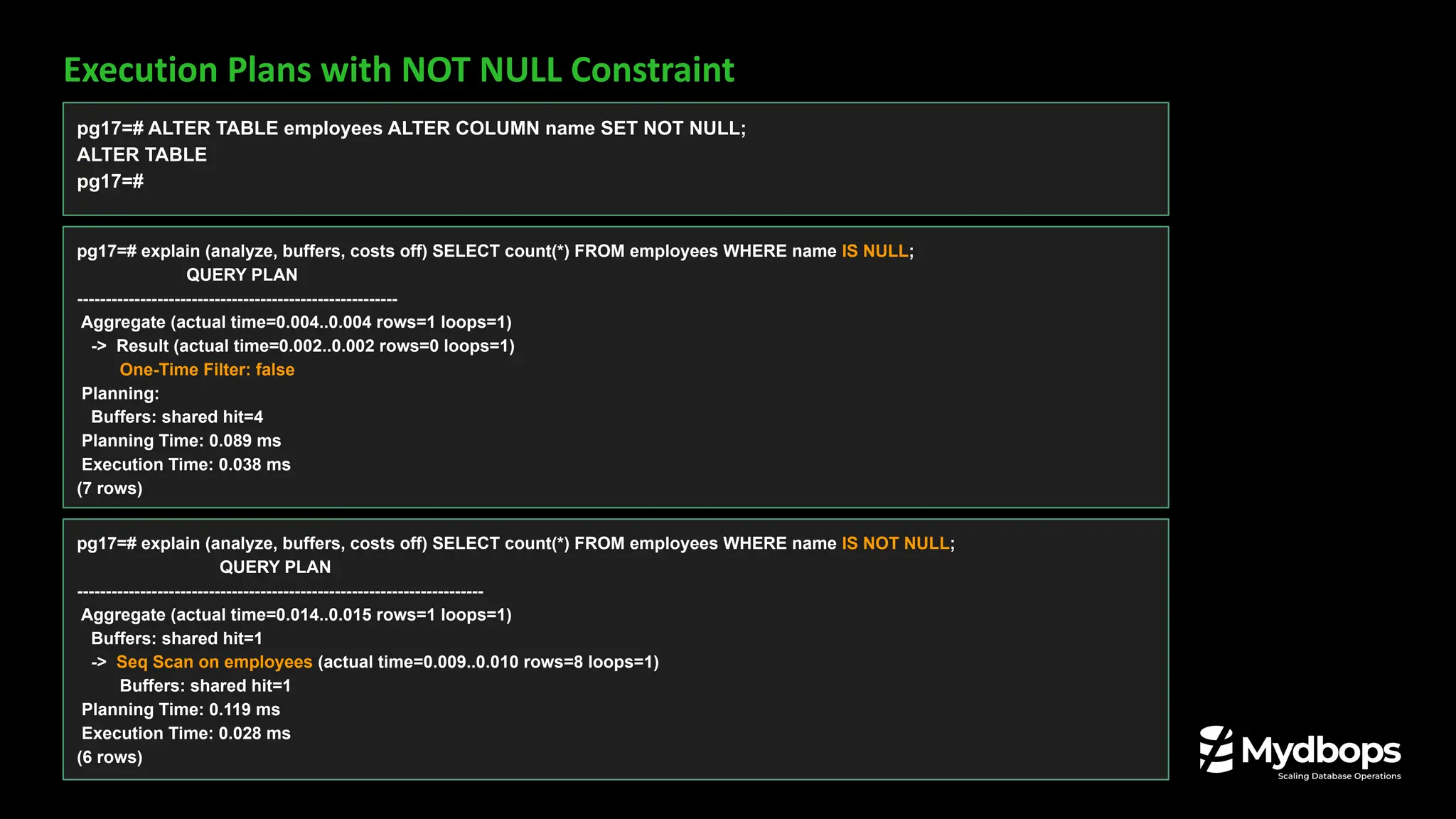
Execution Plans with NOT NULL Constraint
pg17=# ALTER TABLE employees ALTER COLUMN name SET NOT NULL;
ALTER TABLE
pg17=#
pg17=# explain (analyze, buffers, costs off) SELECT count(*) FROM employees WHERE name IS NULL;
QUERY PLAN
--------------------------------------------------------
Aggregate (actual time=0.004..0.004 rows=1 loops=1)
-> Result (actual time=0.002..0.002 rows=0 loops=1)
One-Time Filter: false
Planning:
Buffers: shared hit=4
Planning Time: 0.089 ms
Execution Time: 0.038 ms
(7 rows)
pg17=# explain (analyze, buffers, costs off) SELECT count(*) FROM employees WHERE name IS NOT NULL;
QUERY PLAN
-----------------------------------------------------------------------
Aggregate (actual time=0.014..0.015 rows=1 loops=1)
Buffers: shared hit=1
-> Seq Scan on employees (actual time=0.009..0.010 rows=8 loops=1)
Buffers: shared hit=1
Planning Time: 0.119 ms
Execution Time: 0.028 ms
(6 rows)
Faster BRIN Index Creation
❏ Multi-Worker Support
❏ Parallel Processing
❏ Sorted Summary Streams
❏ Leader Integration
❏ Efficient Resource Use
Partitioned and distributed
workloads enhancements
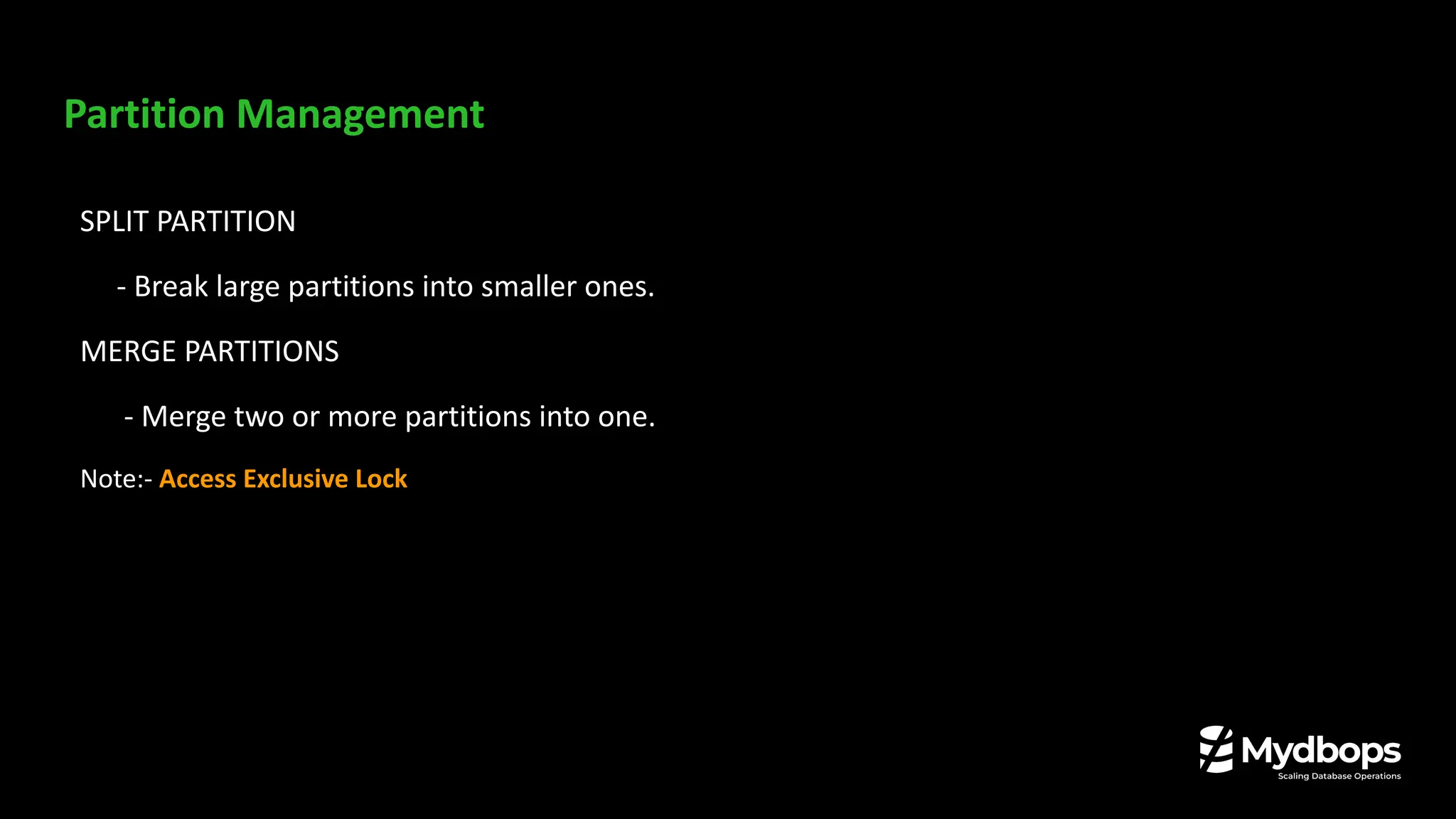
Partition Management
SPLIT PARTITION
- Break large partitions into smaller ones.
MERGE PARTITIONS
- Merge two or more partitions into one.
Note:- Access Exclusive Lock
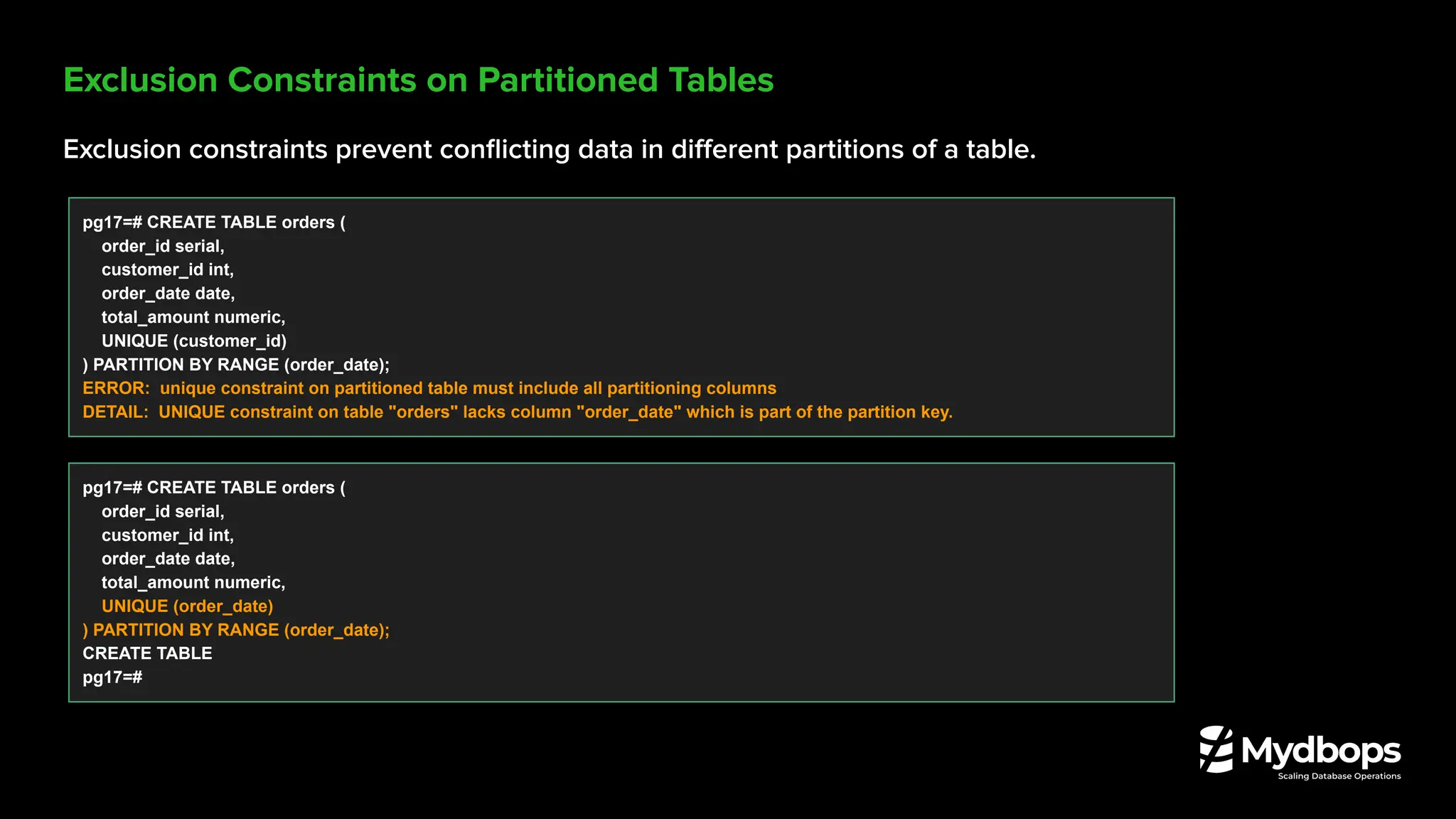
Exclusion Constraints on Partitioned Tables
Exclusion constraints prevent conflicting data in different partitions of a table.
pg17=# CREATE TABLE orders (
order_id serial,
customer_id int,
order_date date,
total_amount numeric,
UNIQUE (customer_id)
) PARTITION BY RANGE (order_date);
ERROR: unique constraint on partitioned table must include all partitioning columns
DETAIL: UNIQUE constraint on table "orders" lacks column "order_date" which is part of the partition key.
pg17=# CREATE TABLE orders (
order_id serial,
customer_id int,
order_date date,
total_amount numeric,
UNIQUE (order_date)
) PARTITION BY RANGE (order_date);
CREATE TABLE
pg17=#
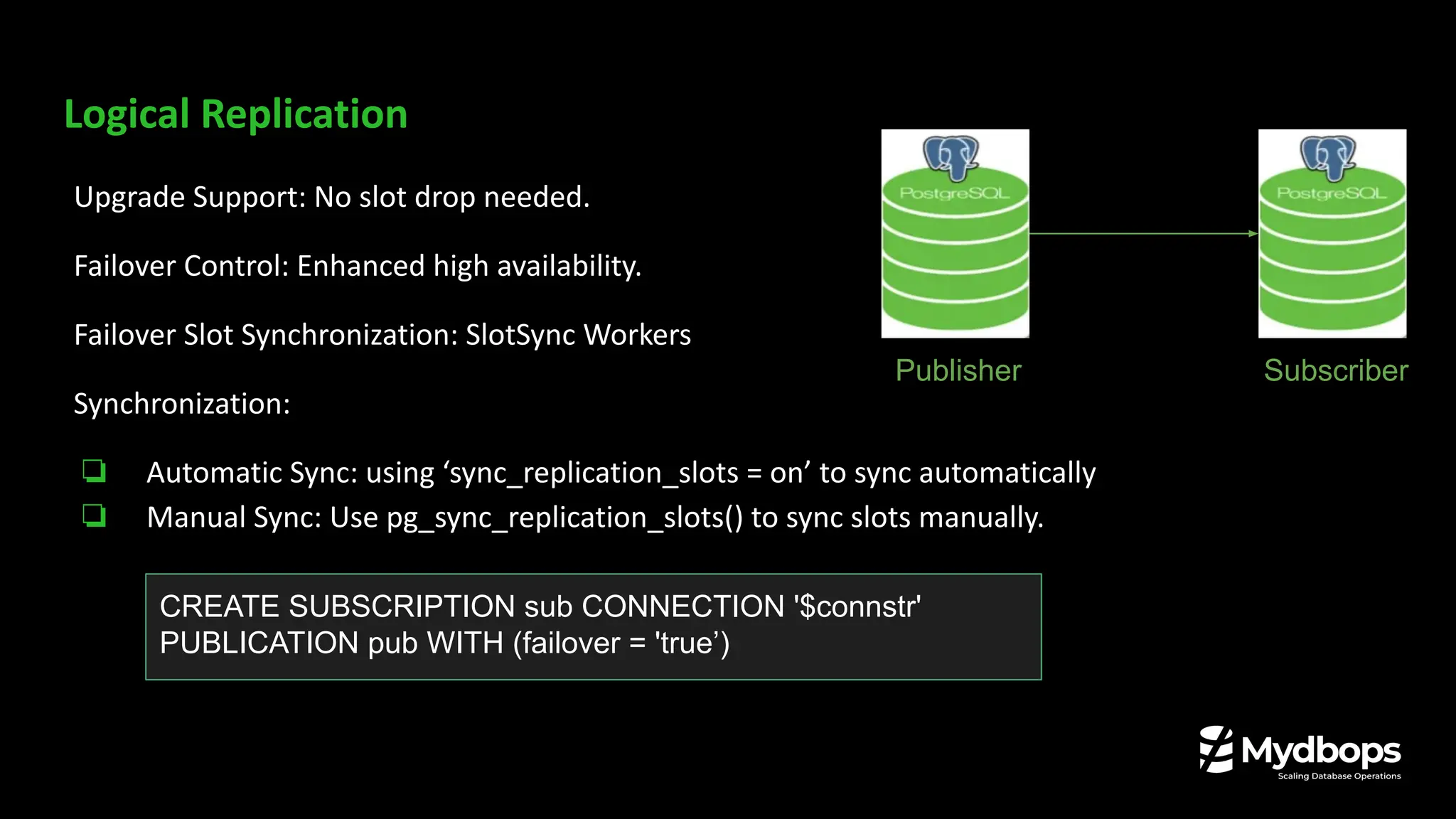
Logical Replication
Upgrade Support: No slot drop needed.
Failover Control: Enhanced high availability.
Failover Slot Synchronization: SlotSync Workers
Synchronization:
❏ Automatic Sync: using ‘sync_replication_slots = on’ to sync automatically
❏ Manual Sync: Use pg_sync_replication_slots() to sync slots manually.
Publisher Subscriber
CREATE SUBSCRIPTION sub CONNECTION '$connstr'
PUBLICATION pub WITH (failover = 'true’)
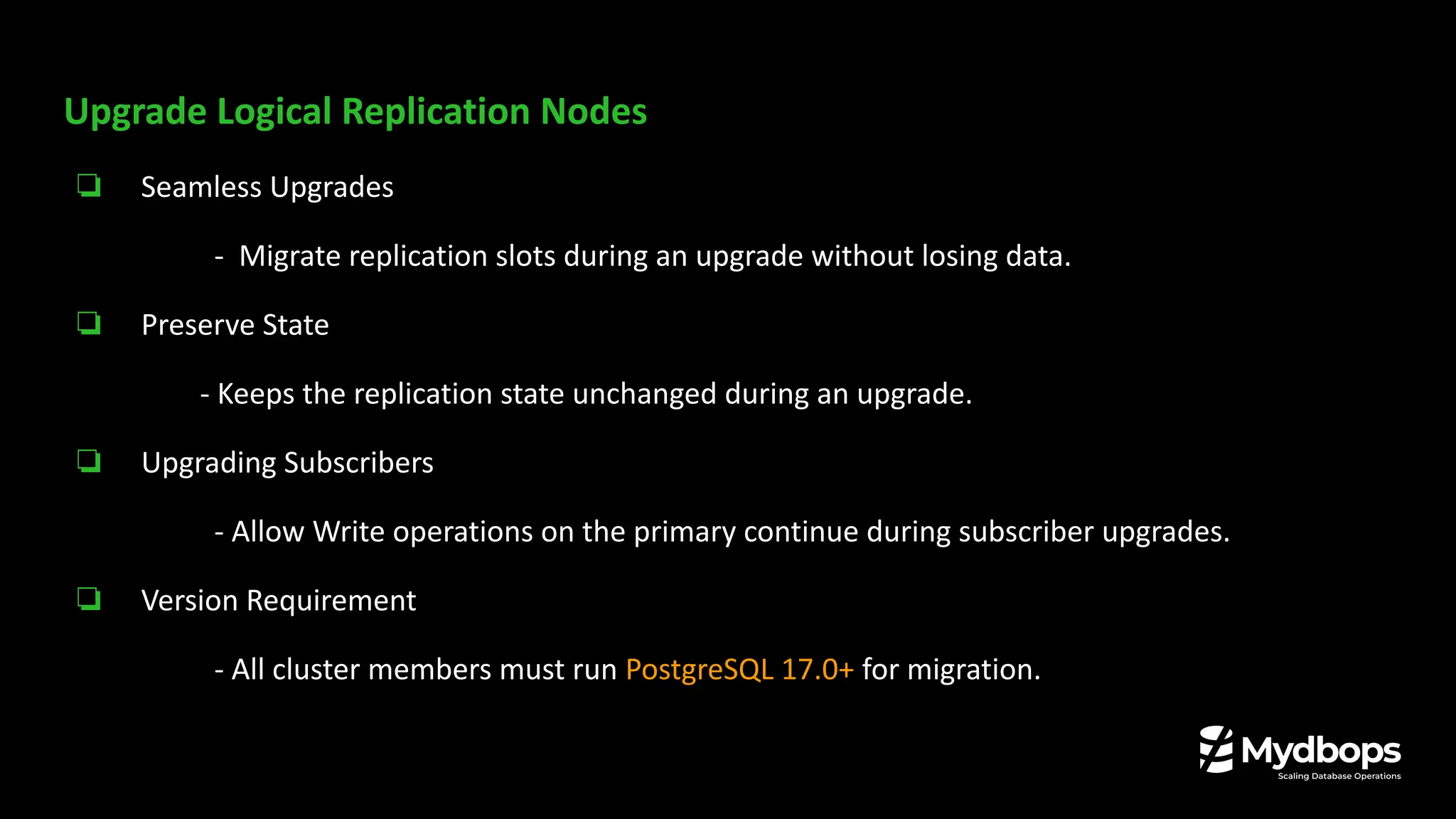
Upgrade Logical Replication Nodes
❏ Seamless Upgrades
- Migrate replication slots during an upgrade without losing data.
❏ Preserve State
- Keeps the replication state unchanged during an upgrade.
❏ Upgrading Subscribers
- Allow Write operations on the primary continue during subscriber upgrades.
❏ Version Requirement
- All cluster members must run PostgreSQL 17.0+ for migration.
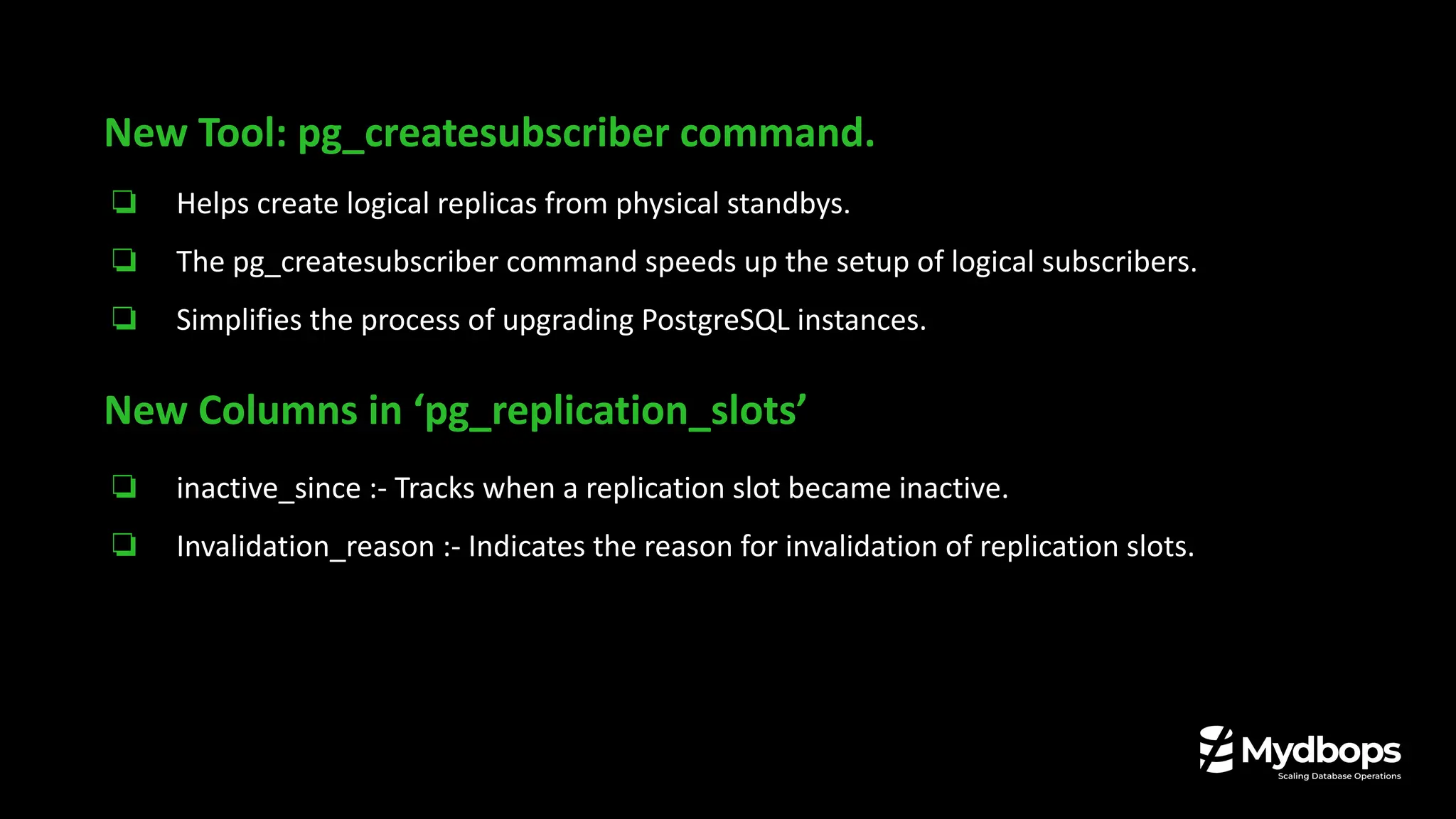
New Tool: pg_createsubscriber command.
❏ Helps create logical replicas from physical standbys.
❏ The pg_createsubscriber command speeds up the setup of logical subscribers.
❏ Simplifies the process of upgrading PostgreSQL instances.
New Columns in ‘pg_replication_slots’
❏ inactive_since :- Tracks when a replication slot became inactive.
❏ Invalidation_reason :- Indicates the reason for invalidation of replication slots.
Postgres 16 Postgres 17
pg16=# SELECT * FROM pg_replication_slots WHERE
slot_name = 'mydbops_testing_slot';
-[ RECORD 1 ]----------+---------------------
slot_name | mydbops_testing_slot
plugin |
slot_type | physical
datoid |
database |
temporary | f
active | f
active_pid |
xmin |
catalog_xmin |
restart_lsn |
confirmed_flush_lsn |
wal_status |
safe_wal_size |
two_phase | f
conflicting |
pg17=# SELECT * FROM pg_replication_slots WHERE
slot_name = 'mydbops_testing_slot';
-[ RECORD 1 ]-------+------------------------------
slot_name | mydbops_testing_slot
plugin |
slot_type | physical
datoid |
database |
temporary | f
active | f
active_pid |
xmin |
catalog_xmin |
restart_lsn |
confirmed_flush_lsn |
wal_status |
safe_wal_size |
two_phase | f
inactive_since | 2024-08-20 04:29:36.446812+00
conflicting |
invalidation_reason |
failover | f
synced | f
Developer Workflow Enhancement
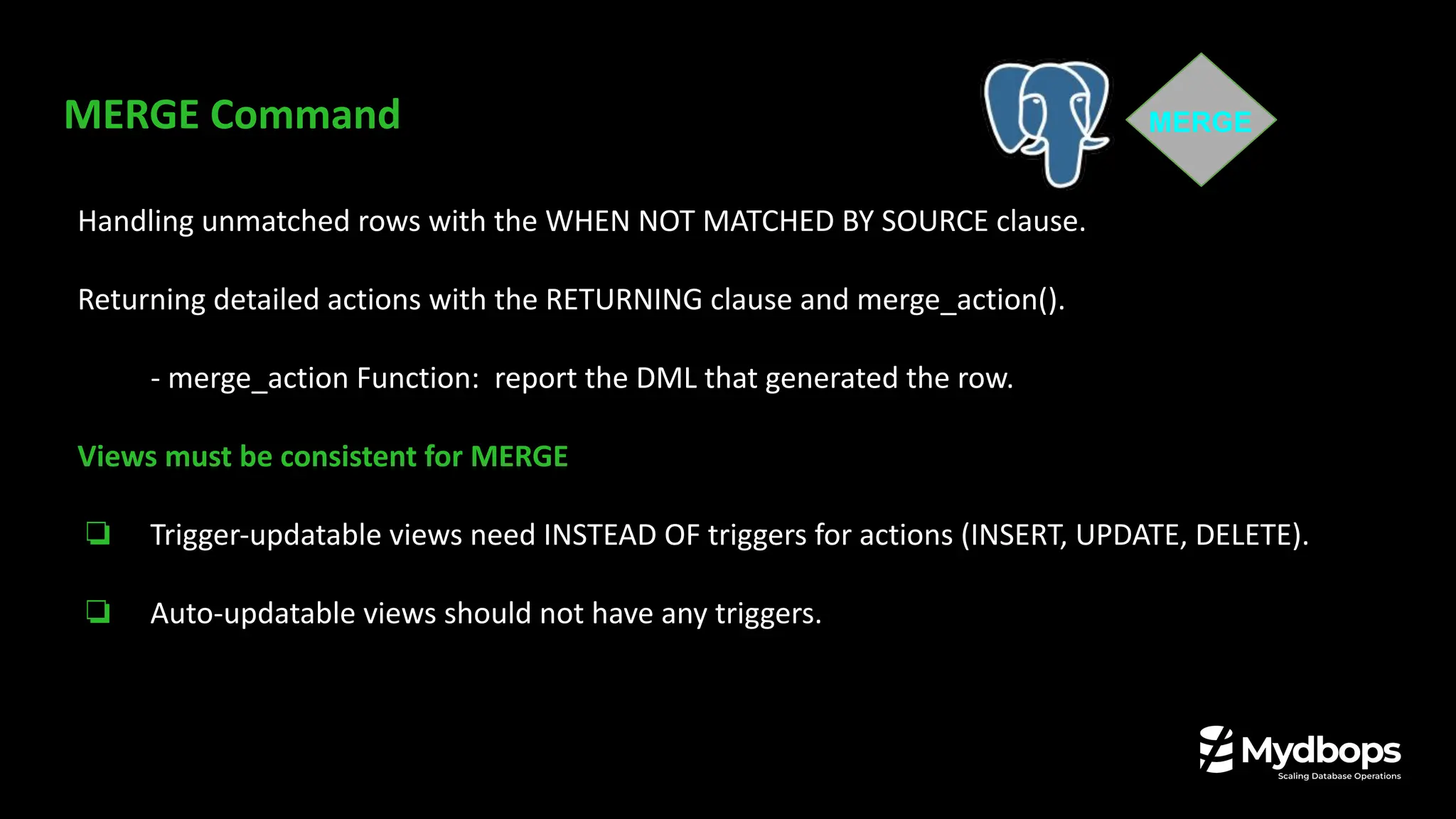
MERGE Command
Handling unmatched rows with the WHEN NOT MATCHED BY SOURCE clause.
Returning detailed actions with the RETURNING clause and merge_action().
- merge_action Function: report the DML that generated the row.
Views must be consistent for MERGE
❏ Trigger-updatable views need INSTEAD OF triggers for actions (INSERT, UPDATE, DELETE).
❏ Auto-updatable views should not have any triggers.
MERGE
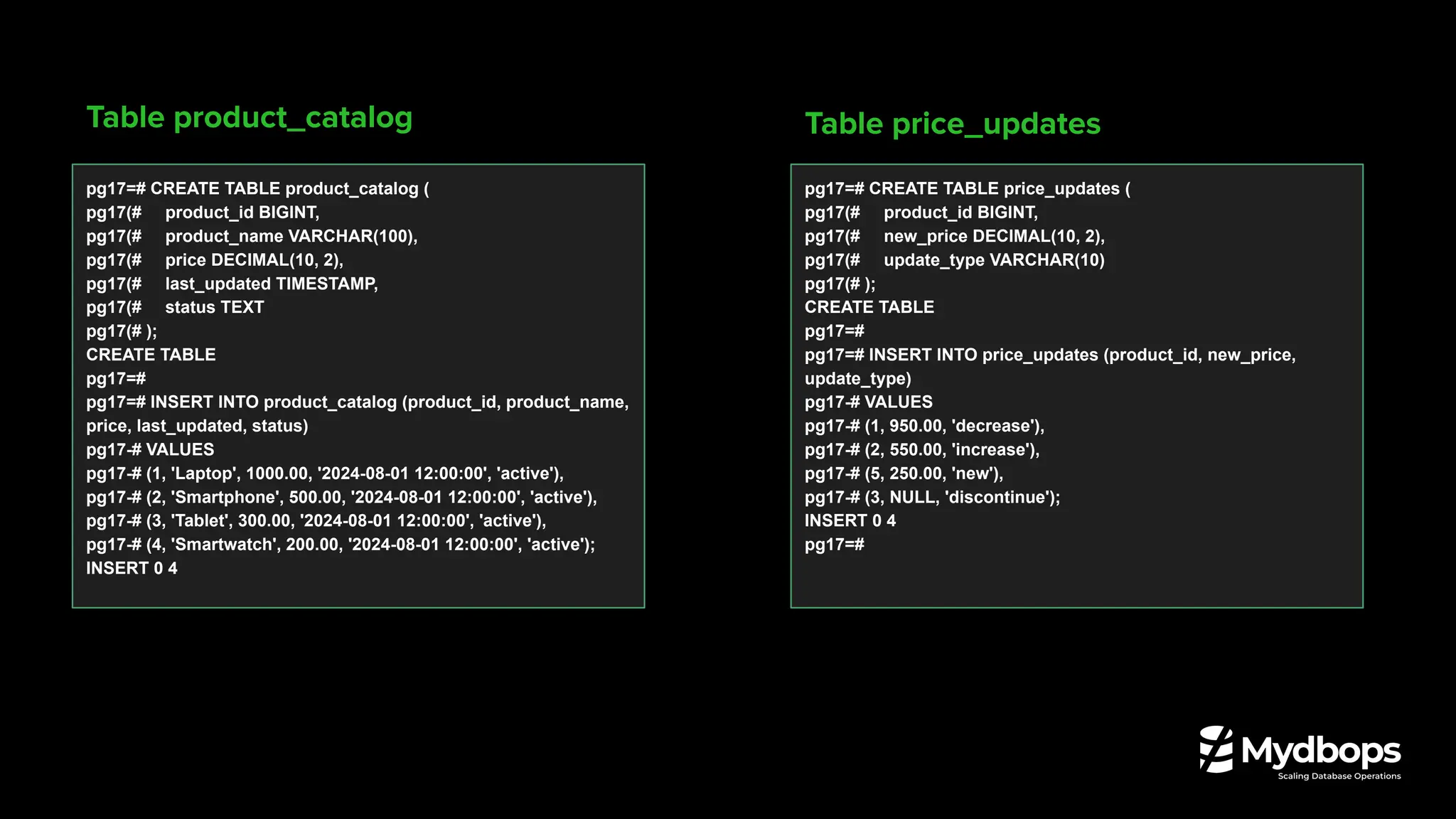
Table product_catalog Table price_updates
pg17=# CREATE TABLE product_catalog (
pg17(# product_id BIGINT,
pg17(# product_name VARCHAR(100),
pg17(# price DECIMAL(10, 2),
pg17(# last_updated TIMESTAMP,
pg17(# status TEXT
pg17(# );
CREATE TABLE
pg17=#
pg17=# INSERT INTO product_catalog (product_id, product_name,
price, last_updated, status)
pg17-# VALUES
pg17-# (1, 'Laptop', 1000.00, '2024-08-01 12:00:00', 'active'),
pg17-# (2, 'Smartphone', 500.00, '2024-08-01 12:00:00', 'active'),
pg17-# (3, 'Tablet', 300.00, '2024-08-01 12:00:00', 'active'),
pg17-# (4, 'Smartwatch', 200.00, '2024-08-01 12:00:00', 'active');
INSERT 0 4
pg17=# CREATE TABLE price_updates (
pg17(# product_id BIGINT,
pg17(# new_price DECIMAL(10, 2),
pg17(# update_type VARCHAR(10)
pg17(# );
CREATE TABLE
pg17=#
pg17=# INSERT INTO price_updates (product_id, new_price,
update_type)
pg17-# VALUES
pg17-# (1, 950.00, 'decrease'),
pg17-# (2, 550.00, 'increase'),
pg17-# (5, 250.00, 'new'),
pg17-# (3, NULL, 'discontinue');
INSERT 0 4
pg17=#
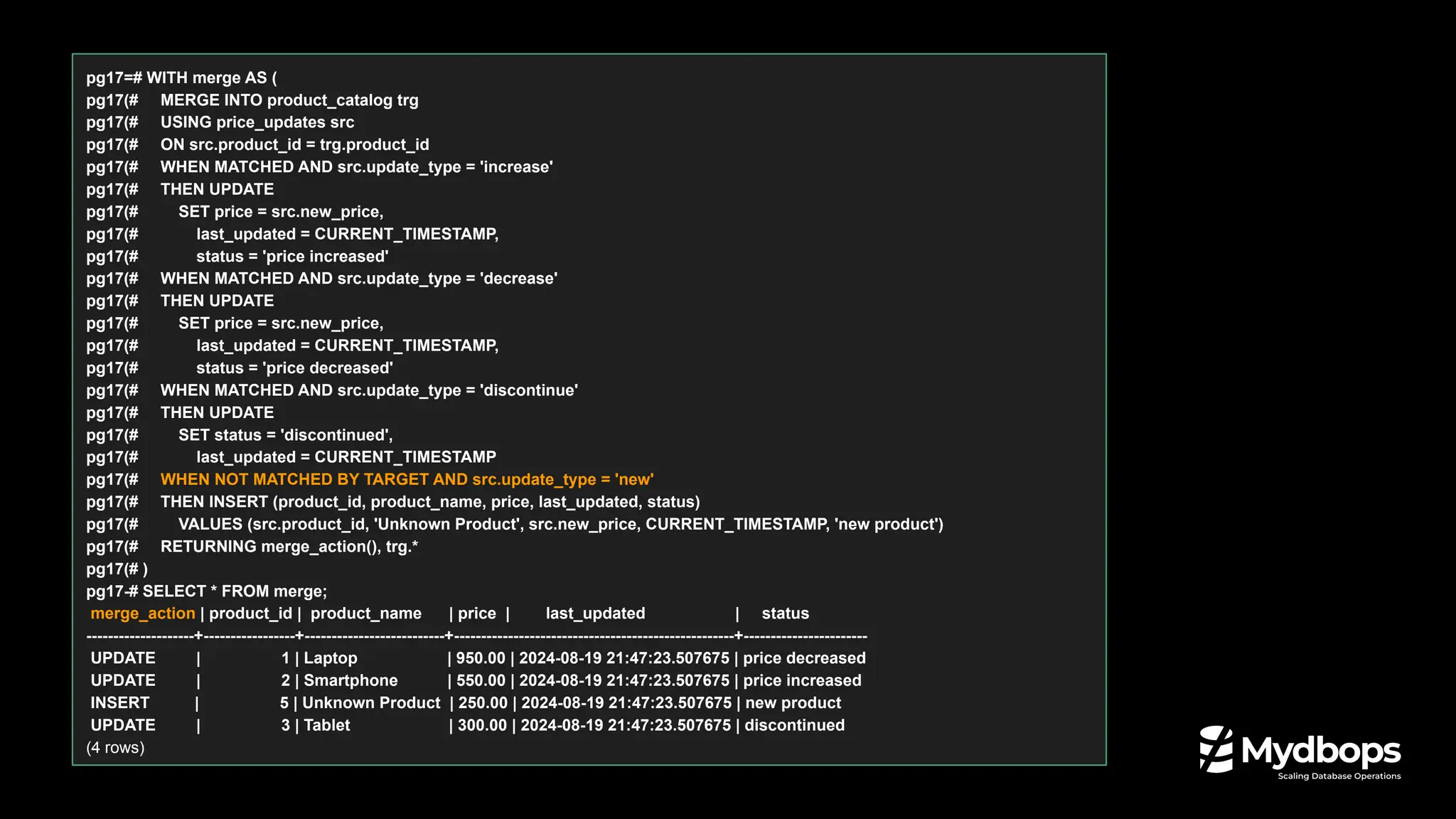
pg17=# WITH merge AS (
pg17(# MERGE INTO product_catalog trg
pg17(# USING price_updates src
pg17(# ON src.product_id = trg.product_id
pg17(# WHEN MATCHED AND src.update_type = 'increase'
pg17(# THEN UPDATE
pg17(# SET price = src.new_price,
pg17(# last_updated = CURRENT_TIMESTAMP,
pg17(# status = 'price increased'
pg17(# WHEN MATCHED AND src.update_type = 'decrease'
pg17(# THEN UPDATE
pg17(# SET price = src.new_price,
pg17(# last_updated = CURRENT_TIMESTAMP,
pg17(# status = 'price decreased'
pg17(# WHEN MATCHED AND src.update_type = 'discontinue'
pg17(# THEN UPDATE
pg17(# SET status = 'discontinued',
pg17(# last_updated = CURRENT_TIMESTAMP
pg17(# WHEN NOT MATCHED BY TARGET AND src.update_type = 'new'
pg17(# THEN INSERT (product_id, product_name, price, last_updated, status)
pg17(# VALUES (src.product_id, 'Unknown Product', src.new_price, CURRENT_TIMESTAMP, 'new product')
pg17(# RETURNING merge_action(), trg.*
pg17(# )
pg17-# SELECT * FROM merge;
merge_action | product_id | product_name | price | last_updated | status
--------------------+-----------------+--------------------------+----------------------------------------------------+-----------------------
UPDATE | 1 | Laptop | 950.00 | 2024-08-19 21:47:23.507675 | price decreased
UPDATE | 2 | Smartphone | 550.00 | 2024-08-19 21:47:23.507675 | price increased
INSERT | 5 | Unknown Product | 250.00 | 2024-08-19 21:47:23.507675 | new product
UPDATE | 3 | Tablet | 300.00 | 2024-08-19 21:47:23.507675 | discontinued
(4 rows)
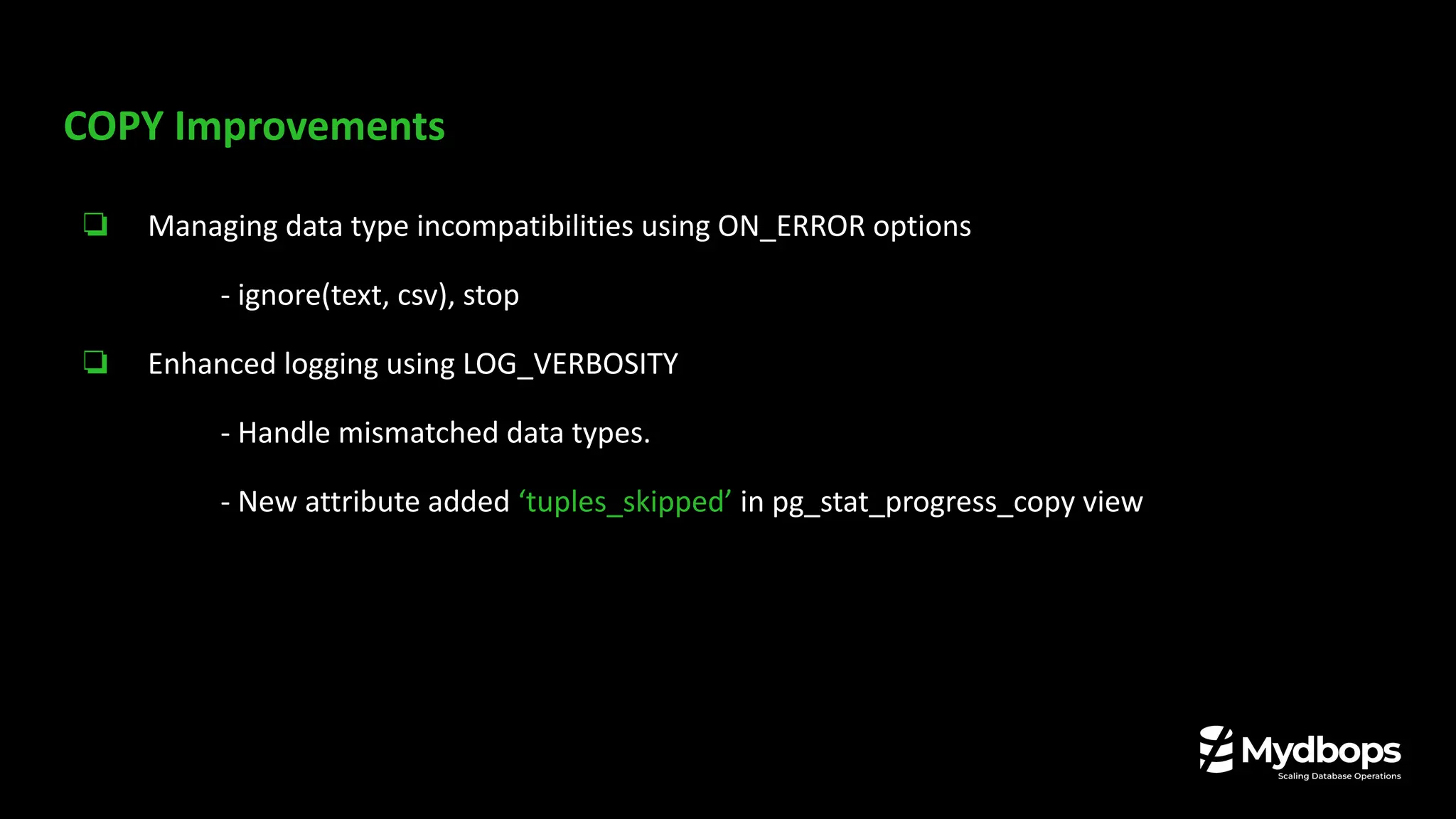
COPY Improvements
❏ Managing data type incompatibilities using ON_ERROR options
- ignore(text, csv), stop
❏ Enhanced logging using LOG_VERBOSITY
- Handle mismatched data types.
- New attribute added ‘tuples_skipped’ in pg_stat_progress_copy view
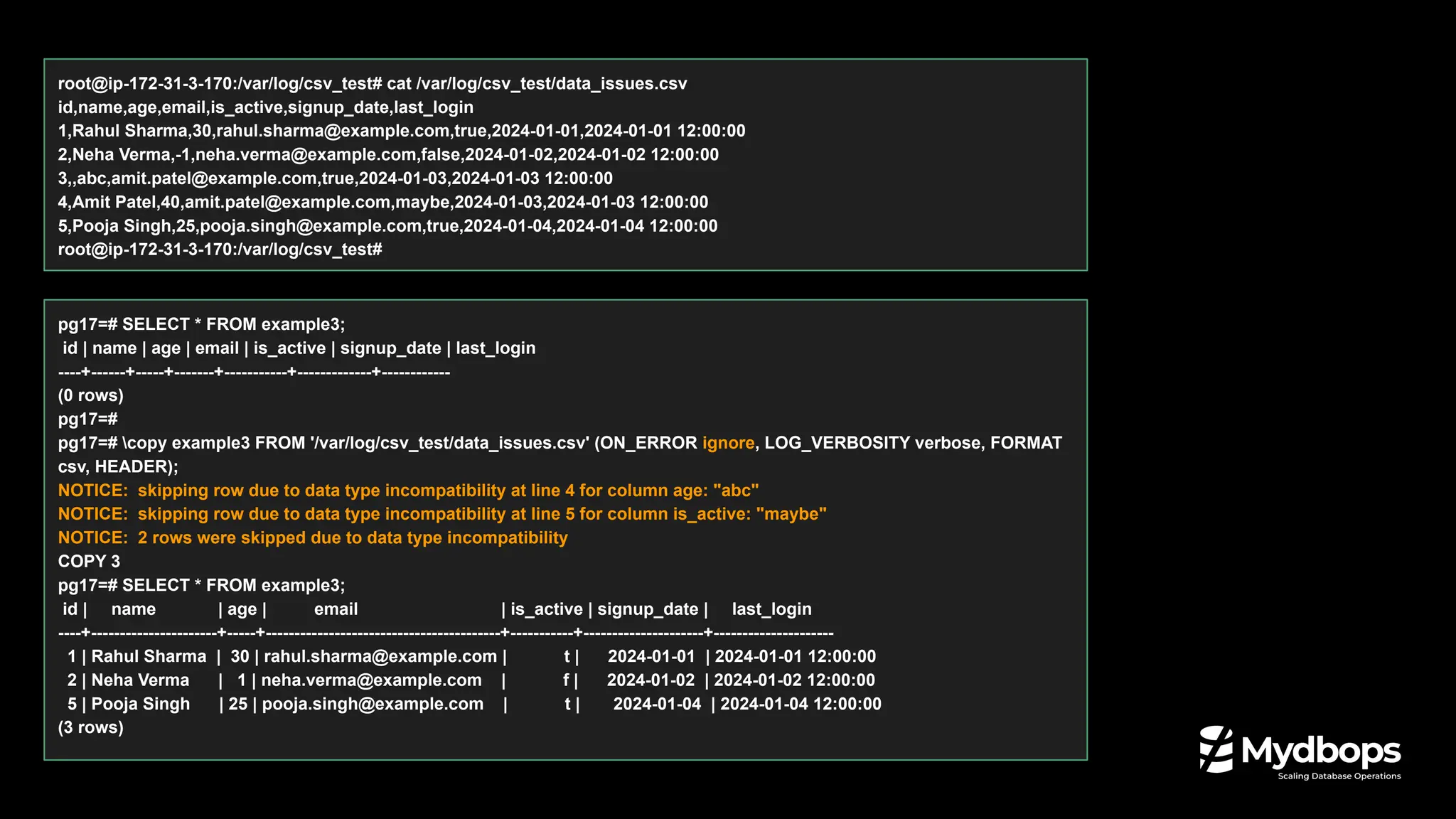
root@ip-172-31-3-170:/var/log/csv_test# cat /var/log/csv_test/data_issues.csv
id,name,age,email,is_active,signup_date,last_login
1,Rahul Sharma,30,rahul.sharma@example.com,true,2024-01-01,2024-01-01 12:00:00
2,Neha Verma,-1,neha.verma@example.com,false,2024-01-02,2024-01-02 12:00:00
3,,abc,amit.patel@example.com,true,2024-01-03,2024-01-03 12:00:00
4,Amit Patel,40,amit.patel@example.com,maybe,2024-01-03,2024-01-03 12:00:00
5,Pooja Singh,25,pooja.singh@example.com,true,2024-01-04,2024-01-04 12:00:00
root@ip-172-31-3-170:/var/log/csv_test#
pg17=# SELECT * FROM example3;
id | name | age | email | is_active | signup_date | last_login
----+------+-----+-------+-----------+-------------+------------
(0 rows)
pg17=#
pg17=# copy example3 FROM '/var/log/csv_test/data_issues.csv' (ON_ERROR ignore, LOG_VERBOSITY verbose, FORMAT
csv, HEADER);
NOTICE: skipping row due to data type incompatibility at line 4 for column age: "abc"
NOTICE: skipping row due to data type incompatibility at line 5 for column is_active: "maybe"
NOTICE: 2 rows were skipped due to data type incompatibility
COPY 3
pg17=# SELECT * FROM example3;
id | name | age | email | is_active | signup_date | last_login
----+----------------------+-----+-----------------------------------------+-----------+---------------------+---------------------
1 | Rahul Sharma | 30 | rahul.sharma@example.com | t | 2024-01-01 | 2024-01-01 12:00:00
2 | Neha Verma | 1 | neha.verma@example.com | f | 2024-01-02 | 2024-01-02 12:00:00
5 | Pooja Singh | 25 | pooja.singh@example.com | t | 2024-01-04 | 2024-01-04 12:00:00
(3 rows)
JSON_TABLE: Convert JSON to table.
Converting JSON data into a table format
pg17=# CREATE TABLE customer_orders (order_data jsonb);
CREATE TABLE
pg17=# INSERT INTO customer_orders VALUES ( '{ "orders": [ { "product": "Laptop", "quantity": 2 }, { "product": "Mouse",
"quantity": 5 } ] }' );
INSERT 0 1
pg17=# SELECT jt.* FROM customer_orders, JSON_TABLE(order_data, '$.orders[*]'
pg17(# COLUMNS ( id FOR ORDINALITY, product text PATH '$.product', quantity int PATH '$.quantity' )) AS jt;
id | product | quantity
----+---------+----------
1 | Laptop | 2
2 | Mouse | 5
(2 rows)
pg17=#
SQL/JSON Enhancements
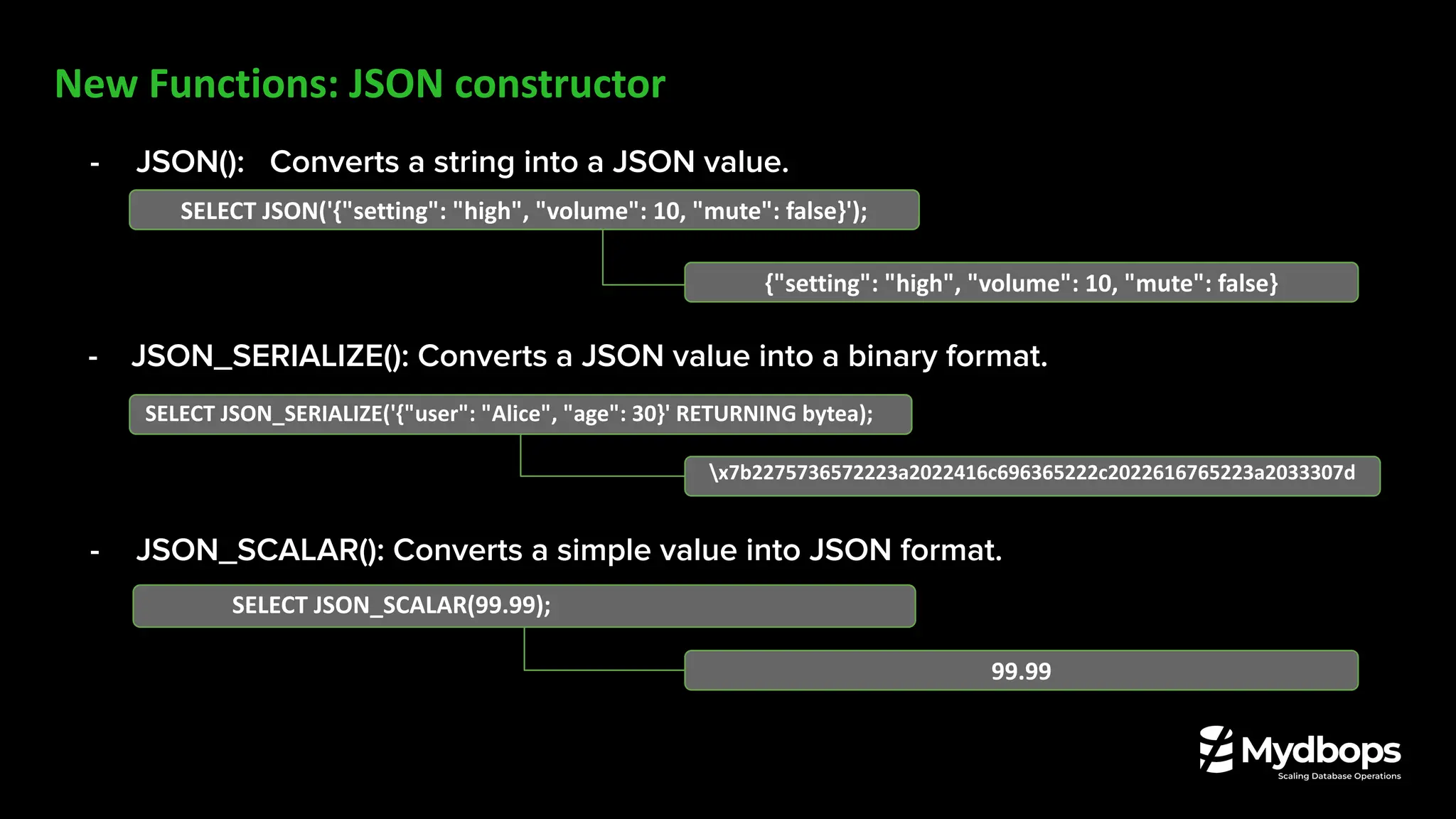
New Functions: JSON constructor
- JSON(): Converts a string into a JSON value.
- JSON_SERIALIZE(): Converts a JSON value into a binary format.
- JSON_SCALAR(): Converts a simple value into JSON format.
SELECT JSON('{"setting": "high", "volume": 10, "mute": false}');
{"setting": "high", "volume": 10, "mute": false}
SELECT JSON_SCALAR(99.99);
99.99
SELECT JSON_SERIALIZE('{"user": "Alice", "age": 30}' RETURNING bytea);
x7b2275736572223a2022416c696365222c2022616765223a2033307d
JSON Query Functions
- JSON_EXISTS(): Checks if a specific path exists in JSON
- JSON_QUERY(): Extracts a part of the JSON data.
- JSON_VALUE(): Extracts a single value from JSON.
SELECT JSON_EXISTS(jsonb '{"user": "Alice", "roles": ["admin", "user"]}', '$.roles[?(@ == "admin")]');
t(true)
SELECT JSON_QUERY(jsonb '{"user": "Bob", "roles": ["user", "editor"]}', '$.roles');
["user", "editor"]
SELECT JSON_VALUE(jsonb '{"user": "Charlie", "age": 25}', '$.user');
“Charlie”
Security Features
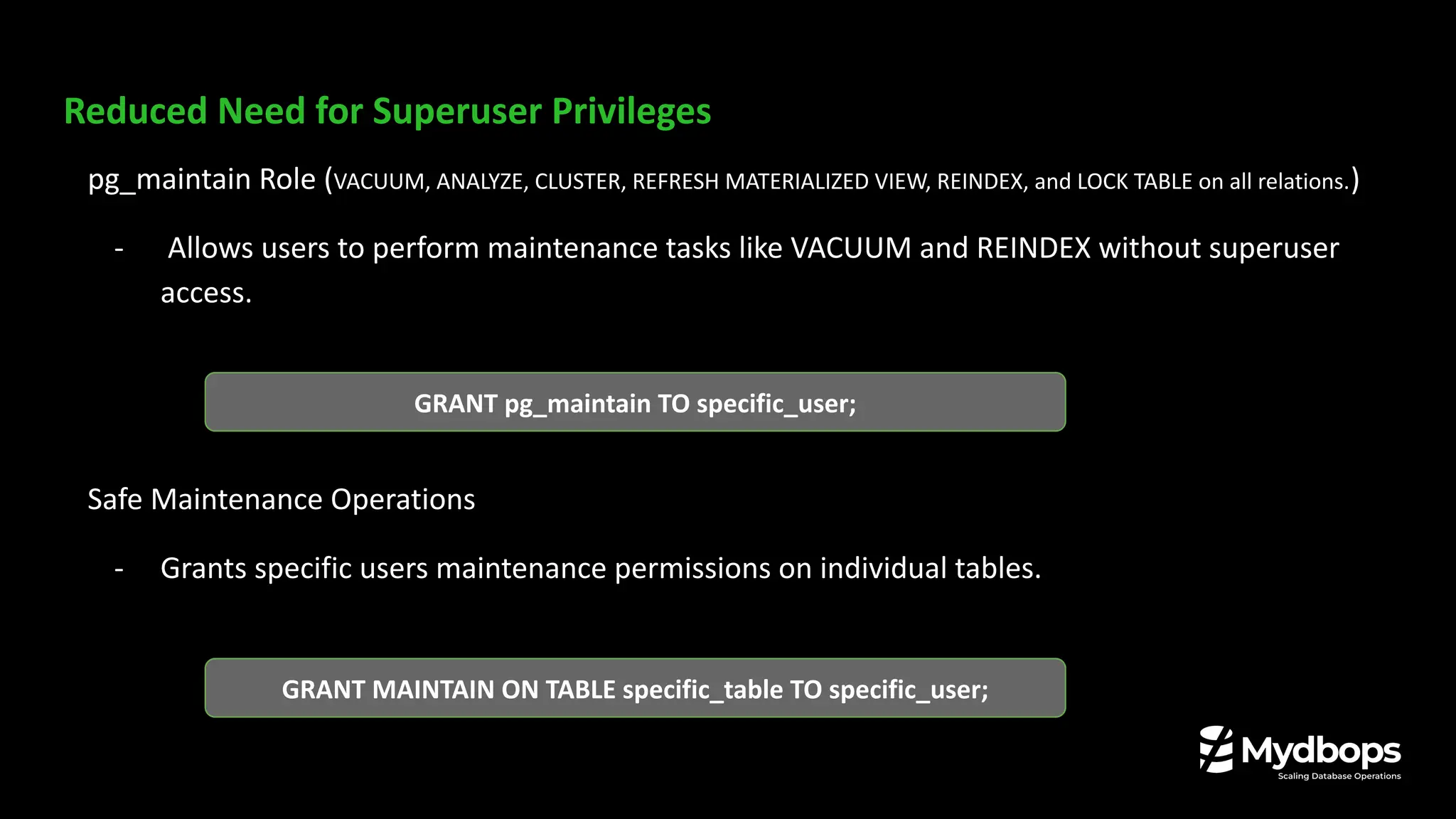
Reduced Need for Superuser Privileges
pg_maintain Role (VACUUM, ANALYZE, CLUSTER, REFRESH MATERIALIZED VIEW, REINDEX, and LOCK TABLE on all relations.)
- Allows users to perform maintenance tasks like VACUUM and REINDEX without superuser
access.
Safe Maintenance Operations
- Grants specific users maintenance permissions on individual tables.
GRANT pg_maintain TO specific_user;
GRANT MAINTAIN ON TABLE specific_table TO specific_user;
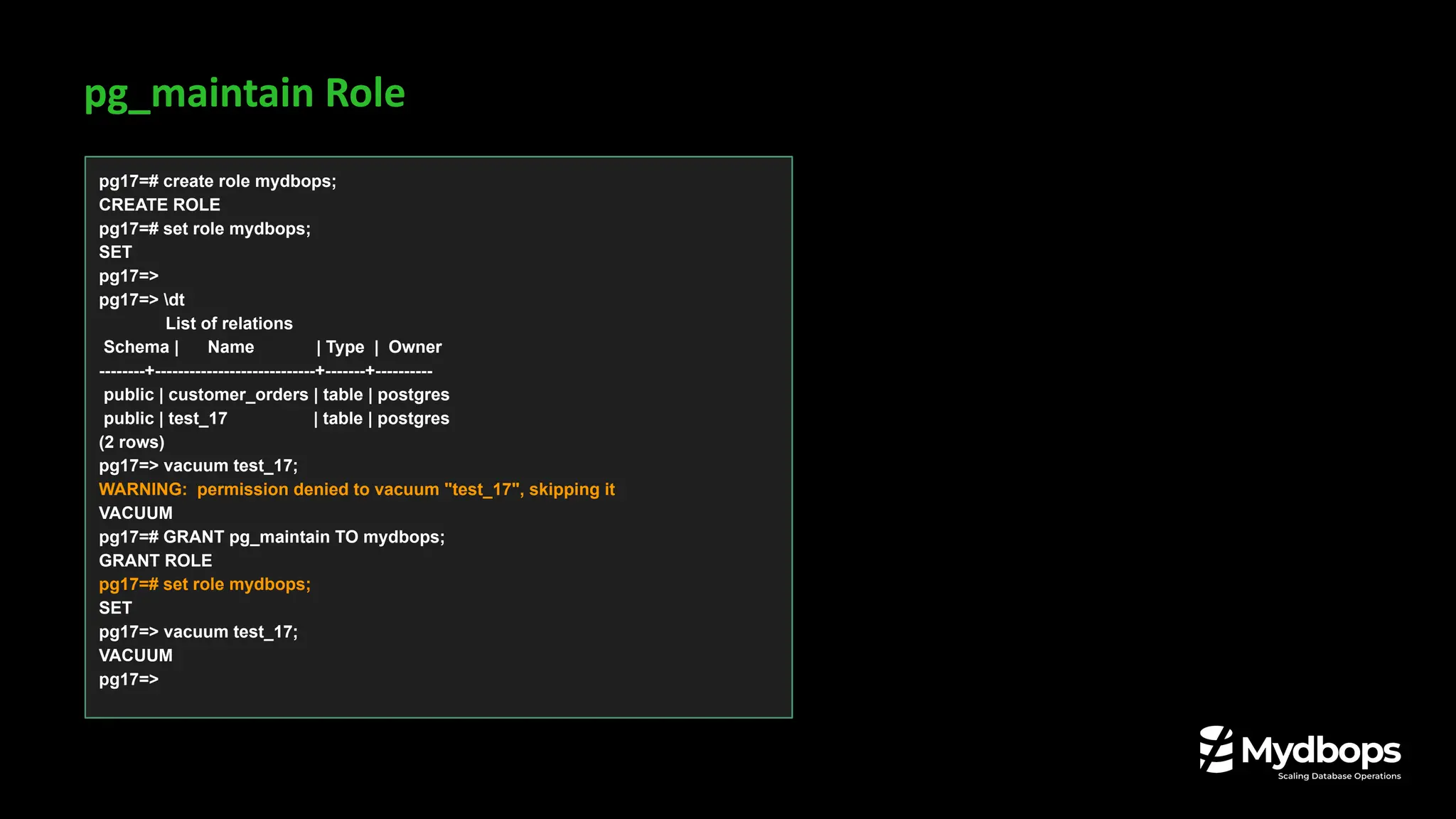
pg_maintain Role
pg17=# create role mydbops;
CREATE ROLE
pg17=# set role mydbops;
SET
pg17=>
pg17=> dt
List of relations
Schema | Name | Type | Owner
--------+----------------------------+-------+----------
public | customer_orders | table | postgres
public | test_17 | table | postgres
(2 rows)
pg17=> vacuum test_17;
WARNING: permission denied to vacuum "test_17", skipping it
VACUUM
pg17=# GRANT pg_maintain TO mydbops;
GRANT ROLE
pg17=# set role mydbops;
SET
pg17=> vacuum test_17;
VACUUM
pg17=>
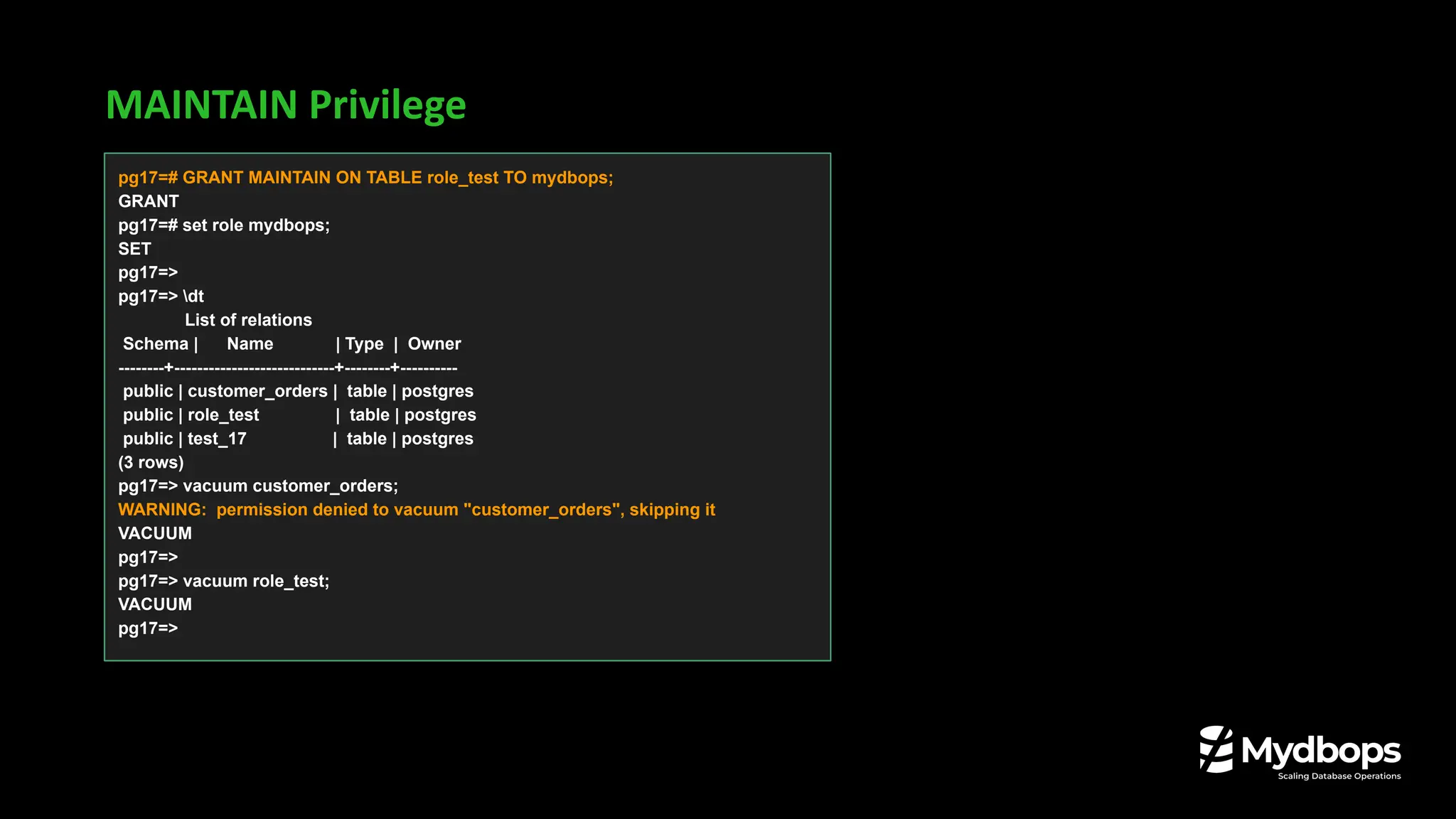
MAINTAIN Privilege
pg17=# GRANT MAINTAIN ON TABLE role_test TO mydbops;
GRANT
pg17=# set role mydbops;
SET
pg17=>
pg17=> dt
List of relations
Schema | Name | Type | Owner
--------+----------------------------+--------+----------
public | customer_orders | table | postgres
public | role_test | table | postgres
public | test_17 | table | postgres
(3 rows)
pg17=> vacuum customer_orders;
WARNING: permission denied to vacuum "customer_orders", skipping it
VACUUM
pg17=>
pg17=> vacuum role_test;
VACUUM
pg17=>
Improved ALTER SYSTEM Command:
ALTER SYSTEM Enhancements
❏ Control Over ALTER SYSTEM
- allow_alter_system
Faster TLS Connections
● Direct TLS Setup:
- sslnegotiation=direct option,
● ALPN Requirement
● Only works on PostgreSQL 17 and newer versions.
Backup and Export Management
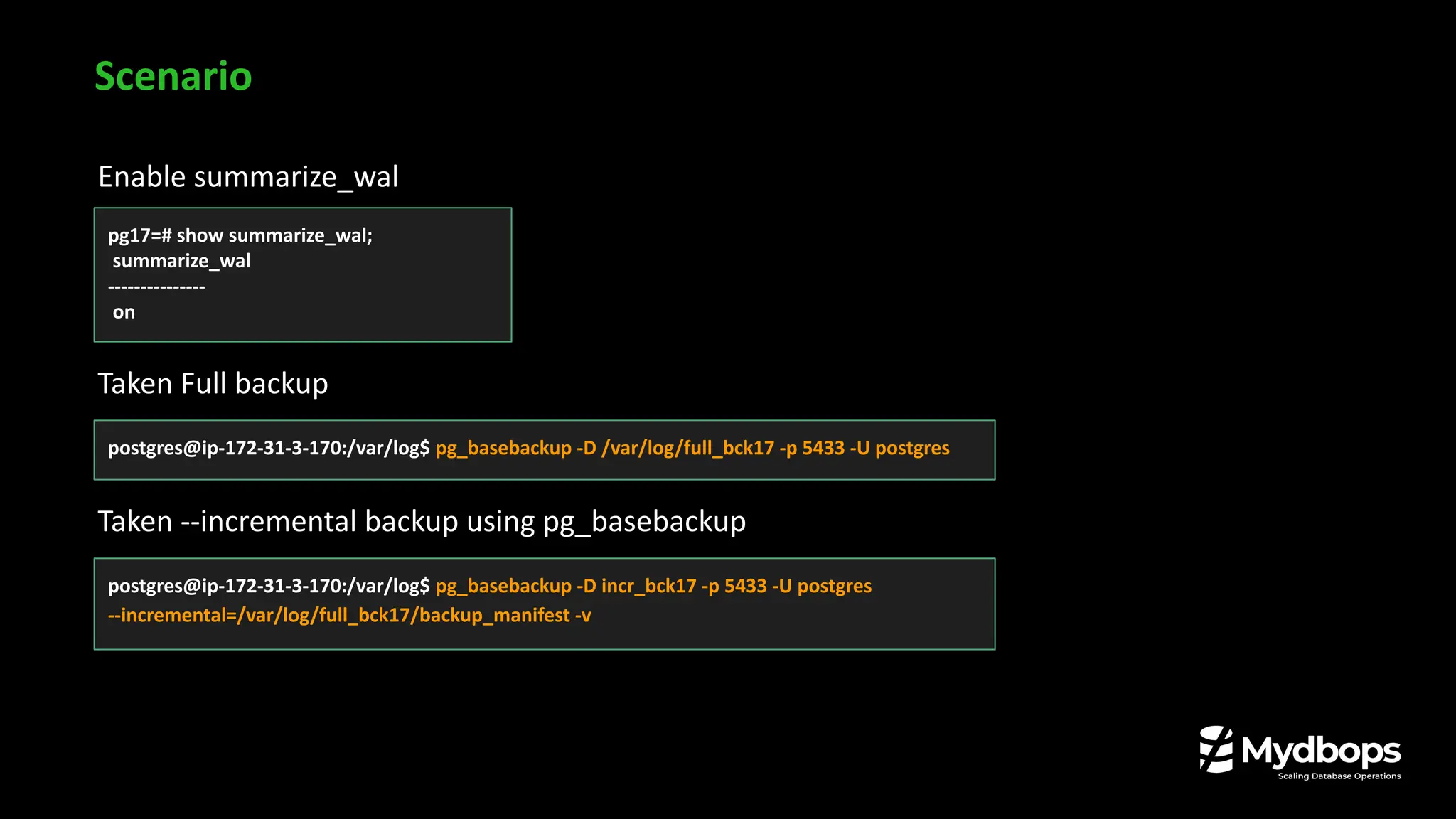
Incremental pg_basebackup
❏ Efficient for Large Databases
❏ Using pg_basebackup --incremental
❏ Tracking Changes with WAL - summarize_wal
❏ Restoration with pg_combinebackup
l Enable summarize_wal
Taken Full backup
Taken --incremental backup using pg_basebackup
Scenario
pg17=# show summarize_wal;
summarize_wal
---------------
on
postgres@ip-172-31-3-170:/var/log$ pg_basebackup -D /var/log/full_bck17 -p 5433 -U postgres
postgres@ip-172-31-3-170:/var/log$ pg_basebackup -D incr_bck17 -p 5433 -U postgres
--incremental=/var/log/full_bck17/backup_manifest -v
Taken full backup including incremental backup using pg_combinebackup
postgres@ip-172-31-3-170:/var/log$ /usr/lib/postgresql/17/bin/pg_combinebackup --output=combine_incr_full_bck
full_bck17 incr_bck17
postgres@ip-172-31-3-170:/var/log/combine_incr_full_bck$ tail -10 backup_manifest
{ "Path": "global/6303", "Size": 16384, "Last-Modified": "2024-08-18 13:26:43 GMT", "Checksum-Algorithm": "CRC32C", "Checksum":
"e8d85722" },
{ "Path": "global/6245", "Size": 8192, "Last-Modified": "2024-08-18 13:26:43 GMT", "Checksum-Algorithm": "CRC32C", "Checksum":
"21597da0" },
{ "Path": "global/6115", "Size": 8192, "Last-Modified": "2024-08-18 13:26:43 GMT", "Checksum-Algorithm": "CRC32C", "Checksum":
"b5a46221" },
{ "Path": "global/6246", "Size": 8192, "Last-Modified": "2024-08-18 13:26:43 GMT", "Checksum-Algorithm": "CRC32C", "Checksum":
"865872e0" },
{ "Path": "global/6243", "Size": 0, "Last-Modified": "2024-08-18 13:26:43 GMT", "Checksum-Algorithm": "CRC32C", "Checksum":
"00000000" }
],
"WAL-Ranges": [
{ "Timeline": 1, "Start-LSN": "2/B000028", "End-LSN": "2/B000120" }
],
"Manifest-Checksum": "0f16e87ab7bd400434c2725cf468d77bbcb702a49d38d749cd0e5af47f8f5fac"}
postgres@ip-172-31-3-170:/var/log/combine_incr_full_bck$
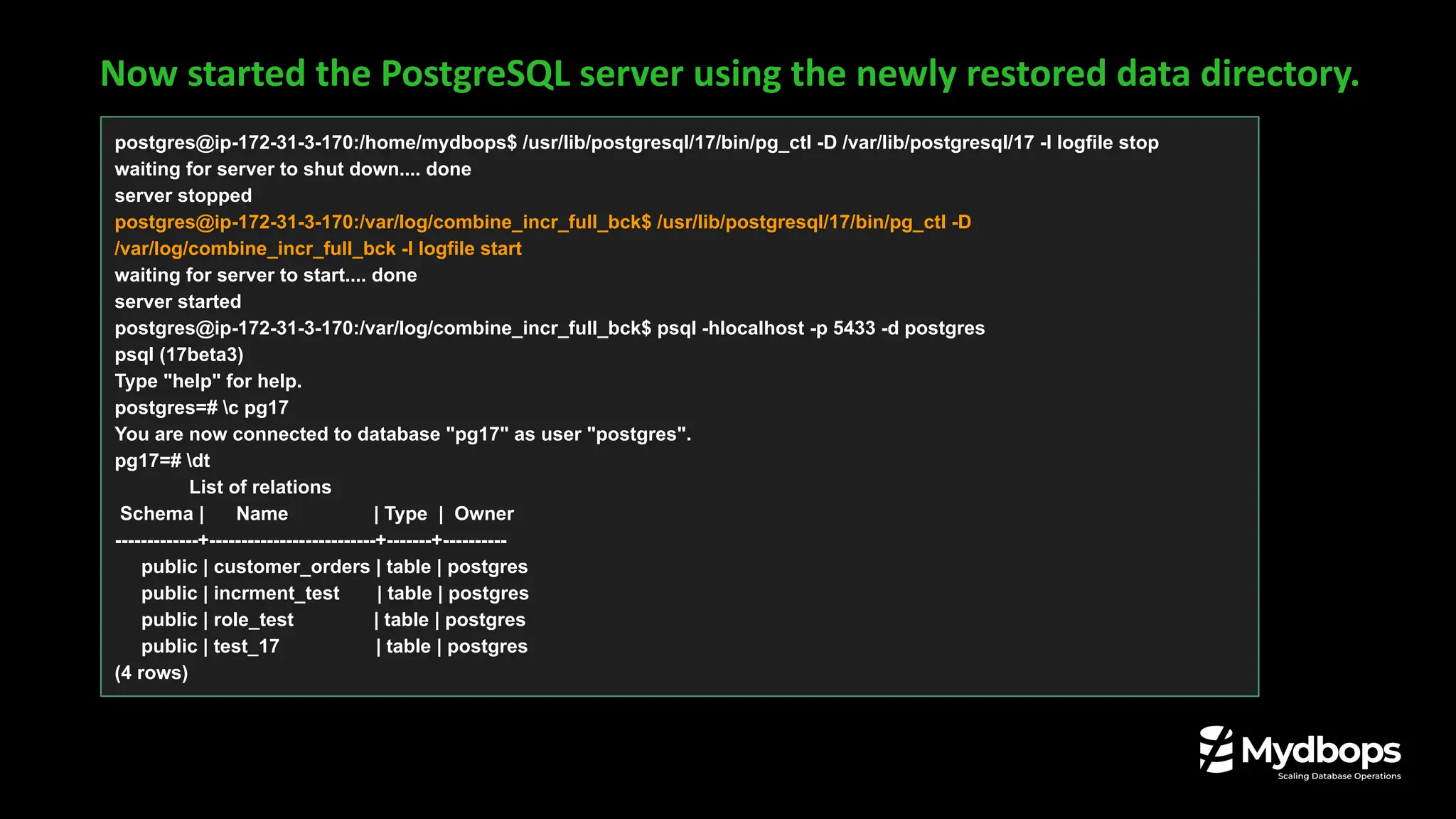
Now started the PostgreSQL server using the newly restored data directory.
postgres@ip-172-31-3-170:/home/mydbops$ /usr/lib/postgresql/17/bin/pg_ctl -D /var/lib/postgresql/17 -l logfile stop
waiting for server to shut down.... done
server stopped
postgres@ip-172-31-3-170:/var/log/combine_incr_full_bck$ /usr/lib/postgresql/17/bin/pg_ctl -D
/var/log/combine_incr_full_bck -l logfile start
waiting for server to start.... done
server started
postgres@ip-172-31-3-170:/var/log/combine_incr_full_bck$ psql -hlocalhost -p 5433 -d postgres
psql (17beta3)
Type "help" for help.
postgres=# c pg17
You are now connected to database "pg17" as user "postgres".
pg17=# dt
List of relations
Schema | Name | Type | Owner
-------------+--------------------------+-------+----------
public | customer_orders | table | postgres
public | incrment_test | table | postgres
public | role_test | table | postgres
public | test_17 | table | postgres
(4 rows)
Monitoring
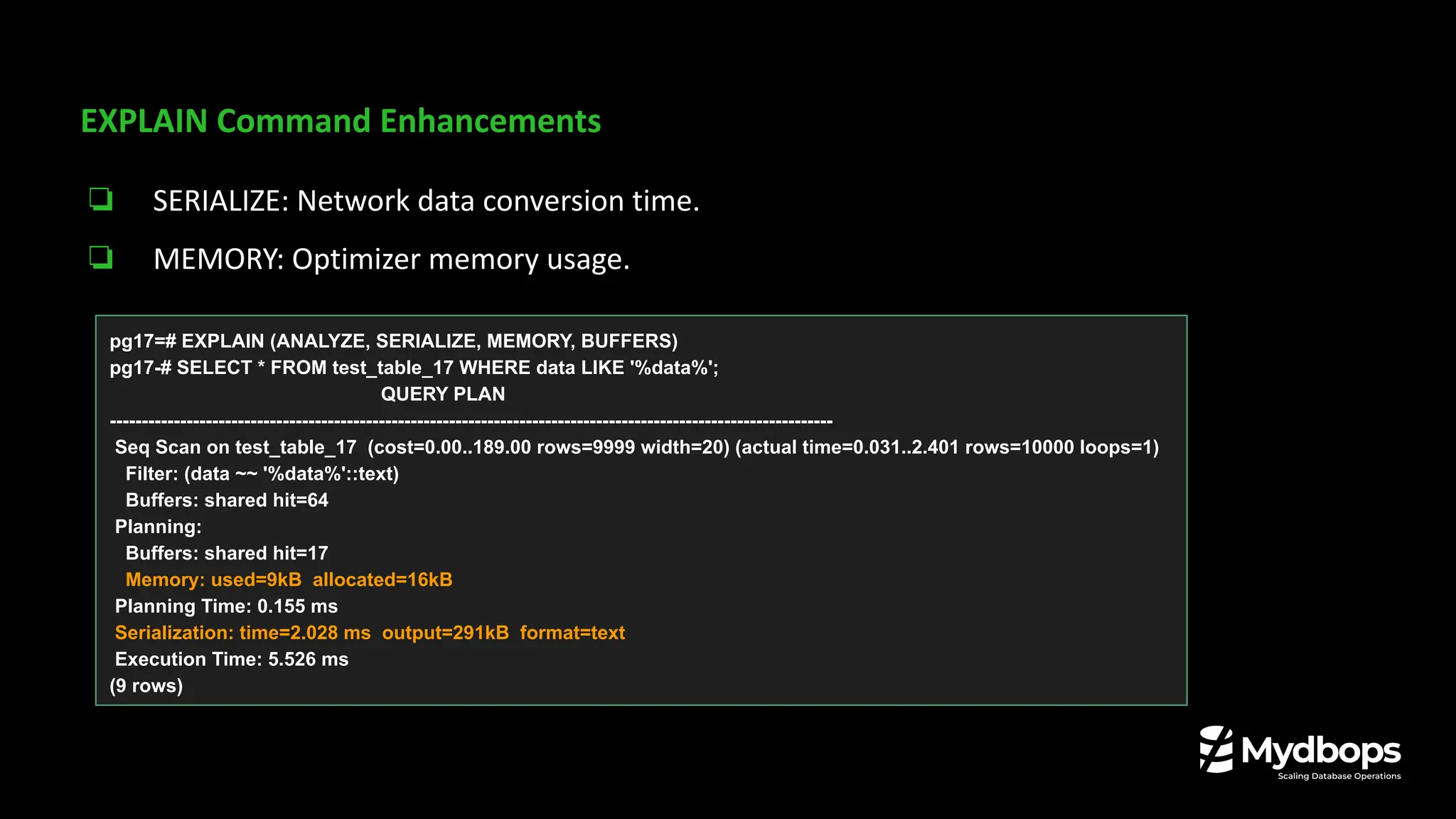
EXPLAIN Command Enhancements
❏ SERIALIZE: Network data conversion time.
❏ MEMORY: Optimizer memory usage.
pg17=# EXPLAIN (ANALYZE, SERIALIZE, MEMORY, BUFFERS)
pg17-# SELECT * FROM test_table_17 WHERE data LIKE '%data%';
QUERY PLAN
-----------------------------------------------------------------------------------------------------------------
Seq Scan on test_table_17 (cost=0.00..189.00 rows=9999 width=20) (actual time=0.031..2.401 rows=10000 loops=1)
Filter: (data ~~ '%data%'::text)
Buffers: shared hit=64
Planning:
Buffers: shared hit=17
Memory: used=9kB allocated=16kB
Planning Time: 0.155 ms
Serialization: time=2.028 ms output=291kB format=text
Execution Time: 5.526 ms
(9 rows)
VACUUM Progress Reporting
❏ Indexes_total: Total indexes on the table being vacuumed
❏ Indexes_processed: Shows how many indexes have been already vacuumed
select * from pg_stat_progress_vacuum;
-[ RECORD 1 ]--------+------------------
pid | 7454
datid | 16389
datname | pg17
relid | 16394
phase | vacuuming indexes
heap_blks_total | 88496
heap_blks_scanned | 88496
heap_blks_vacuumed | 0
index_vacuum_count | 0
max_dead_tuple_bytes| 67108864
dead_tuple_bytes | 2556928
num_dead_item_ids | 10000000
indexes_total | 1
indexes_processed | 0
pg_wait_events View
- Shows wait event details and description.
pg17=# SELECT * FROM pg_wait_events;
-[ RECORD 1
]-----------------------------------------------------------------------------------------------------------------------------
type | Activity
name | AutovacuumMain
description | Waiting in main loop of autovacuum launcher process
Pg_stat_checkpointer
❏ Displays statistics related to the checkpointer process.
❏ Replaced some of the old stats found in pg_stat_bgwriter.
pg17=# SELECT * FROM pg_stat_checkpointer;
-[ RECORD 1 ]-------+------------------------------
num_timed | 345
num_requested | 21
restartpoints_timed | 0
restartpoints_req | 0
restartpoints_done | 0
write_time | 1192795
sync_time | 1868
buffers_written | 56909
stats_reset | 2024-08-14 10:29:39.606191+00
pg17=#
Pg_stat_statements
CALL Normalization: Fewer entries for procedures.
pg16=# SELECT userid, dbid, toplevel, queryid, query,
total_exec_time, min_exec_time, max_exec_time,
mean_exec_time, stddev_exec_time FROM
pg_stat_statements WHERE query LIKE 'CALL
update_salary%';
-[ RECORD 1 ]-----+-------------------------------
userid | 10
dbid | 16384
toplevel | t
queryid | -6663051425227154753
query | CALL update_salary('HR', 1200)
total_exec_time | 0.10497
min_exec_time | 0.10497
max_exec_time | 0.10497
mean_exec_time | 0.10497
stddev_exec_time | 0
-[ RECORD 2 ]----+-------------------------------
pg17=# SELECT userid, dbid, toplevel, queryid, query,
total_exec_time, min_exec_time, max_exec_time,
mean_exec_time, stddev_exec_time, minmax_stats_since,
stats_since FROM pg_stat_statements WHERE query LIKE
'CALL update_salary%';
-[ RECORD 1 ]------+------------------------------
userid | 10
dbid | 16389
toplevel | t
queryid | 3335012495428089609
query | CALL update_salary($1, $2)
total_exec_time | 1.957936
min_exec_time | 0.06843
max_exec_time | 1.694025
mean_exec_time | 0.489484
stddev_exec_time | 0.6955936256612045
minmax_stats_since | 2024-08-20 14:19:29.726603+00
stats_since | 2024-08-20 14:19:29.726603+00
pg17=#
Postgres 16 Postgres 17
Removed old_snapshot_threshold Parameter
● Behavior on Querying Old Data
- "Snapshot too old" error
● Reason for Removal
Any Questions ?
References:-
https://www.postgresql.org/about/news/postgresql-17-beta-1-released-2865/?ref=dailydev
https://www.percona.com/blog/the-powerful-features-released-in-postgresql-17-beta-2/
https://databaserookies.wordpress.com/2024/07/17/postgres-17-copy/
https://pganalyze.com/blog
https://youtu.be/aWScCI5Ko18?si=KyAknBoxmagR18hh
https://andyatkinson.com/blog/2024/04/16/postgresql-17-merge-split-partitions
https://medium.com/@hnasr/combining-i-os-in-postgresql-17-39fe81d2981a
https://databaserookies.wordpress.com/2024/08/09/enhanced-merge-command/
https://www.mydbops.com/blog/postgresql-17-incremental-backup-pg-basebackup-pg-combinebackup/
https://techcommunity.microsoft.com/t5/azure-database-for-postgresql/what-s-new-with-postgres-at-microsoft-2024-edition/ba-p/4140085
https://pganalyze.com/blog/5mins-postgres-17-faster-vacuum-adaptive-radix-trees#the-building-blocks-adaptive-radix-trees-and-tidstore
https://databaserookies.wordpress.com/2024/06/11/exploring-postgresql-17-a-developers-guide-to-new-features-part-2-nulls-constraint-and-perfor
mance/
https://gist.github.com/benoittgt/ab72dc4cfedea2a0c6a5ee809d16e04d?permalink_comment_id=4972955#file-issue_with_multiple_any-sql-L3
Consulting
Services
Consulting
Services
Connect with us !
Reach us at : info@mydbops.com
Thank you!

What's New in PostgreSQL 17? - Mydbops MyWebinar Edition 35

  • 1.
    What’s New in PostgreSQL17 Presented by Mukul Mahto Mydbops Mydbops MyWebinar - 35 Aug 23rd, 2024
  • 2.
    Consulting Services Consulting Services Managed Services ❏ Database Managementand consultancy provider ❏ Founded in 2016 ❏ Assisted 800+ happy customers ❏ AWS partners ❏ PCI & ISO certified About Us
  • 3.
    ❏ Introduction toPostgreSQL 17 ❏ Performance Optimization ❏ Partitioning & Distributed Workloads ❏ Developer Workflow Enhancement ❏ Security Features ❏ Backup and Export Management ❏ Monitoring Agenda
  • 4.
    PostgreSQL 17 Key Enhancements -Performance Boosts - High Availability - Developer Features - Security Why Upgrade? - Boosted Efficiency - High Availability - Cutting-Edge Features
  • 5.
  • 6.
    ❏ Improved VacuumMechanism New Data Structure: Efficient radix tree replaces old array. Dynamic Memory Allocation: No 1GB limit. Faster TID Lookup: Speedier Tuple ID searches. 20x Memory Reduction with New Data Structure ❏ Reduced WAL Volume for Vacuum Single record for freezing and pruning. Faster Sync: Reduced sync and write time. Mark Items as LP_UNUSED Instead of LP_DEAD: Reduces WAL volume
  • 7.
    Comparison Performance ofPostgres 16 vs 17 maintenance_work_mem is set to 64 megabytes on both of these. Postgres 16:- Postgres 17:- CREATE TABLE test_16 (id INT); INSERT INTO test_16 (id) SELECT generate_series(1, 10000000); CREATE INDEX ON test_16(id); UPDATE test_16 SET id = id - 1; CREATE TABLE test_17 (id INT); INSERT INTO test_17 (id) SELECT generate_series(1, 10000000); CREATE INDEX ON test_17(id); UPDATE test_17 SET id = id - 1;
  • 8.
    Postgres 17 Postgres 16 -[RECORD 1 ]------+--------------- pid | 21830 datid | 16384 datname | pg16 relid | 16389 phase | vacuuming heap heap_blks_total | 88496 heap_blks_scanned | 88496 heap_blks_vacuumed| 7478 index_vacuum_count | 1 max_dead_tuples | 11184809 num_dead_tuples | 10000000 -[ RECORD 1 ]--------+--------------- pid | 21971 datid | 16389 datname | pg17 relid | 16468 phase | vacuuming heap heap_blks_total | 88496 heap_blks_scanned | 88496 heap_blks_vacuumed | 27040 index_vacuum_count | 0 max_dead_tuple_byte | 67108864 dead_tuple_bytes | 2556928 num_dead_item_ids | 10000000 indexes_total | 0 indexes_processed | 0
  • 9.
    Postgres 16 Postgres17 2024-08-19 10:49:17.351 UTC [21830] LOG: automatic vacuum of table "pg16.public.test_16": index scans: 1 pages: 0 removed, 88496 remain, 88496 scanned (100.00% of total) tuples: 3180676 removed, 10000000 remain, 0 are dead but not yet removable removable cutoff: 747, which was 0 XIDs old when operation ended new relfrozenxid: 745, which is 2 XIDs ahead of previous value frozen: 0 pages from table (0.00% of total) had 0 tuples frozen index scan needed: 44248 pages from table (50.00% of total) had 10000000 dead item identifiers removed index "test_16_id_idx": pages: 54840 in total, 0 newly deleted, 0 currently deleted, 0 reusable avg read rate: 24.183 MB/s, avg write rate: 22.317 MB/s buffer usage: 119566 hits, 156585 misses, 144501 dirtied WAL usage: 201465 records, 60976 full page images, 233670948 bytes system usage: CPU: user: 9.04 s, system: 3.56 s, elapsed: 50.58 s 2024-08-19 10:51:54.081 UTC [21959] LOG: automatic vacuum of table "pg17.public.test_17": index scans: 0 pages: 0 removed, 76831 remain, 76831 scanned (100.00% of total) tuples: 0 removed, 10000000 remain, 0 are dead but not yet removable removable cutoff: 827, which was 1 XIDs old when operation ended new relfrozenxid: 825, which is 1 XIDs ahead of previous value frozen: 0 pages from table (0.00% of total) had 0 tuples frozen index scan not needed: 0 pages from table (0.00% of total) had 0 dead item identifiers removed avg read rate: 34.779 MB/s, avg write rate: 19.580 MB/s buffer usage: 79090 hits, 74631 misses, 42016 dirtied WAL usage: 4969 records, 2 full page images, 309554 bytes system usage: CPU: user: 2.71 s, system: 1.14 s, elapsed: 16.76 s
  • 10.
    Streaming I/O inPg 17 ❏ Streaming I/O with I/O combining - Reads multiple pages in one go - Increases read size to 128K(default) - New GUC: io_combine_limit ❏ Streaming I/O Enhancements for Sequential Scans - Faster sequential scans with 128K reads - Reduces system calls for improved speed - Improves SELECT query performance ❏ Streaming I/O Benefits for ANALYZE - Efficient data reading via prefetching - Improved performance for table statistics - Supports faster query planning 1 2 3 1 2 3 8k 8k 8k 24k Postgres 16 Postgres 17 OS OS
  • 11.
    Postgres 16 pg16=# EXPLAIN(ANALYZE, BUFFERS) SELECT COUNT(*) FROM test_16; QUERY PLAN ------------------------------------------------------------------------------------------------------------------------------ Aggregate (cost=212496.60..212496.61 rows=1 width=8) (actual time=2869.400..2869.401 rows=1 loops=1) Buffers: shared hit=416 read=88080 -> Seq Scan on test_16 (cost=0.00..187696.48 rows=9920048 width=0) (actual time=145.205..2082.923 rows=10000000 loops=1) Buffers: shared hit=416 read=88080 Planning Time: 0.059 ms JIT: Functions: 2 Options: Inlining false, Optimization false, Expressions true, Deforming true Timing: Generation 0.316 ms, Inlining 0.000 ms, Optimization 0.120 ms, Emission 1.452 ms, Total 1.888 ms Execution Time: 2869.794 ms (10 rows)
  • 12.
    Postgres 17 pg17=# EXPLAIN(ANALYZE, BUFFERS) SELECT COUNT(*) FROM test_17; QUERY PLAN ------------------------------------------------------------------------------------------------------------------------------------------------ Finalize Aggregate (cost=142142.30..142142.31 rows=1 width=8) (actual time=1287.047..1287.196 rows=1 loops=1) Buffers: shared hit=4544 read=83952 -> Gather (cost=142142.09..142142.30 rows=2 width=8) (actual time=1281.208..1287.189 rows=3 loops=1) Workers Planned: 2 Workers Launched: 2 Buffers: shared hit=4544 read=83952 -> Partial Aggregate (cost=141142.09..141142.10 rows=1 width=8) (actual time=1268.267..1268.268 rows=1 loops=3) Buffers: shared hit=4544 read=83952 -> Parallel Seq Scan on test_17 (cost=0.00..130612.87 rows=4211687 width=0) (actual time=51.831..836.598 rows=3333333 loops=3) Buffers: shared hit=4544 read=83952 Planning: Buffers: shared hit=61 Planning Time: 0.416 ms Execution Time: 1287.960 ms (14 rows)
  • 13.
    ● Configurable CacheSizes: Adjustable SLRU cache. ● Banked Cache: Efficient data eviction by bank. ● Separate Locks: Each bank uses its own lock. Improved SLRU Performance
  • 14.
    Query Optimization ❏ FasterB-Tree Index Scan - Improved IN clause performance. ❏ 3x Performance boost
  • 15.
    Postgres 16 Postgres 17 pg16=#EXPLAIN (ANALYZE, BUFFERS) SELECT * FROM test_16 WHERE id IN (1, 2, 3, 4, 45, 6, 10007); QUERY PLAN ------------------------------------------------------------------------------------------------------------------------------ Index Only Scan using test_16_id_idx on test_16 (cost=0.43..31.17 rows=7 width=4) (actual time=0.052..1.277 rows=7 loops=1) Index Cond: (id = ANY ('{1,2,3,4,45,6,10007}'::integer[])) Heap Fetches: 0 Buffers: shared hit=24 read=1 Planning: Buffers: shared hit=61 Planning Time: 0.401 ms Execution Time: 1.293 ms (8 rows) pg17=# EXPLAIN (ANALYZE, BUFFERS) SELECT * FROM test_17 WHERE id IN (1, 2, 3, 4, 45, 6, 10007); QUERY PLAN ------------------------------------------------------------------------------------------------------------------------------ Index Only Scan using test_17_id_idx on test_17 (cost=0.43..31.17 rows=7 width=4) (actual time=0.056..0.542 rows=7 loops=1) Index Cond: (id = ANY ('{1,2,3,4,45,6,10007}'::integer[])) Heap Fetches: 0 Buffers: shared hit=6 read=1 Planning: Buffers: shared hit=70 Planning Time: 0.452 ms Execution Time: 0.564 ms (8 rows)
  • 16.
    Performance Boost withConstraints ❏ NULL Constraint Optimization - Skips unnecessary checks for faster queries. ❏ Impact of NOT NULL on Execution - Reduces processing for more efficient scans.
  • 17.
    Execution Plans withoutNOT NULL Constraint pg17=# explain (analyze, buffers, costs off) SELECT count(*) FROM employees WHERE name IS NULL; QUERY PLAN ----------------------------------------------------------------------- Aggregate (actual time=0.022..0.023 rows=1 loops=1) Buffers: shared hit=1 -> Seq Scan on employees (actual time=0.016..0.017 rows=2 loops=1) Filter: (name IS NULL) Rows Removed by Filter: 8 Buffers: shared hit=1 Planning Time: 0.068 ms Execution Time: 0.058 ms pg17=# explain (analyze, buffers, costs off) SELECT count(*) FROM employees WHERE name IS NOT NULL; QUERY PLAN ----------------------------------------------------------------------- Aggregate (actual time=0.021..0.022 rows=1 loops=1) Buffers: shared hit=1 -> Seq Scan on employees (actual time=0.008..0.015 rows=8 loops=1) Filter: (name IS NOT NULL) Rows Removed by Filter: 2 Buffers: shared hit=1 Planning Time: 0.038 ms Execution Time: 0.039 ms (8 rows)
  • 18.
    Execution Plans withNOT NULL Constraint pg17=# ALTER TABLE employees ALTER COLUMN name SET NOT NULL; ALTER TABLE pg17=# pg17=# explain (analyze, buffers, costs off) SELECT count(*) FROM employees WHERE name IS NULL; QUERY PLAN -------------------------------------------------------- Aggregate (actual time=0.004..0.004 rows=1 loops=1) -> Result (actual time=0.002..0.002 rows=0 loops=1) One-Time Filter: false Planning: Buffers: shared hit=4 Planning Time: 0.089 ms Execution Time: 0.038 ms (7 rows) pg17=# explain (analyze, buffers, costs off) SELECT count(*) FROM employees WHERE name IS NOT NULL; QUERY PLAN ----------------------------------------------------------------------- Aggregate (actual time=0.014..0.015 rows=1 loops=1) Buffers: shared hit=1 -> Seq Scan on employees (actual time=0.009..0.010 rows=8 loops=1) Buffers: shared hit=1 Planning Time: 0.119 ms Execution Time: 0.028 ms (6 rows)
  • 19.
    Faster BRIN IndexCreation ❏ Multi-Worker Support ❏ Parallel Processing ❏ Sorted Summary Streams ❏ Leader Integration ❏ Efficient Resource Use
  • 20.
  • 21.
    Partition Management SPLIT PARTITION -Break large partitions into smaller ones. MERGE PARTITIONS - Merge two or more partitions into one. Note:- Access Exclusive Lock
  • 22.
    Exclusion Constraints onPartitioned Tables Exclusion constraints prevent conflicting data in different partitions of a table. pg17=# CREATE TABLE orders ( order_id serial, customer_id int, order_date date, total_amount numeric, UNIQUE (customer_id) ) PARTITION BY RANGE (order_date); ERROR: unique constraint on partitioned table must include all partitioning columns DETAIL: UNIQUE constraint on table "orders" lacks column "order_date" which is part of the partition key. pg17=# CREATE TABLE orders ( order_id serial, customer_id int, order_date date, total_amount numeric, UNIQUE (order_date) ) PARTITION BY RANGE (order_date); CREATE TABLE pg17=#
  • 23.
    Logical Replication Upgrade Support:No slot drop needed. Failover Control: Enhanced high availability. Failover Slot Synchronization: SlotSync Workers Synchronization: ❏ Automatic Sync: using ‘sync_replication_slots = on’ to sync automatically ❏ Manual Sync: Use pg_sync_replication_slots() to sync slots manually. Publisher Subscriber CREATE SUBSCRIPTION sub CONNECTION '$connstr' PUBLICATION pub WITH (failover = 'true’)
  • 24.
    Upgrade Logical ReplicationNodes ❏ Seamless Upgrades - Migrate replication slots during an upgrade without losing data. ❏ Preserve State - Keeps the replication state unchanged during an upgrade. ❏ Upgrading Subscribers - Allow Write operations on the primary continue during subscriber upgrades. ❏ Version Requirement - All cluster members must run PostgreSQL 17.0+ for migration.
  • 25.
    New Tool: pg_createsubscribercommand. ❏ Helps create logical replicas from physical standbys. ❏ The pg_createsubscriber command speeds up the setup of logical subscribers. ❏ Simplifies the process of upgrading PostgreSQL instances. New Columns in ‘pg_replication_slots’ ❏ inactive_since :- Tracks when a replication slot became inactive. ❏ Invalidation_reason :- Indicates the reason for invalidation of replication slots.
  • 26.
    Postgres 16 Postgres17 pg16=# SELECT * FROM pg_replication_slots WHERE slot_name = 'mydbops_testing_slot'; -[ RECORD 1 ]----------+--------------------- slot_name | mydbops_testing_slot plugin | slot_type | physical datoid | database | temporary | f active | f active_pid | xmin | catalog_xmin | restart_lsn | confirmed_flush_lsn | wal_status | safe_wal_size | two_phase | f conflicting | pg17=# SELECT * FROM pg_replication_slots WHERE slot_name = 'mydbops_testing_slot'; -[ RECORD 1 ]-------+------------------------------ slot_name | mydbops_testing_slot plugin | slot_type | physical datoid | database | temporary | f active | f active_pid | xmin | catalog_xmin | restart_lsn | confirmed_flush_lsn | wal_status | safe_wal_size | two_phase | f inactive_since | 2024-08-20 04:29:36.446812+00 conflicting | invalidation_reason | failover | f synced | f
  • 27.
  • 28.
    MERGE Command Handling unmatchedrows with the WHEN NOT MATCHED BY SOURCE clause. Returning detailed actions with the RETURNING clause and merge_action(). - merge_action Function: report the DML that generated the row. Views must be consistent for MERGE ❏ Trigger-updatable views need INSTEAD OF triggers for actions (INSERT, UPDATE, DELETE). ❏ Auto-updatable views should not have any triggers. MERGE
  • 29.
    Table product_catalog Tableprice_updates pg17=# CREATE TABLE product_catalog ( pg17(# product_id BIGINT, pg17(# product_name VARCHAR(100), pg17(# price DECIMAL(10, 2), pg17(# last_updated TIMESTAMP, pg17(# status TEXT pg17(# ); CREATE TABLE pg17=# pg17=# INSERT INTO product_catalog (product_id, product_name, price, last_updated, status) pg17-# VALUES pg17-# (1, 'Laptop', 1000.00, '2024-08-01 12:00:00', 'active'), pg17-# (2, 'Smartphone', 500.00, '2024-08-01 12:00:00', 'active'), pg17-# (3, 'Tablet', 300.00, '2024-08-01 12:00:00', 'active'), pg17-# (4, 'Smartwatch', 200.00, '2024-08-01 12:00:00', 'active'); INSERT 0 4 pg17=# CREATE TABLE price_updates ( pg17(# product_id BIGINT, pg17(# new_price DECIMAL(10, 2), pg17(# update_type VARCHAR(10) pg17(# ); CREATE TABLE pg17=# pg17=# INSERT INTO price_updates (product_id, new_price, update_type) pg17-# VALUES pg17-# (1, 950.00, 'decrease'), pg17-# (2, 550.00, 'increase'), pg17-# (5, 250.00, 'new'), pg17-# (3, NULL, 'discontinue'); INSERT 0 4 pg17=#
  • 30.
    pg17=# WITH mergeAS ( pg17(# MERGE INTO product_catalog trg pg17(# USING price_updates src pg17(# ON src.product_id = trg.product_id pg17(# WHEN MATCHED AND src.update_type = 'increase' pg17(# THEN UPDATE pg17(# SET price = src.new_price, pg17(# last_updated = CURRENT_TIMESTAMP, pg17(# status = 'price increased' pg17(# WHEN MATCHED AND src.update_type = 'decrease' pg17(# THEN UPDATE pg17(# SET price = src.new_price, pg17(# last_updated = CURRENT_TIMESTAMP, pg17(# status = 'price decreased' pg17(# WHEN MATCHED AND src.update_type = 'discontinue' pg17(# THEN UPDATE pg17(# SET status = 'discontinued', pg17(# last_updated = CURRENT_TIMESTAMP pg17(# WHEN NOT MATCHED BY TARGET AND src.update_type = 'new' pg17(# THEN INSERT (product_id, product_name, price, last_updated, status) pg17(# VALUES (src.product_id, 'Unknown Product', src.new_price, CURRENT_TIMESTAMP, 'new product') pg17(# RETURNING merge_action(), trg.* pg17(# ) pg17-# SELECT * FROM merge; merge_action | product_id | product_name | price | last_updated | status --------------------+-----------------+--------------------------+----------------------------------------------------+----------------------- UPDATE | 1 | Laptop | 950.00 | 2024-08-19 21:47:23.507675 | price decreased UPDATE | 2 | Smartphone | 550.00 | 2024-08-19 21:47:23.507675 | price increased INSERT | 5 | Unknown Product | 250.00 | 2024-08-19 21:47:23.507675 | new product UPDATE | 3 | Tablet | 300.00 | 2024-08-19 21:47:23.507675 | discontinued (4 rows)
  • 31.
    COPY Improvements ❏ Managingdata type incompatibilities using ON_ERROR options - ignore(text, csv), stop ❏ Enhanced logging using LOG_VERBOSITY - Handle mismatched data types. - New attribute added ‘tuples_skipped’ in pg_stat_progress_copy view
  • 32.
    root@ip-172-31-3-170:/var/log/csv_test# cat /var/log/csv_test/data_issues.csv id,name,age,email,is_active,signup_date,last_login 1,RahulSharma,30,rahul.sharma@example.com,true,2024-01-01,2024-01-01 12:00:00 2,Neha Verma,-1,neha.verma@example.com,false,2024-01-02,2024-01-02 12:00:00 3,,abc,amit.patel@example.com,true,2024-01-03,2024-01-03 12:00:00 4,Amit Patel,40,amit.patel@example.com,maybe,2024-01-03,2024-01-03 12:00:00 5,Pooja Singh,25,pooja.singh@example.com,true,2024-01-04,2024-01-04 12:00:00 root@ip-172-31-3-170:/var/log/csv_test# pg17=# SELECT * FROM example3; id | name | age | email | is_active | signup_date | last_login ----+------+-----+-------+-----------+-------------+------------ (0 rows) pg17=# pg17=# copy example3 FROM '/var/log/csv_test/data_issues.csv' (ON_ERROR ignore, LOG_VERBOSITY verbose, FORMAT csv, HEADER); NOTICE: skipping row due to data type incompatibility at line 4 for column age: "abc" NOTICE: skipping row due to data type incompatibility at line 5 for column is_active: "maybe" NOTICE: 2 rows were skipped due to data type incompatibility COPY 3 pg17=# SELECT * FROM example3; id | name | age | email | is_active | signup_date | last_login ----+----------------------+-----+-----------------------------------------+-----------+---------------------+--------------------- 1 | Rahul Sharma | 30 | rahul.sharma@example.com | t | 2024-01-01 | 2024-01-01 12:00:00 2 | Neha Verma | 1 | neha.verma@example.com | f | 2024-01-02 | 2024-01-02 12:00:00 5 | Pooja Singh | 25 | pooja.singh@example.com | t | 2024-01-04 | 2024-01-04 12:00:00 (3 rows)
  • 33.
    JSON_TABLE: Convert JSONto table. Converting JSON data into a table format pg17=# CREATE TABLE customer_orders (order_data jsonb); CREATE TABLE pg17=# INSERT INTO customer_orders VALUES ( '{ "orders": [ { "product": "Laptop", "quantity": 2 }, { "product": "Mouse", "quantity": 5 } ] }' ); INSERT 0 1 pg17=# SELECT jt.* FROM customer_orders, JSON_TABLE(order_data, '$.orders[*]' pg17(# COLUMNS ( id FOR ORDINALITY, product text PATH '$.product', quantity int PATH '$.quantity' )) AS jt; id | product | quantity ----+---------+---------- 1 | Laptop | 2 2 | Mouse | 5 (2 rows) pg17=# SQL/JSON Enhancements
  • 34.
    New Functions: JSONconstructor - JSON(): Converts a string into a JSON value. - JSON_SERIALIZE(): Converts a JSON value into a binary format. - JSON_SCALAR(): Converts a simple value into JSON format. SELECT JSON('{"setting": "high", "volume": 10, "mute": false}'); {"setting": "high", "volume": 10, "mute": false} SELECT JSON_SCALAR(99.99); 99.99 SELECT JSON_SERIALIZE('{"user": "Alice", "age": 30}' RETURNING bytea); x7b2275736572223a2022416c696365222c2022616765223a2033307d
  • 35.
    JSON Query Functions -JSON_EXISTS(): Checks if a specific path exists in JSON - JSON_QUERY(): Extracts a part of the JSON data. - JSON_VALUE(): Extracts a single value from JSON. SELECT JSON_EXISTS(jsonb '{"user": "Alice", "roles": ["admin", "user"]}', '$.roles[?(@ == "admin")]'); t(true) SELECT JSON_QUERY(jsonb '{"user": "Bob", "roles": ["user", "editor"]}', '$.roles'); ["user", "editor"] SELECT JSON_VALUE(jsonb '{"user": "Charlie", "age": 25}', '$.user'); “Charlie”
  • 36.
  • 37.
    Reduced Need forSuperuser Privileges pg_maintain Role (VACUUM, ANALYZE, CLUSTER, REFRESH MATERIALIZED VIEW, REINDEX, and LOCK TABLE on all relations.) - Allows users to perform maintenance tasks like VACUUM and REINDEX without superuser access. Safe Maintenance Operations - Grants specific users maintenance permissions on individual tables. GRANT pg_maintain TO specific_user; GRANT MAINTAIN ON TABLE specific_table TO specific_user;
  • 38.
    pg_maintain Role pg17=# createrole mydbops; CREATE ROLE pg17=# set role mydbops; SET pg17=> pg17=> dt List of relations Schema | Name | Type | Owner --------+----------------------------+-------+---------- public | customer_orders | table | postgres public | test_17 | table | postgres (2 rows) pg17=> vacuum test_17; WARNING: permission denied to vacuum "test_17", skipping it VACUUM pg17=# GRANT pg_maintain TO mydbops; GRANT ROLE pg17=# set role mydbops; SET pg17=> vacuum test_17; VACUUM pg17=>
  • 39.
    MAINTAIN Privilege pg17=# GRANTMAINTAIN ON TABLE role_test TO mydbops; GRANT pg17=# set role mydbops; SET pg17=> pg17=> dt List of relations Schema | Name | Type | Owner --------+----------------------------+--------+---------- public | customer_orders | table | postgres public | role_test | table | postgres public | test_17 | table | postgres (3 rows) pg17=> vacuum customer_orders; WARNING: permission denied to vacuum "customer_orders", skipping it VACUUM pg17=> pg17=> vacuum role_test; VACUUM pg17=>
  • 40.
    Improved ALTER SYSTEMCommand: ALTER SYSTEM Enhancements ❏ Control Over ALTER SYSTEM - allow_alter_system
  • 41.
    Faster TLS Connections ●Direct TLS Setup: - sslnegotiation=direct option, ● ALPN Requirement ● Only works on PostgreSQL 17 and newer versions.
  • 42.
  • 43.
    Incremental pg_basebackup ❏ Efficientfor Large Databases ❏ Using pg_basebackup --incremental ❏ Tracking Changes with WAL - summarize_wal ❏ Restoration with pg_combinebackup
  • 44.
    l Enable summarize_wal TakenFull backup Taken --incremental backup using pg_basebackup Scenario pg17=# show summarize_wal; summarize_wal --------------- on postgres@ip-172-31-3-170:/var/log$ pg_basebackup -D /var/log/full_bck17 -p 5433 -U postgres postgres@ip-172-31-3-170:/var/log$ pg_basebackup -D incr_bck17 -p 5433 -U postgres --incremental=/var/log/full_bck17/backup_manifest -v
  • 45.
    Taken full backupincluding incremental backup using pg_combinebackup postgres@ip-172-31-3-170:/var/log$ /usr/lib/postgresql/17/bin/pg_combinebackup --output=combine_incr_full_bck full_bck17 incr_bck17 postgres@ip-172-31-3-170:/var/log/combine_incr_full_bck$ tail -10 backup_manifest { "Path": "global/6303", "Size": 16384, "Last-Modified": "2024-08-18 13:26:43 GMT", "Checksum-Algorithm": "CRC32C", "Checksum": "e8d85722" }, { "Path": "global/6245", "Size": 8192, "Last-Modified": "2024-08-18 13:26:43 GMT", "Checksum-Algorithm": "CRC32C", "Checksum": "21597da0" }, { "Path": "global/6115", "Size": 8192, "Last-Modified": "2024-08-18 13:26:43 GMT", "Checksum-Algorithm": "CRC32C", "Checksum": "b5a46221" }, { "Path": "global/6246", "Size": 8192, "Last-Modified": "2024-08-18 13:26:43 GMT", "Checksum-Algorithm": "CRC32C", "Checksum": "865872e0" }, { "Path": "global/6243", "Size": 0, "Last-Modified": "2024-08-18 13:26:43 GMT", "Checksum-Algorithm": "CRC32C", "Checksum": "00000000" } ], "WAL-Ranges": [ { "Timeline": 1, "Start-LSN": "2/B000028", "End-LSN": "2/B000120" } ], "Manifest-Checksum": "0f16e87ab7bd400434c2725cf468d77bbcb702a49d38d749cd0e5af47f8f5fac"} postgres@ip-172-31-3-170:/var/log/combine_incr_full_bck$
  • 46.
    Now started thePostgreSQL server using the newly restored data directory. postgres@ip-172-31-3-170:/home/mydbops$ /usr/lib/postgresql/17/bin/pg_ctl -D /var/lib/postgresql/17 -l logfile stop waiting for server to shut down.... done server stopped postgres@ip-172-31-3-170:/var/log/combine_incr_full_bck$ /usr/lib/postgresql/17/bin/pg_ctl -D /var/log/combine_incr_full_bck -l logfile start waiting for server to start.... done server started postgres@ip-172-31-3-170:/var/log/combine_incr_full_bck$ psql -hlocalhost -p 5433 -d postgres psql (17beta3) Type "help" for help. postgres=# c pg17 You are now connected to database "pg17" as user "postgres". pg17=# dt List of relations Schema | Name | Type | Owner -------------+--------------------------+-------+---------- public | customer_orders | table | postgres public | incrment_test | table | postgres public | role_test | table | postgres public | test_17 | table | postgres (4 rows)
  • 47.
  • 48.
    EXPLAIN Command Enhancements ❏SERIALIZE: Network data conversion time. ❏ MEMORY: Optimizer memory usage. pg17=# EXPLAIN (ANALYZE, SERIALIZE, MEMORY, BUFFERS) pg17-# SELECT * FROM test_table_17 WHERE data LIKE '%data%'; QUERY PLAN ----------------------------------------------------------------------------------------------------------------- Seq Scan on test_table_17 (cost=0.00..189.00 rows=9999 width=20) (actual time=0.031..2.401 rows=10000 loops=1) Filter: (data ~~ '%data%'::text) Buffers: shared hit=64 Planning: Buffers: shared hit=17 Memory: used=9kB allocated=16kB Planning Time: 0.155 ms Serialization: time=2.028 ms output=291kB format=text Execution Time: 5.526 ms (9 rows)
  • 49.
    VACUUM Progress Reporting ❏Indexes_total: Total indexes on the table being vacuumed ❏ Indexes_processed: Shows how many indexes have been already vacuumed select * from pg_stat_progress_vacuum; -[ RECORD 1 ]--------+------------------ pid | 7454 datid | 16389 datname | pg17 relid | 16394 phase | vacuuming indexes heap_blks_total | 88496 heap_blks_scanned | 88496 heap_blks_vacuumed | 0 index_vacuum_count | 0 max_dead_tuple_bytes| 67108864 dead_tuple_bytes | 2556928 num_dead_item_ids | 10000000 indexes_total | 1 indexes_processed | 0
  • 50.
    pg_wait_events View - Showswait event details and description. pg17=# SELECT * FROM pg_wait_events; -[ RECORD 1 ]----------------------------------------------------------------------------------------------------------------------------- type | Activity name | AutovacuumMain description | Waiting in main loop of autovacuum launcher process
  • 51.
    Pg_stat_checkpointer ❏ Displays statisticsrelated to the checkpointer process. ❏ Replaced some of the old stats found in pg_stat_bgwriter. pg17=# SELECT * FROM pg_stat_checkpointer; -[ RECORD 1 ]-------+------------------------------ num_timed | 345 num_requested | 21 restartpoints_timed | 0 restartpoints_req | 0 restartpoints_done | 0 write_time | 1192795 sync_time | 1868 buffers_written | 56909 stats_reset | 2024-08-14 10:29:39.606191+00 pg17=#
  • 52.
    Pg_stat_statements CALL Normalization: Fewerentries for procedures. pg16=# SELECT userid, dbid, toplevel, queryid, query, total_exec_time, min_exec_time, max_exec_time, mean_exec_time, stddev_exec_time FROM pg_stat_statements WHERE query LIKE 'CALL update_salary%'; -[ RECORD 1 ]-----+------------------------------- userid | 10 dbid | 16384 toplevel | t queryid | -6663051425227154753 query | CALL update_salary('HR', 1200) total_exec_time | 0.10497 min_exec_time | 0.10497 max_exec_time | 0.10497 mean_exec_time | 0.10497 stddev_exec_time | 0 -[ RECORD 2 ]----+------------------------------- pg17=# SELECT userid, dbid, toplevel, queryid, query, total_exec_time, min_exec_time, max_exec_time, mean_exec_time, stddev_exec_time, minmax_stats_since, stats_since FROM pg_stat_statements WHERE query LIKE 'CALL update_salary%'; -[ RECORD 1 ]------+------------------------------ userid | 10 dbid | 16389 toplevel | t queryid | 3335012495428089609 query | CALL update_salary($1, $2) total_exec_time | 1.957936 min_exec_time | 0.06843 max_exec_time | 1.694025 mean_exec_time | 0.489484 stddev_exec_time | 0.6955936256612045 minmax_stats_since | 2024-08-20 14:19:29.726603+00 stats_since | 2024-08-20 14:19:29.726603+00 pg17=# Postgres 16 Postgres 17
  • 53.
    Removed old_snapshot_threshold Parameter ●Behavior on Querying Old Data - "Snapshot too old" error ● Reason for Removal
  • 54.
  • 55.
    References:- https://www.postgresql.org/about/news/postgresql-17-beta-1-released-2865/?ref=dailydev https://www.percona.com/blog/the-powerful-features-released-in-postgresql-17-beta-2/ https://databaserookies.wordpress.com/2024/07/17/postgres-17-copy/ https://pganalyze.com/blog https://youtu.be/aWScCI5Ko18?si=KyAknBoxmagR18hh https://andyatkinson.com/blog/2024/04/16/postgresql-17-merge-split-partitions https://medium.com/@hnasr/combining-i-os-in-postgresql-17-39fe81d2981a https://databaserookies.wordpress.com/2024/08/09/enhanced-merge-command/ https://www.mydbops.com/blog/postgresql-17-incremental-backup-pg-basebackup-pg-combinebackup/ https://techcommunity.microsoft.com/t5/azure-database-for-postgresql/what-s-new-with-postgres-at-microsoft-2024-edition/ba-p/4140085 https://pganalyze.com/blog/5mins-postgres-17-faster-vacuum-adaptive-radix-trees#the-building-blocks-adaptive-radix-trees-and-tidstore https://databaserookies.wordpress.com/2024/06/11/exploring-postgresql-17-a-developers-guide-to-new-features-part-2-nulls-constraint-and-perfor mance/ https://gist.github.com/benoittgt/ab72dc4cfedea2a0c6a5ee809d16e04d?permalink_comment_id=4972955#file-issue_with_multiple_any-sql-L3
  • 56.
  • 57.