AWS DMS: Architecture, Best Practices, and Limitations
Presented by
Arun N, Mydbops
Mydbops My Webinar - 46
26th September 2025
Consulting
Services
Consulting
Services
Managed
Services
❏ Database Management and
Consultancy Provider
❏ Founded in 2016
❏ Assisted 800+ happy customers
❏ AWS partners
❏ PCI & ISO certified
About Us
❏ AWS Data Migration Service Overview
❏ AWS DMS Architecture - Core Components
❏ Migration Strategies
❏ Real-world Use Cases
❏ Common Challenges
❏ Best Practices
❏ Performance Tuning
❏ Security Considerations
❏ Limitations
Agenda
AWS Data Migration Service Overview
❏ Migrates data with minimal downtime
❏ Support homogeneous and heterogeneous migration
❏ Same Database Engine (Homogeneous)
❏ Different Database Engine (Heterogeneous)
❏ Supports structured and unstructured schema migration from
source to target.
❏ AWS DMS handles data migration according to the selected mode.
AWS DMS Architecture – Core Components
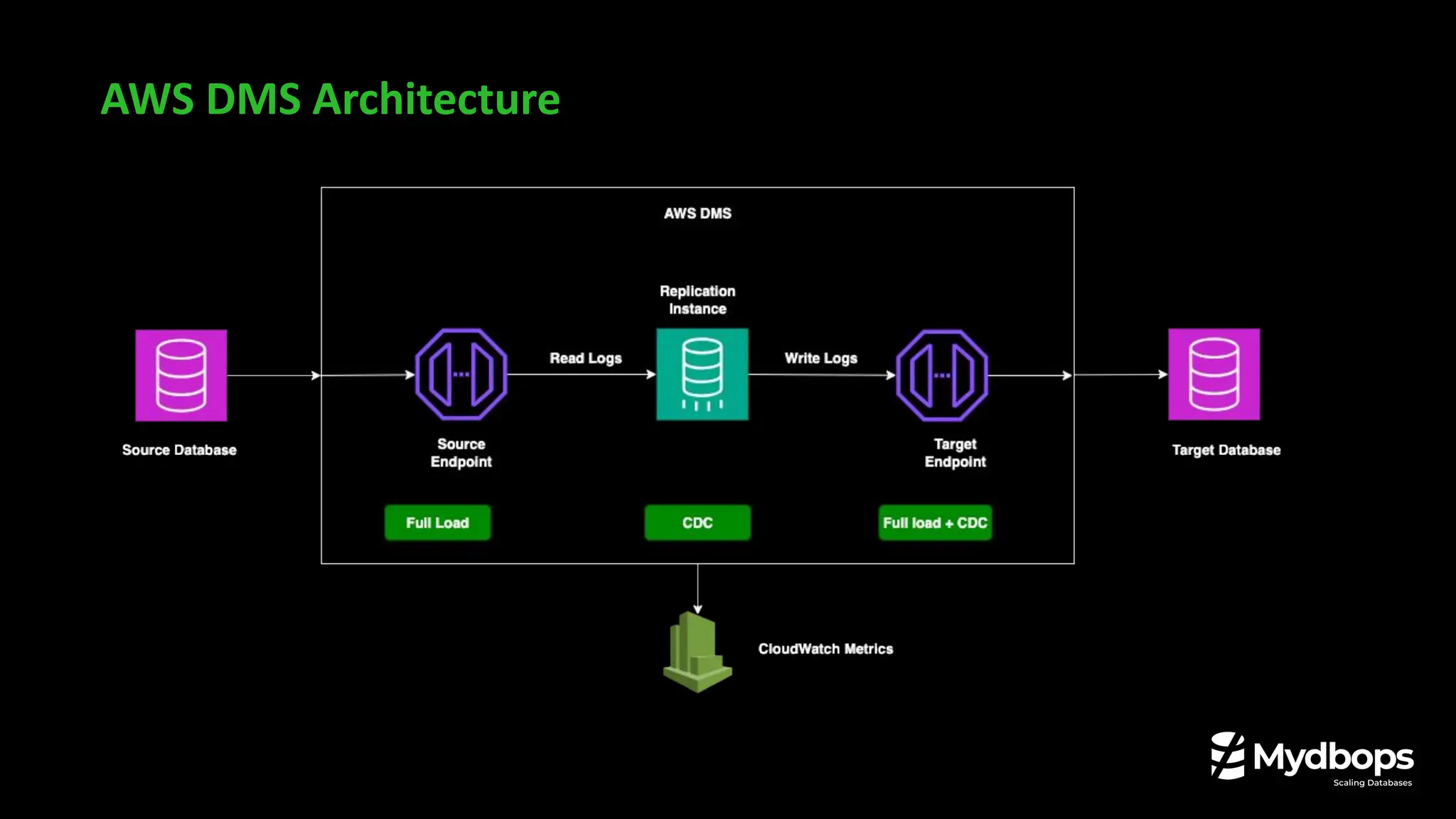
AWS DMS Architecture
AWS DMS Components
❏ Replication Instance
❏ Source Endpoint
❏ Target Endpoint
❏ Data Migration Tasks
❏ Cloudwatch Metrics
AWS DMS: Migration Modes
AWS DMS Migration Modes
❏ Full Load:
❏ Full load migration to the target database initiated.
❏ CDC (Change Data Capture):
❏ Captures real-time changes from source
❏ Full Load + CDC:
❏ Initial full load followed by change data captured
❏ Homogeneous and Heterogeneous migration
❏ On-prem to AWS RDS migrations
❏ Structure change by enabling partitioning on target.
❏ Transformation rules.
❏ Continuous data replication for disaster recovery
❏ Analytics data pipeline
❏ Reverse replication.
Real-world Use Cases
❏ Full load may take longer time based on data size.
❏ Data type limitations
❏ Migrating LOB-heavy tables
❏ Latency between source and target
❏ Source & Target connectivity
Common Challenges
❏ Pre-validate source and target configurations
❏ Ensure proper network connectivity & low latency
❏ Use dedicated replication source server
❏ Perform pre-assessment test before migration
❏ Monitor replication tasks regularly
Best Practices
❏ Avoid schema changes during migration.
❏ Keep DMS transformations rules simple.
❏ Enable AWS Control Tables on target server.
❏ Binlog retention: Must be ≥ 24 hours.
Best Practices
AWS DMS: Performance Tuning
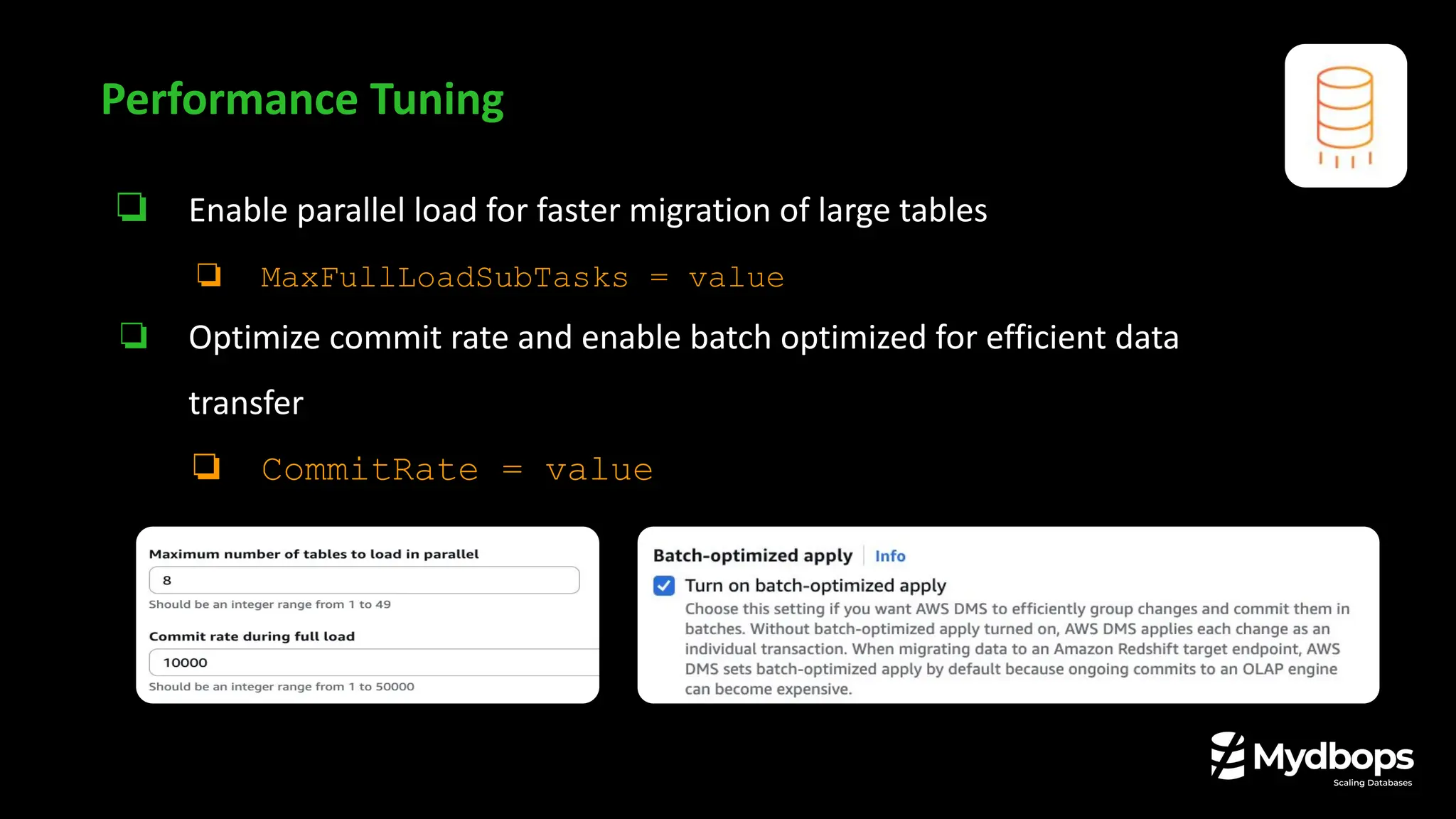
❏ Enable parallel load for faster migration of large tables
❏ MaxFullLoadSubTasks = value
❏ Optimize commit rate and enable batch optimized for efficient data
transfer
❏ CommitRate = value
Performance Tuning
❏ Use table partitioning to migrate large tables in manageable chunks
❏ Limited LOB mode is faster
❏ Keep DMS instance in same AZ
Performance Tuning
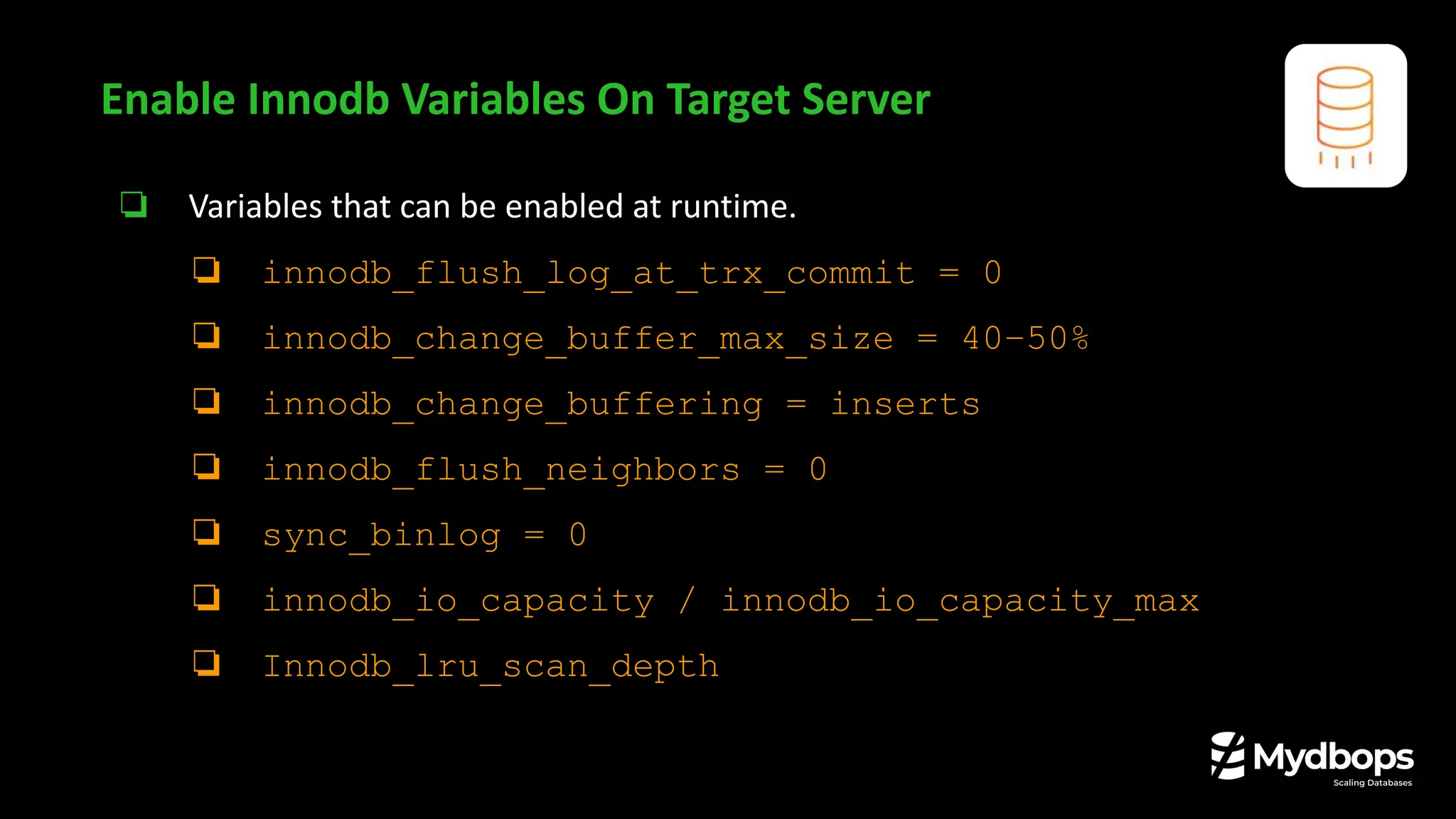
❏ Variables that can be enabled at runtime.
❏ innodb_flush_log_at_trx_commit = 0
❏ innodb_change_buffer_max_size = 40–50%
❏ innodb_change_buffering = inserts
❏ innodb_flush_neighbors = 0
❏ sync_binlog = 0
❏ innodb_io_capacity / innodb_io_capacity_max
❏ Innodb_lru_scan_depth
Enable Innodb Variables On Target Server
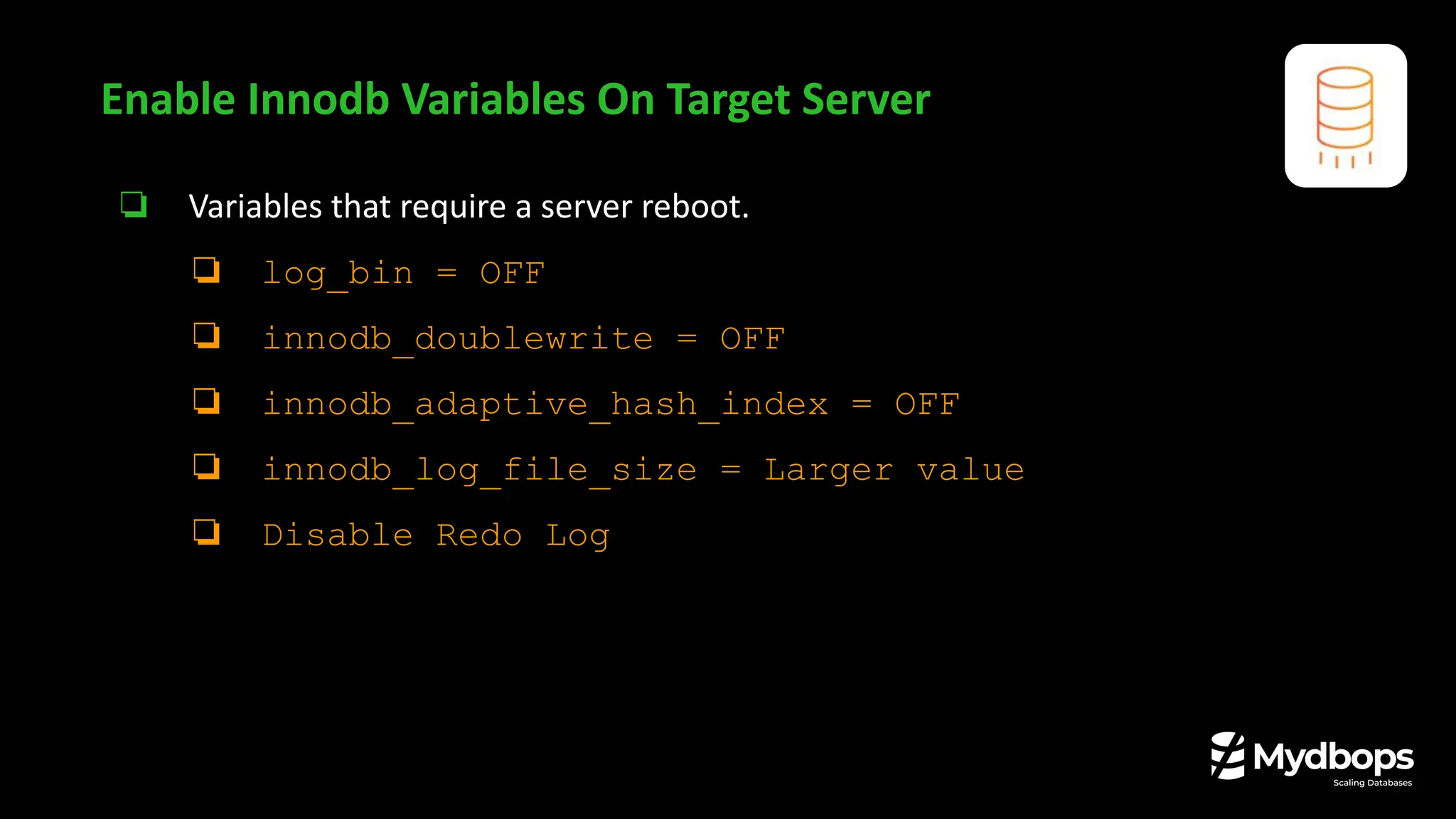
❏ Variables that require a server reboot.
❏ log_bin = OFF
❏ innodb_doublewrite = OFF
❏ innodb_adaptive_hash_index = OFF
❏ innodb_log_file_size = Larger value
❏ Disable Redo Log
Enable Innodb Variables On Target Server
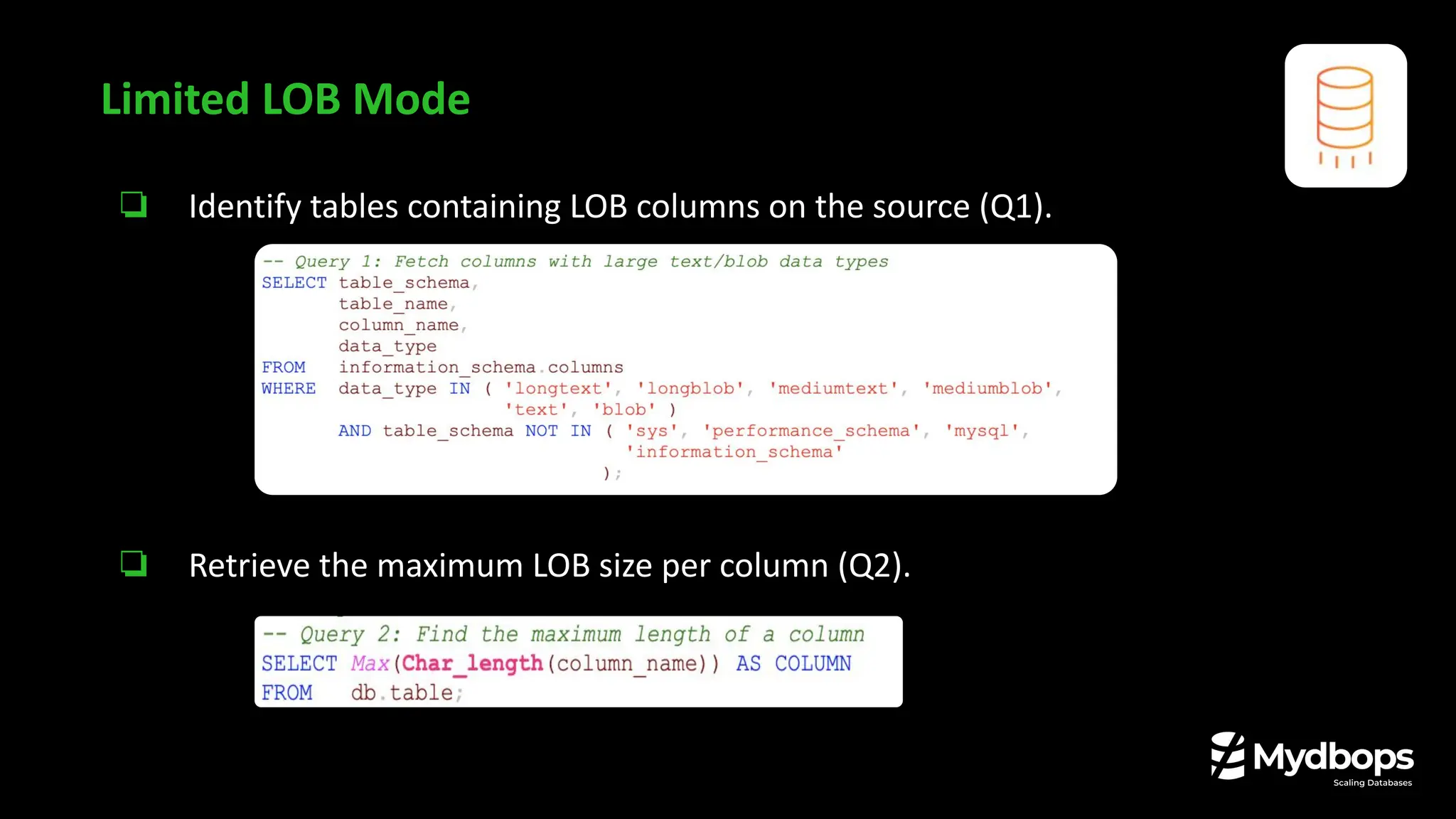
How to choose right LOB size?
❏ Identify tables containing LOB columns on the source (Q1).
❏ Retrieve the maximum LOB size per column (Q2).
Limited LOB Mode
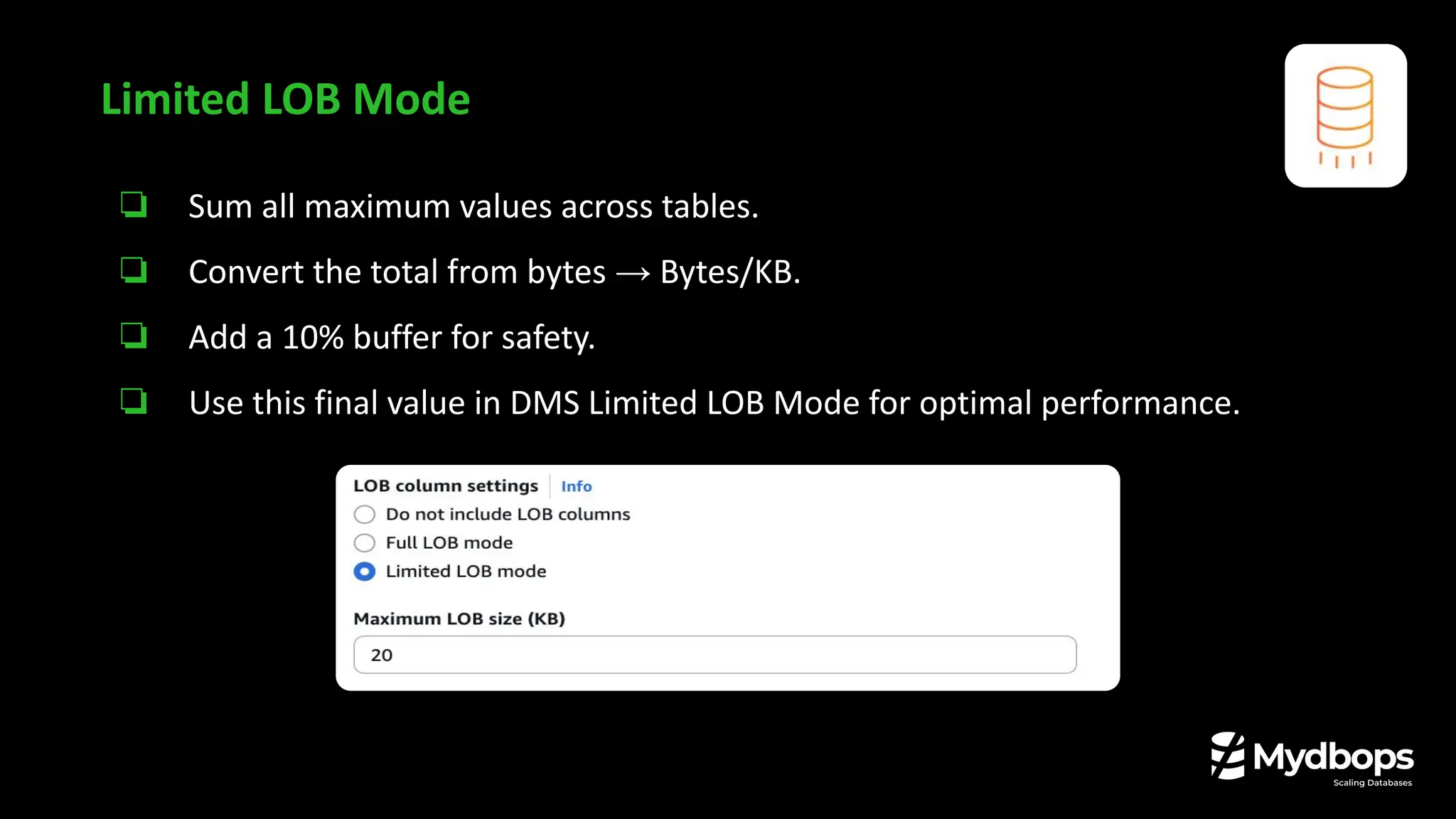
❏ Sum all maximum values across tables.
❏ Convert the total from bytes → Bytes/KB.
❏ Add a 10% buffer for safety.
❏ Use this final value in DMS Limited LOB Mode for optimal performance.
Limited LOB Mode
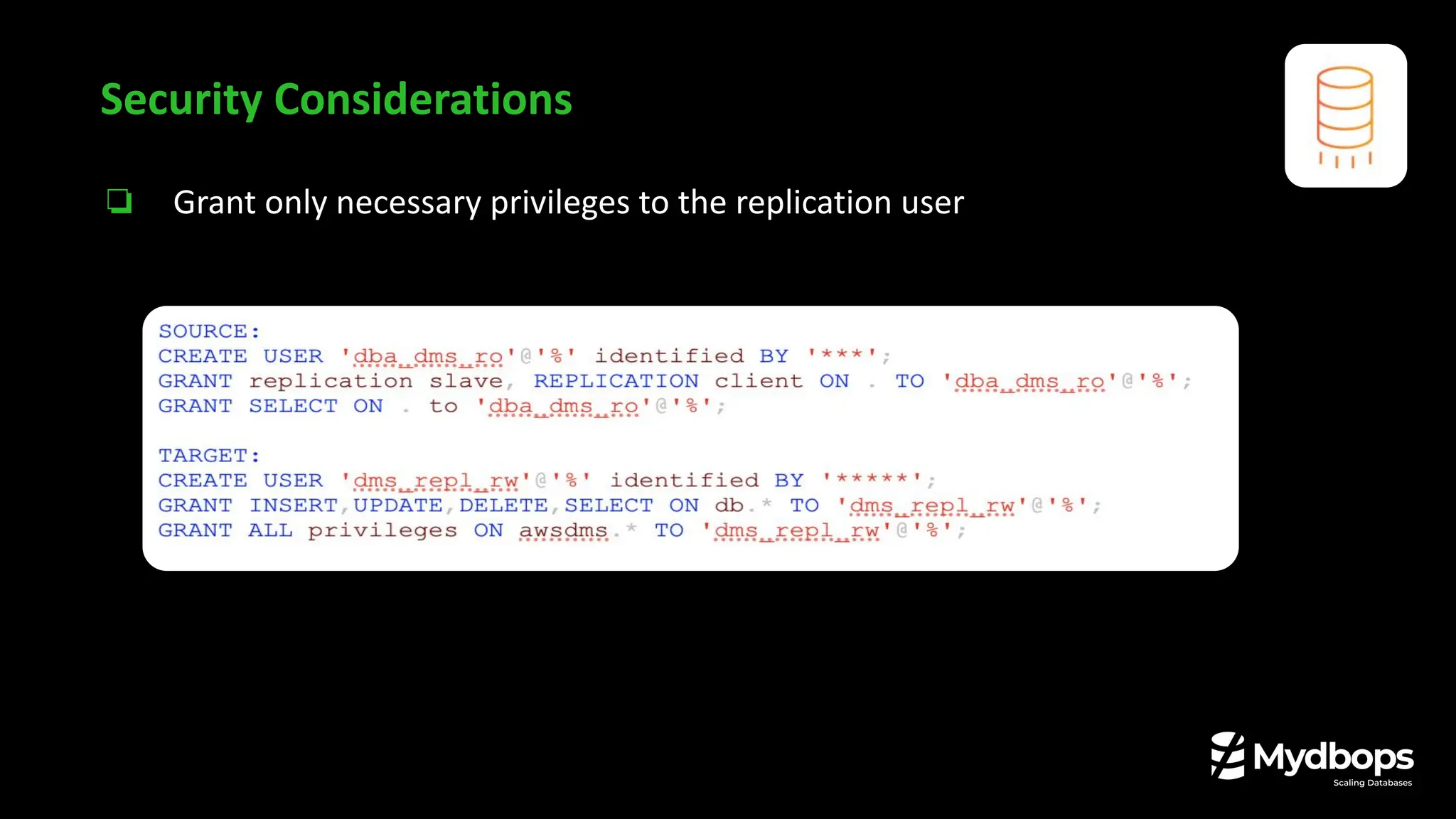
AWS DMS: Security Considerations
❏ Grant only necessary privileges to the replication user
Security Considerations
❏ Enforce strong passwords for database users
❏ Use SSL connections for secure data transfer between endpoints
❏ Apply required-privilege IAM roles and policies for DMS tasks
❏ Avoid public access
Security Considerations
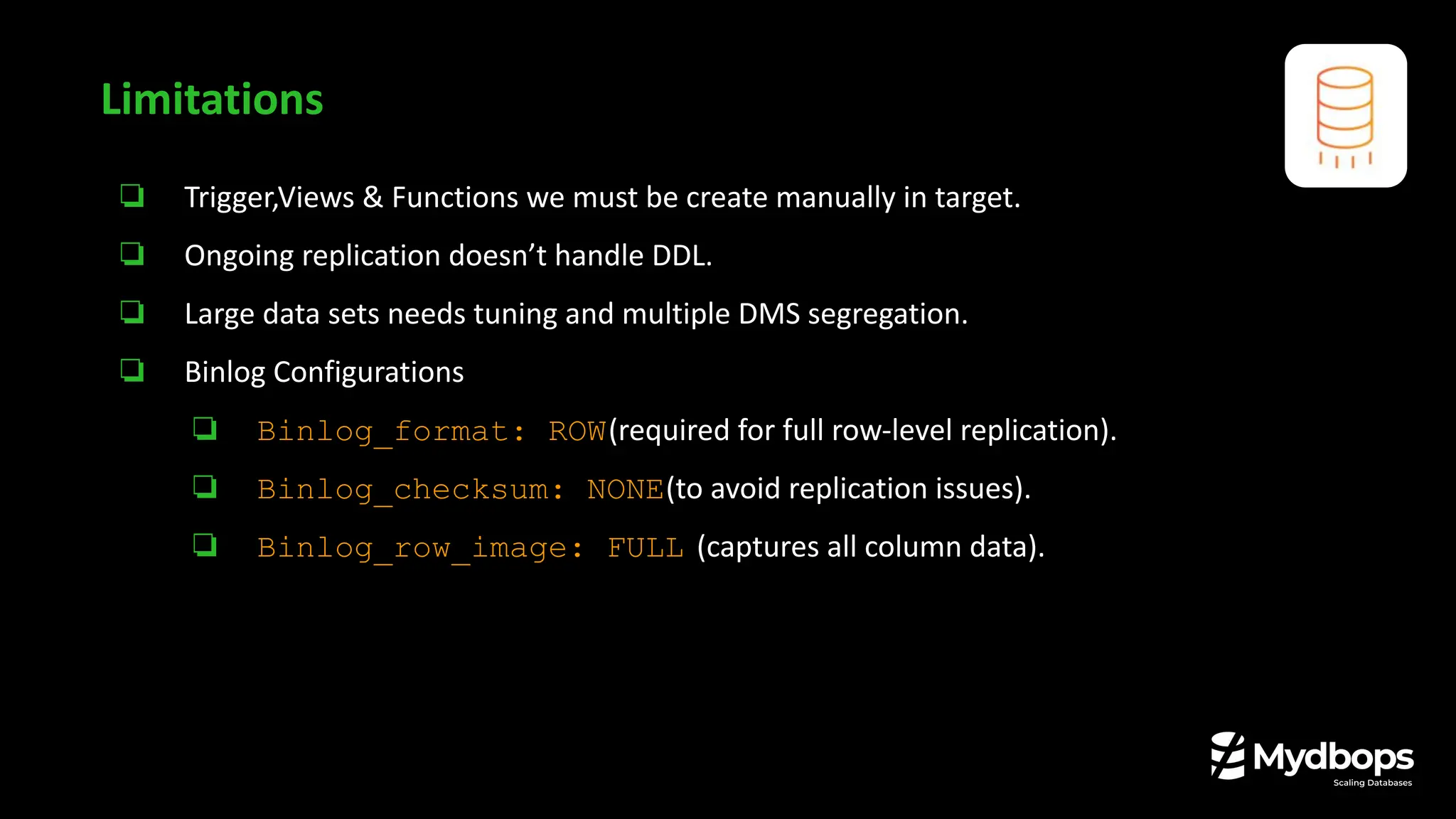
❏ Trigger,Views & Functions we must be create manually in target.
❏ Ongoing replication doesn’t handle DDL.
❏ Large data sets needs tuning and multiple DMS segregation.
❏ Binlog Configurations
❏ Binlog_format: ROW(required for full row-level replication).
❏ Binlog_checksum: NONE(to avoid replication issues).
❏ Binlog_row_image: FULL (captures all column data).
Limitations
https://docs.aws.amazon.com/dms/latest/userguide/Welcome.html
https://aws.amazon.com/dms/getting-started/
https://aws.amazon.com/blogs/database/aws-dms-best-practices-for-moving-large-tables
-with-table-parallelism-settings/
https://aws.amazon.com/rds/getting-started/
https://docs.aws.amazon.com/dms/latest/userguide/CHAP_BestPractices.html
https://repost.aws/knowledge-center/dms-replication-instance-storage-full
References
Thank you !

AWS DMS: A Practical Guide to Architecture, Best Practices & Limitations | Mydbops Webinar 46

  • 1.
    AWS DMS: Architecture,Best Practices, and Limitations Presented by Arun N, Mydbops Mydbops My Webinar - 46 26th September 2025
  • 2.
    Consulting Services Consulting Services Managed Services ❏ Database Managementand Consultancy Provider ❏ Founded in 2016 ❏ Assisted 800+ happy customers ❏ AWS partners ❏ PCI & ISO certified About Us
  • 3.
    ❏ AWS DataMigration Service Overview ❏ AWS DMS Architecture - Core Components ❏ Migration Strategies ❏ Real-world Use Cases ❏ Common Challenges ❏ Best Practices ❏ Performance Tuning ❏ Security Considerations ❏ Limitations Agenda
  • 4.
    AWS Data MigrationService Overview ❏ Migrates data with minimal downtime ❏ Support homogeneous and heterogeneous migration ❏ Same Database Engine (Homogeneous) ❏ Different Database Engine (Heterogeneous) ❏ Supports structured and unstructured schema migration from source to target. ❏ AWS DMS handles data migration according to the selected mode.
  • 5.
    AWS DMS Architecture– Core Components
  • 6.
  • 7.
    AWS DMS Components ❏Replication Instance ❏ Source Endpoint ❏ Target Endpoint ❏ Data Migration Tasks ❏ Cloudwatch Metrics
  • 8.
  • 9.
    AWS DMS MigrationModes ❏ Full Load: ❏ Full load migration to the target database initiated. ❏ CDC (Change Data Capture): ❏ Captures real-time changes from source ❏ Full Load + CDC: ❏ Initial full load followed by change data captured
  • 10.
    ❏ Homogeneous andHeterogeneous migration ❏ On-prem to AWS RDS migrations ❏ Structure change by enabling partitioning on target. ❏ Transformation rules. ❏ Continuous data replication for disaster recovery ❏ Analytics data pipeline ❏ Reverse replication. Real-world Use Cases
  • 11.
    ❏ Full loadmay take longer time based on data size. ❏ Data type limitations ❏ Migrating LOB-heavy tables ❏ Latency between source and target ❏ Source & Target connectivity Common Challenges
  • 12.
    ❏ Pre-validate sourceand target configurations ❏ Ensure proper network connectivity & low latency ❏ Use dedicated replication source server ❏ Perform pre-assessment test before migration ❏ Monitor replication tasks regularly Best Practices
  • 13.
    ❏ Avoid schemachanges during migration. ❏ Keep DMS transformations rules simple. ❏ Enable AWS Control Tables on target server. ❏ Binlog retention: Must be ≥ 24 hours. Best Practices
  • 14.
  • 15.
    ❏ Enable parallelload for faster migration of large tables ❏ MaxFullLoadSubTasks = value ❏ Optimize commit rate and enable batch optimized for efficient data transfer ❏ CommitRate = value Performance Tuning
  • 16.
    ❏ Use tablepartitioning to migrate large tables in manageable chunks ❏ Limited LOB mode is faster ❏ Keep DMS instance in same AZ Performance Tuning
  • 17.
    ❏ Variables thatcan be enabled at runtime. ❏ innodb_flush_log_at_trx_commit = 0 ❏ innodb_change_buffer_max_size = 40–50% ❏ innodb_change_buffering = inserts ❏ innodb_flush_neighbors = 0 ❏ sync_binlog = 0 ❏ innodb_io_capacity / innodb_io_capacity_max ❏ Innodb_lru_scan_depth Enable Innodb Variables On Target Server
  • 18.
    ❏ Variables thatrequire a server reboot. ❏ log_bin = OFF ❏ innodb_doublewrite = OFF ❏ innodb_adaptive_hash_index = OFF ❏ innodb_log_file_size = Larger value ❏ Disable Redo Log Enable Innodb Variables On Target Server
  • 19.
    How to chooseright LOB size?
  • 20.
    ❏ Identify tablescontaining LOB columns on the source (Q1). ❏ Retrieve the maximum LOB size per column (Q2). Limited LOB Mode
  • 21.
    ❏ Sum allmaximum values across tables. ❏ Convert the total from bytes → Bytes/KB. ❏ Add a 10% buffer for safety. ❏ Use this final value in DMS Limited LOB Mode for optimal performance. Limited LOB Mode
  • 22.
    AWS DMS: SecurityConsiderations
  • 23.
    ❏ Grant onlynecessary privileges to the replication user Security Considerations
  • 24.
    ❏ Enforce strongpasswords for database users ❏ Use SSL connections for secure data transfer between endpoints ❏ Apply required-privilege IAM roles and policies for DMS tasks ❏ Avoid public access Security Considerations
  • 25.
    ❏ Trigger,Views &Functions we must be create manually in target. ❏ Ongoing replication doesn’t handle DDL. ❏ Large data sets needs tuning and multiple DMS segregation. ❏ Binlog Configurations ❏ Binlog_format: ROW(required for full row-level replication). ❏ Binlog_checksum: NONE(to avoid replication issues). ❏ Binlog_row_image: FULL (captures all column data). Limitations
  • 26.
  • 27.