A PRACTICAL GUIDE
TO ACTIONABLE
AUDIENCE RESEARCH
NAMP Conference 2018 | #NAMPC
@devonvsmith | www.measurecrea?ve.com
HI! I’M DEVON.
I’m the co-founder of Measure Crea4ve.
AGENDA
• Audience research strategy
• Ac4vity #1: Framing your research ques4on
• Research methods
• Ac4vity #2: Map out your plan
• Making decisions with data
• Q&A
BY THE END, YOU SHOULD BE ABLE TO:
• Plan for an audience research project
• Overcome common challenges and pivot your approach
• Translate research findings into prac4cal change
www.slideshare.net/devonvsmith
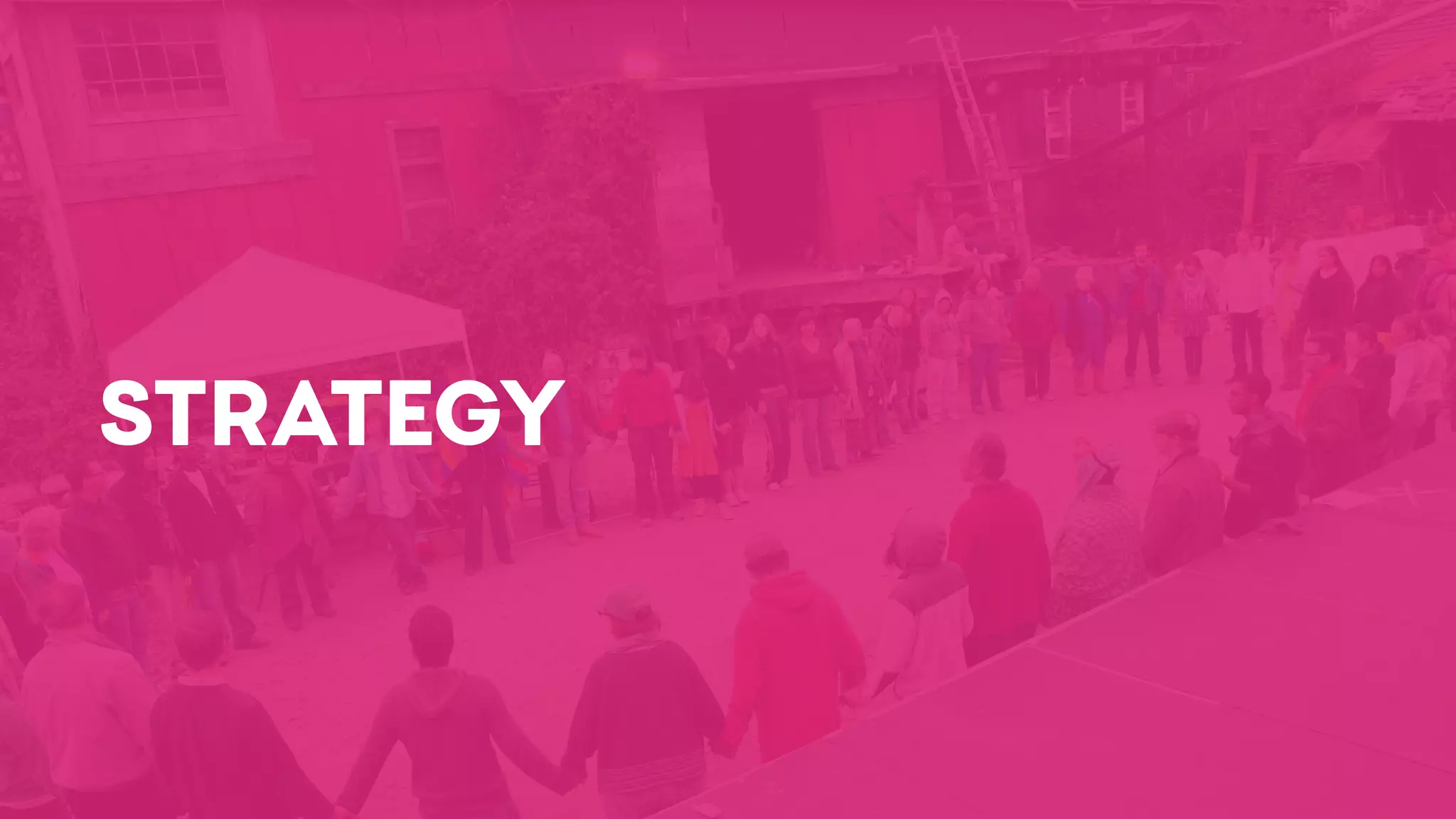
STRATEGY
WHY AUDIENCE RESEARCH?
When we don’t know:
• Who our audiences are, or could be
• What our audiences want, think, or respond to
• Where the opportunity is for something new
• How much to invest in changing our current approach
Ac4onable research depends on precisely defining the
ques4on you’re trying to answer.
Tips:
• Be specific
• Narrow your focus
• Make sure the ques4on is answerable
CHOOSING A RESEARCH QUESTION
Examples:
• How are new audiences this year demographically dis4nct
from current audiences?
• What are the 3 most important ideas to communicate to
poten4al donors?
• How do La4nX audiences use our space differently than
other audiences?
• What type of content on our website convinces 4cket
buyers to purchase?
CHOOSING A RESEARCH QUESTION
Ac4onable research depends on precisely defining the
ques4on you’re trying to answer.
Tips:
• Narrow your focus
• Establish a baseline
• Lean toward skep4cs and those with barriers
DEFINING YOUR AUDIENCES
Examples:
• Donors giving under $50 during the past two years
• Poten4al sponsors, not yet commi_ed
• Survey respondents who were unaware we did _______
• La4nX a_endees to _______ exhibit
• Families with kids aged 8-18 and financial means
DEFINING YOUR AUDIENCES
ACTIVITY #1: FRAME
YOUR OWN RESEARCH
QUESTION
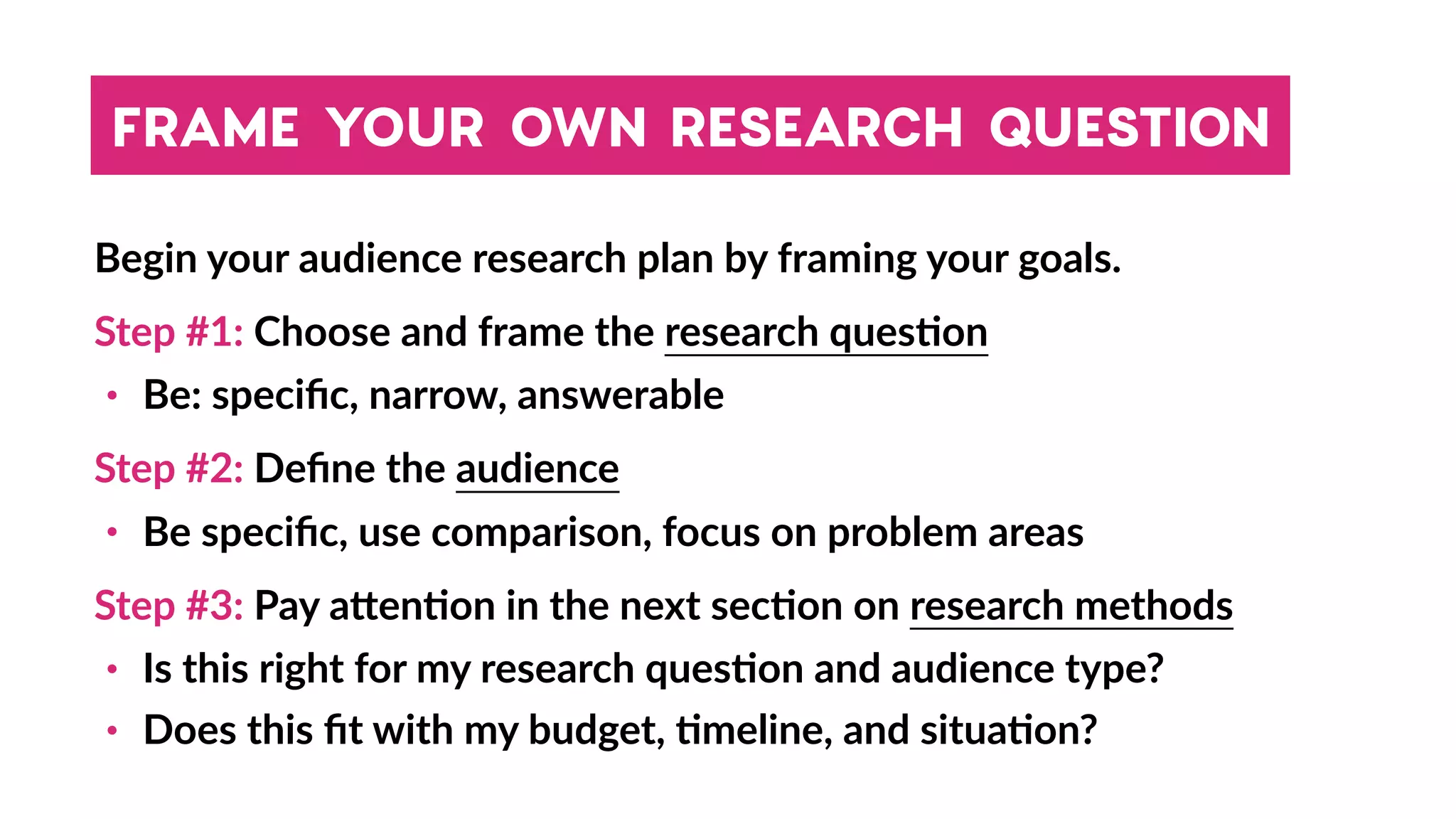
FRAME YOUR OWN RESEARCH QUESTION
Begin your audience research plan by framing your goals.
Step #1: Choose and frame the research ques4on
• Be: specific, narrow, answerable
Step #2: Define the audience
• Be specific, use comparison, focus on problem areas
Step #3: Pay a_en4on in the next sec4on on research methods
• Is this right for my research ques4on and audience type?
• Does this fit with my budget, 4meline, and situa4on?
RESEARCH METHODS
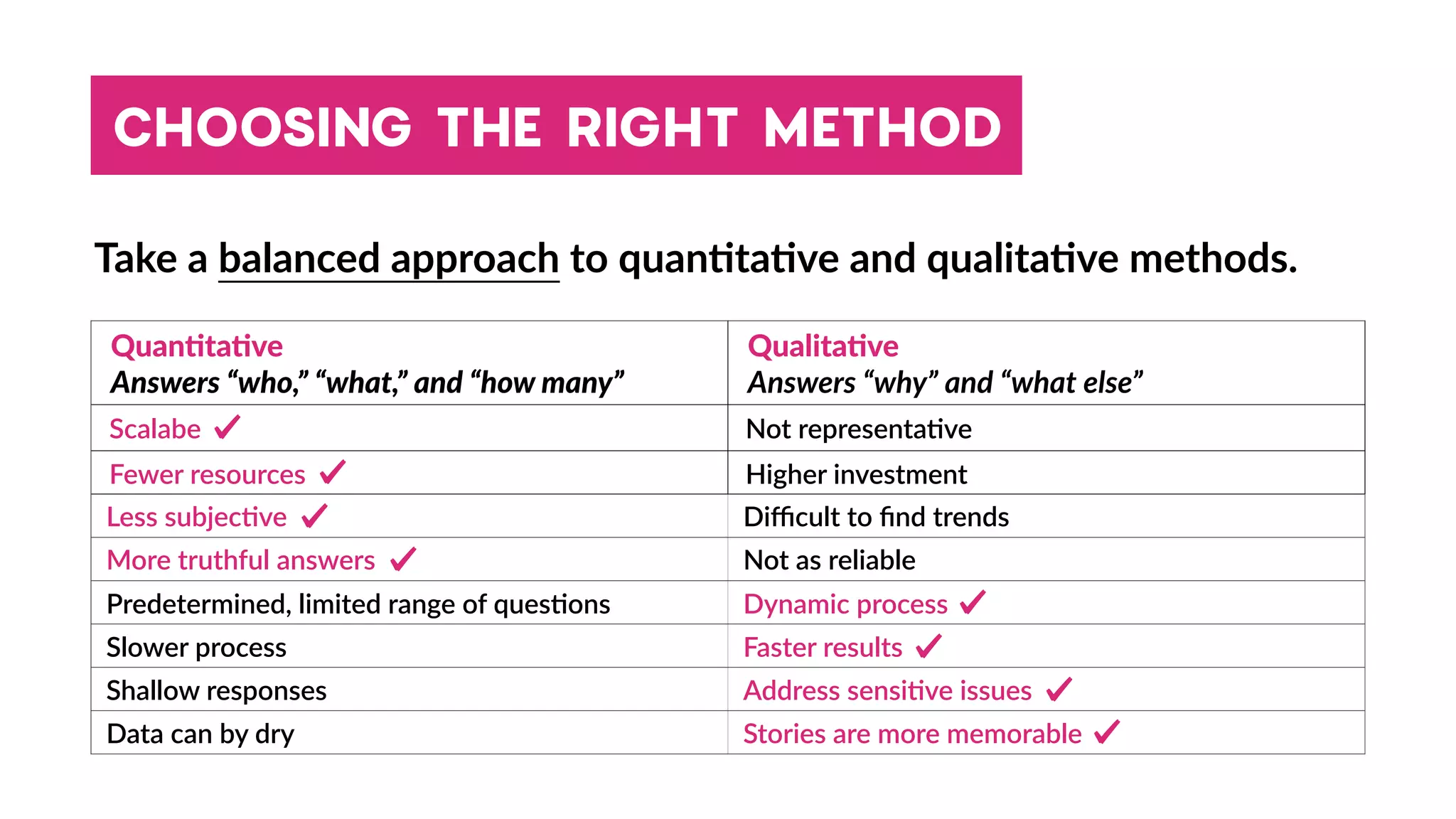
CHOOSING THE RIGHT METHOD
Take a balanced approach to quan4ta4ve and qualita4ve methods.
Quan%ta%ve
Answers “who,” “what,” and “how many”
Qualita%ve
Answers “why” and “what else”
Scalabe Not representa/ve
Fewer resources Higher investment
Less subjec/ve Difficult to find trends
More truthful answers Not as reliable
Predetermined, limited range of ques/ons Dynamic process
Slower process Faster results
Shallow responses Address sensi/ve issues
Data can by dry Stories are more memorable
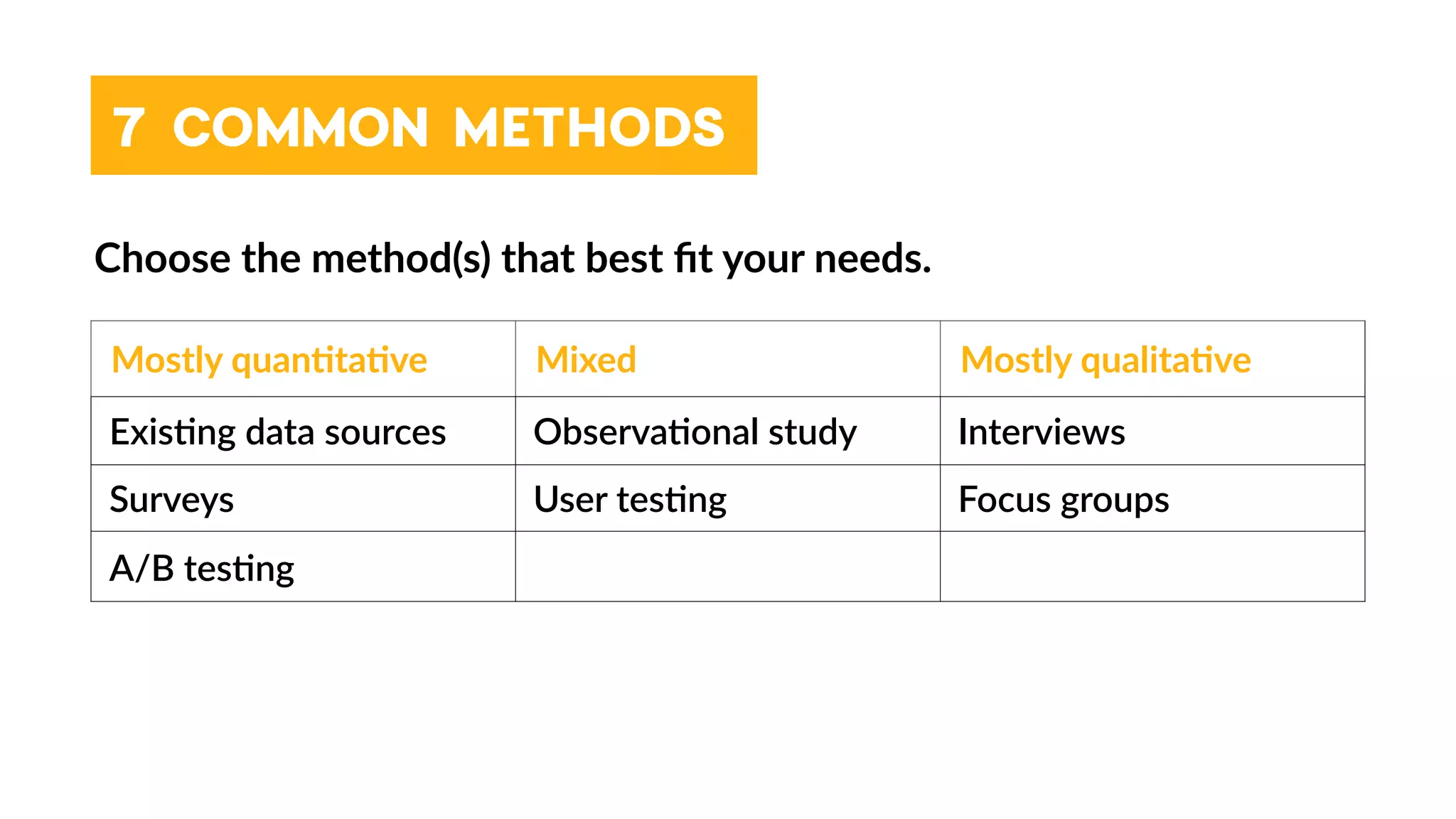
Choose the method(s) that best fit your needs.
7 COMMON METHODS
Mostly quan4ta4ve Mixed Mostly qualita4ve
Exis/ng data sources Observa/onal study Interviews
Surveys User tes/ng Focus groups
A/B tes/ng
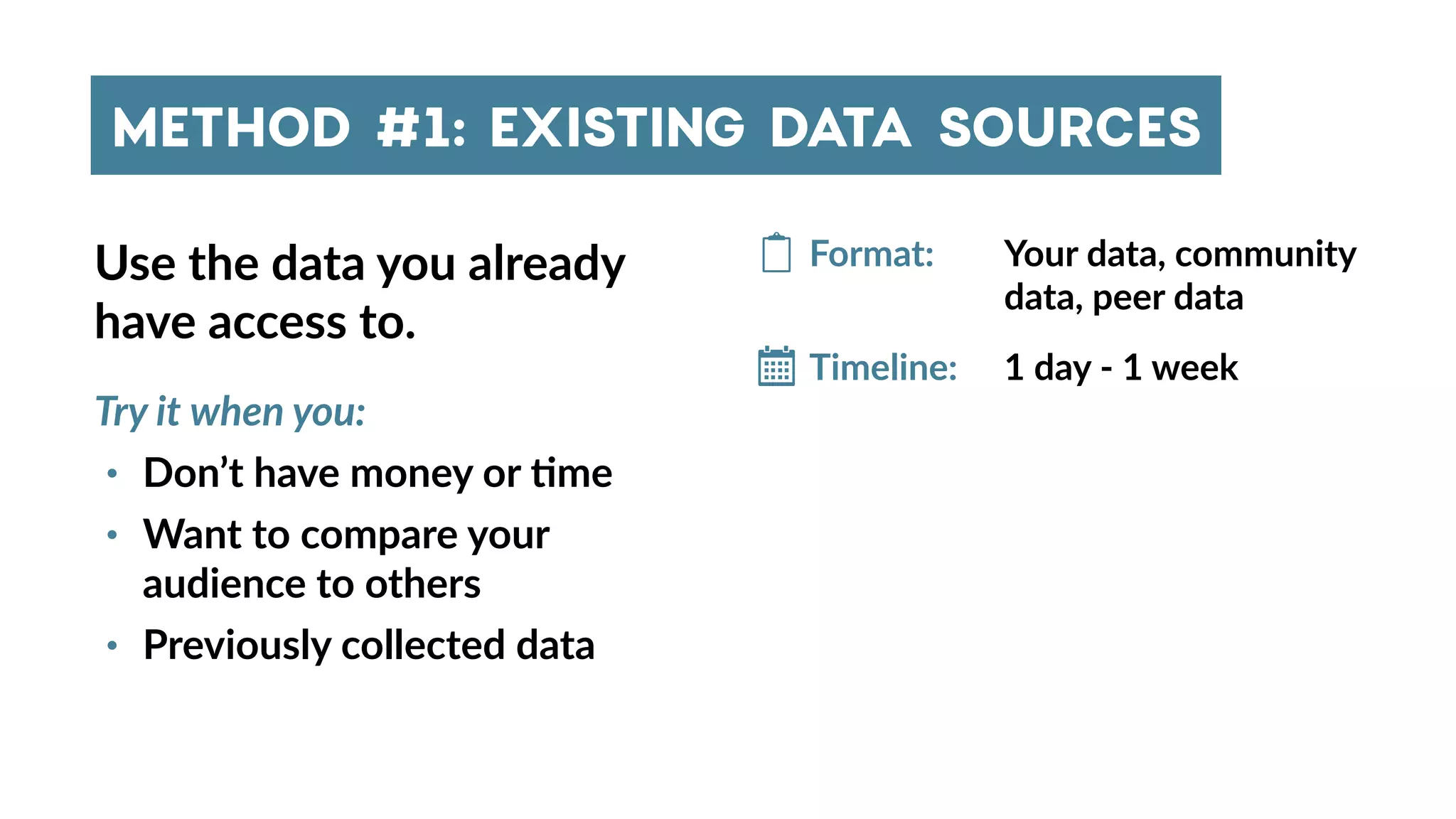
Use the data you already
have access to.
Try it when you:
• Don’t have money or 4me
• Want to compare your
audience to others
• Previously collected data
METHOD #1: EXISTING DATA SOURCES
Format:
Timeline:
Your data, community
data, peer data
1 day - 1 week
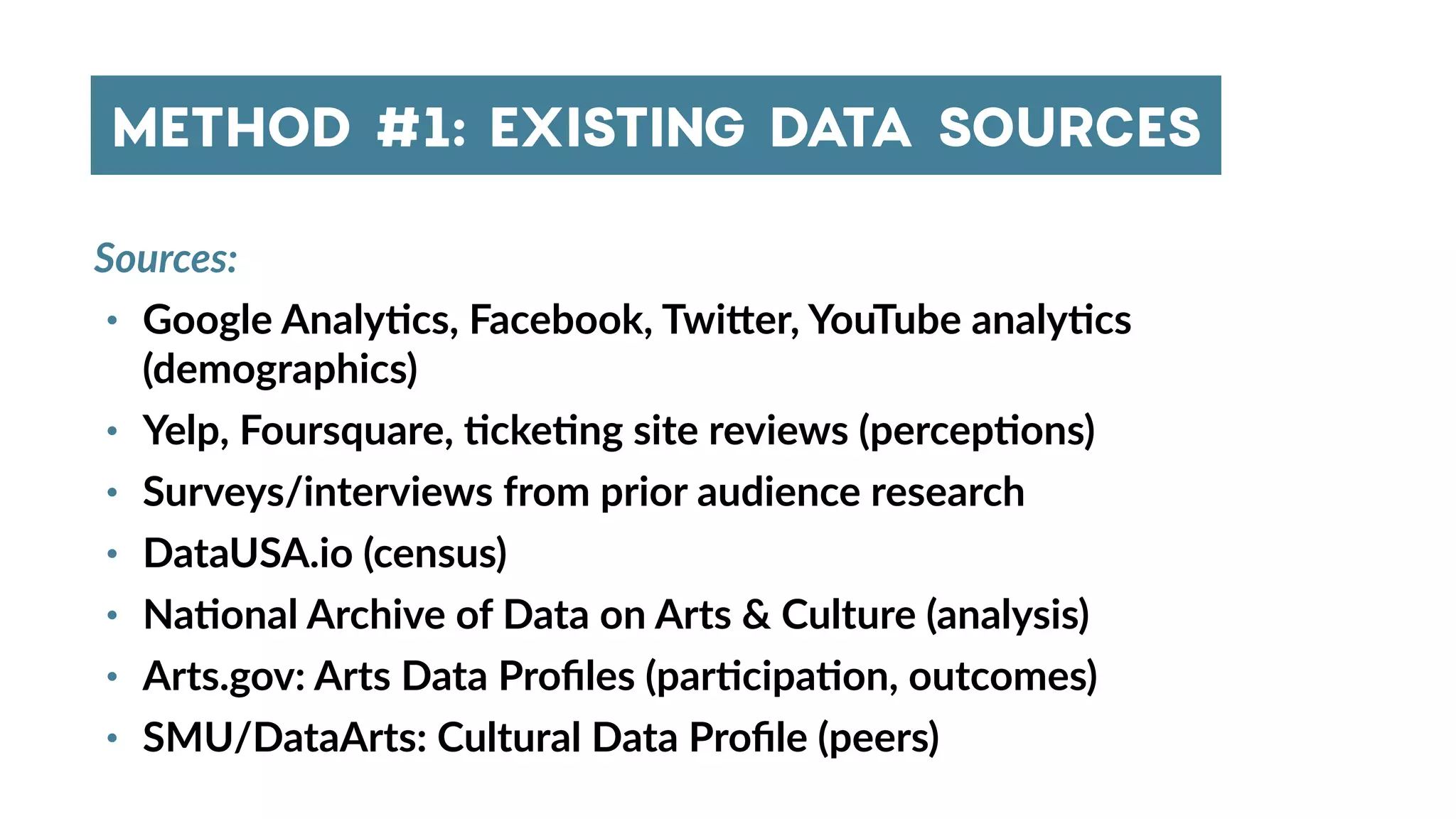
Sources:
• Google Analy4cs, Facebook, Twi_er, YouTube analy4cs
(demographics)
• Yelp, Foursquare, 4cke4ng site reviews (percep4ons)
• Surveys/interviews from prior audience research
• DataUSA.io (census)
• Na4onal Archive of Data on Arts & Culture (analysis)
• Arts.gov: Arts Data Profiles (par4cipa4on, outcomes)
• SMU/DataArts: Cultural Data Profile (peers)
METHOD #1: EXISTING DATA SOURCES
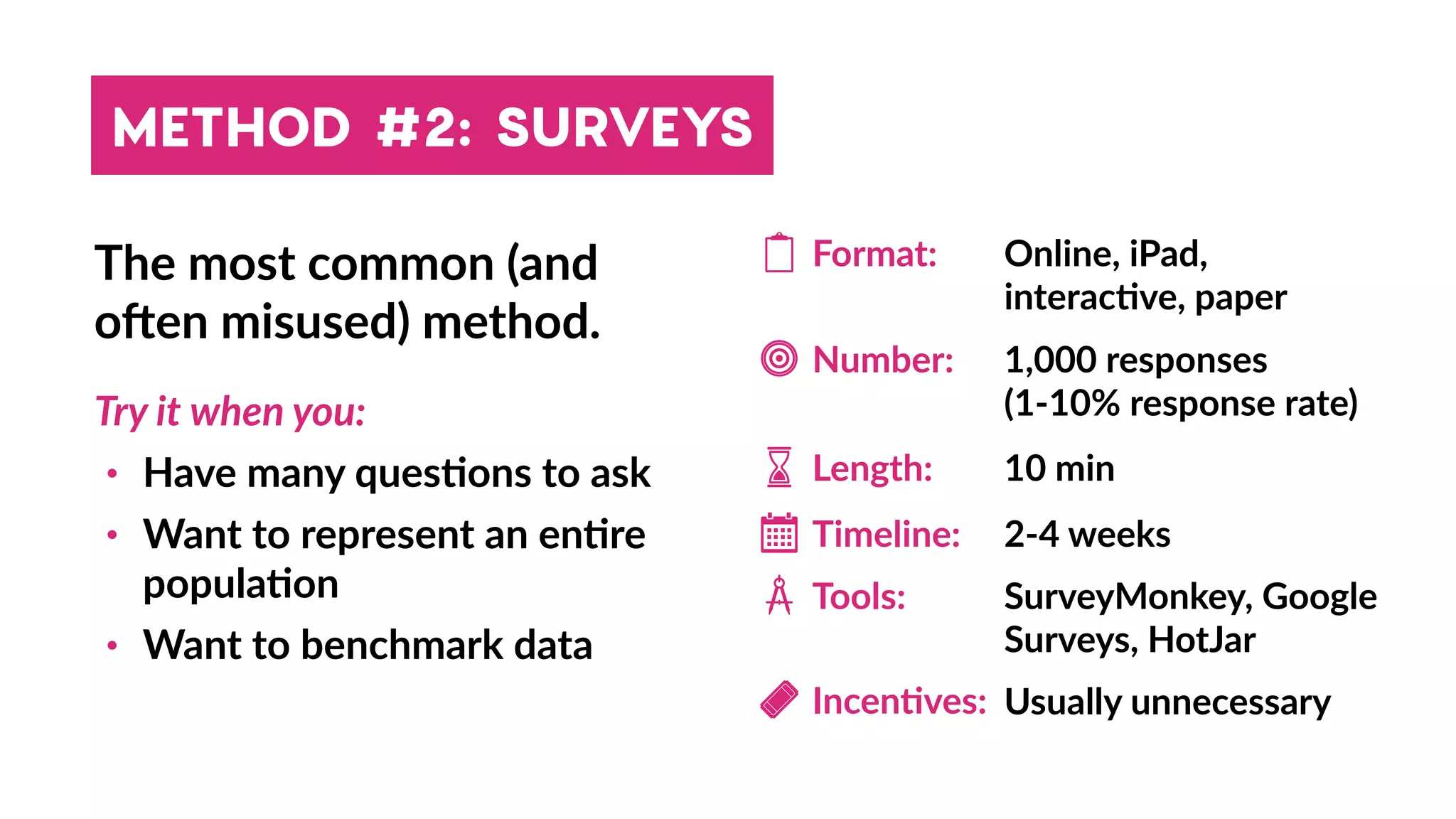
METHOD #2: SURVEYS
The most common (and
ohen misused) method.
Try it when you:
• Have many ques4ons to ask
• Want to represent an en4re
popula4on
• Want to benchmark data
Timeline:
Incen4ves:
Length:
Format: Online, iPad,
interac4ve, paper
Number: 1,000 responses
(1-10% response rate)
Tools: SurveyMonkey, Google
Surveys, HotJar
10 min
2-4 weeks
Usually unnecessary
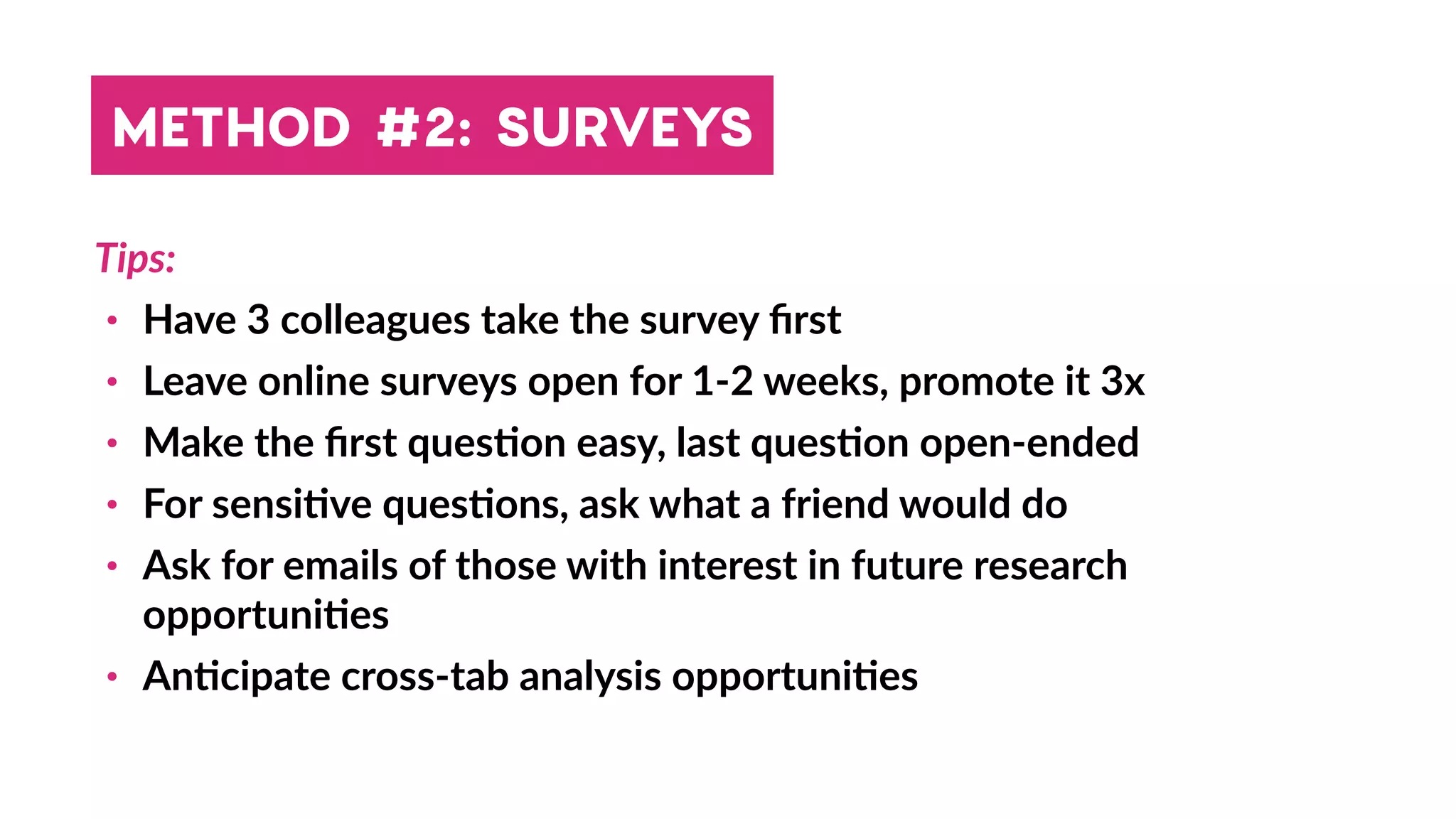
Tips:
• Have 3 colleagues take the survey first
• Leave online surveys open for 1-2 weeks, promote it 3x
• Make the first ques4on easy, last ques4on open-ended
• For sensi4ve ques4ons, ask what a friend would do
• Ask for emails of those with interest in future research
opportuni4es
• An4cipate cross-tab analysis opportuni4es
METHOD #2: SURVEYS
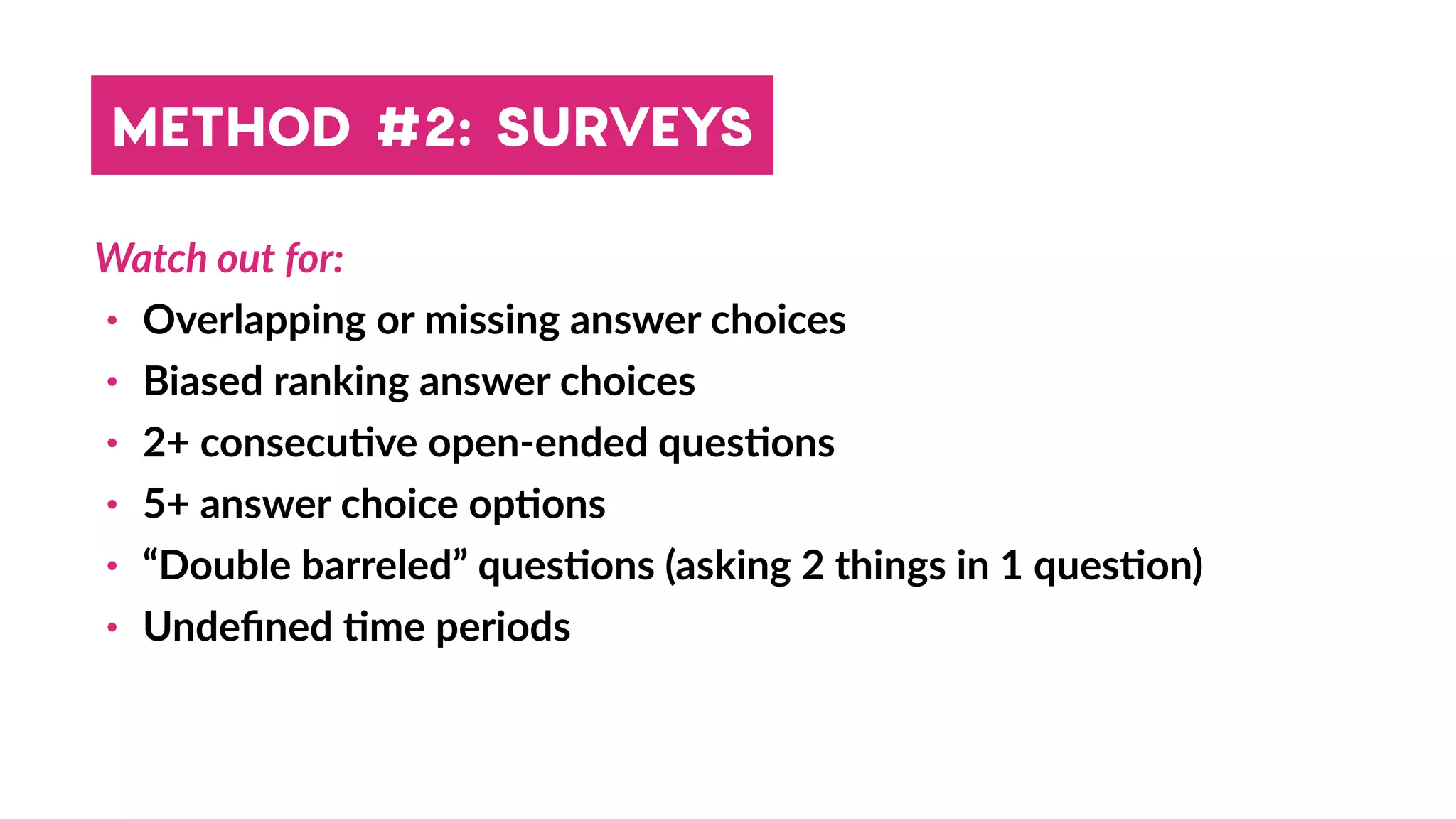
Watch out for:
• Overlapping or missing answer choices
• Biased ranking answer choices
• 2+ consecu4ve open-ended ques4ons
• 5+ answer choice op4ons
• “Double barreled” ques4ons (asking 2 things in 1 ques4on)
• Undefined 4me periods
METHOD #2: SURVEYS
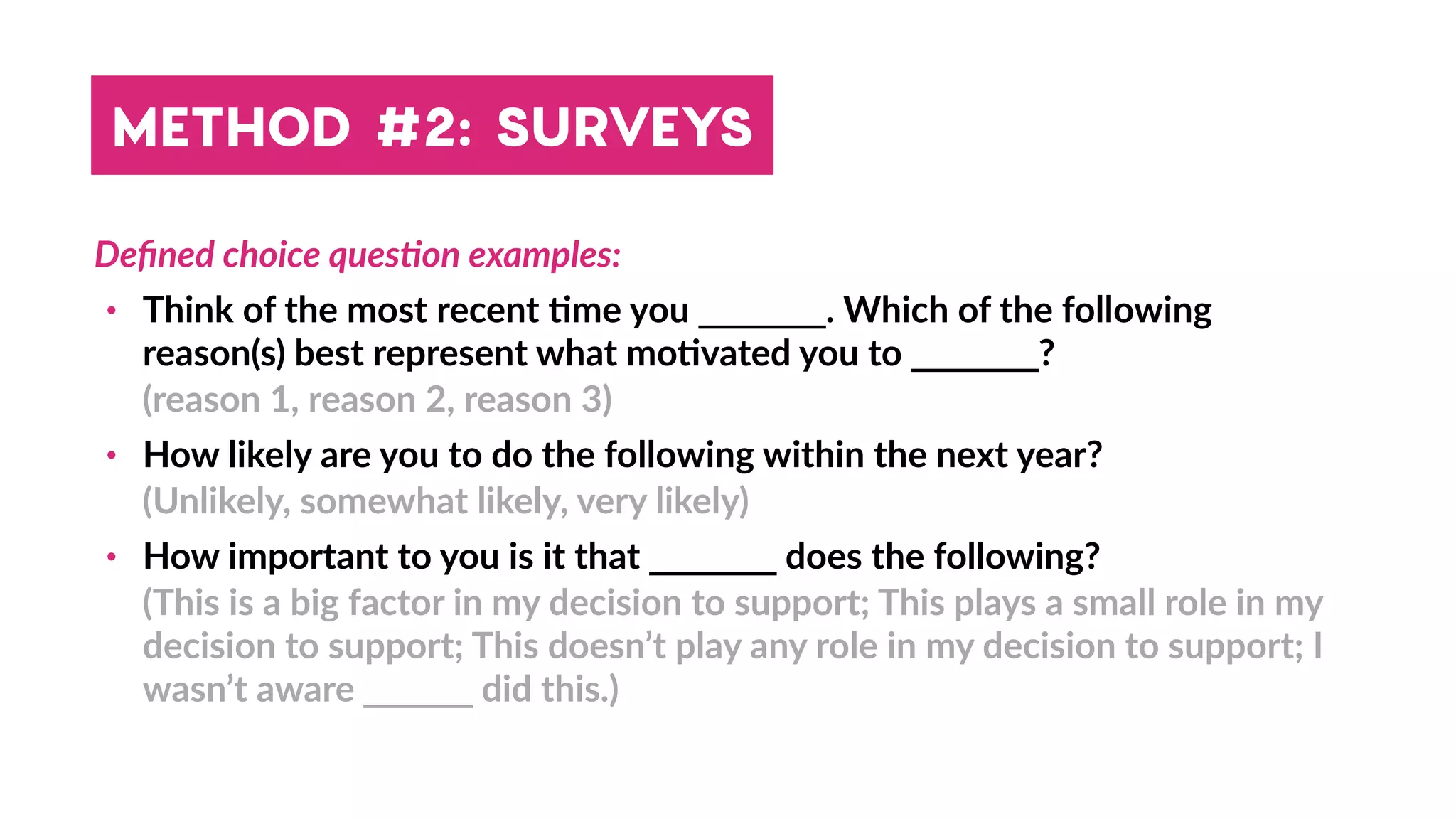
Defined choice quesBon examples:
• Think of the most recent 4me you _______. Which of the following
reason(s) best represent what mo4vated you to _______?
(reason 1, reason 2, reason 3)
• How likely are you to do the following within the next year?
(Unlikely, somewhat likely, very likely)
• How important to you is it that _______ does the following?
(This is a big factor in my decision to support; This plays a small role in my
decision to support; This doesn’t play any role in my decision to support; I
wasn’t aware ______ did this.)
METHOD #2: SURVEYS
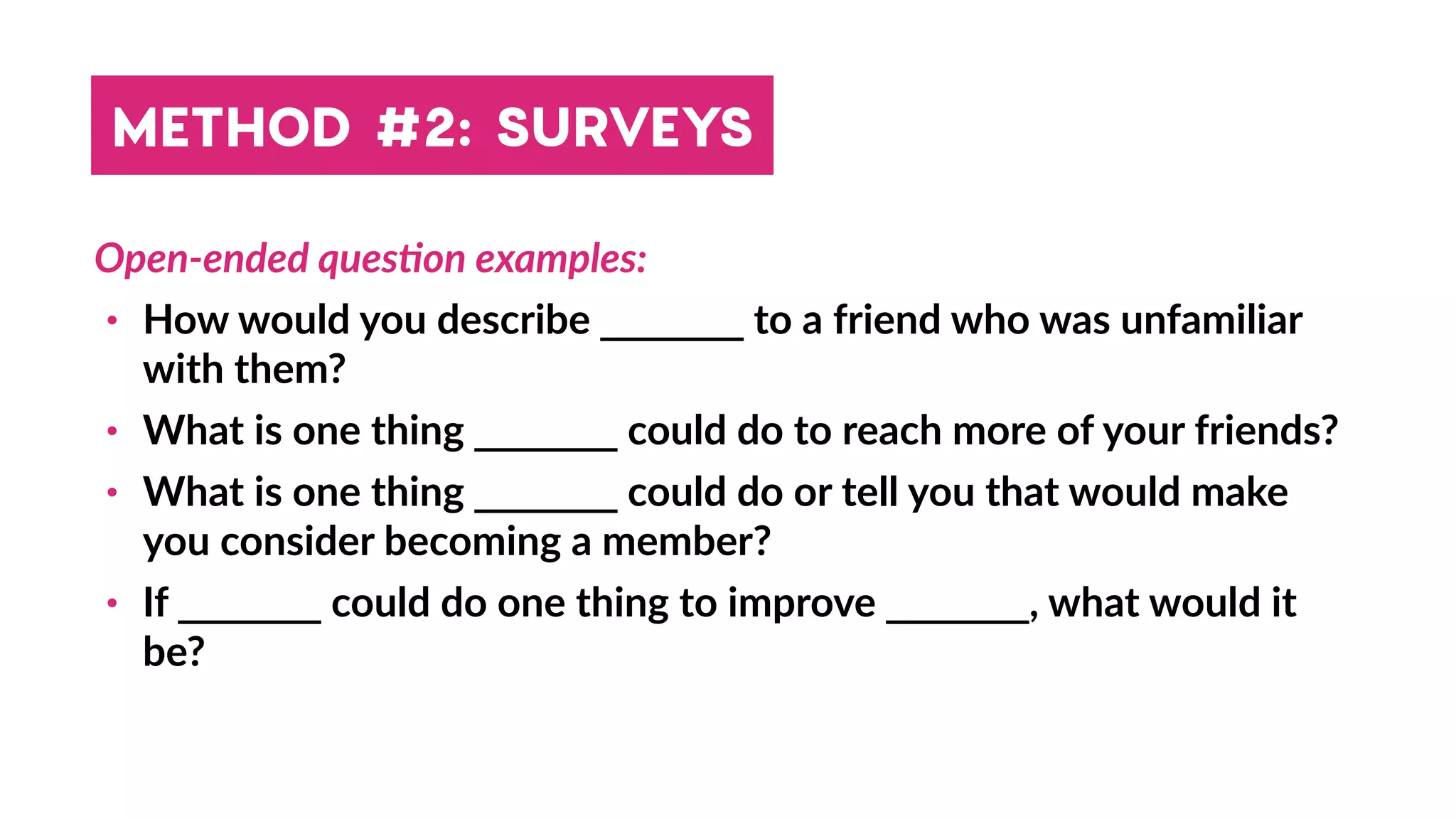
Open-ended quesBon examples:
• How would you describe _______ to a friend who was unfamiliar
with them?
• What is one thing _______ could do to reach more of your friends?
• What is one thing _______ could do or tell you that would make
you consider becoming a member?
• If _______ could do one thing to improve _______, what would it
be?
METHOD #2: SURVEYS
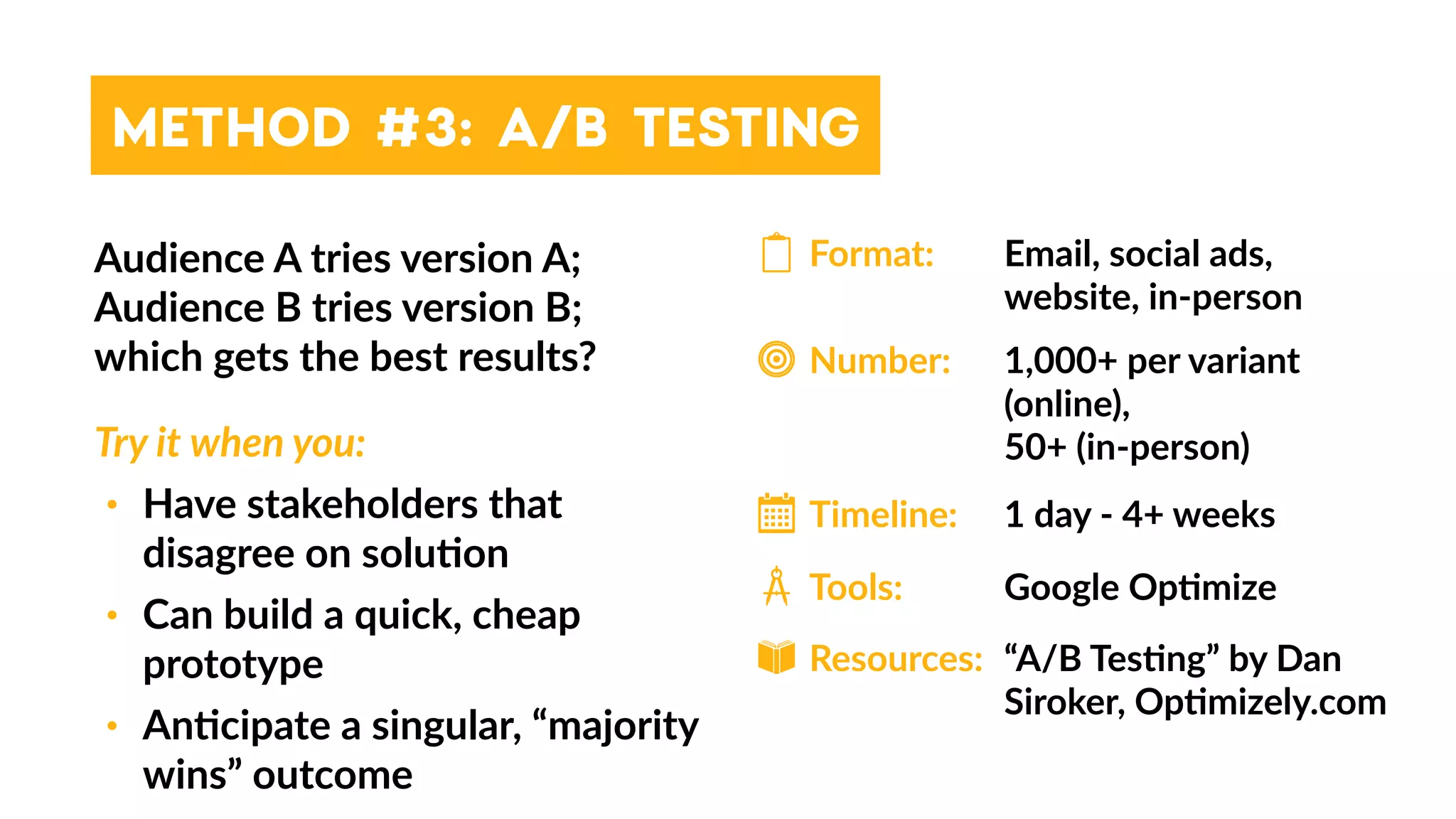
METHOD #3: A/B TESTING
Audience A tries version A;
Audience B tries version B; 

which gets the best results?
Try it when you:
• Have stakeholders that
disagree on solu4on
• Can build a quick, cheap
prototype
• An4cipate a singular, “majority
wins” outcome
Format:
Timeline:
Resources:
Tools:
Number:
Email, social ads,
website, in-person
1,000+ per variant
(online), 

50+ (in-person)
1 day - 4+ weeks
Google Op4mize
“A/B Tes4ng” by Dan
Siroker, Op4mizely.com
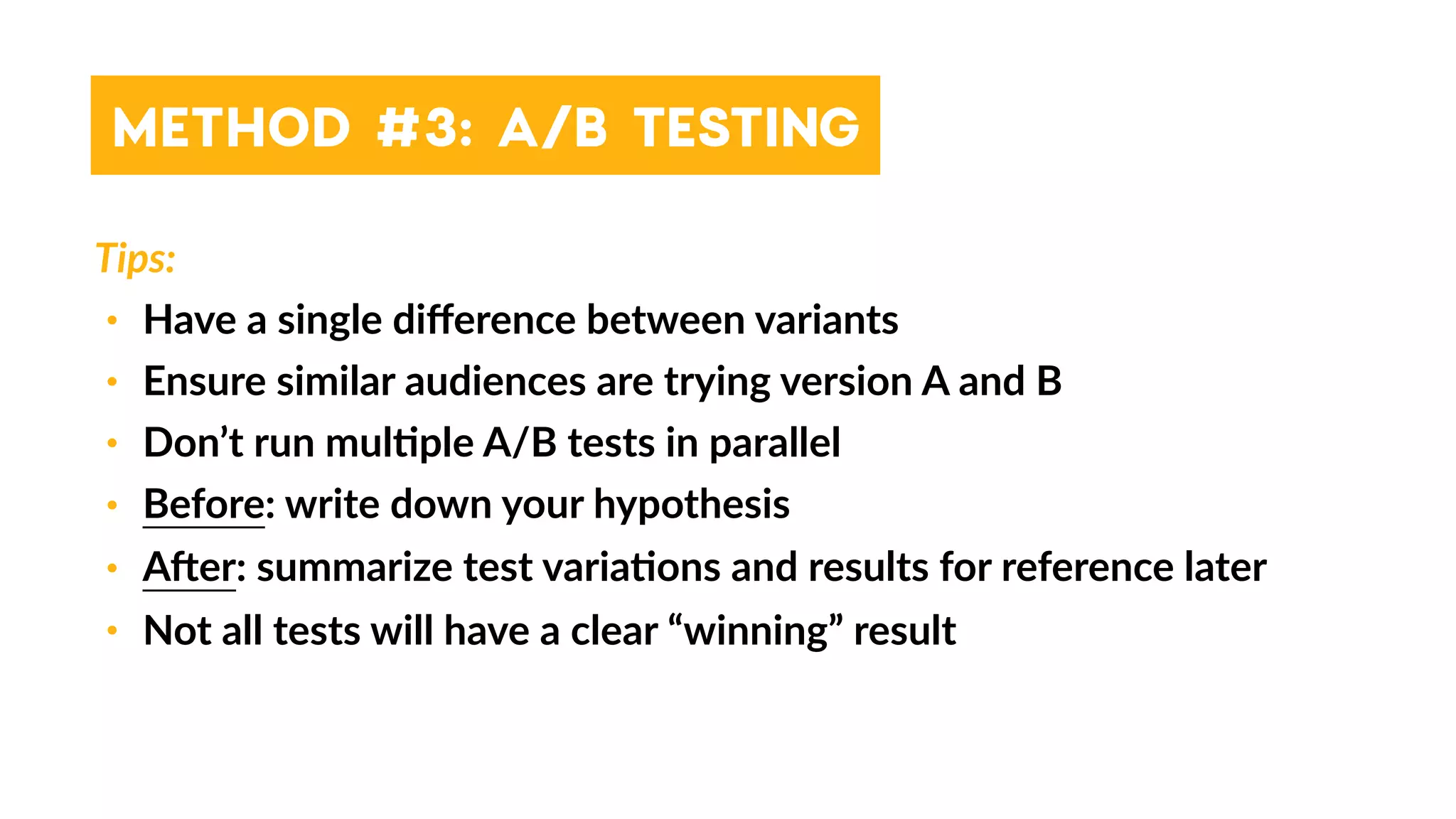
Tips:
• Have a single difference between variants
• Ensure similar audiences are trying version A and B
• Don’t run mul4ple A/B tests in parallel
• Before: write down your hypothesis
• Aher: summarize test varia4ons and results for reference later
• Not all tests will have a clear “winning” result
METHOD #3: A/B TESTING
METHOD #4: OBSERVATIONAL STUDIES
Watch audience behavior while
they’re in your space or another
space.
Try it when you:
• Want to understand new
audiences or behaviors
• Want to improve an exis4ng
process
• Expect easy to interpret
behavior
Format:
Timeline:
People:
Tools:
Length:
Number:
Dwell 4me, naviga4on
path, public spaces
50+ par4cipants
1-4 hours
1+ observers
1 day - 1 week
Phone or paper
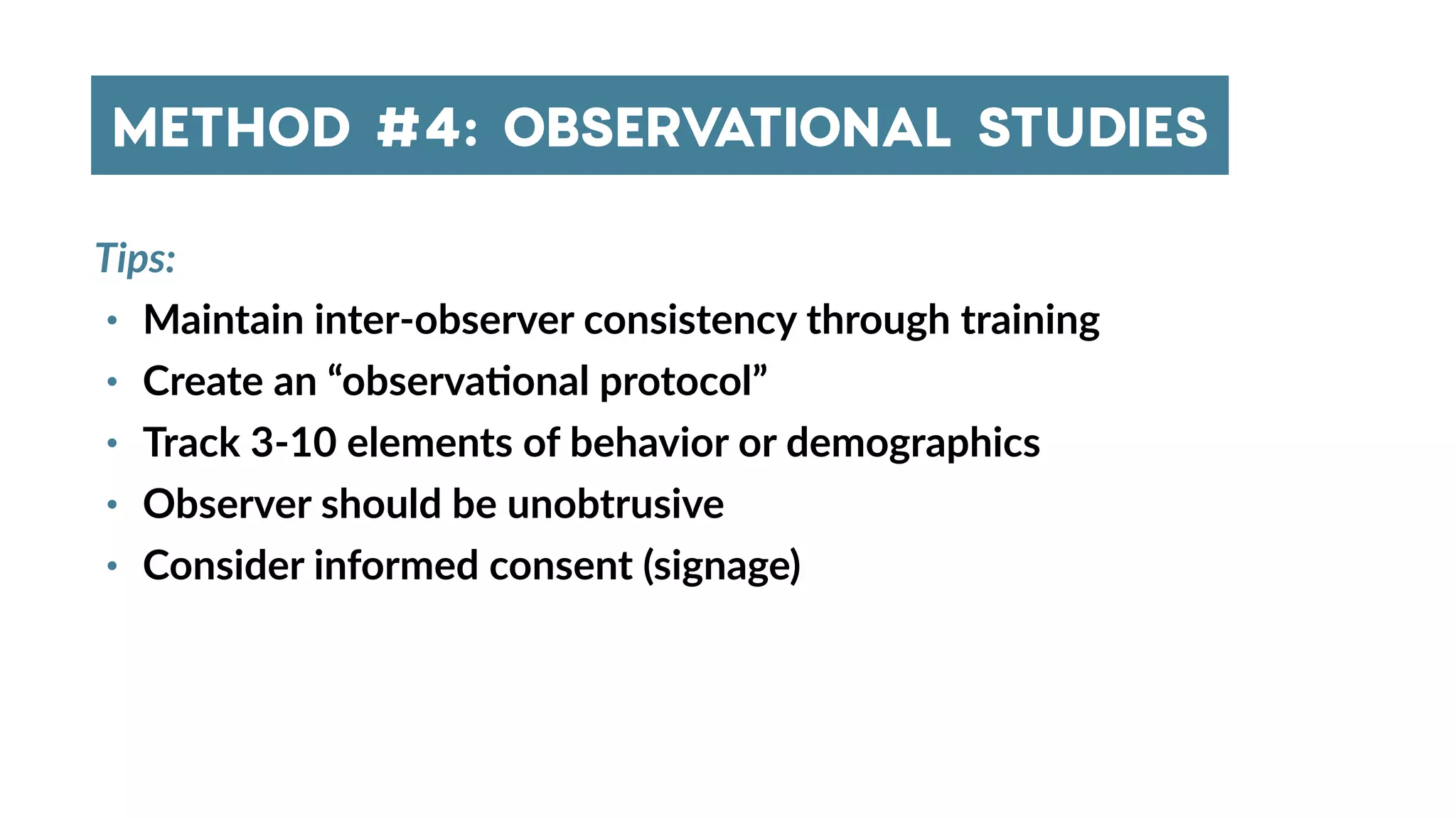
Tips:
• Maintain inter-observer consistency through training
• Create an “observa4onal protocol”
• Track 3-10 elements of behavior or demographics
• Observer should be unobtrusive
• Consider informed consent (signage)
METHOD #4: OBSERVATIONAL STUDIES
METHOD #5: USER TESTING
Watch audiences while they
use a simplified, early version
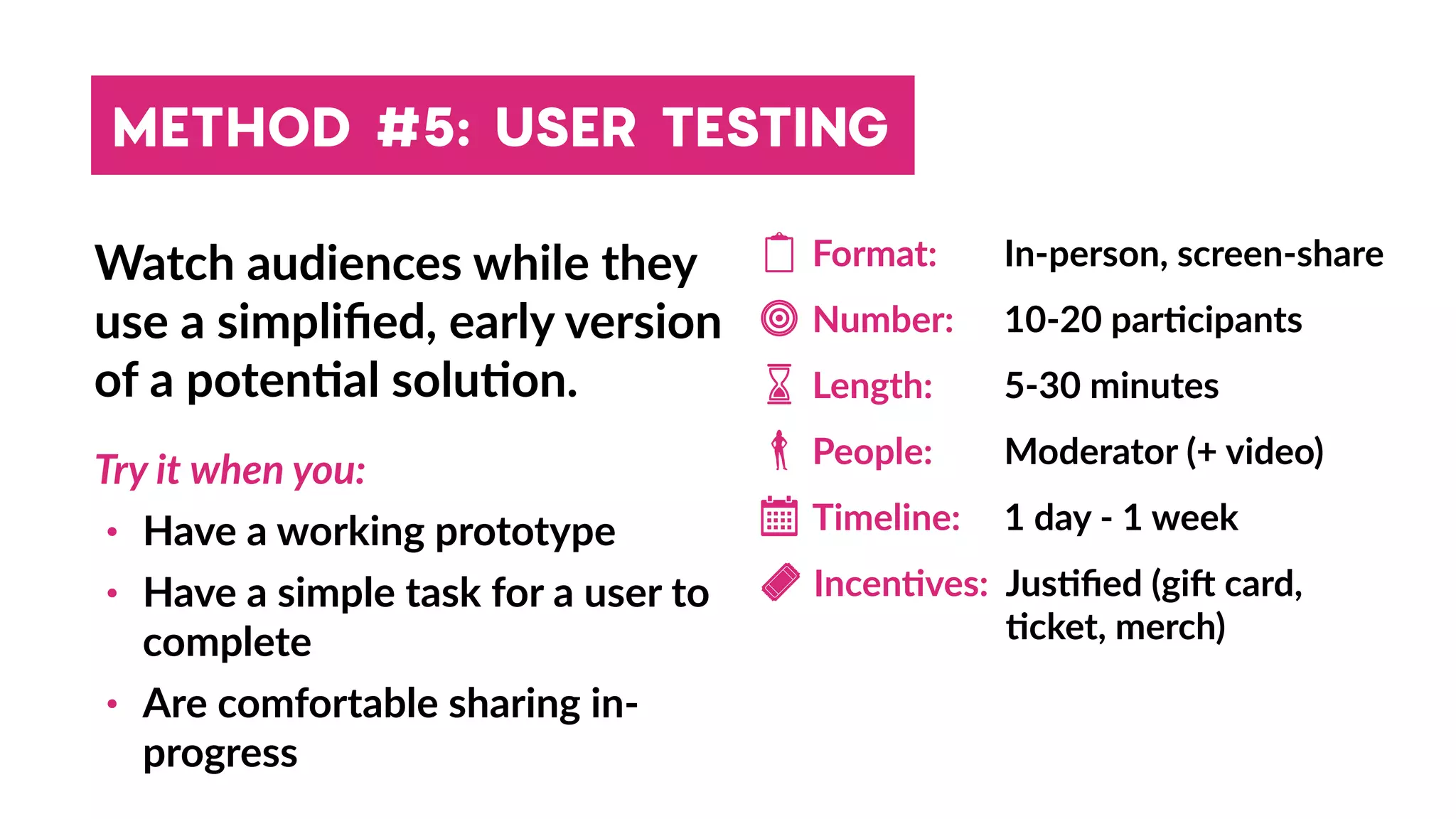
of a poten4al solu4on.
Try it when you:
• Have a working prototype
• Have a simple task for a user to
complete
• Are comfortable sharing in-
progress
Format:
People:
Length:
Number:
In-person, screen-share
10-20 par4cipants
5-30 minutes
Moderator (+ video)
Timeline: 1 day - 1 week
Incen4ves: Jus4fied (gih card,
4cket, merch)
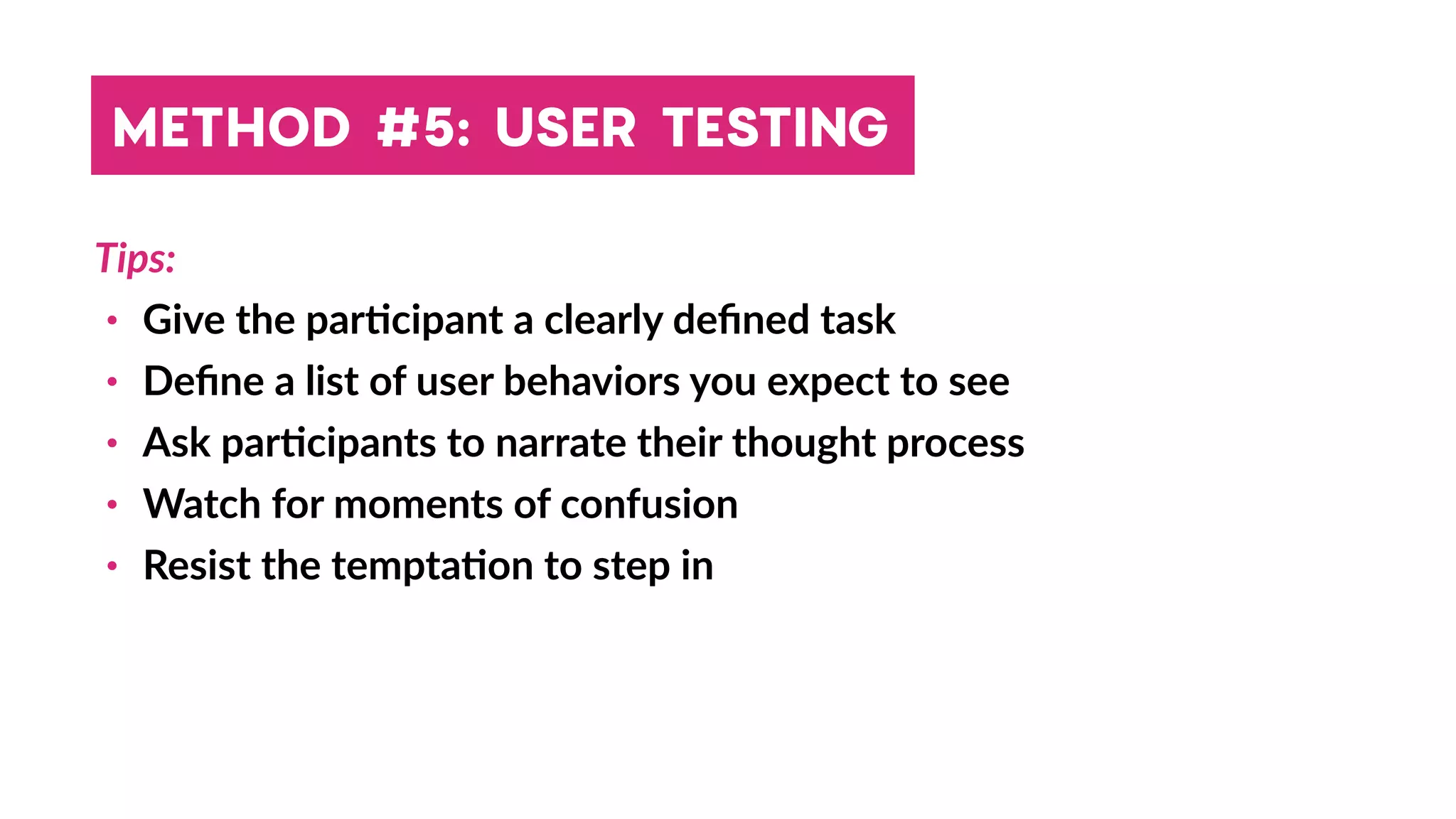
Tips:
• Give the par4cipant a clearly defined task
• Define a list of user behaviors you expect to see
• Ask par4cipants to narrate their thought process
• Watch for moments of confusion
• Resist the tempta4on to step in
METHOD #5: USER TESTING
METHOD #6: INTERVIEWS
People like to be asked their
opinions, you’re (probably)
not bothering them.
Try it when you:
• Need to gather stories,
situa4ons, characters
• Have poten4ally sensi4ve or
complex topics to discuss
Format:
Timeline:
People:
Incen4ves:
Length:
Number:
Phone, video, in-person,
recorded kiosk
3-5 interviewees per
type (10-25% response)
5-30 minutes
1 interviewer 

(+ record audio)
1-4 weeks
Usually unnecessary
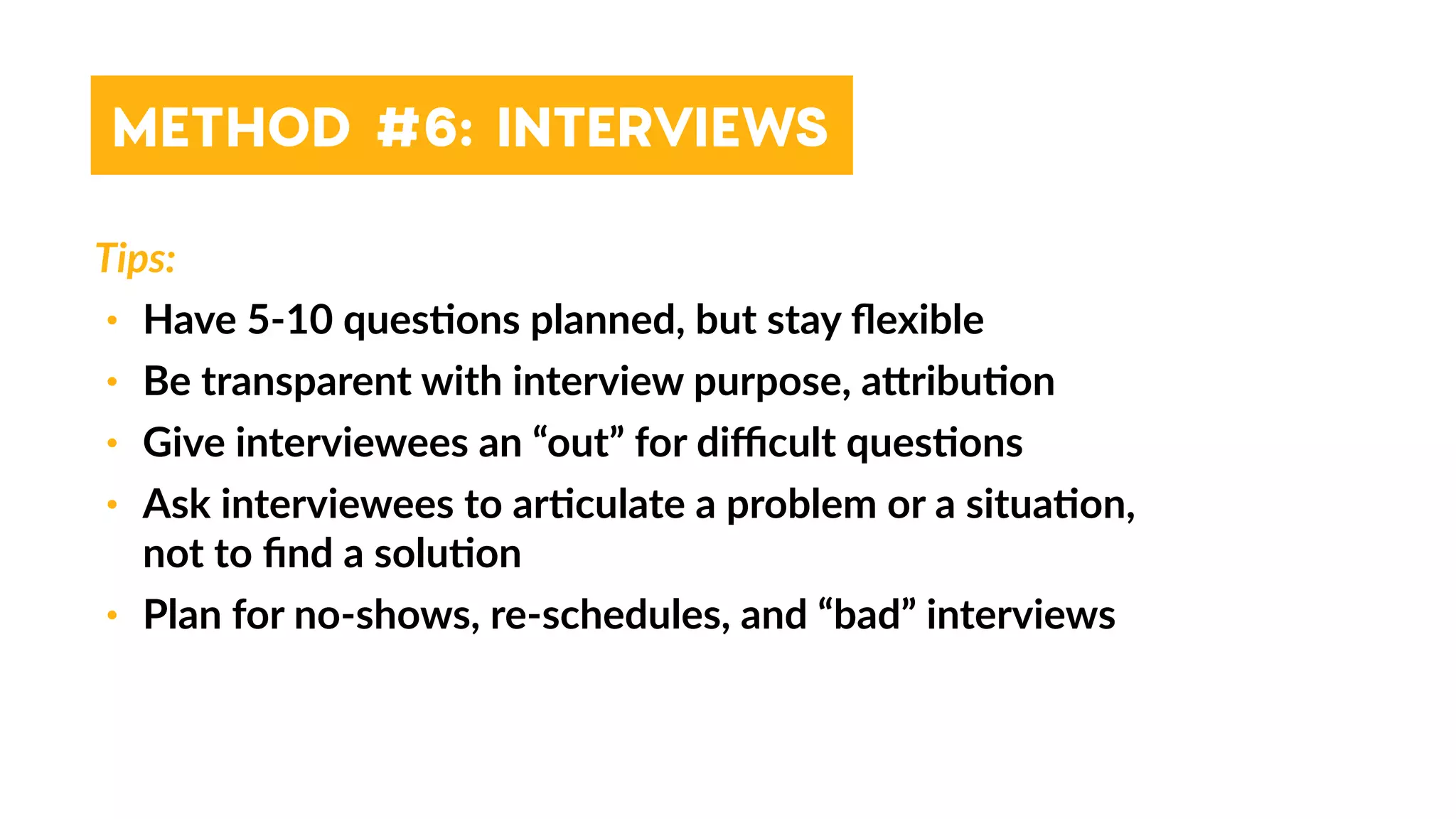
Tips:
• Have 5-10 ques4ons planned, but stay flexible
• Be transparent with interview purpose, a_ribu4on
• Give interviewees an “out” for difficult ques4ons
• Ask interviewees to ar4culate a problem or a situa4on,
not to find a solu4on
• Plan for no-shows, re-schedules, and “bad” interviews
METHOD #6: INTERVIEWS
Interview quesBon examples:
• Tell me about the first 4me you learned about _______.
• What was your reac4on when _______ did _______?
• Walk me through the moments just before your most recent
decision to _______.
• I’m going to give you a short descrip4on of six different quali4es
about _______. We want to hear your take on how each resonates
with you.
• What are the benefits that you value most from _______?
METHOD #6: INTERVIEWS
METHOD #7: FOCUS GROUPS
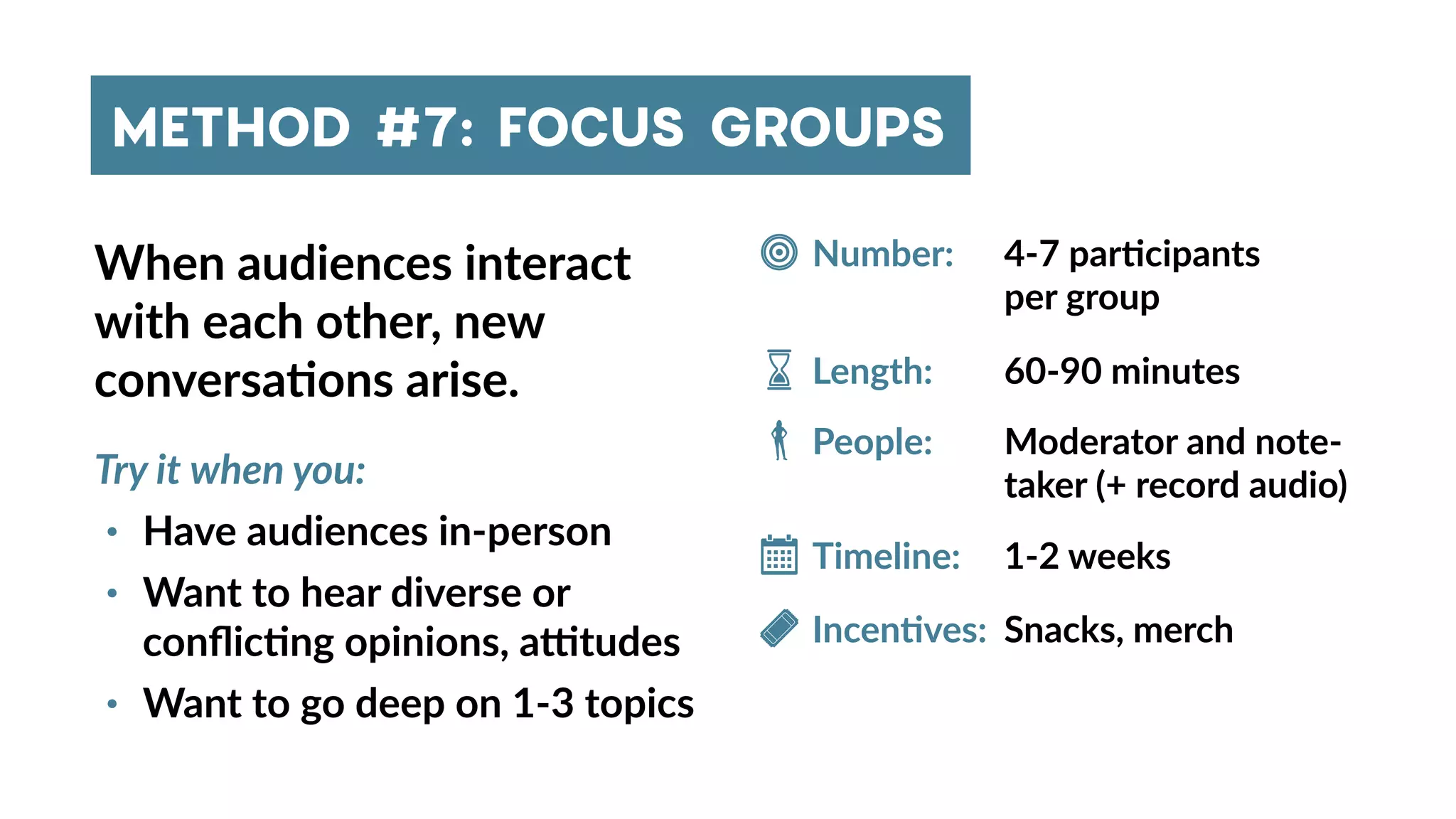
When audiences interact
with each other, new
conversa4ons arise.
Try it when you:
• Have audiences in-person
• Want to hear diverse or
conflic4ng opinions, astudes
• Want to go deep on 1-3 topics
4-7 par4cipants
per group
Number:
Timeline:
People:
Incen4ves:
Length:
Snacks, merch
1-2 weeks
Moderator and note-
taker (+ record audio)
60-90 minutes
Tips:
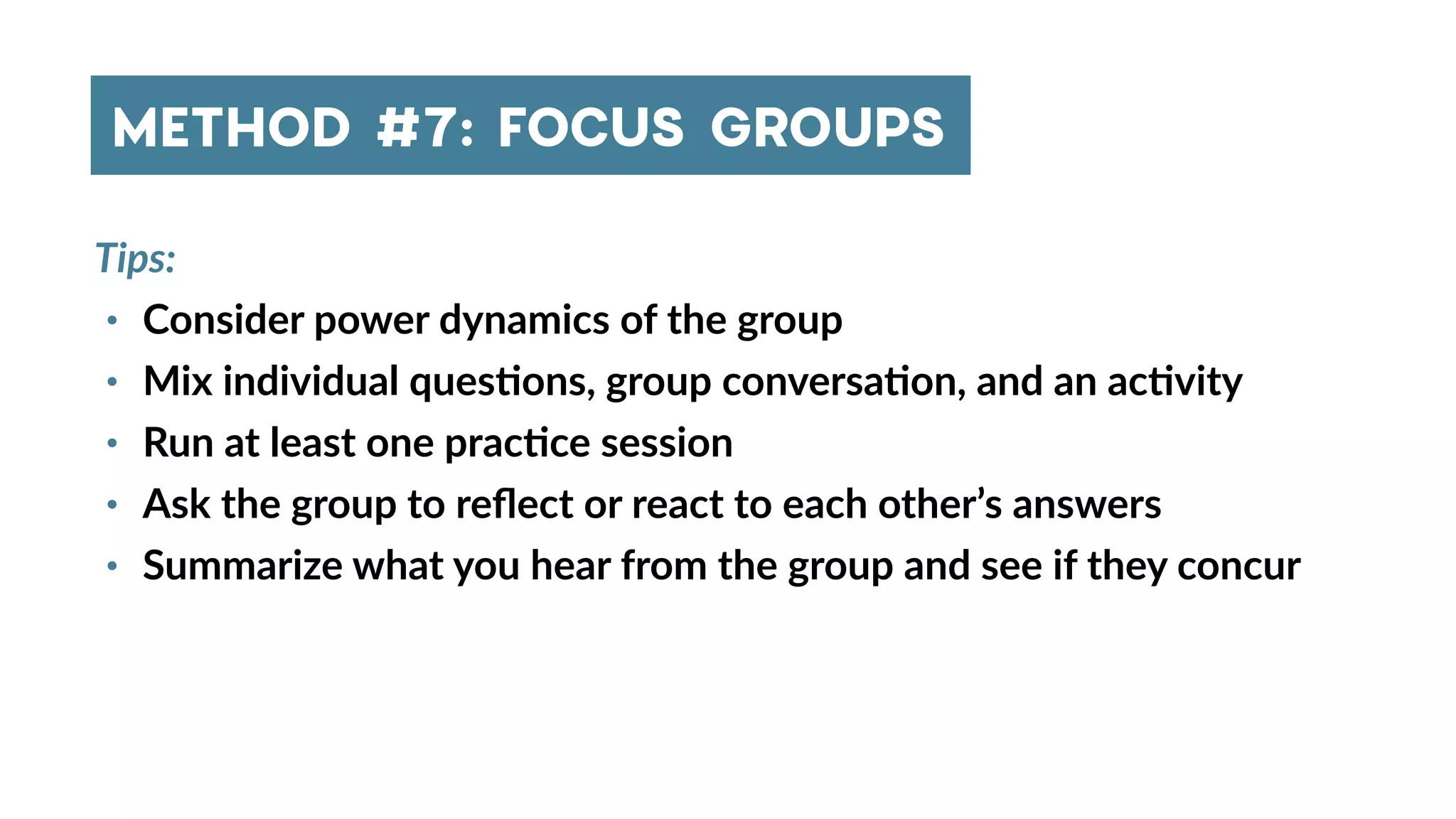
• Consider power dynamics of the group
• Mix individual ques4ons, group conversa4on, and an ac4vity
• Run at least one prac4ce session
• Ask the group to reflect or react to each other’s answers
• Summarize what you hear from the group and see if they concur
METHOD #7: FOCUS GROUPS
Example agenda:
• Solo ques4on: What was your awareness of _______ when we first
contacted you?
• Scenario 1: If you saw this ad on Facebook, what would your first
reac4on be? Your next step?
• Group conversa4on: Can anyone share an example of a recent 4me
that they _______? How similar is everyone else’s experience?
• Scenario 2: If you visited this sec4on of the website, what would you
expect to find?
• Group ac4vity: sor4ng items into categories; walk me through why
you chose these categories.
METHOD #7: FOCUS GROUPS
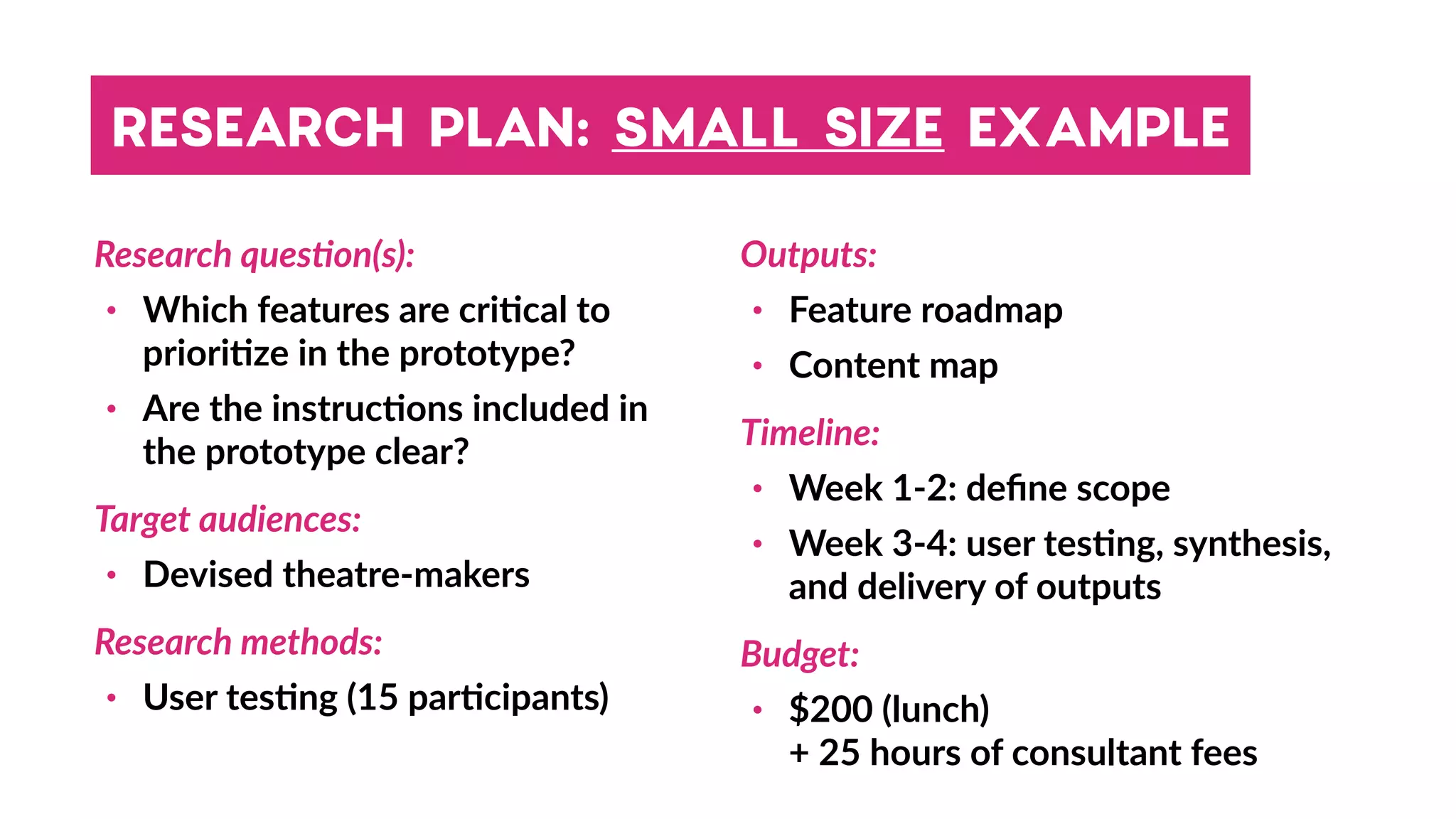
RESEARCH PLAN: SMALL SIZE EXAMPLE
Research quesBon(s):
• Which features are cri4cal to
priori4ze in the prototype?
• Are the instruc4ons included in
the prototype clear?
Target audiences:
• Devised theatre-makers
Research methods:
• User tes4ng (15 par4cipants)
Outputs:
• Feature roadmap
• Content map
Timeline:
• Week 1-2: define scope
• Week 3-4: user tes4ng, synthesis,
and delivery of outputs
Budget:
• $200 (lunch) 

+ 25 hours of consultant fees
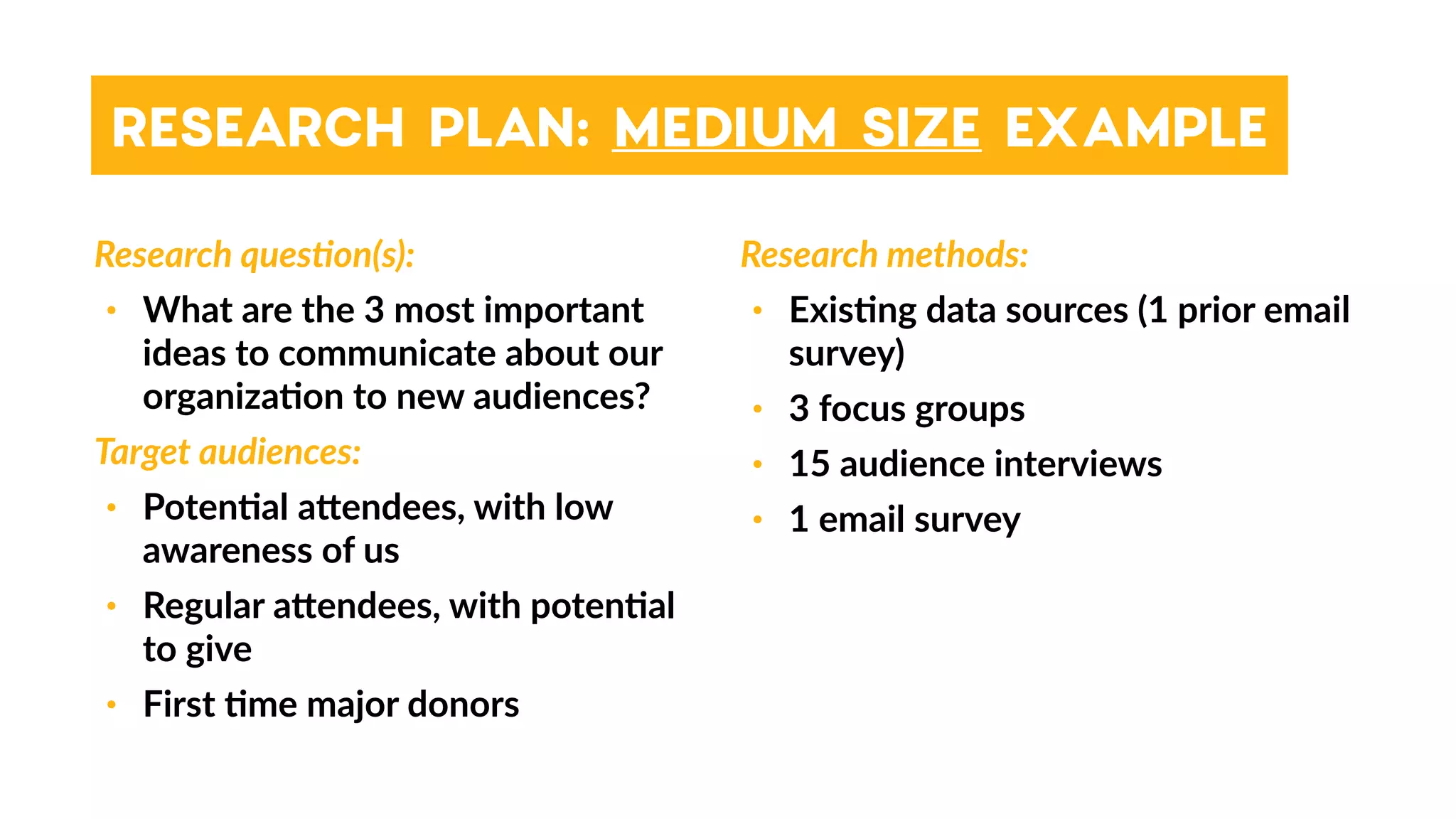
RESEARCH PLAN: MEDIUM SIZE EXAMPLE
Research quesBon(s):
• What are the 3 most important
ideas to communicate about our
organiza4on to new audiences?
Target audiences:
• Poten4al a_endees, with low
awareness of us
• Regular a_endees, with poten4al
to give
• First 4me major donors
Research methods:
• Exis4ng data sources (1 prior email
survey)
• 3 focus groups
• 15 audience interviews
• 1 email survey
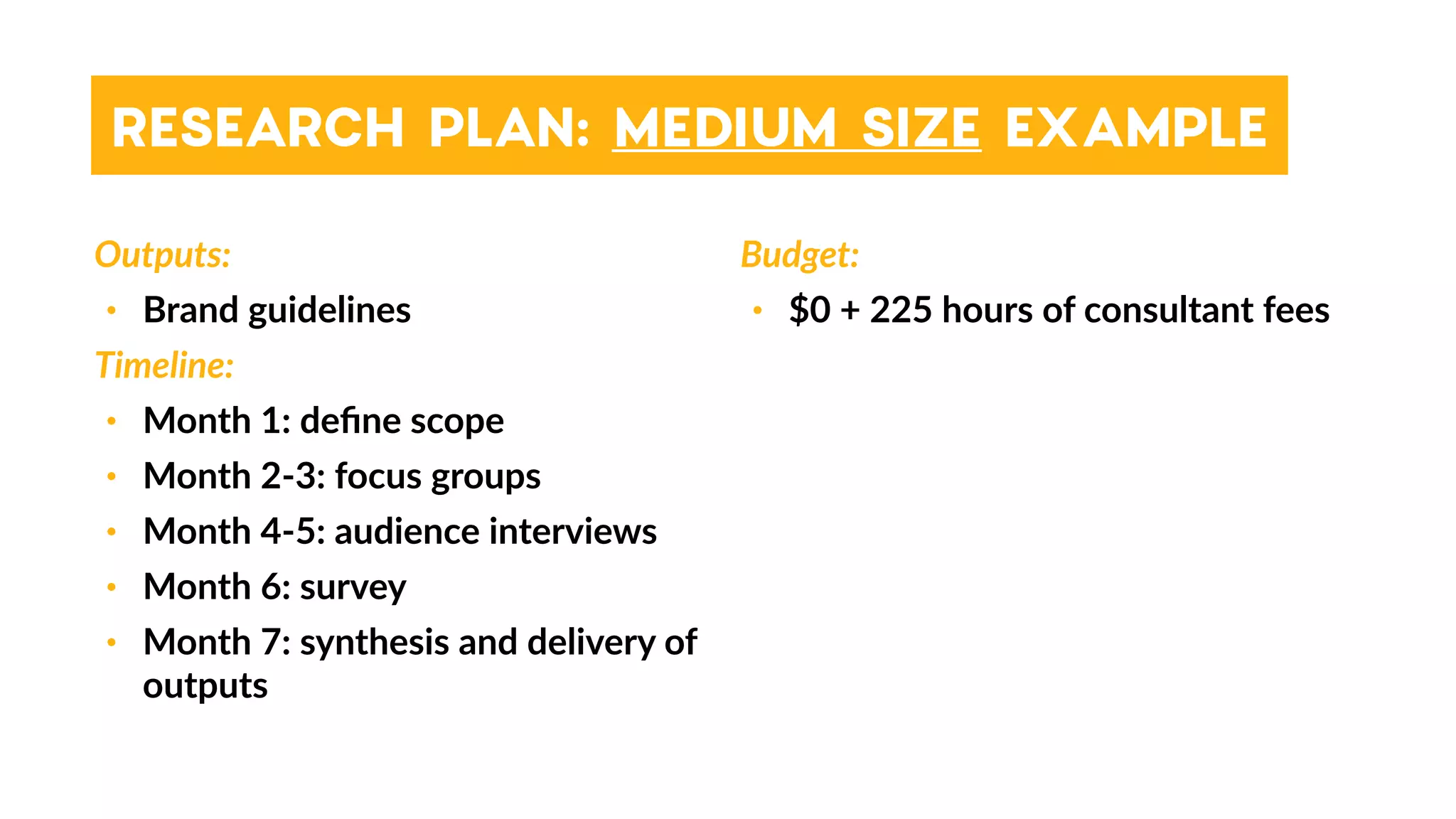
RESEARCH PLAN: MEDIUM SIZE EXAMPLE
Outputs:
• Brand guidelines
Timeline:
• Month 1: define scope
• Month 2-3: focus groups
• Month 4-5: audience interviews
• Month 6: survey
• Month 7: synthesis and delivery of
outputs
Budget:
• $0 + 225 hours of consultant fees
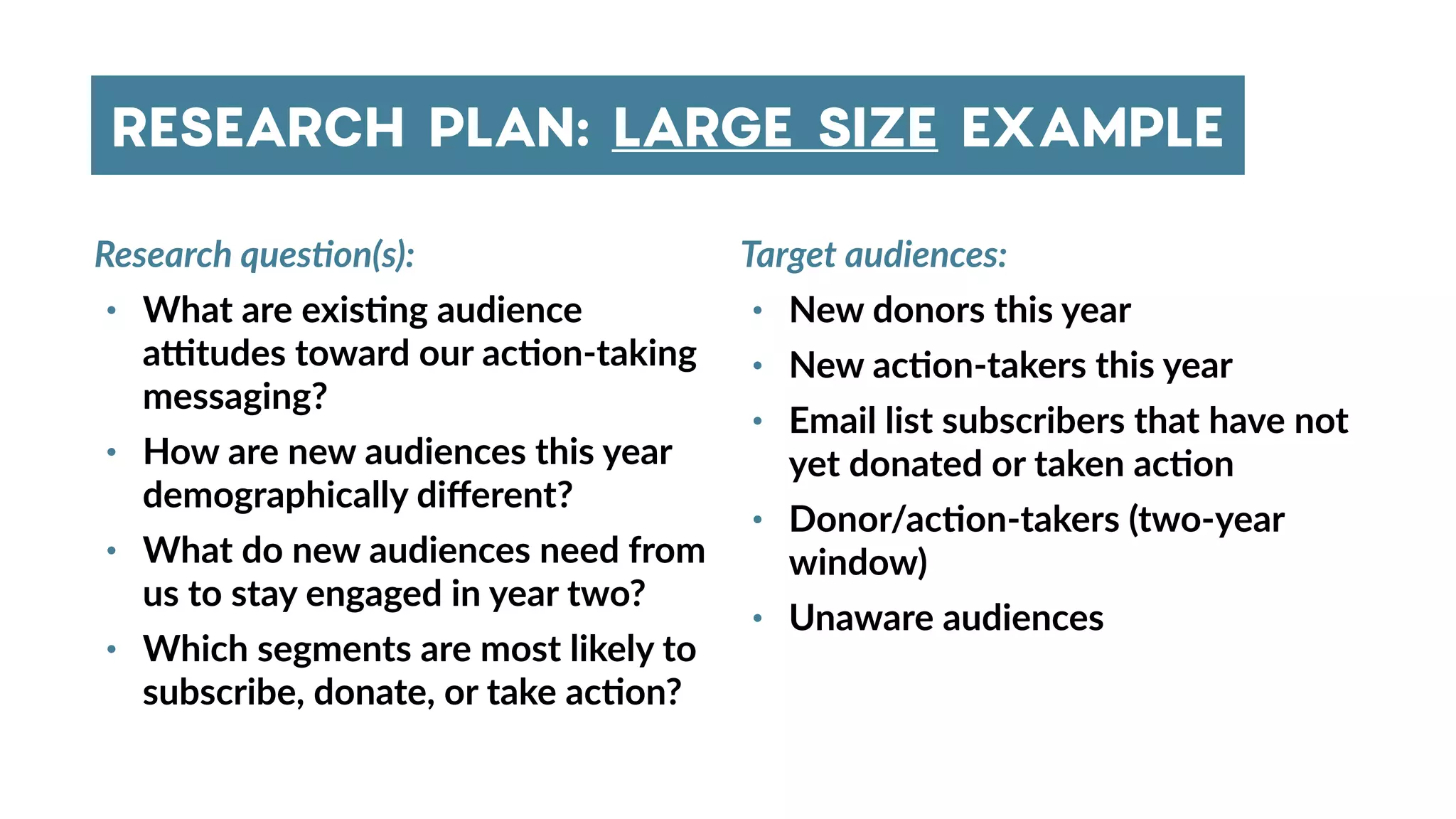
RESEARCH PLAN: LARGE SIZE EXAMPLE
Research quesBon(s):
• What are exis4ng audience
astudes toward our ac4on-taking
messaging?
• How are new audiences this year
demographically different?
• What do new audiences need from
us to stay engaged in year two?
• Which segments are most likely to
subscribe, donate, or take ac4on?
Target audiences:
• New donors this year
• New ac4on-takers this year
• Email list subscribers that have not
yet donated or taken ac4on
• Donor/ac4on-takers (two-year
window)
• Unaware audiences
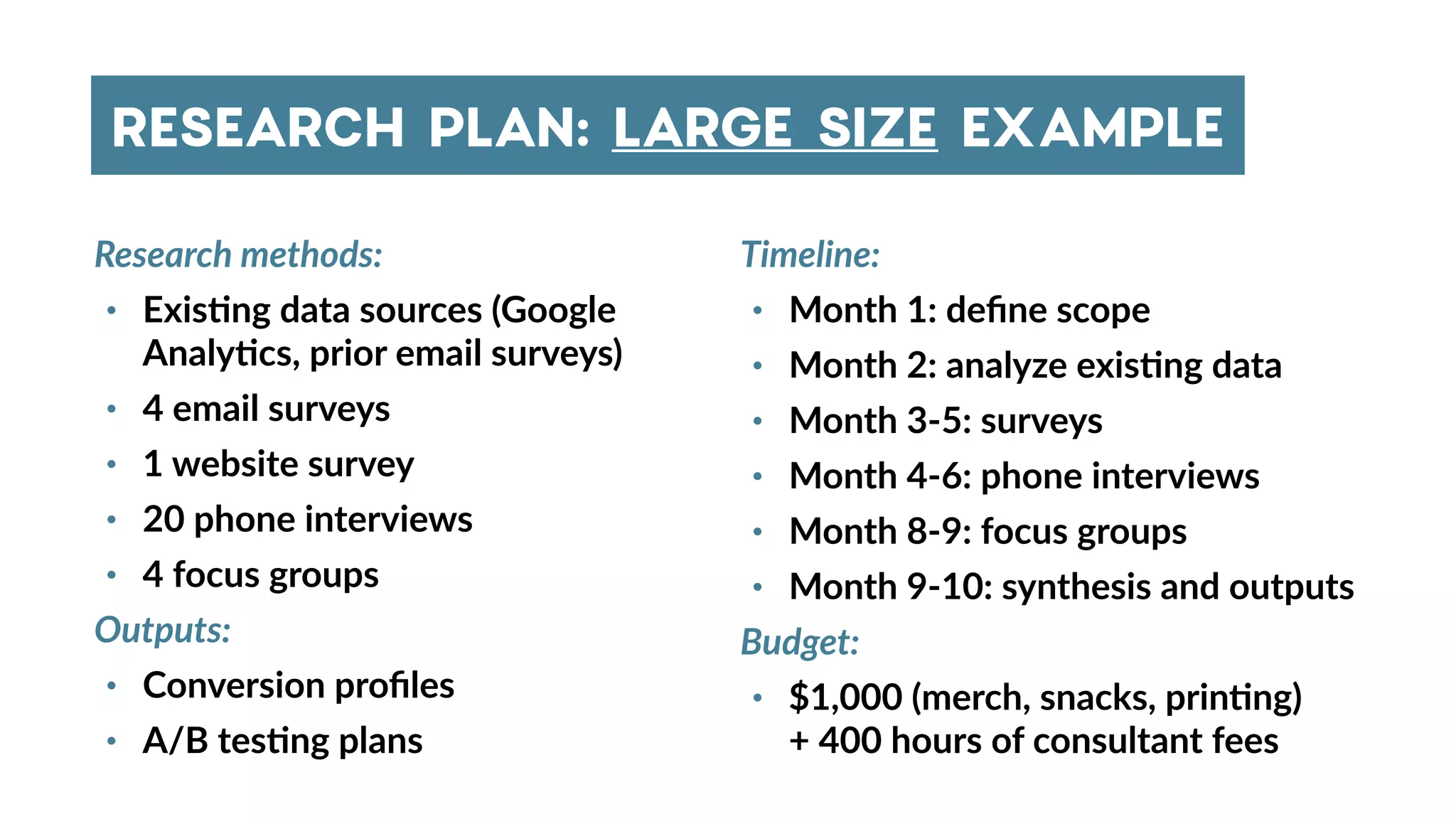
RESEARCH PLAN: LARGE SIZE EXAMPLE
Research methods:
• Exis4ng data sources (Google
Analy4cs, prior email surveys)
• 4 email surveys
• 1 website survey
• 20 phone interviews
• 4 focus groups
Outputs:
• Conversion profiles
• A/B tes4ng plans
Timeline:
• Month 1: define scope
• Month 2: analyze exis4ng data
• Month 3-5: surveys
• Month 4-6: phone interviews
• Month 8-9: focus groups
• Month 9-10: synthesis and outputs
Budget:
• $1,000 (merch, snacks, prin4ng)

+ 400 hours of consultant fees
ACTIVITY #2: MAP OUT
YOUR RESEARCH PLAN
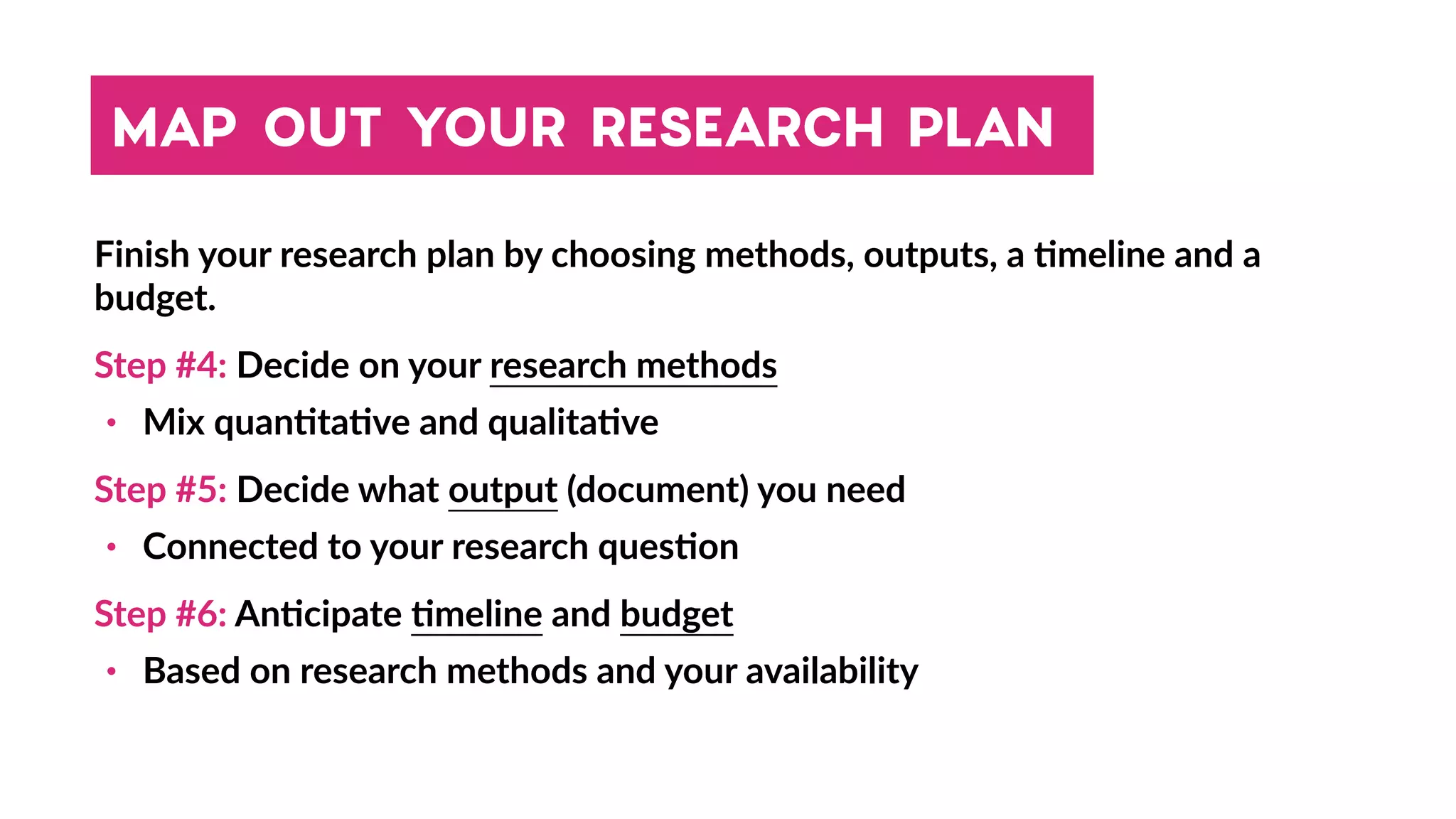
MAP OUT YOUR RESEARCH PLAN
Finish your research plan by choosing methods, outputs, a 4meline and a
budget.
Step #4: Decide on your research methods
• Mix quan4ta4ve and qualita4ve
Step #5: Decide what output (document) you need
• Connected to your research ques4on
Step #6: An4cipate 4meline and budget
• Based on research methods and your availability
MAKING DECISIONS
WITH DATA
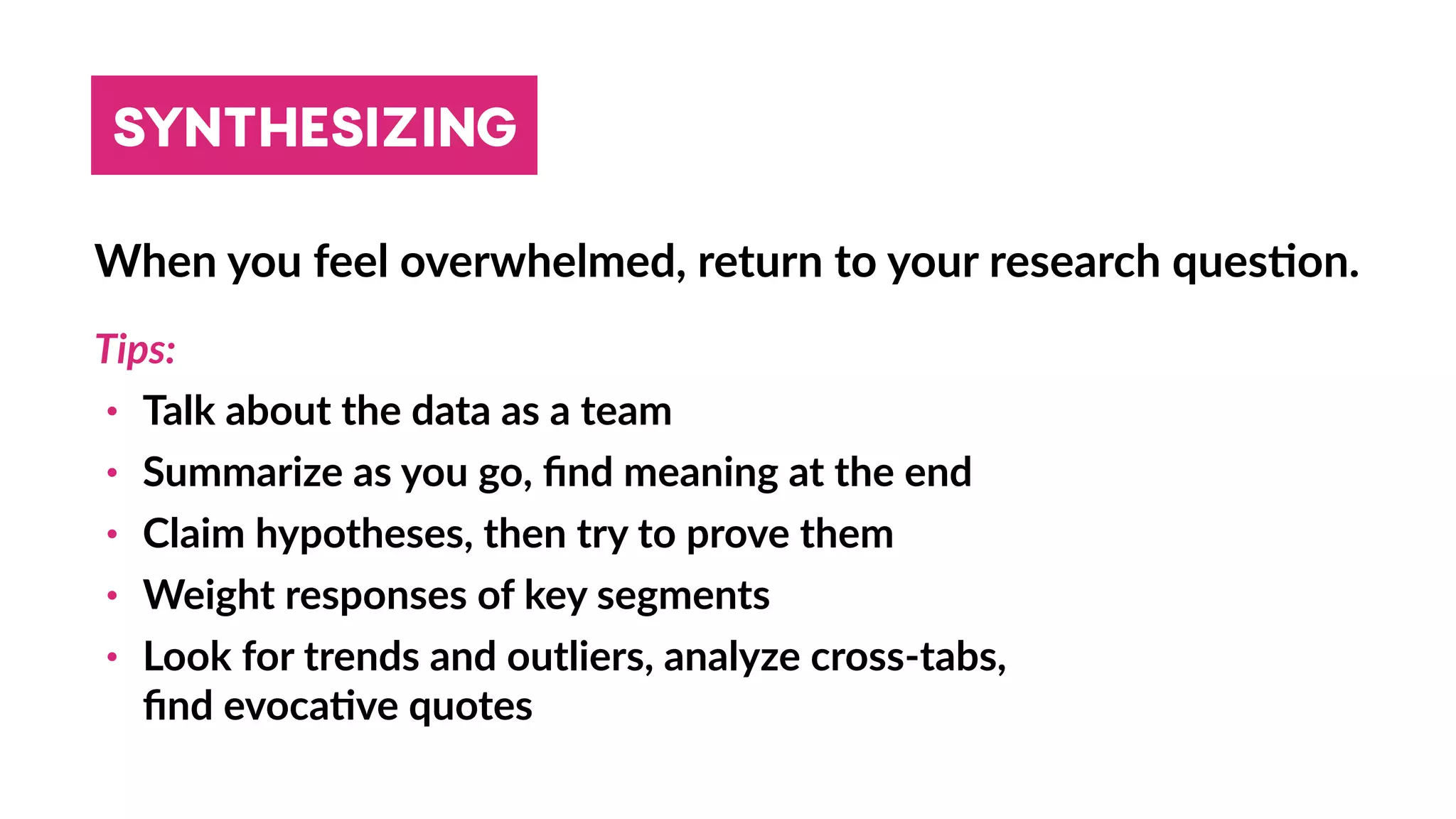
SYNTHESIZING
When you feel overwhelmed, return to your research ques4on.
Tips:
• Talk about the data as a team
• Summarize as you go, find meaning at the end
• Claim hypotheses, then try to prove them
• Weight responses of key segments
• Look for trends and outliers, analyze cross-tabs, 

find evoca4ve quotes
SHARING WITH STAKEHOLDERS
The data doesn’t ma_er if no one understands it.
Tips:
• Work backwards from decision-makers’ needs
• Answer the research ques4on first, then demonstrate “proof”
• Report by audience type, not by research method
• Interpret data, don’t (just) share raw numbers
• Mix visuals, stories, and graphs
SHARING WITH STAKEHOLDERS
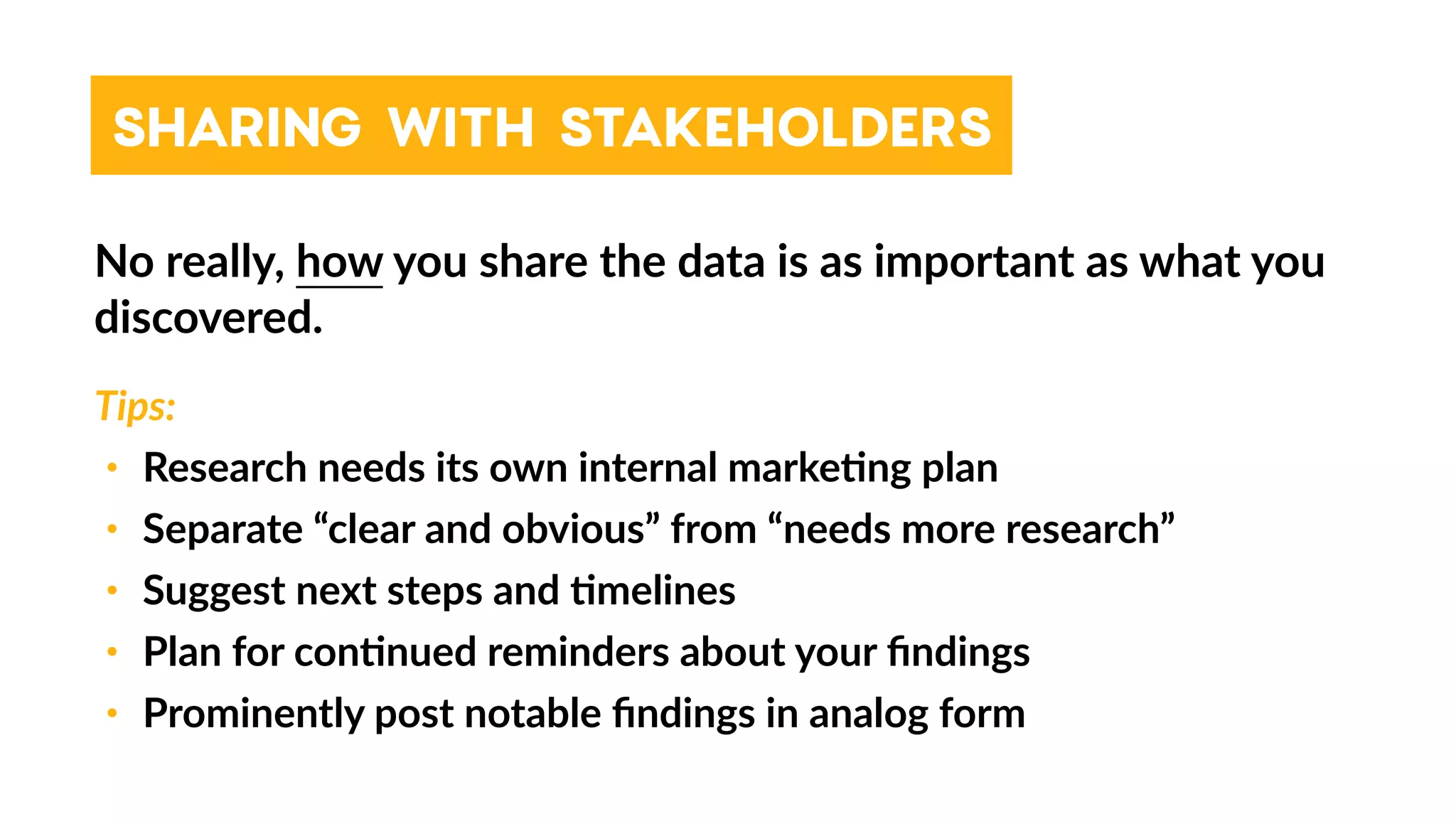
No really, how you share the data is as important as what you
discovered.
Tips:
• Research needs its own internal marke4ng plan
• Separate “clear and obvious” from “needs more research”
• Suggest next steps and 4melines
• Plan for con4nued reminders about your findings
• Prominently post notable findings in analog form
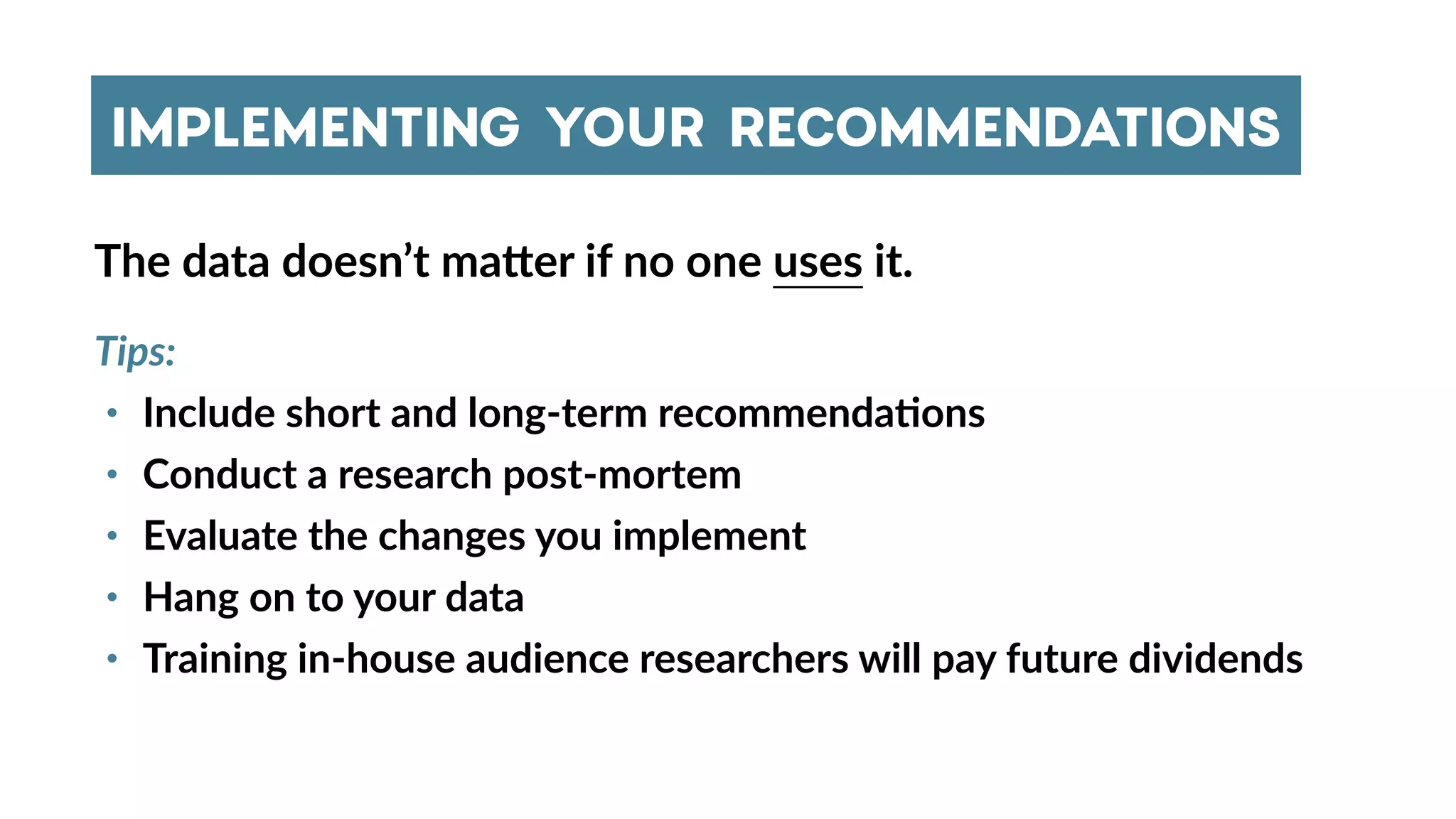
IMPLEMENTING YOUR RECOMMENDATIONS
The data doesn’t ma_er if no one uses it.
Tips:
• Include short and long-term recommenda4ons
• Conduct a research post-mortem
• Evaluate the changes you implement
• Hang on to your data
• Training in-house audience researchers will pay future dividends
Q&A
@devonvsmith | www.measurecrea?ve.com | #NAMPC
A Practical Guide to Actionable Audience Research

A Practical Guide to Actionable Audience Research

  • 1.
    A PRACTICAL GUIDE TOACTIONABLE AUDIENCE RESEARCH NAMP Conference 2018 | #NAMPC @devonvsmith | www.measurecrea?ve.com
  • 2.
    HI! I’M DEVON. I’mthe co-founder of Measure Crea4ve.
  • 3.
    AGENDA • Audience researchstrategy • Ac4vity #1: Framing your research ques4on • Research methods • Ac4vity #2: Map out your plan • Making decisions with data • Q&A
  • 4.
    BY THE END,YOU SHOULD BE ABLE TO: • Plan for an audience research project • Overcome common challenges and pivot your approach • Translate research findings into prac4cal change www.slideshare.net/devonvsmith
  • 5.
  • 6.
    WHY AUDIENCE RESEARCH? Whenwe don’t know: • Who our audiences are, or could be • What our audiences want, think, or respond to • Where the opportunity is for something new • How much to invest in changing our current approach
  • 7.
    Ac4onable research dependson precisely defining the ques4on you’re trying to answer. Tips: • Be specific • Narrow your focus • Make sure the ques4on is answerable CHOOSING A RESEARCH QUESTION
  • 8.
    Examples: • How arenew audiences this year demographically dis4nct from current audiences? • What are the 3 most important ideas to communicate to poten4al donors? • How do La4nX audiences use our space differently than other audiences? • What type of content on our website convinces 4cket buyers to purchase? CHOOSING A RESEARCH QUESTION
  • 9.
    Ac4onable research dependson precisely defining the ques4on you’re trying to answer. Tips: • Narrow your focus • Establish a baseline • Lean toward skep4cs and those with barriers DEFINING YOUR AUDIENCES
  • 10.
    Examples: • Donors givingunder $50 during the past two years • Poten4al sponsors, not yet commi_ed • Survey respondents who were unaware we did _______ • La4nX a_endees to _______ exhibit • Families with kids aged 8-18 and financial means DEFINING YOUR AUDIENCES
  • 11.
    ACTIVITY #1: FRAME YOUROWN RESEARCH QUESTION
  • 12.
    FRAME YOUR OWNRESEARCH QUESTION Begin your audience research plan by framing your goals. Step #1: Choose and frame the research ques4on • Be: specific, narrow, answerable Step #2: Define the audience • Be specific, use comparison, focus on problem areas Step #3: Pay a_en4on in the next sec4on on research methods • Is this right for my research ques4on and audience type? • Does this fit with my budget, 4meline, and situa4on?
  • 13.
  • 14.
    CHOOSING THE RIGHTMETHOD Take a balanced approach to quan4ta4ve and qualita4ve methods. Quan%ta%ve Answers “who,” “what,” and “how many” Qualita%ve Answers “why” and “what else” Scalabe Not representa/ve Fewer resources Higher investment Less subjec/ve Difficult to find trends More truthful answers Not as reliable Predetermined, limited range of ques/ons Dynamic process Slower process Faster results Shallow responses Address sensi/ve issues Data can by dry Stories are more memorable
  • 15.
    Choose the method(s)that best fit your needs. 7 COMMON METHODS Mostly quan4ta4ve Mixed Mostly qualita4ve Exis/ng data sources Observa/onal study Interviews Surveys User tes/ng Focus groups A/B tes/ng
  • 16.
    Use the datayou already have access to. Try it when you: • Don’t have money or 4me • Want to compare your audience to others • Previously collected data METHOD #1: EXISTING DATA SOURCES Format: Timeline: Your data, community data, peer data 1 day - 1 week
  • 17.
    Sources: • Google Analy4cs,Facebook, Twi_er, YouTube analy4cs (demographics) • Yelp, Foursquare, 4cke4ng site reviews (percep4ons) • Surveys/interviews from prior audience research • DataUSA.io (census) • Na4onal Archive of Data on Arts & Culture (analysis) • Arts.gov: Arts Data Profiles (par4cipa4on, outcomes) • SMU/DataArts: Cultural Data Profile (peers) METHOD #1: EXISTING DATA SOURCES
  • 18.
    METHOD #2: SURVEYS Themost common (and ohen misused) method. Try it when you: • Have many ques4ons to ask • Want to represent an en4re popula4on • Want to benchmark data Timeline: Incen4ves: Length: Format: Online, iPad, interac4ve, paper Number: 1,000 responses (1-10% response rate) Tools: SurveyMonkey, Google Surveys, HotJar 10 min 2-4 weeks Usually unnecessary
  • 19.
    Tips: • Have 3colleagues take the survey first • Leave online surveys open for 1-2 weeks, promote it 3x • Make the first ques4on easy, last ques4on open-ended • For sensi4ve ques4ons, ask what a friend would do • Ask for emails of those with interest in future research opportuni4es • An4cipate cross-tab analysis opportuni4es METHOD #2: SURVEYS
  • 20.
    Watch out for: •Overlapping or missing answer choices • Biased ranking answer choices • 2+ consecu4ve open-ended ques4ons • 5+ answer choice op4ons • “Double barreled” ques4ons (asking 2 things in 1 ques4on) • Undefined 4me periods METHOD #2: SURVEYS
  • 21.
    Defined choice quesBonexamples: • Think of the most recent 4me you _______. Which of the following reason(s) best represent what mo4vated you to _______? (reason 1, reason 2, reason 3) • How likely are you to do the following within the next year? (Unlikely, somewhat likely, very likely) • How important to you is it that _______ does the following? (This is a big factor in my decision to support; This plays a small role in my decision to support; This doesn’t play any role in my decision to support; I wasn’t aware ______ did this.) METHOD #2: SURVEYS
  • 22.
    Open-ended quesBon examples: •How would you describe _______ to a friend who was unfamiliar with them? • What is one thing _______ could do to reach more of your friends? • What is one thing _______ could do or tell you that would make you consider becoming a member? • If _______ could do one thing to improve _______, what would it be? METHOD #2: SURVEYS
  • 23.
    METHOD #3: A/BTESTING Audience A tries version A; Audience B tries version B; 
 which gets the best results? Try it when you: • Have stakeholders that disagree on solu4on • Can build a quick, cheap prototype • An4cipate a singular, “majority wins” outcome Format: Timeline: Resources: Tools: Number: Email, social ads, website, in-person 1,000+ per variant (online), 
 50+ (in-person) 1 day - 4+ weeks Google Op4mize “A/B Tes4ng” by Dan Siroker, Op4mizely.com
  • 24.
    Tips: • Have asingle difference between variants • Ensure similar audiences are trying version A and B • Don’t run mul4ple A/B tests in parallel • Before: write down your hypothesis • Aher: summarize test varia4ons and results for reference later • Not all tests will have a clear “winning” result METHOD #3: A/B TESTING
  • 25.
    METHOD #4: OBSERVATIONALSTUDIES Watch audience behavior while they’re in your space or another space. Try it when you: • Want to understand new audiences or behaviors • Want to improve an exis4ng process • Expect easy to interpret behavior Format: Timeline: People: Tools: Length: Number: Dwell 4me, naviga4on path, public spaces 50+ par4cipants 1-4 hours 1+ observers 1 day - 1 week Phone or paper
  • 26.
    Tips: • Maintain inter-observerconsistency through training • Create an “observa4onal protocol” • Track 3-10 elements of behavior or demographics • Observer should be unobtrusive • Consider informed consent (signage) METHOD #4: OBSERVATIONAL STUDIES
  • 27.
    METHOD #5: USERTESTING Watch audiences while they use a simplified, early version of a poten4al solu4on. Try it when you: • Have a working prototype • Have a simple task for a user to complete • Are comfortable sharing in- progress Format: People: Length: Number: In-person, screen-share 10-20 par4cipants 5-30 minutes Moderator (+ video) Timeline: 1 day - 1 week Incen4ves: Jus4fied (gih card, 4cket, merch)
  • 28.
    Tips: • Give thepar4cipant a clearly defined task • Define a list of user behaviors you expect to see • Ask par4cipants to narrate their thought process • Watch for moments of confusion • Resist the tempta4on to step in METHOD #5: USER TESTING
  • 29.
    METHOD #6: INTERVIEWS Peoplelike to be asked their opinions, you’re (probably) not bothering them. Try it when you: • Need to gather stories, situa4ons, characters • Have poten4ally sensi4ve or complex topics to discuss Format: Timeline: People: Incen4ves: Length: Number: Phone, video, in-person, recorded kiosk 3-5 interviewees per type (10-25% response) 5-30 minutes 1 interviewer 
 (+ record audio) 1-4 weeks Usually unnecessary
  • 30.
    Tips: • Have 5-10ques4ons planned, but stay flexible • Be transparent with interview purpose, a_ribu4on • Give interviewees an “out” for difficult ques4ons • Ask interviewees to ar4culate a problem or a situa4on, not to find a solu4on • Plan for no-shows, re-schedules, and “bad” interviews METHOD #6: INTERVIEWS
  • 31.
    Interview quesBon examples: •Tell me about the first 4me you learned about _______. • What was your reac4on when _______ did _______? • Walk me through the moments just before your most recent decision to _______. • I’m going to give you a short descrip4on of six different quali4es about _______. We want to hear your take on how each resonates with you. • What are the benefits that you value most from _______? METHOD #6: INTERVIEWS
  • 32.
    METHOD #7: FOCUSGROUPS When audiences interact with each other, new conversa4ons arise. Try it when you: • Have audiences in-person • Want to hear diverse or conflic4ng opinions, astudes • Want to go deep on 1-3 topics 4-7 par4cipants per group Number: Timeline: People: Incen4ves: Length: Snacks, merch 1-2 weeks Moderator and note- taker (+ record audio) 60-90 minutes
  • 33.
    Tips: • Consider powerdynamics of the group • Mix individual ques4ons, group conversa4on, and an ac4vity • Run at least one prac4ce session • Ask the group to reflect or react to each other’s answers • Summarize what you hear from the group and see if they concur METHOD #7: FOCUS GROUPS
  • 34.
    Example agenda: • Soloques4on: What was your awareness of _______ when we first contacted you? • Scenario 1: If you saw this ad on Facebook, what would your first reac4on be? Your next step? • Group conversa4on: Can anyone share an example of a recent 4me that they _______? How similar is everyone else’s experience? • Scenario 2: If you visited this sec4on of the website, what would you expect to find? • Group ac4vity: sor4ng items into categories; walk me through why you chose these categories. METHOD #7: FOCUS GROUPS
  • 35.
    RESEARCH PLAN: SMALLSIZE EXAMPLE Research quesBon(s): • Which features are cri4cal to priori4ze in the prototype? • Are the instruc4ons included in the prototype clear? Target audiences: • Devised theatre-makers Research methods: • User tes4ng (15 par4cipants) Outputs: • Feature roadmap • Content map Timeline: • Week 1-2: define scope • Week 3-4: user tes4ng, synthesis, and delivery of outputs Budget: • $200 (lunch) 
 + 25 hours of consultant fees
  • 36.
    RESEARCH PLAN: MEDIUMSIZE EXAMPLE Research quesBon(s): • What are the 3 most important ideas to communicate about our organiza4on to new audiences? Target audiences: • Poten4al a_endees, with low awareness of us • Regular a_endees, with poten4al to give • First 4me major donors Research methods: • Exis4ng data sources (1 prior email survey) • 3 focus groups • 15 audience interviews • 1 email survey
  • 37.
    RESEARCH PLAN: MEDIUMSIZE EXAMPLE Outputs: • Brand guidelines Timeline: • Month 1: define scope • Month 2-3: focus groups • Month 4-5: audience interviews • Month 6: survey • Month 7: synthesis and delivery of outputs Budget: • $0 + 225 hours of consultant fees
  • 38.
    RESEARCH PLAN: LARGESIZE EXAMPLE Research quesBon(s): • What are exis4ng audience astudes toward our ac4on-taking messaging? • How are new audiences this year demographically different? • What do new audiences need from us to stay engaged in year two? • Which segments are most likely to subscribe, donate, or take ac4on? Target audiences: • New donors this year • New ac4on-takers this year • Email list subscribers that have not yet donated or taken ac4on • Donor/ac4on-takers (two-year window) • Unaware audiences
  • 39.
    RESEARCH PLAN: LARGESIZE EXAMPLE Research methods: • Exis4ng data sources (Google Analy4cs, prior email surveys) • 4 email surveys • 1 website survey • 20 phone interviews • 4 focus groups Outputs: • Conversion profiles • A/B tes4ng plans Timeline: • Month 1: define scope • Month 2: analyze exis4ng data • Month 3-5: surveys • Month 4-6: phone interviews • Month 8-9: focus groups • Month 9-10: synthesis and outputs Budget: • $1,000 (merch, snacks, prin4ng)
 + 400 hours of consultant fees
  • 40.
    ACTIVITY #2: MAPOUT YOUR RESEARCH PLAN
  • 41.
    MAP OUT YOURRESEARCH PLAN Finish your research plan by choosing methods, outputs, a 4meline and a budget. Step #4: Decide on your research methods • Mix quan4ta4ve and qualita4ve Step #5: Decide what output (document) you need • Connected to your research ques4on Step #6: An4cipate 4meline and budget • Based on research methods and your availability
  • 42.
  • 43.
    SYNTHESIZING When you feeloverwhelmed, return to your research ques4on. Tips: • Talk about the data as a team • Summarize as you go, find meaning at the end • Claim hypotheses, then try to prove them • Weight responses of key segments • Look for trends and outliers, analyze cross-tabs, 
 find evoca4ve quotes
  • 44.
    SHARING WITH STAKEHOLDERS Thedata doesn’t ma_er if no one understands it. Tips: • Work backwards from decision-makers’ needs • Answer the research ques4on first, then demonstrate “proof” • Report by audience type, not by research method • Interpret data, don’t (just) share raw numbers • Mix visuals, stories, and graphs
  • 45.
    SHARING WITH STAKEHOLDERS Noreally, how you share the data is as important as what you discovered. Tips: • Research needs its own internal marke4ng plan • Separate “clear and obvious” from “needs more research” • Suggest next steps and 4melines • Plan for con4nued reminders about your findings • Prominently post notable findings in analog form
  • 46.
    IMPLEMENTING YOUR RECOMMENDATIONS Thedata doesn’t ma_er if no one uses it. Tips: • Include short and long-term recommenda4ons • Conduct a research post-mortem • Evaluate the changes you implement • Hang on to your data • Training in-house audience researchers will pay future dividends
  • 47.