What is the Toulmin method of argumentation? Claim – Data - Warrant
Types of arguments The Toulmin Model Claim, Data, Because
Who is Stephen Toulmin? He was a British philosopher who wrote a book called The Uses of Argument (1958).  Toulmin was looking for a method that accurately described the way people make convincing and reasonable argument.  Because Toulmin argument takes into account the complications in life— all those situations when people have to qualify their thoughts with words such as  sometimes ,  often ,  presumably ,  unless , and  almost — his method isn’t as airtight as formal logic.  But for exactly that reason, Toulmin logic has become a powerful and, for the most part, practical tool for understanding and shaping argument.
Making Claims In the Toulmin model, arguments begin with claims, which are debatable and controversial statements or assertions you hope to prove. Notice in this model the arguments depend on conditions set by others— your audience or readers. It’s raining  might be an innocent statement of fact in one situation; in another, it might provoke a debate:  No, it’s not.  That’s sleet. And so argument begins, involving a question of definition.
The Toulmin Model Claim : the proposition that the arguer is supporting.  It  must  be an opinion and cannot be a fact. Data : the specific evidence or reason used to support the claim (often introduced with the word “because” or “since”; sometimes this is the claim of another argument) Warrant : the inference that allows you to move from the grounds to the claim (often only implied in the argument)
Other Elements Backing  –  Support for the warrant, backing the reason given Grounds  – Facts, statistics, expert testimony, observations Qualifier  – Degree of certainty
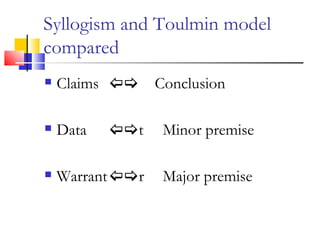
Syllogism and Toulmin model compared Claims  Conclusion Data  Minor premise Warrant  Major premise
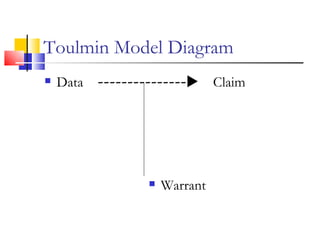
Toulmin Model Diagram Data  ---------------  Claim Warrant
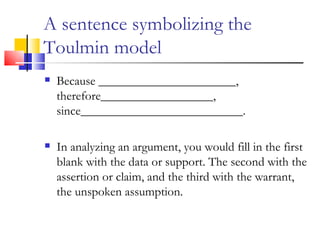
A sentence symbolizing the Toulmin model Because ______________________, therefore__________________, since__________________________. In analyzing an argument, you would fill in the first blank with the data or support. The second with the assertion or claim, and the third with the warrant, the unspoken assumption.
Imagine someone looking over your shoulder As you use Toulmin, image a crowd of “prospective readers” hovering over your shoulder, asking questions.  At every stage in Toulmin argument— making a claim, offering a reason, or studying a warrant— you might converse with those nosy readers, imagining them as skeptical , demanding, even a bit testy.
Rebuttal They may get on your nerves, but they’ll likely help you foresee the objections and reservations real readers will have regarding your arguments. In the Toulmin system, potential objections to a claim are called  conditions of rebuttal . Understanding and reacting to these conditions are essential to back up your claim where it is weak, but also to understand the reasonable objections of people who see the world differently.
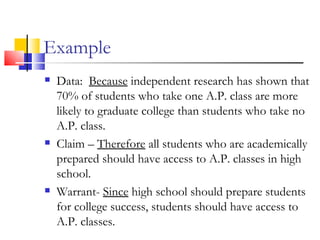
Example Data:  Because  independent research has shown that 70% of students who take one A.P. class are more likely to graduate college than students who take no A.P. class. Claim –  Therefore  all students who are academically prepared should have access to A.P. classes in high school. Warrant-  Since  high school should prepare students for college success, students should have access to A.P. classes.
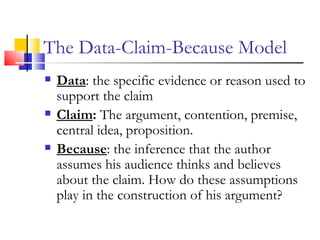
The Data-Claim-Because Model Data : the specific evidence or reason used to support the claim  Claim :  The argument, contention, premise, central idea, proposition. Because : the inference that the author assumes his audience thinks and believes about the claim.   How do these assumptions play in the construction of his argument?
Data, Claim, Because Model Diagram Data ---------------Claim [Because]

What is toulmin

  • 1.
    What is theToulmin method of argumentation? Claim – Data - Warrant
  • 2.
    Types of argumentsThe Toulmin Model Claim, Data, Because
  • 3.
    Who is StephenToulmin? He was a British philosopher who wrote a book called The Uses of Argument (1958). Toulmin was looking for a method that accurately described the way people make convincing and reasonable argument. Because Toulmin argument takes into account the complications in life— all those situations when people have to qualify their thoughts with words such as sometimes , often , presumably , unless , and almost — his method isn’t as airtight as formal logic. But for exactly that reason, Toulmin logic has become a powerful and, for the most part, practical tool for understanding and shaping argument.
  • 4.
    Making Claims Inthe Toulmin model, arguments begin with claims, which are debatable and controversial statements or assertions you hope to prove. Notice in this model the arguments depend on conditions set by others— your audience or readers. It’s raining might be an innocent statement of fact in one situation; in another, it might provoke a debate: No, it’s not. That’s sleet. And so argument begins, involving a question of definition.
  • 5.
    The Toulmin ModelClaim : the proposition that the arguer is supporting. It must be an opinion and cannot be a fact. Data : the specific evidence or reason used to support the claim (often introduced with the word “because” or “since”; sometimes this is the claim of another argument) Warrant : the inference that allows you to move from the grounds to the claim (often only implied in the argument)
  • 6.
    Other Elements Backing – Support for the warrant, backing the reason given Grounds – Facts, statistics, expert testimony, observations Qualifier – Degree of certainty
  • 7.
    Syllogism and Toulminmodel compared Claims  Conclusion Data  Minor premise Warrant  Major premise
  • 8.
    Toulmin Model DiagramData  ---------------  Claim Warrant
  • 9.
    A sentence symbolizingthe Toulmin model Because ______________________, therefore__________________, since__________________________. In analyzing an argument, you would fill in the first blank with the data or support. The second with the assertion or claim, and the third with the warrant, the unspoken assumption.
  • 10.
    Imagine someone lookingover your shoulder As you use Toulmin, image a crowd of “prospective readers” hovering over your shoulder, asking questions. At every stage in Toulmin argument— making a claim, offering a reason, or studying a warrant— you might converse with those nosy readers, imagining them as skeptical , demanding, even a bit testy.
  • 11.
    Rebuttal They mayget on your nerves, but they’ll likely help you foresee the objections and reservations real readers will have regarding your arguments. In the Toulmin system, potential objections to a claim are called conditions of rebuttal . Understanding and reacting to these conditions are essential to back up your claim where it is weak, but also to understand the reasonable objections of people who see the world differently.
  • 12.
    Example Data: Because independent research has shown that 70% of students who take one A.P. class are more likely to graduate college than students who take no A.P. class. Claim – Therefore all students who are academically prepared should have access to A.P. classes in high school. Warrant- Since high school should prepare students for college success, students should have access to A.P. classes.
  • 13.
    The Data-Claim-Because ModelData : the specific evidence or reason used to support the claim Claim : The argument, contention, premise, central idea, proposition. Because : the inference that the author assumes his audience thinks and believes about the claim. How do these assumptions play in the construction of his argument?
  • 14.
    Data, Claim, BecauseModel Diagram Data ---------------Claim [Because]

Editor's Notes

  • #3 Stephen Toulmin, who developed model for substantiating claims made by writers (2003). Toulmin begins from the position that the goal of every argument is to establish a claim and then support the claim through data, warrants and qualifiers. You need to be able to analyze the plausibility of the claim. When a teacher tells you that you need more support, he or she is suggested that you need more data. The sociology teacher can advise you on your paper of the causes of child abuse to qualify your conclusion. Your AP teacher can remind you to anticipate possible rebuttals to your argument about the war in Vietnam.
  • #10 With this formula, claim seems not merely an assertion but rather the logical conclusion that must e reached after testing evidence that supports a belief. Because such an approach helps students understand the elements of an argument, it is therefore a valuable pedagogical technique, since greater understanding among our students is a desirable quality. You will notice the Toulmin model at work in that last sentence.