Modern argument, simplified
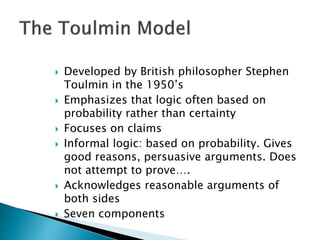
 Developed by British philosopher Stephen
Toulmin in the 1950’s
 Emphasizes that logic often based on
probability rather than certainty
 Focuses on claims
 Informal logic: based on probability. Gives
good reasons, persuasive arguments. Does
not attempt to prove….
 Acknowledges reasonable arguments of
both sides
 Seven components
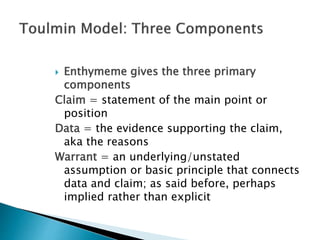
 Enthymeme gives the three primary
components
Claim = statement of the main point or
position
Data = the evidence supporting the claim,
aka the reasons
Warrant = an underlying/unstated
assumption or basic principle that connects
data and claim; as said before, perhaps
implied rather than explicit
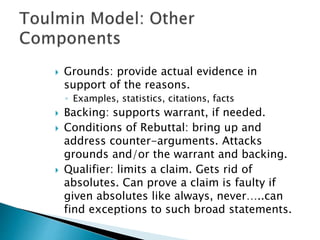
 Grounds: provide actual evidence in
support of the reasons.
◦ Examples, statistics, citations, facts
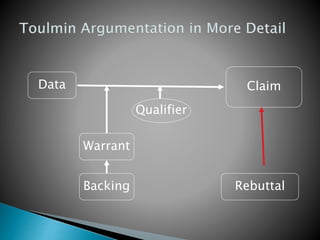
 Backing: supports warrant, if needed.
 Conditions of Rebuttal: bring up and
address counter-arguments. Attacks
grounds and/or the warrant and backing.
 Qualifier: limits a claim. Gets rid of
absolutes. Can prove a claim is faulty if
given absolutes like always, never…..can
find exceptions to such broad statements.
ClaimData
Qualifier
Warrant
Backing Rebuttal
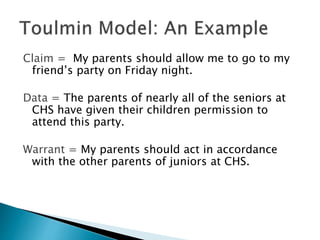
Claim = My parents should allow me to go to my
friend’s party on Friday night.
Data = The parents of nearly all of the seniors at
CHS have given their children permission to
attend this party.
Warrant = My parents should act in accordance
with the other parents of juniors at CHS.
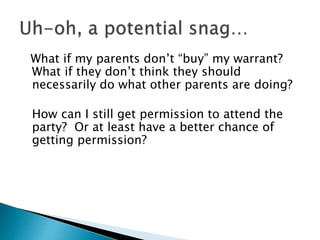
What if my parents don’t “buy” my warrant?
What if they don’t think they should
necessarily do what other parents are doing?
How can I still get permission to attend the
party? Or at least have a better chance of
getting permission?
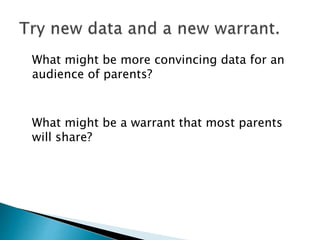
What might be more convincing data for an
audience of parents?
What might be a warrant that most parents
will share?

Toulmin presentation

  • 1.
  • 2.
     Developed byBritish philosopher Stephen Toulmin in the 1950’s  Emphasizes that logic often based on probability rather than certainty  Focuses on claims  Informal logic: based on probability. Gives good reasons, persuasive arguments. Does not attempt to prove….  Acknowledges reasonable arguments of both sides  Seven components
  • 3.
     Enthymeme givesthe three primary components Claim = statement of the main point or position Data = the evidence supporting the claim, aka the reasons Warrant = an underlying/unstated assumption or basic principle that connects data and claim; as said before, perhaps implied rather than explicit
  • 4.
     Grounds: provideactual evidence in support of the reasons. ◦ Examples, statistics, citations, facts  Backing: supports warrant, if needed.  Conditions of Rebuttal: bring up and address counter-arguments. Attacks grounds and/or the warrant and backing.  Qualifier: limits a claim. Gets rid of absolutes. Can prove a claim is faulty if given absolutes like always, never…..can find exceptions to such broad statements.
  • 5.
  • 6.
    Claim = Myparents should allow me to go to my friend’s party on Friday night. Data = The parents of nearly all of the seniors at CHS have given their children permission to attend this party. Warrant = My parents should act in accordance with the other parents of juniors at CHS.
  • 7.
    What if myparents don’t “buy” my warrant? What if they don’t think they should necessarily do what other parents are doing? How can I still get permission to attend the party? Or at least have a better chance of getting permission?
  • 8.
    What might bemore convincing data for an audience of parents? What might be a warrant that most parents will share?