TOULMIN’S MODEL
DEVELOPED BY : STEPHEN E . TOULMIN
PRESENTATION BY: MALA DEEP UPADHAYA
2017-SEPTEMBER-4
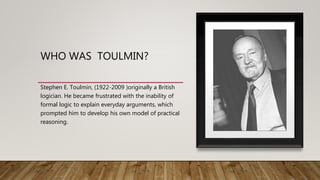
WHO WAS TOULMIN?
Stephen E. Toulmin, (1922-2009 )originally a British
logician. He became frustrated with the inability of
formal logic to explain everyday arguments, which
prompted him to develop his own model of practical
reasoning.
TOULMIN MODEL
Toulmin model is valuable adjunct to
modern rhetoric with heuristic ability to
generate new ideas by focusing on
audience and its flexibility.
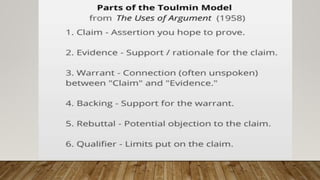
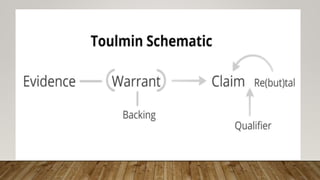
PRIMARY AND SECONDARY COMPONENTS
PRIMARY
• CLAIM
• GROUNDS
• WARRENT
SECONDARY
• BACKING
• REBUTTAL
• QUALIFIERS
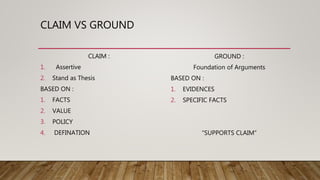
CLAIM VS GROUND
CLAIM :
1. Assertive
2. Stand as Thesis
BASED ON :
1. FACTS
2. VALUE
3. POLICY
4. DEFINATION
GROUND :
Foundation of Arguments
BASED ON :
1. EVIDENCES
2. SPECIFIC FACTS
“SUPPORTS CLAIM”
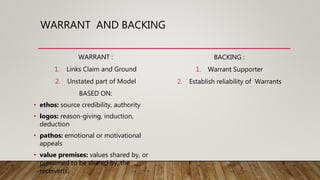
WARRANT AND BACKING
WARRANT :
1. Links Claim and Ground
2. Unstated part of Model
BASED ON:
• ethos: source credibility, authority
• logos: reason-giving, induction,
deduction
• pathos: emotional or motivational
appeals
• value premises: values shared by, or
presumed to be shared by, the
receiver(s)
BACKING :
1. Warrant Supporter
2. Establish reliability of Warrants
REBUTTAL VS QUALIFIERS
REBUTTAL :
• It is a tool
• Potential objection to Claim
• Acknowledge exception that might
invalided claim
QUALIFIERS :
• It is a tool
• Limits put on Claim
SUBSUMES OF MODEL
The model’s ability to subsumes these logics result in idea generating
.
• INDUCTIVE REASEONING
• DEDUCTIVE REASEONING
• ANALOGICAL REASONING
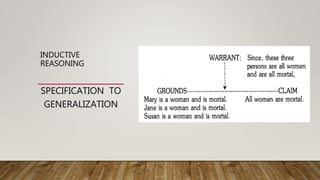
INDUCTIVE
REASONING
SPECIFICATION TO
GENERALIZATION
DEDUCTIVE
REASONING
GENERALIZATION
TO
SPECIFICATION
ANALOGICAL
REASONING
SHOWS SEVERAL
SIMILARITES BETWEEN
TWO OBJECTS ,BACKED
BY GENERAL
CONCLUSION FOR
SPECIFIC CLAIM
CHECKING ARGUMENT'S CLARITY AND EFFICACY
Toulmin suggest applying the following questions at each step :
1. What Position do I want my audience to take?
2. Where must my audience begin so that they will take the step
I want them to take and agree to my claim?
3. What is the linking idea between grounds and claim?
4. Is the move from ground to claim safe and reliable?
5. What possibilities might upsets the arguments?
6. Is a qualification necessary?
LIMITATION OF MODEL
• Depends upon the arguer’s willingness to think critically
and creatively.
• Helpful for creating the OUTLINE of an arguments , not
the WHOLE things.
WORKS CITED
karbach, Joan . ”Using Toulmin’s Model Of
Argumentation” (type: Pdf).
Wright, David . “The Toulmin Model Of Argument”
StudioLab, Furman University (2012).

Toulmin's model

  • 1.
    TOULMIN’S MODEL DEVELOPED BY: STEPHEN E . TOULMIN PRESENTATION BY: MALA DEEP UPADHAYA 2017-SEPTEMBER-4
  • 2.
    WHO WAS TOULMIN? StephenE. Toulmin, (1922-2009 )originally a British logician. He became frustrated with the inability of formal logic to explain everyday arguments, which prompted him to develop his own model of practical reasoning.
  • 3.
    TOULMIN MODEL Toulmin modelis valuable adjunct to modern rhetoric with heuristic ability to generate new ideas by focusing on audience and its flexibility.
  • 4.
    PRIMARY AND SECONDARYCOMPONENTS PRIMARY • CLAIM • GROUNDS • WARRENT SECONDARY • BACKING • REBUTTAL • QUALIFIERS
  • 7.
    CLAIM VS GROUND CLAIM: 1. Assertive 2. Stand as Thesis BASED ON : 1. FACTS 2. VALUE 3. POLICY 4. DEFINATION GROUND : Foundation of Arguments BASED ON : 1. EVIDENCES 2. SPECIFIC FACTS “SUPPORTS CLAIM”
  • 8.
    WARRANT AND BACKING WARRANT: 1. Links Claim and Ground 2. Unstated part of Model BASED ON: • ethos: source credibility, authority • logos: reason-giving, induction, deduction • pathos: emotional or motivational appeals • value premises: values shared by, or presumed to be shared by, the receiver(s) BACKING : 1. Warrant Supporter 2. Establish reliability of Warrants
  • 9.
    REBUTTAL VS QUALIFIERS REBUTTAL: • It is a tool • Potential objection to Claim • Acknowledge exception that might invalided claim QUALIFIERS : • It is a tool • Limits put on Claim
  • 10.
    SUBSUMES OF MODEL Themodel’s ability to subsumes these logics result in idea generating . • INDUCTIVE REASEONING • DEDUCTIVE REASEONING • ANALOGICAL REASONING
  • 11.
  • 12.
  • 13.
    ANALOGICAL REASONING SHOWS SEVERAL SIMILARITES BETWEEN TWOOBJECTS ,BACKED BY GENERAL CONCLUSION FOR SPECIFIC CLAIM
  • 14.
    CHECKING ARGUMENT'S CLARITYAND EFFICACY Toulmin suggest applying the following questions at each step : 1. What Position do I want my audience to take? 2. Where must my audience begin so that they will take the step I want them to take and agree to my claim? 3. What is the linking idea between grounds and claim? 4. Is the move from ground to claim safe and reliable? 5. What possibilities might upsets the arguments? 6. Is a qualification necessary?
  • 15.
    LIMITATION OF MODEL •Depends upon the arguer’s willingness to think critically and creatively. • Helpful for creating the OUTLINE of an arguments , not the WHOLE things.
  • 16.
    WORKS CITED karbach, Joan. ”Using Toulmin’s Model Of Argumentation” (type: Pdf). Wright, David . “The Toulmin Model Of Argument” StudioLab, Furman University (2012).