

What Is The Difference Between
Artificial Intelligence (AI)?
Weak (Narrow) And Strong (General)
© 2020 Bernard Marr, Bernard Marr & Co. All rights reserved
Title
Text
Introduction
Introduction
Did you know there are two forms of artificial intelligence? Weak or narrow
artificial intelligence (AI) is what we encounter daily today. Strong or general
AI is the next phase where machines can think like humans without being
programmed by humans. Learn the differences between weak and strong AI.
What Is The Difference Between Weak (Narrow)
And Strong (General) Artificial Intelligence (AI)?
© 2020 Bernard Marr, Bernard Marr & Co. All rights reserved
Although artificial intelligence (AI) was once a rare concept, most people
experience AI in their daily lives. From digital personal assistants such as Alexa
and Google Home to driving directions and recommendations, artificial
intelligence is no longer an idea only seen in science fiction books and movies.
While most individuals understand AI is when machines complete higher-level
functions such as recognizing speech and making decisions like humans can,
but not everyone might understand that there is a distinction between weak AI
and strong AI. So, let’s take a look at the differences between weak, also known
as narrow AI, and strong or general AI.
© 2020 Bernard Marr, Bernard Marr & Co. All rights reserved
Weak (Narrow) AI
The artificial intelligence that we now see in our daily lives is what we refer to as weak (narrow AI). It’s
actually the only artificial intelligence that exists today. It’s called weak because it has limited
functionality. The AI algorithms are built to accomplish specific tasks rather than possess full cognitive
abilities like the human brain. Weak AI illustrates that intelligent behavior can be modeled. Examples of
weak AI include Siri, Alexa and Google search.
Weak AI is in action when there can be a programmed response such as when AI runs a chess
program. These algorithms will process data to find things they know and then classify based on
training/programming. They can’t veer off the programmed path.
Weak AI has changed many aspects of business and our personal lifestyles by being able to solve or
complete tasks much quicker or better than humans can. It’s what powers chatbots and
recommendation engines on streaming services. Weak AI can also discover patterns in volumes of data
to help diagnose disease and develop treatments. It’s certainly been a transformative technology thus
far.
© 2020 Bernard Marr, Bernard Marr & Co. All rights reserved
Strong (General) AI
Strong or general artificial intelligence at this point is only theoretical. It’s when
machines develop consciousness and decision-making on par (or better) than
humans. When strong AI is achieved, the machines won’t rely on human
programming to be able to think or accomplish tasks. This is the AI imagined in
sci-fi stories such as “I-Robot” and “The Terminator.”
Additionally, machines with strong AI will be able to exhibit self-awareness and
emotions. Ultimately, the goal with general AI is a machine that has intelligence
in true human form.
© 2020 Bernard Marr, Bernard Marr & Co. All rights reserved
Weak AI and Strong AI Comparison
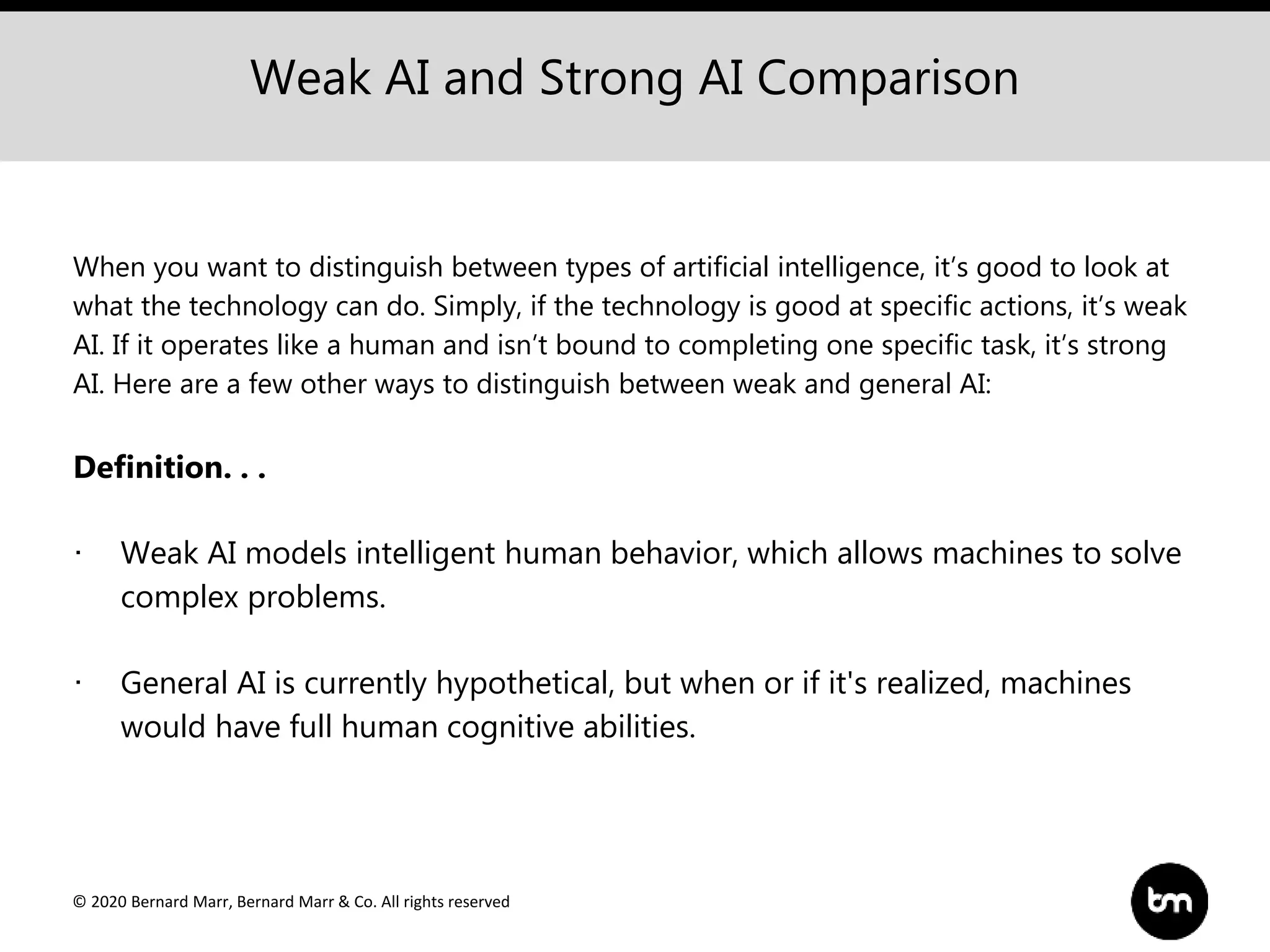
When you want to distinguish between types of artificial intelligence, it’s good to look at
what the technology can do. Simply, if the technology is good at specific actions, it’s weak
AI. If it operates like a human and isn’t bound to completing one specific task, it’s strong
AI. Here are a few other ways to distinguish between weak and general AI:
Definition. . .
· Weak AI models intelligent human behavior, which allows machines to solve
complex problems.
· General AI is currently hypothetical, but when or if it's realized, machines
would have full human cognitive abilities.
© 2020 Bernard Marr, Bernard Marr & Co. All rights reserved
Weak AI and Strong AI Comparison
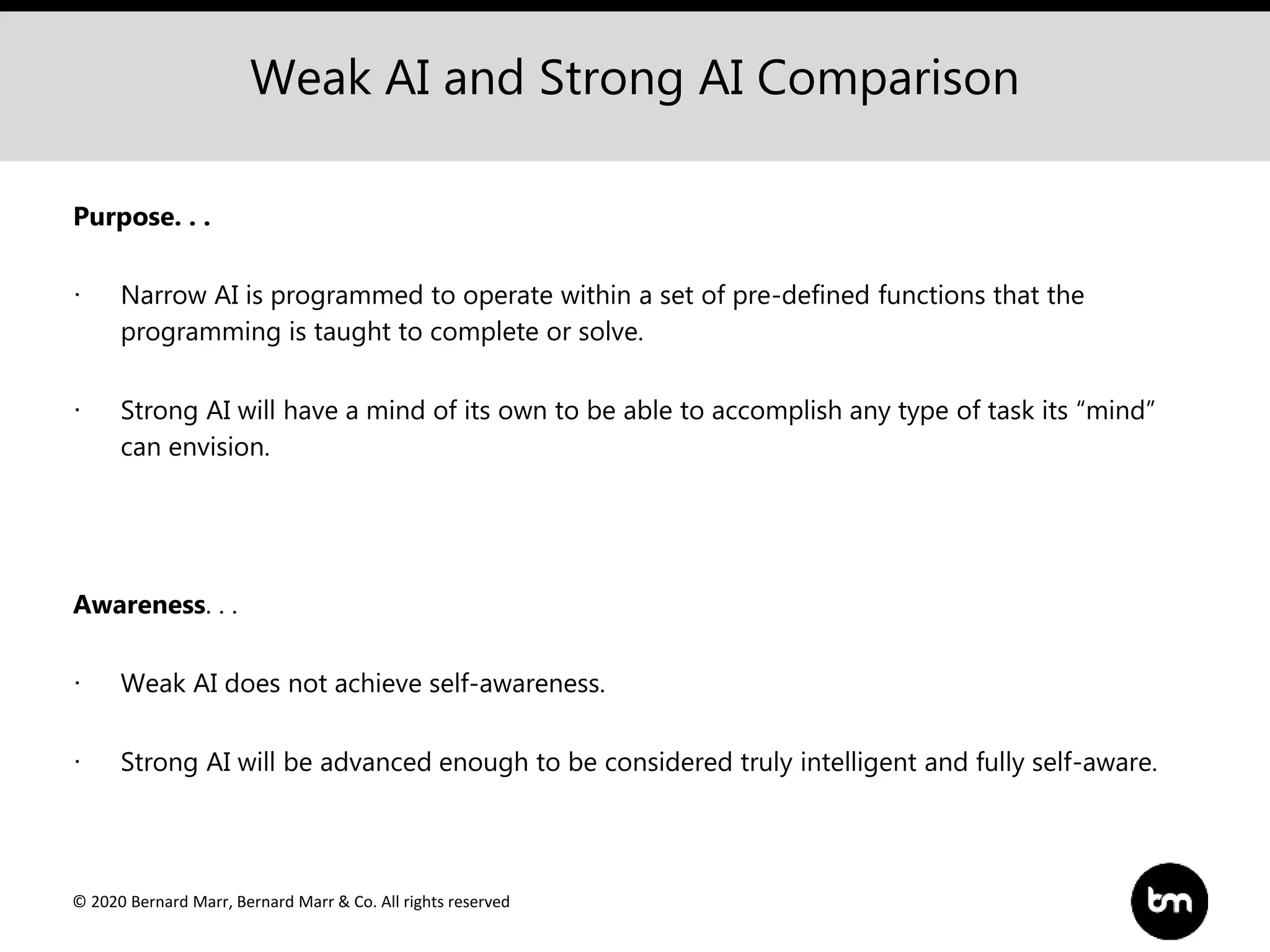
Purpose. . .
· Narrow AI is programmed to operate within a set of pre-defined functions that the
programming is taught to complete or solve.
· Strong AI will have a mind of its own to be able to accomplish any type of task its “mind”
can envision.
Awareness. . .
· Weak AI does not achieve self-awareness.
· Strong AI will be advanced enough to be considered truly intelligent and fully self-aware.
© 2020 Bernard Marr, Bernard Marr & Co. All rights reserved
Weak AI and Strong AI Comparison
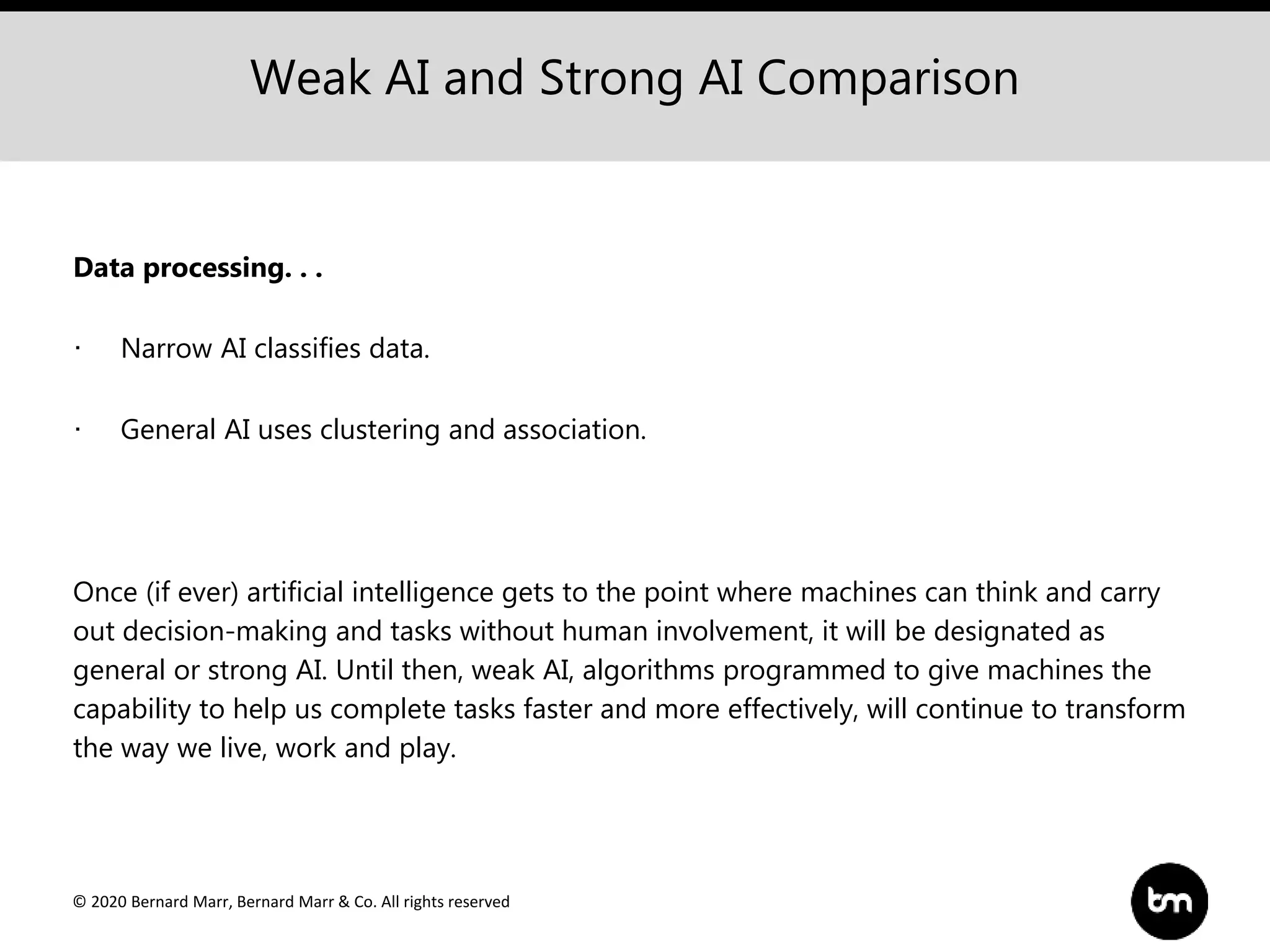
Data processing. . .
· Narrow AI classifies data.
· General AI uses clustering and association.
Once (if ever) artificial intelligence gets to the point where machines can think and carry
out decision-making and tasks without human involvement, it will be designated as
general or strong AI. Until then, weak AI, algorithms programmed to give machines the
capability to help us complete tasks faster and more effectively, will continue to transform
the way we live, work and play.
© 2020 Bernard Marr, Bernard Marr & Co. All rights reserved
Weak AI and Strong AI Comparison
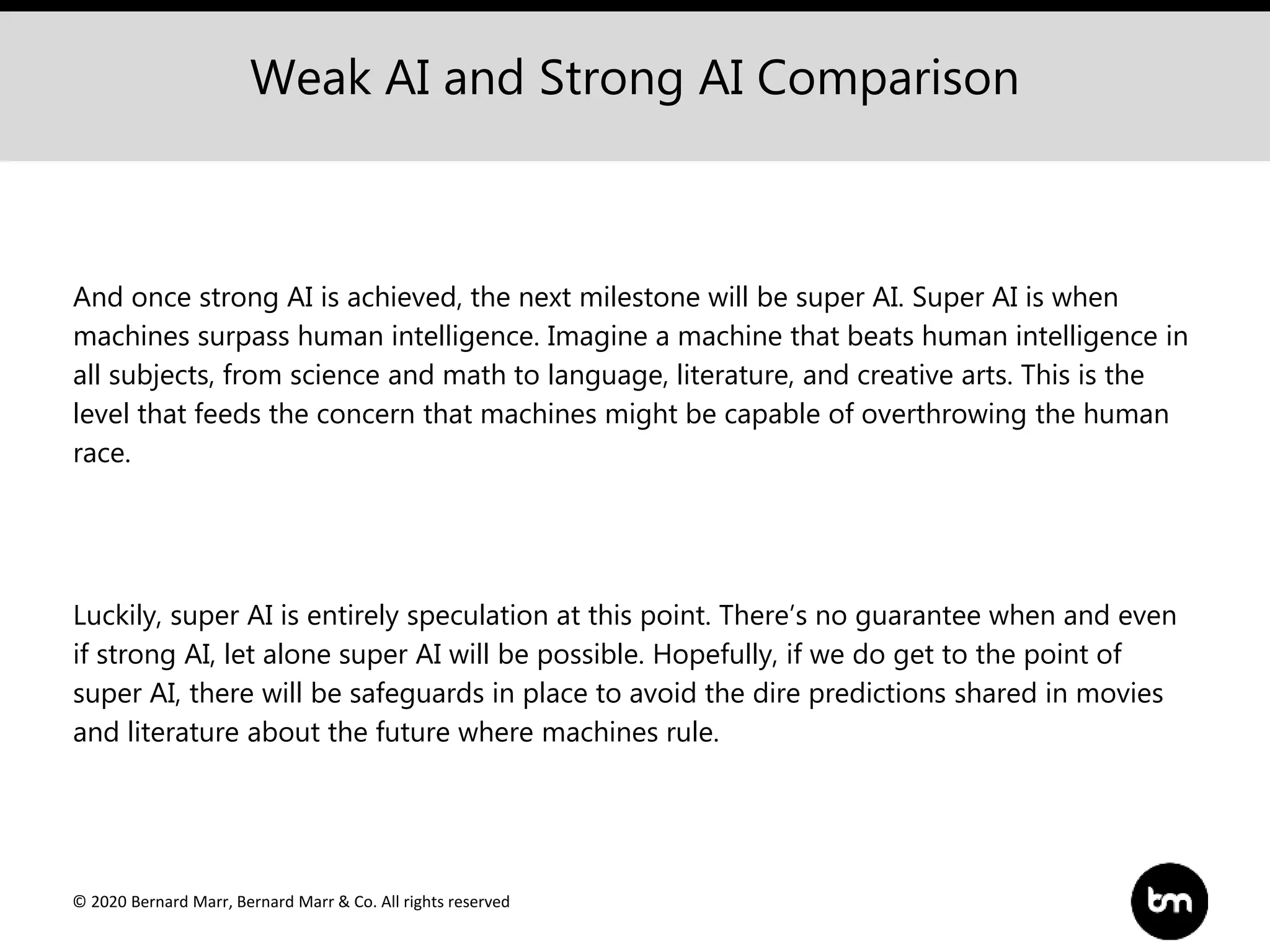
And once strong AI is achieved, the next milestone will be super AI. Super AI is when
machines surpass human intelligence. Imagine a machine that beats human intelligence in
all subjects, from science and math to language, literature, and creative arts. This is the
level that feeds the concern that machines might be capable of overthrowing the human
race.
Luckily, super AI is entirely speculation at this point. There’s no guarantee when and even
if strong AI, let alone super AI will be possible. Hopefully, if we do get to the point of
super AI, there will be safeguards in place to avoid the dire predictions shared in movies
and literature about the future where machines rule.
Bernard Marr is an internationally best-selling author, popular keynote speaker, futurist, and a
strategic business & technology advisor to governments and companies. He helps
organisations improve their business performance, use data more intelligently, and
understand the implications of new technologies such as artificial intelligence, big data,
blockchains, and the Internet of Things.
LinkedIn has ranked Bernard as one of the world’s top 5 business influencers. He is a frequent
contributor to the World Economic Forum and writes a regular column for Forbes. Every day
Bernard actively engages his 1.5 million social media followers and shares content that
reaches millions of readers.
Visit The
Website
© 2020 Bernard Marr , Bernard Marr & Co. All rights reserved
© 2017 Bernard Marr , Bernard Marr & Co. All rights reserved
© 2020 Bernard Marr, Bernard Marr & Co. All rights reserved
Bernard Marr is an internationally best-selling author, popular keynote speaker, futurist, and a
strategic business & technology advisor to governments and companies. He helps
organisations improve their business performance, use data more intelligently, and
understand the implications of new technologies such as artificial intelligence, big data,
blockchains, and the Internet of Things.
LinkedIn has ranked Bernard as one of the world’s top 5 business influencers. He is a frequent
contributor to the World Economic Forum and writes a regular column for Forbes. Every day
Bernard actively engages his 1.5 million social media followers and shares content that
reaches millions of readers.
Visit The
Website
Title
Subtitle
Be the FIRST to receive news,
articles, insights and event
updates from Bernard Marr & Co
straight to your inbox.
Signing up is EASY! Simply fill out
the online form and we’ll be in
touch!
© 2020 Bernard Marr, Bernard Marr & Co. All rights reserved

What Is The Difference Between Weak (Narrow) And Strong (General) Artificial Intelligence (AI)?

  • 1.
    What Is TheDifference Between Artificial Intelligence (AI)? Weak (Narrow) And Strong (General)
  • 2.
    © 2020 BernardMarr, Bernard Marr & Co. All rights reserved Title Text Introduction Introduction Did you know there are two forms of artificial intelligence? Weak or narrow artificial intelligence (AI) is what we encounter daily today. Strong or general AI is the next phase where machines can think like humans without being programmed by humans. Learn the differences between weak and strong AI. What Is The Difference Between Weak (Narrow) And Strong (General) Artificial Intelligence (AI)?
  • 3.
    © 2020 BernardMarr, Bernard Marr & Co. All rights reserved Although artificial intelligence (AI) was once a rare concept, most people experience AI in their daily lives. From digital personal assistants such as Alexa and Google Home to driving directions and recommendations, artificial intelligence is no longer an idea only seen in science fiction books and movies. While most individuals understand AI is when machines complete higher-level functions such as recognizing speech and making decisions like humans can, but not everyone might understand that there is a distinction between weak AI and strong AI. So, let’s take a look at the differences between weak, also known as narrow AI, and strong or general AI.
  • 4.
    © 2020 BernardMarr, Bernard Marr & Co. All rights reserved Weak (Narrow) AI The artificial intelligence that we now see in our daily lives is what we refer to as weak (narrow AI). It’s actually the only artificial intelligence that exists today. It’s called weak because it has limited functionality. The AI algorithms are built to accomplish specific tasks rather than possess full cognitive abilities like the human brain. Weak AI illustrates that intelligent behavior can be modeled. Examples of weak AI include Siri, Alexa and Google search. Weak AI is in action when there can be a programmed response such as when AI runs a chess program. These algorithms will process data to find things they know and then classify based on training/programming. They can’t veer off the programmed path. Weak AI has changed many aspects of business and our personal lifestyles by being able to solve or complete tasks much quicker or better than humans can. It’s what powers chatbots and recommendation engines on streaming services. Weak AI can also discover patterns in volumes of data to help diagnose disease and develop treatments. It’s certainly been a transformative technology thus far.
  • 5.
    © 2020 BernardMarr, Bernard Marr & Co. All rights reserved Strong (General) AI Strong or general artificial intelligence at this point is only theoretical. It’s when machines develop consciousness and decision-making on par (or better) than humans. When strong AI is achieved, the machines won’t rely on human programming to be able to think or accomplish tasks. This is the AI imagined in sci-fi stories such as “I-Robot” and “The Terminator.” Additionally, machines with strong AI will be able to exhibit self-awareness and emotions. Ultimately, the goal with general AI is a machine that has intelligence in true human form.
  • 6.
    © 2020 BernardMarr, Bernard Marr & Co. All rights reserved Weak AI and Strong AI Comparison When you want to distinguish between types of artificial intelligence, it’s good to look at what the technology can do. Simply, if the technology is good at specific actions, it’s weak AI. If it operates like a human and isn’t bound to completing one specific task, it’s strong AI. Here are a few other ways to distinguish between weak and general AI: Definition. . . · Weak AI models intelligent human behavior, which allows machines to solve complex problems. · General AI is currently hypothetical, but when or if it's realized, machines would have full human cognitive abilities.
  • 7.
    © 2020 BernardMarr, Bernard Marr & Co. All rights reserved Weak AI and Strong AI Comparison Purpose. . . · Narrow AI is programmed to operate within a set of pre-defined functions that the programming is taught to complete or solve. · Strong AI will have a mind of its own to be able to accomplish any type of task its “mind” can envision. Awareness. . . · Weak AI does not achieve self-awareness. · Strong AI will be advanced enough to be considered truly intelligent and fully self-aware.
  • 8.
    © 2020 BernardMarr, Bernard Marr & Co. All rights reserved Weak AI and Strong AI Comparison Data processing. . . · Narrow AI classifies data. · General AI uses clustering and association. Once (if ever) artificial intelligence gets to the point where machines can think and carry out decision-making and tasks without human involvement, it will be designated as general or strong AI. Until then, weak AI, algorithms programmed to give machines the capability to help us complete tasks faster and more effectively, will continue to transform the way we live, work and play.
  • 9.
    © 2020 BernardMarr, Bernard Marr & Co. All rights reserved Weak AI and Strong AI Comparison And once strong AI is achieved, the next milestone will be super AI. Super AI is when machines surpass human intelligence. Imagine a machine that beats human intelligence in all subjects, from science and math to language, literature, and creative arts. This is the level that feeds the concern that machines might be capable of overthrowing the human race. Luckily, super AI is entirely speculation at this point. There’s no guarantee when and even if strong AI, let alone super AI will be possible. Hopefully, if we do get to the point of super AI, there will be safeguards in place to avoid the dire predictions shared in movies and literature about the future where machines rule.
  • 10.
    Bernard Marr isan internationally best-selling author, popular keynote speaker, futurist, and a strategic business & technology advisor to governments and companies. He helps organisations improve their business performance, use data more intelligently, and understand the implications of new technologies such as artificial intelligence, big data, blockchains, and the Internet of Things. LinkedIn has ranked Bernard as one of the world’s top 5 business influencers. He is a frequent contributor to the World Economic Forum and writes a regular column for Forbes. Every day Bernard actively engages his 1.5 million social media followers and shares content that reaches millions of readers. Visit The Website © 2020 Bernard Marr , Bernard Marr & Co. All rights reserved © 2017 Bernard Marr , Bernard Marr & Co. All rights reserved © 2020 Bernard Marr, Bernard Marr & Co. All rights reserved Bernard Marr is an internationally best-selling author, popular keynote speaker, futurist, and a strategic business & technology advisor to governments and companies. He helps organisations improve their business performance, use data more intelligently, and understand the implications of new technologies such as artificial intelligence, big data, blockchains, and the Internet of Things. LinkedIn has ranked Bernard as one of the world’s top 5 business influencers. He is a frequent contributor to the World Economic Forum and writes a regular column for Forbes. Every day Bernard actively engages his 1.5 million social media followers and shares content that reaches millions of readers. Visit The Website
  • 11.
    Title Subtitle Be the FIRSTto receive news, articles, insights and event updates from Bernard Marr & Co straight to your inbox. Signing up is EASY! Simply fill out the online form and we’ll be in touch! © 2020 Bernard Marr, Bernard Marr & Co. All rights reserved