What is Raynaud’s phenomenon? What is
Scleroderma? What is the link?
Dr John Pauling
BMedSci MRCP (Rheumatology) PhD
Consultant Rheumatologist
RNHRD
•  “What is Raynaud’s phenomenon?”
•  “What is scleroderma?”
•  “How do these conditions affect the body?”
•  “What are antibodies important with this?”
•  “Friends say they have Raynaud’s too but my
Raynaud’s seems worse. Are they the same?
•  “How are all these problems linked?”
•  “What causes scleroderma?”
•  “How can understanding the development of
scleroderma help guide treatment?”
www.rnhrd.nhs.uk
What I will try to cover over next 30 minutes or so
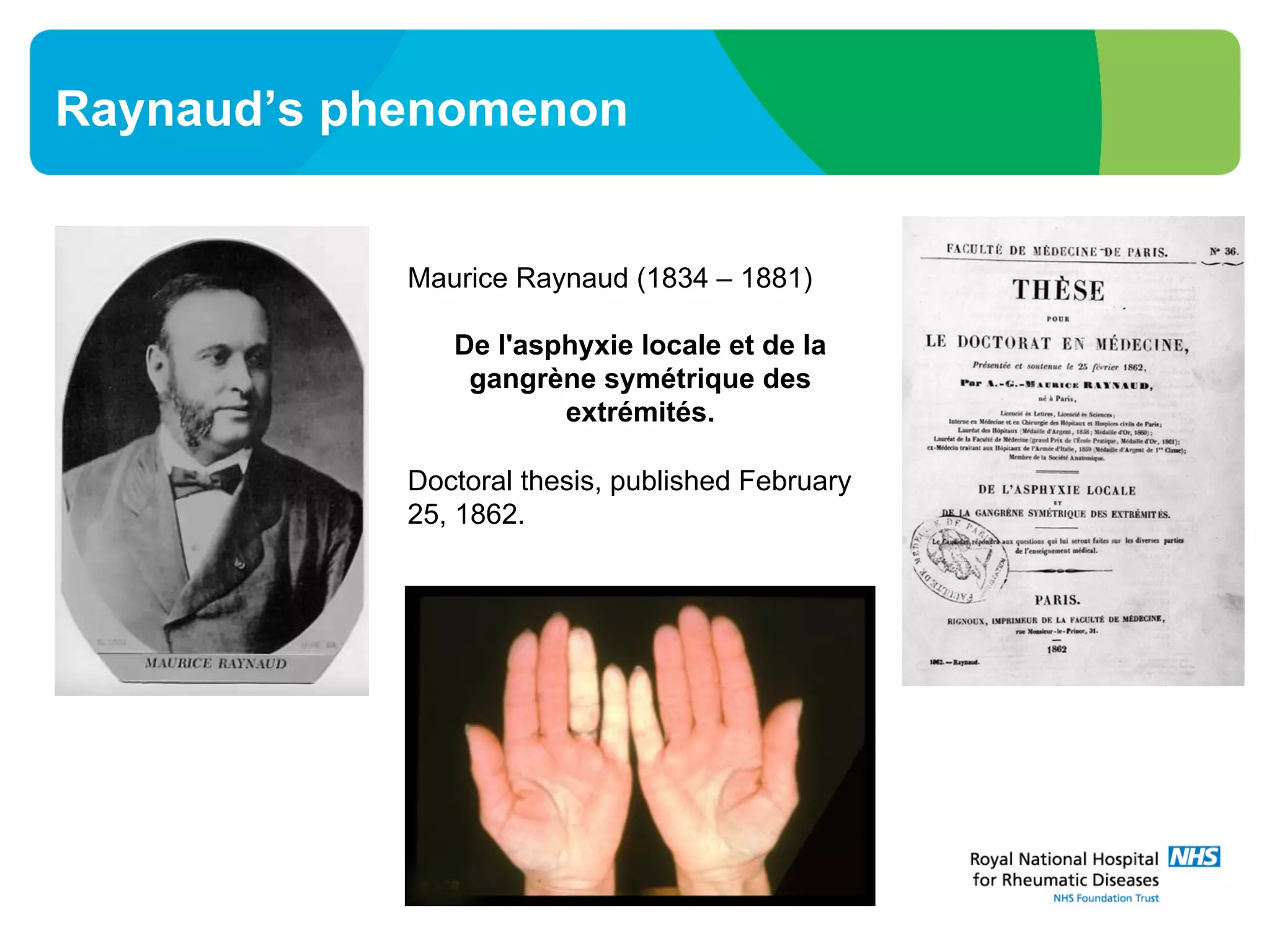
Raynaud’s phenomenon
Maurice Raynaud (1834 – 1881)
De l'asphyxie locale et de la
gangrène symétrique des
extrémités.
Doctoral thesis, published February
25, 1862.
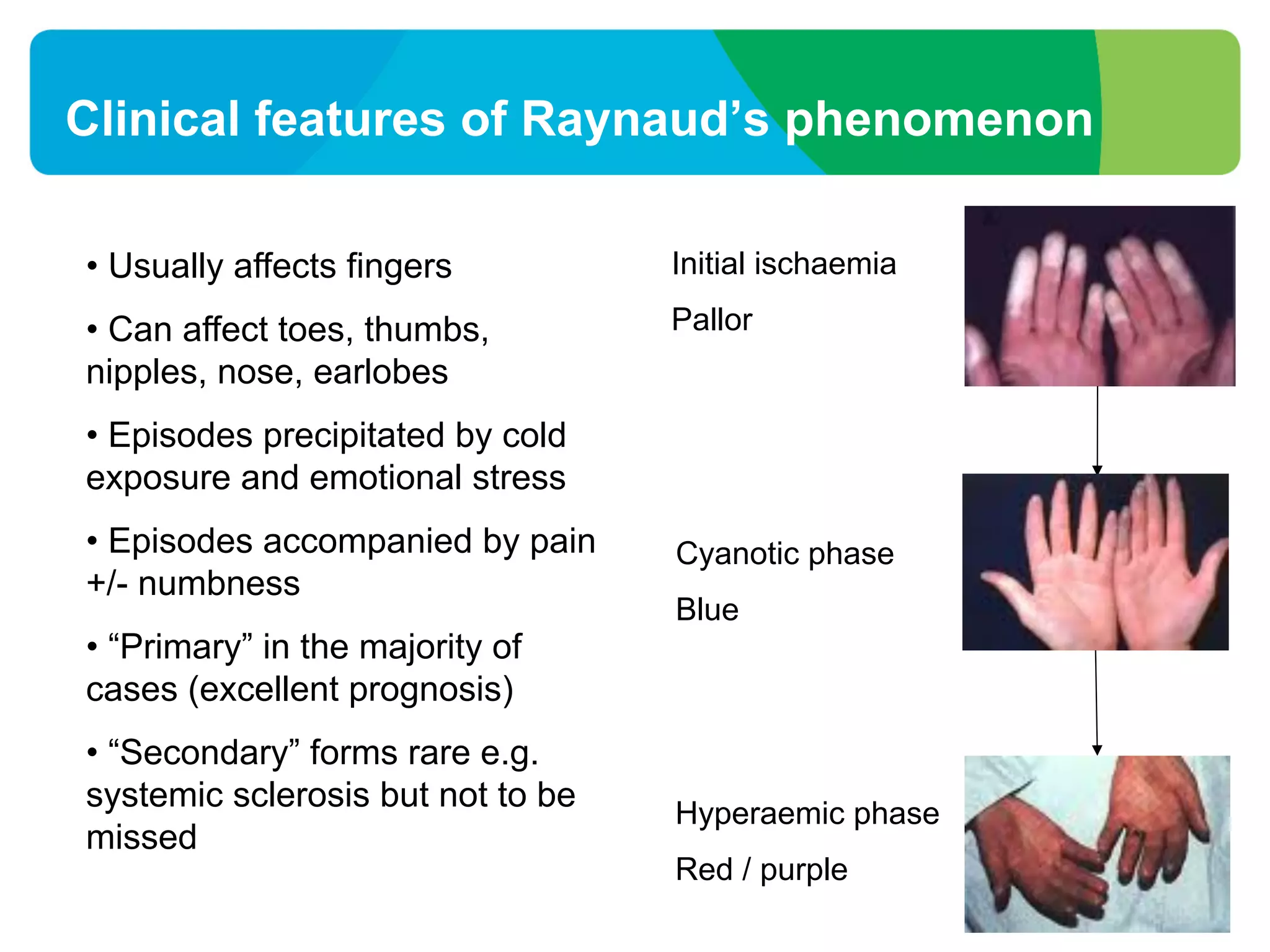
Initial ischaemia
Pallor
Cyanotic phase
Blue
Hyperaemic phase
Red / purple
Clinical features of Raynaud’s phenomenon
• Usually affects fingers
• Can affect toes, thumbs,
nipples, nose, earlobes
• Episodes precipitated by cold
exposure and emotional stress
• Episodes accompanied by pain
+/- numbness
• “Primary” in the majority of
cases (excellent prognosis)
• “Secondary” forms rare e.g.
systemic sclerosis but not to be
missed
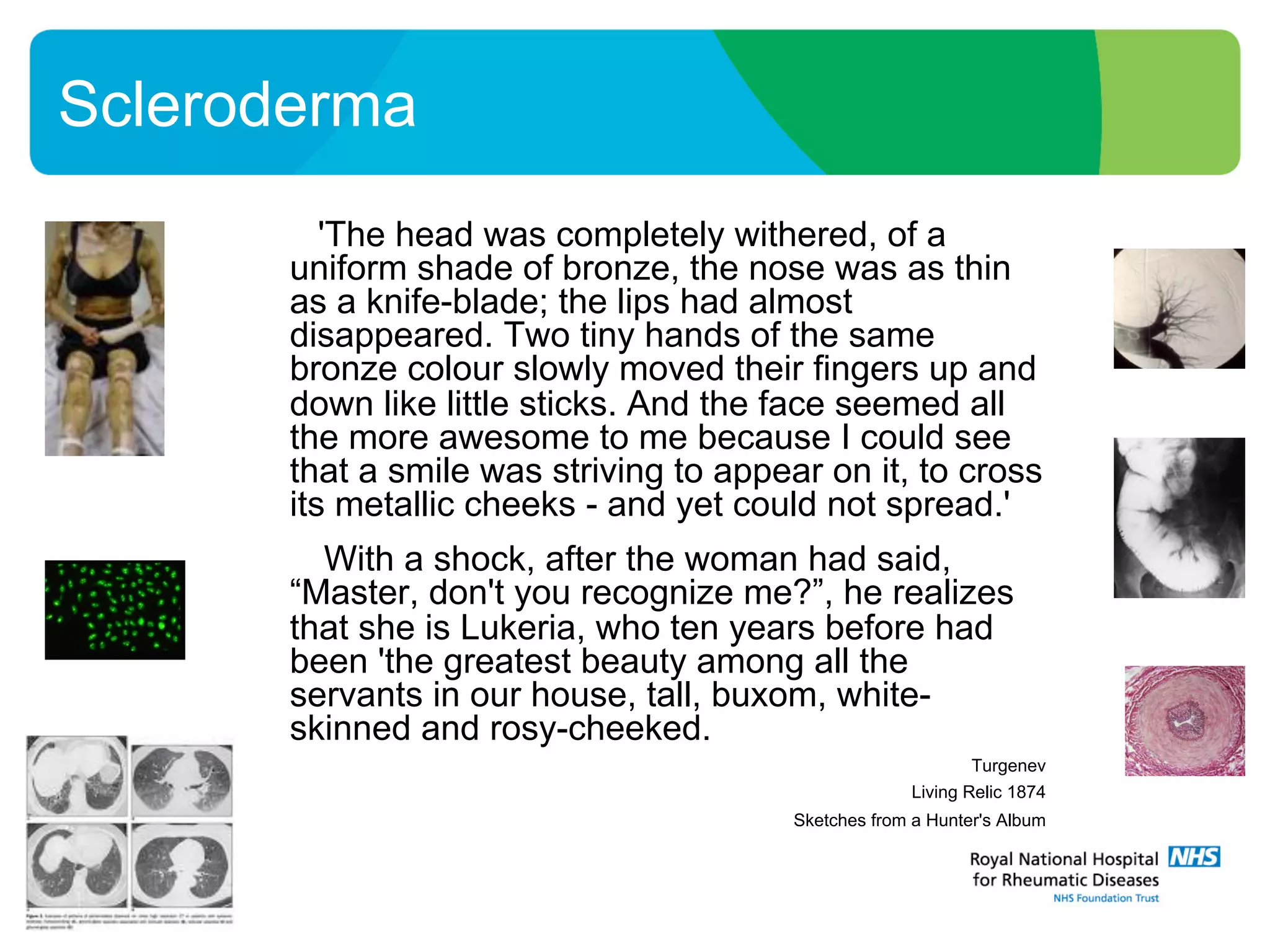
'The head was completely withered, of a
uniform shade of bronze, the nose was as thin
as a knife-blade; the lips had almost
disappeared. Two tiny hands of the same
bronze colour slowly moved their fingers up and
down like little sticks. And the face seemed all
the more awesome to me because I could see
that a smile was striving to appear on it, to cross
its metallic cheeks - and yet could not spread.'
With a shock, after the woman had said,
“Master, don't you recognize me?”, he realizes
that she is Lukeria, who ten years before had
been 'the greatest beauty among all the
servants in our house, tall, buxom, white-
skinned and rosy-cheeked.
Turgenev
Living Relic 1874
Sketches from a Hunter's Album
Scleroderma
www.rnhrd.nhs.uk
Systemic sclerosis (SSc) / Scleroderma
www.rnhrd.nhs.uk
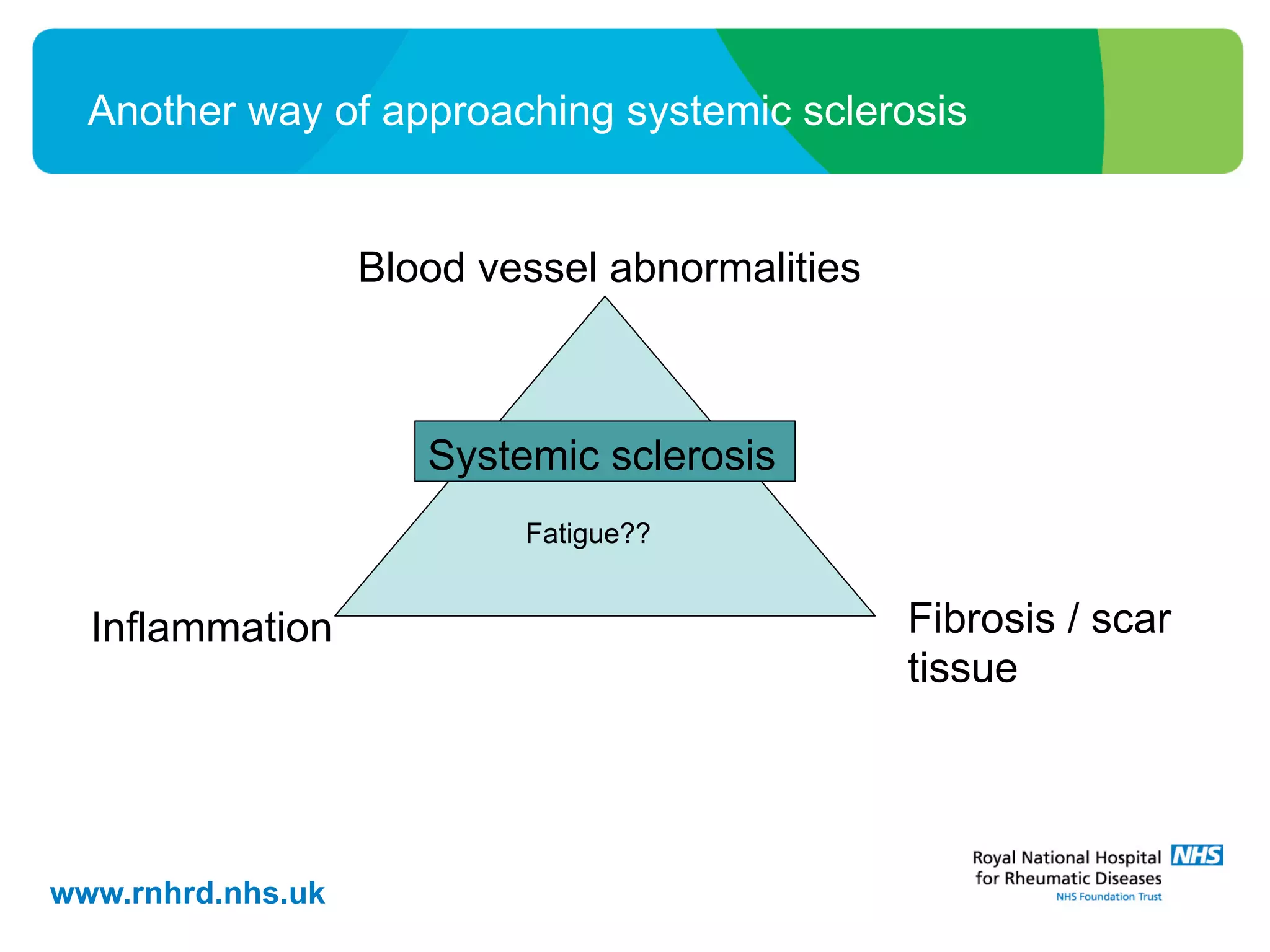
Another way of approaching systemic sclerosis
Systemic sclerosis
Blood vessel abnormalities
Fibrosis / scar
tissue
Inflammation
Fatigue??
www.rnhrd.nhs.uk
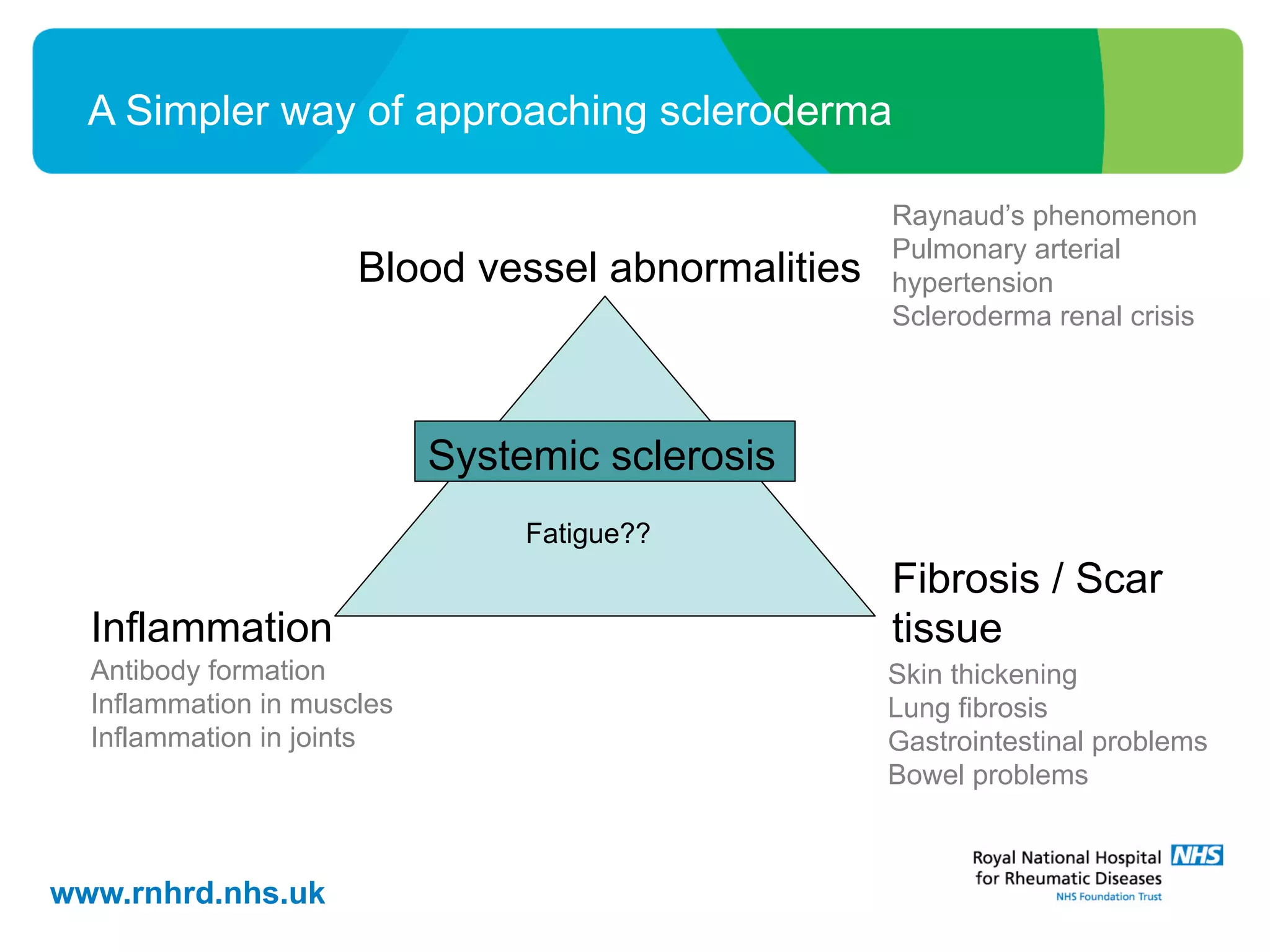
A Simpler way of approaching scleroderma
Systemic sclerosis
Blood vessel abnormalities
Fibrosis / Scar
tissueInflammation
Raynaud’s phenomenon
Pulmonary arterial
hypertension
Scleroderma renal crisis
Skin thickening
Lung fibrosis
Gastrointestinal problems
Bowel problems
Antibody formation
Inflammation in muscles
Inflammation in joints
Fatigue??
www.rnhrd.nhs.uk
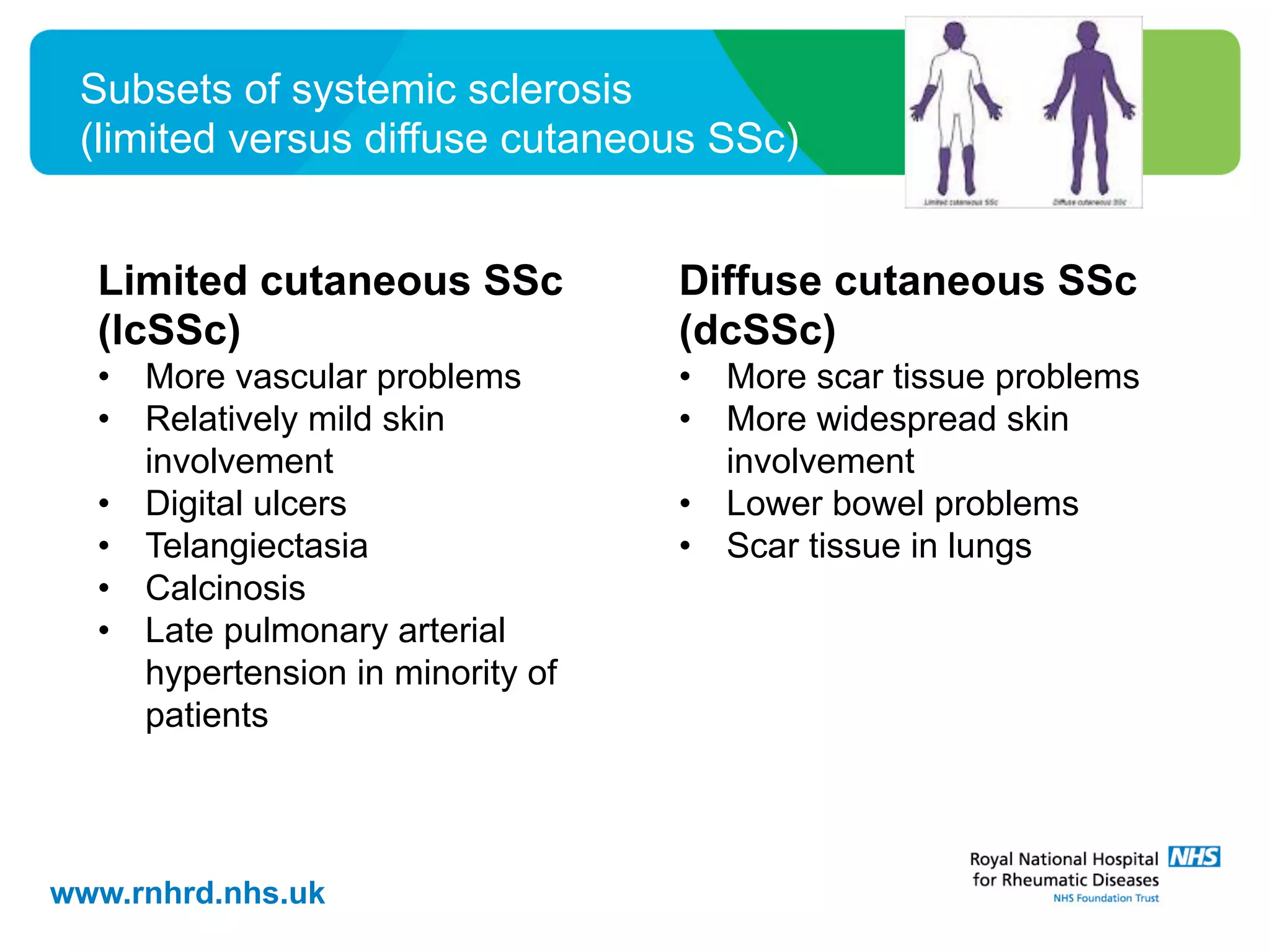
Subsets of systemic sclerosis
(limited versus diffuse cutaneous SSc)
Limited cutaneous SSc
(lcSSc)
•  More vascular problems
•  Relatively mild skin
involvement
•  Digital ulcers
•  Telangiectasia
•  Calcinosis
•  Late pulmonary arterial
hypertension in minority of
patients
Diffuse cutaneous SSc
(dcSSc)
•  More scar tissue problems
•  More widespread skin
involvement
•  Lower bowel problems
•  Scar tissue in lungs
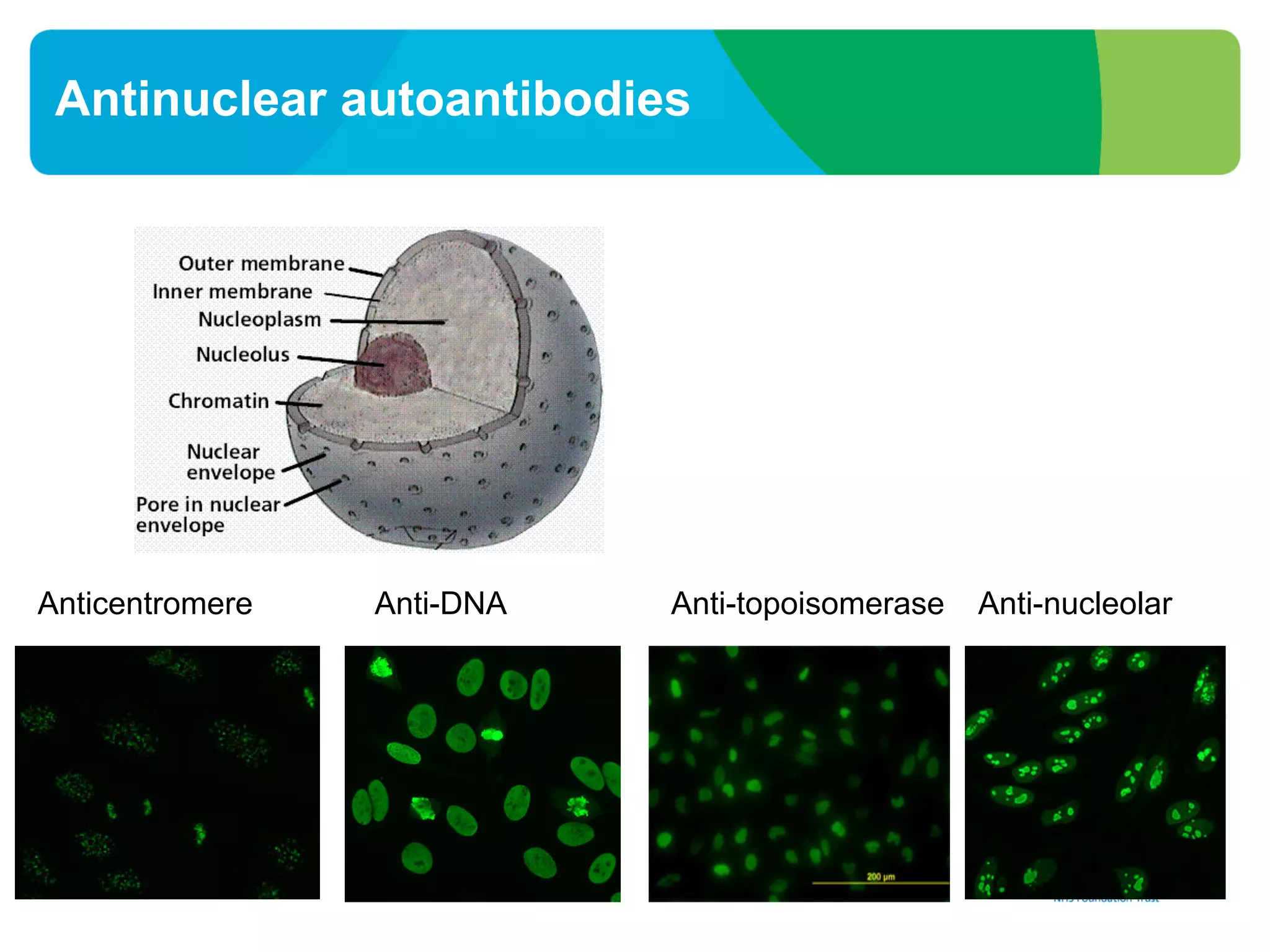
Antinuclear autoantibodies
Anticentromere Anti-DNA Anti-topoisomerase Anti-nucleolar
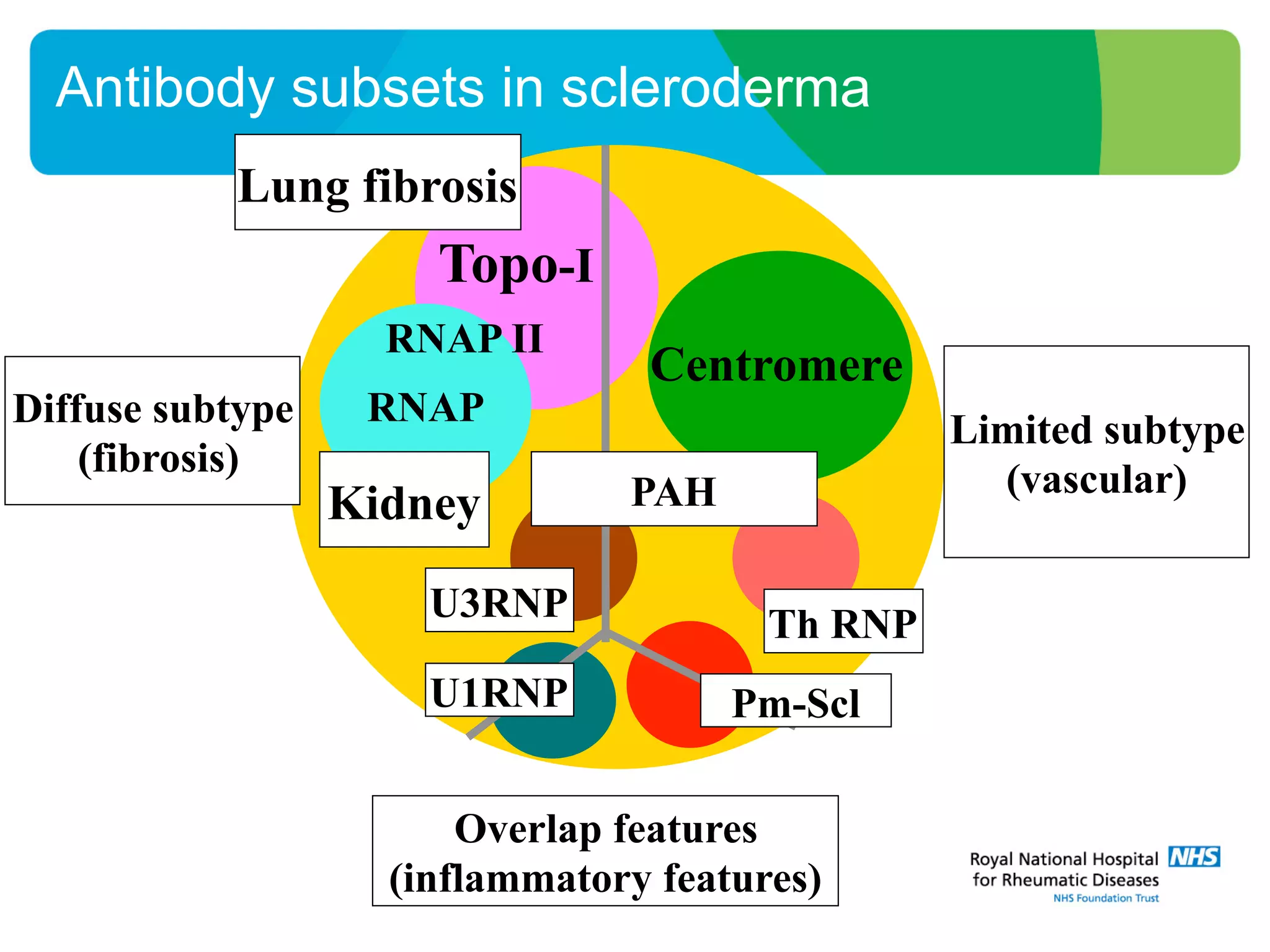
Antibody subsets in scleroderma
RNAP
Topo-I
Centromere
Lung fibrosis
Diffuse subtype
(fibrosis)
Limited subtype
(vascular)
Overlap features
(inflammatory features)
Kidney
Th RNP
RNAP II
U3RNP
U1RNP Pm-Scl
PAH
www.rnhrd.nhs.uk
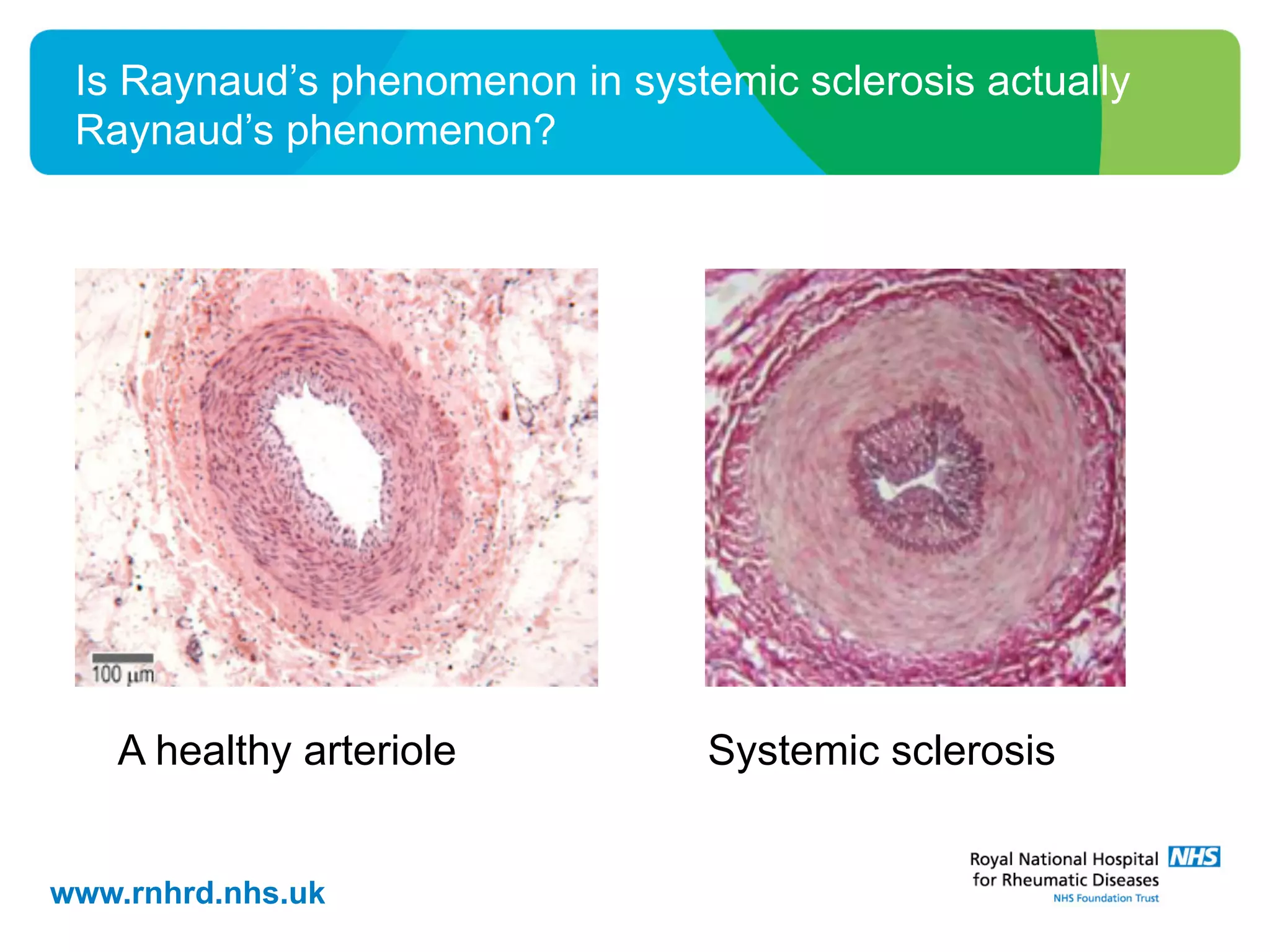
Is Raynaud’s phenomenon in systemic sclerosis actually
Raynaud’s phenomenon?
A healthy arteriole Systemic sclerosis
www.rnhrd.nhs.uk
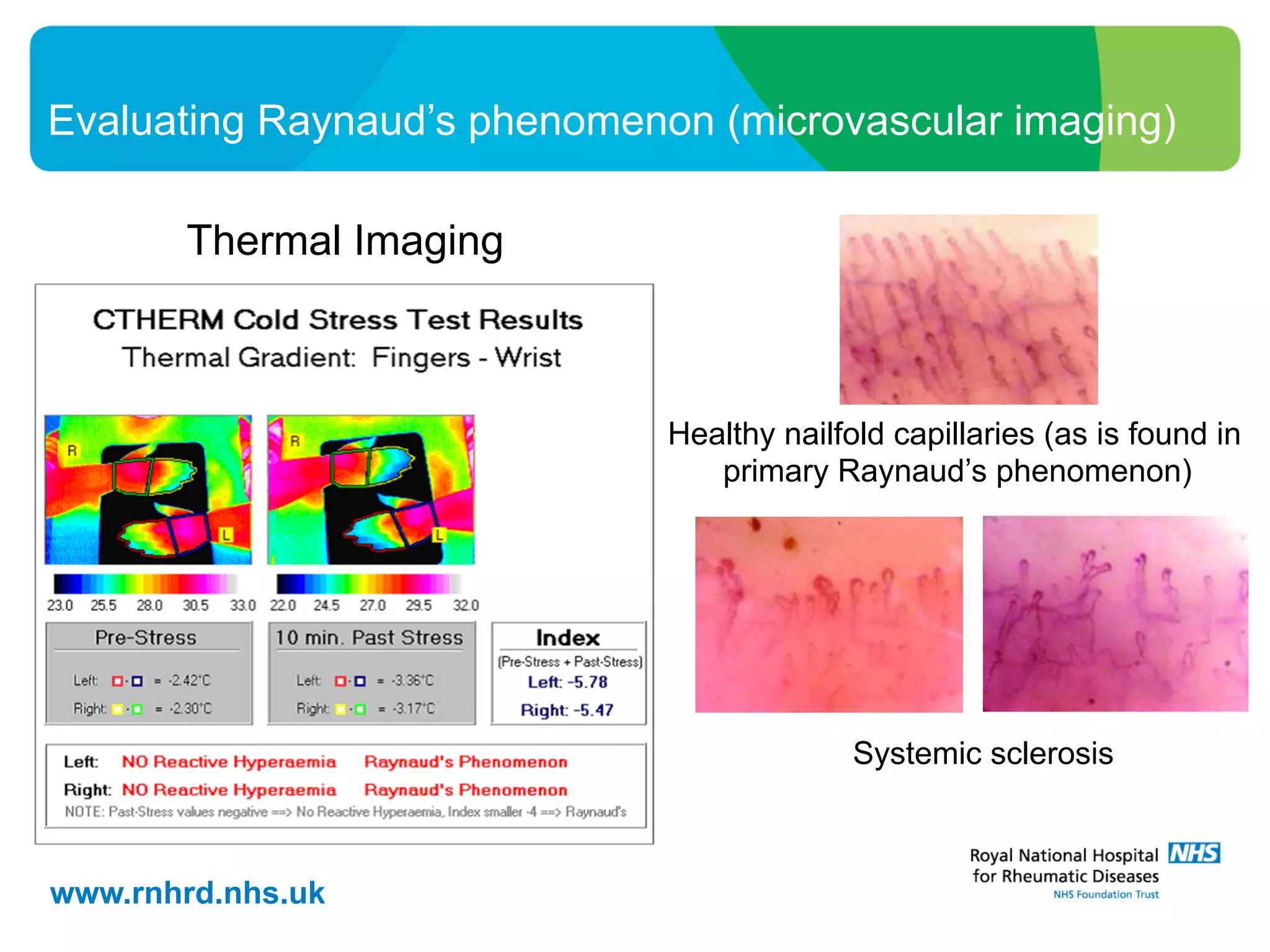
Evaluating Raynaud’s phenomenon (microvascular imaging)
Thermal Imaging
Healthy nailfold capillaries (as is found in
primary Raynaud’s phenomenon)
Systemic sclerosis
www.rnhrd.nhs.uk
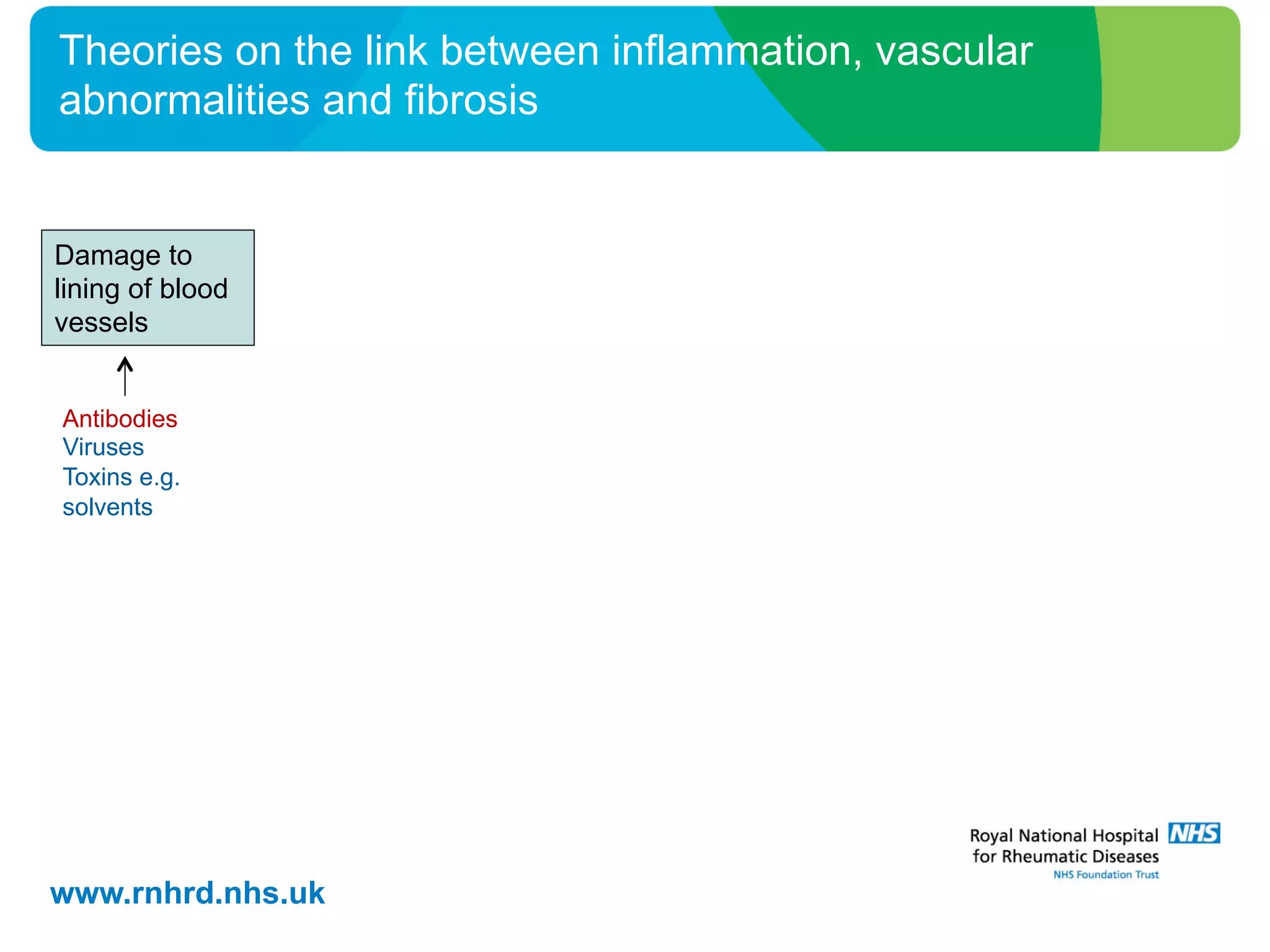
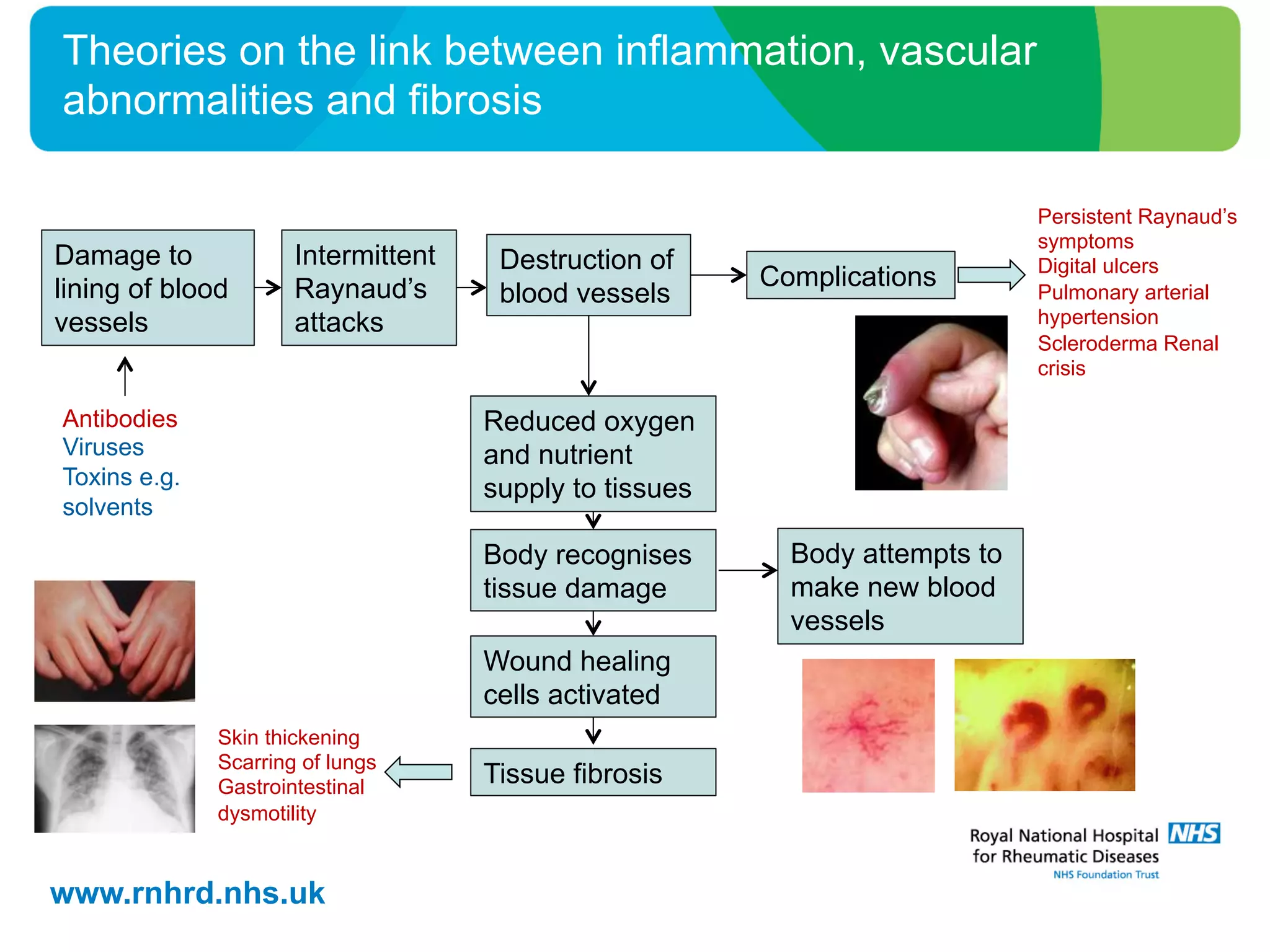
Theories on the link between inflammation, vascular
abnormalities and fibrosis
Damage to
lining of blood
vessels
Antibodies
Viruses
Toxins e.g.
solvents
www.rnhrd.nhs.uk
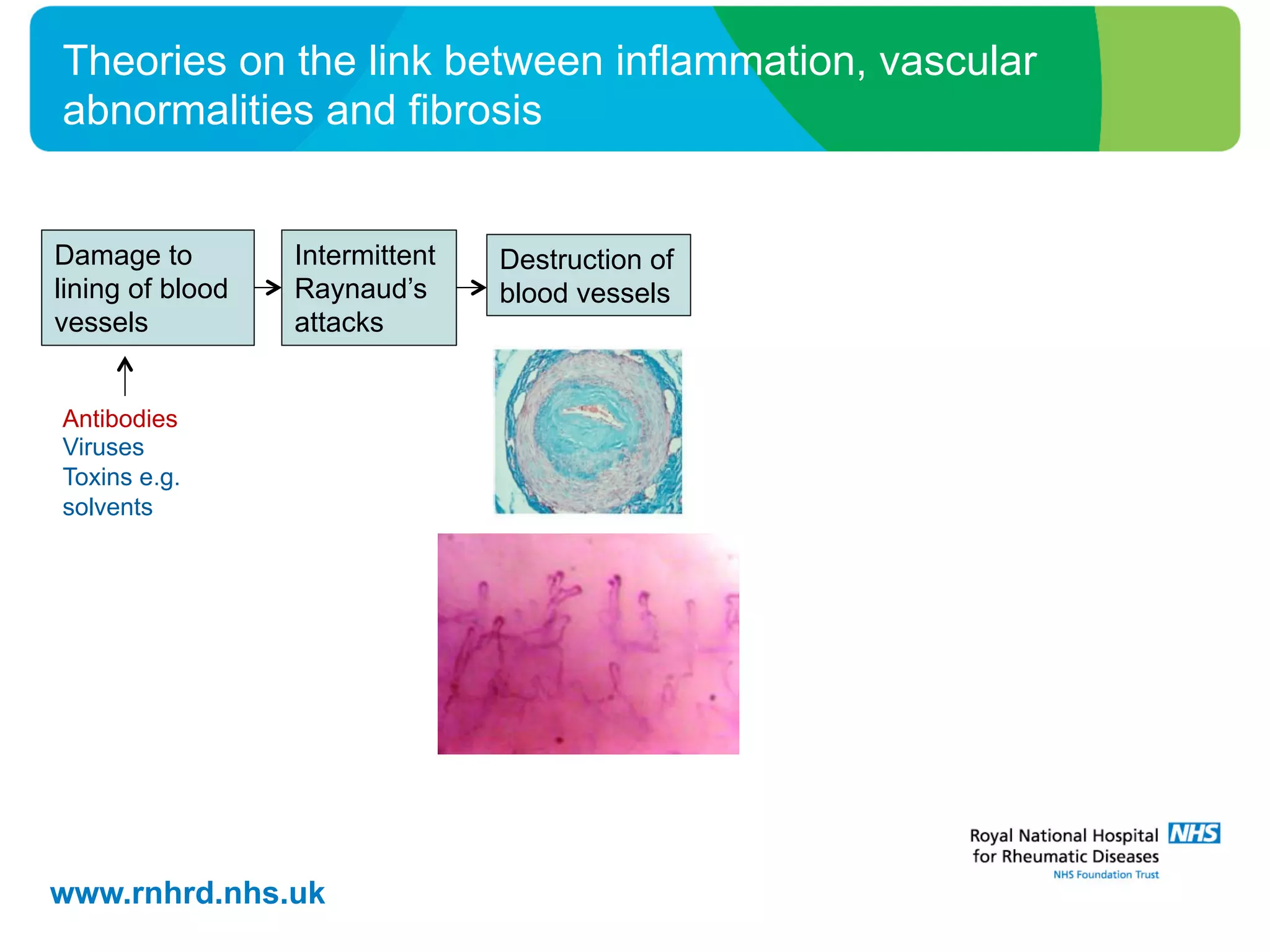
Theories on the link between inflammation, vascular
abnormalities and fibrosis
Damage to
lining of blood
vessels
Intermittent
Raynaud’s
attacks
Destruction of
blood vessels
Antibodies
Viruses
Toxins e.g.
solvents
www.rnhrd.nhs.uk
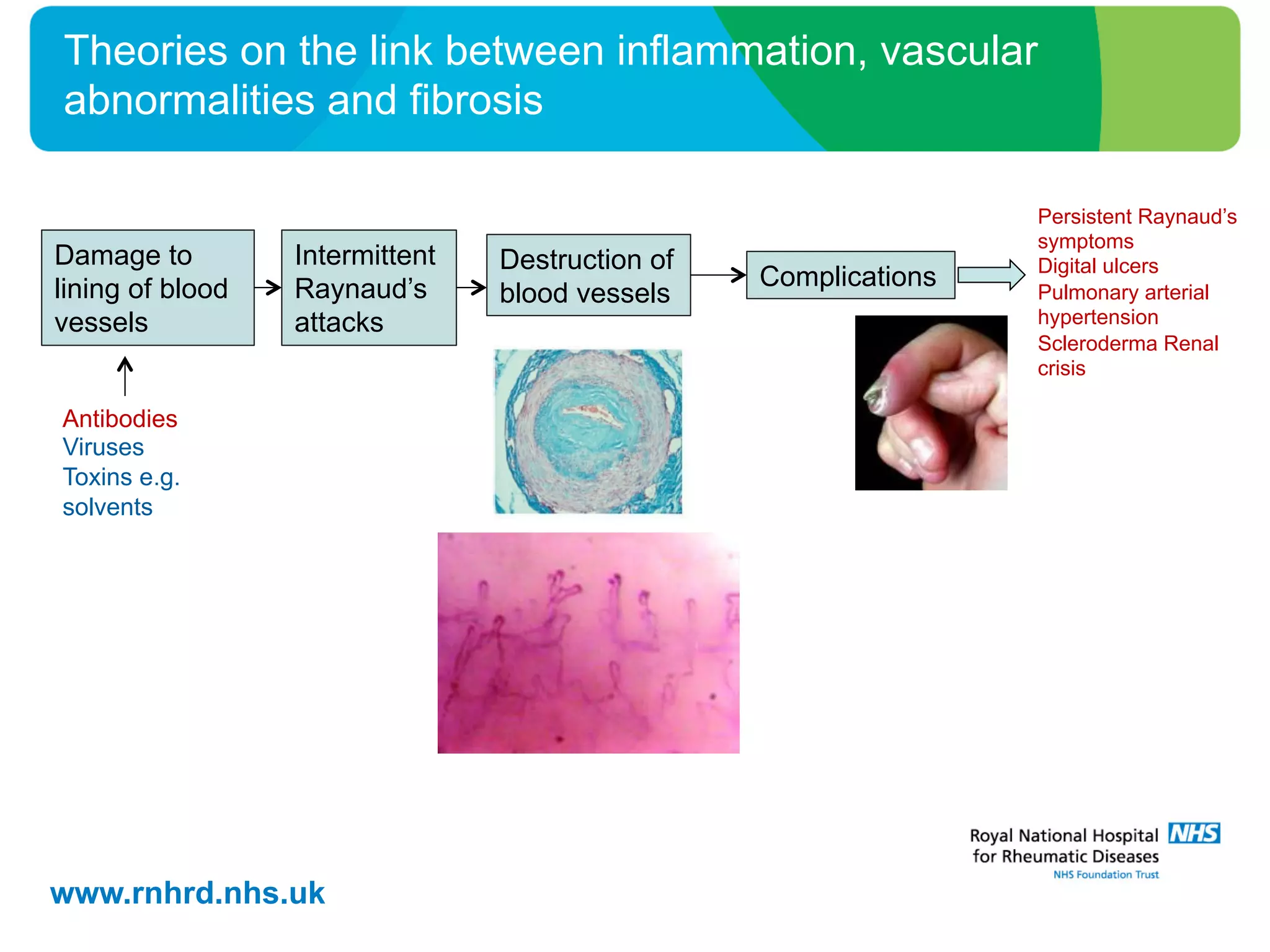
Theories on the link between inflammation, vascular
abnormalities and fibrosis
Damage to
lining of blood
vessels
Intermittent
Raynaud’s
attacks
Complications
Destruction of
blood vessels
Antibodies
Viruses
Toxins e.g.
solvents
Persistent Raynaud’s
symptoms
Digital ulcers
Pulmonary arterial
hypertension
Scleroderma Renal
crisis
www.rnhrd.nhs.uk
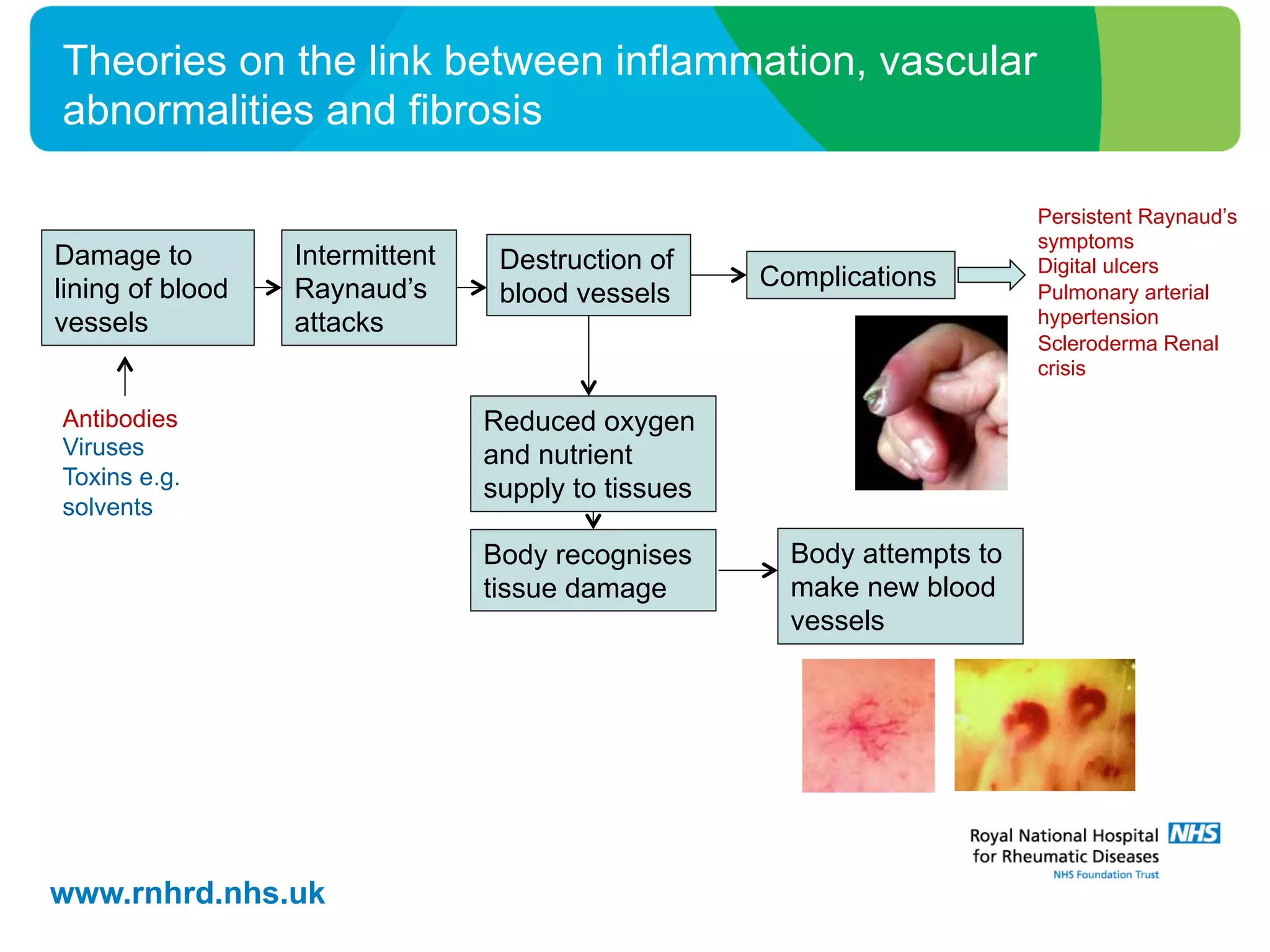
Theories on the link between inflammation, vascular
abnormalities and fibrosis
Damage to
lining of blood
vessels
Intermittent
Raynaud’s
attacks
Body recognises
tissue damage
Complications
Destruction of
blood vessels
Reduced oxygen
and nutrient
supply to tissues
Antibodies
Viruses
Toxins e.g.
solvents
Persistent Raynaud’s
symptoms
Digital ulcers
Pulmonary arterial
hypertension
Scleroderma Renal
crisis
Body attempts to
make new blood
vessels
www.rnhrd.nhs.uk
Theories on the link between inflammation, vascular
abnormalities and fibrosis
Damage to
lining of blood
vessels
Tissue fibrosis
Intermittent
Raynaud’s
attacks
Body recognises
tissue damage
Wound healing
cells activated
Complications
Destruction of
blood vessels
Reduced oxygen
and nutrient
supply to tissues
Antibodies
Viruses
Toxins e.g.
solvents
Persistent Raynaud’s
symptoms
Digital ulcers
Pulmonary arterial
hypertension
Scleroderma Renal
crisis
Skin thickening
Scarring of lungs
Gastrointestinal
dysmotility
Body attempts to
make new blood
vessels
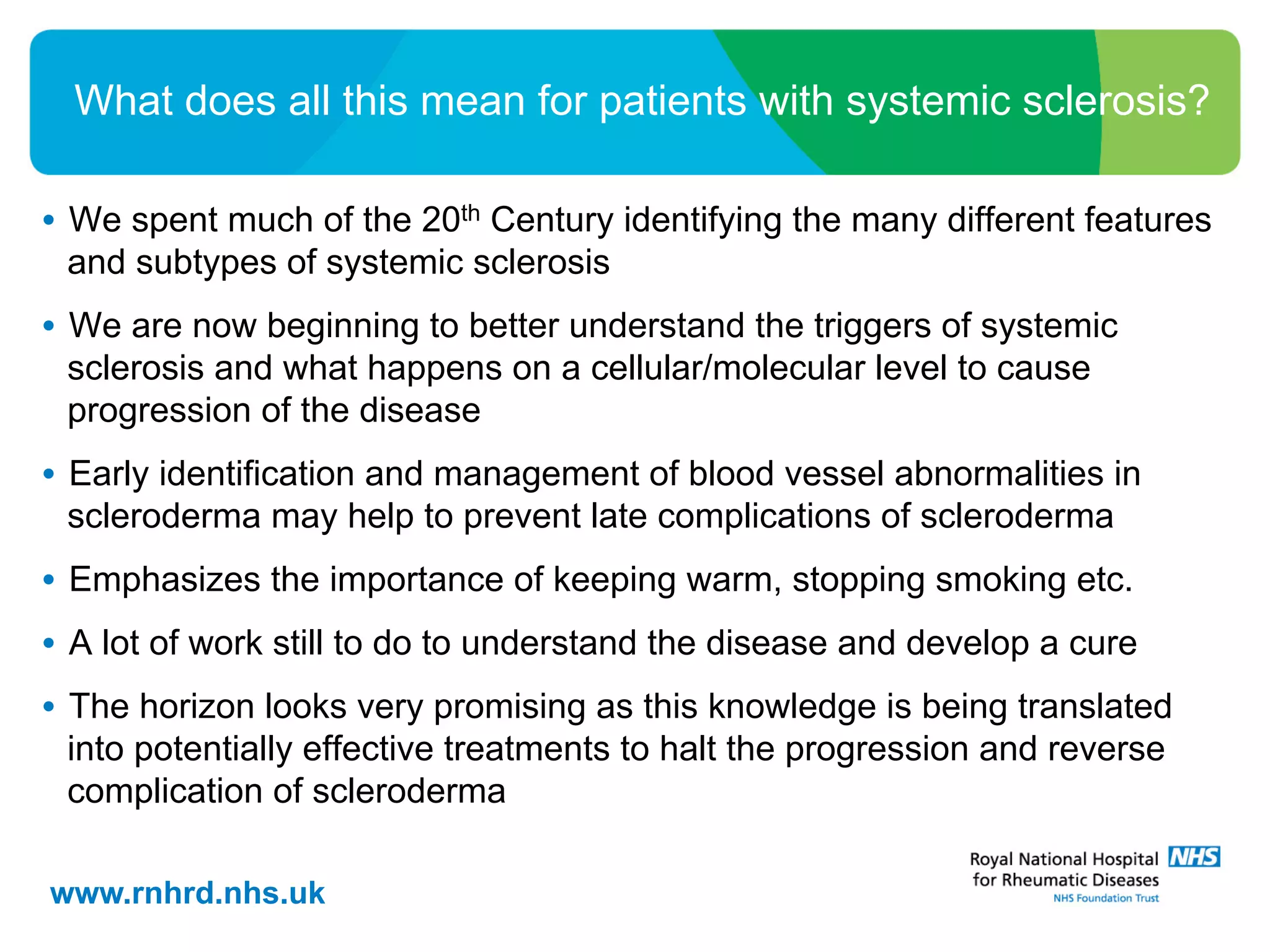
•  We spent much of the 20th Century identifying the many different features
and subtypes of systemic sclerosis
•  We are now beginning to better understand the triggers of systemic
sclerosis and what happens on a cellular/molecular level to cause
progression of the disease
•  Early identification and management of blood vessel abnormalities in
scleroderma may help to prevent late complications of scleroderma
•  Emphasizes the importance of keeping warm, stopping smoking etc.
•  A lot of work still to do to understand the disease and develop a cure
•  The horizon looks very promising as this knowledge is being translated
into potentially effective treatments to halt the progression and reverse
complication of scleroderma
www.rnhrd.nhs.uk
What does all this mean for patients with systemic sclerosis?
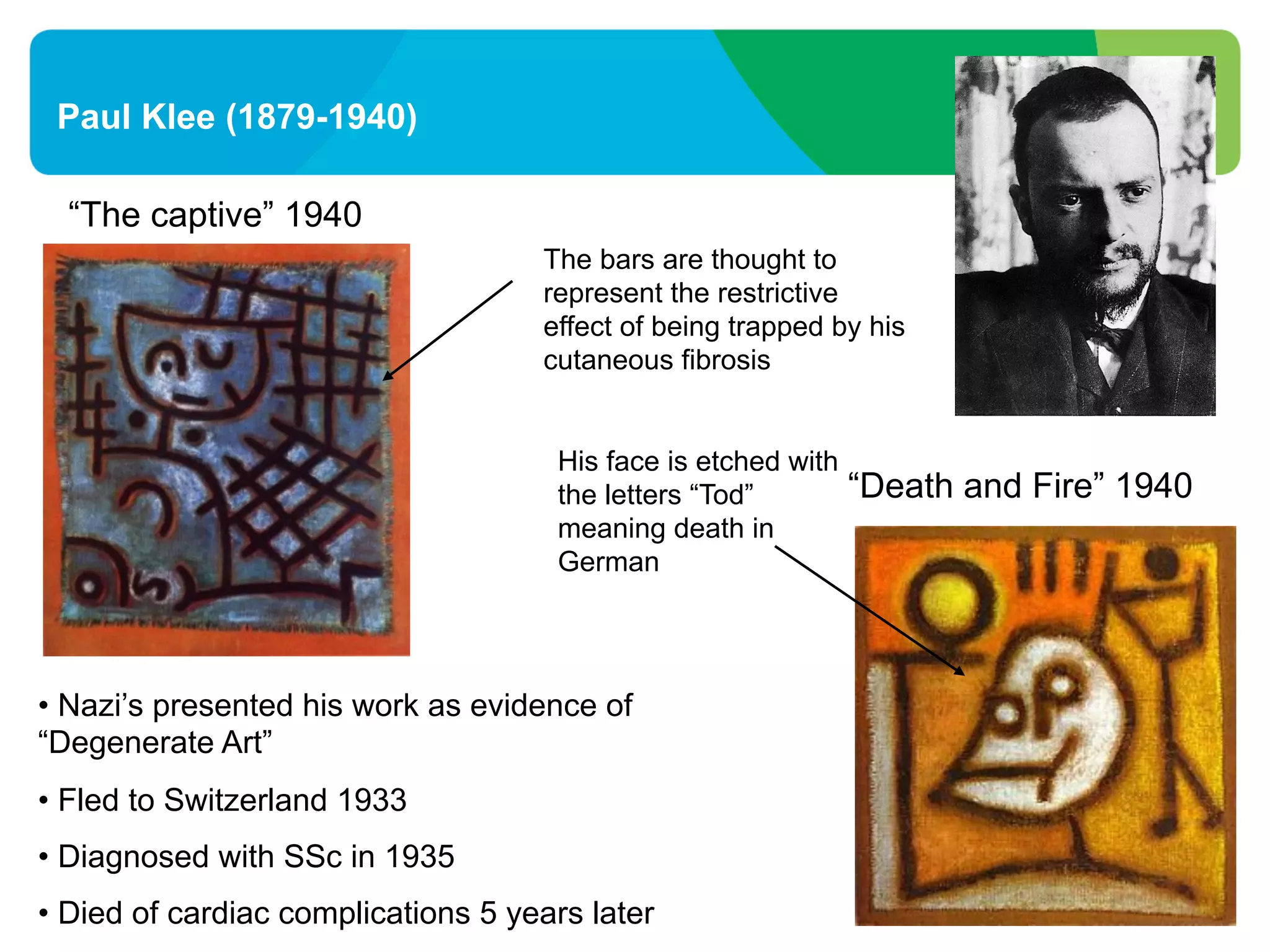
“The captive” 1940
• Nazi’s presented his work as evidence of
“Degenerate Art”
• Fled to Switzerland 1933
• Diagnosed with SSc in 1935
• Died of cardiac complications 5 years later
Paul Klee (1879-1940)
“Death and Fire” 1940
The bars are thought to
represent the restrictive
effect of being trapped by his
cutaneous fibrosis
His face is etched with
the letters “Tod”
meaning death in
German

What is scleroderma? What is Raynaud's?

  • 1.
    What is Raynaud’sphenomenon? What is Scleroderma? What is the link? Dr John Pauling BMedSci MRCP (Rheumatology) PhD Consultant Rheumatologist RNHRD
  • 2.
    •  “What isRaynaud’s phenomenon?” •  “What is scleroderma?” •  “How do these conditions affect the body?” •  “What are antibodies important with this?” •  “Friends say they have Raynaud’s too but my Raynaud’s seems worse. Are they the same? •  “How are all these problems linked?” •  “What causes scleroderma?” •  “How can understanding the development of scleroderma help guide treatment?” www.rnhrd.nhs.uk What I will try to cover over next 30 minutes or so
  • 3.
    Raynaud’s phenomenon Maurice Raynaud(1834 – 1881) De l'asphyxie locale et de la gangrène symétrique des extrémités. Doctoral thesis, published February 25, 1862.
  • 4.
    Initial ischaemia Pallor Cyanotic phase Blue Hyperaemicphase Red / purple Clinical features of Raynaud’s phenomenon • Usually affects fingers • Can affect toes, thumbs, nipples, nose, earlobes • Episodes precipitated by cold exposure and emotional stress • Episodes accompanied by pain +/- numbness • “Primary” in the majority of cases (excellent prognosis) • “Secondary” forms rare e.g. systemic sclerosis but not to be missed
  • 5.
    'The head wascompletely withered, of a uniform shade of bronze, the nose was as thin as a knife-blade; the lips had almost disappeared. Two tiny hands of the same bronze colour slowly moved their fingers up and down like little sticks. And the face seemed all the more awesome to me because I could see that a smile was striving to appear on it, to cross its metallic cheeks - and yet could not spread.' With a shock, after the woman had said, “Master, don't you recognize me?”, he realizes that she is Lukeria, who ten years before had been 'the greatest beauty among all the servants in our house, tall, buxom, white- skinned and rosy-cheeked. Turgenev Living Relic 1874 Sketches from a Hunter's Album Scleroderma
  • 6.
  • 7.
    www.rnhrd.nhs.uk Another way ofapproaching systemic sclerosis Systemic sclerosis Blood vessel abnormalities Fibrosis / scar tissue Inflammation Fatigue??
  • 8.
    www.rnhrd.nhs.uk A Simpler wayof approaching scleroderma Systemic sclerosis Blood vessel abnormalities Fibrosis / Scar tissueInflammation Raynaud’s phenomenon Pulmonary arterial hypertension Scleroderma renal crisis Skin thickening Lung fibrosis Gastrointestinal problems Bowel problems Antibody formation Inflammation in muscles Inflammation in joints Fatigue??
  • 9.
    www.rnhrd.nhs.uk Subsets of systemicsclerosis (limited versus diffuse cutaneous SSc) Limited cutaneous SSc (lcSSc) •  More vascular problems •  Relatively mild skin involvement •  Digital ulcers •  Telangiectasia •  Calcinosis •  Late pulmonary arterial hypertension in minority of patients Diffuse cutaneous SSc (dcSSc) •  More scar tissue problems •  More widespread skin involvement •  Lower bowel problems •  Scar tissue in lungs
  • 10.
    Antinuclear autoantibodies Anticentromere Anti-DNAAnti-topoisomerase Anti-nucleolar
  • 11.
    Antibody subsets inscleroderma RNAP Topo-I Centromere Lung fibrosis Diffuse subtype (fibrosis) Limited subtype (vascular) Overlap features (inflammatory features) Kidney Th RNP RNAP II U3RNP U1RNP Pm-Scl PAH
  • 12.
    www.rnhrd.nhs.uk Is Raynaud’s phenomenonin systemic sclerosis actually Raynaud’s phenomenon? A healthy arteriole Systemic sclerosis
  • 13.
    www.rnhrd.nhs.uk Evaluating Raynaud’s phenomenon(microvascular imaging) Thermal Imaging Healthy nailfold capillaries (as is found in primary Raynaud’s phenomenon) Systemic sclerosis
  • 14.
    www.rnhrd.nhs.uk Theories on thelink between inflammation, vascular abnormalities and fibrosis Damage to lining of blood vessels Antibodies Viruses Toxins e.g. solvents
  • 15.
    www.rnhrd.nhs.uk Theories on thelink between inflammation, vascular abnormalities and fibrosis Damage to lining of blood vessels Intermittent Raynaud’s attacks Destruction of blood vessels Antibodies Viruses Toxins e.g. solvents
  • 16.
    www.rnhrd.nhs.uk Theories on thelink between inflammation, vascular abnormalities and fibrosis Damage to lining of blood vessels Intermittent Raynaud’s attacks Complications Destruction of blood vessels Antibodies Viruses Toxins e.g. solvents Persistent Raynaud’s symptoms Digital ulcers Pulmonary arterial hypertension Scleroderma Renal crisis
  • 17.
    www.rnhrd.nhs.uk Theories on thelink between inflammation, vascular abnormalities and fibrosis Damage to lining of blood vessels Intermittent Raynaud’s attacks Body recognises tissue damage Complications Destruction of blood vessels Reduced oxygen and nutrient supply to tissues Antibodies Viruses Toxins e.g. solvents Persistent Raynaud’s symptoms Digital ulcers Pulmonary arterial hypertension Scleroderma Renal crisis Body attempts to make new blood vessels
  • 18.
    www.rnhrd.nhs.uk Theories on thelink between inflammation, vascular abnormalities and fibrosis Damage to lining of blood vessels Tissue fibrosis Intermittent Raynaud’s attacks Body recognises tissue damage Wound healing cells activated Complications Destruction of blood vessels Reduced oxygen and nutrient supply to tissues Antibodies Viruses Toxins e.g. solvents Persistent Raynaud’s symptoms Digital ulcers Pulmonary arterial hypertension Scleroderma Renal crisis Skin thickening Scarring of lungs Gastrointestinal dysmotility Body attempts to make new blood vessels
  • 19.
    •  We spentmuch of the 20th Century identifying the many different features and subtypes of systemic sclerosis •  We are now beginning to better understand the triggers of systemic sclerosis and what happens on a cellular/molecular level to cause progression of the disease •  Early identification and management of blood vessel abnormalities in scleroderma may help to prevent late complications of scleroderma •  Emphasizes the importance of keeping warm, stopping smoking etc. •  A lot of work still to do to understand the disease and develop a cure •  The horizon looks very promising as this knowledge is being translated into potentially effective treatments to halt the progression and reverse complication of scleroderma www.rnhrd.nhs.uk What does all this mean for patients with systemic sclerosis?
  • 20.
    “The captive” 1940 • Nazi’spresented his work as evidence of “Degenerate Art” • Fled to Switzerland 1933 • Diagnosed with SSc in 1935 • Died of cardiac complications 5 years later Paul Klee (1879-1940) “Death and Fire” 1940 The bars are thought to represent the restrictive effect of being trapped by his cutaneous fibrosis His face is etched with the letters “Tod” meaning death in German