RAIDRedundant Array of Independent DisksBy Vinay Aggarwal
OutlineWhat is RAID.RAID configurations used.Implementations.
What is RAID?RAID, an acronym first defined by David A. Patterson, Garth A. Gibson, and Randy Katz at the University of California, Berkeley in 1987 to describe a redundant array of inexpensive disks,[1] a technology that allowed computer users to achieve high levels of storage reliability from low-cost and less reliable PC-class disk-drive components, via the technique of arranging the devices into arrays for redundancy.
Today stands for Redundant Array of Independent Disks.
It’s a technology that enables greater levels of performance, reliability and/or large volumes when dealing with data.
How?? By concurrent use of two or more ‘hard disk drives’.
How Exactly?? Mirroring, Stripping (of data) and Error correction techniques combined with multiple disk arrays give you the reliability and performance.RAID FlavorsCommonly used ones:
RAID 0
RAID 1
RAID 5
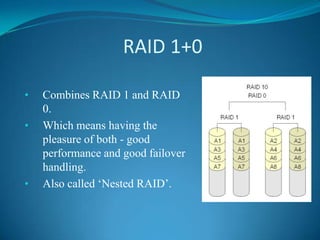
RAID 1+0
RAID 0+1
Other types used…but rarely: RAID 2,3,4,6,50……RAID 0It splits data among two or more disks.
Provides good performance.
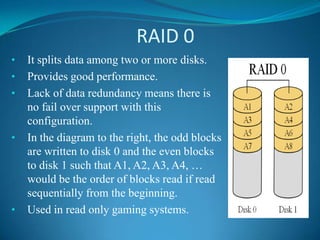
Lack of data redundancy means there is no fail over support with this configuration.
In the diagram to the right, the odd blocks are written to disk 0 and the even blocks to disk 1 such that A1, A2, A3, A4, … would be the order of blocks read if read sequentially from the beginning.
Used in read only gaming systems.RAID 1RAID1 is ‘data mirroring’.
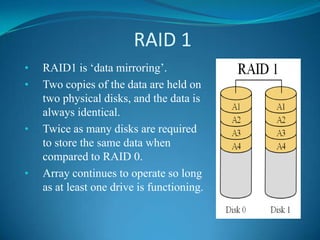
Two copies of the data are held on two physical disks, and the data is always identical.
Twice as many disks are required to store the same data when compared to RAID 0.
Array continues to operate so long as at least one drive is functioning.RAID 5RAID 5 is an ideal combination of good performance, good fault tolerance and high capacity and storage efficiency.
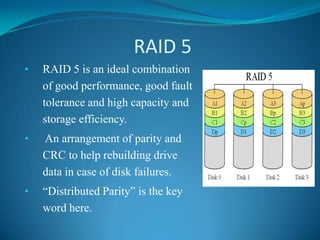
 An arrangement of parity and CRC to help rebuilding drive data in case of disk failures.
“Distributed Parity” is the key word here.RAID 5 analysisPerformance is also as good as RAID 0, if not better. We can read and write parallel blocks of data.One of the drawbacks is that the write involves heavy parity calculations by the RAID controller. Write operations are slower compared to RAID 0.Pretty useful for general purpose uses where ‘read’s’ are more frequent the ‘write’s’.

What is R.A.I.D?

  • 1.
    RAIDRedundant Array ofIndependent DisksBy Vinay Aggarwal
  • 2.
    OutlineWhat is RAID.RAIDconfigurations used.Implementations.
  • 3.
    What is RAID?RAID,an acronym first defined by David A. Patterson, Garth A. Gibson, and Randy Katz at the University of California, Berkeley in 1987 to describe a redundant array of inexpensive disks,[1] a technology that allowed computer users to achieve high levels of storage reliability from low-cost and less reliable PC-class disk-drive components, via the technique of arranging the devices into arrays for redundancy.
  • 4.
    Today stands forRedundant Array of Independent Disks.
  • 5.
    It’s a technologythat enables greater levels of performance, reliability and/or large volumes when dealing with data.
  • 6.
    How?? By concurrentuse of two or more ‘hard disk drives’.
  • 7.
    How Exactly?? Mirroring,Stripping (of data) and Error correction techniques combined with multiple disk arrays give you the reliability and performance.RAID FlavorsCommonly used ones:
  • 8.
  • 9.
  • 10.
  • 11.
  • 12.
  • 13.
    Other types used…butrarely: RAID 2,3,4,6,50……RAID 0It splits data among two or more disks.
  • 14.
  • 15.
    Lack of dataredundancy means there is no fail over support with this configuration.
  • 16.
    In the diagramto the right, the odd blocks are written to disk 0 and the even blocks to disk 1 such that A1, A2, A3, A4, … would be the order of blocks read if read sequentially from the beginning.
  • 17.
    Used in readonly gaming systems.RAID 1RAID1 is ‘data mirroring’.
  • 18.
    Two copies ofthe data are held on two physical disks, and the data is always identical.
  • 19.
    Twice as manydisks are required to store the same data when compared to RAID 0.
  • 20.
    Array continues tooperate so long as at least one drive is functioning.RAID 5RAID 5 is an ideal combination of good performance, good fault tolerance and high capacity and storage efficiency.
  • 21.
    An arrangementof parity and CRC to help rebuilding drive data in case of disk failures.
  • 22.
    “Distributed Parity” isthe key word here.RAID 5 analysisPerformance is also as good as RAID 0, if not better. We can read and write parallel blocks of data.One of the drawbacks is that the write involves heavy parity calculations by the RAID controller. Write operations are slower compared to RAID 0.Pretty useful for general purpose uses where ‘read’s’ are more frequent the ‘write’s’.